Author: Alistair Nunn

All About Eve (1950)

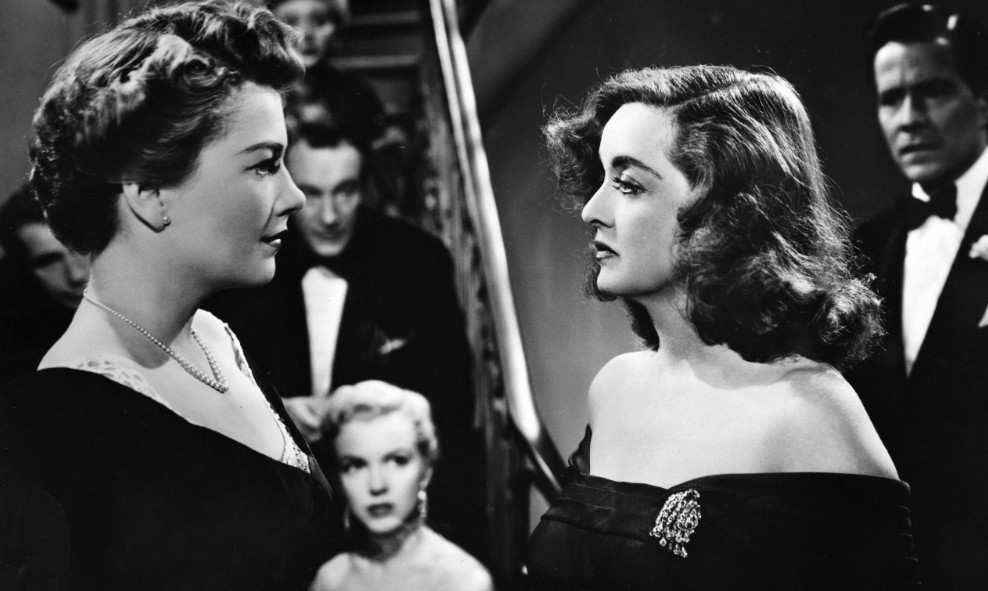
Anne Baxter and Bette Davis become deadly rivals in All About Eve

Director: Joseph L Mankiewicz

Cast: Bette Davis (Margo Channing), Anne Baxter (Eve Harrington), George Sanders (Addison DeWitt), Celeste Holm (Karen Richards), Gary Merill (Bill Sampson), Hugh Marlowe (Lloyd Richards), Thelma Ritter (Birdie), Gregory Ratoff (Max Fabian), Marilyn Monroe (Claudia Casswell)
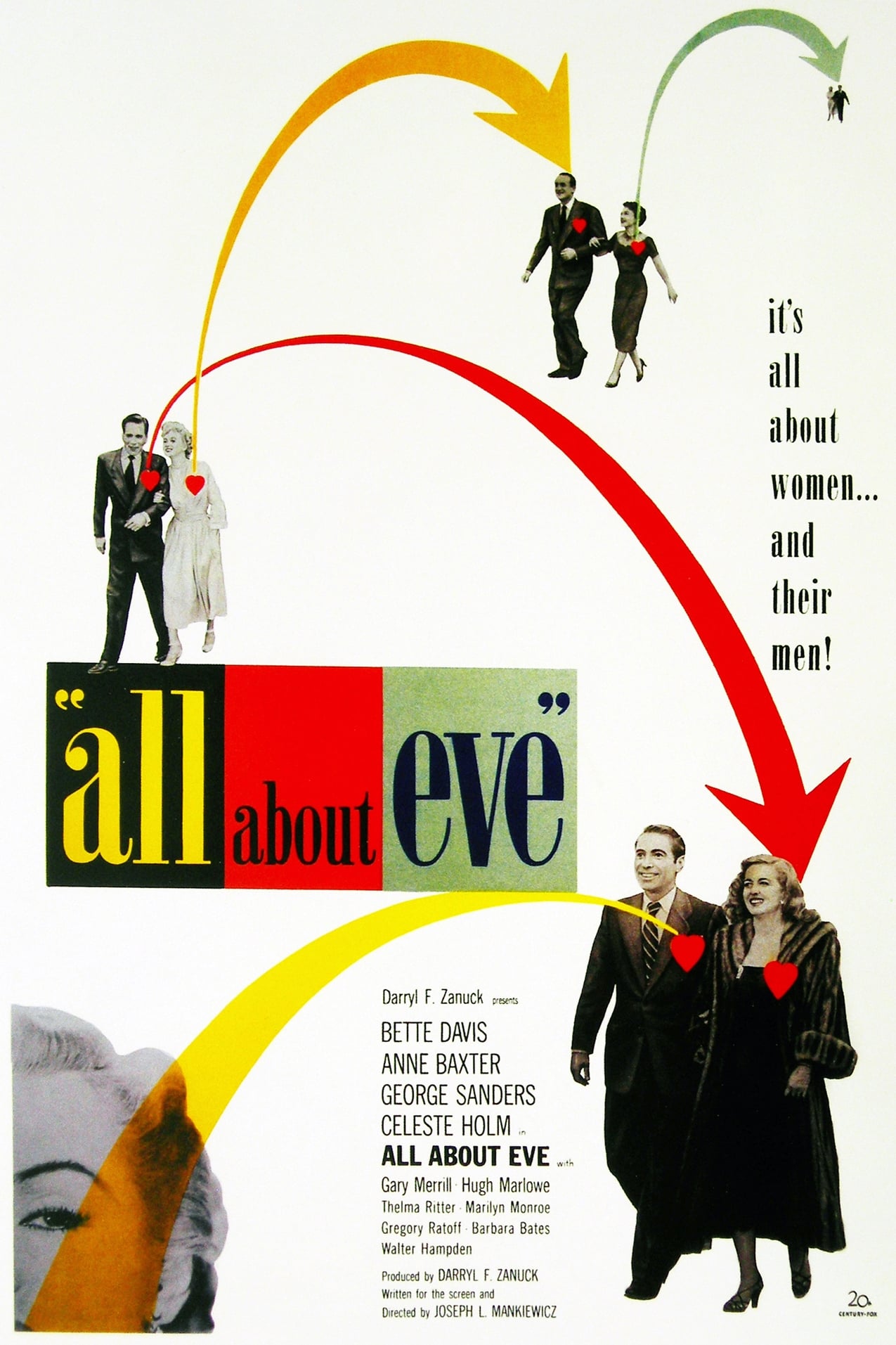
At a theatre awards ceremony, a table of people watch Eve Harrington (Anne Baxter) collect the Sarah Siddons Award for Distinguished Achievement. She thanks them all effusively. They stare at her with mute loathing. I guess that’s show business. Mankiewicz’s biting and witty film boasts possibly one of the greatest scripts for the movies ever written, a biting expose of rivalries and backstage politics, that also manages to find a lot of warmth for its characters. Arch, but in its own strange way tender hearted and hopeful, its Mankiewciz’s greatest achievement.

Margo Channing (Bette Davis) is a gifted actress and one of the leading lights of Broadway, as well as the on-stage muse of playwright Lloyd Richards (Hugh Marlowe), close friends with his wife Karen (Celeste Holm) and in love with her director Bill Sampson (Gary Merill). But Margo is just beginning to worry, now she has reached her forties, that her parts are drying up. Into her world arrives Eve (Anne Baxter), a besotted fan who swiftly becomes first her assistant then her understudy and eventual replacement. Despite her sweet exterior, Eve is fiercely ambitious determined to find fame and success – and only cynical theatre critic Addison DeWitt (George Sanders) seems to notice.

All About Eve cemented Mankiewicz as Hollywood’s go-to for high-brow literary entertainment. Which is odd when you think about it, because what makes All About Eve work – and enduringly popular – is that it’s a fantastically quotable soap, played with relish. It’s not a million miles away from a ten-part, cliff-hangers aplenty Netflix drama. But it stands out because of Mankiewicz’s craft – when you pen lines as cutting, acerbic, tender and true as those in All About Eve, is it any wonder that Hollywood sees you as the next Fitzgerald?

And the dialogue is sparkling, from start to finish. From a cuttingly dry opening voiceover from George Sander’s Addison DeWitt – beautifully delivered, crammed with cynicism, cattiness, pride and purring contempt (“Minor awards are for such as the writer and director since their function is merely to construct a tower so that the world can applaud a light which flashes on top of it.”) that it sets the tone for a film where dialogue is king. Mankiewicz is not much of a visual stylist – only the final shot, a besotted fan starring into an endless series of mirrors – sticks in the mind, and his approach as a director is intensely theatrical, but it doesn’t matter when his dialogue sings.

All About Eve works as both a supremely entertaining peek behind the curtain and also a neat parable about ageing, change and relevance. Perhaps there are few better examples of the changing of the guard, than the impact of growing old on a woman in theatre: from girlfriend to mother, with hardly a role in between. It’s the change Margo is dreading. And as she grows too old for her leading lady roles, what has she actually to show for it? Not much in the way of family or happiness.

If Eve looked closer, perhaps she’d wonder if it was worth it. As Margo makes clear in her dressing room and at a party thrown for Bill, she’s not got much to look forward to. (It’s not often commented on that the film’s most famous line, “Fasten your seatbelts it’s going to be a bumpy night”, is followed by an evening of Margo’s maudlin self-pity). For all her glamour and fame, it’s clear Margo is unhappy: “So many people know me. I wish I did” she says at one point, and for all the whirlwind of her life, she’s not exactly over-burdened by close friends.

It’s easy to forget, because All About Eve is so well known for being a bitchfest – and Mankiewicz’s cutting one-liners are genius – that you forget its lead is a sad and lonely figure, and the film presents a conservative view of motherhood being a crucial role for a woman. We don’t automatically remember this speech’ but it’s crucial for Margo: “There’s one career all females have in common – whether we like it or not: being a woman. Sooner or later, we’ve got to work at it, no matter how many other careers we’ve had or wanted. And, in the last analysis, nothing is any good unless you can look up just before dinner or turn around in bed – and there he is.”

Margo is the signature part for Bette Davis, but memory has distorted it. You can expect it to be a parade of sharply barbed attacks, but it is much more than this. Yes, she does these with aplomb (“I wouldn’t worry too much about your heart. You can always put that award where your heart ought to be”), but under the regal grande dame, there is a rather vulnerable woman, scared about where her life is going and terrified of being unloved. For all the Davis fireworks, it’s an affecting – and perhaps this is why it became such a gay icon, during those years of people forced into the closet –vulnerable and lonely performance.

That vulnerability contributes to the sense of vampire story. Eve arrives in the dead of night, inveigles her way into Margo’s life and then slowly takes that life over. Eve is almost draining Margo’s life force, leaving her even more aware of the lonely impact of her choices. There’s the suggestion of sexual obsession in Eve – standing on stage, holding Margo’s costume in front of her and imagining the applause, Eve seems as much besotted with Margo as she does with becoming her. And of course Eve is a unknowable fake. Anne Baxter’s gentle, butter-wouldn’t-melt sweetness is just the right side of phoney. Only Thelma Ritter’s (very funny) bitchy dresser detects dictates her invented backstory about a deceased husband is baloney (“What a story! Everything but the bloodhounds snappin’ at her rear end.”).

Later Birdie will comment Eve is studying to become Margo – and that’s spot on. As Eve moves further up the ladder, Baxter drops her gentleness and becomes increasingly steely. “A contempt for humanity, an inability to love and be loved, insatiable ambition – and talent. We deserve each other” Addison will tell her – and he’s spot on. Eve’s driving motivation is ambition, and anyone is fair game if it will help her move up the greasy ladder of theatrical success.

Eve uses everyone. She manipulates Karen into making Margo missing a performance – then invites the press in advance to her performance, which is met with raves. Afterwards Eve gives an interview in which she lacerates Margo as a bitter has-been holding her back. It’s enough for Karen – and Celeste Holm is very good as this gently supportive woman, with the firmest principles of anyone on show here – but the men can’t let go. It takes an attempted seduction to drive away Bill, but the weaker Lloyd seems to be sucked into her web (the film is coy about the implied affair). It should be clear that Eve is a force draining energy out of everything she can, determined to get to the top.

And we know she gets there: after all we’ve seen her win the Sarah Siddons prize! But Eve has none of Margo’s soul. The film ends with her meeting the even more vainly empty Phoebe, who Addison immediately recognises is intent on the same scheme as Eve was. And so, the whirligig of time brings in its revenges. Eve has learnt everything from Margo, except how to be a human: she has all her technique and none of her heart. The film even manages to feel a bit sorry for her – a woman who has achieved everything she wants, and finds it makes her neither happy nor popular.

It’s the heart of Mankiewicz’s film, perhaps even its warning message. What is the point of all this greatness, if all you have to show for it are false-friendships with poisonous pals like Addison? It’s the moral message behind a film filled with one-liners and wonderful speeches, a masterclass in theatrical writing for cinema. Bette Davis is superb, funny and heartfelt. Baxter is quietly terrifying. Ritter and Holm are superb and Sanders is so well case in this role, you wonder if Mankiewicz somehow invented him specially for it. All About Eve may be grand, soapy entertainment – but soap has never been smarter than this.
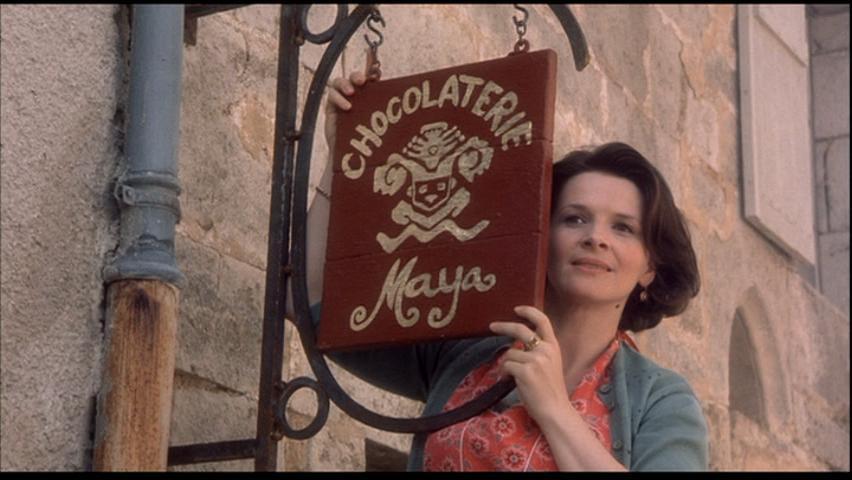
Chocolat (2000)

Juliette Binoche changes people’s lives with sweet treats in Chocolat

Director: Lasse Hallström

Cast: Juliette Binoche (Vianne Rocher), Judi Dench (Armande Voizin), Alfred Molina (Comte de Reynaud), Lena Olin (Josephine Muscat), Johnny Depp (Roux), Victoire Thivisol (Anouk Roucher), Hugh O’Conor (Pere Henri), Carrie-Anne Moss (Caroline Clairmont), Peter Stormare (Serger Muscat), Leslie Caron (Madame Audel), John Wood (Guillaume Blerot), Elisabeth Commelin (Yvette Marceau), Ron Cook (Alphonse Marceau)

In 1950s France, expert chocolatiere Vianne Rocher (Juliette Binoche), and her six-year-old daughter Anouk (Victorire Thivisol) travel the country following the North Wind accompanied only by Anouk’s imaginary kangaroo. If that sentence alone has too much whimsy for your stomach to take, don’t invest two hours of your time in the rest of the film. Vianne and her daughter rock up in a very traditional town, run by the Comte de Reynaud (Alfred Molina), a stuffed-shirt who won’t admit his wife has left him. The austere Comte is horrified when Vianne’s sweet goodies prove super popular with the townspeople, whose lives suddenly start to change in profound and exciting ways as the quality of the chocolate helps them discover their own suppressed desires.

As if the title alone wasn’t enough of a warning, Chocolat is almost impossibly sweet, like being water-boarded by hot chocolate. Shot in a village that can only be described as chocolate box, it’s twee, sentimental and exhibits practically all the worst elements of cosy women’s fiction. With Miramax muscle behind it, this heavy-going confection briefly persuaded the world it was some sort of easy-going arthouse picture – rather than a smug fable of cliched situations and characters, coated in an unsettling number of scenes of actors eating chocolate with orgasmic grins.

It will not surprise you to hear that Vianne’s arrival in the village is the catalyst for huge change – the sort of change a trailer would surely describe as “their lives were all starters, until she showed them the importance of dessert”. Vianne is played by Juliette Binoche channelling Nigella Lawson as a yummy mummy domestic goddess. Her shop operates with the sort of business model that only exists in escapist fiction: customers spin a sort of Rorschach wheel and whatever they see in the picture decides the chocolate they will buy (no one would dare ask “Do you just have a box of milktray?”). The whimsy is nearly as thick as the molten goodies in the mixing bowl.

The village is stuffed with esteemed actors going through the motions. Judi Dench shows Maggie Smith that she can play crusty-old-women-with-hearts-of-gold as easily as her, as a grandmother who has been refused access to her grandson by his over-cautious mother. (It’s the sort of role people love to see veteran actors do, and duly landed Dench an Oscar-nomination). With some flatly written lines, Dench provides a bit of sparkle in a role she could play standing on her head. Carrie-Anne Moss is pretty good as her daughter, a repressed fusspot, who won’t let her son have fun. John Wood plays a crusty bachelor with the hots for war widow Leslie Caron. You don’t need to be a master confectioner to mix these ingredients together into the expected resolutions.

Hallström keeps events ticking gently along, in a film so soothing it seems designed to help you fall asleep. For a while Hallström was the go-to-guy for middle-brow, unimaginatively “prestige” adaptations of middle-brow, popular novels (this was his second after The Cider House Rules – and he had several to follow – each progressively a bit worse than the one before). The closest genuine emotion comes from Lena Olin’s abused wife of bullying café owner Peter Stormare. Sure, Olin’s problems are solved in about a few minutes, but the threat to her from Stormare is an intrusion of something that feels genuinely dramatic in what is otherwise a souffle. (Olin gets the film’s only memorable line, whacking her husband over the head when he attacks Vianne with the words “Who says I can’t use a skillet”, a line that’s both rather funny and bizarrely out of place.)

Naturally, the stuffy village learning needs to learn to cut lose a bit and embrace life, love and happiness. Alfred Molina’s Comte is the sort of chap who browbeats the local priest (who loves himself a bit of Elvis) into parroting the conservative sermons he’s written for him about the virtue of being miserable. Of course, the Comte is actually a decent guy (when he finds out what a bastard Stormare is, he banishes him at once), just old-fashioned and as much in need of the orgasmic power of chocolate to heal his pain as everyone else. Did Cadburys and Hersheys sponsor this film?

Just when you thought the film’s cosy warmth and supreme heritage gentleness couldn’t get more trying, it tops itself with the arrival of a punch of whimsical Romani people even more smackably smug than Vianne. Worst of all they are led by Johnny Depp at his most lazily teenage dream-boat, sporting a pony-tail and a bizarre Irish accent. He’s even more of a free-spirit than anyone else, strumming his guitar at the drop of his hat. You’ll dream of a hole in his boat taking him to the bottom of the Seine.

It all ends as you might expect: everyone discovers lovely things about themselves and each other, everyone settles down, Depp and Binoche get-it-on (and keep the relationship going as he drifts in-and-out town), the Comte becomes a top bloke and the invisible kangaroo skips away on the North Wind. Eat a box of Quality Street instead.

The Best Years of Our Lives (1946)

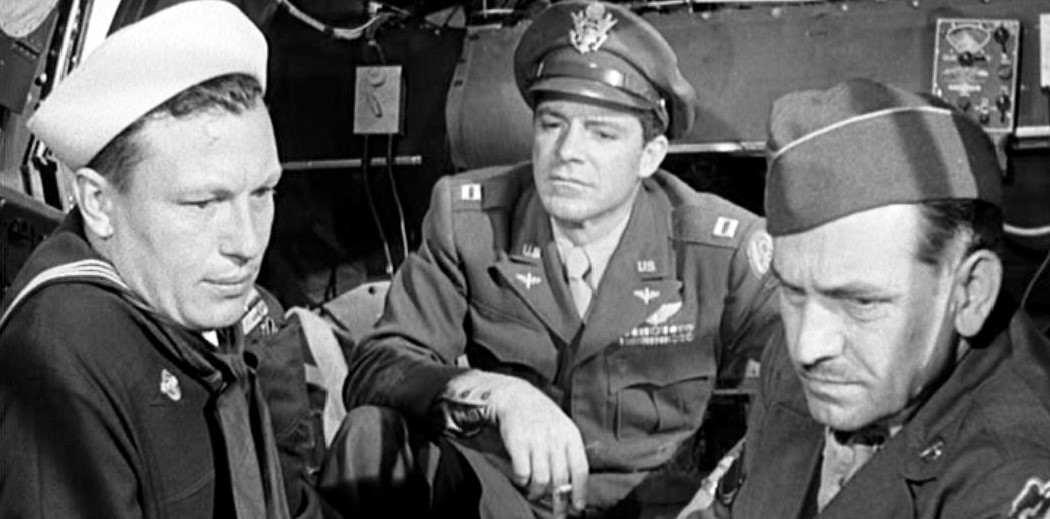
Harold Rusell, Dana Andrews and Fredric March find coming home can be as tough as war in The Best Years of Our Lives

Director: William Wyler

Cast: Myrna Loy (Milly Stephenson), Fredric March (Sgt Al Stephenson), Dana Andrews (Captain Fred Derry), Teresa Wright (Peggy Stephenson), Virginia Mayo (Marie Derry), Cathy O’Donnell (Wilma Cameron), Harold Russell (PO Homer Parish), Hoagy Carmichael (Butch Eagle), Gladys George (Hortense Derry), Roman Bohnen (Pat Derry), Ray Collins (Mr Milton)

Three men return from the Second World War. They’ve changed, but everything around them seems the same. How do they even begin to adjust when no one really understands what they’ve been through? The Best Years of Our Lives was a sensation when it was released, speaking to a whole country reeling from the shock of war. Many films focus on the gruelling experience of war, but few take on the struggle to find a place for veterans and help them reintegrate into normal life.

Our three veterans all meet at the airport, trying to home to the same small (fictional) city in the Midwest. Normally they would probably have never met: but war has given them a shared bond they will find hard to replicate back home. Al Stephenson (Fredric March) is a banker, who has developed something of a drinking problem to the surprise of his wife Milly (Myrna). Fred Derry (Dana Andrews) was a café worker who became an Air Force Captain – but finds that doesn’t interest employers back home. He also now has nothing in common with the flighty, flirty wife Marie (Virginia Mayo) he married before shipping out – and far more in common with Al’s thoughtful daughter Peggy (Teresa Wright). Homer Parish (Harold Russell) lost both his hands, replaced with mechanical hooks. Can he overcome the adjustments – and allow himself to be loved by Wilma (Cathy O’Donnell)?

What The Best Years of Our Lives explores brilliantly is how quick we are to praise heroes, but how slow we can be to offer them practical help and support. These problems aren’t just restricted to an unlucky one or two – the film goes out of its way to demonstrate the problem is universal. Our three leads are from different services, and radically different walks of life: an important businessman who served as a sergeant, a wash-out who found a purpose in the air force and an athletic sailor who returns without his hands. Rich or poor, it’s tough to find your place whoever you are.

Wyler shoots all this with a documentary realism, with extensive use of deep focus photography. It helps make this a frequently moving film. It sometimes feels like Wyler just captured real events. Flying home our heroes see “people playing golf like nothing happened”. They are all so nervous going home that both Al and Homer both suggest going for a drink rather than leave the cab they are sharing. Everyday problems about going to the office or looking for a job seem more affecting because we know they’ve come back from the war and don’t deserve knock-backs like this.

The heart of this film is Fred’s struggles to find some sort of purpose on civvie street. War offered more opportunities to him more than anyone else. He is a nobody who became a respected somebody. Now he can’t get a job in a department store. As a potential employer tells him, his CV is stuffed with irrelevant experience and his years out of the job market mean he’s fallen behind the rest. This is how a man with a chest full of medals, winds up serving ice cream and busting a gut trying to flog perfume to housewives who let their children run wild around his stand.

Dana Andrews is the heart of this film, giving a marvellous performance of great depth and sadness. Haunted by nightmares, Fred’s optimism drips away the longer he fails to find proper work. Perhaps most heart-breakingly of all, he increasingly makes himself the target of his dry wit. By the time he has surrounded to the indignity of taking back his old soda jerk job (and reporting to the spotty kid who used to be his assistant), Fred is disparagingly belittling his own wartime accomplishments.

If someone as matinee idol handsome, with a wonderful war record, as Fred can’t get ahead, what chance does anyone have? Fred’s wife (Virginia Mayo, marvellously smackable as this shallow girl) isn’t even interested in him, only the idea of him – begging him to wear his uniform (medals and all) for as long as possible so she can show him off like a new handbag. Fred is knocked back so many times, he comes to believe he deserves it. In a beautiful scene, late in the film, he walks through a field covered in old air force bombers. It’s a striking visual metaphor – one Fred is all too aware of – that he’s as much on the scrap heap as them.

The Best Years of Our Lives shows time and again how quick we are to forget. Al is hauled over the coals for offering a loan to a collateral-free GI who wants to start a farm. But Al feels a loyalty to men like this – and he recognises, unlike his superiors, there are qualities you just won’t find in a bank account. Homer is confronted at Fred’s workplace by an arrogant anti-Commie, who suggests the entire war was a waste of time, spent fighting the wrong foes. Calling Homer “a sucker” for losing his hands in the wrong war leads to a fight – and Fred losing his job for punching the guy out. Where is the sense of debt to these people?

Homer not only has to deal with disability – but also the metallic claws which get him all the wrong attention. The army trained him how to use the claws – but as Al observes, watching Homer’s awkward homecoming “couldn’t train him to put his arms round his girl”. They can solve the practical problem, but there is no support for actually coming to terms with the emotional impact.

Homer is played by real-life veteran paraplegic (and non-actor) Harold Russell, in a poignantly sincere, unstudied performance. It becomes even more heart-breaking, as his torment clearly rooted in Russell’s own experiences. When Homer demonstrates to Wilma how vulnerable he is without his hands –  if a door shuts, he’s trapped in a room, he can’t dress himself– it’s almost unbearably sad (O’Donnell is equally good in this scene). Russell’s simple, matter-of-factness is more moving than any histrionics.

The only plot that doesn’t get fully explored is Al’s implied drinking problem. He gets pissed the first night home (and his wife comments several times on his growing reliance). Everything to Al feels a little different – his kids are older, his bankwork seems stuffier. Today the film would dive more into Al’s probable survivor guilt. But Al makes a stand when others won’t to help his veterans – and March has a superb, low-key speech at a banquet in his honour where he vows to invest small loans into returning GIs. The film also gently probes – and in some ways leaves open – the ongoing problems he and Milly (warmly played by Myrna Loy) have had in their marriage, problems which Al’s absence and drinking have not helped solve.

Wyler pulls these threads together in a restrained style that largely avoids melodrama (though Hugo Freidhofer’s score is frequently overblown – Wyler apparently hated it). Instead, dilemmas are grounded in reality. Al might like Fred, but the last thing he wants is for Fred to get his daughter Peggy (Teresa Wright in a gentle, touching performance) caught up in a divorce. In a perfect example of Wyler’s restrained, documentary style, Al and Fred have a quiet man-to-man discussion, before Fred calls Peggy to see he can’t see her anymore. He does this in the back corner of the frame while the foreground shows Al listening to Homer and his uncle play the piano. It’s a perfect example of the way Wyler uses deep focus to give the film a fly-on-the-wall quality.

There is something extraordinarily modern about The Best Years of Our Lives. It feels calm and un-histrionic – and of course many veterans still struggle today. The camera feels observational and unobtrusive and the characters respond to situations in a very natural way. It’s also helped by the wonderfully natural acting. It all comes together in a film that is important without feeling like it’s trying to be important. An observant, sensitive exploration of the experience of veterans (made by a veteran), that never feels false and looks at our world with affection but realism.

Crimes and Misdemeanors (1989)

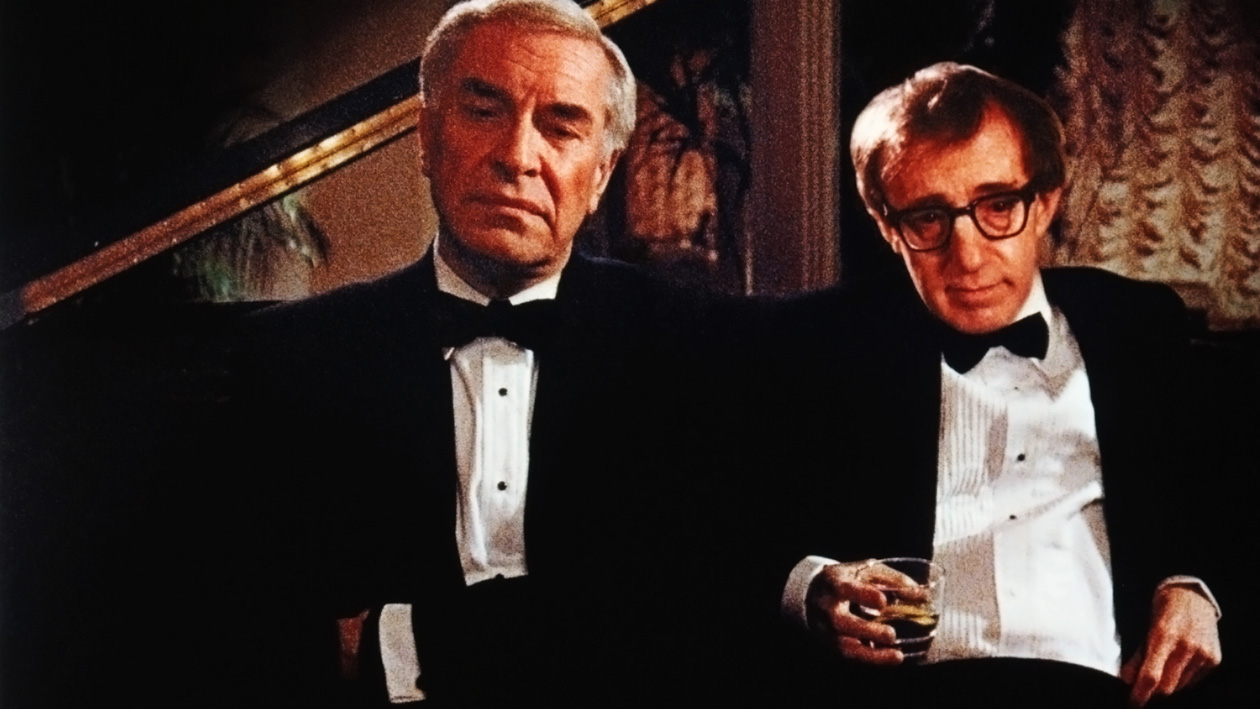
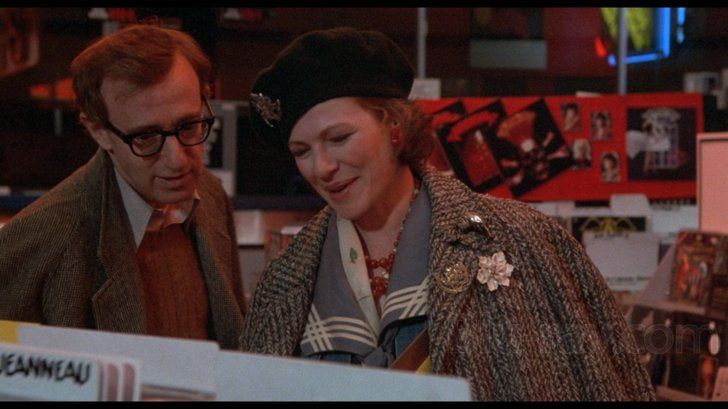
Martin Landau and Woody Allen reflect on Crimes and Misdemeanors

Director: Woody Allen

Cast: Caroline Aaron (Barbara), Alan Alda (Lester), Woody Allen (Cliff Stern), Claire Bloom (Miriam Rosenthal), Mia Farrow (Halley Reed), Joanna Gleason (Wendy Stern), Anjelica Huston (Dolores Paley), Martin Landau (Judah Rosenthal), Jerry Orbach (Jack Rosenthal), Sam Waterston (Ben)

Successful ophthalmologist Judah Rosenthal (Martin Landau) has it all: respect, fortune, a loving family…and a mistress. That mistress, Dolores (Anjelica Huston), won’t play ball and disappear but actually wants Judah to deliver on his half promises of leaving his wife. Should Judah confess all, as his rabbi friend Ben (Sam Waterston) suggests? Or should he follow the advice of his gangster brother Jack (Jerry Orbach) and remove Dolores permanently? Meanwhile, documentary film-maker Cliff (Woody Allen) has been hired by his brother-in-law, pompously successful TV producer Lester (Alan Alda), to shoot a film celebrating Lester’s life. During the shooting, Cliff can barely hide his irritation – or his growing attraction to Halley (Mia Farrow), the associate producer both he and Lester are romancing. Who will she end up with?

Dostoyevsky – could you live with a murder? – gets the Woody Allen treatment in one of Allen’s most highly respected, but troubling films. To be honest, I didn’t much care for Crimes and Misdemeanors. I have moral qualms about it – and, I will hasten to add, these qualms have nothing to do with the lack of punishment for Judah. Crimes and Misdemeanors hides its blatant cynicism and loathing for people, underneath some fine acting and good jokes. But its possibly one of Allen’s most unlikeable works, where his sympathies seem hideously astray.

It wants to be an exploration of the guilt that follows a crime. But to be honest, aside from some expert furrowing of brow and distressed line deliveries from Landau, I’m not sure Woody has much to say about guilt. Furthermore, I think he is inviting us to sympathise with Judah not because he feels bad (and even then, so what?), but for various extenuating circumstances. Namely, he’s a good man (he has all but funded a new hospital wing by himself) with a loving family and is a dedicated doctor. Furthermore, his mistress is presented almost exclusively as a demanding and difficult floozy (Anjelica Huston in an unflattering part – although at least she gets more to do than Claire Bloom in the thankless part of Judah’s wife, an almost non-existent role).

Frankly, the film suggests Judah’s motives are more complex than just removing a self-caused problem and since he feels shock (sorrow for Dolores or the crime seems noticeable absent, and it feels like Allen mistakes the one for the other) and is a nice guy, we should think again about our knee-jerk reactions of right and wrong. Problem is, Judah is not a nice guy – he’s shallow, self-pitying and self-justifying – and watching a character with, it turns out, no real morals go through a moral quandary doesn’t make for engaging viewing.

Judah’s moral reaction to the murder is insubstantial. Essentially guilt makes him wonder where there is in fact a God after all – before deciding that, on balance, the probability is that the universe will not punish him. Other than that, I’m not sure Allen has much more to add to the discussions of right and wrong. Dostoyevsky made hundreds of pages of conscious and guilt shattering a man’s equilibrium. Allen can’t manage more than about ten minutes of screen time, let alone 90 minutes.

Perhaps that’s why Crimes and Misdemeanors is padded out with a second, almost as long, unconnected secondary plot. It’s a one-sided rivalry between Allen’s film-maker and Alda’s pompous producer, with Mia Farrow as an artistic waif who serves as the prize for this unspoken competition. (This is perhaps one of the worst Allen films for female characters: we have two cold, personality-free wives for the main characters, a shrill mistress, a bland artistic waif and Woody’s character has a sister who is tied to a bed and defecated on. How did the same guy write Hannah and Her Sisters?)

Again, Allen’s sympathies lie with the idealistic, uncompromising Cliff, even more so because his interest in making films people don’t want to see makes him, in Allen’s eyes, noble. Compare and contrast with the film’s loathing for Lester – hilariously played by Alan Alda as a neat self-parody. Lester is everything Cliff isn’t, but secretly wants to be (though I’m not sure Allen realises this): successful, well-regarded, admired, rich and gets all the girls. No wonder the film hates him – even though, to be honest, he doesn’t seem the bad. After all, the sort of drive and ambition that Lester has is exactly what makes a man successful.

It wouldn’t matter so much if Cliff wasn’t remarkably similar to him, but considerably less charming. Just like Lester, Cliff is a self-important bore, cuddling his lack of success as proof of his genuineness. Cliff has no problem with effectively creepily stalking Halley (despite being married – fine though as Allen thinks she’s a bitch). Cliff’s passive aggressive assertions that Halley deserves someone like him rather than someone like Lester aren’t romantic, they’re creepy. (Needless to say, Halley ends up with Lester, to Cliff’s shock, horror and disappointment – while his wife plans to leave him).

Now I get it, there are people reading this who will think “well yes you just don’t like it because you want a simple ending where the baddies are punished – well life isn’t like that”. That’s not the case: I’m fine with films where murderers escape scot-free: but I generally want the film to know they are bad people. Crimes and Misdemeanors doesn’t. And it doesn’t really have anything of interest to say. It’s one of Allen’s films where his cynicism about humanity is exposed too heavily. You long for a bit more critical insight into Cliff, or for a more acute exposing of Judah’s self-interested excuses. You get neither, instead Allen ending on the note that the universe is dark and indifferent and only love can change things. There’s lots of the first two and precious little of the third here.

Julius Caesar (1953)

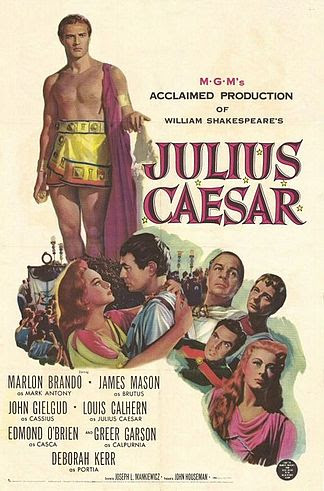
Mason and Gielgud confront Brando in Hollywood’s faithful Shakespeare adaptation Julius Caesar

Director: Joseph L Mankiewicz

Cast: Marlon Brando (Mark Antony), James Mason (Brutus), John Gielgud (Cassius), Louis Calhern (Julius Caesar), Edmond O’Brien (Casca), Greer Garson (Calpurnia), Deborah Kerr (Portia), George Macready (Marullus), Michael Pate (Flavius), John Hoyt (Decimus Brutus), Douglass Watson (Octavius)

Hollywood has always been in awe of Shakespeare. For large chunks of Hollywood’s Golden Age, it was felt the Bard’s mighty words could only be performed in a certain way by certain actors and that it somehow besmirched the Bard to put him on celluloid. It’s partly why there are few truly radical productions of Shakespeare on screen. By 1953 Orson Welles had directed inventive, challenging productions of Macbeth and Othello that reworked Shakespeare for cinematic effect, but these had been met by horror by some critics (‘how dare he change things!’). Julius Caesar fit the mould in many ways for how Hollywood felt Shakespeare should be done – traditionally, respectfully and by a cast of trained theatre actors. Then they threw in a curve ball by casting Brando as Mark Antony.

It’s hard now to really understand the hesitancy (and outright snobbery) from many about the very idea of Brando doing Shakespeare. This was the mumbling Stanislavsky-trained star of Streetcar, the earthy, T-shirt wearing slab of muscle that yelled “Stella!” – who on Earth did he think he was? Shakespeare is for plummy accents, focused on poetry. Brando took a huge risk taking this role on. But, today, his performance feels fresh, vivid and in many places strikingly modern.

Brando bought a more relaxed, natural style – and, yes he also affected a slightly plummy Brit accent – and bought a emotional realism to the most exhibitionist of Shakespeare’s great roles. (Let’s not forget, most of Antony’s part is a massive public speech). Brando creates an Antony who is passionate, loyal, committed – but also cunning, manipulative and very aware of the effect he is attempting to generate in that famous speech. He delivers the speech with aplomb, but concentrated as much on the emotion of what he was saying as the poetry of how he said it. It makes for an excellent marriage between two different styles of theatre, and Brando’s powerhouse delivery (Oscar nominated) carries real energy and dynamism.

It sits within a very traditional production, carefully shepparded to the screen by Joseph L Mankiewicz. Mankiewicz was a two-time Oscar winner for Best Director – but his reputation was largely formed on his mastery with dialogue and actors, rather than any visual sensibility. Julius Caesar is intelligently and faithfully bought to the screen – albeit with little cinematic flourish – shot with a moody black-and-white (designed to ape news-real footage and add further dramatic urgency to the action) on sets that were leftover at the studio from Quo Vadis. (Some of the busts are hilariously out of place – pretty sure Brutus has a bust of the Emperor Hadrian in his home, quite something seeing as he died 160 years before Hadrian was born.)

Mankiewicz by and large lets the play speak for itself.  What Shakespeare wrote, he largely says, and there is little in the way of message in a play that has been reversioned to almost any oppressive regime you can imagine. A few flourishes diverge from the text. He radically simplifies Acts 4 and 5 of the play (particularly the Battle of Philippi and the consecutive suicides of Brutus and Cassius), reducing these down to little more than half an hour. Wisely he focuses on the more dramatic Acts 1-3. The scheming is tense and moody, the assassination swift and brutal. The crowd scenes in Rome bustle with an immediacy and vibrancy – the camera often sits among the plebians during the speeches, encouraging us to share their feelings and reactions to the speeches. Antony is made a calculating and cunning figure – consciously waiting for certain reactions: he even, in one directorial flourish, enters bearing Caesar’s corpse during Brutus oration.

Mankiewicz’s main strength is in working with actors. Although Brando claimed the plaudits, the play is actually centred around Brutus, the intellectual of good intentions drawn into a conspiracy for the best intentions who finds principles and coups make for impossible bedfellows. The film’s finest performance is from the simply superb Mason, who was born to play tortured decent patricians like this and creates a Brutus stuffed with doubt, pride, arrogance, uncertainty and a little touch of fear. His patrician voice is perfect for this “most honourable of all the Romans”, and he sets about murder as the deeply unpleasant task it is, guided by his assumption that he-knows-best. The little moments are brilliantly done: from his petrified nerves at the assassination to his pious sermons on morality to Cassius to his tenderness and care for his wife and servants. It’s a wonderful performance.

To complement him, Mankiewicz recruited one of the greatest Shakespearean actors living as Cassius. Gielgud hadn’t done a film for over ten years (he always felt the cinema to be a minor art), and Julius Caesar was the only opportunity he had to capture one of his great Shakespearean performances on film until Prospero’s Books nearly 40 years later. It’s fascinating to watch a film where the old school (in Gielgud) and new school of acting (in Brando), both bring their own approaches to Shakespeare. This is Gielgud’s finest Shakespearean performance on camera – he must surely have learned more about acting on camera from Mason and Brando – the first time his style moved away from ‘singing the verse’ towards something more emotional, his Cassius a bitter, manipulative man who starts the film holding all the cards and ends up with none of them.

Watching these three powerhouse performers work is a treat – and also to see their styles merging and playing off each other. Mason is the perfect fusion of the realism of Brando and theatricality of Gielgud. Brando learned huge amounts from Gielgud, frequently consulting him on delivery. Gielgud surely took as much from Brando on adding greater emotion and realism into his screen performances, shirking the declamatory style that often makes him grand but unconnectable. The other actors around them offer versions of these styles: O’Brien stands out best as a shrewd and cunning Casca, Calhern tries a little too hard to be grand as Caesar, Kerr and Garson are a bit too theatrical in thankless parts as “the wives”.

Julius Caesar as a whole though is a lean, pacey and intelligent staging of the play, directed unobtrusively but professionally, very well acted by the cast. While Mankiewicz does nothing radical here – look at Orson Welles Othello and there you’ll see how the language of cinema can add a whole new perspective to Shakespeare, in a way this film never does. But while not radical, it focuses on story and character really well. The set-piece moments – the speeches, the murder, the plotting – are staged with urgency, energy and drama. Mainstream Hollywood still wasn’t ready for radical reworking of Shakespeare (this got lots of Oscar noms, Welles Othello was a flop), still seeing him as someone best cast in marble – but with Julius Caesar Hollywood took baby steps towards suggesting there could be a different future.

Chicago (2002)

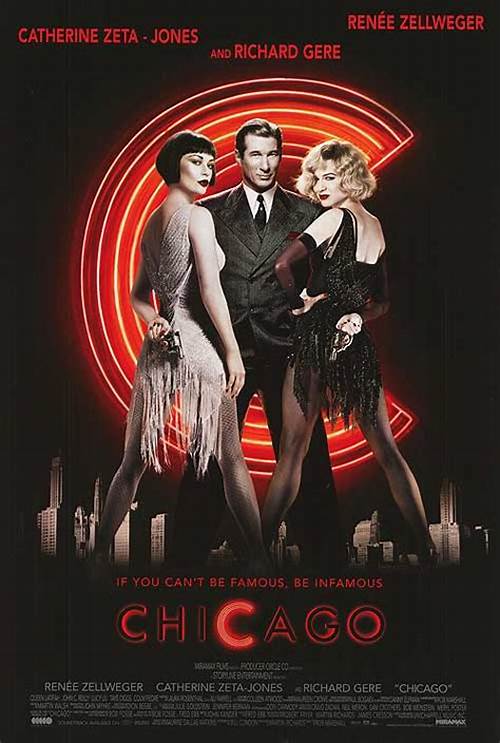
Catherine Zeta-Jones struts her stuff in Rob Marshall’s fabulous Oscar winner Chicago

Director: Rob Marshall

Cast: Renée Zellweger (Roxie Hart), Catherine Zeta-Jones (Velma Kelly), Richard Gere (Billy Flynn), Queen Latifah (“Mama” Morton), John C. Reilly (Amos Hart), Christine Baranski (Mary Sunshine), Taye Diggs (The Bandleader), Colm Feore (Martin Harrison), Lucy Liu (Kitty Baxter), Dominic West (Fred Casely), Mya (Mona), Susan Misner (Liz), Denise Faye (Annie), Deidre Goodwin (June)

It’s become quite the fashion to knock Chicago. Heck I’ve done it myself. How did this mere musical win Best Picture? It’s not even as if the original production was much more than an entertainment. It’s another of those films diminished by whispers that it doesn’t deserve the title of Best Picture. But, look at the film with an unprejudiced eye, and you’ll see that this is the best stage-to-screen musical theatre adaptation since Cabaret. Chicago is such dynamic, high octane entertainment, you would have to a really cold heart not to enjoy it.

A heart as cold, perhaps, as most of the characters. Its set in a 1920s Chicago where it doesn’t matter what you are famous for, so long as you are famous. Who are the bigger stars? The people on stage of the infamous on death row? Roxie Hart (Renée Zellweger) is a wannabe who guns down her conman lover Fred Casely (Dominic West) when his promises of the stage career she’s dreaming of turns out to be all hot air. Roxie works out that she can turn her infamy into just plain fame – following the inspiration of vaudeville-star-turned-accused-murderer Velma Kelly (Catherine Zeta-Jones), who is now more famous than ever. With amoral lawyer Billy Flynn (Richard Gere) in their corner, can they play all sides against the middle and find freedom and fame?

Chicago’s debt to Bob Fosse is in almost every single frame. Rob Marshall’s brilliant choreography is inspired by Fosse’s own work for the original production. It means the entire film drips with the passionate sexiness of Fosse’s best work. It’s also inspired by Fosse’s Cabaret in its use of the musical numbers. There all the musical numbers were kept within the nightclub, acting as a subtle commentary on the events of the film. Here they occur in Roxie’s imagination, staged in a shadowy empty theatre with a mysterious band leader (a charismatic Taye Diggs) introducing each song. It’s a brilliant concept, that allows them to be staged with the sort of exuberance and theatricality that would look plain odd in a ‘real’ setting.

And what musical numbers they are! These are toe-tappingly, finger-clickingly fun, that will make you want to jump up and join in. Marshall’s choreography and direction is not only faultless, but also covers a range of styles. From the sultry opening of All That Jazz performed by Catherine Zeta-Jones, we get burlesque (When You’re Good to Mama), sensual sexiness (Cell Block Tango), knock-about farce (We Both Reached for the Gun), classic 1930s Astaire and Rogers (Roxie) and surreal madness (Razzle Dazzle). The one thing they all have in common is the high-octane energy they are performed with (no wonder all those dancers are so slim!), with no one leaving anything in the dressing room.

Chicago is possibly one of the best edited musicals ever made. Marshall gets a superb balance between camera movements, cutting and the dance numbers. We can appreciate – and see – every step of the intricate choreography, with clear camera movements and angles. But the film is also edited practically on the beat. Cuts accentuate changes in the tempo and even marry up with the exact movements of the dancers. Not only that, the numbers frequently cut from reality to fantasy and back again – and this parallel montage is superbly done, with perfectly timed transitions. The cutting complements each number so well, it actually makes them more exciting and dynamic. It’s a masterclass in using the language of cinema to accentuate the impact of dancing.

But Marshall manages to make Chicago not just a collection of amazing dances and fabulous tunes. In our celebrity worship age, Chicago feels increasingly more relevant – you can imagine Roxie would love to be on reality TV and would never be off Twitter. It doesn’t matter that she’s got no real talent (in fact it makes the fact that all the musical numbers are fantasies even more witty), she’s just desperate to be known. Shooting her lover is the best thing that’s ever happened to her and she’ll do anything to stay in the newspapers, from a fake pregnancy to playing the timid ingenue.

Everyone in Chicago is just playing the game. Velma is just as desperate to cling to fame – and her growing desperation at losing the limelight to Roxie is almost touching. Mama Morton, the quietly corrupt prison warden, lives vicariously through her inmates (she even dyes her hair to match Roxie’s). The media lap up the details of every killing, turning the trials into huge soap operas. And at the heart you have Billy Flynn, as much a showman as he is a lawyer, playing every angle and knowing its all about telling a good story rather than truth or justice.

Chicago is played with absolute commitment. Renée Zellweger is excellent as the fiercely ambitious, amoral Roxie, her fragile softness perfect for the image Roxie likes to project, just as she is able to twist her face into selfish meanness. Zeta-Jones clearly hadn’t forgotten her years of musical theatre, demonstrating she is a superb singer and dancer, her vampish glamour perfect for Velma’s dark ambition. Richard Gere (in a role turned down by Travolta, as he ‘didn’t get’ the framing device) channels his natural charisma and good natured smirk into a role that could have been made for him. Reilly is surprisingly sweet and effective as Roxie’s put-upon husband and Latifah hugely entertaining as the knowingly manipulative Mama.

Chicago may be “just a musical” – but you’d be hard pressed to find a better entertainment. The song and dance numbers are superb and the film still manages to land some blows on celebrity culture. Hollywood has always loved musicals – can you imagine how the viewers of Broadway Melody would have responded if they had seen this? – and with Chicago we get something we’ve not seen since the golden days of Bob Fosse. There are few Oscar winners as straight forwardly entertaining as this.

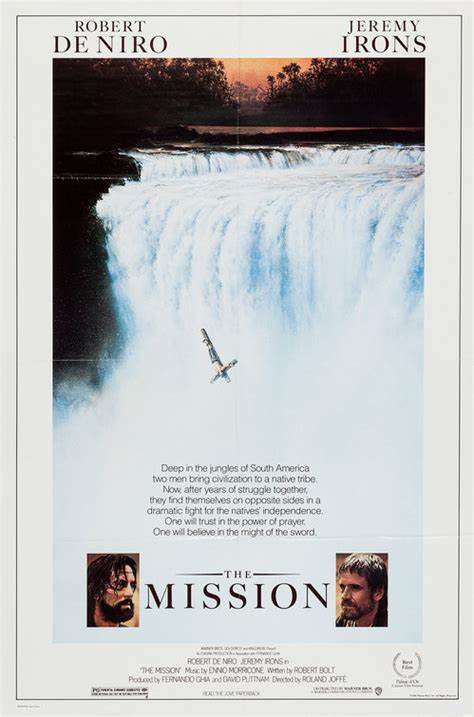
The Mission (1986)

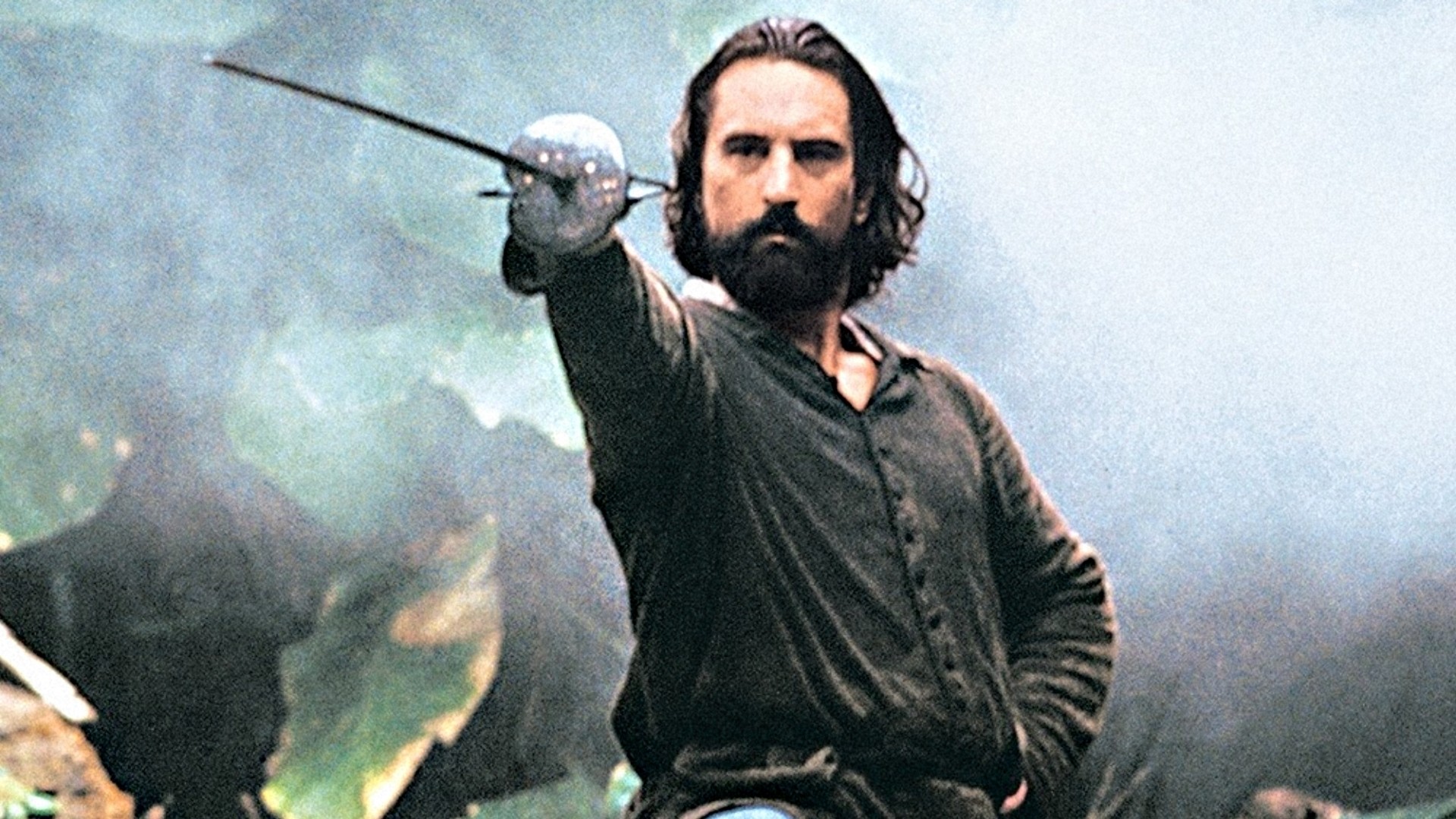
Robert de Niro turns aside from the Jesuit rule to fight for right in The Mission

Director: Roland Joffé

Cast: Robert de Niro (Rodrigo Mendoza), Jeremy Irons (Father Gabriel), Ray McAnally (Cardinal Altamirano), Aidan Quinn (Felipe Mendoza), Cherie Lunghi (Carlotta), Ronald Pickup (Hontar), Chuck Low (Don Cabeza), Liam Neeson (Father John Fielding)

Spoilers: The incredibly grim and depressing ending of The Mission is discussed in detail.

When the world is run by men, how much of a voice does God have? Roland Joffé’s film explores colonial politics and religious duty in Spanish and Portuguese controlled South America. Needless to say, God doesn’t get that much of a vote when questions of land ownership, slavery and money are in play – and no noble stand from Jesuit priests is going to make a jot of difference. Joffé’s beautifully made and moving epic might be slightly self-important, but it won the Palme d’Or. With powerful imagery and sequences but some under-explored themes and characters, its one of those films that probably would have benefited from being at least an hour longer.

In the Paraguayan jungle in the 1750s, Jesuit priest Father Gabriel (Jeremy Irons) successfully converts a Guarani community at his mission. Problem is to the Spanish and Portuguese empires the Guarani are fit only for exploitation and slavery. Mercenary slaver Rodrigo Mendoza (Robert de Niro) is one of them – but his world collapses after he murders his brother (Aidan Quinn) in a dispute over the woman (Cherie Lunghi) they both love. Mendoza makes his penance with the Jesuits, and the forgiveness he receives from the Guarani changes his life, leading to his conversion. But when a treaty – with the reluctant agreement of papal legate Cardinal Altamirano (Ray McAnally) – calls for an end to the mission, Gabriel and Mendoza resolve to fight: one with prayers the other with the weapons he has sworn off. Can they help the Guarani defend themselves from colonialism?

I don’t think its too much of a spoiler to say, no they can’t. The Mission may occasionally muddle itself by trying to say a lot in a short run-time, but on one thing it’s clear: the world is what men have made it, and they’ve made it a pretty dreadful place. The final quarter of the film is entirely given over to the spirited fight to protect the mission, as Mendoza and the other priests take up arms to help these people defend their homes. Joffé doesn’t gloss over the hideous cost of this, with a staggeringly high body count. The Europeans don’t differentiate between combatants and non-combatants, and the killed (and everyone is killed) fall with a sickening finality.

Watching the senseless destruction of this entire community for no purpose other than stripping the Guarani people of anything of value and shipping it back to Europe, you can only agree with Cardinal Altamirano that perhaps it would have been better for all concerned if ships had never crossed the Atlantic. When the dreams of bringing Christian civilisation end with Father Gabriel leading a march of peaceful converts into a hail of bullets, something has gone badly amiss in the world. Hammering home how helpless decency is, Mendoza is fatally wounded (and the village finally doomed) when he is distracted from destroying the bridge into the village, by running to safe a wounded child. No good deed goes unpunished in The Mission.

All of this is, by the way, immensely moving. It’s a tribute to Joffé’s quiet, coldly realistic eye for violence among the natural world that the final half hour is a hard watch. The European invaders may be faceless, scruffy monsters, but even they are briefly halted by the sound of prayer from the village (before they burn it down and kill everyone). The Mission is a profoundly beautiful film, which strains hard for spiritual meaning, and this final sequence is almost impossibly tragic to watch. Just as he had done in The Killing Fields, Joffé’s ability to report without sensationalism on real life tragedy, amongst scenery of great beauty, makes for powerful viewing.

There is so much right about The Mission, it feels harsh criticising it. The film was shot entirely on location (at times the cast show clear signs of the jungle-tummy that spread like wildfire through the cast and crew) and Chris Menges’ (Oscar-winning) cinematography captures the exotic beauty of the jungle, with a powerful visual sense of the spiritual and the sublime. It’s an effect built on immeasurably by Ennio Morricone’s extraordinary score (one of the greatest ever recorded), every single note perfectly chosen to communicate the holy serenity of the Jesuits and the dark flaws of mankind.

Its in exploring those flaws that the film feels a tad rushed. I dearly wish this was an hour longer, if for no other reason that it could bring greater focus to the balance between faith and realpolitik in greater depth. Although the Cardinal gets a few moments to reflect on this, and explicitly question the self-appointed right the Europeans have given themselves as masters of the world, the film never quite manages to dive into these. (McAnally however is excellent as this tortured and ashamed man). Too often these ideas are boiled down into “worldly men bad, priests good”.

The role of the Missionaries themselves also goes unquestioned – these are, after all, people who have crossed the seas with the same sort of imperialist missions as anyone else, finding the indigenous tribes and aiming to make them (no matter how decent their motives) as much like the Europeans as they can. Instead there are presented as purely good and holy. Just think what another hour could have done for expanding the insight into the role of the Church here.

There is a few too many blunt statements of intentions and plot information, rather then real insight. You come out of it still with only a most basic idea of why Gabriel and Mendoza make the decisions they do – or what they hope the outcomes might be. More of a dive into the characters could have given more context to their holy intentions.

In the end the film’s main aim is pushing a message of peace. It’s the message Mendoza must learn. The film’s other most successful sequence covers his extraordinary penance, dragging a huge bundle of armour and weapons up a mountain to the mission. De Niro sells the anguish as beautifully as he does Mendoza’s shamed gratitude when he is greeted warmly by the very people he had enslaved. Its moments like this where The Mission achieves its aim of grappling with something close to how spirituality can move and change us – which often gets bogged down elsewhere in ticking off plot.

The message of peace is embodied by Irons’ profound and generous performance as Gabriel, a man who believes the world should be simpler than it is. I just wish the film had given itself more room to delve into its themes. In trying to cover imperialism, religion, spirituality and native rights, all in two hours (the Guarani draw a short story, with not one of them really being given a character) its too much. A richer, more textured film would make for a richer overall experience. It’s a film of great beauty in score and photography, often moving, but doesn’t make its message much more than give peace a chance.

Hannah and Her Sisters (1986)

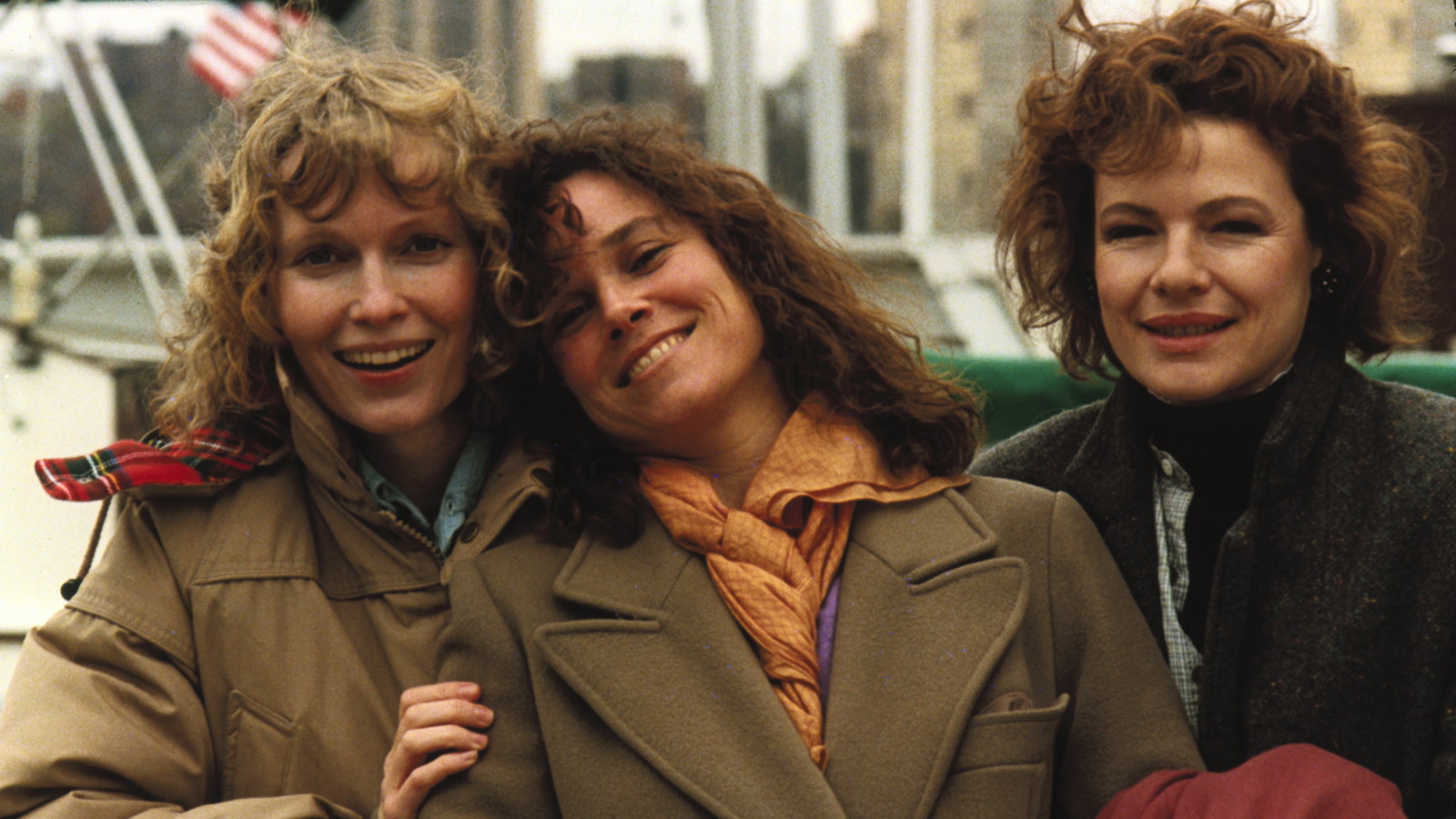
Mia Farrow, Barbara Hershey and Dianne Wiest are Hannah and Her Sisters one of Allen’s finest films

Director: Woody Allen

Cast: Woody Allen (Mickey), Michael Caine (Elliot), Mia Farrow (Hannah), Carrie Fisher (April), Barbara Hershey (Lee), Lloyd Nolan (Evan), Maureen O’Sullivan (Norman), Daniel Stern (Dusty), Max von Sydow (Frederick), Dianne Wiest (Holly), Sam Waterston (David)

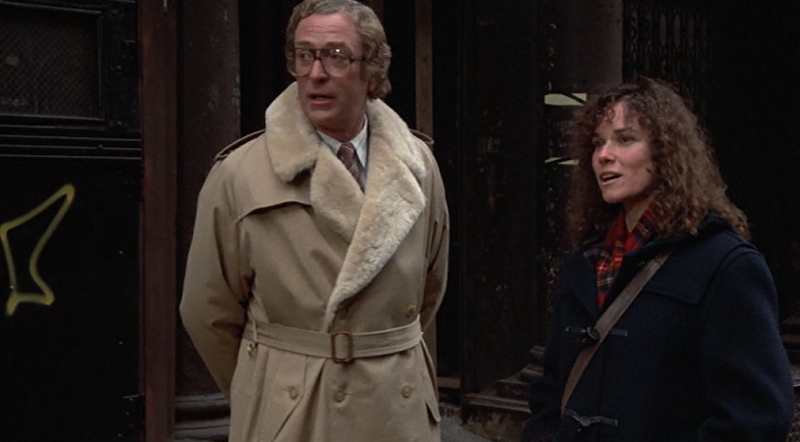
Hannah (Mia Farrow) is divorced from Mickey (Woody Allen) and happily married to Elliot (Michael Caine). Eliot is in love with Lee (Barbara Hershey). Lee is Hannah’s sister. Holly (Dianne Wiest) is considering dating Mickey. Holly is also Hannah’s sister. This whirligig of relationships is the heart of Hannah and Her Sisters, one of Woody Allen’s finest and certainly most humane films. Witty and heartfelt, it’s one of his sharpest scripts, crammed with acute observation and fine gags and is directed with a coolly introspective eye.

Allen splits the film into multiple sections, each opening (like the chapter of a novel) with a quote from the scene we are about to watch. Music plucked from Allen’s beloved classics (most often, and fittingly considering its romance theme, Bewitched, Bothered and Bewildered) frequently bridge scenes. Internal monologues is used often to allow us to explore the inner lives of the characters (the actors do a marvellous job reacting on screen to this internal thought process we are hearing).

The film uses a host of inspirations carefully mixed into Allen’s Manhattan Metropolitan middle-class milieu. The entire film has an autumnal Chekovian feel to it, with a rich sense of lives continuing ‘off stage’ as much as on. While the title obviously echoes Three Sisters, it’s study of romantic and intellectual entanglements overlaps with Chekov, as does the film’s love of wordplay. There are also, of course, echoes of Bergman (with gags) both in the film’s episodic structure but also its framing device of three Thanksgivings dinners, reflecting Bergman’s triumphant Fanny and Alexander.

The most effective thing about the film, in addition to its wit, is the surprising warmth it feels for the characters. Not always in an Allen film does one find the sympathy and empathy so widely spread – there is usually at least one character who is the target for the writer’s scorn. But here, no major character is presented as either the butt of snide humour or sneers. Even von Sydow’s pretentious artist is capable of searing emotional pain, and its hard not to sympathise with him as clients enquire whether his art will fit with their home décor. Each scene carefully balances the perspectives of multiple characters to allow us to relate to what each of them is going through. It’s possibly the largest cast of fully-rounded characters in an Allen film, and his most generous film.

It’s a film that avoids judgement over its characters, despite the frequently terrible and morally troubling things they do. It’s a film that understands the heart is an uncontrollable but resilient muscle, which doesn’t always guide us to the right or the easy things. Of course today, with Allen, you think it’s probably not a surprise he had sympathy with a group of people engaged in relationships that often involve profoundly betraying others. But at least her understands the irresistible urge people have to continue doing things they shouldn’t.

It’s hard not to overlook that the film’s least explored character (despite her multi-layered performance) is Mia Farrow’s Hannah. Poor Hannah, the still, moral centre of the film, is betrayed by both her husband and her sister (to their mutual guilt). Allen leaves her in ignorance – even though she knows something is wrong – and while Allen acknowledges what Elliot and Lee is doing is wrong, he mitigates things by making clear Hannah’s decency and generosity makes her overwhelming. While we see the impact a sudden distance from her husband has on Hannah (in a great shot she talks to him while he is off camera in another room, making her look like she is talking to a wall), Hannah is one of the few characters we don’t get the insight of an internal monologue for, and that feels like an easier way for Allen to maintain our sympathies for others.

The person whose internal monologue we hear the most is her conflicted husband Elliot. Hannah and Her Sisters may be unique in that it has two characters who are clear Allen substitutes. While Allen plays one, Caine is the husband (who looks alarmingly like a prediction of future developments in the Allen-Farrow relationship). Caine is superb, not least because he turns lines you can hear could be delivered with an Allenesque twitchiness, into ones crammed with utter emotional genuineness.

For all that he is a cheat, Elliot is strangely guileless and rather sweet, plagued with guilt and also giddy as a schoolboy, begging Lee to read an ee cummings poem that carries special meaning for him. Caine makes Elliot a genuine human character, a flawed man trying to avoid hurting people (but causing pain everywhere). If Branagh in Celebrity (with his distracting Allen imitation) showed how much of a slave to Allenesque delivery you can become, Caine shows how heartfelt simplicity and underplaying can bring out deeper emotion from Allen’s dialogue. Allen also rather brilliantly directs this abashed dance of attraction: from Caine’s internal monologue telling him to play it cool, moments before he kisses Lee, to the camera framing Frederick’s sketches of a naked Lee directly in Elliot’s line of sight while he tries to think of literally anything else.

Caine also matches superbly with Barbara Hershey, excellent as a woman who feels trapped in her life and drawn to Elliot despite herself. Lee’s current relationship is with Frederick, wittily played in a near parody of Bergmanesque brooding by Max von Sydow, who takes a late lurch into real vulnerability, a pretentious artist who is part-lover-part-tutor and is disconnected from the real world, Lee is virtually his only link left with it. Frederick is clearly a tutor and surrogate parent, as much as a lover to Lee – and that attraction to a figure who can take responsibility in her life is clearly something she’s attracted in Elliot. The slow, guilt-ridden coming together of Elliot and Lee – and the slow deflation of this fling – is the emotional heart of the movie.

The film’s other two arcs provide more of the gags. Woody Allen gifts himself some of his finest comic moments as Hannah’s hypochondriac ex-husband (the second Allen stand-in) undergoing an existential crisis after he discovers he is in fact not dying of a terminal disease. Dianne Wiest is similarly excellent (and also Oscar winning) as Hannah’s unsuccessful sister Holly, a would-be actress too insecure to find success. Wiest is not only funny, but also vulnerable and affecting, as she tries to find her place in the world. In many ways Wiest plays a third version of Allen here, as she becomes a neurotic writer channelling her real life into writing (to the consternation of her sister).

Changing reality into scripts is the only thing awkward about Hannah and Her Sisters today. Hannah and her extended family (and many children) are a thinly veiled portrait of Farrow’s own family (Hannah’s mother is even played by Farrow’s real life mother Maureen O’Sullivan). Like Allen and Farrow, Mickey and Hannah needed to adopt and foster children. And of course Eliot’s affair with Hannah’s sister eerily mirrors Allen’s own affair with Farrow’s adopted daughter, and the film’s sympathy for Elliot sometimes seems like an unsettling excusing of Allen’s future conduct. That’s not even mentioning one of the film’s earliest jokes is Allen’s character complaining about the cutting of a child molestation skit from his Saturday Night Live-ish show (“what’s the problem half the country’s doing it” quips Allen, a joke that doesn’t work today for so many reasons).

But put that aside because, whatever your opinion of Allen, Hannah and Her Sisters is one of his finest films. It’s expertly shot and directed with a real unobtrusive ease (Allen’s innate understanding of this Manhattan world contrasts sharply with how at sea he is in his European movies). The acting is spot on. As well as being very funny, the moral conundrums the film explores are sympathetic and witty, as are the flawed human beings behind them. Possibly his best film.

Minari (2020)

A family struggle against adversity in Lee Isaac Chung’s autobiographical and heartwarming Minari

Director: Lee Isaac Chung

Cast: Steven Yeun (Jacob Yi), Han Ye-ri (Monica Yi), Alan Kim (David Yi), Noel Kate Cho (Anne Yi), Youn Yuh-jung (Soon-ja), Will Patton (Paul)

Lee Isaac Chung grew up in rural Arkansas during the Reaganite 80s, when everyone felt they could live the American dream. His young life – and the experiences of his parents – from the basis of Minari, an emotionally involving, tender and quietly hopeful film about planting a future. The film is named after an obstinate Korean plant which takes root and grows where it can – a struggle the Yi family can sympathise with.

Jacob (Steven Yeun) dreams of building a family legacy, a Korean food farm that will find an eager market among Korean-Americans. His wife Monica (Han Ye-ri) is less than keen, looking with dread at the leaky trailer house her husband has invested their savings in. Nevertheless, Jacob sets about planting with back-breaking dedication, but very little practical knowledge – all while he and Monica continuing working as chicken sorters during the day. Her concerns are not helped by the heart condition of their son David (Alan Kim) – and that they are now over an hour from a hospital. Not even the arrival of Monica’s mother Soon-ja (Youn Yuh-jung) to provide childcare can help reduce the growing tensions in this family.

Although Minari is mostly in Korean, this is a very American tale. Jacob is a man very much trying to live the American dream, building a new business (and life) for his family. Even more American than that, he’s doing it out in the American west, working to conquer land that has beaten several farmers before him. Minari perfectly fuses together a respect for Korean heritage and culture with an inclusive view of the American ideal: that being rewarded for your hard work is something anyone can achieve.

As such Minari repackages many familiar story elements – childhood memories, a bond between an eccentric elderly relative and a child, near biblical struggles against the elements to build a farm, marital problems and fish-out-of-water set-ups – into something that feels fresh and highly engaging. Chung’s involving, carefully intimate direction is crucial to this, his connection with the material helping make it both funny and at times heart-breakingly tragic, while never allowing it to slip from being fundamentally hopeful.

Jacob’s desire to build the farm is both impressively ambitious and strangely irresponsible. Jacob wants to demonstrate his family should have faith in itself, taking immense pride in ‘Korean smart thinking’ as he finds home-made solutions to farming problems. He works with such dedication – frequently to the point of physical exhaustion – that its impossible not to admire him. But as he carries out his improvised fixes – from a well he digs that runs dry to working out how close together he can plant his produce – everything carries an edge-of-your-seat tension, as we are all too aware he’s making it up as he goes. Yeun is excellent as a man afraid of failure, driving himself to do everything he can to escape that fate, but often too blunt and proud to ask for help.

Chung isn’t afraid to demonstrate the damage this can have on a marriage. The couple frequently argue. So much that they seem to have forgotten the romantic moments in Korea that bought them together – hearing ‘their song’ playing, Jacob can’t even remember having heard it. Monica resents a farm she never wanted but feels forced to support. Han Ye-ri is wonderful, beautifully expressing a range of suppressed emotions, her face speaking volumes about her shock on first seeing their new home. The couple move between arguments and silent non-communication as the pressure of trying to make this business work – combined with supporting a family– drives a wedge between them.

Much of this is seen from their perspective of their children, in particular son David (an effectively sweet performance from Alan Kim). Fitting for a film about a director’s memories of his childhood, David is really the main character, with his perceptions and interactions with the other characters driving the narrative. He’s at an age where he is just beginning to understand some of the problems in his life, but still has the joy and sulky stroppiness of a young child.

What becomes the heart of the film is the relationship between David and his newly arrived Grandma, who he ends up sharing a room. David’s hostility to this woman – he’s furious that she’s not like an American, cookie-baking Grandma, instead being too Korean and (according to David) smelly – slowly changes, as she treats him with an honesty he doesn’t get from his tense parents. Any friendship formed over one tricking the other into drinking piss is sure to last!

The Grandma is played, in a scene-stealing performance scooping a truckful of prizes, by veteran Korean actress Youn Yuh-jung. In many ways it’s a simple part – the older family member who says outrageous things, but has a heart of gold – but Youn plays it with a quirk but also an immense sincerity that becomes genuinely moving. Unlike his parents, she encourages David to do things (like running) rather than do as little to preserve his heart. She helps him build his confidence – and finds she has more in common with this bluntly-spoken child than anyone else. In turn she gives him the attention his stressed parents are unable to. It’s not an original role, but it’s quite beautifully judged.

What is (sadly) surprising is that this Korean family finds themselves warmly welcomed into this Christian Arkansas community. I was waiting – as I am sure other viewers have – for a moment of racism or for Jacob to be exploited. Instead, the Yi family are given nothing but support from banks and the church in Arkansas (the only person who does screw the family is an unseen Korean businessman who cancels a crucial order). The family makes friends with local eccentric and Korean war veteran Paul (a jittery but charming performance by Will Patton) who, when he says he’s honoured to be invited to their home, really means it.

This warmth, of people maybe arguing and feuding but coming together and supporting each other, is a big part of what makes this film hopeful. The characters may all make huge mistakes – but they do for the very best of reasons. This is not a depressing film – which considering how much goes wrong, is a surprise. It’s a film where hard work is noble and huge disaster strikes it draws people together not apart. The minari itself is a part of that message of hope: it will grow down by the river, forge a fine crop, and survive all disasters: like family, it’s something we can always rely on.

Rebecca (1940)

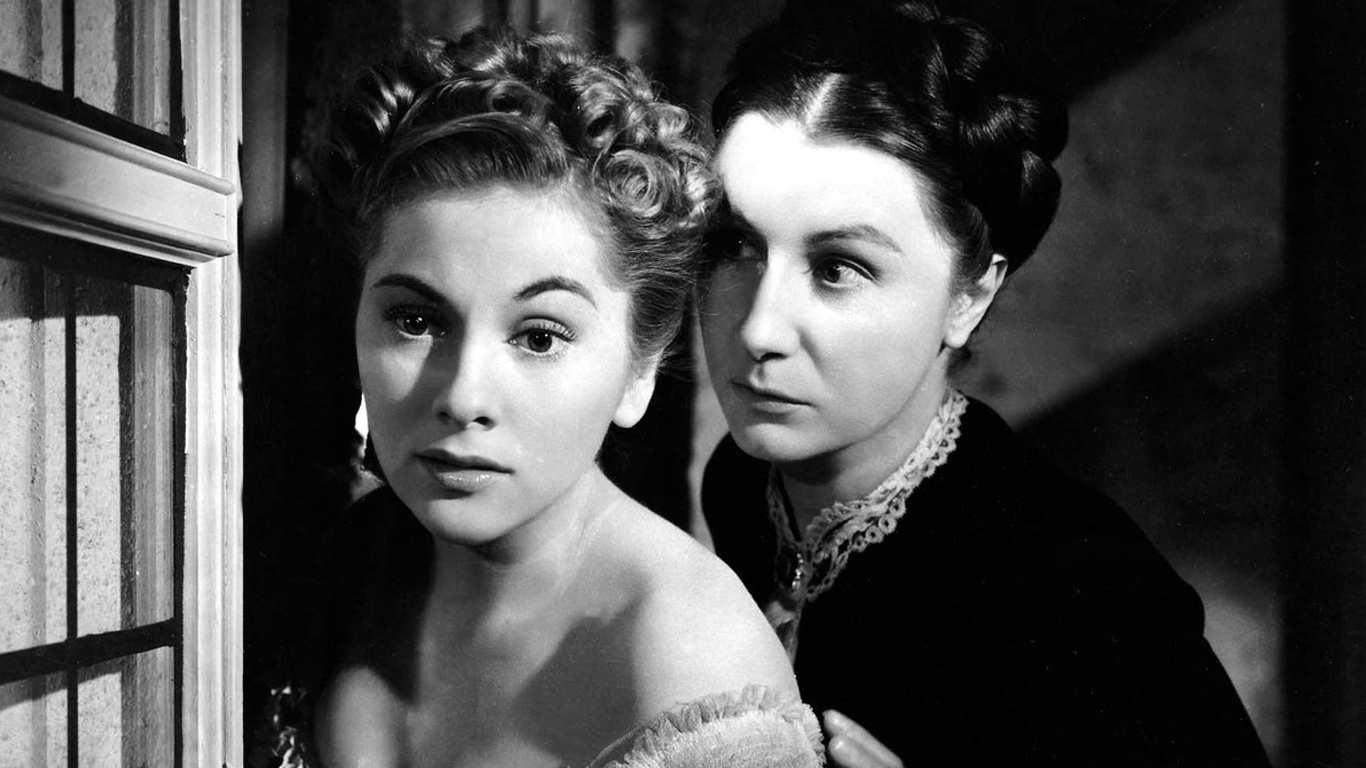
Joan Fontaine and Laurence Olivier find married life isn’t a bed of roses in Rebecca

Director: Alfred Hitchcock

Cast: Joan Fontaine (The second Mrs de Winter), Laurence Olivier (Maxim de Winter), Judith Anderson (Mrs Danvers), George Sanders (Jack Favell), Reginald Denny (Frank Crawley), Gladys Cooper (Beatrice Lacy), C. Aubrey Smith (Colonel Julyan), Nigel Bruce (Major Giles Lacy), Florence Bates (Mrs Edythe Van Hopper), Edward Fielding (Frith), Leo G. Carroll (Dr Baker)

It’s impossible to know what people are really thinking isn’t it? Rebecca is a film all about secrets and misconceptions, the biggest enigma of them all being that title character, the deceased wife casting a ghostly shadow over every scene. Adapted from Daphne du Maurier’s best-selling novel, Rebecca was Hitchcock’s first American picture and a masterclass in atmosphere with a vulnerable and deeply sympathetic lead, packaged into a wonderfully entertaining film combining the best of producer David O. Selznick’s sense for literary translation with Hitchcock’s filmic virtuosity.

On the French Riviera, a naïve young woman (Joan Fontaine), working as a paid companion for widower Mrs Van Hopper (Florence Bates), meets and becomes engaged to the aristocratic Maxim de Winter (Laurence Olivier). Maxim is a widower, whose previous wife Rebecca drowned. Becoming the second Mrs de Winter, our heroine quickly finds herself out of her depth in Manderley, Maxim’s colossal country home. Every where she goes there are memories of Rebecca, her husband still seems to be in love with his first wife and the housekeeper Mrs Danvers (Judith Anderson), still fanatically loyal to Rebecca, takes every opportunity to subtly remind the second Mrs de Winter of her own inadequacy. But is there a darker mystery behind the death of Rebecca?

Hitchcock’s Oscar-winning film (his only one, although he didn’t get the Director award) is a gothic delight. The action takes place in a mist-filled Cornwall, in a house where every nook and cranny has a dark secret. From its opening sequence, with the camera tracking through a fogbound forest before emerging in sight of a the intimidatingly grand Manderley, this is a film swimming in atmosphere and a dread of dark, psychological secrets, wrapped up in a dynamic melodrama.

At its heart is the vulnerable second Mrs de Winter – so timid we never even learn her name – beautifully embodied by Joan Fontaine. Nervous, awkward and shy, her hands often clasped together and shoulders (under a parade of unglamourous cardigans) tense, she rarely (if ever) looks comfortable. Fontaine’s wonderfully judged performance makes her bashful and deferential but also kind and guileless. Her polite eagerness to do the right thing and help people makes us warm to her instantly. And it’s impossible not to empathise with this gentle middle-class girl, parachuted into being the grand mistress of a huge house. Everyone seems to find her wanting – even Maxim’s decent sister (a droll performance by Gladys Cooper) good naturedly criticises everything from her lack of hobbies to poor dress sense.

That house would make anyone feel inadequate. Hitchcock frequently shoots Fontaine dwarfed by Manderley’s huge interiors, with its walls which seem to stretch on forever. She looks like a small frightened rabbit, as hopelessly oppressed by the building as she is bewildered by the procedures involved in running a house like this. Plus, there are all those reminders of Rebecca – everything seems to carry a monograph and not an item in the house seems to be without her personal touch. In many ways Rebecca is a ghost story without a ghost, where Rebecca’s presence (or lack of it) dominates the entire world of the film.

And our heroine (so uncertain of who she is, she tells a phone caller “I’m sorry Mrs de Winter has been dead for some time” before she suddenly remembers that is now her) won’t be allowed to escape that legacy. Not least because Mrs Danvers is there to remind her. In a superbly cold, calculating and chilling performance of barely repressed obsessiveness, Judith Anderson is outstanding as this housekeeper from your nightmares. Mrs Danvers is determined to turn Manderley into a mausoleum to her lost mistress – and ideally the new Mrs de Winter into a human sacrifice. Hitchcock manages to suggest more than a hint of sexual obsession into Mrs Danvers – she fondles with awe Rebecca’s negligee, drapes herself in Rebecca’s fur coats and remembers her with a breathless intensity. It’s an obsession that makes her subtly unbalanced and deeply dangerous.

Rebecca contains many of the themes that would run through Hitchcock’s work. Obsession obviously has a dark hold over Manderley, not least over Maxim who has the air of a man capable of violence. Unspoken, unknown crimes haunt over Manderley. The death of Rebecca is constantly bought back to us, not least with the film’s continual visual reference to crashing waves. The second Mrs de Winter feels isolated and watched at every turn, a stranger (and potential victim) in her own home. Several shots hammer home giddy, vertigo-inducing heights – from Maxim’s introduction on the cliffs, to the long drop from the heights of Manderley which Mrs Danvers urges a distraught Mrs de Winter to consider taking.

But what’s superb about Rebecca is that the reveals we expect to find are of course totally different to the reveals we get. A lot of this hinges on Olivier’s complicated and fascinating performance as Maxim. In many ways a man of total self-assurance – he barely breaks away from his breakfast to phone Mrs Van Hopper and inform her he will marry her companion – the more time we spend with him, the more his vulnerability, insecurity becomes clear, as does his patrician pride which leads to a self-damaging bluntness. When the secrets are revealed, its striking how this scion of the upper classes becomes suddenly lost – just as finally receiving some answers and reassurance turns Fontaine’s Mrs de Winter into someone more sure of herself than we have ever seen.

The film’s final act spools out a well-paced, intriguing courtroom drama, turned reversed murder-mystery. While some of the original novel’s developments are changed for code-related reasons (the usual provisos on crime and punishment), it makes very little impact on the compelling nature of the vice that seems to be trapping Maxim and his wife. Much of this is powered by George Sander’s superbly hissable turn as a preening playboy (and total shit), purring lines such as “I say marriage to Max is hardly a bed of roses is it?” with a near sadistic glee. It builds to a denouement straight out of horror, with Mrs Danvers taking rightful place as a demonic lord of misrule.

Rebecca was a product of the collaboration between Selznick and Hitchcock: two strong personalities who knew their own mind. Their relationship was fraught and troubled – they basically agreed on almost nothing – but the clash produced a work that stands as some of their best. Selznick demanded Hitchcock stick to the book – he had wanted to name the lead character ‘Daphne’, and introduce a running joke of sea sickness and a Jane Eyre-ish ‘mad woman in the attic’ – and in turn Hitchcock refused to film Selznick’s suggested flourishes (such as a smokey “R” filling the night sky for the final shot). Goes to show that conflict can produce great art.

Rebecca is an outstanding gothic melodrama, superbly acted (there is not a weak link in the cast) and brilliantly directed with a mist-filled flair and sense of heightened tension. A fascinating psychological puzzle while also being superbly gripping entertaining, it’s one of the finest Best Picture winning films of all time.