Author: Alistair Nunn

The Lady Vanishes (1938)

lady vanishes
May Whitty is searched for by Margaret Lockwood and Michael Redgrave in The Lady Vanishes

Director: Alfred Hitchcock

Cast: Margaret Lockwood (Iris Henderson), Michael Redgrave (Gilbert Redman), Paul Lukas (Dr Hartz), May Whitty (Miss Froy), Cecil Parker (Mr Todhunter), Linden Travers (“Mrs” Tothunter), Naunton Wayne (Caldicott), Basil Radford (Charters), Mary Clare (Baroness), Catherine Lacey (Nun), Googie Withers (Blanche), Sally Stewart (Julie)
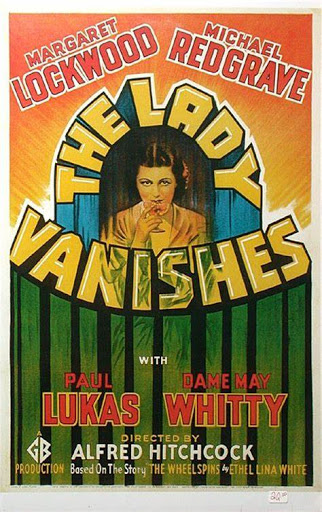
In his conversations with Hitchcock, Francois Truffaut declared every time he tried to study The Lady Vanishes, all its tricks and mechanics, he always ended up too wrapped up in the plot to notice them. It’s about as fitting a tribute as a film can get, that it got one of the world’s ultimate film buffs just sit down and enjoy the ride. The Lady Vanishes is Hitchcock’s penultimate British film and it might well be one of the most enjoyable and entertaining films he ever made.

It’s late 1930s in Europe and a group of mostly British travellers have got stuck waiting for a train in the fictional country of Bandrika (but it’s clearly Germany). Iris Henderson (Margaret Lockwood) is on her way back home to (perhaps somewhat reluctantly) get married, exasperated by the loud noise made in the room above through the night by folk music expert Gilbert (Michael Redgrave). Charters (Basil Radford) and Caldicott (Naunton Wayne) are cricket obsessives, desperate to get home for the big test match. Mr Todhunter (Cecil Parker) is a lawyer, keen not to draw attention to the fact Mrs Todhunter (Linden Travers) isn’t actually his wife. When the train finally leaves the station the next day, Iris is hit on the head by a plant plot (was it pushed?) that very nearly hits governess Miss Froy (May Whitty). Miss Froy takes care of Iris on the train – but when Iris wakes after a rest, she finds Miss Froy has disappeared and – furthermore – everyone denies she ever existed in the first place. While a Bandrikan psychiatrist Dr Hartz (Paul Lukas) claims she may be suffering from concussion, only Gilbert believes her story. Will they be able to prove Miss Froy is real and rescue her from whatever peril she has found herself in?

Hitchcock’s The Lady Vanishes shouldn’t really work – not least since it takes nearly 20 minutes before we get any indication that we are watching anything other than a romantic comedy. But perhaps that’s also why it works, because those first 20 minutes are beautifully scripted, with some cracking dialogue and some skilfully drawn character work that invests us in these people long before any danger arises. It also serves as a brilliant counterpoint to the nearly non-stop tension and action that comes in the final hour of the film – who could have believed that all that light hearted banter in a guest house could end in a ruthless shoot out in the woods?

It all seems to change pace on a classic Hitchcock touch – a folk singer is suddenly, violently, strangled by an unseen assailant (why? I’ve no idea. The film doesn’t think you’ll care about the logic gap, and you don’t). But a large part of the film’s success stems from Hitchcock’s collaboration with Sidney Gilliat and Frank Launder on script-writing duties. Gilliat and Launder made a number of changes to the original novel, adding a greater espionage element. Even more importantly, they overhauled several of the characters, not least changing the Gilbert character from an engineer into a charming (if eccentric) folk music expert with a deadpan wit. Even more successfully, they introduced the hilarious ultra-British Charters and Caldicott, classic eccentric grown-up public schoolboys with a fascination with cricket (the combo was so popular Naunton and Wayne played versions of these characters another eleven times).

The script’s wit, playfulness and scintillating dialogue is what drives most of the film’s energy – and certainly what helps to make it as entertaining as it is. In particular, the dialogue exchanges between Lockwood and Redgrave hum with the sort of love-them-hate-them banter that wouldn’t seem out of place in a screwball comedy (“You’re the most contemptible person I’ve met in all my life!” “Confidentially I think you’re a bit of a stinker as well”), and the two actors shine in roles that start with classic feuding but subtly and beautifully come together as a romantic couple by the film’s end. Lockwood has pluck, guts and determination, a mix of socialite and head girl determination. Redgrave is superb as Gilbert, showing the sort of matinee idol wit and charm – not to mention an unconventional romantic sex appeal – that he very rarely got to exhibit again (sadly he didn’t get on with Hitchcock, and never worked with him again).

The film is full of wit and invention, but mixes it with a properly engrossing mystery. Every character has very clear reasons for denying the existence of Miss Froy (May Whitty is superb as a seemingly dotty old woman, hiding cunning and an unexpected capacity for action). We know that of course Iris is right – but even so, it’s hard not to begin to suspect that maybe the oily Dr Hartz (Paul Lukas whose professional smoothness neatly tips into cruelty) is right and she is suffering from concussion. The unravelling of this mystery is half Agatha Christie (vital clues pop up here and there), half famous five adventure – but the nearly “real time” playing out of the mystery injects huge amounts of tension and excitement, particularly as the villains start to be revealed.

The film also serves, interestingly, as a plea for British invention in European affairs in the era of appeasement. The train is stuffed nearly exclusively by Brits, most of whom are quite content at first to let things drift and not rock the boat. However, when the chips are finally down and its time to make a stand, the majority of the characters knuckle down and get their hands dirty to fight for justice. Even Charters and Caldicott take up arms (with a typical British reserve) to protect their fellow passengers, while Gilbert has already shown himself capable of being a man of action (as well as a pretty neat impressionist and physical comedian) when called upon. It’s telling that Cecil Parker’s Mr Todhunter is the nearest thing we see to an appeaser on the train (with a fear-and-hope-tinged expectation that everyone is playing by his own antiquated rules), and he’s the only one who angrily questions taking a stand.

It’s not surprising from Hitchcock, who made an even more passionate plea for intervention a few years later with Foreign Correspondent. Neither is it a surprise how superbly the film is made. Hitchcock is at the top of his game here, shooting the train brilliantly (the set was tiny, not that you could tell from the number of angles Hitch finds here). His mastery of the pace and tone of the film is spot on: the second half never lets up, and you never for one minute lose the film’s wit, even while the stakes become more bigger and bigger. The film has possibly the most winning romantic pairing in all of Hitch’s movies, helped hugely by the natural and winning playing of Redgrave and Lockwood. It so successfully builds up the possibility of Iris being mistaken, that it makes the audience start to question what they’ve seen.

It’s a superbly directed film, but above all it’s supremely entertaining in a way few other films can hope to be. Its re-watch value – from hearing the jokes again, to spotting the early clues – means it will be rewarding audiences for decades to come.


Wonder Woman 1984 (2020)

wonder woman 1984
Gal Gadot is delightful again in superior sequel Wonder Woman 1984

Director: Patty Jenkins

Cast: Gal Gadot (Diana Prince/Wonder Woman), Chris Pine (Steve Trevor), Kristen Wiig (Dr Barbara Minerva), Pedro Pascal (Maxwell Lord), Robin Wright (Antiope), Connie Nielsen (Hippolyta), Kristogger Polaha (Handsome man), Lucian Perez (Alistair), Ravi Patel (Baba Jide), Oliver Cotton (Simon Stagg), Stuart Milligan (President of the United States)

Wonder Woman in 2017 received the sort of rave reviews superhero films dream of. It was refreshing to have an action flick with a woman as the driving force. But Wonder Woman was, aside from that, very much a conventional superhero origins movie, with little truly original about it. Perhaps memories of it as being more revolutionary than it in fact was, lie behind the more hesitant critical reaction to Wonder Woman 1984, in many ways a more entertaining and smarter film.

In 1984, Diana Prince (Gal Gadot) works at the Smithsonian, and fights for justice in her spare time as Wonder Woman (it’s not clear how she this striking woman manages to keep her identity secret bar smashing a few CCTV cameras). However, she leads a private and lonely life, still mourning the death of Steve Trevor (Chris Pine) during the First World War. Her confidence is admired by her ditzy and nervous (and clearly smitten!) colleague Dr Barbara Minerva (Kristen Wiig), who longs to be like her. An exhibit arrives at the Smithsonian – a mysterious stone that legend has it will grant any wish that the person holding it asks. Diana, in a whimsical moment, wishes for the return of Steve – and is shocked when a man claiming to be Steve appears in her life. Dr Minerva meanwhile wishes to be like Diana in every way – little knowing her secret powers. But the stone has other people interested in it: it could be just the tool that ambitious, but failed, entrepreneur Maxwell Lord (Pedro Pascal) needs to turn his life around. But is there a cost for all this gift giving? What will the stone take in return – and can humanity survive a world where the slightest wish could come true?

Wonder Woman 1984 has a clear theme: taking the easy path might help you to get what you want, but an unearned victory is never a true one. It’s a concept introduced from the start, in an opening flashback section where a child Diana takes a shortcut in an Olympics race, and is denied victory by her mentor Antiope (Robin Wright in a welcome cameo). Antiope, in the way of all mentors, reminds her we learn lessons from loss and defeat, and short-cutting around failure never pays off in the end. It’s a clear message that being granted your wishes without working for them is empty.

And of course there is a cost! The stone takes from you the thing you value most, in exchange for what you want the most. In Diana’s case – having made her wish unknowingly, in a single moment of whimsy – what she loses is her strength, the thing that makes possible the thing she values most: her ability to change the world for the better. In turn, when Barbara wishes to be like Diana, the stone takes from her the very humanity that made her such an endearing and sweet person.

These sort of exchanges are not new to anyone who has ever read a fairy tale. But they are told here with refreshing honesty, not to mention a certain level of charm. Above all, this simple morality tale works because we are invested in the characters. Even without the memory of their relationship from the first film, Gadot and Pine are so likeable and charming in this film (Pine in particular is a delight, his eyes filling with wonder at the modern era – from a childish glee at escalators to tear-filled awe at the space programme) that, even though you know from the start what they are doing is “wrong” (after all Steve is inhabiting another man’s body, and every audience eventually the hero needs to do the right thing and give that body back), you still feel their joy at being together and Diana’s anguish at the thought of giving up the only (selfish) thing she’s ever wanted.

The same is true for the other two characters affected by the stone. Although nominally villains, both Wiig and Pascal play characters who, if anything, are deeply-flawed anti-heroes. Wiig is absolutely endearing as the gentle and shy Barbara, so much so it’s heartbreaking to see her freeze up as the film progresses. Pascal is hilariously overblown as a wannabe Gordon Gekko, but his relationship with his son is nicely drawn and his character is tinged with an underlying insecurity. Wonder Woman 1984 is refreshing in that it doesn’t present heroes and villains, but ordinary people needing to find the courage to reject their dreams for reality. Some do, others don’t.

It’s not a perfect film by a long stretch. As with the previous film, a final act fight scene lacks humanity and is dull. The film is probably fifteen minutes overlong. The various action scenes are well staged, but lack freshness. Some of the humour doesn’t always land. It’s hard not to snigger at a late act revelation of a new power for Wonder Woman. And while the film thankfully avoids the crassness of the first and its trenches setting, a photo of Wonder Woman helping to liberate concentration camps feels horrendously out of place (it’s meant to show her goodness, but I just wondered why on earth did she wait so long to do anything about the Holocaust?).

But the bad is outweighed by the good in a genuinely entertaining and charming movie whose freshness and lightness exceeds the original. Gal Gadot is still wonderful in the lead role – determined but sweet – Chris Pine does some of his best work and Wiig and Pascal are very good. I’d confidently say this is a better film than the first, a richer character study inspired by fairy tales, that really gets to the emotional heart of its lead character. I may be alone in that, but that’s what I think.

Around the World in Eighty Days (1956)

Around the world header
David Niven and Cantinflas head Around the World in Eight Days in this Oscar-winning epic

Director: Michael Anderson

Cast: David Niven (Phileas Fogg), Cantinflas (Passepartout), Shirley MacLaine (Princess Aouda), Robert Newton (Inspector Fix), Charles Boyer (Monsieur Gasse), Joe E. Brown (Stationmaster), John Carradine (Colonel Proctor), Charles Coburn (Steamship clerk), Ronald Colman (Railway official), Melville Cooper (Mr Talley), Noel Coward (Roland Hesketh-Baggott), Finlay Currie (Andrew Stuart), Marlene Dietrich (Hostess), Fernandel (Paris coachman), Hermione Gingold (Sporting lady #1), Cedric Hardwicke (Sir Francis Cromarty), John Gielgud (Foster), Trevor Howard (Denis Fallentin), Glynis Johns (Sporting lady #2), Evelyn Keyes (Paris flirt), Buster Keaton (Train conductor), Beatrice Lille (Revivalist), Peter Lorre (Steward), Victor McLaglen (SS Henrietta helmsman), John Mills (London coachman), Robert Morley (Gauthier Ralph), Jack Oakie (SS Henrietta captain), George Raft (Bouncer), Frank Sinatra (Piano player), Red Skelton (Drunk), Harcourt Williams (Hinshaw)

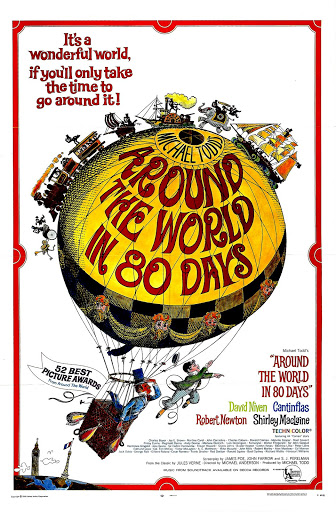
In the 1950s, cinema struggled to encourage people to come out of their homes and leave that picture box in the corner behind. Big technicolour panoramas and famous faces was what the movies could offer that TV couldn’t. This led to a trend in filmmaking that perhaps culminated in 1956 with Around the World in Eighty Days triumphing among one of the weakest Best Picture slates ever seen at the Oscars. Around the World had everything cinema knew it could do well: big, screen-filling shots of exotic locations filmed in gorgeous colour; and in almost every frame some sort of famous name the audience could have fun spotting. It’s perhaps more of a coffee table book mixed with a red carpet rather than a narrative film: entertaining, but overlong.

Faithfully following Jules Verne’s original novel (with added balloon trips), Phileas Fogg (David Niven) is a punctilious and precise Englishman of the old school, whose life is run like clockwork and whose only passion is whist. Nevertheless he accepts a challenge from his fellow members of the Reform Club (among them Trevor Howard, Robert Morley and Finlay Currie) to circumnavigate the globe in 80 days or less. Setting off with his manservant – the recently hired, accident prone Passeportout (Cantinflas) – Fogg races around the world, from Paris to Cairo to India to Hong Kong to Japan to San Francisco. Along the way he rescues Princess Aouda (Shirley Maclaine) from death by human sacrifice in India and has to confront the suspicions of Inspector Fix (Robert Newton) who is convinced that Fogg is responsible for a huge theft at the Bank of England. Can Fogg make it back to the Reform Club hall on time to win his bet?

Around the World was the brain-child of its producer Michael Todd. A noted Broadway producer, Todd had been looking to make a similar splash in the movies. Perhaps it’s no surprise that he decided the finest way to do this (after the mixed success of a movie version of Oklahoma) was to produce something that‘s pretty much akin to a massive Broadway variety show. Around the World – as you would expect – is an incredibly episodic film, seemingly designed to be broken down into a number of small sequences either to showcase the scene’s guest star or to provide comic opportunities for Cantinflas to display his Chaplinesque physical comedy.

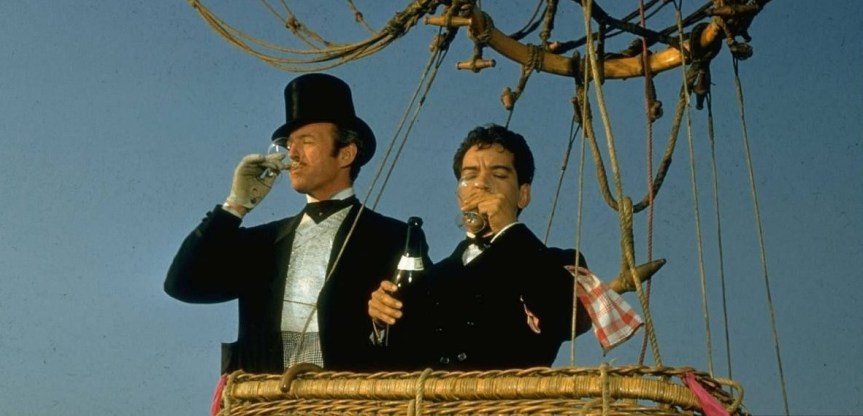
That and lots of opportunities for some lovely scenic photography. Nearly every major sequence is bridged with luscious photography capturing some exotic part of the world – from the coast of Asia to the Great American Plains. It’s pretty clear this is a major attraction of the film: come to the movies and see those parts of the world you’ve always dreamed of, just for the price of a movie ticket! Surely introduction of a hot air balloon to allow Fogg and Cantinflas to travel from Paris to Spain was purely to allow lovely aerial shots of the French countryside and chateaux. It’s the sort of film that proudly trumpeted in its publicity the number of locations (112 in 13 countries!), the vast number of extras (68,894!) and even the number of animals (15 elephants! 17 fighting bulls! 3,800 sheep!). It’s all about the scale.

That scale also carries across to the guest cameos. Between enjoying the scenic photography, viewers can have fun spotting cameos. Can that really be Noel Coward running that employment agency! The chap who owns the balloon, I’d swear that’s Charles Boyer! Wait that steward: that’s Peter Lorre! Good lord that’s Charles Coburn selling Fogg tickets for the steamer! Oh my, Buster Keaton is helping them to their seats on the train! Marlene Dietrich is running that saloon – and good grief that’s Frank Sinatra playing the piano! Most of the stars enter into the spirit of the thing, even if they frequently start their shots with backs to the camera, before turning to reveal their star-studded magnificence. Sadly time has faded some of the face recognition here, not helped by David Niven (perfectly cast as the urbane and profoundly English Fogg, so precise that his idea of romantic talk is to recount past games of whist) probably today being one of the most famous people in it.

Todd marshals all this with consummate showman skill. It’s handsome, very well mounted and generally entertaining – even if it is painfully long (it’s not quite told in real time, but can feel like it at points). The film is nominally directed by Michael Anderson. However, I think it’s pretty clear his job was effectively to point the camera at the things Michael Todd had lined up (be they location or stars) – Todd had already dismissed the original director, John Farrow, after a day’s shooting for not being sufficiently ”co-operative”. To be honest it’s fine as this is an entertainment bereft of personality, instead focused on being “more is more”.

Part of its extended runtime is due to the long comedic sequences given to Cantinflas. A charming performer – and possibly the most famous comedian in Latin-America at the time – Cantinflas can be seen doing everything from bicycle riding, to bull fighting (for a prolonged time), to gymnastics to horseback riding. (Far different from the unflappable and spotless English gentleman Niven is playing.) Your enjoyment of this may depend on how far your patience lasts. I’m not sure mine quite managed to last the course. Sadly one of Cantinflas’ greatest comedic weapons, his Spanish wordplay, was completely lost in translation.

There are some decent sections. The iconic balloon flight is well mounted and gives the most impressive images (the famously vertigo-suffering Niven was replaced by a double for much of this). Others, like the bullfight or an interminable parade in San Francisco go on forever. The casting of Shirley MacLaine as an Indian princess is an uncomfortable misstep (even at the time MacLaine felt she was painfully miscast), made worse by an offensive “human sacrifice” storyline – that got cut when the film was screened in India. Robert Newton though is very good value as the misguided but officious Inspector Fix.

Around the World in Eighty Days is grand, handsomely mounted entertainment. But to consider it as a Best Picture winner feels very strange. It’s not a lot more than an entertaining variety show, its plot impossibly slight (made to feel even more so by its vastly over-extended run time). While you can enjoy it in pieces, it finally goes on too long for its own good. Entertainingly slight as it is, it’s still one of the weakest Best Picture winners ever.

The Searchers (1956)

The Searchers (1956)

Ford’s dark tale of obsession and racism is one of the finest Westerns ever made

Director: John Ford

Cast: John Wayne (Ethan Edwards), Jeffrey Hunter (Martin Pawley), Vera Miles (Laurie Jorgensen), Ward Bond (Reverend Captain Samuel Johnson Clayton), Natalie Wood (Debbie Edwards), John Qualen (Lars Jorgensen), Olive Carey (Mrs Jorgensen), Henry Brandon (Scar), Beulah Archuletta (Look), Ken Curtis (Charlie McCorry), Harry Carey Jnr (Brad Jorgensen), Hank Warden (Mose Harper), Dorothy Jordan (Martha Edwards), Walter Coy (Aaron Edwards), Pippa Scott (Lucy Edwards)

John Ford’s career was a long tribute to the decency of the regular American. How fascinating then that one of his greatest films is in fact a dark investigation into the dangers of obsession, vengeance and prejudice in ordinary Americans. Working with his regular leading man, John Wayne, together they created a character who shared many qualities with Ford’s other leading men – a rugged, determined, taciturn man of the wilderness – but laced him with deeply negative attitudes and a horrendously damaged psyche. The Searchers becomes a masterpiece, presenting how narrow the line between hero and villain can be while – in an admittedly very gentle way – posing questions about the claims of the settlers to moral superiority.

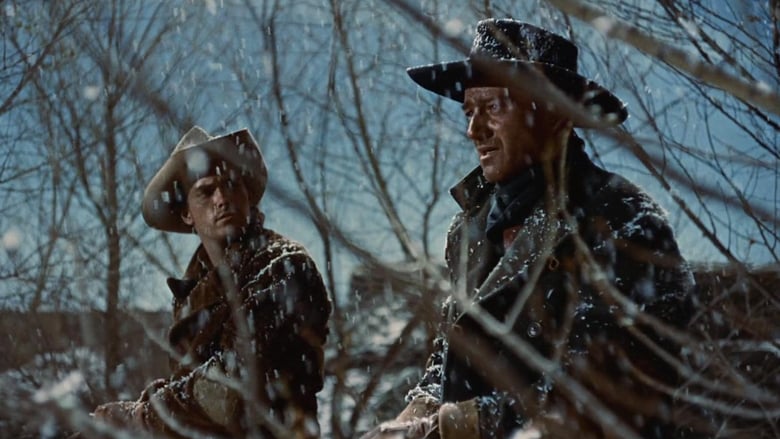
Ethan Edwards (John Wayne) returns to his brother’s homestead from an unspecified (though clearly morally questionable) career as a gun for hire after fighting for the confederacy (a cause he sees no reason to disavow). He’s an awkward presence, with an unspoken love for his brother Aaron’s (Walter Coy) wife Martha (Dorothy Jordan) and a racial hostility towards their adopted son Martin (Jeffrey Hunter) who is one-eighth Cherokee. Shortly after his arrival, an Indian raid draws him and most of the local men on a futile chase. While they are gone, the Edwards’ homestead is destroyed, with the family all murdered except daughter Debbie. Ethan and Martin begin what becomes a five-year quest to find her and bring her home – although as he discovers Debbie has become wife to her kidnapper, the war chief Scar (Henry Brandon), Ethan’s aim shifts from rescue to executing Debbie for racial disloyalty.

Racism is what lies at the heart of The Searchers and around discussions of the film today. Firstly, let’s acknowledge how brave the film is in presenting Ethan’s racially motivated rage without excuse. This was after all John Wayne, the straightest shooter of the lot. Here, in no doubt his greatest ever performance, Wayne’s Mount Rushmore-like qualities are inverted into a bitter, lonely man whose murderous rage against the Native Americans is extreme, even within an environment which sees the tribes as a dangerous “other”.

Edwards’ racism tips into everything and is there right from the start: “I could mistake you for a half breed” he scowls at Martin. Later he will prevent Martin drinking alcohol – a clear reference to the belief among settlers that one drop of alcohol turns Indians into savage beasts. One of his first actions on the trail is to desecrate the buried corpse of an Indian, shooting out his eyes (condemning him to walk sightless in the afterlife). In a gunfight he has to be stopped from shooting retreating Indians in the back. Later, in a crazed fury, he guns down buffalo simply to deny them as food to the tribes. That’s not to mention his disgust with every trace of indigenous culture.

What’s striking watching the film is that, even though he’s the central character and is played by John Wayne, Ethan may well actually be the villain of the piece – or at best an anti-hero wild card. Our actual hero is the kindly, decent and brave Martin Pawley, played with a slight nervousness by Jeffrey Hunter. Martin is appalled by Ethan’s violence, his anger and above all by his plan for enforcing racial harmony by exterminating the niece he sees as a race traitor. It’s not just the fact he has Cherokee blood that makes Martin appalled by the danger in Ethan. It’s the simple fact that he’s just a decent guy, who recognises that good and bad isn’t a question of race but a question of people. And his presence on the quest, it’s made clear, is as much about protecting Debbie from Ethan as it is finding and rescuing her.

You can see these attitudes quite clearly late in the film, where the pair encounter white women who have been recovered from Indian kidnappers. These women are confused and traumatised. But while Martin attempts to communicate with and comfort them, to Ethan they are worse than nothing now. “They ain’t white anymore” he scowls at a soldier. Leaving them, Ford holds the shot on Wayne who turns to look back at them with a face dripping with such disgust and loathing, it sears into the memory.

Does the film condemn these attitudes? You can argue that the film plays into a racial nightmare – white women kidnapped and violated by savage tribesmen. But Ford is, I’d suggest, presenting racism here – and going as far as he could in the 1950s to attack it. Ethan and Martin encounter an Indian settlement that has been attacked by the cavalry. The settlement is a burnt-out husk, with Indian women and children among those indiscriminately slain – visually it is immediately reminiscent of the burnt-out Edwards homestead. Another later cavalry charge against the Indians will again see panicked women and children flee in terror. Even Scar, the villain of the piece, is motivated just like Ethan by anger – his actions are a response to the murder of two of his children. And his scalping, rape and murder don’t look so different from Ethan, who shoots people in the back, plans to murder his niece and later scalps a dead man.

The Searchers takes a slightly nihilistic view that the West was a violent place – for all the beauty Ford discovers in his crisply sublime shots of monument valley – and that many of the people in it had questionable motives and principles. A ”hero” for this time might well be Ethan, a sullen and violent man under a veneer of gentlemanly politeness, clearly motivated from the start far more by a desire for revenge for the murder of the woman he loves. Ford, Wayne and Jordan establish this love between Ethan and Martha subtly but unmistakably – the opening scenes are littered with moments of the two of them sharing glances and a hesitant but unmistakeable physical intimacy.

Again, a lot of the quality of this comes back to the wonderful work Ford draws from Wayne, helping the actor to find the cracks and flaws in this marble bust of Americanism. Wayne’s Ethan is awkward, angry, distant, difficult, cruel – a natural outsider, who has grown bitter against the world. Discovering Martha’s body, Wayne also allows Ethan to crumple into the sort of grief that translates within seconds into an iron loathing for the world and everything in it. He talks of the certainty of finding Debbie – but it’s a certainty born more of his idea of his own superior (white) determination rather than any faith (for all the language could suggest that). Ethan is in fact hostile and contemptuous of faith of any sort.

Ford frames Ethan frequently as an outsider, often framed uncomfortably in doorways, darkened walls seeming to close around him. Nowhere is this more beautifully done than in the film’s final shot which finds Ethan alone and forgotten outside the Jorgensen homestead, a man who has no place in the civilised world of family and friends, but an outsider with no place anywhere who must return to the wilderness. Wayne does this with a quiet, deflating gentleness – a beautiful suggestion of Ethan’s knowledge that the world is leaving him behind. Ford frames this beautifully in mid-shot to create one of the iconic images of cinema.

The Searchers isn’t perfect. There is a prolonged, slightly comic, sub-plot around Martin’s marriage to Laurie Jorgensen (Vera Miles in a thankless part), which culminates in the sort of fisticuff based comic stuff that looks more suited to The Quiet Man than here. The beautiful shots of monument valley are brilliantly done – but they also serve to point out the odd decision to shoot many of the exteriors on such obviously fake soundstages. While the film questions the attitudes and assumptions made about the Native American people in Hollywood films, the violent figure of Scar is the only Native American character given any real screen time (Martin’s accidental “wife” Look is treated as a joke, right up to her surprisingly tragic fate), making it easier to still see the tribes as an existential threat to civilisation, for all that Ford tries to contrast their suffering with the death of the settlers.

But Ford was trying to sneak something in here under the wire, at a time when people would only accept straight-forward stories of goodies and baddies in the West. He did this by turning Wayne for a pillar of taciturn goodness into someone who is almost a mirror image of his nemesis Scar, both men motivated by racial hatred. He parallels the violence of the Indians with the cavalry. He suggests in fact that there was good and bad on both sides. And I can’t think of another film where the viewer is convinced for a huge portion of the runtime that our hero intends to carry out an honour killing. The Searchers presents a man who holds racist views and trusts that we are smart enough to see the danger in Ethan’s extremism. Thankfully most of us are.

Ice Station Zebra (1968)

Rock Hudson takes command in the rather turgid cold war thriller Ice Station Zebra

Director: John Sturges

Cast: Rock Hudson (Commander James Farraday), Ernest Borgnine (Boris Vaslov), Patrick McGoohan (David Jones), Jim Brown (Captain Leslie Anders), Tony Bill (Lt Russell Walker), Lloyd Nolan (Admiral Garvey), Alf Kjellin (Colonel Ostrovsky)

Rumour has it that Howard Hughes loved this movie so much, he insisted on the Las Vegas TV broadcaster he owned to screen the film over 100 times. For most of the rest of us, once will probably be enough to take in all the fun that can be pulled out of this sub-par Alistair MacLean Cold War thriller, a poor relation to The Guns of the Navarone and Where Eagles Dare.

It’s the middle of the Cold War and US submarine commander James Farraday (Rock Hudson) is ordered to the North Pole to rescue a British scientific team. However that mission is just a cover for the real goal – something to do with retrieving a top secret gizmo from a crashed satellite. Farraday is ordered to transport British intelligence agent “David Jones” (Patrick McGoohan) to the Pole, who has bought Soviet defector Boris Vaslov (Ernest Borgnine) along with him. En route, sabotage nearly downs the sub, and on arrival the base has been nearly destroyed. Looks like there is a traitor on board – but is it Boris or recently arrived marine Captain Leslie Anders (Jim Brown)? Who can tell?

To be honest most people watching the film. It’s one of many not-particularly-intriguing mysteries in a hopelessly over-extended film that takes nearly two hours to get going, and then crams its paper-thin characters into a series of adventures that bounce from dull to cliché with giddy haste. Directed with a professional lack of engagement by John Sturges (who could believe the director of Bad Day at Black Rock and The Great Escape could have made something as flat as this?).

It’s a film that mistakes lack of explanations and rushed conclusions for intriguing mystery. There is barely enough actual plot here to sustain an hour and a half let alone the nearly two and a half hours the film takes to get nowhere in particular. The middle of the film is given over to a series of submarine escapades that would have already felt familiar at the time from The Enemy Below and have been bettered since in countless submarine films. From deep dives to furiously leaking compartments, there isn’t anything particularly new here.

When we finally arrive at the polar base, there is finally some decent mystery – as well as a haunting atmosphere – as the characters explore the badly damaged base and its traumatised residents (You can see how this film influenced John Carpenter as he directed The Thing). Sadly, what the film hasn’t managed to do up to this point is make us care at all about any of the characters. Rock Hudson, never a particularly inspiring performer, makes a dry and unengaging lead (first choice Gregory Peck would have made the world of difference). Patrick McGoohan does his best as the mysterious British agent, but the character is so lightly written that you never really feel particularly intrigued by his mystery. Ernest Borgnine chews the scenery as the ex-Pat Soviet while Jim Brown is serviceable as the marine captain. Virtually no other character makes any real impact.

The film culminates eventually in a confusing stand-off between the Americans and the Soviets, until the villains reveal themselves and a détente that doesn’t end up destroying the world is revealed. That’s about the sum total of interest the film can spark. Other than that, it’s slow pace, unengaging characters, uninvolving plot and unoriginal action make it a great deal of fuss about nothing in particular. Howard Hughes may have wanted to watch it a hundred times. You probably won’t want to.

Elizabeth: The Golden Age (2007)

Elizabeth the golden age
Cate Blanchett returns as Elizabeth I in the slightly underwhelming Elizabeth: The Golden Age

Director: Shekhar Kapur

Cast: Cate Blanchett (Elizabeth I), Geoffrey Rush (Sir Francis Walsingham), Clive Owen (Sir Walter Raleigh), Abbie Cornish (Bess Throckmorton), Samantha Morton (Mary Queen of Scots), Jordi Molla (King Philip II), Susan Lynch (Annette Fleming), Rhys Ifans (Robert Reston), Eddie Redmayne (Anthony Babington), Tom Hollander (Amias Paulet), David Threlfall (John Dee), Steven Robertson (Sir Francis Throckmorton), Adam Godley (William Walsingham), Laurence Fox (Sir Christopher Hatton), William Houston (Guerae de Espes)

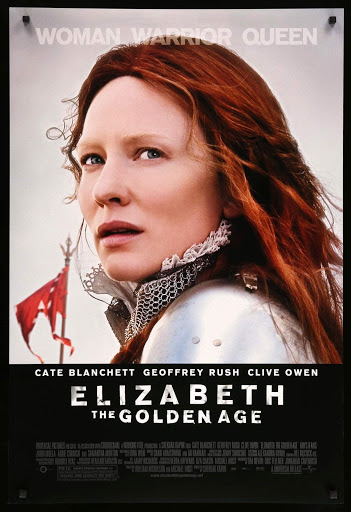
Its 1585 and the reign of Elizabeth I (Cate Blanchett) has seen England enter a Golden Age. But tensions are rising with the Spanish and their king Philip II (Jordi Molla). The Spanish plot to replace the protestant Elizabeth on the throne with the catholic Mary Queen of Scots (Samantha Morton), sending their agents (including the likes of Rhys Ifans and Eddie Redmayne) to England to ferment rebellion. Can Elizabeth’s trusted advisor Sir Francis Walsingham (Geoffrey Rush) root out this potential rebellion? Or could this be a trap to lure England into a naval war with Spain and its chilling armada of ships?

Elizabeth: The Golden Age is a late sequel to the more influential Elizabeth, which mixed in the ruthlessness of The Godfather, with a sprinkling of sex in a darkly tinged Elizabeth England which seemed to drip conspiracy (setting the tone for costume dramas for the next ten years at least). Compared to its original, Elizabeth: The Golden Age seems a much more traditional piece of filmmaking. It’s luscious and handsomely filmed, with the darkness and oppression of the original replaced with golden hued lighting, sumptuous (Oscar-winning) costumes and some very impressive set-designs, all of which help to point up the glamour of the past in a way that seems much more similar to a 1970s epic than the more inventive work of the original.

It’s a part of the film’s idea of the country now enjoying the glory Elizabeth’s reign has bought, with the dark corridors replaced by the bright lights of peace and opulence. The film’s reimagining of Tudor history does still present some interesting perspectives, not least in the character of Elizabeth. Now firmly in middle-age – and committed to a life of celibate singledom – Cate Blanchett’s regally imperious Elizabeth is still emotionally vulnerable with a deep sense of longing in her. Unable to live the life of romantic freedom she could in her youth, she now lives an emotional life vicariously through her ladies in waiting, particularly Abbie Cornish’s sharp and knowing Bess Throckmorton.

This focuses on Elizabeth alternating between encouraging and discouraging (due to her own half-realised romantic longing) a romance between Bess and famed explorer Walter Raleigh. Played by Clive Owen at his most buccaneering (with an accent that playfully lies between Norfolk and New England, suggesting the American accent came from Raleigh), Raleigh bewitches the Queen with exciting tales of abroad – but with her unable to flirt with him fully as she wishes, Bess is encouraged to dance intimately with him among other romantic gestures. The most important thing throughout for Elizabeth is that it is she controls and dictates the relationship – and when the couple start to make their own decisions, it leads to disaster.

It’s all part of Michael Hirst’s (here sharing script writing duties with William Nicholson) imaginative reinvention of Tudor history (remixed into an exciting version of what could have happened). This also comes together very nicely in an interesting conspiracy thriller take on the Babington plot and the goals of the Spanish to use it to manipulate both Elizabeth and Mary Queen of Scots. The film is at its strongest when playing with historical expectations.

However, too often it plays into the sort of “Britain Triumphant” nonsense that made Michael Gove on release (and you imagine Laurence Fox today – here popping up as Christopher Hatton) thrilled. The British characters – Elizabeth, Raleigh, Walsingham – are brave, charismatic, ingenious and attractive. The villainous Spanish are thick-lipped, spittle flecked, bad-haired meanies with Philip II literally a sinister limping hunchback. No scene in Spain is complete without dark lighting, chanting monks, massive crucifixes and a general air of oppression. When ships sink, the camera doesn’t miss the chance to capture a crucifix sinking to the bottom of the briny. The Babington conspirators plot out of a dyers shop, where blood red dye drips all around them. The plot culminates in a “just missed her” point blank gun confrontation (the film’s most silly flourish). Subtle it ain’t.

And also it feels more Little Englander than its predecessor. Whereas the first film saw as much darkness and dirty dealing among the British as it did Europe, this film feels like a “Britain Stands Alone” against treacherous, lecherous, sanctimonious (or all three) Europeans. Sure the Armada was a terrific win for Britain – here with much of the credit reassigned to Raleigh who steers fire ships into the path of the Spanish ships (Drake is reimagined as a lumpen bureaucrat dazzled by Raleigh’s pizzazz) – but it owed as much (as even the Tudors themselves admitted) to the weather and luck as it did bravery and skill. Unlike the first film, Elizabeth: The Golden Age seems determined to define European and Catholic as suspiciously “other”. It makes for a less rewarding film.

And a less interesting one. For all its playing with psychology, this is a very much more traditional costume drama, celebrating Merrie Olde Englande where the original film challenged us to question our expectations. Kapur and Hirst settle for spectacle and style, over drama and truth. Blanchett is impressive as always – and the rest of the cast very sound – but this is a sequel that only lives as a counterpoint for the original.

Morocco (1930)

Morocco header
Marlene Dietrich and Gary Cooper romance in the heat of Morocco

Director: Josef von Sternberg

Cast: Gary Cooper (Legionnaire Tom Brown), Marlene Dietrich (Mademoiselle Amy Jolly), Adolphe Menjou (La Bessiere), Ulrich Haupt (Adjutant Caesar), Eve Southern (Madame Caesar), Francis McDonald (Sergeant), Paul Porcasi (Lo Tinto)

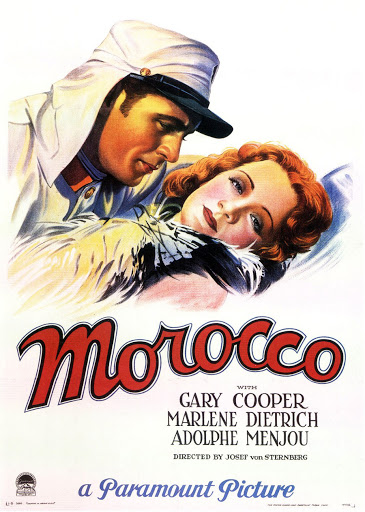
Josef von Sternberg was one of the greatest directors of early cinema – and Marlene Dietrich was his muse. Or was he her Svengali? Either way, they first worked together on German film The Blue Angel and such was the impression made by Dietrich, Hollywood was desperate to get her and von Sternberg together for a new picture that would channel her star power into ticket sales. Morocco is the picture they come up with, a romance tinged with heartbreak set in French occupied-Morocco around a Foreign Legion troop passing through town.

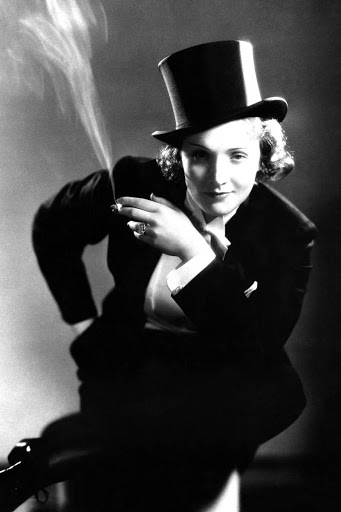
Dietrich was Amy Jolly, a woman of uncertain and shady past, new in town and making a living as a night club singer. There here routine encompasses everything from erotic singing in top hat and tails (complete with a bisexual vibe – you can tell this is pre-Code Hollywood?) to an apple selling singing routine. She’s loved by La Bessiere (a rather bland Adolphe Menjou), a stuffed shirt rich guy. But her heart belongs to man’s-man legionnaire Tom Brown (Gary Cooper), a toughened old soldier with a girl in every barracks town. Who will Amy end up with? Will she follow her heart or her head? Can she bear to live the life of a soldier’s mistress amongst the camp followers?

Writing it all down, there are probably few mysteries about the resolution you get from Morocco, which even at its 90 minute run time feels like an impossibly slim piece of fluff. But that hardly really matters when von Sternberg shoots the film with a romantic flourish and with Dietrich and Cooper as such compelling leads. It’s odd to think, looking at it now, that Morocco was acclaimed as one of the greatest films ever made on release (it’s not even the best or most lasting Dietrich/von Sternberg Hollywood collaboration of which there were five more to come).

But it lasts in history because it introduced Dietrich to the wider world. Von Sternberg took control over every aspect of her image to best present her to the world – including a torturous 45 takes of her first line (because after all the first line was the one that will make the first impression on an audience). Von Sternberg and cinematographer Lee Garmes choose lighting methods and angles that would enhance her features, and shot huge parts of the film to favour her (much to the annoyance of Gary Cooper, who resented von Sternberg’s shunting of him to the sidelines).

Von Sternberg was determined that Dietrich would make an impression: and she certainly did with her cabaret act, still probably the film’s highlight. Dressed in a striking male garb, her rendition of When Love Dies is sold on her confidence, sexual allure and tinge of bisexuality (viewers were scandalised and titalated that the routine ended with Dietrich playfully kissing a woman in the audience) to make a lasting impact. Von Sternberg lets the tension build as well by holding the camera calmly on Dietrich (in drag) while the audience at first boo before silencing and then being swept up in her performances. This is the approach taken for the rest of the film – and its rather weak plot – focusing on the a magnetic quality, the indefinable star quality some people have to just make you watch them.

It’s recognised by von Sternberg, who builds the film around her. It’s tempting to see Adolphe Menjou – the jilted would-be husband, in awe of the star – as a von Sternberg self-portrait, dressed as he is to resemble the director. But von Sternberg felt so confident over his control of Dietrich and her career, I suspect there is actually far more of him in lothario Tom Brown, the sort of man who may love a woman but also very much likes her to submit her will to his own. Brown may have his moments of decency – he wants Amy to have the best chance in life, which is clearly with La Bessiere rather than him – but he’s also an at times ruthless opportunist and adventurer, with a string of broken hearts behind him. Interestingly, considering their later films and her reputation, Dietrich’s Jolly is actually a fairly passive figure throughout the film, to whom events happen and who never feels in charge of her destiny. Perhaps more than a little of life drippling through to the screen?

Saying that the film has some bite in it, with the dialogue from Jules Furthman often rich, rough and ready, creating characters who speak at times bluntly but with a sort of urban poetry. Sadly, the dialogue scenes are often frequently the dullest in the film. Von Sternberg was still at the time a natural director of silent film, not the talkies. Hollywood itself had still not really learned how to do record dialogue and do camera movements at the same time, so most of the dialogue scenes are visually flat and rather forced (not helped by the storyline itself being often less then enthralling).

Where Morocco really comes into its own is when it falls back on visuals. As a director of pictures, von Sternberg is outstanding. The camera perfectly captures the bustle of the Moroccan market town. There is a beautiful sequence where Amy raises through a seemingly never-ending row of soldiers to try and find Tom. The Morocco in this film may bear almost no resemblance to the real Morocco – it’s clearly a Hollywood fantasy land – but it also looks at no time like it was shot on a Hollywood backlot. Tom Brown’s slow and sad browse through Amy’s dressing room, before deciding he should leave for her own good is hauntingly well done in near total silence, matched with beautifully empathetic camera moves. The final imagery, as our heroes head out into the sands of Morocco, is marvellous, a perfect collection of shots and reactions leading to an image for the ages.

And Morocco is a film of images strung together with a rather dull plot and a very stilted scenes of dialogue. Marlene Dietrich is at the centre of many of these images. This was her only Oscar nomination – but it’s not her finest performance. She’s still learning her craft and – above all you feel – still very much an elaborate prop for von Sternberg. The more they became something like equals the stronger the pictures would become. Gary Cooper was unhappy on the film – but actually his performance is remarkably strong and assured, dripping sexuality (von Sternberg also works a lovely little scene that pokes fun at Cooper’s height).

Morocco seems like a landmark of cinema that is of greater academic interest at times than it is dramatic. But when the dialogue fades away and the film is able to relax into the series of arresting images that make up most of it, it’s still a marvellous and intriguing work.

Mank (2020)

Mank header
Gary Oldman excels as Herman J Mankiewicz in David Fincher’s bitter Hollywood epic Mank

Director: David Fincher

Cast: Gary Oldman (Herman J Mankiewicz), Amanda Seyfried (Marion Davies), Lily Collins (Rita Alexander), Arliss Howard (Louis B Mayer), Tom Pelphrey (Joseph L Mankiewicz), Charles Dance (William Randolph Hearst), Sam Troughton (John Houseman), Ferdinand Kingsley (Louis B Mayer), Tuppence Middleton (Sara Mankiewicz), Tom Burke (Orson Welles), Joseph Cross (Charles Lederer), Jamie McShane (Shelly Metcalfe), Toby Leonard Moore (David O Selznick)

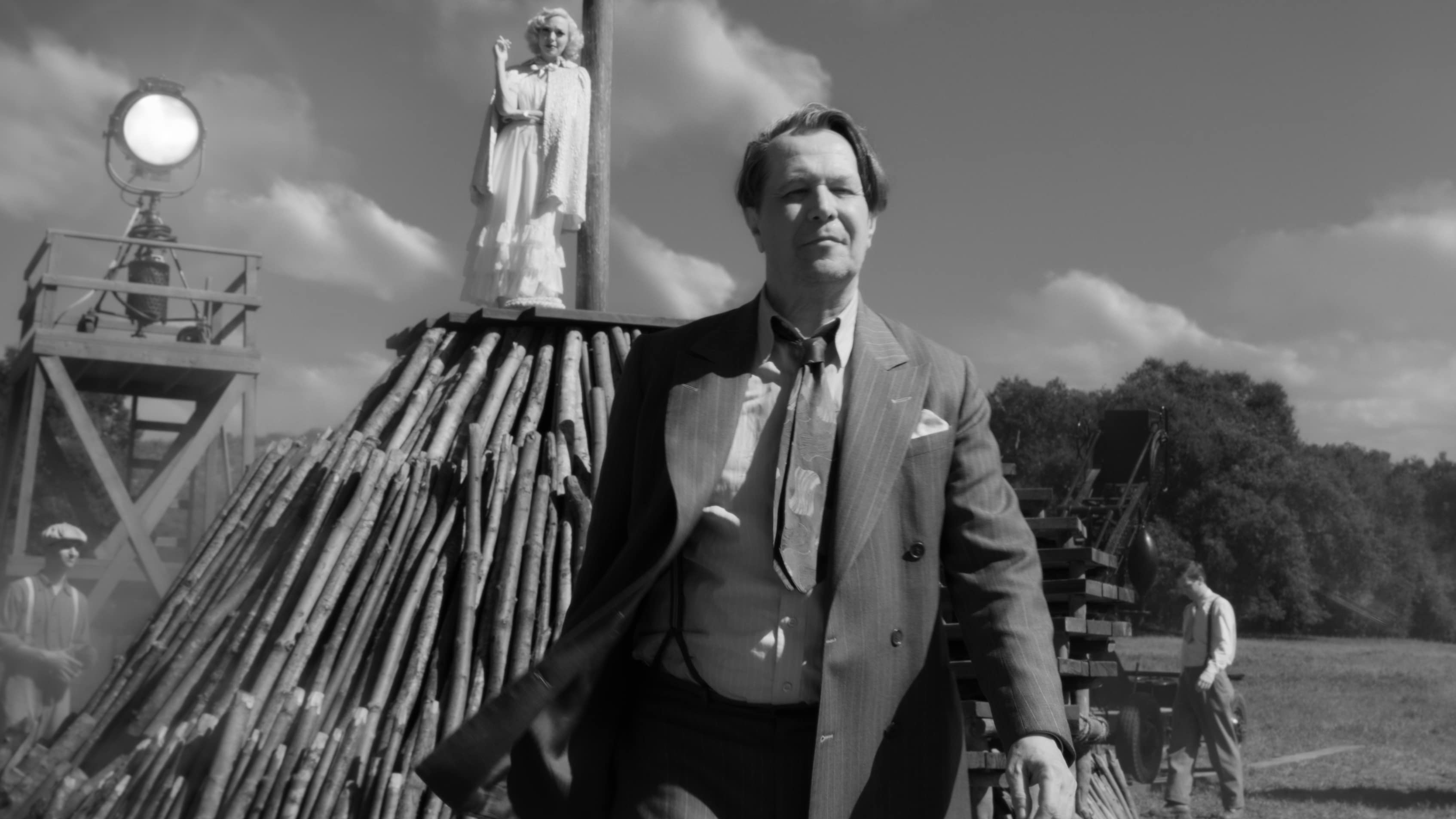
It’s 80 years old, but age has not withered Citizen Kane’s mystique, still one of the greatest films ever made. The story of its creation has intrigued generations, a fascination only increased by the larger-than-life personalities involved, from Orson Welles down. David Fincher’s lovingly made, but bitingly shrewd deconstruction of classic Hollywood, explores the creation of the film by focusing on its credited co-writer Herman J Mankiewicz, the film neatly intercutting between the alcoholic Mankiewicz drafting the screenplay while in enforced retreat and his prime years as a writer-for-hire to the major Hollywood studios of the 1930s.

Mankiewicz is played by Gary Oldman (at 62, already seven years older than Mankiewicz was when he died). A noted wit, Mankiewicz makes an excellent living running the writers’ room at Louis B Mayer’s (Arliss Howard) MGM. Mankiewicz views the work of writing films as slightly beneath him, easy money (“Millions are to be grabbed out here and your only competition is idiots” he cables Ben Hecht). Mankiewicz’s sociability eventually finds him an informal role as “court jester” to newspaper tycoon (and MGM bank roller) William Randolph Hearst (Charles Dance) and he builds a warm friendship with Heart’s shrewd mistress, actress Marion Davies (Amanda Seyfried). The relationship sours as Mankiewicz grows disgusted by the dirty tricks campaign MGM and Hearst launch against the left-wing candidate for governor in 1936. In 1939 Mankiewicz works on the script for Citizen Kane, hired by Orson Welles (Tom Burke) with the support of an assistant Rita (Lily Collins) who helps him craft the words and stay sober long enough to type them.

Fincher’s film can easily be seen as a loving homage to old-school Hollywood. Certainly, Fincher fully embraces 30s filming style. From the carefully crafted period credits to the slightly distorted sound that apes the echoey on-set recording of classic Hollywood, this is a technical masterpiece. Beautifully shot in a series of sultry black-and-white images, with several visual references to Citizen Kane, it looks simply marvellous. The musical score is a brilliant mixture of Herrmannesque and classic Hollywood symphonic music with an edge. Even the casting has a slight old-school Hollywood unreality about it, from Oldman being at least 30 years too old to Amanda Seyfried being too young. Fincher embraces every flourish and stylistic tic from the Golden Era of Hollywood.

But the film is about as far as you can get from rose-tinted glasses. Instead this is a vicious, angry, look at Hollywood’s corruption, that owes as much to Billy Wilder’s Sunset Boulevard. Hollywood is a carnival of greed and abuse of power, where art takes a second seat to cold hard cash (“This is a business where the buyer gets nothing for his money but a memory. What he bought still belongs to the man who sold it. That’s the real magic of the movies!” Louis B Mayer exclaims). Power is abused, lies are peddled to the public (Upton Sinclair, the Democratic candidate for governor, is subtly savaged by MGM-propaganda films) and the rich shamelessly steal from the rest.

The film doesn’t give a pass to the “talent” either. Mankiewicz and his writers’ room – a who’s who of greats, from Ben Hecht to George S Kaufman, SJ Perelman and Charles MacArthur – are blasé and spend as much time playing cards and seducing broads as they do scribbling ideas. Mankiewicz sets the tone, a super-smart wordsmith who thinks the movies are a joke and never invests himself in any of his work, happy to simply pick up a pay cheque. Mankiewicz doesn’t care about the quality and completely misses (or doesn’t even understand or care about) the power of movies. Anyway, his judgement is terrible, denouncing The Wizard of Oz as an epic disaster in waiting and never bothering to ensure he receives credit.

Oldman perfectly captures the shambling, slightly rotund and scruffy disdain of Mankiewicz, as well as brilliantly suggesting that the booze and cigarettes are an aid to forget his own disgust and self-loathing. With Oldman’s verbal dexterity triumphant (Mankiewicz actually carries more than a few echoes of his Winston Churchill), Mankiewicz’s real gift (and reason for living) is clubability and a skill at getting on with everyone. He’s the ultimate insider in a profession he thinks is an unworthy joke. It’s what gives him the ability to drop perfectly formed, biting bon mots at the drop of the hat – and this devil-may-care attitude amuses William Randolph Hearst (a chillingly still and powerful Charles Dance who can turn from congenial to menacing in a moment).

It’s also what wins the friendship of Marion Davies, who Mankiewicz recognises as a kindred spirit, a woman of intelligence and sensitivity, playing a role in an industry she holds in uncertain affection. This is career best work from Amanda Seyfried, giving Marion intelligence and a touching vulnerability. However, unlike Mankiewicz, she is happy in the role she has been ‘cast in’. It would never occur to her to launch the sort of scathing attack on this gilded set that Mankiewicz’s script for Citizen Kane becomes.

The film is in fact less interested in the writing of Kane than you might expect.Kan, even with Tom Burke making a wonderfully detailed Orson Welles. It does however make sure to give most of the credit for story and dialogue with Mankiewicz, with Welles reduced to a petulant tantrum (the inspiration for Kane’s room wrecking) when Mankiewicz demands credit. (The film is in effect a dramatisation of Pauline Kael’s Raising Kane essay, which attempted to shift the key creative contribution from Welles to Mankiewicz). But then perhaps Mankiewicz finally realised films can be a vehicle for respectable, worthy work.

That is surely the lesson Mankiewicz learnt from the 1936 Gubernatorial campaign. His offhand remark inspires MGM to refashion its news reel department into a propaganda machine. Mankiewicz is plagued by guilt, self-loathing and disgust for his employers over this cynical and destructive abuse of power – but also his own failure to exploit his skills and talent to really make a difference (in a way his brother Joseph manages to do). Again, Fincher’s intelligent and beautifully crafted film leaves all this lingering in the mind, its initial impact only growing over time as you digest its complexities.

However, it is a film perhaps a little too absorbed in its detail to keep an eye on the heart. There are several scenes that feel missing. The film needs more of Mankiewicz as the court jester at Hearst’s. It needs more space to allow us to understand where Mankiewicz’s rage and bitterness really comes from. It needs more time to tackle his mixed feelings about his work. More exploration of the foundations of Citizen Kane. The pace sometimes flags and it’s a cold and admirable film rather than one that can be love, occasionally feeling a little pleased with itself (with its deliberately scuff-marked film and burned reel marks). I can well imagine some people using the dreaded word “boring” and it’s really a film for the cine-buff rather than the casual viewer.

The main flaw – and it might well be a big one – is that there isn’t enough focus given to what motivates Mankiewicz to turn so completely against the gilded in-crowd. Even when haggling over credit with Welles, Mankiewicz still points out he (unlike Welles) is a Hollywood insider and will win any arbitration. But the motivations of the film are hard to find amongst the skilful recreation of its design. The characters at times seem a little to artificial and lifeless.

But it has a host of other positives, all superbly marshalled by Fincher’s pitch perfect direction. The cast is superbly led by Oldman. Among the rest, Arliss Howard is terrific as the venal and hypocritical Louis B Mayer, Tuppence Middleton very affecting as Mankiewicz’s put-upon wife and Lily Collins charming as Mankiewicz’s assistant Rita Alexander. With its evocation of Hollywood style spot on, Fincher’s film also brilliantly deconstructs the dark, corrupt heart of Hollywood where powerful producers and money men are focused on their own ends. Shown through the eyes of one disaffected insider, it makes for a film-buffs delight and an intriguing if sometimes cold viewing.

Frost/Nixon (2008)

Frost Nixon header
Frank Langella and Michael Sheen face-off in famous interviews in Frost/Nixon

Director: Ron Howard

Cast: Frank Langella (Richard M Nixon), Michael Sheen (David Frost), Kevin Bacon (Jack Brennan), Rebecca Hall (Caroline Cushing), Toby Jones (Irving “Swifty” Lazar), Matthew MacFadyen (John Birt), Oliver Platt (Bob Zelnick), Sam Rockwell (James Reston Jnr), Clint Howard (Lloyd Davis)

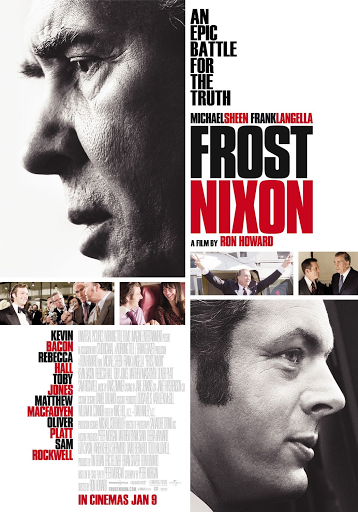
If there is a bogeyman in American politics, it will always be disgraced President Richard Nixon. Because, however divisive Donald Trump is, Nixon will always be the king who was toppled, the man some consider a crook and a war criminal, others a gifted politician and negotiator. The truth is somewhere, as always, in the middle – but what seems inarguable is that Nixon was a man of deep personal flaws, which contributed considerably to his fall. Peter Morgan’s play explored the complexities of Nixon’s character through his famous TV interviews with British talk show host David Frost, a man with a few chips of his own. Ron Howard takes what was already a fairly cinematic script by Morgan, and produces a smoothly professional, entertaining and very well acted film.

After Richard Nixon (Frank Langella) has been forced into resigning, he is in the political wilderness. Watergate engrossed the world, with hundreds of millions of people tuning in to follow every detail. Who in television could resist those numbers? Certainly not David Frost (Michael Sheen), who believes if he can secure an exclusive interview with Nixon he could have a television package that could pull in millions of viewers, make Frost a fortune, and catapult him into the front ranks of TV interviewers. Slowly the project comes together. But both participants have a lot to prove: for Nixon this could be a chance of redemption; for Frost to prove he is more than a chat show host better suited to grilling the Bee Gees than the President. With both men underestimating each other, who will emerge on top in the interviews?

One of Ron Howard’s greatest strengths as a director is his ability to elicit fine performances from good actors. This is the real bonus he brings to this faithful adaptation of Morgan’s award-winning play. He presents it with a highly skilled professionalism and a refreshing lack of distraction that allows the audience to focus on the acting and the dialogue, its real strengths. Frost/Nixon is sharply written – with Peter Morgan’s expected mix of careful research and dramatic licence (most especially in a late-night phone call between the two men before the final day’s filming) – crammed with fine lines, well drawn characters and fascinating insights into both politics and television.

Perhaps Howard’s finest decision was to ensure the two stars of the play (in both the West End and Broadway) were retained for the film. Langella and Sheen’s performances – already brilliant in the stage version, which I was lucky enough to see – are outstanding here, both of them completely inhabiting their characters. The comfort and familiarity between the two performers are crucial – and ensure that the vital scenes between the two characters carry an electric charge.

Langella brilliantly captures the physicality and voice of Nixon, but also finds deep insights into the President’s tortured soul. He communicates Nixon’s sense of inadequacy and bitterness, his resentment at having to fight all his life for things others have been gifted. He balances this with Nixon’s pride and paranoia that constantly leads him to cheat others first. Langella’s Nixon, lost and bored in retirement, is desperate to regain his statue, but also tortured by a guilt and regret he can hardly bring himself to name. Under his robustness and confidence, lies deep shame and sorrow. It’s a brilliant capturing of perhaps the most psychologically complex leader America ever had.

Sheen is just as superb as Frost. As you would expect from an accomplished mimic, the voice is almost alarmingly accurate (he makes a better Frost than Frost did!). But just as insightful is his understanding of Frost’s psychology. Just like Nixon, Frost is a hard-working lad from a poorer background who has had to fight for everything he has. Sheen’s Frost is a phenomenal hard worker – producer, financier and star of his own career – who works hardest of all to appear an effortlessly confident dilettante. Sheen’s Frost balances immense pressures – facing personal and financial ruin – with an assured smile, keeping every plate spinning by never allowing a moment of doubt.

It leads into fascinatingly different attitudes to the interviews themselves. Nixon prepares in detail – and determines his best strategy is long winded answers that present his case and prevent attack. Frost is so focused on delivering the interviews that he sacrifices his actual interview preparation (certainly more so than he did in real life). Morgan uses the conventions of boxing dramas – corners, breaks between ‘rounds’, advice from their trainers – to capture a sense of gladiatorial combat.

However, the play is more complex than this. The reason why Frost struggles to land a glove on Nixon in earlier interviews on his domestic and foreign policies is that Nixon genuinely believes he is in the right – but (perhaps as Frost understood) the final interviews based on Watergate will see a more vulnerable Nixon as on that subject he knows he’s in the wrong. I suspect the real Frost knew that to get to Nixon on that final topic, he needed to be ‘softened up’ first to feel comfortable and produce a revelation.

Because the film is refreshingly positive in its view of television. A medium that films often attack for being trivial and boiling things down to soundbites and snippets, here acknowledges the strengths that can bring. A single snippet of an apologetic and crushed Nixon is worth thousands of words – and small moments can turn a TV programme from a failure to an event. Howard uses the power of the close-up at these moments to demonstrate how TV can zero in with a merciless gaze on a single moment. It’s a defence of the power of TV and its ability to reduce things down to moments.

Howard’s understanding of the strengths that lie at the heart of the play – and to tell the story simply – is what makes an already cinematic play translate wonderfully to the screen. With Langella and Sheen outstanding (with the supporting cast all equally excellent), the film entertainingly demonstrates the preparation and delivery of the interviews, while offering shrewd psychological insights into two men who had a lot more at a stake – and in common – than at first appeared. Professional, handsome and captivating, this is Hollywood movie making at its best.

Raiders of the Lost Ark (1981)

Raiders of the lost ark header
Harrison Ford goes in search for treasure in Raiders of the Lost Ark

Director: Steven Spielberg

Cast: Harrison Ford (Indiana Jones), Karen Allen (Marion Ravenwood), Paul Freeman (René Belloq), Ronald Lacey (Major Arnold Toht), John Rhys-Davies (Sallah), Denholm Elliott (Dr Marcus Brody), Wolf Kahler (Colonel Dietrich), Anthony Higgins (Major Gobler), Alfred Molina (Satipo)

Indiana Jones is now one of the most beloved – and instantly recognisable – film characters ever created. So, it’s strange to think that Raiders of the Lost Ark was released to such little fanfare. That soon changed when the film came out. In some cinemas it was so popular it played for the whole year. It became a box-office smash, turned Harrison Ford into Hollywood’s leading movie star for the next 20 years, and made Steven Spielberg Hollywood’s leading director. And it did all that because I’m not sure there is a more entertaining, tightly made, funny, thrilling and (at times) scary adventure film out there. Spielberg and producer George Lucas may have wanted to make a film that aped B-movie adventure serials – but they ended up reinventing an entire genre.

It’s 1936 and the Nazis are in search of occult relics. Their latest target is the Ark of the Covenant, which Hitler believes will make his armies invincible. What chance is there of stopping him finding it? Well obviously the US government must put its trust in Professor Indiana Jones (Harrison Ford), one of the world’s leading archaeologists who also (fortunately) is pretty handy in a fight. Not only that, but his ex-girlfriend Marian Ravenwood (Karen Allen), daughter of his former mentor, holds one of the keys to finding the Ark. Indy and Marian end up on an adventure that crosses continents, taking on the ruthless Nazis and mixing with profound mysteries that man is not meant to know.

Hollywood wasn’t happy about Spielberg making the film. His previous film – the war comedy 1941 – had bombed, losing millions. The studio was insistent with producer George Lucas: if he wanted to see his dream of making an old-fashioned B-movie with his friend Spielberg come true, then he would need to stick tightly to a budget. After all, Spielberg had a reputation for delivering films overtime and overbudget. Our heroes stuck to this deal – and Spielberg has said it was a blessing, as it forced him to keep the film lean, tight and, above all, free of indulgence. Spielberg’s direction is perfect, so good in fact that he set the template for nearly all big-budget directing (in terms of tone, pace, mood and tempo) to come. Every action film since owes something in its DNA to Raiders.

Raiders is far more entertaining – and brilliant – than it has any right to be. It’s effectively a series of set-pieces, threaded together by screenwriter Lawrence Kasdan into a plot. Kasdan’s dialogue though was spot-on – like the film, lean, tight and perfectly focused. With exceptional brevity and focus it brilliantly creates a small core of characters, and then gives them room to bounce off each other. Its dialogue is quotable, fun and punchy. He – with Lucas and Spielberg – also crafts a central character who is flawed but deeply likeable, and a heroine who is independent and dynamic. The script is a big part of the reason why the film is a success – it makes us care deeply for the characters as they get involved in the death-defying stunts and action set pieces that make up a lot of the film.

And we don’t follow any character more than Indy himself. Thank God Tom Selleck had to withdraw at the last minute. George Lucas had resisted casting Harrison Ford as he was worried about the overlap with Han Solo. But the part fits Ford like a glove. Sure, it comes from the same wheel-house as Solo – although Indy is more taciturn, intellectual and a degree less cocksure than Solo, more a man reluctantly forced into danger than a swaggering pirate – but Ford’s skill is faultless. Ford has an everyday quality to him, and he brings a world-weary tiredness to Indiana. He has the confident grin, but he’s just as likely to see that switch to concerned desperation (there is a perfect moment of this in the opening sequence, when the vine he is grasping on a cliff top suddenly works loose). He may be a bit of a rogue (not averse to shooting a swordsman) but he’s also a good man, with the street smarts of a ruffian, who is frequently exasperated by the errors of his sidekicks. This is the sort of man that men want to be and women want to be with – an impossibly difficult trick to pull off.

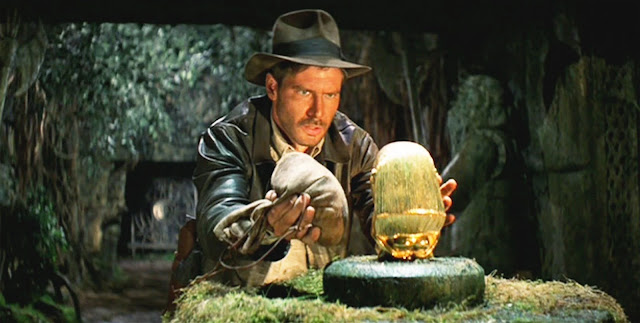
We relate to Indy because he’s vulnerable. He’s an underdog. The outstanding opening sequence – basically a little mini-movie in itself – showcases this. As Indy heads into a hidden temple for an idol (dodging spiders, bottomless pits, arrows from walls and most famously a huge boulder – a stunt Ford did for real) we get his entire character showcased. He’s astute, resourceful, trusting (sometimes too trusting) and ingenious. But he also takes a hell of a physical pounding, gets scared and above all goes through huge danger only to end up empty-handed. And of course, we find out he can cope with all this, but definitely not snakes (is there a better action set-piece punch line than “Grow a little backbone, will ya!”). It sets the tone for the rest of the film – in fact with the first five minutes alone, Raiders is already better than 99% of all other adventure films.

But then this is a director working at the top of his game. All the elements come together perfectly here: Spielberg always knows when to keep the tempo up, cuts the action superbly and also presents us with a brilliant mixture of tension, excitement and awe. He and Lucas brilliantly understand the power of images – there is a reason why a rolling boulder has become part of cinema’s language. The design of Raiders (one of its five Oscars) is absolutely perfect. Nothing like these temples could really have existed in real life – but as an evocation of 1930s adventure serials they are perfect. Mix that in with that brilliant sound design (those whip cracks for staters) and John Williams’ majestic score (from the classic Indy march to the haunting strains that tie in with the Ark) and this film is a masterclass for affecting the senses.

Then those set-pieces are told with just the right balance between thrills and wit. Again, Harrison Ford is a big part of this: he’s never smug, his trademark furrowed brow suggesting stress as much as his grin communicates relief at surviving. The truck chase – which sees Indy move from horse to truck, to under a speeding truck to back in the driving seat, half the time with a bullet in his arm – is a masterclass in thrills and superb editing. It’s such damn good fun that the film even gets away with a nonsensical beat where a car-load of Nazis is pushed off a huge cliff (the first and last indication that we are anywhere near a cliff in the whole scene!). Just like the opening sequence our hero’s combination of ingenuity, never-say-die determination and vulnerability is what makes it compelling (the Williams score also plays a huge part in building both the excitement and the triumph).

The whole film is a series of triumphant set-pieces. Spielberg also tinges the film with just enough darkness as well. The Nepal gun battle carries a real sense of danger, Indy’s fight with a tough Nazi air mechanic culminates in a quite gruesome death (although the fight beforehand has plenty of wit to it, as Indy is hopelessly outmatched physically by this giant). That’s all before the film’s famous closing sequence as the Ark finally opens up to reveal the power of God – bad news for the assembled Nazis crowded around it. The face-melting horror (and it’s hard to imagine any action adventure film doing something this horrific today) is impossible to forget, brilliantly executed and carries just the right amount of dread.

The darkness though is counter-balanced throughout by sly wit and a sense of fun. Wonderful jokes – from Major Toht’s nunchucks that become a coat hanger to an exhausted Indy responding to Marian’s kisses by falling asleep – pepper the script. The cast are fabulously chosen. Karen Allen is perfect as the independent Marian. Paul Freeman is chillingly austere and charmingly amoral as Indy’s rival Belloq. Denholm Elliott’s Marcus Brody is excellent as an older, wiser version of Indy very different from the comic buffoon he would become. The same can also be said for John Rhys-Davies Falstaffian but shrewd and loyal Sallah.

Raiders of the Lost Ark sees every element come together perfectly. Spielberg’s direction – the film did come in on time and on budget, going on to be the biggest success of its year – is completely perfect. Ford creates a character who from his first appearance is iconic (the zoom to introduce him is a wonderful tip of the hat to John Wayne’s classic entrance in Stagecoach – continuing the homages, the final shot is also a lovely nod to Citizen Kane). Every action set piece is a brilliant mix of thrills, danger, triumph and even a touch of horror (be it gruesome deaths or dreadful beasts). It’s a film that can not fail to entertain, raise a smile – and still have you hiding behind the sofa at points. Lucas and Spielberg wanted to make a film that would remind them of the adventures of our childhood. They were so successful that their film ended up defining the childhoods of millions of us.