Category: Action film

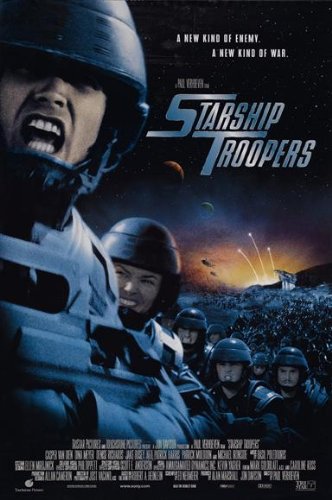
Starship Troopers (1997)


Earth’s military might goes up against space bugs in Paul Verhoeven’s militaristic satire

Director: Paul Verhoeven

Cast: Casper Van Dien (Johnny Rico), Dina Mayer (Dizzy Flores), Denise Richards (Carmen Ibanez), Jake Busey (Ace Levy), Neil Patrick Harris (Carl Jenkins), Patrick Muldoon (Lt Zander Barcalow), Clancy Brown (Sgt Zim), Michael Ironside (Lt Jean Rasczak), Seth Gilliam (Cpl Sugar Watkins)

Every so often, a film uses the tropes of bad films so well, and makes such effective satirical digs, that people initially miss the point of what the film is trying to do. This is pretty much what happened with Paul Verhoeven’s Starship Troopers. On the surface a terribly acted, deeply stupid sci-fi actioner about soldiers killing space bugs, Verhoeven actually created a sharply intelligent, wry satire on the very bombastic militaristic fascism it seems to celebrate. This satirical bent was missed not only by the critics, but also the producers of the straight-to-video sequels the film spawned.

In the 23rd century, mankind has reached the stars. But it’s done so by creating a militaristic, aggressive society, where the young are encouraged to join up to the military in order to become “citizens”. Leaving high-school, hotshot would-be-pilot Carmen Ibanez (Denise Richards) joins up – followed by her boyfriend Johnny Rico (Casper van Dien), in turn followed by Dizzy Flores (Dina Mayer), the girl in love with him. Joining the ground soldiers, Ricco and Flores find themselves as the point of the spear in mankind’s war with the Arachnids (the Bugs), a race of (it becomes clear) intelligent and savage insects on a distant planet.

Starship Troopers isn’t really like anything else: it might well be Verhoeven’s American masterpiece, the perfect mix of his love for extreme gore, violence and sex (filmed with lashings of comic colour and playful glee) with keen social satire, the very ideas he had explored in everything from Robocop to Total Recall. At first glance, Starship Troopers serves up the all-action, gun-toting space battle excitement you would expect from its genre. But Verhoeven not only ramps everything up to 11, he also laces the dialogue and action with a keen satirical bent that hammers home the underlying theme of how war essentially (as Verhoeven puts it) “makes fascists of us all”.

The action is regularly interrupted by propaganda newsreel footage, which stresses the importance of sacrifice for the military effort. The military training camps are almost obsessively focused on brainwashing and reducing the young people in them to cogs in the machine, with safety and welfare as very much a secondary concern (the death of a recruit in an exercise is a concern only because it shows careless leadership rather than because of the death itself). Everyone in the film seems to be a perfect physical specimen. Military lives are thrown away through a combination of arrogance (they’re just bugs, this will be easy!) and incompetence, but never with any feeling of responsibility or expression of regret (though the media works hard to adjust all casualty figures wildly downwards).

The film fires shots at everything in the industro-military complex. The foreign policy of this world is ludicrously aggressive and jingoistic. Despite the spin of the propaganda, it’s pretty clear that humanity has started the war itself. The army is like Hitler’s wet dream – sleek perfect bodies, suicidal self-sacrifice, a complete lack of questioning of any orders or directives, a willing acceptance of corporal punishment. This attitude of violence and unthinking aggression is at every point of society – newsreel footage shows children holding guns with grinning soliders, who then proceed to hand out live ammunition. Later children are shown stomping cockroaches, to cries of the “the only good bug is a dead bug!”. Trials are routinely praised for the brevity (one day between arrest, conviction and execution!). It’s a terrifying world.

What Verhoeven does so well is that, while aware of the multi-leveled nastiness of the world of Starship Troopers, he also makes it a pretty effective straight-war movie. It’s exciting and the action quotient is high. Just like the soldiers in the picture, it’s very easy to see the bugs as faceless opponents which it is easy to feel little regret over killing. The battle scenes are high scale – and of course blackly comic in their extreme gore and bloodlust. But you can still enjoy the action – which is why the film works so well as satire. And also perhaps why so many at the time missed the point. Verhoeven makes this as an enjoyable B-movie, by really effectively using the tropes of B-movies. He turns the trashy B-movie into a sort of art exhibit.

That surely also explains some of the casting. I’m not sure how many of the actors are in on the joke. Certainly Casper van Dien and Denise Richards seem blissfully unaware of the satirical bent under the film. These two wooden actors trot through the sort of banal, by-the-numbers plot arcs and dialogue that fill films like these, with van Dien’s jaw as chiselled as granite and Richards grinning no matter the content of the scene. But their honest woodenness is perfect for the film: a smarter actor would have wanted to tip the wink to the audience, but these guys play it totally straight without even a hint that they are aware of the message underneath.

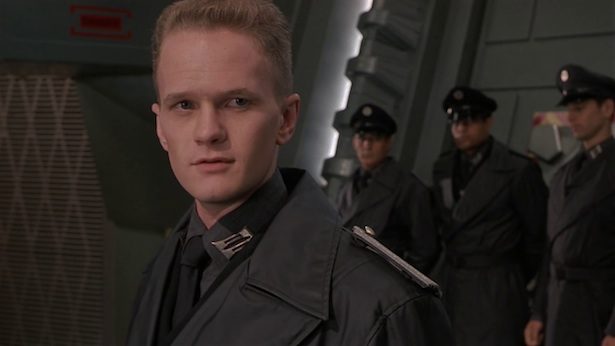
The more satirical element is left to other members of the cast: Michael Ironside has great fun as an almost absurdly fanatical solider, first introduced as a teacher lecturing his students on how the state must come before everything else and violence is the solution to all the world’s problems. Neil Patrick Harris tips a slight nod to the audience as a young man who rises so swiftly through the ranks that by the time we reach the end of the film, he’s a Gestapo-coated secretive colonel. He fits right into the grey militaristic, Nazi design of the military. You can watch all this stuff and simply enjoy the silliness – teenage boys will love this. And when they mature they’ll realise how awful the world it’s presenting is.


Starship Troopers is the ultimate military satire, a film that pushes every single fascist, militaristic society cliché to the limit. The news comes only from state propaganda. Military training involves brainwashing, maiming and slaughter. Education praises anger and violence as a solution to all problems. Verhoeven shoots this all with a grandeur, that pushes the celebration of militaristic violence to the max. 

It’s a film which is brave enough to make its militaristic sequences exciting, to shoot and cut this fascist wet dream with a stirring sense of excitement underpinning all the action. At the end you can celebrate the small victory our heroes celebrate in what is clearly going to be an ongoing war – until of course you realise it’s the victory of a Nazi organisation. The fascist world of the future may bring us sexual and racial equality – but that’s because it’s worked out everyone is needed to feed the grinder. It’s a super-smart satire film that disguises itself as a completely trashy action flick. It’s actually rather brilliant.

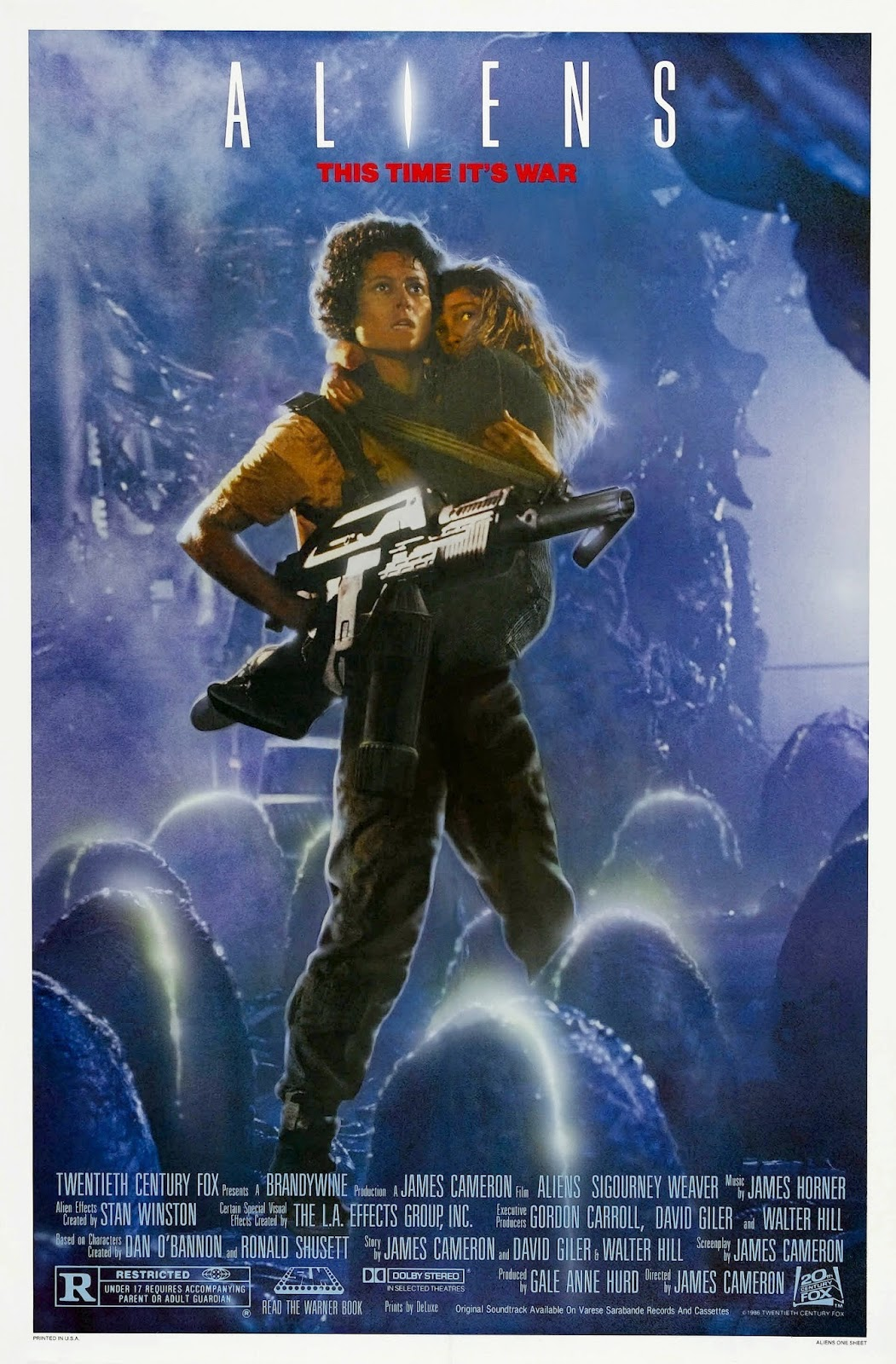
Aliens (1986)


Sigourney Weaver takes on the terrifying alien hordes in Aliens

Director: James Cameron

Cast: Sigourney Weaver (Ellen Ripley), Michael Biehn (Corporal Dwayne Hicks), Paul Reiser (Carter Burke), Lance Henriksen (Bishop), Carrie Henn (Newt), Bill Paxton (Private Hudson), William Hope (Lieutenant Gorman), Jenette Goldstein (Private Vasquez), Al Matthews (Sergeant Apone), Mark Rolston (Private Drake)

When any list of greatest-sequels-ever-made is put together, you get the familiar names: Godfather Part II, Toy Story 2, The Empire Strikes Back – but no such list is complete without James Cameron’s groundbreaking Alien sequel, Aliens. In fact, Aliens is so bloody good no list of great action films, science fiction films or even war films is complete without it. 

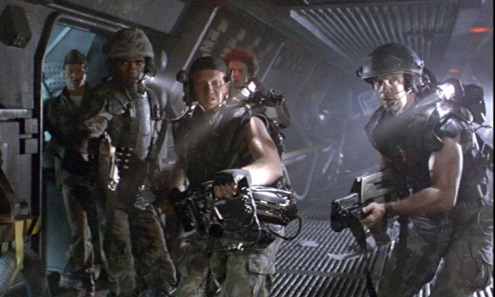
Set 57 years after Alien, Ripley (Sigourney Weaver) is awakened from hypersleep and returns to Earth. Her warnings of the hideous Alien threats on LV-426 go unheeded by the soulless Weyland-Yutani company – until all contact is lost with the terraforming colony there. At which point, company man Burke (Paul Reiser) recruits a troop of marines to head to LV-426 on a rescue mission. However, the over-confident marines find themselves on a devastated base with only one survivor, a traumatised young girl called Newt (Carrie Henn), and are quickly out of their depth fighting against a ferocious enemy whose tactics and motivations they don’t understand. 

Can this really only be the second large-scale movie James Cameron ever made? The guy may be (allegedly) a demanding, perfectionist dick, but you are left in no doubt of his mastery of genre film-making – or the thematic depth and emotional weight he can bring to what in the hands of thousands of other film-makers would have been a cheap-shock, monster-schlock thriller. Aliens is quite simply magnificent, one of the best Hollywood films you are likely to see. I’ve seen it I don’t know how many times, but it never, ever loses its impact. It’s always gripping, the action is always compelling and it never ever fails to scare and thrill you. 

Cameron’s trick is that he is so good at build-up. Nary a single Alien is seen on screen for the best part of an hour. Instead Cameron invests time in establishing the characters and their relationships. We begin to understand each of the marines as individuals. We feel our empathy for Ripley grow as we discover she has lost her daughter while in hypersleep, that she still feels traumatised by the events she witnessed, but that she has a strength of character, integrity and will that helps her weather the storms she has endured. You understand these characters so well – and the world that they inhabit – that when they start getting torn apart by slathering xenomorphs, it carries real weight and impact.

All the weapons the marines have and their tactics are carefully explained. We spend a good 15 minutes in the base itself before any Aliens arrive: the entire complex is quickly established as basically a huge haunted house. The wonderful production design makes it feel like the industrial zone on The Crystal Maze if a desperate hand-to-hand battle had been fought there (it’s also great that Cameron leaves what actually happened there to our imagination). Cameron has a mastery of small details – so the marines’ motion detectors have an electronic bleeping that increases in intensity as movement gets closer. It’s a brilliant tension builder that works time and again. The over-confident marines also makes their later fear all the more realistic and strangely affecting.

Then of course when things do kick off, it goes absolutely mental. Not for nothing is poor Hudson (a career establishing performance of bravado hiding fear from Bill Paxton) screaming “It’s game over man! GAME OVER!” after the first foray into the Alien nest. Paxton by the way has a perfect part in this film – every single line is endlessly quotable, largely because of his pitch-perfect delivery (I love “What so you mean they cut the power? They’re ANIMALS man!”), and despite being a cocky blow-hard, you end up loving him. Jenette Goldstein is similarly excellent as an almost impossibly hard-as-nails marine – she’s full of good advice, such as “Just nerve gas the whole fucking nest”.

The rest of the film is a helter-skelter of high octane, perfectly paced action. Every single sequence in this film is a stand-out, with stakes that feel impossibly high. Cameron really understood just how terrifyingly, inhumanly, remorselessly brutal the Aliens are – they are relentless and brilliantly single-minded, as well as having a ruthless cunning. They look and sound incredibly unsettling, and their darker, more animalistic design works wonders. It’s actually amazing, considering how this film is over 30 years old, that the Alien effects look better here than in Ridley Scott’s Alien: Covenant. Technically this film hasn’t aged a day – even the model work makes the film look real and lived in, rather than electronic and shiny.

James Horner’s score is sombre, unsettling and foreboding. It makes brilliant use of near ambient sound, before building into crashing, threatening crescendos in sequence with the action. Mix that in with the film’s brilliant sound design, and you’ve got a marvellous soundscape. The Aliens sound unnatural in their hissing fury. The military equipment is just the right side of futuristic and modern. The lighting is a dark mixture of shadows and reds. Everywhere seems unsettled. The editing is hugely influential – fluid, calm, brilliantly communicating the story and the geography of the action, everything.

Cameron’s greatest triumph, though, is to ground the story so well in a sense of family. The marines, for all their arguments and feuds, are a functional family unit – part of the reason William Hope’s useless Gorman struggles is because he doesn’t have the confidence to impose himself on such a tight group. But the real family theme is the mother-daughter relationship between Ripley and Newt. This is a bond that grows throughout the film, and feels really genuine and warm. It’s also a relationship that gives an emotional basis for all the actions we see. Cameron recognised that we can all relate to a basic family and that protecting this against the Aliens is what defines us in relation to them.

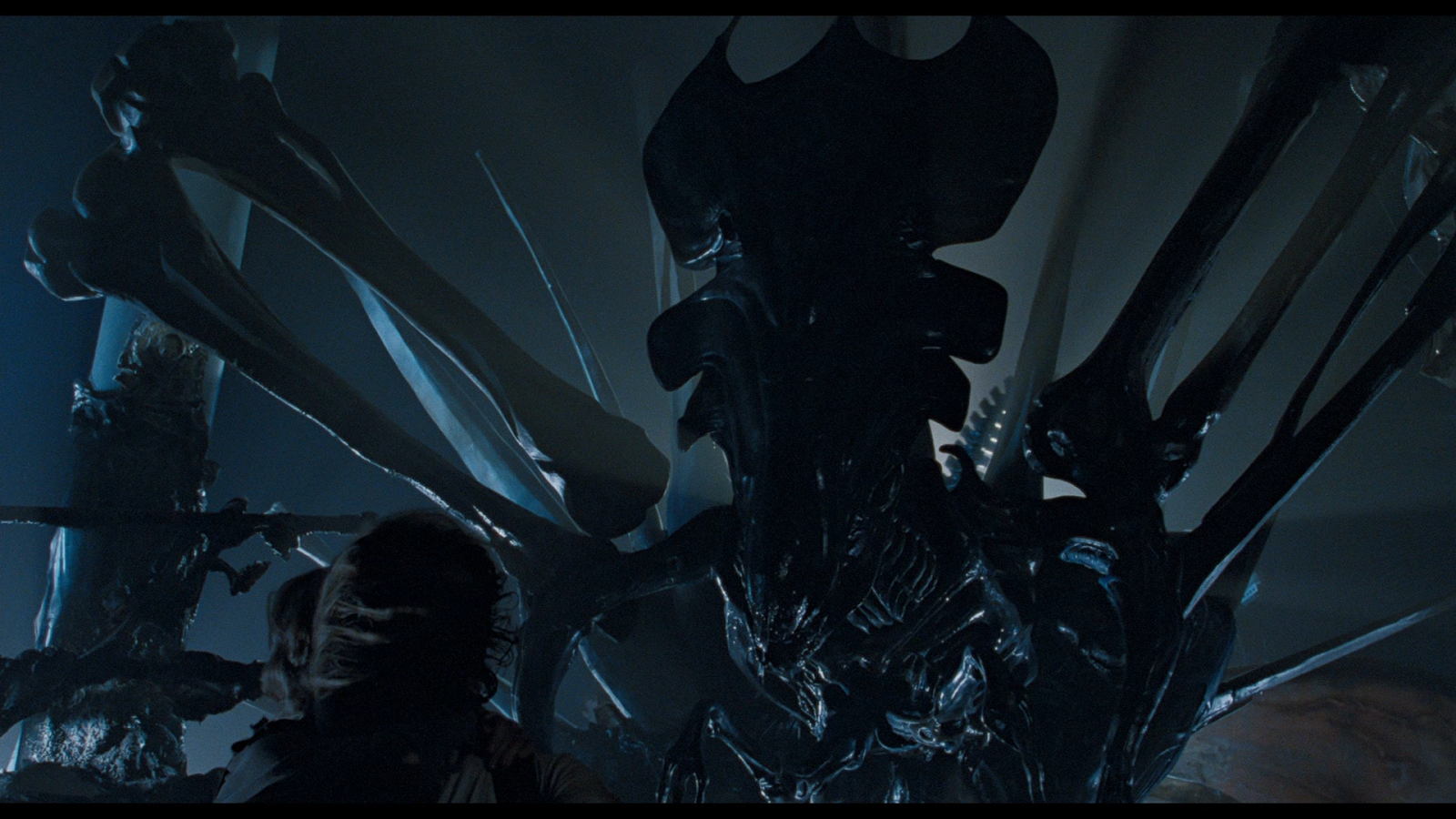
Of course, it also allows some clever thematic contrasts later when we are introduced to the Queen Alien. While it would be easy to blame this film for the tired cliché of the “Alien Queen” which we’ve seen time and time again, it’s used really well here. The Aliens may be conscienceless killers, but they’re still someone’s children: and we get a really neat contrast between Ripley and the Alien Queen’s determination to protect their children (as well as the best use of the word “Bitch” until Molly Weasley in Harry Potter).

The film’s secret weapon however is Sigourney Weaver’s outstanding performance in the lead. Not many actors get Oscar nominations for sci-fi or action films: Sigourney Weaver is one. And she deserved it because this is an iconic performance. Ripley isn’t an action hero – she’s strong and resourceful and she survives because of that. She’s not skilled at expressing herself or communicating – largely because it’s clear she’s suffering from PTSD. She completely fails to win over the corporate board with her story, and it’s clear the marines don’t hold her initial briefing in high regard. But even before they arrive on the planet, she’s beginning to win their respect. By the time of the initial encounter, her principled, strong-willed, sensible resourcefulness effectively makes her the expedition’s leader. 

Alongside this, Weaver does a fantastic job with Ripley’s growing maternal feelings towards Newt – the bond between these two is immediately clear, and her maternal protection of Newt becomes one of her core motivations. With Weaver, Hicks and Newt we end up with a strange family at the centre – a curious closeness that makes the film feel unique. It adds a strong emotional core to the film, and gives Weaver a depth to play with that enlightens her relationships throughout the film – she’s clearly got a strong protective feeling, and her desire to protect the marines is as much a part of this as her feelings for Newt.  It’s a terrific performance, full of feeling and strength. She fully deserved the Oscar nomination – arguably she could have won.

Aliens is one of those landmark films that never lets you down. Cameron’s direction of it is pitch-perfect, there’s hardly a fault in the whole film. It’s a masterpiece of design and construction and totally gripping from start to finish. It’s not only one of the best sequels of all time, as a purely enjoyable and affecting piece of cinema it may well be superior to the original. Even more than the first film, it made Ellen Ripley one of the great iconic characters of cinema. It will never get old and it’s never going to get tired. If you haven’t seen it, you really, really should.

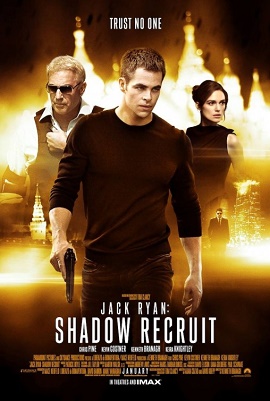
Jack Ryan: Shadow Recruit (2014)


Chris Pine comes out from behind the desk to head into the field in Jack Ryan: Shadow Recruit

Director: Kenneth Branagh

Cast: Chris Pine (Jack Ryan), Keira Knightley (Cathy Muller), Kevin Costner (Commander Thomas Harper), Kenneth Branagh (Viktor Cherevin), Len Kudrjawizki (Konstantin), Alec Utgoff (Aleksandr Borovsky), Peter Andersson (Dimitri Lemkov), Elena Velikanova (Katya), Nonso Anozie (Embee Deng), Colm Feore (Rob Behringer), Gemma Chan (Amy Chang), Mikhail Baryshnikov (Minister Sorkin)

Jack Ryan is the all-American, ordinary-analyst-turned-CIA Agent at the centre of the late Tom Clancy’s books. He’s been played by a range of actors, from Alec Baldwin to Ben Affleck via Harrison Ford, but his character remains the same – a boy scout, a man of principle and simple courage, pushed to do what must be done. He’s smart and quick-witted. Jack Ryan: Shadow Recruit was meant to serve as another reboot, to restart the Jack Ryan franchise after a mixed reception to Ben Affleck’s The Sum of All Fears. Sadly, it was another false start.

An origins story, it opens with Ryan (Chris Pine) studying at the LSE, before joining the marines in the wake of 9/11. He is critically injured in a helicopter crash, where he hauls two men from the wreckage while suffering from a broken back. Learning to walk again, he falls in love with Dr Cathy Muller (Kiera Knightley) and is recruited as a financial analyst by Thomas Harper (an effectively gruff but charismatic Kevin Costner) from the CIA’s Department of Making-Sure-We-Don’t-Get-Hit-Again (catchy name). Collecting financial intelligence while working as an auditor at a Wall Street firm, he notices some worrying financial deals from funds controlled by Russian tycoon Viktor Cherevin (Kenneth Branagh). Going to Moscow under the guise of auditing Cherevin, he and Cathy quickly find themselves embroiled in a dangerous terrorist conspiracy.

Jack Ryan: Shadow Recruit is decent fun. It’s also a rather impersonal and safe piece of film-making, that structurally and creatively feels like a 1990s action film reset in the 2010s. In a world of Jason Bourne, it genuinely feels a little old-fashioned and uninspired. It takes recognisable elements from dozens of action films and remixes them with a certain flair, but not a lot of imagination. It feels like the least “Branagh” film Branagh has directed, the camerawork being surprisingly restrained and contained considering his love of sweeping opera and dynamic, showy visuals.

But Jack Ryan is not a bad film, it’s just an enjoyably average one. It puts Ryan front-and-centre of the film, and Chris Pine really delivers in establishing Ryan’s old-fashioned principles of right and wrong, his sense of duty and his willingness to do what needs to be done when called. Pine also does a great job of demonstrating Ryan’s fear and panic as he finds himself increasingly out of his comfort zone – not least in a terrifying hotel bathroom brawl with an under-used Nonso Anonzie – in the aftermath of which he drops his mobile while trying to call for backup, and then can’t remember where the hell “Location Gamma” is when told to report there to meet a contact.

Of course, this incarnation of Ryan as an analyst rushed into the field doesn’t last, and the film succumbs from there to turning Ryan into an old-school action man, the sort of guy who drives cars at 85 mph through Moscow streets with ease, jumps on a motorbike and roars off in pursuit of a bomb with maverick self-assurance and takes on a trained assassin with a Die Hard-ish confidence. It’s a shame that the interesting character work of the first 2/3rd of the movie gets lost in the final third – but it’s another sign of the film delivering what it feels an action film should be rather than finding something unique and original.

At least Pine gets some good material to work with, which is more than can be said for Kiera Knightley. For all her American accent, this is Knightley at her most British Rose, her toothy, coy grin ever-present in every scene – and that’s about all she contributes. Not that this is entirely her fault, since Cathy is a character sketched on a fag packet, a successful doctor who obsessively worries that her husband is having an affair, making her feel weaker and needier than the filmmakers perhaps realise Later she exists to be a Damsel in Distress, and is then given a spurious involvement in identifying the villain’s target – which she identifies not because it is a medical facility she is familiar with, or perhaps somewhere she visited as a child or on a professional call-out, but solely because Her Man works there. (As if these CIA geniuses couldn’t work out that a financial terror attack on the US might be targeting Wall Street).


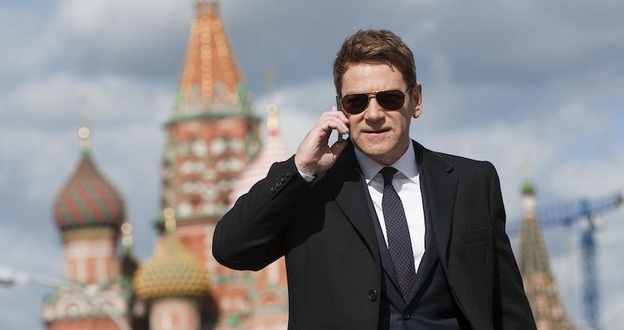
The villain’s plot is dully labyrinthine, but can be safely boiled down into having something to do with financial chicanery and a bombing attack, to destroy the US economy. Not that it really matters – it allows a suitable mix of booms, bangs and the sort of tense “breaking into the office to download the files against the clock” sequence that you’ve seen several times before. Kenneth Branagh cuts himself a bit short with Cherevin, a character who seems sinister but is really barely competent and hits every villain trope from pervy leering to executing an underling. We barely get any sense of his motivations or his background.

He’s also probably the only Russian nationalist in the world who is a Napoleon Bonaparte fan. Last time I checked, Napoleon was the enemy in the War of 1812 that redefined Russian history for the next 100 years. But then I’ve read a few Napoleonic era books, so I’m biased… This film clearly knows nothing about Bonaparte, with Ryan declaring at one point that the planned attack is “straight out of Napoleon’s playbook” – how Napoleon’s trademark fast movement and combined use of infantry and artillery, drilled to perfection, relates to a basic distraction strategy I don’t know but never mind. But then this is a dumb action film that name checks Napoleon because you’ve probably heard of him, rather than because it makes sense.

There is a lot to groan at, or say meh to, in Jack Ryan. But yet, I’ve seen it three times and it grows on me each time. Chris Pine is a very likeable screen presence, and the build-up of the film works well. Branagh directs it with a taut efficiency, even if it’s a film that lacks any real inspiration and feels like one for the money. But it presents its 1990s-style action beats with enough conviction and sense of fun that you kinda go with it. Yes it’s totally forgettable, but run with it and you’ll find yourself strangely charmed by it.

Pacific Rim (2013)


Idris Elba, Charlie Hunnam and Rinko Kikuchi are cancelling the Apocalypse in Pacific Rim

Director: Guillermo del Toro

Cast: Charlie Hunnam (Raleigh Becket), Idris Elba (General Stacker Pentecost), Rinko Kikuchi (Mako Mori), Charlie Day (Dr Newt Geiszler), Max Martini (Hercules Hansen), Robert Kazinsky (Chuck Hansen), Ron Perlman (Hannibal Chau), Clifton Collins Jnr (Tendo Choi), Burn Gorman (Dr Gottleib), Diego Klattenhoff (Yancy Beckett)

Film can be a beautiful and thought-provoking art-form. But sometimes, gosh darn it, you just want to leave the works of the great artists behind and watch a big, loud film in which giant robots hit giant monsters. Over and over again. In lurid, glorious, high colour detail. That’s pretty much the life and career of Guillermo del Toro. Make something like Pan’s Labyrinth. Then follow it up with something so wildly, tonally different you won’t believe it’s from the same guy: Pacific Rim.

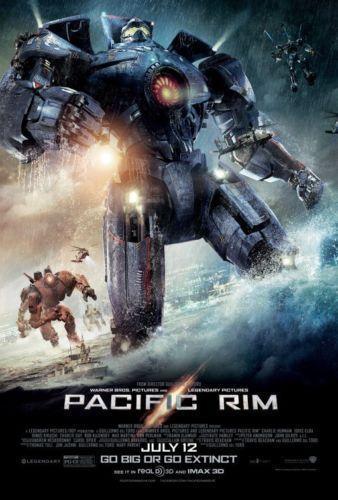
In 2013, huge monsters (Kaiju) emerge from an interdimensional portal at the bottom of the Pacific Ocean. As they destroy cities left, right and centre, mankind is pushed to the limit. Eventually they develop Jaegers – giant robots controlled by two pilots, whose minds are linked together and used to drive the Jaeger’s movements. In 2020, Raleigh Becket (Charlie Hunnam) leaves the Jaeger force, commanded by General Stacker Pentecost (Idris Elba), after his brother and co-pilot is killed by a Kaiju. By 2025, the world governments decide to cut the funding of the Jaeger programme – forcing Pentecost to call Becket out of retirement and team him with his adopted daughter Mako Mori (Rinko Kikuchi) to launch a final, desperate, assault on the portal with the few remaining Jaegers, in an attempt to stop the ever-increasing number of Kaijus for good.

Pacific Rim is loud. It is silly. Its plot is a collection of clichés and offcuts from other movies. Some of the acting in it is ludicrously bad, over-the-top, poorly accented or all three. It looks and sounds like a direct-to-DVD movie made on a massive budget. Yet, despite all this, it’s really, really good fun. The ultimate guilty pleasure. Deafeningly dumb, but somehow it sort of knows this, and it knows you know it, so it just gives you what you wanted when you sat down – bangs, bashes and silly dialogue. Maybe this all works because Del Toro is actually a real director: he can shoot this nonsense with a sense of flair and scale, and is confident enough as a storyteller to just accept he’s making a dumb film and doesn’t need to try and pile some spurious depth on it, but just run with the emptiness.

Pacific Rim gives you this: some truly sublime robot vs. monsters battling in a variety of beautifully shot locations, in particular downtown Hong Kong. I mean, who wouldn’t love seeing this smashy super-action? The robots basically look really cool, the monsters are really imaginative, it’s tonnes of fun. Of course the battles are silly, there is always “one more weapon” to use that is bigger and better than anything they’ve used before (so why not do that from the start?). Del Toro also shoots the fights with a surprisingly calm camera, that makes the action the frantic lead, rather than the normal thing you see in these films, with the camera flying around all over the place. They’re edited really well. The score is great. The battles don’t overstay their welcome, and the characters at the centre of the Jaegers are always kept front-and-centre. Who wouldn’t love them?

The plotline of the film has a B-movie directness, which del Toro manages to fill with some depth. It’s a film about co-operation and learning to work together. This should be pretty wearingly obvious – okay it is – but somehow it strangely moving in the film. The Jaegers literally need two people to work together so closely they share a mind to operate it. The whole Jaeger programme only works from intimate co-operation. Characters feud and argue – but the film is about them learning to overcome these differences and work together. The film hammers home the fatality rate of this war with kaijus so well, that you end up really caring for sacrifices and risks these people are running. When Jaeger pilots start dying, I find it actually rather moving in its brutal suddenness. 

At lot of this comes from the wonderful, hero-worshipping, film style del Toro uses. Look at shots such as when (in flashback) Idris Elba’s Penthouse climbs out of a Jaeger, framed by the sun behind him – he looks like some sort of ultimate hero. The Jaeger pilots all have their own distinctive themes, and are framed and shot with idealism and adoration. Sure their personal issues are the most rampant form of clichéd melodrama – but it’s sold with complete conviction, and told with such unabashed simplicity, that you end up caring for it. 

This is despite the fact that most of the acting is pretty below par. Idris Elba is the one major exception – the only one with the charisma to sell such basic plots as “dying of brain tumour” and to make chuckle worthy lines like “we are cancelling the apocalypse” sound like rallying cries, rather than seriously awful crap. Charlie Hunnam, by comparison, has nowhere near that level of charisma and Raleigh Becket is probably the most forgettable lead character you’re going to see in a movie like this. Robert Kazinsky is pretty awful as his rival Jaeger pilot (his accent is dreadful). Charlie Day and Burn Gorman are hit-and-miss as the comic sidekick scientists. Rinko Kikuchi is however pretty good – and with her “drift” memory loss she has probably the film’s most affecting sequence.

But this isn’t a film of subtle character work or sharp scripting. It’s got a B-Movie aesthetic, but it delivers it totally honestly. Basically, Guillermo del Toro is a good enough director to be comfortable with making a really, really good bad movie, Pacific Rim is deeply silly and stupid, but it is a lot of fun and its characters (despite their pretty forgettable or clichéd nature) are still people you really invest in. Del Toro pulls off a neat trick filming this, perhaps because the film is so sweetly honest, and unabashed, about what they are doing here. It’s got a heart-warming message about co-operation. It never feels exploitative. It’s got a childish sweetness about it, a real family robot basher. It’s the best bad movie you’ll ever see.

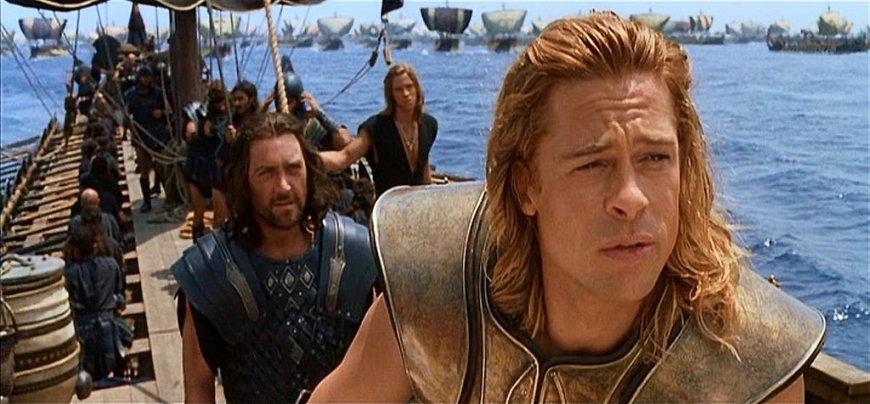
Troy (2004)


Brad Pitt sails into history and legend as Achilles in the misunderstood Troy

Director: Wolfgang Petersen

Cast: Brad Pitt (Achilles), Eric Bana (Hector), Orlando Bloom (Paris), Diane Kruger (Helen), Brian Cox (Agamemnon), Peter O’Toole (Priam), Rose Byrne (Briseis), Saffron Burrows (Andromache), Brendan Gleeson (Menelaus), Sean Bean (Odysseus), Julian Glover (Triopas), James Cosmo (Glaucus), John Shrapnel (Nestor), Julie Christie (Thetis), Garrett Hedlund (Patroclus), Vincent Regan (Eudorus), Nigel Terry (Archeptolemus), Trevor Eve (Velior), Tyler Mane (Ajax)

VERSION CONTROL: Some films are just vastly superior as Director’s Cuts. Troy is one. The longer cut of Troy,I can assure you, is a richer, deeper, more enjoyable film. So watch that one. I’m also spoiling The Illiad. For those who worry about such things.

When I was younger I loved the Greek myths. I had two or three books of them and I read them over and over again. I practically grew up knowing the whole story of the siege of Troy in intimate detail. This helped feed my love for sweeping epic films, with big casts, spectacle and themes. So it probably won’t surprise you to hear I love Troy. That I’ve seen it dozens of times. It’s the film I wish had existed when I was a kid, because I would have watched it again and again. I know it’s not perfect, but I can forgive it almost anything. 

In Ancient Greece, a peace treaty has finally been agreed between Sparta’s King Menelaus (Brendan Gleeson) and Priam (Peter O’Toole) of Troy. Priam’s sons Hector (Eric Bana) and Paris (Orlando Bloom) are in Sparta to seal the treaty – only for Paris to fall in love with Menelaus’ unloved wife Helen (Diane Kruger). When they elope – despite Hector’s fears for the harm it will cause Troy’s people – Menelaus’ ambitious brother Agamemnon (Brian Cox) sees his chance to cement his hold over the last corner of the Mediterranean by conquering Troy. But to do so he’ll need the help of the greatest warrior in Greece, Achilles (Brad Pitt), who cares only for his legend and hates Agamemnon. 

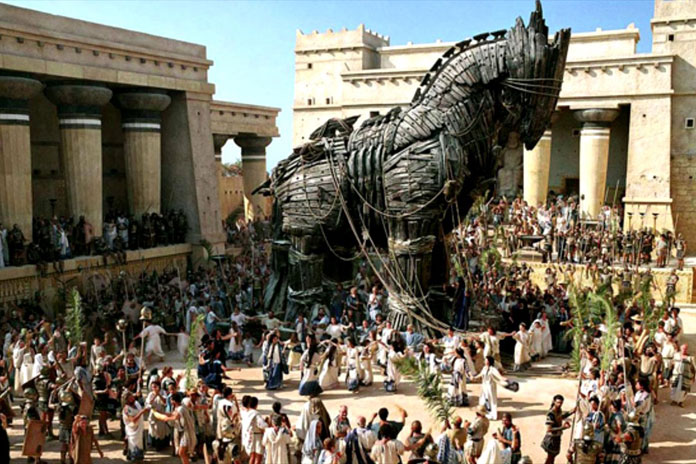
Directed with an old-fashioned grandeur by Wolfgang Petersen, mixed with an unflinching look at the blood and guts of war, Troy is a grand, cinematic epic that looks fantastic. The production and costume design are spot-on, and there is a great mixture of the “real” and the “special effect” in what you see on screen. It’s also got some cracking battle and fight choreography. The sword fight choreographers worked overtime on this one. The film embraces the grace and style of Achilles – he’s not the largest or strongest, but he has a pace, speed, intelligence and ruthlessness that allows him to duck, sway and constantly be one step ahead of his opponents. It doesn’t shy away from the brutality of his violence, and the camera never forgets the fallen.
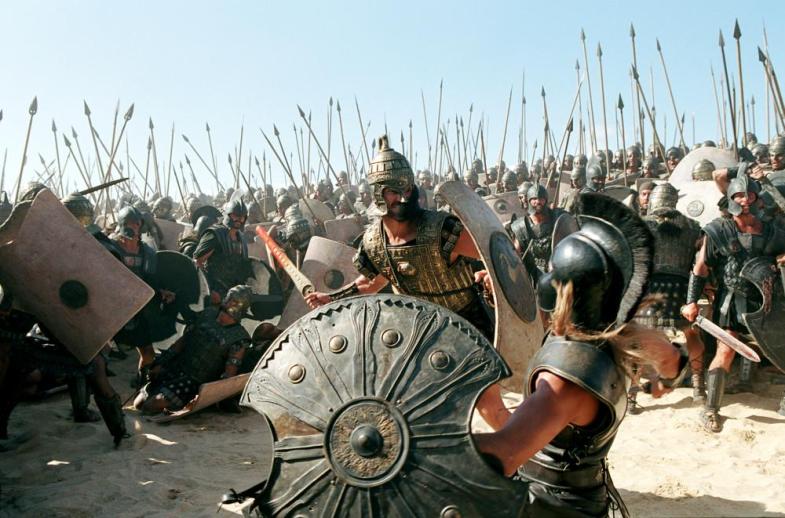
It’s a film that understands the impact of war. It makes us care about many of the characters – and frequently shocks us with senseless, sudden deaths, or devotes time to the grief of those they leave behind. Our hero Hector has an almost tortuous-to-watch lengthy build up to his final fight – and then the camera gives us a moment or two when he is fatally wounded to see the light start to go from his eyes before Achilles delivers the killer blow. It’s a film that moves the viewer, that excites us with action while letting us grieve the cost of war.
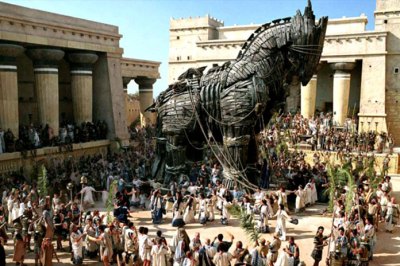
The script is also a reasonably decent adaptation of elements of Homer, remixed with a modern (God-free) twist – as if this was the “true” story legend has been spun from. The script is put together by Game of Thrones’ David Benioff, and has his recognisable mix of epic scope and noble principles, clashing with realpolitik.

So why was Troy rejected by so many people? Why was it so misunderstood on release? It’s a mis-sold and partly mis-cut story struggling to embrace its own implications. Maybe I’m reading stuff into it, but I feel like this is a different film than the marketing or filmmakers seem to have understood. 

Firstly, Achilles is (at least for the first two thirds) effectively the film’s villain. He has no interest in people, only a sociopathic wish to be remembered as a great warrior. He’s ruthless in combat and slaughters indiscriminately. He’s temperamental and emotionally stunted. Contrast him with Eric Bana’s Hector: a devoted family man, who values the lives of the people of Troy first and foremost. Hector is effectively reimagined from the source material as a very modern man – the audience surrogate, the hero we can relate to, compared to the greedy, rapacious Greeks.

The struggle the film has is its biggest star plays Achilles – and it doesn’t want to compromise his box office appeal. So it tries not to draw too much attention to this contrast, and avoids passing too much judgement on Achilles. So we struggle when Achilles and Hector fight – anyone with any sense is surely rooting for the guy with a wife who just wants to see his kid grow up, rather than the sociopath, even if he is played by a super-star. All the characters hammer home our distress at Hector fighting Achilles, by the fact all of them reckon he’s got no chance. There are moving farewells for Hector with his father, wife and son. Hard to sympathise with Achilles when he slays the film’s most sympathetic character and drags him in the dirt right?

Achilles only starts to develop humanity (and become a modern hero) when he hits rock bottom after killing Hector – and is shamed first by Priam’s humbling, controlled pain (a tour-de-force from Peter O’Toole) then by his slowly developing love for Briseis. From this point , Achilles fights specifically to protect others – and finally puts aside his longing for immortal fame to try and save Briseis from the slaughter of the sack of Troy. The film’s slightly muddled unwillingness to condemn Achilles earlier, and its desire to celebrate him at the end, muddies the water. But there is a clear character arc slowly developing of Achilles becoming a humbler, more humane man.

As Achilles doesn’t look that good opposite Hector, the film turns Agamemnon into a ruthlessly ambitious, vain and greedy tyrant (played with a lip-smacking, roaringly enjoyable style by Brian Cox). Agamemnon (like many of the Greeks) is a modern politician – he wants to fashion the Greek city states into a single nation (sure one under his control, but it’s a more modern idea). The film, however, uses him to make Achilles desire for lasting fame feel more sympathetic. We all hate hypocritical politicians and cowardly bullies, right? And we all prefer the romance of the individual fighter uninterested in worldly affairs, right? Ergo, says the film, if we don’t like Achilles because we prefer Hector, we can also like Achilles a bit more if we don’t like Agamemnon. It’s clever structure in a way – but because the film doesn’t completely commit to it, it gets a bit lost in the telling.
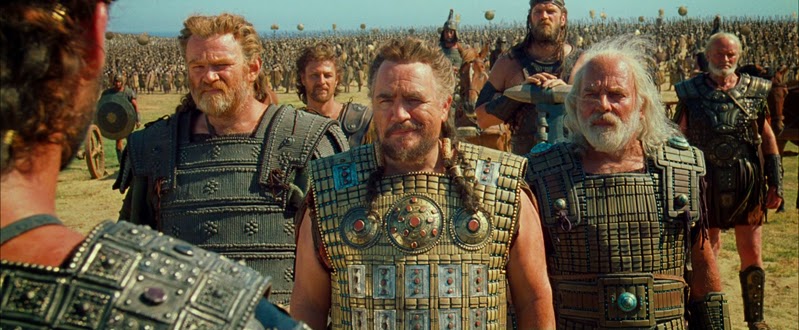
The film’s attitude to Agamemnon is reflected in its favouring of Trojans over Greeks. While the Greek commanders squabble, or engage in political chicanery, the Trojans have an old school nobility. The film is enamoured with Priam. He’s played by Peter O’Toole in his grandest style (and O’Toole, though he can’t resist a bit of ham here and there, is very good). But Priam is in fact a naïve idiot, who makes a mess of everything. He’s incapable of accepting the realities of the world – his decisions lead to disaster at every turn. He may be overtly noble, honest and full of integrity – but like Ned Stark in Game of Throneshe’s completely out of his depth in Agamemnon’s ruthless world. Achilles may call him a “far better king”, but by any modern standard, Priam is in fact a terrible king, who makes all his decisions based on his regard for the Gods, rather than a claim appraisal of the situation.

These two reasons are why the film struggles. The film despises the Greeks but wants us to love Achilles – while at the same time having him kill without compassion, including our main audience surrogate character. It wants us to aspire to the romantic ideals of Priam and the Trojans – even while it demonstrates time and again that these ideas are hopelessly misguided, and completely wrong. It goes part of the way to accepting these contradictions, but it can never quite bring itself to villainise Brad Pitt, or condemn the noble Peter O’Toole.

I like to watch it my own way, balancing these contradictions – and I think if you do that (like watching the TV show The Tudors if you accept what the show can’t: that Henry VIII is the villain) then the film is really rewarding, full of interesting ideas and packed with cracking scenes.

It also allows some wonderful performances. Brad Pitt is, I suppose, an odd choice for Achilles in many ways – and he seems a bit bound in by his 1950s-Hollywood-Epic-Transatlantic accent. But he really looks the part, and I don’t think he’s afraid to let Achilles look bad – and he sells his conversion into a more heroic figure. Eric Bana is terrific as Hector – warm, engaging, hugely admirable. He has a world-weary tiredness to him – while Pitt’s Achilles is as cold as marble, Bana’s Hector looks like he has the cares of the world on his shoulders, tired already of the violence and horror he has had to endure.

There are tonnes of excellent supporting performances. Sean Bean in particular is so good as the wry and infinitely wise Odysseus you will be wishing they had made an Odyssey sequel so you can see more of him. Cox and O’Toole are rather good (bless, they are clearly enjoying themselves) as flip sides of the same coin. Byrne is affecting as gentle Briseis. Brendan Gleeson makes a fiercely bullying Menelaus. I’m not sure Saffron Burrows has ever been better than here. James Cosmo and Nigel Terry shine in smaller roles.
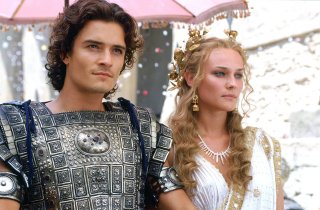
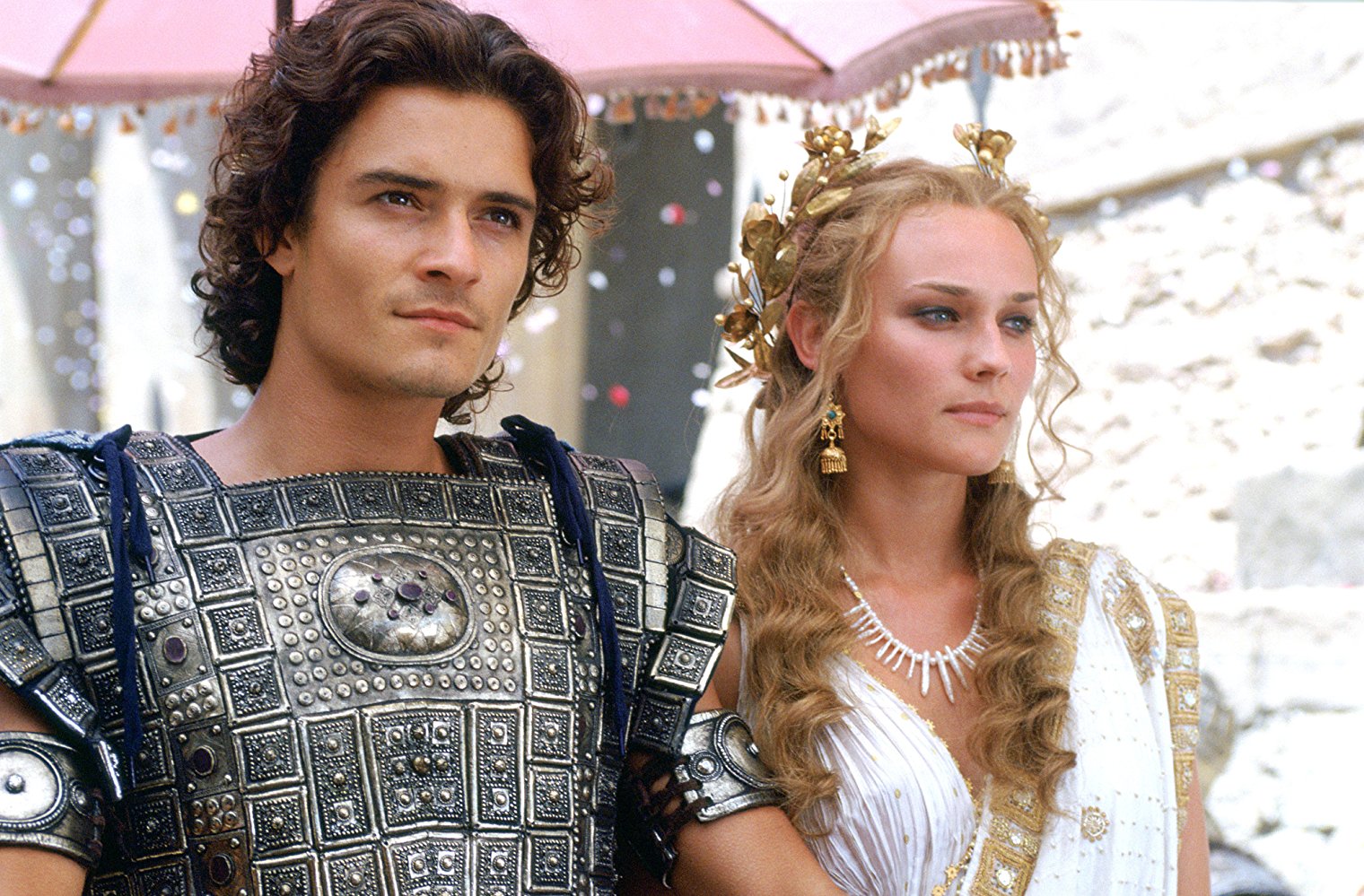
Poor Orlando Bloom struggles with a part that is hugely difficult – Paris is basically a spoilt coward. The film makes great play of Helen (a pretty good Diane Kruger in a near impossible part as the most beautiful woman, like, ever) being attracted to Paris precisely because he’s more of a romantic, and not interested in violence – but he tends to come across more as a thoughtless playboy, who lands everyone in trouble. It’s tricky for Bloom as this is the purpose of the film – and in many ways he’s very good casting for it – but that’s partly because he’s not the most persuasive of actors. He has a slight redemption arc – but I’m not sure Bloom as the presence to really sell it. 

I can’t believe how much I’ve actually written about this– but, for all its faults and its confused structure  I actually rather deeply love it. Maybe it’s tied in too much with my love for Greek myths. Maybe I love these all-star character actor epics. But I think it’s a film that puts a lot at stake for its characters – and really makes you invest in them – and that draws some fine performances from its cast and frames them all in a brilliant vista. It’s crammed with some terrific scenes. It never fails to entertain me. It’s almost a go-to film. I’ve seen it dozens of times and yet it never tires for me. I love it. In many ways it’s one of my filmic (forgive me) Achilles’ heels.

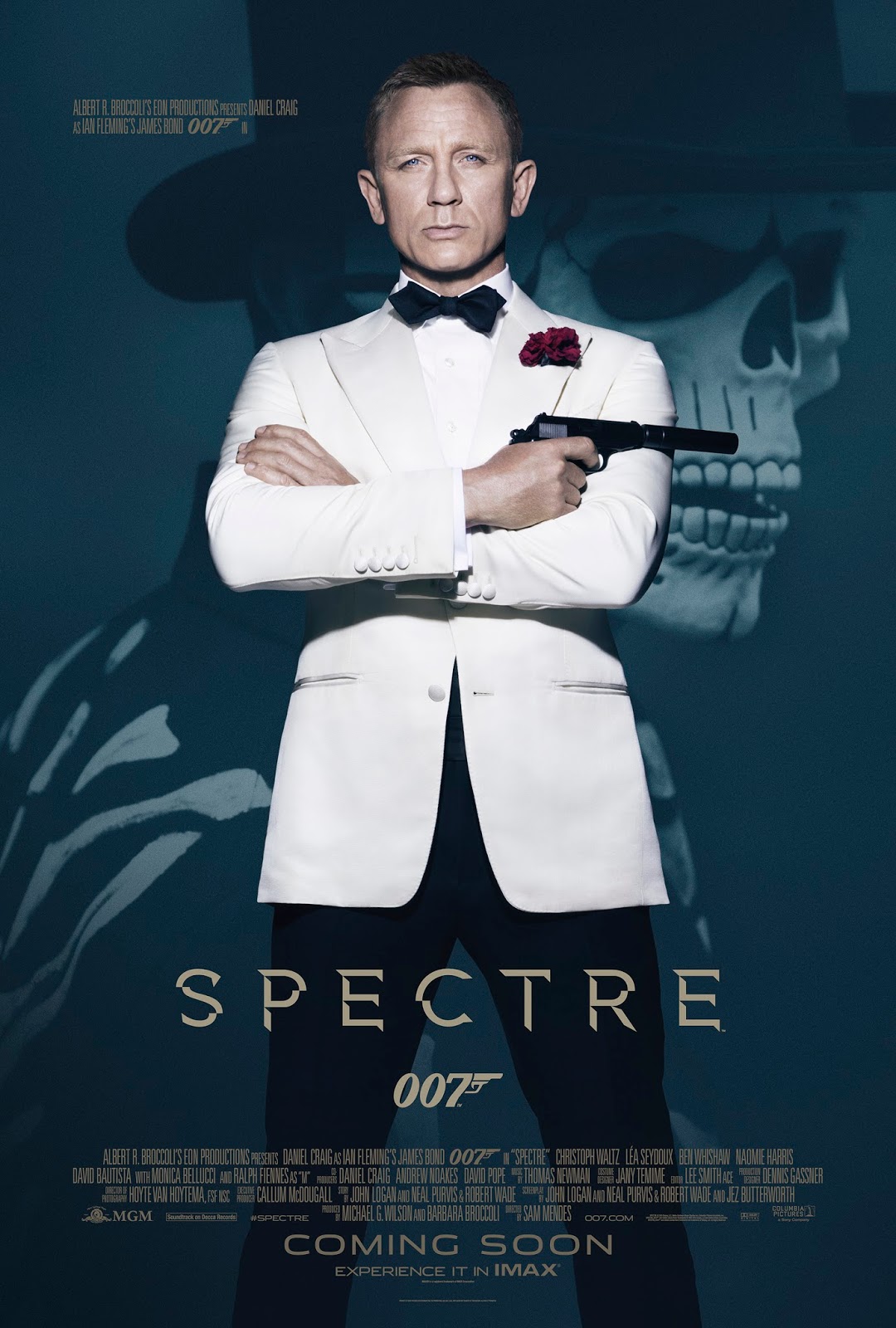
Spectre (2015)


Bond heads into danger in thematic mess Spectre

Director: Sam Mendes

Cast: Daniel Craig (James Bond), Christoph Waltz (Franz Oberhauser/Ernst Stavro Blofeld), Léa Seydoux (Dr Madeleine Swann), Ralph Fiennes (M), Ben Whishaw (Q), Naomie Harris (Eve Moneypenny), Dave Bautista (Mr Hinx), Andrew Scott (Max Denbigh), Monica Bellucci (Lucia Sciarra), Rory Kinnear (Bill Tanner), Jesper Christensen (Mr White)

SPOILERS: Okay, surely most people have seen this by now – but just in case I’m going to spoil the big twist of Spectre. It is, by the way, a really, really, really stupid, annoying terrible twist. So you won’t mind. But just in case you do… Spoilers.

In 2002, Austin Powers: Goldmember had, amongst its ridiculous plotlines, a reveal that Austin Powers and Dr Evil were, in fact, long lost brothers. It was the crowning height of silliness in the franchise, the ultimate punchline to Mike Myers’ James Bond spoof. Well the wheel comes full circle: in 2015, Spectre’s shock plot reveal was – James Bond and Ernst Stavro Blofeld – wait for it – they were only – guess what! – raised by the same man, so basically sorta brothers! Who would have thunk it? The world’s greatest spy and world’s greatest villain both grew up together. Yup, the Bond producers actually thought this was a good idea. Yup they were completely wrong.

Spectre opens in Mexico with Bond (Daniel Craig) preventing an attack on a football stadium – although this attack basically involves trashing an entire city block. Benched by M (Ralph Fiennes), he investigates the shadowy organisation known as Spectre, which he discovers is run by Franz Oberhauser (Christop Waltz), a man Bond seems to know a great deal about. Meanwhile M engages in Whitehall battles with the intelligence director Max Denbigh (Andrew Scott) and his sinister “Nine Eyes” programme, designed to control all surveillance in the developed world.

Spectre is a film that really falls apart in its final third, as ridiculous revelation piles on top of ludicrous contrivance. After Skyfall, we all wanted Sam Mendes to come back to do another Bond film, but this makes every single mistake that film avoided: self-conscious,  silly in the wrong way, takes itself way too seriously, despite its best efforts it doesn’t really do anything new, and attempts to build a “Bond universe” around a franchise that works because it keeps reinventing itself in stand-alone films. It’s the Bond producers attempt to do a Marvel film – and it ain’t pretty. Did we need to create some sort of tenuous link between the Craig-era Bond movies? Did we need Blofeld and Bond to have a “very personal” connection? No we massively did not.

Mendes shoots the action with a mock grandeur that seems to be serving other things than the plot. Critics fawned over the long shot that follows Bond through the Day of the Dead street festival, through a hotel, out of a window, across a series of roofs and into the first action scene. But for me, it’s a self-conscious, look-at-me piece of trickery. It’s an air of pretention that runs through the whole film: it’s a film that wants you to think it’s making Big Points around Bond’s psychology and background, but keeps running aground because it goes about them in such a ham fisted way, particularly when compared to Skyfall’s subtlety and willingness to look at Bond’s vulnerability.

Most sequences in the film feels strangely flat and lifeless. There is a surprisingly sterile car chase through the streets of Rome between Bond and Hinx. The opening montage in Mexico just never really grips – maybe because it’s not clear what’s going on, maybe because it feels so self-consciously grandiose. The film’s tone is over the place – there are lashings of Moore. Bond falls through a collapsing building only to land on a sofa. During the car chase, Bond hits a button only to have some Frank Sinatra start playing on the radio. Craig does at least go through the comedy with a breezy lightness, though it sits oddly in a film that features a villain shooting himself in the head, and a guy having his eyes gouged out. 

The whole investigation into Spectre just isn’t interesting. Because the film has been written with such a self-conscious eye on fandom, it never gives us a reason within the film to care about it at all. Spectre don’t seem to be doing anything, other than being a shady organisation making money. We don’t get told why Bond is invested in it or Oberhauser until late in the day. The film pins everything on a “beyond the grave” video from Judi Dench’s M to give us a reason for chasing this plot. But nothing feels at stake and we don’t get told about Bond’s personal stake in it until almost the end – and even when we do, Bond doesn’t really seem to give a toss about the reveal.

Ah yes. The reveal. A few years ago, Star Trek Into Darkness had a terrible, nonsensical reveal around Benedict Cumberbatch’s character – turns out he was Khan. This was met with derision because (a) it had no impact on the wider viewers who didn’t know who Khan was, (b) it felt shoe-horned in as fan service, and (c) it had no impact on the characters in the film who’d never met Khan before. So who cared? He might as well have said “My real name is Fred”. This was the case with the Blofeld reveal here. The name means little to non-Bond fans. And it means naff-all to Bond. We’ve never heard it mentioned in the film before. It comes out of nowhere. It means nothing – it’s dropped into the film to get a cheer at comic con – so nakedly so, that it just annoyed people.

It doesn’t help that the whole “secret brothers” thing is a really, really dumb idea. I mean so mega-dumb it was, as mentioned, the final ridiculous flourish of Austin Powers. How did they look at this and think “yes”? Again it feels like retreading Skyfall ground – this already had given us interesting insights into Bond by having him return to his childhood home. But what did we learn about Bond here? Sweet FA. Whatever iconic status Blofeld had is immediately undermined by making him a pathetic envious child. Christoph Waltz’s bored performance doesn’t help either.

And as the film doesn’t spend any time establishing Blofeld or Spectre doing terrible things, it has to make a series of tenuous connections to Craig’s other films to ludicrously suggest that everything that happened in those films was Blofeld’s evil plan. This is so clearly bollocks, retroactive adaptation that it just makes you snort. Skyfall’s villain was very clearly established as a personally motivated lone-wolf – it makes no sense that he was sent by Blofeld. The first two Craig films established a secretive organisation, but it was framed very much as corporate ruthless villainy – the idea that it was an organisation established to destroy Bond is nonsense.

The reveal that Blofeld wants to destroy Bond personally makes most of the film itself make no sense. If Blofeld wants Bond to come to his base to exact revenge for childhood wrongs, why does his muscle-man Hinx spend the film so aggressively trying to kill him (especially in the film’s stand out action sequence, a no-holds-barred scrap on a train)? It’s almost like they were making it up as they go. Even Quantum of Solace held together better plotwise than this (ironically QoS goes almost completely unmentioned in Blofeld’s evil schemes – probably because it’s a bad film). The final confrontation between Bond and Blofeld strains credulity and patience – reaching for a personal rivalry that hasn’t been established by anything other than fans’ vague memories of watching You Only Live Twice on a Sunday afternoon years ago.

I’ve not mentioned the Bond girls either. The film tries to make a “strong female character” in Léa Seydoux’s Madeline Swann, but she is a plot device rather than a character, with no consistent personality, solely there to be whatever the plot requires. When it needs her to be a gun-toting, self-reliant, go-getter who sasses Bond, she is. When it needs her to be a damsel in distress she forgets all that firearms stuff and waits for a man to save her. When the plot needs her to express total devotion for Bond she does. When it needs her shortly afterwards to leave him, guess what, she does that as well. She is a character who makes no sense at all. It doesn’t help that she looks way too young for Craig. The wonderful Monica Belluci is given a thankless role of informant and brief sex partner for Bond – she of course was far too close to Craig’s age to be the main Bond girl. Just as he did with the shower sex scene in Skyfall, Craig manages to make this seduction seem inappropriate and pervy – it’s not his strength.

Lea Seydoux. She is, by the way, 17 years younger than Daniel Craig. Just saying.

 The stupidly unclear, dully predictable “Nine Eyes” plot doesn’t make things any better either. One of Skyfall’s neatest tricks was to cleverly mislead us about Ralph Fiennes’ Gareth Mallory, setting him up as an antagonist to slowly reveal him as an ally. This film attempts an inverted version of this trick with Andrew Scott’s Max Denbigh. Problem is, Scott is at his most softly-spoken Moriarty sinister – you are in no doubt he’s a wrong ‘un from the first frame. What would have worked is making Denbigh Bond’s ally. This would make the reveal of his villainy at least a surprise for some people in the audience. As it is the whole reveal is no shock what-so-ever. The whole plot starts to feel like plates being spun in the air, a way to give Fiennes, Kinnear and Harris something to do on the margins of the film.

I mean – he just LOOKS like a villain doesn’t he?

Okay Spectre is well filmed. It’s got some good scenes. Ben Whishaw continues to be excellent as Q – and gets loads to do here which is great. Craig actually does some of the comedy with charm and skill – even if he hardly seems as engaged with the material here as he did before, as if he was already becoming tired of the whole enterprise. But it’s too long (over 2 and a half hours!), and straight from its pretentious “The Dead Are Alive Again” opening, it’s straining for a thematic depth and richness that it constantly misses. It makes nothing of its family feud plotline and we learn very little about Bond as a character at all. It mistakes stupid fan-service and pointless reveals for plot, and it builds itself towards a reveal that it expects to get a cheer from the audience, but has no real connection to the plot of the film we are watching, and is in no way earned by the events of the film. 

Spectre is, at best, in the middle rank of Bond films – too self-important, incoherent and (whisper it) a little dull in places to really work. It’s not a complete failure – but it is a major disappointment. There is enough here to entertain most of the time, but not enough to really engage the mind or the guts. For Sam Mendes, lightening didn’t strike twice.

GI Joe: Retaliation (2013)


Channing Tatum and Dwayne Johnson wonder how they landed in this mess in GI Joe: Retaliation

Director: Jon M. Chu

Cast: Dwayne Johnson (Roadblock), Bruce Willis (General Joe Colton), Channing Tatum (Duke), Jonathan Pryce (President of the US), Adrianne Palicki (Lady Jaye), DJ Controne (Flint), Ray Park (Snake Eyes), Byung-hun Lee (Storm Shadow), Ray Stevenson (Firefly), Arnold Vosloo (Zartan), Walton Goggins (Warden James), RZA (Blind master)

Back in 2009, Hasbro (flushed with success from its Transformers franchise) released GI Joe: a humble, straightforward nonsense actioner (almost exactly the sort of film spoofed by Team America) in which gung-ho American action heroes save the world, destroying major cities on the way. It was harmless, Stephen Sommers-directed fun. Critics hated it. Audiences saw it, but were basically meh. It left us on a cliff-hanger. The cliff-hanger led to this joyless, “by-contractual-obligation” reboot.

The villainous Zartan (Arnold Vosloo) has changed his entire DNA to make him an exact physical match for the President of the United States (Jonathan Pryce) and taken his place. Using his powers, he orders a surprise attack on the GI Joe force, wiping out their base. All the Joes, including Duke (Channing Tatum) are killed, except for Roadblock (Dwayne Johnson), Lady Jaye (Adrianne Palicki) and Flint (DJ Controne). Now they need to form a team to take revenge, defeat Zartan and prevent the plans of the newly escaped Cobra Commander.

Oh dear God this is an awful film: a truly dire comic book disaster, terribly written and practically incoherent in its plot and storyline, peopled from top to bottom with bored looking actors. It’s barely a sequel at all to the original film. In fact, it disregards most of the plot of GI Joe: Rise of Cobra altogether, barely acknowledging its existence. None of the plot threads of the first film are carried across at all, with the exception of the replacement of the President. On top of that, all the characters the first film spent time establishing as our heroes are unceremoniously dispatched (mostly off-screen) to be replaced with a trio of new heroes, none of whom make any real impact. Is it just me who feels cheated that all the characters the first film tried to build up just get wiped out like so many wasps when a pest controller comes calling?

Was it really necessary to totally dump the previous film? It wasn’t that bad. And if they were going to do that, could they not have come up with a fresher reboot than this? Who on earth thought the way to make the series fresher was to introduce Bruce Willis (at his most breezily, contemptuously disengaged) as a new hero? The film barely has time to introduce its new heroes: Lady Jaye has Daddy issues and is looking for approval (her Daddy, by the way, sounds like a sexist asshole with his “women shouldn’t serve in the military” attitudes and I was waiting for another character to point this out – they don’t of course), while Flint barely has a character beyond being a cheeky-chappie. When even Dwayne Johnson can barely be bothered to bring his C-game to a role, you know you’re in trouble: this film turns the most engaging action star of our age into a dull rent-a-muscle.

Then the plot. Yawn. Oh dear God yawn. Is there a plot? Not really. Events happen. They keep happening. Occasionally characters (like the “Blind Master”) pop up to essentially blurt out a load of plot, in between rushed character introductions. Turgid fight scenes are given extended screentime – but since they usually involve people we don’t really know fighting people we’ve barely been introduced to, it’s pretty hard to get engaged in them. Nothing really links together or carries any meaning. In fact, the film is about so little – and what plot there is, so clumsily and irritatingly spoonfed to the audience while our heroes take a frustratingly long time to catch-up – that you’ll be surprised the run time is as long as it is. I’ve already forgotten most of it and I watched it two days ago.

I say watched it, because I’m not sure “letting it pass before my eyes” on a Saturday morning over breakfast really counts. Certainly the final battle scenes – involving the storming of a bunker, something blowing up in space, world leaders in peril, and embarrassingly trite “personal rivalry” stories coming to a head – are so unimaginatively filmed, so dully predictable in their execution, that I fast forwarded through them. I just wanted the fucking thing to end. In fact I bemoaned the failure of Cobra to knock off all the Joes to start with. Not that the villains are much better themselves.

Pity poor Channing Tatum. Actually on reflection don’t: he’s well out of it. Tatum and Johnson’s double bill is the most likeable thing in the movie, the only thing that feels remotely real. Tatum was called back for reshoots (as he became more famous in between finishing filming and the planned release date, after the success of Magic Mike) and it’s a neat reminder of what an engaging, off-the-cuff performer he can be: when he kicks the bucket, the film’s most likeable, interesting character goes with it. The other actors just seem interested in picking up a cheque.

GI Joe: Retaliation isn’t a reboot. It’s an execution. It’s not even an execution you can get worked up about. In fact, I would have happily knocked off some of its characters myself. Did we create the language of cinema to come up with something as stodgy and insipid as this? Where is the magic and inspiration, where is the fun? What looking glass did we fall through, that anyone thought this pile of crapparoo was the way to restart a franchise?

Free Fire (2016)


The calm before the storm in Ben Wheatley’s gun-fight Free Fire

Director: Ben Wheatley

Cast: Sharlto Copley (Vernon), Armie Hammer (Ord), Brie Larsen (Justine), Cillian Murphy (Chris), Jack Reynor (Harry), Babou Ceesay (Martin), Enzo Cilenti (Bernie), Sam Riley (Stevo), Michael Smiley (Frank), Noah Taylor (Gordon), Patrick Bergin (Howie)

At some unspecified point in the late 1970s, IRA men Chris (Cillian Murphy) and Frank (Michael Smiley) meet with Vernon (Sharlto Copley), via an intermediary Justine (Brie Larsen), to buy a lot of guns in an abandoned New York warehouse. Unfortunately, Frank’s druggy brother-in-law Stevo (Sam Riley) the night before was badly beaten by one of Vernon’s men Harry (Jack Reynor), after Stevo had maimed Harry’s cousin. Next thing anyone knows, guns are drawn and the shooting starts…

And that shooting lasts for the course of the rest of the film. Free Fire is like some sort of slightly odd concept album. As if Wheatley and co-screenwriter Amy Jump sat down and wondered “can we make a gunfight that basically lasts the entire course of a film”? The answer was, as it turns out, yes they could. Was it actually a good idea? Well that’s less clear.

The good stuff first. The film looks terrific, and is very well shot. The mix of beige and slightly over-saturated colours capture a hilariously flashy look at the 1970s. Soundtrack choices are very well made. The sound design – surely the main focus of any film focused on gunfights – is excellent, with bullets sounding like they are ricocheting past your ear. It’s cut with intelligence and clarity – it’s always immediately clear where you are and where everyone else is (Wheatley even patiently films our characters entering the warehouse through a series of doors – and old trick but it immediately gives us the geography).

The screenplay is also pretty funny in places, and does a good job of sketching out characters incredibly quickly. It’s lucky it also has a fine cast of actors to inhabit these swiftly drawn characters. Best in show is probably Armie Hammer as a suave, cock-sure hired gun who clearly believes the whole shebang is a little beneath him. Cillian Murphy as the nominal lead makes an engaging double act with Michael Smiley. Sharlto Copley adds maverick, overblown colour as a cocky weapons dealer. Brie Larson plays the long game as the intermediary whose loyalties seem a little unclear. Sam Riley is engrossingly pathetic as the whining loser whose actions lead to the whole disaster.

The gun fight itself is a neat combination of the realistic and the comic book. Our heroes are hilariously inaccurate with their weapons (as you expect most people would be in this situation) but this doesn’t stop every single character getting shot in the arms, legs and other body parts multiple times. Adrenalin means they largely shrug these off for the first half hour of the film, but by the final third each character is unable to walk and visibly struggling with growing shock and loss of blood. I’ll admit it’s rather fun to see a gunfight conducted largely by people crawling around on the floor groaning, in between whining and complaining at each other.

Structurally there isn’t a lot to the film. There is a twist of sorts as both sides are double crossed (the identity of the double crossers should be worked out by most astute watchers) and the film occasionally throws enemies together in odd partnerships and alliances. But the plot is basically a real-life survival film – who is going to get out of this warehouse alive?

Which is what brings us back to this concept album idea. Yes this an entertaining enough film – and it’s very short – but is a single gun fight between characters we’ve only vaguely got to know in the opening 10 minutes really enough to sustain long term interest? Is this something I can imagine re-watching? It’s got some funny lines and some decent moments, but honestly no not really. It’s an inventive idea, like a challenge Wheatley has set himself. But instead of seeing what is clearly a talented director playing with toys and seeing if he can make a film centred solely around an action set-piece, imagine if he turned that creative fuel on making an actual film. We know he can – he’s got some fine material on his resume. So why make this?

Free Fire feels like a conscious attempt at making a cult film, with its 1970s aesthetic, its eclectic cast of characters, its witty moments and punchy action sequences. I’ll agree it’s very different from anything else I’ve seen. Does that necessarily mean that it’s a good film? I’m not sure. It’s a challenge and almost a joke. It’s different from action scenes in Hollywood blockbusters – but at the end of the day, for all the fact that the gun shots have consequence, it’s just an extended action set-piece without context. Very entertaining but kind of empty.

The Mask of Zorro (1998)

Antonio Banderas buckles his swash as Zorro

Director: Martin Campbell

Cast: Antonio Banderas (Alejandro Murrieta/Zorro), Anthony Hopkins (Don Diego de la Vega/Zorro), Catherine Zeta Jones (Elena Montero), Stuart Wilson (Don Rafael Montero), Matt Letscher (Captain Harrison Love), Tony Amendola (Don Luiz), Pedro Armendáriz Jnr (Don Pedro), LQ Jones (Three Fingered Jack), Julieta Rosen (Esperanza De La Vega), Maury Chaykin (Prison Warden)

Zorro is a classic, musketeers/Robin Hood style hero from the old school. A dashing, duelling nobleman who battles the cruel rich to save the struggling poor. It’s the formula of a thousand post-war B-movies. The great thing about that formula is the sense of fun around them is already there – a decent film can capture it. And The Mask of Zorro manages to be lot more than just a decent film.

In 1821, as the Spanish leave California, Don Rafael Montero (Stuart Wilson) sets a trap to defeat his arch-nemesis Zorro (Anthony Hopkins). Knowing his real identity is Don Diego de la Vega, Montero throws de la Vega into prison after accidentally killing his wife (the woman they both loved) and kidnapping de la Vega’s daughter to raise as his own. Twenty years later, de la Vega escapes just as Montero returns to California to steal its resources. De la Vega teams up with Alejandro Murrieta (Antonio Banderas), a young bandit hungry for revenge. Taking him under his wing, he trains him as the new Zorro – though both have conflicted feelings when de la Vega’s daughter Elena (Catherine Zeta-Jones) arrives, knowing nothing of her true heritage.

Few films have captured the magic, Errol Flynn-style thrills of old-school Hollywood swashbuckling as well as The Mask of Zorro. Characters swoop and tumble, and swords swish and clash. It sounds odd to say, but the sound design for the sword fights is amazing, each clash has a metallic, ringing clarity that sounds incredibly cool. Match that with the fact that all five of the principals have clearly spent their time in sword school, and you’ve got pure, sword-clashing entertainment.

The plot also keeps things simple. The story is a fairly straight forward heroic revenge drama, with more than a touch of The Count of Monte Cristo (de la Vega’s prison escape is pure Dumas, while Murrieta disguising himself as a rich don to destroy his enemies from within is straight out of Cristo’s playbook). We also have (in another Monte Cristo touch) the Pygmalion mentor-pupil relationship, with de la Vega tutoring Murrieta not only in sword play, but also the manners of a gentleman. The villain’s plot is not exactly clearly explained (it has something to do with stealing Mexican gold to buy California from the Mexicans) but fortunately (a) the film doesn’t really spend too much time worrying about it and (b) since the plot involves enslavement and ruthless murder, it hardly matters anyway as their villainous credentials are very well established.

As the young Zorro, Banderas (at the height of his roguish charm) is very fine, giving it just the right balance of cocksure confidence and playful exuberance. He also weights the character with a genuine love for his murdered brother, which expands as the film progresses into a sincere empathy for the poor and downtrodden. He also has great chemistry with Zeta-Jones (basically establishing her career here) – they meet in no less than three guises, and with each the romantic spark is exceptional. The famous foreplay sword-fight scene (culminating with Murrieta using precise strokes to remove Elena’s top) works because their sword fight is not only playful, but their romantic interest and mutual respect is clear.

Anthony Hopkins also relishes the chance to take an action role (it’s quite something to think he was nearly 60 at the time of filming). Sure, not all the stunts are him of course – and he had to have a generous application of fake tan to give him a Spanish appearance – but the performance works because Hopkins gives it a perfect playful charm, while never losing the sight of the pain under de la Vega’s surface. He gives a lot of weight to what could otherwise have been a straight “mentor role”.

Campbell directs all this with a brisk, old-school simplicity – the film has a true 1930s swashbuckling feel to it. It’s not exactly the last word in exciting film making, but it doesn’t have to be. The important thing Campbell understands here is keeping the pace up, and presenting us with something fun or exciting (or both) every scene. So whether it is a decent gag, a piece of cool looking sleight of hand (de la Vega using a whip to extinguish candles from a distance) or the clash of swords, something always keeps you entertained.

When you match that with some performances you’ve got a great piece of Sunday afternoon entertainment. It’s possibly a bit too long, and Wilson’s Rafael (while in some ways an interesting, conflicted character) is never really allowed the space to become an effective counterpoint to the heroes. But despite that, it offers more than enough entertainment, excitement and fun. It’s got a decent, fun script with plenty of good lines, and by keeping the focus on a small core cast it really allows us to bond with those characters. It lacks a certain undefinable quality that makes it a beloved film, but it has enough to make it a welcome guest whenever it comes round.

Thor: Ragnarok (2017)


Thor and Hulk: It’s the buddy movie you’ve been waiting for

Director: Taika Waititi

Cast: Chris Hemsworth (Thor), Tom Hiddleston (Loki), Cate Blanchett (Hela), Idris Elba (Heimdall), Jeff Goldblum (Grandmaster), Tessa Thompson (Valkyrie), Karl Urban (Skurge), Mark Ruffalo (Bruce Banner/Hulk), Anthony Hopkins (Odin), Benedict Cumberbatch (Doctor Strange), Rachel House (Topaz), Taika Waititi (Korg)

The Marvel franchise is now on to 17 films. That’s 17 films all in the same universe, with at least three more to come in the next year or so. The weight of franchise backstory has started to feel overbearing, with so many other films to tie into and characters to set up that the individual film itself is left with barely any identity or purpose. How refreshing then to have a film that cuts loose and takes a slightly different tone: a genuine action comedy. Thor: Ragnarok is so tonally different from the other Thor films (let alone the other films in the series) it actually manages to feel like its own beast – it’s as close to a director-led vision as the franchise has got.

Thor (Chris Hemsworth) has been all over the universe, working to stop Ragnarok (the prophesised end of Asgard). Returning to Asgard, he unmasks his troublesome step-brother Loki (Tom Hiddleston) who has been disguised as Odin (Anthony Hopkins). Travelling to Earth to rescue their dying father, they arrive in time to see his death. Unfortunately, this releases their elder sister Hela, Goddess of Death (Cate Blanchett). While Hela ruthlessly conquers Asgard, Thor is trapped on the planet Sakaar and forced to enter a deadly gladiatorial contest – against his Avenger ally the Hulk (Mark Ruffalo) – all while trying to escape back to Asgard to stop Hela.

Thor: Ragnarok has a plot that ambles at points rather than sprints. But this hardly matters, as its main focus is on entertaining the audience. Waititi creates a sort of punk 1980s wildness, mixed with a fun-loving wit. The result is a film with action, and high stakes – but never takes itself too seriously. It perfectly understands how to puncture grandeur or pomposity of the Asgardian gods with a neat one-liner or a bit of everyday conversational inanity (a lot of the latter comes from Waititi himself, hilariously playing chilled out rock gladiator Korg).

Waititi also allows Hemsworth to let rip with his comic timing rip in a way he’s scarcely been allowed to do since Branagh’s original. It drops the faux-Shakespearean seriousness of Thor: The Dark World, and Hemsworth repositions the character in a more relaxed and charming style. From his opening introduction, undercutting the monologing of a fire demon with a dry series of puns while dangling from a ceiling in chains, he finds a neat balance between seriousness and charisma. Waititi is also (like Branagh) not afraid to let Asgard’s mightiest warrior be the butt of a few sight gags – one laugh out loud moment involving a very strong window is a stand out. Hemsworth demonstrates here he’s a far more accomplished comedian (physically and verbally) than he gets credit for.

This more relaxed Thor is perfect for the rock-and-roll feel of the film. Expertly scored (there is particularly fine use of Led Zeppelin’s Immigrant Song) it has a groovy, 1980s feel. The planet Sakaar is a primary-coloured, odd-alien filled, campy explosion of energy and vibrant punky fun. Said planet is run by the Grandmaster, played by Jeff Goldblum at his most Jeff Goldblumiest ever – if you can picture that you’ve got the tone of the whole planet. This neon lit style is reminiscent of everything from Flash Gordon to The Last Starfighter

The film’s loose comic style also allows a series of fun match-ups, from Thor and Loki (a wonderfully weaselly, fun Tom Hiddleston – still one of the best things in this whole franchise), to Thor and Strange (a lovely cameo from Cumberbatch), Thor and Valkyrie (a neat mixture of drunken self-loathing and female Thor-ness from Tessa Thompson) and lastly Thor and Hulk. The latter provides a lot of the film’s comic gold, the Hulk finally turned into some sort of character with achildish vulnerability and swagger (though the film still finds time for a Hulk penis gag). Waititi also throws in some nice call-backs to previous films – the bunch here set themselves up as the Revengers, while there are multiple references to the mantra used to calm the Hulk in Avengers: Age of Ultron – without making it feel in-jokey. 

There is so much fun in the film, you almost forget the main plot of the film is fairly heavy-going, end-of-the-world stuff. For a Marvel film there is a large body count of recurring characters (at least four bite the bullet here), while Hela’s plot encompasses mass slaughter and destruction. Scenes with Hela are kept short (structurally the film effectively strands her on Asgard to contain her invincibility), so it’s just as well the part is played with such charismatic dryness and imperious arrogance by Cate Blanchett (easily the best Marvel villain since Loki). She’s ably backed up by Karl Urban, adding a lot of complexity to reluctant cowardly turncoat Skurge. Waititi shoots Hela’s rampage of destruction with an exciting dynamism – it’s an action scene that feels different, no mean feat in a franchise that has had so many fights.

In fact most of the action feels very fresh, the fights never out-stay their welcome, and there are some brilliant visual flourishes – the final battle in particular throws in some almost painterly images as Thor and his allies take on Hela’s zombie army. The arena fight between Hulk and Thor is about a million times more interesting than the dull Hulkbuster battle between Iron Man and Hulk in the past Avengers film as Watiti keeps the focus on character rather than pummelling. The film also manages to keep the stakes high – there are always innocent people our heroes fight to protect.

Thor: Ragnarok might well be the most entertaining, fun film Marvel has produced. It’s almost certainly the best Thor film. While The Dark World failed dismally to build on the mixture of earnestness and comedy in Branagh’s original, this one feels like a natural progression of the first, amping everything up into a vibrant, 1980s styled cocktail of action and fun. It’s terrifically entertaining, well paced, anchored in characters we care about, and it just wants to entertain the viewer. You’d have to be pretty cold for it not to succeed.