Category: Box office bomb

Hello Dolly! (1969)

Hello Dolly! (1969)

Bloated, miscast and over-produced musical that nearly sank the genre and studio

Director: Gene Kelly

Cast: Barbra Streisand (Dolly Levi), Walter Matthau (Horace Vandergelder), Michael Crawford (Cornelius Hackl), Marianne McAndrew (Irene Molloy), EJ Peaker (Minnie Fay), Danny Lockin (Barnaby Tucker), Joyce Ames (Ermengarde Vandergelder), Tommy Tune (Ambrose Kemper), Judy Knaiz (Gussie Grander), David Hurst (Rudolph Reisenweber), Louis Armstrong (Band leader)

The old-fashioned musical had always been a winner for Hollywood. So, I guess it made perfect sense to pump $25 million (just over $200 million in today’s money) into Hello Dolly!. Reality didn’t agree though. Hello Dolly! was a massive box-office bomb which, despite its seven Oscar nominations (including Best Picture, due to intense studio lobbying) pretty much killed the traditional, Freed-style musical stone-dead. After this, musicals would have drama at their heart (like Fiddler on the Roof or Cabaret) and scale down the production numbers.

It also didn’t help that the mega-budget, colossal production values across its bum-numbing two-and-a-half hour run time ruthlessly exposed Hello Dolly! as a perilously slight story, in a way its years playing on Broadway hadn’t. Dolly Levi (Barbra Streisand) is a widowed matchmaker, hired by grumpy “half-a-millionaire” Horace Vandergelder (Walter Matthau) to find him a wife. However, Dolly rather fancies getting back into the game with Horace herself. Around them other parties flirt, such as Horace’s niece Ermengarde (Joyce Ames) with artist Ambrose Kemper (Tommy Tune) and his clerks Corenlius Hackl (Michael Crawford) and Barnaby Tucker (Danny Luckin) with fashion store owner Irene Molloy (Marianne McAndrew) and her assistant Minnie Fay (EJ Peaker).

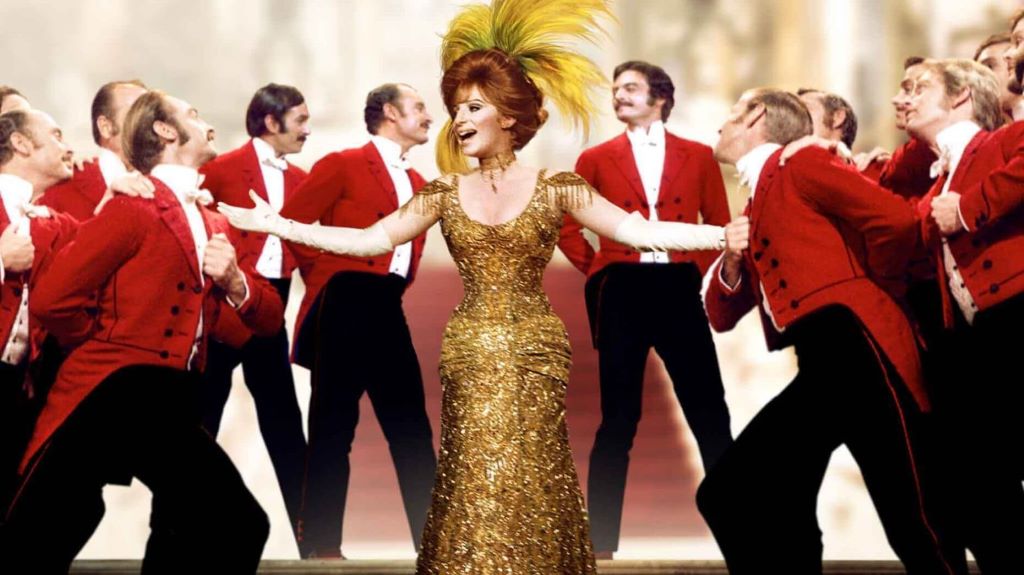
I’ll grant the scale and sets are impressive. Whole streets and parks were built. Grand, elaborate costumes (some of Streisand’s costumes cost thousands and thousands of dollars by themselves) add wow factor. If you believe “more is more” Hello Dolly! is for you, it’s Oscar for set design well deserved. But as you watch Streisand hit a high note in long shot while an entire parade of thousands takes place around her, you start to realise you’ve not formed a bond with the characters. When we finally get them all in one place (a crowded restaurant in New York) the best part of thirty minutes is taken up with three massive numbers (Dancing waiters! Streisand’s entrance number! Comedy foot-tapping from Crawford! Louis Armstrong cameo!) that piles so much stuff on, that you almost forget what the scene was meant to be about in the first place.

What this probably needed to be is a tighter, American in Paris style romantic comedy, the sort of stuff Arthur Freed would have run out in 100 minutes with a few set pieces. Instead, it’s a bloated mega-production with colossal sets, 12,000 extras, widescreen soaking up the action and vast, never-ending dance numbers that fail to progress either story or emotion. After being bludgeoned by balletic leaps, you suddenly realise not only has nothing much happened, but you are being asked to invest in the future happiness of characters you barely know and often hardly even like.

It’s not helped by the chronic miscasting of the leads. Barbra Streisand was the hottest star in town – the studio was (correctly) convinced mega-stardom was inevitable after watching the rushes of Funny Girl – but she is wrong on almost every level for Dolly Levi. A part intended for a slightly-over-the-hill widower in her late 40s, was barely retrofitted for a glamourous diva aged 26. Streisand, clearly painfully aware she was wrong for the part, struggles to work out how to play it. Sometimes she’s coquetteish, other times she goes for a mother-in-law largeness, most of the time she ends up channelling Mae West sauciness. While her singing is (of course) outstanding, she never looks comfortable. Equally out-of-place is Walter Matthau, whose grouchy comedy style never meshes with the tone of the film (although he has a great bit of business with a walking stick which he hammers down onto a table with such irritated force it almost rebounds and hits him in the face).

It also doesn’t help that Matthau and Streisand all-too-clearly can’t stand each other (their closing kiss is hilariously awkward – try replicating their physical positions to see how unnatural and unromantic it is). On set Matthau felt Streisand was too big for her newcomer boots while Streisand saw him as envious of her star quality. The two frequently fell into heated rows: this at least meant they fitted in naturally on a set where almost no-one got on. Streisand and Kelly’s working styles (both being demanding perfectionists) proved incompatible, Kelly stopped speaking to the official choreographer who also stopped speaking to the costume designer.

With the leads struggling, most of the film’s charm actually relies on its secondary leads. Hello Dolly! is, actually, an effective showcase for Michael Crawford’s physical dexterity (some would say recklessness) and his sweet romance with Marianne McAndrew’s charming Irene Molloy is the film’s emotional heart. It’s a shame both their film careers effectively ended here (though Crawford would go on to greater things on stage). Their dance number Elegance is one of the film’s most engaging while their duet It Only Takes a Moment is the simplest filmed and most moving moment in the film.

Bloat and bombast overwhelms the rest. Although Kelly knows how to shoot dancing – effective camera moves and having the dancers move towards the camera, increasing their dynamism is very well done – he’s far less suited to the character moments which Stanley Donen and Vincente Minnelli excelled at. The gags very rarely land, either because the timing is off or the camera is so focused on getting the mammoth sets in that the bits of business look like minor irrelevances.

Fundamentally, Hello Dolly! bet the house on throwing all the budget on the screen to wow audiences the way something like The Great Ziegfeld had over thirty years ago. But audiences needed an emotional connection with what they were watching. Hello Dolly spectacularly fails to deliver on this. What we were left with is a very slight story about matchmaking, basically a chamber piece with about six characters, transposed onto the sort of epic backdrop that makes Gone with the Wind look humble. The mismatch never works and the entire enterprise eventually collapses under its own gravitational pull. A box office dud that nearly sank the studio, the musical would never be the same again.

Golda (2023)

Golda (2023)

Undramatic saga of Middle East history that fails to bring seismic events to life

Director: Guy Nattiv

Cast: Helen Mirren (Golda Meir), Camille Cottin (Lou Kaddar), Liev Schreiber (Henry Kissinger), Rami Heuberger (Moshe Dayan), Rotem Keinan (Zvi Zamir), Lior Ashkenazi (Lt General David Elazar), Dvir Benedek (Major General Eli Zeira), Ed Stoppard (Major General Benny Peled), Dominic Mafham (Lt General Haim Bar-Lev), Emma Davies (Miss Epstein), Ohad Knoller (Major General Ariel Sharon)

I’m sure you couldn’t have picked a worse time to release a film celebrating Israel’s fight against the Arab nations than November 2023. As the world looks on in horror at the latest cycle of violence engulfing Gaza, it hardly feels like the right time to kick back and cheer as Israeli forces fight for their country in the 1973 Yom Kippur War. But, even without that, Golda is fatally undermined by being a turgid, dull biopic where despite the volume of events little is made either engaging or interesting.

Golda Meir (Helen Mirren) is Prime Minister of Israel, managing the country’s military response after the combined forces of Egypt and Syria launch a surprise attack on the Golan Heights and Sinai. After intelligence failures leave Israel on the back foot, Meir must plan Israel’s counter-offensive, deal with the moral complexities of sacrificing soldiers, and work diplomatically to ensure the continued support of the US via Secretary of State Henry Kissinger (Liev Schreiber), all while dealing with cancer. All of this is told through the intermittent use of a framing device, where Meir is being interviewed by a 1974 committee investigating those intelligence failures.

Golda is obviously apeing Cuban Missile Crisis political thriller Thirteen Days, with its focus on a tight timeline, generals in cigarette-smoke-filled rooms making tough calls, and the dilemmas faced by an elected leader trying to ensure their country’s survival. Unfortunately, where Thirteen Days mixed history lesson with genuine drama, Golda just feels like it takes thirteen days to watch. How did they manage to make such a seismic conflict as dull as this?

There was a bit of controversy initially on casting the non-Jewish Helen Mirren. That can be largely forgotten, not least because Mirren is by some way the best thing in the film, gravelly and conveying the unbearable pressure on Meir. She even gets to show her human side, with sweet scenes with her loyal assistant (well played by Camille Cottin) and a plate of borsch and an offer for Henry Kissinger (a decent Liev Schreiber). Mirren is caked under various prosthetics but does a good job.

But the rest of the film is a dull mess with its flat, lifeless script singularly failing to add tension or drama. The film feels like a box-ticking exercise, from flat conversations on various troop movements to the casualty figures Meir dutifully records in her notebook. Only rarely does the film bring any of this viscerally to life (such as the increasingly crowded morgue Meir walks through to receive her cancer treatments). Events at the front are given no human face to draw us into the crackly reports coming in over radios, and there is little sense of characters having to debate and choose between different courses of action under huge pressure. Keeping the action contained within just a few indoor locations serves to make the film feel cheap rather than claustrophobic.

Our only glimpse of the front is to see Dayan fly over the Golan Heights (and promptly vomit in guilt). Discussions in briefing rooms get bogged down in establishing who someone is and what they are in charge of, rather than communicating the stakes. So, we get various uniform-clad actors spouting reams of geographical locations, division numbers and military statistics, accompanied by maps where the odd cigarette lighter stands in for various armies. Somehow, despite the volume of talking, its nearly impossible to understand any of this, so poorly is it communicated visually.

That’s before we get started on the film’s one-sided lack of historical context. A brief series of captions that opens the film runs down an Israeli-only perspective of the country’s history. The crucial background of the 1967 war – a pre-emptive strike by Israel that seized the land now being attacked in 1973 – is completely ignored. It’s never made clear that the Arab nations argued they had launched their attack in response to 1967, and no wider context is given.

This feels particularly awkward considering recent events (in late 2023) threw the conflicting narratives in the region even more into the limelight. Both Arabs and Israelis have legitimate cases. But a film that focuses on one side only and whose only Arab voice is a radio intercept of a Syrian gleefully celebrating the “death of the Zionists” hardly feels like it is making a mature and sensitive statement about the Middle East conflict.

It means the film’s final celebration that the war led to the peace agreement between Egypt and Israel – including the recognition of Israel by Egyptian Premier Sadat – rings hollow. Peace, as a topic, is never raised in the course of the film (so hardly feels like a thematically correct ending) and its celebration at the end feels like a fig leaf to suggest an “upbeat” ending, when 1973 was effectively just another round in a war that was to continue (with increasingly horrific impact on civilians on both side) for the rest of all our lifetimes so far.

Golda fails as drama, fails as history and fails as a film. It’s a mess.

The Flash (2023)

The Flash (2023)

The final death rattle of the DCU franchise, a terrible film fill of bad storytelling and lousy gags

Director: Andy Muschiette

Cast: Ezra Miller (Barry Allen/The Flash/Young Barry Allen/Evil Barry Allen), Michael Keaton (Bruce Wayne/Batman), Sasha Calle (Kara Zor-El/Supergirl), Michael Shannon (General Zod), Ron Livingston (Henry Allen), Maribel Verdú (Nora Allen), Kiersey Clemons (Iris West), Antji Traue (Faora-Ul), Ben Affleck (Bruce Wayne/Batman), Jeremy Irons (Alfred)

This is how it ends. Not with a zippy bang, but a stumbling fart. The Flash is, quite simply, one of the most dreadful, misguided messes you are likely to see: the final sad, rammed-together-by-committee piece of pandering from a franchise declared DOA before the film was even released. Could The Flash have worked if the DCEU had been a success? Its defenders might say yes, but let’s be honest: no. And not just because of Ezra Miller. Though God that didn’t help.

Anyway the plot. We meet Barry Allen/The Flash (Ezra Miller), fighting crime with the Justice League. Because the DCEU was in a rush (and never bothered to make an origins film allowing muggles to understand who the hell he is), after an action-packed opening we are basically rushed at dizzying speed through his backstory (the sort of thing Marvel, back in the day, would have spent two films building). Allen’s Dad (Ron Livingston) is in prison for the murder of his Mum (Maribel Verdú) though he’s innocent. Allen works out he can go back in time to change this. He does but then (naturally) ruins the past. He finds himself back in Man of Steel time which – we are hurriedly told – is the same time he got his powers. The grief that made Barry a hero in our timeline didn’t happen here so the Barry of this timeline is, to put it bluntly, a complete prick. He’s also changed lots of other fan-pleasing stuff, lost his powers, wiped most of the DCEU characters from history (no loss) and has to team up with a different Batman (Michael Keaton) to train his past self and save the world.

First and foremost – who thought it was a good idea to make a film that depends on this much knowledge of a character who has never had a film made about him before? Marvel’s Spiderman got away with jumping over the origins story because we’d already seen it twice. Joe Regular Public has no bloody idea who Barry Allen is. They aren’t ready to be introduced to his backstory like it’s established, famous stuff and watch it being twisted upon. Or watch a plot twist about the granting of its powers unfold at the same time as we are told when we event got them in the first place. It’s totally bizarre – it’s like the film is throwing in call-backs to films that never happened.

This sort of plot, watching our hero change the past, needs us to actually have lived through the past with that hero. To understand the emotional impact it’s had on him and to have watched him mature. Instead, we get all this stuff dumped on top of us and then watch a version of a character we don’t really know teach another version of that character how his powers work without us having been given any knowledge ourselves of how those powers work, meaning we are as ignorant as he is.

It doesn’t help that we’re given no reason to bond with Barry Allen – any of them. Firstly, let’s get the elephant out of the room. We now know what will prevent a Hollywood studio cancelling a troubled star: if they have invested $200 million on a film in which they appear in every single frame. Miller is sort of beyond toxic now: someone who has stolen, assaulted women, groomed minors, proclaimed themselves an Indigenous messiah and faced multiple arrests and restraining orders. If this film had cost $20 million it would never have been released. Hell, if it had cost $75 million like the tax-written-off Batgirl, it would have been spiked. But DC and Warner had too many eggs in the Ezra basket so hoped we might forget they were asking us to bond with a literal criminal.

Leaving that aside though: all iterations of Barry Allen seem pretty awful people. The first is selfish whiner with poor empathy. The second is an absolute douchebag, a character so irritating he manages to make the original look like a wise mentor. The third who pops up later is a 2D man-child. Nothing Barry does is engaging or sympathetic, but yet the film assumes we love him as much as those working on it clearly do.

This multiple iterations could have worked if we had seen Barry mature over multiple films and then gone back to meet the “initial” version of himself. It makes no impact when we have no bond with the character. The film assumes emotional connections with characters and totems that simply don’t exist. For example, Future Barry is furious Past Barry uses a cherished teddy bear (his dead mother’s last gift) as a dartboard target. That might mean something if we’d seen Barry carry this totem for a couple of films: The Flash has to give us all the information about the totem (including its existence) within thirty seconds. It’s a small example of the film’s topsy-turvy nonsense.

While sprinting to introduce a franchise, it also indulges in piles of fan-bait nostalgia. The most obvious is, of course, the return of Michael Keaton as Batman. Perhaps due to Miller’s toxic nature, the film played this angle up big time in its trailers. But it’s nostalgia that only really means something to people in their 40s and 50s and literally sod all to most of today’s audience. Every second Keaton appears on screen it “homages” the Burton pics – he can’t take a crap without hearing Elfman’s music, the visuals are littered with references and Keaton wearily says things like “let’s get nuts”. Keaton looks like he hates himself for saying yes to the (presumably) truckloads of money he was paid to be here.

He only doesn’t win “most disengaged actor” because we have a thinking-of-his-castle Jeremy Irons and Michael Shannon trotting through the film practically wearing a t-shirt saying “by contractual obligation”. Shannon centres a CGI filled smackdown that inevitably ends the film’s penultimate act, before the multiple Allens disappear to a CGI world of parallel universes and dead actors recreated by the power of special effects and the desire of deceased actor’s estates to earn a tasteless quick buck (there is something really tasteless about Christopher Reeve’s appearance in particular).

The CGI in this film, by the way, is some of the worst you are ever going to see in a tentpole release. Never mind the uncanny valley of its array of nostalgia cameos or the blurry, explosion in a paint-shop vision of alternate realities, crammed with utterly unconvincing CGI clones of its actors. Watch Barry’s rescue of babies from a collapsing hospital in act one – these are hellish figures of uncanny unreality, looking like nothing less than the spawn of Satan. Let them fall Barry, let them fall!

That’s before we even start on the crazy morality of this film. It’s idea that that past is sacrosanct and must never be changed fits it’s worship at the altar of nostalgia – after all it’s the film where a film from 1989 is treated like a holy text. It could have worked if the film had committed to its idea that we have to learn to let go of our grief and that heroes need moments of tragedy to set them on the path to greatness. But after witnessing all this, our Barry at the film’s end… changes the past AGAIN to save his Dad. Did he learn nothing? What kind of message is this?

But then this sort of muddled nonsense probably comes from the length of time the film gestated: it was in development for nearly a decade. So long, that its star became a toxic criminal, a separate TV-show about the Flash was developed, screened for eight seasons, adapted this very story and ended and the franchise this was meant to be part of died. The Flash emerges from this rubble as a catastrophic piece of contractual obligation. The death rattle of a franchise, which was released because its studio had invested so much in it, it was desperate to make something back. It’s a film no-one wanted to make, release or see. A test case for the nightmare modern franchise box-office film-making is.

Murphy’s War (1971)

Murphy’s War (1971)

This heavy-handed anti-war Don Quixote story is far from a success

Director: Peter Yates

Cast: Peter O’Toole (Murphy), Siân Phillips (Dr Hayden), Phillipe Noiret (Louis Brezan), Horst Janson (Captain Lauchs), John Hallam (Lt Ellis)

In the dying days of World War Two, the merchant ship Mount Kyle is sunk in the Venezuelan Orinoco by a German U-Boat. Surviving the machine-gunning murder of the crew is Irish engineer Murphy (Peter O’Toole), who is treated at a Quaker mission by Dr Hayden (Siân Phillips). Murphy at first seems happy to be out of the war: but that changes, after the murder of fellow survivor Lt Ellis (John Hallam) by u-Boat captain Lauchs (Horst Janson), hunting the survivors. Murphy, assisted by Frenchman Louis (Phillipe Noiret), decides to take revenge, kitting out a crashed bi-plane to launch a series of increasingly obsessive attacks on the u-Boat with Murphy succumbing to a vendetta.

Peter Yates takes an action-adventure novel and adjusts into an anti-war epic that becomes increasingly shrill as it reaches its nihilistic ending. This shift led to several clashes between Yates and the film’s producer Michael Deeley, who was looking for a box-office hit with a charismatic star. While Yates’ film is complex in its eventual structure, the overall impact of the film is confused and blunted, its sympathies mixed and logic often flawed. It has its moments but doesn’t quite work.

As part of its anti-war set-up, Yates believed it was essential to humanise the German sailors (after all, he wanted the viewer to feel unease at Murphy’s destructive crusade). Unfortunately, creates a dissonance in the film. The first thing the German sailors do is ruthlessly machine-gun the Mount Kyle’s sailors as they tumble into burning waters. Graphically shown is every beat of the fear, as charred machine-gunned bodies fill the frame while the Germans show not a moment of regret (indeed we next see them celebrating the Captain’s award of an iron cross). The captain murders Lt Ellis with a face filled with regret, but his execution involves bullets causing Ellis’ body to jerk in its graphic death throws. How are we supposed to sympathise with them after that?

The focusing on such brutality fits the anti-war hell the film wants to lay out. But it fatally undermines the film’s aim to sure Murphy’s campaign to destroy the u-Boat as an obsessive and destructive campaign. With no reason given for the brutal war crimes committed by the u-Boat (for good measure they also machine gun the Quaker settlement, killing many of the villagers), its hard not to feel that actually Murphy has a point and that these guys deserve punishment. Would a throwaway line about a secret German mission or a need to hide have hurt the film?

The film can’t have it both ways. It can’t luxuriate in the destruction and murder war soldiers commit and then ask us to sympathise with these same soldiers when their death is threatened by another obsessive soldier on a quest for revenge. In a better developed film this sort of clash of sympathies might feel more natural. Instead, the Germans are either monstrous or sympathetic depending on the needs of the scene while Murphy himself makes an awkward shift late on from a guy with righteous anger into a destructive figure we are invited to condemn.

This is a particular shame as there is a lot in Murphy’s War to admire. Yates directs with an assurance and sense of epic scale. The Venezuelan scenery is shot with a real beauty by Douglas Slocombe and the film is edited with a professional excellence by future-Bond-director John Glen. The film’s first half hits a “boy’s own adventure” tone very effectively – making the later shift into 70’s anti-establishment nihilism more awkward – with inventive sequences as Murphy, McGiver-like, reassembles the downed biplane and jerry-rigs some home-made bombs.

A big part of any success is the charismatic performance of Peter O’Toole, who tears into the role of this Irish rebel with relish. Mixing insouciant wit with a bitter irony that slowly gives away to a sociopathic gleam as obsession takes hold, this is an excellent performance. O’Toole manages to make a character who is, in many ways, slightly incoherent work effectively. After all this rebel we hear condemning war with counter-culture cool, who fights to the bitter end; a guy who expresses indifference for his colleagues but goes to unimaginable lengths to avenge them. These contradictions don’t feel naturally developed, but ideas that are put in place to ease the plot.

Saying that, the film has some interesting beats as Murphy collapses more and more into Don Quixote like obsession, tilting at his underwater windmill. (Yates clearly had a passion for this angle as he would make two attempts to make a film of Don Quixote before finally making a TV version in 2000). O’Toole is perfect for this increasing severing from reality and as his Sancho Panza, Phillipe Noiret contributes a warm, humane performance as reluctant Louis, who silently acquiesces in a campaign he clearly feels is misguided and delusional. Equally good is Siân Phillips, balancing exasperation and affection for Murphy, finally unable to brake through his walls of aggression.

There are good ideas and moments in Murphy’s War but its poor-plotting (its story is also strikingly slight, with the preparation of the biplane and its test flight filling an elongated stretch of the film) and jumbled mix of adventure and anti-war sentiments eventually fatally undermine its effectiveness. Despite fine work from Yates and a charismatic and highly watchable performance from O’Toole it’s, at-best, an interesting failure.

Indiana Jones and the Dial of Destiny (2023)

Indiana Jones and the Dial of Destiny (2023)

Is there a place for Indy in the 2020s? The nostalgia-tinged would-be epic doesn’t provide an easy answer

Director: James Mangold

Cast: Harrison Ford (Indiana Jones), Phoebe Waller-Bridge (Helena Shaw), Mads Mikkelsen (Jurgen Voller), Antonio Banderas (Renaldo), John Rhys-Davies (Sallah), Toby Jones (Basil Shaw), Boyd Holbrook (Klaber), Ethann Isidore (Teddy Kumar), Karen Allen (Marion Ravenwood), Shaunette Renée Wilson (Mason), Thomas Kretschmann (Oberst Weber), Olivier Richters (Hauke)

Okay let’s get the elephant out of the room: It’s better than The Kingdom of the Crystal Skull. Yes folks, we have a new fourth-best Indiana Jones film. Is that something to celebrate? Indiana Jones and the Dial of Destiny makes some of the same errors as the previous valedictory effort, but at least it learned a few things and it’s been made by people who clearly love Indy. But they loved it too much, creating an often overblown, hellishly overlong, everything-but-the-kitchen-sink film which never just jump when it can flip, spring, bounce then explode at the end of it.

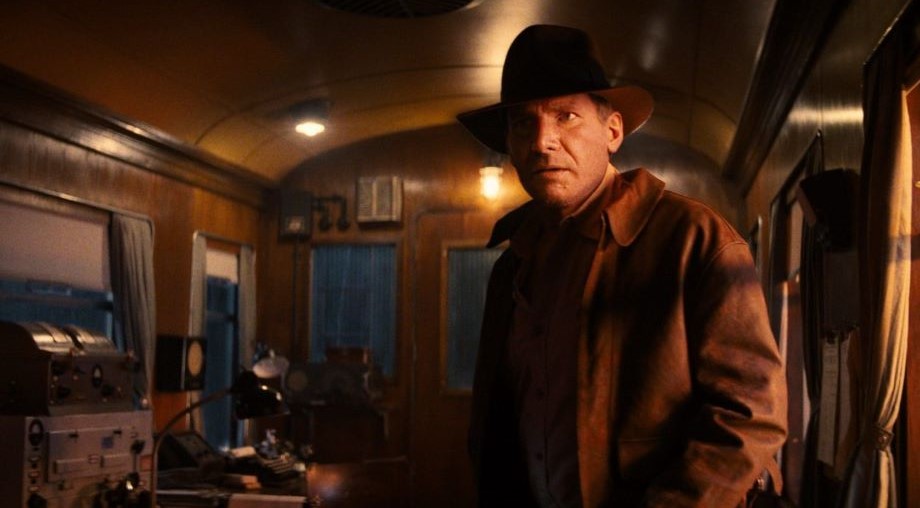
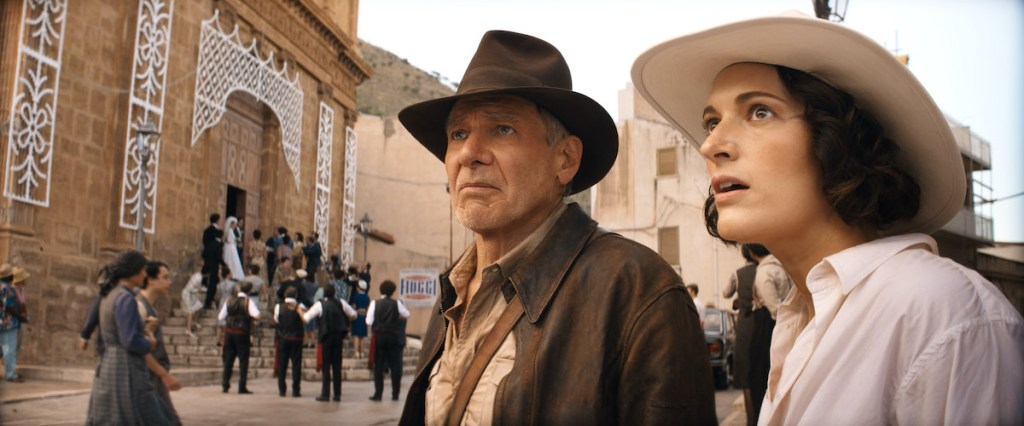
It opens with a (younger) Indy (Harrison Ford) battling Nazis in the dying days of the Second World War, trying to save a train full of precious artefacts. After defeating them, we flash forward to 1969 with Indy now a retiring archaeology professor to disinterested students in New York’s Public University, out of a place in an era where man has stepped on the moon. Grouchy, separated and fed-up, Indy’s life gets disrupted one more time when his god-daughter Helena Shaw (Phoebe Waller-Bridge) turns up on the hunt for Archimedes’ Dial. Indy knows about this dial as it was also the obsession of Nazi physicist Jurgen Voller (Mads Mikkelsen), last seen on that train in 1945 and now the brains behind the NASA moon landings. Indy and the unscrupulous Helena end up in a duel with Voller to find the dial – the prize being what Voller believes is a chance to change history.

Back in the day, Raiders of the Lost Ark was largely made so Spielberg and Lucas could show they could make an action-packed, crowd-pleaser quick and cheap. Today The Dial of Destiny is one of the most expensive films ever made (lagging only behind assorted Avengers films, the recent Star Wars trilogy and various other franchise entries). So much mony to make something less than half as good.

What this has allowed is Mangold and co to act like kids given the keys to their parents’ car. The Dial of Destiny is an explosion of Indy ideas, all rammed into the film willy-nilly. It’s made by people who feel this is their only chance to make an Indy film and don’t want to miss the opportunity to include every idea they’ve ever had.

We end up with a film that feels both far too long and yet strangely rushed. The Dial of Destiny would be immeasurably improved if about twenty minutes (at least) had been cut from its run-time and its poorly sketched thematic ideas condensed down. Its narrative structure has one too many quests, with Indy and Helena forever searching for a thing that leads to a thing that leads to yet another thing. An entire sequence, involving a pointless cameo from Banderas as a one-legged diver, would have been better slashed to ribbons or cut altogether. Every single one of the mega-budget chase sequences go on at least 2-3 minutes too long, straining the interest.

At the same time, the film manages to feel rushed. Ideas are presented and then taken nowhere at all. We see Indy tipping most of a bottle of whisky into his coffee in the morning – this suggested alcoholism never rears its head again. Voller is working in partnership (it seems) with the CIA, but their motives for this are never explained and Voller calmly ditches them part way through the film. Indy is framed for murder, but this plot thread is judicially abandoned by the time we get to the end. John Rhys-Davies literally pops up to drive Indy to an airport and make a trailer-friendly speech.

Most strikingly, all the films blaring action and endless bangijg stuff buries the most interesting plot thread of a tired, depressed Indy who no longer knows his place is in the world. The film solves Shia LaBeouf’s toxic unpopularity by having Mutt die in Vietnam, giving Indy a burden of guilt and grief. This is an Indy who has fallen from his Princeton heights, as ancient to his students as the artefacts he lectures about. It’s a thread though that the film only intermittently remembers, so crowded out is it by overlong chases, so that when the film’s conclusion returns to it as a major motivator for Indy it feels forced.

In any case, the film’s action set-pieces peak with the 1945 opening section with a digitally de-aged Ford and Mikkelsen facing off on a speeding train. I think the de-aging effect is very well done (though Indy speaks with Ford’s current 80-year-old voice), and this sequence has a sort of nostalgic charm to it and at least it feels of a piece with the originals. Not that its perfect: it’s overlong and overblown of course – a castle explodes, Indy runs over the top of a speeding train – and looks like something created with blue-screens and digital effects rather than in reality. (It’s also clear a digitally de-aged Ford head has been placed on a stunt double at key points.)

But it’s a bright-spot. There are others: Harrison Ford, again, is perfect for the role – crusty, resigned but still with the glamour of excitement in his eyes. He and the film don’t back away from his advanced age – Indy looks more vulnerable than ever – and Ford sells the moments he’s allowed in the film’s breakneck speed to reveal Indy’s emotional turmoil. He also has a great chemistry with Phoebe Waller-Bridge, who effectively channels Han Solo as an immoral adventurer who learns about decency. Mikkelsen’s mastery makes him an impressive villain.

I’ve been really hard on this film. It is fun I promise. I laughed and at times I was thrilled. But it is too much. Even the settings of the chases offer a sensory and time overload: a chase around a ticker-tape parade in New York onto a subway (with Indy on a horse) has an overload of visual details. A chase through the streets of Marrakesh goes on forever – and is over-built with our heroes chasing Voller while also being chased by Helena’s gangster-former-fiancee. film culminates in a final sequence which is just about not as silly as aliens – but by any other score is incredibly silly.

Essentially The Dial of Destiny is undermined by fan love. Mangold is a good director but doesn’t know where to stop. The film leans into nostalgia too hard but, above all, it offers far too much bang for your buck. The film is frequently at its most effective in its quieter, character-driven moments. Like Crystal Skull, it mistakes bigger for better. It’s still a more entertaining and a better film than Crystal Skull – but, somehow, its excessive overindulgence makes you feel strangely disappointed.

Wilson (1944)

Wilson (1944)

Well-meaning if slightly dry hagiography that struggles to turn history into drama

Director: Henry King

Cast: Alexander Knox (Woodrow Wilson), Charles Coburn (Professor Henry Holmes), Geraldine Fitzgerald (Edith Wilson), Thomas Mitchell (Joseph Tumulty), Ruth Nelson (Ellen Wilson), Cedric Hardwicke (Senator Henry Cabot Lodge), Vincent Price (William G McAdoo), William Eythe (George Felton), Mary Anderson (Eleanor Wilson), Ruth Ford (Margaret Wilson), Sidney Blackmer (Josephus Daniels), Madeline Forbes (Jessie Wilson), Katherine Locke (Helen Bones)

Darryl F Zanuck had a passion project: a biopic of the 28th President Woodrow Wilson. It would be both a tribute to a man, he felt, was overlooked and also a homage to current President Roosevelt – and a warning for the future. Like FDR, Wilson had introduced a raft of reforms and led the country in wars – and Zanuck was worried America would fudge the peace, just as Wilson had failed to get the Senate to endorse the League of Nations, leaving it a toothless lion.

Zanuck’s no-expense spared approach gives us a laudatory biopic that lavishes Wilson in euphoric praise, smooths off all his edges and presents him as a visionary and a near-flawless leader. The money was thrown into building elaborate sets and costumes – vast swathes of the White House and the Palace of Versailles were re-built on the sound stages of 20th Century Fox – and the script repackaged a series of major events interspersed with Wilsonian speeches. It was launched to a fanfare, was nominated (largely due to Zanuck’s influence) for ten Oscars (winning five) and was a box-office failure.

But is it a good movie? In truth, not quite. Despite the lavish production values, this is a dry, unimaginative and stately progression through its subject’s life. Henry King marshals events with the professionalism of an accomplished journeyman, but little inspiration. There is nothing striking, original or brave in a single minute of Wilson, but everything is perfectly framed and (considering its immense length) well-paced. King uses a series of low-angle shots to hammer home the magnificent detail of the sets and Alfred Newman’s score remixes a series of patriotic scores and heavenly-sounding choirs to build the impression of Wilson as secular saint.

But Wilson remains a largely undramatic movie, with an (Oscar-winning) script by Lamar Trotti that fails to inject drama or skilfully convey information. The warning signs are there in the film’s opening, with a group of New Jersey Democrats arrive to recruit Princeton head Wilson to run for Governor and clumsily give each other a potted precis of his CV and academic achievements while they wait for him to join them. Dialogue frequently info dumps historical research in our ears. Newspapers bluntly tell us in crude headlines what’s happening. Poor Thomas Mitchell’s entire role seems to be made up of running into rooms clutching telegrams announcing major events.

In amongst all this research though, we get very little idea of what Wilson actually stood for. There is virtually no time spent on his Governorship of New Jersey, other than a two-scene disagreement with the Democratic bosses whose power he breaks. On becoming President, his major legislative reforms are covered in a less-than-a-minute montage of signed bills. He consults his cabinet once or twice and, when war comes, walks a fine line between preserving American strength and not rushing into war. The final act of the film covers his failed battle for the League of Nations, the only policy the film invests any time into explaining.

For much of the rest of the time, this hagiography concerns itself with down-playing or skating over anything in Wilson that could be perceived as a flaw. Wilson here talks a good game of reform, equality and rights for all. In real life, he was a dyed-in-the-wool segregationist, sceptical about women’s suffrage as well as being an intellectually arrogant elitist who, later in his Presidency, began to see himself as a sort of vessel for God’s policies. While he was undoubtedly a highly effective moderniser and legislator, none of his faults make it to the screen.

Other areas are also carefully removed. Wilson was often accused of being heavily under the influence of advisors like “Colonel” House – House gets a one-scene cameo here. He ran for re-election in 1916 promising to keep America out of the war – this unfortunate broken promise is repackaged as Wilson sitting in the White House deeply regretting the campaign the party is running for him but stating there’s nothing he can do about it. His controversial re-marriage in 1915 to the much-younger Edith Galt (only two years after his wife died) is excused by his wife informing his daughters on her death bed that Wilson must marry again as he needs a wife. Wilson’s incapacity after a stroke in 1920 is down-played, while Edith (who effectively took over running the country for her husband in a constitutional scandal that would never stand today) states “I never made a decision without your knowledge and consent” while sitting with a sturdy Wilson.

All of this is played out in parallel with making Wilson’s rivals in the Senate mustachio-stroking schemers. None more so than Henry Cabot Lodge (well played by Cedric Hardwicke) who begins a career of animosity against the President after being made to wait for a meeting at the White House. In real life, Wilson refused any compromise offered by Lodge to get the League approved by the Senate, but here Wilson is a noble crusader foiled by political pygmies.

Saying that, the film benefits hugely from a very strong performance from Alexander Knox as Wilson, who not only looks and sounds exactly like the President, but perfectly captures his mannerisms. It makes you regret though the film is so little interested in Wilson’s personality or in building any picture of the humanity behind this leader. The rest of the cast have little to do other than state historical facts or stand to listen to Knox masterfully delivering Wilsonian speeches.

Wilson has a historical interest for Presidential buffs and, while it downplays the negatives around Wilson, it makes a very effective case for the President as a visionary leader (he was undoubtedly right about the League of Nations – even if his stance here is restructured into an FDRish self-determination for all nations). But this is a dry, stately film that never manages to turn the march of time into the thrust of drama. The Oscar-winning sets and photography look impressive, but its simplistic and hagiographic presentation of events eventually shakes your interest.

Macbeth (1948)

Macbeth (1948)

Welles first Shakespeare film is a bizarre mix of inspiration and amateurishness

Director: Orson Welles

Cast: Orson Welles (Macbeth), Jeanette Nolan (Lady Macbeth), Dan O’Herlihy (Macduff), Roddy McDowell (Malcolm), Edgar Barrier (Banquo), Alan Napier (Holy Father), Erskine Sanford (Duncan), John Dierkes (Ross), Keene Curtis (Lennox), Peggy Weber (Lady Macduff), Lionel Braham (Siward)

Macbeth was Welles’ last hurrah in Hollywood before decades of self-imposed banishment and exile. He arrived at Republic Pictures – proud creator of B-movie Westerns, although also the home of a few John Ford classics most notably The Quiet Man – who were delighted to sign up a deal for a literary classic directed by America’s leading man of the theatre. What they ended up with was a film that’s such a bizarre mish-mash of brilliance, originality and amateurishness nonsense, that they were basically befuddled.

Welles shot the film, as contracted, within 23 days on old Westerns sets, with a budget od spit and boot polish. Welles was focused, more than any other film he’d worked on to that point, on visual imagery and total control of sound and audio. So much so he wasn’t fussed about recording any sound on set. All the actors pre-recorded their dialogue, under Welles’ strict instructions, and then silently lip synched while shooting the scenes. This gave Welles the freedom for a host of expressionistic, shadow-filled shots where the actors faces and mouths were frequently unseen – or longer shots where it was impossible to clearly see lips moving. It also made some truly rigid, uncomfortable performances (Jeannette Nolan was granted permission to record her sleepwalking scene ‘live’ so she could perform it with some semblance of conviction).

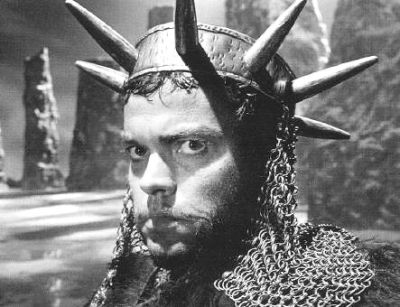
Macbeth was set in a Scotland somewhere between a fiercely traditional high-school production and a hodge-podge of influences from Celtic wizardry to Mongolian hordes. It’s shot on a dust-lined, cavern-filled panorama that frequently looks like a giant theatrical set or an empty multi-purpose wall-lined amphitheatre, with only a few scenes exchanging this for mist-filled heaths or low-ceilinged caves. The costuming and design is an eclectic mix: the murderers look like cavemen, some thanes wear kilts, Malcolm and his soldiers dress in medieval armour, Macbeth and Banquo look like fur-coated renegades from Genghis Khan. Welles himself would regret a bizarre crown which made him look like the Statue of Liberty.

There is a feeling that every idea was grabbed and thrown at the wall, in the expectation (hope?) that some of them would stick and lead to cinematic magic. There is a vague attempt to suggest Scotland is at war between Christianity and Paganism. A composite character, the ‘Holy Father’ parades around – chasing away witches, leading prayers for Duncan, taking dictation for Macbeth, warning Lady Macduff, rousing Malcolm – but with very little real sense that this ever adds up to anything logical or thematically clear. Welles merrily re-writes and transposes dialogue. Some works well – Banquo here seems far more of a potential partner than usual – others less so (Lady Macbeth turns up at the murder of the Macduffs for no clear reason).

But the stuff that works really works – and most of it is visual. The witches are shadowy figures, whose voices alter in cadence and pattern from scene to scenes (Welles had mixed male and female voices together to create an unsettling rhythm), their faces never seen. Inspired by his famous “Voodoo Macbeth” stage production, they craft muddy statues of Macbeth which they crown with a crude coronet. In one of the encounters with Macbeth, the camera pulls away to isolate Macbeth, lit in misty isolation. More Voodoo touches are seen in the hammering drum beats that greet Duncan to Macbeth’s castle.

Mist and expressionistic images dominate. Malcolm’s army urges from among the fog, carrying their branches from Birnam wood. The final battle is a series of isolated shots of characters, often the camera craning up to them or seeing them march towards it. Macbeth is frequently shot from below, to heighten his sense of being almost an ogre. When first seen as king, he sits, isolated and drunk at the top of a flight of stairs, making him seem less imposing and more weak from the start of his reign. He is haunted not only by Banquo’s ghost, but Duncan’s as well, Welles camera cutting to reveal his cavern dining room empty of everyone but the Macbeth and the ghosts of murdered friends, the camera tracking the shadow of his fingers along the wall to reveal the bleeding Banquo.

The entire production becomes like a drug-induced fantasy, something a near-catatonic Macbeth might just be imagining as his dreams are crushed by the cruel fate he feels destined to follow. Welles establishes a now popular idea of the play being a huge cycle: at this death, the witches announce “Peace, the charm’s wound up” the camera catching a sight of Fleance who seems destined to repeat the chaos. (“The charm’s wound up” not indicating an end, as often mis-interpretated, but a readiness to be enacted.)

The camera, freed of the need to capture dialogue on set, flies around roams around or moves with swiftness. Characters walk into shadows. Sequences – such as the murder of the Macduffs – are met with a parade of fast cuts and actors charging towards the camera. Music cues are carefully repeated, and lines carry across transitions. There are plenty of striking images, from a mass crowd praying for Duncan to a low-angle camera tracking a worried Macbeth in the aftermath of the murder.

But yet… this is also a curious dog’s dinner of a film. For every great idea, others (like the Holy Father) either don’t land or make no sense. Macbeth’s seduction of the murderers, interestingly shot over his shoulder at an imposing distance from his servants, is followed by a laughably badly acted and staged murder of Banquo. The actors all perform in, pretty much across the board, dreadful cliched Scottish accents. This accentuates the problem of lip synching on set, which renders nearly everyone in the film flat and strangely lifeless, stuck to replicating a performance from days ago.

This includes Welles himself. Macbeth is, by some distance, his least interesting film Shakespeare performance. His Thane is all surface and no depth and Welles’ decision to play him as a slave to destiny, frequently renders him catatonic, reading the lines with a Scottish lilt that travels by way of Dublin, with plenty of pace but no depth. Jeannette Nolan struggles slightly with Lady Macbeth, a decent match with Welles but lacking presence. There is barely a performance of merit among the rest of the cast: McDowell is dreadful, O’Herlihy all at sea, Barrier out of his depth. The bulk of the cast look and sound – in their traditional costumes and awkward, unconvincing accents – like high school students staging “the Scottish play” in the most “Scottish” way possible.

Welles, naturally, having shot the film promptly disappeared to Europe leaving notes and memos from a distance about how it should be assembled, some of which were promptly ignored by a supportive studio turn exasperated. Those in Europe were more respecting of the results, praising Welles for re-imagining the text and its expressionistic, fluid shooting style. In America, these elements were condemned a mess. Macbeth is a bit of both: good ideas sitting alongside amateurishness and nonsense. It’s most interesting by far as a silent film: there are images here that linger, from the witches mud statue to Lady Macbeth’s plumet to death. But as an overall package Welles would dwarf it with Othello and Chimes at Midnight, which combined good Shakespeare and good film-making. Macbeth is a struggle to marry expressionist film-making and literary grace that doesn’t always succeed.

Further reading:

Fantastic Beasts: The Secrets of Dumbledore (2022)

Fantastic Beasts: The Secrets of Dumbledore (2022)

The Potterverse goes through its death throws in this anaemic offering in a misguided franchise

Director: David Yates

Cast: Eddie Redmayne (Newt Scamander), Jude Law (Albus Dumbledore), Mads Mikkelsen (Gellert Gindelwald), Ezra Miller (Credence Barebone/Aurelius Dumbledore), Dan Fogler (Jacob Kowalski), Alison Sudol (Queenie Goldstein), William Nadylam (Yusof Kama), Callum Turner (Theseus Scamander), Jessica Williams (Lally Hicks), Victoria Yeates (Bunty), Richard Coyle (Aberforth Dumbledore), Poppy Corby-Tuech (Vinda Rosier), Fiona Glascott (Minerva McGonagall), Katherine Waterston (Tina Goldstein)

If the House of Potter teetered after the not-very-good Crimes of Grindelwald, it collapsed with the release of The Secrets of Dumbledore to waves of indifference. It’s proof that if you super-size your series not because you have a genuine story reason but because you think a fat goose will lay even more golden eggs than a thin one, you’ll eventually end up with a dead obese goose.

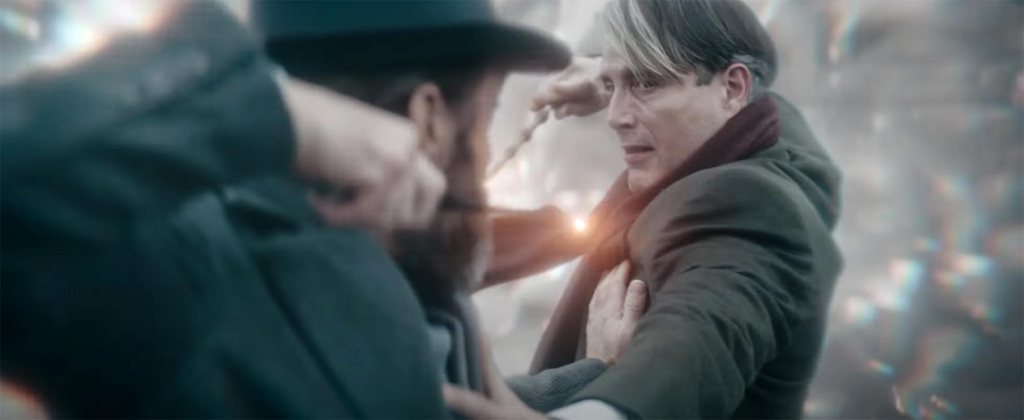
A year or something has passed and Dumbledore (Jude Law) and Grindelwald (now Mads Mikkelsen, thank God) continue circling, neither quite willing to end their ‘friendship’. Grindelwald is determined though to seize control of the Wizarding World by manipulating the election for the Supreme Leader to launch his anti-Muggle war. Dumbledore recruits a team, led by Newt (Eddie Redmayne), to stop him – but with Grindelwald’s new power to see the future, seized from a Fantastic Beast, Dumbledore can’t tell anyone his plan (plus ca change). Meanwhile Credence (Ezra Miller), is groomed by Grindelwald to destroy Hogwarts’ favourite professor.

The Secrets of Dumbledore may be flabby, over-extended and frequently meander down alleyways and byways that feel frustratingly pointless – but it is a better film than The Crimes of Grindelwald. Its problem is, it’s nowhere near good enough to win back the massive loss of audience faith that complete shit-show (combined with all sorts of social media storms) caused.

The Secrets of Dumbledore’s major positive is the arrival of Mikkelsen as Grindelwald. Replacing Johnny Depp (and his “personal problems”), he gives the film an automatic upgrade. If you want an arrogant, sinister, manipulative, but also dashing, romantic villain, why in God’s name wouldn’t you have cast Mikkelsen in the first place? The film is more daring on the Dumbledore and Grindelwald relationship than any other Potter film before – we even hear the “L” word.

Anything focused on these two – either together or alone – is invariably the good stuff. The two of them (Jude Law is equally good) semi-threatening, semi-reminiscing, semi-flirting in a café at the start is the finest scene, and the genuine regret between them is rather well done. Rowling also writes in, pretty much direct from the final book, the entire tragic Dumbledore-backstory reveal which the final Deathly Hallows film bizarrely cut (perhaps she thought it was as terrible an idea as I did?). Law plays this little moment to perfection.

You end up wishing the film was a more personal story between these two. Unfortunately, we get this over-inflated mess. The most bizarre thing about Secrets of Dumbledore is that simultaneously loads is going and the plot feels incredibly slight and mostly pointless. Frequently events bend down alleys or fizzle out into pointlessness. Far from being full of secrets, Dumbledore and his brother fall over themselves to share their secrets at every opportunity to keep the plot moving forward.

After the money-grabbing decision to squeeze as much cash out of this franchise (five movies!) as possible, The Secrets of Dumbledore feels like it has taken on a lot of padding to get up to length. Rowling, to put it frankly, isn’t that great at structuring a screenplay (it’s telling Steven Kloves was bought back to help bang this into shape). It’s a reminder it’s a very different set of skills telling a coherent story, full of twists, turns and universe building over 2 hours compared to 700 pages.

Grindelwald’s plan involves the complex and poorly explained, killing and resurrection of a magic goat. There is a lot of talk of “the people getting a say” in the election: an election where no one gets a say, since the leader of this civilisation is chosen on the whim of said magic goat. Our heroes go to the German Ministry of Magic solely, it seems, so Newt’s brother can be captured. A “spy” is planted among Grindelwald’s forces who does no spying, has parts of his memory wiped for no reason and then rejoins the heroes. Two characters communicate via a magic mirror, even though they’ve never met and couldn’t know who the other is. A labyrinthine plot about an assassination has so many hastily explained twists I genuinely have no idea what was going on. At regular intervals the heroes reconvene with Dumbledore, like players in a video game being given a brief for the next level.

Even more than the last one, the “Fantastic Beasts” idea feels like a burden. They’d have done better just starting a new “Dumbledore vs Grindelwald” franchise. The plot sort of revolves around a poorly explained magic animal. Theseus is whacked in a prison guarded by a deadly scorpion. In a bizarre tonal zig-zag, Newt distracts this beast’s scorpion-y minions by doing a funny dance – interrupted every so often by it grabbing a “political prisoner”, eating them alive and then spitting out the half-chewed corpse for its minions to consume. Remember when this felt like this series was going to be about the charming adventures of a naïve zoologist?

The legacy characters stumble through with little to do. Redmayne’s Newt is a character so bizarrely ill-conceived as the lead in a prelude-to-war series he’s often quietly relegated to side missions. Dan Fogler’s Jacob and Alison Sudol’s Queenie continue a nonsensical emotional journey (she, let’s not forget, defected to Grindelwald – the man who wants to destroy Muggles – because she wasn’t allowed to marry a Muggle). Katherine Waterston’s Tina is relegated to a cameo.

Then there’s Credence. This character, the central Macguffin of the last two films, is here relegated to the role of heavy whose long-hyped clash with Dumbledore is a little more than a dull one-sided scuffle. It’s hard not to think the character has been reduced to glorified extra due to the increasingly toxic public image of Ezra Miller (has there ever been a franchise more unlucky in its casting?). But the unceremonious dumping of this entire plotline so crucial to films one and two hammers home the feeling that there is no consistent planning going on here at all.

I said in Crimes of Grindelwald this franchise in need of a new creative eye. David Yates directs his seventh Potter film and, while he does nothing wrong, I don’t think he’s got a single new idea in the tank. The look and feel of this film, its visuals, the effects, its tone, its colour palette – all of it is now achingly familiar, making it feel even more like something tipped carelessly off a production line. It also looks shockingly over-processed: I know it’s about magic but by Merlin’s Beard nothing looks real. Does it feel magic to be back at Hogwarts? No, it looks like a freaking CGI nightmare.

The lack of freshness surely contributed to its death at the box-office. No one seems to have stopped and asked “would someone who hasn’t been working on Potter full time for over 12 years care about this?”. I don’t think they did. If you work the Golden Goose night and day, demanding it produces an egg a day, eventually it will keel over. It didn’t have to be like this, but there is more chance of Depp returning than anyone making the next two films in this misbegotten series.

Cleopatra (1963)

Cleopatra (1963)

The biggest epic of them all – and one of the most infamous – is a mess but at times entertaining

Director: Joseph L Mankiewicz

Cast: Elizabeth Taylor (Cleopatra), Richard Burton (Mark Antony), Rex Harrison (Julius Caesar), Roddy McDowell (Octavian), Pamela Brown (High Priestess), George Cole (Flavius), Hume Cronyn (Sosigenes), Cesare Danova (Apollodorus), Kenneth Haigh (Brutus), Andrew Keir (Agrippa), Martin Landau (Rufio), Robert Stephens (Germanicus), Francesca Annis (Eiras), Isabelle Cooley (Charmian), Jacqui Chan (Lotos), Andrew Faulds (Canidius)

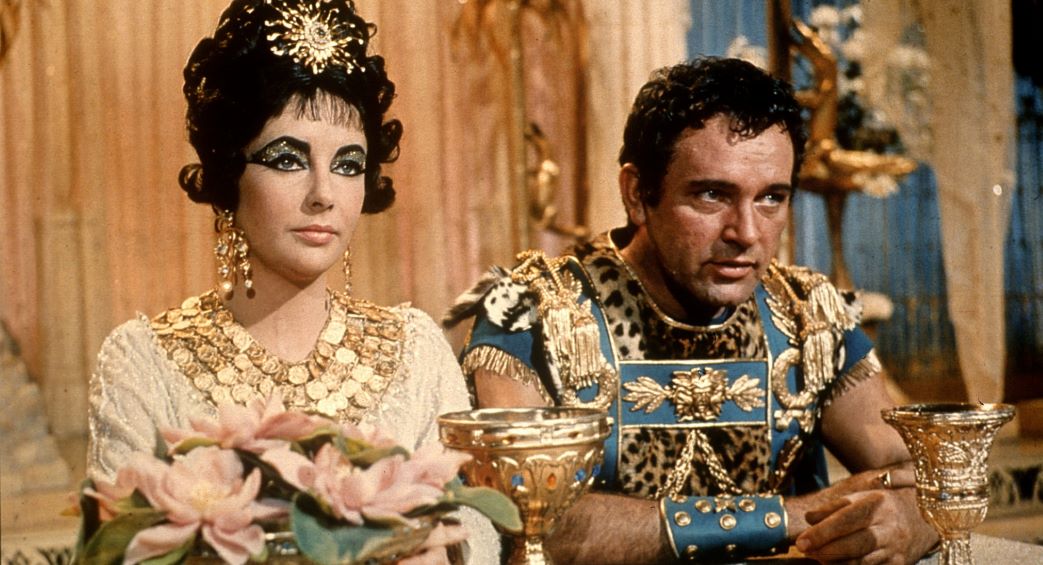
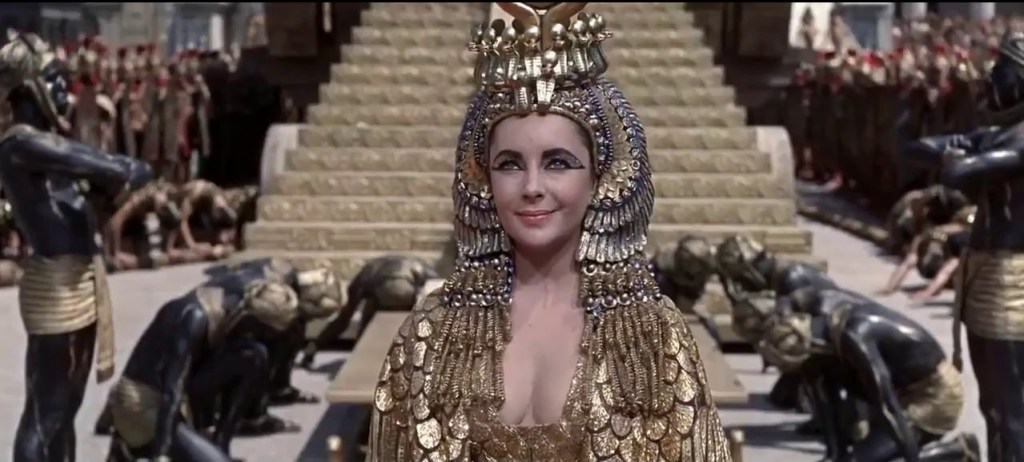
One of the most legendary epics of all time – for all the wrong reasons. Cleopatra is the mega-budget extravaganza that nearly sunk a studio, years in its shambolic, crisis-hit making that turned its stars into a celebrity brand that changed their lives forever. Painfully long, it’s a rambling, confused film that feels like something that was filmed before anyone had the faintest idea what the story they were trying to tell was. Then, just when you consider giving up on it, it will throw in a striking scene or intelligent performance and you’ll sit up and be entertained. Just never quite enough.

In its four hours it covers eighteen years. Julius Caesar (Rex Harrison) arrives in Egypt after victory over his rival Pompey at the Battle of Pharsalus. There he quickly becomes enamoured with Cleopatra (Elizabeth Taylor), the cunning, intelligent witty sister of bratty Pharoah Ptolemy XIII (Richard O‘Sullivan). Caesar takes Cleopatra’s side in the civil war for the Egyptian throne and takes her as a second wife, having a son (and potential heir) with her. Made dictator for life, he and Cleopatra return to Rome – where is assassinated. A friendless Cleopatra finds herself drawn towards Caesar’s deputy Mark Antony (Richard Burton), the two of them starting a passionate affair that will tear the Roman world apart and lead them into a civil war against Caesar’s politically astute but coldly realpolitik nephew (and official heir) Octavian (Roddy McDowell).

Cleopatra’s shoot – and the hullabaloo of press interest around it – is almost more famous (and perhaps more interesting) than the film itself. After a long gestation, filming started in London under the direction of veteran Rouben Mamoulian, with Taylor on board (for a bank-busting fee) with Peter Finch as Caesar and Stephen Boyd as Antony. Then it all fell apart. Taylor caught meningitis in the cold conditions, nearly died and the film nearly collapsed. The script was rewritten (again), Mamoulian, Finch and Boyd all left. Joseph L Mankiewicz came on board to write and direct, London filming (and all the sets) was junked and production moved to Rome. This all took a year.

In Rome, Rex Harrison and Richard Burton joined the cast as shooting began again practically from scratch. The planning however had been so laborious that Mankiewicz hadn’t been able to finish the script. So, instead, he decided to start shooting what he had and write the rest as he went. Sets were built for unwritten scenes and money continued to pour down the drain. This also meant a huge amount of hanging around for all concerned, spare time Burton and Taylor used to start a tabloid-filling affair which became the talk of the world. After nearly two years of filming, the studio ended up with millions of feet of film, a feud over whether to release two films or one long one and no-one with any real idea why they had made the film in the first place.

And God you can tell watching it. Cleopatra is an over-extended, rather unfocused mess that feels like the compromise product it is. What is this film trying to say? No one seems to know, least of all Mankiewicz. Is this an elegy to the loss of the Roman republic? Hardly when Caesar is presented as sympathetically as he is. Was the film looking to explore Antony and Cleopatra as tragic lovers or deluded would-be emperor builders? God alone knows. Is Cleopatra a temptress or a genius, a chancer or a political genius? No idea. Her infinite variety here is basically to be whatever the scene requires at the time, all wrapped up in Taylor’s effortless charisma.

Mankiewicz’s script – presumably written and then filmed almost immediately in many cases – falls back onto what he was comfortable with. Dialogue scenes are frequently over-written and over-long, so intricately constructed it was impossible to cut them down and still have them make sense.  The man who rose to the height of his profession directing witty conversation pieces in rooms, tried to do the same with his three leads in these massive sets. Acres of screen time stretch out as combinations of three leads spout mountains of dialogue at each other, often to very little dramatic impact. To keep the pace up, the film is frequently forced to take huge time-jumps.

Empires rise and fall in the gaps between scenes, armies assemble and are defeated in the blink of an eye. At one point Caesar and Cleopatra find a murdered character in the garden – the impact rather lost on the audience as this character is never mentioned before or after this. Years fly by and characters swiftly report off-screen events of momentous import, from Antony’s marriage and peace with Octavian to Caesar’s victory over Ptolomy. Caesar himself is murdered – Kenneth Haigh leads a series of stalwart British character actors in glorified cameos – in a silent ‘vision’ witnessed by Cleopatra, that cuts to Antony’s briefly shouting (unheard) his funeral oration (this at least means we don’t need to hear cod-Shakespearean dialogue in either scene).

The other thing that couldn’t be cut was the film’s epic scale. Cleopatra’s entrance to Rome plays out nearly in real time, a never-ending procession of flights of fancy parading into the capital capped with Taylor’s cheeky grin at the end of it at Cleopatra’s panache. The battle of Actium looks impressive – with its boat clashes, flaming ships and colliding vessels – so much so that you almost regret we don’t get to see more of Pharsalus and Philippi than their aftermaths. The huge sets are striking, as are the legion of costumes Taylor has to change into virtually from scene to scene.

Of course, what people were – and always are – interested in is how much the fire off-stage between Burton and Taylor made it to the screen. I’ve honestly always felt, not much. Perhaps by this point both actors were too fed up and punch-drunk from the never-ending project. Perhaps they simply didn’t have any interest in the film. Burton falls back on grandstanding – he confessed he felt he only learned how to act on film from watching Taylor. Taylor is undeniably modern in every frame, but she somehow manages to hold a rather loosely defined character together, so much so that you forget she’s fundamentally miscast.

Of the leads Rex Harrison emerges best as an avuncular Caesar whose well-spoken wit hides an icy interior overflowing with ruthlessness and ambition. The film loses something when he departs just before the half-way mark. (It’s a mark, by the way, of the film’s confused structure that Burton only appears an hour into the film – and that for an inconsequential “plot update” chat with Caesar’s wife Calpurnia). There are decent turns from Cronyn as Cleopatra’ advisor, Pamela Brown as a Priestess, Andrew Faulds as a gruff Agrippa and even George Cole as Caesar’s trusted, mute servant. Best in show is probably Roddy McDowell’s ice cold Octavian – like a version of Harrison’s Caesar with all charm removed – who would have certainly been an Oscar nominated if the studio hadn’t screwed up his nomination papers.

Cleopatra still ended up with multiple Oscar nominations – even some wins – but took years to make back the money blown on it. At four hours, it bites off way more than it can chew and vey rarely comes together into a coherent shape. Scenes alternate between too short and way too long and three leads with very different acting styles struggle to make the best of it. You feel watching it actually sorry for Mankiewicz: it’s not really his fault, the scale of this thing would have sunk any director. Cleopatra has flashes of enjoyment, but much of it drags for the viewer as much as it did for those making it.

Amsterdam (2022)

Amsterdam (2022)

Lots of quirk, whimsy and smugness, not a lot of interest or dynamism in this satirical mis-fire

Director: David O. Russell

Cast: Christian Bale (Burt Berendsen), Margot Robbie (Valerie Voze), John David Washington (Harold Woodsman), Robert De Niro (General Gil Dillenbeck), Chris Rock (Milton King), Rami Malek (Tom Voze), Anya Taylor-Joy (Libby Voze), Zoe Saldana (Irma St Clair), Mike Myers (Paul Canterbury), Michael Shannon (Henry Norcross), Timothy Olyphant (Tarim Milfax), Andrea Riseborough (Beatrice Vandenheuvel), Taylor Swift (Elizabeth Meekins), Matthias Schoenaerts (Detective Lem Getwiller), Alessandro Nivola (Detective Hiltz), Ed Begley Jnr (General Bill Meekins)

David O Russell’s has made a niche for himself with his ensemble awards-bait films, filled with touches of quirk and offering rich opportunities for eccentric, showy performances from actors. Some of these have walked a fine line between charm and smugness: Amsterdam tips too far over that line. Like American Hustle it’s a twist on a real-life event (opening with a pleased with itself “A lot of this really happened” caption) but, unlike that film, it fails to insert any compelling storyline, settling for a whimsical shaggy-dog story that frequently grinds to a halt for infodumps or lectures.

Set in 1933, just as Roosevelt has taken office, it follows three friends who formed a friendship for life in post-war Amsterdam. They are: wounded veterans doctor Burt Berendsen (Christian Bale) and lawyer Harold Woodsman (John David Washington) and socialite-artist-turned-nurse Valerie Voze (Margot Robbie). Berendsen and Woodsman lost touch with Valerie in the 1920s, but now they are all bought together after the murder of their respected former commander as part of a plot from various nefarious types to overthrow the government in a fascist-inspired coup.

Sounds gripping right? Well, Amsterdam fails to find any urgency in this. In fact, details of this plot and the political context it’s happening in are sprinkled around the film as if Russell kept forgetting what the film was supposed to be about. It’s almost as if he stumbled on an unknown piece of American history – a rumoured coup attempt, thwarted by being denounced by the ex-Marine General approached to lead it (here represented by De Niro’s ramrod straight General Dillenbeck) – but got more and more bored with it the longer he spent on it.

Instead, his real interest is in the faint overtones of Jules et Jim style thruple between Berendsen, Woodsman and Voze (though this is American not French, so any trace of homoeroticism is dispatched, despite the obvious bond between the two men). The most engaging part of the film is the Act two flashback to these three healing, dancing and bonding in post-war Amsterdam, in a “our troubles are behind us” bliss. Even if it’s self-satisfied in its bohemianism.

To be honest, even then, they have an air of smugness behind them. They pass the time singing improvised nonsense songs based on words pulled out of a hat and playfully posing in Valerie’s modernist artwork. Valerie is played with almost enough charm by Robbie for you to overlook she is a standard Manic Pixie Dreamgirl, the sort of babe who pulls shrapnel from bodies to turn it into artistic tea-sets as a commentary on the madness of war. She and Woodsman form a relationship (with the married Berendsen as a sort of – well I’m not sure what, but definitely not a sexual third wheel) and these blissful Amsterdam days are the times of their life. Russell is so keen for us to know it, that all three pop up in short cutaways at key moments to whisper “Amsterdam” direct to the camera, an affectation that fails to deliver the spiritual impact its straining for.

It’s better than the shaggy dog story around the conspiracy that fills the 1930s part of the storyline. This remains so poorly defined, that Bale has to narrate a concluding slideshow of clips and fake newsreel and newspaper coverage to explain what on earth has just happened. The lack of clarity about the stakes – and the general lack of seriousness or urgency anyone treats them with –fails to provide any narrative oomph. Instead, it drifts along from casual meeting to casual meeting, every scene populated with a big-name actor showboating.

There is a lot of showboating in this film. Bale, an actor with an increasingly worrying tendency for funny voices and tics, fully embraces the facially scarred, glass-eye wearing Berendsen, perpetually stooped with a war wound and prone to fainting from pain-killer overuse. It’s a showy, actorly performance with a licence to go OTT. Bale does manage to invest it with an emotional depth and vulnerability, but there’s more than an air of indulgence here.

Most of the rest follow his lead. Malek and Taylor-Joy sink their teeth into a snobby socialite married couple. Rock essentially turns his role as a veteran into a less sweary extension of his stand-up act. Myers and Shannon seize with relish roles as ornithologist spies (is this meant to be a joke about the origins of the James Bond name from the author of a bird-spotting guidebook?) Poor John David Washington ends up feeling flat with his decision to underplay (like he’s in a different movie) and only De Niro really manages to feel like anything other than an actor on holiday.

Russell wants to make a point about the continual corruption of the rich and how their hunger for more power will never be sated. There are some half-hearted attempts at attacking racism, with the ill treatment of black veterans, but it lacks bite or edge. His attempts to draw parallels with Trump are all too clear, but the film largely fails to integrate these ideas into the film. In fact, it ends up relying on voiceover lectures from Bale about dangers to democracy. It ends up like being hectored by an angry socialist after a student revue night.

The film is shot with a series of low angle shots and medium and close ups that eventually made me feel like I was watching it from the bottom of a well. A vague sepia-ish tone is given by Emmanuel Lubezki, but the film looks flat and visually uninteresting (so much so I was stunned to see $80million had somehow been blown on it, despite most of the cast working for scale). It drifts towards a conclusion, without giving us anything human to invest in (as Russell managed so well in Silver Linings Playbook or The Fighter) or providing the sort of caper enjoyment he delivered in American Hustle. Instead, it’s oscillates between smug and dull.