Category: Comedy

Husbands and Wives (1992)

Husbands and Wives (1992)

Does life reframe art in Allen’s slightly bitter collapsing marriage story with himself the hero?

Director: Woody Allen

Cast: Woody Allen (Gabe Roth), Judy Davis (Sally Simmons), Mia Farrow (Judy Roth), Juliette Lewis (Rain), Liam Neeson (Michael Gates), Sydney Pollack (Jack Simmons), Lysette Anthony (Sam), Blythe Danner (Rain’s mother), Ron Rifkin (Richard), Cristi Conaway (Shawn Grainger)

Gabe (Woody Allen) and Judy (Mia Farrow) are shocked and confused when their best friends Sally (Judy Davis) and Jack (Sydney Pollack) calmly announce before dinner they are separating. Both find themselves new partners – Judy’s colleague Michael (Liam Neeson), who Judy is also attracted to, and new-age aerobics trainer Sam (Lysette Anthony) – but also discover the grass is not always greener. Meanwhile, Judy is increasingly discontented with her childless marriage and Gabe develops a flirtatious friendship with his student Rain (Juliette Lewis), an aspiring writer with a fixation on older men.

You can’t watch Husbands and Wives and not think about the real-life relationship between Allen and Farrow. The film was their last collaboration and released just as their incredibly public separation filled the newspapers (which it has continued to do ever since). Farrow is cast as a character that, like Hannah and Her Sisters, feels like a twist on her own life – only this time darker. Again, the conceiving of children is a major problem for the Allen-Farrow characters and Farrow’s character is described as considerate but overbearing, with the addition here that she is passive-aggressive and manipulative. You can’t help but think, how much was Allen already resenting her?

But, leaving aside the psychology (I think it’s a fair thought though – Allen’s own films have commented numerous times on how writers re-write their own lives, and there are more than enough signs Allen does the same) this is still one of Allen’s most impressive works. Husbands and Wives explores the complex nature of adult relationships, in particular how familiarity can breed a dissatisfaction with our own lives. It also looks at how moving on is never easy and how we are still tied with emotional cords we can’t easily cut to the very people we might want to leave behind.

So, Jack can jump into his new relationship with the younger and sexually exciting Sam (Jack smugly sings the virtues of healthy living and watching silly films). But he is still overcome with jealousy when Sally also starts dating. Sally says she enjoys the single life – but during a date constantly retreats into a side room (where she can be easily overheard by her date) to phone Jack and berate him for moving on so soon after their separation. Allen argues that, discontented and problematic as Jack and Sally’s marriage may be, it is so familiar to them that the idea of leaving it is too much.

Essentially, the shared memories and experiences of a long-term relationship make it too difficult to move on. The separation of their friends makes Gabe and Judy readdress their own relationship – and the find its closer to the rocks than they think. With the passion gone, Gabe feels Judy doesn’t need him while Judy is unhappy with Gabe’s unwillingness to have a child. Judy doesn’t share her poetry with him and Gabe feels she is overly critical of his new novel (and is unhappy about the character in it who is clearly her). Inevitably (it is Allen) sex comes into play – both Gabe and Jack are sexually dissatisfied: Judy has lost interest and Sally can’t enjoy sex (not even with Liam Neeson).

Gabe, therefore, allows himself to get closer to Juliette Lewis’ student on the creative writing course he teaches. Again, being Allen, there is a considerable age difference – but at least that’s addressed in the film, as every single one of Rain’s exes are older men, all with positions of authority over her (a family friend, her psychiatrist, her teacher…). Lewis is rather good as this coquetteish flirt, and Gabe is (at first) much more open to her criticism of his book than he was from Judy (largely as, consciously or not, he wants to get in her pants).

The film is shot with a cinema verité fly-on-the-wall immediacy, echoing documentary. It has the characters pop-up as talking heads throughout, discussing their perceptions and feelings to an unseen interviewer. It’s an approach that has mixed results – although an interesting new way for Allen to use the internal monologue. The documentary approach does, however, produce some excellent scenes. Most striking, the raw hand-held energy of the opening scene, where Jack and Sally announce their separation to the rising horror and shock of Gabe and Judy, surely one of Allen’s finest shot and acted scenes.

Of course, they are mainly horrified because they see they have even less in common, really, than Jack and Sally. While Allen throws in one happy marriage – Rain’s parents seem loving – he also makes it clear their daughter is maladjusted. Husbands and Wives suffers under Allen’s cynicism for humanity – there isn’t a lot of hope in here, other than you might find a more functional type of contented misery. The sympathy also drifts more to the male characters: Gabe is a sort of innocent, Jack impulsive but his actions justified. On the other hand, Judy is a manipulator, Sally an shrill, frigid neurotic, Sam an idiot and Rain a temptress.

The performances are good. Judy Davis is very good (and Oscar-nominated) as the difficult, emotionally confused Sally. Pollack is fittingly smug as a man in the midst of a mid-life crisis. Neeson rather touching as an overly needy editor. Allen and Farrow play familiar parts, but with an accomplished ease. It’s just that Husbands and Wives is a rather glum watch – for all the jokes. It takes a depressing, rather archly cynical look at a world that doesn’t have a lot of promise in it. While it might well be truthful, the documentary approach of the film sometimes brings it closer to the Allen/Farrow home than you might find comfortable.

Men in Black: International (2019)

Tessa Thompson and Chris Hemsworth struggle through the messy Men in Black: International

Director: F Gary Gray

Cast: Chris Hemsworth (Agent H), Tessa Thompson (Molly Wright/Agent M), Liam Neeson (High T), Kumail Nanjiani (Pawny), Rafe Spall (Agent C), Rebecca Ferguson (Riza Stavros), Emma Thompson (Agent O), Kayvan Novak (Vungus the Ugly)

Remember Men in Black? An amusing, odd-couple buddy movie about a secret agency patrolling alien activity on Earth. To be honest, the well was pretty dry after when the first movie ended. The formula – with original stars Will Smith and Tommy Lee Jones – attempted to recapture the magic twice with diminishing returns. This, surely final, attempt subs in the stars of Thor: Ragnorak for an over-long, neither terribly exciting nor funny movie that feels like it’s been assembled by an arguing committee.

Molly Wright (Tessa Thompson) encounters the Men in Black when they erase the memories of her parents (but accidentally leave hers intact) when she’s a child. As an adult she becomes obsessed with joining them, dedicating her life to building the skills the agency needs. Recruited by shrewd head of US operations Agent O (Emma Thompson) as Agent M, she’s shipped to the UK to join forces with their ace Agent H (Chris Hemsworth), under the direction of branch chief High T (Liam Neeson), to safeguard an alien dignitary. When the dignitary is assassinated, Agents M and H find themselves at the centre of a conspiracy that could destroy the whole world.

Tonally, Men in Black: International is a mess. At times it’s a farcical buddy movie, at others a darker action film. What it is all the time is overlong, meandering and only occasionally interesting. It stretches its slim action over nearly two hours (the first film was barely more than 90 minutes!), with the plot featuring so many diversions and chases down rabbit holes, that you are desperate to get back to the Eiffel Tower for the signposted showdown.

It doesn’t help that most of the events in the film are fairly predictable. You only need to have seen a film before to work out who the ‘surprise’ villain is. Every action scene – flipping heck nearly every joke – has been done in hundreds of films before. Anything remotely interesting – in some version of this film Agent H could have been a washout, coasting on his glory days rather than the stereotypical cocky-but-cool hero he is – has been ironed out. None of the dialogue sticks even vaguely in the head and not one of the punchlines lands.

Every scene is written with a perfunctory A-to-B quality. For example, at their first meeting Agent H is dozing at his desk, when Agent M approaches to ask to join his latest mission. She has a comprehensive briefing prepared for him (because she’s new and eager) which he shoves aside with a few off-the-cuff I’ll-read-it-later gags (because he’s a bog-standard action hero who acts on instinct). He claims he wasn’t dozing but meditating and sends her on her way. As she leaves, she tells him he has a “tell”: when he meditates he snores. This is neither particularly funny or enlightening, but because Agent H needs to be impressed for the film to continue, he is and recruits her. That’s a decent insight into the formulaic writing.

F Gary Gray tried to resign multiple times as the story he wanted to tell – something slightly darker about alien refugees on the run from a hideous force – was forced more and more into cookie-cutter Hollywood summer blockbuster fare by the producers. Fights like this perhaps explain why the motivations and actions of several characters make little sense. While Gray and the producers feuded over their cuts of the films, Hemsworth and Thompson allegedly then hired their own scriptwriters to re-write their dialogue.

It ends up an incoherent film, where it feels like some scenes were inserted by test audiences. For example, Rebecca Ferguson pops up for essentially a pointless cameo where she gains control of the macguffin. This long sequences only exists so we can get: a hot actress as an ex for Hemsworth’s character, a fight between Ferguson and Thompson (because Hemsworth can’t fight a girl, he fights the heavy – complete with lame Thor hammer joke), and an unneeded wrap up of a minor plot hole from the film’s opening. At the end they get the macguffin back again – but you could have dropped the whole sequence and got to the ending much quicker and lost nothing.

Hemsworth and Thompson do their best, although the film can’t decide whether to make them buddies or potentially romantic partners. Perhaps the confusion comes about from the actors’ obvious lack of sexual chemistry (they are much more believable as mismatched buddies). I actually feel both actors would have been better the other way around, rather than the lazy casting here. Hemsworth’s sweet earnestness and geeky charm under the muscle would be better as the newbie agent, while Thompson’s confidence and no-nonsense brusqueness matches the more the experienced agent. They do their best anyway, but they have some piss-poor material to work with.

It says a lot that the best moments of the film feature Emma Thompson coasting with snark through a few minutes of screentime. Liam Neeson seems an odd choice for a character clearly written as a posh English gent. Rafe Spall’s casting memo clearly told him he was in some sort of cartoon farce, so embarrassingly broad is his performance. The CGI chess pawn comic relief character does and says nothing that has even a passing relationship with the word “funny”.

Men in Black: International is a fairly dull, predictable, unimaginative franchise entry that, by trying to appeal to everyone with its derivative stunts and jokes, ends up appealing to no-one.

Crimes and Misdemeanors (1989)

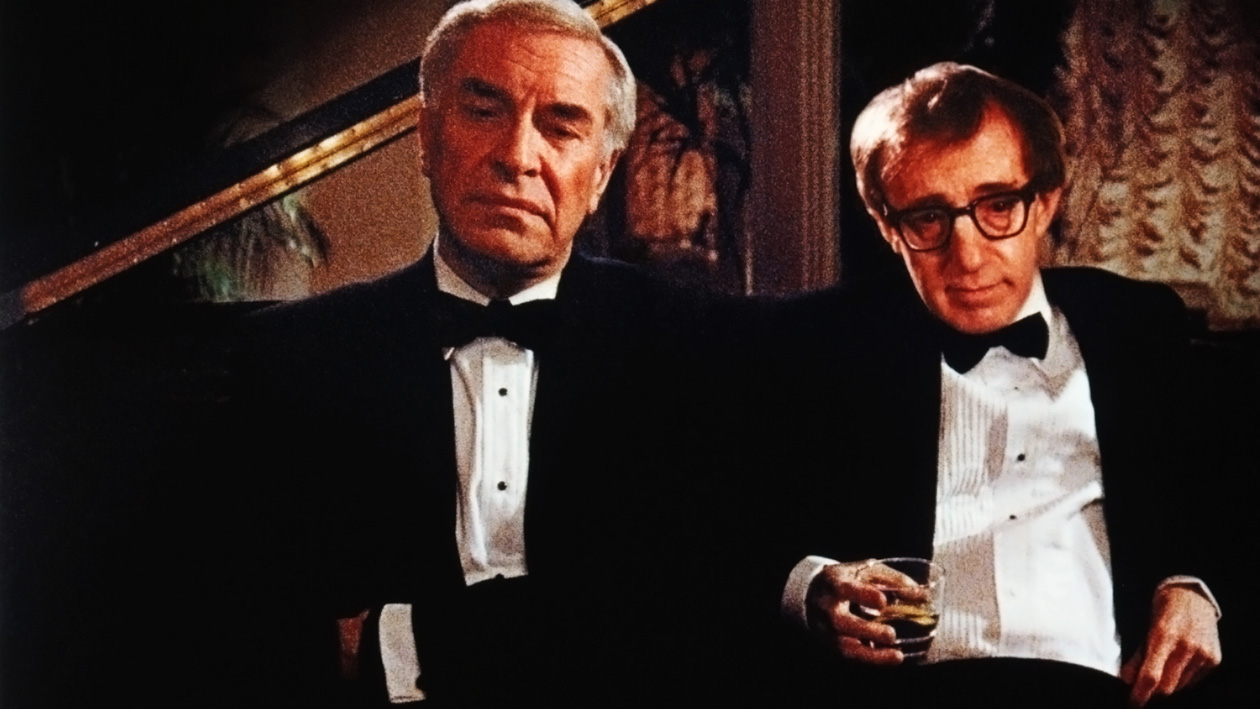
Martin Landau and Woody Allen reflect on Crimes and Misdemeanors

Director: Woody Allen

Cast: Caroline Aaron (Barbara), Alan Alda (Lester), Woody Allen (Cliff Stern), Claire Bloom (Miriam Rosenthal), Mia Farrow (Halley Reed), Joanna Gleason (Wendy Stern), Anjelica Huston (Dolores Paley), Martin Landau (Judah Rosenthal), Jerry Orbach (Jack Rosenthal), Sam Waterston (Ben)

Successful ophthalmologist Judah Rosenthal (Martin Landau) has it all: respect, fortune, a loving family…and a mistress. That mistress, Dolores (Anjelica Huston), won’t play ball and disappear but actually wants Judah to deliver on his half promises of leaving his wife. Should Judah confess all, as his rabbi friend Ben (Sam Waterston) suggests? Or should he follow the advice of his gangster brother Jack (Jerry Orbach) and remove Dolores permanently? Meanwhile, documentary film-maker Cliff (Woody Allen) has been hired by his brother-in-law, pompously successful TV producer Lester (Alan Alda), to shoot a film celebrating Lester’s life. During the shooting, Cliff can barely hide his irritation – or his growing attraction to Halley (Mia Farrow), the associate producer both he and Lester are romancing. Who will she end up with?

Dostoyevsky – could you live with a murder? – gets the Woody Allen treatment in one of Allen’s most highly respected, but troubling films. To be honest, I didn’t much care for Crimes and Misdemeanors. I have moral qualms about it – and, I will hasten to add, these qualms have nothing to do with the lack of punishment for Judah. Crimes and Misdemeanors hides its blatant cynicism and loathing for people, underneath some fine acting and good jokes. But its possibly one of Allen’s most unlikeable works, where his sympathies seem hideously astray.

It wants to be an exploration of the guilt that follows a crime. But to be honest, aside from some expert furrowing of brow and distressed line deliveries from Landau, I’m not sure Woody has much to say about guilt. Furthermore, I think he is inviting us to sympathise with Judah not because he feels bad (and even then, so what?), but for various extenuating circumstances. Namely, he’s a good man (he has all but funded a new hospital wing by himself) with a loving family and is a dedicated doctor. Furthermore, his mistress is presented almost exclusively as a demanding and difficult floozy (Anjelica Huston in an unflattering part – although at least she gets more to do than Claire Bloom in the thankless part of Judah’s wife, an almost non-existent role).

Frankly, the film suggests Judah’s motives are more complex than just removing a self-caused problem and since he feels shock (sorrow for Dolores or the crime seems noticeable absent, and it feels like Allen mistakes the one for the other) and is a nice guy, we should think again about our knee-jerk reactions of right and wrong. Problem is, Judah is not a nice guy – he’s shallow, self-pitying and self-justifying – and watching a character with, it turns out, no real morals go through a moral quandary doesn’t make for engaging viewing.

Judah’s moral reaction to the murder is insubstantial. Essentially guilt makes him wonder where there is in fact a God after all – before deciding that, on balance, the probability is that the universe will not punish him. Other than that, I’m not sure Allen has much more to add to the discussions of right and wrong. Dostoyevsky made hundreds of pages of conscious and guilt shattering a man’s equilibrium. Allen can’t manage more than about ten minutes of screen time, let alone 90 minutes.

Perhaps that’s why Crimes and Misdemeanors is padded out with a second, almost as long, unconnected secondary plot. It’s a one-sided rivalry between Allen’s film-maker and Alda’s pompous producer, with Mia Farrow as an artistic waif who serves as the prize for this unspoken competition. (This is perhaps one of the worst Allen films for female characters: we have two cold, personality-free wives for the main characters, a shrill mistress, a bland artistic waif and Woody’s character has a sister who is tied to a bed and defecated on. How did the same guy write Hannah and Her Sisters?)

Again, Allen’s sympathies lie with the idealistic, uncompromising Cliff, even more so because his interest in making films people don’t want to see makes him, in Allen’s eyes, noble. Compare and contrast with the film’s loathing for Lester – hilariously played by Alan Alda as a neat self-parody. Lester is everything Cliff isn’t, but secretly wants to be (though I’m not sure Allen realises this): successful, well-regarded, admired, rich and gets all the girls. No wonder the film hates him – even though, to be honest, he doesn’t seem the bad. After all, the sort of drive and ambition that Lester has is exactly what makes a man successful.

It wouldn’t matter so much if Cliff wasn’t remarkably similar to him, but considerably less charming. Just like Lester, Cliff is a self-important bore, cuddling his lack of success as proof of his genuineness. Cliff has no problem with effectively creepily stalking Halley (despite being married – fine though as Allen thinks she’s a bitch). Cliff’s passive aggressive assertions that Halley deserves someone like him rather than someone like Lester aren’t romantic, they’re creepy. (Needless to say, Halley ends up with Lester, to Cliff’s shock, horror and disappointment – while his wife plans to leave him).

Now I get it, there are people reading this who will think “well yes you just don’t like it because you want a simple ending where the baddies are punished – well life isn’t like that”. That’s not the case: I’m fine with films where murderers escape scot-free: but I generally want the film to know they are bad people. Crimes and Misdemeanors doesn’t. And it doesn’t really have anything of interest to say. It’s one of Allen’s films where his cynicism about humanity is exposed too heavily. You long for a bit more critical insight into Cliff, or for a more acute exposing of Judah’s self-interested excuses. You get neither, instead Allen ending on the note that the universe is dark and indifferent and only love can change things. There’s lots of the first two and precious little of the third here.

Hannah and Her Sisters (1986)

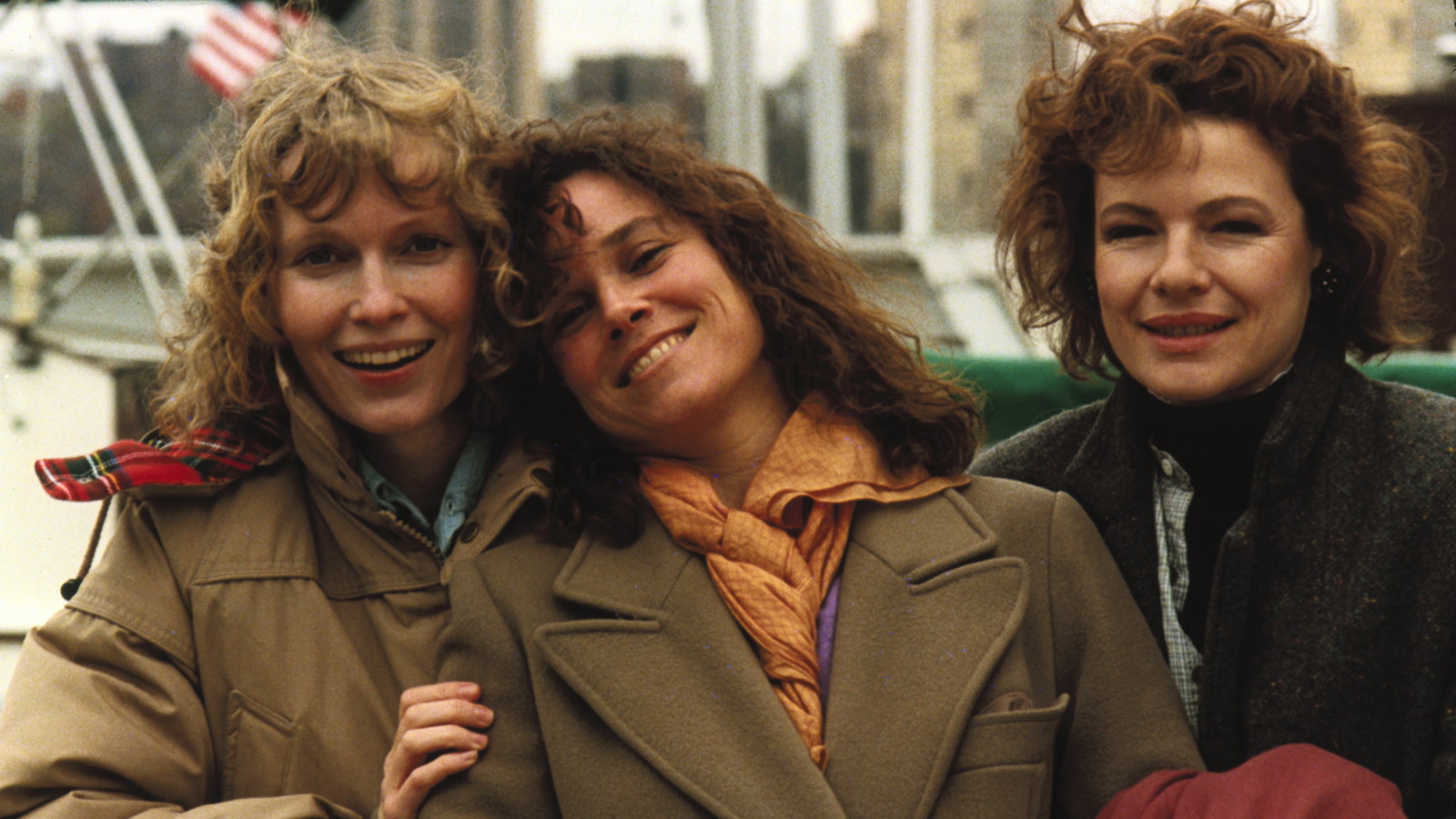
Mia Farrow, Barbara Hershey and Dianne Wiest are Hannah and Her Sisters one of Allen’s finest films

Director: Woody Allen

Cast: Woody Allen (Mickey), Michael Caine (Elliot), Mia Farrow (Hannah), Carrie Fisher (April), Barbara Hershey (Lee), Lloyd Nolan (Evan), Maureen O’Sullivan (Norman), Daniel Stern (Dusty), Max von Sydow (Frederick), Dianne Wiest (Holly), Sam Waterston (David)

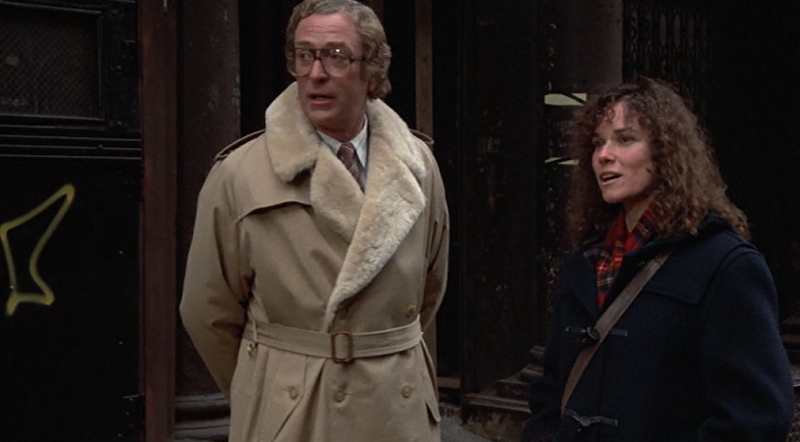
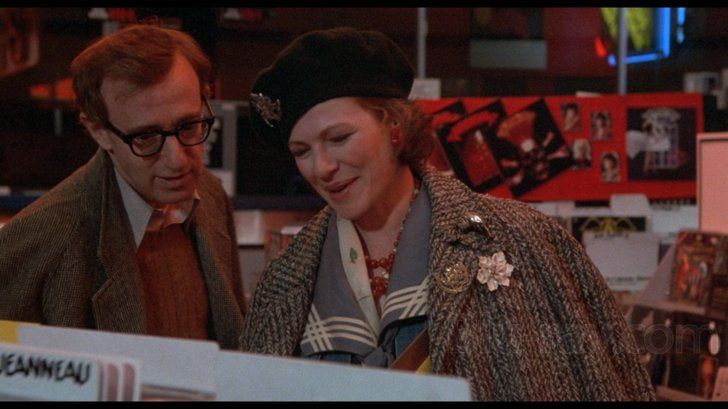
Hannah (Mia Farrow) is divorced from Mickey (Woody Allen) and happily married to Elliot (Michael Caine). Eliot is in love with Lee (Barbara Hershey). Lee is Hannah’s sister. Holly (Dianne Wiest) is considering dating Mickey. Holly is also Hannah’s sister. This whirligig of relationships is the heart of Hannah and Her Sisters, one of Woody Allen’s finest and certainly most humane films. Witty and heartfelt, it’s one of his sharpest scripts, crammed with acute observation and fine gags and is directed with a coolly introspective eye.

Allen splits the film into multiple sections, each opening (like the chapter of a novel) with a quote from the scene we are about to watch. Music plucked from Allen’s beloved classics (most often, and fittingly considering its romance theme, Bewitched, Bothered and Bewildered) frequently bridge scenes. Internal monologues is used often to allow us to explore the inner lives of the characters (the actors do a marvellous job reacting on screen to this internal thought process we are hearing).

The film uses a host of inspirations carefully mixed into Allen’s Manhattan Metropolitan middle-class milieu. The entire film has an autumnal Chekovian feel to it, with a rich sense of lives continuing ‘off stage’ as much as on. While the title obviously echoes Three Sisters, it’s study of romantic and intellectual entanglements overlaps with Chekov, as does the film’s love of wordplay. There are also, of course, echoes of Bergman (with gags) both in the film’s episodic structure but also its framing device of three Thanksgivings dinners, reflecting Bergman’s triumphant Fanny and Alexander.

The most effective thing about the film, in addition to its wit, is the surprising warmth it feels for the characters. Not always in an Allen film does one find the sympathy and empathy so widely spread – there is usually at least one character who is the target for the writer’s scorn. But here, no major character is presented as either the butt of snide humour or sneers. Even von Sydow’s pretentious artist is capable of searing emotional pain, and its hard not to sympathise with him as clients enquire whether his art will fit with their home décor. Each scene carefully balances the perspectives of multiple characters to allow us to relate to what each of them is going through. It’s possibly the largest cast of fully-rounded characters in an Allen film, and his most generous film.

It’s a film that avoids judgement over its characters, despite the frequently terrible and morally troubling things they do. It’s a film that understands the heart is an uncontrollable but resilient muscle, which doesn’t always guide us to the right or the easy things. Of course today, with Allen, you think it’s probably not a surprise he had sympathy with a group of people engaged in relationships that often involve profoundly betraying others. But at least her understands the irresistible urge people have to continue doing things they shouldn’t.

It’s hard not to overlook that the film’s least explored character (despite her multi-layered performance) is Mia Farrow’s Hannah. Poor Hannah, the still, moral centre of the film, is betrayed by both her husband and her sister (to their mutual guilt). Allen leaves her in ignorance – even though she knows something is wrong – and while Allen acknowledges what Elliot and Lee is doing is wrong, he mitigates things by making clear Hannah’s decency and generosity makes her overwhelming. While we see the impact a sudden distance from her husband has on Hannah (in a great shot she talks to him while he is off camera in another room, making her look like she is talking to a wall), Hannah is one of the few characters we don’t get the insight of an internal monologue for, and that feels like an easier way for Allen to maintain our sympathies for others.

The person whose internal monologue we hear the most is her conflicted husband Elliot. Hannah and Her Sisters may be unique in that it has two characters who are clear Allen substitutes. While Allen plays one, Caine is the husband (who looks alarmingly like a prediction of future developments in the Allen-Farrow relationship). Caine is superb, not least because he turns lines you can hear could be delivered with an Allenesque twitchiness, into ones crammed with utter emotional genuineness.

For all that he is a cheat, Elliot is strangely guileless and rather sweet, plagued with guilt and also giddy as a schoolboy, begging Lee to read an ee cummings poem that carries special meaning for him. Caine makes Elliot a genuine human character, a flawed man trying to avoid hurting people (but causing pain everywhere). If Branagh in Celebrity (with his distracting Allen imitation) showed how much of a slave to Allenesque delivery you can become, Caine shows how heartfelt simplicity and underplaying can bring out deeper emotion from Allen’s dialogue. Allen also rather brilliantly directs this abashed dance of attraction: from Caine’s internal monologue telling him to play it cool, moments before he kisses Lee, to the camera framing Frederick’s sketches of a naked Lee directly in Elliot’s line of sight while he tries to think of literally anything else.

Caine also matches superbly with Barbara Hershey, excellent as a woman who feels trapped in her life and drawn to Elliot despite herself. Lee’s current relationship is with Frederick, wittily played in a near parody of Bergmanesque brooding by Max von Sydow, who takes a late lurch into real vulnerability, a pretentious artist who is part-lover-part-tutor and is disconnected from the real world, Lee is virtually his only link left with it. Frederick is clearly a tutor and surrogate parent, as much as a lover to Lee – and that attraction to a figure who can take responsibility in her life is clearly something she’s attracted in Elliot. The slow, guilt-ridden coming together of Elliot and Lee – and the slow deflation of this fling – is the emotional heart of the movie.

The film’s other two arcs provide more of the gags. Woody Allen gifts himself some of his finest comic moments as Hannah’s hypochondriac ex-husband (the second Allen stand-in) undergoing an existential crisis after he discovers he is in fact not dying of a terminal disease. Dianne Wiest is similarly excellent (and also Oscar winning) as Hannah’s unsuccessful sister Holly, a would-be actress too insecure to find success. Wiest is not only funny, but also vulnerable and affecting, as she tries to find her place in the world. In many ways Wiest plays a third version of Allen here, as she becomes a neurotic writer channelling her real life into writing (to the consternation of her sister).

Changing reality into scripts is the only thing awkward about Hannah and Her Sisters today. Hannah and her extended family (and many children) are a thinly veiled portrait of Farrow’s own family (Hannah’s mother is even played by Farrow’s real life mother Maureen O’Sullivan). Like Allen and Farrow, Mickey and Hannah needed to adopt and foster children. And of course Eliot’s affair with Hannah’s sister eerily mirrors Allen’s own affair with Farrow’s adopted daughter, and the film’s sympathy for Elliot sometimes seems like an unsettling excusing of Allen’s future conduct. That’s not even mentioning one of the film’s earliest jokes is Allen’s character complaining about the cutting of a child molestation skit from his Saturday Night Live-ish show (“what’s the problem half the country’s doing it” quips Allen, a joke that doesn’t work today for so many reasons).

But put that aside because, whatever your opinion of Allen, Hannah and Her Sisters is one of his finest films. It’s expertly shot and directed with a real unobtrusive ease (Allen’s innate understanding of this Manhattan world contrasts sharply with how at sea he is in his European movies). The acting is spot on. As well as being very funny, the moral conundrums the film explores are sympathetic and witty, as are the flawed human beings behind them. Possibly his best film.

Going My Way (1944)

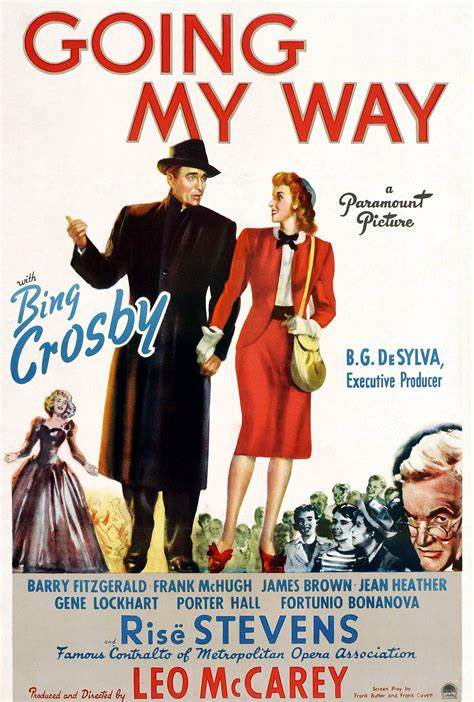
Bing Crosby wins hearts and minds in the sentimental Best Picture winner Going My Way

Director: Leo McCarey

Cast: Bing Crosby (Father Chuck O’Malley), Barry Fitzgerald (Father Fitzgibbon), Frank McHugh (Father Timothy O’Dowd), Rise Stevens (Genevieve Linden/Jenny Tuffel), James Brown (Ted Haines Jr), Gene Lockhart (Ted Haines Snr), Jean Heather (Carol James), Porter Hall (Mr Belknap), Fortunio Bonanova (Tomaso Bozani), Eily Malyon (Mrs Carmody)

“Schmaltz isn’t selling” record producers tell Father O’Malley (Bing Crosby) when he pitches them the little ditty he’s penned to raise funds to save his church from financial ruin. Well no one told the producers of this film: and just as well, as this became one of the most successful films of the 1940s, raking in buckets of cash and armfuls of Oscars. Watching it today, you’d hardly believe it – but that’s to forget the stress and fear of a nation at war, or that Bing Crosby (in a tailor-made role) was practically the most popular human being alive. For all that, watching Going My Way today won’t challenge you at all – other than perhaps your patience.

Father O’Malley (Bing Crosby) arrives in a (allegedly) rough neighbourhood in New York. He’s to take over the parish from the ageing Father Fitzgibbon (Barry Fitzgerald) but, gosh darn it, Father Bing doesn’t have the heart to tell Father Fitzgibbon that, so pretends to be his new curate. Promptly, Father Bing sets about solving all the problems of the parish with his charming homespun wisdom, decency, empathy and ability to bond with all. Gosh darn it, before you know what’s happened he’s turned the rough-and-tumble local boys from larcenists into an all-male choir and has roped in an old friend (who just happens to be the lead singer at the MET Opera) to give him and the boys the stage to sing a few of his songs and help save the church.

Yup, Going My Way is exactly that sort of film, and your enjoyment of it is going to be inversely proportional to how quickly being dipped in pure schmaltz brings you out in hives. This film is sickly sweet in its cozy comfort, a reassuring view of a world straight out of Enid Blyton, where the priest has all the answers, the hearts of businessmen can be melted by a few wise words, and dropping a few sporting references can win over the local ‘tough’ kids.

Going My Way is so homely and quaint, it makes Capra feel positively edgy. In fact, it lacks any of the energy, wit and style Capra brings to his pictures. That lack of buzz doesn’t help it, the languid pace drawing your attention all the more to its overbearing decency and careful weeding out of anything that could even cause a scintilla of doubt.

Instead it’s a warm gentle hug – and a hug that takes a great deal of time (at just two hours, it can seem like it’s going on forever). There are fewer songs in it than you might expect – only one every 10-15 minutes max. Often very little happens – and when it does, drama is very far from the agenda. Instead every problem is solved with consummate ease (it just needs Father Bing to open people’s eyes). Everyone is at heart decent in the extreme: the local tough kids have more high spirits than hooliganism to them, the (very) Irish women have stern exteriors but soft hearts, and the ruthless businessman is a devoted family man. After a while, I felt my patience being sorely tested.

In the middle of this, we get Bing Crosby, who won an Oscar for his work here. It’s a part tailor-made for Bing. In fact, so much so, that he essentially turns O’Malley into a dog-collar wearing version of his own stage persona, with touches of wry humour, whimsy and an affectionate smile. It’s no mean thing creating an entire persona – or performing it – but it feels a little rich to win an Oscar for it. O’Malley is of course perfect, a man free of any blemish who backs humbly into the limelight. A liberal who thinks Church should be fun (though far from a radical), there is nothing to cast even a shadow of doubt on his perfection: his flirtation with a girl never went so far as a date, he has the patience of a saint and he always knows exactly what to say to everyone.

He even wears down the defensiveness of Barry Fitzgerald’s Father Fitzgibbon. Fitzgerald also won an Oscar (for Supporting Actor) and effectively created the cinematic template for what an Irish priest is like. Fitzgibbon is bumbling with a sing-song whimsy, stuck-in-his-ways but basically decent, a touch prickly but also vulnerable and caring. His Irishness (like many of the rest of the cast) is dialled up to eleven. It’s an engaging performance, even if this old-cove-with-a-heart-of-gold schtick already felt familiar. But blimey, like the rest of the film, it can be far too much.

John Ford would have loved the Irish sentimentality of this film. It’s not perhaps Going My Way’s fault that its unquestioning regard and confidence in the church – and the assumption that all would treat them with complete deference and absolute respect – has dated it. But then maybe this was the case then as well, and it just felt much more reassuring to watch a simple world where a priest has all the answers and can change everyone’s lives. In the simple world of the film, you just let the cliché and coincidence wash over you and go with the flow.

Nevertheless, it still can make for a long watch if you aren’t in the right mood for this constant spin of Sunday-afternoon-gentleness. I have to confess it was too sweet for me – way too sweet. And there isn’t much of interest in the film, McCarey directing with a professional but uninteresting staidness (you couldn’t believe he cut his teeth doing Laurel and Hardy, so visually dull and slow is this film). Every outcome is dipped in sentimentality and sweetness and eventually watching the film is like gorging on candy-floss. Light, insubstantial, not as filling as it should be, and at the end you feel like throwing up.

Dr Strangelove; or How I Learned to Stop Worrying and Love the Bomb (1964)

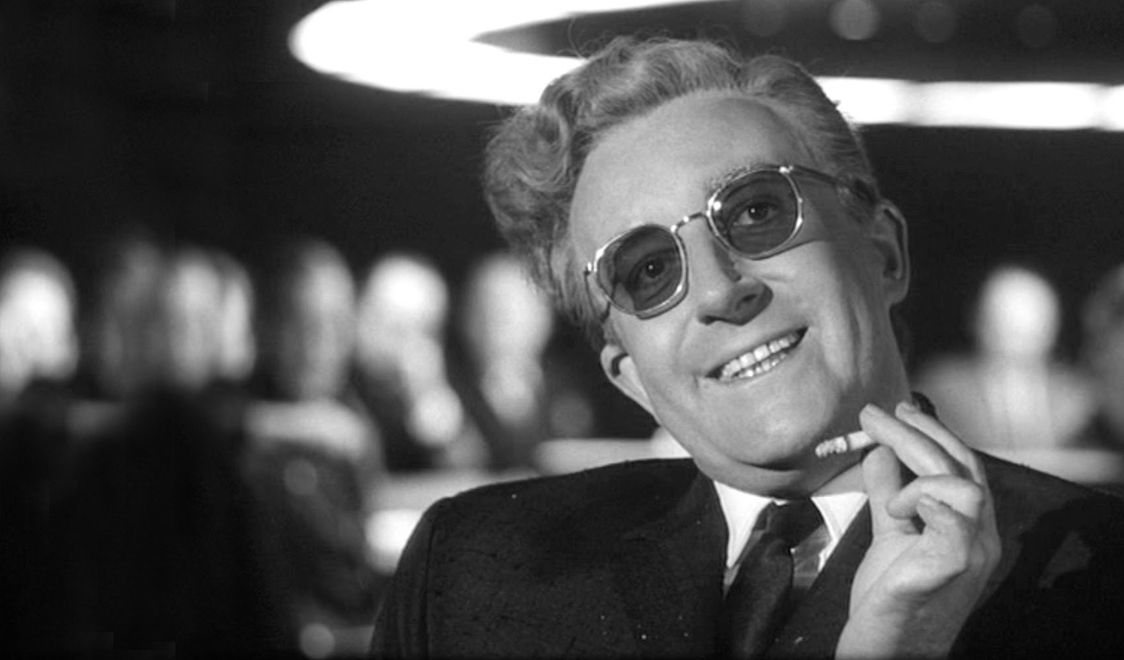
Peter Sellers tries to stop the end of the world in the terrific satire Dr Strangelove

Director: Stanley Kubrick

Cast: Peter Sellers (Group Captain Lionel Mandrake/President Merkin Muffley/Dr Strangelove), George C. Scott (General Buck Turgidson), Sterling Hayden (Brigadier General Jack D Ripper), Keenan Wynn (Colonel Bat Guano), Slim Pickens (Major “King” Kong), Peter Bull (Russian Ambassador), Jack Creley (Mr Staines), James Earl Jones (Lt Lothar Zogg), Tracy Reed (Miss Foreign Affairs)

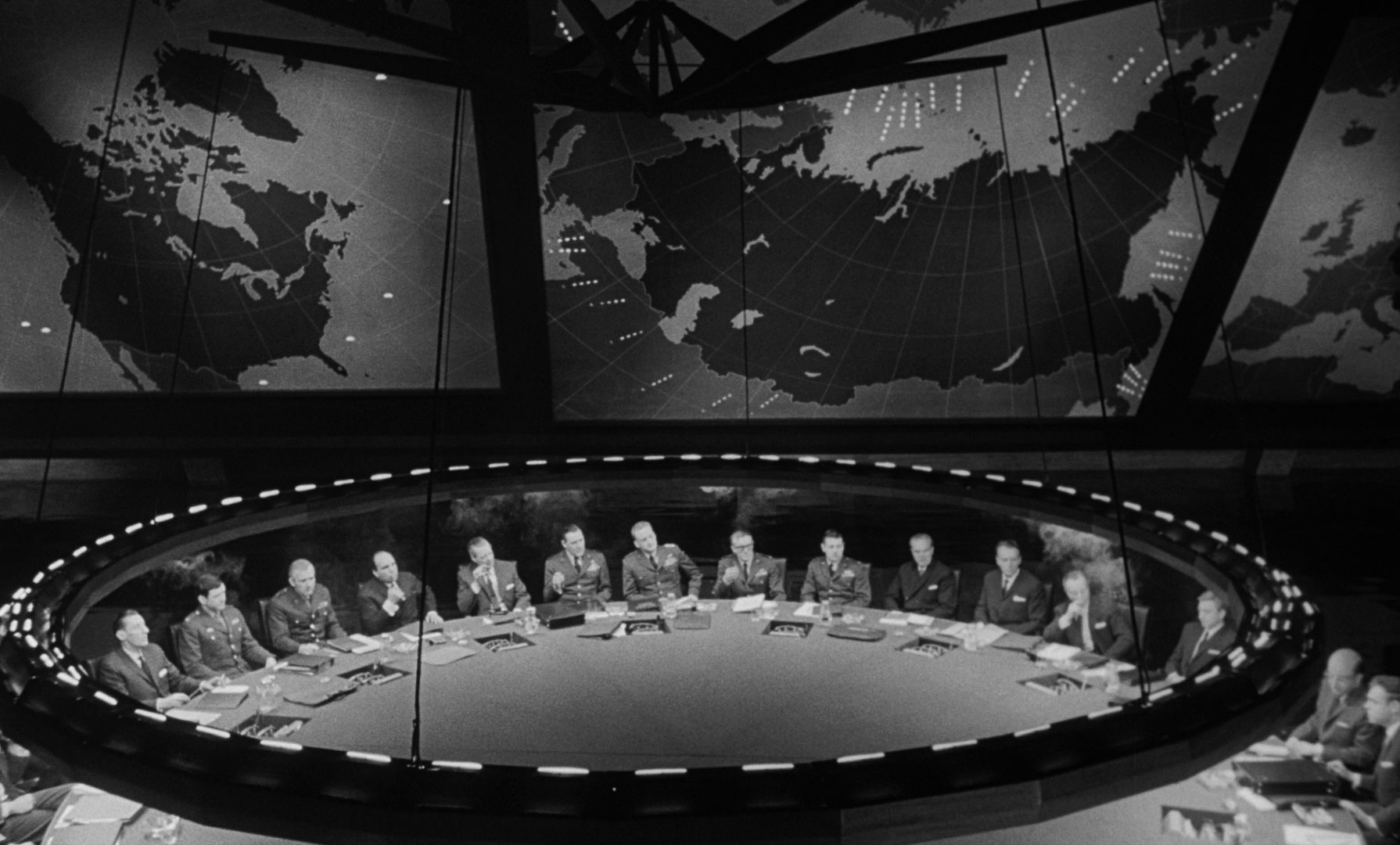
“Gentlemen you can’t fight in here. This is the War Room!” Kubrick’s hugely influential satire helped shape our perceptions of the Cold War and its mantra of mutually assured direction. Showing no mercy to its targets, it mixes Goonish schoolboy humour with moments of genuine tension and rising horror. Sure it features some of the faults of its director –self-importance, cold distance and much of the wit is due to Sellers and the performers rather than the not-particularly-witty-Kubrick – but there is no doubt it remains a seminal classic.

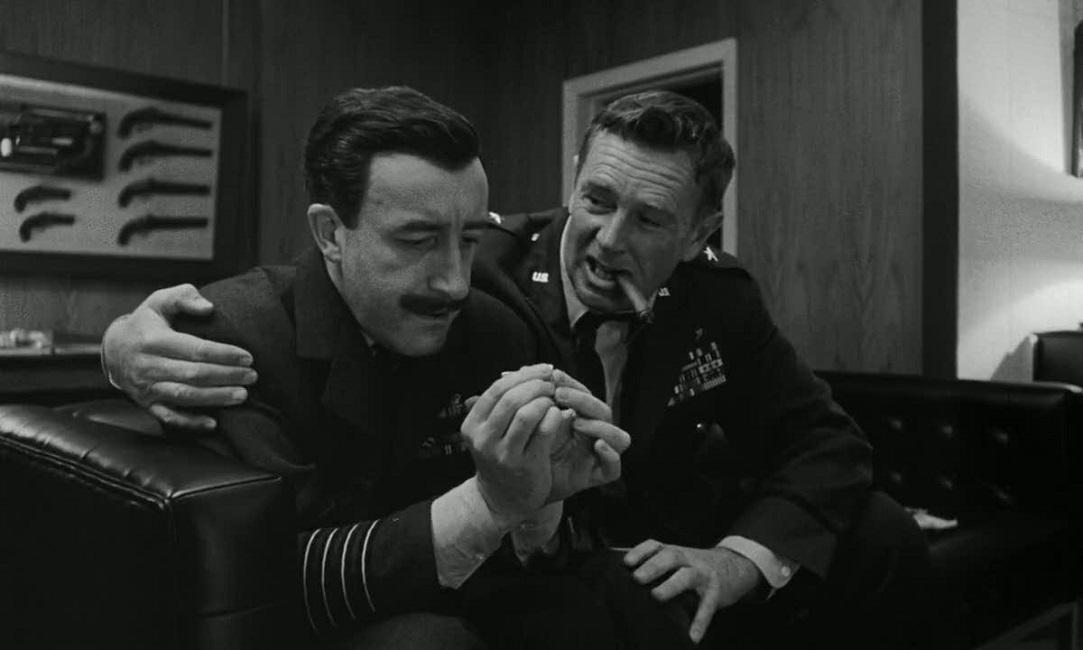
General Jack D Ripper (Sterling Hayden – excellent) orders his planes to drop their nuclear bombs on the USSR. Ripper is launching a pre-emptive strike to protect the American way of life from the Commies and, most importantly, to protect our precious bodily fluids. Yup he’s crazy, something his second-in-command RAF Group Captain Lionel Mandrake (Peter Sellers) quickly realises, but can’t do anything about. US President Merkin Muffley (Sellers again) reacts with horror at the prospect of all-out-war, negotiating with the Soviets to co-operate in shooting down the planes, while some of his advisors such as trigger-happy General Buck Turgidson (George C Scott, hilariously OTT) argue perhaps there is some merit in striking first. And sinister former-Nazi scientific consultant Dr Strangelove (Sellers one more time) spells out the impact of nuclear war.

Kubrick quickly came to the conclusion that if you were going to make a film about nuclear war, it almost couldn’t be anything buta comedy: after all the idea of two sides building a huge arsenal of weapons capable of destroying the world was so crazy, you wouldn’t believe it if you were told it. Dr Strangelove therefore ends up taking place in a world that’s one third grounded and two-thirds heightened reality. There is a great deal of college-style humour in the film (you can see it in those characters names which reference everything from the Whitechapel killer to female genitalia and excrement), but it works because its (mostly) played dead-straight.

Part of the film’s appeal was the number of sacred cows it slays. All the things that, at the time, America was meant to respect were ridiculed. The military, politicians, the Presidency, America’s moral authority, the ingenuity of American science and engineering. It’s all shown to be ineffectual, misguided, underpinned by fascist-tinged insanity, myopically obsessed with big bangs over humanity or plain ridiculous. Every single authority figure in the film is deconstructed over its course as some combination of childish, empathy-free or useless. You can’t come out of this film and every again have an unquestioning assurance our leaders know what they are doing.

This works, because it’s placed in a film that in many ways has the plot of a far more serious film (its very similar of course to Fail Safe). Chunks of it are played completely straight, or with just the merest touch of the surreal. In particular the sequences set on the bomber, commanded by Major Kong (played at short notice by Slim Pickens after injury prevented Sellers taking on that role as well) have that true sense of Kubrickian detail in their careful staging of all the procedures a bomber crew would follow (even if it still allows some fun to be poked at the expense of the survival kit, the contents of which would give a fella “a pretty good weekend in Vegas”).

Those bomber scenes sometimes outstay their welcome in their cold technicality (it’s odd to say that a film as short of this sometimes feels a little overlong), but that’s largely because in a film that is clearly demanding us to shake our heads at the madness, it struggles to get us invested in a more conventional heroic story (especially as success there is starting a nuclear conflagration).

Perhaps that’s because of the coldness in Kubrick’s style – emotion doesn’t often find its way into his greatest works, and he was often reliant on working with the right people (get a McDowell in it or a  Nicholson and things can click, get an O’Neal and you can get a different story). Humour isn’t his strong suit, but fortunately he worked with Sellers at his finest hours. Sellers takes on three roles, all of them a sharp contrast, and he’s masterful in all of them. There were fewer more gifted improvisational performers than Sellers, and each of his parts benefits hugely from the dynamism (of various sorts) he gives them. It’s also interesting that two of them are actually the “one sane man” (Muffley and Mandrake) while Strangelove is a pantomime monster of insanity (introduced late in the film, he’s the final indicator that our fates are in the hands of complete lunatics).

For Mandrake, Sellers parodied the stiff-upper lip upper class, with Mandrake a stuffed-shirt, attempting to wheedle recall codes out with Ripper with a clumsy bonhomie. Muffley is played almost dead-straight as a weak man out of his depth. But he does have a phone call monologue with the Russian premier (largely improvised with Sellers) that is one of the funniest things you’ll ever see. There’s no restraint in Strangelove, a wheel-chair bound grotesque with a phantom (hardcore fascist) hand, constantly suppressing involuntary Hitler salutes and trying to hide his mounting excitement at the prospect of worldwide annihilation (“Mein Fuhrer! I can valk!”).

Kubrick’s directorial approach – wisely – seems to have been to acknowledge that Sellers was providing so much of the madness and dark comedy the concept demands, that he could be more restrained. Interestingly, for being his most famous film, it often feels like one of his least personal ones. It stands outside much of the Kubrick cannon – it’s short, its often brisk, technically it’s unflashy and often unobtrusive – and it plays on the director’s weakest vein, comedy.

But it’s got his mastery of detail – partly also due to its faultless set design by Ken Adam. The reconstruction of the bomber interior is overwhelmingly convincing (the Air Force was amazed at how accurate it was). Ripper’s low-ceilinged office is a visual metaphor for the character’s insular insanity. Most influential of-all, the Bond villain-ish War Room, with its vast circular table and huge screens was so perfectly conceived, it cemented the idea for generations of what war planning rooms should look like (Reagan even asked where it was when he took office). The film may be darkly surreal, but its surroundings give it an authority that is essential for its success.

Authority is what the film needed to work. Perhaps that’s the greatest contribution of Kubrick, to create a structure of convincing reality, allowing the surreal and insane actions to work. From Ripper’s clear fixation on his own impotence (“I do not avoid women but I do deny them my essence”) – to Turgidson’s increasingly bombastic militarism (“I don’t say we won’t get our hair mussed, but I do say no more than 10 to 20 million killed. Tops.”), they all work because they contrast with a setting soaked in reality and detail. It also adds the important depth that gives the film impact: sure it wouldn’t happen like this, but something like this could happen.

Dr Strangelove’s humour has at times dated – there’s something undeniably schoolboyish about its tone. Stretches showing the detail of the bomber’s operation go on way too long. The film itself also takes a while to get going, and like many Kubrick films it has an air of being pleased with itself. But in Sellers it has a comic genius at the height of his game and its impact in changing the way we think about the world can’t be denied. Still a classic.

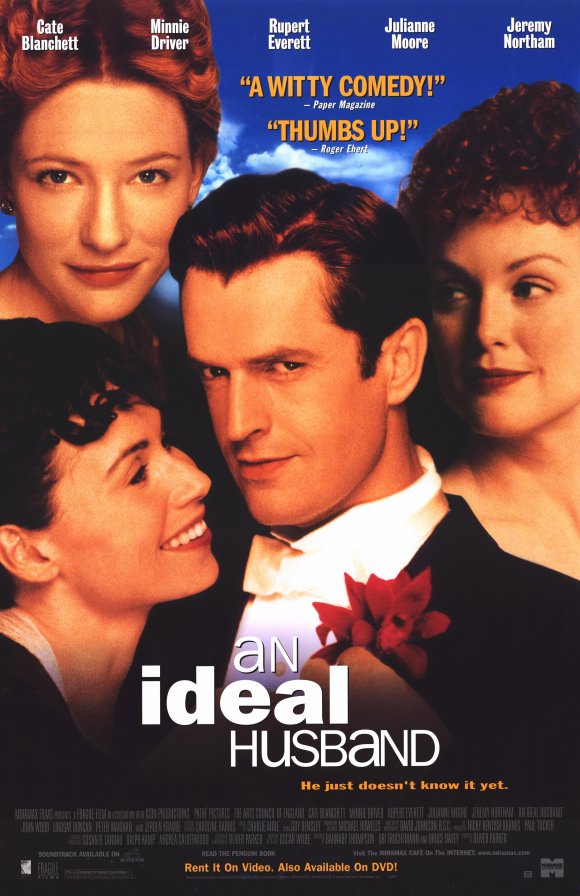
An Ideal Husband (1999)

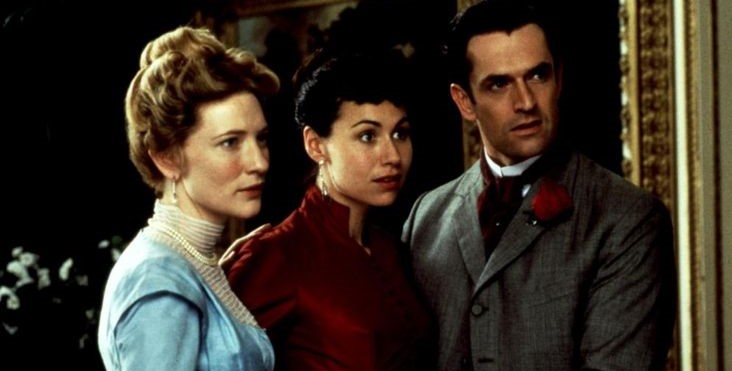
Cate Blanchett, Minnie Driver and Rupert Everett do the best in this Wilde mis-fire An Ideal Husband

Director: Oliver Parker

Cast: Rupert Everett (Lord Arthur Goring), Cate Blanchett (Lady Gertrude Chiltern), Minnie Driver (Miss Mabel Chiltern), Julianne Moore (Mrs Laura Cheveley), Jeremy Northam (Sir Robert Chiltern), John Wood (Lord Caversham), Peter Vaughan (Phipps), Lindsay Duncan (Lady Markby), Simon Russell Beale (Sir Edward), Nickolas Grace (Vicomte de Nanjac)

I have a theory that Shakespearean comedy rarely translates well to screen because what makes it work is its theatricality and how it encourages laughter by interacting directly with the audience. I think you could say the same for Oscar Wilde. Certainly, this film version of An Ideal Husband looks lovely and never misses a single Wildean bon-mot. But it’s overlong, drags rather in its final third and, above all, isn’t particularly funny.

The plot has been freshened up and adjusted in places to make for a more filmic narrative, but the principles are the same from the play. Sir Robert Chiltern (Jeremy Northam) is a pillar of the establishment, famed for his unshakeable dedication to principle and adored by his wife Lady Gertrude (Cate Blanchett) who sees him as a paragon. But all that could be shaken up when Mrs Laura Cheveley (Julianne Moore) re-enters his life, bringing with her shocking revelations that could destroy Sir Robert. So he turns to help to his best friend, the witty and debonair Lord Arthur Goring (Rupert Everett), who is himself in love with Sir Robert’s sister Mabel (Minnie Driver). How will events play out as they start to spiral out of control?

Oliver Parker’s film is cautious, safe and – for all that it tries to open the play out with scenes in parks and Parliament – conservative and safe. You can imagine Wilde himself would probably have wanted something a little more daring had he been involved. As it is, things that work very well on stage (the farcical elements of mistaken identity and a house with a different character hiding behind every door) don’t really work on film. These ideas are inherently theatrical and depend on the heightened unreality of theatre – in the cold hard harshness of cinema, they feel out of place.

Put frankly, the big thing the play misses is the live audience. You can imagine this cast going down an absolute storm in the West End. The lines that demand a wink to the audience, bits of business that invite laughter, just fall flat here. They are rendered lifeless by the demands of being fit into a film, or having to take place in a world that seems real, when Wilde’s plays are all about a sort of bizarre ultra-Victorian world of form covering up a suggestive naughtiness. When the characters go and watch The Importance of Being Earnest at the theatre (a sign of the film’s clumsy opening out, and its lack of wit when left to its own devices) the dialogue style that doesn’t really work in the “real world” of film suddenly feels perfectly natural when we see people speak it on stage.

Parker’s film fails to bring any particular inspiration to events. Instead it seems determined to package Wilde as a heritage product, the sort of thing you can imagine people considering a safe thing for the whole family to sit down and watch. There is no sense of cheek, sex or danger in this like you can get in Wilde. Instead it’s all about attractive actors in period-drama drawing rooms, going about their work with skill. All made to look as pretty as possible with some lovely costumes. It’s Sunday tea-time viewing.

But despite this, some of those performances are spot on. I’m not sure there is an actor alive today better suited to Wilde than Rupert Everett. His imperious drawl, his sardonic wit, his louche manner (not to mention his ability to suggest an illicit wickedness under the surface) make him absolutely perfect. Everett has shown time and again – on film and in the theatre – he has an affinity for the dryness needed for Wilde, as well as being able to communicate the intelligence without smugness. All the successful scenes of the movie revolve around him, and he invariably brings out the best from his co-stars. He’s also far-and-away the funniest thing in the film.

The rest of the cast are more mixed. Cate Blanchett is the stand-out in (sadly) the least interesting main role, the rather stuffy Lady Gertrude (you wish you’d been able to see her let rip as the more wicked Mrs Cheveley) – like Everett she “gets it”. Jeremy Northam also does excellent work in the straight-man role of Sir Robert, but his characteristic dignity and intelligence do very well in the role. Julianne Moore though seems oddly constrained by the period setting as Mrs Cheveley (strange that she did this at the same time as her superior work as a restrained Englishwoman in The End of the Affair) while Minnie Driver lacks impact as Mabel. John Wood and Peter Vaughan – two old pros from the theatre – bring much of the energy and wit in supporting roles.

An Ideal Husband is fine. But watching it you’d wonder what all the fuss about Wilde is about. And that can’t be a good thing. If Wilde wrote a review of it, it would be funnier than anything in the film.

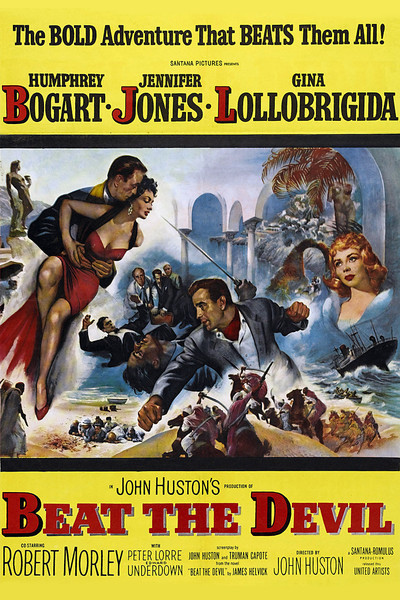
Beat the Devil (1953)

Jennifer Jones, Gina Lollobrigida and Humphrey Bogart in the tongue-in-cheek Beat the Devil

Director: John Huston

Cast: Humphrey Bogart (Billy Dannreuther), Jennifer Jones (Gwendolen Chelm), Gina Lollobrigida (Maria Dannreuther), Robert Morley (Peterson), Peter Lorre (Julius O’Hara), Edward Underdown (Harry Chelm), Ivor Barnard (Major Jack Ross), Marco Tulli (Ravello), Bernard Lee (Inspector Jack Clayton)

Beat the Devil is a curious beast. You could argue it was ahead of its time. Huston and Bogart had started out with the intention of making a straight crime mystery, a sort of Maltese Falcon in Europe. But when they arrived on location, obviously something in the weather got to them and Truman Capote flown in to help redraft the script on a daily basis to turn it into a sort of satirical comedy. For audiences expecting a hard-boiled crime mystery, it left heads scratched and cinema seats empty. Bogart lost a packet on the film – and later claimed to hate it – and it only existed in a badly cut-about version until it was restored in 2016.

The slightly surreal plot hardly really matters. A crowd of unusual people gather in a run-down port in a small Italian town, waiting to take the ship to East Africa. Gwendolen (Jennifer Jones) and Harry Chelm (Edward Underdown) are seemingly upper-class Brits (or are they?). American Billy Dannreuther (Humphrey Bogart) and his European wife Maria (Gina Lollobrigida) might also once have been something, but they sure ain’t now. Peterson (Robert Morley) and his associates the suspiciously un-Irish Julius O’Hara (Peter Lorre), rat-faced bully Major Jack Ross (Ivor Barnard) and nervous Ravello (Marco Tulli) are almost certainly all criminals on their way to a big score in Africa. Thrown together, this unlikely grouping end-up in a heady cocktail of betrayals, schemes, affairs and lies that spools out like a demented shaggy-dog story.

Beat the Devil is really more of an experience, a series of gags and light-hearted scenes played with a grin and a wink. Nothing in it is meant to be taken seriously, and this semi-surreal group of events becomes ever more absurd as it goes on. By the time the cast are abandoning a sinking ship, trudging up a beach to be captured by Arab officials who eventually allow them to row back to port where they find their ship didn’t actually sink…you really should just decide to go with the flow.

Instead the film is about shuffling up familiar tropes from hard-boiled noir with Oscar Wildeish farce. Certainly the Chelms seem to have wandered in from something totally different (not least since Gwendolen’s name is reminiscent of Importance of Being Earnest). Harry (a superbly stiff-upper lipped Edward Underdown) is a blithely unaware would-be English gentleman, pompously aware of his social class and blithely unaware that his wife seems to immediately start an affair with Billy. Gwendolen is the exact sort of character you might expect to see in Wilde, a dreamer tipping into fantasist, who blurts out things she shouldn’t and falls instantly in love with Billy. She’s also whipper-smart – more than capable of defeating Harry at chess without looking (“usually he’s a wonderful loser” she tells Billy, by way of apology for Harry’s strop).

Billy and Gwendolen embark on an immediate affair (although of course, in deference to the Hays Code, its just kept this-side-of-implicit). Mind you the film has a zingy wife-swop feel to it, since it’s pretty clear that Maria is far more interested in the British reserve of Harry (“Emotionally I’m English” she says before eulogising tea and crumpets) than she is in the ordinary-Joe cunning of her husband (although perhaps Harry is just as oblivious to this as everything else around him).

Billy is Bogart deliberately at his most Bogart-ish, channelling every grimy-but-smart dubious-hero the star ever played. Bogart plays the entire film with a grin on his face and delights in lines like “Fat Guys my best friend, and I will not betray him cheaply”. He also sparks delightfully with Jennifer Jones, who seems to having the time of her life as a character so flighty and unpredictable that even she looks like she hasn’t a clue what she is going to do (or feel) from one moment to the next.

The supporting cast of creeps and freaks Dannreuther is conspiring with to make a fortune (its something to do with land and uranium) similarly seem to have walked in from a side-ways Dashiel Hammett universe. For all their dirty deeds – and it seems Petersen had ordered a hit in the UK, although never for a minute would you believe this looking at Robert Morley’s puffed up bluster – they are a rather sweetly naïve and incompetent. Morley’s Petersen, a sort of galloping major, carries no real threat. Peter Lorre is very funny as a suspiciously German sounding Irishman (“Many Germans in Chile have come to be called O’Hara” he comments), prone to flights of verbal fancy and a chronic lack of focus. Ivor Barnard is as close as the film comes to threat as the aggressively incompetent Major Ross, a chippy bully who resents his shortness and eulogises Hitler at the drop of a hat. These heavies are each ridiculous figures.

And it makes sense, since the plot is a great inflated balloon of nonsense. There are chases, sinking ships that stay unsunk, a moment where two major characters are briefly believed dead, obsessive conversations about hot water bottles and reveals that puncture any sense of grandeur for each character. It’s the sort of aimless story you could imagine natural raconteurs like Huston and Capote finding absolutely delightful, and the whole film feels like a dramatization of a dinner-table anecdote.

Take it on those terms and its all rather good fun, even if it makes no sense. The cast look like they are having a whale of a time, and the total lack of seriousness about the whole enterprise generally makes it glide by with ease. Take a couple of drinks, sit back, don’t think about it too much and enjoy the jokes.

The Graduate (1967)

Dustin Hoffman is out of his depth in coming-of-age comedy The Graduate

Director: Mike Nichols

Cast: Dustin Hoffman (Benjamin Braddock), Anne Bancroft (Mrs Robinson), Katharine Ross (Elaine Robinson), William Daniels (Mr Braddock), Murray Hamilton (Mr Robinson), Elizabeth Wilson (Mrs Braddock), Buck Henry (Room clerk), Brian Avery (Carl Smith), Walter Brooke (Mr McGuire), Norman Fell (Mr McCleery)

In 1967, the world went crazy for The Graduate. This comedy of manners and sex tapped into a whole generation’s growing sense of rebellion. Who wants to be told their life has already been mapped out for them? The Graduate seemed to capture that mood and was celebrated as the ultimate example of how someone could break out of the mould. It’s a young person’s film, and perhaps you need to be young to watch it. The older you get – and the further away from those dreamlike days of the late sixties where everything seemed possible – the more the film feels like an amusing but soulless story, with a privileged bore at its heart.

Benjamin Braddock (Dustin Hoffman – actually nearly 30) is a fresh-faced young graduate, top of his class and a sports star. Arriving back home in California, he’s depressed, lost, uncertain about what he wants from life, but pretty sure it isn’t the litany of office, marriage and a career in “plastics” that his parents expect. His isolation brings him to the attention of Mrs Robinson (Anne Bancroft – only 6 years older than Hoffman), the wife of his father’s business partner. She sets about to seduce him, partly out of boredom, partly perhaps because she feels the same ennui and depression as he does (not that Benjamin ever notices – more on that later). They start a long summer affair, conducted with supreme awkwardness on Benjamin’s part, which suddenly becomes complex when he falls for her daughter Elaine (Katharine Ross). Can true love triumph?

The good first. The film’s popularity was grounded in its wit – and it has a very funny script by Buck Henry, who also appears in one of the film’s funniest sequences, as an overly helpful desk clerk at the hotel where Benjamin is awkwardly trying to book a room for his assignation. The film is pacey and energetic and full of imaginative cuts (a brilliant one sees Benjamin flopping out of a pool, jump cutting to him descending onto Mrs Robinson in bed) and directorial flourishes. It’s a dynamic and sexy young film, full of bounce and appeal, with some great jokes.

Mike Nichols – who won the film’s only Oscar for Best Director – shoots the film with real vibrancy. He does a fantastic job getting us to invest in Benjamin. A huge percentage of the film sees the camera focus in on Benjamin, usually in medium-shot or close-up – and it’s a rare moment when he isn’t in frame. The camera rarely leaves him for the first ten minutes, first zooming out from a close-up of him sitting on a plane, following him along a conveyor belt to the terminal (where his blankness slowly changes to fearful anticipation of what waits at home) to tracking along beside him at his welcome home party. This party is stuffed with his parents’ friends, and Ben’s isolation, claustrophobia and insecurity seem all the more striking as the camera gets closer and closer to him. It’s a superb example of using the camera to build empathy for the character.

Nichols’ excellent work continues throughout the film, which makes excellent use of shots, editing and zooms to make us experience Benjamin’s emotions, helping us root for him. It also helps that the film is scored to some of the finest music Simon and Garfunkel ever performed. The slightly sad, wistful feel to their songs – from Sound of Silence to Scarborough Fair – seems to perfectly frame Benjamin’s doubts, just as the slightly more hopeful beats of Mrs Robinson seem to capture him embracing freedom at the film’s end.

The decision to cast Hoffman pays off in spades. Hoffman is no one’s idea of a WASPy sports-star alpha male, but he’s everyone’s idea of an outsider. His performance is pitched perfectly – awkward, shy, uncertain, unaffected and natural. In fact, the film is pretty much perfectly cast. Anne Bancroft’s performance defined her whole career, the predatory Mrs Robinson whom she invests with touches of emotional vulnerability and more than a trace of the very same depression and fear that Benjamin is feeling. An entire generation effectively fell in love with the charming Katharine Ross.

Freedom is what the film is all about. But today, you feel the film skims only lightly on depths it could explore in detail. Benjamin can feel all the ennui he likes: he’s got it so made, I wish I had his problems. With his wealth, his fast car, the vast array of businessmen falling over themselves to offer him low-work-high-reward jobs, not to mention the gallery of attractive women throwing themselves at him, it’s the sort of misery only the rich enjoy. Almost constantly dressed in suit and tie, with his combed down hair, he looks a million miles from the generation that would party at Woodstock and protest Vietnam. Benjamin probably went on to vote for Reagan (twice). There is nothing counter-culture about him whatsoever. He ticks off noisy teenagers at a drive in and seems to find the young as hard to understand as the old. He’s less a generation adrift, more of an individual misfit.

The film though loves him to pieces, in the same way it largely treats Mrs Robinson as somewhere between a joke and a monster. She’s written as either a horny exploiter of youth, or a vengeful harpy. Rather than a ruthless cougar, today she seems to be more of a vulnerable, damaged figure. Every scene with Bancroft carries moments of pain, sadness and world-weary depression. Why else is she so able to spot these traits in Benjamin? Watch her desperation and hurt when Benjamin starts to date her daughter. That’s real humanity there, miles from the empty selfishness of Benjamin, who genuinely doesn’t get why she could take it so amiss that he intends to replace her with her own daughter.

The most striking moment in the film that captures this is the scene where Benjamin attempts small talk during one of their nights together. The film wants us to think Ben is looking for something real, and that Mrs Robinson just wants the sex. But the conversation is a masterclass from Anne Bancroft of suppressed pain and regret, as she talks of having to drop her art degree because she was seduced by her husband, of years of living an empty life. Benjamin of course doesn’t get it – he guesses she dropped the art because she wasn’t interested – and then gets cross when he feels he’s being belittled. Mrs Robinson’s sad eagerness to persuade him to stay is rather affecting – more than the film really allows. I credit Anne Bancroft with much of this.

And then we have Elaine. The second half of the film shifts gear dramatically from the first. While the first half is a sex comedy and study of suburban discontent, the second seems to change into the sort of celebration of youthful energy that the first half could be said to be partially satirising. Elaine is an independent young woman, embracing her education and the opportunities it offers. Suddenly, an energised Benjamin is tearing across country to win Elaine back (let’s put aside that Benjamin behaves in this section like something between a stalker and a creep).

However, as the film nears its conclusion, that celebration of the promise of youth is undercut somewhat, as Elaine chooses to make  all the same mistakes her mother made. The film even hints at this with its famous ending shot. After eloping from her wedding, Elaine and Ben sit on the back seat of the bus. The camera holds the shot as they laugh, until they stop laughing and then sit next to each other, and then awkwardly look this way and that as if waiting for someone to tell them what to do. What do they really have in common? Having made a spontaneous decision like this, what happens next? It’s another little genius flourish by Nichols – although it’s also the film having its cake and eating it, selling the sequence before this as a triumph of true-love, then asking us to question if the world is that simple.

Some of these ideas felt lost in the excitement of the film’s first release, when it captured a wave of public feeling. But the older the film gets, the more awkward it looks. As if the kids who watched it in the sixties and turned into the Reaganite Baby Boomers of the 1980s, slowly realised that the message it was selling was not quite true and perhaps their parents weren’t that different after all.

Watching The Graduate today, I found it hard to shake the feeling that if I flashed forward to the characters’ lives in 1997 I would find a very different, but still very similar story. Benjamin Braddock would be a wealthy businessman, still dressed in suit and tie, who went into plastics or computers or some such and swallowed the “greed is good” mantra from his corner-office. Elaine a depressed housewife, mother to a couple of kids, who left her dreams of forging her own life behind to marry the subject of a youthful fling. Who, with her own regrets, finally understands the sadness and misery at the core of her mother’s life. And is making eyes at that attractive young man next door…

The American President (1995)

The buck stops with Michael Douglas in Aaron Sorkin’s dress rehearsal for TV, The American President

Director: Rob Reiner

Cast: Michael Douglas (President Andrew Shepherd), Annette Bening (Sydney Ellen Wade), Martin Sheen (AJ MacInerney), Michael J Fox (Lewis Rothschild), Richard Dreyfuss (Seantor Bob Rumson), David Paymer (Leon Kodak), Samantha Mathis (Janie Basdin), John Mahoney (Leo Solomon), Anna Deavere Smith (Robin McCall), Nina Siemaszko (Beth Wade), Wendie Malick (Susan Sloan), Shawna Waldron (Lucy Shepherd), Anne Haney (Mrs Chapil)

Taken solely on its own merits, The American President is a charming, witty romantic comedy which makes some shrewd (liberal-tinged) comments about American politics. But no-one is ever going to take The American President on its own merits. Because this Sorkin-scripted bundle of joy is so clearly a dry-run for The West Wing, it’s hard to watch it without spotting the roots of it here: everything from shared characters to scraps of dialogue. Perhaps only M*A*S*H stands with this film as so dwarfed by its spin-off.

President Andrew Shepherd (Michael Douglas) is a widower, raising his daughter Lucy (Shawna Waldron). Heading into the third year of his first term, he’s got a domestic agenda dominated by his new crime bill (although Shepherd won’t risk increasing gun controls). Charming, articulate and passionate – he’s also lonely. But his life changes when he falls for environmental lobbyist Sydney Ellen Wade (Annette Bening), their courtship seeing them fumble through “boy-meets-girl” when boy just happens to be the most powerful man in the world. Will the President’s popularity survive him dating someone outspoken and passionate? Or will it be a tool for his Republican rival Senator Bob Rumson (Richard Dreyfuss) to hit him on everything from family values to patriotism?

It’s impossible not to enjoy The American President. Sorkin’s playful, articulate and smart dialogue is of course an absolute triumph. The cast are extremely well-chosen. Few actors look as damn Presidential as Michael Douglas, not to mention carrying with them an air of impassioned authority and commanding bonhomie. Annette Bening is spot-on as exactly the sort of feisty and intelligent woman that would attract a liberal minded President, but turn off pundits and regular people. Martin Sheen was obviously so comfortable with Sorkin’s dialogue style that promotion to the President seemed inevitable (seriously it’s very odd watching the film and seeing Sheen not being treated like the President!). Michael J Fox’s entire career was revitalised by Sorkin tapping into the frantic, fast-paced comic energy that is the actor’s forte.

Rob Reiner’s direction is fresh, relaxed and perfectly complements the dialogue. We get a few West Wing style walk-and-talks (does this make Reiner the inventor of it?). The film superbly balances romantic comedy with serious political discussion on military intervention and proportional response (“the least Presidential thing I do”), the environment and gun control. It also gets a neat idea of the shady, and dirty, business of generating votes in the House – and the deals that need to be done to secure legislation. Reiner gets great stuff from the actors (Sorkin didn’t question his casting, since so many of them ended up in The West Wing) and keeps the momentum up beautifully.

The film has a lovely Capra-esque feel to it. Sorkin is even witty enough to lean on this by having Sydney discuss Capra openly with a White House security guard – also a lovely moment to establish Sydney’s genuineness and openness, as compared to the jaded I-don’t-care attitude of her colleague. There is a real feel in it – and of course this optimism carries across to The West Wing – that good people in the right place can change the world. That decency and compassion can trump (so to speak) the cynicism of Washington insiders. (The idea appeals to everyone – what is Donald Trump but a nightmare version of a plain-speaking man in Washington who says what he thinks?).

Balanced with some lovely comedy, it works extremely well. Along with the debate, Sorkin has a great feeling for the absurdity of the Leader of the Free World trying to work out how he can behave like a regular Joe and ask a girl out on a date. Simple ideas, from sending flowers to the etiquette of having someone stay over, are laced with difficulties. The film gets a wonderful sense of how the public eye can unjustly tear people apart – all drummed up by Dreyfuss’ eminently hissable villain.

There is some great chemistry between Douglas and Bening. Douglas is at possibly his most charming and authoritative here, effortlessly selling the lightness but also the powerfully effective speeches Sorkin crafts for him (his final press conference speech that effectively closes the film is a barnstormer). Bening, as well as being perfectly cast, walks a neat line between serious professional and girlish crush, that comes across extremely well.

It’s hard though, for all the film’s romantic charm, not to look at it through the filter of The West Wing. It’s both a first pass, and a historical curiosity. Sorkin recycled many of the ideas touched upon here (most noticeably Sheen’s President would spend an entire episode discussing proportional responses) and also expanded several characters. Douglas’ teacher turned President, widely read and with a liberal outlook, is a clear forerunner of Bartlett. Sheen himself plays a character who is all but Leo. Fox plays a character combining elements of Josh and Toby. Anna Deavere Smith is a CJ without those distinctive touches Allison Janney bought to the role. Names, plot developments, concepts are all recycled. Stylistic flourishes in the writing match.

The American President isn’t as good as The West Wing of course – few things are. But as a boiled down, Hollywood version with a romantic twist, it’s still pretty damn good.