Category: Comic book film

The Batman (2022)

The Batman (2022)

Robert Pattinson presents a noirish Bat in Matt Reeves’ dark, moody vision

Director: Matt Reeves

Cast: Robert Pattinson (Bruce Wayne/Batman), Zoë Kravitz (Selina Kyle/Catwoman), Paul Dano (The Riddler), Jeffrey Wright (Lt James Gordon), John Turturro (Carmine Falcone), Peter Sarsgaard (DA Gil Colson), Andy Serkis (Alfred Pennyworth), Colin Farrell (Oswald Cobblepot/Penguin), Jayme Lawson Bella Réal) Rupert Penry-Jones (Mayor Don Mitchell Jnr), Barry Keoghan (Arkham Prisoner)

The rain pounds down on Gotham. In the shadows a masked man strikes terror into the hearts of wrong-doers. It could only be the start of a new Batman trilogy. At least that’s the intention, as DC Comics mines its strongest asset, in a dark, noirish version that positions Batman as a gumshoe pulp detective with fisticuffs. If Reeves film at times has more ambition than it knows what to do with, at least it is ambitious.

For two years Bruce Wayne (Robert Pattinson) has been crusading on the streets of Gotham as Batman, trying to fix the city’s problems one criminal at a time. He’s formed an uneasy alliance with police Lt James Gordon (Jeffrey Wright) and is just about tolerated by the official force. That starts to change when unhinged serial killer The Riddler (Paul Dano) begins a campaign of terror targeting Gotham’s elites, who he accuses of corruption. How far will the Riddler go? How do crime boss Carmine Falcone (John Turturro) and mysterious cat burglar Selina Kyle (Zoë Kravitz) fit in?

Reeves’ film is a grimy film-noir Batman. Pretty much the entire film is set at night-time, in seedy bars and filthy streets with barely a frame unaccompanied by the pounding of rain on the soundtrack. Atmospherically shot by Grieg Fraser, the film has a rain-sodden canvas with deep blacks and splashes of red. It’s sound design – and Michael Giacchino’s music – uses deep bases and reverbative sounds that give the film an intimidating rumble.

Reeves’ takes Fincher’s Seven and Zodiac as key inspirations, mixed with the shadowy darkness of Pakula and other 1970s filmmakers. Gotham is the hellish noir of Seven, where light is a stranger. The Riddler is radically re-interpreted as an ingenious psychopath, covering his crimes with cryptic clues, cultivating an online audience with videos where he conceals his face behind a sort of gimp mask and prominent spectacles – in methods and style he’s very similar to the Zodiac killer.

Batman is a tech-assisted private eye, working alongside the official forces, doing things they can’t do. Few other Batman films have zeroed in on the detective element of the character as much, but it’s possibly his main skill here: searching for clues, deftly cracking the Riddler’s cryptic clues, chasing down leads, utilising top-of-the-line surveillance equipment (a set of contact lenses that records everything he sees) and making connections from crime to crime. He’s a sort of miserable Sam Spade who punches lots of people.

Setting the film very early in Batman’s crusade allows for a rough and raw quality to Batman’s gear and approach, helped by Pattinson’s age. The suit has a homespun practicality to it, a hulking suit of armour that bullets bounce of, with various useful attachments. The batmobile is essentially a normal car with a massively souped-up engine. Batman often travels on a normal but powerful motorbike, and stakes out witnesses with his armour disguised under a hoodie. At times Bruce misjudges things: a fall from a building that almost goes horribly wrong, the odd fight where he bites of more than he can chew.

With an eemo look inspired by Kurt Cobain, Bruce Wayne is a surly recluse with serious emotional difficulties. He has a tense relationship with surrogate father Alfred (an effective Andy Serkis), who disapproves of how Bruce spends his evenings. The Batman has far less Bruce Wayne in it than almost any other Batman movie. This Bruce only feels comfortable behind the mask and has worked hard to crush all fear and emotion to find security in anonymity. He has cut himself off not only from the city, but from humanity, idealising his lost parents – and is a stern, humourless judge who describes his mission as one of vengeance.

There is a lot of vengeance needed in Reeve’s corrupt Gotham. The film bites off a huge chunk of content around corruption, class conflict and injustice. The Riddler’s crimes are all connected to corruption, people whose hands are actually filthy with drug money. His fury extends to the Wayne family – Gotham’s venerated philanthropists – and the film is at its best with this character when he functions as a sort of avenging angel of class war.

But it doesn’t quite manage to nail down exploring the morality of a serial killer, eliminating pernicious public figures. There is no discussion of the misguided merit in the twisted motives of the killer. He’s always presented as wicked and insane, with no scope given to understand or acknowledge the legitimate social points he makes. A late act reveal of his deeper plot comes from nowhere and (with its indiscriminate destruction) feels inconsistent with any point the film was trying to make earlier. It seems instead to exist to give us a big action set-piece. The film strains towards a coherent message about institutional, systemic corruption, but doesn’t quite give it the depth and shade it needs.

It’s all part of a film that isn’t quite smart enough, or a script that isn’t deft enough. Take a look at those riddles. Darkly fascinating as they are, their never quite strong or enigmatic enough. The film offers no ‘light-bulb moment’ when a hidden message is suddenly made clear. Batman cracks them all quickly, apart from one. Most audience members will quickly suss out that one and you suspect the only reason Batman doesn’t is that if he did the film would end quickly.

Ending quickly is something The Batman isn’t concerned about. At nearly three hours, it is far too long – particularly as it never quite works out what it is trying to say. There are too many sub-plots: an unrecognisable Colin Farrell is good value as The Penguin, but his entire presence is to set up future movies. The film drags out its ending with a sudden twists, which don’t feel like a wider plan playing out behind the scenes rather than slightly jarring extensions.
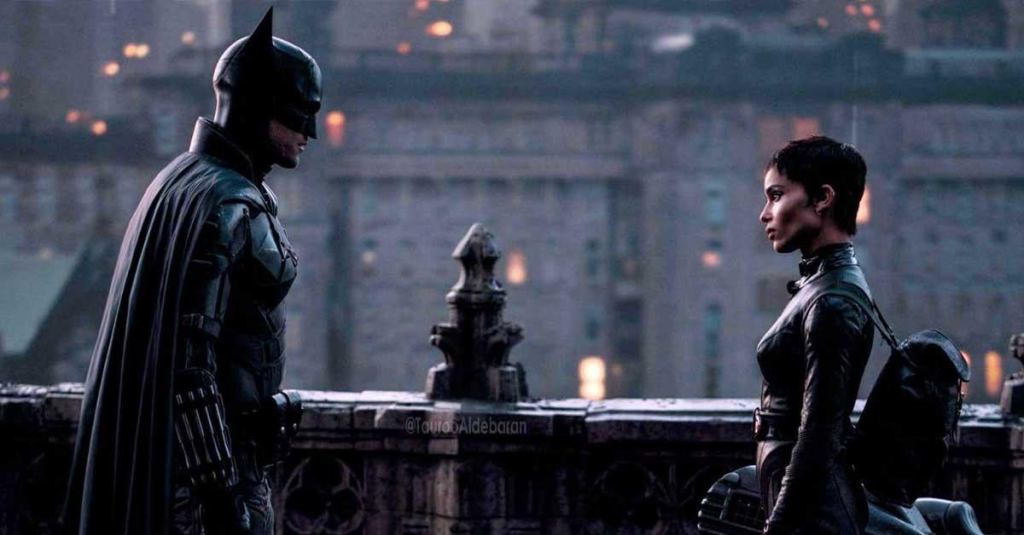
The Batman covers a lot, but none of it in enough depth. Very good as Robert Pattinson is, I don’t feel we learn a lot about Wayne. The Batman adds a romance with Selina Kyle (a dynamic Zoë Kravitz) and gives her a sub-plot of her own which largely just crowds the film. None of these plots are complex in themselves, but they all play out at the same time, reducing the focus on each of them. It’s all too much for you get to a handle on what the film is trying to be about.

Essentially, you feel Reeves had hundreds of ideas about what he wanted his Batman film to be – and didn’t have the heart to leave any of them out. But, even when over-ambitious, he’s an impressive and exciting film-maker. The Batman is crammed with great scenes (from action to disturbing splashes of horror). When the sequel comes, a clearer overall theme will help a great deal. But, with this dark but beautifully made film – and an impressive Batman from Robert Pattinson – I’ll be excited to see what Reeves does next.
Spider-Man: No Way Home (2021)

Spider-Man: No Way Home (2021)

Tom Holland’s Spider-Man encounters friends and enemies from another franchise or two

Director: Jon Watts

Cast: Tom Holland (Peter Parker/Spider-Man), Zendaya (MJ), Benedict Cumberbatch (Dr Stephen Strange), Jacob Batalon (Ned Leeds), Marisa Tomei (May Parker), Jon Favreau (“Happy” Hogan), Jamie Foxx (Max Dillon/Electro), Willem Dafoe (Norman Osborn/Green Goblin), Alfred Molina (Otto Octavius/Doctor Octopus), Benedict Wong (Wong), Tony Revolori (“Flash” Thompson), Andrew Garfield (Peter Parker/Spider-Man), Tobey Maguire (Peter Parker/Spider-Man), Rhys Ifans (Dr Curt Connors/Lizard), Thomas Haden Church (Flint Marko/Sandman), JK Simmons (J Jonah Jameson)

It’s been out long enough now – and Marvel are even advertising the Guest Stars – so I guess we can worry slightly less about spoiling this massive crossover event. Spider-Man: No Way Home became one of the biggest hits of all time. It’s not hard to see why, in our nostalgia-loving times. But its not just about nostalgia – lovely as it is to see all those old characters once again. It’s also a hugely entertaining, rather sweet film, crammed with slick lines and jokes, while also, like the best of Marvel’s films, having a heart. We’ve got a hero here so humanitarian he goes to huge risks to try and save the villains. That’s refreshingly human.

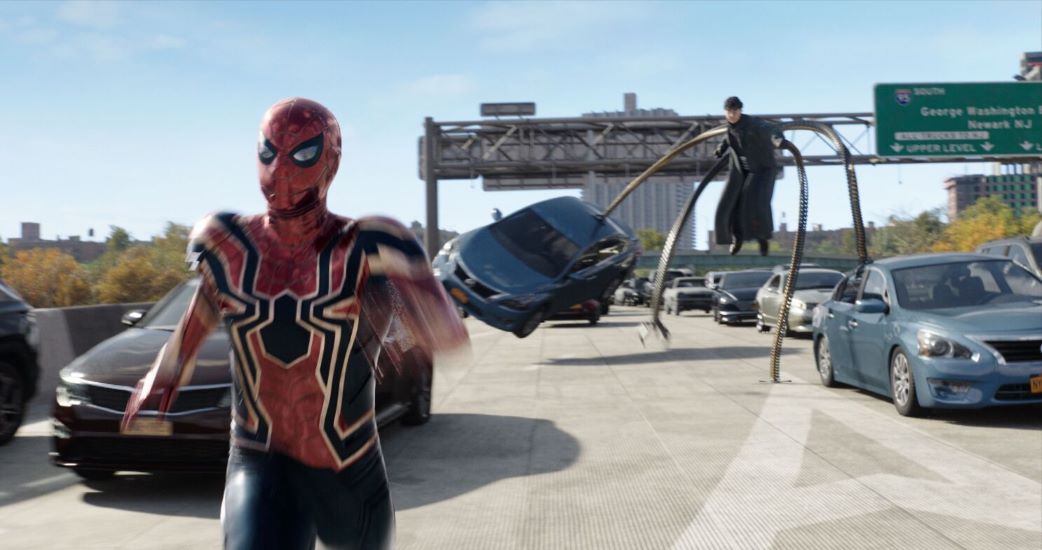
Picking up after the conclusion of Spider-Man: Far From Home, Peter Parker’s (Tom Holland) secret-identity is known. Parker finds himself at the centre of a massive, world-wide scandal, which ends the college chances of him and his friends MJ (Zendaya) and Ned (Jacob Batalon). Peter asks Dr Strange (Benedict Cumberbatch) for help: namely can the world forget who he is? When the spell goes wrong, people who know Parker’s identity from other realities start appearing. And these guys aren’t happy, with villains like Dr Otto Octavius (Alfred Molina), Electro (Jamie Foxx) and psychopath Green Goblin (Willem Dafoe) arriving. But, when Peter discovers sending them back will condemn them to die in the battle against their Spider-man, he decides to do everything he can to try and save them.

No Way Home’s success partly lies on the nostalgia factor, especially for those of us who loved the early Maguire films. And you can sign me up to that: I can’t believe it’s been 20 years since the first one came out! No Way Home throws in characters from all five pre-Holland films and zeros in on the best of the bunch. The films has a lot of fun shuffling and realigning these characters in interesting new combinations, often allowing them to moan about things like origin stories (there is a very funny exchange between Electro and Sandman on the danger of falling into experiments) or just to get on each other’s nerves (Molina’s Doc Ock is spectacularly grumpy).

You pretty much have to have a heart of stone not to enjoy seeing most of these characters again – particularly as they are played with such lip-smacking aplomb. Above all, Dafoe relishes the chance to cement his place as one of the great villains, switching perfectly between gentle and psychotic as the schizophrenic Norman Osborn/Green Goblin (and becoming the nemesis of no-less than two Spider-men). Molina is equally good: pomposity and rage turning into avuncular decency. These two landmark villains from the two best films take most of the limelight, with a smaller share for Jamie Foxx (far more comfortable here than he was in Amazing Spider-Man 2). But every villain is given moments of tragic depth and seeing them react to news of their deaths is strangely moving.

It sets the table rather nicely for a film about redemption. Peter believes he can save these villains from death if he can cure them and restore their humanity. While the pragmatic Strange sees this as pointless, Peter can’t turn his back on a chance to save people. On top of this, No Way Home also serves as a meta-redemption arc for the two previous franchises: Maguire gets a third film worthy of the first two and Garfield is given the sort of rich material he was denied in his failed series.

Which brings us nicely to the biggest returns. Denied by both actors for the best part of a year, this film throws not one, not two but three Spider-men at us, with Maguire and Garfield reprising their incarnations. All three delight in sparking off each other, riffing on everything from web-slingers to making normal life work (“Peter time”) alongside Spider-manning. Maguire settles nicely into the Big-Brother role, giving a worldly experience to the others without losing his gentle idealism. Garfield is sensational – lighter, funnier and warmer than he was in his own films, with a hidden grief that plays out with genuine impact.

Who couldn’t get excited about seeing these three together – or to see the film make these scenes work as well as it does? It shuffles and reassembles things we are familiar with, but presents them in new and intriguing combinations and above all feels true to the characterisations established in previous films. Maguire, Molina and Dafoe in particular feel like they’ve not been away since their own films, while Garfield and Foxx deepen and improve their characters. But it became a mega-hit because it has a truly strong story behind it.

A story staffed by strong, relatable characters. There is a genuine sense of alarm around how Peter and his friends in the film’s opening act are hounded and persecuted by a population scared of them. Even here redemption is key, with Peter going to dangerous lengths to try and get his friends a second chance at getting into MIT. These three characters have a sweet, warm friendship and the chemistry, in particular between Holland (who is sensational, endearing, funny but bringing the role great emotional depth) and Zendaya is stronger than it’s ever been.

And that’s before we hit the film’s genuinely endearing message. Holland’s still-optimistic hero (another excellent contrast with his more damaged alter-egos) is motivated by saving people. And that includes the villains. Maybe it’s the years of Covid, but there is something hugely lovable about a hero who wants to give people a second chance. It’s a living demonstration of “with great power comes great responsibility” (words this film introduces into the Marvel universe with powerful effect, in a mid-film climax). In fact the film is, in some ways, the origin-story Holland’s Spider-Man never had: it gives him a foundational tragedy, leaves him in an isolated position, strips him of his Iron Man style tech and leaves him in a set-up (alone in a cheap apartment, struggling to make ends meet and superheroing on the side) familiar from the comics.

Watts directs the film with real confidence and zest, especially outside the action set-pieces: there is frequent use of ingenious-but-not-flashy single takes and the film’s patient momentum for much of its first half, focusing on character and emotion, really pay off in the second half of fan-service and fights. The camera effects used for Peter’s web-slinging and his spider-sense have a delightful quirky invention. What he really does well though is zero in on the emotion and when events get tragic, he isn’t afraid to commit to that. It gives the film an emotional force that really connected with people.

That heart is what sustains it. It’s a joyful nostalgia trip – that redeems elements of the previous films – but this is a film that really cares about its characters – all of them – and wants you to as well. That gives difficult, emotional struggles to all its Spider-Men, that searches of the humanity in its villains, even the worst of them, making us sympathise with them even as they do dreadful things. Combined with the action and adventure – and the electric pace of the best of Marvel – No Way Home rightly stands as one of the best entries so far.

Eternals (2021)

Eternals (2021)

A cast of diverse actors are totally crushed in this pompous, dull Marvel film

Director: Chloé Zhao

Cast: Gemma Chan (Sersi), Richard Madden (Ikaris), Kumail Nanjiani (Kingo), Lia McHugh (Sprite), Brian Tyree Henry (Phastos), Lauren Ridloff (Makkari), Barry Keoghan (Druig), Don Lee (Gilgamesh), Harish Patel (Karun), Kit Harington (Dane Whitman), Salma Hayek (Ajak), Angelina Jolie (Thena)

It must have seemed like a good idea at the time… Marvel had already turned one little known gang of superheroes into a huge hit with The Guardians of the Galaxy. World defining stakes had been the core of most of The Avengers films. An ensemble cast of diverse actors were pulled together with an acclaimed (and now Oscar winning!) director at the helm. They only forgot one thing: to make the final film interesting, engaging or feel in any way original.

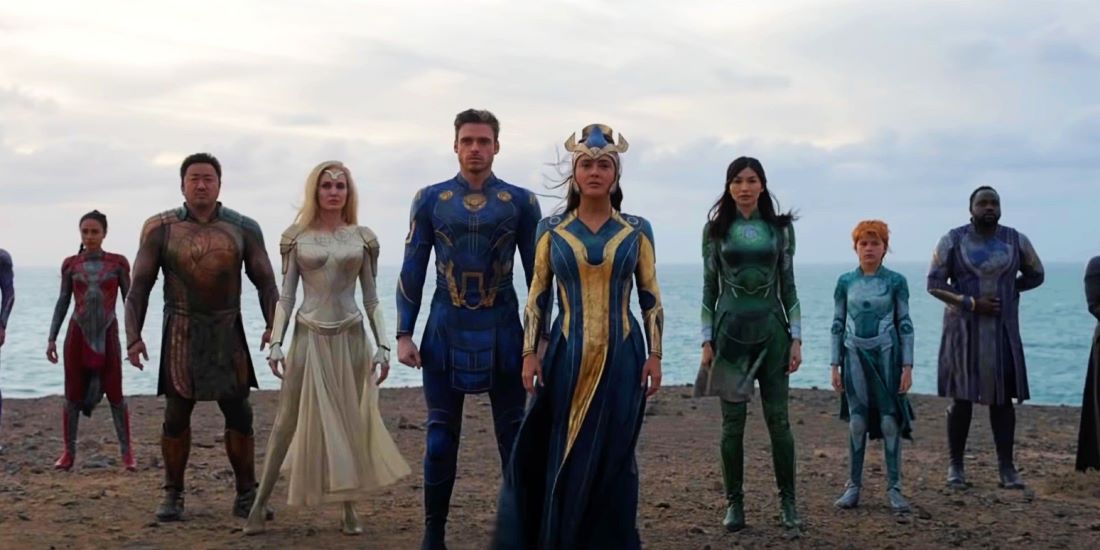
Our heroes are a group of very serious God-like Aliens called Eternals, who have been sent to Earth thousands of years ago by even more God-like Celestrial Aliens to protect humanity from savage monsters called Deviants. By 1521, the Deviants are defeated and our heroes are left unsure of what to do. Ordered to never interfere in the events of humanity, they go their separate ways and settle down into life on Earth. But in the present day the Deviants return – and the Eternals start to uncover dark facts about their mission.

All of this takes place over a runtime which feels pretty bloody eternal itself. Essentially the film opens with an info-dump, then spends a couple of hours getting the gang back together (interspersed with occasional additional info-dumps) before the inevitable final-act smackdown to save the world. The stakes have arguably never been higher: but with the film’s indolent pace and thinly sketched characters it sure-as-hell doesn’t feel like it. There is a lot of uninvolving world-building and its ends up feeling every bloody minute of its epic runtime.

With its group of characters, essentially a loving family that has fallen out, this should really be an intimate, character-driven film. But it never balances the huge cast, the epic action and building relatable characters swiftly. Instead the Eternals rarely seem like anything more than heavy-handed sketches defined by basic character traits: a caring empath, a warrior princess, a slightly austere would-be-leader, a mentor destined to die, an eternal child frustrated about never growing up, a natural showman, a cold mind-controller, a deaf athlete and a gay guilt-ridden inventor. The cast (as very proudly trumpeted in its marketing material) is on paper the most diverse ever in Marvel. But it’s like simply making it representative was enough and they didn’t need to bother creating rich, engaging and multi-faceted characters.

All of them are squashed into a film that really feels like it could have been made by anyone. For all Zhao’s occasional indie visual beauty, this is totally free of authorial voice, with completely routine action set-pieces. There is the odd joke, but Zhao’s attempt to put her own mediative personality on the film only really ends up making the bits between the fights dry and boring. Put quite simply, Marvel seems to have rather crushed any life out of her. We get endless solemn moments, as characters watch with horror the results of the development in mankind they have encouraged (from the genocide of the Incas to the bomb at Hiroshima). These nearly always feel on-the-nose and obvious. It all stems from Zhao failing to make us care about these characters.

So, when they find out they have been betrayed by their masters – that their purpose is to fatten the Earth for feasting, not raise it in good health – its rather hard to feel the impact of the betrayal. The film isn’t even smart, or daring, enough to acknowledge that the same manipulative Gods who have used the Eternals have done the same thing to the Deviants. The film continues to treat these as wicked killers, when in fact they are as much victims as everyone else. Would it have killed Eternals to acknowledge this for a moment, to explore the implications of this more?

Especially since it’s so bloody long. It takes almost two hours for the film to bring the gang back together. Each reunion with a new Eternal is basically played the same – a brief bit of banter and then a horrified reaction as they discover the truth. Which means we basically see versions of the same scene play out six times, with diminishing levels of interest. Can’t these guys conference call?

There is no momentum to this ever. Where is the pace? Where is the urgency? The Eternals have been told they’ve only a few days to save the Earth, but they seem to spend most of it ambling around chatting and catching-up. Even when the end-of-the-world starts, most of them still sit around starring at the middle distance sadly and bemoaning their lot. This – and soft spoken intensity and lackadaisical wandering – are constantly used by the film as a short hand for seriousness, a self-importance the film wears very, very heavily.

All of the actors get crushed under the weight of the film. Nanjiani stands out pretty much as the only one having anything approaching fun while only Lee gets to show some sort of warm, uncomplicated human connection. Keoghan, Ridloff and Henry do decent work, but the rest of the cast seem hampered by how very, very, very serious they need to be all the time. One of them, of course, is a wrong ‘un (you can make a pretty decent guess early on which in it will be), but they turn out to be the dullest most stick-up-the-butt character of the lot. Despite the huge amount of time we spend with them, lead characters like Chan’s Sersei and Madden’s Ikaris remain enigmas we can’t be bothered to find out more about.

Eternals is pretty much a failure. It’s long. It builds an expansive universe with a series of clumsy lectures and fails to make any of these interesting. It’s got long battle scenes which feel like several other films. It’s got no personality or vibe to it. It sets up the odd interesting idea then takes it nowhere. It makes the end of the world a massive yawn, while telling you it’s a hugely important and daring film (it’s neither of those things). You end up feeling this might be the most forgotten Marvel film since The Incredible Hulk.

Batman (1989)

Batman (1989)

Comic book movies get a jump start in the very first attempt to take the genre really seriously on screen

Director: Tim Burton

Cast: Jack Nicholson (Jack Napier/The Joker), Michael Keaton (Bruce Wayne/Batman), Kim Basinger (Vicki Vale), Robert Wuhl (Alexander Knox), Pat Hingle (Commissioner Gordon), Billy Dee Williams (Harvey Dent), Michael Gough (Alfred Pennyworth), Jack Palance (Carl Grissom), Jerry Hall (Alicia Hunt), Tracey Walter (Bob), Lee Wallace (The Mayor), William Hootkins (Lt Max Eckhardt)

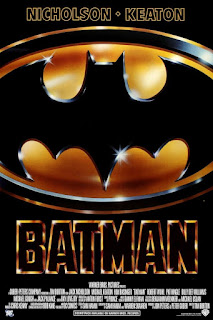
Strange to think, but there was a time when comic book movies were not Hollywood’s be-all and end-all. Instead, they were slightly embarrassing, campy messes, big-name actors were a little ashamed to appear in and studio executives were convinced no-one outside a comic-book shop would be remotely interested. So, you could say Batman is one of the most influential films of the last 30 years, a massive box-office smash that treated its source material fairly seriously. For the first time ever, it was suggested these films could be dark and adult, as well as fun. Sure, there is a lot more goofy humour in it than you might remember, but it changed how this genre was perceived.

It’s an origin story of sorts. Bruce Wayne (Michael Keaton) has just started his campaign as Batman, the masked vigilante terrifying criminals at night in crime-ridden Gotham city. A late-night scuffle at a factory stuffed with toxic waste (but of course) sees psychopathic gangster Jack Napier (Jack Nicholson) tumble into a vat of chemicals. Napier emerges, disfigured and insane, as The Joker and starts a campaign of terror across Gotham. A campaign only Batman can end.

Fans feared during its production that the film would follow in the footsteps of the campy 60s TV show. So many letters of complaint (at least 50,000 – imagine how many tweets that would translate into today) at the casting of ‘comic actor’ Keaton hit the officers of Warner Bros, the company’s share price even took a dip. Fans were only reassured when the film opened – and you know you’re in for something heavyweight, as soon as Elfman’s strikingly gothic yet bombastic score echoes out.

Gothic is the word here: Gotham is imagined as world where Art Deco meets Steampunk by way of German Expressionism – it’s like a Fritz Lang explosion in a graphic novel panel. The film was a brilliant twist on noir, with every street hosting a looming nightmare. This was a dark, sinister world where it was always night (fitting for the Dark Knight) and horrors lurked around every corner.

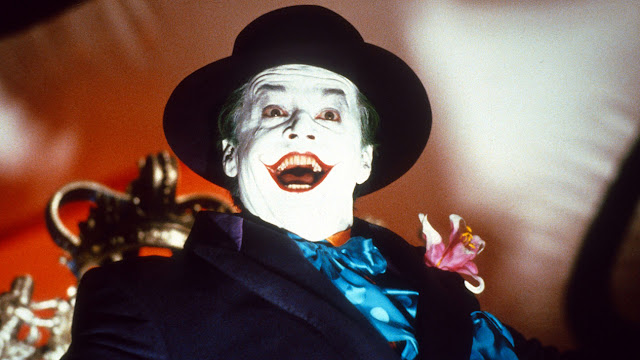
The nightmare at the heart of the film is of course the Joker. Nicholson was so uncertain about doing the film that he struck a deal giving him unprecedented control over the hours he worked, the length of the shoot, the billing and above all a huge back-end salary on box-office and merchandise (the deal was so good, he also made millions from Batman Returns, the sequel he didn’t even appear in). But it was worth it as the film benefits hugely from Nicholson’s cultural and artistic cache, but also his flamboyantly, unashamedly demonic performance, a grinning imp clearly having a whale of a time. Shrewdly, Burton recognised the Joker was such an outrageous character he could provide all the campy, OTT humour some viewers expected – and because it was in tune with the anarchy of the character, the fans wouldn’t mind. Which of course they didn’t, because it’s Jack.

Nicholson soaks up nearly all the energy of the film, leaving very little left for Keaton. Almost certainly very aware of the overwhelmingly negative reaction to his casting, Keaton plays the role absolutely dead-straight. So dead-straight in fact, that he all but forgets to bring any life to the character what-so-ever. Batman is a humourlessly sober hero (the rubber headset also meant Keaton couldn’t hear anything on set) while Wayne has a timid shyness that masks personal trauma. Keaton hits the notes very carefully and seemingly has decided to hide all the manic energy he had shown elsewhere. He effectively concedes the film to Nicholson – and it says a lot that he even looks overawed by Kim Basinger’s greater vibrancy as love-interest Viki Vale.

Watching Batman today, with our attitude to this sort of material changed completely (not least by Christopher Nolan), it’s striking how much more goofy this film seems. It actually says a lot that this was hailed as the darkest, most serious comic-book movie ever. It’s crammed with Burtonish pratfalls and visual humour, from tea trays blocking bullets to Basinger fainting when surprised by a jack-in-the-box. Classic Hollywood imagery is spoofed – at one point the batwing flies over the clouds, holds position dead-centre of the moon and then dives down while everyone in the film is dressed in a mix of pastiche 1930s style and 1980s clothing. In no way could you mistake anything here as happening in something approaching the real world (compare and contrast the few-degrees-to-the-left reality of Batman Begins).

Burton was in fact an odd-choice for director, with only two live-action films under his belt. He’s not been fond of Batman – he called it “mainly boring to me…more of a cultural phenomenon than a great movie” – and the film is an odd fusion of styles. Burtonish dark humour and surreal dashes, mixed with blockbuster action and Prince songs. The film itself has a drifting and unfocused plot (part of constant studio rewriting – shooting the climax Nicholson asked Burton “Why am I climbing up these stairs?” to which Burton responded “We’ll work it out when you get to the top”) which plays around with ideas of trauma motivating these characters but goes nowhere with it. The Joker has no scheme and the film gives him no real personality depth or manages to explore his anarchism in the way The Dark Knight did. Events sort of happen with a shady logic and an unconnected inconsistency, until the film decides to end with a parade climax and rooftop fight.

What’s also striking is how little the comic books are treated like Holy Text by the film-makers (a complete no-no today, where even the slightest deviation from the writ leads to an avalanche of on-line criticism). Batman offs criminals without a second thought, his backstory is radically altered, the continuity merrily distorted. He seems less like a highly-trained fighter and detective, and more a gamely-trying brawler dependent on gadgets. Every character outside Batman, Vale and, I guess, the Joker is a clueless old buffer. While the film is inspired by the look of some of the comic books, it basically has no interest at all in their mythology or deeper themes.

Batman is entertaining but manages to feel long – largely because its plot is vague and drifts, without a tightly controlling theme or plot arc. It’s at times rather inconsistently edited – watch the sequence in the art gallery that is rife with continuity errors – and the film is slightly in awe of Jack Nicholson’s exuberant performance that dominates the film and crushes the life out of any narrative. But it showed that comic books could take place in a world that was dark and imposing rather than primary coloured and that superheroes didn’t need to wear their underpants over their trousers to get the crowds in. For all its flaws, it’s the first stone in the road to the Marvel Cinematic Universe (and yes I know it’s a DC comic).

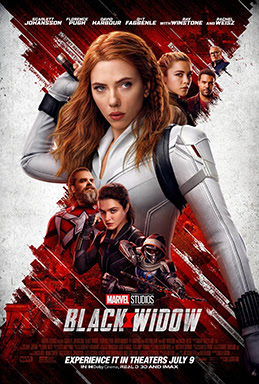
Black Widow (2021)

Scarlett Johansson crashes through a film that seems to exist by contractual obligation, Black Widow

Director: Cate Shortland

Cast: Scarlett Johansson (Natasha Romanoff), Florence Pugh (Yelena Belova), David Harbour (Alexei Shostakov), O-T Fagbenle (Rick Mason), Olga Kurylenko (Antonia Dreykov), William Hurt (Thaddeus Ross), Ray Winstone (General Dreykov), Rachel Weisz (Melina Vostokoff)

After the events of Captain America: Civil War, Natasha Romanoff (Scarlett Johansson) is on the run, when she receives a mysterious parcel from her “sister” – or rather the young girl she spent a few years with as a “family” of Russian agents undercover in America in the 1980s – Yelena Beloba (Florence Pugh). The parcel contains a drug that can be used to break the mind-control that nasty General Dreykov (Ray Winstone) has over his army of Widows: young girls like Natasha and Yelena, forced to become assassins in a torture chamber/training room called The Red Room. Natasha and Yelena team up to free the other assassins, but they will need the help of their “parents”, Russian super-soldier Shostakov (David Harbour) and genius inventor Melina (Rachel Weisz).

As the credits rolled on this formulaic slice of Marvel adventurism, I couldn’t for the life of me work out why it even existed in the first place. For a film centred around Scarlett Johansson’s Black Widow character, I expected to come out of this epic with some new understanding of her character. Not only do we not learn anything about her at all, we get no additional insight into what makes her tick, no deeper look into her character. We learn nothing about her that we don’t know already: and the film isn’t even smart or profound enough to reflect on the fact that we all know that the character died in the last film we saw her in. Does it exist solely so Marvel can say “Look we made a film about the only female Avenger, so shut up already!”

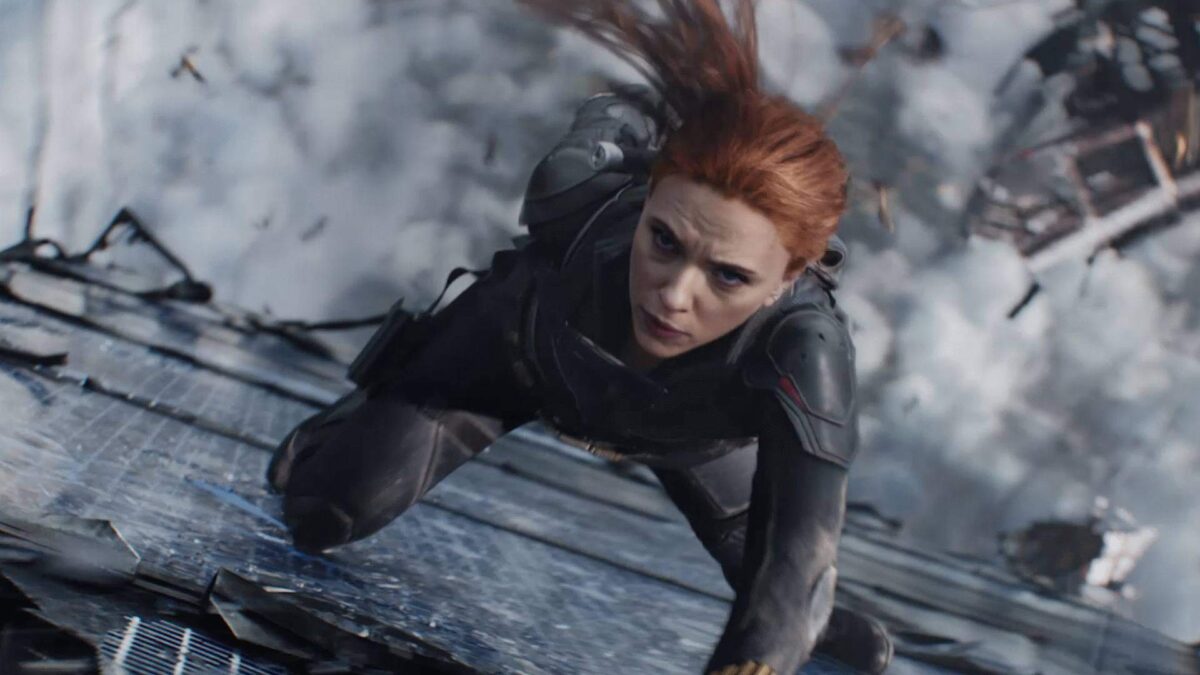
The film is stuck between being a greatest hits celebration of Johansson’s work elsewhere and providing as much focus as possible for Florence Pugh to take up the mantle in future films. In fact, the focus is so much on Pugh – who is terrific and gets all the best lines – that Johansson becomes a bit of a straight-man in her own damn movie. It’s Black Widow who has to say all the unhip, dull things (“We can’t steal that car!”) while her sister snipes, swears and plays devil-may-care with the consequences. For what should be her moment in the sun, Johansson gets rather short-changed here. But then perhaps she didn’t really care – it certainly never feels that she had anything she was determined to say or do here, other than cash a huge cheque.

The film is framed around a back story of villainy involving the nasty Dollshouse-style assassin school that both sisters were forced to attend, here revealed to still be in operation with a team of brainwashed female assassins. At the centre, like a creepy Charlie with brain-washed Angels, is General Dreykov, played by a barely-even-trying Ray Winstone (his accent is laughably atrocious). Dreykov is such a peripheral figure in the film that he never feels like either a threat or a dark manipulative force and his “plan” is such an after-thought, Winstone has to hurriedly state it for the first time in a final act monologue.

The film is supposed to be about misogyny, and how Dreykov has left a poisonous legacy of abuse of young women for his own ends. This includes forcing his daughter (a thankless mute role under a helmet for Olga Kurylenko) into a killer robber-suit as the sort of uber-assassin. Natasha is plagued with guilt about harming this character in the past – a guilt that would have way more impact on the viewer if we had seen even one bloody scene of them together to establish a relationship. How much more interesting, too, would the film have been if we had seen Kurylenko’s character as the new head of this abusive ring of spies, having taken up her father’s mantle and absorbing his poisonous world view. But no, such nuances are beyond this film.

There are a few moments of emotion and comedy gained from Natasha’s fake family – the parents who are not her parents, the sister who is not her sister. This odd group reunion makes for some laughs, but its noticeable that the main emotional impact is on Pugh’s younger, less settled character rather than the confident, assured Natasha. It’s another major flaw in the film: at the end of the day, I can’t imagine this had any real impact on the character at all. Does Natasha really change her view of herself at the end? No: she talks the talk about having “a new family” but her level of connection with them (certainly with her parents) doesn’t seem to go much beyond patient affection. Again, the real emotional impact is on Pugh’s character who has finally found something to base her life on: this would have worked so much better as an origins story.

Instead, this seems to exist solely to answer a trivia question I’m not sure anyone was asking: “What did Black Widow do in between Captain America: Civil War and Avengers: Infinity War?” If your life really was lacking without the answer to that, this is the film for you. Otherwise, there is little at all to make any of this stand out from any of the other 20+ Marvel films. Its action scenes are cookie-cutter (naturally everywhere Natasha goes, the place is destroyed), the emotional beats are completely unrevealing, the baddie so forgettable you might even miss it when he dies, and we get a few actors (Harbour and Weisz) coasting on a couple of decent lines and bit of comic business. Apart from anything involving Florence Pugh, this film is totally and utterly forgettable.

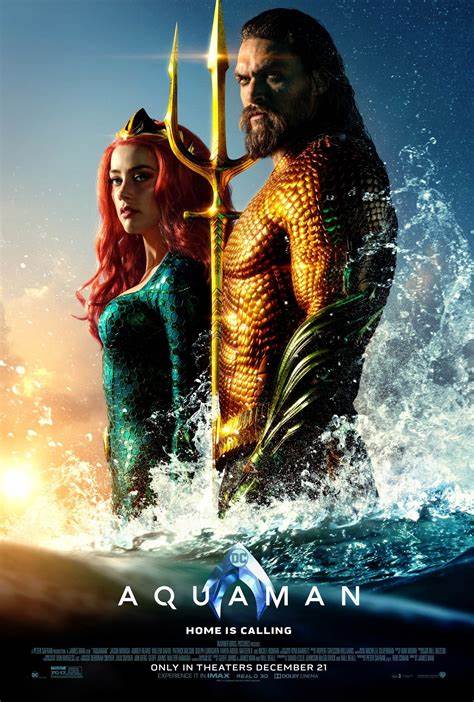
Aquaman (2018)

Jason Momoa takes himself rather seriously in the deeply silly Aquaman

Director: James Wan

Cast: Jason Momoa (Arthur Curry/Aquaman), Amber Heard (Mera), Willem Dafoe (Nuidis Vulko), Patrick Wilson (Orm Marius), Dolph Lundgren (King Nereus), Yahya Abdul-Mateen II (David Kane/Black Manta), Ludi Lin (Captain Murk), Temuera Morrison (Thomas Curry), Nicole Kidman (Queen Atlanna), Micheal Beach (Jesse Kane), Julie Andrews (Karathen)

After helping the rest of the Justice League save the world Arthur Curry aka Aquaman (Jason Momoa) is quite the celebrity. Curry is the son of lighthouse keeper Thomas (Temuera Morrison) and Atlantian Queen Atlanna (Nicole Kidman), who fled her unloved husband and his underwater kingdom but was recaptured when Arthur was young. Her other son Orm (Patrick Wilson) is now King of Atlantis, planning to lead the forces of the sea in a war against those on land. Can Arthur and Orm’s unwilling betrothed Mera (Amber Heard) combine to prevent a war? And will Arthur become a worthy hero?

Aquaman makes a valiant effort to embrace perhaps the silliest set-up for a comic book novel yet. Based around a massive, technologically advanced underwater kingdom that has (inexplicably) remained silent and secret for thousands of years, who inhabitants all seem to have superhuman strength and magical skills (guess it must be all that water pressure), the film at times is hard to take seriously. But it sort of gets away with it, as Wan leans into the tongue-in-cheek campness of all this (and I’m amazed how camp these Atlantians are) and asks us not to take anything we see that seriously, but just to sit back and enjoy the ride.

And the film is basically just a big ride, as we travel from place-to-place and watch Aquaman hit things in various under-water and above ground locations, while keeping up a bit of rapid-fire banter that will flower (but of course!) into an opposites-attract romance with Mera. One thing Wan does very well is to find a way to present the various fights in a style I’ve not seen before. The showpiece one-on-ones take place in a series of incredibly smooth one-shots, which twist and glide around our heroes while they despatch countless foes and, in one impressive show-piece, in and out and across buildings during a fight in an Italian cliff-side town. The ending may be your typical CGI smackdown, but Wan’s presents the fights in a way that actually looks different and excites a bit of awe.

Where the film is less successful is in its slightly tired coming-of-age/proving-his-worth/resolving-his-loss storyline, which offers few surprises. Try as I might, I can’t find Jason Momoa a charming enough actor to effectively make me invest in his character. Compare him to Dwayne Johnson, who is always willing to laugh at himself and is the very embodiment of charming self-awareness. Momoa takes himself very seriously – he always needs to be the coolest guy in the room – and his air of cocky self-importance sometimes jars in a film as dopey as this one.

This also means the film fails to sell a real plot arc for Aquaman himself. Its nominally about a character learning to acknowledge his mistakes, vulnerability and inability to go-it-alone. This doesn’t always feel earned and sometimes emotionally confused. One of Aquaman’s earliest acts is to let the ruthless father of a hijacker (a scowlingly charismatic Yahya Abdul-Mateen II) drown. Later he expresses regret for doing this as, by making an enemy, he endangered Mera. Not regret because it was wrong to let the man die, but a sociopathic concern for his loved ones rather than someone else’s. The character’s growth never really convinces – he still seems like the same cocky maverick at the end than he was at the beginning, rather than someone who has matured into a real leader.

But aside from these doubts, this is a big silly pantomime pretty much told with the right balance between seriousness and tongue-in-cheek. Amber Heard mixes heroism with a dopey, flower-eating sweetness as Mera. Willem Dafoe constantly looks like he’s about to snigger as a wetsuit glad Grand Vizier. There is something rather lovable about a film so eclectic in its cast that Julie Andrews (of all people) voices a sea monster and Dolph Lundgren tackles King Nereus like it’s his shot at Macbeth.

Bangs, booms and few jokes carry us through a deeply silly but enjoyable film. There is a great deal of visual imagination for the sea kingdoms, a mix of Greek inspired nonsense and space-ship bombast. Wan pretty much throws the kitchen sink at the screen, and while it’s definitely rather too long it’s also bubbling with just as much tongue-in-cheek fun that you roll with it. Nothing here reinvents the wheel – and the plot often feels like a rather clumsy after-thought – but it’s still an entertaining wheel.

Shang-Chi and the Legend of the Ten Rings (2021)

Simu Liu deals with father-son issues in Shang-Chi and the Legend of the Ten Rings

Director: Destin Daniel Cretton

Cast: Simu Liu (Shang-Chi), Awkwafina (Katy), Meng’er Zhang (Xu Xialing), Tony Leung (Xu Wenwu), Fala Chen (Ying Li), Michelle Yeoh (Ying Nan), Ben Kingsley (Trevor Slattery), Benedict Wong (Wong), Florian Munteanu (Razor Fist)

Thousands of years ago Xu Wenwu (Tony Leung) discovered ten rings which gave him immortality and power. Sadly, he used these powers for evil – until in 1996 he falls in love with Ying Li (Fala Chen), the powerful guardian of a mystical village he has searched hundreds of years for. They have two children – but after she dies, Wenwu returns to darkness and trains his son Shang-Chi to become an assassin. Aged 14, Shang-Chi flees: ten years later, Shaun (Simu Liu) works as a hotel valet with his best friend Katy (Awkwafina), both accomplished students with no aims in life.

All that changes when his father’s heavies attack them in San Francisco, stealing the mysterious pendant Ying Li gave to her son. She also gave a pendant to his sister Xu Xialing (Meng’er Zhang) – so Shang-Chi and Katy head to Macau to find her. But Xu resents Shang-Chi for abandoning her and has trained herself into the martial super-fighter her father would never allow her to become.

Shang-Chi and the Legend of the Two Rings is a curiously mixed bag. First the good: it’s a huge amount of fun. There are some cracking gags and some of the fight scenes have to be seen to be believed. In particular, an early fight scene on a San Francisco bus is an absolute belter. A whirligig of movement, flicks, kicks and punches in, on and around a bendy-bus, using bars, doors, windows and bells to imaginative effect. Hugely exciting, its something the rest of the film struggles to live up to – although a vertigo inducing scaffolding bound fight in Macau comes close.

The film is also built around engaging characters. Shang-Chi is charmingly played by Simu Liu as a very reluctant hero, an extremely polite, decent guy with a wistful wish to just mess around and not grow up, but determined to do the right thing when pushed. He’s very well matched with Awkwafina, extremely funny but also heartfelt as his best friend, great with the one-liners but handling the serious content very well. The film dances rather neatly along a line of not-quite-deciding if these old friends are a potential romantic couple as well, which actually makes for a rather sweet dynamic.

Unfortunately, where the film is a bit weaker is in making it clear exactly what the character arc, or goal, for Shang-Chi is. While this is partly the intent of the film – he has, after all, effectively been drifting through life for a decade – the lack of a really compelling story line or a powerful sense of motivation from Shang-Chi slightly weakens the story. We never really quite get a grip on him as a character, other than knowing he’s a decent guy, out of his depth.

That’s partly because the film invests so much depth into his father, played superbly by Tony Leung making his English-language debut. Wenwu is conflicted, traumatised and motivated by a desire to bring his family together, unable to see that children’s upbringing has made them confused and vulnerable rather than strong. In every scene, I always understand what Wenwu wants and where he is going in a way I don’t with the hero – and this somehow feels the wrong-way round. Effectively, Wenwu is the protagonist of the movie, and Shang-Chi never quite steps up to take his place.

Instead, Shang-Chi has a fairly conventional “Daddy’s issues” plot line – can he overcome his fear and respect for his wicked father? I’d point out that his sister – well played by Meng’er Zhang – has exactly the same issue, but the film isn’t interested in her solving them, focusing instead on the father and son confrontation. Essentially, thematically, not a lot in Shang-Chi and the Legend of the Ten Rings is actually that new – it’s a fairly familiar coming-of-age Superhero origins story, with the loss of a parent and a clash with the surviving parent thrown into the mix.

Not that there is anything too wrong with that when it’s done well. Most of the film is done well, with jokes and fine set-pieces. Ben Kingsley enjoys himself hugely reprising his deluded actor from Iron Man 3. The film quite effectively builds in a Chinese aesthetic – large chunks of the dialogue is in Mandarin – and riffs charmingly off Chinese myths and legends and kung-fu inspirations. The Ten Rings themselves are barely explained at all, but an end-of-credits scene shows this was intentional.

Its weakest section is of course when we get to the final confrontation. This is a CGI over-loaded smack-down between two huge special effects – and carries significantly less impact than the emotional clash between father and son the film has been building towards. A braver film would have left it there without the CGI monsters – but the Marvel films have always been convinced that spectacle is what people want, and I guess they’ve not got much wrong so far.

Shang-Chi and the Legend of the Ten Rings introduces a charming hero, but by the end of the film I still wasn’t quite sure who he was or what he wanted from life. Maybe that doesn’t matter since sequels are inevitable, but there is something amiss when the villain makes such a dominant impression that he takes over the film, as Tony Leung does here. Fun, but a little too long and a little lacking in focus.

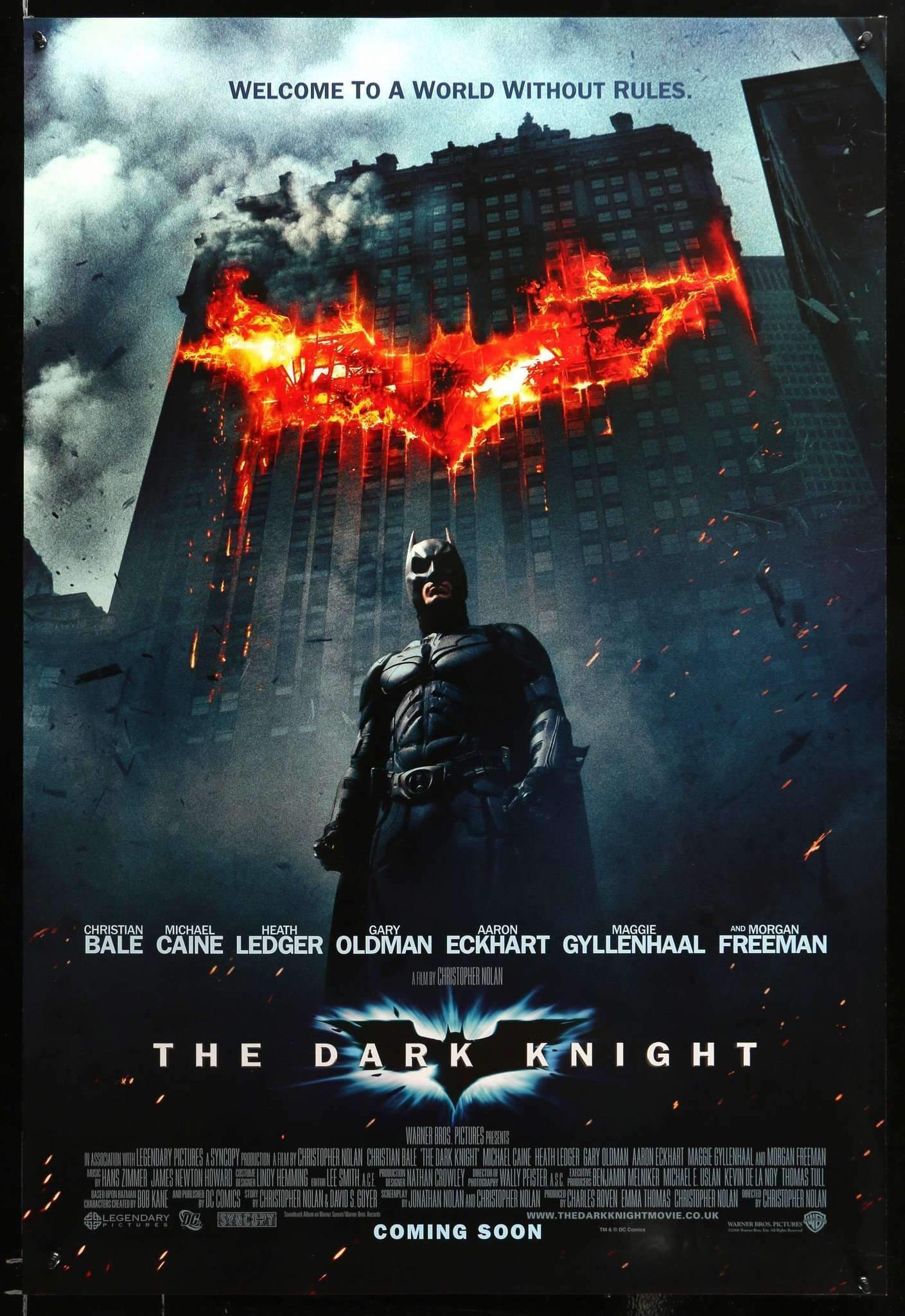
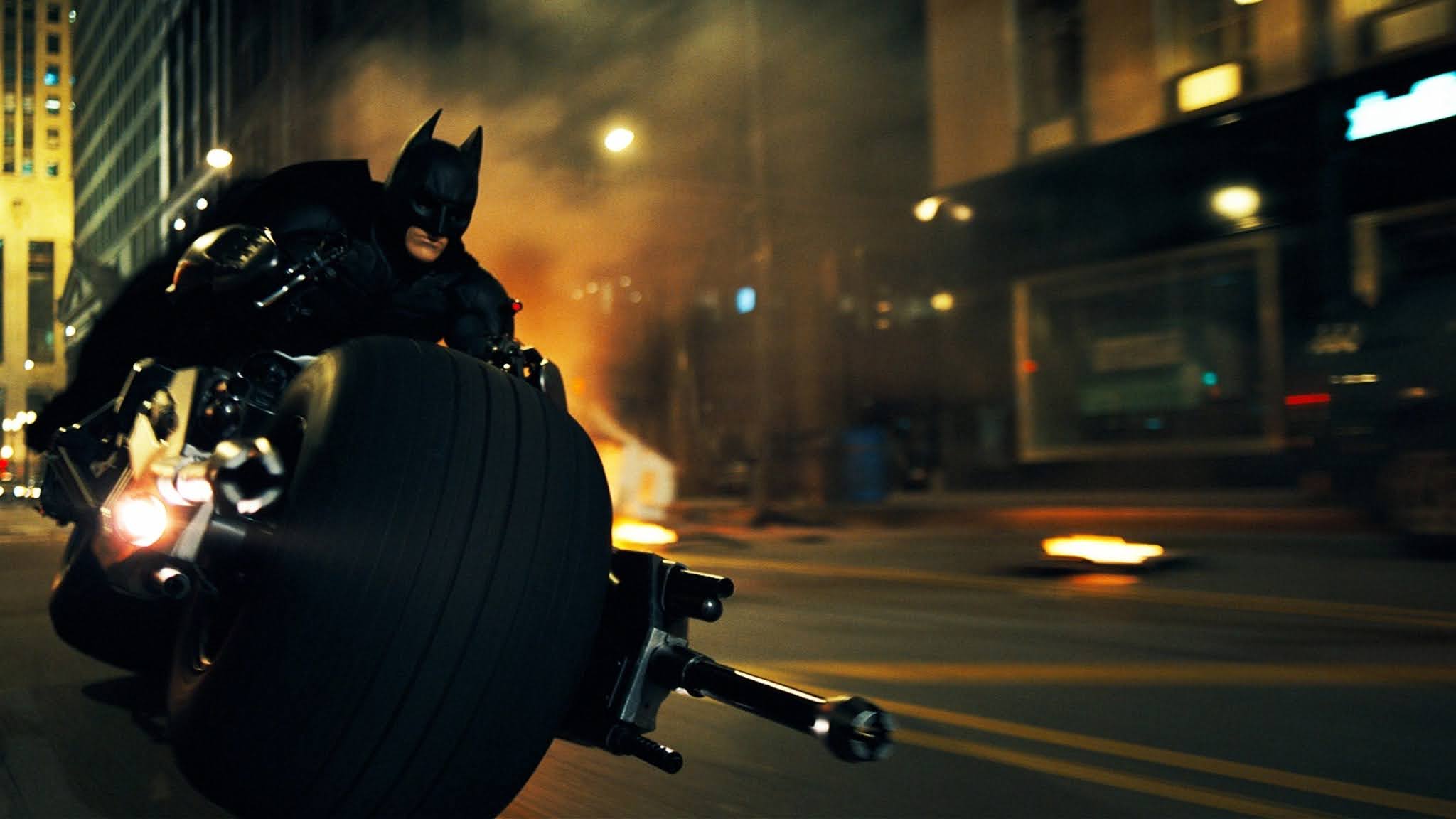
The Dark Knight (2008)

Heath Ledger leaves a great legacy as The Joker in The Dark Knight

Director: Christopher Nolan

Cast: Christian Bale (Bruce Wayne/Batman), Michael Caine (Alfred Pennyworth), Heath Ledger (The Joker), Gary Oldman (Lt James Gordon), Aaron Eckhart (Harvey Dent), Maggie Gyllenhaal (Rachel Dawes), Morgan Freeman (Lucius Fox), Eric Roberts (Sal Maroni), Monique Gabriela Curnen (Detective Ramirez), Ng Chn Han (Lau), Ritchie Oster (The Chechan), Colin McFarlane (Commissioner Loeb) Anthony Michael Hall (Mike Engel), Joshua Harto (Coleman Reese), Cillian Murphy (Scarecrow)

Christopher Nolan’s Batman Begins reset the table for superhero films. The Dark Knight took that table, picked it up, overturned it and rebuilt it from scratch. This influential film is certainly the greatest superhero film ever made and the calling card Nolan will carry for the rest of his life. Its exclusion from the 2008 Best Picture list at the Oscars (and Nolan’s snubbing for Best Director) was so widely condemned as snobbery (especially as the slot went to the atrocious awards-bait The Reader, a film even Oscar-host Hugh Jackman quipped he hadn’t seen) it led to the Oscars doubling the number of Best Picture Nominees (something benefiting several genre films inferior to this one). The Dark Knight declared forever superhero films could be proper films with characters, intriguing stories and interesting things to say.

It’s been a year or so since Bruce Wayne (Christian Bale) began his caped crusade as Batman, wiping out organised crime in the city. District Attorney Harvey Dent (Aaron Eckhart) – working closely with Bruce’s childhood sweetheart Rachael Dawes (Maggie Gyllenhaal) – has launched his own tough on crime crusade that has led to many mobsters landing behind bars. In the police force, Lt James Gordon (Gary Oldman – superb as a man whose good intentions lead to great harm) is straightening out the most bent police force on record. Now the gangs are desperate and in retreat – so desperate that they turn to the sort of dangerous, anarchic freak they would never usually countenance working with: a man known only as The Joker (Heath Ledger). The Joker though has his own plans for the city, for Batman and his own crazed ideas of social anarchy.

The Dark Knight is told on a huge scale: but Nolan never once loses sense of the fact this is an adventure film, while making sure that it explores ideas around society and humanity that leaves most high-brow films standing. Sumptuously made, a technical marvel it has set-pieces that stand with the greatest in cinema, dialogue that is crisp and brimming with intelligence and every performance in it excels. Nolan’s cinematic verve creates a film that always feels fresh.

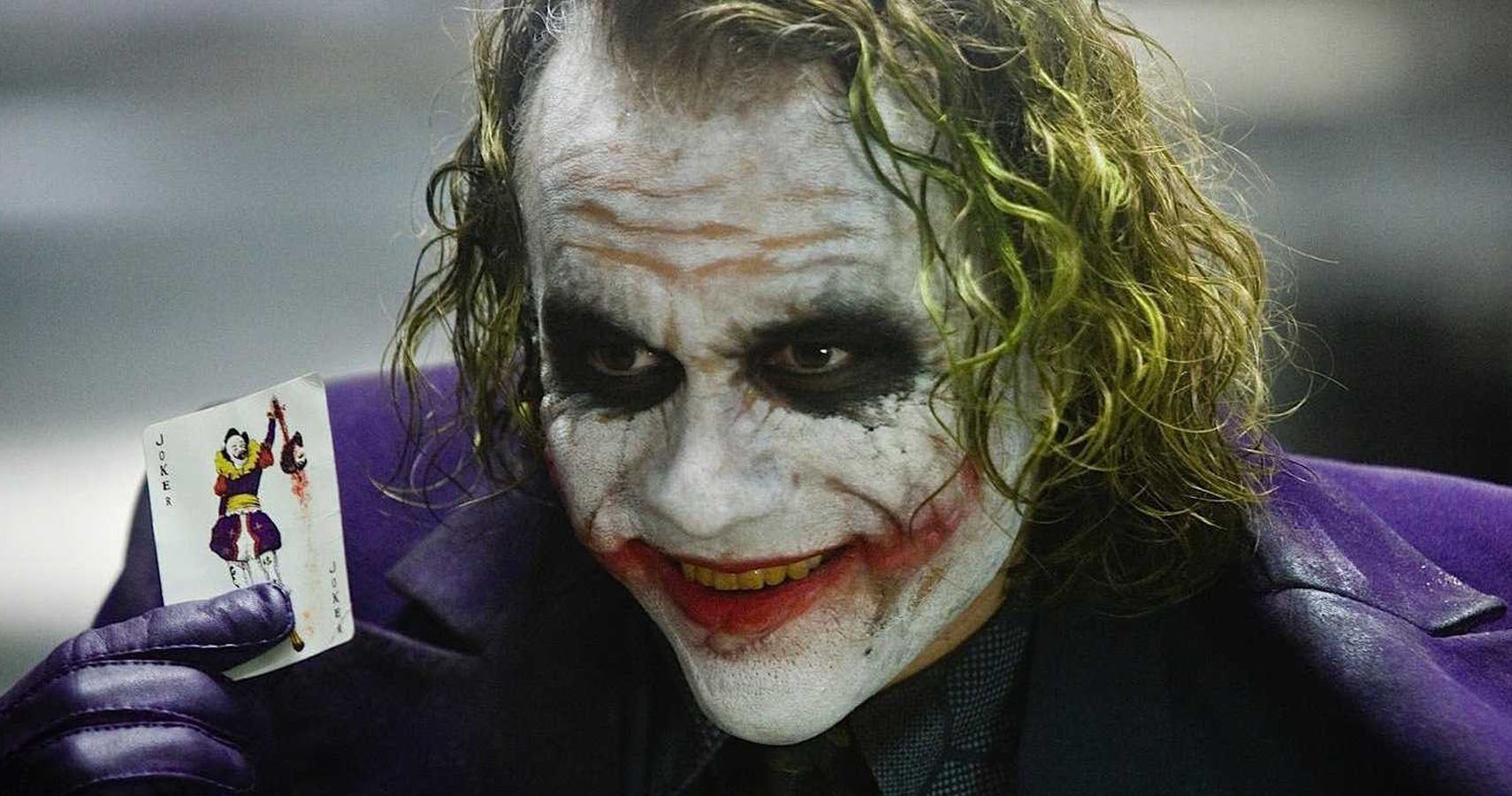
It’s hard not to reflect on the film without remembering the tragic death of Heath Ledger. A controversial choice for the Joker – despite Brokeback Mountain he was seen by many as a lightweight actor – Ledger’s performance is astounding. He radically redefines the character, giving every scene an eerie edge somewhere between violence and black comedy. His Joker has the bowed head and animalistic prowling of a hyena (along with the laugh), a snake-like licking exploration of his facial wounds, a voice that switches from a deep baritone to a high-pitched giggle.

He’s dangerously, psychotically violent, with a dark, demonic delight in mayhem, a wickedness that is not funny so much as unsettlingly comic and an unpredictability laced with a sharp and intimidating intelligence. Ledger essentially redefined a character who had existed for decades. It’s an extraordinary performance, winning numerous awards, that stands as the definitive interpretation of the character as a scuzzy, streetwise hood with the willingness to do anything at all.

The Joker is the channel Nolan’s film uses to explore fascinating ideas around order and chaos, and the clash between anarchy and rules. Nolan understands that, for all his confused psyche – heading out to beat up criminals for his nightly activities – Batman is a bastion of law and order and moral righteousness. He’s a fiercely ordered and meticulous man, who plans several steps ahead of his enemies, holds rigidly to a moral code and has the confidence (arrogance?) to believe he is best placed to make the big calls for the many. They are personally traits he shares with all the films heroes: he, Gordon and Dent are all men who harvest long-term plans to deliver mass benefits.

Standing against them is their antithesis. The Joker believes principles are bunkum, with life motivated by randomness and selfishness. These are polar opposite theories of life being explored here – and the Joker’s plans (such as they are) are to show that mankind is, at heart, an awful, terrible thing that can only destroy. But the schemes of our heroes also smack of arrogance and control – a sense of almost divine certainty in their righteousness.

Basically, what we get here is a discussion on our fear of anarchy. Deep down we all like conspiracy theories, because it shows someone is in charge. Randomness is terrifying. We all like to feel there is an organising force behind events – no one wants to meet their end by the toss of coin. We feel comforted by being part of an overall plan – even if it’s a plan for our demise. The Joker’s power comes not from his skills in themselves, but his willingness to break all rules and destroy anything and anyone at any time for any reason. There is no protecting against this. And it’s terrifying.

Nolan introduces the concept – and the character’s warped way of thinking – from the very start. The stunning opening sequence features a bank heist (with a neat cameo from Heat veteran William Fichtner – a deliberate homage) where the Joker has devised a ragged, but brutal plan which involves each member of the gang offing each other in turn (not that they are aware of that!). It’s a blazingly, triumphantly cinematic opening and a brilliant entrée to Nolan’s superbly directed, engrossing film.

While juggling intelligent ideas it’s also a brilliant, edge-of-the-seat ride crammed with jaw-dropping set-pieces. Each of them is underpinned by that rich psychological clash. Bruce Wayne is trapped in tactics utterly unsuited for his opponent, his assumption that criminals are simple people motivated by greed. Even worse, the Joker delights in identifying the clear lines Batman won’t cross, and dances right across them, wiping out the psychological advantages that Batman has over other criminals: once the Joker establishes Batman will never kill him, he forever knows he has the upper-hand.

Bravely the film ends not with a bang, but a character-driven, personal three-way confrontation between its three heroes (Batman, Gordon and Dent), low-key but bubbling with resentments, fury and pain. It’s a perfect cap – and a capturing of the film’s argument that the greatest damage people like the Joker can cause is not to our property but to our souls.

It’s easy in all this to overlook Christian Bale, but he is wonderful as Wayne (and again this is a film that is as much, if not more, about Wayne than Batman). Increasingly distancing himself from people – his last links to human warmth being Alfred (Michael Caine, again in wonderful mentor form) and Rachel Dawes (re-cast to terrific effect with Maggie Gyllenhaal, who brings wonderful depth and complexity to the role) – Wayne carries a martyr complex, damaging to his psyche.

Nolan’s film is a dense and rich thematic exploration of chaos and certainty which expertly combines thills and actions with a character driven plot. Superbly acted, wonderfully paced, rich and intelligent – with a genre defining performance by Ledger – this is truly great film-making, one of the greatest blockbusters of all time.

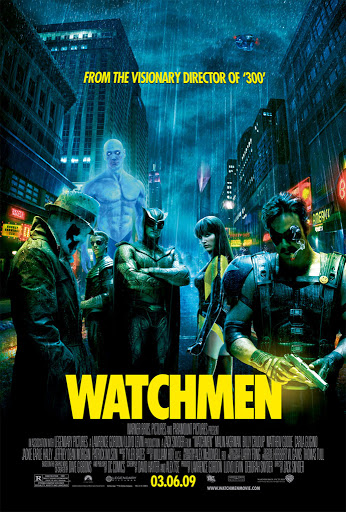
Watchmen (2009)

Watchmen (2009)


Morally complex heroes in Zach Snyder’s visually impressive but slightly empty Watchmen

Director: Zach Snyder

Cast: Malin Åkerman (Laurie Jupiter/Silk Spectre II), Billy Crudup (Jon Osterman/Dr Manhattan), Matthew Goode (Adrian Veidt/Ozymandias), Jackie Earle Haley (Walter Kovacs/Rorschach), Patrick Wilson (Daniel Dreiberg/Nite Owl II), Jeffrey Dean Morgan (Edward Blake/Comedian), Carla Gugino (Sally Jupiter/Silk Spectre), Matt Frewer (Edgar Jacobi/Moloch), Stephen McHattie (Hollis Mason/Nite Owl)

If you asked people to name the greatest Graphic Novel Ever, chances are they would come up with Alan Moore’s Watchmen. This scintillating deconstruction of superheroes and the morality of caped avenging satirises what the impact of superheroes in a real world might be. It had taken decades – and several cancelled attempts – to get a version to the screen. So, if nothing else, Zach Snyder deserves plaudits for merely persuading Hollywood executives to get this expensive, R-rated, morally complex film to the screen. Sure, the final result isn’t perfect, but it’s got a fair bit going for it.

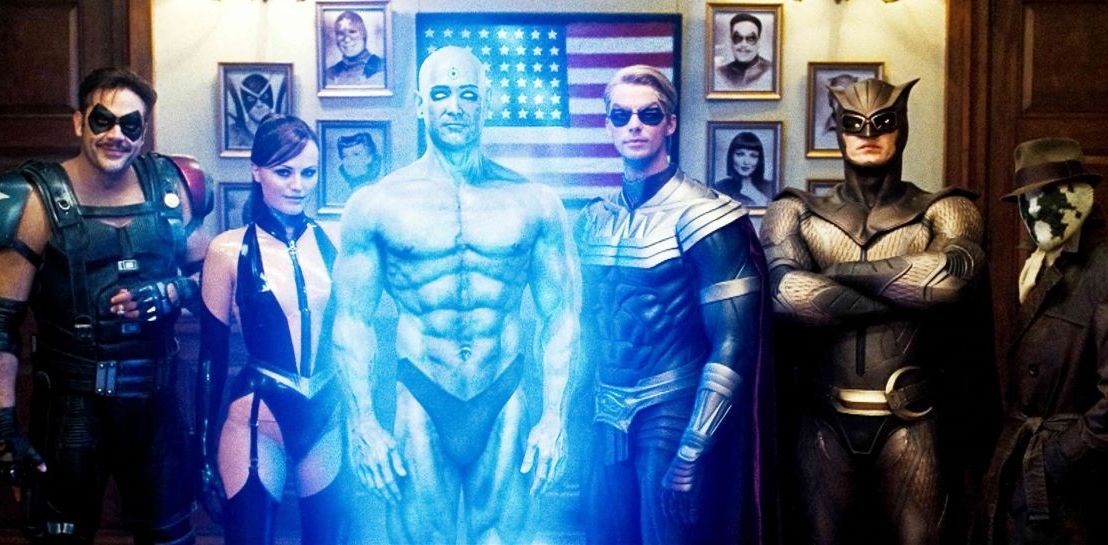
Watchmen is set in an alternative 1985 where Richard Nixon is serving his fourth term and the Armageddon of Nuclear war is just around the corner. Masked vigilantes had been a common sight on the streets – although banned since 1977. The Vietnam war was won (in a few days) by the God-like Dr Manhattan (Billy Crudup), a scientist granted superhuman powers in 1959 after an accident with a field generator. Most other vigilantes are retired, other than right-wing bully the Comedian (Jeffrey Dean Morgan). When the Comedian is murdered by a masked intruder, his fellow members of superhero group the Watchmen, worry someone is eliminating them for reasons unknown.

Snyder’s Watchmen is a visual feast. Snyder – a huge fan of the graphic novel – used it as a visual bible, quoting it in several frames. The film is a beautiful mix of dark, filmic visuals and striking comic book primary colours, while frequently embracing the inky black murkiness of the violent world its depicting. Shot with the same high energy and dynamism as 300, Snyder’s ability to turn pulpy Warhol inspired visuals into fast-paced, filmic action is second-to-none.

What however is more of a shame is the feeling that the main things in Watchmen that interest Snyder might be the visuals. Where the film sometimes fails to come to life is where it deals with the complex morality of its heroes. The original deconstructed the morality of heroes. How a man with the powers of a God could come to look on humanity with an (albeit affectionate) distance. How a masked PI would be so convinced that right and wrong were certain that he would be willing to carry out acts of bone-crunching violence. That a hero could calculate sacrificing millions of lives for the greater good isn’t just acceptable, its recommended. That for others the exhilaration of spending their nights beating up criminals is an escape from the mundane realities of life.

The problem is that Watchmen never quite gets to the heart of these moral questions, of really tackling the rights, wrongs and shades of grey of those ethical quandaries. Rather than delving into them, ideas are too often stated. While its daring for a film to include heroes who are as deeply flawed, violent and, at times, even as unpleasant as this – it still doesn’t quite flesh out the complexities of this.

Too often the film takes a naughty pleasure in its violence and brutality, seeing that as a short-hand for presenting a morally unclear world. And at times wants us to go “how cool is that!” rather than asking “should I be enjoying watching indiscriminate slaughter from a vigilante”. Its telling that the recent HBO series of Watchmen – a sequel to the Graphic Novel set in the modern world – feels more like a true adaptation of the source material than this. That dealt with fascinating ideas about race in America, morality and acceptable sacrifices for the greater good (and still managed to work in plenty of action). By comparison, this film of the source material itself feels less deep. Now of course run time is part of that, but it should have been possible to make a film this long that more successfully combined ideas and visuals.

Snyder’s passion for the material is clear – but the film is often a little too obvious. From cuts to musical cues, it’s a film that pushes the envelope only in terms of its look and feel. It tries its best, but its vision of transmitting the depths of the original sometimes seem to stop at a faithful visual rendition of its style.

But it’s made with a lot of love and passion, not least in the acting. The decision to go largely with unknown actors pays off very well. Earle Haley brilliantly channels his character from the graphic book, a prickly obsessive with an unshakeable moral certainty. Crudup perfectly conveys the vast moral distance a real Superman would probably feel towards normal people. Goode’s chilling coldness and arrogance is perfect. Wilson gives the film heart as the closest thing to a genuinely decent guy. Åkerman does her best with a part that feels slightly underwritten and at times a plot requirement, largely defined by the emotions she provokes in the male character.

There are plenty of excellent moments in Watchmen but I’m not sure it ever really, truly becomes its own thing (in the way the HBO series did manage to do). In trying to so completely ape the visuals, and fit in all the plot, it becomes a companion piece rather than a stand-alone production. If Snyder had perhaps had a bit more courage to tack away from the strict structures of the original source material it could perhaps have helped make a stronger film. However, saying that I can imagine the fans hitting the roof if he had… And Snyder’s ability to persuade the studio to make a film with such a nihilist feel and ending is to be commended. Watchmen is a mixed bag, but when it works it does work well.

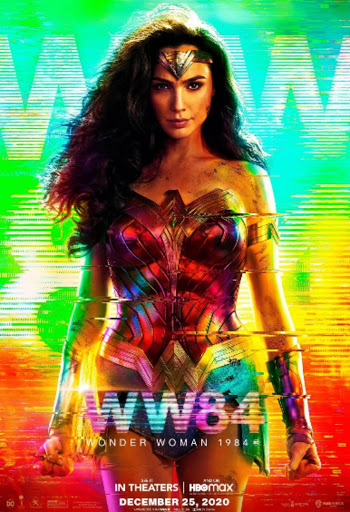
Wonder Woman 1984 (2020)

wonder woman 1984
Gal Gadot is delightful again in superior sequel Wonder Woman 1984

Director: Patty Jenkins

Cast: Gal Gadot (Diana Prince/Wonder Woman), Chris Pine (Steve Trevor), Kristen Wiig (Dr Barbara Minerva), Pedro Pascal (Maxwell Lord), Robin Wright (Antiope), Connie Nielsen (Hippolyta), Kristogger Polaha (Handsome man), Lucian Perez (Alistair), Ravi Patel (Baba Jide), Oliver Cotton (Simon Stagg), Stuart Milligan (President of the United States)

Wonder Woman in 2017 received the sort of rave reviews superhero films dream of. It was refreshing to have an action flick with a woman as the driving force. But Wonder Woman was, aside from that, very much a conventional superhero origins movie, with little truly original about it. Perhaps memories of it as being more revolutionary than it in fact was, lie behind the more hesitant critical reaction to Wonder Woman 1984, in many ways a more entertaining and smarter film.

In 1984, Diana Prince (Gal Gadot) works at the Smithsonian, and fights for justice in her spare time as Wonder Woman (it’s not clear how she this striking woman manages to keep her identity secret bar smashing a few CCTV cameras). However, she leads a private and lonely life, still mourning the death of Steve Trevor (Chris Pine) during the First World War. Her confidence is admired by her ditzy and nervous (and clearly smitten!) colleague Dr Barbara Minerva (Kristen Wiig), who longs to be like her. An exhibit arrives at the Smithsonian – a mysterious stone that legend has it will grant any wish that the person holding it asks. Diana, in a whimsical moment, wishes for the return of Steve – and is shocked when a man claiming to be Steve appears in her life. Dr Minerva meanwhile wishes to be like Diana in every way – little knowing her secret powers. But the stone has other people interested in it: it could be just the tool that ambitious, but failed, entrepreneur Maxwell Lord (Pedro Pascal) needs to turn his life around. But is there a cost for all this gift giving? What will the stone take in return – and can humanity survive a world where the slightest wish could come true?

Wonder Woman 1984 has a clear theme: taking the easy path might help you to get what you want, but an unearned victory is never a true one. It’s a concept introduced from the start, in an opening flashback section where a child Diana takes a shortcut in an Olympics race, and is denied victory by her mentor Antiope (Robin Wright in a welcome cameo). Antiope, in the way of all mentors, reminds her we learn lessons from loss and defeat, and short-cutting around failure never pays off in the end. It’s a clear message that being granted your wishes without working for them is empty.

And of course there is a cost! The stone takes from you the thing you value most, in exchange for what you want the most. In Diana’s case – having made her wish unknowingly, in a single moment of whimsy – what she loses is her strength, the thing that makes possible the thing she values most: her ability to change the world for the better. In turn, when Barbara wishes to be like Diana, the stone takes from her the very humanity that made her such an endearing and sweet person.

These sort of exchanges are not new to anyone who has ever read a fairy tale. But they are told here with refreshing honesty, not to mention a certain level of charm. Above all, this simple morality tale works because we are invested in the characters. Even without the memory of their relationship from the first film, Gadot and Pine are so likeable and charming in this film (Pine in particular is a delight, his eyes filling with wonder at the modern era – from a childish glee at escalators to tear-filled awe at the space programme) that, even though you know from the start what they are doing is “wrong” (after all Steve is inhabiting another man’s body, and every audience eventually the hero needs to do the right thing and give that body back), you still feel their joy at being together and Diana’s anguish at the thought of giving up the only (selfish) thing she’s ever wanted.

The same is true for the other two characters affected by the stone. Although nominally villains, both Wiig and Pascal play characters who, if anything, are deeply-flawed anti-heroes. Wiig is absolutely endearing as the gentle and shy Barbara, so much so it’s heartbreaking to see her freeze up as the film progresses. Pascal is hilariously overblown as a wannabe Gordon Gekko, but his relationship with his son is nicely drawn and his character is tinged with an underlying insecurity. Wonder Woman 1984 is refreshing in that it doesn’t present heroes and villains, but ordinary people needing to find the courage to reject their dreams for reality. Some do, others don’t.

It’s not a perfect film by a long stretch. As with the previous film, a final act fight scene lacks humanity and is dull. The film is probably fifteen minutes overlong. The various action scenes are well staged, but lack freshness. Some of the humour doesn’t always land. It’s hard not to snigger at a late act revelation of a new power for Wonder Woman. And while the film thankfully avoids the crassness of the first and its trenches setting, a photo of Wonder Woman helping to liberate concentration camps feels horrendously out of place (it’s meant to show her goodness, but I just wondered why on earth did she wait so long to do anything about the Holocaust?).

But the bad is outweighed by the good in a genuinely entertaining and charming movie whose freshness and lightness exceeds the original. Gal Gadot is still wonderful in the lead role – determined but sweet – Chris Pine does some of his best work and Wiig and Pascal are very good. I’d confidently say this is a better film than the first, a richer character study inspired by fairy tales, that really gets to the emotional heart of its lead character. I may be alone in that, but that’s what I think.