Category: Courtroom drama

The Life of Emile Zola (1937)

The Life of Emile Zola (1937)

Oscar-winning biopic that laid down many of the conventions we expect

Director: William Dieterle

Cast: Paul Muni (Emile Zola), Gloria Holden (Alexandrine Zola), Gale Sondergaard (Lucie Dreyfus), Joseph Schildkraut (Captain Alfred Dreyfus), Donald Crisp (Maitre Labori), Erin O’Brien-Moore (Nana), John Litel (Charpentier), Henry O’Neill (Colonel Picquart), Morris Carnovsky (Anatole France), Louis Calhern (Major Dort), Ralph Morgan (Commander of Paris), Harry Davenport (Chief of Staff), Vladimir Sokoloff (Paul Cezanne)

One of the lesser-known Best Picture winners, The Life of Emile Zola is a prime example of the 1930s trend for “Great Man” pictures, setting the template for a whole genre of biographical movies. A whistle-stop tour of how the Great Man came to be, before a tight focus on what made him great – ideally ending in either triumph or disaster (or, as is the case here, with both). It’s from a time when the viewing public didn’t expect a rigid adherence to the fact – and when films were very open with their flexibility with the truth (the film opens with an on-screen caption which happily states most of what happens in it is made up.) Actually, I think being told from the start you are watching a heavily fictionalised version of the truth covers a multitude of sins: and that The Life of Emile Zola is pretty entertaining when you get past that.

Emile Zole (Paul Muni) is of course one of the most famous French authors. But he was also at least as famous for his campaigning and presence as he was for his volumes and volumes of best sellers. The film follows Zola, for its first forty minutes or so, from poverty-stricken writer, struggling to make ends meet in the draughty hovel he shares with similar future-genius Cezanne, to success (although in real life by the time he wrote Nana, the book that makes him a sensation here, he was already hugely famous). Zola becomes increasingly aimless. What worlds are there left to be conquered? That all changes when Lucie (Gale Sondergaard) the wife of army officer Alfred Dreyfus (Joseph Schildkraut) asks for his help to save his life from unjust imprisonment and exile on Devil’s Island. Because the army are convinced Dreyfus is a spy – and won’t let inconvenient things like evidence that someone else did it get in the way.

The film is called The Life of Emile Zola but really it might as well have been called The Dreyfus Affair. This infamous miscarriage of justice drives the entire second half of the movie – with Zola himself disappearing from focus for stretches as the film covers the conspiracies that led to Dreyfuss spending the best part of a decade imprisoned for something he didn’t do. What seems strange today is that the film makes no mention of the most famous angle of the case: Dreyfus was almost solely suspected because he was Jewish, and the case became one of the most infamous antisemitic persecutions in history. But the studio heads – Jewish themselves and nervous of being accused of making a film that criticised Nazi Germany – removed all reference to Dreyfus’ Jewishness from the script. It’s a curious omission, but by and large doesn’t affect the film’s final impact.

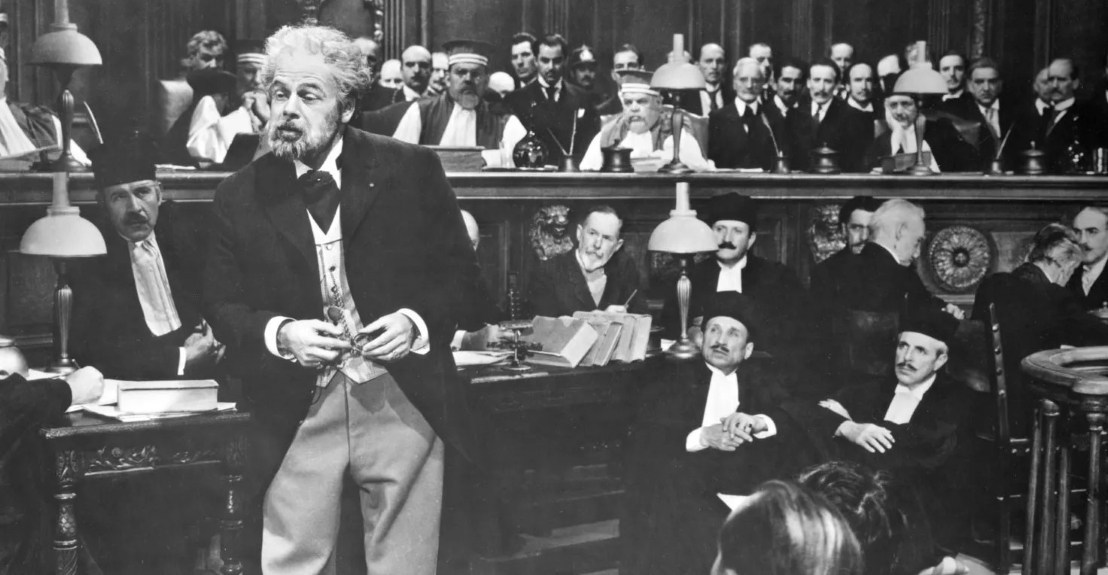
Dieterle’s movie is also one of the first courtroom dramas. A large chunk of the final third is given over to Zola’s trial for libel (after his famous J’Accuse article, denouncing the army’s persecution of Dreyfus). In a crowded courtroom, the film carefully follows the intricacies of the court case, from calling to witnesses to final speeches (all fairly accurate, even if Zola is given a larger role with a final speech). As in the trial itself, the blatant unfairness (witnesses shouted down, defence questions vetoed, evidence withheld and even invented) is hammered home with shocking regularity. Donald Crisp does fine work as the liberal lawyer, hamstrung by a crooked system.

The Dreyfus affair element is really what makes the film come to life. The French army officers are almost to a man a group of corrupt bullies, who have pre-decided the outcome of their investigation and are determined that every single element of it should support that decision. By contrast Joseph Schildkraut (winning an Oscar that feels more for Dreyfus than him, delivering an effective if rather one-note performance) is the soul of decency and nobility as a Dreyfus who is at first bewildered then fighting a manful struggle against despair. Even better is Gale Sondergaard, who gets an ahistorical impassioned speech to win Zola to the cause and carries a core of quiet anger under her shock.

The Dreyfus Affair was the struggle of Zola’s life, the crusade that would win him a place in history, perhaps even more than his books. It’s also the sort of campaigning material that gives rich rewards to actors. Paul Muni seizes the opportunity. The film was shot in reverse so Muni would need to spend less and less time in make-up as shooting went on: the old-age make-up and wigs are very effective, matched by Muni’s physicality and voice which subtly changes as the character ages.

Muni is an actor who seized any chance for a bit of grandstanding. The film gives him its best one with a five-minute monologue closing the trial, during which Zola argues with passionate but quiet reasonableness that Dreyfus is an innocent victim. It’s even more effective since Dieterle has kept Muni silently off-centre for much of the court case. Muni sometimes carries the whiff of stagey ham, but in several moments he brings both a charming cheek and strong morality to Zola. It’s a very strong performance from one of the leading actors of the 1930s.

The film itself is also a good mixture of the twee and the compelling. Most of the Dreyfuss material falls into the latter category. It’s the early days of Zola that falls into twee: Zola scrippling ideas, bantering with Cezanne on the purpose of art, playfully mining prostitute Nana for the material he will make into a hit book. There is a nice foreshadowing through the film with Zola’s obsession with blocking draughts – an obsession that will later cost him his life to a misfunctioning heater.

It’s a well directed film. Dieterle mixes in nice touches of humour (a husband and wife using subterfuge to disguise from each other that they are both buying Nana) and also effective details that speak of Dreyfus’ isolation (the letter that has been redacated into nothingness, the effective transition of several years at Devil’s Island that stresses how little has changed, Dreyfus’ giddy joy when finally allowed to walk unheeded in and out of his prison cell).

The Life of Emile Zola looks today like a surprising winner of Best Picture. But the patterns for both courtroom drama and many biographical dramas were laid down here. By the end, as the survivors pay tribute to Zola with high-blown speeches, the audience should be convinced that this was a man deserving of being honoured by a whole movie. It’s setting of a template copied many times over can make it look a little twee today, but its’ still well done, with some powerful flashes of effective film-making and great acting.

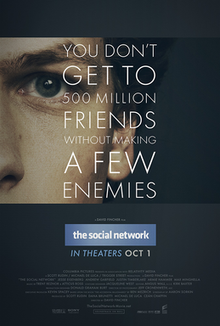
The Social Network (2010)

Andrew Garfield and Jesse Eisenberg bring the making of Facebook to life in Fincher’s modern American classic

Director: David Fincher

Cast: Jesse Eisenberg (Mark Zuckerberg), Andrew Garfield (Eduardo Saverin), Justin Timberlake (Sean Parker), Armie Hammer (Cameron Winklevoss/Tyler Winklevoss), Max Minghella (Divya Narendra), Brenda Song (Christy Lee), Rashida Jones (Marilyn Delpy), Joseph Mazzello (Dustin Moskovitz), Rooney Mara (Erica Albright), John Getz (Sy), David Selby (Gage)

Nothing has changed our interaction with the world faster than the internet. And nothing on the internet has changed how we interact as much as social media. As it drives changes in the way we relate to other people, it’s a brave film that tries to capture this zeitgeist and turn it into an effective movie. The Social Network is a brave movie – and also a brilliant one, a defiantly modern and far-sighted movie that avoids being the sanctimonious message movie it could have become, by concentrating on personal relationships, drama and, above all, a strong and compelling story.

Its October 2003 and a 19-year old Harvard student Mark Zuckerberg (Jesse Eisenberg) gets dumped by his girlfriend Erica (Rooney Mara). So, he responds like many people today would – but not in 2003 – by writing a series of rude and angry blogs about her. And at the same time, he does something you and I wouldn’t be able to do – he builds overnight a campus website called Facemash that allows users to rate the attractiveness of female students. It’s a sensation – and a scandal.

Off the back of it, Zuckerberg is approached by the Winklevoss brothers (in a skilled double performance by Armie Hammer) to see if he’d be interested in building an elite social network, Harvard Connection, for them. Zuckerberg agrees – but did he independently already have the idea for Thefacebook, an elite social network for Ivy League students? Either way, with funds from friend Eduardo Saverin (Andrew Garfield) he builds the platform which is to become Facebook. Does it all end well? Since the story is framed around Zuckerberg in 2009, sitting in depositions while being sued by both the Winkelvoss brothers (“the Winklevi”) and Saverin, you can guess not.

Fincher’s film reflects its central character in many ways – cool, efficient, tightly wound, juggling intellectualism with simmering tension. It’s vibrant, fresh, razor-sharp, perfectly paced and superbly dramatic. It turns what could have been a terrifically dull story of very clever people typing lines of code into a whipper-sharp story of jealousies, rivalries and suspicions. It also brilliantly veers away from being a polemic. It could easily have made points – as many films have – about the “evils and dangers of that creepy thing the internet” or constantly reminded us how morally superior film-makers are to social media kingpins. It does nothing of the sort. Instead it’s a brilliantly insightful look at the birth of a phenomenon that also makes subtle, intelligent points about some of the behaviours that phenomenon led to. All while keeping us gloriously entertained.

A big part of the film’s success is in Sorkin’s superb script. The material is perfect for him. The character’s intellectualism fits with his pithy turn of phrase, while their perceptions of themselves as victims or on a moral crusade fits with his ability to write morality with empathy. It also helps that he is the master of crackling dialogue. The idea to structure the film around the depositions is also a master-stroke. Not just a reminder of what’s to come, it adds an air of artificiality to everything we see (perfect as well for Sorkin’s smarter-than-life dialogue) – after all, each scene is based on the filtered remembrances of people in the depositions. And all of them remember a subtly different story.

Sorkin and Fincher also manage to avoid having villains in play. It would be easy to make Zuckerberg a villain: many films would have done. But Zuckerberg here isn’t bad – it’s more that he’s tunnel-visioned, selfish and socially inept. Erica (a marvellous turn by Rooney Mara as the first victim of social media bullying) has a point when she says she dumping him not because he’s a geek but because he’s not really a nice person. But Zuckerberg’s actions – his betrayals as some read them – come not from vindictiveness but a shark-like moving forward that leaves people behind him. And he’s also, as the film is keen to show repeatedly, lonely. He has one friend – whom he sacrifices on the altar of his creation – and is ruthless at cutting people out of his life when they fail to meet the standards he has set them.

The film channels the skills of Eisenberg – whose range is not huge – perfectly here, in a role he was surely born to play. Eisenberg crafts his physicality in something hunched, oppressed and sullen while his flat voice is perfect for a man who expresses himself through his creation not his personality. He gives Zuckerberg both a ruthlessness, but also a strange lack of knowledge – constantly surprised that his actions have consequences that leave him alone. He makes him a true lonely god of the internet – the man who invented the biggest social networking centre in the world, but who doesn’t have a friend himself.

But it also makes clear that Zuckerberg lacks the usual flaws of his kind: he’s not interested, it seems, in money, riches, fame or drugs. To him, the prize is to do not to be seen to do. He makes a rich contrast with Sean Parker (a brilliantly charismatic Justin Timberlake), the creator of Napster, who briefly influences him but is primarily interested in the flash and bang that the retiring Zuckerberg isn’t. What he does have is the drive and ruthlessness that his friend Eduardo Saverin (a wonderful performance from Andrew Garfield as a marvellously sweet, but clearly naïve and out-of-his-depth man completely lacking the vision a project like Facebook needs) doesn’t have – and which makes Saverin unsuitable for thinking in the global terms Zuckerberg is.

And the film has little time for the Winklevoss twins. Played with chutzpah in a double role by Armie Hammer (who skilfully distinguishes both of them), Zuckerberg is right when he describes them as rich kids who had everything they ever wanted in life – and seem outraged that they can’t be given the rights to Facebook as well. As he points out they intended to do nothing other than come up with a concept. These rowers – in a witty touch their boat is sponsored by that dinosaur Polaroid – also represent the old elite under siege from new media. The entitled rich, who can’t comprehend that the world is being handed to them on a plate.

The film also makes for an intriguing meta-commentary on the growth of social media. From the trolling of Erica, through the bitter feuds and arguments, the he-said-she-said fighting of the depositions, and the quick shifts between friendship and rivalry, it also manages to capture the world of social media in a nutshell. The atmosphere where actions can explode in people’s perception, where statements you made years ago come back to bite you, where judgement and criticism are constant and the ability to communicate more easily also makes fights easier to start, seem more and more prescient.

Fincher’s film does this marvellously, with a wit and sense of dramatic flair that reminds me of a more grounded Network. Sure the scene at Henley-on-Thames is hand-in-the-mouth agonising for any British person to watch (it is littered with major errors from turn-of-phrase to its understanding of life in Britain), but when every other scene in it is perfectly done it doesn’t matter. Like any victory, Facebook has many people claiming to be its father. You could say the film about this film: superbly directed, a brilliant script and perfectly cast, it’s a triumph.

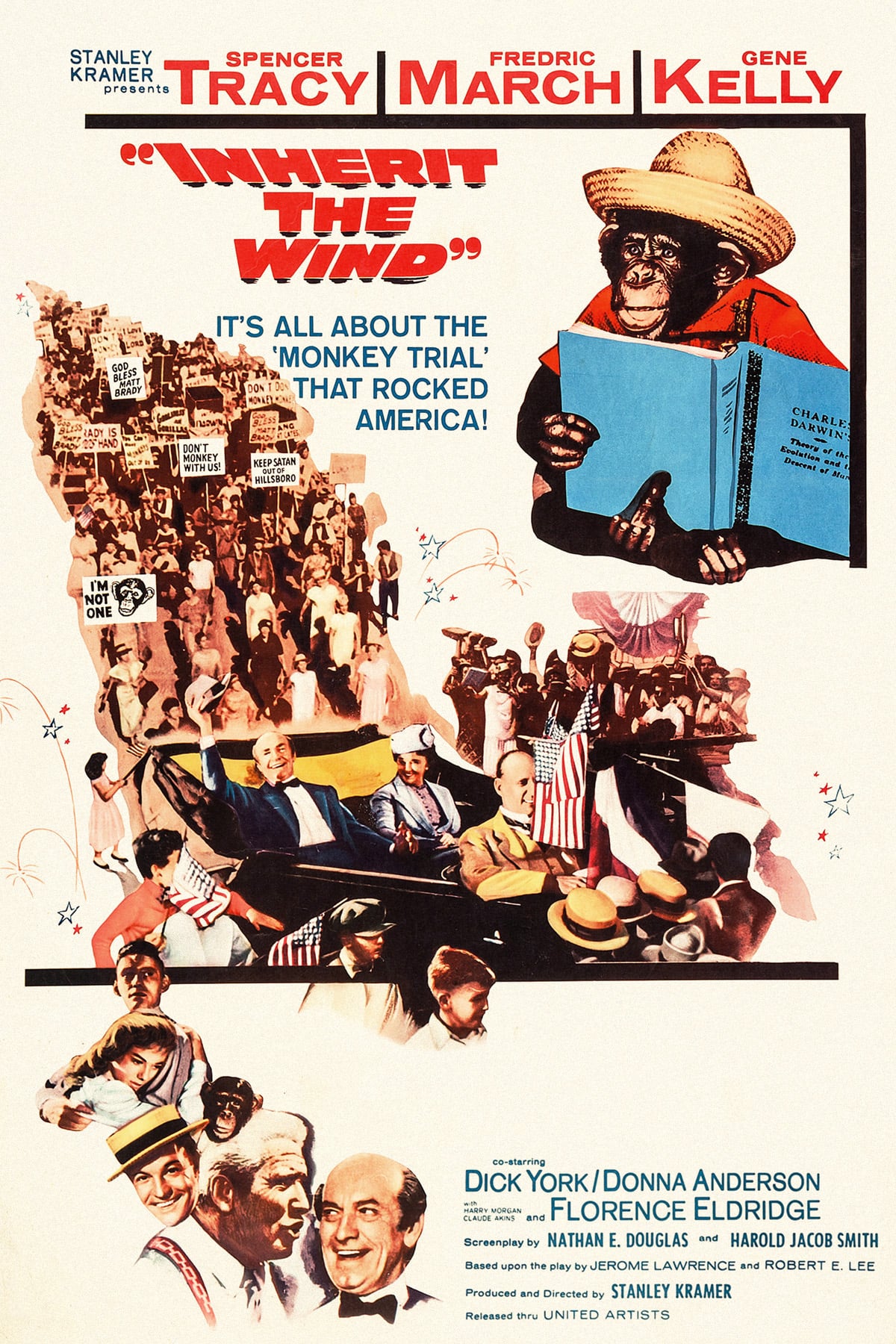
Inherit the Wind (1960)

Spencer Tracy and Fredric March go toe-to-toe in Stanley Kramer’s liberalism-on-trial movie Inherit the Wind

Director: Stanley Kramer

Cast: Spencer Tracy (Henry Drummond), Fredric March (Matthew Harrison Brady), Gene Kelly (EK Hornbeck), Florence Eldridge (Sara Brady), Dick York (Bertram T Cates), Donna Anderson (Rachel Brown), Harry Morgan (Judge Merle Coffey), Claude Atkins (Reverend Jeremiah Brown), Elliott Reid (Prosecutor Tom Davenport), Paul Hartman (Deputy Horace Meeker)

In 1960, Inherit the Wind was a parable. The teaching of Darwinism being illegal in a small town that defined itself by its faith couldn’t really happen today could it? So, the film used the concept as an angle to criticise the restrictions placed on free speech during the McCarthy years. The wheel has come full circle now: it’s no longer unlikely at all to imagine something like this happening. Indeed, versions of it have already taken place in America this century. This change does actually help the film look increasingly more prescient as time goes by.

A fictionalised version of the famous Scopes monkey trial (with most of the names changed, but many of the court room events fundamentally the same) a local schoolteacher, Bertram Cates (Dick Young), in a small Southern town is placed on trial for teaching Darwinism in his school. Staunch Christian and former Presidential candidate Matthew Harrison Brady (Fredric March) volunteers to put the case for the prosecution. Cates’ defence will be handled by the renowned liberal lawyer Henry Drummond (Spencer Tracy). Sparks fly in a courtroom and around the town, where many people are instinctively opposed to anything that can be seen to draw doubt on intelligent design.

Kramer’s films are often both praised and criticised for their rather heavy-handed liberalism. Inherit the Wind is no different. You’d be hard pressed to miss the message here about the dangers of intrusive laws designed to govern what we think and believe. Kramer’s film edges away from making criticism of fundamentalism too overt. Sure, the local preacher (a lip-smacking Claude Atkins) is a tongue-frothing “burn ‘em all!” maniac, only happy when stirring up an outraged mob. But on the other hand, Drummond is revealed to be a man of (liberal) faith – and, in an agonisingly heavy-handed final note, the film ends with him literally weighing The Bible and On the Origin of the Species in his hands then clasping them both together. You see – science and faith can work together!

While it’s easy to smile at Inherit the Wind’s striving for inoffensive liberalism, it means well and actually produces some effective court-room set-pieces. While its overlong – the sections outside of the court could do with trimming down and a rather shoe-horned plot with Cates dating the local preacher’s daughter (not helped by the blandness of both actors) promises much but delivers very little. What the film really works at is a chance for two seasoned performers to go at each other hammer and tongs in the court. Chances they both seize.

Spencer Tracy sets a template of sensible, liberal reasonableness mixed with a well-defined sense of right and wrong that would serve him well in a further three collaborations with Kramer. He brings Drummond a rumbled worldliness, a shrewd intelligence and a patient forbearance but never once lets us forget his righteous fury that this case is even happening in the first place. His courtroom performance hinge on a winning reasonableness that can turn on a sixpence into ingenious traps for witnesses. He’s a rock of decency in a shifting world and Tracy effectively underplays several scenes, making Drummond seem even more humane.

It also means that Tracy makes a lovely performing contrast with Fredric March’s firey passion as Brady. Sweating in the heat of the court, March’s Brady is overflowing with moral certainty and fury. March’s performance is big, but the character himself has a court-personae that depends on him appearing like an embodiment of God’s fury. It works because March gives Brady a quiet air of sadness. This is a man raging against the dying of the light – this case is his last hurrah. Brady is becoming yesterday’s news, but can’t seem to consciously accept this. In quieter moments, he is clearly a man of reflection and reasonableness – but (in a surprisingly modern touch) is all to aware that a raging public personae is what “sells”.

Kramer’s film is at its strongest when it lets these two actors go toe-to-toe. These moments aren’t just in the fireworks for court. Private scenes between the two show a great deal of mutual respect and even admiration. The two men are old friends. Drummond is very fond of Brady’s wife Sara (played excellently by Fredric March’s real life wife Florence Eldridge), who also regards him as a man of decency. They can sit on a bench at night and reflect on the good times. Brady may be a type of demagogue but he’s not a rabble rouser like the Reverend Brown (who he publicly denounces) even while he enjoys the attention of crowds. Drummond isn’t adverse to whipping up a bit of popular support – or enjoying the attention. It’s a fine contrast of two men who both similar and very different.

Aside from this, Kramer sometimes trips too often into rather obvious and heavy-handed social commentary. Gene Kelly is on good form in an over-written part as a cynical journalist – he sort of cares about justice, but only if its a good story and has only scorn for anyone else who believes anything. The film closes with a rather heavy-handed denunciation of his lack in belief in anything, compared to Brady’s faith. The script is at times a little too weak – Tracy and March sell the hell out of a vital confrontation near the end, playing “gotcha” moments that the script largely fails to deliver – but there is still lots of meat in there. Some of the staging and performances – including the extended pro-religion protests that pad out the run time – are a little too obvious.

But at heart, there is a very true and increasingly more-and-more relevant message in this film – and when its acted as well as this, it’s hard not to enjoy it.

Judgment at Nuremberg (1961)

Maximilian Schell on a misguided attempt to salvage his country’s dignity in Judgment at Nuremberg

Director: Stanley Kramer

Cast: Spencer Tracy (Judge Dan Haywood), Burt Lancaster (Dr Ernst Janning), Richard Widmark (Colonel Ted Lawson), Maximilian Schell (Hans Rolfe), Marlene Dietrich (Frau Bertholt), Montgomery Clift (Rudolph Peterson), Judy Garland (Irene Hoffmann), William Shatner (Captain Harrison Byers), Howard Caine (Hugo Wallner), Werner Klemperer (Emil Hahn), Joh Wengraf (Dr Karl Wieck), Karl Swenson (Dr Heinrich Geuter), Ben Wright (Herr Halbestadt), Virginia Christine (Mrs Halbestadt), Edward Binns (Senator Burkette)

“I was just following orders”. It’s a statement you instantly associate with people who know they are doing the wrong thing, but cling to the idea it’s not their responsibility because they’ve been told to do it. The Nuremberg trials – which started with the major surviving war criminals, but then investigated every level of German society from the army to industry to doctors to the judiciary – exploded this as an excuse. But the trials also raised wider questions, ones that Judgment at Nuremberg explores: how do you make judgments for individuals when, arguably, nearly everyone in the country holds some sort of moral responsibility? What happens when justice collides with political reality? What price is put on getting justice for the few against the need to move on?

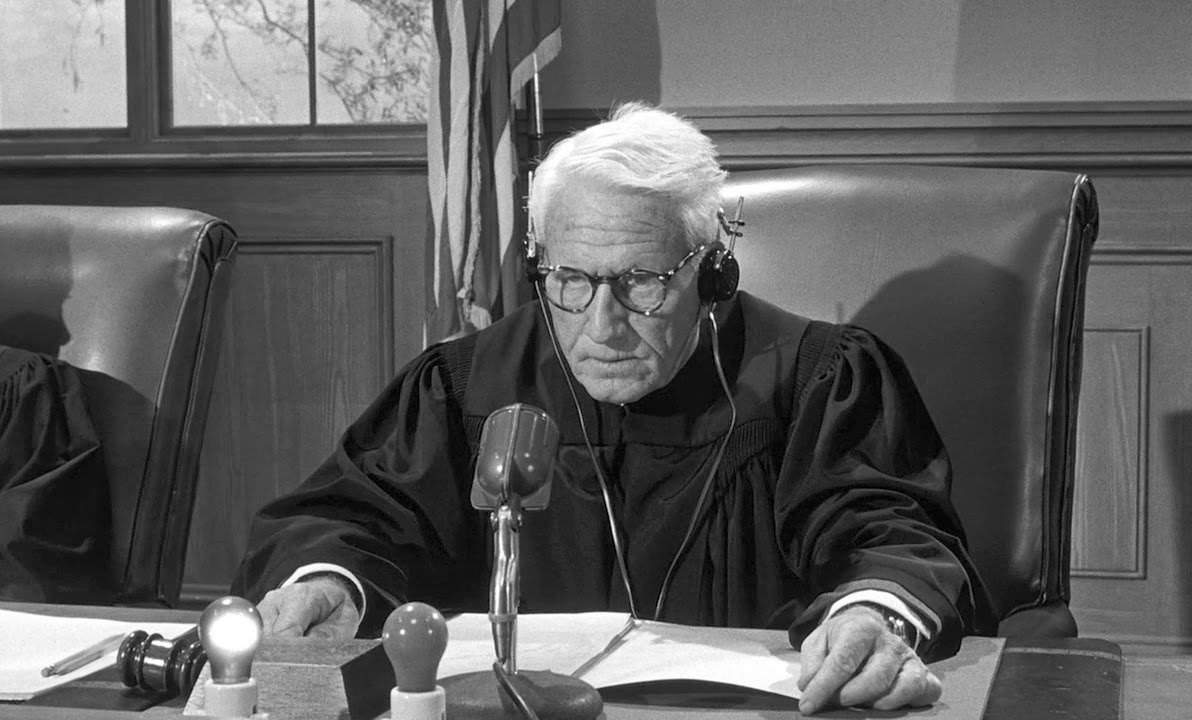
These, among others, are fascinating questions explored in Stanley Kramer’s engrossing – if at times a little dry and on-the-nose – film. In 1948 Judge Dan Hayward (Spencer Tracy) arrives in war-torn Nuremberg to judge the trial of four senior German judges. The most prominent of the accused is internationally renowned Dr Ernst Janning (Burt Lancaster). Janning’s passionate advocate Hans Rolfe (Maximilian Schell) believes the trial is about the Allies punishing the Germans and wants to show “we were not all like them”. Prosecuting laywer Colonel Ted Lawson (Richard Widmark) wants the trials to continue until all the guilty have been punished. But with Cold War tensions rising – and Berlin already under blockade by the Soviets – the politicians back home want the trials to wind down, particularly as the Germans could be key allies against the USSR. How will Hayward balance these pressures as the trial progresses?

Kramer’s film is a brilliant reconstruction of the detail of the trials. He had wanted to film the entire thing on location – but, when the trial room was unavailable, Kramer had the trial room rebuilt in exact detail in the studio (the production design is absolutely spot-on by Rudolph Sternard). The film stages all the issues of simultaneous translation, headphones and trial procedure in loving detail. His technical direction is well managed – even if the camera perhaps once too often pans around those involved in the trial while they speak. The trial drama is structured around three key witnesses (rather than documents), and brings out impressive performances from the entire cast.

Abby Mann’s screenplay wisely focuses in, not on the primary Nuremberg trials, but one of the many sub-trials. Little known, this works so well dramatically, because they both delve deeper into how every facet of German life was corrupted by Nazism – that in this case, leading judges condemned those they knew were innocent to death – and also allow an exploration around the purpose of the Nuremberg trials themselves. Were these trials crucially about justice at all costs and should continue indefinitely – as some characters clearly believe? Or were they meant as representative affairs, demonstrating the guilt of a selected few, at which point their purpose was done?

Kramer’s film is an educative piece, which explores this. Crucially several German characters are introduced, each of them unsure as to how much the national guilt should apply to them. Should Hayward’s household staff consider themselves guilty? As Hayward points out, Dachau was only about 20 miles away: not to know of its existence at all, was surely be wilful ignorance. Marlene Dietrich (excellent as an austere widow), is bitter that she has lost everything after her husband (a German general) was executed (an execution that many of the characters feel was harsh). He never liked Hitler, and he wasn’t a Nazi: how bad could he have been? He only did his duty right?

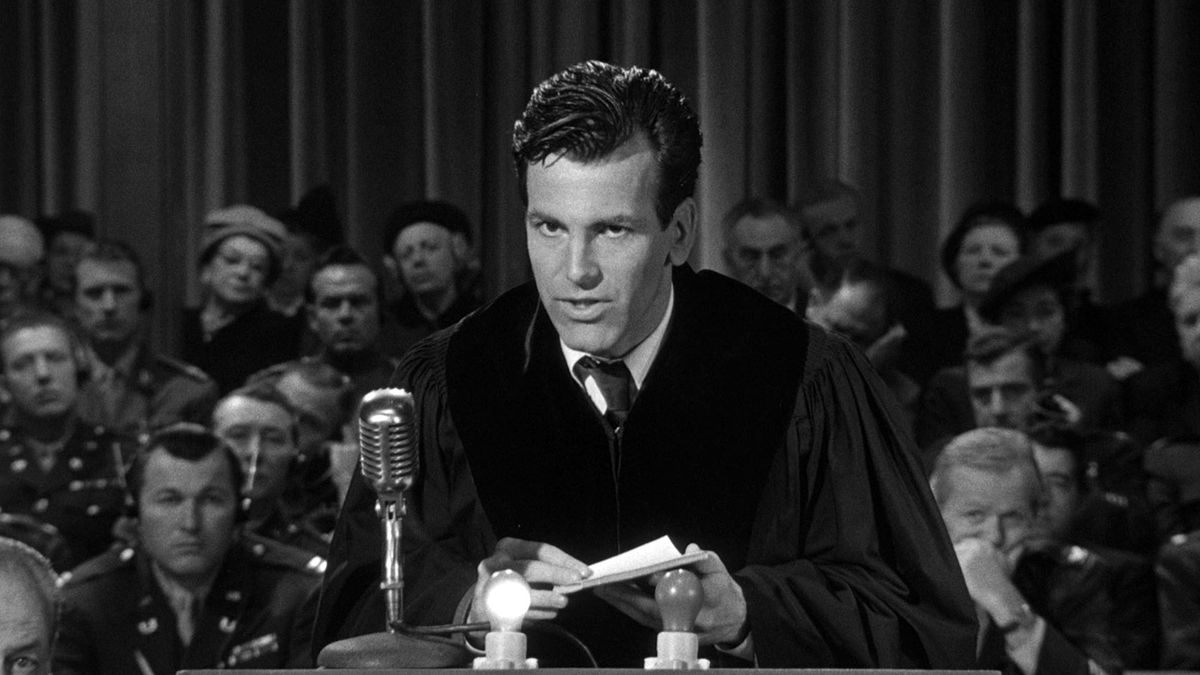
Meanwhile, firebrand lawyer Hans Rolfe believes that he must salvage some sense of German identity from the trial: he needs to show that “we were not all like that”. And rescuing the reputation of Dr Janning as “the Good German” is crucial to that. An Oscar-winning Schell (the part is perfect for his grandiose style) superbly captures the agonised guilt that has transformed into anger in this man: the desperation to protect his country that leads him to undertake the same brutal interrogations of witnesses during the trial that his clients are accused of doing. Repeating the same actions of the past that he hates, with a misguided goal of restoring pride to his country.

And why does Dr Janning become the focus of this desire to show not everyone was bad? One of the interesting things the film raises is questions of class. Rolfe sees him as the model Good German and Hayward struggles to see why he was involved in miscarriages of justice, because he is very much “one of us”. Ramrod straight, he’s no fanatic (like one of his fellow accused), he’s a noble, world-renowned lawyer. Lancaster’s Janning, with his rigid physicality, clearly thinks himself a world above his fellow accused. He has touched pitch, but feels he’s not really been defiled at heart: that there were clear reasons why he did the things he did. He has no sympathy for the crudity of Nazism, but still feel ashamed that he allowed himself to get tied up with it. He starts the trial trying to be above the entire process, as if not engaging will somehow stop him from feeling corrupted, even while his haunted face drips with shame.

It’s a nobility that many on the US side find appealing. It appeals to the same minds that deems Richard Widmark’s combatative Colonel Lawson as not quite gentlemanly, but vindictive. Never mind that Widmark’s lawyer wants justice done, regardless of the cost. It’s the same sympathy many now feel for Dietrich’s dignified widow, who feels so classy and noble that she can’t really be implicated in any nastiness. Janning unnerves Hayward and others, because if he can fall so can they. It also makes him a perfect candidate for rehabilitation. And, with the Soviets closing in on Berlin, many among the Americans want such a fate as much as Rolfe does, so that Germany can be rebuilt as a bulwark against Communism. But are we kidding ourselves? Janning may be the face of decency, but how decent can he be when he decided justice was an optional extra in his courtroom?

The film carefully explores these questions of politics being the art of compromise: of the need perhaps to end one era in order to start another. They’re attitudes I think the film acknowledges as legitimate, but also questions: “What was the war for?” Widmark’s character asks. When you have horrors such as those in the camps – and the film plays one of the key films to powerful effect during the trial – surely politics as normal can’t be allowed to continue? (Interestingly the film allows Dietrich and Schell’s characters to both, legitimately, question the inclusion of this evidence as too emotive and not relevant to the actual crimes of the accused.) Hayward himself comes under pressure to deliver light sentences which will be better for the country. Will he do so?

How can he when the evidence of suffering is so clear to him. The two key witnesses bought into the film are a man with learning difficulties and a woman who had been accused (falsely) of being seduced by a Jewish neighbour. The roles are played by Montgomery Clift and Judy Garland – and a lot of the emotion of these scenes partly comes from the tortured vulnerability of these two actors. These are people whose lives have been shattered – unjustly – and have paid terrible personal prices. Yes it might be expedient for us to look past these stories, but is it right?

Yes, you can argue Judgment at Nuremberg is a little preachy, but I think there are many more interesting ideas thrown up here than Kramer (usually denounced as a simple right-and-wrong director) gets credit for. The performances are superb: Schell is of course marvellous, but Spencer Tracy perfectly channels his ability to project morality as the unsettled judge who finds his easy assumptions challenged. And the film finally boils down perhaps to the simple question of right and wrong.

Even at the end Janning, while admitting the justice of his sentence, and the wrongness of his actions, is still desperate for everyone to know he wasn’t really one of them. That he never knew it would come to those horrors. As Hayward says “It came to that the first time you sentenced a man to death who you knew to be innocent”. Perhaps that the message of the film: justice is complex but needs to be done – and it doesn’t matter about your motives or thoughts, only the things you do.

A Separation (2011)

A family on the bring of collapse in Asghar Farhadi’s brilliant A Separation

Director: Asghar Farhadi

Cast: Payman Maadi (Nader), Leila Natami (Simin), Sareh Bayet (Razieh), Shahab Hosseini (Hodjat), Sarina Farhadi (Termeh), Merila Zare’I (Miss Ghahraii), Ali-Ashgar Shahbazi (Nader’s father), Babrl Karimi (Judge), Kimia Hosseini (Somayeh), Shirin Yazdanbakhsh (Simin’s mother)

It’s very easy today to imagine Iran as another world. A mysterious country, locked behind an oppressive regime that we are constantly told by our leaders is a frightening, distant place not to be trusted. But this prosperous country, with its rich historical background, isn’t some sort of Mars. It’s full of regular, normal people just trying to do their best for their families. It’s the strongest thing you’ll take out of Asghar Farhadi’s heartfelt, low-key, deeply moving masterpiece: deep down, we are all united by how circumstances push us into desperate situations with few good options.

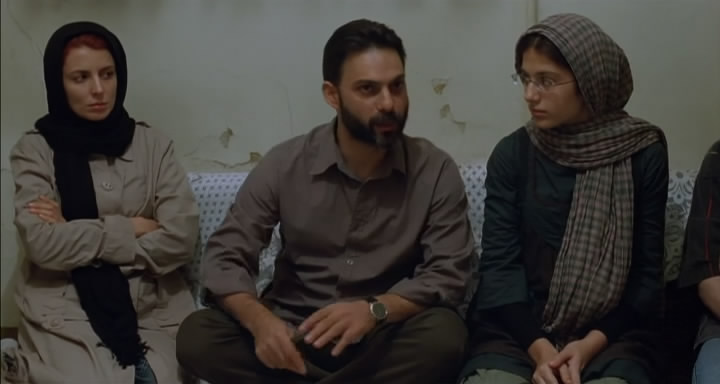
Married couple Nader (Payman Maadi) and Simin (Leila Natami) have petitioned for divorce. Secular Muslims, they want to emigrate to find better opportunities for their teenage daughter Termeh (Sarina Farhadi). Simin wants to leave now – but Nader won’t leave while his aged father (Ali-Ashgar Shahbazi), suffering from Alzheimer’s, is alive. Their only option, under Iranian law, is divorce. However, separation makes it impossible for Nader to care during the day for his father. He hires Razieh (Sareh Bayet), a devout Muslim – but the position causes her a host of problems, from concerns about touching another man (she calls her Imam to ask if she can change the old man’s trousers after an accident), to her worries about what will happen if her husband Hodjat (Shahab Hosseini), a feckless man in and out of prison, finds out she is working for a single man. After Razieh ties  Nader’s father to a bed to keep him safe, she and Nader argue, during which he forces her out of his flat. Razieh then has a miscarriage that night. Did Nader know she was pregnant? If so, he could face prison for murder. Both families find themselves in desperate straits.

A Separation is a superb piece of film-making, deceptively simple in its assembly and shooting, but carrying a huge emotional force as we become invested in the lives of the people it follows. Farhadi never passes moral judgement over his characters. All of them have strong reasons for doing what they are doing, rooted in what’s best for the family. Everyone acts in the way they feel will best protect their loved ones. Arguments become profoundly personal and damaging – but they don’t start out that way. It’s simply a question of things slipping out of control.

That’s not helped by the laws of the Iranian state. Farhadi’s film is very careful to never pass explicit comment on Iran’s laws. But the nature of the regime – and the mood it encourages – is at the heart of all the problems. Tensions are perhaps inevitable between the middle-class and secular Nadar and Simin, and the more working-class and traditional Razieh and Hodjat. This is class and religion in one cocktail, both sides carrying impressions that are nearly impossible to shake off.

But it’s the laws of the state that amplify this: where a man and a wife must go through a demanding pantomime for divorce or a man can be sentenced for murder for the lightest push on the shoulder of a woman who then miscarries. The judge hearing the pre-trial arguments (a very gentle and dignified performance from Babrl Karimi) may be the very soul of reasonableness, but it doesn’t change the fact that the laws he must rigidly uphold continually inflame the situation.

The story is brilliantly constructed, a tightly plotted melodrama that frequently presents new information that forces us to reinterpret what we have seen and heard. It mixes superbly domestic drama and crime procedural, and frequently only the audience has the complete picture of everything that has happened. Key arguments – the loss of money, Razieh’s unexplained absence from her duties, the difficulties of keeping Nadar’s father safe – are shown to us from every angle. But still, we understand the very natural – and human – reactions that people who do not have all the facts, as we have, make. Perhaps it’s the constant stress of simply living – magnified in a crowded and difficult city like Tehran – that seem to put every character on a knife-edge, terrified that a wrong step could land them in a host of trouble.

But that’s the power of Farhadi’s film-making – he invests every shot with sympathy and empathy. He wants us to understand everyone. It would be easy to make Hodjat exactly the sort of chippy, argumentative, working-class figure Nadar clearly thinks he is – but we also see his desperation, poverty, shame at not being able to provide for his family. Simin is easy to see as a woman trying to escape to live her own life – but she is also willing to cause collateral damage to the rest of her family. Nadar is the picture of a more liberal Iranian – but he also refuses to listen to people and is selfish in equating what he wants with what everyone else should want. There are no easy moral choices here – and no clear “heroes and baddies” for us to invest in.

The film reminds us that on every side of a dispute there are real people, with real concerns. And that the collateral damage can be just as bad. Nadar’s father is left even more catatonic than he was at the film’s start. Nadar and Simin’s daughter Termeh becomes consumed with guilt and disillusionment over the moral compromises her parents are forced to make. Her distress plays constantly at the edges of scenes – and even her morals eventually end up compromised – only coming fully into focus with Farhadi’s heartbreakingly open-ended conclusion.

The acting is superb. Payman Maadi is harassed and desperate under a veneer of controlled reason. Leila Natami plays a modern career woman, compromising herself every day, with great power and intensity. Sareh Bayet’s vulnerability is matched only with her profound sense that she cannot compromise her morals, in a performance that brilliantly mixes fear, resentment, warmth and anger. Shahab Hosseini superbly brings to a life a loud, brash man who is secretly profoundly weak, scared and trapped. There isn’t a wrong note in the entire cast, and Farhadi’s patient and intimate direction and shooting allows each of them to bring their characters superbly to life.

This is a brilliant film which shows an intriguing – but sensitive – insight into life in Iran. But it most strongly demonstrates how human we all are. Everyone in the film is doing what they feel is best for their family – be that trying to hold them together, forcing the issue of emigration, earning money from work, or suing for compensation for the loss of a child. It’s a glorious reminder of how our lives can be altered by circumstances, and our intentions drastically different from their impact.

The Trial of the Chicago 7 (2020)

Sacha Baron Cohen leads a campaign for justice in Aaron Sorkin’s The Trial of the Chicago 7

Director: Aaron Sorkin

Cast: Eddie Redmayne (Tom Hayden), Sacha Baron Cohen (Abbie Hoffman), Joseph Gordon-Levitt (Richard Schultz), Mark Rylance (William Kunstler), Yahya Abdul-Mateen II (Bobby Seale), Michael Keaton (Ramsey Clark), Frank Langella (Judge Julius Hoffman), John Carroll Lynch (David Dellinger), JC MacKenzie (Tom Foran), Alex Sharp (Rennie Davis), Ben Shenkman (Leonard Weinglass), Jeremy Strong (Jerry Rubin), Kelvin Harrison Jnr (Fred Hampton), Noah Robbins (Lee Weiner), Daniel Flaherty (John Froines), Caitlin Fitzgerald (Daphne O’Connor)

Aaron Sorkin’s work celebrates the great liberal possibilities of America. Is there any writer who has more faith in the institutions of the American state – while being so doubtful of many of the actual people running those institutions? You can imagine Sorkin sees more than a bit of himself in Abbie Hoffman, jocular prankster and wordsmith, angry at his country in the way only someone who really loves it can be. This idea is at the heart of Sorkin’s biopic of the trial of seven activists for promoting violence in the build-up to the Democratic convention of 1968 in Chicago.

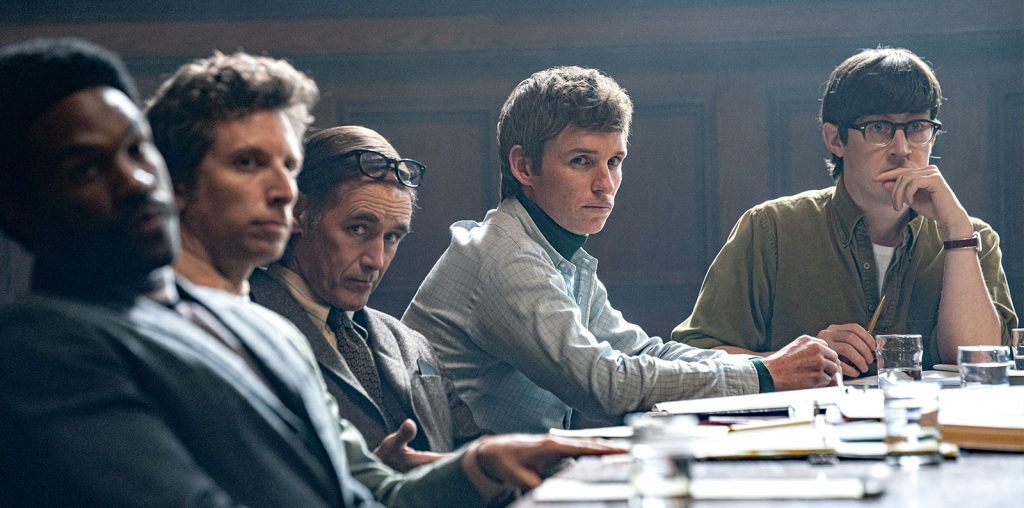
Vietnam is in full swing with young men dying in their thousands to defend a cause many are starting to believe isn’t worth it. Nixon has just been elected – and his government wants to make an example of these left-wing, hippies he believes are drowning out “the silent majority”. Student leaders Tom Hayden (Eddie Redmayne) and Rennie Davis (Alex Sharp), hippie activists Abbie Hoffman (Sacha Baron Cohen) and Jerry Rubin (Jeremy Strong), and pacifist David Dellinger (John Carroll Lynch) are arraigned in court for conspiracy to incite a riot, facing a ten year prison sentence. Black Panther Bobby Seale (Yahya Abdul-Mateen II), who wasn’t in Chicago at the time, is thrown in to make them look more threatening. With radical lawyer William Kunstler (Mark Rylance) in their corner, the defendants deal with a slanted case from the government, being backed all the way by the judge Julius Hoffman (Frank Langella) who can’t hide his contempt for them.

The Trial of the Chicago 7 feels like it’s on the cusp of making a grand statement about the rights and liberties of Americans, at a time of great civil unrest. With the country more divided now than it’s  ever been since the events of the film, this should be a timely message. But somehow the film doesn’t quite manage to deliver it. There is too much going on – an attempt to cover divisions in the left and counter-culture, the events in Chicago in 1968, the trial, clashes outside of court – it’s almost as if Sorkin the director has failed to marshal Sorkin the writer into making a clear and coherent thematic point. Instead the film becomes a chronicle of shocking courtroom events, affecting, but not as earth-shaking as it should be.

Part of this is the fragmented script. An occasional device is used, whereby Hoffman turns the events of the trial into a lively stand-up routine at some unspecified future point. This is a pretty neat idea as a framing device – however it only pops up at odd moments rather than giving a spine to the film (as well as missing the chance to filter events through the perception of one member of its sprawling cast). You end up thinking it’s just Sorkin the writer coming up with a way of giving us information Sorkin the director can’t work out how to do visually.

This tends to affect a lot of the stuff outside of the courtroom. Sorkin’s dialogue is surprisingly plodding here, too often ticking the boxes or establishing backstory and motivation that will play out later. He has his moments and his gift for capturing revealing details make for brilliantly inspired speeches and dialogue riffs that reveal acres of character while feeling very light. But, considering what he is capable with (and could have done with this material) it feels like autopilot.

That’s the problem here: it’s a little too pedestrian. Only an argument between frustrated liberal Hayden and his lawyer Kuntsler captures something of the dynamic pace of Sorkin at his best. Other scenes – such as an out of courtroom scene between decent just-doing-my-job prosecutor Richard Schulz (a low-key but very good Gordon-Levitt) and Hoffman and Rudin – are a little too on-the-nose in making their points about liberty, truth and justice. 

The strongest moments by far are in the courtroom – and the true-life staggering lack of proper procedure followed there. The film is rightly angry, without tipping too much into outright preaching. It’s shocking to see how little the rights of the defendants were respected. Much of this came from the attitude of the judge, Julius Hoffman: a traditionalist, his contempt for the defendants clear throughout, handing out contempt of court charges like sweeties. Frank Langella stands out as a man so convinced of his own morality – and so locked into his own certainty about right and wrong – that he is completely unaware many of his rulings are biased and is deeply hurt at being accused of racial imbalance, while having the only black defendant literally bound and gagged.

Yahya Abdul-Mateen II is superb as Bobby Searle, the Black Panther leader furious at being roped into the trial. Searle loudly – and vigorously – protests the trial has not been delayed to allow his lawyer to attend and that he has been refused (consistently) by the judge his right to represent himself. The treatment of him is shocking and appalling. But it feels like no attempt is made to put this in wider context either of civil rights at the time or in America since. And that feels like a major miss. We’re only a few degrees from the same effectively happening today.

This is part of the film’s general problem in finding its real focus, or wider context. I suspect its heart is probably in the views expressed by Hoffman on the stand – particularly those around not having his thoughts on trial before – but this film is too scatter-gun.

What the film does do well is with the quality of its performances. Sorkin may be a rather a visually flat director – his shooting of the convention riots completely fails to conceal the lack of budget – but he encourages great work from actors. Redmayne and Cohen give skilled performances as the acceptable and radical faces of left-wing politics. Strong is wonderful as a hippie with a firm sense of right and wrong, while Carroll Lynch is great as a pacifist driven to the edge. Mark Rylance excels as radical lawyer Kunstler, softly spoken but passionate, who brings fire to proceedings.

It’s a shame though that The Trial of the Chicago 7 settles for mostly being a walk-through of the trial. An attempt to really capture a sense of the deeper politics gets lost, and the failure of the film to really draw parallels with today or place these events in their wider context feels like a missed opportunity. Even the film’s end captions don’t give you as much information as you would hope – especially telling considering its abrupt ending. A well-meaning effort, but a middle-brow film.

JFK (1991)

Kevin Costner goes on a quest for the truth in Oliver Stone’s crazy but brilliant JFK

Director: Oliver Stone

Cast: Kevin Costner (Jim Garrison), Sissy Spacek (Liz Garrison), Kevin Bacon (Willie O’Keefe), Tommy Lee Jones (Clay Shaw), Jack Lemmon (Jack Martin), Walter Matthau (Senator Russell B Long), Gary Oldman (Lee Harvey Oswald), Joe Pesci (David Ferrie), Donald Sutherland (Colonel X), Laurie Metcalf (Susie Cox), Michael Rooker (Bill Broussard), Jay O. Sanders (Lou Ivan), Edward Asner (Guy Banister), Brian Doyle-Murray (Guy Banister), John Candy (Dean Andrews), Sally Kirkland (Rose Cheramie), Wayne Knight (Numa Bertel), Priutt Taylor Vince (Lee Bowers), Tony Plana (Carlos Bringuier)

When great events happen, it’s hard for us to accept they might take place for random reasons. Rather than freak occurrences or boring individuals, we’d rather see them taking place due to an impenetrable web of shadowy figures. There is something in us that rejects randomness and embraces order. Conspiracy theories are the (ironic) result of these, with their exponents often the most passionate believers in the all-pervading genius of big government. Events like the death of President Kennedy can’t be because some nobody shot him. Instead it must be part of a wider junta of baddies, with every man you see merely a front for a cabal of the wicked. It’s hard not to be swept up by the lure of the conspiracy theories (they invariably have the best stories after all) – and Oliver Stone’s JFK is perhaps the definitive mainstream conspiracy theory essay.

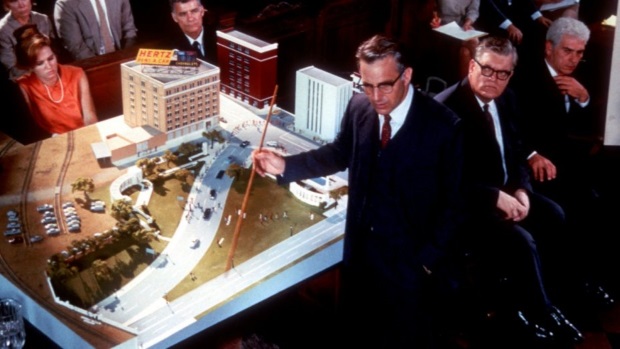
Taking the campaign of Louisiana DA Jim Garrison (Kevin Costner) to find out the “truth” about the murder of President Kennedy, Stone’s film is part a fascinating presentation of half-truths and “might-have-beens” and part a sprawling mess of irresponsible nonsense. Either way it’s assembled with astonishing panache, a level of filmic skill that makes it (literally) almost impossible to tell whether what you are seeing is true and what is invention. Stone’s film superbly interweaves a variety of film stocks and effects to seamlessly splice together newsreel footage, Zapruder film and his own reconstructions so brilliantly it frequently becomes hard to tell which is which.

The same logic also applies to the script. JFK is frequently engaging and fascinating. But you have to remember that it is the equivalent of meeting the most literate and articulate street corner “End-of-the-Worlder”. Such is Stone’s skill he could, I am sure, have created an equally compelling film which would have you questioning the Moon Landings or the shape of the Earth. JFK throws an army of questions, objections and theories at the screen. And while it rarely provides much in the way of answers, only points that it wants you to think about, these theories frequently fascinate. Imagine JFK as a sort of video essay, linked together with dramatic scenes, with its points delivered by authoritative and trusted actors like Donald Sutherland, Jack Lemmon and Walter Matthau.

There is absolutely no doubting the technique of Stone here, or his mastery of the language of cinema. The work of Robert Richardson’s photography, with its myriad styles, and of Joe Hutshing and Pietro Scalia’s editing, pulling together a host of images, snapshots and flash cuts into an insidiously convincing whole, is breathtaking. Light in particular is superbly used, casting some characters in shadow, flaring up to (literally) blind others – light frequently plays across Garrison’s glasses, a visual metaphor for his own struggle to see the light. The speeches he writes for his characters are superbly done, and make their points with great skill – Sutherland (superb) has a hugely convincing story of military black ops action (and inaction) before and after the assassination that fills almost 20 minutes of screentime.

There are compelling arguments made about the ability of Oswald to fire the shots, the triangulation of fire, the spurning of an easier shot before the fateful turn, Oswald’s seemingly illogical movements after the shooting etc. etc. There is decent reasoning behind all of this, and the points are marshalled very well. But, like all extremist theories, suddenly it will turn into something just a little batshit (Lyndon B Johnson ordering the hit or some sort of cabal of Cubans, CIA, FBI and Secret Service working together to conduct a coup).

Much of Stone’s passion for finding the truth (the film’s mantra) is rooted in his own romantic view of Kennedy, as some sort of lost “Prince Who Was Promised”. To Stone, Kennedy would have withdrawn us from Vietnam (news I am sure to the President who started and escalated America’s involvement in it), ended the military industrial complex (contrary to his platform when elected of a stronger US military), bought the Cold War to an end (again, running against his sustained opposition to the Soviet Union) and introduced full Civil Rights (a cause he was lukewarm on at best – unlike his brother or his successor Johnson).

But Kennedy was a romantic figure who had the ability to invite people to invest him with whatever qualities they wanted (both good and bad), a magic cemented forever by his untimely murder. In reality there is no indication that JFK would do (or want to do) any of the things JFK argues he was assassinated for. But that’s all part of the magic of the conspiracy. Facts and events can be marshalled into whatever you want them to be. (Tellingly the only member of Garrison’s investigative team who questions these theories is shown to be a creep in the pay of the conspirators.)

So Kennedy can be a saint, and the film can outline (with no evidence at all beyond a series of coincidences and unlikely or random events) a grand vision of master schemers reshaping America over the body of a dead President. Does it really stand up? Well no of course not. But I will say it is compelling viewing – even if it is essential to keep an open mind about it. Stone later wished he had made clearer that much of the work here was pure fiction (and speculative at best). Certainly it’s a point to keep in mind.

Perhaps Stone should also have looked again at some of the other beats in the film. The film’s version of Jim Garrison as a kind of saintly campaigner for justice flies in the face of many (then and later) who believed the Louisiana DA a shameless self-promoter – an argument made easier to believe by the real Garrison’s cheeky cameo in the film as his ‘nemesis’ Earl Warren. No mention is made in the film that the case he brings against Clay Shaw was dismissed by the jury after less than an hour, and the film avoids explicitly showing his lack of evidence. Costner delivers the final speech, with its famous “back and to the left” commentary on what seems like Kennedy’s unnatural movement after being hit by a bullet and breakdown of the “magic bullet” (both theories now largely discredited), with aplomb, but the film puts a halo on Garrison which doesn’t really stand up.

But again at least it’s entertaining. Other parts of the film don’t even manage that: the baseline narrative that links up the various compelling conspiracy lectures is frequently dull, insipid and lamely written. Sissy Spacek has perhaps the most thankless role in film history as Garrison’s wife whose nearly every line is a variation on “Honey please stop reading the Warren Report and come to bed”. Even that though pales against the exploration of the 1960s gay scene in Louisiana (which Clay Shaw and his “fellow conspirators” were leading members of) which has an unpleasant stink of homophobia, playing into a host of deeply unpleasant (and false) stereotypes of gay people as perverted, promiscuous and preying on the straight. One suspects there was more than a little truth in the idea that Garrison’s fury at Shaw was at least partly motivated by homophobia.

These sequences work considerably less well today – and frequently go on far too long – but when the film focuses on its Kennedy theories it is at least compelling, even if it’s all rubbish. The film made it mainstream to believe Kennedy was killed by a conspiracy in which Oswald was, if he was involved at all, only a patsy. How different would the world have been if Oswald had lived and been made to explain why and how he killed Kennedy? But then chances are, being such an average an unremarkable man, people wouldn’t have believed him anyway.

Stone’s film is a triumph of agenda-led fantasy. Stuffed with faults it makes you at least ask questions – even if you wisely use those questions to affirm many of its points are questionable at best. But any film buff will love the skill it’s told with and the beauty of its technical assembly. Costner was perhaps a little too bland to drive the thing along (although the film uses his innate morality very well), but there are several good performances not least from Gary Oldman who is brilliant as put-upon, used but unknowable Oswald. Nuts, crazy and packed with compelling nonsense, it at least always encourages you to find out more about the actual history.

Amistad (1997)

Djimon Hounsou excels as a slave longing for freedom in Amistad

Director: Steven Spielberg

Cast: Djimon Hounsou (Sengbe Pieh/Joseph Cinqué), Matthew McConaughey (Roger Sherman Baldwin), Anthony Hopkins (John Quincy Adams), Morgan Freeman (Theodore Joadson), Nigel Hawthorne (President Martin van Buren), David Paymer (John Forsythe), Pete Postlethwaite (William S Holabird), Stellan Skarsgård (Lewis Tappen), Razaaq Adoti (Yamba), Abu Bakaar Fofanah (Fala), Anna Paquin (Isabella II), Chiwetel Ejiofor (James Covey), Peter Firth (Captain Fitzgerald), Jeremy Northam (Judge Coglin), Xander Berkeley (Ledger Hammond), Arliss Howard (John C Calhoun)

After the American Revolution, independence left one issue in America that would profoundly split the country: slavery. This was a land divided, between abolitionists and plantation owners, the more emancipation-minded North and slave states of the South. Slavery was – and remains – the ugly stain on the American soul. Steven Spielberg’s film uses a significant court case of its day to shine a light on these contrasting and conflicting priorities in American society throughout much of the early 19th century, that would eventually lead to civil war.

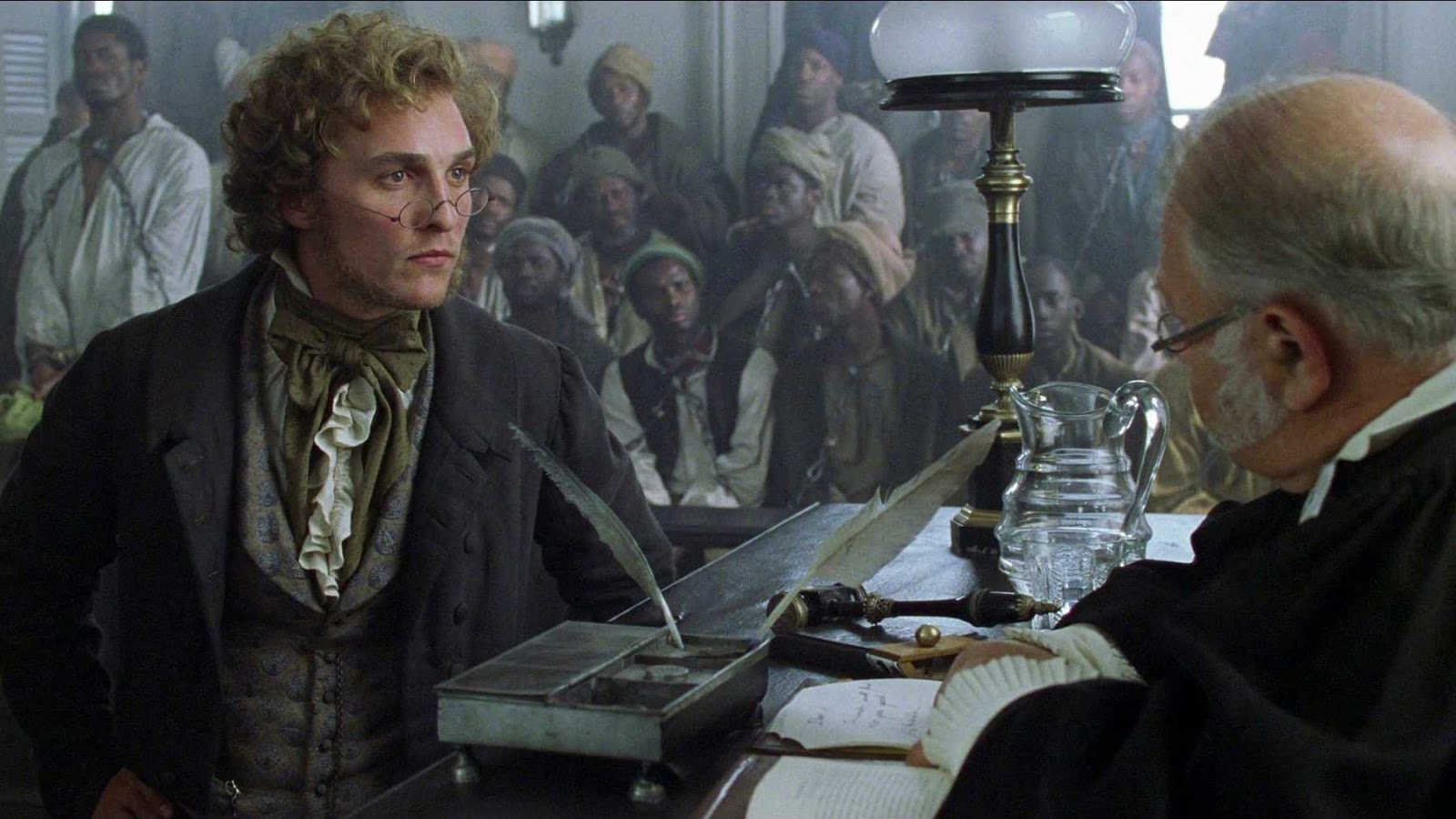
The film tells the true story of the slave revolt on the Spanish slaver ship Amistad. Here the slaves, led by Joseph Cinqué (Djimon Hounsou) escaped captivity, rose up and killed most of the crew (leaving just two men alive to sail the ship) and tried to return to their home in Sierra Leone. Arrested by an American naval ship while collecting fresh water, the slaves are transported to Connecticut where they find themselves on trial as escaped slaves, facing charges of piracy and murder. Their cause is taken up by Northern abolitionists Lewis Tappen (Stellan Skarsgård) and his black associate Theodore Joadson (Morgan Freeman), and their lawyer Roger Sherman Baldwin (Matthew McConaughey) a property lawyer. However, the case’s international implications for slavery attracts the concern of President Martin van Buren (Nigel Hawthorne), eager to support the prosecution, while former President John Quincy Adams (Anthony Hopkins), a lawyer and opponent of slavery, offers his advice to the defence.

Spielberg’s film has just the right balance of human interest and humanitarian concern to overcome its slight air of a civics lesson. Although largely a courtroom drama, what the film is really trying to do is capture in one moment the troubling contradiction of the land of the free built on slaves, and give a voice and empathy to the slaves themselves. 

Although some have criticised this as a “white saviour” film, I feel that’s unfair. This is a film that starts and ends with Cinqué’s story and filters America through his perception. We can well understand why he rages at his lack of comprehension of laws that can be adjusted, court decisions overturned or how words can be twisted to take on other meanings. A film front and centred, say, by Matthew McConaughey’s Baldwin and focusing on journey from seeing this as just another case into a crusade would be a white saviour film. Instead the white characters drop in and out of the story as the narrative requires, and it’s the struggles and courage of the black characters that form the heart of the narrative.

Spielberg also brings to life the cruelty and inhumanity of slavery and what it does to all of us. The film opens with the confined, appalling conditions of the slave ship while Cinqué (with hands running with blood) tries to release a nail from the wood which he will use to free himself from his chains. The film intriguingly opens without the African characters being translated – giving us a sense of their isolation and perhaps also stressing how different they are from the Western “civilisation” that has taken them from their homes. 

It isn’t until half way through the film, until a translator is found for Cinqué, that the film gives us the backstory that Cinqué has struggled to communicate. Spielberg spares no punches in showing the violence of abduction, the brutality and casual slaughter of the slavers, the starvations, the floggings that end in blood sprayed death, the cramped conditions practically designed to weed out the weak. A mother chooses drowning for herself and her child rather than life on the ship. Later the slavers chain unwanted slaves to a bag of rocks and cast them overboard to reduce their cargo load. If there was any doubt about the heart-rending evil behind slavery, it’s removed from your mind.

It also serves to hammer home the injustice of America’s own system. Under political pressure – van Buren is worried about the reaction of both Spain and the Southern States to the Africans being found innocent – the trial encounters interference and appeals every step of the way. It’s a system that prides itself on being the greatest in the world, but shows time and time again how it can be weighted against the weakest. The courtroom scenes – skilfully directed and played – show time and time lawyers valuing obscure property laws above right and wrong. And we are brought time and time again to the reactions and lack of understanding of the African characters, who come from a society where there is no equivocation and no words equivalent to “usually” or “perhaps”.

The film perhaps does take a little too long over its various legal machinations, and could do with losing a few minutes here and there. But that would be to sacrifice its many strengths. Looking wonderful, with a marvellous score by John Williams (riffing on the American pipes and African tribal influences), one of the strongest acting companies Spielberg ever assembled does outstanding work. Carrying much of the film is Djimon Hounsou, who makes Cinqué anything but a victim – he is a proud, defiant and intelligent man, humble enough about his qualities but quick to act to defend his rights. Uncowed but infuriated by the situation he finds himself in, he is never a passenger but at all times a key figure in his own liberation, even if his legal case must be fought by whites.

McConaughey enjoys himself under a bad wig, glasses and dirty teeth as the lawyer Baldwin, ambitious but with more than an air of decency. Postlethwaite is at his quietly authoritative best as his opposition counsel. Freeman lends the film a large part of his grace and dignity in a small, observant part of the freed-slave turned abolitionist, with Skarsgård more political as his white colleague. Hawthorne makes a van Buren a slightly flustered, impatient figure. Peter Firth demonstrates a great contempt for slavery behind an imperious exterior.

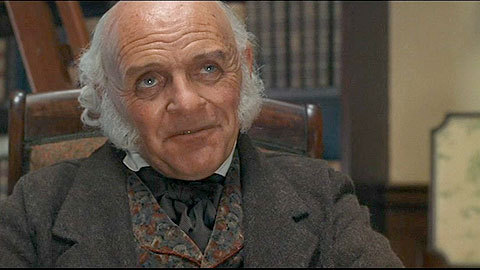
The film’s highlight performance though is Hopkins’ Oscar-nominated turn as John Quincy Adams. Adjusting his physicality to match the ageing ex-President, Hopkins captures his slightly nasal Massachusetts twang and adds a significant amount of twinkly charm and wry shrewdness to this adept political operator. A large chunk of the film’s final 20 minutes is given over to Hopkins, with the highlight a long monologue of Adams speech to the Supreme Court (in actuality a speech over eight hours in length!), that is a tour-de-force of skilled showmanship. It’s Hopkins’ last great performance of the 1990s. 

Spielberg’s Amistad is a superb courtroom drama but also a heartfelt condemnation of the inhumanity man can show to man. It never forgets either that while this was a victory, it was only a skirmish not the war. While the film at times overplays the inevitability of Civil War (which did not exactly start over this issue), it skilfully shows the divide in the American culture between abolition and slavery – and how many felt for the first cause, but feared the supporters of the second so much they would rather not address it. Either way, Amistad may at times be a little dry – but that gives its moments of emotion even more force.

Paths of Glory (1957)

Kirk Douglas leads men into pointless battle in Kubrick’s Paths of Glory

Director: Stanley Kubrick

Cast: Kirk Douglas (Colonel Dax), Ralph Meeker (Cpl Philippe Paris), Adolphe Menjou (Major General Georges Broulard), George Macready (Brigadier General Paul Mireau), Wayne Morris (Lt Roget), Richard Anderson (Major Saint-Auban), Joe Turkel (Pvt Pierre Arnaud), Timothy Carey (Pvt  Maurice Ferol), Emile Meyer (Father Duprée), Bert Freed (Sgt Boulanger), Susanne Christian (German singer)

Kubrick’s fourth film is one that often gets overlooked when running over his CV – and it’s had less cultural impact than, say, A Clockwork Orange, 2001 or The Shining – but out of all of his films (except maybe The Shining) it’s the one I’ve come back to the most often, and is certainly his first stone-cold classic. This Word War One tragedy simmers with anti-war sentiment, and it’s so beautifully made and assembled you can see its influence in films right up to 1917.

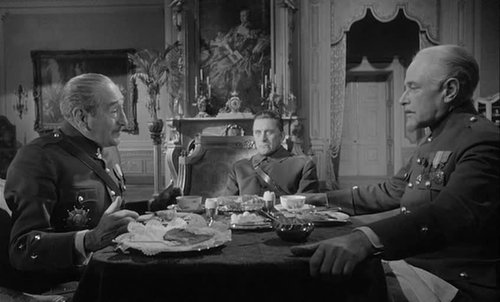
In 1916 the war is bogged down into trench warfare. Command wants results, an action they can point to, so General Broulard (Adolphe Menjou) is sent by the General Staff to instruct General Mireau (George Macready) to launch an attack on a well defended German position called “the Anthill”. Mireau says any attack would be suicide – until the prospect of his promotion being directly linked to it is mentioned, at which point he becomes the attack’s most passionate advocate. Mireau passes the order onto regiment commander Colonel Dax (Kirk Douglas), who protests that the attack is pointless, but is ordered to lead it or be relieved of his command. The attack is a costly farce, and the humiliated Mireau (with Broulard’s tacit agreement) demands a blood sacrifice – one man from each company will be placed on trial for cowardice and shot as an example for the whole French army. Dax deplores this injustice – but with the administrative meat-grinder as deadly as the one on the front, what hope does he have?

Kubrick believed passionately in the project but also needed a commercial hit in order to bolster his career. So he recruited Kirk Douglas to get the funding – Douglas took a third of the film’s budget as his salary, so it wasn’t all charity – and he rewrote the ending of the book to allow Dax to come up with a last minute solution to get the soldiers off. Douglas, to his credit, was having none of that and demanded a rewrite that restored the book’s original bleak ending. 

So it’s largely thanks to Douglas we get the shape of the film that we end up with – but it’s clear that it’s Kubrick’s genius that makes it the film it is. Actor and director were a perfect combination here, so much so that Douglas got Kubrick on board to direct Spartacus (an unhappy experience for them both). But Paths of Glory was where both actor and director were working in perfect partnership, both pushing the other to give of their very best. Dax is the perfect Douglas role – decent, intelligent, well-spoken, passionate, a natural leader, but the film undermines all this with his ineffectiveness. Each of his crusades goes wrong, and he fails at every goal he sets himself. Douglas brilliantly captures both sides of this in his generously low-key but committed performance.

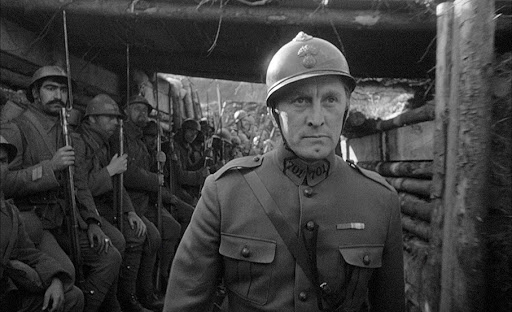
He has a great framework of a film around him from Kubrick. The director uses several longs shots, extended takes and tracking shots to throw us into the world. The opening sequences at the military HQ, taking in the palatial setting of Mireau’s campaign office, have a stately construction and technical formality which then contrasts superbly with the lower angle, tracking shot-laden, POV sequences set in the trenches. Kubrick’s camera glides through these trenches, low angles seeming to make them tower over the viewer, the mud and filth only worse in the body-strewn no-man’s land that stands between the French and the Germans.

It culminates in the attack sequence, one of the greatest battle sequences ever placed on film. Following the doomed advance at a methodical pace, matching the speed of the soldiers, the camera tracks over no man’s land as explosions rend the ground and bodies are thrown to the mud under a hail of bullets. At the front is Dax, vainly blowing on his whistle and encouraging the men forward, while all around him devastation and slaughter win out. Any thought that this wasn’t a pointless enterprise from start to finish is completely dispelled, and our sympathies are completely with Dax and the soldiers, whose lives are superfluous to the ambitions of the generals.

Both generals cut appalling figures for different reasons. Mireau, played with a trumpeting, vain bombast by Macready, is a “blood and guts” soldier who never places his own blood and guts anywhere near the line. Proudly bragging about the skills of his soldiers, then furiously denouncing their cowardice, one telling shot has him in the trenches staring through binoculars at the German positions, oblivious to the wounded men filing past him. Later he orders the shelling of these very trenches in fury at their failure to advance far enough. Broulard is hardly better, Menjou’s “hail well met” bluster hiding a chilling lack of empathy.

The Germans are never seen, because the real enemies here are war itself (and we are kidding ourselves if the same thing wasn’t happening on the other side) and the authorities who push us into it. The film is almost like some sort of black satire, with the generals confidently telling their soldiers they are right behind them, before retreating several miles to the rear to watch the battle unfold. Dax is middle-management, caught between trying his best to deliver orders he knows are impossible, and protecting men he knows are doomed, and failing at both tasks.

The system demands blood sacrifices from the lowest possible rungs, so the hierarchy can reassure themselves they are not blamed (Dax’s offer to take all the blame is promptly rejected by Broulard – no question of any of the officers being at fault!), so the men are chosen by their company commanders. One is chosen by lottery (he of course is a decorated war hero, but that cuts no ice), one because he’s an “undesirable” and the third because he has witnessed his own commanding officer’s cowardice. None of them deserve it, but their guilt is “proved” in a kangaroo court that lasts less than 15 minutes, and in which Dax is barely allowed to put a defence case.

Kubrick’s film becomes a surprisingly fast (it’s less than 90 minutes) but inexorable march towards those three stakes in the ground and the firing squad. Questions of justice and courage are completely pointless – any brave acts in the film are pointless, two of the victims are cited for their courage and the most cowardly character in the film, Wayne Morris’ snivelling Lt Rouget, ends up commanding the firing squad – and the message we are left with is that the institution of war and man are the real villains here.

War has no heroes, only survivors. Victories are important to the generals only in the sense of being tools to jockey for position, and the common soldier is an expendable puppet who can be killed on a whim to fill any political reason. It’s a harsh and chilling view of the military – and leaves very little hope – but it’s superbly made and controlled by Kubrick, in a film surprisingly with more heart in it than any film he ever made before or since. It’s a film that leaks with sorrow and disgust at the victims of the military machine, a film with emotion as well as a technical marvel. It might be Kubrick’s most complete film.

Adam's Rib (1949)

Spencer Tracy and Katharine Hepburn go toe-to-toe in court and marriage in Adam’s Rib

Director: George Cukor

Cast: Spencer Tracy (Adam Bonner), Katharine Hepburn (Amanda Bonner), Judy Holliday (Doris Attinger), Tom Ewell (Warren Attinger), David Wayne (Kip Lurie), Jean Hagen (Beryl Caighn), Hope Emerson (Olympia La Pere)

He’s a tough-on-crime DA. She’s a top liberal lawyer with a feminist agenda. So when Doris Attinger (Judy Holliday) is arrested for firing a gun at her philandering husband Warren (Tom Ewell) and his lover Beryl (Jean Hagen), naturally Adam (Spencer Tracy) and Amanda Bonner (Katharine Hepburn) end up on opposite sides of the court case in this witty “battle of the sexes” married life comedy.

Directed with unfussy calmness by George Cukor who, as he often does, hires the best actors, points the camera and lets them get on with it, Adam’s Rib is an enjoyable and fascinating watch, partly ahead of its time in its gender politics, partly relic of another era. It completely accepts the idea that a woman can be a successful, skilful lawyer – the idea isn’t even questioned – while still bemoaning the march of militant feminism. After all even the title is a humourous little reminder of where Eve came from.

The plot revolves around Amanda’s belief that a man firing a gun at a cheating wife would get very different treatment from a woman doing the same: that he would be seen as a man protecting his home, while the woman is a neurotic danger. Adam disagrees strongly with this – a crime is a crime – and to be honest he’s probably right (today Doris would almost certainly go down for actual bodily harm, if not attempted murder). But in the 1940s, this issue gets tied up with women starting to push against the idea that their role was just to follow the man’s lead and not threaten to shake up his existence. And that’s exactly contrary to what happens in this film.

Amanda is played by force-of-nature Katharine Hepburn at her most quick-witted and sharp, a lawyer more successful in many ways than her husband (and by being in private practice, probably the main bread winner as well, although that is never stated). Her place in the court is never questioned, which is interesting in itself in the post-war era where the idea of women in the professional world was just beginning to be seen as a possibility (although lord knows there was still decades to go until it was to be seen as completely normal).

It’s not a position that Adam questions. His main problems are more with the law being used as a tool for a very specific agenda, rather than a feeling that women are crowding into his realm. Played with brusque stuffiness and uncomfortable formality that tips over into moral outrage by Spencer Tracy (again showing his natural gift for both acting and reacting), Adam feels that his belief in the law is being damaged by Amanda’s use of Judy’s case as a political tool for women’s rights, rather than being judged on its actual merits. 

So this becomes the spring board for a series of extremely well-acted (and frequently funny) arguments between this tempestuous couple as the court case turns from a flirtatious rivalry into an increasingly bitter one. These ding-dong battles work so well on screen because of the immense chemistry between Tracy and Hepburn, a couple so devoted in real life that they convey this even when really going at each other on screen. 

Mix that in with an obvious sexual chemistry between them (and this film is remarkably open about sex, by my count the camera cuts to black to imply sex at least three times in this movie – and the couple have separate beds in their bedroom as per the Hays Code, but only one sees the sheets disturbed by sleeping!) and you’ve got an entertaining show. The courtroom antics are frequently both dynamic and entertaining, and the perspectives of both Adam and Amanda carry force – yes women are treated differently by the law, but you surely can’t deny that Doris broke that law.

There isn’t much room for the rest of the cast apart from the barnstorming Tracy-Hepburn show, with the two seasoned performers tearing through the screen. Judy Holliday comes off best in the second-string as the woman on trial, suggesting enough hypocrisy and two-facedness under the surface of her butter-wouldn’t-melt sweetness. Holliday was also helped by Hepburn’s generous insistence that she be made the focus of their scenes together – Hepburn being keen to help Holliday land the leading role in the film Born Yesterday, the play of which made Holliday’s name on Broadway (it worked and Holliday won the Oscar the next year). 

Of the rest, there is a neat, naughty little cameo from Jean Hagen as the other woman, though Tom Ewell mugs as the husband. David Wayne meanwhile plays the Bonners’ next door neighbour, a supremely irritating musician, smug and trying, but whom we’re meant to think of as a witty, eccentric “character”.

The latter half of the film starts to tip a little bit, as Adam has of course to end with the upper hand (he is after all the man!) which he does using underhand tactics and an actually rather unpleasant business with a fake gun (the sort of trick that you imagine if Tracy had pulled in real life, Hepburn would have walked out of the door and never come back). But this is still a film with plenty of top gags and a refreshing look at a marriage where both participants are professional equals and which goes quietly some way in arguing for greater rights for women, before retreating back to its more conservative resolution. Still great entertainment – and Tracy and Hepburn are both at the top of their games here.