Category: Crime drama

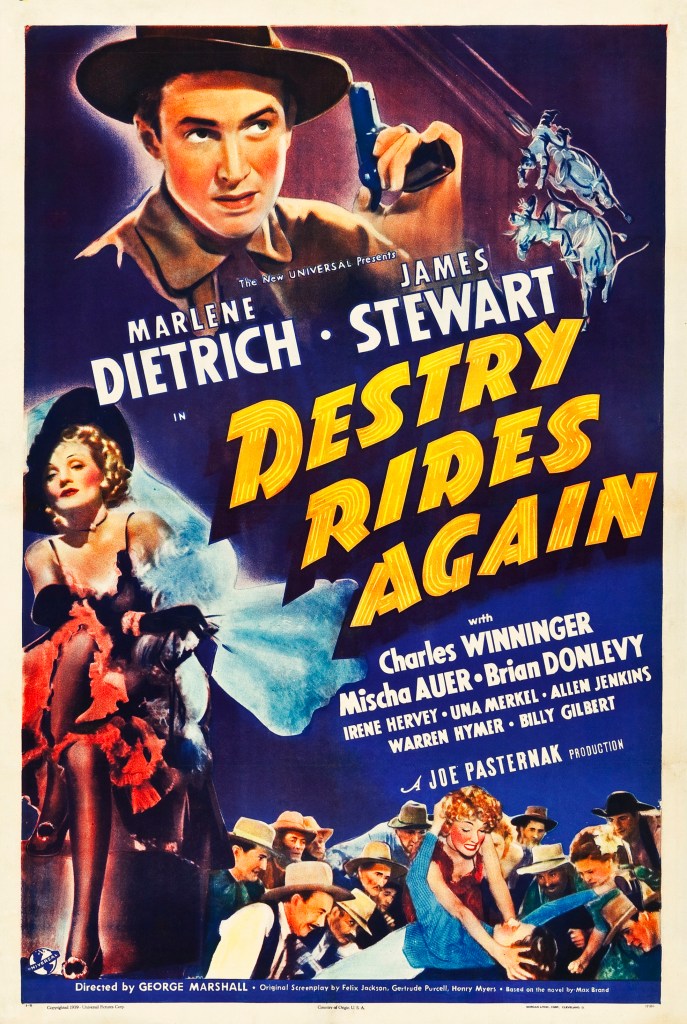
Destry Rides Again (1939)

Destry Rides Again (1939)

A gun-shy sheriff needs to clean up this town in this delightfully funny semi-comedy Western

Director: George Marshall

Cast: Marlene Dietrich (Frenchy), James Stewart (Tom Destry Jnr), Mischa Auer (Boris), Charles Winninger (Washington Dimsdale), Brian Donlevy (Kent), Allen Jenkins (Gyp Watson), Warren Hymer (Bugs Watson), Irene Hervey (Janice Tyndall), Una Merkel (Lily Belle), Billy Gilbert (Loupgerou), Samuel S Hinds (Mayor Hiram J Slade), Jack Carson (Jack Tyndall)

There’s a new deputy sheriff in town! Son of a wild-shooting, hard-as-nails lawman, Tom Destry Jnr (James Stewart) is surely the man to bring justice to Bottleneck. Or at least that’s what everyone thinks until his carriage arrives and out steps an aw shucks slouching drawler, carrying a parasol, who loves a homespun yarn and – worst of all! – doesn’t see the point of carrying guns. Surely, he’ll be a push-over for Kent (Brian Donlevy), the corrupt saloon owner who runs the town? Guess again. Tom will soon change all sorts of minds, not least Kent’s gal, glamourous singer (and card sharp) the improbably accented Frenchy (Marlene Dietrich).

George Marshall’s Destry Rides Again is pretty much a delight from start to finish. It combines rich comedy and Western satire, with genuine sharp-shooting thrills, and showcases a host of actors at the top of their game. It’s crammed with excellent jokes, shrewd observations and some moments of truly affecting tragedy. It’s the finest film Marshall, otherwise a journeyman, directed with confidently handled, crowd-filled set pieces and a wonderful sense of pace.

It’s hard not to fall in love with a man who doesn’t care what people think of him but, when push comes to shove, could beat them all in a game of quick draw. It helps abundantly when he’s played by James Stewart at his most boyish and lovable. Tom is determined to prove the law can be done another way: that escalating things by pulling a firearm only leads to trouble (“You see if I have had a gun there, why, one of us might have got hurt – and it might have been me”). Tom is quick-witted and confident enough to face down crises without a gun – putting him years ahead of the townsfolk who judge everyone by their ability to hit a target.

In fact, Destry Rides Again in its opening hour really commits to the idea of Tom as an ahead-of-his-time pacifist, who thinks through events with the grace of a chess-master. We’re constantly encouraged to delight not only in his smarts – the incriminating traps he lays for all around him, the skilful way he defuses situations – but also respect for his cool and guts (you need to be damn sure of yourself to order a glass of milk in Kent’s no-holds-barred saloon).

Tom eventually of course has to give them a show – his pin-point accuracy with a pistol leaves the town gasping, and a group of would-be trouble-makers lamely muttering how sorry they are to have disturbed the peace – but he’s far too brave to need to prove himself. Real courage is not caring what people think of you, and real smartness is being happy for others to call you a knabby-pabby yellow-belly. After all, they’ll only underestimate you – and make it even more likely Tom’s methodical, law-following approach will yield the right results.

Marshall mines gallons of fish-out-of-water comedy from Tom’s willingness to look the fool. From his arrival at the town clutching the parasol of a fellow passenger – his shoot-first-and-second-think-third fellow passenger Tyndall (Jack Carson) is mistaken for him because he matches the bill of what the town expects – to his passion for whittling napkin rings and his calm aw shucks good humour when handed a mop and told to use that to “clean up this town”. But we are never left with a doubt that Tom is the bravest, smartest, toughest guy in the town – and that he doesn’t need to constantly proof it to himself and others.

It eventually sinks in as well to glamour madam, Frenchy. Marlene Dietrich had not only never appeared in a Western before, she’d been declared “box office poison” just a few months earlier. In the public mind she was associated with glamour, distance and von Sternberg majesty. All that was to change with Destry Rides Again, where she was lusty, earthy but still with a touch of class. Who would have imagined Sternberg’s muse engaging in a no-holds barred cat fight with Una Merkel’s domineering housewife (a brawl that trashes most of the bar)?

Dietrich is quite superb in the role of this enigmatic madam. Her distinctive singing is used liberally throughout the film. Which fits nicely with Frenchy’s role in the town as the glamourous distracting agent for the crimes of Kent (a smugly grinning Brian Donlevy). Not that she’s an innocent: she swipes cards from punters in crooked card games and knows full well Kent sends “out of town” anyone who crosses him. But there is something in Tom she finds intriguing, perhaps because he’s smarter, more interesting and different from any other an in this benighted outlaw stop-off.

It helps as well that there is a clear magnetic attraction between the two. Not to mention between Stewart and Dietrich – it’s no surprise, watching the film, to hear they had a passionate affair during its making. Stewart has never really felt sexier than here with Dietrich, while Stewart helps Dietrich feel warmer and more approachable than she ever did with Sternberg. The dance (literally at one point) between these two, captures in microcosm the struggle for the town’s soul: will Tom win them over, or will the gun-totting baddies?

Marshall doesn’t quite cap the film off as well as you might hope. Eventually, Tom is left no choice but to pick up his guns. The film does present a final shoot out quite unlike anything you’ve ever seen before – ending in a battle-of-the-sexes brawl in the saloon, shot with an immersive comedy. But it doesn’t change the fact that Destry Rides Again can’t in the end square its circle: Tom may preach stern words over violence, but when push comes to shove only guns solve problems.

But you forgive it because this film is a hugely entertaining delight. There are a multitude of delightful supporting roles. Best of all are Mischa Auer is extremely funny as a Russian would-be-deputy who (literally) doesn’t wear the trousers in his marriage and Charles Winninger as the town drunk turned sheriff, who has a secret heart of gold even if he can’t tuck his shirt in (there is a lovely, late, call-back to this mannerism in the film from Tom that is genuinely moving). Destry Rides Again manages to be both a sort of spoof, but also a very real genuine Western, with a near perfect mix of jokes and action. It doesn’t quite manage to deliver on its concept, but it does more than enough.

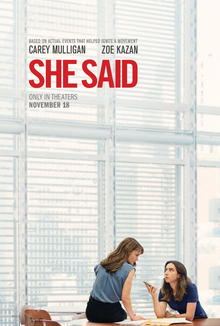
She Said (2022)

She Said (2022)

Earnest, well-meaning but not entirely dramatic recounting of the New York Times investigation into Weinstein

Director: Maria Schrader

Cast: Carey Mulligan (Megan Twohey), Zoe Kazan (Jodi Kantor), Patricia Clarkson (Rebecca Corbett), Andre Braugher (Dean Baquet), Jennifer Ehle (Laura Madden), Samantha Morton (Zelda Perkins), Ashley Judd (Herself), Zach Grenier (Irwn Reiter), Peter Friedman (Lanny Davis), Angela Yeoh (Rowena Chiu)

In 2017, the New York Times published revelations about Miramax kingpin Harvey Weinstein that shocked the world. Weinstein had used his position to force his sexual attentions on anyone from aspiring actresses to employees, with a rap sheet of crimes ranging from gropes to rape. It shook Hollywood to its core. She Said is the dramatization of the investigation carried out by reporters Jodi Kantor (Zoe Kazan) and Megan Twohey (Carey Mulligan) who sought out the victims, won their trust and pushed the story through despite threats of legal action.

She Said is a worthy, well-meaning film. It has moments of genuine power and its recreation of the testimony of the victims is tragic and heart-rending. But yet… I didn’t find it dramatic. I was left wondering, why did this true story of journalistic tenacity not carry the same impact as Spotlight or All the President’s Men?

Perhaps it’s because the film doesn’t really cover this story as an investigation. There isn’t the sense of facts slowly emerging to form a horrifying picture, or one small incident ballooning into an earth-shattering scandal. Instead, Twohey and Kantor are certain they have the basic facts from the start, with the film being instead a reveal of how many cases there are, rather than an expose of a wrong. While this is still important, it isn’t necessarily always dramatic and, eventually, She Said starts to feel every minute of its two-hour-plus run time.

The real focus of the film probably should have been the journalists’ determined work to win the trust of the principal witnesses – in particular Jennifer Ehle’s Laura Madden, whose whole life has been partially in the shadow of Weinstein’s assault in the 90s. Kantor – played with an empathetic richness by Zoe Kazan – worked night and day to encourage these women to bring their stories to the public. Instead, the film gets distracted with trying to cover too much, both the famous and the unknown victims, and the peripheral presence of Rose McGowan, Gwyneth Paltrow and Ashley Judd (playing herself) unbalance the movie away from the difficult, challenging – but more dramatically rewarding – work exploring office workers called into meetings to “massage” their gross boss.

It’s a shame the focus gets pulled away from these unknown women, who were little more than teenagers when Weinstein abused them in the 90s, since the sequences where they tell their stories are the ones that carry the most impact. There are superb cameo appearances from a trio of great actors. Ehle is superb as a woman resigned to trying to put things behind her, Morton brilliant as another prickling with rage and resentment, and Yeoh very good as a woman who never really managed to process her trauma. The careful, respectful, but deeply sad recounting of these women’s experiences by this trio are the film’s highlights.

Too much of the rest of the film gets bogged down in editorial procedure and the flat collecting of facts. It’s a bad sign when the film has to continuously state the “danger” the characters are facing while investigating and how every wall has ears. While Weinstein was a horrible man, terrifyingly powerful within his industry, I find it a stretch when (unchallenged) a character fears Weinstein will have him killed. I can’t see Weinstein hiring a hitman or utilising the sort of espionage techniques that would make the FBI jealous.

The film also struggles to get to grips with the depressing limits to any struggle for justice in the field of sexual harassment and assault. It starts by depicting Twohey’s investigation into Trump’s “locker room” pussy-grabbing “banter”, which peters out into a total failure to have any real impact at all. While the film suggests this as a motivating factor for the journalists to “get it right” this time, it doesn’t seem to acknowledge the limits of #metoo. It’s clearly very different to get Hollywood to clean out its house, compared to taking on someone with real power. Equally, the film gives no space to attempting to understand why Lisa Bloom, who represented victims of Bill O’Reilly and Trump, went to town defending Weinstein. There are interesting topics to explore here, but She Said wants to simplify its narrative down to goodies and baddies.

Time is also given over to the journalist’s home lives, none of which adds much to the overall narrative. Kantor’s relationship with a 10-year-old daughter just beginning to understand words like “rape” never quite solidifies into a thematic motivator. Twohey’s struggles with post-natal depression are bravely raised, but effectively disappear from the film (which makes me feel even a feminist film is squeamish about saying anything except motherhood is the dream for all women).

The final arc gets equally slightly bogged down in the fact-checking procedure. At times, the film has a little too much of a documentary feel, as if drama might have got in the way of the message. Despite this, there are some very good performances, with Kazan and Mulligan concealing mounting outrage under professional, dispassionate cool (Mulligan gets an outburst at a harassing bar patron, which does feel like too much of a “for your consideration” moment), even if we get little sense of who they are as people.

She Said is a very worthy look at a seismic news story, which never quite translates its coverage of impactful events into a truly compelling narrative.

Pickpocket (1959)

Pickpocket (1959)

Bresson’s fascinating message of hope, simply but superbly deconstructs the addiction of a life of crime

Director: Robert Bresson

Cast: Martin Lasalle (Michel), Marika Green (Jeanne), Jean Pelegri (Police Inspector), Dolly Scal (Michel’s mother), Pierre Leymarie (Jacques), Kassagi (First Accomplice), Pierre Etaix (Second Accomplice), Cesar Cattegno (Inspector)

A man watches with fixed eyes, breathless and tense, as another man’s hands artfully dodge out from beneath his newspaper to caress the lapels of his fellow train passenger, coming away with a wallet clasped between the folds of his paper. It has a clammy sense of the illicit, a tempting underbelly of the world, where the normal rules don’t apply and the special can take advantage of others because they deserve the world’s benefits more. It’s about being a pickpocket, but it could be about any shadowy world just under what society permits, where the attraction is being part of the club more than any of the actual awards from the act.

No wonder pickpocket Michel (Martin Lasalle) starts to believe his own pumped-up hype: he’s no ordinary man, but a superman, an uber-mensch who has a right to help himself to the gains of others. Getting caught? It will never happen: after all just fools and little people stumble into that trap. Instead, Michel walks through the streets of Paris with the fixed glare of the addict, who can’t wait for his next stealing fix. He’ll take from anyone (even his own mother), ignore the pleas of friends, taunt a police inspector and hoard his gains in a secret nook under his bed. Even the glances that come his way from the daughter of his mother’s landlord, Jeanne (Marika Green), can’t win him away from his longing for the buzz of crime.

Bresson’s perfectly formed novella of a film (it clocks in at a trim 74 minutes) turns this into a profound journey into one man’s soul, where he will constantly dance between temptation and redemption. Loosely inspired by Dostoyevsky’s Crime and Punishment (the criminal who thinks he is a better man, the police officer he engages in a battle of wits), Bresson uses this underlying idea to craft a profound, articulate and focused study of the emptiness behind indulging our worst instincts.

Because that’s what Michel is doing. He’s clearly smart enough to find a proper job, casting aside the offers of his friend Jacques to fix him up. But he can’t raise the passion for a normal life. Bresson, whose style embraced the rawness of unnatural performers, almost literally plucked Martin Lasalle from the streets. Carefully tutored by Bresson, all artificial effects were hammered out of him, leaving Lasalle a blank and exact performer. It works perfectly for Bresson’s concept of the criminal as a dysfunctional human, unable to relate to or understand others, unable to engage in the world, coming to life for his crimes and plodding through the rest of time with monotony and a striking lack of emotional engagement. (It admittedly works less well for those scenes where Lasalle must demonstrate emotion, which he plays with a mechanical dutifulness.)

Michel can’t bring himself to see his dying mother, dropping money off with Jeanne to pass over for him (money, it later transpires, he had stolen from her in any case). His friendship with Jacques sees him go blandly through the emotions. We constantly see him trudging up and down stairs, opening and closing his door, moving his few possessions around, all of it with clockwork regularity that seems relentless. He falls in with fellow pickpockets but doesn’t even learn their names. The most he ever seems engaged is during his sly exchanges with a police inspector (avuncular Jean Pelegri) who seems certain he’s a thief.

Perhaps Michel is so relatively animated in these exchanges because he’s desperate to be caught. Because how can you be a superman, if no one can really see what you are doing? The bitter irony is, your genius for theft can only be publicly acknowledged by being caught, the greatest failure of any thief. But Michel longs, in some part of himself, for recognition, praise and to stand-out. His life – in a grimy bedsit, wearing the same ill-fitting suit (which hangs about him, as if exaggerating his blankness) – is strikingly un-special. His best attribute as a pickpocket is that he’s a non-entity you wouldn’t look at twice. Is there a bigger slap in the face for the man who would be king, that his greatest strength is his ability to not be seen?

It must be particularly harsh, as Bresson makes clear Michel isn’t even a particularly adept pickpocket. He fluffs his first few attempts, his heart pounding so much that he can’t bring about the steady hands needed. His early crimes are clumsy and ineffective. At a race meet that opens the film, he filches cash from a lady’s handbag and only a lack of evidence saves him when he is immediately picked up. When he is finally found by his expert accomplice (played by real-life thief, and master of sleight-of-hand, Kassagi), his crude techniques are ruthlessly exposed.

This would-be superman never reaches the heights of Kassagi. Bresson’s shooting of the pickpocket’s crimes are edited like the greatest heist thrillers, tense moments of balletic beauty. We see hands carefully unbutton jackets from behind. Wallets knocked out of pockets and caught as they slide down a person’s body. Wrists are clasped and stroked as watches are removed. The pickpockets work in a team of three: one takes the wallet, passes it to a second who palms it instantly to a third who escapes. All this is caught by Bresson with all the grace of Gene Kelly. It’s exciting, dynamic – and also (you can’t escape it) sensual. You can see why Michel gets such a thrill out of it.

But he’s also the least of his team of three – and when the other two get nicked, he really should take the hint. He practises at length to make his fingers more supple, his ability to grasp watches and wallets more fluid. But his movements are never quite graceful enough, his face always a little too sweaty, his eyes flicking a little too much as if worried about being caught in an assignation. Later he travels to London but returns penniless, too inept to keep hold of his cash from card-sharps.

Bresson’s film reaches, gently but highly effectively, for a spiritual message. What joy or grace is there for Michel? Crime and the dreams of being someone special fill a void in his life. That void has no room for friends or family. Not even for God, who he’s touched by “for three minutes” at his mother’s funeral. Even the (to us) evident love of Jeanne can’t really touch him enough to change his ways. Or at least, perhaps not until he hits rock bottom where, like Paul on the road to Damascus, he will have a sudden vision, trapped behind bars, that life can be different.

To give that impact, Bresson has to show (and understand) the lurid temptation of a life beyond the rules and the norms. Pickpocketing was his tool – and it perfectly conveys the addictive glamour of feeling superior to others – but really it could have been the buzz of any addiction, the thieves hunting each other out with the knowing eyes of fellow addicts. These sensual delights are false though, engaging and absorbing as they are. Told without melodrama, it’s a stunning, hard-boiled thriller that ripens into a profound, subtle and intelligent parable, assembled with a cool, exact genius that makes filmmaking look simple.

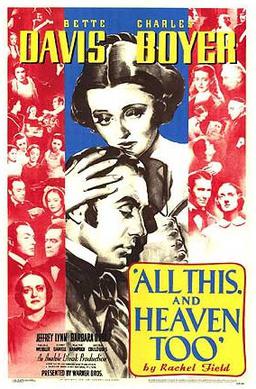
All This and Heaven Too (1940)

All This and Heaven Too (1940)

Illicit romance, murder, scandal… it should all be so much more exciting than this film makes it

Director: Anatole Litvak

Cast: Bette Davis (Henriette Deluzy-Desportes), Charles Boyer (Duke Charles de-Praslin), Barbara O’Neil (Fanny Sebastiani de-Praslin), June Lockhart (Isabelle de Choiseul-Praslin), Virginia Weidler (Louise de Choiseul-Praslin), Jeffrey Lynn (Reverend Henry Martin Field), George Coulouris (Charpentier, Harry Davenport (Pierre), Montagu Love (Army General Horace Sebastiani), Helen Westley (Mme LeMarie), Henry Daniell (Broussais)

In the 1840s, Henriette (Bette Davis) arrives as governess at the home of the Count de-Praslin (Charles Boyer). She’s calm, collected, patient and caring: in short she’s everything that the count’s wife Fanny (Barbara O’Neil) is not, and it doesn’t take the count long to work it out. With Henriette swiftly becoming a second mother to his four children, the count and Henriette find themselves falling, unspokenly, in love. But Fanny isn’t fooled – and neither is the gutter press – and as scandal brews, the count takes drastic action to stop his wife, leading to a legal case that will shock France.

All This, and Heaven Too was conceived as a sweeping romance to rival Gone with the Wind. Money was lavishly splashed on sets and costumes (Bette Davis has no fewer than 37 costumes in the film, averaging at one every five minutes). Based on a famous murder case – that some felt had contributed towards the anti-monarchy atmosphere that led to the revolution of 1848 – All This, and Heaven Too had everything on paper to challenge Gone with the Wind in romance stakes. So why doesn’t it?

There is something too restrained, too slow and controlled about the film. It’s overlong – the original cut was over three hours, reduced to 2 hours 20 minutes – and takes a very long time to get going. The two stars underplay very effectively – with Davis cast very successfully against type as a mousey, rather timid Jane Eyre-ish figure – but it also means that the sort of grand romance the film is aiming for never quite takes fire, for all the careful shots of burning flames between the two lovers as they discuss their romantic predicaments in roundabout terms.

Litvak’s film saddles itself with a framing device that, while accurate to the real-life story, adds very little. The film opens with Henriette teaching children in America – children who have no respect for her, having heard whispers of her scandalous past – which leads into her telling the story to them (and us) about her past. The film returns to this framing device at the end, but as a whole it provides very little insight or interest to the core thrust of the film’s action. The film also wastes time on Jeffrey Lynn’s Reverend (Heinrette’s future husband), a relationship that seems largely in there to absolve Henriette of any possible indirect responsibility for the murder (she can’t be a hussy, she marries a man of the cloth!).

A large chunk of the film is designed to minimise what was a major scandal that rocked French society. This was a (possible) sexual affair between an unhappily married aristocrat and the governess to his children. It culminated in the countess being stabbed and beaten to death and her blood-stained husband found on the scene, claiming he had fought and chased away an intruder (which, writing it down, is basically the plot of The Fugitive). He never confessed, but committed suicide via arsenic in prison a few months later. Henriette was arrested as an accessory (presumably for encouraging the count to kill his wife) but released.

This should have been racy, racy stuff – but the film shies away from it. It’s probably linked to the expectation that the Hays Code would never accept the idea of Henriette as an adulteress who never goes unpunished. The possible Therese Raquin style set-up is instead translated into a more Jane Eyre model, with the employer in love but the servant too noble to act on her feelings and expose herself to disgrace. The film does pull no punches in making clear that the count committed the crime (the camera zooming in on Boyer’s starring eyes as he advances on his pleading wife) but since he was always destined to meet a historical punishment (he helpfully absolves Henriette on his deathbed) there were no concerns there.

All This, and Heaven Too can’t have a passionate, lusty drama so it avoids any overt spark between Boyer and Davis. Both actors play this unspoken attraction extremely well, but the film has to work overtime to get drama out of their several scenes of standing carefully apart or side-by-side, talking about everything except their own feelings. Boyer, as ever, is first class: his expressive eyes and beautiful ability to listen and react is as perfect for an unspoken romance, as it is for a man who becomes convinced murder is his only escape. Davis’ meeker, Joan Fontainesque role suits her extremely well, even if it disappoints those expecting fireworks.

Those fireworks come from Barbara O’Neil instead, raving and unreasonable as a woman driven to the edge by this semi-imagined affair, in an energetic performance that gained one of the film’s three Oscar nominations. But the film’s strange momentum affects her too: she is left to repeatedly hit the same notes over again, as the film repeats its established set-up over and over for 90 minutes before she is murdered (then squashes everything connected to the historical scandal and the murder trial into the final 40 minutes).

It’s productions standards are high and it’s well shot by Gone with the Wind cameraman Ernest Haller. There is some beautiful use of shadows and several ball scenes are expanded with some gorgeous use of mirrors. It ticks many of the boxes you expect a period romance to have, but is fatally hampered by its caution and by its restrictive narrative choices. It ends up feeling long and drifts too often through its build-up, forcing it to rush its pay-off. All of this contributes to its lack of challenge to GWTW in the romance stakes.

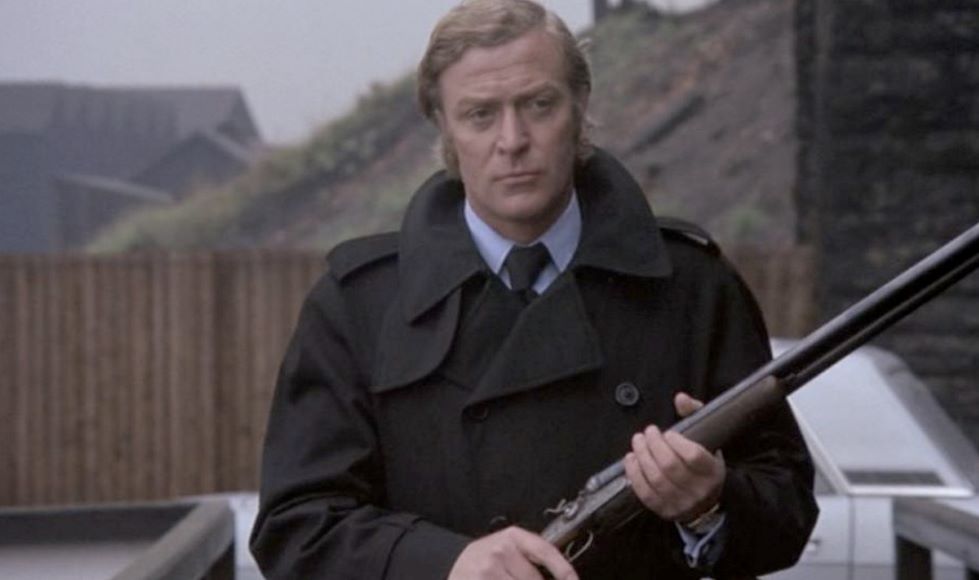
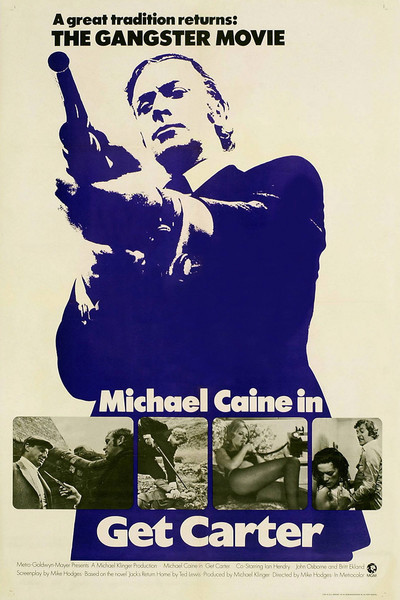
Get Carter (1971)

Get Carter (1971)

Brutal, dark and nihilistic British gangster film removes any chance that you might fancy trying a life of crime

Director: Mike Hodges

Cast: Michael Caine (Jack Carter), Ian Hendry (Eric), John Osborne (Kinnear), Britt Ekland (Anna), Brian Mosley (Cliff Brumby), George Sewell (Con McCarty), Tony Beckley (Peter the Dutchman), Glynn Edwards (Albert Swift), Alun Armstrong (Keith), Bernard Hepton (Thorpe), Petra Markham (Doreen), Geraldine Moffat (Glenda), Dorothy White (Margaret)

It’s probably the finest British gangster film ever made. Get Carter is a cold, dark, grimy film – a punch to the solar plexus, which completely rejects any sense of charm in its gangster characters. Michael Caine called Jack Carter a shadow Caine, the man he could have become if his life had broken out slightly differently. It’s set in an unremittingly bleak Newcastle, but it feels like it might be happening in an anti-chamber of hell, with its thoroughly amoral lead barely aware he’s spiralling towards destruction. It’s a sociopathic, Jacobean revenge tragedy set among the dirt filled suburbs of Newcastle.

Jack Carter (Michael Caine) is a professional fixer for London gangster brothers. He returns to his childhood home of Newcastle after the sudden death of his brother. But he’s not satisfied with the official explanation. Instead, he dives into an investigation, in which he cares not a jot about the collateral damage he causes or the likely reaction of the underworld powers that be as he rocks the boat to destruction, trashing the lives of everyone he meets, good and bad.

Powered by an extraordinary performance of blank nihilism and cold, unexpressed fury by Caine, nominally Jack is a man motivated by the harm done to his family. However, Hodges film is so cold-eyed and realistic about the mentality of gangsters, we know it’s just an excuse. Carter is never heart-broken, he’s annoyed. His brother may have been punished and his niece (it transpires) misused, but fundamentally what motivates Carter is the affront. By taking a pop at his family, he feels they really think they can take a pop at him. How dare they: he’s Jack Carter.

Any charm Carter has, solely comes from residual affection for Caine. By any measure, Carter is an awful man (even if he has a good turn of phrase). He is a sociopath with no concern for anyone. When friendly Keith (a young Alun Armstrong) is beaten black and blue for helping Carter, how does our hero respond? Tosses a few bank notes on his bed and tells him “buy some karate lessons”. Carter sees the world solely as made up of debts, which can be discharged by money, never mind the situation. His niece throws beer over a friend? He’ll pay for the dry-clean. Keith gets bashed up: take a roll of twenties, what’s your problem?

Carter directly kills four people (and is responsible for several other deaths), all with a blank-eyed lack of reaction. There isn’t any sadism to what he does – the deaths are mostly efficient and to his mind, justified, because by taking actions against his family they disrespected him. When he locks a woman in the boot of his car, and a pair of heavies push the car into the Tyne he doesn’t bat an eyelid at her inevitable death (never mind he slept with her hours before). People who find themselves close to Jack, or drawn into his circle, suffer terribly and he literally couldn’t care less.

Get Carter is the bleakest of all gangster films, shot with an imaginative kitchen-sink beauty by Mike Hodges, which actually carries a lot more visual glory than you might expect. Drained out colours abound – there are virtually no bright primary colours in this, with the whole of Newcastle a mix of muddy browns, soot-stained greys and filthy charcoals. Hodges’ film is also dynamic and fast-paced: he throws in striking aerial and crane shots (there is a beautiful shot that follows a car chase from a bird’s eye view), but also gets down and dirty in this grainy world.

It’s an urgent, lean and mean film constantly kicking you in the shins, but told with skill and artistry. Hodges pieces together a marvellous early scene, where Carter visits local heavy Kinnear (a suave, chillingly well-spoken John Osborne): simultaneously, in one single location, two scenes (both with vital information) play out at the same time – Carter chats to Kinnear’s moll Glenda (Geraldine Moffat), picking up vital information while on the same sofa Kinnear beats his guests at cards. Everything though is perfectly clear: masterful stuff. It’s also a film crammed with small details that reward careful viewing: Carter’s bed has a cross-stitch of “What would Jesus say?” above it (I dread to think) and on his train journey, look out for a fellow passenger with a distinctive ring.

So confidently is this put together, it’s amazing to think Hodges was a first-time director. This is a film dripping with menace, but also a horrifyingly immersive camera. We are frequently thrown into the midst of the action. Carter frequently looms over the camera or is filmed in violent motion moving towards his next goal. There is not a jot of romanticism around the film: neither about the gangsters or the bleak world they operate in. Newcastle is pre-Thatcherite hellhole, with precious little glamour. Even the gangster locales – the clubs and pubs – are bashed-up and unpleasant.

Across the board, the gangsters are exposed as cruel, heartless and vile. Touches of class are ruined by everyone’s fundamental lack of class. Cliff Brumby’s (Brian Mosley) planned classy restaurant sits atop a concrete multi-story car-park. Kinnear’s (John Osborne) fancy country house is the setting of the grimmest, most depressing orgy you’re likely to see. Carter is trying his best to dress classily, but his cruelty always punctures the illusion. He’s introduced watching a porn film with his bosses in London and the film revolves around the seamy underworld of homemade porn.

The women in the film are primarily used by the gangster as props for these films, and Get Carter doesn’t shy away from the exploitative fate for women in this world. However, you can’t disagree that it takes in a bit of exploitation itself. Britt Ekland has high billing for her single scene, where she lies mostly naked on a bed pantily having phone sex with Carter (who goes about this, as all things, with a functional efficiency, at least as interested in the excited reaction of his middle-aged landlady who is sitting in the room with him while he chats on the phone). It’s undeniably a moment for us to gawp but it still feels less cold and cruel than those awful porn films.

Carter discovers his niece has found her way into these. He even sheds a tear over this: but he doesn’t care because of what has happened to her. Again it’s all about him: Carter couldn’t care less about the morals and is perfectly happy for porn to soak up other women. He’s not really that interested in his niece: it’s all about the damage to him, that a “made man” like him should have a member of his family getting boffed like a slag for others entertainment. How bloody dare they?

Get Carter understands this is a dark and soulless world, and is a film bereft of hope. Its hero is a revenge obsessed sociopath, who only smiles in the film after he has burnt everything around him down. Gangsters destroy everything they touch and care about nothing other than themselves. All debts can be settled with money, all women are toys to be used and thrown away. Death means nothing and the world is a drained-out hell of shabby houses and dirty clubs. It’s the grimmest and finest British gangster film out there. Who would want to be gangster after seeing this?

Strangers on a Train (1951)

Strangers on a Train (1951)

A man accidentally agrees to a murderous exchange in Hitchcock’s tense, seductive thriller

Director: Alfred Hitchcock

Cast: Farley Granger (Guy Haines), Ruth Roman (Anne Morton), Robert Walker (Bruno Antony), Leo G. Carroll (Senator Morton), Patricia Hitchcock (Barbara Morton), Kasey Rogers (Miriam Joyce Haines), Marion Lorne (Mrs Antony), Jonathan Hale (Mr Antony), Howard St John (Captain Turley)

Two men meet on a train: Tennis star Guy Haines (Farley Granger) and entitled playboy Bruno Antony (Robert Walker). They chat awkwardly, possibly because Guy is too polite to tell Bruno to sod off and leave him alone. They both have problems: Guy can’t marry his girlfriend, Senator’s daughter Anne Morton (Ruth Roman) because his trampy wife Miriam (Kasey Rogers) won’t give him a divorce; Bruno longs to escape from the shadow of his controlling dad. Then Bruno makes a suggestion: he’ll dispatch Miriam and Guy can kill his father. No-one will suspect a thing, as neither man has a motive. Criss Cross. Guy shakes hands and forgets all about it: until Bruno murders his wife and demands quid pro quo.

Hitchcock’s dread was to be arrested for a crime he did not commit. As a young boy, his father sent him down to the local police station with a note instructing him to locked up for a few hours to teach him a lesson. The horror stayed with Hitchcock for his whole life. Strangers on a Train was one of his best explorations of this concept (with the twist that the hero secretly wanted to but wouldn’t of course), and desperately attempts to prove his innocence and stop the psychopath he’s accidentally commissioned.

It’s a dream of a concept from Patricia Highsmith’s novel, superbly assembled into a tense thriller, where questions of whodunnit are (as so often in Hitchcock) irrelevant, with the real suspense coming from how the hero is going to get himself out of his predicament. That horrific predicament is masterfully assembled by Hitchcock into a series of striking set-pieces and shots, all of which carefully build a sense of being trapped in a terrible, oppressive nightmare as Guy realises there is no escape from the expectant glare of Bruno, determined that he fulfil his side of the bargain.

Bruno haunts Guy like a phantom. Guy sees him standing in front of an empty Lincoln memorial, Hitchcock shooting Walker like a distant black smear on the pristine white background. At a tennis match, Bruno sits fixedly starring at Guy, while every other face moves from side to side around him. Bruno inveigles his way into the home of Guy’s would-be fiancée and cheerfully sends him instructions on the best time and method for dispatching his father. The world seems to close around Guy – he’s framed through grills, trapped in rooms, never in control of his own destiny.

Bruno is relentless in his pursuit – and that feels like the right word for it – of Guy. It’s a superb performance from Robert Walker as this sexually ambiguous psychopath, chillingly amoral, fixated on his own desires and unrelenting in his sinister obsessions. Walker’s charisma and slimy, insinuating charm dominate the movie – he’s bizarrely sympathetic, so honest is he in his carefree sociopathy – and makes a great contrast with Granger. Here Hitchcock used the weakness of an actor to splendid effect. Original choice William Holden would never have been so meek and awkward talking with Bruno on a train: Granger, a less strong performer, utterly convinces as someone so inept at removing himself from an unwanted conversation he accidentally commits to murder.

The meeting between the two men on the train drips with homoerotic tension. It plays pretty much like a pick-up, Bruno smoothly working his way from sitting opposite Guy, to sitting next to him, to sharing dinner with him. Hitchcock introduces the two of them with tracking shots of their very differently shoed feet walking to a train, until they accidentally touch feet. Later a lounging Bruno stretches out his feet to touch Guy’s once more. Bruno essentially seduces Guy, Guy’s flustered awkwardness at least as much connected to a sort of sexual confusion as it is to the strange social interaction. Walker’s performance has a seductive purr and a beautiful delicate, feminine precision.

Not that it stops him committing murder. The killing of Miriam (wonderfully played with a slutty charm by Kasey Rogers) sees Bruno again as stalker, only this time with murder in mind. He prowls behind Miriam – dragging two horny lads along – as she moves through a fairground, keeping his distance but constantly catching her eye. Hitchcock tracks these flirtatious glances – this really is murder by seduction – and Bruno impresses her like a would-be lover with his prowess at the strong-man bell. It’s a dance, the two of them drifting down a tunnel in boats, one after the other.

And it culminates in an intimate killing by strangulation. Hitchcock uses a virtuoso shot: we watch the killing of Miriam reflected in the lens of her fallen oversized glasses, Bruno bearing down over her until she disappears. The perverse sexual excitement Bruno feels over the killing creeps into his fascination with Anne’s sister Barbara (played, for extra perverse points, by Hitchcock’s daughter Patricia) who wears similar glasses to Miriam. Bruno stares at her with dreadful, tingling excitement and eventually loses control of himself miming out strangulation on a guest at the Morton’s house, swept up in the thrill of it.

Of course, Guy is far too straight-laced (in every sense) to get to wrapped up in Bruno’s plot. (Rather different from Highsmith, where his equivalent character regretfully but willingly upholds his part of the bargain.) The film overplays its hand slightly as it heads into the denouement with an overextended tennis match intercut with Bruno attempting to retrieve Guy’s lighter from a drain (where he has dropped it, en route to planting it at the murder scene). It pulls it back though with a final fight on a wildly speeding-out-of-control carousel (just the right side of ridiculous).

The film is littered with little references to doubles and dark shadows and is a superbly constructed thrill ride by Hitchcock. Granger’s weaknesses as a performer are surprisingly well suited to his role, although Hitchcock failed to hide his lack of regard for Ruth Roman in a weakly written role. The film gets a superb dark momentum from Robert Walker’s marvellous performance and Hitchcock shoots it with a brilliantly unsettling stalkerish eye, with Bruno’s trailing of each of his targets tinged with a dark sexuality beneath the malicious intent. With good reason, Hitchcock called this his “first American movie” and it kickstarted a run of hits.

Shadow of a Doubt (1943)

Shadow of a Doubt (1943)

A small town family is corrupted by a malign force in Hitchcock’s favourite of his films

Director: Alfred Hitchcock

Cast: Teresa Wright (Charlie Newton), Joseph Cotton (Uncle Charlie Oakley), Macdonald Carey (Detective Jack Graham), Henry Travers (Joseph Newton), Patricia Collinge (Emma Newton), Wallace Ford (Detective Fred Saunders), Hume Cronyn (Herbie Hawkins), Edna May Wonacott (Ann Newton), Charles Bates (Roger Newton)

It’s a surprise to discover Shadow of a Doubt was Hitchcock’s favourite of his films (although the Master of Suspense was a notorious kidder). It rarely makes even the top ten of Great Hitchcock’s and for years was semi-forgotten in his CV. But delve into this small-town chiller and it becomes less of a surprise the master was so fond of it. Hitchcock’s first American-set film (his previous American films being British-set), this takes an idyllic, everyone-knows-your-name, no-doors-locked small town in California and injects into the middle of it a ruthless sociopath, as charming as he is shockingly ruthless. Doesn’t that sound like Hitchcock all over?

That small-town is Santa Rosa in California. There the Newton family is thrilled at the imminent arrival of Uncle Charlie (Joseph Cotton) from New York. None more so than his niece Charlie (Teresa Wright), a precocious teenager who shares her uncle’s wit and worldly wisdom. He arrives laden with gifts – but also dragging two police detectives and swirling rumours of terrible crimes. Surely Uncle Charlie – hero to all and idol of his niece – can’t also be the ruthless “Merry Widow” killer, dispatching aged widows for their riches? And, if he is, what on earth will Charlie do about it?

A lot of what would become Hitchcock’s central concerns in his later, darker, mature works make their inaugural appearance in this dark, creeping mystery. Everything in the Newton home is perfect, until they welcome Charlie, whose amiable greed and self-interest tarnishes everything he touches. Despite this, he’s the most likeable, charismatic, charming character in the film. So much so, a big part of us wills him not to be the murderer we can all be pretty confident he is. He’s far too exciting and dynamic for us to want him torn away from us!

The two Charlies are close – so much so Hitchcock would surely have dialled up the incestuous spark between them even further if he had made the film fifteen years later. They have a near supernatural mental bond, seemingly able to predict where and when the other might be. They laugh and flirt. In arguments Uncle Charlie grasps his niece like a frustrated lover, clutching her too him. As well as sharing many character traits (implying it would be easy for Charlie to become like Uncle Charlie) they’re closeness feels as much like a courtship as it does familial closeness. When Uncle Charlie takes Charlie to a gin bar to gain her confidence and support to hide from the cops, the entire scene feels like the appeal of a would-be lover.

It overlaps another theme future Hitchcock have taken further: the thin line between innocence and killer. Uncle Charlie and his namesake have a special bond. They share the same world-view and many of the same ideas. They’re both charismatic and natural leaders. They both feel stifled by this small-town world. They are both ruthlessly determined when roused. One of them might be innocent and one might be good – but how much of a push would it be to turn one into the other?

Hitchcock probes this possibility throughout in a film stuffed with doubles and duality. Both Charlies are introduced with similar shots of them lying in bed, being questioned by others. Later Uncle Charlie will inherit Charlie’s room in the house. Greeting each other at the station, they move towards each with mirroring shots. They share the same name. Twins, doubles, mirrors and the number two abound in the film – a marvellous blog here captures this all in far more detail and insight than I could here.

Uncle Charlie slithers into Santa Rosa like the serpent into the garden of Eden. He offers temptation left, right and centre. The Newton family receive lavish (stolen) gifts. His brother-in-law’s bank gets a investment from the cash Uncle Charlie carries around (he’s old fashioned you see). He laughs and jokes, reminds Charlie’s mother of the joys of her past and inveigles himself into the heart of the family (he even sits at the head of the table). But he’s also a dark, sinister figure, frequently framed at the top of staircases, marching inexorably towards camera and (in one stand out moment) breaking the fourth wall to address us directly while coldly, contemptuously outlining his theory about the pointless burden useless lives have on the rest of us.

He’s played with a charismatic, cold-hearted, jovial wickedness by Joseph Cotton. Cotton is so good as this on-the-surface amiable man, with a soul devoid of any love, it you’ll wish he’d got parts like this more often. Liberated from playing decent best-friends, Cotton dominates the film with a malignant charisma, married with a growing only-just-concealed desperation at the fragility of his fate. Opposite him, Teresa Wright is marvellous as a young woman who finds her sense of morality fully awakened into outrage by this dark presence corrupting everything in her life.

Corruption is central to Shadow of a Doubt – no wonder Hitchcock loved it – with Uncle Charlie turning everything in the simple, honest town into something darker and tainted by his very presence. There is an almost cliched home-spun decency about the town (almost as if co-writer Thornton Wilder was parodying his Our Town), serving to make Uncle Charlie’s modern sociopathy even more of a destructive force.

Shadow of a Doubt is directed with immense care, but a great deal with subtle flourish. Staircase shots abound, to stress sinister motivations, positions of weakness and unease. Characters lurch towards the camera frequently, as if the whole film was hunting us down. An air of menace, lies and danger builds inexorably as Uncle Charlie’s true-nature leaks out. There is also wit: not least from Charlie’s father (a jovial Henry Travers) and eccentric neighbour (a scene-stealing Hume Cronyn) gleefully discussing true crime throughout. There is also Hitchcock’s love of irony, not least in the fact Charlies problems are largely caused by his attempts to conceal a newspaper article that otherwise would have gone unnoticed.

Hitchcock makes his cameo early on as a card player on a train journey. He’s revealed to be holding all the trumps. That’s how he likes it: and perhaps explains his fondness for Shadow of a Doubt. Low key but perfectly constructed, it’s a film that latches onto themes of corruption, dark temptation and ruthless violence. Film logic abounds – who cares that the detective’s investigation is so inept they’d never be employed again – and the second half is crammed with murder attempts as unsubtle as they are ingeniously dark. Shadow of a Doubt feels like a prototype for darker themes of obsession and temptation Hitchcock would explore in the future. Perhaps that’s why he was so fond of it: it’s where he started to spread his wings.

The Fugitive (1993)

The Fugitive (1993)

An innocent man goes on the run in the one of the finest thrillers of the 90s

Director: Andrew Davis

Cast: Harrison Ford (Dr Richard Kimble), Tommy Lee Jones (US Marshal Sam Gerard), Sela Ward (Helen Kimble), Joe Pantoliano (US Marshal Cosmo Renfro), Jereon Krabbé (Dr Charles Nichols),Andreas Katsulas (Fredrick Sykes), Daniel Roebuck (US Marshal Bobby Biggs), Tom Wood (US Marshal Noah Newman), L Scott Caldwell (US Marshall Erin Poole), Johny Lee Davenport (US Marshall Henry), Julianne Moore (Dr Anne Eastman), Ron Dean (Detective Kelly), Joseph Kosala (Detective Rosetti), Jane Lunch (Dr Kathy Wahlund)

I think there are few things more terrifying than being accused of something you didn’t do. How can you hope to prove your innocence, when no one listens and there isn’t a scrap of evidence to back up your story? How dreadful again if the crime you are accused of, that everyone thinks you are guilty of, is the brutal murder of your wife? The double blow of everyone thinking you guilty, while the real killer walks free. What would you do to clear your name? And how much harder would that be, if you were also on the run from the law who are eager to prep you for the electric chair?

It’s the key idea of The Fugitive, adapted from a hit 60s TV show, and undoubtedly one of the best thrillers of the 90s. Harrison Ford is Dr Richard Kimble, on death row for the murder of his wife Helen (Sela Ward). In transit to prison, an accident caused by a convict’s escape attempt gives him a chance to escape. Returning to Chicago, Kimble is determined to hunt down the mysterious one-armed man he knows murdered his wife and work out why. Problem is, he’s being chased down by a team of US Marshals led by the relentless Sam Gerard (Tommy Lee Jones), who’s not interested in Kimble’s guilt or innocence, only in catching him.

The Fugitive is propulsive, involving and almost stress-inducing in its edge-of-the-seat excitement. It’s a smart, humane and gripping thriller, both a chase movie and an excellent whodunnit conspiracy thriller. It’s one of those examples of Hollywood alchemy: a group of people coming together at the right time and delivering their best work. It’s comfortably the finest work of Andrew Davis, a journeyman action director, who delivers work of flawless intensity, perfectly judging every moment. It’s shot with an immediacy that throws us into the city of Chicago and its surroundings (Davis was a resident of the city and worked with photographer Michael Chapman to bring the real city to life on screen) and the film never lets up for a moment.

It gains hugely from the casting of the two leads. No actor can look as relatably harassed as Harrison Ford. Determined but vulnerable – there is a marvellous moment when Ford squirms with suppressed fear rising in an elevator filled with cops – Ford makes Kimble someone we immediately sympathise with. He’s smart – evading police, forging IDs, inveigling himself into hospitals to access amputee records – but constantly aware of the danger he’s in, brow furrowed with worry, narrow escapes met with near-tearful relief. Ford excels at making righteousness fury un-grating – the film makes a lot of his boy-scout decency – and never forgets Kimble is a humanitarian doctor, putting himself frequently at risk to save lives, from pulling a wounded guard from wreckage during his escape or saving a boy from a missed diagnosis in the hospital where he is working as a cleaner.

You need a heavyweight opposite him, which the film definitely has with Tommy Lee Jones. Jones won an Oscar for his hugely skilful performance. It would have been easy to play Gerard as an obsessed, fixated antagonist. Jones turns him into virtually a dual protagonist. Much as we want Kimble to stay one step ahead of the law, we respect and become bizarrely invested in Gerard’s hunt for him. Jones is charismatic as the focused Gerard, but also a man far more complex than he lets on. He genuinely cares for his team, takes full responsibility for their actions and finds himself becoming increasingly respectful of Kimble, even entertaining the idea of his innocence.

Not that an unspoken sympathy will stop him doing his job. When Kimble pleads his innocence at their first meeting his (iconic) response is “I don’t care”. Later, he doesn’t hesitate to fire three kill-shot bullets at Kimble when nearly capturing him in a government building – Kimble saved only by the bullet-proof glass between them. Jones never loses track of Gerard’s dedication above all to doing his job (the investigation he starts into Kimble’s case is motivated primarily by it being the most efficient way to work out where Kimble might go). But the edgy humour and pretend indifference hide a man passionate about justice and with a firm sense of right and wrong.

These two stars make such perfect foils for each other, it’s amazing to think they spend so little time opposite each other. Davis makes sure those few meetings have real impact, starting with their iconic early face-off at the top of a dam. A gripping chase through the bowels of this concrete monster, it’s also a brilliant establishing moment for how far both men will go: Gerard will continue the hunt, even after losing his gun to Kimble in a fall – because he has another concealed, ready to hand; Kimble won’t even think about using a gun and will go to the same never-ending lengths to preserve his chance at proving his innocence, by jumping off that dam.

The film implies they recognise these similarities in each other. Perhaps that’s why Kimble even eventually bizarrely trusts Gerard as a disinterested party – even while he remains terrified of Gerard catching up with him. The unpicking of (what turns out to be) the conspiracy behind Helen’s death is carefully outlined and surprisingly involving (considering it rotates around sketchily explained corporate shenanigans) – largely because Davis has so invested us in Kimble’s plight.

That’s the film’s greatest strength. Everything draws us into sharing Kimble’s sense of paranoia: that one misspoken word or bad turn could lead to his capture. Scored with lyrical intensity by James Newton Howard, it’s tightly edited and only gives us information when Kimble gets it. We only learn information about the night of the murder as he remembers or uncovers it. Davis twice pulls brilliant “wrong door” routines, where both editing and the careful delivery of information to us at the same time as Kimble makes us convinced that raids are focused on him, when they are in fact looking at someone else entirely.

This sort of stuff makes us nervous, worried for Kimble – and hugely entertained. I’ve seen The Fugitive countless times, and its relentless pace, constant sense of a never-ending chase and the brilliance of its lead performers never make it anything less than utterly engrossing. There is barely a foot wrong in its taut direction and editing and it’s crammed with set-pieces (the dam face-off, a chase through a St Patrick’s Day parade, a breathless fight on an elevated train) that never fail to deliver. It’s a humane but sweat-inducing thriller, a near perfect example of its genre.

Zodiac (2007)

Zodiac (2007)

A chilling chronicle of the hunt for a serial killer told with a superb mix of journalism and filmic flair

Director: David Fincher

Cast: Jake Gyllenhaal (Robert Graysmith), Mark Ruffalo (Inspector Dave Toschi), Robert Downey Jnr (Paul Avery), Anthony Edwards (Inspector Bill Armstrong), Brian Cox (Melvin Belli), Elias Koteas (Sergeant Jack Mulanax), Donal Logue (Captain Ken Narlow), John Carroll Lynch (Arthur Leigh Allen), Dermot Mulroney (Captain Marty Lee), Chloë Sevingy (Melanie Graysmith), John Terry (Charles Thieriot), Philip Baker Hall (Sherwood Morrill), Zach Grenier (Mel Nicolai)

It’s one of the great unsolved mysteries of American history, like San Francisco’s version of Jack the Ripper. For a large chunk of the late 60s and early 70s, a serial killer known only as “the Zodiac killer” murdered at least five (and claimed 37) innocent people, all while sending mysterious, cipher-filled letters to San Francisco newspapers, taunting police and journalists for failing to catch him and threatening further violent acts. The investigation sifted through mountains of tips and half clues but only produced one possible suspect, Arthur Leigh Allen: though no fingerprint or handwriting match could conclude a case.

The story of the hunt for this elusive killer, stretching into the 1980s and concluding with another dead-end coda in 1992, is bought to the screen in a film from David Fincher that expertly mixes cinematic flair with journalistic observation. Channelling All the President’s Men and 70s conspiracy thrillers as much as it does the dark obsession of Fincher’s Seven, Zodiac is a master-class not only in the bewildering detail of large-scale investigations (in the days before computer records and DNA evidence) but also the grinding, destructive qualities of obsession, as those hunting the Zodiac killer struggle to escape the shadow of a case that grows to dominate their lives.

Zodiac focuses on three men, all of whom find their lives irretrievably damaged by their investigation. At first, it seems the drive will come from Robert Downey Jnr’s Paul Avery. Avery is the hard-drinking, charismatic, old-school crime correspondent on the San Francisco Chronicle. In a performance exactly the right-side of flamboyant narcissism, Downey Jnr’s Avery is a man who likes to appear like he takes nothing seriously, even while the burden of the case (and a threat to his life from the Zodiac killer) tips him even further into a drink habit that is going to leave him living in a derelict houseboat, in a permanent state of vodka-induced intoxication.

The second is Inspector Dave Tosci, a performance of dogged, focused professionalism from Mark Ruffalo. He’s confident he’ll find his man, and will go to any lengths to do it, staying on call night and day, and hoarding facts about the case like a miser. He relies more than he knows on level-headed, decent partner Bill Armstrong (played with real warmth by Anthony Edwards). Tosci’s self-image and belief slowly crumble as every lead turns dead end, every gut instinct refuses to be backed by the evidence. The killing spree becomes his personal responsibility, a cross he bears alone for so long that when a belated letter from Zodiac surfaces in 1978, his own superiors believe Tosci sent it in some vain attempt to keep a cooling case alive.

Our third protagonist, present from the arrival of the very first Zodiac letter at the door of the Chronicle, is Jake Gyllenhaal’s Robert Graysmith. A quiet, studious, teetotal political cartoonist who is literally a boy scout, Graysmith spent a huge chunk of the 70s and 80s trying to crack the case, eventually turning his investigation into a best-selling book. It’s Graysmith who becomes the focus of Fincher’s investigation of obsession. The glow of monomania is in Gyllenhaal’s eyes from the very start, as the cipher and its deadly message spark a mix of curiosity and moral duty in him. He feels compelled to solve the crime, but it’s a compulsion that will overwhelm his life. The Zodiac is his Moby Dick, the all-powerful monster he must slay to save the city. (“Bobby, you almost look disappointed” Avery tells him, when Avery suggests some of the Zodiac’s murderous claims are false, as if reducing the wickedness of the Zodiac also reduces the power of Graysmith’s quest.)

The real Graysmith commented when he saw the film, “I understand why my wife left me”. It’s a superb performance of school-boy doggedness, mixed with quietly fanatical, all-consuming obsession from Gyllenhaal, as the film makes clear how close he came (closer than almost anyone else) to cracking the case, but nearly at the cost of his own sanity. Graysmith pop quizzes his pre-teen children on the case over their breakfast (a far cry from, at first, his instinct to shield his son from the press coverage) and as he becomes increasingly unkempt, so his house more and more becomes a mountain of boxes and case notes.

It’s the secondary theme of Zodiac: how obsession doesn’t dim, even when events and evidence drop off. The second half of the film features very little new in the case (which peaked in the early 70s) but focuses on the lingering impact of the ever more desperate and lonely attempts to solve it. Armstrong, the most well-adjusted of the characters, perhaps knew it was a hopeless crusade when he threw his cards in and left the table after a few years to spend time with his children while they grew up. Avery cashes out as well – even if his health never recovers. Tosci is cashiered from the game, and even Graysmith finally realises the impact on him.

That second half of the film is long. Too long. It also, naturally, leaves us with no ending – a sad coda that hints at the guilt of primary (only) suspect Arthur Leigh Allen, but gives us (just like the surviving victims) no closure. It’s fitting, and deliberate, but still the only real flaw of Zodiac is that, at 150 minutes, it’s too long. The deliberate draining of life from the case, like a deflating balloon, also impacts the narrative, which consciously drops in intensity (and, to a degree, interest – despite Gyllenhaal’s subtle and complex work as Graysmith). It’s even more noticeable considering the compelling flair with which Fincher delivers the first half of his scrupulously researched film.

Fincher and screenwriter James Vanderbilt spent almost 18 months interviewing everyone involved with the case. Nothing was included in the film unless it could be verified by witnesses. That included the crimes of the Zodiac: only attacks where there were survivors are shown, the only minor exception being Zodiac’s murder of a taxi driver (where only distant eye-witnesses were available) – even then, every event is confirmed by ballistics and no dialogue is placed into the mouth of the victim. The film also acknowledges the unknown nature of the Zodiac killer: each time the masked killer appears in recreations of his crime he is played by a different (masked) actor, subtle differences in build, tone of voice and manner reflecting the contradictory eye-witness statements. These chilling scenes are shot with a sensitivity that sits alongside their horrifying brutality. Fincher felt a genuine responsibility to reflect the horror of what happened, but with no sensationalism.

Instead, he keeps his virtuoso brilliance for the investigation. The newspaper room filling with the super-imposed scrawl of the Zodiac killer, while the actors read out the words. Restrained but hypnotic editing, carefully grimed photography, camera angles that present everyday items in alarming new ways, a mounting sense of grim tension at several moments that makes the film hard to watch. A superb sequence surrounding the Zodiac’s demand to speak to celebrity lawyer Melvin Belli (a gorgeous cameo from Brian Cox), first on a live TV call-in show, then in person (a “secret meeting” swamped by armed police, which Zodiac, of course, doesn’t turn up to). This is direction – aided by masterful photography (Harris Savides) and editing (Angus Wall) – that immerses us in a world (like drowning in a non-fiction bestseller), while never letting its flair draw attention to itself.

Zodiac was a box-office disappointment and roundly forgotten in 2007. It’s too long and loses energy, but that’s bizarrely the point. It implies, heavily, that Allen (played with a smug blankness by John Carroll Lynch) was indeed the killer, but doesn’t stack the deck – every single piece of counter evidence is exhaustingly shown. In fact, that’s what the film is: exhaustive in every sense. It leaves you reeling and tired. It might well have worked better, in many ways, as a mini-series. But it’s still a masterclass from Fincher and one of the most honest, studiously researched and respectful true-life crime dramas ever made. And just like life, it offers neither easy answers, obvious heroes or clean-cut resolutions, only doubts and lingering regrets.

See How They Run (2022)

See How They Run (2022)

Smug, semi-spoof murder mystery which can’t decide whether it loves or scorns the genre

Director: Tom George

Cast: Sam Rockwell (Inspector Stoppard), Saoirse Ronan (Constable Stalker), Adrien Brody (Leo Köpernick), Ruth Wilson (Petula Spencer), Reece Shearsmith (John Woolf), Harris Dickinson (Richard Attenborough), David Oyelowo (Mervyn Crocker-Harris), Charlie Cooper (Dennis), Shirley Henderson (Agatha Christie), Pippa Bennett-Warner (Ann Saville), Pearl Chandra (Selia Sim), Paul Chahidi (Fellowes), Sian Clifford (Edana Romney), Lucian Msamati (Max Mallowan), Tim Key (Commissioner Harrold Scott), Jacob Fortune-Lloyd (Gio)

It’s the 100th performance of Agatha Christie’s The Mousetrap (“how much longer can it run”, the characters ask. If only they knew…) and producers are in talks for a big movie adaptation. At the party, boorish American film director Leo Köpernick (Adrien Brody) offends absolutely everyone – and promptly gets murdered. Not only are the cast (including Richard Attenborough – wittily impersonated by Harris Dickinson) suspect, but also the film producers which, contractually, can only go into production when the play closes. Investigating: dishevelled Inspector Stoppard (Sam Rockwell) and his super enthusiastic sidekick Constable Stalker (Saoirse Ronan).

See How They Run desperately wants to be a witty commentary on Agatha Christie style locked-room mysteries. It even opens with a voiceover from Brody’s Köpernick, full of scorn for the medium and its cliches before revealing, as per form, that as the least sympathetic character he himself is about to be knocked off. To be fair, there are one or two decent jokes. But the presence of Reece Shearsmith just made me think: Shearsmith and Steve Pemberton’s anthology dramady Inside No. 9 would have pulled off the same idea, but with far more wit and better understanding of Christie, in half an hour. And certainly with better jokes.

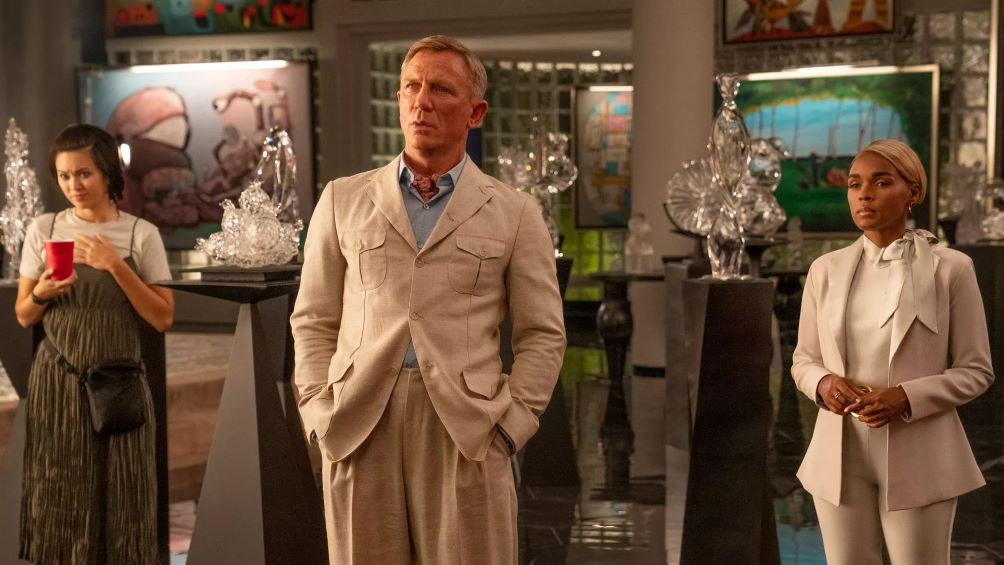
Instead See How They Run feels like it has only the most superficial understanding of Christie, based more on watching a few scenes of Poirot rather than reading the books. Rian Johnson’s Knives Out made a wittier, smarter and more enlightening commentary on Christie in its updating of the form, than this comedy ever manages. It’s never quite clear whether the makers want this to be a genuine Christie-style mystery or an inversion. Stoppard and Stalker go about their investigation in a traditional manner. The suspects all have motives of a sort. There is a definite mystery.

But it’s all lightweight and uninformed. Christie tropes are nudged and then ignored, as if the writers don’t understand them. What better opportunity could you have for Christie’s love for one mysterious character in the story turning out to be an actor in the group in disguise (invariably summarised by Poirot as “the performance of his/her life!”). There actually is a mysterious character here – but it turns out to be another person. Christie tropes around red herrings, secondary crimes, poison – all of them go unexplored.

The film ends with a deliberately counter-intuitive action sequence: but it’s not clear to me why. It’s neither particularly funny, nor does it feel like it has anything to say about the form other than offering an ending we might not expect. There is a nudge on the fourth wall (it’s the ending Köpernick wants) but what point is being made here? Is the action ending endorsing Köpernick’s belief that Christie-style mysteries are formulaic or boring, or is the shoot-out meant to look excessive and ridiculous? Is it implying everything we are watching is Köpernick’s dying fantasy? Is it a gag? I have no idea at all, and that sums up this tonal mess.

It’s a film that wants to have its cake and eat it. It tries to present a genuine murder mystery – and to be fair, when it does this, it does make for a good guessing game – but also wants to take potshots at the genre. It ends up doing neither particularly successfully. And there’s something a bit unlikeable about a film that wants to feed off the audience’s love of a Golden Age detective mystery, but also kinda wants to tell you how the thing you like is actually a bit stupid – and by extension so are you.

Its humour all too often feels a little studenty and obvious – the naming of Rockwell’s character as Stoppard being a case in point (although it does make for one good gag when Pearl Chandra’s charming Shelia Sim denounces another character as “a real hound, inspector”). It eventually feels like a rather smug film, which just goes to show how hard it is to make a Christie-style mystery.

If there is a decent joke in the thing, it’s that it manages to build a film where the plot of The Mousetrap is vital to the outcome, without ever revealing anything about what happens in The Mousetrap. (Presumably, the Christie estate would have had their guts for garters if they did.) Any moment where it looks like we might learn a major event in the play, a character interrupts or someone says “I already know”. These narrative gymnastics are the most inventive thing about it.

The other thing it’s got going for it is a performance of immense charm and comic likeability from Saoirse Ronan, who has rarely been as sweet, bubbly and adorkable as she is here. Ronan’s comic timing is excellent, and Stalker’s mixture of dogged determination and chronic over-enthusiasm provides virtually all the film’s highlights. Rockwell ambles through a (perhaps deliberately) under-written role, but most of the rest of the excellent cast feel under-utilised. Who casts Shearsmith and gives him not a single joke? Sian Clifford to deliver about three lines? David Oyelowo and Ruth Wilson do a lot with very little, but it’s telling that the final act appearance of Lucian Msamati and Paul Chahidi as a master-and-servant double act provides almost as much humour as the rest of the cast put together.

See How They Run passes the time – but that’s really about that. It doesn’t really have anything smart or funny to say about murder mysteries and it never offers anything truly unique or striking to justify itself (other than Ronan’s lovely performance). It’s straining as hard as it possibly can to ape the Coens or (most of all) the quirk of Wes Anderson, but totally lacks the skill and finesse of either. It feels like a film commissioned off the back of Knives Out success: but to be honest if you want to see something that brilliantly riffs off Christie while also being a bloody good mystery, just watch that instead.