Category: Directors

Alice Doesn’t Live Here Anymore (1974)

Alice Doesn’t Live Here Anymore (1974)

An engaging film explores the difficult choices faced by a generation of women

Director: Martin Scorsese

Cast: Ellen Burstyn (Alice Hyatt), Kris Kristofferson (David), Alfred Lutter (Thomas Hyatt), Diane Ladd (Flo), Vic Taybeck (Mel), Valerie Curtin (Vera), Jodie Foster (Audrey), Harvey Keitel (Ben), Lane Bradbury (Rita), Billy Green Bush (Donald Hyatt), Lelia Goldoni (Bea)

Alice Doesn’t Live Here Anymore takes a traditional ‘woman’s picture’, and firmly updates it to the concerns of the 1970s. It’s a successful mix of hope, romance and compromise, that manages to capture a sense of what a difficult and unusual time for a generation of women who grew up told being a wife-and-mother was the be-all-and-end-all only to find themselves in an era of possibilities with more options in life.

Alice (Ellen Burstyn), a wife-and-mother in a comfortable but largely romance-free marriage, is suddenly widowed. She realises she has a chance of becoming what she wanted to be when she was a kid: a singer. She and twelve-year-old son Thomas (Alfred Lutter) leave town, hoping to find this dream in Monterey, where she grew up. Their road trip is interrupted as Alice searches for singing jobs to pay their way, eventually stalling in Tucson where she works as diner waitress and finds the possibility of romance with softly-spoken divorced rancher David (Kris Kristofferson).

What’s striking about Alice is that you might expect it to be a story of feminist independence: a woman, striking out on her own, seizing her dreams. But it’s actually a more realistic – you might almost say quietly sad – film, where dreams are notoriously hard to achieve. Alice attracted ire at the time as she didn’t fit the bill of a feminist role model. For starters, at times she remains just as keen on finding a man as she does making it as a singer. Her talent is good but not stand-out – even she claims her voice is weak with an odd wobble. And she makes a host of dubious personal decisions out of a desire to be liked or to accommodate herself to others.

Burstyn captures this in her outstanding, Oscar-winning, performance. Alice is caught at that cross-roads of not being ready to let go of the traditionalist outlook she absorbed growing up, while dreaming of standing on her own two feet. It’s a problem you can imagine many women in 70s America, a country fumbling towards gender equality, struggled with. We grow incredibly fond of her as she strives for independence, while also sometimes wanting to shake out of her timid reliance on affection from others.

ADLHAM is a film about complexities and defies easy answers. Her marriage seems like one of mutual convenience. Then it surprises us: Alice’s tearfully silent realisation that they she and her husband have nothing to really talk about is met not with incomprehension but with a tenderly affectionate hug from her husband. Alice has an undeniable deep grief at his death – but she’s also quick to feel emotions, and you could argue her quickness to move on suggests she mourns the loss of an anchor in her life.

Her relationship with her son is an a mix of motherly care and a desire to be his friend. Alfred Lutter is very good as this slightly spoilt pre-teen who can switch from sulking playful laughter. ADLHAM shows plenty of fun and games between these two, like a water-fight in a motel. But it also makes clear Alice’s inability to control Tommy and her tendency to let take the lead. She rarely (if ever) corrects his bad behaviour or language, allows him to play music at top volume whenever he wants (to the intense irritation of others) and you feel her discomfort with being an authority figure (only once does she put her foot down, and is consumed with tearful guilt almost immediately after).

Similarly, her need to be close to a man leads to a parade of dubious choices. She is unable to pick up on signals that a seemingly charming man she meets at a bar (Harvey Keitel) is a married man with a hair-trigger temper. The gentler David might seem like a better prospect, but there is enough in Kris Kristofferson’s manner to suggest he has only so much patience for Tommy and that he might also be as flat and dull a man as Alice’s first husband was. ADLHAM could be suggesting some people are trapped into making similar mistakes over-and-over again.

Burstyn is the heart-and-soul of this look at the difficult balance between hope and reality. Alice is deeply emotional, her heart perilously close to her sleeve. Tears come incredibly easily, in juddering waves that shake her whole body. Burstyn makes her both defiant – “I don’t sing out my ass” she tells one leering bar-owner – but also vulnerable and needy. She’s can be playful and comic – she performs skits for David, throws herself into banter with Tommy and loves putting on voices – and then touchy and judgemental. It’s a performance that mixes rawness with insight and delusion, where Alice can go from cold-eyed realism at her singing to convincing herself all her problems will be solved the second she arrives in Monterey.

Scorsese, directing with subtle, classical grace, makes this goal feel like a chimera. In fact, the constant postponing of the journey suggests it will never happen. Scorsese opens the film with a 50’s style prologue (deliberately shot on a soundstage and filmed like a mix of The Wizard of Oz and Powell and Pressburger) showing the young Alice at Monterey that hardly makes it feel like a golden future. In fact, it looks more like a step backward when Scorsese cuts from it to a wide-angled, rock-n-roll sound-tracked panning shot over Socorro in a whip-sharp transition.

There is a slight unease in ADLHAM  that nothing is quite fixed, which Scorsese accentuates with the film’s subtle hand-held camera-work (every shot has some slight shaky movement in it). It’s balanced with some lovely old Hollywood touches (at one point Alice lights a cigarette for David in her mouth and passes it to him, a classic Hays Code metaphor for sex), genuine comedy and human connection. Lots of that comes from the Tucson dinner, either from Valerie Curtin’s hilarious inept waiter (introduced passing the same three meals between three people with increasing panic) and Diane Ladd’s (Oscar-nominated) turn as blousy but caring Flo, with whom Alice forms a surprising bond that surprises her. (It perhaps echoes the film’s complex message, that life-long waitress Flo, flirting for tips, seems more independent than Alice).

Alice is an interesting, refreshing look at how difficult this moment of time could be for people caught between two ways of thinking. It has a superb performance by Burstyn (who provided much of the drive behind making the film, including hiring Scorsese) leading a very strong cast (including a strikingly mature, relaxed performance from Jodie Foster as a precocious pre-teen tearaway). It’s ending breaks into something more reassuring and traditional, but it’s also soaking in hints that it is far from a full-stop: the possibility that Alice has entered into a new chapter in her life that might be more similar than she thinks to her old one.

Winchester ’73 (1950)

Winchester ’73 (1950)

Psychological darkness underpins this dark and exciting Western from Mann and Stewart

Director: Anthony Mann

Cast: James Stewart (Lin McAdam), Shelley Winters (Lola Manners), Dan Duryea (‘Waco’ Johnny Dean), Stephen McNally (‘Dutch’ Henry Brown), Millard Mitchell (Frankie ‘High Spade’ Wilson), Charles Drake (Steve Miller), John McIntire (Joe Lamont), Will Geer (Wyatt Earp), Jay C Flippen (Sergeant Wilkes), Rock Hudson (Young Bull), Tony Curtis (Private)

“The Gun That Won the West” was the proud boast of the Winchester Repeating Arms Company of its rifle ((it can fire several shots before reloading unlike normal rifles). As Winchester 73 puts it, such guns built the West and any Indian would give his soul for one. In Anthony Mann’s complex psychological western, it’s also an instrument of death defining a whole era. Winchester 73 follows the path of one ‘perfect’ repeating rifle, won in a shooting competition by Lin McAdam (James Stewart) but stolen from him and passed from hand-to-hand, seeming to curse everyone who touches it to death.

McAdam has his own mission, searching for the man who killed his father, ruthless criminal ‘Dutch’ Henry Brown (Stephen McNally). These two compete for the rifle, in a Tombstone shooting content refereed by legendary Wyatt Earp (Will Geer) whose orders to keep the peace in this town stop the two of them turning guns on each other from the off. Defeated, Dutch steals the rifle (after getting the jump on McAdam), but he doesn’t keep it long as it moves from owner-to-owner. Meanwhile, McAdam purses Dutch, with faithful friend High Space (Millard Mitchell) in tow, encountering war bands, cavalry troops and Lola Manners (Shelley Winters), a luckless woman tied to a string of undeserving men.

Winchester 73 unspools across 90 lean, pacey minutes and gives you all the action you could desire, directed with taut, masterful tension by Mann. It opens with a cracking Hawkesian shooting contest, with the equally matched McAdam and Dutch moving from shooting bullseyes, to dimes out of the sky to through the hoops of tossed rings. Among what follows is a tense face-off between cavalry and Indians, a burning house siege of Dutch’s ruthless ally ‘Waco’ Johnny Dean (Dan Duryea), a high noon shoot-out and a final, deadly, rifle shooting wilderness cat-and-mouse shoot-out between McAdam and Dutch. It’s all pulled together superbly, mixing little touches of humour with genuine excitement.

However, what makes Winchester 73 really stand out is the psychological depth it finds. Audiences were sceptical of James Stewart – George Bailey himself – as a hard-bitten sharp-shooter out for revenge. But Stewart – deeply affected by his war service – wanted a change and Mann knew there was darkness bubbling just under the surface. McAdam is frequently surly, moody and struggles to express warmth and kindness. He can only confess his fondness for High Spade while glancing down at the rifle he’s cleaning and the most romantic gesture he can give Lola is a gun when they are caught up in a cavalry siege, wordlessly suggesting she save the final bullet for herself. McAdam is driven and obsessively focused, stopping for nothing and no-one on his manhunt, a manhunt High Spade worries he is starting to enjoy too much.

And he’s right to worry. In hand-to-hand combat, Stewart lets wildness and savagery cross his face, his teeth gritted, eyes wild. Scuffling for the rifle with Dutch, there is a mania in his eyes that tells us he is capable of killing with his own hands, a look that returns when he later savagely beats the cocky Waco (it’s even more shocking, as Waco’s ruthless skill is well established, before McAdam whoops him like an errant child). Stewart plays a man deeply scarred by the loss of his father, his emotional hinterland laid waste by a burning need for revenge to fill his soul.

This is the West Winchester 73 sees, one of anger, self-obsession and lies. Seemingly charming trader Joe Lamont (John McIntire, very good) is a shameless card sharp who cheats everyone left-right-and-centre. Waco is perfectly happy to sacrifice his own gang so that he can escape the law – just as he’s perfectly happy to use women and children as human shields and provoke a hapless Steve Miller (Charles Drake), Lola’s luckless lover, into out-matched violence. Steve is hard to sympathise for, having left Lola in the lurch without a second thought when they are caught in the open by a war band (he rides off shouting ‘I’ll get help’ and only returns after finding it by complete fluke).

In this West, a gun is the ultimate symbol. Mann opens every section of the film with a close-up shot of the gun itself, this most prized of possessions, each time in the hands of a new owner. Earp keeps his town strictly gun-free, and both McAdam and Dutch instinctively reach for their holster-less waists when they first meet. (Will Geer does a fine line in avuncular authority as Earp, treated with affectionate patience which becomes quiet fear when he smilingly reveals who he is). The cursed rifle, like Sauron’s ring, seems to tempt everyone and then betray anyone who touches it. Of all its owners, only Dutch and McAdam seem to understand how to use it: and of course, McAdam is the only man with the determination to truly master it.

There isn’t much room for women in all this. Much like the rifle, Lola herself is passed from man-to-man. Played with a gutsy determination by Shelley Winters, she’s first seen thrown out of Tombstone on suspicion of being a shameless floozy, before passing from the useless Steve (who Winters wonderfully balances both affection and a feeling of contempt for) to the psychopathic Waco (few people did grinning black hats better than Dan Duryea). It’s been argued that Lola fills all the traditional female Western roles in one go – hooker, faithful wife, independent women, damsel-in-distress, redemptive girlfriend – and there’s a lot to be said for that. So masculine and violent is this world, women constantly need to re-shape and re-form themselves for new situations.

Fascinating ideas around violence, obsession and sexuality underpin a frontier world where, it’s made clear repeatedly, life is cheap make Winchester 73 really stand out. Led by a bravura performance by James Stewart (who negotiated the first ever ‘points deal’ for this film and made a fortune), with striking early appearances from Rock Hudson (awkwardly as a native chief) and Tony Curtis (as a possibly too pretty cavalry private), it’s both exciting and thought-provoking in its dark Western under-currents

Westfront 1918 (1930)

Westfront 1918 (1930)

Wonderfully filmed, but grim and slightly too allegorical war film, sitting in All Quiet’s shadow

Director: GW Pabst

Cast: Fritz Kampers (The Bavarian), Gustav Diessl (Karl), Hans-Joachim Moebis (The Student), Claus Clausen (The Lieutenant), Jackie Monnier (Yvette), Hanna Hoessrich (Karl’s wife), Else Helle (Karl’s mother), Carl Ballhaus (Butcher)

If there is one thing you definitely understand when watching Westfront 1918, it’s the impact of the First World War on ordinary Germans. Westfront 1918 is low on plot and is close to an experience film, following four regular soldiers ground down by the military campaign on the trenches, with horrific psychological and physical injuries which will leave most of them dead (or as good as). Our soldiers are Karl (Gustav Diessl), a husband who discovers his wife has found comfort at home in the arms of the local butcher, the young Student (Hans-Joachim Moebis) in love with Yvette (Jackie Monnier), a rotund Bavarian joker (Fritz Kampers) and the tightly-strung Lieutenant (Claus Clausen) under huge pressure.

The inescapable comparison Westfront 1918 lives with is to All Quiet on the Western Front (shot almost at the same-time). Unfortunately, the novel Westfront 1918 is based on is not as strong as Erich Remarque’s and the film goes for such an allegorical universality in its characters (most of whom don’t get names) that it doesn’t carry the same powerful emotional impact. All Quiet also shows its characters going from hope to disillusionment: what Pabst is going for, with unrelenting grimness, is to show disillusioned men stuck in a pointless slaughter, fighting a distant and faceless enemy.

All they is chaotic uncertainty and the suddenness of death. The story is topped and tailed with different types of incompetence and inadequacy. Our heroes, on a brief leave near the front, are forced to hit the basement after their occupied village is shelled by their own artillery (this fuck-up will be repeated again and again, to the exasperation of the Lieutenant as his men duck in the trenches from their own shells). The film climaxes in an over-crowded, shelled-out church acting as field hospital, with over-worked doctors and inadequate medical supplies struggling to save lives. Stressing how much this is a hell on earth, the camera pans past a shattered Christ statue in the rubble. This dance with death isn’t just pointless, it’s ineptly led.

The combat sequences are shot with a strikingly observant camera, soaking up the detail, the soundtrack (and the ground) constantly peppered with exploding shells. Pabst stages our arrival at the trenches in a striking tracking shot, stressing their narrowness and inhospitality and the flimsy protection they provide. The final battle that closes the film – a French tank advance against hopelessly outmatched Germans – includes brilliant stationary shots that hold a fixed view of the battlefield. In front of us march (and run) troops – but also, when troops are hit, their bodies slump and remain there in shot, sprayed with mud when shells explode. Slowly the frame fills with the detritus of war. It’s an extremely well-done capturing of the grimness of war.

Pabst’s film stresses the unfairness and dismissal of the ordinary soldier by the officers. Senior officers are based miles from the front, fighting a very different war: pushing troops around a map and enjoying fine rations, served by batmen. When the Student struggles into their presence with a message after a harrowing journey, they barely register his presence: he’s left slumped on the floor and only fed when the batman sneaks him some food. Everyone is not equal and the soldiers there is no point volunteering for things (the student has only taken on his hazardous mission in the hope he can steal away afterwards to see Yvette).

The homefront is equally troubled, crowds queuing for low rations and those left behind struggling with the loneliness and shame (as millions die a few miles away). Pabst’s film also treats those on the homefront as victims. When Karl’s wife is found in an adulterous twist with a butcher, Westfront 1918 gives as much sympathy to her loneliness and depression as much as it does Karl’s rage. In fact, if anything, Karl’s fury towards a woman he hasn’t seen in 18 months finding some comfort is held up as his character flaw, something he will spend time deeply regretting later. What does a passing moment like this matter when you could be killed at any time? Pabst’s argues we should stick together as Komarades, not turn on each other.

The film’s main weakness is the characters largely act as ciphers and universally representative figures. Westfront 1918 never quite manages to make them people we really care for in themselves, even as they fall. Which isn’t to say the tough moments don’t land: one character’s fate, drowned in a pool of mud, only his hand sticking limply out after death, is especially tough. The impact of death land (literally so in one shot which drains out the light to leave one character’s face literally looking like a skull) but, unlike All Quiet, we never quite feel like we fully know and understand these men.

This is perhaps why Pabst’s film is now most strongly remembered for its technical innovations. His first sound film, Pabst didn’t want his camera to be restricted into a stationary position so that a sound boom could pick up the sounds. He and cameraman Fritz Arno invented a sound-proof casing for the camera to allow them to move. In doing this, Pabst re-introduced much mobility to sound film-making.

Westfront 1918 is a film full of admirable film-making virtues and a strong streak of humanity. It doesn’t carry quite the same emotional impact as All Quiet – and it will always be remembered as that’s companion piece – but it has moments of haunting, virtuoso film-making. It’s view of war as a pointless grindstone inevitably led to it being banned by the Nazis. But it’s also sad to reflect that Pabst spent the next war (reluctantly) filming propaganda films for Joseph Goebbels. As Westfront 1918 tells us, life is cruel.

Prizzi’s Honor (1985)

Prizzi’s Honor (1985)

Would-be satirical mafia farce, that is slow, dense and insufficiently funny to hit its target

Director: John Huston

Cast: Jack Nicholson (Charley Partanna), Kathleen Turner (Irene Walkervisks/Irene Walker/Mrs Heller), Anjelica Huston (Maerose Prizzi), Robert Loggia (Eduardo Prizzi), John Randolph (Angelo Partanna), Lee Richardson (Dominic Prizzi), Michael Lombard (Rosario Filangi), Lawrence Tierney (Lt Davey Hanley)

Charley Partanna (Jack Nicholson) is a good-natured guy, loyal to his job – which just happens to be rubbing people out for the Prizzi crime family in New York. His gentle amble through Mafia life is thrown out of whack after a parade of unlucky events, silly mistakes and random occurrences. All of these can be linked back to his falling in love with Irene Walkervisks (Kathleen Turner), a con-woman, assassin and practised liar who may-or-may-not be in love with the besotted Charley. These two find themselves in the middle of a complex Prizzi family feud, much of it built up by Charley’s former girlfriend Maerose Prizzi (Anjelica Huston). What sides will everyone pick?

John Huston’s Prizzi’s Honor was one of the first films to take Mafia tropes, all that iconography The Godfather had made so ubiquitous and try and satirise it. Adapted from Richard Condon’s novel (by Condon), it carefully recreates the style and features of Mafia films, replaying the conventions – feuds, hits, femme fatales, pay-offs – with a streak of comedy. But what it lacks is the zip and energy this sort of dark satire really needs. It’s far too stately and never quite funny enough. Instead, it’s often slow and difficult to follow – and, damningly, is most engaging when it’s most like a regular gangster film.

It feels like an old man’s film. I’d defy you to look at this and then The Asphalt Jungle and not feel Huston was lacking fire here with this frequently untense, and slow film. It opens with a hugely over-extended wedding sequence, almost twenty minutes long, which laboriously introduces the characters. It frequently fails to pick to the pace from there: too many scenes lack thrust and drive, working their way slowly towards narratively unclear purposes. Now sometimes that is because so many of the characters are lying to each other – but Prizzi’s Honor does a consistently poor job of making sure we are either aware of the real truth or that we are in full understanding of the stakes at play.

A large part of the fault is the wordy, dense screenplay from Richard Condon (how did a sharp adapter of books like Huston allow this?). It takes nearly an hour for the film to really get going with a proto gang-war initiated by Irene impulsively shooting a police captain’s wife during a botched hit. Along the way, it creates too many long conversation scenes that lack spark or wit. It’s a far too faithful an adaptation, relying far too much on telling not showing. Multiple off-screen plot developments (involving complex double cross schemes) are related to us through conversations that are (honestly) hard to follow, boring to watch and delivered and shot with a flat, functional lack of interest. All of these would have worked better with a mixture of words and visuals – seeing some of these complex events playout, with an accompanying voiceover (the sort of thing Scorsese would have done brilliantly – see Casino).

Neither script nor direction is sprightly or engaging enough. It’s languid musical score and the ambling camerawork and editing also doesn’t help. It consistently feels slow, it’s meaning fuzzy, it’s action not gripping enough, it’s jokes not funny enough. Each scene is either too over-stuffed with plot-heavy information or too light on emotional connection or purpose. I’d be surprised if many people could explain exactly how the plot mechanics worked when the credits roll which, for a film that gives over a lot of time to slowly explaining things in dense dialogue is not a good sign.

The film depends on its performers to spring into life. Best of all is Anjelica Huston’s Oscar-winning turn as Maerose, disgraced black sheep of the Prizzi family. She rips into this vampish manipulator, running rings around the other characters with her sexual power or superb play-acting (there is a great scene when she makes herself up to look depressed and miserable to win the sympathy of her dim kingpin father played by Lee Richardson). It’s a funny, engaging and dangerous performance that you wish was in the film a hell of a lot more than it is. Close behind is William Hickey, rasping with malice, as a lizardry Godfather full of greed, ambition and utterly lacking in morals, presenting a neat sideways parody of Brando-style figures.

The two leads have their moments. Jack Nicholson is surprisingly restrained as Charley, surely one of the most gentle and dim characters he’s ever played (probably the film’s best joke, since it’s JACK). Nicholson gives him a childish naivety, easy to manipulate, whether that’s Irene saying she definitely didn’t know about the Prizzi-robbing scam her late husband pulled alongside her or the rings the smarter Prizzi’s and his consiglieri father (a coldly jovial John Randolph) run round him. He’s sexually naïve – putty in the hands of Maerose (‘With the lights on?’ he asks with meek bewilderment when she invites him to a clinch in her apartment) and Irene (‘On the phone? Now?’ he asks when she suggests some sexy banter) – and, with his New Yoick accent and prominent upper lip feels like a dutiful child trusted to run errands by his parents.

Opposite him Kathleen Turner embraces the lusty femme fatale qualities that made her a star, playing a husky voiced practised liar with a ruthless heart. Prizzi’s Honor though deals Turner a tough-hand: she’s the most enigmatic character and possibly its most poorly developed, the film giving so little clarity to her inner life that part of me wonders if Turner herself was slightly confused as to her character. Even in a film where the female lead is a ruthless, murdering grifter, she’s still largely only seen in relation to the men in the film – a potentially satirical point the film doesn’t really develop at all.

Both actors give sterling performances, but so slow and artificial is the film, so laboured its pacing that I found it extremely hard to care about what was truth what was a lie. Prizzi’s Honor has small moments but it’s devoid of the energy and pace that could have made it a dark comic delight. With the lack of investment it creates in an audience, it’s frequently hard-to-follow plot developments and clumsy, unengaging exposition, even the dark ending is unlikely to make much an impact. Hugely praised at the time – partly, you feel, due to affection for its director – it’s a slow, unengaging film that only briefly sparks to life.

Bound for Glory (1976)

Bound for Glory (1976)

Beautifully filmed but psychologically and politically un-insightful film, easier to admire than enjoy

Director: Hal Ashby

Cast: David Carradine (Woody Guthrie), Ronny Cox (Ozark Bule), Melinda Dillon (Mary Jennings Guthrie), Gail Strickland (Pauline), Randy Quaid (Luther Johnson), John Lehine (Locke), Ji-Tu Cumbuka (Slim Snedeger), Elizabeth Macey (Liz Johnson), Mary Kay Place (Sue Ann), M. Emmet Walsh (Trailer Driver)

Woody Guthrie was a sort of poet of American folk music, his music influencing a generation of artists, from Bob Dylan onwards. His music spun a vision of the enduring strength of the working man and their rights to a share of the American Dream. It’s mythic stuff, so feels perfectly positioned to be spun into a modern fable in Ashby’s Bound for Glory. Coated in period detail, a sort of Grapes of Wrath by way of Barry Lyndon, it’s a lyrical piece of historical memory making with a nominal grounding in social and political issues. Is it a complete success? Perhaps it’s a film easier to admire than love.

It takes the title from Guthrie’s (David Carradine) biography, and follows his journey from Dust Bowl Texas in the 1930s to the hopes of employment in California, where he joins a mass of not-particularly-welcomed economic migrants. He discovers there an audience for his politically tinged folk music, but steadfastly refuses to compromise his principles. Actually, aside from these broad sketches and Guthrie himself, almost everything in this is essentially fictional. It’s a myth being spun, building a legend of a sort of John the Baptist of American folk music, a nostalgic vision of 30s America which makes little room for Guthrie’s actual politics.

Actually, that’s one of the most fascinating things in Bound for Glory. So keen is this to create a nostalgic view of an America from yesteryear, celebrating the perseverance of blue-collar America, it avoids talking in detail about anything Guthrie actually believed in. Although possibly not a card-carrying member of the Communist party, Guthrie was certainly at least a fellow-traveller. He had sharply left-wing, pro-worker, anti-capitalist views. His music echoed this – ‘This land is your land’ is actually about land ownership. But most traces of this have been carefully rinsed out of Bound for Glory.

That isn’t to say that it doesn’t take a deepe dive into Depression era America than any film since The Grapes of Wrath. Guthrie’s pilgrimage – and there is something distinctly Saintly about how he is presented here, making him more comfortable a figure than a left-wing radical – features plenty of dwelling on injustice and poverty. It opens in the ramshackle poverty of Dust Bowl Texas, where winning a dollar in a bet is potentially life changing. Migrants to California are at hurled from goods trains, then risk being shot (as one of Guthrie’s friends is) when attempting to jump on them as they puff past. They are barred entry on the road to California (in cars weighted down with their few possessions) if they can’t produce $50. The migrant camps are run-down, overcrowded and run by baton-wielding work-bosses who have complete power to decide who works and who doesn’t and don’t hesitate to wield their weapons to enforce their will.

Bound for Glory however avoids saying anything too firm against all this. It can carry sympathy for the plight faced by the working man but, much like The Grapes of Wrath, it’s terrified about saying or doing anything that could possibly be seen as promoting left-wing politics. Guthrie sometimes mumbles vague statements about the working man finding his slice of the American dream, but never anything too pointed about the fact that unfairness and having-and-have-noting is built into the system, like a spine in a body. The bravest shot the film takes is at a complacent priest, who smugly turns a hungry Guthrie away from his large church because he only hands out soup to people who have worked that day. Otherwise, the furthest it allows Guthrie to go is asking his wealthy lover (Gail Strickland in a thankless part) if she feels guilty having so much when others have so little. It’s the washed down, simplistic politics of the playschool.

And, to be honest, it robs Bound for Glory of much of its life and blood. It fails to replace this with a fierce personal story (like The Grapes of Wrath) and it never even attempts to make anything like a political statement as Ashby’s old collaborator Warren Beatty would do five years later with the similarly luminously beautiful Reds. Quite frankly, as Bound for Glory unrolls slowly and deliberately it does so with precious little fire and guts to it and (at times) very little interest. In other words, it’s very possible to sit and watch it and (while admiring it very much) kind of wish you were watching Rocky instead (as the voters for Best Picture at the Oscars that year clearly did).

It becomes instead a triumph of style, photography and design, rather than an enlightening biopic or making a statement about the Great Depression (other than it was tough). David Carradine hasn’t quite got the charisma to bring the vague threads Ashby gives him together. (Almost every single big name actor in Hollywood turned it down, which tells you something). Guthrie remains a vague, drifting blank, whose views and beliefs are undefined and to whom events frequently seem to just happen. Of the supporting roles (several women in particular get dull, thankless parts) only Ronny Cox gets something to get his teeth into as a musician turned union activist.

The real merits of Bound for Glory is it’s Barry Lyndon like recreation of a time and period. A lot of that is due to the breathtaking photography of Haskell Wexler – not for no reason was he the first person billed on the film. Wexler’s work is extraordinary, creating a sepia-toned view of Great Depression America that feels like its been taken straight from a photo library and placed on screen. Bound for Glory also astounded viewers at the time with the first Steadicam shot captured on screen, which starts with an aerial view, glides down to Guthrie and then follows him through a crowd of hundreds of extras to fail to be picked for a work party. It was the cherry on top of the Oscar-winning cake for Wexler.

It’s just a shame that these surface delights are all that really come to life. Other than that, this is distant, reserved and (in truth) slightly empty work from Ashby that presents the basic facts in a mythologised way that you feel removes much of the core truth. It turns a fascinating man of real conviction, into an unknown enigma, an Orpheus of the Dust Bowl who goes on a Pilgrim’s Progress that leads to (if we’re honest) nowhere in particular. It’s a film that strains a bit too hard for high art at the cost of passion or entertainment.

Mr Deeds Goes to Town (1936)

Mr Deeds Goes to Town (1936)

Capra’s brilliant comedy lays out his world version – and is extremely entertaining to boot

Director: Frank Capra

Cast: Gary Cooper (Longfellow Deeds), Jean Arthur (Babe Bennett), George Bancroft (McWade), Lionel Stander (Cornelius Cobb), Douglass Dumbrille (John Cedar), Raymond Walburn (Walter), HB Warner (Judge May), Ruth Donnelly (Mabel Dawson), Walter Catlett (Morrow), John Wray (Farmer)

If any film first set out what we think of today as ‘Capraesque’ it might well be Mr Deeds Goes to Town. This was the film where so many of the elements we associate Capra – the honest little guy and his small-town, homespun American values against the selfish, two-faced, disingenuousness of the elites – really came into focus. Mr Deeds Goes to Town develops these ideas with a crisp, sharp comic wit, with Capra’s reassuringly liberal-conservative message delivered to perfect, audience-winning effect. It led to the even-better Mr Smith Goes to Washington and the template for every film which celebrates the little guy asking ‘why’ things have to be done this way.

Longfellow Deeds (Gary Cooper) is just your-average-Joe from small-town Mandrake Falls in Vermont who suddenly finds that he has inherited the unheard-of sum of $20million from a recently deceased uncle. His uncle’s assorted lawyers, led by suavely corrupt John Cedar (Douglass Drumbille) expect the naïve Deeds will happily allow them to continue riding the gravy train they’ve enjoyed for years. However, Deeds proves to have a mind of his own, refusing to kowtow to opportunists.

However, Deeds has an Achilles heel: he’s fallen hard for Babe Bennett (Jean Arthur), who he believes to be an out-of-work office girl but is in fact a star reporter, spinning the stories she picks up from their dates into articles about Deed that make him a laughing stock (the ‘Cinderella Man’). When Deeds discovers the truth – and is simultaneously threatened by Cedar with institutionalisation over his plans to give away his fortune to help the poor – he’s flung into a desperate court case to establish his sanity. Will a heart-broken Deeds defend himself?

Mr Deeds, with a sparkling script from Riskin, captures Capra’s idea of true American values. Deeds is a softly-spoken, unfailingly honest, no-nonsense type who won’t waste a minute on flattery and forlock-tugging and respects hard-work and plain, simple decency. He’s an independent spirit: be that playing the tuba, sliding down the banisters of his grand home, jumping on board fire trucks to help out or sweetly scribbling limericks, he’s as endearingly enthusiastic as he is lacking in patience for pretension.

He also proves an honest man is no fool, but a shrewd judge of character – expertly recognising a lawyer who turns up pushing for his uncle’s ‘common law wife’ to take a share of his fortune is an ambulance-chasing crook – and he’s no push-over or empty suit (made the chair of his uncle’s Opera board, he shocks the rest by actually proceeding to chair the meeting and make decisions). He’s the sort of humble-stock, common-roots, middle-class hero without any sense of snobbery or self-importance, just like his hero President Grant, judging people on their merits not their finery.

It is, in short, a near perfect role for Gary Cooper, at the absolute top-of-his game here: funny, charming and hugely endearing. Cooper can also convincingly back-up Deeds’ affability with a (literal) fist when pushed too far. Cooper is an expert at preventing an otherwise almost-too-good-to-be-true character from becoming grating or irritating. He’s also extremely touching when called upon – his giddy, bed-rolling phone call to Jean Arthur’s Babe is as sweet as his broken edge-of-tears sadness when he discovers she’s been lying to him (I can think of very few 30s actors who would have been comfortable looking as emotionally vulnerable as Cooper does here).

But Capra’s world view was always more complex though than we think. It’s easy to see Mr Deeds as arguing we should re-direct our efforts to helping the poor and needy, and the greed and hypocrisy of the rich (the sort of snobs who mock Deeds to his face at the dinner table). That might be closer to screenwriter Robert Riskin’s views: but actually, Capra’s vision has more of an Edwardian paternalism to it. He sees Deeds’s destiny – once he renounces the wild living of suddenly being loaded – not be a Tony Benn style-radical but the sort of paternalistic benefactor of the deserving poor you might see in a cosy Downton Abbey-style costume-drama.

Because the people Deeds ends up helping share his view of the world, as one where hard-work and having the right attitude should lead to rewards (with the implicit message, that if you can’t succeed then, it’s your fault). Deeds is tugged out of his slowly forming playboy lifestyle by John Wray’s desperate farmer. Wray is at the heart of a genuinely affecting sequence, determined to cause Deeds harm (believing stories of him frittering away money on eccentric trifles) and ending it in shameful tears, accepting Deeds unasked-for help. Like this man, those Deeds helps have lost farms and land due to the depression, screwed by the games of the financial elites.

But Mr Deeds Goes to Town never once tries to suggest there is anything fundamentally wrong with this system – only some of the people who have risen to the top. And even then, it’s their personal greed and inverted snobbery that’s their crime, not the fundamentally unbalanced financial system. The main strawman for elite’s financial frippery is the Opera house committee Deeds chairs for: he can’t see the point of taking a loss on an art institution, essentially arguing it should focus more on commerce to earn its way – the sort of art view that it’s only good if loads of people pay for it (on that basis Avengers Endgame is the greatest film ever made).

It’s part of a criticism of snobbery that the homely, common-man, Deeds can’t abide: captured in the idea that enjoying the plays and books ordinary people don’t want to read is somehow proof of an elitist coldness that doesnt value ordinary people. There’s an inverted Conservative snobbery here.

Now, don’t get me wrong: there’s still a decent world-view in Capra at valuing hard working people who want to help themselves. In the big city where life is a “crazy competition for nothing”, it’s refreshing to have someone who doesn’t care about societies ins and outs society, but does care that hungry farmers have a sandwich to eat. But it’s also a more conservative, and safe message than people remember.

Saying all that, Mr Deeds is a hugely entertaining film. The romance between Cooper and Jean Arthur (absolutely in her element as the screwball femme fatale with a heart-of-gold) expertly mixes genuine sweetness with spark. The film’s Act Five trial scene is perfectly executed, a brilliant parade of snobs and slander leading to an inevitable final reel rebuttal from Cooper that the actor knocks out of the park. (It works so well, the whole structure would be largely repeated in Mr Smith with the twist that here Deeds doesn’t speak at all) There are a host of superb performances: Stander is perfect as the cynical hack who finds himself surprised at his own conscience, perfectly balanced by Drumbrille as the suave lawyer who has no conscience at all.

All of these elements come together to sublime effect in a film that is rich, entertaining and genuinely sweet – with a possibly career-best performance from Cooper (Again, it’s refreshing to see an alpha-male actor so willing to be vulnerable). Capra’s direction is sublime: dynamic, witty and providing constant visual and emotional interest. Its politics are more conservative and simplistic than at first appears, but as a setting-out of Capra’s mission statement for warmer, kinder, small-town American values of simplicity, plainness, honesty and decency it entertainingly puts forward as brilliant a case as Deeds does.

The Color Purple (1985)

The Color Purple (1985)

Spielberg’s film has many strengths but is a little too sentimental and can’t always grasp everyday horror

Director: Steven Spielberg

Cast: Whoopi Goldberg (Celie Harris-Johnson), Danny Glover (Albert Johnson), Adolph Caesar (Ol’ Mister Johnson), Margaret Avery (Shug Avery), Rae Dawn Chong (Mary ‘Squeak’ Agnes), Oprah Winfrey (Sofia), Akosua Busia (Nettie Harris), Willard Pugh (Harpo Johnson), Dana Ivey (Miss Millie), Desreta Jackson (Young Celie)

The Color Purple was Spielberg’s first foray into making ‘grown-up’ movies. He still seems like an odd choice for it today: author Alicia Walker was very hesitant, until ET proved to her Spielberg could make a film with empathy for a minority outsider. Producer and composer Quincy Jones actively courted Spielberg for the role – after all, this was a period where a mainstream film about the lives of Black people was rarely made without a white POV character (effectively, Spielberg filled that role instead). The Color Purple has several things about it that are hugely effective: but I found it much less moving than many others have. It feels like a film trying too hard, pushing its beats too firmly, sometimes timid and (interestingly) struggling to grasp the horror of relentless, everyday cruelty with the same understanding it gives explosive, violence.

Adapted from Walker’s Pulitzer-prize winning novel, it follows the life of Celie (Whoopi Goldberg) in the opening decades of the twentieth century. The victim of sexual abuse from her father (with whom she has two children, taken from her at birth) she is effectively sold to Mister Johnson (Danny Glover), a terminally inadequate man who violently takes out his frustrations on her. Forcibly separated from her beloved sister Nettie (Akosua Busia), Celie waits for years until she finds closeness with her husband’s lover, singer Shug Avery (Margaret Avery). Meanwhile, her adopted wider family encounter tragedy of their own, not least Sofia (Oprah Winfrey) the strong-willed wife of Johnson’s son Harpo (Willard Pugh) who unjustly finds herself persecuted by the law.

You can’t doubt the passion that’s gone into making The Color Purple. There is much to admire in it, not least the richness of its photography. Several sequences are profoundly affecting. The film constantly places Celie in a vulnerable position – the film’s opening constantly frames Celie and her husband together to stress his height and strength and to accentuate her vulnerability. This slowly inverts in the film as Celie starts to find a strength of character and independence. But the heightened trauma of her forced separation from her sister and the violence her husband is capable of is hard-to-watch.

It also works thanks to a subtle, low-key and tender performance from Whoopi Goldberg as Celie. With impressive restraint, Goldberg creates a woman beaten down by relentless misery who, for years, not only accepts domestic violence as something she deserves but as a regular part of the world (she even advises Harpo that he should exert control over Sofie with his fists). It’s genuinely affecting when, after over an hour, Goldberg finally smiles and begins to flourish as someone takes notice of her for who she is in her friendship with Shug. When years of pent-up fear and anger finally burst out of Celie, Goldberg really sells this cathartic moment that hits home all the more because of her quiet reserve of her performance.

In fact, the film is awash with fine performances. Danny Glover is very good as the weak-willed Mister Johnson, exerting the only power he has (domestic) with brutal force but treating others around him either with love-struck awe (Shug) or deferential fear (his father). Oprah Winfrey is excellent as a strong-willed, independent woman whose force-of-nature personality protects her at home but condemns her in a wider world that still revolves around racism. Margaret Avery carefully develops a woman who at first feels arrogant and self-absorbed into one revealed to be full of humanity (indeed it’s hard to understand what she ever saw in the pathetic Johnson). Adolph Caesar suggests sadism behind every sneer and muttered line as Mister Johnson’s appalling father.

These performances elevate a film that gets a lot right. The Color Purple understands how ashamed the abused can feel: from the guilt Celie feels at her father’s sexual abuse to the cowed, hollow person who feels she is ugly and worthless after years of oppression. It successfully displays a world where women are commodities, bought and sold by fathers and husbands with no say in their own lives. In this male-dominated world, Mr Johnson effectively rules his household like a plantation, treating his wife and children as he pleases. The camera doesn’t flinch when punches lash out.

But The Color Purple is also a sentimental film. Quincy Jones’ overly-empathetic score rings out over every scene, constantly telegraphic what we are meant to be feeling, choking the action. Some moments of humour land: a running-joke about the hapless Harpo falling through the roofs he tries to repair or Mr Johnson’s failed attempt to cook breakfast for Shug (and her furious rejection of this burnt slop) is refreshing. But the faint comic air given to Sofie’s post-jail employer Miss Milley, most crucially at her panic at the prospect of driving herself home alone leading her to insist Sofie breaks off re-uniting with her children after years of separation to take her home, works less well.

What’s fascinating about The Color Purple is that Spielberg, too me, can’t quite fully grasp casual everyday cruelty. Those petty acts of selfish cruelty, and the constant, demeaning talking-down and psychological cruelty of belittling people everyday. There is something about this relentless, unseen, low-key, damaging abuse that’s a little outside his world view. He understands the drama of slaps, punches and rapes but the everyday grind of an abusive partner effectively telling you every day you’re stupid and worthless is something the film can’t grasp (interestingly, the closest it can get to it is in trauma Johnson’s father has given his son). Tiny, reflexive, almost casual acts of cruelty and power play don’t quite land (in many ways, Johnson sleeping through his son’s wedding, is an act of cruel dominance not a gag) in the ways the violence does.

There has been criticism that a Black director should have taken on the project (and that’s fair) but really, I feel what this needs is a female director. Someone who could appreciate, in a way I don’t feel Spielberg quite can, the powerlessness of being a real outsider in a male-controlled world, constantly in danger. Because, in many ways, that constant disparagement is what has crushed Celine, even more than her husband’s fists. Instead the film is more comfortable with highlight moments of oppression, rather than continual misery. It can ‘t deliver on the grim grind of many years, it prefers the key moments that have immediate impact but lack the mortar binding them together.

It’s not the only part of the film where Spielberg blinks. The novel’s sexuality is stripped out, the romantic relationship between Shug and Celine almost completely ejected (you can feel the film’s discomfort whenever sex rears its head – Spielberg has never filmed sex with anything other than awkward embarrassment). It’s a loss of nerve Spielberg has acknowledged, in a film which leans hard into a sentimental and ‘all problems solved’ ending (that even gives a level of redemption to Mr Johnson that the novel avoided).

That’s the flaw with The Color Purple. There is something too well-planned and careful about it, a film building towards key points but which does that at the cost of a lot of the truth that underpins its characters. In the end it offers easier, more digestible versions of every theme it covers. It’s acting and filming is frequently first-class, but as a result I found it far less moving than I feel it should be.

Frankenstein (2025)

Frankenstein (2025)

Del Toro’s dream project makes it to the screen in a lavish gothic spectacular

Director: Guillermo del Toro

Cast: Oscar Isaac (Baron Victor Frankenstein), Jacob Elordi (The Creature), Mia Goth (Elizabeth Harlander), Felix Kammerer (William Frankenstein), Lars Mikkelsen (Captain Anderson), Christoph Waltz (Henrich Harlander), David Bradley (Blind Man), Charles Dance (Baron Leopold Frankenstein), Ralph Ineson (Professor Krempe)

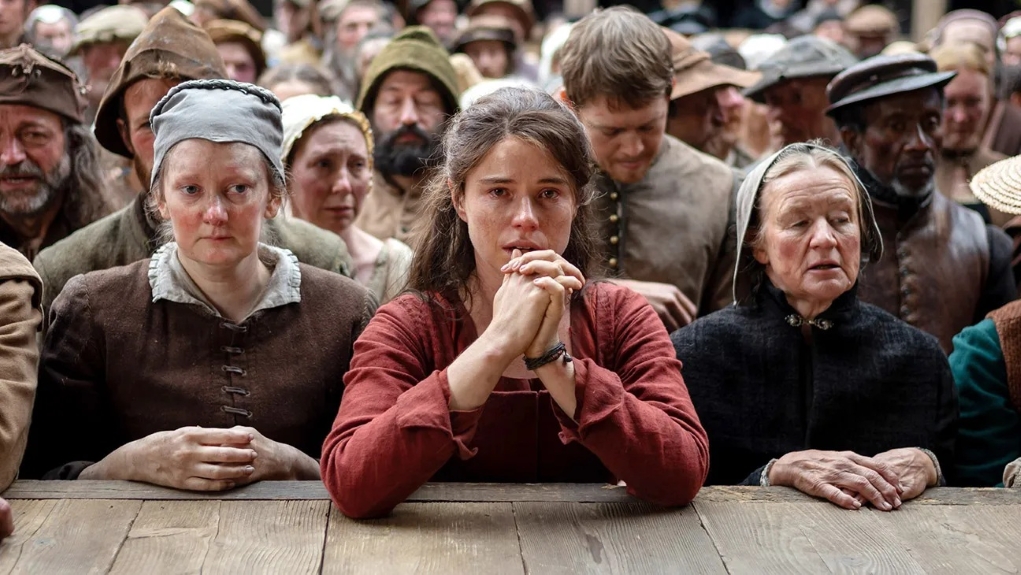
When he was a kid del Toro fell in love with James Whale’s Frankenstein. It was his dream project to create his own version of Mary Shelley’s classic. Year of dreaming pay off in this visually gorgeous, and emotionally engaging film – even if it’s also a little overlong and overindulgent. Del Toro throws everything into Frankenstein, creating a grand Gothic epic whose sympathies firmly lie with the abused Creature.

You must be familiar with the plot: in eighteenth century Germany, Frankenstein (Oscar Isaac), driven by never-really-resolved anger over his mother’s death, dreams of conquering death. With the funding of arms dealer Harlander (Christoph Waltz), who is also uncle to the woman he loves: Elizabeth (Mia Goth) who happens to be fiancée to his younger brother William (Felix Kammerer). On a stormy night, he gives life to the Creature (Jacob Elordi) but quickly rejects him. The Creature tries to find a place in the world, only to discover the world is full of prejudice and violence towards him and the Creature’s resentment against his thoughtless creator grows.

Del Toro’s film looks absolutely stunning, a sumptuously designed Gothic melodrama with extraordinary sets, grand costumes and beautiful cinematography (the Polar-set framing device is particularly striking, covered in lusciously contrasting blues and greens). There are striking echoes of the visual intensity of Pan’s Labyrinth, with Frankenstein’s lab turned into a mix of laboratory and classic temple, including a giant Medusa sculpture. The birthing sequence is a grandiose, operatically Gothic thing of beauty, a version of Whale’s film dialled gloriously up to eleven.

Del Toro’s film goes back to the novel in some ways (in themes and its Polar framing device), but in many ways it’s more of a complex, emotional reimagining of Whale’s film. Isaac’s Frankenstein, an egotist in need of an audience feels very similar to Colin Clive. Whale’s key motif, the Creature’s romantic yearning for the sun, becomes thematically central here. As there, Frankenstein conducts his experiments in a colossal Gothic tower, keeps the Creature chained and makes vague attempts to rear it and takes no responsibility for his actions or the deaths connected to it (in fact Isaacs’s Frankenstein lies and lies in a weasily attempt to protect his reputation). Waltz’s arms dealer funder of Frankenstein’s insanity feels like a version of Pretorious from Bride of Frankenstein, while del Toro goes even further than that film in deepening the bond between the Creature and the Blind Man.

Del Toro also doubles down on Whale’s implicit sympathy for the Creature. Here re-imagined as possessing near super-human strength and durability (his violent responses to being attacked being partially a result of his own strength being uncontrollably great), his child-like vulnerability is as dialled up as his actual physical invulnerability. The Creature feels, first and foremost, like a thought experiment by Frankenstein – and the fact this experiment has effectively rendered the Creature immortal and capable of a Wolverine-like cellular regeneration, condemned to walk the Earth forever alone only heightens the creator’s myopic selfishness.

One of del Toro’s key themes is terrible parenting. Much as he loathed his domineering, brutal father (Charles Dance, in a role perfectly crafted for his austere distance) who caned his face (his hands are too precious) when he flunked remembering anatomy facts, Frankenstein ends up echoing his father’s approach. When the creature constantly fails to say anything other than ‘Victor’, he too reaches for a cane to beat learning into him. Like his father, he resents the creature for being a bad reflection on him. He is, effectively, a dead-beat Dad, casually fathering a child which he has no idea how to treat, who falls back on cruelty.

There can be few Frankenstein’s on film less sympathetic than the version played here by an impressively egotistical Oscar Isaac. He’s full of preening self-importance and self-justification, obsessed with his task but giving no thought to its consequences. Twice he reanimates corpses then callously switches them off without a second thought. Giving birth to Frankenstein – just like in Whale’s film – after an initial interest (that is really self-congratulatory pride) his reaction is to chain him up in the basement and lose patience at him. With his constant milk-drinking there is a sense he’s a little boy who never grew up, and to him love is founded on possession: first of his mother, then his brother, then Elizabeth, all of whom at various points he wants to keep to himself – while his anger at the Creature is rooted in his failing to meet Victor’s expectations.

Frankenstein is at heart an angry mother’s boy, resenting his father for ‘taking’ his mother away from him (del Toro even has him wrapped in his mother’s distinctive red when he wakes to discover the Creature lives). There is more than an echo in that in his love for Elizabeth, the fiancée of his younger brother (who he also subconsciously resents for both ‘killing’ his mother in childbirth and for having the sort of relationship with his father Victor never had). These Freudian feelings are subtly enforced by Mia Goth playing both roles (it’s so subtly done I missed it first time round). Victor’s love for Elizabeth is just as possessive and selfish as that for his mother – and in the same ways his contempt for the Creature is for ‘failing’ him.

By contrast with this monster, the Creature is presented overwhelmingly sympathetically. Played with an outstanding physical and emotional commitment by Jacobi Elordi, he’s framed as a child stumbling towards a painful adolescence. Freshly born, he waddles like a toddler, stares in fascination at leaves floating on a stream and painfully forms the word ‘Victor’. Of course, it never occurs to his creator that this is the equivalent of “mama”. Only Elizabeth, who feels an immediate affinity with the sensitive soul, understands this. Only she tries to speak to him – or asks what his name is.

The poor Creature escapes into a world he quickly full of senseless, prejudiced violence. He bonds with a stag – only for the creature to be shot in front of him by hunters (who instantly turn their guns onto him). In conversation, Elordi presents a man who is sensitive, kind and gentle but capable of anger and fury. Del Toro crafts a tender relationship between the Creature and David Bradley’s Blind Man (the only person, other than Elizabeth, to look past his appearance). The film’s second act, focusing on the Creature’s emotionally painful interaction with the world is its strongest – not least because you feel throughout del Toro’s deep bond with him.

After all this, it’s surprising that Frankenstein ends on a note of hope. Del Toro’s film isn’t always quite nimble enough for this: some of its more optimistic moments can feel as if they have emerged a little thin air (or from the optimistic wishes of the director). In particular, Elizabeth’s bond with the Creature feels so swiftly sketched out it failed to completely convince (more time on this and less time on Waltz’ creepy arms dealer would have been welcome). But this feels like a passionate, committed and perhaps above all beautiful to-look-at piece of work with a real emotional heart. This easily lifts it into the upper echelons of Frankenstein adaptations.

Bugonia (2025)

Bugonia (2025)

Satire, kidnap drama, politics and more combine in Lanthimos’ partially successful thriller

Director: Yorgos Lanthimos

Cast: Emma Stone (Michelle Fuller), Jesse Plemons (Teddy Gatz), Aidan Delbris (Don), Stavros Halkias (Casey), Alicia Silverstone (Sandy Gatz)

The world sometimes feels like its racing towards hell in a handcart And those on the bottom surely can’t help but look at the super-rich and wonder what on Earth do I have in common with them? But some, maybe particularly beaten down by life, may conclude something different: I’ve got nothing in common with the super-rich, because they are literally not of this Earth. That they are mysterious aliens who walk among us, planning to wipe us out. Bugonia takes a deep dive into the troubled, damaged psyche that can embrace the worm-hole of conspiracy theory, as well as the uncaring platitudes of the mega-companies that (maybe) rule the world.

Michelle Fuller (Emma Stone) is the CEO of Auxolith, an all-powerful pharmaceutical company that operates (at times) right on the fringes of legal. She becomes the target of beaten-down beekeeper Teddy Gatz (Jesse Plemons) and his loyal learning-disabled cousin Don (Aidan Delbris). Teddy is certain Michelle is from the planet Andromeda, that she can contact her mothership through her hair and that her mission is to wipe out mankind. Locking her in the basement of his farm-house, they enter into a mix of interrogation, battle of wills and wits and fluctuating power balances. Is Teddy deranged, vulnerable or misguided? Is Michelle scared victim, arch-manipulator or heartless CEO?

All this plays out, often in tight close-up, in Lanthimos’ jet-black comedy, which is two parts social satire to one part blisteringly nihilistic view of humanity and our future. As Burgonia’s carefully oscillates from one side to another, its political views and stances can be hard-to-perceive, but it certainly suggests Lanthimos has hardly the highest hopes for future. This helps make the film fresh, engaging and challenging. It’s constant cuts from one ‘side’ to the other, also means these two rivals rarely share the same frame, visually imposing their distance and rivalry – Lanthimos even uses non-complementary framing to place them awkwardly together, two people with no common ground.

While Teddy nominally holds the cards as the kidnapper, he’s so clearly such a weak, scared, vulnerable character (often framed weakly within the film) it’s hard not to feel sorry for him. Similarly, Michelle may go through some truly ghastly treatment as Teddy tries to unmask her ‘secret identity’, but remains such a forceful, dominant character (“I’m a winner and you are a fucking loser” she rants at Teddy at one point), framed with such utter assurance, her bland corporate indifference to others and willingness to manipulate the fault-lines in her kidnappers relationships (especially the gentle, child-like Don) never make her feel like a victim but just as dangerous as Teddy.

Teddy’s crazy, flat-Earth-mindset (and Lanthimos punctures each chapter with a view of an increasingly flat Earth, which is at first a darkly comic hat tip and then takes on a second chilling meaning late on) ranting and raving is presented as both darkly funny and also unsettling in how he can use it to justify any violence. Sure, it’s funny that he shaves Michelle’s head and covers her with cream to ‘weaken her influence’, or with gentle earnestness stresses he leads the human resistance to Andromeda (membership currently two). Slightly less funny that he insists he and Don chemically castrate themselves so as not to be seduced, or that pumps Michelle full of over 400 volts to try and unmark her (all while insisting her is a humanitarian, but as an alien Michelle technically has no human rights).

But then Michelle’s corporate coldness is rarely absent. She may remember all her staff’s name with a practised efficiency, but there is a degree of empathy missing in her, replaced with pragmatic hardness. As it becomes clear Teddy’s selection of her is (perhaps) more connected to her drugs companies treatment of his mother (Alicia Silverstone), her blasé assurances that everything was done legally and lack of any real guilt speaks volumes.

Lanthimos always keeps us guessing with Michelle: at moments she will switch from fear and vulnerability, to suddenly snapping back with utter authority, absorbing all the power in the room from the frequently hapless Teddy. Teddy in fact increasingly resembles a lost little boy (he even cycles through town with the relentless pedal-turning speed of a toddler), way-out-of-his-depth and at times all but deferring to Michelle’s advice about her own kidnapping.

Bugonia becomes a dance, not only between truth and fiction, but between two strikingly very different people, one so accustomed to power than even when in a nominally powerless situation they don’t feel anything but a winner, the other a desperate, scraggy haired loser who seems unable to really process what he should do to win a hand where he seems to hold all the aces. To make it work you need two electric actors: Lanthimos has this in spades with two trusted collaborators.

Stone’s ability to switch between corporate fear, desperate negotiation and earnest insincerity are as striking as her ability to keep her character so utterly, eventually terrifyingly, unknowable. In every second of Bugonia you can never be certain exactly what sort of person Stone is playing, her sociopathic assurance both understandable in the situation but also deeply unsettling. Plemons’ gives Teddy a child-like earnestness and desire to do the right thing that underpins his unhinged, ludicrous conspiracy theories, making him someone we both pity and understand is capable of doing terrible things for reasons he can justify to himself. Credit also goes to Aidan Delbris’ affecting performance as the gentle, easily-led Don.

Bugonia may well over-play its hands at points. It’s hard not to expect some sort of twist coming our way – I’m not sure how many people will be surprised by how the film plays out. It’s nihilistic ending feels a little too hard-edged and pointed for a film that hasn’t, until that point, embraced that level of flat-out cynicism. A clumsy introduction of a cop with a shady past is thrown in merely (it seems) to give us another reason to feel sorry for Teddy. Lanthimos’ at points engages, not always successfully, in a level of body horror that wouldn’t feel out of place in the excesses of Cronenberg. But then there are moments of real wit: the paralleled cuts of both Teddy/Don and Michelle going through their fitness regimes, a painfully uncomfortable bolognaise meal that tips into a full-out barney between the two stars, it’s unsettling near-finale in Michelle’s office and the playful realisation that much of the truth was there from the start, but hidden.

Bugonia might be a little too scatter-gun and self-consciously crazy to be a really effective satire, but with two terrific performances and an unsettlingly tense shooting style from Lanthimos (with echoes of everything from Dreyer to Hitchcock) there is enough of interest there to keep your mind bubbling even after it’s hard-hittingly sour ending.

The Phoenician Scheme (2025)

The Phoenician Scheme (2025)

Anderson marries heart, truth and a genuinely engaging and compelling plot with his unique quirk

Director: Wes Anderson

Cast: Benecio del Toro (Zsa-Zsa Korda), Mia Threapleton (Sister Liesl), Michael Cera (Bjorn Lund), Riz Ahmed (Prince Farouk), Tom Hanks (Leland), Bryan Cranston (Reagan), Mathieu Amalric (Marseilles Bob), Richard Ayoade (Sergio), Jeffrey Wright (Marty), Scarlett Johansson (Hilda Sussman), Benedict Cumberbatch (Uncle Nubar), Rupert Friend (Excalibur), Hope Davis (Mother Superior), Bill Murray (God), Charlotte Gainsbourg (Korda’s late wife), Willem Dafoe (Knave), F. Murray Abraham (Prophet), Stephen Park (Korda’s pilot), Alex Jennings (Broadcloth), Jason Watkins (Notary)

Wes Anderson is one of those directors I often sit on the fence about, with a style so distinctive it can in become overwhelming. But when it works, it works – and The Phoenician Scheme is (aside from his superb Netflix Dahl adaptations) his best work since his masterpiece The Grand Budapest Hotel. In this film, Anderson finds an emotional and story-telling engagement that adds depth to all the stylised invention. It’s a film I’ve found more rewarding the longer I’ve thought about it.

Set in an Anderson-esque 1950s (Andersonland?), notorious industrialist and arms trader Zsa-Zsa Korda (Benecio del Toro) spends his life dodging assassins. After one attempt gets close, he decides to try and repair his relationship with estranged daughter Liesl (Mia Threapleton), a novice nun who suspects her father might have had her mother murdered (he denies it). With governments, business competitors and others on his tail, Korda throws together a complex scheme for one last success in Phoenicia, a massive new development built with slave labour. As Korda juggles rivals and investors, will he repair his relationship with his daughter? And how will he fare in his recurrent visions of standing at the (noir) Gates of Heaven, being judged for entry?

Anderson’s film, of course, is another superb example of his visual style, constructed like an intricately layered work of art. Each shot could probably hang in an art gallery, framed to perfection with gorgeously sublime colours that soak off the screen. The elaborate set design and vintage costume work are striking as always, with every piece perfectly placed and every feature expertly judged. Within this, his carefully selected cast deliver the wry, dry and arch Anderson-dialogue with aplomb, embracing every moment (of many) where Anderson allows the characters to share a raised eyebrow or a pithy aside to the camera.

In other words, it might all be as you expect – a formula that started to feel a bit tired after intricate, insular films like The French Dispatch and Asteroid City, which felt so personal to Anderson that they were virtually impenetrable to everyone else. But what elevates The Phoenician Scheme is that Anderson embraces both a surprisingly tense plot-line – the closest he can probably get to a thriller, laced throughout with satire, humour and more than a fair share of the ridiculous – and gives a genuine emotional force to a father and daughter struggling to recognise what (if anything) could bring them together. Throw in questions around life, death and what constitutes making a life ‘worth living’ and you’ve got a rich, intriguing and rewarding film that could stand even without the Anderston scaffolding.

Perhaps only Anderson could mix an unscrupulous businessmen targeted by assassins (some of these are delightfully, blackly, comic – not least an opening plane bomb that sees Korda ejecting his pilot for refusing to attempt a crazy hail-Mary manoeuvre to survive an inevitable crash) with Korda closing vital deals (in a deliberately, impenetrably complex scheme) by shooting hoops with a pair of baseball-fanatic brothers (Tom Hanks and Bryan Cranston, both hilarious), taking a bullet for a fez-wearing gangster (Matheiu Almaric, wonderfully weasily) and forcing an eccentric naval captain (Jeffrey Wright, perfectly deadpan) during a blood donation to sign with a bomb. And spin out a joke where Korda hands over custom-made hand grenades to business associates like they are branded pens. All while dodging a shady government cabal (fronted by Rupert Friend’s Transatlantic Arthurian-nick-named Excalibur).

But The Phoenician Scheme works because under this comic twist on spy thrillers, it has a real heart. Anderson’s finest films are where he works with an actor who can bring depth and feeling to the quirk. And here, he might just have brought out the best from an actor prone to a little quirk himself. Benecio del Toro gives Korda a world-weary cynicism but also a subtle fragility. There is nothing that won’t flummox Korda, a guy tipped off on attempts on his life because he frequently recognises assassins he’s hired himself in the past. But he’s also quietly afraid his life has been for nothing: that he is, in fact, not a rogue but an out-and-out villain ruining countless lives. And that God (in the form of, who else, Bill Murray) isn’t going to be welcoming up there.

It motivates a careful dance of reconciliation and grooming to take over his business with his estranged daughter Liesl, delightfully played by Mia Threapleton (with just the right mix of dead-pan flair for the dialogue, while giving it an arch warmth). Liesl imagines herself as distant from Korda as can be – the novice (literally) to his expert manipulator – but she turns out to have far more talent for Korda’s mix of chutzpah, disregard for rules and ruthless improvisation. Watching the relationship – and recognition – between these two (beautifully played by both actors) is very funny and also surprisingly sweet (you know its Anderson when a nun suddenly pulling a small machete out of her wimple is both oddly endearing and absolutely hilarious).

This sense of emotional development and personal and dramatic stakes is improved further by the celestial semi-trial (cue Willem Dafoe as an advocate angel), in a black-and-white heaven that mixes Powell and Pressburger’s Matter of Life and Death (surely the name Korda is no coincidence) and the imagery of Luis Buñuel. This all leads into a surprisingly gentle but affecting tale of redemption and second-chances, including an ending that feels surprising but also somehow completely, wonderfully inevitable and fitting,

The Phoenician Scheme may even be slightly under-served by its Andersonesque framing and design: after all it’s become easy to overlook the depths when the display is as extraordinary as this. When Anderson unearths a deeper meaning, working with masterful performers who can imbue his quirky, witty dialogue with heft, he can be one of the best out there. And do all that without sacrificing an air of charming whimsy, and building towards the most hilarious fist fight since Bridget Jones’s Diary (between del Toro and Cumberbatch’s tyrannically awful Uncle Nubar). Not a lot of directors can pull that off – and it’s a lovely reminder that Anderson at his best is an absolutely unique, wonderful gem in film-making.