Category: Fred Zinnemann

The Men (1950)

The Men (1950)

Brando makes his film debut in this earnest but realistic drama about paraplegic war veterans

Director: Fred Zinnemann

Cast: Marlon Brando (Ken Wilocek), Teresa Wright (Ellen), Everett Sloane (Dr Brock), Jack Webb (Norm), Richard Erdman (Leo), Arthur Jurado (Angel), Virginia Farmer (Nurse Robbins)
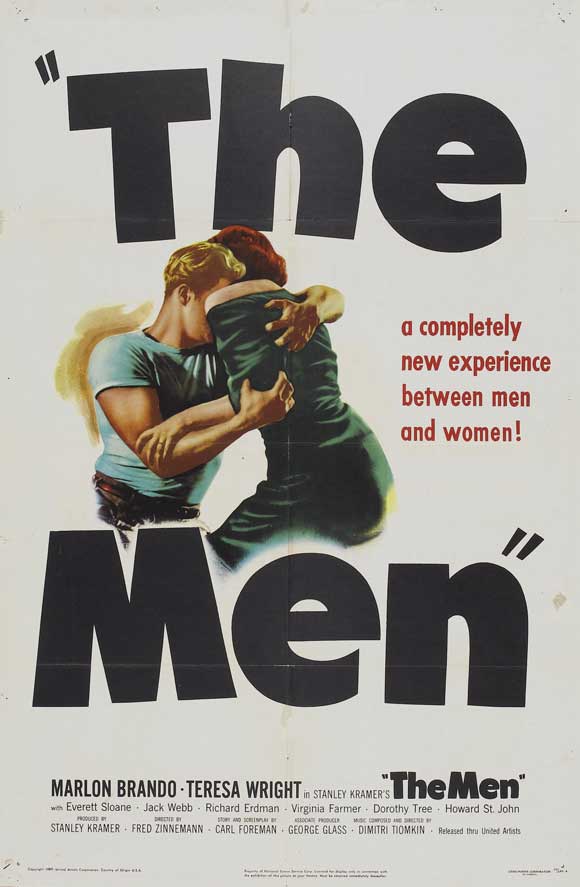
The Men opens with a thoughtful dedication to the two wars many soldiers have fought: the first with weapons, the second “with abiding faith and raw courage” against the physical and emotional consequences of the first. Fred Zinnemann’s documentary-influenced The Men takes a careful look at how the impact of that second war at a paraplegic veterans hospital. Ken Wilocek (Marlon Brando, in his film debut) is a former college sports star now confined to a wheelchair and struggling to adjust. His fiancé Ellen (Teresa Wright) is still eager to marry – but are either of them ready for the difficulties Ken will have adjusting his life?

The biggest strength of The Men – aside from its realist lack of flash – is how it avoids easy answers to big questions. Sure, Carl Foreman’s script has a tendency to lean into a mix of relationship drama and information film. But in looking at Ellen and Ken’s wedding night (and, in a neat visual metaphor of a misfiring champagne bottle, their likely sex lives), The Men is coldly realistic. Ellen might be largely presented as a picture-perfect ideal woman – but even she is freaked out by Ken’s squeaky wheelchair, twitching leg, implied impotence and the thought of what she has let herself in for.

That’s as nothing to the self-loathing fury – directed into rage at Ellen – Ken feels. This man who defined himself by machismo and physicality, who labours for weeks to stand upright so he can get married at the alter (it’s a sign of the film’s avoidance of easy solutions that, despite this, Ken still falls over at the alter) suddenly realises that he will always be partially dependent on his wife for simple tasks. He’ll never be the provider he expected to be – and he’ll never be able to fulfil some of his wife’s sexual needs. A proud man, no wonder the realisation throws him into depression.

It’s moments like this when Zinnemann’s film is at its strongest. It’s a film surprisingly frank and (for the time) daring about the emotional and physical consequences of war injury. Everett Sloane’s impassioned doctor is introduced warning wives and mothers about the consequences of paraplegia and the difficulties emotionally, physically and (he all but says) sexually they will have – but he might as well be talking direct to the camera informing the audience.

ZInnemann’s film, in a dispassionate but respectful way shows the process of rehabilitation, its strengths and its weaknesses. From physical training to the difficult emotional adjustments. The film used several real-life veterans – including Arthur Jurado in a key role as a Latino paraplegic holding onto optimism – and worked closely with hospital medical staff (some of whom appear as themselves). There is a solid sense of respectful realism about the whole thing. (You can feel the hand of producer Stanley Kramer.)

He’s also helped hugely by a powerful, committed and complex performance from Brando in the lead role. Making his first film, Brando astounded Zinnemann and the crew with his commitment. Effectively Brando “learned” to be paraplegic, forming deep friendships with the veterans (far more allegedly than with his fellow actors). His performance is a searing collection of contradictions. Ken is boyish, eager and lets excitement flash across his face when playing sports or driving an adjusted car for the first time. But he’s just as apt to be surly, resentful and bitter, to snap at those trying to help him and furious at the failings his own body have forced on him.

It comes to a head at that disastrous wedding night. Brando struggles with a growing realisation of his dependence and helplessness and his face flares with the pained recognition that this is in no way the wedding night be imagined. Throughout much of the film he is desperate to cling to any chance of recovery – from imagining sensation in his legs to furious workouts to build his upper body strength to help him pretend he still has fully functioning limbs. It’s a fabulous performance, a slice of realism and humanity, underplayed with an everyday casualness.

It does mean Teresa Wright at times looks a little more actorly as Ellen. To be fair to Wright, her part is saddled with the most conventional plot arcs and scenes, of romantic devotion mixed with sudden doubts. (It’s not helped by Dimitri Tiomkin’s overly emphatic themes for her character, that do their best to do all the work for the audience). Her scenes tend to have the air of the infomercial about them, as Ellen debates disabilities with Dr Brock and her doubting parents. Foreman’s dialogue also tends to lean a little too much into “I’ll love you Ken, no matter what” territory.

The Men is at its weakest when it looks at societal integration. For all the quality of Brando and the low-key sensitivity of Zinnemann’s direction, this ends up being a lighter, less impactful version of Wyler’s astounding The Best Years of Our Lives. Brando plays a combination of Dana Andrews’ and Harold Russell’s characters from that film, but The Men never hits the same heights of universal experience and pain as that film does. (Teresa Wright basically plays the same role here as she did opposite Dana Andrews). It’s just a little too low-key, a bit too documentary.

When away from the medical, there is a lack of inspiration and poetry from The Men. It gains a lot from Brando’s performance, but without him it would feel more like a Government infomercial. When it hits drama, for all its daring, it never manages to fully turn itself into something more than a traditional romance-against-the-odds. It has its heart in the right place, but it feels like a companion piece to better films than a classic in its own right.

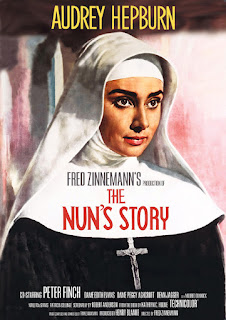
The Nun's Story (1959)

The Nun's Story (1959)

A nun struggles to balance faith and duty in this handsomely made, beautifully paced drama

Director: Fred Zinnemann

Cast: Audrey Hepburn (Sister Luke/Gabrielle van der Mal), Peter Finch (Dr Fortunati), Edith Evans (Reverend Mother Emmanuel), Peggy Ashcroft (Mother Mathilde), Dean Jagger (Dr van der Mal), Mildred Dunnock (Sister Margharita), Beatrice Straight (Mother Christophe), Patricia Collinge (Sister William), Rosalie Crutchley (Sister Eleanor), Ruth White (Mother Marcella), Barbara O’Neil (Mother Didyma), Colleen Dewhurst (“Archangel Gabriel”)

Gabrille van der Mal (Audrey Hepburn) has two passions in her life: her faith and a desire to heal the sick. Dreaming of combining these and working with native patients suffering from tropical diseases in the Belgian Congo, at 19 she joins an order of nuns who specialise in nursing. But the life of nun is far from an easy one, and Sister Luke (as she becomes) constantly struggles to square the circle of her faith, passion for medicine, ambitions and her natural antipathy towards authority. It’s a square she struggles with for almost twenty years, culminating in a crisis of faith during the German occupation of Belgium during World War II.

Zinnemann’s gracefully directed film, not surprisingly won the warm support of the Production Code Office, with its faithful depiction of the life and work of Nuns ticking all the boxes of a devout picture. However, The Nun’s Story is a more complex and intriguing film than this. While it finds much to praise in the self-sacrifice and devotion of the nun’s life, it isn’t afraid to look at how this institution (like many others) values obedience over innovation and praises submission over individualism. It stresses, in a way very few other films have done, how strikingly difficult it must be to lead your life in a religious devotion, and how much such orders (by their nature) demand we must put aside our natural inclinations.

Sister Luke is warned from the start by her doctor father (a genial Dean Jagger) that, with her stubbornness and independence, she is likely to find strictures on obedience hard to follow. He’s right. Superbly played by Audrey Hepburn (in her personal favourite performance), Sister Luke constantly finds it a near impossible struggle to submit herself to the authority of the order. Hepburn makes clear Sister Luke’s sincere faith, and her desire to belong, but also her unwillingness to accept that this might involve any compromise on her work as a nurse.

From the first she demonstrates she is unwilling to stop tending to a patient when the bell rings for her to attend prayer. She constantly reproofs herself for her inability to subjugate her personality to the requirements of her religious order. Training in tropical diseases at her medical college, she refuses a request from Mother Marcella to deliberately flunk an exam to prove her humility. As a ‘reward’, the best qualified nun in tropical diseases is dispatched to a sanatorium in Belgium to further learn obedience. Even when she is eventually allowed to work in the Congo it’s only in the “White’s Only” hospital (as they need the staff) and she is reproved for showing off when she makes much needed improvements to the hospitals working practices.

In many ways the film is a fascinating look at how hard it was for a woman to make a mark in the early 20th century. Clearly Sister Luke should have trained as a doctor – she graduates fourth in her class in tropical medicines – but that door was closed to her, and her only chance of working in Africa was as a member of a religious order. She ends up working in a system where she must constantly make difficult calls between her two passions (faith and medicine) – with her order placing devotion and obedience as the primary goal.

Not that the film is disparaging of religion. The devotion and goodness of the nuns is above question. Their ability to turn the other cheek and forgive is shown as an unparalleled virtue – even a shocking crime in the Congo is patiently forgiven. Many senior nuns are more than capable of balancing Sister Luke’s devotion to medicine with the orders demands. Mother Christophe (wonderfully and warmly played by Beatrice Straight) at the sanatorium, disagrees with the exam choice forced on Sister Luke and supports her to find a balance between her work and her order’s demand for obedience. Mother Mathilde (a matronly Peggy Ashcroft) in the Congo encourages her improvements – with the proviso she is told first. Others – such as Reverend Mother Emmanuel (a gently reserved Edith Evans) – consider it more important that Sister Luke dilutes her individualism in the order.

It makes for a fascinating film, that praises the devotion and self-sacrifice of religious orders, while not shying away from how rigid they often (by their very nature) are. Sister Luke in many ways is an ill-fit for being a nun. She can’t, or won’t, put her own beliefs about what is right second and she has an obstinance and pride (which she admits herself) that should really have ruled her out from the order in the first place. While the film doesn’t quite do enough to give as much space to her faith as it does her passion for medicine, it also makes it clear many characters – most astutely Peter Finch’s coolly professional Congo-based atheist doctor – recognise that she isn’t able to make the ultimate sacrifice that being a nun requires: the full submission of her own will.

Zinnemann directs this with a graceful, careful pace that finds many moments of quiet emotion amongst the imposing world of the order. The film is bookended by beautifully done sequences of departure and arrival, with possessions carefully left-behind and doors opening onto new and radically different worlds (the ending in particular plays out in a powerful silence). The film is beautifully shot by Franz Planer, with a wonderfully restrained score by Franz Waxman. It’s perfect material for this director, who was always strongest when showing the individual struggling within a system that demands they turn against their own nature.

The Nun’s Story is perhaps a little overlong and at times takes it stately pace a little too slowly. But it has a wonderful performance by Audrey Hepburn (who is in nearly every single frame), gorgeous location shooting and is directed with restraint and intelligence by Zinnemann. It also manages the difficult duty of finding things to both praise and criticise in the life of a religious order and both respects and questions the lifestyle and its rules. A middle brow film no doubt, but a fine example of highly skilled and professional Hollywood film-making.

Julia (1977)

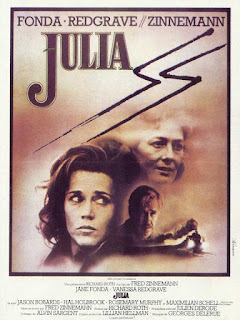
Julia header
Jane Fonda and Vanessa Redgrave play friends separated by time in Fred Zinnemann’s award-bait Julia

Director: Fred Zinnemann

Cast: Jane Fonda (Lilian Hellman), Vanessa Redgrave (Julia), Jason Robards (Dashiell Hammett), Maximilian Schell (Mr Johann), Hal Holbrook (Alan), Rosemary Murphy (Dorothy Parker), Dora Dull (Woman passenger), Elizabeth Mortensen (Girl passenger), Meryl Streep (Anne Marie), John Glover (Sammy)

Playwright Lilian Hellman (Jane Fonda) remembers her close childhood friendship with Julia (Vanessa Redgrave), the daughter of wealthy Jewish parents being bought up by her grandparents. As young women, their lives take dramatically different routes: Lilian finds eventual success with The Children’s Hour, with the support of her mentor and lover Dashiell Hammett (Jason Robards); Julia travels to Vienna and then Germany where she becomes involved in anti-Nazi activity. Eventually, the need for money leads to Julia asking Lilian to smuggle funds over the German border.

That’s the meat of Fred Zinnemann’s old-fashioned, highly-genteel memory piece that also manages to make it sound far more exciting and interesting than the dry, worthy, middle-brow story that actually ends up on screen. What’s missing from the film almost completely is passion. This is a story that required fire: a sympathy for radicalism, or anger at the targeted cruelty and injustice of fascism. It gets none of this, instead offering a handsome reconstruction of period details, all filmed with a Golden Age glow, and a narrative focus that feels like it’s aimed at the wrong character.

It’s part of why this awards-bait drama hasn’t lasted in the public perception (it’s very hard to find a copy to watch – really striking for a film nominated for 11 Oscars and winning three, including two acting Oscars). There is very little really rewarding either emotionally or narratively here. The film lacks a real sense of danger or foreboding – even a scene showing fascist thugs throwing Jewish students off a balcony in Vienna is shot with a striking lack of edge or horror. And it unbalances itself by giving more time and priority to Hellman’s struggles to come up with a play “worthy of her” than it does to the title character and the real drama of her struggles. Redgrave is on screen for about 14 minutes. It’s effectively like watching The Pianist but entirely from the perspective of Emilia Fox’s character rather than Adrien Brody’s.

What we end up with is a film that feels old-fashioned, dry and respectable. It offers everything that will impress you, and reassure you that it is important film-making: a big subject, famous names, actors giving emotional performances, period detail, a tragic ending. But it lines these factors up in a way that never ever comes to life dramatically. There is a story buried in here about friendship – and Fonda and Redgrave are very good at selling a strong personal bond, especially considering their limited time on screen together – but what should be the heart of the story gets lost in a biography of Hellman, a digression into her relationship with Dashiell Hammett, and the lack of insight the film seems to have into the fate of Jews and outsiders in an increasingly fascist Europe.

The film’s only real sequence of interest is Hellman’s dash with money across the border and illicit meeting with Julia, a sequence involving coded messages, switching of hats and double-meaning conversation which fits with a spy novel. Zinnemann films this with a fine air of tension and intrigue – but it’s the only time the film stumbles to life.

I think Zinnemann struggled to find what really compelled him to tell this story. Which is a shame as a Julia-focused story – a woman struggling against a system – would have been meat and drink to the director of High Noon, From Here to Eternity and A Man For All Seasons. Instead, his skill from those films of empathising with characters trapped in a desperate situation and forced to take a stand on principle, is lost. In the end he and the film find little to interest them in Hellman, the successful novelist who feels a middle-class intellectual’s guilt at not doing more to help, who is fundamentally a footnote in a far larger story of rising Nazi terror in Europe.

The film has also perhaps faded from public attention because subsequent controversy revealed that a large part of this true story was almost certainly self-aggrandising bull-shit by Hellman. A New York psychiatrist, Muriel Gardiner, claimed in 1983 that Julia’s story was her story and that she had never met Hellman (but they did share a lawyer). No trace of a “Julia” has been found in Hellman’s life, and no evidence at all that she ever undertook this dangerous dash into Germany. Zinnemann also fell out with Hellman, privately coming to believe she was “an extremely talented, brilliant woman, but she was a phony character” and said his “relations with her were very guarded and ended in pure hatred”. Knowing that, it’s hard not to see the same distance on the screen.

Saying that, Jane Fonda is very good in the film, surprisingly fragile, uncertain and scared, and plagued with guilt that she cannot do enough to help her friend. Redgrave won an Oscar for her committed and passionate performance, which tapped into her radicalism and gives a slight character a great deal of depth (in her speech, the pro-Palestinian Redgrave made a famously controversial political speech denouncing “Zionist hoodlums”). Robards won the film’s other acting Oscar, for a professional turn as Hammett. In a very weak year for American film, Schell also landed an Oscar nomination for a brief cameo as a go-between Hellman meets in a Parisian park.

The performances are fine and the style and manner of the film is reassuringly middle-of-the-road. There is everything here to convince you this is an important film, apart from drama, purpose or conviction. Perhaps it’s so hard to find, because so few people have looked for it since 1977?

From Here to Eternity (1953)

From Here to Eternity (1953)

Glorious romance goes up against military discipline in this sweeping, entertaining Oscar-winner

Director: Fred Zinnemann

Cast: Burt Lancaster (First Sergeant Milton Warden), Montgomery Clift (Private Robert E. Lee Prewitt), Deborah Kerr (Karen Holmes), Donna Reed (Alma Burke/Lorene), Frank Sinatra (Private Angelo Maggio), Philip Ober (Captain Dana Holmes), Mickey Shaughnessy (Sergeant Leva), Harry Bellaver (Private Mazzioli), Ernest Borgnine (Staff Sergeant James “Fatso” Judson), Jack Warden (Corporal Buckley)

Dominating the 1953 Oscars, From Here to Eternity is exactly the sort of sweeping, highly-professional studio epic Hollywood at its best produced in its Golden Years. Everything turned out pretty much right, with iconic imagery and characters, and skilled production and acting turning a soapy story into something quite profound. From Here to Eternity is entertainment-as-art, a sharply intelligent film that sails along smoothly. It feels like a generational progression from Casablanca – it may not quite hit those heights, but it deserves to be in the same conversation.

It’s 1941 at Pearl Harbour and three soldiers discover going their own way, rather than conforming to rules and expectations, causes no end of trouble. Private Prewitt (Montgomery Clift) is repeatedly hazed by his comrades (with the support of his CO) for refusing to join the boxing team. A champion boxer, Prewitt retired after accidentally blinding an opponent and nothing will persuade him to go back. His only comfort is with local social club ‘hostess’ Lorene (Donna Reed). First Sergeant Warden (Burt Lancaster) is persuaded to try for officer – because otherwise he risks prison for his love affair with the CO’s unloved wife Karen (Deborah Kerr). Private Maggio (Frank Sinatra), Prewitt’s only friend, is a loyal wild-card who can’t stick to the rules and is targeted by brutal stockade sergeant “Fatso” Judson (Ernest Borgnine).

From Here to Eternity sounds like a great big soap, a sort of 1980s glossy TV mini-series made before its time (it was later remade exactly as that). It’s got that in its DNA, but is made with such luscious, professional, old-school Hollywood excellence it becomes something special. Superb craftsmen work in every position to produce a classic melodrama with touches of romance, thriller, war drama and tragedy. With excellent performances across the board (Sinatra and Reed both won Oscars, while Lancaster, Clift and Kerr were all nominated), FHtE tells emotive, empathetic stories about genuine characters trapped in situations beyond their control.

The film is a masterclass in adaptation. The original novel – a popular tome of its day – tells a story crammed full of sex, STDs, homosexuality, bad language and violence across its 800+ pages. No wonder it was a hit – and no wonder, under the Production Code, it was thought impossible to adapt it into a film. Screenwriter Daniel Taradash carefully reworked and ‘hinted’ at several things that could not be explicitly said (for example, no one calls Lorene a prostitute, but you’d have to be pretty dense not to realise she is doing more than pouring drinks in that bar). Restraint, as it often did, demanded invention and bought out the best (and subtle work) in people. The film’s requirement to focus on dialogue and character rather than controversy hugely works to its benefit.

Zinnemann was the perfect director for the material. Drawing wonderful performances from the actors, he also keep the film intimate, drawing us closer to the characters over scale, despite the temptations of the film’s location shooting in Hawaii (Zinnemann pushed strongly against shooting in technicolour and widescreen). The film also fits perfectly with one of Zinnemann’s key pre-occupations: the struggle of principled men (most strikingly Prewitt) in a society that demands them to say or do something against those principles. Just as the townspeople wanted Marshal to run and the Tudor court wanted More to swear allegiance, so our characters buck against conforming with the roles they are expected to play.

You can see why the military – after supporting the project – were less happy when they saw the film. The individual is championed at the cost of the machine. Prewitt’s principles are praised, while his regiment is hopelessly corrupted by his incompetent and careerist commander. The hazing is endemic, and supported from above – and no one even notices or cares that Fatso is also abusing his position to brutalize Maggio. The CO is so useless – as well as ruining his wife’s life, rendering her infertile and cheating on her all over town – that the company is effectively run by First Sergeant Warden, the only NCO with the courage of his principles. Under pressure from their army sponsors, the film does see the chain of command cashier the CO (a scene Zinnemann hated) – but the sympathy is with the individual rather than the system.

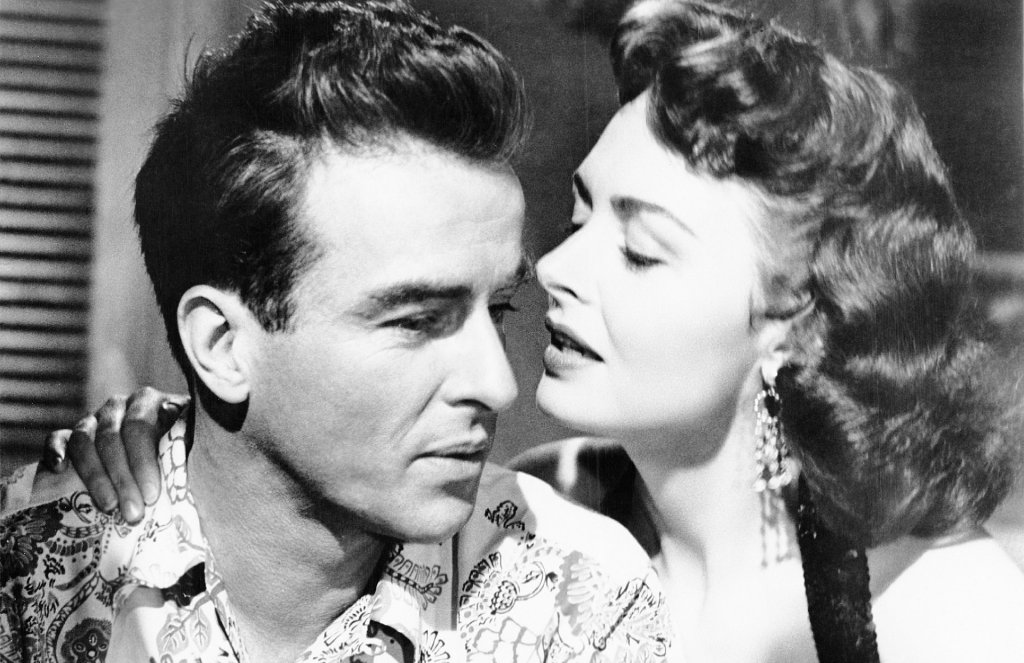
From Here to Eternity is also a highly effective romance. Its most famous image will always be the clinch between Lancaster and Kerr, kissing and embracing while the turf washes up around them. But the film is also realistic – its why it remains so effective. Warden and Karen are made as miserable by their growing love as they are happy (they even comment on this). Relationships are never an easy ride, and demand constant dedication. Lorene and Prewitt’s relationship is far from rose-tinted, with the two of them constantly forced apart by their own mistakes and choices.

It’s melodrama told with emotional intelligence and realism – and Zinnemann gets great performances from great actors. Lancaster brings immense strength and purpose to Warden, but also a concealed vulnerability and decency. Kerr – revitalising her career after a string of “good wives” – brilliantly conveys Karen’s desperation and misery, along with her wary hope her life could change. That moment on the beach, the surf washing around them as they make-out is a rare moment of relaxed happiness. Other than that, its one tough conversation after another – stolen moments in bars or cars, where the two of them confront the difficulty of their situation, but also their need for each other. That’s old school romance for you – unavoidable, but never-endingly difficult and even a little painful.

Sinatra (in the role that changed his career – and the debate around how he got the role inspired that horse’s head in The Godfather) brings charm, cheek and tragedy to Maggio. How did Maggio end up in this man’s army? He’s quietly fun loving, but bucks the rules like almost no other character in the film. Sure he’s an upstanding guy – the only one who sticks by Prewit and defends him – but he can’t follow a simple order. Mostly because he’s not really disciplined enough. Plus he makes enemies – worst of all Borgnine’s bruising sergeant. He’d be so much happier running a bar for soldiers than he ever is being a soldier himself.

This makes him very different from Clift’s Prewit. Clift gives one of his finest performances as this fully-realised tragic hero. Prewit is a man of principle who, for the best reasons, makes choices that have a terrible impact on him. He’ll stand by his decision not to box, even though it opens up a bucket load of unpleasantness for him and Maggio. If that leaves him with one friend and no supporters, so be it. He may not look like a boxer (the studio wanted a more muscular lead), but he is every inch the emotionally conflicted, guilt-plagued and confused GI, stubborn but profoundly sincere, with the strength of character to stand alone, but the vulnerability to need affection from Lorene (and respond like a lovesick kid when he thinks she has spurned him). It’s a complex, mature and excellent performance.

All these events are eventually dwarfed by the outbreak of war. If there is one thing that Zinnemann will accept is bigger than the individual, it’s world war. The film quietly counts down to the attack on Pearl Harbor (without the characters realising it), sneaking us peaks at calendars and reports to let us know how close we are to the fateful day. When it comes, it reveals the characters of the people we’ve been following. Warden takes command in a way his CO never could. Prewit, hiding out with Lorene (Reed by the way is marvellous, her investing Lorene with a real world-weary sadness), decides its his mission to return from AWOL, despite the dangers this will cause him. The attack is grippingly but simply filmed.

From Here to Eternity is a complex film, made with real professional skill, and a rewarding character study. Zinnemann gets the tone right at almost every single point and draws out brilliant performances from a very strong cast. As an example of Hollywood Studio film making, it’s hard to beat.

High Noon (1952)

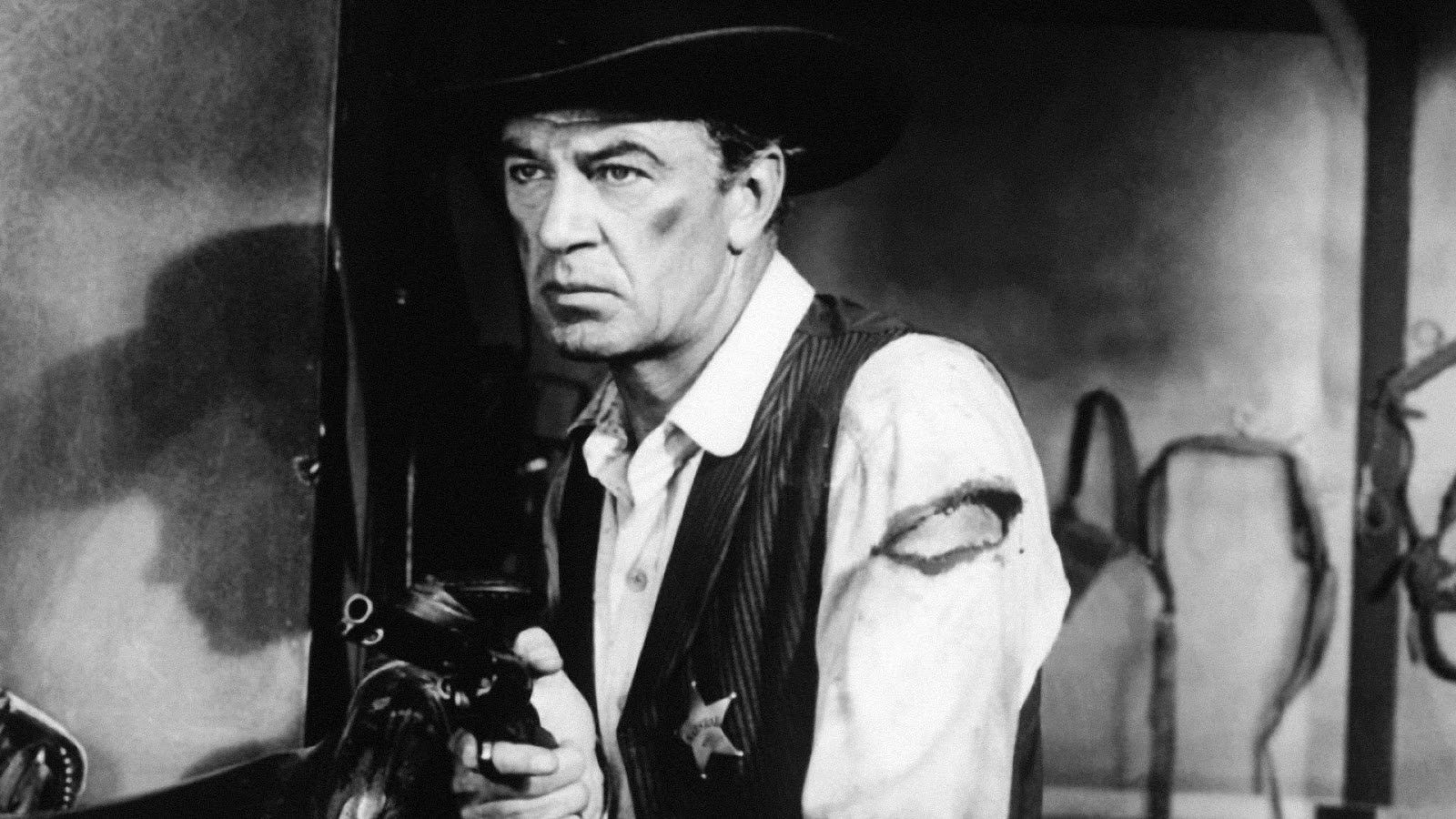
Gary Cooper stands alone in High Noon

Director: Fred Zinnemann

Cast: Gary Cooper (Marshal Will Kane), Grace Kelly (Amy Fowler Kane), Thomas Mitchell (Mayor Jonas Henderson), Lloyd Bridges (Deputy Marshal Harvey Pell), Katy Jurado (Helen Ramirez), Otto Kruger (Judge Percy Mettrick), Lon Chaney Jny (Marshal Martin Howe), Eve McVeagh (Mildred Fuller), Harry Morgan (Sam Fuller), Morgan Farley (Minister Mahin), Ian MacDonald (Frank Miller), Lee Van Cleef (Jack Colby)

It’s 10:35 am on the day of the wedding of retiring Marshal Will Kane (Gary Cooper) to Quaker Amy Fowler (Grace Kelly). It should be the happiest day of his life – but events are interrupted by news that Frank Miller (Ian MacDonald), a killer Kane put away, has been released and will arrive on the midday train with his gang to kill Kane. Kane’s first instinct – and the town’s – is for Kane to flee the town: but Kane doesn’t want to spend his life looking over his shoulder, and besides his friends and colleagues in the town will stand with him right? He decides to make his stand – to the outrage of his pacifist wife – only to find one-by-one the citizens of the town excuse themselves from helping Kane. After all, who wants to die?

Playing out like a Western 24, Kane has got a little under 90 minutes to put together a posse to give himself a fighting chance against these hardened killers. Zinnemann’s film is full of carefully placed shots of clocks that hammer home the ominous approach of Kane’s seemingly inevitable death. In a brilliant use of contrasts, Kane walks with growing desperation in virtually every shot through the increasingly abandoned town, mixed with clever cut-backs to the Miller gang waiting patiently at the train station (with deep focus shots of the train lines stretching on forever) for Miller to arrive and kick off the killing. Using a wonderful combination of low-angles, tracking shots and one superb crane shot that pulls out and away to show Kane stranded alone in the abandoned town, Zinnemann’s film stresses Kane’s isolation, anxiety and growing desperation.

Because Kane is scared. And why shouldn’t he be? He’s past-his-best and over-the-hill, a long-serving hero on his last day in the job, outmatched by his opponent. Why on earth wouldn’t he be desperate for help? John Wayne and Howard Hawks hated the film, loathed its perceived anti-American-spirit and, most of all, couldn’t stand the idea of a Western hero being scared and desperate for help. They even made a twist on the film, Rio Bravo, where Wayne played a marshal turning down any and all help in order to do what a man needs to do alone. For them that was a Western hero, and this self-doubting, anxious pussy Kane – the man even cries at one point! – was an abomination.

Cooper seemed to be no-one’s choice for the film – Heston, Brando, Fonda, Douglas, Clift and Lancaster all turned it down – but scooped the Oscar as Kane. Then 51, his obvious age and vulnerability – at one point Lloyd Bridges almost beats the crap out of him – make him feel even more at risk from this threat. In a performance devoid of vanity – other than perhaps Kane landing the radiant (and thirty years younger) Grace Kelly as his wife – Cooper is sweaty, nervous, twitchy and a mix of All-American duty and genuine nerves, resentment and terror at what feels almost certain to be his end. Kane knows why he must do it, but to Wayne’s disgust, he still doesn’t like it.

Carl Foreman, the screenwriter, was to be pulled before the House of Un-American Activities for his communist sympathies. And the entire film is pretty clearly a commentary on the McCarthyite era, specifically the abandonment of those pulled before the house by those who seemed to be their friends. Like the blacklisted Hollywood writers and actors, Kane opens the film with admirers and friends all of whom eulogise his greatness and decency: and all of them turn their back on him as the chips go crumbling down.

Most of the film is given over to Kane desperately going from ally to ally, only to find that he is offered only platitudes, excuses and outright cowardice. His deputy demands a recommendation for Kane’s job, and chucks in his star when Kane refuses. Old friends hide in their houses and refuse to come out when Kane comes calling. Lon Chaney Jnr’s retired marshal pleads illness. The judge rides straight out of town and suggests Kane does the same. At a town meeting in the church, the voices calling to help Kane are few and far between, and Mayor Thomas Mitchell praises Kane to the skies, before concluding the town would be better off if he could ride away and not come back. The one man who volunteers backs down when he finds out no one else has volunteered, and the only person eager to fight is a 14 year old boy. 

So much for loyalty and the American way. When the chips are down, words mean nothing and it’s the actions that show the man. Customers in the saloon talk about how life wasn’t that bad when the Millers ruled the town (to show how wrong this is, literally their first action when riding into town is to steal something from a milliners). Others moan that all this law enforcement from Kane has actually made business a bit worse for the town. Why do the hard thing, why make the stand, when it’s so much easier to just look down, keep quiet and let the just suffer while your life ticks on.

Cooper’s Kane is masterfully low-key, subtle, using only the slightest gestures to show deep-rooted, only barely hidden resentment and bitterness, covering fear. What he’s doing he’d give anything not to do, but he sees no choice. There is no other Western where the hero writes a will, and quietly weeps with his head on his hands on his desk. There is no other Western where the hero spends so long trying to make a manly task easier to do. There is no other Western where the self-serving cowardice and hypocrisy of the townsfolk are more blatant. No wonder Cooper – in the final insult for Wayne – drops his tin star in the dirt at the film’s end, as the townsfolk rush out to congratulate him on winning the duel. This is a film that looks at America as it really is – and many people didn’t like that one little bit.

Zinnemann’s direction is spot on, a perfect blend of tension build and technical mastery, mixed with superb dialogue from Carl Foreman. Not a word or shot is wasted, and every single character and event is carefully sketched in, established and build up with no effort at all. Cooper is superb, Grace Kelly just as good in a thankless role as the humourless Quaker wife who struggles with her life-long principles against her love for her husband. Beautifully filmed, with a wonderful score with Dimitri Tiomkin, High Noon is a classic for a reason, a masterpiece of slow-build and enlightened social commentary.

The Day of the Jackal (1973)


Edward Fox takes aim as suave assassin The Jackal

Director: Fred Zinnemann

Cast: Edward Fox (The Jackal), Michel Lonsdale (Deputy Commissioner Claude Lebel), Terence Alexander (Lloyd), Michael Auclair (Colonel Rolland), Alan Badel (The Minister), Tony Britton (Inspector Thomas), Denis Carey (Casson), Cyril Cusack (Gunsmith), Maurice Denham (General Colbert), Olga Georges-Picot (Denise), Barrie Ingham (St. Clair), Derek Jacobi (Caron), Jean Martin (Wolenski), Ronald Pickup (Forger), Anton Rodgers (Bernard), Delphine Seyrig (Colette de Montpellier), Donald Sinden (Mallinson), Timothy West (Commissioner Berthier)

The definition of lazy criticism is to say a story doesn’t work because we know the outcome. If that was the case, no production of Hamlet would ever work, and no adaptation of a best-selling book would ever find favour with an audience. We’d be bored by films based on history and we’d be even more indifferent to the hundreds of films made every year that follow accepted narrative structures. What makes a film compelling is often not the destination, but the journey. How do we get there? What do we learn? How does it make us feel? All of these things are keenly observed throughout Fred Zinnemann’s masterful adaptation of The Day of the Jackal.

The year is 1962 and the French President Charles de Gaulle is blamed by many for weakening France by granting independence to Algeria. The Organisation Armée Secrète (OAS) hire an English professional assassin known only as The Jackal (Edward Fox) to assassinate De Gaulle. When word of the target leaks to the panicked French Government, Commissioner Claude Lebel (Michael Lonsdale) is given an impossible task – identify a man of whom the government knows nothing and stop him from carrying out a plan only he knows the details of. Meanwhile, the Jackal relentlessly goes about his meticulous planning.

So anyone with passing familiarity with history will know that de Gaulle was not assassinated in the early 60s. Watching The Day of the Jackal, you know that the Jackal will fail. But that’s not the point of the film. Instead it’s a masterful, streamlined thriller that completely understands how much we can invest in watching someone go about a job with calm, cool professionalism. It’s the ingenuity and meticulousness that makes the film compelling, the way each angle of the Jackal’s plan is carefully considered and information slowly delivered to the audience. In some areas we are a couple of steps ahead of Lebel’s search. In others we are as far behind as he is: we may know the weapon and the Jackal’s secret identities, but we know as little about his final plan as Lebel does – it’s only when it’s revealed that all the pieces we’ve seen make perfect sense.

It’s a film that has been assembled with all the grace and skill of a master clockmaker. Zinnemann’s direction and Kenneth Ross’ taut screenplay make every second count. There isn’t a single piece of flab on the bones of this movie, every scene carries a piece of vital information that contributes to the overall picture. Zinnemann sprinkles the film with careful passing shots of calendars and clocks, making the sense of a countdown towards the Jackal’s strike hang intimidatingly over the whole film. The film is gripping, right from its opening reconstruction of the almost-successful OAS assassination attempt on De Gaulle in 1962. Everything feels perfectly interlinked and connected, each scene brilliantly builds on top of the ones before.

This is quite simply an unshakeably brilliant engine of a film, a relentless ride with tension and excitement dripping from every frame. It’s not afraid to be cruel or dangerous – and some of the victims are truly blameless – and it’s not afraid to show that violence and cruelty are weapons as much for the authorities as the Jackal (the cruellest act, after all, is committed by the French Army on poor loyal Wawlinski).

A large part of the success of the film rests on Edward Fox’s performance in the lead. Fox gives the Jackal an unshakeable, public-school, confidence, an attractive resolve that sees him meet every obstacle with a cool elán, resolutely unperplexed by anything that he encounters. Fox’s superb performance succeeds in making you engage with (and even root for) a man who is a cold-blooded professional killer, who commits murder (when provoked) without hesitation. How does this happen? Again it’s his efficiency, his expertise. The film totally understands how engrossing watching talented people go about their work can be.

The film makes the minutia of setting up an operation immensely compelling. In careful detail, we see exactly how the Jackal goes about getting a false passport from the authorities. How he scopes out a potential place to conduct the assassination. His careful preparation of disguises and fake identities. In one gloriously done scene, we see him practise using his specially constructed rifle on a melon at a huge range. Carefully he takes a series of shots at the melon, adjusting the sight each time to make the weapon as accurate as possible. The scene is a showcase for the Jackal’s meticulous professionalism (you can see why the producers were outraged when the scene was cut from a TV screening in the 1980s – it’s practically a highlight of the movie).

Similar investment, however, is made in the detailed footwork involved in tracing and detecting the Jackal by the French and English police. Michael Lonsdale is a perfect foil for Fox’s urbane cool, with his dour, grey, crumpled Label, a man selected somewhat unwillingly for a mission but who slowly reveals the cool head and nerves of steel that made him perfect for the job. The police-work used to try and close the net on the Jackal is as intricate as the hitman’s own work – careful plodding through files and methodical calculation and educated guesswork. It’s as far from the rush and tumble of Hollywood as you can imagine – but somehow, because it feels so real, every discovery against the odds by the authorities becomes hard-won and exciting. The sense of a net being skilfully built also serves to make the Jackal’s skilful evasion of each trap all the more compelling.

And the tense race against time lasts for the whole of the film. The film brilliantly keeps this cat-and-mouse game alive, with the police and the Jackal constantly leap-frogging each other to stay one step ahead. Each move and counter-move has all the intricacy of a chess game. There are enough twists and turns to keep every audience member gripped. The eventual assassination attempt itself is built up to beautifully – a wordless, tense but brilliantly assembled montage of liberation day celebrations keeps both the police and the audience on their toes as to where the Jackal will strike from. The finale of the film turns on a twist of fate that is simply a brilliant coup de theatre. There is even a droll little coda that deepens the mystery of the Jackal even further.

Zinnemann’s direction throughout is flawless – calm, measured and methodical, and never allowing flash or bombast to drown out events. It’s helped as well by the wonderful cast of actors – a real who’s-who of British and French character actor talent, with Alan Badel’s smooth Interior Minister, Eric Porter’s cool but fanatic OAS leader, Cyril Cusack’s quiet gunsmith and Derek Jacobi’s eager young detective particular standouts. I also have a lot of time for Olga Georges-Picot’s quietly moving performance of a woman pushed to extreme actions by grief.

The Day of the Jackal is another of those near perfect movies. Everything it sets out to do it does perfectly, and it rewards constant viewing. It’s got some terrific unflashy performances and is a perfect demonstration of why professionalism and expertise can be so engrossing. It wraps this up into a deliciously tense confection, where every scene bubbles with undercurrents of drama and danger. There is not an off-beat – instead it’s a brilliant piece of pulp cinema that transcends itself into being something truly adept and dramatic. You can’t take your eyes off it for a second. I don’t hesitate for a second in saying it’s one my favourite thrillers.

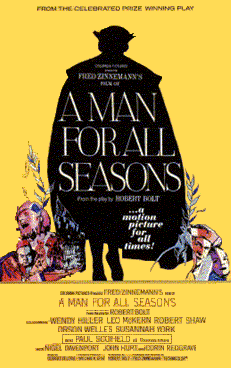
A Man For All Seasons (1966)


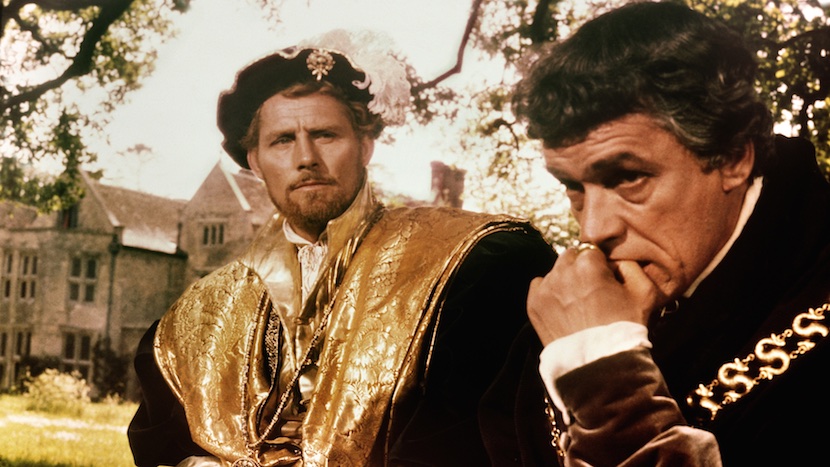
Paul Scofield ways up a difficult demand from a not-so merry monarch

Director: Fred Zinnemann

Cast: Paul Scofield (Sir Thomas More), Wendy Hiller (Alice More), Robert Shaw (Henry VIII), Orson Welles (Cardinal Wolsey), Leo McKern (Thomas Cromwell), Susannah York (Margaret More), Nigel Davenport (Duke of Norfolk), John Hurt (Richard Rich), Corin Redgrave (William Roper), Colin Blakely (Matthew)

Writing these film reviews is sometimes harder when it’s a film you know so well. I was probably in my very early teens when I first saw this and I’ve seen it dozens of times since. I know all the scenes, all the beats, and I love it. This is a brilliant film, and its depth, richness and intelligence are ingrained. It’s a wonderfully written, played and directed piece that transforms a historical event from a history lesson into an endlessly relevant and affecting parable.

Paul Scofield (simply becoming the man) is Sir Thomas More. With Queen Catherine unable to bear Henry VIII (Robert Shaw) a son, wheels are in motion to ditch the Queen and marry the king to Anne Boleyn (a split second cameo from an unpaid Vanessa Redgrave, making you believe in a moment Anne could split a kingdom). More, however, can’t agree to the divorce – his faith in the Catholic church is non-negotiable, and the church won’t recognise the marriage. So while the rest of the kingdom falls in line, More is arrested and takes refuge in his complete silence – having never spoken of his reasons, he can never be tried for them.

Re-watching this masterful film for the first time in a few years on a newly released, fully restored Blu-ray, I was immediately reminded what a thoughtful, interesting and enjoyable film it is. Having read the play again, I genuinely think (and I’m not alone) Bolt’s script is superior to the original. Several changes have been made, most notably the removal of the “Common Man”, a theatrical device whereby one actor played all the smaller working class roles, while delivering a commentary on the action. It’s a very theatrical device, which Bolt believed wouldn’t work on screen, but its removal also purifies the story, tightens the focus and allows us to focus on More. The commentary on More’s conflicted character is instead provided by Paul Scofield’s superlative performance in close-up. Bolt also removed much of the political background, making the film more of a parable of conscience rather than a “history play”.

The film is a beautiful celebration of old-fashioned Hollywood film making. Fred Zinnemann is sometimes forgotten today, extremely unfairly for a man with a hugely impressive back catalogue. A Man for All Seasons was perfect for a director whose best work saw one man stand alone against a system – be that at Pearl Harbour or the Wild West. Zinnemann was an “actor’s director”, and draws out a series of impressive performances. But his often simple set-ups never feel staged.

He and John Box (production designer) understand the power of claustrophobia, of life and death conversations in small rooms – from Wolsey’s imposing red office that seems an extension of his personality, to Cromwell’s poky office and More’s cell, the sense of being trapped builds throughout the film. By contrast, the final courtroom’s spaciousness only underlines the fact that it’s a fix. Throughout the film looks wonderful and its spare score is a beautiful Tudor-style series of compositions that carry a perfect pitched of awe and doom. It’s so beautiful (and often overlooked) I’ve put a link to the opening here.

 In fact, Zinnermann constructs the film throughout with wonderful beats and telling shots. The first appearance of Henry VIII, his head obstructing the sun, More blinking looking up, is one of the best visual impressions you’ll see of the Icarus nature of the Tudor court. A beautiful cut takes us from More (in a windswept garden, a lovely commentary on the turbulence of his life) wondering if he can find a way to sign the oath, to a shot of the view from behind his prison bars – pages and pages of story told to us in one simple cut. Later, from the same position, we’ll see a whole year pass by in a few moments – simple, unfussy, very effective. The film is packed with small, subtle moments like this that never intrude by themselves, but build to create the effect of the film wonderfully.

And this is a great film, there’s no doubt about that. The story is surprisingly simple, but Bolt and Zinnermann make it feel truly universal: the man against the state, the individual standing for what he believes is right despite all the pressure bought to bear against him. It’s a timeless parable and could be applied to virtually any time or place you could name. It’s also extremely well written: nearly every other line is memorable, the speeches are extraordinary. Every moment of reflection and observation sounds (and is) universal in its application. Its straightforwardness also helps make the story very moving, and it successfully carries out the trick of telling a movie about a saint while making him a living, breathing man we can relate to.

Of course, a large part of its success is due to Paul Scofield’s performance in the lead role. Honed after years of performing the role, it’s again almost hard to talk about individually as Scofield is so central to the film; talking about its success is in many ways to talk about Scofield’s success. Scofield’s performance is one where the actor disappears and the character remains: his More is totally real. You feel throughout not only his dignity and wisdom and his sharply defined sense of private and public morality – but also his warmness, his wit, his benevolent regard for people and those around him. He’s a caring master and friend – but not a push-over; and is adamantine in his decisions. Scofield is also able to show the contradictions of the man: a private man who cannot give up the lure of the limelight. Every beat of the performance is brilliantly observed, a list of highlights would fill a book. He carries the entire film from start to finish and never lets it slip for a second.

He’s helped by some wonderful support (and it’s a testimony to his generosity as an actor that he cedes the screen several times). Robert Shaw’s Henry VIII is a scene stealing tour-de-force. It’s up there with Robert Duvall’s Kilgore as cameos that wrench control of the movie. He’s on-screen for about 12 minutes, but he perfectly captures Henry’s charisma and his childish temper and fury. He’s intelligent (but not that intelligent – I love his sulky response when he is quickly bested by Margaret More in knowledge of Latin) and friendly but not that friendly – the sort of man who literally rips flowers from a tree to show someone how beautiful they are: destruction and excitement combined in one moment. You totally believe that this is a man who could shatter a country in a fit of pique.

Wendy Hillier also deserves notice for what might be the trickiest role in the film as Lady Alice, a woman who lives happily in the shadow of her husband. Ill-educated and lacking any understanding of her husband, it’s a part that could be almost yokel like. But Hillier brings it a world of dignity and fiery defiance, and she brings a completely convincing fury to Alice as she rails against  injustice. The final scene between her and More is a masterclass from both of simple, uncomplicated love that has held two people with very little in common together for a lifetime.

There is literally not a bad performance in this film. Every actor is perfectly cast and completely understands their roles. Nigel Davenport masterfully portrays the pride and dimness that lies under Norfolk’s bluff domineering persona. John Hurt nails Rich’s weakness, selfishness and greed and layers it with a convincing note of underlying self-loathing: a star marking performance. Orson Welles seems to have prepared his whole life for the bloated, corrupt Wolsey. Leo McKern (the only other cast member from the original production) invests Cromwell with a low viciousness and a deadly political savvy that is based exclusively on realpolitik and devoid of decency. Susannah York, Corin Redgrave and Colin Blakely all also excel.

Historically, the character of More has faced far more criticism and scepticism recently. Several historians have bought attention to More’s rigid Inquisition-like Catholicism and his willingness to execute heretics; Hilary Mantel’s equally brilliant Wolf Hall was partly written as a response to Bolt’s presentations of More and Cromwell, lauding the latter at the expense of the former.

But these controversies are not what this film is about – and it’s never trying to be a history lesson. It presents its version of the story on its own terms (very little is ever leaned about the “King’s Great Matter” or the reasons for it) – instead, like The Crucible, it turns a historical event into a deeply moving and profound parable. In doing this it transcends being a simple recounting of events, and instead becomes an independent work of art. Historical accuracy is of no relevance to the audience when viewing Henry IV Part 1: it is of no matter here either, and is something the film never claims. And it’s all the better for it. Still one of my all-time favourites.