Category: Hal Ashby

Bound for Glory (1976)

Bound for Glory (1976)

Beautifully filmed but psychologically and politically un-insightful film, easier to admire than enjoy

Director: Hal Ashby

Cast: David Carradine (Woody Guthrie), Ronny Cox (Ozark Bule), Melinda Dillon (Mary Jennings Guthrie), Gail Strickland (Pauline), Randy Quaid (Luther Johnson), John Lehine (Locke), Ji-Tu Cumbuka (Slim Snedeger), Elizabeth Macey (Liz Johnson), Mary Kay Place (Sue Ann), M. Emmet Walsh (Trailer Driver)
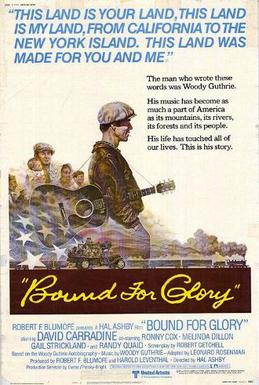
Woody Guthrie was a sort of poet of American folk music, his music influencing a generation of artists, from Bob Dylan onwards. His music spun a vision of the enduring strength of the working man and their rights to a share of the American Dream. It’s mythic stuff, so feels perfectly positioned to be spun into a modern fable in Ashby’s Bound for Glory. Coated in period detail, a sort of Grapes of Wrath by way of Barry Lyndon, it’s a lyrical piece of historical memory making with a nominal grounding in social and political issues. Is it a complete success? Perhaps it’s a film easier to admire than love.

It takes the title from Guthrie’s (David Carradine) biography, and follows his journey from Dust Bowl Texas in the 1930s to the hopes of employment in California, where he joins a mass of not-particularly-welcomed economic migrants. He discovers there an audience for his politically tinged folk music, but steadfastly refuses to compromise his principles. Actually, aside from these broad sketches and Guthrie himself, almost everything in this is essentially fictional. It’s a myth being spun, building a legend of a sort of John the Baptist of American folk music, a nostalgic vision of 30s America which makes little room for Guthrie’s actual politics.

Actually, that’s one of the most fascinating things in Bound for Glory. So keen is this to create a nostalgic view of an America from yesteryear, celebrating the perseverance of blue-collar America, it avoids talking in detail about anything Guthrie actually believed in. Although possibly not a card-carrying member of the Communist party, Guthrie was certainly at least a fellow-traveller. He had sharply left-wing, pro-worker, anti-capitalist views. His music echoed this – ‘This land is your land’ is actually about land ownership. But most traces of this have been carefully rinsed out of Bound for Glory.

That isn’t to say that it doesn’t take a deepe dive into Depression era America than any film since The Grapes of Wrath. Guthrie’s pilgrimage – and there is something distinctly Saintly about how he is presented here, making him more comfortable a figure than a left-wing radical – features plenty of dwelling on injustice and poverty. It opens in the ramshackle poverty of Dust Bowl Texas, where winning a dollar in a bet is potentially life changing. Migrants to California are at hurled from goods trains, then risk being shot (as one of Guthrie’s friends is) when attempting to jump on them as they puff past. They are barred entry on the road to California (in cars weighted down with their few possessions) if they can’t produce $50. The migrant camps are run-down, overcrowded and run by baton-wielding work-bosses who have complete power to decide who works and who doesn’t and don’t hesitate to wield their weapons to enforce their will.

Bound for Glory however avoids saying anything too firm against all this. It can carry sympathy for the plight faced by the working man but, much like The Grapes of Wrath, it’s terrified about saying or doing anything that could possibly be seen as promoting left-wing politics. Guthrie sometimes mumbles vague statements about the working man finding his slice of the American dream, but never anything too pointed about the fact that unfairness and having-and-have-noting is built into the system, like a spine in a body. The bravest shot the film takes is at a complacent priest, who smugly turns a hungry Guthrie away from his large church because he only hands out soup to people who have worked that day. Otherwise, the furthest it allows Guthrie to go is asking his wealthy lover (Gail Strickland in a thankless part) if she feels guilty having so much when others have so little. It’s the washed down, simplistic politics of the playschool.

And, to be honest, it robs Bound for Glory of much of its life and blood. It fails to replace this with a fierce personal story (like The Grapes of Wrath) and it never even attempts to make anything like a political statement as Ashby’s old collaborator Warren Beatty would do five years later with the similarly luminously beautiful Reds. Quite frankly, as Bound for Glory unrolls slowly and deliberately it does so with precious little fire and guts to it and (at times) very little interest. In other words, it’s very possible to sit and watch it and (while admiring it very much) kind of wish you were watching Rocky instead (as the voters for Best Picture at the Oscars that year clearly did).

It becomes instead a triumph of style, photography and design, rather than an enlightening biopic or making a statement about the Great Depression (other than it was tough). David Carradine hasn’t quite got the charisma to bring the vague threads Ashby gives him together. (Almost every single big name actor in Hollywood turned it down, which tells you something). Guthrie remains a vague, drifting blank, whose views and beliefs are undefined and to whom events frequently seem to just happen. Of the supporting roles (several women in particular get dull, thankless parts) only Ronny Cox gets something to get his teeth into as a musician turned union activist.

The real merits of Bound for Glory is it’s Barry Lyndon like recreation of a time and period. A lot of that is due to the breathtaking photography of Haskell Wexler – not for no reason was he the first person billed on the film. Wexler’s work is extraordinary, creating a sepia-toned view of Great Depression America that feels like its been taken straight from a photo library and placed on screen. Bound for Glory also astounded viewers at the time with the first Steadicam shot captured on screen, which starts with an aerial view, glides down to Guthrie and then follows him through a crowd of hundreds of extras to fail to be picked for a work party. It was the cherry on top of the Oscar-winning cake for Wexler.

It’s just a shame that these surface delights are all that really come to life. Other than that, this is distant, reserved and (in truth) slightly empty work from Ashby that presents the basic facts in a mythologised way that you feel removes much of the core truth. It turns a fascinating man of real conviction, into an unknown enigma, an Orpheus of the Dust Bowl who goes on a Pilgrim’s Progress that leads to (if we’re honest) nowhere in particular. It’s a film that strains a bit too hard for high art at the cost of passion or entertainment.

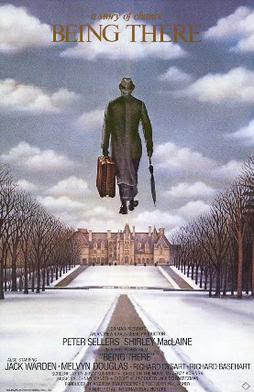
Being There (1979)

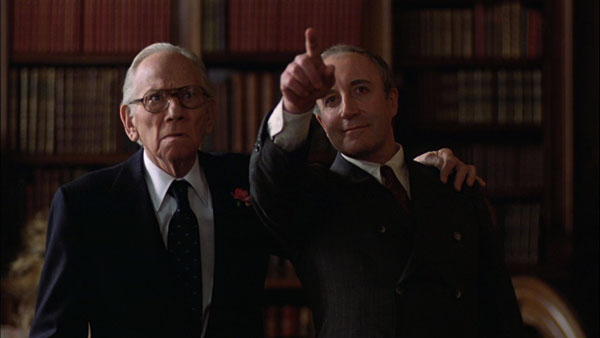
Peter Sellers is a void in the satirical Being There

Director: Hal Ashby

Cast: Peter Sellers (Chance, the gardener/Chauncey Gardiner), Shirley MacLaine (Eve Rand), Melvyn Douglas (Ben Rand), Richard Dysart (Dr Robert Allenby), Jack Warden (The President), Richard Basehart (Ambassador Vladimir Skrapinov), David Clennon (Thomas Franklin), Fran Brill (Sally Hayes), Ruth Attaway (Louise)

In movies honesty and simplicity often hide a deeper truth – a more pure view of the world, unaffected by cynicism. Being There takes these ideas and inverts them. What if we were so desperate to see a higher meaning in the words of the unaffected, that we kidded ourselves that even their blandest utterances carried deep meaning. It’s the central idea of Being There, proving again that a delusion only works when those affected are also those most invested in sustaining it.

Chance (Peter Sellers) is a child-like innocent. He works in the garden of “the old man” (implied to be his father). He has never in his life left the confines of his self-contained home. He can’t read, he can’t write. His meals are prepared for him by the old man’s staff. Apart from gardening his only other interest is television – and even that is a mute, hypnotic interest with Chance meekly watching anything screened in front of him. When the old man passes away, Chance (of whom there is no record at all) is asked to leave the house by the old man’s lawyers. He finds himself in a modern 1970s world, but still dressed (and with the manners) of a 1930s gentleman.

Accidentally hit by the chauffer driven car of Eve (Shirley MacLaine), the younger wife of wealthy businessman Ben Rand (Melvyn Douglas), Chance (his name mistakenly overheard as Chancey Gardiner) finds himself in the home of Ben where his manners, dress and polite comments about gardening are interpreted as being deep, intellectual musings on society and the economy. In a few days Chance is advising the President (Jack Warden) and his opinion is being solicited by the media. Will anyone notice that Chance is a harmless but basically empty man?

Being There is not just a hilarious satire of the capacity of the rich and powerful to persuade themselves of things. It’s also a satire on the Capraesque notion of the innocent seeing a truth that the rest of us can’t see. It throws in more than enough social commentary on the edges as well – Chance is revered because he looks right: well-dressed, courtly manners, softly spoken, polite and above all white. The film gets a few pointed blows in on this that look more and more central to the film the older it gets. Seeing Chance’s earnest musings on gardening being interpreted as deeply meaningful economic commentary on the television, the woman who bought him up in the old man’s house – a black servant Louise – announces “It’s for sure a white man’s world in America. Look here: I raised that boy since he was the size of a piss-ant… Shortchanged by the Lord, and dumb as a jackass. Look at him now! Yes, sir, all you’ve gotta be is white in America, to get whatever you want.”

And she’s right. Interpreted by the rich, white, entitled men of America as one of their own, it never occurs to them that Chance might be something else. And his statements carry such bland emptiness – precisely because Chance is merely stating genuine gardening tips – that it becomes easy to invest them with whatever depth they like, because they have no depth themselves. While in Capra, Chance would stumble upon some of the corruption at the top or make these people rethink their lives, here he drifts through, barely understanding what is happening around him, allowing these powerful men to interpret him as something that reassures them about their own lives.

In the 1970s the film was seen as a satire on the television generation. But watching it today – despite Chance’s mute, unengaged smile while watching TV – this isn’t about a mindless cabbage potato being seen as a sage. He’s a completely empty vessel that can have meanings poured into him – and then can all stick because not for a single second is Chance trying to get anything out of it. He would be as happy returned to the street as he is in the palaces of the mighty.

The film works due to the success of Peter Seller’s performance. Seller’s had pitched long and hard for the role: he had always believed himself a void beneath the mad-hat comic personas he had inhabited, and believed himself uniquely placed to understand the neutrality of Chance. That’s what he brings here. It takes true skill to play a character as blank as this one. Chance never responds to the situation he is in – and seems to have no understanding at all of the situation. He’s completely genuine and honest – exactly what gives his comments weight to people, because he is not even remotely trying to add any weight to them – and meekly accepts all the things that happen to him. He is honest on every question he is asked – that his only interests are gardening and TV – and sits quietly, smiling, until finally saying or doing things he has frequently copied from TV.

Seller’s restrains himself utterly in the role and eventually his very tame, sweet blankness makes him endearing. The performance would fall apart if even for a split second there was a tip of hat or wink to the camera. There’s none of that. Compare Chance to say Forrest Gump. Gump is the quintessential example of the cliché man who really understands the world better than all of us. Chance is the reality, a simple man, harmless but incapable of really engaging with the world. In Hal Ashby’s skilled and restrained hands this becomes crucial to the awe he is treated with by the rich. He’s a mystery we get no answers to and someone we know as little about at the end as we did at the start. But yet Sellers is mesmeric.

Melvyn Douglas’ provides a superb (Oscar-winning) performance as Ben Rand. How much does Rand really believe in Chance? He’s charismatic, determined and driven – but also nearing the end of his life. Does he want to believe in his faith in Chance, because it makes him feel better? Is Chance almost a sort of advance satire of movements like scientology – faiths that make rich people feel better about themselves, because it affirms their views and place in the hierarchy? It’s possible – and why not when they can craft an idea of Chance that is far superior to their nervy (and literally impotent) President (Jack Warden in a smart little turn).

Ashby at time overplays his hand a little. The final image – a benign Chance literally walking on water on the Rand estate lake – is famous, but its meaning is unclear. Does it imply that Chance is some form of second coming? Or does the naïve and clueless Chance simply walk across water because he doesn’t understand that he can’t? I feel the latter myself – the idea of him being a Jesus figure is so out of keeping with the film, I see it as a final physical representation of his own lack of knowledge about the world. Some hated the final flourish (visually wonderfully done as it is) – although not as much as the bizarre outtake of Sellers cracking up that plays over the credit (Sellers in particular loathed this, believing it shattered the magic of his performance and cost him an Oscar).

Being There isn’t perfect – it’s too long and Shirley MacLaine gets rather a thankless part as the wife who becomes infatuated with Chance (more could perhaps have been got out of her seeing the truth of Chance, rather than being as arrogantly deluded as the rest). Moments have dated less well than others. But it’s got a sharp idea at its heart – and its satire of the rich, Hollywood sentimentality and society feels sharper every day. Rather fittingly as well the film has an autumnal quality about it in Ashby’s coldly reserved shooting: Sellers and Douglas both died shortly after its release, the book’s author Jerzy Kosinski would be plagued after its release with accusations of plagiarism and Ashby’s (after a drug fuelled but successful 1970s) career would collapse almost immediately after its release. But it’s a smart, mysterious, witty and profound film that gains greater meaning with age.

The Last Detail (1973)


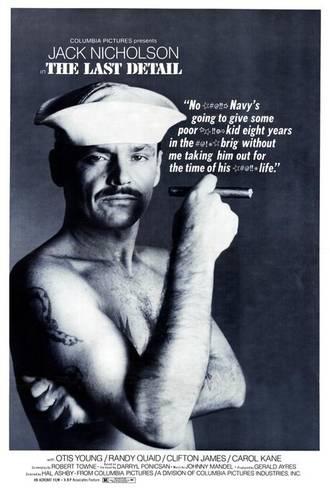
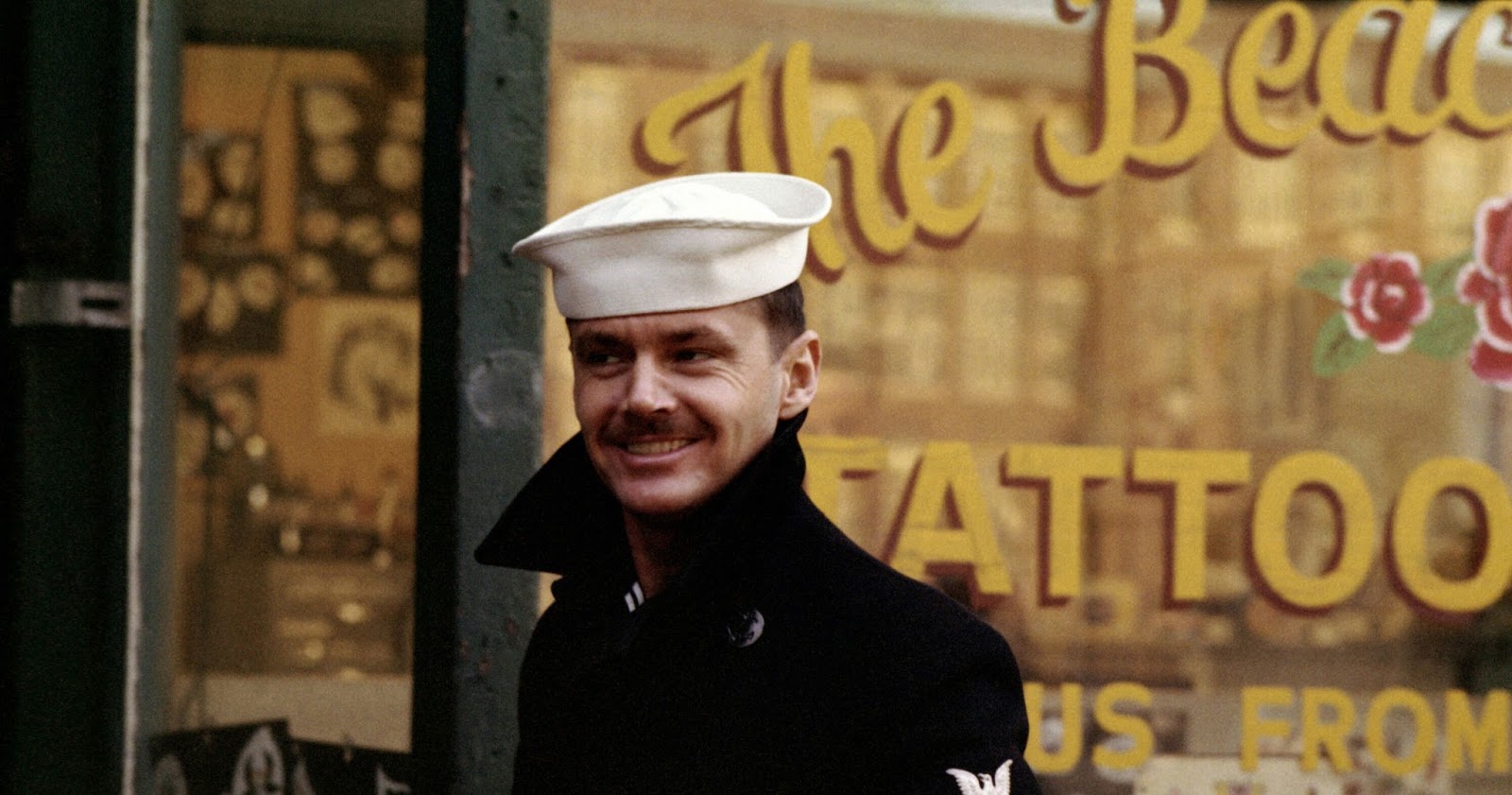
Randy Quaid, Jack Nicholson and Otis Young are sailors on a wild week in the classic The Last Detail

Director: Hal Ashby

Cast: Jack Nicholson (Signalman Billy Buddusky), Otis Young (Gunner’s Mate Richard Mulhall), Randy Quaid (Seaman Laurence Meadows), Clifton James (MAA), Carol Kane (Young Prostitute), Michael Moriarty (Marine Duty Officer), Nancy Allen (Nancy), Luana Anders (Donna)

When you see Jack Nicholson in a film from his late period – basically the 90s onwards – it’s easy to wonder what all the fuss is about. It’s sometimes hard when you see him eating the scenery to remember that in the 1970s Nicholson did a run of such mighty, landmark performances that he basically earned the right to do what he wanted for the rest of his life. The Last Detail is an often overlooked classic from the 1970s – and Nicholson is simply outstanding in it.

Buddusky (Jack Nicholson) and Mulhall (Otis Young) are “lifers”, career sailors who are ordered to take a young sailor, Meadows (Randy Quaid), from Virginia to Portsmouth Naval Prison in Maine. Meadows will serve eight years for stealing $40. Given a week to make the journey, Buddusky and Mulhall at first plan to get Meadows there as soon as possible so they can have a leisurely return and spend their per diems on a blow-out. However, feeling sorry for Meadows’ harsh punishment and lack of life experience, they decide instead to take their time on the journey and show Meadows a good time – including drinking, whoring and general hi-jinks.

The Last Detail is a brilliant slice of 1970s filmmaking, an episodic road movie with a script to die for and a simply superb performance from Nicholson. Hal Ashby’s film is both a celebration of the rebellious attitudes of the 1970s and a sad acceptance of their failure. It’s a heartfelt film where we discover and understand more and more about each character and find out more about the age as well. It’s also a lovely story of bromance – of three men who come together, find themselves developing a very close bond, but are trapped by the rigid organisation they are part of.

The film is completely Nicholson. This is the sort of tour-de-force that cements him in any list of the greatest screen actors ever. It’s just a marvellous performance, near perfect. Buddusky is the ultimate impotent rebel, a man with a natural rough leadership quality over those at his level, but who basically lives within a societal prison that he can’t really imagine breaking free from. Buddusky will let rip – never better than the marvellous sequence where he erupts against a racist barman who also refuses to serve the underage Meadows (“I am the MOTHERFUCKING SHORE PATROL” he suddenly screams, after almost a minute of slow tension build-up) – but he’s also quiet and thoughtful. Watch Nicholson’s reaction shots when he listens to Meadows reminisce on his childhood dreams of being a vet. What a masterclass of quiet acting – Budduksy is enchanted, irritated, sad, bored, confused, moved – all at once and more. 

Buddusky feels a brotherly affection for Meadows – perhaps also, a reflection of his own sense of being trapped. Nicholson alternates between affection and frustration with a touch of self-loathing. At one point during a drunken night at a motel, he demands Meadows punch him out, because he is the one taking him to prison. Meadows refuses – sweetly these guys are the best (only?) friends he’s ever had – Buddusky reacts by punching a cupboard repeatedly in fury. Later, during a fumbled sexual encounter for Meadows with a prostitute, he is kindly and understanding. It’s a fascinating performance of frustration, confusion and unaimed anger. There is nothing he can’t do.

Young is excellent as Mulhall (there is a great sequence where Mulhall berates Buddusky for his risky attitude, revealing Mulhall’s basic conventional outlook), while Quaid’s Meadows is an endearingly innocent figure: a kleptomanic with no friends, a sad family background (a visit to his abandoned family home reveals his mother to be an alcoholic), a sad, lonely boy who (unwisely) looks to a prostitute for emotional connection, and holds an unfulfilled dream of becoming a Master Signalman. He still takes on the others’ confidence through – just watch how Meadows grows in assurance as the film goes on. All three of these actors spark off each other brilliantly.

Ashby’s camera drifts gently, allowing the actors a great deal of freedom. Ashby shot the film in chronological order which works brilliantly – not least in that you see Randy Quaid grow in confidence as an actor just as the character emerges from his shell. Scenes are allowed to loosely continue, often past the point you might expect, which really allows the actors to breathe and the characters to grow: scenes of the characters drinking (rather feebly) in a carpark (as they can’t get into a bar) feel organic and almost improvisational. Ashby uses a lot of dissolves and fades to mark the passage of time – often in the middle of conversations to move us from one point to another – which also work really well.

This works perfectly for Nicholson, as it allows us to learn more about Buddusky’s shallow rebellion. Buddusky may rail against the oppression of the navy but he’s totally reliant on the grounding it gives him. Mulhall is more open about this – as a black man, it has given him some standing and a steady income to support his mother – but Buddusky is adrift in the real world. Watch him flirting with a college girl at a party. He’s hopeless, falling back on how navy work is man’s work, repeating it several times like a mantra before a crude joke. Nicholson’s first introduction is him (hungover) telling a soldier where his superior officer can stick his summons. Next time we see him, he’s arrived to see that officer. Buddusky badmouths everything and boasts of being “a badass” all the time – but every time he’s with an officer Nicholson seems to shrink and clam up. He can rebel only in words, on his downtime. On the clock he just has to fit in with the rest.

Part of the visual genius of the casting is Young and Quaid are both over six feet, making Nicholson look smaller and stunted. It’s a really neat visual metaphor for his sense of rebellion. He and Mulhall may bitch and moan about the injustice of the navy – but there is never really any question that they won’t carry out the task they are doing. Neither man has any real aim or goal in life, nor any particular insight or any plan. They just want not to be told to do things they don’t want to do. Meadows is off to prison – but Mulhall and Buddusky are also “lifers”. They ain’t going nowhere. They might not always like it, but they’d rather do that than drop out – when they meet genuine counter-culture types, none of them can understand or relate to them at all.

But the film is not depressing – it’s actually rather moving and lovable – because the bromance between the men is so well drawn. They grow to care a great deal for each other. They may not always have much in common, but they clearly have a whale of a time in each other’s company. The laughter feels genuine and grows from the actors’ own obvious rapport – I’m pretty sure they are near corpsing a few times – and it’s infectious. There is a dream-like freedom to the film – for its duration, reality is suspended and they can be free. They’re like children allowed out of school for the day. It’s hugely, engrossingly enjoyable and moving.

The Last Detail is a simply brilliant film. Ashby is a partly forgotten film maker, but films like this have a quiet, unflashy poetry to them. Robert Towne’s script is perfect – foul-mouthed and barbed, but full of unexpected emotional depths and beautiful character beats. Young and Quaid are excellent – but oh man Nicholson. He is so good in this film, it has to be seen to be believed. He is a living, breathing force of nature – he burns up the screen, but it never feels like showmanship. He’s sublime – it might be his greatest ever performance. And this is a great film that, in demonstrating the weakness of the rebellious feelings of the 1970s, might just understand that era better than many other films. An overlooked masterpiece – you should make it your mission to seek it out.