
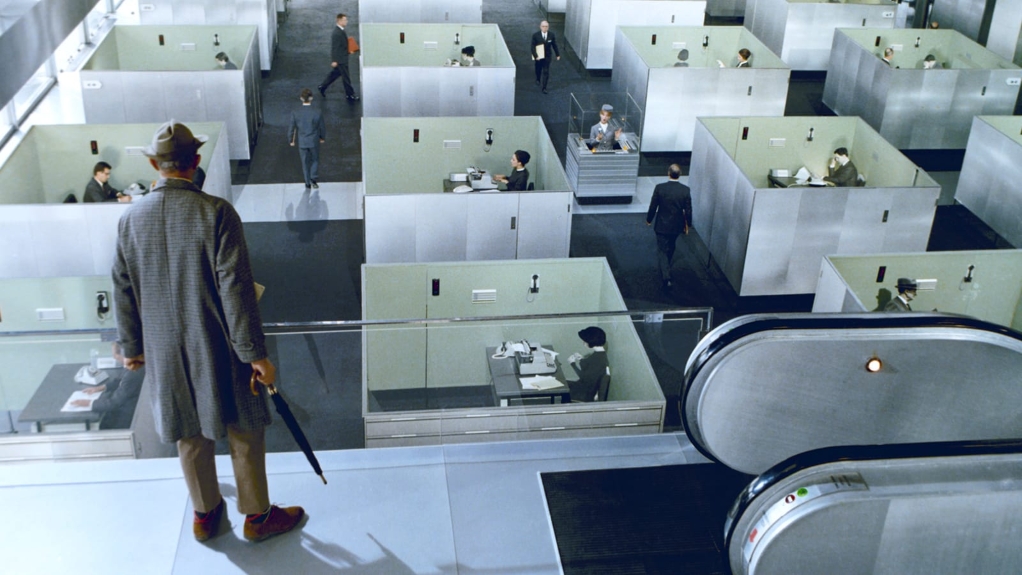
On a huge set, modern life is gently parodied in this unique, demanding but joyous comedy
Director: Jacques Tati
Cast: Jacques Tati (Monsieur Hulot), Barbara Dennek (Young American), Jacqueline Lecomte (Her friend), Georges Montant (M Giffard), Erika Dentzler (Mme Giffard), John Abbey (M Lacs), Yves Barsacq (Friend), Jack Gauthier (Guide)
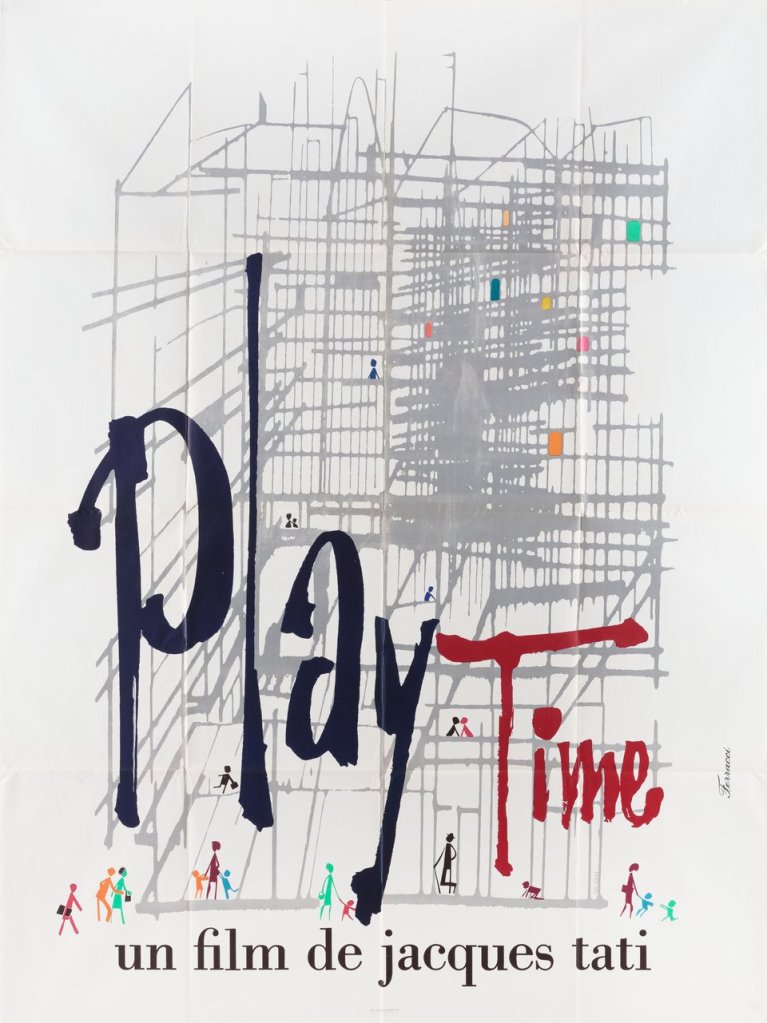
Jacques Tati, heir to the great silent comedians, had dreamed of making his own perfect film. It would have the synchronisation of sound and image together, where every detail could be honed and measured to maximum effect. To achieve this, he was willing to sink every franc he had into the experiment. Most of those went on building a gleaming city block, with the interiors built to Tati’s exact requirements, nicknamed Tativille. And in this playground of his making, Tati created (over a couple of years) Playtime, a sprawling, almost incomparable masterpiece that pretty much lost him every single one of those francs when it was released.
There is no plot as such to Playtime. It follows a disparate group of people across a single 24-hour-period in Paris. Not the Paris of postcards mind you: this is the modern Paris of the 1960s, where every building is a shining, glass-covered cathedral of commerce and every street is a perfectly laid-out boulevard with cars moving down it in perfect unison. Over the course of a series of vignettes – set, in turn, in an airport, a labyrinthine office-block, a series of personality-free apartments, the opening night of a restaurant and a regimented supermarket – a group of American tourists, office workers, visitors and Jacques Tati’s famous creation Monsieur Hulot, stumble about never quite letting the monumental modernity around them crush their free spirits.
Perhaps it’s not a surprise Playtime flopped. It’s a long film and, with every single frame choca-block with comedic action which your eye is invited to roam over it, it’s often hard-work to watch, demanding a large amount of focus and attention to get the most out of it. Tati loathed the concept of the close-up, and Playtime almost totally lacks anything not a medium- or long-shot. Without the camera to guide you, it’s left to the viewer and the odd audio nudge from Tati’s use of ambient, carefully modulated sound to point the viewer where to look and what to pay attention too. This can, however, be richly rewarding, allowing you to ‘pick your own adventure’ in the detail-crammed frames, where almost every character has their own story.
Tati pulled together everything in Playtime himself, working Bresson-like with a cast of amateur actors (some of them his neighbours!) who were carefully drilled into hitting their appropriate marks without losing their spontaneity. Watching Playtime is to see almost a metronome bought to life, with every single decision on every single footstep made to the neatest, closest detail – the sort of obsessive level of detail Kubrick would be proud of. And everything is timed to perfection, a few big sight-gags never crowding out a litany of little moments, small glimpses of situational humour, that reward the viewer whose eye happens to stroll to the correct point at the correct time.
It’s only just controlled by Tati’s use of sound. Dialogue is nearly non-existent in Playtime, as a smattering of French, English, German and other languages is overheard, but only really when we are required to be looking in the direction of the speaker. Otherwise, across the massive 70mm image, sound fades up and down on key points, depending on where Tati wants us to look. The sound of feet walking a corridor can suddenly carry real aural impact. But then so can the squeak of a restaurant door, or the squirt of a lemon, the tapping of a finger… the sound nudges and guides us around this complex, shining world to draw our eye to key moments.
Playtime is a triumph of production design, its gleaming, artificial world of glass-fronted buildings and aesthetically clean surfaces part of the robotic modern world – one far different from our brief glimpses of the Eiffel Tower or Montmartre in reflections. There is no character at all to this world of consumerist, futuristic Utopian surfaces, where chairs are perfect identikit leather, offices are perfectly laid out blocks of cubicles and supermarkets enforce rigid one-way systems between its pristine aisles. Part of Tati’s joke is how this new world of gleaming futurism is not only taking over everything – in a travel agent, a series of posters for exotic locations all show the same anonymous office block – but even seems to excite the tourists more than the idea of the ‘real’ Paris.
It’s easy to think Tati was parodying the sort of commercialist thinking of de Gaulle (satirised here as an impossibly short president arriving at the airport, with a luggage flap prominently blowing behind him). After all, even the homes we see (only filmed from the outside) look like shop windows peering in at a stack of furniture identical to the sort we’ve seen in offices, with people at home as tucked into cubicles as they are in their offices. But in fact, Playtime suggests that, even in a world as hideously over constructed as this one, people will find a way to break down barriers and bond. That people don’t naturally become cogs in a machine, but wild, unpredictable elements.
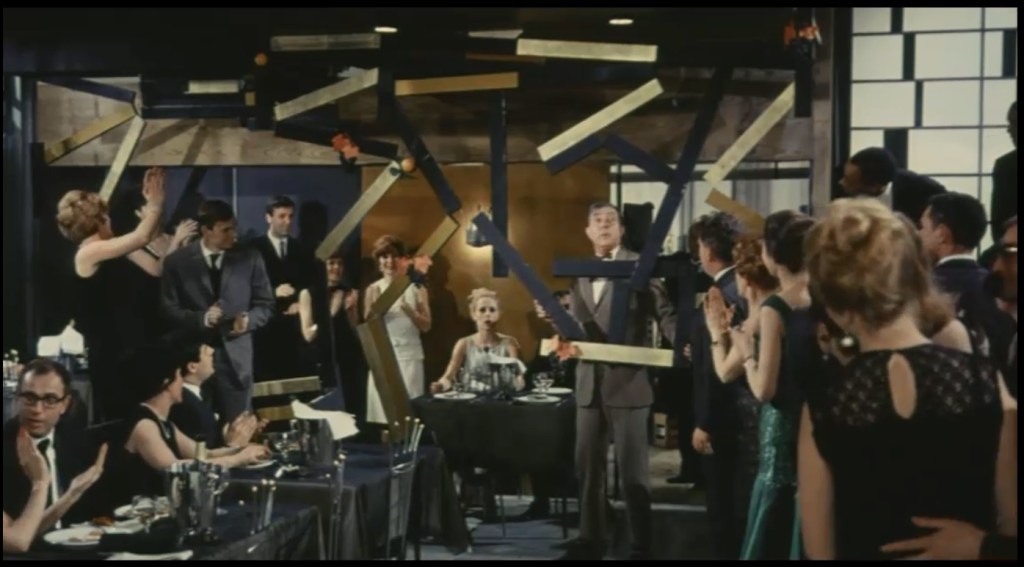
That’s at the heart of the film’s longest vignette, that covers what is really a disastrous opening night at a restaurant – where the walls fall down, the chairs leave terrible marks on the clientele’s backs, the waiters are overwhelmed and the floor becomes an impassable mass of people. But the night isn’t a disaster, despite a parade of comic pratfalls, sight gags and misunderstandings that would make Fawlty Towers look like fine-dining, because people are there to have a good time. And that they do, whether it’s turning the collapsed area into a VIP zone, forming an impromptu band or encouraging a sing-along, what could have been a parade of fury becomes instead something joyful and, yes, playful. You actually don’t watch Playtime at these moments feeling embarrassed for them, but instead wish you were there.
It’s a tone that Playtime ends on, suddenly upbeat, magical and almost like the entire film is about to break into a charming Busby Berkely number, with cars moving together in circular patterns. That’s where you admire the skill of Tati, the superb control and attention to detail that never also forgets that all this stuff is meant to be fun. And yes, as noted, Playtime puts a lot of focus on the viewer to find that fun. But when they do spot it, it’s hard not to be a little bit charmed and entertained by it.
And there are some great jokes. A business switchboard that emits a shriek of sounds when operated by its concierge (who smokes his cigar whenever out of sight of his boss). Hulot bamboozled in an office, where people call each other to be delivered papers in their own desks. A game of charades Hulot is roped into playing in a house. A waiter who swops his pristine clothes for damaged ones from others until he stands in rags. A doorman who continues operating his glass door, even after it’s been smashed to smithereens. You could spot a thousand other gags in the corner of every frame, in a film almost like no other designed for multiple re-watchings. Tati may have lost a fortune, but he also delivered a film like few others.

