Category: John Huston

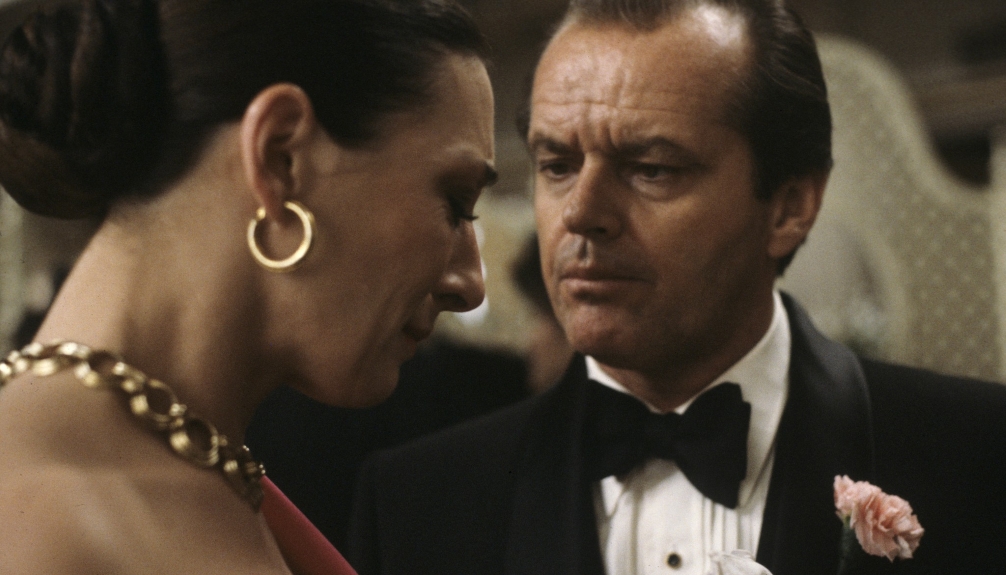
Prizzi’s Honor (1985)

Prizzi’s Honor (1985)

Would-be satirical mafia farce, that is slow, dense and insufficiently funny to hit its target

Director: John Huston

Cast: Jack Nicholson (Charley Partanna), Kathleen Turner (Irene Walkervisks/Irene Walker/Mrs Heller), Anjelica Huston (Maerose Prizzi), Robert Loggia (Eduardo Prizzi), John Randolph (Angelo Partanna), Lee Richardson (Dominic Prizzi), Michael Lombard (Rosario Filangi), Lawrence Tierney (Lt Davey Hanley)

Charley Partanna (Jack Nicholson) is a good-natured guy, loyal to his job – which just happens to be rubbing people out for the Prizzi crime family in New York. His gentle amble through Mafia life is thrown out of whack after a parade of unlucky events, silly mistakes and random occurrences. All of these can be linked back to his falling in love with Irene Walkervisks (Kathleen Turner), a con-woman, assassin and practised liar who may-or-may-not be in love with the besotted Charley. These two find themselves in the middle of a complex Prizzi family feud, much of it built up by Charley’s former girlfriend Maerose Prizzi (Anjelica Huston). What sides will everyone pick?

John Huston’s Prizzi’s Honor was one of the first films to take Mafia tropes, all that iconography The Godfather had made so ubiquitous and try and satirise it. Adapted from Richard Condon’s novel (by Condon), it carefully recreates the style and features of Mafia films, replaying the conventions – feuds, hits, femme fatales, pay-offs – with a streak of comedy. But what it lacks is the zip and energy this sort of dark satire really needs. It’s far too stately and never quite funny enough. Instead, it’s often slow and difficult to follow – and, damningly, is most engaging when it’s most like a regular gangster film.

It feels like an old man’s film. I’d defy you to look at this and then The Asphalt Jungle and not feel Huston was lacking fire here with this frequently untense, and slow film. It opens with a hugely over-extended wedding sequence, almost twenty minutes long, which laboriously introduces the characters. It frequently fails to pick to the pace from there: too many scenes lack thrust and drive, working their way slowly towards narratively unclear purposes. Now sometimes that is because so many of the characters are lying to each other – but Prizzi’s Honor does a consistently poor job of making sure we are either aware of the real truth or that we are in full understanding of the stakes at play.

A large part of the fault is the wordy, dense screenplay from Richard Condon (how did a sharp adapter of books like Huston allow this?). It takes nearly an hour for the film to really get going with a proto gang-war initiated by Irene impulsively shooting a police captain’s wife during a botched hit. Along the way, it creates too many long conversation scenes that lack spark or wit. It’s a far too faithful an adaptation, relying far too much on telling not showing. Multiple off-screen plot developments (involving complex double cross schemes) are related to us through conversations that are (honestly) hard to follow, boring to watch and delivered and shot with a flat, functional lack of interest. All of these would have worked better with a mixture of words and visuals – seeing some of these complex events playout, with an accompanying voiceover (the sort of thing Scorsese would have done brilliantly – see Casino).

Neither script nor direction is sprightly or engaging enough. It’s languid musical score and the ambling camerawork and editing also doesn’t help. It consistently feels slow, it’s meaning fuzzy, it’s action not gripping enough, it’s jokes not funny enough. Each scene is either too over-stuffed with plot-heavy information or too light on emotional connection or purpose. I’d be surprised if many people could explain exactly how the plot mechanics worked when the credits roll which, for a film that gives over a lot of time to slowly explaining things in dense dialogue is not a good sign.

The film depends on its performers to spring into life. Best of all is Anjelica Huston’s Oscar-winning turn as Maerose, disgraced black sheep of the Prizzi family. She rips into this vampish manipulator, running rings around the other characters with her sexual power or superb play-acting (there is a great scene when she makes herself up to look depressed and miserable to win the sympathy of her dim kingpin father played by Lee Richardson). It’s a funny, engaging and dangerous performance that you wish was in the film a hell of a lot more than it is. Close behind is William Hickey, rasping with malice, as a lizardry Godfather full of greed, ambition and utterly lacking in morals, presenting a neat sideways parody of Brando-style figures.

The two leads have their moments. Jack Nicholson is surprisingly restrained as Charley, surely one of the most gentle and dim characters he’s ever played (probably the film’s best joke, since it’s JACK). Nicholson gives him a childish naivety, easy to manipulate, whether that’s Irene saying she definitely didn’t know about the Prizzi-robbing scam her late husband pulled alongside her or the rings the smarter Prizzi’s and his consiglieri father (a coldly jovial John Randolph) run round him. He’s sexually naïve – putty in the hands of Maerose (‘With the lights on?’ he asks with meek bewilderment when she invites him to a clinch in her apartment) and Irene (‘On the phone? Now?’ he asks when she suggests some sexy banter) – and, with his New Yoick accent and prominent upper lip feels like a dutiful child trusted to run errands by his parents.

Opposite him Kathleen Turner embraces the lusty femme fatale qualities that made her a star, playing a husky voiced practised liar with a ruthless heart. Prizzi’s Honor though deals Turner a tough-hand: she’s the most enigmatic character and possibly its most poorly developed, the film giving so little clarity to her inner life that part of me wonders if Turner herself was slightly confused as to her character. Even in a film where the female lead is a ruthless, murdering grifter, she’s still largely only seen in relation to the men in the film – a potentially satirical point the film doesn’t really develop at all.

Both actors give sterling performances, but so slow and artificial is the film, so laboured its pacing that I found it extremely hard to care about what was truth what was a lie. Prizzi’s Honor has small moments but it’s devoid of the energy and pace that could have made it a dark comic delight. With the lack of investment it creates in an audience, it’s frequently hard-to-follow plot developments and clumsy, unengaging exposition, even the dark ending is unlikely to make much an impact. Hugely praised at the time – partly, you feel, due to affection for its director – it’s a slow, unengaging film that only briefly sparks to life.
Freud (1962)

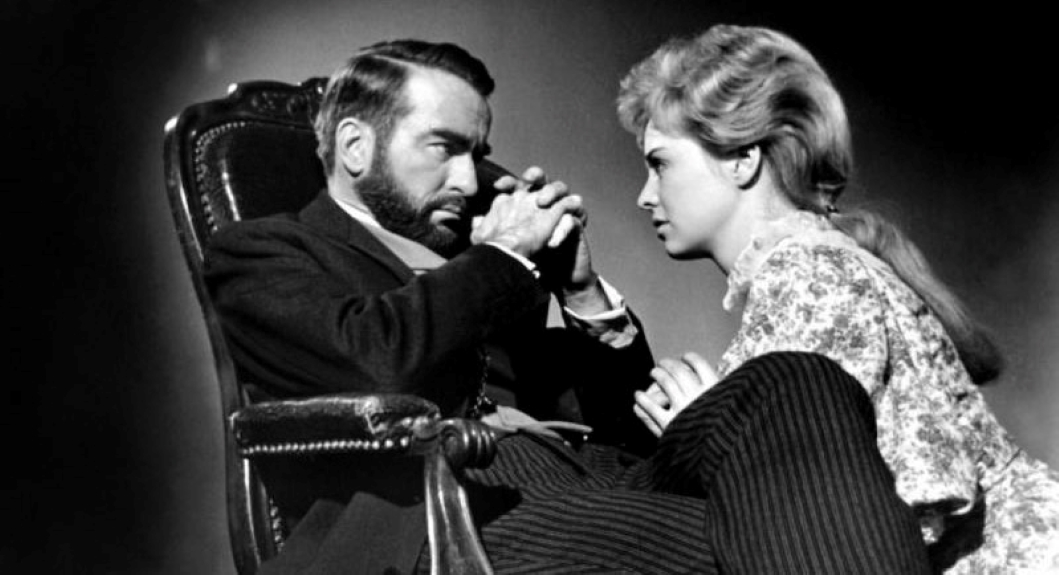
Freud (1962)

This intriguing film makes an excellent attempt at exploring the nature of thought

Director: John Huston

Cast: Montgomery Clift (Sigmund Freud), Susannah York (Cecily Koertner), Larry Parks (Dr Joseph Breuer), Eric Portman (Dr Theodore Meynet), Susan Kohner (Martha Freud), Eileen Herlie (Ida Koetner), Fernand Ledoux (Dr Charcot), David McCallum (Carl von Schlosser), Rosalie Crutchley (Amalia Freud)

Few thinkers had as much impact on the 20th century as Sigmund Freud. For generations, Freud’s theories on psychology and sexuality were defining texts shaping perceptions of our inner world. John Huston was fascinated by his work, translating its spirit into this thought-provoking, if at times clinical, film that focuses on a few key years in Freud’s life and does its very best to communicate the thought behind the theory, while being careful to never delve too far into thornier matters. (Despite the poster’s blaring tagline “He dared to search beyond the flesh!”).

Freud is played by Montgomery Clift, whom we meet in 1885 Vienna as a young doctor. Freud’s theories that physical ailments might have a psychological cause are widely dismissed by the medical establishment, represented by smug Dr Meynet (Eric Portman). However, Freud is convinced the secret of treating neurosis lies within – not least since he recognises symptoms of neurosis in his own dreams, haunted by half-memories of his mother and complex feelings for his father. Working with his mentor Dr Joseph Breuer (Larry Parks), Freud explores hypnosis to access patients’ repressed feelings, working closely with Cecily Koertner (Susannah York), a young woman who has inexplicably lost the ability to walk. Slowly Freud begins to form a theory of sexuality in children, as well as discovering guided discussions and word association to be more effective than hypnosis.

Huston’s film is shot in luscious black and white by Douglas Slocombe, composed of a mixture of images that balance painterly influences with surrealist nightmares. Freud and Koertner’s dream sequences are shot with a grainy intensity, a series of chilling images ranging from Freud being dragged towards his enthroned mother by a roped dwarf to Koertner’s mother domineering a beach from a grand tower. These surrealist touches tear through a film that otherwise presents a more earnest exploration of Freud’s theorising. It serves as a necessary contrast to the constraining formality of 19th-century Vienna, where inner passions and feelings are routinely stamped down.

Freud studiously explores the evolution of its subject’s thinking, in particular through his analysis of the fictional Cecily (standing in for several patients). Played with gusto by Susannah York, the film carefully structures her psychological make-up as a detective mystery to be slowly peeled away, with wrong-turns, false dawns and incorrect assumptions abounding. Initially treated with caring patience by Breuer’s hypnosis, slowly Freud replaces his mentor first as a doctor and then (to his subtle discomfort) as the subject of Cecily’s transposed attractions. These interior searches, eventually culminating in Freud’s first experiments of psychoanalysis and word association, are fascinating moments that pivot the film, with convincing false conclusions regularly introduced to constantly challenge the viewer’s assumptions.

It leads to the formulation of Freud’s Oedipal theories that cross a Rubicon his mentor cannot. In that, Breuer is joined by most of the medical profession. Huston’s film is strong on the stuffy self-confidence of the establishment, too hide-bound by its own ideas to recognise genius in their midst. Portman’s grandiose Dr Meynet gently, but firmly and devastatingly, rubbishes any nascent idea that neurosis patients are anything other than idlers and whingers. Meetings where Freud presents papers offer choruses of raucous boos and naked fury (at one point a dignified doctor literally stands up and spits at Freud’s feet in disgust). Hypnosis, with its vague medical support for its method is used as something close to a parlour trick by an otherwise supportive Dr Charcot (Fernand Ledoux) to pass physical symptoms from patient to patient, demonstrating the symptom is psychological even as he does nothing to understand the cause.

The path to decoding the human mind – as the film firmly believes Freud’s theories have done, hammered home by Huston’s narration which opens and closes the films and intermittently provides an internal monologue for Freud – is a bumpy one. Freud is frequently disturbed by the implications of his investigations. A young solider – a fragile David McCallum – alarms him when, under hypnosis, he reveals a deep, sexual longing for his mother via the fondling of a mannequin (naturally concealed under his father’s uniform). Freud’s closeness to his mother – a marvellous Rosalie Crutchley – becomes wrapped up in his theories, his dreams and memories haunted by half-remembered encounters and longings that cause him great unease.

Much of the clarity of this unease – and the tension as the unsettling implications of Freud’s nascent beliefs become more apparent – owes its success to Clift’s performance in the lead role. Clift was in extremely poor health at the time, still suffering from the effects of a near fatal car crash (including cataracts that affected his vision). An addiction to painkillers and alcohol had shot his memory to pieces. He struggled to remember lines (so much so the studio attempted to sue him for the film’s many delays), but his soulfulness appears to glorious effect. He makes Freud a profound and troubled but artistic thinker, a humanitarian full of empathy which also makes him a conduit for guilt and shame. His impassive face makes him the perfect listener but does not hide his own torment. It’s a marvellous performance, one that manages to convey the power of thinking.

Unfortunately, its genesis is also bound up in the story of the film’s making, that has often dwarfed the film itself in discussions about this intriguing movie. Huston – increasingly angry at Clift’s unreliability, compounded by his alpha-male disgust at Clift’s homosexuality – bullied the actor relentlessly during the film’s making, forcing him into take-after-take after every line flub to the increased anger of the other actors (York, in particular, was outspoken in her disgust at this). Huston had also originally written a script with Jean-Paul Sartre but, not surprisingly, the two were incompatible, Sartre eventually having his name removed from the credits.

It’s a shame these stories have dominated the discussion of the film, as it is a rich, intriguing work directed with a thoughtfulness by Huston that helps it become a thoughtful and patient film, rather than a triumphalist one (the film lacks either a eureka moment or a closing triumph, leaving Freud still rejected by the establishment and quietly visiting his father’s grave, having come to terms with his own feelings). With a marvellous performance by Clift – even if his treatment on set was shocking – it’s an intelligent, intriguing and well-handled exploration of a complex theme. It’s more than a curiosity, it’s a measured and serious film with flashes of surrealism that engages intelligently with important themes.

Escape to Victory (1981)

Escape to Victory (1981)

The sort of odd movie pitch that could only have been made in the 80’s: it’s a POW film – but with footballers! And Stallone in goal! Cult nonsense, but fun.

Director: John Huston

Cast: Sylvester Stallone (Captain Robert Hatch), Michael Caine (Captain John Colby), Pelé (Cpl Luis Fernandez), Max von Sydow (Major Karl von Steiner), Bobby Moore (Terry Brady), Osvaldo Ardilles (Carlos Rey), Paul von Himst (Michel Fileu), Kazimier Deyna (Paul Wolchek), Hallvar Thoresen (Gunnar Hilsson), Mike Summerbee (Sid Harmor), Russell Osman (Doug Cluire), John Wark (Arthur Hayes), Daniel Massey (Colonel Waldron), Tim Pigott-Smith (Major Rose), Carole Laure (Renee)

It’s possibly the most bizarre idea in movies. An old-school, boy’s-own-adventure about POWs starring a Panini sticker album’s worth of footballers, led by Michael Caine and Sylvester Stallone playing the Germans (actually represented by a team of ringers from the New York Cosmos) in a ‘friendly’ football match in Paris. Oh, and it’s directed by John Huston. Who thought this one up?

Needless to say Escape to Victory is a cult hit. Caine plays professional footballer John Colby, his career interrupted by internment in a POW camp, challenged to an exhibition match by football-mad Major von Steiner (Max von Sydow). When von Steiner’s bosses turns the game into a propaganda vehicle, Colby is under intense pressure to pull out. When he refuses – not wanting to put his players lives at risk, some of whom (the Eastern European ones) have been rescued from labour camps – instead he is asked to accommodate a daring escape plan, led by American Robert Hatch (Sylvester Stallone) who joins as ‘trainer’ and back-up goalie. With the match scheduled, a plan is formed: the team will escape at half time. But will the players abandon the game, or will sporting pride kick in?

Well, what do you think? The whole film is a build up to the game. Are they really going to leave it at 4-1 to the Germans? The pedestrian opening two thirds of the film can pass you by. You certainly feel it passed John Huston by (if you ever want to see a great director do a pay cheque movie, watch this). The film settles into familiar rhythms of both genres (sports and POW movies) mashed together. For the latter; forgers, escape committees, roll-calls, daring escape attempts over and under wire, muttered attempts to board trains with fake papers are all dutifully ticked-off. Nothing unusual: the interest is all in the sports film.

And if you are going to make a sports film – crammed with training montages – who else would you hire than a dream list of footballers to perform them. And no footballer was more of a God-like figure than Pelé. Welcome to the only film the Greatest Player Ever made (as soon as he opens his mouth, you’ll see why). Alongside him England’s legendary World Cup winner Bobby Moore, charming Argentinian Ossie Ardilles (not trusted with a line), several other internationals from across Europe and (filling out the numbers) half a dozen players from Ipswich Town (though, to be fair, John Wark might just be the best actor). Most of the best parts involve watching these stars go through their paces.

Michael Caine – who only took the film so he could say he had genuinely played with Pelé – anchors all this reasonably well (even though, at 47, he looks noticeably out-of-shape considering he’s playing an international footballer at the peak of his career). The role of Colby is no stetch for him, but Caine conveys carrying responsibility rather well, and there is some decent material as he butts heads against the unhappy upper-class officers who want him to tell the Germans to shove it.

The officers – decent performances from Daniel Massey and Tim Pigott-Smith among others – point out the Germans won’t give them a sporting chance. But, this is the sort of film where boy’s own pride kicks in, and we get a classic ‘let’s show em’ attitude. This culminates, of course, in the half-time planned escape attempt being aborted as the players protest “We can win this!” and the side head back out for the second half (and, of course, glory).

It’s a big shout as our heroes take a heck of a drubbing in the first half. (This despite Caine’s ahead-of-his-time coaching advice to make the ball do the running, which sounds like tika-taka seventy years early – was Escape to Victory required viewing in Spanish football academies?). To the disappointment of von Steiner – our token ‘Good German’ played with his customary professionalism of von Sydow – who gave his word it would be a fair game, his superiors hire “a very good referee” who will “make no mistakes”. German tackles fly in un-punished, a dubious penalty is awarded and Pelé’s ribs are broken in a filthy foul forcing the team to play with ten men. Those dirty, cheating Germans! Thank goodness Bobby Moore scores to give them a chance.

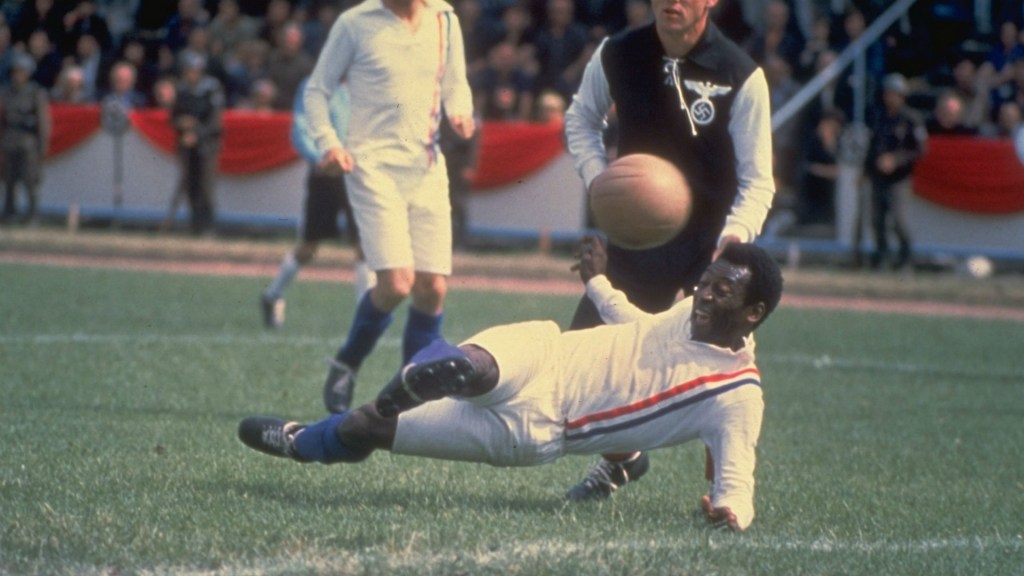
Every star player gets their moment in the spotlight, most of all Pelé who scores with a trademark bicycle kick. (I wonder if Pelé counted this one in his career goals record?) It’s a breath-taking piece of skill – von Steiner even proves his “Decent German” credentials by rising to applaud (to the fury of his fellow officers). Our heroes pull it back to 4-4 before having a goal disallowed for a false off-side (mind you it feels less inexplicable in an age where VAR chalks off goals for offside elbows). Then of course the Germans are awarded a penalty as the last kick of the game after a fair tackle by Ardiles.

And so, we come to Stallone. Perhaps the most inexplicable thing in this, the Italian Stallion at least convinces as a man who knows nothing about football. Looking trim, Stallone handles most of the POW and escape stuff (and a token romance subplot with a French resistance fighter) but of course space had to be made for him in the game. So, he plays as keeper (the team’s first choice keeper volunteers for Caine to break his arm so Stallone can be released from lock-up to play in the film’s most difficult to watch moment). Stallone wanted to score the winning goal, but was told that was unlikely for a keeper, so instead he saves the penalty to preserve the moral victory. Stallone mumbles his way through the film, feeling bizarrely out of place, but he was the big star.

Escape to Victory is a truly bizarre thing. But it’s got a fun football game in it and as sort of exhibition match it’s a bit of a treat. And watching it shortly after the passing of Pelé, it feels almost like a rather lovely tribute.

Beat the Devil (1953)

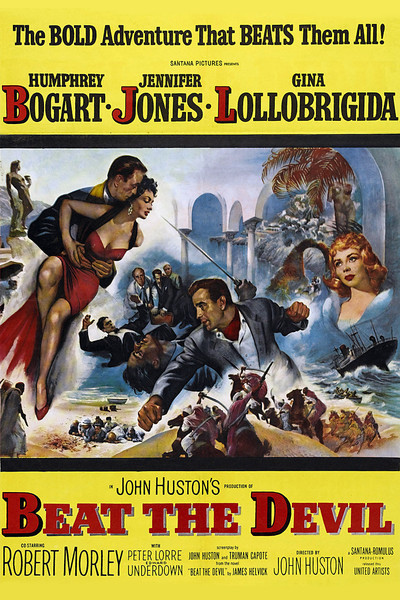
Jennifer Jones, Gina Lollobrigida and Humphrey Bogart in the tongue-in-cheek Beat the Devil

Director: John Huston

Cast: Humphrey Bogart (Billy Dannreuther), Jennifer Jones (Gwendolen Chelm), Gina Lollobrigida (Maria Dannreuther), Robert Morley (Peterson), Peter Lorre (Julius O’Hara), Edward Underdown (Harry Chelm), Ivor Barnard (Major Jack Ross), Marco Tulli (Ravello), Bernard Lee (Inspector Jack Clayton)

Beat the Devil is a curious beast. You could argue it was ahead of its time. Huston and Bogart had started out with the intention of making a straight crime mystery, a sort of Maltese Falcon in Europe. But when they arrived on location, obviously something in the weather got to them and Truman Capote flown in to help redraft the script on a daily basis to turn it into a sort of satirical comedy. For audiences expecting a hard-boiled crime mystery, it left heads scratched and cinema seats empty. Bogart lost a packet on the film – and later claimed to hate it – and it only existed in a badly cut-about version until it was restored in 2016.

The slightly surreal plot hardly really matters. A crowd of unusual people gather in a run-down port in a small Italian town, waiting to take the ship to East Africa. Gwendolen (Jennifer Jones) and Harry Chelm (Edward Underdown) are seemingly upper-class Brits (or are they?). American Billy Dannreuther (Humphrey Bogart) and his European wife Maria (Gina Lollobrigida) might also once have been something, but they sure ain’t now. Peterson (Robert Morley) and his associates the suspiciously un-Irish Julius O’Hara (Peter Lorre), rat-faced bully Major Jack Ross (Ivor Barnard) and nervous Ravello (Marco Tulli) are almost certainly all criminals on their way to a big score in Africa. Thrown together, this unlikely grouping end-up in a heady cocktail of betrayals, schemes, affairs and lies that spools out like a demented shaggy-dog story.

Beat the Devil is really more of an experience, a series of gags and light-hearted scenes played with a grin and a wink. Nothing in it is meant to be taken seriously, and this semi-surreal group of events becomes ever more absurd as it goes on. By the time the cast are abandoning a sinking ship, trudging up a beach to be captured by Arab officials who eventually allow them to row back to port where they find their ship didn’t actually sink…you really should just decide to go with the flow.

Instead the film is about shuffling up familiar tropes from hard-boiled noir with Oscar Wildeish farce. Certainly the Chelms seem to have wandered in from something totally different (not least since Gwendolen’s name is reminiscent of Importance of Being Earnest). Harry (a superbly stiff-upper lipped Edward Underdown) is a blithely unaware would-be English gentleman, pompously aware of his social class and blithely unaware that his wife seems to immediately start an affair with Billy. Gwendolen is the exact sort of character you might expect to see in Wilde, a dreamer tipping into fantasist, who blurts out things she shouldn’t and falls instantly in love with Billy. She’s also whipper-smart – more than capable of defeating Harry at chess without looking (“usually he’s a wonderful loser” she tells Billy, by way of apology for Harry’s strop).

Billy and Gwendolen embark on an immediate affair (although of course, in deference to the Hays Code, its just kept this-side-of-implicit). Mind you the film has a zingy wife-swop feel to it, since it’s pretty clear that Maria is far more interested in the British reserve of Harry (“Emotionally I’m English” she says before eulogising tea and crumpets) than she is in the ordinary-Joe cunning of her husband (although perhaps Harry is just as oblivious to this as everything else around him).

Billy is Bogart deliberately at his most Bogart-ish, channelling every grimy-but-smart dubious-hero the star ever played. Bogart plays the entire film with a grin on his face and delights in lines like “Fat Guys my best friend, and I will not betray him cheaply”. He also sparks delightfully with Jennifer Jones, who seems to having the time of her life as a character so flighty and unpredictable that even she looks like she hasn’t a clue what she is going to do (or feel) from one moment to the next.

The supporting cast of creeps and freaks Dannreuther is conspiring with to make a fortune (its something to do with land and uranium) similarly seem to have walked in from a side-ways Dashiel Hammett universe. For all their dirty deeds – and it seems Petersen had ordered a hit in the UK, although never for a minute would you believe this looking at Robert Morley’s puffed up bluster – they are a rather sweetly naïve and incompetent. Morley’s Petersen, a sort of galloping major, carries no real threat. Peter Lorre is very funny as a suspiciously German sounding Irishman (“Many Germans in Chile have come to be called O’Hara” he comments), prone to flights of verbal fancy and a chronic lack of focus. Ivor Barnard is as close as the film comes to threat as the aggressively incompetent Major Ross, a chippy bully who resents his shortness and eulogises Hitler at the drop of a hat. These heavies are each ridiculous figures.

And it makes sense, since the plot is a great inflated balloon of nonsense. There are chases, sinking ships that stay unsunk, a moment where two major characters are briefly believed dead, obsessive conversations about hot water bottles and reveals that puncture any sense of grandeur for each character. It’s the sort of aimless story you could imagine natural raconteurs like Huston and Capote finding absolutely delightful, and the whole film feels like a dramatization of a dinner-table anecdote.

Take it on those terms and its all rather good fun, even if it makes no sense. The cast look like they are having a whale of a time, and the total lack of seriousness about the whole enterprise generally makes it glide by with ease. Take a couple of drinks, sit back, don’t think about it too much and enjoy the jokes.

Moulin Rouge (1952)

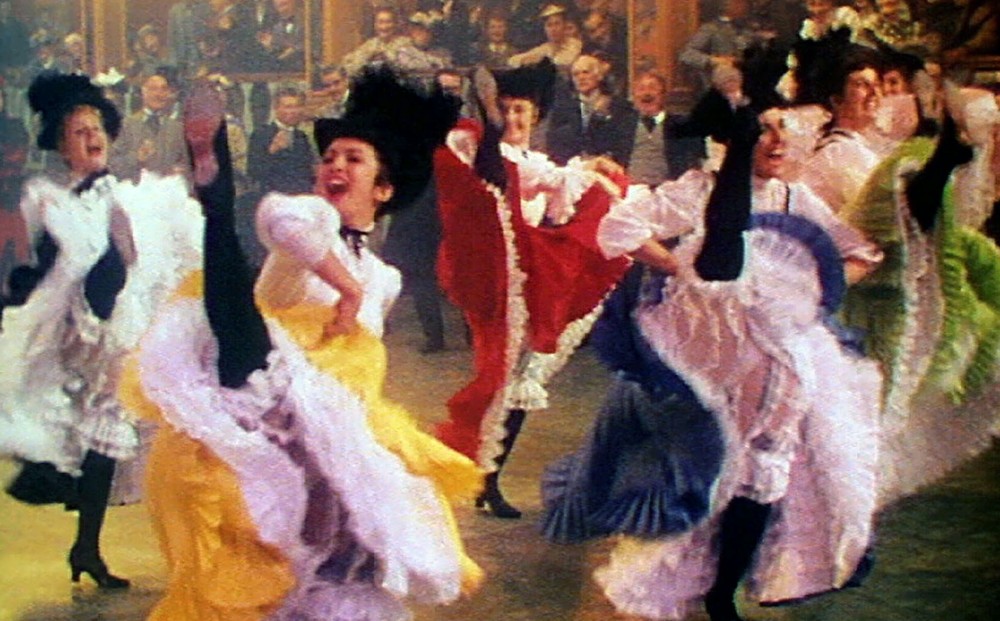
Dancers a go-go in John Huston’s Moulin Rouge (not that one!)

Director: John Huston

Cast: José Ferrer (Henri de Toulouse-Lautrec/Comte Alphonse de Toulouse-Lautrec), Zsa Zsa Gabor (Jane Avril), Suzanne Flon (Myriamme Hyam), Claude Nollier (Comtess de Toulouse-Lautrec), Katherine Kath (La Goule), Muriel Smith (Aicha), Colette Marchand (Marie Charlot), Georges Lannes (Sgt Patou), Theodore Bikel (King Milan IV), Peter Cushing (Marcel de la Voisier), Christopher Lee (Georges Seurat)

John Huston’s biography of Toulouse-Lautrec is less well known than its exclamation marked name-sake. It would be easy to say there is little in common, beyond the name and setting, between Huston’s film and Luhrmann’s operatic jukebox musical. But that’s to overlook the sprightly and confident shooting that Huston gives many of the scenes in the Moulin Rouge, and the mood of depression and corruption that underlies all the glamour of the club. These are two films very much drinking from the same well – even if the aesthetic and style of both are drastically different.

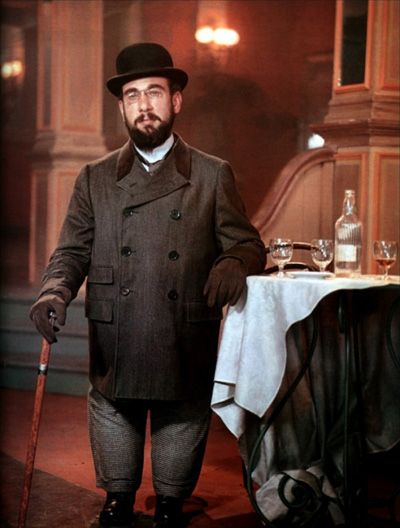
This artist biography focuses mostly on the last decade of Toulouse-Lautrec’s life. Played by José Ferrer (who also does double duty as the artist’s patrician father), it’s an exploration of the self-loathing and depression that drives the artist and funnels itself into his art. Art which is bold, animated with strikingly unique use of colours and movement. It’s all very different from the more timid, self-conscious crippled artist, the growth of whose legs was arrested after an accident in his childhood. Huston’s film front-and-centres Toulouse-Lautrec’s quest for love, but it has enough to say about the rest of its subject’s life.

Similar to his later work on Moby Dick, Huston aimed for a very particular look for his film, inspired by the colours used in the artwork of its subject. Shooting in Technicolour – and much to the objection of that company, who believed all films should showpiece it’s particularly striking bold colours rather than the muted colours Lautrec at times used – he manages to assemble a picture that feels like it completely captures not only the style of the artist, but also captures something of the more grimy and seedy side of the Parisian streets he walked. There is a neat little scene in the middle of the film where Lautrec argues with a printer over mixing his own specialised colours, rather than the more traditional colours he works with. Hard not to see that as a commentary on Huston’s own struggles with Technicolour.

It gives the film though its own very distinctive look, in which Huston uses a number of cinematic approaches that really capture the vibrancy of the Moulin Rouge. The opening scenes, that showcase a flashy can-can dance at the club is shot with immediacy, the camera roving in amongst the dancers, throwing us into the atmosphere and excitement of this ground-breaking night club. Alongside which – within the confines of the Hay’s Code – we get a sense of the sexuality of the nightclub, captured in the tempestuous clashes between the dancers and the pettiness and suddenness of feuds that spring up over every subject matter.

The film doesn’t quite continue all this vibrancy in the rest of its length as it focuses more on Lautrec’s own personal life. José Ferrer, always a distantly patrician actor, is perhaps a little too stilted to really invest us in the emotional pain of a man who didn’t believe he was worth loving. However his commitment to playing the part physically can’t be faulted. To play the diminutive Lautrec, Ferrer wore a contraption that folded his lower legs up behind him (he could only wear it for about 15 minutes before he had to restore the circulation to his legs), wearing this even in scenes he could not be seen full length, so as to get the posture of Lautrec correct. It’s a shame that Ferrer’s slightly reserved manner and precision leaves you feeling like the character is being studied at arms length rather than up-close and personally.

This affects slightly the focus on romance that the film takes – art gets its place, but the style very much looks at these in context of romantic struggles. Lautrec is presented as man convinced of his own ugliness and the barrier of his disability, who could never find a woman who would love him. This drew him, it seems, either towards destructive relationships (in particular with a ‘prostitute’ – not that you would know thanks to the Hays Code – played with an Oscar-nominated richness by Colette Marchand) or to relationships he convinced himself could only be hopeless, platonic obsessions (Suzanne Flon as an art-lover who only the most self-loathing of men couldn’t tell is devoted to Lautrec).

The film interestingly rather misses a sense of fun that you might expect from a nightclub scene. Lautrec is of course miserable for most of his life, self-medicating his physical pain and depression with drink. His parents are either guilty at the accident that crippled him, or frustrated at his choice to spend his life painting the dancers of the Parisian night-life. Huston does get a great sense of the compulsion of the artist – Lautrec is rarely seen not sketching something – and his film is very successful at capturing the loneliness that can accompany art.

If the film does sometimes become a slightly old-fashioned a-to-b story of an artist and his inspiration, it counter-balances this with the flashes of creativity and vibrancy Huston brings to the film. Huston was himself critical of the film in the future, thinking it a missed opportunity – I would suppose due to the general lack of sex in a story set in an environment soaked in it – but working within the limitations he had, it’s a fine piece of work. While you could wish for a slightly more engaging lead performance, it certainly works very effectively to bring its setting and story to life.

Moby Dick (1956)

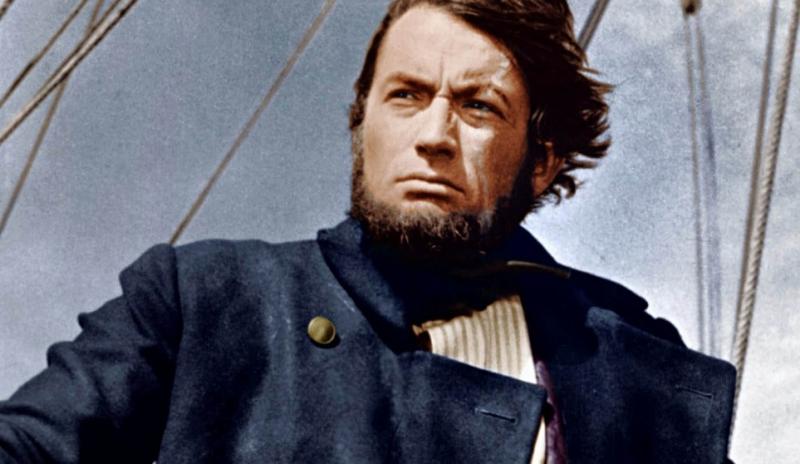
Gregory Peck on a voyage of obsession as Ahab hunting Moby Dick

Director: John Huston

Cast: Gregory Peck (Captain Ahab), Richard Basehart (Ishmael), Leo Genn (Starbuck), Orson Welles (Father Mapple), Friedrich von Ledebur (Queequeg), James Robertson Justice (Captain Boomer), Harry Andrews (Stubb), Bernard Miles (The Manxman), Noel Purcell (Carpennter), Edric Connor (Daggoo), Meryn Johns (Pelog), Joseph Tomelty (Peter Coffin), Francis de Wolff (Captain Gardiner)

There might be fewer books that lend themselves less to being turned into a film than Herman Melville’s monumental Moby Dick. Perhaps the greatest of all American novels, its’ the story of New England whaler the Pequod’s Captain Ahab’s obsessive quest to kill Moby Dick, the great white whale that took his leg. But it’s also an intense intellectual and spiritual journey into the nature of humanity, which has thrown the book open to multiple interpretations, even more tempting with a book that defies explanation. Try capturing that on film.

John Huston’s Moby Dick is a noble attempt, more criticised at the time than it probably deserves, with the visual language of film unable to ever capture the metaphorical weight of the original novel. What Huston needed to do is to try and capture some of the spirit of the novel, bring its central story to life and make a film that ideally makes you want to search the book out. I would say Moby Dick succeeds on that score.

Reducing the monumental novel (often described as one of the great “unread” books in people’s homes) to under two hours, brings out the narrative, stressing the surface story as an adventure on the high seas, a doomed quest under an obsessive captain. The detail of the reconstruction of the whaling ship, its operations on the sea (including some graphic slaughter of some, fortunately, fake whales) and the atmosphere of the time is brilliantly reconstructed. The film is staffed by an extraordinary collection of actors, whose faces speak of lives led in salt-spray. 

So, starting with the idea that no film could ever capture the depth and richness of the book, Moby Dick is a decent, smart enough attempt. The key themes are there in strength. It captures obsession and the idea of the ship being a sort of microcosm of society, led astray by a leader who has his own passions at heart, over and above the well-being of the crew, but has enough magnetism to pull the crew with him nevertheless. 

Huston laboured long and hard to bring the film to life, in a wrestle with Melville. Even adapter Ray Bradbury claimed he had “never been able to read the damn thing”, with Huston and Bradbury clashing constantly during the writing process. It works, and Bradbury’s adaptation is beautifully done, but in a way John Huston himself was a sort of Ahab with the book as his whale. 

In fact you could argue – as many have – that Huston himself was the natural casting for Ahab (take a look at Chinatown to see what I mean). A charismatic raconteur, ruthless and fixated on his goals, that’s an Ahab we could buy into. Perhaps in that world, Orson Welles – here giving a neat little cameo that avoids bombast as Father Mapple – would have been the perfect director, marrying mastery of cinema with a wonderful understanding of transforming literature into film.

Gregory Peck is the Ahab we do get. At the time the casting was strongly criticised – people just couldn’t buy the straight-as-an-arrow Peck as the destructively bullying Ahab. Peck himself remained strongly critical of his performance here all his life. Separated from the time, Peck’s performance is stronger than you anticipate, capturing a gruff fixation and magnetic charisma that you can believe pulls people in. Peck may strain a little too hard for the elemental anger, but Peck’s Ahab has a bass richness, a sort of inverted Lincolnish (he even looks a little like Lincoln) self-righteousness that makes you believe he could rouse a ship to choose its own destruction. Peck also brings a spiritually dead look to Ahab, a man turned from hope to destruction. Huston teasingly keeps Ahab in reserve for almost a quarter of the film until his first appearance, allowing the build in the audience’s expectations.

The casting of the crew uses a fine selection of British and Irish actors (the film was shot in Ireland), with Harry Andrews particularly strong as jolly but non boat-rocking first mate Stubb. Leo Genn gets the meatiest material as Starbuck, a decent, working man with a firm sense of principle but who lacks any sense of the charisma needed to swing people to his point of view. The film bumps up Starbuck’s role, centralising his growing unease at Ahab’s madness, opportunities which Genn (nearly underplaying to contrast with Peck’s theatricality) works a treat. Richard Basehart – a good voice for narration but much less of a presence – gets a bit lost as Ishmael. There is an intriguing bit of casting – something that would never happen today – that sees Austrian aristocrat turned actor Friedrich von Ledebur play the Maori-inspired Queequeg, a visual disconnect that is more than a little distracting for a while.

Moby Dick is beautifully filmed and assembled, even if Huston throws in the odd obvious shot – sun beating down on the ship, a close up of the whale’s eye. It has a unique look – on the remastered blu-ray – with the image reflecting the faded, bleached look of whale prints (an effect achieved by superimposing a black-and-white negative over a colour one, draining most of the colours our), which gives it a great deal of visual interest. It’s never going to replace the book – but honestly what could? As an exploration of the ideas at its heart it’s wonderful – and a great prompt to pick it up – but with a marvellous sense of life on sea, a stirring score and a wonderful sense of intelligent construction it more than works.

The Treasure of the Sierra Madre (1948)

Three men go in search of The Treasure of the Sierra Madre

Director: John Huston

Cast: Humphrey Bogart (Fred C Dobbs), Walter Huston (Howard), Tim Holt (Bob Curtin), Bruce Bennett (James Cody), Barton MacLane (Pat McCormick), Alfonso Bedoya (Gold Hat)

Is there anything that warps the human character more than greed? Humanity sometimes seems driven only by the desire for more, to fill our pockets with cash and leave the rest behind. It’s greed that becomes the subject of John Huston’s masterful The Treasure of the Sierra Madre – and specifically the effect it has on Humphrey Bogart’s Fred C Dobbs. If you can pick up as much gold as you want off the ground around you, why does it become so difficult to watch others take it away?

Dobbs and Bob Curtin (Tim Holt) are down-on-their-luck drifters in Mexico, bumming spare change off American businessmen and struggling on hand-to-mouth jobs for shady businessmen. So how could they resist the chance to team up with fast-talking old-timer Howard (Walter Huston) who knows that there’s gold in dem da hills? Heading into the wilderness – partly financed by Dobbs’ lucky small lottery win – the three men strike lucky and start pulling the gold from the ground. Problem is as the piles grow, so slowly does the men’s suspicion each other – not least Dobbs, who grows increasingly paranoid and unbalanced at the thought of any danger to his gold. In the wilderness of Mexico, with bandits across the countryside can the men’s growing suspicion of each other be held off long enough to get the gold back home?

Based on a novel by B Traven – an author so notoriously private that even today no one knows who he was – John Huston’s classic is part adventure story, part treatise on the human condition. It’s also gloriously entertaining at every turn. One of the first major Hollywood films to be shot largely on location, it drips with the sultry heat of Mexico, beautifully filmed by Huston. Huston’s masterful script also packs the film with a punch, from quotable titbits (most famously the oft-misquoted “Badges? I don’t have to show you any stinkin’ badges!”) to its Shakespearean touches as a rambling, mad, paranoid Dobbs walking alone through the desert wilderness like a cut-price Lear.

Dobbs is the heart of the film – and there is perhaps no anti-hero more ‘anti’ in the whole of Hollywood than this ruthlessly selfish, obsessive paranoiac. Bogart probably gives his finest performance ever as the scruffy, sweaty, unshaven and bitter drifter who finds he can’t abide the idea of having to give away any of what he sees as his share of the loot. And, worse than that, becomes convinced that the whole world is out to take it from him. 

Bogart digs deep into the weasily, rat-like greed of this man. Bogart fought long and hard to play who he called “the worst shit you ever saw”. Dobbs has a strange moral code and sense of honour that’s entirely personal. Having his character impugned by others is an affront he can’t abide – though murder and violence are perfectly acceptable. He’s the sort of guy who will savagely beat a man who stiffs him for wages and then precisely take only what he’s owed from the guy’s wallet. Bogart is perfect as the cold-eyed loner who talks big at first about partnership, but later whines about how he staked most of the starter capital so should be getting a larger share of the profits. Bogart, in perhaps one of the biggest snubs in Hollywood history, missed out on an Oscar nomination in a notoriously weak year for Best Actor. Perhaps, the vision of Rick Blaine bitterly muttering to himself, covered in flies and filth, while plotting the murder of his friends in the Mexican outback was too much for the voters to take. Either way, Bogart’s late mental collapse into near-Shakespearean envy, jealousy and twitchy paranoia is as effective as it is subtly done.

More fortunate at the Oscars were the Huston family. John had written the part of Howard for his father Walter. It bought Huston Snr the Oscar for Best Supporting Actor. Walter Huston is wonderful as this fast-talking eccentric, rocketing through his dialogue at a hundred miles an hour, as if he has lived so long through the events he is talking about that he barely has the time or patience to tell the story at a normal pace. Huston adds touches of wonderful eccentricity, to Howard’s insane jig of joy when finally finding the site of the gold, to his infectiously unrestrained cackling laughter. 

Eccentric as he is though, Howard is a decent and honourable man who has every intention of sharing the gold and is well aware of its corrupting influence. The wily Howard is also the only essential member of the crew – the only one with the experience to survive in the wilderness, the only one who can recognise and knows how to mine for gold. The most loyal to the fellowship, he’s the good angel to Dobb’s bad. In the middle of this moral spectrum, John Huston places Tim Holt’s Bob, a plain-speaking, more naïve figure who has elements of both characters in his pride and hunger for gold, matched with his sense of honour and loyalty. The film partly becomes an unspoken struggle for the soul of Holt’s Bob, as we wait to see which way he will fall. 

Not that any of these men are angels. They are all determined to protect what they have. Struggling in shoot-outs with bandits is fine. They even vote on whether or not to execute a fellow drifter (played by Bruce Bennett) who encounters their stake and enquires about joining them for a share. Bennett’s Cody is, by the way, the smartest character in the film, who sees with pathetic ease through the nervy lies told by the three men, as well as acutely analysing their situation and options with a sharpness that seems beyond all of them. 

Of course by that point suspicion between them – specifically Dobbs and Bob – has already grown dramatically. Dobbs takes to spying on his fellows and digs a separate hiding place to which he carefully takes his own share (Curtin takes to doing the same). John Huston includes a marvellous sequence where the three men each wake up in turn during the night – and react with suspicion on noting the absence from the tent of the others. Later Bob will think long and hard before saving Dobbs from a mining cave-in. Only Howard seems less affected about the gold – although with his talk of the corruption he has seen in the past, perhaps he was a Dobbs himself in the past, now grown wiser and more accepting of the easy-come-easy-go nature of gold. 

Huston’s Oscar winning script (he also lifted the Oscar for Best Director, although Best Picture went to Laurence Olivier’s Hamlet) keeps the rich vein of irony running throughout the script, even while it shows how susceptible men are to corruption. The film’s final act – and the eventual fate of the gold – is a treat, a natural extension of the films theme of mankind being a dog-eat-dog world. What else can you do but sit in the dust and laugh at it all? 

There are no heroes really in The Treasure of the Sierra Madre – even the mountain remains named only in the title of the film – just three men, scruffy, seedy and not that smart, struggling to grab what they can from the earth. Life becomes more and more cheap as the film goes on – Dobbs and Curtin are like brothers at the start, but increasingly come to see both other people and each other as expendable rivals. With Dobbs like some scruffy Smaug, the film boils down to each man confronting his own emptiness. The only character with any emotional hinterland is the drifter Cody, looking for gold for his wife and kids (his story has real impact on Curtin), the rest are just living from moment to moment.

John Huston’s classic is a marvellous musing on the nature of greed and humanity, superbly filmed by Huston with not a single false note in acting or writing. Perfectly placed, it mixes a western vibe with a Shakespearean grandness – and has a simply wonderful performance by Bogart. A classic that really delivers.

The Dead (1987)

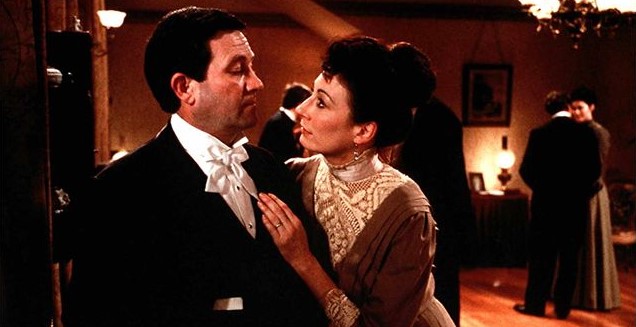
Donal McCann and Anjelica Huston in a marriage with a past in The Dead

Director: John Huston

Cast: Anjelica Huston (Gretta Conroy), Donal McCann (Gabriel Conroy), Cathleen Delany (Julia Morkan), Helena Carroll (Kate Morkan), Rachael Dowling (Lily), Ingrid Craigie (Mary Jane), Dan O’Herlihy (Dan Browne), Marie Kean (Mrs. Malins), Donal Donnelly (“Freddy” Malins), Sean McClory (Mr. Grace), Frank Patterson (Bartell D’Arcy), Colm Meaney (Raymond Bergin)

John Huston’s final film was a long-standing passion project, anfaithful adaptation of James Joyce’ short story from The Dubliners. Huston had only a few months to live when shooting the film – he was hooked up to an oxygen supply for the course of its film-making and confined to a wheelchair. His children Anjelica and Tony (who wrote the screenplay) helped to nurse him through this final project. The final film makes for a beautiful wistful, heartfelt and tragically toned story that’s small in scale but carries great emotional force.  It’s a beautiful adaptation.

The film is set at a Christmas house party for family and friends, a regular thrown by two spinster sisters, Julia (Catheen Delany) and Kate (Helena Carroll) Morkan. The soiree – with recitals, dancing and wonderful meal – is an annual treat, with a regular guest list of family and old friends. The Morkan’s nephew Gabriel (Donal McCann) frequently serves as unofficial master of ceremonies – this year nervously checking and rechecking his after-dinner speech. However, at this year’s dinner Gabriel’s wife Gretta (Anjelica Huston) is caught-off-guard by a moving song, that brings back to her a flood of memories from her younger days of a late first love – a revelation of a past life that in their bedroom after the party, stuns Gabriel and causes him to reassess everything he thought he knew about his wife’s past and how his own life has been bereft of the sort of passion she has displayed over a memory.

The summary above essentially captures the entire story of this James Joyce tale that is short on events but deeply long on emotional meaning. Critics have sometimes said it can only be a shadow of the original – but it’s an adaptation not a replacement. Huston’s film is a gentle, unhurried, carefully presented chronicle of everyday lives and the emotional depth that’s can lie buried beneath them. The Dead is short on flash, but it has such warmth, love and respect for its characters, and vibrancy in its playing that it hardly matters that for almost an hour nothing (as such) actually happens. Instead, Huston and his actors so completely understand and communicate the warm bonds between its characters – from decades of knowing each other – and the entire party has such an air of truth to it you can genuinely just enjoy watching the characters enjoy it.

It’s full of perfectly observed moments that ring true – and all straight from Joyce. The younger men who attend the party, and duck out of a gorgeous piano recital for a quick drink, to return and lead vigorous applause at its end. The awkwardness of small talk between two people that don’t really know each other, but are too polite to turn away. The affectionate indulgence of the drunken son of an old friend (“sure, he’s not as bad as he was last year”) who is quietly not passed the port and leads a praise for Julia’s slightly-off-note singing that is so lavish it manages to be as touchingly well-meant as it is grin-inducingly embarrassing. Huston had a long-held regard for the warmth and generosity of Irish hospitality and feeling and this seeps into every pore of the film.

But the film is stuffed full of moments of simple, real-world pleasure crafted by a director who understood that the impact of the stories late emotional revelations depended on the everyday low-key presentation of the film’s first hour. And there is no end of delight be had from the Morkan sister’s tearful pleasure and pride at Gabriel’s sincere speech of gratitude at the dinner’s end (even if it is overladen with classical parables). Or in the quietly supportive way Gabriel goes about organising events for them in the house, from shepherding the tipsy Freddy to a bathroom to sober up to ending events by gently wakening Protestant Dan Browne at the party’s end from his drunken doze in the cloakroom. Around all these events is the conversation of people who have known each other for years and are comfortable to sink back into the patter of familiar themes.

All of which is then perfectly counter-pointed by Gretta’s quiet revelation of a past of passion and deeply held first love that she has never spoken of before – and causes Gabriel to certainly look anew at everything in his life. It’s a sad and delicate Proustian revelation of how the slightest nudges to our memory (in this case the soulful rendition of an old Irish song) can unlock sudden wells of feeling, making events from years ago suddenly seem as painfully recent as yesterday. 

For suddenly Gabriel moves from initial jealousy into a deep and abiding sadness at how nothing in his own life could ever have motivated such depth of feeling from himself – that frankly he has nothing in his experience to match the grief and unforced emotion his wife has displayed. It’s a very Joycian revelation in which the present and the future is readdressed in light of the past. Suddenly Gabriel must reflect that his life has been one of competent and forgetful mediocrity and that he himself will die – and that fate awaits us all, with the snow falling on us all living or dead, and that Gabriel will forever lack the emotional depth and poetry to express it.

The film’s elegiac qualities match perfectly with the end of Huston’s career – and maybe the sad regret of Gabriel is Huston judging whether he made an impact either. The film however is beautiful, recreating Ireland perfectly in California with a superb cast of Irish theatre stalwarts specially imported. Donal McCann is wonderful as Gabriel, Anjelica Huston quietly moving as his wife while the rest of the cast are faultless: from Cathleen Delany and Helena Carroll’s carefully judged spinsterish generosity to Donal Donnelly’s garrulously friendly drunkenness (perhaps motivated by the impossibility of living up to his mother’s – an imperious Marie Kean – high standards). The Dead may not capture all the depth and beauty of Joyce’s writing (what can?) but it captures more than enough to be a beautifully judged film.

The Asphalt Jungle (1950)

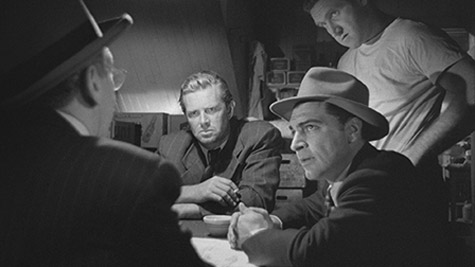
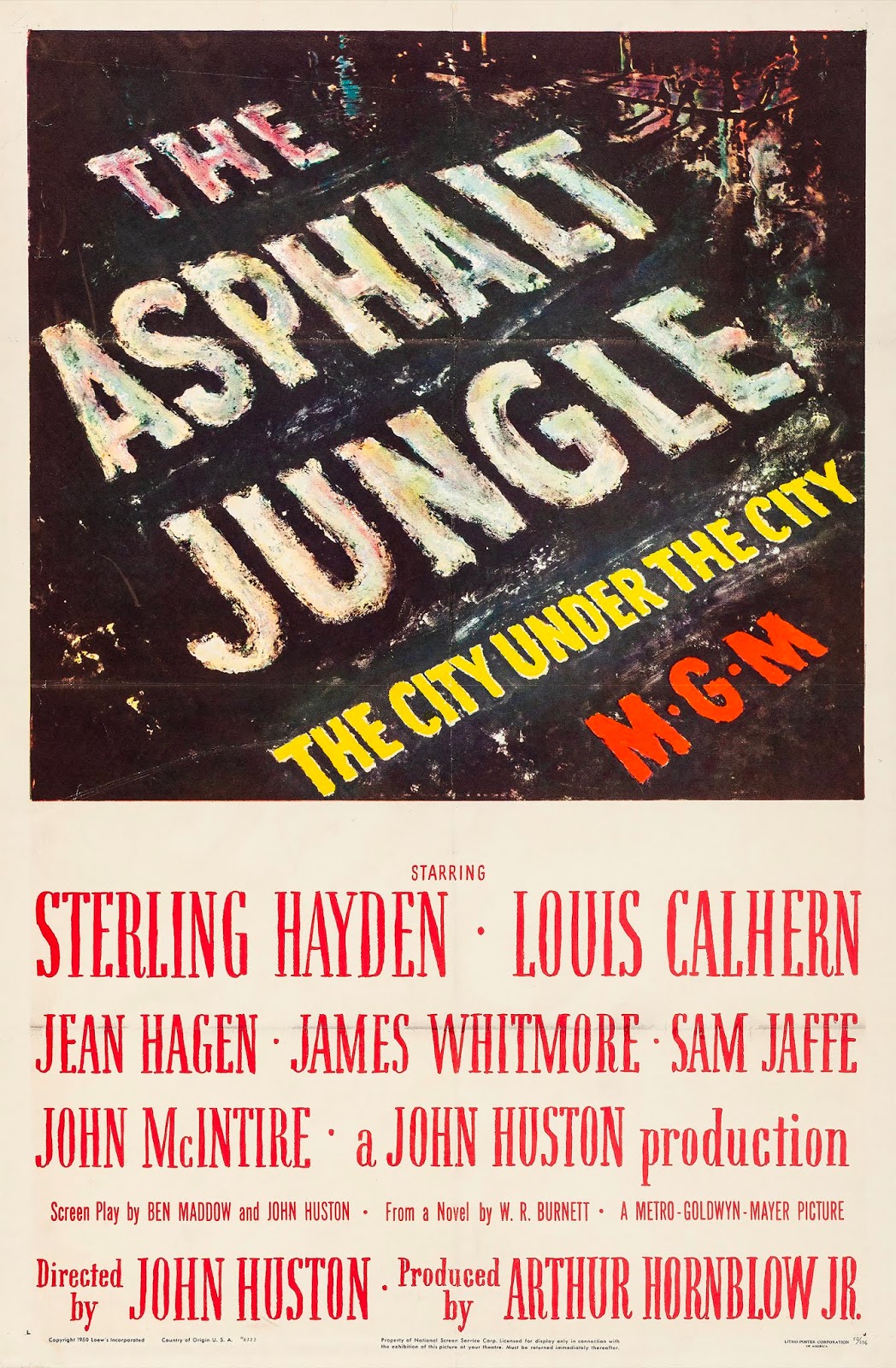
A masterplan goes wrong in John Huston’s crime drama The Asphalt Jungle

Director: John Huston

Cast: Sterling Hayden (Dix Handley), Louis Calhern (Alonzo D Emmerich), Jean Hagen (“Doll” Conovan), James Whitmore (Gus Minissi), Sam Jaffe (“Doc” Erwin Riedenschneider), John McIntire (Police Commissioner Hardy), Marc Lawrence (Cobby), Barry Kelley (Lt. Ditrich), Marilyn Monroe (Angela Phinlay), Brad Dexter (Bob Brannom)

“Doc” Erwin Riedenschneider (Sam Jaffe) is out of the slammer after seven years, and the self-proclaimed “Professor” of criminal plans has a scheme for one final job. But rather than sell it to the highest bidder, Doc approaches crooked lawyer Alonzo Emmerich (Louis Calhern) to fund the crime and then split the proceeds with Doc. To carry out his robbery on a jewellery safe in a bank, he’ll need a gang including get-away driver Gus (James Whitmore) and Gus’ pal and “hooligan” Dix Handley (Sterling Hayden). But even the best laid plans of criminals can fall foul of events and the basic untrustworthiness of criminals themselves.

John Huston surprised some by turning his attention – Oscar in hand from The Treasure of the Sierra Madre – to noir cops and robber’s thrillers, but that was to forget he had made his name with his masterful adaptation of Dashell Hammett’s The Maltese Falcon. And in The Asphalt Jungle he created a small scale but almost perfect slice of criminalise noir, a brilliantly paced and acted film beautifully assembled that effortlessly chronicles the disastrous fall out of a robbery where it seemed everything was going perfectly.

Huston’s direction of the piece is, as nearly always, superlative. His painterly framing of scenes is dead on the money here, his framing of the actors within the scene absolutely without fault. Huston has an uncanny scene for arranging his actors in the minimum number of shots necessary, reducing dramatically the need for clumsy cut aways. Instead multiple actors are often artfully arranged in the frame, allowing the performers to react in the moment and the camera itself to capture the complete story in one smooth shot. It also allows for some great character intros, not least a shot of the Police commissioner in the background of the frame while foregrounded are the hands of his subordinate Dietrich, nervously fondling his hat. Straight away we get the mood of the scene.

This is all part of the brilliant noirish construction of a film that largely features sympathetic criminals – and it’s clear that the film’s sympathy is with the robbers here, the cops either incompetent, bureaucrats or corrupt themselves – either turning on each other, crumbling under pressure, making rudimentary errors that wind up getting them caught or failing into tragic fates that are left questioning what the point of it all was. This is all superbly caught in the moody darkness and shadows that soak over the picture, and highlighted further by the superb script, that packs some excellent lines and beautiful thematic points throughout the film.

It’s also helped by some great performances. Sam Jaffe (Oscar-nominated) is terrific as the cunning calm and businesslike “Doc” who seems unable to understand why things are not quite panning out as he planned, but is heartily sorry that it’s the case. He at least has honour among thieves, refusing to abandon his fellow criminals and quietly disappointed when betrayal raises its head. I love as well his screamish apology that the crime will involve one “hooligan” – or heavy – since he’s not the sort of guy who likes to resort to messy crimes (no matter that things quickly slide out of hand). He’s the sort of professional who expects everyone to play by the same rules, but that doesn’t stop him having his own private passions, particularly for the fairer sex, that will wind up catching him out.

He’s especially proved wrong since Sterling Hayden’s ‘hooligan’ Dix turns out to be the moral force of the gang, despite his down-on-his-luck scruffiness. Hitting crime as a way to finance his dream of buying back his family’s horse farm – and sadly losing most of that finance on the horses – Hayden is gloomy faced and gruff but has his own clear moral code in an affectingly gentle performance of vulnerability beneath the toughness. Debts and betrayal are anathema to him, and he winds up far more of the decent crook than any of the rest – he’s also the only one of the lot who can hold down a loving relationship, forging a genuinely sweet relationship with Jean Hagen’s Doll. Huston’s sympathies are clearly with the down-on-his-luck Dix, a decent guy who has just lost at life.

Of course the crook they can’t trust is the lawyer, a fine performance of snivelling weasliness under a veneer of culture from Louis Calhern. Puffed up, arrogant but desperate for the money and fundamentally weak and easily led, Calhern is excellent as the money man who only adds to the gang’s troubles, led on by Brad Dexter’s wonderfully impatient and ruthless hired gun. Calhern’s sad air of corrupted authority is only enhanced by his lecherous delight in his lusciously young mistress, a radiant early performance from Marilyn Monroe (shot like a classic painting by Huston).

Huston’s film throws this gang together flies together into a superbly detailed and gripping drama of the planning, execution and dreadful fall out of a robbery that clearly inspired the (perhaps even better) Rififi (so much so that it practically has the same story and structure), The Asphalt Jungle is a fabulously made and written pleasure, unpretentious but wonderful story telling marshalled expertly by a director at the top of his game.

Fat City (1972)

Stacy Keach and Jeff Bridges excel as boxers failing to live The Dream in Fat City

Director: John Huston

Cast: Stacy Keach (Billy Tully), Jeff Bridges (Ernie Munger), Susan Tyrell (Oma Lee Greer), Candy Clark (Faye), Nicholas Colasanto (Ruben), Art Aragon (Babe), Curtis Cokes (Earl)

The American Dream has an underbelly. For all those dreamers who find fame, fortune and glory in the Land of Free there are thousands who never made it. Thousands who stayed rooted at the bottom of the rung of the ladder and saw their dreams disappear and lives head into turnaround. Fat City – the good life, according to the slang of San Francisco, the crazy goal you’ll never achieve – is all about those left behind by their dreams.

Billy Tully (Stacy Keach) is a former boxer, now down on his luck and now possibly struggling with alcoholism. Ernie Munger (Jeff Bridges) is a young prospect who shows some promise in the ring. Both of them dream of getting into the limelight – but what hope do they have when it’s nearly impossible to turn your life around in smalltown America?

John Huston’s film is unflashily assembled, but carries a fundamental emotional power as it investigates with a simplicity and honesty the difficult dynamics of real life. It’s a film which has no pat answers, no simple solutions and doesn’t offer much in the way of hope. Which is not to say that it is a depressing vision of the world. Just a recognisable one. Because, sure, for most of us there isn’t any real chance of seeing our lives change. 

Huston’s film – brilliantly shot with a 1970’s muddy graininess mixed with flashes of revealing light by Conrad Hall – is wonderfully well observed and beautifully paced and keeps refreshingly loyal to its essentially downbeat vision of life. There is nothing forced in Huston’s well-paced touch and his embracing of the ordinariness of the drama and the lives of the characters. Because for both of them what we see in this film – and it ain’t much – is still clearly the high point of their life. Just getting into the ring and being beat (and only one fight in the film ends with one of our heroes winning – and even then he’s unaware of his win, he’s so punchdrunk) makes them something rather than nothing. These small moments are the best they can hope for.

Because both men have lives of nothingness in front of them. Keach’s Tully is a man whose best years are already behind them, but keeps up a touching air of hope and belief that maybe that could change, even while he drunkenly stumbles from one moment to the next. And maybe he did have something in the past – but he certainly doesn’t have something to come. Keach captures this superbly – like a reliable pro embracing what he feels might be the highlight of his career – investing Tully with a gentleness but also touch of fantasy, a man who can’t quite accept where his life is, but despite a lack of bitterness he’s still a man balancing fantasies. 

Jeff Bridges makes a perfect balance to this amiable failure of a man as Ernie, a young man who may well have more promise than Tully but lacks any sense of personal drive. He’s a friendly but empty shell. While Tully at least goes through spells of wanting success – even if he drifts and falls into alcoholic patches of non-achievement and becomes lost in recollections – Ernie has no desire. He’ll allow himself to be put forward but will do no work at all to push himself forward. He’s a young man with no hurry, a man who seems destined to never achieve anything because he has no desire to do so. It’s a great performance of amiable emptiness from Bridges.

But then you hope that Ernie won’t be heading to the alcoholism that consumes Tully and his romantic interest Orma. Played by an Oscar-nominated Susan Tyrell, Orma is the picture of a failed life, a semi-bloated, rambling alcoholic who oscillates between small insights and far more common drunken ramblings and bitter drunken whining but believes strongly in what she does. Huston’s film places her firmly as much of a drifter through life as Ernie in her way, taking up with Tully while her lover serves prison time – and moving easily and with little impact from one domestic set-up to another. Tyrell and Keach give outstandingly strong performances of drunkenness, never over-playing and totally convincing in their slurred speech, attempts to not appear as drunk as they are and emotional swings from calm to sudden and consuming fury.

But then what is there to look forward to in this life than the next drink? Certainly not the fights. For all the dreams of trainer Ruben (Nicolas Colosanto – very good) to find the next big thing, every fight we see is a tragic and painful affair mostly ending in defeat. Ruben drives carfuls of beaten, ring fodder from place to place, watches them get duffed up and then takes them home all the while dreaming of a title shot. It is dreams shared by Tully – even while we watch his slow, alcoholic fuelled body struggle to get through a few minutes of shadow boxing.

But then that’s the message of Fat City the anti-Rocky – and probably more realistic for it. Huston;s simple touch and pure vision help to make this one of his finest films, his unfussy and naturalistic camera encouraging truthful and powerful performances from his leads. And every small moment is full of it, including a marvellous wordless sequence that sees Tully’s Mexican opponent arrive in town (on a rundown bus), wordlessly check into a motel, piss blood and then head to the ring to be (only just) beaten – a moment of victory so fleeting and small it barely counts (and is only a hiatus on Tully’s return to shambling from bar to bar on the streets). The American Dream is a great thing – but for many people it’s just that: a dream.