Category: John Schlesinger

Darling (1965)

Darling (1965)

Christie is superb in a film that’s more prudish than its reputation – and feels more sympathetic to its heroine today

Director: John Schlesinger

Cast: Julie Christie (Diana Scott), Laurence Harvey (Miles Brand), Dirk Bogarde (Robert Gold), José Luis de Vilallonga (Prince Cesare della Romita), Roland Curram (Malcolm), Basil Henson (Alec Prosser-Jones), Helen Lindsay (Felicity Prosser-Jones), Carlo Palmucci (Curzio della Romita), Alex Scott (Sean Martin), Trevor Bowen (Tony Bridges)
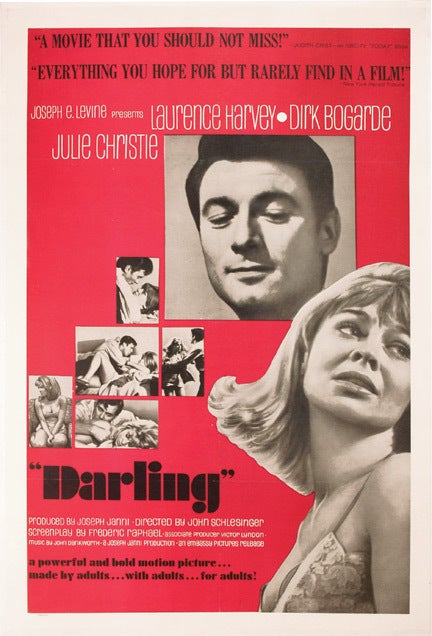
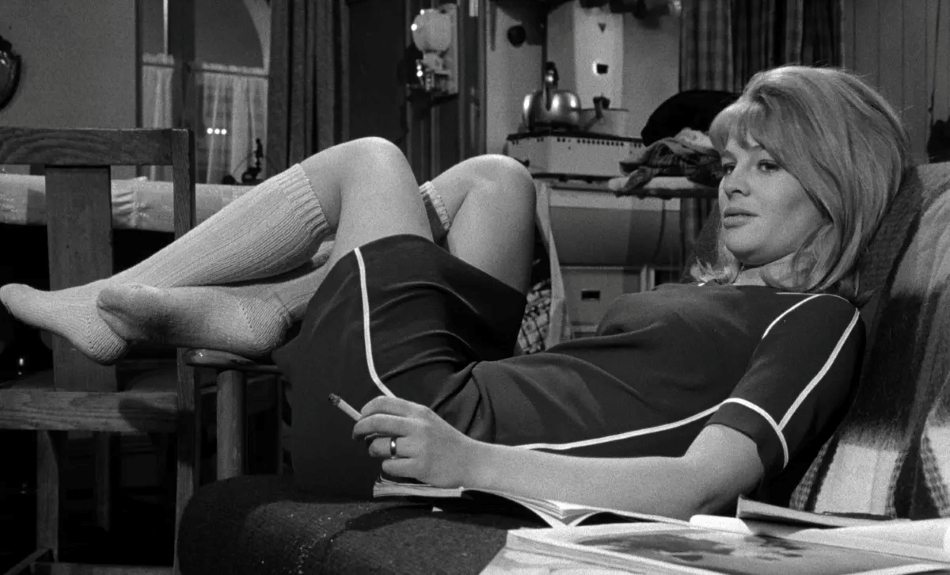
Perhaps no film screams “Swinging Sixties” more than Darling. Diana Scott (Julie Christie), a beautiful and charming model, decides the best way to move up the social ladder is to use those skills. She throws her first husband aside for high-brow TV journalist Robert Gold (Dirk Bogarde), before starting an affair with heartless, philandering marketing executive Miles Brand (Laurence Harvey) all while moving ever upwards. But will she learn there is nothing worse than getting what you want?

You can get a sense of how seismic it must have seemed. Darling was free and open about sex in a way very few films had been before. Today it can seem a bit coy – this is hardly Performance and most of the juicier stuff is implied – but the film starts with adultery and spirals into sex parties, orgies, couple swopping and menage a trois via bisexuality and a hint of transsexuality. What could be more sixties than that – and many at the time were excited (and tantalised) by the world of opportunity it seemed to present.

But, watching today, it hardly feels like Darling celebrates this stuff. Instead, this is a dark satire that heartily endorses the idea that behind all this hedonism is not very much at all. In fact, the most dated thing about Darling might be its air of 1950s frowning discomfort at all the naughtiness – and most of all, a disapproving frown for the ambitious young women at its heart, determined to get what she wants. It’s hard not to escape the feeling the film judges Diana harshly, while giving a pass to Bogarde’s Robert who (to be honest) is scarcely much better.

So why does the film still work – and much better than I expected? Because Schlesinger’s direction of Raphael’s arch and satirical script is inventive and playful enough to nullify the moral lecture elements. There is enough wit in the presenting of puffed-up, hypocritical powerbrokers (like Brian Wilde’s MP, breaking away from a moral sermon to drool over Diana) as two-faced meanies to sooth the moral pronouncements. In fact, with so many elements of that, its possible (and, arguably, hard for a modern viewer not to) to say ‘good on you’ to Diana for chancing her hand.

It’s also hard not to sense Darling taking pops at Diana’s middle-class sister and her husband – so constrained, they apologise to each other in bed – or the pretentious bores at an art gallery or the tedious self-importance of a Waugh-ish author who Robert idolises (and Diana finds boring as shit). This tone of spreading the mockery makes the film feel far even-handed (if a little scattergun). It even has a go at the conservative British public (actual real people) who, in Bogarde’s vox-pop interviews, blame laziness, immigrants and homosexuality for all the faults of Britain in 1965 (how times change).

Take all that into account and balance it against the strength of the performances, with Julie Christie astonishingly good as Diana. Winning an Oscar, Christie bursts at the seams with charisma and wit, making it almost impossible to dislike her, even when part of the film is appalled by her. Christie makes Diana witty, smart but also vulnerable, her manipulation of people is more instinctive than overt and there’s a great deal of sadness in her. She’s a lonely woman who believes being the centre of the attention will cure that feeling – whereas, in fact, the more she does so, the lonely she feels. And it leads to self-destructive behaviour that destroys relationships she cares about.

That loneliness surprisingly powers a lot of the film, giving Darling a sad after-taste. There is something very tender in Diana breaking down in tears at a photography session. Christie brilliantly plays her anxiety at finding the ‘classy’ Parisian joint Miles has taken her is a borderline sex party, translating itself into a desire to fit in, culminating in a burst of childlike delight when she has a hit in a mean-spirited game of abusive comments. And Darling gifts a fantastic scene to Christie near its conclusion, as Diana undergoes a near breakdown in her gilded Italian mansion prison, ripping furnishings, smashing ornaments as she collapses into self-loathing misery.

It’s this tenderness that underpins – or rather undermines – the film’s satirical ticking off for Diana that keeps it entertaining today. Not to mention it’s harder today to find as much sympathy (as I suspect the film wants) for Bogarde’s Robert. Bogarde is very good as this middle rung on society’s ladder, a guy who loves the idea of a hot young mistress but who slips quickly into cardigan-wearing dullness, becoming the same humiliated cuckold told transparent lies by Diana and her lover as her made her first husband.

But Robert is also  a hypocrite, cowardly walking out on his family without a backward glance and seeing no irony at all in his own practised ease at planning affairs (he even knows you need to bring a stuffed suitcase to your hotel assignations). And while the film finds a silent disapproval for Diana’s abortion, it’s hard not to notice that Robert is hardly doing cartwheels when she announces her pregnancy.
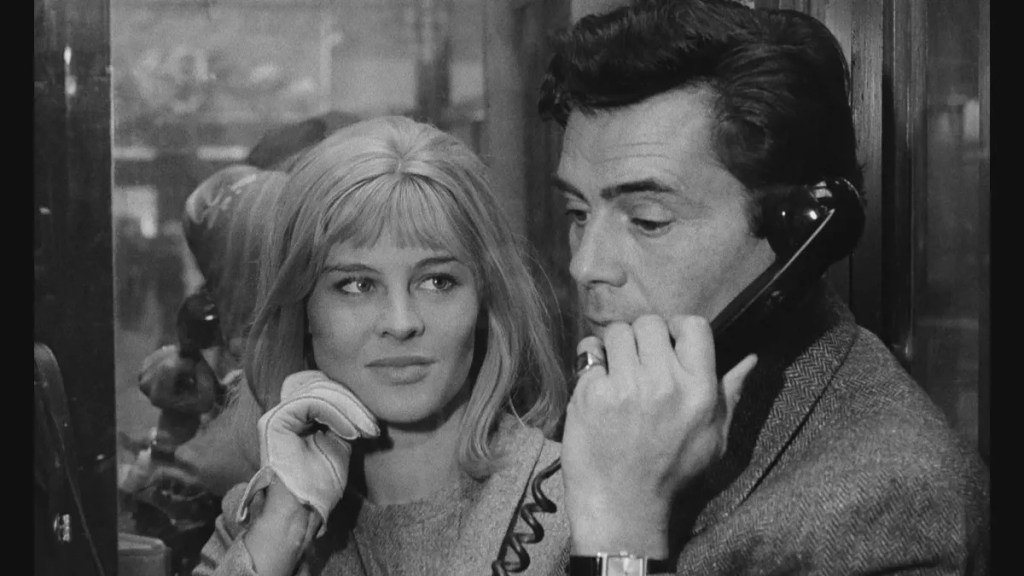
Surprisingly it’s actually easier to see the shallow Miles as the most honest person in the film. Played with an ice-cold distance by Laurence Harvey (vocally partly channelling Richard Burton), Miles may be a cad but at least he never pretends to be anything else. While every other man spins Diana a self-aggrandising story, Miles openly treats their relationship as transactional and never lies. It says a lot for Darling’s view of its era that the most honest man is a morality-free advertising executive.

He fits in neatly into a world where anything important is roundly ignored. The film opens with Diana’s latest billboard being pasted over a Third World hunger campaign; Diana later presents prizes at a charity fundraiser for this campaign, where the wealthy hoi polloi are more interested in stuffing their faces and gambling (and the only Black people in attendance are servants – one upper class pervert lasciviously asks if they are ‘available’, like they are items on a menu).

On top of this, Diana keeps up a running voiceover commentary, frequently blatantly contradicting her actions on screen. But her tone is so breezy and blissfully guilt-free that, again, it’s a little hard not to warm to her – even as she claims ignorance for deeds we see her carrying out. Schlesinger frequently demonstrates the irony of this spun version of her life.

In all, there is much to enjoy in Darling – more than I was in fact expecting. It’s extremely handsomely filmed (there is a great shot of Diana striding down Miles’ boardroom table from a low angle and a lovely day-to-night cut at a harbour that really stands out) and has some very sharp lines, blessed by a fantastic performance by Christie and great character turns from Bogarde and Harvey. I suspect part of the interest now is delving down into the deeper implications of the film. What may have once been seen as a dark celebration of freedom, now feels at point judgemental and prudish – but, to counter that, its lead now feels less like an amoral temptress and more of a confused and lost tragic soul with genuine warmth. It’s a test case in how time can both define and change perceptions of a film.

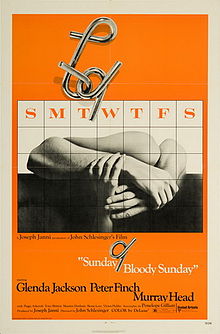
Sunday Bloody Sunday (1971)

Sunday bloody sunday header
Peter Finch, Murray Head and Glenda Jackson in an unconventional relationship in Sunday Bloody Sunday

Director: John Schlesinger

Cast: Peter Finch (Dr Daniel Hirsh), Glenda Jackson (Alex Greville), Murray Head (Bob Elkin), Peggy Ashcroft (Mrs Greville), Tony Britton (George Harding), Maurice Denham (Mr Greville), Bessie Love (Answering service lady), Vivian Pickles (Alva Hodson), Frank Windsor (Bill Hodson), Thomas Baptiste (Professor Johns), Richard Pearson (Patient), Jon Finch (Scotsman)

Is anything better than nothing? Or, sometimes, is nothing better than anything? It’s a question that lies at the heart of John Schlesinger’s mature and surprisingly low-key exploration of relationships Sunday, Bloody Sunday. In the on-going puzzle of life, what on earth are the answers?

Alex (Glenda Jackson), a divorced woman in her mid-thirties, is in a relationship with young artist Bob Elkin (Murray Head). But the bohemian Bob is also in another relationship, with 50-year-old Dr Daniel Hirsh (Peter Finch). Bob moves between his two partners. Alex and Daniel, who have never met, accept they have him on a timeshare basis and work within his rules, for fear of losing him.

That’s a brief summary – but this is not a film overburdened with plot. Rather it’s a character study. Perhaps its greatest strength (and for some it’s main weakness), is the lack of melodrama or conflict in this unconventional set-up. Any expectations that this might be building towards a cathartic outburst or a traumatic event of some kind should be dispelled from the start. This is a very restrained and genuine film, deeply heartfelt, that avoids cheapness.

In fact, the film becomes a very striking study of the fear of loneliness. Both Alex and Daniel live in semi-acknowledged fear of being left alone. You can see the emotional fragility in them, when separated from Bob. Alex – who Bob has abandoned during a weekend’s baby-sitting to visit Daniel – quietly sits eating fudge and trying to read a book, while tears play in her eyes. Later Daniel will similarly resemble a little boy lost after being stood up at a restaurant. The excitement of being with Bob – for all his faults – are just as acute as the sadness when left alone in their own company.

Both Alex and Daniel are people staring down the barrel of a life of being alone. Alex is a woman stuck between two stools – too bohemian to be happy in a nine-to-five and a safe everyday relationship, too conventional to fully embrace the sort of devil-may-care casualness of Bob. She seems uncertain herself what she wants from life (the perfect relationship, or the bursts of happiness with a young lover).

Daniel, a gay Doctor in middle-class London from a traditional Jewish background, has spent a lifetime quietly carrying on and accepting companionship where he can find it. A man who has understood that a certain degree of isolation is just part and parcel of being who he is. Who balances, perhaps, the flaws in his relationship against getting only a part of what he wants as opposed to nothing.

It’s those questions the film comes back to time and time again. Alex expresses them most clearly, happy in the moments of playful joy she finds with Bob, but this only covering deep lying anxieties. Flashbacks reveal her childhood worries about traumatic events befalling her father (bought on by the killing of a friend’s dog in a road traffic accident due to the carelessness of a child she is looking after). These fears are directly linked to her tentativeness towards long-term relationships: she invests emotionally so much in those she cares for, that it’s difficult for her to find a romantic partner that is perfect enough to justify this level of commitment.

But Daniel has similar issues: his life has taught him to expect that he might always be alone. An insight into his romantic life before Bob is shown with a chance encounter with a former pick-up (played with chippy aggressiveness by Jon Finch) who forces Daniel to give him a lift and then pinches his medical bag. These sorts of risky, emotion-free entanglements are dwarfed by the tenderness and warmth Daniel gets with Bob, for all that Bob is mercurial and immature. As Daniel says at the film’s end (in a beautiful fourth-wall breaking address to the camera), Bob isn’t perfect but he’s something and that while Bob never made him completely happy, right now Daniel is happy only when he is not missing him. It’s balances like this that people make in their lives.

It may also be a fascination with youth. Both Alex and Daniel are either heading into – or deep into – middle age, and they surely wouldn’t deny there is an additional excitement from spending time with the defiantly young Bob. Bob – a rather thankless role to be honest, played with a deliberate lack of depth by Murray Head – is in some ways a cipher, a rather selfish young man who can only think about moving on to the next opportunity, not the difficulties of being fixed in one place and making the best of it. Does this young man’s attitude carry additional appeal to two people with greater ties and responsibilities? Perhaps it does.

Schlesinger’s film is well-paced, and directed with an intimacy by the director who surely built many elements of his own life into Daniel. The two leads – who share a scene only twice, at one point literally passing each other in cars like ships in the night – are both superb. Glenda Jackson is superbly able to suggest a hinterland of emotional guardedness and fragility, behind a confident exterior, that only cracks at key moments. It’s a brilliantly subtle performance of small moments.

Peter Finch is equally superb as Daniel. The film was controversial at the time for featuring the first gay kiss in British cinema (sexuality questions are refreshingly not a major part of the equation and never discussed, which makes the film ever more modern – the kiss itself is played with an unshowy naturalism). The part had been hard to cast – Ian Bannan was fired (to his later intense regret) for being visibly uncomfortable – but Finch (less worried, perhaps because his romances with everyone from Vivien Leigh to Shirley Bassey were so well known, no one watching in the cinema could imagine he was really gay) embraces the part with a beautifully sensitive empathy. It’s a wonderful moving portrait of a man who has come to terms with loneliness and accepted it. Tender and very true, it’s wonderfully heartfelt.

Both stars (along with Schlesinger and the script, credited by Penelope Gilliatt but likely the work of several hands) were nominated for Oscars (inexplicably the film itself was snubbed), and its perhaps their sensitive and tender work is behind the film’s success. Schlesinger co-ordinates all this into a unshowy but very mature intelligent analysis of relationships and the compromises that come with them. Thoughtful and questioning, it’s adult cinema.

Midnight Cowboy (1969)

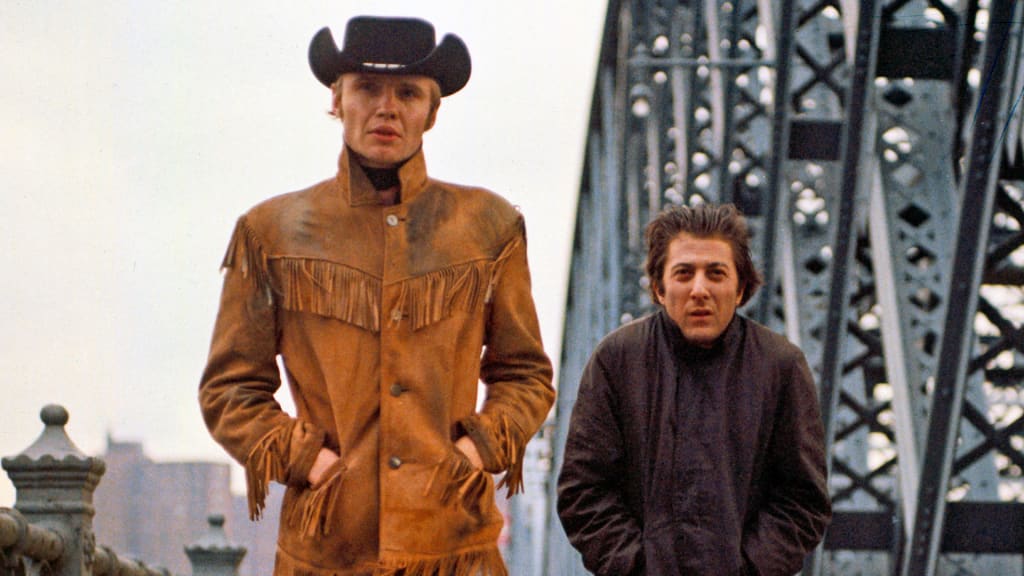
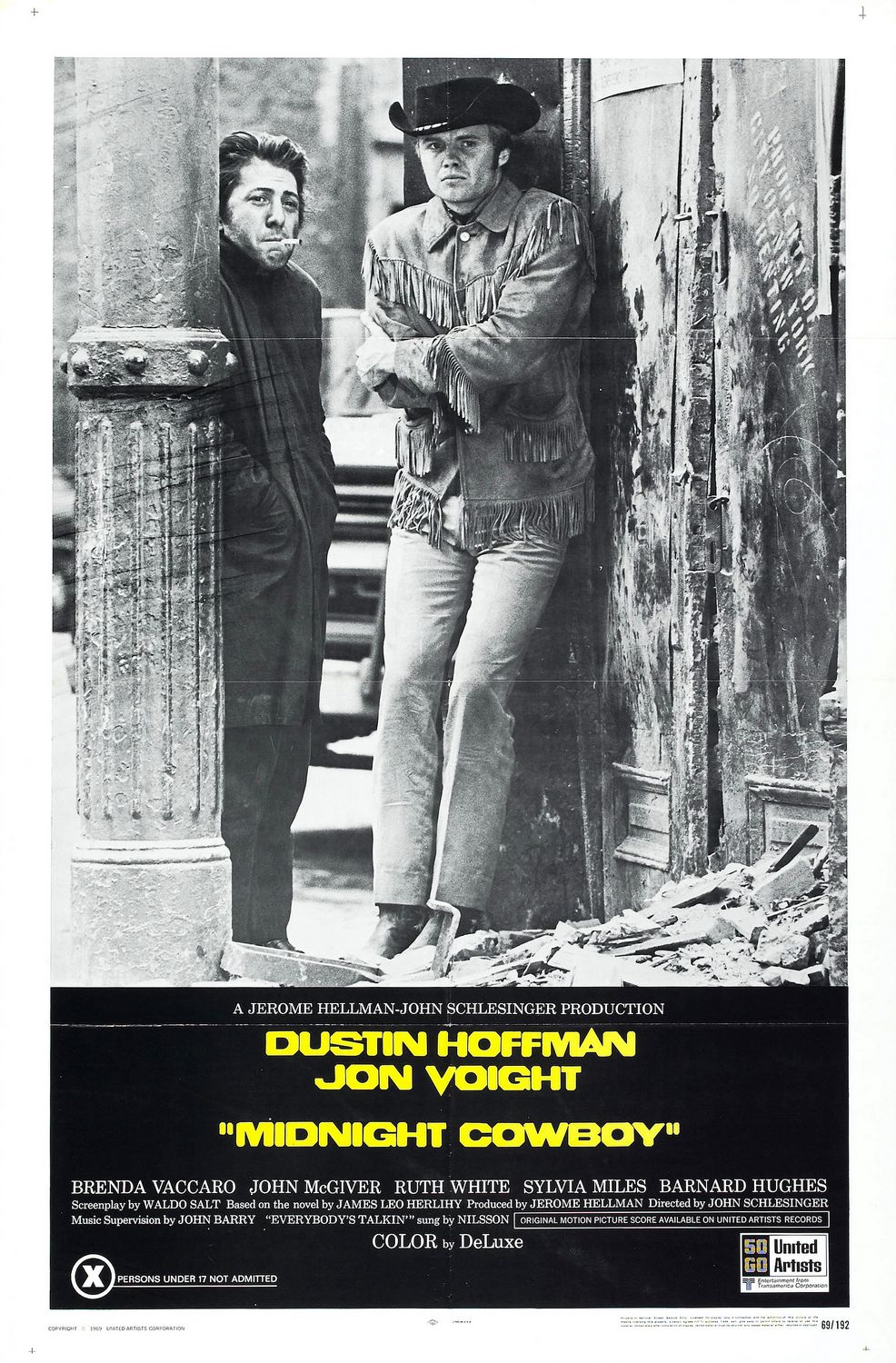
Jon Voight and Dustin Hoffman are an odd couple in the Big Apple in Midnight Cowboy

Director: John Schlesinger

Cast: Jon Voight (Joe Buck), Dustin Hoffman (Enrico “Ratso” Rizzo), Sylvia Miles (Cass), John McGiver (Mr O’Daniel), Brenda Vaccaro (Shirley), Barnard Hughes (Towny), Bob Balaban (Young Student), Ruth White (Sally Buck), Jennifer Salt (Annie)

Even today it still feels like an odd Best Picture winner: two down-and-outs in the slums of New York, both trying to hustle, develop a strangely symbiotic relationship part brotherly, part semi-romance. It’s even more bizarre when you remember the year before the Academy had given the Big One to the super-safe family-friendly charms of Oliver! Still the only X-rated film to win Best Picture (though it looks hilariously tame for such a rating today), Midnight Cowboy is both the first step towards the fresh, modern film-making of the 70s and also a dated landmark of a particular era of film-making.

Joe Buck (Jon Voight) is the would-be Cowboy, escaping the hum-drum life of dishwashing in a run-down restaurant in Texas (not to mention a backstory darkly hinted at of a childhood of neglect and traumatic sexual encounters of the past) to make the trip to the Big Apple to find a new career – as a gigolo. After all he “ain’t a for-real cowboy. But [he is] one helluva stud”. Sadly making a career of sleeping with rich women for money ain’t half a lot harder to pull off than you might think. Not least when you are quite the naïve rube, certainly compared to more practised hustlers like “Ratso” Rizzo (Dustin Hoffman), a crippled, seriously ill born-and-bred New York who lives a hand-to-mouth on the streets desperate for each coin he can find. Both hustlers team up to try and make their wealth from Joe’s attractions – but life is tough for the desperate underclass of American society.

Released in 1969, the film stunned the States with Brit John Schlesinger’s insight into the dark underbelly of the American dream. Schlesinger, in a way few film makers before had, focused on the scuzzy poverty of the American loser, the two dreamers who fantasised about turning their lives around into the American ideal, but instead met failure and depression at every turn. This was a million miles from the “poor boy made good” vision of past films, or the sort of Capraesque spin of small-town guys winning out in the big city due to their inherent pluck and honesty. There’s none of that in Midnight Cowboy

Throw in Schlesinger’s style – the way his camera immerses you in New York with its “on the hoof” immediacy (Schlesinger couldn’t afford to get the streets closed, so simply shot the actors in medium or long-shot in real streets and locations, with real people) – and you got a vision of America you hadn’t seen before. The use of locations gives triumphant shots – Jon Voight emerging head and shoulders above the New Yorkers as he walks through bustling streets – and also moments that hum with authenticity. Most famously Hoffman’s “I’m walkin’ here” outburst when the actor was nearly mowed down by a taxi mid-shot while crossing a road. Midnight Cowboy takes you down in the gutter with these characters, and makes you feel part of their world. When we see the freezing poverty they live-in – in an abandoned apartment block – you practically shiver with them.

Throw in with this Schlesinger’s (and Waldo Salt’s fabulous script) careful and sensitive exploration of the bonds between the two men. Starting as strangers, both Ratso and Joe slowly find themselves drawn together in a symbiotic way that’s part soul mate, part unspokenly romantic. It’s implied throughout that the two characters feel a connection towards each other that they lack both the emotional and intellectual language to understand. But it’s there for the audience to pick up on, even if the sexuality of the two characters is something they seem barely able to understand (Joe’s sexuality is certainly far more fluid than he can even begin to grasp, while Ratso hurls around homosexual slurs so often you can tell he doth protest too much). These characters become inseparable, tending to each other (at one point an ill and soaking Ratso loosely embraces Joe, while Joe uses his shirt to dry his face and hair), sharing dreams and hopes for the future, forming a bond that goes way beyond questions of sexuality. For both of them it’s more than clear that an emotional bond like this is something alien to them both, a connection they have long feared in a cruel world.

Both actors excel in the two roles. Voight – in a career making performance – is understanding as a man who is naïve, easily fooled, caring but distant, who slowly begins to replace his wide-eyed innocence with a greater understanding of himself. Joe is a hopeless hustler – a failure as a seducer of women, and twice reduced to tragically mismanaged male prostitution, a stud who ends up paying his first customer to spare her feelings. The film carefully sketches in a backstory of emotional frigidity which adds context to a character who is charmingly selfish but learns to make a connection with another human being.

Hoffman was equally keen for the role, desperate for a part that would be the polar opposite of Benjamin from The Graduate. While Voight plays with a grounded naturalism and unaffected genuineness, Hoffman’s performance pushes the envelope of quirk. There is no end to the affectation of the role – scruffy, limping, sweaty, loud, twitchy – it’s a show-off of a role, with the moments of emotional vulnerability seized on with an actorly relish. But it still works because, despite it all, Hoffman communicates a genuine empathy and sorrow in the role, and because the performance bounces so well off Voight’s stiller, more balanced work.

The film works less well when it drifts away from this central pairing. The “marks” get short shrift, with the women in particular either hornily manipulative (Sylvia Miles, receiving a generous Oscar nod for five minutes work) or serenely wise (Brenda Vaccaro as a woman with more insight into Joe’s fluidity of sexuality than himself). Joe’s male marks are a tragically ashamed young student (Bob Balaban in an effecting debut) or full of messed up self-loathing (Barnard Hughes). 

Similarly, Schlesinger’s directorial flourishes may have looked like modern cinema verite at the time, but don’t half look like dated, heavy-handed touches today. Joe’s backstory – told in wordless sequences with different film stock – not only seem tiresome and alienating but also flimsy in the extreme in their psychological insight. Schlesinger’s satire on the Warholesque arty high-life of New York is heavy handed in the extreme, and its filming style outrageously clunky. The film’s psychological depth is thin and insight often blunted, while Schlesinger’s analysis of character often seems dependent on actors (some overindulged) rather than a true vision.

But despite that, Midnight Cowboy works because the characters are so rich and the insight into the life down-and-outs in New York still feels real. Voight and Hoffman (for all his indulgence) are excellent and the sexless romance between the two characters is intriguing and, by its conclusion, carries real emotional weight. While dated and lacking in as much insight as you might wish, it’s still a film that reflects on the damaging gap between dreams and reality, and the difficulty of casting the former aside.

Marathon Man (1976)

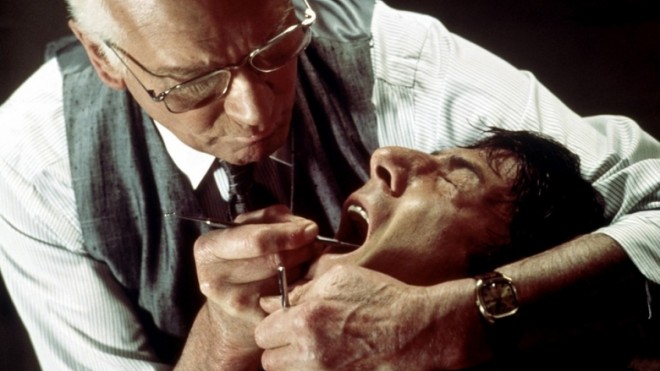
“Is it safe?”: Laurence Olivier interrogates Dustin Hoffman in Marathon Man

Director: John Schlesinger

Cast: Dustin Hoffman (Thomas “Babe” Levy), Laurence Olivier (Dr Christian Szell), Roy Scheider (Henry “Doc” Levy), William Devane (Peter Janeway), Marthe Keller (Elsa Opel), Richard Bright (Karl), Marc Lawrence (Erhadt), Fritz Weaver (Professor Biesenthal)

The 1970s were the era of the conspiracy thriller. These were deliberately enigmatic, almost opaque, mysteries in which a humble individual was thrown up against sinister forces, backed by equally shady governments. Marathon Man is a stylish (if rather impenetrable) mystery that offers some gripping moments but gets bogged down a little too much in pleasure at its edginess, darkness and professional assurance.

Thomas “Babe” Levy (Dustin Hoffman) is a post-graduate student working on a re-evaluation of the McCarthy era, partly aimed at clearing his father’s name (who committed suicide while under investigation). Babe’s brother Henry “Doc” (Roy Scheider) works for a shady government organisation, and has recently narrowly avoided assassination twice in France. Doc suspects the killers were sent by renegade-Nazi Dr Christian Szell (Laurence Olivier). Szell’s New York-based brother was recently killed in a car crash, and with his death Szell has lost vital access to his cash reserve of diamonds in a New York bank, which he needs to maintain his safety in Uruguay.

I hadn’t seen Marathon Man for several years, and I was struck by how long it takes to get going: it takes a solid 45 minutes to get to the point. Huge swathes of the opening act of the film is all about getting the set-up and atmosphere, rather than establishing the story. It also seems to be about setting up as complex as possible a context for a film that boils down to a pretty straightforward plot. Nearly all the action that Doc gets up to in Europe is pretty much impossible to work out and never seems to tie in with the rest of the plot once it starts (exciting as it is to watch him dodge assassination attempts). Even the marathon running of the hero, and his relationship with Marthe Keller’s mysterious swiss woman doesn’t in the end really tie in that closely with the story.

But then that’s often the way with Marathon Man. It’s a film in love with atmosphere, its Hitchcockian tricks and its brooding creepiness more than with logic, story or even (really) character. It’s pretty hard to work out what’s going on, and the muttered plot revelations and Schlesinger’s grimy, often deliberately obscure, filming style doesn’t always help the humble viewer work things out. It wants to be like other 70s thrillers and juggle huge events – but it’s actually a rather small-scale, humble film telling a deliberately dreary story, scored with a very 70s combination of electronic noises and plonking piano notes. Plot wise it never really explains what is it about, and gets so bogged down in cross and double cross that it eventually loses its own way.

Where the film does succeed is its individual scenes. Mention Marathon Man and anyone who has heard of it will immediately say “the dental torture film?” They might even say “Is it safe?”. Marathon Man’s dramatic centre-piece is this unnervingly taut torture scene (not too graphic it has to be said – gosh violence in films has moved on since 1976!) where Szell questions Babe (just the one question repeated over and over again) while using his dental skills to “encourage” Babe to answer (ouch!). Ever been even slightly squeamish about going for a dental check-up? This probably isn’t the film for you (heck even one of Szell’s murderous henchmen can’t watch). 

Schlesinger shoots this scenes extremely well, with the camera lingering effectively on everyday dental tools that become dreaded torture devices. Schlesinger builds sequences around action and violence very effectively: escape attempts by Babe are gripping and fight scenes are extremely tense, particularly Doc’s fending off of an assassin in a Paris hotel room.

That scene also highlights another effective part of Schlesinger’s direction of the film: his use of bystanders. The life and death struggle between Doc and an assassin is witnessed across the street by a wheelchair-bound old man powerless to intervene. The opening road-rage deaths of Szell’s Nazi brother and a furious New York Jew are intercut constantly with the reactions and confusions of people in New York’s streets. In the film’s finest scene, Szell has to undertake a terrifying (for him) walk through New York’s Jewish quarter to collect and value his diamonds. His paranoia and fear of being recognised mean he sweatily watches every face. When he is recognised by an old woman – who shrieks for help from bemused passers-by – you really feel Szell’s fear that this woman will turn the mass of watching New Yorkers into a lynch mob. The bystanders really add depth to the film’s paranoia – they are both dangerous and also help to isolate the characters.

The film’s main strength is Laurence Olivier’s stand-out sinister performance as the Mengele-like Szell. Terrifyingly cold, paranoid and sadistically proud, Szell is a truly great villain, and Olivier channels all his Shakespearean experience into turning him into an iconic villain. The film also really works matching Olivier’s imperious old-schoolishness with Hoffman’s edgy, brittle method (the famous anecdote from the film was Olivier’s aghast reaction to Hoffman’s decision to prepare for the torture scene by not sleeping for three days: “Dear boy, would it not be easier to just act?”).

Hoffman is actually very good in the film as a man out of his depth from the start who slowly becomes as hardened and dangerous as the people chasing him. In fact Hoffman, is so involving and empathetically frightened in this film (his desperate range of answers to “Is it safe” are really affecting) that you overlook that he is clearly far too old to be playing a college graduate. Roy Scheider is similarly good as his domineering, but loving spy brother.

But it’s Olivier’s mastery of nastiness that really makes the film lodge in your mind. Schlesinger’s film is often long-winded, opaque and confusing, but Olivier delivers a master-class in imperious nastiness. Szell is a nightmare image of the well-spoken, polite monster and Olivier’s eyes carry a spark of intense menace. Honestly I could happily watch just the scenes he is in – particularly that masterfully performed street walking scene – and be happy to stick with that. The rest of the film is often a bit of a murky mess, but when Oliver is at the centre you forget all that. Marathon Man is a conspiracy thriller so confusing I think it confuses itself – but in the individual scenes it often brilliantly captures dread, discomfort and fear.