Category: Leo McCarey

The Bells of St Mary’s (1945)

The Bells of St Mary’s (1945)

Schmaltzy but also rather charming, a superior sequel to Going My Way

Director: Leo McCarey

Cast: Bing Crosby (Father Chuck O’Malley), Ingrid Bergman (Sister Mary Benedict), Henry Travers (Horace P Bogardus), William Gargan (Joe Gallagher), Ruth Donnelly (Sister Michael), Joan Carroll (Patsy Gallagher), Martha Sleeper (Mary Gallagher), Rhys Williams (Dr McKay), Dickie Tyler (Eddie Breen), Una O’Connor (Mrs Breen)

When Bing Crosby asked America if they were Going My Way in 1944, the answer was a massive yes. It was inevitable we got a sequel –the first sequel to be nominated for Best Picture – The Bells of St Mary’s. In a stunning display of it ain’t broke so don’t fix it, The Bells of St Mary’s drops Father Bing (aka Chuck O’Malley) into another urban-parish-with-problems, this time turning round a rundown convent school, run by straight-laced Sister Ingrid Bergman (aka Mary Benedict). Can Father Bing and Sister Ingrid set aside their incredibly-good-natured rivalry to: (a) convince heartless local businessman Horace Bogardus (Henry Travers) to donate a new school building, (b) save sensitive young Eddie from easy-going bullying and (c) re-build the marriage of easy-going-bad-girl Patsy’s parents? If you have any doubt Father Bing can solve these problems without breaking his easy-going-sweat, you ain’t spent long enough going his way.

The Bells of St Mary’s score over its Oscar-winning forbear by being significantly less gag-inducing in its snowstorm of saccharine schmaltz. This is despite the fact it shares almost all the flaws of the original. It goes on forever, very little really happens, every single problem is solved with a little flash of Father Bing’s gentle insight, and it’s painfully predictable. But The Bells of St Mary’s manages to not outstay its welcome because it’s told with genuine wit and, in Ingrid Bergman, has a consummate performer who is actually charming and lovable rather than someone we are just told is charming and lovable.

It’s also somehow more down-to-earth, the resolution to its problems being a bit more relatable than Going My Way’s MET-opera finale for the tough kids. Father Bing is marginally less saintly smug and has an underhand cunning – having worked out his wise words ain’t melting the heart of Bogardus (how strange it is to see George Bailey’s Clarence as a child-hating arsehole), he quickly switches to a little conspiracy of suggestion to make Bogardus fret about being set on a highway to hell. Despite this of course, O’Malley remains blissfully perfect, a liberal churchman and bathed in perfection.

The Bells of St Mary has complete faith in the fundamental goodness of the church. The only questions are ones of approach: O’Malley favours a manly Christianity where decent men fight bullies, while Mary Benedict’s instinct is to turn the other cheek and take the moral high ground. O’Malley feels the kids will be served best if they relax, Mary Benedict sees virtue in hard work and self-improvement. Naturally, lessons are learned on both sides: O’Malley discovers sending the boys on holiday isn’t a ticket for good behaviour, Mary Benedict teaches bullied Eddie to box and prove himself to his bully.

Sister Ingrid might be a bit more serious because, unlike Father O’Malley, she’s lived a bit in her time. The tomboy-turned-nun can swing a baseball bat with the best of them and when she tells young Patsy you “have to know what you are giving up” when you become a nun, there is more than a hint Sister Mary might have snuck behind a few bike-sheds back in the day. Perhaps this contributes to The Bells of St Mary’s cheekily suggesting a little bit of sexual tension between the eunuch-like O’Malley and Mary Benedict. (Crosby and Bergman played up to this to tease their on-set Catholic advisors, at one point ending a take with an improvised passionate kiss – a gag that’s probably a little funnier than some of those in the film.)

Ingrid Bergman is actually rather marvellous here. It’s a reminder she had fine light comic chops, making Mary charming, warm and rather endearing – for all Sister Mary switches from hard-headed academic realism to a flighty faith that God Will Provide so long as they pray hard enough (very different from O’Malley’s God Helps Those Who Help Themselves angle). Bergman hilariously dances and prances, like Sugar Ray, while teaching Eddie to box but is also touchingly gentle when comforting a distressed Patsy. Bergman is such a good actress she pretty much lifts the entire film another level from its original.

She even lifts the game of Bing Crosby. Though he still largely coasts through on his own charm and persona, but he pushes himself into some more fertile dramatic territory. Even the film’s  contrived plot developments like Sister Ingrid’s TB diagnosis – something which for reasons she can’t be told about (don’t ask) – end up carrying a touch of realistic drama. Not that Bing forgets what the people want to see: of course Patsy’s father is a piano player, so of course within seconds of him turning up at her mother’s flat he and Bing dive straight into a musical number.

Despite all the treacle that The Bells of St Mary’s wades through, there is enough genuine charm here (among all its sentimental, signposted silliness) for you to cut the film some slack. Leo McCarey directs mostly with an unfussy professionalism – although he does sprinkle in the odd good bit of comic business, noticeably a cat stuck crawling around under O’Malley’s signature straw hat, on the mantlepiece behind him during his first meeting with the nuns. And it might largely be due to Bergman’s skilful presence, but there is genuinely more substance here than Going My Way. It might still feel like gorging on candy, but at least this time you don’t feel your stomach groaning in pain after you’ve finished.

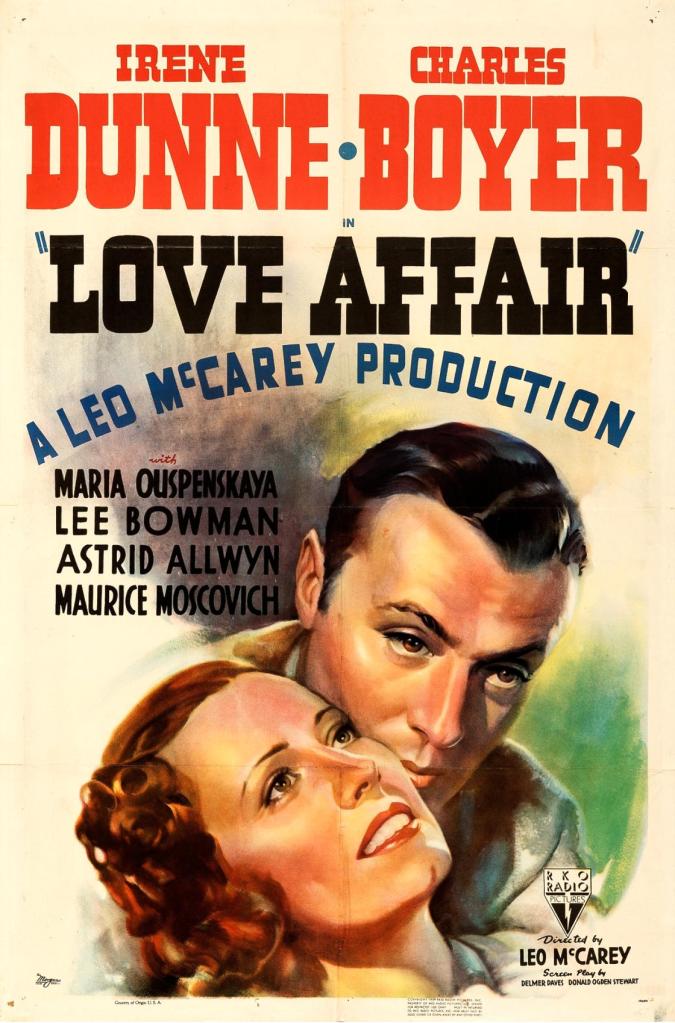
Love Affair (1939)

Love Affair (1939)

Two people in love, separated by circumstance, in this film of two halves: one comedy, one sentimental

Director: Leo McCarey

Cast: Irene Dunne (Terry McKay), Charles Boyer (Michel Marnay), Maria Ouspenskaya (Michel’s Grandmother), Lee Bowman (Kenneth Bradley), Astrid Allwyn (Lois Clark), Maurice Moscovich (Maurice Cobert)

In many ways you could say Love Affair was the turning point in Leo McCarey’s career. For years in silent films and the early talkies he had been one of Hollywood’s leading comedy directors, the quick-witted master of the improvisational pun. But there was a second McCarey: the devout Catholic, concerned about social issues. The McCarey who light-heartedly complained when was given an Oscar for The Awful Truth rather than his heartfelt critique of elderly care, Make Way For Tomorrow. This McCarey increasingly leaned into well-meaning, sentimental dramas.

So why is Love Affair a turning point? Because the first half is a charming, funny, sexy meet-cute: and the second a well-meaning but sentimental love story that pulls two people apart. Those meet-cuters are famous Parisian playboy (he’s basically a gigolo) Michel Marney (Charles Boyer) and nightclub singer Terry McKay (Irene Dunne). They meet on a trans-Atlantic liner and fall in love. Problem is they are both engaged to others (both of them rich), waiting for them in New York. Should they decide to chuck it in and be together, they arrange to meet six months later at the top of the Empire State Building. Come the day, Michel waits – but on the way there, Terry is hit by a car and possibly left paralysed. She doesn’t want to tell him. He thinks she never planned to show up. Will they ever be together?

That car crash is the pivot in a film that feels like two genres surprisingly successfully wedded together. Love Affair is a great idea (so good in fact that McCarey remade it about 20 years later as An Affair to Remember), a romantic story with all the joy and vibrancy of a couple finding each other and falling in love, then the painful sting of tragic circumstances pulling them apart. It manages to be sweetly funny and then more or less manages to land just the right side of sentimental (though, lord, it skates near to the edge).

You go with that more overtly manipulative conclusion though, since the subtle comedic and romantic manipulation of the first half is so well done. McCarey encouraged his actors to improvise: filming started with McCarey sitting at a piano, plinking keys, waiting for inspiration to jazz up the script. It’s an approach many actors found challenging (Cary Grant nearly had a meltdown at first on The Awful Truth). But he found the perfect pairing with Boyer and Dunne.

Of course, Irene Dunne was a veteran. An actress far too overlooked today, Dunne flourished under McCarey’s style. Here she’s gloriously warm, sexy and charming. Terry McKay has a very dry (at times almost slightly smutty) wit; she’s absolutely no fool, but also kind, caring and considerate. Dunne sparkles every time she steps in front of the camera, displaying the sort of comic timing you can’t buy (her teasing glances at Michel during their first meeting, when she accidentally reads a telegram all about his sexual exploits at Lake Como, are to die for). But her face also lights up with a genuine radiance as she finds herself falling in love.

She also sparks wonderfully with Charles Boyer. Another overlooked star of 1930s Hollywood, Boyer was desperate to work with McCarey. He found the improvisational style awakened a relaxed, playful element in his acting that helped make Michel exactly the sort of dreamboat you could imagine falling in love with on a cruise. Boyer was also a superb reactor, his face able to communicate anything from growing interest, to delight and also piety, pain and disappointment. Boyer’s comic timing, like Dunne’s is faultless. Like her, he also effortlessly shifts to drama in the second half, expertly demonstrating the maturity of a playboy into someone generous and understanding.

With these two actors, McCarey couldn’t go too far wrong. Their natural ease with each other makes for wonderful chemistry. They are two people who progress naturally from teasing, to enjoying each other’s company, to realising they enjoy each other’s company way too much. Today, Love Affair can look a little tame – they don’t even kiss (although one shot of crashing waves, cutting to them opening a door on the boat to walk along the deck together, is rather suggestive). But the point is that this is love not an affair (or an affair about love). The feelings they develop for each are genuine and, bless them, they don’t want to corrupt it with behaviour that could compromise them.

Tellingly their love is cemented during a stop off in Madeira, where they visit Michel’s aunt (played by an archly eccentric Maria Ouspenskaya). She welcomes them into her home, bonds with Terry, and Michel shows Terry a far different side to himself than his playboy persona: a thoughtful artist. McCarey even shoots them together (in a beautifully lit scene by photographer Rudolph Maté) in a chapel, kneeling side-by-side at the altar. Could McCarey make the endorsement of their love more clear?

Perhaps he felt he needed to, since the screenplay was controversial. The Hays Code had no intention of allowing a film showing two engaged people walking out on their partners. Perhaps that’s why they needed to be “punished” with that sudden car crash. The second half is less successful: maybe because I find the “I can’t ruin his life by making him look after me in a wheelchair” a little too on the nose. Boyer and Dunne play the hell out of it: Dunne is quietly crushed under a surface of charm and what-will-be-will-be. Boyer tries his best to hide his pain, but still searches for some of what he’s lost in his new career as an artist.

Of course, the truth will out – and it will end happily. But there’s a little too much sentiment in the second half, after the heartfelt romancing of the first. A little too much put-a-brave-face-on-the-pain, a few too many contrivances to maintain the illusion (of course they go to the same play on Christmas Eve!). There are too many sickly sweet scenes of Dunne singing with the kids at the orphanage she’s recuperating at (a ghastly advance warning of McCarey’s tedious Going My Way). But it just about works, because we really care about Terry and Michel. We want them to be together, come what may.

Love Affair can be a mixed bag, but it’s got two wonderful performances for Boyer and Dunne (she was nominated, he was robbed) and McCarey manages to juggle comedy, romance, sweetness and a little touch of sadness. It’s a luscious romantic film, even while you see it manipulating you – and for that, it will always give you a great deal of pleasure.

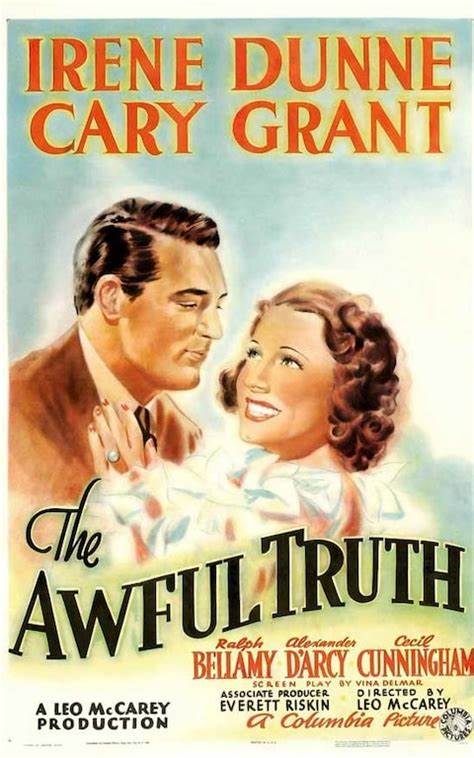
The Awful Truth (1937)

Irene Dunne and Cary Grant flex their comic muscles to outstanding effect in The Awful Truth

Director: Leo McCarey

Cast: Irene Dunne (Lucy Warriner), Cary Grant (Jerry Warriner), Ralph Bellamy (Dan Leeson), Alexander D’Arcy (Armand Duvalle), Cecil Cunningham (Aunt Patsy), Molly Lamont (Babara Vance), Esther Dale (Mrs Leeson), Joyce Compton (Dixie Belle Lee), Robert Allen (Frank Randall), Robert Warwick (Mr Vance), Mary Forbes (Mrs Vance), Skippy (Mr Smith)

Lucy (Irene Dunne) and Johnny (Cary Grant) Warriner divorce because both of them are constitutionally incapable of being faithful. But yet, they also pretty much can’t stand the idea of the other being with anyone else. Can they face The Awful Truth that they are, in fact, perfect for each other? This is a feuding husband and wife who enjoy the horrified looks on the faces of other people as much as they enjoy seeing how far they can push each other.

When winning the Oscar for Best Director for this film, Leo McCarey believed he actually deserved it for his more serious melodrama about the struggles of the elderly, Make Way for Tomorrow. While Make Way for Tomorrow might well be a more serious work, and not the souffle of The Awful Truth, I’m pretty sure far fewer people over the past 80 odd years have found revisiting it such a delight as going back into The Awful Truth. Perhaps the eponymous truth for McCarey was that we are never the best judges of our own work.

The Awful Truth is possibly the best, funniest, remarriage comedy ever made. It was pulled together almost from nothing onset. Nominally an adaptation of a play by Arthur Richman, McCarey effectively dumped almost the entire plot and instead largely improvised the film and its plot on set as he went, throwing in jokes, plot developments and bits of business depending on what worked with the actors on the day. Producer Harry Cohn would arrive on set to find McCarey plinking on a piano, swopping stories and coming up with ideas for what they would shoot that day. From this the director would decide on the structure of the scene, the jokes and most of the dialogue. No wonder Cohn was pulling his hair out.

Sounds like chaos right? The stars certainly thought so. Grant was terrified. Prior to this a reliable Studio actor, used to being given the lines and standing where he was told. Finding out here that McCarey wanted something loose and improvisational, at first he was all at sea – even offering instead to buy himself out of the film. But McCarey saw something in him: in fact what he saw was “Cary Grant”. The Awful Truth is the moment the Grant we all know came to be: sophisticated, arch and a masterfully relaxed light comedian (rumour has it, at least partly based on McCarey himself). From hating the experience, Grant suddenly realised it was inspired. The same went for his co-stars: Dunne, Bellamy and the rest all excitedly contributed their own ideas and business into what became one of the greatest comedies of all time.

The Awful Truth is frequently laugh-out loud funny, a perfect combination of witty lines delivered with pin-point perfection. Many of the best lines fall to Irene Dunne’s Lucy, from denying an affair with her latest beau (“That’s right Armand. No one could ever accuse you of being a great lover. That is, I mean to say…”), to archly responding to Jerry’s “I know how I’d feel if I was sitting her with a girl and her husband walked in” with a “I’ll bet you do”. Grant though gets plenty of his own – “The car broke down? People stopped believe that one before cars started breaking down.” – and only he could make “I only just met her” a laugh-out loud moment. Nearly every scene has a perfect bon mot, brilliantly delivered.

McCarey’s direction also adds hugely to the comic effect. The Awful Truth is so smooth, polished and assured you can overlook how skilfully and brilliantly it’s been put together to accentuate the comic effect. From cuts that reinforce or set up gags, to characters entering and leaving at the edges of frames at the perfect moment for a laugh, the entire film is a masterclass in how to shoot and frame comic business. The film is a triumph of reaction shots: watch Grant, Dunne and Bellamy respond to the appalling singing of Jerry’s new girlfriend Dixie Bell (Lucy: “I guess it was easier for her to change her name than her whole family to change theirs”). Best of all a superb sequence where we hear Jerry and Armand fight off screen (with crashes aplenty) while Lucy attempts to maintain a banal ‘nothing to see here’ conversation with Daniel and his mother.

The entire film is a triumph of comic set-pieces, with Grant and Dunne sparking off each other like two whirligigs of static electricity. Both actors are absolutely sublime. Grant manages to make everything not only funny, but also effortlessly cool and his archness and confidence are hilarious. Dunne throws herself comedy with a full-blooded commitment and a total willingness to look silly. Like Grant, she also has the ability to tip the wink to the camera and flag up just how ridiculous many of these situations are. Ralph Bellamy, on paper, has the dullest role as the straight man but as well as being winningly naïve, he also has two show-stopping moments, most strikingly his hilariously enthusiastic dancing (made even funnier by Dunne’s increasingly uncomfortable efforts to keep up with him).

It’s all wrapped up in a plot light as air, perfect for the jokes to latch themselves onto. You’ll laugh almost from the first, but you’ll also care about these two dotty eccentrics who are clearly perfect for each other. With Grant creating his entire screen persona in front of your eyes and Dunne absolutely radiantly hilarious, The Awful Truth will carry on entertaining the masses for decades to come. Hopefully McCarey doesn’t regret that Oscar decision too much.

Ruggles of Red Gap (1935)

Charles Laughton wonders what he’s got himself in for in Ruggles of Red Gap

Director: Leo McCarey

Cast: Charles Laughton (Ruggles), Mary Boland (Effie Floud), Charles Ruggles (Egbert Floud), ZaSu Pitts (Mrs Judson), Roland Young (Earl of Burnstead), Leila Hyams (Nell Kenner), Maude Eburne (Ma Pettingell), Lucien Littlefield (Charles Belknap-Johnson), Leota Lorraine (Mrs Belknap-Johnson), James Burke (Jeff Turtle)

Ruggles (Charles Laughton) is the perfect gentleman’s gentleman. So how will he react when his gentleman, the Earl of Burnstead (Roland Young), loses him at cards to nouve riche American Westerner Egbert Floud (Charles Ruggles) and his social-climbing wife Effie (Mary Boland)? Wodehousian antics meet societal culture-clashes, in Leo McCarey’s witty and rather sweet comedy from Charles Laughton’s annus mirabilis (Ruggles, Bligh and Javert all in the same year!) that’s a celebration of American egalitarianism and the well-hidden warm cordiality of the polite British.

Directed with a fine sense of comedic timing by Leo McCarey, Ruggles of Red Gap is refreshingly heart-warming and a celebration of the rewards of decency. For all his initial reserve – and Jeevesian distaste for his new employer’s brashness and love of chequered suits – Ruggles emerges as a decent man, liberated by the classless openness of America. In fact, the idea of all men being equal opens Ruggles eyes for the first time to the idea of making his own decisions (after all he doesn’t question being told he will be moving from Paris to Washington State) and being seen as something other than just an extension of his employer.

Ruggles makes this point with some excellently delivered set-pieces. Most of these revolve around the enjoyable cultural clash between Ruggles and his new employer, the relaxed Egbert, who can’t imagine not calling Ruggles by a host of invented names (from “Bill” to “The Colonel” – the latter causing no end of trouble later) or inviting this staid servant to sit down and have a beer. Egbert’s obliviousness to the careful social rules that Ruggles has lived his entire life by works, because there is not a jot of meanness or correction to it. Egbert genuinely doesn’t understand the fine points of class difference and sees no reason not to treat Ruggles like a friend rather than a servant.

It makes for some terrific moments of comic business. Ruggles and Egbert conduct a running battle where Egbert’s natural politeness and Ruggles’ duteous deference leads to them constantly insisting the other walks first through doorways. Their first day together sees Egbert and a friend taking Ruggles to a Parisian bar and getting him roundly pissed (probably for the first time in his life). Later Egbert’s insistence on introducing him when they arrive in Red Gap as his friend “the Colonel”, combined with Ruggles patrician manners leads to him being mistaken as a genuine aristocrat by the snobbier element of Red Gap society.

Regular Americans may be overly boisterous – you can’t miss the increasingly irritated reactions by Parisians at Egbert’s reunion on the streets of Paris with an old friend, which escalates from embraces, to loud whoops to riding each other like horses – but generally they mean well (good natured fun is poked at the American’s hopelessness with foreign languages – “je voodrais ham un eggs”). In Red Gap, the patrons of a saloon greet Ruggles as one of their own. In turn Ruggles – and even the Earl of Burnstead – are charming and respond far more warmly to their decency than the snobbery of the hoi polli.

If there are unsympathetic characters in the film, it’s the snobs of the American elite, desperate to grab a bit of that old world glamour. Egbert’s snobby brother-in-law Charles sticks out as dyed-in-the-wool snob, concerned mostly with position and being seen with the right people. Effie (hilariously played by Mary Boland) is interested in Ruggles largely as a status symbol, and spends her entire time crafting Egbert into her idea of a gentleman. By contrasts the actualupper status chap, the Earl (delightfully under played with a hilarious uber-poshness by Roland Young) is relatively decent, humble and far prefers the fun-loving social crowd of Red Gap the stuffed shirts.

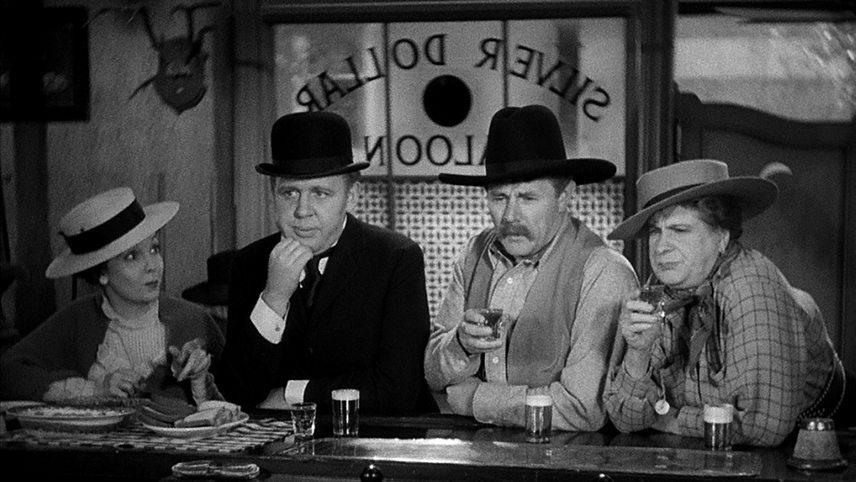
The film was a very personal one for Laughton, deep into his decision to take up American citizenship. Ruggles’ (and Laughton’s) love for American society is captured in the scene where he recites the Gettysburg Address to the rapt patrons of the saloon (none of whom could remember a single word of it when asked beforehand). In previews, the audience sniggered at Laughton’s emotional rendition (he couldn’t get through it without weeping) – so McCarey re-cut so we only see Laughton from behind and instead focuses on the faces of his audience: suddenly the scene carries real emotional force.

Laughton’s performance is an odd mix. Some moments – such as the Gettysburg address – he nails. His interplay with the other actors is highly effective, but many of his reaction shots often feel overplayed. He over eggs the pudding with the comic eyebrows and, like the scenes when he plays drunk, he sometimes seems to be trying too hard to be funny. But his ability to offer several different versions of shock and surprise is pretty faultless and he captures beautifully Ruggles growing sense of independence and delight at there being more opportunities in life than he ever imagined.

The rest of the cast bounce off each other with all the ease of a relaxed repertory company. Charles Ruggles (who knew Ruggles was such a common name!) is brilliant as Egbert, loud, brash but overwhelmingly kind and decent. His comic timing is exquisite and his chemistry with Mary Boland (one patient the other long suffering) is a constant delight. The comic playing of the cast, with assured – if at times visually disjointed – direction by Leo McCarey helps craft this into a delightfully heart-warming comedy of manners with just the right touch of slap-stick. At the end of which you’ll be as willing to jack it all in and set up a grill in Red Gap as Ruggles is.

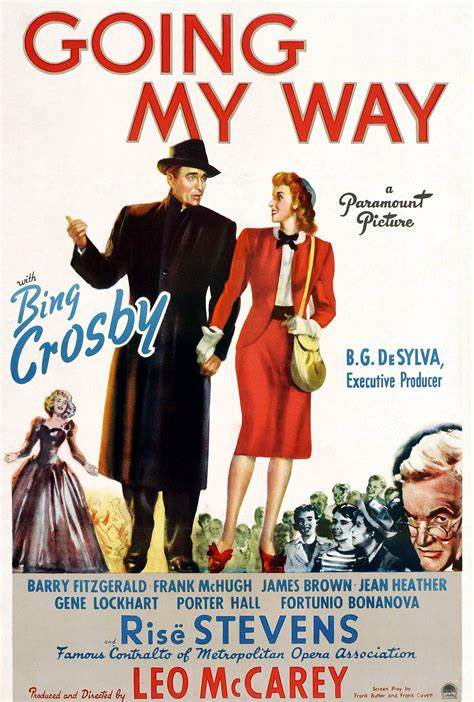
Going My Way (1944)

Bing Crosby wins hearts and minds in the sentimental Best Picture winner Going My Way

Director: Leo McCarey

Cast: Bing Crosby (Father Chuck O’Malley), Barry Fitzgerald (Father Fitzgibbon), Frank McHugh (Father Timothy O’Dowd), Rise Stevens (Genevieve Linden/Jenny Tuffel), James Brown (Ted Haines Jr), Gene Lockhart (Ted Haines Snr), Jean Heather (Carol James), Porter Hall (Mr Belknap), Fortunio Bonanova (Tomaso Bozani), Eily Malyon (Mrs Carmody)

“Schmaltz isn’t selling” record producers tell Father O’Malley (Bing Crosby) when he pitches them the little ditty he’s penned to raise funds to save his church from financial ruin. Well no one told the producers of this film: and just as well, as this became one of the most successful films of the 1940s, raking in buckets of cash and armfuls of Oscars. Watching it today, you’d hardly believe it – but that’s to forget the stress and fear of a nation at war, or that Bing Crosby (in a tailor-made role) was practically the most popular human being alive. For all that, watching Going My Way today won’t challenge you at all – other than perhaps your patience.

Father O’Malley (Bing Crosby) arrives in a (allegedly) rough neighbourhood in New York. He’s to take over the parish from the ageing Father Fitzgibbon (Barry Fitzgerald) but, gosh darn it, Father Bing doesn’t have the heart to tell Father Fitzgibbon that, so pretends to be his new curate. Promptly, Father Bing sets about solving all the problems of the parish with his charming homespun wisdom, decency, empathy and ability to bond with all. Gosh darn it, before you know what’s happened he’s turned the rough-and-tumble local boys from larcenists into an all-male choir and has roped in an old friend (who just happens to be the lead singer at the MET Opera) to give him and the boys the stage to sing a few of his songs and help save the church.

Yup, Going My Way is exactly that sort of film, and your enjoyment of it is going to be inversely proportional to how quickly being dipped in pure schmaltz brings you out in hives. This film is sickly sweet in its cozy comfort, a reassuring view of a world straight out of Enid Blyton, where the priest has all the answers, the hearts of businessmen can be melted by a few wise words, and dropping a few sporting references can win over the local ‘tough’ kids.

Going My Way is so homely and quaint, it makes Capra feel positively edgy. In fact, it lacks any of the energy, wit and style Capra brings to his pictures. That lack of buzz doesn’t help it, the languid pace drawing your attention all the more to its overbearing decency and careful weeding out of anything that could even cause a scintilla of doubt.

Instead it’s a warm gentle hug – and a hug that takes a great deal of time (at just two hours, it can seem like it’s going on forever). There are fewer songs in it than you might expect – only one every 10-15 minutes max. Often very little happens – and when it does, drama is very far from the agenda. Instead every problem is solved with consummate ease (it just needs Father Bing to open people’s eyes). Everyone is at heart decent in the extreme: the local tough kids have more high spirits than hooliganism to them, the (very) Irish women have stern exteriors but soft hearts, and the ruthless businessman is a devoted family man. After a while, I felt my patience being sorely tested.

In the middle of this, we get Bing Crosby, who won an Oscar for his work here. It’s a part tailor-made for Bing. In fact, so much so, that he essentially turns O’Malley into a dog-collar wearing version of his own stage persona, with touches of wry humour, whimsy and an affectionate smile. It’s no mean thing creating an entire persona – or performing it – but it feels a little rich to win an Oscar for it. O’Malley is of course perfect, a man free of any blemish who backs humbly into the limelight. A liberal who thinks Church should be fun (though far from a radical), there is nothing to cast even a shadow of doubt on his perfection: his flirtation with a girl never went so far as a date, he has the patience of a saint and he always knows exactly what to say to everyone.

He even wears down the defensiveness of Barry Fitzgerald’s Father Fitzgibbon. Fitzgerald also won an Oscar (for Supporting Actor) and effectively created the cinematic template for what an Irish priest is like. Fitzgibbon is bumbling with a sing-song whimsy, stuck-in-his-ways but basically decent, a touch prickly but also vulnerable and caring. His Irishness (like many of the rest of the cast) is dialled up to eleven. It’s an engaging performance, even if this old-cove-with-a-heart-of-gold schtick already felt familiar. But blimey, like the rest of the film, it can be far too much.

John Ford would have loved the Irish sentimentality of this film. It’s not perhaps Going My Way’s fault that its unquestioning regard and confidence in the church – and the assumption that all would treat them with complete deference and absolute respect – has dated it. But then maybe this was the case then as well, and it just felt much more reassuring to watch a simple world where a priest has all the answers and can change everyone’s lives. In the simple world of the film, you just let the cliché and coincidence wash over you and go with the flow.

Nevertheless, it still can make for a long watch if you aren’t in the right mood for this constant spin of Sunday-afternoon-gentleness. I have to confess it was too sweet for me – way too sweet. And there isn’t much of interest in the film, McCarey directing with a professional but uninteresting staidness (you couldn’t believe he cut his teeth doing Laurel and Hardy, so visually dull and slow is this film). Every outcome is dipped in sentimentality and sweetness and eventually watching the film is like gorging on candy-floss. Light, insubstantial, not as filling as it should be, and at the end you feel like throwing up.