Category: Directors

The Fabelmans (2022)

The Fabelmans (2022)

Spielberg explores his childhood in this warm but honest look at the triumph and pain of movie-making and family

Director: Steven Spielberg

Cast: Gabriel LaBelle (Samuel Fabelman), Michelle Williams (Mitzi Schildkraut-Fabelman), Paul Dano (Burt Fabelman), Seth Rogan (Bennie Loewy), John Butters (Regina Fabelman), Keeley Karsten (Natalie Fabelman), Sophia Kopera (Lisa Fabelman), Mateo Zoryan Francis DeFord (Young Sammy), Judd Hirsch (Boris Schildkraut), Jeannie Berlin (Hadassah Fabelman), Robin Bartlett (Tina Schildkraut), David Lynch (John Ford)
Perhaps no director is more associated with cinema’s magic than Steven Spielberg. And watching The Fabelmans, a thinly fictionalised story about his childhood, clearly few directors have as much of that cinematic magic in their blood. The Fabelmans joins a long line of post-Covid films about auteur directors reflecting on their roots (clearly a lot of soul searching took place in 2020). Surprisingly from Spielberg, The Fabelmans emerges as a film that balances sentiment with moments of pain and a love of cinema’s tricks with the suggestion of its darker powers rewrite reality according to the eye of the director (or rather the editor).

The film follows thirteen years in the life of the young Spielberg, here reimagined as Samuel Fabelman (Gabriel LaBelle, by way of Mateo Zoryan Francis-DeFord). His father Burt (Paul Dano) is an electrical engineer with a startling insight into the way computers will shape the modern world. His mother Mitzi (Michelle Williams) is a former concert pianist turned full-time Mom. The family moves from New Jersey to Phoenix and finally California, as Burt’s career grows. From a young age Samuel is enchanted by cinema, filming startling narrative home movies, packed full of camera and editing tricks. But he and the family are torn between art and science, just as Mitzi’s friendship with “Uncle” Bennie (Seth Rogan), Burt’s best friend, is revealed to go far deeper.

The Fabelmans is both a love letter to cinema and to family. But it’s a more honest one than you expect. It’s got an open eye to the delights and the dangers of both, the pain and joy that they can bring you. The film’s theme – expertly expressed in (effectively) a sustained monologue brilliantly delivered by Judd Hirsch in a brief, Oscar-nominated, cameo as Samuel’s granduncle a former circus lion tamer turned Hollywood crew worker – is how these two things will tear you apart. The creation of art makes demands on you, both in terms of time and dedication, but also a willingness to make reality and (sometimes) morality bend to its needs. And family are both the people who give you the greatest joy, and the ones that can hurt you the most.

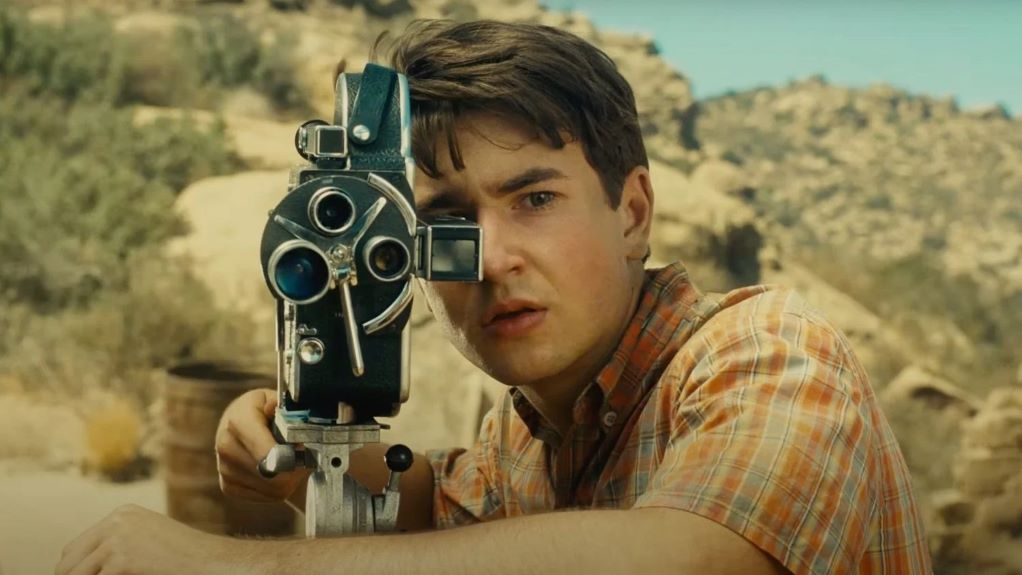
Spielberg’s film tackles these ideas with depth but also freshness, lightness and exuberant joy. Nowhere is this clearer than the film’s reflection of Spielberg’s deep, all-consuming love for the art of cinema. Its opening scene shows the young Samuel – an endearingly warm and gentle performance from Francis-DeFord – transfixed during his first cinema visit by the train crash the concludes DeMille’s The Greatest Show on Earth. So much so he feels compelled to recreate it – much to his father’s annoyance – with an expensive gift trainset, before his mother suggests filming it. Even this 10-year olds film, shows a natural understanding for perspective and composition.

The young Samuel – in an inspired moment of Truffautesque brilliance – is so enraptured with his resulting film, that he plays it repeatedly, projecting it onto his hands, as if holding the magic. No wonder he becomes a teenager obsessed with movie-making, who talks about film stocks and editing machines at a hundred miles an hour, locking himself away for hours carefully snipping and editing footage. The film this young auteur directs – very close recreations of Spielberg’s actual movies – are breath-taking in their invention and the joy. A western with real gun flashes – Burt is astounded at the effect, achieved by punching holes in the film – an epic war film crammed with tracking shots and stunningly filmed action.  This is a boy who loves the medium, excited to uncover what it can do, who finds it an expression for his imagination.

He’s clearly the son of both his parents. Burt, played with quiet, loving dignity by Paul Dano (torn between holding his family together and the knowledge he can’t do that), is a quintessential man of science. It’s from him, Samuel gets his love for the nitty-gritty mechanics of film-making, its machinery and precision. But to Burt it’s only a “hobby” – real work is the creation of something practical. So his artistic sensibility films comes from his mother Mitzi, gloriously played by Michelle Williams as a women in a constant struggle to keep her unhappiness at bay by telling everyone (and herself) its all fine. She needs a world filled with laughter and joy.
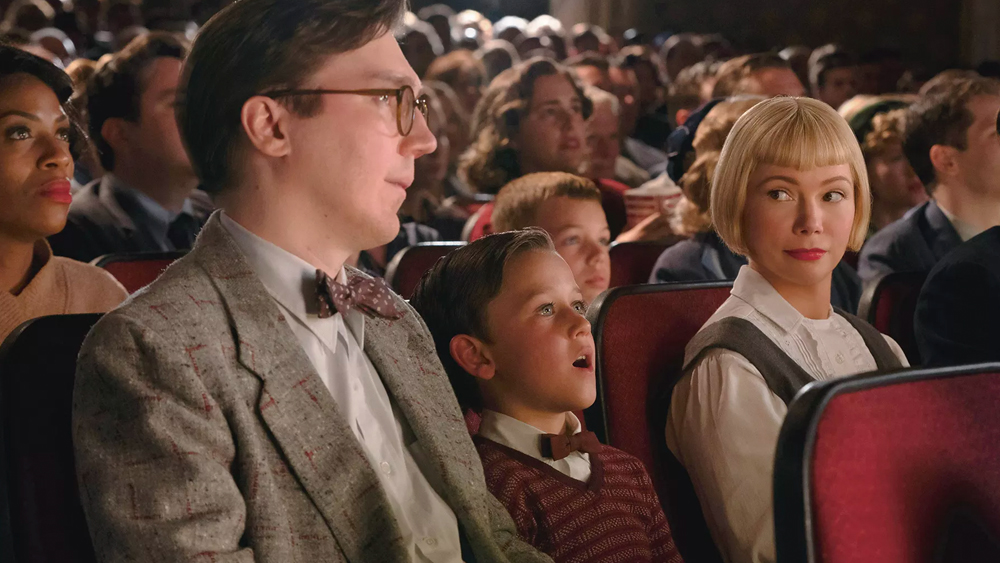
It’s what she gets from Uncle Bennie (Seth Rogan, cuddly and kind). It’s also where the darkness of both family and film-making touches on this bright, hopeful world. Creating a film of a camping trip the extended family have taken, its impossible for Samuel not to notice at the edge of the frames that Bennie and his mother are more than just friends. His solution? Snip this out of the film he shows the family, then assemble an “alternative cut” which he shows his mother, showcasing the tell-tale signs of her emotional (if not yet physical, she swears) infidelity. The Fabelmans skirts gently however, over how Spielberg’s teenage fear of sexuality in his mother and the association of sex with betrayal may have affected the bashful presentation of sex in many of his movies.

Samuel’s camping film works best as a reassuring lie. He’ll repeat the trick a few years later, turning his jock bully (who flings anti-Semitic insults and punches) into the super-star of his high-school graduation film, a track superstar who is made to look like a superman. Confronted about it, Samuel acknowledges it’s not real – but maybe it just worked better for the picture. It’s as close as Spielberg has ever come to acknowledging the dark underbelly of cinematic fantasy: it can mask the pain and torment of real life and it can turn villains into heroes. His unfaithful Mum becomes a paragon of virtue, his school bully a matinee idol.

Why does he do it? Is it to gain revenge by confronting those who have let him down with idealised versions the know they can’t live up to? Even he is not sure. Perhaps, The Fabelmans is about the young Spielberg reconciling that even if the movies are lies, they can also be joyful, exciting lies that we need: and that there is more than enough reason to continue making them. Just as, angry as we might get with our parents, we still love them.

The film is held together by a sensational performance by Gabriel LaBelle, who captures every light and shade in this journey as well as being uncannily reminiscent of Spielberg. It’s a beautifully made film, with a gorgeous score by John Williams that mixes classical music with little touches of the scores from Spielberg classics. And it has a final sequence dripping with cineaste joy, from a film deeply (and knowledgably) in love with cinema. Who else but David Lynch to play John Ford, handing out foul-mouthed composition tips? And how else to end, but Spielberg adjusting the final shot to match the advice, tipping the hat to the legend?

The Fabelmans creeps up on you – but its love for film and family, its honesty about the manipulations and flaws of both and its mix of stardust memories and tear-stained snapshots feels like a beautiful summation of Spielberg’s career.

Eastern Promises (2007)

Eastern Promises (2007)

Brutal violence in London’s underbelly in Cronenberg’s formal and chilling dark fairytale

Director: David Cronenberg

Cast: Viggo Mortensen (Nikolai Luzhin), Naomi Watts (Anna Ivanova Khitrova), Armin Mueller-Stahl (Semyon), Vincent Cassel (Kirill Semyonovich), Sinead Cusack (Helen), Mina E Mina (Azim), Jerzy Skolimowski (Stepan Khitrov), Donald Sumpter (Inspector Yuri), Raza Jaffrey (Dr Aziz), Josef Altin (Ekrem), Tatiana Maslany (Tatiana’s voice)

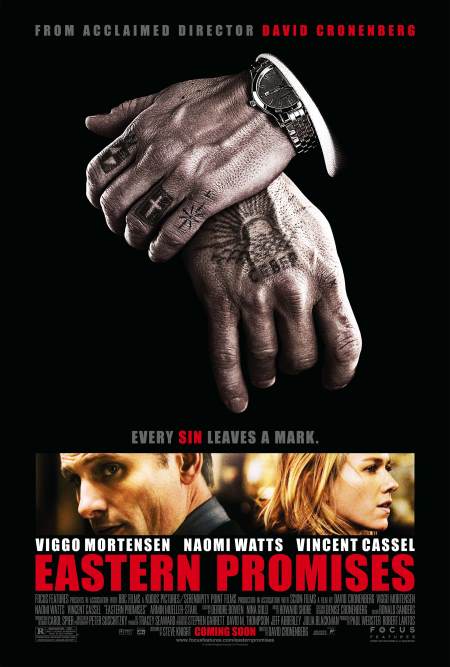
Big promises shipped back to Russian villages, telling women about dreams they can make reality in the bright lights of London. Those are Eastern Promises – but the reality, of sexual slavery and abuse in Russian Mafia controlled houses is horrifyingly different. Set in an underbelly of London just under grand restaurants and red buses, Eastern Promises is a typically tough and bloody gangster fable from David Cronenberg, which plays out like a nightmare fairytale.

It’s the nightmare of midwife Anna Khitrova (Naomi Watts). When a pregnant Russian teenager dies giving birth, the only clue she has to who her daughter’s family might be is a Russian diary and a business card for a Russian restaurant. Anna – whose family are Russian immigrants – is offered help by grandfatherly restaurant owner Semyon (Armin Mueller-Stahl). Seymon is all pleasant insistence that he can help, even as asks after every detail of her life. Because Seymon is a ruthless Mafia kingpin, with a hapless son Kirill (Vincent Cassel) leaning on the emotional and practical support of his imposing, heavily tattooed driver Nikolai (Viggo Mortensen). As Anna is pulled further and further into Semyon’s deadly world of death, could she have a surprising saviour?

Cronenberg’s film, sharply scripted by Steven Knight, is shot with a traditional stillness and a palette of strong colours – all of which reassuring visual language is utterly at odds with the skin-slashing violence at its heart. Eastern Promises opens with a Russian gangster practically having his head sawn off with a switchblade, in the hands of a mentally-handicapped nephew of a minor Turkish gangster. There isn’t a single gun in Eastern Promises – after all that would be breaking British law! – instead violence is meted out with the violent intimacy of a knife across the throat.

The film’s formal structure and framing – angles and cutting are kept simple, almost static – works brilliantly. As we watch throats slashed, grim sexual encounters or moments of imposing menace, the matter-of-fact presentation of these become more-and-more chilling. Eastern Promises feels like a bogey-man fable. Seymon’s restaurant – all class and bright red walls – an ogre’s cavern that leads us into an ever-grimmer world of violence and mayhem.

It’s a world Anna is unprepared for. Determined and resilient, Naomi Watts’ Anna is also undone by her politeness. How can she refuse an offer to help from someone as polite as Seymon? Watts does extremely well with a slightly under-written role, a woman on a quest who slowly realises how terrible the world she is peeking into is, but stop from trying to force through what she believes is right. Her disbelief – and out-of-place semi-innocence and sense of moral duty – make her stand out all the more in this terrible underbelly world, full of ogres and secret codes.

At the centre of is a monster. Armin Mueller-Stahl looks like your favourite uncle, but he quietly exudes cold, remorseless villainy. He’s the sort of man who delights in cooking the finest borsch, playfully teases his granddaughter’s violin playing and doesn’t bat an eyelid about ordering a rival to be dismembered. Mueller-Stahl is terrifying as this man the audience instinctively knows is dangerous and will stop at no moral boundaries to get what he wants (watch the steely eyed kindness he asks Anna where she works, lives and who she knows during their first meeting).

The obvious moral void in Seymon makes the unreadable Nikolai even more intriguing. Played with an extraordinary physical and linguistic commitment by Mortensen, Nikolai’s body is a tattooed walking advert of his past and capacity for violence and he’s the sort of relaxed heavy who is as unfussed with stubbing a cigarette out on his tongue as he is with snipping fingers off a corpse. Mortensen’s skill here is to make us constantly unsure where the moral lines are for Nikolai. He is a confirmed killer, but he takes an interest in Anna. Is this sexual or protective? What does he make of his bosses’ brutality towards women? What does he think of his direct superior Kirill?

Kirill is played with a larger-than-life weakness by Vincent Cassel in a thrilling performance that constantly shifts expectations. At first, he seems like a drunken blow-hard with a capacity for thoughtless violence. But Cassel makes clear he is a weak man with some principles, bullied by his father (to whom he is a constant disappointment), desperate to prove he is more capable than he is. He has an emotional reliance on Nikolai laced with sexual fascination (he can barely keep his hands off him).

Nikolai seems to accept this. But we don’t seem to know why. His actions are constantly open to interpretation. Ordered to have sex with a prostitute, he almost apologises to her after – left alone with her after Kirill has watched their sexual encounter, he’s strangely tender. He urges Anna to keep her distance but follows orders with calm disinterest. How far will he go? What moral qualms does he have, if any? Mortensen’s carefully judged performance is a master-class in inscrutability in a film that plays its cards very close to its chest as to why he (and others) do the things they do.

Cronenberg’s entire film is structured like this. Is the dragon a dragon or a potential knight? Can Anna emerge from this semi-Lynchian nightmare world and return to normal life – or will everything connected to her be destroyed by this world. Cronenberg’s study of this shady, heartless world is masterful. The “rules” and code of this brutal Russian Mafia world are excellently explored. And the film’s formal style culminates in a stunningly violent but beautiful (if that’s the right word) fight between a nude Mortensen and two knife-wielding Checians in a Turkish bath that is a brutal model for how these things can be done.

Eastern Promises resolves itself, after twists and turns, into something more comforting and traditional than you might expect. But is it a fairy tale ending to a nightmare? Either way, Cronenberg’s mix of formality and unflinching gore is masterful and in Mortensen it has a performance both relaxed and full of tightly-wound violence. Tough but essential.

Funny Girl (1968)

Funny Girl (1968)

A star-turn is the main interest in this grand-scale but so-so musical

Director: William Wyler

Cast: Barbra Streisand (Fanny Brice), Omar Sharif (Nicky Arnstein), Kay Medford (Rose Brice), Anne Francis (Georgia James), Walter Pidgeon (Florenz Ziegfeld), Lee Allen (Eddie Ryan), Mae Questel (Mrs Strakosh), Gerald Mohr (Branca), Frank Faylen (Keeney)

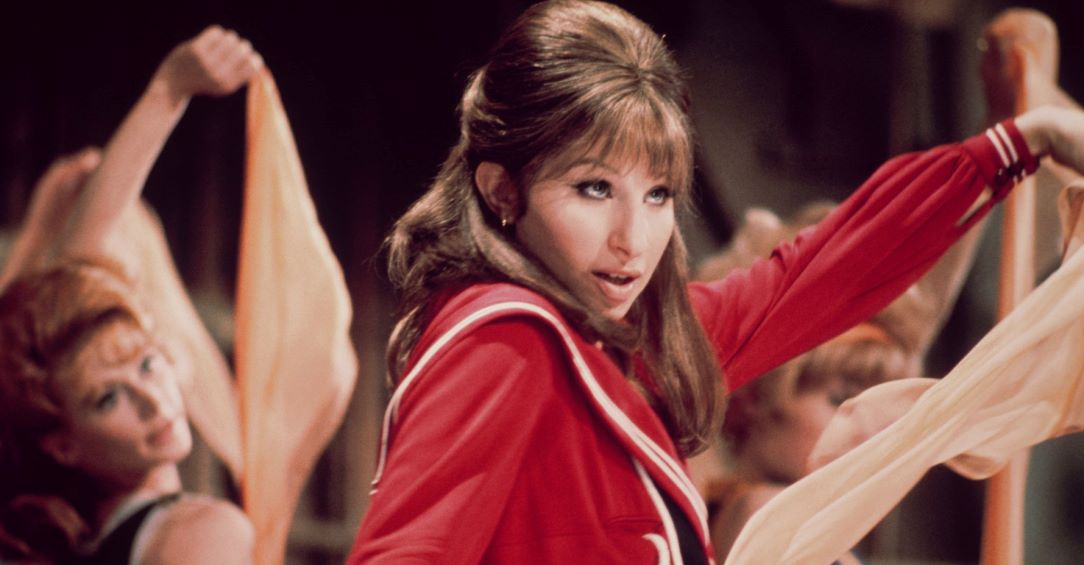
Fanny Brice was the major pre-war star of Broadway, the leading lights of the Ziegfeld Follies, the sort of all-singing, all-dancing spectaculars they just don’t make any more. A fictionalised version of her life became a Broadway smash, produced by her son-in-law Ray Stark. Hollywood came knocking, leading to this film version. Shepherded to the screen by William Wyler (his first ever musical, a genre he’s avoided due to being deaf in one ear) it would tell of Brice’s early success, her relationship with Ziegfeld (Walter Pidgeon) and her marriage to dodgy gambler Nicky Arnstein (Omar Sharif). And to play Brice? It could only be the woman who created the role, a young sensation called Barbra Streisand.

Funny Girl begins, ends and is exclusively about Barbra Streisand. Making her film debut, Streisand is, not to put too fine a point on it, absolutely sensational. This is charismatic, star-making stuff from an actress who knew exactly how to tailor the part (already basically written for her) to her strengths. Streisand is funny, kooky, witty but also vulnerable, shy, preoccupied with her low-opinion on her looks. She totally convinces as a charismatic figure who can dominate the room with cheek, won’t think twice at bluffing she can roller-skate to land a role or pigeon-hole Zeigfeld and argue against being asked to do something in performance. But she equally easily embodies a vulnerable woman, worried she is an unlovable ugly duckling, so certain she is destined to be alone she zeroes in on the first man who shows interest in her.

That’s not even mentioning the magnetism of Streisand. A truly confident, unique performer you couldn’t imagine anyone else so brilliantly mixing power-ballad notes with this sort of quirky character comedy. She can belt out Don’t Rain on My Parade or I’m the Greatest Stars with an awe-inspiring voice. She can add layers of pathos and tragedy to songs like People and Funny Girl. But few other performers could be both a diva and a pratfall artist on roller-stakes or mix arch-wit with low-comedy by stuffing a pillow up her dress in performance to turn her bride character pregnant in His Love Makes Me Beautiful, the Ziegfeld number she desperately doesn’t want to perform (because she can’t see herself as a beautiful bride).

Streisand is so central to Funny Girl’s success that I’m not sure that so much as three minutes go by without her appearing. It’s not a surprise as, subtract her from the mix, and Funny Girl is a fairly bland, unoriginal and at times slightly flat musical that struggles to do or say anything interesting. It’s had millions poured into its elaborate sets, it’s grandiose costumes and its vintage, sepia-tinged photography. But it’s an overlong, overblown, poorly paced film blessed with a star turn.

Wyler’s main strength as a director on mega-budget spectaculars like this was his professionalism and control, the gifts a producer likes. Visually though, Funny Girl frequently looks lost in widescreen, sets shot in a way that magnifies their emptiness and lacking the sort of affinity for timing and musicality that something like Minnelli, Donen and Kelly made look so natural (Most of the larger musical numbers were worked on by Herbert Ross). There is the odd strong shot – a showy helicopter shot pans down to Fanny on a tug steaming past the Statue of Liberty during Don’t Rain on my Parade or a sunset that pops up between the faces of Sharif and Streisand during a dockside embrace. But too many shots favour getting the money on the screen or struggle to frame two people interestingly in widescreen.

Mind you the story is a bit of a struggle. Fanny’s ascent to success is fast-paced and untroubled by conflict. Every gamble she takes pays-off, every cheeky trick goes unpunished. She can’t roller-skate when hired to do so? She sabotages the closing number of Ziegfeld’s show with her pregnancy flourish? Doesn’t matter – everyone loves it. She teeters for a few minutes on being fired, then jumps to promotion and glory. Ziegfeld – the sort of elite, New England aristocratic role perfect for Walter Pidgeon – just sighs and acknowledges talent gonna talent.

There are a few more clashes in her personal life. Her marriage to Nicky is the core emotional plotline of the film, but Nicky’s rough edges (in real life he was a conman and a swindler) are shaved off. Instead, he is played as a charming rogue, a professional gambler who bamboozles Fanny’s manager into giving her a stonking payrise and plays with honour and grace at the card table. When his business dealings go south, it’s never really his fault and he’s so noble he works to save Fanny’s honour by taking the rap for a collapsed business and arguing she should divorce him forthwith.

It doesn’t help that Nicky is played by Omar Sharif. Sharif, while a striking screen presence, had an acting range pretty much restricted to playing Sherif Ali. He’s unable to give the role any depth or interest, he can’t sing (thankfully he only tries once) and he’s overly reliant on his expressive eyes. He’s no match for Streisand, with whom he has less chemistry than rumour suggests was the case.

Streisand though was one-in-a-million here. Rumours abound she was a difficult and demanding presence, who fought tooth-and-nail with Wyler. She requested endless retakes to get her performance just right and “contributed” to script cuts (Anne Francis, playing a blousy Ziegfeld singer, was furious that her role effectively ended on the cutting room floor). Her perfectionism made her a controversial figure in Hollywood – but it’s also the brilliant fine-tuning of her own skill that won her the Oscar she shared with Katherine Hepburn. On a side note, Streisand had been controversially invited to join the Academy before she made a film, meaning the vote I assume she cast for herself was the one that guaranteed her the Oscar.

Funny Girl is large, overlong, largely visually and narratively uninteresting film that has a bright, shining, tour-de-force superstar in the lead who is in absolute, total control of her talent. Without Streisand it would be a tedious turkey – with her, it’s a strange landmark.

Tár (2022)

Tár (2022)

Character flaws abound in this intriguing and challenging film, open to multiple interpretations

Director: Todd Field

Cast: Cate Blanchett (Lydia Tár), Nina Hoss (Sharon Goodnow), Noémie Merlant (Francesca Lentini), Sophie Kauer (Olga Metkina), Julian Glover (Andris Davis), Allan Corduner (Sebastian Brix), Mark Strong (Eliot Kaplan), Sylvia Flote (Krista Taylor), Mila Bogojevic (Petra)

Absolute power corrupts absolutely. It’s a maxim humanity manages to prove true, time and time again. It doesn’t matter what the field is, when someone holds sway over the dreams and ambitions of others, there’s a decent chance that power can be enjoyed so much it starts being abused. It’s an idea key to Todd Field’s gloriously complex and challenging Tár, a film that defies easy explanations and characterisations, both frighteningly in the “here and now” but also terrifyingly universal.

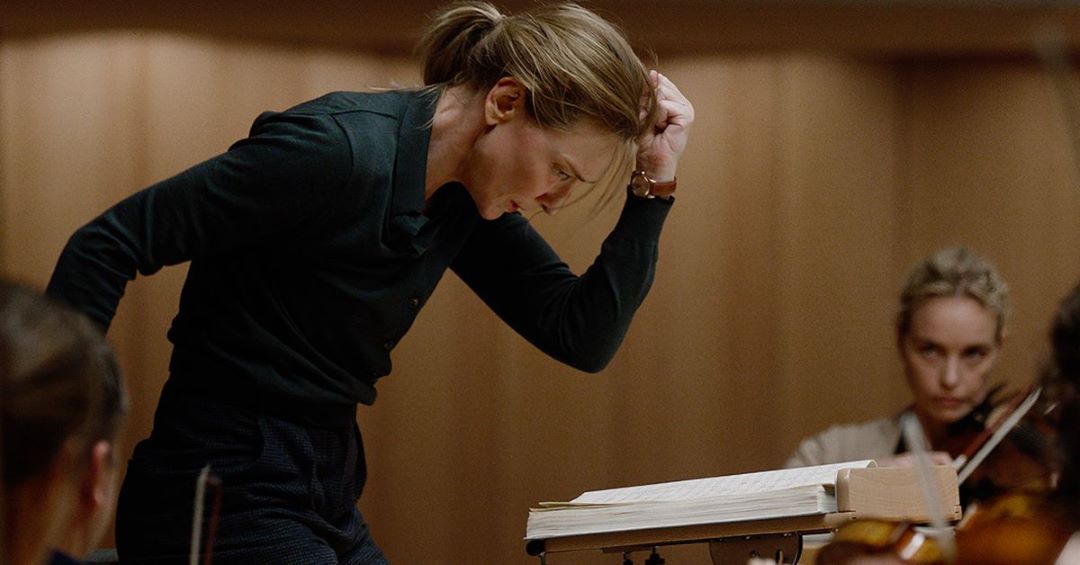
Lydia Tár (Cate Blanchett) is an internationally renowned conductor and composer. The first ever head of the Berlin Philharmonic Orchestra, she lives a jet-setting life of international acclaim and fame, praised at every stop-off for her stunning reinventions of classical music. But dark shadows swirl around her. She plays favourites: and her favourites are always attractive young women, just starting their career, who see her as inspiration and mentor. And Tár? She sees advantages to this. It’s unspoken knowledge to all, from her partner first violin Sharon (Nina Hoss) to the other members of the Orchestra. But as the suffering of one of Tár’s spurned proteges threatens to leak out into the public domain, her empire topples just as she reaches the summit of her career.

Tár is a brilliantly insidious film, a quiet but compelling character study that borrows elements of Kubrickian unknowability. In particular, Field avoids making moral decisions for the audience, but trusts we are smart enough to come to our own conclusions. Effectively, we spend the film following a deeply flawed, Spacey-like figure, whose life falls apart without being invited to feel morally superior to her. It allows us to feel the pain of her meeting the consequences of her actions, but never lets us forget her own arrogance and cruelty caused them in the first place.

Tár is both an inspirational genius and a dyed-in-the-wool bully. She solves problems with the mindset of an aggressive alpha – her solution to her daughter being picked on by a classmate, is outbullying the bully (“I will get you” she tells her, assuring her no one will believe her because Tár “is a grown-up”). She treats her assistant (and possibly former lover) Francesca who tags behind her in the hope of a junior conductor role like a slave, brow-beats Orchestra members and fellow conductors with friendly pressure and views every relationship in terms of what she can get out of it.

As this deeply flawed human-being, Cate Blanchett is mesmeric. Tár is a firm reminder that she is, perhaps, the greatest actor in the world and all her range is on show here. Blanchett is imperious, assured and totally brilliant. She invests Tár with such – admittedly deeply flawed – humanity, we have to constantly pull ourselves up to remember she’s a dreadful person. Tár is arrogant, convinced of her own genius and sees no-one as her peer. She’s also inspirational, charismatic and oddly charming. Blanchett’s mixes tragedy, grief, denial, panic and bottomless bitterness as Tár’s carefully constructed life falls apart like a time-delay car crash that suddenly jumps back into normal time.

Carefully paced – it’s difficult not to reflect on Tár’s opening words at a career retrospective interview on the importance of timing to give each moment its precise impact – Tár never rushes, unless it needs to and slowly, but assuredly unfolds the final days of her empire. It’s like watching the Indian Summer of an Astro-Hungarian Emperor, barely aware that huge global forces are about to sweep everything away and rob her of her control of events. Field reflects this in the film’s assembly: earlier sequences are marked by their long takes – virtuso set-pieces for Blanchett – and tracking camera, that constantly centres Tár. Later sequences become shorter, choppier, narrative information becomes less clear – it’s like Tár has lost control of the film as much as she has her life.

Control is central, and Tár’s abuse of it her undoing. Her (unspoken but implied) predatory demands for sexual favours in return for career advancement are an open secret among colleagues. Field adds a threatening sense of Tár being watched – either recorded on a phone, or shots of the red-haired back of a mysterious woman at key moments. The woman is Krista, a former protégé, the exact nature of her fall-out with Tár unclear, but who Tár has black-balled in the classical music world. Even as the fallout from this threatens to consume her, Tár can’t help herself from attempting to groom a new cellist (Sophie Kauer), fixing a blind audition, favouring her in private workshops and bypassing the orchestra’s new cellist to land her a juicy lead.

It’s part of Field’s wonderful and searching analysis of the corruption of power – even as the house of cards totters, people can’t seem to see it. While being a universal parable, the film is also fiercely topical. Tár has clear parallels with figures like Spacey. Her ageing former mentor (a crisp Julian Glover) bemoans how the slightest mistaken word to someone can be misinterpreted as lecherous abuse. Attention has focused on the idea of this as a cancel culture movie. Tár, at a Juillard lecture, does strongly disagree with a young BIPOC composer, who can’t relate to cis-gender old white guys like Bach. Tár pushes the rather self-righteous young man to justify himself, which he attempts. But she also goes increasingly further and further, moving from persuasion to brow-beating (her natural resort as a bully) and thinly veiled mockery. She’s smart enough to deconstruct the contradictions in the young man’s views – but cruel enough to mock his bravery at standing up. But Field allows both sides legitimate points, something that you don’t nearly get enough of in our polarised world.

Field also tips Tár more and more into something unsettling and other worldly. Tár’s uniquely perceptive hearing means she is plagued with strange noises: a chiming echoing around her bolt-hole apartment (the reveal of what this is, is another reminder of her indifference to other people), a screaming heard while out running, a metronome that wakes her at night. Strange daydreams, with ghostly, vampiric presences fill her mind. Late, she enters a damp-soaked abandoned building which feels like the gateway to some Lynchian parallel universe, guarded by a Tarkovsky-like dog who might as well be the gatekeeper to her nightmares. Much of the final act of the film unspools like a wild, terrible dream, where key events may not even be real. Reality crumbles, just as Tár’s control over her personal and professional life disintegrates.

Through it all we are invited by Field to empathise, but not sympathise, with this demanding and domineering woman. To understand her, but not forgive her, to dislike her but not tar and feather her. A lesser film would have done the moral work for us. Nothing is explicit about Tár’s cruelty, but the tears of her assistant (a superbly fragile Noémie Merlant) and the tight-lipped frustration of Sharon (Nina Hoss is terrifically pained and long-suffering in a difficult role) speak volumes. But yet, it’s hard not to feel something for someone as their life falls apart, no matter how earned the fall might be. Blanchett uses all her skills to make Tár someone who is frequently awful but never a bogeyman, is categorically in the wrong, but still a figure of hubristic tragedy.

Blanchett is earth-shatteringly good in the lead role and Field’s direction is subtle, balanced and plays just enough with your perceptions. Perhaps some of what we see takes place in Tár’s nightmares, perhaps we only see certain characters from Tár’s biased perceptions. It could even be a fabulous ghost story with past misdeeds haunting the frame, a deconstruction of our willingness to pull down the flawed, a study of the abuse of power – or all three and more. The fact you will debate it for weeks to come, means it’s definitely a great film.

Nomadland (2020)

Nomadland (2020)

Poetic and surprisingly moving, this Best Picture winner is light on plot but deep on meaning

Director: Chloé Zhao

Cast: Frances McDormand (Fern), David Strathairn (Dave), Linda May, Charlene Swankie, Bob Wells, Peter Spears, Derek Endres

We all have ideas about what life should look like in the 21st century. Settled job, dream home, the rooted life. It’s what we are expected to be working towards – but it’s not for everyone. Nomadland, Chloé Zhao’s Malick-influenced road movie explores the lives of those who decide to live off that beaten track. The modern nomad, who chooses flexibility to move their home from place to place and don’t want to be tied down by bricks-and-mortar. It makes for a meditative, soulfully poetic film with a quietly mesmeric power.

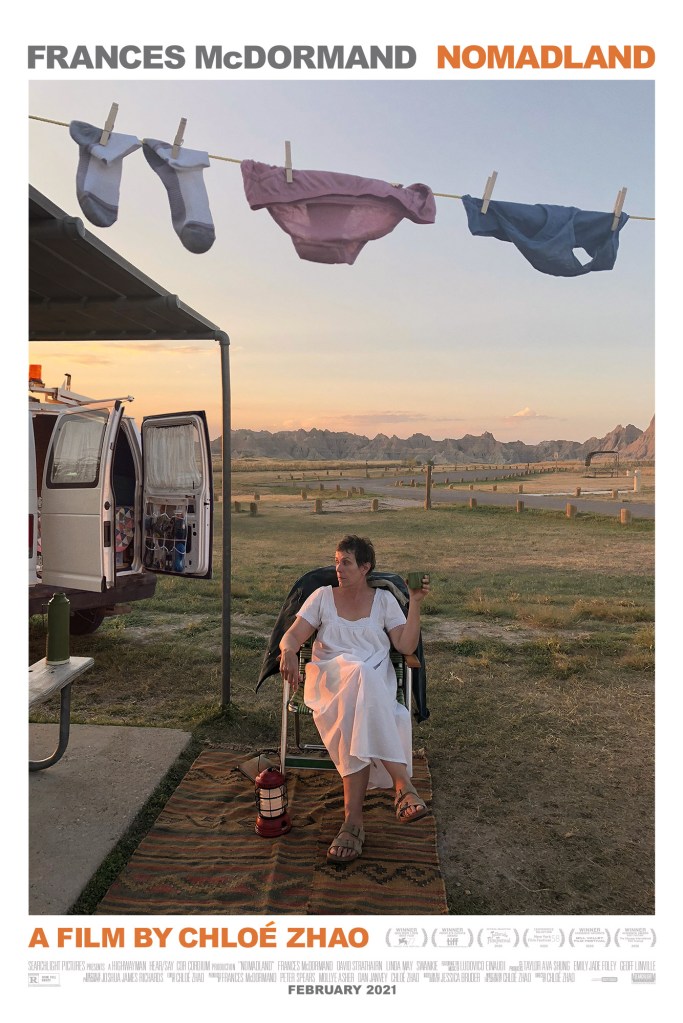
Fern (Frances McDormand) is recently widowed, childless and has lost her job after the gypsum plant in Empire, Nevada closes. But, far from down-hearted, Fern is determined to lead a new life without the fixed commitments of her old one. She sells most of her possessions, kits out a van as a travel home and begins to drive across the country, taking seasonal jobs as and where she stops. She finds herself part of a warm and supportive community of nomads, who help to learn how to flourish in this unconventional home life.          

Nomadland winning Best Picture is as close as the Oscars have come to giving an award to Terence Malick. It’s hard not to feel his influence over the camera’s languid worship of the beauty of the Badlands, or its characters quiet searching for higher in life, via a communing with nature. Zhao’s film is a very effective and surprisingly moving character study, with only the smallest smidgen of a plot, but full of feeling. Radiantly shot by Joshua James Richards, it finds an orange-tinged beauty in a dawn and dusk and tiny moments of joy in rain falling in your face. All contrasted with the dull oppressiveness of buildings, those four walls shutting out nature.

Zhao’s film goes a long way in challenging neat assumptions we might have about this lifestyle. “I’m not homeless I’m houseless” Fern states and she politely – but firmly – turns down well-meaning offers of charity. The decision to move from place-to-place is not one enforced by poverty or failure. Instead, this is a rich, vibrant, supportive community that looks out for each other and share a legitimate (and refreshing) view of the world. Who says you need to spend your life chasing the dollar and building up a debt to have a fixed slice of real-estate you can sort of call your own?

This is particularly true in our post-recession world. Nomadland starts with the final collapse of an industrial community, now a ghost town. Many of the nomads find seasonal work that is often manual and low-skilled. Fern’s first job (of many) is working at an Amazon dispatch location, where jolly team leaders burst with enthusiasm met with smiling indifference by the (often older) staff. Fern’s travel is shaped around moving to key locations for seasonal work – Amazon, a campsite, a short-order chef job, beet processing… The economic situation is poor, but this is a way of playing the system to get a higher level of freedom, without debt or financial pressures.

It’s a key subject of a talk given to fellow nomads by Bob Wells, an influential advocate of the nomad life-style (one of any people playing versions of themselves). It’s part of a series of events at a nomad event – a sort of convention – where people gather to share experiences, advise and life-hacks. Ever needed to know how to change a tyre or what size bucket you should use for your built-in toilet? Wonder no more! On the road people come together in a way they never would in more regular life. With everything transient and nothing fixed, friendships and connections are more intense, constantly in that first glow of excitement.

That’s the pay-off of choosing this lifestyle. Everything is transient. Close friendships form, but you might not see the other person for months at a time. While phones help you to keep in touch, day-to-day you see completely different people from place-to-place. It will never be completely clear where you might be to your family. However, the short-lived intensity of connections can lead to a closeness and intimacy that might otherwise take months – a friend of Fern’s confides she has terminal cancer but regrets nothing, with a warmth and trust that would normally takes years to form not weeks.

It’s implied as well that the more short-lived intensity of friendships fits more with what the slightly taciturn and guarded Fern wants from life. Frances McDormand makes her friendly, ready with a smile, good company – but she is always slightly reserved and guarded. She will give sympathetic ears and invite confidences. But she is also a woman determined to live by her own rule. Having lived most of her life in one place in a happy marriage, a conversation with her sister (who bails her out with a loan to repair her van) reveals she was always prone to not look back when a decision was made. It’s the same with deciding to live on the road as moving to Empire – Fern knows her own heart and mind, and will fully commit to that.

This is despite temptations, the main one she faces being David Strathairn’s (the only other professional actor in the film) Dave, a fellow nomad who makes no secret of his romantic interest in her. Sweetly played by Strathairn, Dave pursues Fern and dangles the possibility of a more fixed and traditional life. They are close, but Fern has lived that life of marriage and rejected already the idea of a family. And, as McDormand makes clear in her soulful eyes, if that life was ever on the cards, it would have been with her husband not this new man, nice as he is.

Nomadland, like Fern, can see the dangers and problems. A van breaking down in the middle of nowhere is a major danger, a broken plate a potential disaster – Fern painstakingly reassembles it, not wishing to spend the money to replace it. Low temperatures and bad weather can make it uncomfortable – although she (smilingly) rejects an offer from a garage owner to sleep inside. But it also understands living this lifestyle is a legitimate choice, filled with rich possibilities. You only need to see Fern joyfully travel to the coast or get wrapped up in the embrace of the vibrant community she finds on the road to see that you could do immeasurably worse with your life.

Zhao’s film has a documentary realism to it, that comes from its deep immersion in real nomad communities. It makes copious use of real nomads playing versions of themselves, giving a rich feeling of authenticity to every moment. It also means we gain a real understanding of the idea that goodbyes are never final in this world, that there is always the prospect of seeing someone again “down the road”. The film’s poetic empathy, its warmth and the vibrant humanity of its characters makes it film that creeps up on you and has a surprising, but profound, power.

Empire of Light (2022)

Empire of Light (2022)

Mendes passion project is strangely free of passion in a film that misses the targets it aims for

Director: Sam Mendes

Cast: Olivia Colman (Hilary Small), Micheal Ward (Stephen Murray), Tom Brooke (Neil), Toby Jones (Norman), Colin Firth (Donald Ellis), Tanya Moodie (Delia), Hannah Onslow (Janine), Crystal Clarke (Ruby), Monica Dolan (Rosemary Bates), Sara Stewart (Brenda Ellis)

In 1981, Hilary Small (Oliva Colman) is the duty manager of grand, old-fashioned, Margate sea-front cinema The Empire. A quiet, lonely spinster who’s never seen any of the cinema’s movies, she carefully performs her duties at work which include servicing the sexual needs of owner Mr Ellis (Colin Firth). However, her life changes when young Black man Stephen Murray (Micheal Ward) starts as an usher. The two strike up a friendship that becomes a relationship – but runs into conflict as Stephen struggles with growing racism and Hilary suffers a relapse into schizophrenia.

Empire of Light has been described as personal passion project by Sam Mendes. Bizarrely it feels like a film which all passion has been strained out of. It’s a functional and safe film, scripted with little inspiration and given life largely by the charisma of its two leads.

Empire of Light partially frames itself as a love-letter to cinema-going and film. Strangely it hardly engages with either of these. In fact, it could (with minor script changes) be set just as easily in a department store, petrol station or bingo hall. This is a film where no-one talks about cinema, watches a film or even seems interested. Toby Jones’ projectionist explains the mechanics of his trade in what feels like a carefully scripted explanation of the workings of a machine the writer knows nothing about. For all the beauty of Roger Deakins’ photography, there is no moment of magic that you might expect from a director who claims to be enamoured with the medium.

Hilary finally decides to watch a film for the first time: “pick any one you like” she tells Jones. He tees up Being There – a film I’m wondering if Mendes has seen. For starters, would I show a film about mental health featuring a racist cartoon in the middle to a woman struggling with her own mental health who has just watched a close friend being beaten up by the National Front? You’re left feeling Norman simply teed up whatever film was in the machine. But then, as he says, he doesn’t really watch the films anyway. Afterwards Hilary and Stephen chat about Peter Sellers – but never once mention he has only just died.

Empire of Light fails at most other things it attempts to do. Its heart is in the coming-of-age, second-chance-at-life romance at its centre. There is fine chemistry between Colman and Ward, and their bashful coming together works as a meeting of two spiritually similar people who feel life is passing them by. Their unspoken courtship early on – rescuing a wounded pigeon together in the abandoned upper-storey of the Empire or watching the New Years fireworks on the roof – has a pleasant innocence. But fundamentally, these characters feel ill-defined and go through personal crises that feel pat and under-developed.

Colman gives her all as Hilary – although this sort of dumpy, frumpy, tragic, timid woman is becoming a little too much of a calling card – but this is a thin character. We slowly realise Hilary is a woman struggling with mental health – making her sexual exploitation by Firth’s smug, sleazy, manager even more unpleasant. She carefully goes about her work, stares down at the ground and wouldn’t even dream of intruding on the cinema-goer by actually watching the film. Colman masters the little touches of glee she gets at the presence of Stephen, Hilary’s simultaneous enjoyment and bashfulness about what she assumes is a hopeless crush.

Where the film fails though is in finding any depth in Hilary’s struggles with schizophrenia. Colman’s character is inspired, in many ways, by Mendes’ own mother. The film aims for a sympathetic presentation of mental health, which it manages but without providing any insight. While many aspects of mental health were not discussed at the time, a film made today really should have more to say than Empire of Light musters.  Instead, Hilary’s condition feels like a dramatic shorthand. For a passion project that’s not good enough – the film even falls back on the age-old “stops taking her meds” plotline. For all the gusto and commitment Colman brings to Hilary’s mental collapse – a furious destruction of a sandcastle, or ranting, drunk, in an apartment where the walls are strewn with self-penned graffiti – it never feels insightful enough.

It’s sadly the same with Micheal Ward’s Stephen. For all Ward is hugely charming as this saintly young man – and for all he expertly suggests Stephen’s anger at the growing tide of racism in Britain – the issues he deals with feel like window-dressing. The most interesting moment is his confrontation with an angry, racist customer who is appeased by Hilary rather than challenged – much to Stephen’s justified fury. But name-checking Brixton and New Cross and saying “it’s getting worse” doesn’t really feel like getting to grips with the dilemmas he, and young men like him, were facing. Particularly when Stephen responds to a deadly beating with something approaching a shrug of the shoulders. You can’t argue with Mendes’ genuine feelings, but there is never enough depth.

Instead, these major social issues are benched by the film’s end, making them feel like discussion points to make Hilary feel better about her life and for Stephen to resolve to move on with his. It has less to say about these issues than an episode of Call the Midwife. Just as it has nothing to say about the magic of cinema going, turning it into a retro back-drop of posters and old sweeties. Far from making a case for cinema, it makes the building as irrelevant as some worry it is becoming today.

Cleopatra (1963)

Cleopatra (1963)

The biggest epic of them all – and one of the most infamous – is a mess but at times entertaining

Director: Joseph L Mankiewicz

Cast: Elizabeth Taylor (Cleopatra), Richard Burton (Mark Antony), Rex Harrison (Julius Caesar), Roddy McDowell (Octavian), Pamela Brown (High Priestess), George Cole (Flavius), Hume Cronyn (Sosigenes), Cesare Danova (Apollodorus), Kenneth Haigh (Brutus), Andrew Keir (Agrippa), Martin Landau (Rufio), Robert Stephens (Germanicus), Francesca Annis (Eiras), Isabelle Cooley (Charmian), Jacqui Chan (Lotos), Andrew Faulds (Canidius)

One of the most legendary epics of all time – for all the wrong reasons. Cleopatra is the mega-budget extravaganza that nearly sunk a studio, years in its shambolic, crisis-hit making that turned its stars into a celebrity brand that changed their lives forever. Painfully long, it’s a rambling, confused film that feels like something that was filmed before anyone had the faintest idea what the story they were trying to tell was. Then, just when you consider giving up on it, it will throw in a striking scene or intelligent performance and you’ll sit up and be entertained. Just never quite enough.

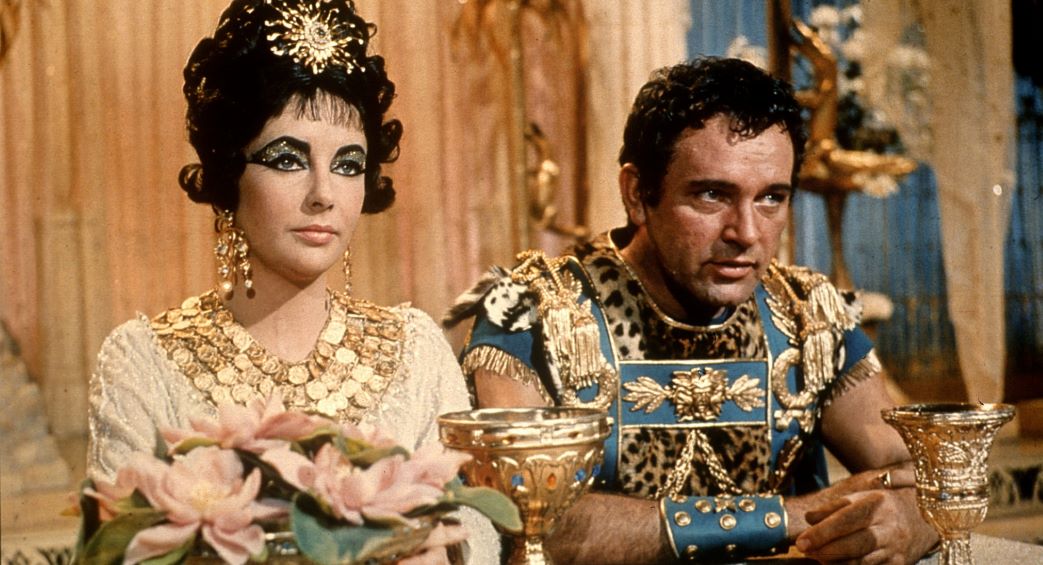
In its four hours it covers eighteen years. Julius Caesar (Rex Harrison) arrives in Egypt after victory over his rival Pompey at the Battle of Pharsalus. There he quickly becomes enamoured with Cleopatra (Elizabeth Taylor), the cunning, intelligent witty sister of bratty Pharoah Ptolemy XIII (Richard O‘Sullivan). Caesar takes Cleopatra’s side in the civil war for the Egyptian throne and takes her as a second wife, having a son (and potential heir) with her. Made dictator for life, he and Cleopatra return to Rome – where is assassinated. A friendless Cleopatra finds herself drawn towards Caesar’s deputy Mark Antony (Richard Burton), the two of them starting a passionate affair that will tear the Roman world apart and lead them into a civil war against Caesar’s politically astute but coldly realpolitik nephew (and official heir) Octavian (Roddy McDowell).

Cleopatra’s shoot – and the hullabaloo of press interest around it – is almost more famous (and perhaps more interesting) than the film itself. After a long gestation, filming started in London under the direction of veteran Rouben Mamoulian, with Taylor on board (for a bank-busting fee) with Peter Finch as Caesar and Stephen Boyd as Antony. Then it all fell apart. Taylor caught meningitis in the cold conditions, nearly died and the film nearly collapsed. The script was rewritten (again), Mamoulian, Finch and Boyd all left. Joseph L Mankiewicz came on board to write and direct, London filming (and all the sets) was junked and production moved to Rome. This all took a year.

In Rome, Rex Harrison and Richard Burton joined the cast as shooting began again practically from scratch. The planning however had been so laborious that Mankiewicz hadn’t been able to finish the script. So, instead, he decided to start shooting what he had and write the rest as he went. Sets were built for unwritten scenes and money continued to pour down the drain. This also meant a huge amount of hanging around for all concerned, spare time Burton and Taylor used to start a tabloid-filling affair which became the talk of the world. After nearly two years of filming, the studio ended up with millions of feet of film, a feud over whether to release two films or one long one and no-one with any real idea why they had made the film in the first place.

And God you can tell watching it. Cleopatra is an over-extended, rather unfocused mess that feels like the compromise product it is. What is this film trying to say? No one seems to know, least of all Mankiewicz. Is this an elegy to the loss of the Roman republic? Hardly when Caesar is presented as sympathetically as he is. Was the film looking to explore Antony and Cleopatra as tragic lovers or deluded would-be emperor builders? God alone knows. Is Cleopatra a temptress or a genius, a chancer or a political genius? No idea. Her infinite variety here is basically to be whatever the scene requires at the time, all wrapped up in Taylor’s effortless charisma.

Mankiewicz’s script – presumably written and then filmed almost immediately in many cases – falls back onto what he was comfortable with. Dialogue scenes are frequently over-written and over-long, so intricately constructed it was impossible to cut them down and still have them make sense.  The man who rose to the height of his profession directing witty conversation pieces in rooms, tried to do the same with his three leads in these massive sets. Acres of screen time stretch out as combinations of three leads spout mountains of dialogue at each other, often to very little dramatic impact. To keep the pace up, the film is frequently forced to take huge time-jumps.

Empires rise and fall in the gaps between scenes, armies assemble and are defeated in the blink of an eye. At one point Caesar and Cleopatra find a murdered character in the garden – the impact rather lost on the audience as this character is never mentioned before or after this. Years fly by and characters swiftly report off-screen events of momentous import, from Antony’s marriage and peace with Octavian to Caesar’s victory over Ptolomy. Caesar himself is murdered – Kenneth Haigh leads a series of stalwart British character actors in glorified cameos – in a silent ‘vision’ witnessed by Cleopatra, that cuts to Antony’s briefly shouting (unheard) his funeral oration (this at least means we don’t need to hear cod-Shakespearean dialogue in either scene).

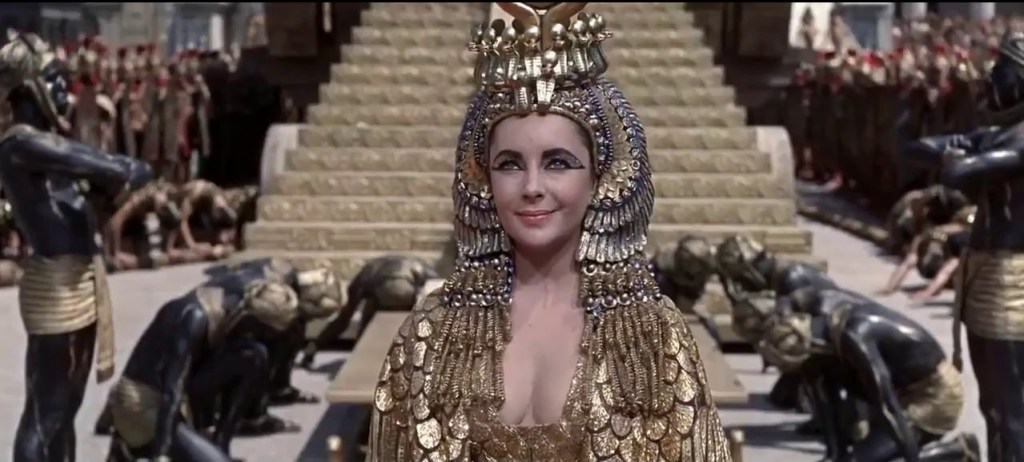
The other thing that couldn’t be cut was the film’s epic scale. Cleopatra’s entrance to Rome plays out nearly in real time, a never-ending procession of flights of fancy parading into the capital capped with Taylor’s cheeky grin at the end of it at Cleopatra’s panache. The battle of Actium looks impressive – with its boat clashes, flaming ships and colliding vessels – so much so that you almost regret we don’t get to see more of Pharsalus and Philippi than their aftermaths. The huge sets are striking, as are the legion of costumes Taylor has to change into virtually from scene to scene.

Of course, what people were – and always are – interested in is how much the fire off-stage between Burton and Taylor made it to the screen. I’ve honestly always felt, not much. Perhaps by this point both actors were too fed up and punch-drunk from the never-ending project. Perhaps they simply didn’t have any interest in the film. Burton falls back on grandstanding – he confessed he felt he only learned how to act on film from watching Taylor. Taylor is undeniably modern in every frame, but she somehow manages to hold a rather loosely defined character together, so much so that you forget she’s fundamentally miscast.

Of the leads Rex Harrison emerges best as an avuncular Caesar whose well-spoken wit hides an icy interior overflowing with ruthlessness and ambition. The film loses something when he departs just before the half-way mark. (It’s a mark, by the way, of the film’s confused structure that Burton only appears an hour into the film – and that for an inconsequential “plot update” chat with Caesar’s wife Calpurnia). There are decent turns from Cronyn as Cleopatra’ advisor, Pamela Brown as a Priestess, Andrew Faulds as a gruff Agrippa and even George Cole as Caesar’s trusted, mute servant. Best in show is probably Roddy McDowell’s ice cold Octavian – like a version of Harrison’s Caesar with all charm removed – who would have certainly been an Oscar nominated if the studio hadn’t screwed up his nomination papers.

Cleopatra still ended up with multiple Oscar nominations – even some wins – but took years to make back the money blown on it. At four hours, it bites off way more than it can chew and vey rarely comes together into a coherent shape. Scenes alternate between too short and way too long and three leads with very different acting styles struggle to make the best of it. You feel watching it actually sorry for Mankiewicz: it’s not really his fault, the scale of this thing would have sunk any director. Cleopatra has flashes of enjoyment, but much of it drags for the viewer as much as it did for those making it.

Mulholland Dr (2001)

Mulholland Dr (2001)

Surrealist, dream-like images fill a film that’s wilfully complex, perplexing and probably Lynch’s masterpiece

Director: David Lynch

Cast: Naomi Watts (Betty Elms/Diane Selwyn), Laura Harring (Rita/Camilla Rhodes), Justin Theroux (Adam Kesher), Ann Miller (Coco), Mark Pellegrino (Joe), Patrick Fischler (Dan), Michael Cooke (Herb), Dan Hedaya (Vincenzo Castigliane), Angelo Badalamenti (Luigi Castigliane), Michael J Anderson (Mr Roque), Monty Montgomery (The Cowboy), Lee Grant (Louise Bonner), James Karen (Wally Brown), Chad Everett (Jimmy Katz), Melissa George (Camilla Rhodes), Billy Ray Cyrus (Gene), Lori Heuring (Lorainne Kesher)

Spoilers: I’ll be discussing in detail the plot (if you can call it that) including its final act reveals which are crucial for understanding the film. So watch it first!

Where do you begin? Mulholland Drive feels like the culmination of Lynch’s work, a perfect boiling down of Twin Peaks, Lost Highway, Wild at Heart and Blue Velvet into a surrealistic meditation on Hollywood, wish-fulfilment, dreams and reality. It’s both wilfully inaccessible and surprisingly clear, both coldly cruel and achingly tender, full of hope and devoid of happiness. It’s tough, cryptic, engrossing viewing and unpeels like an onion (and likely to have the same effect on you as that vegetable). Every scene may mean everything or nothing, but there is not a moment of it that isn’t darkly, thrillingly engrossing.

It starts with a car crash on Mulholland Drive – but not before a stream of seemingly disconnected images that only later reveal their importance, including a women on a bed and a dizzying array of disconnected jittybug dancers drifting across the screen like paper cut-outs before a purple background. The car crash involves a mysterious woman ‘Rita’ (Laura Harring) who narrowly escapes being murdered but is left with amnesia. She stumbles to the house of Betty (Naomi Watts), a newly arrived girl in Hollywood, eager to become an actress. With only a bag of money and a mysterious blue key to go on, Rita and Betty search to find out who Rita is. Meanwhile, director Adam Kesher (Justin Theroux) finds his film (which Betty wants to audition for) being taken over by gangsters. Did I also mention an incompetent-but-brutal hitman, a supernaturally omniscient albino cowboy and a monstrous goblin-like hobo who lives behind a diner and can kill on sight?

Mulholland Drive grew out of Lynch’s plans for a new Twin Peaks style TV series. He shot a pilot, the footage from which takes up much of the first two thirds. Like Twin Peaks it was full of mysterious alleyways to be explored: it’s amnesiac lead, mysterious money and blue key, shadowy gangsters (even led by Twin Peaks veteran Michael J Anderson, here in a Red Room style hide-away, his head attached to a prosthetic body), creepy supernatural nightmare elements. Alas, the executives hated it (it wasn’t exactly Desperate Housewives), but French investors stepped in to fund Lynch turning it into a surrealist movie, with an additional half an hour of footage to an ending (of a sort).

A sort of ending is what we get. Mulholland Drive is a famously confusing, impenetrable film. But to me it seems clear. Lynch’s solution was to turn all the pilot footage into a bizarre and terrible dream – and latch on an ending set in the ‘real world’ which re-presents characters, events and throwaway moments in surprising new lights, leading us to radically reinterpret everything. Effectively, the first two-thirds are the guilt-ridden nightmare of Diane (Watts again), a failed actress in Hollywood who paid for a hit on a star actress Camilla (Harring again) who she believes seduced and spurned her. In her dream, Diane reimagines both herself and Camilla exactly as she wishes they were: herself unspoilt by Hollywood with preternatural talent, Camilla as an amnesiac utterly reliant on her.

What we have here is dreams as wish fulfilment: and what city is more about that, than Hollywood? Mulholland Drive plays as the dark underbelly of Sunset Boulevard (pretty dark and bitter already!). Lynch’s Hollywood is a vicious, heartless, bloody place, where cruelty and death are commonplace. In ‘the dream’ the gangsters – terrifying cameos from Hedaya and composer Badalamenti, the latter dribbling inadequate coffee from his mouth during a meeting in a grotesque power play – call the shots. Reality might be worse. This heartless factory of dreams chews up and spits out innocents like Diane, turning her from naïve and optimistic into  bitter, twisted shell, emotionally maladjusted, locked in her apartment tearily in thrall to her worst instincts.

It makes sense in a way that the film is dominated (probably) by a dream. Hollywood is the town of stories, and it’s perversely logical that the unreality should feel so detailed, engrossing and narratively compelling while what is (probably) reality is fragmented, mundane and laced with cruelty. To the people of films, stories are richer and more freeing than anything that happens in real life and infinitely more comforting.

Comfort is what our dreamer wants. Naomi Watt’s Betty seems like a cliché of a small-town girl, swept up in the big city. Full of aw-shucks charm, the eagle-eyed will spot little moments of strength that feel out of character. There are micro-flashes of anger and she’s determined to break into a mysterious, abandoned house to find a clue when Rita runs. She’s a gifted actress, turning a mundane script in an audition (a script she and Rita laugh at) into a simmering performance of sexual control that stuns the room. But this is a multi-layed performance, just one facet of a whole.

Because Betty’s talent is recognised in the way her ‘real-world’ counterpart Diane – stuck in small supporting roles, gifts from Camilla – never is. There are touches of this in that audition: the director is the least involved and speaks only in vague bullshit. Its not just that talent recognition: in the dream she can turn her lover Camilla, an independent and (perhaps) selfish figure, into someone so dependent on her that she literally doesn’t even know who she is. She even turns the man Camilla leaves her for, into a deluded, humiliated cuckold in thrall to gangsters.

Lynch’s crafting of this dream is flawless. He can mine tension from even the smallest moments. Innocuous events – two men sitting in a diner, a kind old couple in a cab, a business meeting, a singing audition – drip with menace and unknown horror. His camera frequently, almost imperceptibly weaves, as if held floating in space. Logic jumps and sudden transitions abound. Lights flicker and time never obeys rules. He is also a master of black humour: a hit-job gone wrong (with bodies and a vacuum cleaner joining the carnage) is hilarious, as is Kesher’s unexpected arrival home to find his wife in bed with a muscular pool cleaner.

Mulholland Drive is also a sensitive and highly emotional romance story between two lost souls. Betty, naïve and helpful and Rita, who clings with gratitude and adoration to the woman who helps her. Moments of sexual tenderness between these two are shot with erotic beauty: contrasted sharply with the more sordid, aggressive couplings between them in ‘reality’.

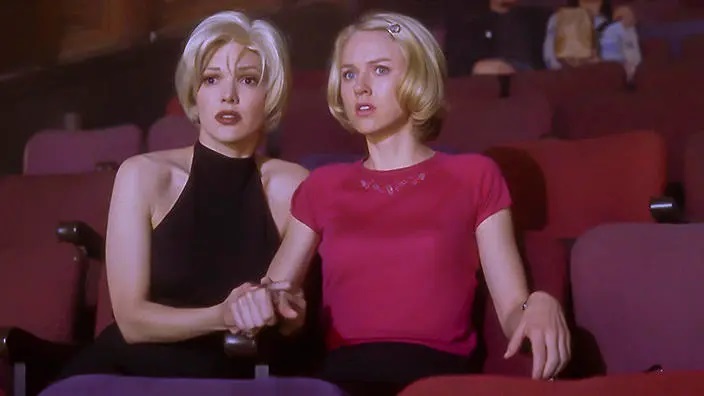
But these mix with moments of chilling, unspeakable horror. The hideous goblin living behind a diner, an embodiment of all that is cruel, evil and twisted, later clutching a box the releases the furies themselves seem to leap from. Is this a dark expression of the dreamer’s own guilt (which seems to be transferred to “Dan” a man we see literally dying of fright in a diner that becomes crucial later)? The Cowboy, who may or may not be of this world, glanced at two dreadful moments (just as he promises) seems to guides the dream. And the Silencio club, a theatre of the bizarre, disturbing auditory and visual twists and turns that serves as the gateway between dream and reality – something Betty subconsciously knows, vibrating in terror in her seat, knowing this fantasy she has crafted is under siege from dark elements of the truth demanding she acknowledge them.

Mulholland Drive deconstructs itself at every turn, aided by Lynch’s wonderful, hypnotic surrealistic touches. What’s beautiful about it, perhaps, is it leaves it very much up to you. For me, the desire for dreams to be fulfilled is crucial. It’s all captured in Watts and Harring’s multi-layered performances, their versions of the same women contrasting and complementing each other. Lynch allows their personalities to blur both in character and in visuals (Rita ends up in a matching wig in touches of Vertigo while the film’s blurring of two personalities echoes Bergman’s Persona, including a homage via a shot where both faces seem to merge into one).

An intense, fascinating dream-like exploration of several classic Lynchian themes, Mulholland Drive is his finest, most rewarding film. One which, whatever interpretation you place on its events, grips and challenges you at every moment, full of scenes which spark a mixture of imagination, horror and intrigue. Powered by two wonderful performances at its lead, both with just the right mix of reality and fantasy about them, it’s an extraordinary film.

Avatar: The Way of Water (2022)

Avatar: The Way of Water (2022)

Cameron’s film makes a huge splash despite its soggy plotted, flooded run-time

Director: James Cameron

Cast: Sam Worthington (Jake Sully), Zoe Saldaña (Neytiri), Sigourney Weaver (Kiri Sully), Stephen Lang (Colonel Miles Quaritch), Kate Winslet (Ronal), Cliff Curtis (Tonowari), Jamie Flatters (Neteyam Sully), Britain Dalton (Lo’ak Sully), Timothy Jo-Li Bliss (Tuk Sully), Jack Champion (Spider), Bailey Bass (Reya), Filip Geljo (Aonung), Duane Evans Jr (Rotxo), Edie Falco (General Frances Ardmore), Brendan Cowell (Captain Scoresby), Jermaine Clement (Dr Ian Garvin)

After thirteen years it finally arrived. The sequel to a film that seemed to leave no cultural impact, Avatar. People were convinced it would flop. But they say that about all Cameron films. And, if anyone should have learned anything from Terminator 2, Titanic and Avatar it was don’t bet against Cameron. If Avatar 2’s purpose was to make an awful lot of money, it has succeeded in every level. If its purpose was to make a strong and entertaining film… I’m not so sure.

About the same amount of time has passed on Pandora and Sully (Sam Worthington) and Neytiri (Zoe Saldaña) have raised a family of four children, including Kiri (Sigourney Weaver) born from the avatar of their friend Grace. They have also raised Quaritch’s son ‘Spider’ (Jack Champion) among them. Then the humans return… a bloody war begins, with Sully leading a guerrilla campaign. The company resurrects Colonel Quaritch (Stephen Lang) as a Na’vi super soldier to fight on their own terms. After Spider is captured, Sully and his family flee to live among the Metkayina, a sea-living tribe. But they can’t escape the war and its dangers.

As Avatar: The Way of Water is garlanded with praise and Oscars nominations, I feel like we are all part of a wide conspiracy of silence. So desperate are so many to keep viewers handing over their cash at the box office, that a film completely designed to be seen on the big screen (and this really is) is being praised to the skies by some as a masterpiece. It is not. It’s not even the best Avatar film. Instead, Avatar 2 is a visually impressive but hellishly long, predictable re-tread of the first film that stuffs the eyes with CGI wonders but leaves not a jot for the heart.

I was reminded part way through the overlong runtime that Cameron once made imaginative, thrilling sequels that completely reset the table. Aliens reinvented a haunted house horror movie as a pulsating action film. Terminator 2 turned a chase story into ramped up family story that mused on destiny. Avatar 2… basically tells exactly the same story, but with a familiar generational family conflict storyline and lots of water. It has the same environmental messages and anti-corporation vibe. When this lands, it works. A whale hunt is shot in terrifying detail, a giant mother whale creature brutally trapped and eviscerated for a small cannister of fluid extracted from its brain. This is also probably the most effective sequence and the one that moved me the most.

The effects do look impressive. There is no denying that, and the motion capture that turns the actors in blue giants is totally convincing. These Na’vi look and feel like flesh and blood beings. The visual imagination that creates this world, with its sweeping vistas and eclipse-kissed sky not to mention the myriad exotic creatures that populate it are stunning. If Avatar 2 deserves praise it’s for that. Pretty much every single frame looks like it cost a million dollars.

Unfortunately, it often also has a sheen of unreality. I became desperate for something real to appear on screen. But when only one character out of ten is not an effect, you don’t get much of that. On top of which the decision to film in slick, blur-free 48 frames per second means everything glides across the screen with the perfect-focused quality of a videogame. Don’t know what I mean? Try looking at things around you while moving your head at moderate speed. What do you see? Blur. Blur is real. The perfect focus of this world clues you up in every second that nothing in it is real.

The lack of reality eventually starts to remind you of The Phantom Menace. In fact, the only thing really separating this from that disaster is that James Cameron is a master director of epic, visual cinema. The film-making here, as a technical exercise , is beyond reproach. And few directors shoot action scenes with as much skill and raw excitement as Cameron. I can’t fault anything about that, even while I struggled to care as they dragged out over a huge chunk of time.

But Cameron’s weakness as always been the writing. He is a flat and unimaginative writer of dialogue – the Na’vi dialogue is awful flicking from ponderous (“We Sully’s stick together. That is our greatest weakness. And our greatest strength!”) to painfully bad (the number of “Bros” and “Dudes” from the Na’vi teenagers is fist-bitingly awkward, like your Dad trying to be down with the kids).

That’s not mentioning the fact that it’s so similar to the first film. The earth people return, war starts and eventually our heroes travel to a new part of Pandora where, just like Jake in the first film, they go through a training montage to learn the “way of the water”. This takes up most of the middle act. That’s not forgetting the huge number of themes and characters reshuffled and represented.  We build towards a clash very similar to the first film at the end. Nothing here feels fresh, everything feels like a retread. Our villain is resurrected as a Na’vi but, despite almost being defined by his racism in the first film, he doesn’t bat an eyelid at this.

There is a vague attempt to transfer Sully’s “torn between two cultures” storyline to Spider. But this character remains terminally under-developed and the film’s attempt to explore the father-son dynamic between him and Quaritch is so rushed, you wonder if Cameron was interested (odd since it’s crucial to the final act). Instead, we get a huge amount of generational clash in the Sully family, with Jake butting heads with his second son who struggles with being “the spare” (oddly appropriate right now), a hot head who gets everyone in trouble. These play out with a reassuring predictability, so much so that if I asked you to guess the fates of those involved you probably could.

There are bizarre logic gaps. Quaritch and his soldiers have been resurrected to destroy the Na’vi resistance – but instantly drop this for a personal vendetta against Sully (no one seems to care about the resistance after the first half an hour). When Spider is captured, Sully and gang don’t give a damn or even consider rescuing him. Sully doesn’t want to put the forest Na’vi in danger by staying – but doesn’t care about moving that danger to the water people.

Above all it’s frankly hellishly long, fully of trivial culture clash stuff and just the fact that the people in at are giant and blue or that it looks fabulous doesn’t make it good. Instead, Avatar 2 is a re-tread that feels like its treading water, spinning plates and repeating rather than reinventing. I’d rather watch the original again which, while it wasn’t inspiring, at least felt new.

Intolerance (1916)

Intolerance (1916)

Scale and sensation fill the screen in this ground-breaking epic that has to be seen to be believed

Director: DW Griffith

Cast: Mae Marsh (The Dear One), Robert Harron (The Boy), Constance Talmadge (The Mountain Girl), Alfred Paget (Prince Belshazzar), Bessie Love (The Bride of Cana), Walter Long (The Musketeer of the Slums), Howard Gaye (Jesus Christ), Lillian Langdon (The Virgin Mary), Frank Bennett (Charles IX), Josephine Crowell (Catherine de Medici), WE Lawrence (Hendi de Navarre), Lillian Gish (Woman Who Rocks the Cradle)

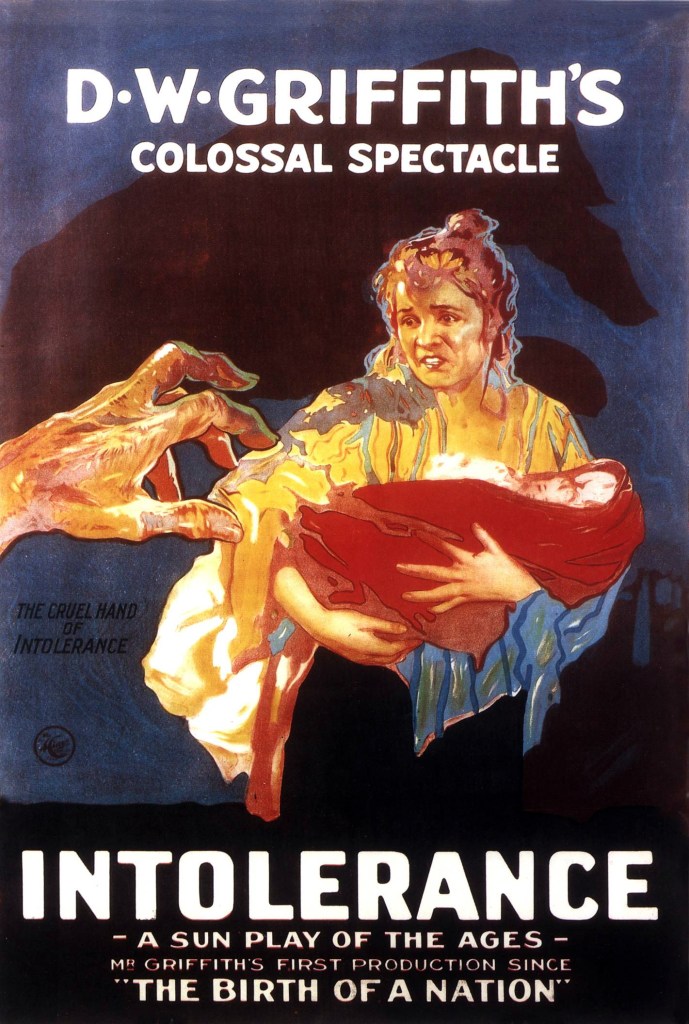
Even today I’m not sure there is anything like it. (Perhaps only the bizarrely OTT Cloud Atlas gets anywhere near it). DW Griffith’s follow-up to his (now infamous) smash-hit success The Birth of a Nation would not just be a melodrama with a social conscience (as he originally planned). Instead, it would be a sweeping epic that have as its theme humanity itself. Intolerance (captioned “Love’s Struggle Throughout the Ages”) would intercut four timelines simultaneously, each showing how prejudice, envy, and rage had shattered lives throughout the history of mankind.

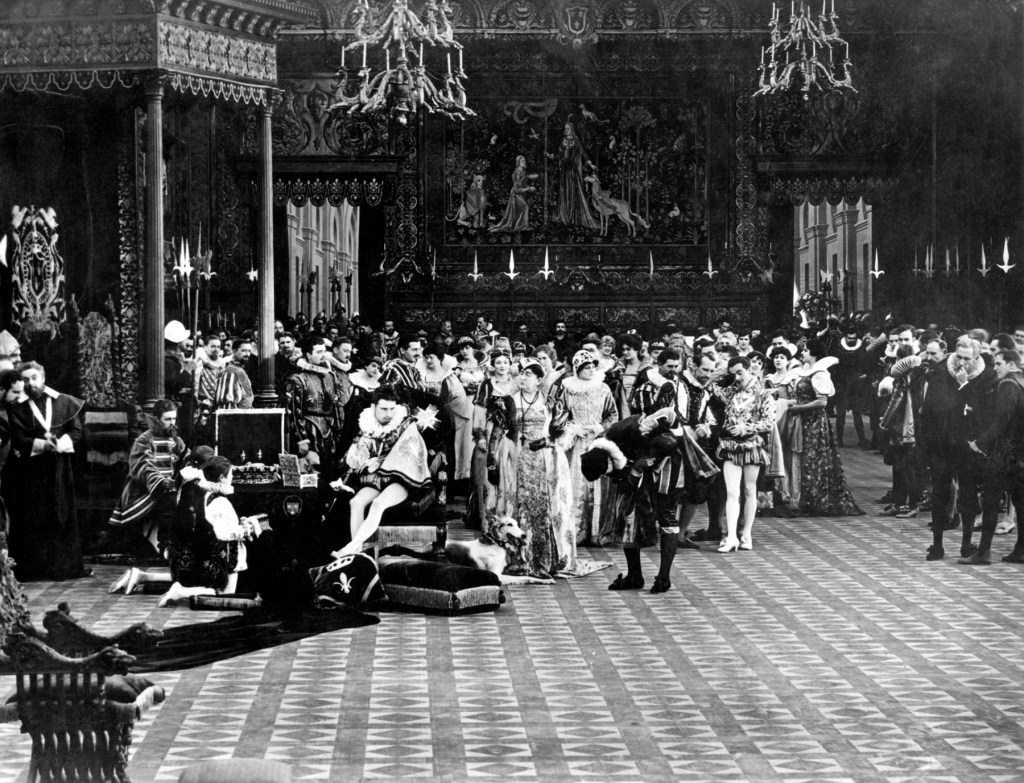
Griffith wanted to make the biggest film ever. The sort of sweeping spectacle that would confine all other competitors to the dustbin of history and cement himself as the new media’s master visionary. Intolerance is certainly that, a film of dizzying technical and narrative scale. Never before had a film thematically intercut between four unlinked but complementary timelines. Nothing links these stories other than theme: all four play out in parallel, events in one reflected in another. Essentially, it’s like a massive book of fables where all the pages have been cut out, reorganised and handed back to you.

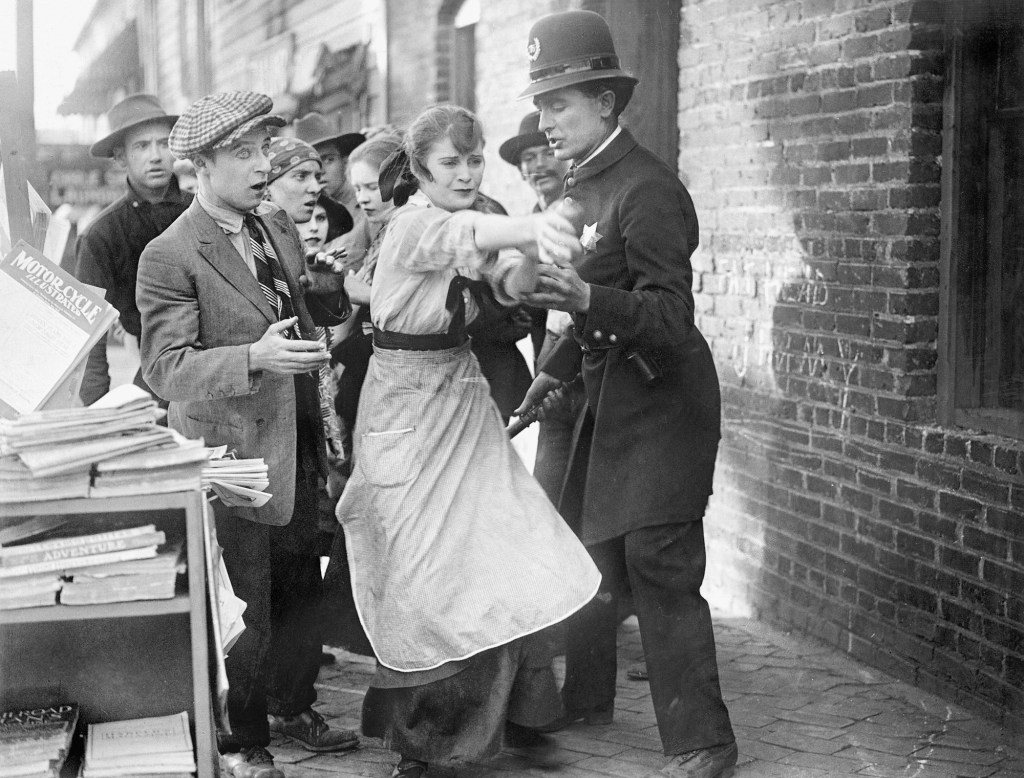
Intolerance started life as The Mother and the Law. This social-issue drama followed a young couple – the Dear One (Mae Marsh) and the Boy (Robert Harron) – forced to flee their factory community for the big city, after the brutal crushing of a strike. There, the Boy is sucked into the circle of a local gangster The Musketeer of the Slums (Walter Long). He renounces it all for love, before he is framed for theft and imprisoned. Then the couple are stripped of their baby and he is arrested again for the murder of the gangster (actually done by his moll). Will the sentence be revoked?

This is still the backbone – and takes up the most of the film’s runtime. But the one thing it didn’t really have is spectacle. A lot of it happens in rooms (bar a last-minute train and car chase). As well as expanding the film’s scope, Griffith also wanted to dial up the scale. Intercut with this are three grandiose historical narratives. In the largest, Griffith had the whole of Babylon rebuilt just so he could film its fall (after betrayal from the priests), despite the struggles of the Mountain Girl (Constance Talmadge) who is in-love-from-afar with Prince Belshazzar (Alfred Paget). We also get the St Bartholomew Day’s Massacre of 1572, as French Catholics butchered their Protestant neighbours. And finally, just to dial up the import, we get the last days of Jesus Christ.

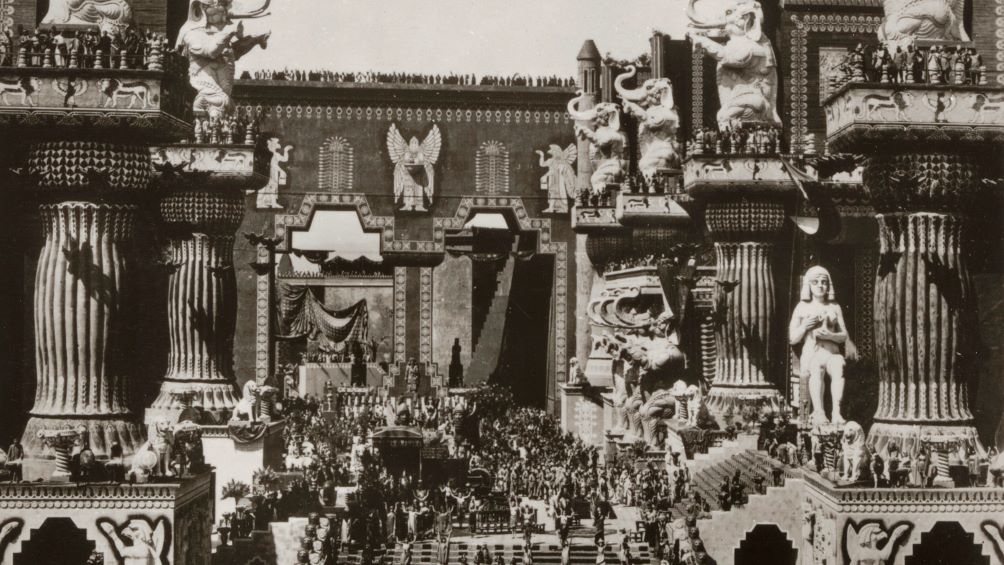
The scale of it! The sets of Babylon have to be seen to be believed. Huge, towering structures so large they dwarf elephants and the thousands of extras thrown in for scale. The camera pans slowly up to stress their gigantism and zooms in slowly in tracking shots to pick out a specific face among thousands. The siege of Babylon plays out like a real military action: armies of extras play out a choreographed battle on multiple levels of the walls while elephants push siege engines into place. Some nifty special effects allow on-screen beheadings and for us to see swords, arrows and spears plunge into bodies. It’s genuinely exciting and influenced every siege you’ve seen on film since.

This scale isn’t just restricted to Babylon. The modern plotline brilliantly recreates strike action by the masses, including a brutal put-down by private and government forces. Questing for a late pardon for her husband (who is literally walking towards the gallows while they do), the Dear One and a kindly policeman hop into the fastest car they can find to chase down the Governor’s train. In 1572, the streets of Paris are skilfully recreated – as are the grand palaces – and the action of the massacre is shot with an intense, Bruegelesque immersion. Jesus is mocked by a large crowd as he drags his cross through the streets before being crucified on a bloody-sky kissed hill with flashes of terrifying red lightening.

The huge scale is also carried across in Griffith’s narrative. This was intended as important film-making with a capital I. Griffith’s film is in places surprisingly anti-authoritarian and firmly on the side of the little guy. The modern strike is caused by a factory wage cut. Why? Because more money is needed for the firm’s charity work and it needs to come from somewhere. The charity workers are, to a woman, shown as judgemental, smug and causing more harm than good from their arrogant assertion that they know best. Homes are broken up, jobs are sacrificed and mothers judged “not good enough” separated from their children. All in the name of a moral crusade that’s more focused on prohibition than protection.

In Babylon, the priests of Bel are weasily, bitter, power-hungry figures, furious at the arrival of the new female God Ishtar, selling the city out to the barbarian hordes to preserve the old religion. The French court are certain the only way to guarantee peace (but really their own positions against the Hugenout faction) is to kill them all. Jesus’ presence is met with stern-faced priests wondering what they can do to get shot of this trouble-maker. We are always invited to sympathise with humble, simple people who want to make their own choices: Brown Eyes (Margery Wilson), a Hugenout daughter hoping to marry, the boisterous Mountain Girl, the loving Dear One and the Boy.

To keep this feeling like a universal fable of hope, names are kept as non-specific as these. Small human moments abound. Brown Eyes is as giddy as schoolgirl on the day before her wedding. Henry IV weeps and nearly vomits after being brow-beaten into ordering the massacre. The Mountain Girl – dragged to a market fair for her obstinacy – decides the best way to put off husbands is to chow down on onions. The Dear One and the Boy go on a charming date, at the end of which she pleads for the strength of character to resist the temptation to let him into her flat before they are married. It’s these little beats of humanity that help sustain the scale.

Intolerance is connected together with a series of captions – frequently badly-written and pretentious (e.g. “The loom of fate wove death for the father”) – and via a recurring image of a woman rocking a cradle, which I think represents the circle of life. The editing between the storylines is masterful though and the film’s pace and structure is generally so well maintained that your understanding of when and where we are is never challenged for a moment.

There have been claims Griffith’s more human epic was a correction to his Birth of the Nation. But that’s to misunderstand the sort of era Griffith came from. In his Victorian background, it was in no-way a contradiction for a man to be both a white supremacist and a sentimental liberal. Griffith believed the South were victims of the Civil War and the ‘unjust’ Reconstruction and felt Intolerance was a logical continuation of that theme. A few of his prejudices are on show here anyway. The only black faces are sinister heavies among the ‘barbarians’ attacking Babylon. Henry of Navarre is a limp-wristed sissy. The female reformers are all ugly harridans (the caption even tells us “When women cease to attract men they often turn to reform as a second choice”). Intolerance is an interesting reminder that a director we now think of today as American cinema’s leading racist was that and a man who passionately believed in social justice. Contradiction is the most human quality we have.

There may be a little too much in Intolerance considering its crushing run-time (the Jesus scenes could be cut with no real loss at all), but generally it hits a balance between pomposity and entertainment. It has plenty of violence and naked ladies (the harem of Babylon is shown in detail – it’s pre-Code folks) to keep the punters entertained, along with charm (though you need to look past the pose-taking, broadness of the performances). Griffith has a way with little shots: there is a lovely track into the face of the Dear One as she silently mourns. The chase in the modern plotline is genuinely tense while the massacre of the innocents in 1572 actually horrifying.

Above all, Intolerance set the table for epic cinema in exactly the way Griffith intended. While it is full of big ideas – at times clumsily presented – it’s also full of breath-taking spectacle that has influenced generations to come. For that reason, if nothing else, anyone interested in film should see it.