Category: Directors

Nomadland (2020)

Nomadland (2020)

Poetic and surprisingly moving, this Best Picture winner is light on plot but deep on meaning

Director: Chloé Zhao

Cast: Frances McDormand (Fern), David Strathairn (Dave), Linda May, Charlene Swankie, Bob Wells, Peter Spears, Derek Endres

We all have ideas about what life should look like in the 21st century. Settled job, dream home, the rooted life. It’s what we are expected to be working towards – but it’s not for everyone. Nomadland, Chloé Zhao’s Malick-influenced road movie explores the lives of those who decide to live off that beaten track. The modern nomad, who chooses flexibility to move their home from place to place and don’t want to be tied down by bricks-and-mortar. It makes for a meditative, soulfully poetic film with a quietly mesmeric power.

Fern (Frances McDormand) is recently widowed, childless and has lost her job after the gypsum plant in Empire, Nevada closes. But, far from down-hearted, Fern is determined to lead a new life without the fixed commitments of her old one. She sells most of her possessions, kits out a van as a travel home and begins to drive across the country, taking seasonal jobs as and where she stops. She finds herself part of a warm and supportive community of nomads, who help to learn how to flourish in this unconventional home life.          

Nomadland winning Best Picture is as close as the Oscars have come to giving an award to Terence Malick. It’s hard not to feel his influence over the camera’s languid worship of the beauty of the Badlands, or its characters quiet searching for higher in life, via a communing with nature. Zhao’s film is a very effective and surprisingly moving character study, with only the smallest smidgen of a plot, but full of feeling. Radiantly shot by Joshua James Richards, it finds an orange-tinged beauty in a dawn and dusk and tiny moments of joy in rain falling in your face. All contrasted with the dull oppressiveness of buildings, those four walls shutting out nature.

Zhao’s film goes a long way in challenging neat assumptions we might have about this lifestyle. “I’m not homeless I’m houseless” Fern states and she politely – but firmly – turns down well-meaning offers of charity. The decision to move from place-to-place is not one enforced by poverty or failure. Instead, this is a rich, vibrant, supportive community that looks out for each other and share a legitimate (and refreshing) view of the world. Who says you need to spend your life chasing the dollar and building up a debt to have a fixed slice of real-estate you can sort of call your own?

This is particularly true in our post-recession world. Nomadland starts with the final collapse of an industrial community, now a ghost town. Many of the nomads find seasonal work that is often manual and low-skilled. Fern’s first job (of many) is working at an Amazon dispatch location, where jolly team leaders burst with enthusiasm met with smiling indifference by the (often older) staff. Fern’s travel is shaped around moving to key locations for seasonal work – Amazon, a campsite, a short-order chef job, beet processing… The economic situation is poor, but this is a way of playing the system to get a higher level of freedom, without debt or financial pressures.

It’s a key subject of a talk given to fellow nomads by Bob Wells, an influential advocate of the nomad life-style (one of any people playing versions of themselves). It’s part of a series of events at a nomad event – a sort of convention – where people gather to share experiences, advise and life-hacks. Ever needed to know how to change a tyre or what size bucket you should use for your built-in toilet? Wonder no more! On the road people come together in a way they never would in more regular life. With everything transient and nothing fixed, friendships and connections are more intense, constantly in that first glow of excitement.

That’s the pay-off of choosing this lifestyle. Everything is transient. Close friendships form, but you might not see the other person for months at a time. While phones help you to keep in touch, day-to-day you see completely different people from place-to-place. It will never be completely clear where you might be to your family. However, the short-lived intensity of connections can lead to a closeness and intimacy that might otherwise take months – a friend of Fern’s confides she has terminal cancer but regrets nothing, with a warmth and trust that would normally takes years to form not weeks.

It’s implied as well that the more short-lived intensity of friendships fits more with what the slightly taciturn and guarded Fern wants from life. Frances McDormand makes her friendly, ready with a smile, good company – but she is always slightly reserved and guarded. She will give sympathetic ears and invite confidences. But she is also a woman determined to live by her own rule. Having lived most of her life in one place in a happy marriage, a conversation with her sister (who bails her out with a loan to repair her van) reveals she was always prone to not look back when a decision was made. It’s the same with deciding to live on the road as moving to Empire – Fern knows her own heart and mind, and will fully commit to that.

This is despite temptations, the main one she faces being David Strathairn’s (the only other professional actor in the film) Dave, a fellow nomad who makes no secret of his romantic interest in her. Sweetly played by Strathairn, Dave pursues Fern and dangles the possibility of a more fixed and traditional life. They are close, but Fern has lived that life of marriage and rejected already the idea of a family. And, as McDormand makes clear in her soulful eyes, if that life was ever on the cards, it would have been with her husband not this new man, nice as he is.

Nomadland, like Fern, can see the dangers and problems. A van breaking down in the middle of nowhere is a major danger, a broken plate a potential disaster – Fern painstakingly reassembles it, not wishing to spend the money to replace it. Low temperatures and bad weather can make it uncomfortable – although she (smilingly) rejects an offer from a garage owner to sleep inside. But it also understands living this lifestyle is a legitimate choice, filled with rich possibilities. You only need to see Fern joyfully travel to the coast or get wrapped up in the embrace of the vibrant community she finds on the road to see that you could do immeasurably worse with your life.

Zhao’s film has a documentary realism to it, that comes from its deep immersion in real nomad communities. It makes copious use of real nomads playing versions of themselves, giving a rich feeling of authenticity to every moment. It also means we gain a real understanding of the idea that goodbyes are never final in this world, that there is always the prospect of seeing someone again “down the road”. The film’s poetic empathy, its warmth and the vibrant humanity of its characters makes it film that creeps up on you and has a surprising, but profound, power.

Empire of Light (2022)

Empire of Light (2022)

Mendes passion project is strangely free of passion in a film that misses the targets it aims for

Director: Sam Mendes

Cast: Olivia Colman (Hilary Small), Micheal Ward (Stephen Murray), Tom Brooke (Neil), Toby Jones (Norman), Colin Firth (Donald Ellis), Tanya Moodie (Delia), Hannah Onslow (Janine), Crystal Clarke (Ruby), Monica Dolan (Rosemary Bates), Sara Stewart (Brenda Ellis)

In 1981, Hilary Small (Oliva Colman) is the duty manager of grand, old-fashioned, Margate sea-front cinema The Empire. A quiet, lonely spinster who’s never seen any of the cinema’s movies, she carefully performs her duties at work which include servicing the sexual needs of owner Mr Ellis (Colin Firth). However, her life changes when young Black man Stephen Murray (Micheal Ward) starts as an usher. The two strike up a friendship that becomes a relationship – but runs into conflict as Stephen struggles with growing racism and Hilary suffers a relapse into schizophrenia.

Empire of Light has been described as personal passion project by Sam Mendes. Bizarrely it feels like a film which all passion has been strained out of. It’s a functional and safe film, scripted with little inspiration and given life largely by the charisma of its two leads.

Empire of Light partially frames itself as a love-letter to cinema-going and film. Strangely it hardly engages with either of these. In fact, it could (with minor script changes) be set just as easily in a department store, petrol station or bingo hall. This is a film where no-one talks about cinema, watches a film or even seems interested. Toby Jones’ projectionist explains the mechanics of his trade in what feels like a carefully scripted explanation of the workings of a machine the writer knows nothing about. For all the beauty of Roger Deakins’ photography, there is no moment of magic that you might expect from a director who claims to be enamoured with the medium.

Hilary finally decides to watch a film for the first time: “pick any one you like” she tells Jones. He tees up Being There – a film I’m wondering if Mendes has seen. For starters, would I show a film about mental health featuring a racist cartoon in the middle to a woman struggling with her own mental health who has just watched a close friend being beaten up by the National Front? You’re left feeling Norman simply teed up whatever film was in the machine. But then, as he says, he doesn’t really watch the films anyway. Afterwards Hilary and Stephen chat about Peter Sellers – but never once mention he has only just died.

Empire of Light fails at most other things it attempts to do. Its heart is in the coming-of-age, second-chance-at-life romance at its centre. There is fine chemistry between Colman and Ward, and their bashful coming together works as a meeting of two spiritually similar people who feel life is passing them by. Their unspoken courtship early on – rescuing a wounded pigeon together in the abandoned upper-storey of the Empire or watching the New Years fireworks on the roof – has a pleasant innocence. But fundamentally, these characters feel ill-defined and go through personal crises that feel pat and under-developed.

Colman gives her all as Hilary – although this sort of dumpy, frumpy, tragic, timid woman is becoming a little too much of a calling card – but this is a thin character. We slowly realise Hilary is a woman struggling with mental health – making her sexual exploitation by Firth’s smug, sleazy, manager even more unpleasant. She carefully goes about her work, stares down at the ground and wouldn’t even dream of intruding on the cinema-goer by actually watching the film. Colman masters the little touches of glee she gets at the presence of Stephen, Hilary’s simultaneous enjoyment and bashfulness about what she assumes is a hopeless crush.

Where the film fails though is in finding any depth in Hilary’s struggles with schizophrenia. Colman’s character is inspired, in many ways, by Mendes’ own mother. The film aims for a sympathetic presentation of mental health, which it manages but without providing any insight. While many aspects of mental health were not discussed at the time, a film made today really should have more to say than Empire of Light musters.  Instead, Hilary’s condition feels like a dramatic shorthand. For a passion project that’s not good enough – the film even falls back on the age-old “stops taking her meds” plotline. For all the gusto and commitment Colman brings to Hilary’s mental collapse – a furious destruction of a sandcastle, or ranting, drunk, in an apartment where the walls are strewn with self-penned graffiti – it never feels insightful enough.

It’s sadly the same with Micheal Ward’s Stephen. For all Ward is hugely charming as this saintly young man – and for all he expertly suggests Stephen’s anger at the growing tide of racism in Britain – the issues he deals with feel like window-dressing. The most interesting moment is his confrontation with an angry, racist customer who is appeased by Hilary rather than challenged – much to Stephen’s justified fury. But name-checking Brixton and New Cross and saying “it’s getting worse” doesn’t really feel like getting to grips with the dilemmas he, and young men like him, were facing. Particularly when Stephen responds to a deadly beating with something approaching a shrug of the shoulders. You can’t argue with Mendes’ genuine feelings, but there is never enough depth.

Instead, these major social issues are benched by the film’s end, making them feel like discussion points to make Hilary feel better about her life and for Stephen to resolve to move on with his. It has less to say about these issues than an episode of Call the Midwife. Just as it has nothing to say about the magic of cinema going, turning it into a retro back-drop of posters and old sweeties. Far from making a case for cinema, it makes the building as irrelevant as some worry it is becoming today.

Cleopatra (1963)

Cleopatra (1963)

The biggest epic of them all – and one of the most infamous – is a mess but at times entertaining

Director: Joseph L Mankiewicz

Cast: Elizabeth Taylor (Cleopatra), Richard Burton (Mark Antony), Rex Harrison (Julius Caesar), Roddy McDowell (Octavian), Pamela Brown (High Priestess), George Cole (Flavius), Hume Cronyn (Sosigenes), Cesare Danova (Apollodorus), Kenneth Haigh (Brutus), Andrew Keir (Agrippa), Martin Landau (Rufio), Robert Stephens (Germanicus), Francesca Annis (Eiras), Isabelle Cooley (Charmian), Jacqui Chan (Lotos), Andrew Faulds (Canidius)

One of the most legendary epics of all time – for all the wrong reasons. Cleopatra is the mega-budget extravaganza that nearly sunk a studio, years in its shambolic, crisis-hit making that turned its stars into a celebrity brand that changed their lives forever. Painfully long, it’s a rambling, confused film that feels like something that was filmed before anyone had the faintest idea what the story they were trying to tell was. Then, just when you consider giving up on it, it will throw in a striking scene or intelligent performance and you’ll sit up and be entertained. Just never quite enough.

In its four hours it covers eighteen years. Julius Caesar (Rex Harrison) arrives in Egypt after victory over his rival Pompey at the Battle of Pharsalus. There he quickly becomes enamoured with Cleopatra (Elizabeth Taylor), the cunning, intelligent witty sister of bratty Pharoah Ptolemy XIII (Richard O‘Sullivan). Caesar takes Cleopatra’s side in the civil war for the Egyptian throne and takes her as a second wife, having a son (and potential heir) with her. Made dictator for life, he and Cleopatra return to Rome – where is assassinated. A friendless Cleopatra finds herself drawn towards Caesar’s deputy Mark Antony (Richard Burton), the two of them starting a passionate affair that will tear the Roman world apart and lead them into a civil war against Caesar’s politically astute but coldly realpolitik nephew (and official heir) Octavian (Roddy McDowell).

Cleopatra’s shoot – and the hullabaloo of press interest around it – is almost more famous (and perhaps more interesting) than the film itself. After a long gestation, filming started in London under the direction of veteran Rouben Mamoulian, with Taylor on board (for a bank-busting fee) with Peter Finch as Caesar and Stephen Boyd as Antony. Then it all fell apart. Taylor caught meningitis in the cold conditions, nearly died and the film nearly collapsed. The script was rewritten (again), Mamoulian, Finch and Boyd all left. Joseph L Mankiewicz came on board to write and direct, London filming (and all the sets) was junked and production moved to Rome. This all took a year.

In Rome, Rex Harrison and Richard Burton joined the cast as shooting began again practically from scratch. The planning however had been so laborious that Mankiewicz hadn’t been able to finish the script. So, instead, he decided to start shooting what he had and write the rest as he went. Sets were built for unwritten scenes and money continued to pour down the drain. This also meant a huge amount of hanging around for all concerned, spare time Burton and Taylor used to start a tabloid-filling affair which became the talk of the world. After nearly two years of filming, the studio ended up with millions of feet of film, a feud over whether to release two films or one long one and no-one with any real idea why they had made the film in the first place.

And God you can tell watching it. Cleopatra is an over-extended, rather unfocused mess that feels like the compromise product it is. What is this film trying to say? No one seems to know, least of all Mankiewicz. Is this an elegy to the loss of the Roman republic? Hardly when Caesar is presented as sympathetically as he is. Was the film looking to explore Antony and Cleopatra as tragic lovers or deluded would-be emperor builders? God alone knows. Is Cleopatra a temptress or a genius, a chancer or a political genius? No idea. Her infinite variety here is basically to be whatever the scene requires at the time, all wrapped up in Taylor’s effortless charisma.

Mankiewicz’s script – presumably written and then filmed almost immediately in many cases – falls back onto what he was comfortable with. Dialogue scenes are frequently over-written and over-long, so intricately constructed it was impossible to cut them down and still have them make sense.  The man who rose to the height of his profession directing witty conversation pieces in rooms, tried to do the same with his three leads in these massive sets. Acres of screen time stretch out as combinations of three leads spout mountains of dialogue at each other, often to very little dramatic impact. To keep the pace up, the film is frequently forced to take huge time-jumps.

Empires rise and fall in the gaps between scenes, armies assemble and are defeated in the blink of an eye. At one point Caesar and Cleopatra find a murdered character in the garden – the impact rather lost on the audience as this character is never mentioned before or after this. Years fly by and characters swiftly report off-screen events of momentous import, from Antony’s marriage and peace with Octavian to Caesar’s victory over Ptolomy. Caesar himself is murdered – Kenneth Haigh leads a series of stalwart British character actors in glorified cameos – in a silent ‘vision’ witnessed by Cleopatra, that cuts to Antony’s briefly shouting (unheard) his funeral oration (this at least means we don’t need to hear cod-Shakespearean dialogue in either scene).

The other thing that couldn’t be cut was the film’s epic scale. Cleopatra’s entrance to Rome plays out nearly in real time, a never-ending procession of flights of fancy parading into the capital capped with Taylor’s cheeky grin at the end of it at Cleopatra’s panache. The battle of Actium looks impressive – with its boat clashes, flaming ships and colliding vessels – so much so that you almost regret we don’t get to see more of Pharsalus and Philippi than their aftermaths. The huge sets are striking, as are the legion of costumes Taylor has to change into virtually from scene to scene.

Of course, what people were – and always are – interested in is how much the fire off-stage between Burton and Taylor made it to the screen. I’ve honestly always felt, not much. Perhaps by this point both actors were too fed up and punch-drunk from the never-ending project. Perhaps they simply didn’t have any interest in the film. Burton falls back on grandstanding – he confessed he felt he only learned how to act on film from watching Taylor. Taylor is undeniably modern in every frame, but she somehow manages to hold a rather loosely defined character together, so much so that you forget she’s fundamentally miscast.

Of the leads Rex Harrison emerges best as an avuncular Caesar whose well-spoken wit hides an icy interior overflowing with ruthlessness and ambition. The film loses something when he departs just before the half-way mark. (It’s a mark, by the way, of the film’s confused structure that Burton only appears an hour into the film – and that for an inconsequential “plot update” chat with Caesar’s wife Calpurnia). There are decent turns from Cronyn as Cleopatra’ advisor, Pamela Brown as a Priestess, Andrew Faulds as a gruff Agrippa and even George Cole as Caesar’s trusted, mute servant. Best in show is probably Roddy McDowell’s ice cold Octavian – like a version of Harrison’s Caesar with all charm removed – who would have certainly been an Oscar nominated if the studio hadn’t screwed up his nomination papers.

Cleopatra still ended up with multiple Oscar nominations – even some wins – but took years to make back the money blown on it. At four hours, it bites off way more than it can chew and vey rarely comes together into a coherent shape. Scenes alternate between too short and way too long and three leads with very different acting styles struggle to make the best of it. You feel watching it actually sorry for Mankiewicz: it’s not really his fault, the scale of this thing would have sunk any director. Cleopatra has flashes of enjoyment, but much of it drags for the viewer as much as it did for those making it.

Mulholland Dr (2001)

Mulholland Dr (2001)

Surrealist, dream-like images fill a film that’s wilfully complex, perplexing and probably Lynch’s masterpiece

Director: David Lynch

Cast: Naomi Watts (Betty Elms/Diane Selwyn), Laura Harring (Rita/Camilla Rhodes), Justin Theroux (Adam Kesher), Ann Miller (Coco), Mark Pellegrino (Joe), Patrick Fischler (Dan), Michael Cooke (Herb), Dan Hedaya (Vincenzo Castigliane), Angelo Badalamenti (Luigi Castigliane), Michael J Anderson (Mr Roque), Monty Montgomery (The Cowboy), Lee Grant (Louise Bonner), James Karen (Wally Brown), Chad Everett (Jimmy Katz), Melissa George (Camilla Rhodes), Billy Ray Cyrus (Gene), Lori Heuring (Lorainne Kesher)

Spoilers: I’ll be discussing in detail the plot (if you can call it that) including its final act reveals which are crucial for understanding the film. So watch it first!

Where do you begin? Mulholland Drive feels like the culmination of Lynch’s work, a perfect boiling down of Twin Peaks, Lost Highway, Wild at Heart and Blue Velvet into a surrealistic meditation on Hollywood, wish-fulfilment, dreams and reality. It’s both wilfully inaccessible and surprisingly clear, both coldly cruel and achingly tender, full of hope and devoid of happiness. It’s tough, cryptic, engrossing viewing and unpeels like an onion (and likely to have the same effect on you as that vegetable). Every scene may mean everything or nothing, but there is not a moment of it that isn’t darkly, thrillingly engrossing.

It starts with a car crash on Mulholland Drive – but not before a stream of seemingly disconnected images that only later reveal their importance, including a women on a bed and a dizzying array of disconnected jittybug dancers drifting across the screen like paper cut-outs before a purple background. The car crash involves a mysterious woman ‘Rita’ (Laura Harring) who narrowly escapes being murdered but is left with amnesia. She stumbles to the house of Betty (Naomi Watts), a newly arrived girl in Hollywood, eager to become an actress. With only a bag of money and a mysterious blue key to go on, Rita and Betty search to find out who Rita is. Meanwhile, director Adam Kesher (Justin Theroux) finds his film (which Betty wants to audition for) being taken over by gangsters. Did I also mention an incompetent-but-brutal hitman, a supernaturally omniscient albino cowboy and a monstrous goblin-like hobo who lives behind a diner and can kill on sight?

Mulholland Drive grew out of Lynch’s plans for a new Twin Peaks style TV series. He shot a pilot, the footage from which takes up much of the first two thirds. Like Twin Peaks it was full of mysterious alleyways to be explored: it’s amnesiac lead, mysterious money and blue key, shadowy gangsters (even led by Twin Peaks veteran Michael J Anderson, here in a Red Room style hide-away, his head attached to a prosthetic body), creepy supernatural nightmare elements. Alas, the executives hated it (it wasn’t exactly Desperate Housewives), but French investors stepped in to fund Lynch turning it into a surrealist movie, with an additional half an hour of footage to an ending (of a sort).

A sort of ending is what we get. Mulholland Drive is a famously confusing, impenetrable film. But to me it seems clear. Lynch’s solution was to turn all the pilot footage into a bizarre and terrible dream – and latch on an ending set in the ‘real world’ which re-presents characters, events and throwaway moments in surprising new lights, leading us to radically reinterpret everything. Effectively, the first two-thirds are the guilt-ridden nightmare of Diane (Watts again), a failed actress in Hollywood who paid for a hit on a star actress Camilla (Harring again) who she believes seduced and spurned her. In her dream, Diane reimagines both herself and Camilla exactly as she wishes they were: herself unspoilt by Hollywood with preternatural talent, Camilla as an amnesiac utterly reliant on her.

What we have here is dreams as wish fulfilment: and what city is more about that, than Hollywood? Mulholland Drive plays as the dark underbelly of Sunset Boulevard (pretty dark and bitter already!). Lynch’s Hollywood is a vicious, heartless, bloody place, where cruelty and death are commonplace. In ‘the dream’ the gangsters – terrifying cameos from Hedaya and composer Badalamenti, the latter dribbling inadequate coffee from his mouth during a meeting in a grotesque power play – call the shots. Reality might be worse. This heartless factory of dreams chews up and spits out innocents like Diane, turning her from naïve and optimistic into  bitter, twisted shell, emotionally maladjusted, locked in her apartment tearily in thrall to her worst instincts.

It makes sense in a way that the film is dominated (probably) by a dream. Hollywood is the town of stories, and it’s perversely logical that the unreality should feel so detailed, engrossing and narratively compelling while what is (probably) reality is fragmented, mundane and laced with cruelty. To the people of films, stories are richer and more freeing than anything that happens in real life and infinitely more comforting.

Comfort is what our dreamer wants. Naomi Watt’s Betty seems like a cliché of a small-town girl, swept up in the big city. Full of aw-shucks charm, the eagle-eyed will spot little moments of strength that feel out of character. There are micro-flashes of anger and she’s determined to break into a mysterious, abandoned house to find a clue when Rita runs. She’s a gifted actress, turning a mundane script in an audition (a script she and Rita laugh at) into a simmering performance of sexual control that stuns the room. But this is a multi-layed performance, just one facet of a whole.

Because Betty’s talent is recognised in the way her ‘real-world’ counterpart Diane – stuck in small supporting roles, gifts from Camilla – never is. There are touches of this in that audition: the director is the least involved and speaks only in vague bullshit. Its not just that talent recognition: in the dream she can turn her lover Camilla, an independent and (perhaps) selfish figure, into someone so dependent on her that she literally doesn’t even know who she is. She even turns the man Camilla leaves her for, into a deluded, humiliated cuckold in thrall to gangsters.

Lynch’s crafting of this dream is flawless. He can mine tension from even the smallest moments. Innocuous events – two men sitting in a diner, a kind old couple in a cab, a business meeting, a singing audition – drip with menace and unknown horror. His camera frequently, almost imperceptibly weaves, as if held floating in space. Logic jumps and sudden transitions abound. Lights flicker and time never obeys rules. He is also a master of black humour: a hit-job gone wrong (with bodies and a vacuum cleaner joining the carnage) is hilarious, as is Kesher’s unexpected arrival home to find his wife in bed with a muscular pool cleaner.

Mulholland Drive is also a sensitive and highly emotional romance story between two lost souls. Betty, naïve and helpful and Rita, who clings with gratitude and adoration to the woman who helps her. Moments of sexual tenderness between these two are shot with erotic beauty: contrasted sharply with the more sordid, aggressive couplings between them in ‘reality’.

But these mix with moments of chilling, unspeakable horror. The hideous goblin living behind a diner, an embodiment of all that is cruel, evil and twisted, later clutching a box the releases the furies themselves seem to leap from. Is this a dark expression of the dreamer’s own guilt (which seems to be transferred to “Dan” a man we see literally dying of fright in a diner that becomes crucial later)? The Cowboy, who may or may not be of this world, glanced at two dreadful moments (just as he promises) seems to guides the dream. And the Silencio club, a theatre of the bizarre, disturbing auditory and visual twists and turns that serves as the gateway between dream and reality – something Betty subconsciously knows, vibrating in terror in her seat, knowing this fantasy she has crafted is under siege from dark elements of the truth demanding she acknowledge them.

Mulholland Drive deconstructs itself at every turn, aided by Lynch’s wonderful, hypnotic surrealistic touches. What’s beautiful about it, perhaps, is it leaves it very much up to you. For me, the desire for dreams to be fulfilled is crucial. It’s all captured in Watts and Harring’s multi-layered performances, their versions of the same women contrasting and complementing each other. Lynch allows their personalities to blur both in character and in visuals (Rita ends up in a matching wig in touches of Vertigo while the film’s blurring of two personalities echoes Bergman’s Persona, including a homage via a shot where both faces seem to merge into one).

An intense, fascinating dream-like exploration of several classic Lynchian themes, Mulholland Drive is his finest, most rewarding film. One which, whatever interpretation you place on its events, grips and challenges you at every moment, full of scenes which spark a mixture of imagination, horror and intrigue. Powered by two wonderful performances at its lead, both with just the right mix of reality and fantasy about them, it’s an extraordinary film.

Avatar: The Way of Water (2022)

Avatar: The Way of Water (2022)

Cameron’s film makes a huge splash despite its soggy plotted, flooded run-time

Director: James Cameron

Cast: Sam Worthington (Jake Sully), Zoe Saldaña (Neytiri), Sigourney Weaver (Kiri Sully), Stephen Lang (Colonel Miles Quaritch), Kate Winslet (Ronal), Cliff Curtis (Tonowari), Jamie Flatters (Neteyam Sully), Britain Dalton (Lo’ak Sully), Timothy Jo-Li Bliss (Tuk Sully), Jack Champion (Spider), Bailey Bass (Reya), Filip Geljo (Aonung), Duane Evans Jr (Rotxo), Edie Falco (General Frances Ardmore), Brendan Cowell (Captain Scoresby), Jermaine Clement (Dr Ian Garvin)

After thirteen years it finally arrived. The sequel to a film that seemed to leave no cultural impact, Avatar. People were convinced it would flop. But they say that about all Cameron films. And, if anyone should have learned anything from Terminator 2, Titanic and Avatar it was don’t bet against Cameron. If Avatar 2’s purpose was to make an awful lot of money, it has succeeded in every level. If its purpose was to make a strong and entertaining film… I’m not so sure.

About the same amount of time has passed on Pandora and Sully (Sam Worthington) and Neytiri (Zoe Saldaña) have raised a family of four children, including Kiri (Sigourney Weaver) born from the avatar of their friend Grace. They have also raised Quaritch’s son ‘Spider’ (Jack Champion) among them. Then the humans return… a bloody war begins, with Sully leading a guerrilla campaign. The company resurrects Colonel Quaritch (Stephen Lang) as a Na’vi super soldier to fight on their own terms. After Spider is captured, Sully and his family flee to live among the Metkayina, a sea-living tribe. But they can’t escape the war and its dangers.

As Avatar: The Way of Water is garlanded with praise and Oscars nominations, I feel like we are all part of a wide conspiracy of silence. So desperate are so many to keep viewers handing over their cash at the box office, that a film completely designed to be seen on the big screen (and this really is) is being praised to the skies by some as a masterpiece. It is not. It’s not even the best Avatar film. Instead, Avatar 2 is a visually impressive but hellishly long, predictable re-tread of the first film that stuffs the eyes with CGI wonders but leaves not a jot for the heart.

I was reminded part way through the overlong runtime that Cameron once made imaginative, thrilling sequels that completely reset the table. Aliens reinvented a haunted house horror movie as a pulsating action film. Terminator 2 turned a chase story into ramped up family story that mused on destiny. Avatar 2… basically tells exactly the same story, but with a familiar generational family conflict storyline and lots of water. It has the same environmental messages and anti-corporation vibe. When this lands, it works. A whale hunt is shot in terrifying detail, a giant mother whale creature brutally trapped and eviscerated for a small cannister of fluid extracted from its brain. This is also probably the most effective sequence and the one that moved me the most.

The effects do look impressive. There is no denying that, and the motion capture that turns the actors in blue giants is totally convincing. These Na’vi look and feel like flesh and blood beings. The visual imagination that creates this world, with its sweeping vistas and eclipse-kissed sky not to mention the myriad exotic creatures that populate it are stunning. If Avatar 2 deserves praise it’s for that. Pretty much every single frame looks like it cost a million dollars.

Unfortunately, it often also has a sheen of unreality. I became desperate for something real to appear on screen. But when only one character out of ten is not an effect, you don’t get much of that. On top of which the decision to film in slick, blur-free 48 frames per second means everything glides across the screen with the perfect-focused quality of a videogame. Don’t know what I mean? Try looking at things around you while moving your head at moderate speed. What do you see? Blur. Blur is real. The perfect focus of this world clues you up in every second that nothing in it is real.

The lack of reality eventually starts to remind you of The Phantom Menace. In fact, the only thing really separating this from that disaster is that James Cameron is a master director of epic, visual cinema. The film-making here, as a technical exercise , is beyond reproach. And few directors shoot action scenes with as much skill and raw excitement as Cameron. I can’t fault anything about that, even while I struggled to care as they dragged out over a huge chunk of time.

But Cameron’s weakness as always been the writing. He is a flat and unimaginative writer of dialogue – the Na’vi dialogue is awful flicking from ponderous (“We Sully’s stick together. That is our greatest weakness. And our greatest strength!”) to painfully bad (the number of “Bros” and “Dudes” from the Na’vi teenagers is fist-bitingly awkward, like your Dad trying to be down with the kids).

That’s not mentioning the fact that it’s so similar to the first film. The earth people return, war starts and eventually our heroes travel to a new part of Pandora where, just like Jake in the first film, they go through a training montage to learn the “way of the water”. This takes up most of the middle act. That’s not forgetting the huge number of themes and characters reshuffled and represented.  We build towards a clash very similar to the first film at the end. Nothing here feels fresh, everything feels like a retread. Our villain is resurrected as a Na’vi but, despite almost being defined by his racism in the first film, he doesn’t bat an eyelid at this.

There is a vague attempt to transfer Sully’s “torn between two cultures” storyline to Spider. But this character remains terminally under-developed and the film’s attempt to explore the father-son dynamic between him and Quaritch is so rushed, you wonder if Cameron was interested (odd since it’s crucial to the final act). Instead, we get a huge amount of generational clash in the Sully family, with Jake butting heads with his second son who struggles with being “the spare” (oddly appropriate right now), a hot head who gets everyone in trouble. These play out with a reassuring predictability, so much so that if I asked you to guess the fates of those involved you probably could.

There are bizarre logic gaps. Quaritch and his soldiers have been resurrected to destroy the Na’vi resistance – but instantly drop this for a personal vendetta against Sully (no one seems to care about the resistance after the first half an hour). When Spider is captured, Sully and gang don’t give a damn or even consider rescuing him. Sully doesn’t want to put the forest Na’vi in danger by staying – but doesn’t care about moving that danger to the water people.

Above all it’s frankly hellishly long, fully of trivial culture clash stuff and just the fact that the people in at are giant and blue or that it looks fabulous doesn’t make it good. Instead, Avatar 2 is a re-tread that feels like its treading water, spinning plates and repeating rather than reinventing. I’d rather watch the original again which, while it wasn’t inspiring, at least felt new.

Intolerance (1916)

Intolerance (1916)

Scale and sensation fill the screen in this ground-breaking epic that has to be seen to be believed

Director: DW Griffith

Cast: Mae Marsh (The Dear One), Robert Harron (The Boy), Constance Talmadge (The Mountain Girl), Alfred Paget (Prince Belshazzar), Bessie Love (The Bride of Cana), Walter Long (The Musketeer of the Slums), Howard Gaye (Jesus Christ), Lillian Langdon (The Virgin Mary), Frank Bennett (Charles IX), Josephine Crowell (Catherine de Medici), WE Lawrence (Hendi de Navarre), Lillian Gish (Woman Who Rocks the Cradle)

Even today I’m not sure there is anything like it. (Perhaps only the bizarrely OTT Cloud Atlas gets anywhere near it). DW Griffith’s follow-up to his (now infamous) smash-hit success The Birth of a Nation would not just be a melodrama with a social conscience (as he originally planned). Instead, it would be a sweeping epic that have as its theme humanity itself. Intolerance (captioned “Love’s Struggle Throughout the Ages”) would intercut four timelines simultaneously, each showing how prejudice, envy, and rage had shattered lives throughout the history of mankind.

Griffith wanted to make the biggest film ever. The sort of sweeping spectacle that would confine all other competitors to the dustbin of history and cement himself as the new media’s master visionary. Intolerance is certainly that, a film of dizzying technical and narrative scale. Never before had a film thematically intercut between four unlinked but complementary timelines. Nothing links these stories other than theme: all four play out in parallel, events in one reflected in another. Essentially, it’s like a massive book of fables where all the pages have been cut out, reorganised and handed back to you.

Intolerance started life as The Mother and the Law. This social-issue drama followed a young couple – the Dear One (Mae Marsh) and the Boy (Robert Harron) – forced to flee their factory community for the big city, after the brutal crushing of a strike. There, the Boy is sucked into the circle of a local gangster The Musketeer of the Slums (Walter Long). He renounces it all for love, before he is framed for theft and imprisoned. Then the couple are stripped of their baby and he is arrested again for the murder of the gangster (actually done by his moll). Will the sentence be revoked?

This is still the backbone – and takes up the most of the film’s runtime. But the one thing it didn’t really have is spectacle. A lot of it happens in rooms (bar a last-minute train and car chase). As well as expanding the film’s scope, Griffith also wanted to dial up the scale. Intercut with this are three grandiose historical narratives. In the largest, Griffith had the whole of Babylon rebuilt just so he could film its fall (after betrayal from the priests), despite the struggles of the Mountain Girl (Constance Talmadge) who is in-love-from-afar with Prince Belshazzar (Alfred Paget). We also get the St Bartholomew Day’s Massacre of 1572, as French Catholics butchered their Protestant neighbours. And finally, just to dial up the import, we get the last days of Jesus Christ.

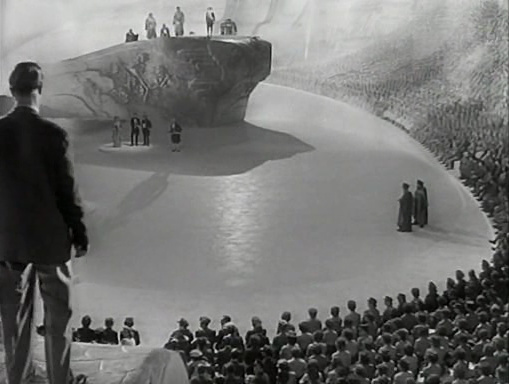
The scale of it! The sets of Babylon have to be seen to be believed. Huge, towering structures so large they dwarf elephants and the thousands of extras thrown in for scale. The camera pans slowly up to stress their gigantism and zooms in slowly in tracking shots to pick out a specific face among thousands. The siege of Babylon plays out like a real military action: armies of extras play out a choreographed battle on multiple levels of the walls while elephants push siege engines into place. Some nifty special effects allow on-screen beheadings and for us to see swords, arrows and spears plunge into bodies. It’s genuinely exciting and influenced every siege you’ve seen on film since.

This scale isn’t just restricted to Babylon. The modern plotline brilliantly recreates strike action by the masses, including a brutal put-down by private and government forces. Questing for a late pardon for her husband (who is literally walking towards the gallows while they do), the Dear One and a kindly policeman hop into the fastest car they can find to chase down the Governor’s train. In 1572, the streets of Paris are skilfully recreated – as are the grand palaces – and the action of the massacre is shot with an intense, Bruegelesque immersion. Jesus is mocked by a large crowd as he drags his cross through the streets before being crucified on a bloody-sky kissed hill with flashes of terrifying red lightening.

The huge scale is also carried across in Griffith’s narrative. This was intended as important film-making with a capital I. Griffith’s film is in places surprisingly anti-authoritarian and firmly on the side of the little guy. The modern strike is caused by a factory wage cut. Why? Because more money is needed for the firm’s charity work and it needs to come from somewhere. The charity workers are, to a woman, shown as judgemental, smug and causing more harm than good from their arrogant assertion that they know best. Homes are broken up, jobs are sacrificed and mothers judged “not good enough” separated from their children. All in the name of a moral crusade that’s more focused on prohibition than protection.

In Babylon, the priests of Bel are weasily, bitter, power-hungry figures, furious at the arrival of the new female God Ishtar, selling the city out to the barbarian hordes to preserve the old religion. The French court are certain the only way to guarantee peace (but really their own positions against the Hugenout faction) is to kill them all. Jesus’ presence is met with stern-faced priests wondering what they can do to get shot of this trouble-maker. We are always invited to sympathise with humble, simple people who want to make their own choices: Brown Eyes (Margery Wilson), a Hugenout daughter hoping to marry, the boisterous Mountain Girl, the loving Dear One and the Boy.

To keep this feeling like a universal fable of hope, names are kept as non-specific as these. Small human moments abound. Brown Eyes is as giddy as schoolgirl on the day before her wedding. Henry IV weeps and nearly vomits after being brow-beaten into ordering the massacre. The Mountain Girl – dragged to a market fair for her obstinacy – decides the best way to put off husbands is to chow down on onions. The Dear One and the Boy go on a charming date, at the end of which she pleads for the strength of character to resist the temptation to let him into her flat before they are married. It’s these little beats of humanity that help sustain the scale.

Intolerance is connected together with a series of captions – frequently badly-written and pretentious (e.g. “The loom of fate wove death for the father”) – and via a recurring image of a woman rocking a cradle, which I think represents the circle of life. The editing between the storylines is masterful though and the film’s pace and structure is generally so well maintained that your understanding of when and where we are is never challenged for a moment.

There have been claims Griffith’s more human epic was a correction to his Birth of the Nation. But that’s to misunderstand the sort of era Griffith came from. In his Victorian background, it was in no-way a contradiction for a man to be both a white supremacist and a sentimental liberal. Griffith believed the South were victims of the Civil War and the ‘unjust’ Reconstruction and felt Intolerance was a logical continuation of that theme. A few of his prejudices are on show here anyway. The only black faces are sinister heavies among the ‘barbarians’ attacking Babylon. Henry of Navarre is a limp-wristed sissy. The female reformers are all ugly harridans (the caption even tells us “When women cease to attract men they often turn to reform as a second choice”). Intolerance is an interesting reminder that a director we now think of today as American cinema’s leading racist was that and a man who passionately believed in social justice. Contradiction is the most human quality we have.

There may be a little too much in Intolerance considering its crushing run-time (the Jesus scenes could be cut with no real loss at all), but generally it hits a balance between pomposity and entertainment. It has plenty of violence and naked ladies (the harem of Babylon is shown in detail – it’s pre-Code folks) to keep the punters entertained, along with charm (though you need to look past the pose-taking, broadness of the performances). Griffith has a way with little shots: there is a lovely track into the face of the Dear One as she silently mourns. The chase in the modern plotline is genuinely tense while the massacre of the innocents in 1572 actually horrifying.

Above all, Intolerance set the table for epic cinema in exactly the way Griffith intended. While it is full of big ideas – at times clumsily presented – it’s also full of breath-taking spectacle that has influenced generations to come. For that reason, if nothing else, anyone interested in film should see it.

The Heiress (1949)

The Heiress (1949)

Is it love or is it avarice? Wyler’s sumptuous costume drama is a brilliant translation of Henry James to the screen

Director: William Wyler

Cast: Olivia de Havilland (Catherine Sloper), Montgomery Clift (Morris Townsend), Ralph Richardson (Dr Austin Sloper), Miriam Hopkins (Lavinia Penniman), Vanessa Brown (Maria), Betty Linley (Mrs Montgomery), Ray Collins (Jefferson Almond), Mona Freeman (Marian Almond), Selena Royle (Elizabeth Almond), Paul Lees (Arthur Townsend)

Pity poor Catherine Sloper (Olivia de Havilland). She’s seems destined forever to be the spinster, the last person anyone glances at during a party. Her father Dr Sloper (Ralph Richardson) can’t so much as walk into a room without gently telling how infinitely inferior she is to her mother. And when a man finally seems keen to court her, her father tells her that of course handsome Morris Townsend (Montgomery Clift) will only be interested in her inheritance. After all, there is nothing a young man could love in a forgettable, dull, second-rate woman like Catherine. He’s cruel, but is he right – is Morris a mercenary?

The Heiress was adapted from a play itself a version of Henry James’ Washington Square. It’s bought magnificently to the screen in a lush, sensational costume drama that comes closer than anyone else at capturing those uniquely Jamesian qualities of ambiguity and contradictory motives among the New American elites. Magnificently directed by William Wyler, it brilliantly turns a theatrical character piece into something that feels intensely cinematic, without once resorting to clumsy ‘opening up the play’ techniques. And it marshals brilliant performances at its heart.

Sumptuously costumed by Edith Head, whose costumes subtly change and develop along with its central character’s emotional state throughout the story, it’s largely set in a magnificently detailed Upper New York household, shot in deep focus perfection by Leo Tover, which soaks up both the reaction of every character and the rich, detailed perfection of decoration which may just be motivating some of the characters. Not that we can be sure about that, since the motives of Morris Townsend and his pursuit of Catherine remain cunningly unreadable: just as you convince yourself he’s genuine, he’ll show a flash of avarice – then he’ll seem so genuinely warm and loving, you’ll be sure he must be telling the truth or be the world’s greatest liar.

Catherine certainly wants it to be true – and believes it with a passion. The project was also a passion piece for de Havilland, and this is an extraordinary, Oscar-winning performance that delves deeply into the psyche of someone who has been (inadvertently perhaps) humiliated and belittled all her life and eventually reacts in ways you could not predict. Catherine is clumsy, naïve and lacking in any finesse. With her light, breathless voice and inability to find the right words, she’s a doormat for anyone. She even offers to carry the fishmonger’s wares into the house for him. At social functions, her empty dance card is studiously checked and her only skill seems to be cross-stitch.

She is an eternal disappointment to her father, who meets her every action and utterance with a weary smile and a throwaway, unthinking comment that cuts her to the quick. Richardson, funnelling his eccentric energy into tight control and casual cruelty, is magnificent here. In some ways he might be one of the biggest monsters in the movies. This is a man who has grown so accustomed to weighing his daughter against his deceased wife (and finding her wanting) that the implications of the impact of this on his daughter never crosses his mind.

Catherine is never allowed to forget that she is a dumpy dullard and a complete inadequate compared to the perfection of her mother. Richardson’s eyes glaze over with undying devotion when remembering this perfection of a woman, and mementoes of her around the house or places she visited (even a Parisian café table later in the film) are treated as Holy Relics. In case we are in any doubts, his words when she tries on a dress for a cousin’s engagement party sum it up. It’s red, her mother’s colour, and looks rather good on her although he sighs “your mother was fair: she dominated the colour”. Like Rebecca this paragon can never be lived up to.

So, it’s a life-changing event when handsome Morris Townsend enters her life. There was criticism at the time that Clift may have been too nice and too handsome to play a (possible) scoundrel. Quite the opposite: Clift’s earnestness, handsomeness and charm are perfect for the role, while his relaxed modernism as an actor translates neatly in this period setting into what could-be arrogant self-entitlement. Nevertheless, his attention and flirtation with Catherine at a party is a blast from the blue for this woman, caught mumbling her words, dropping her bag and fiddling nervously with her dance card (pretending its fuller than of course it is).

Her father, who sees no value in her, assumes it is not his tedious child Morris has his eyes on, but the $30k a year she stands to inherit. And maybe he knows because these two men have tastes in common, Morris even commenting “we like the same things” while starring round a house he all too clearly can imagine himself living in – by implication, they also have dislikes in common. (And who does Sloper dislike more, in a way, than Catherine?) Morris protests his affections so vehemently (and Sloper lays out his case with such matter-of-fact bluntness) that we want to believe him, even while we think someone who makes himself so at home in Sloper’s absence (helping himself to brandy and cigars) can’t be as genuine as he wants us to think.

As does Catherine. Part of the brilliance of de Havilland’s performance is how her performance physically alters and her mentality changes as events buffet her. A woman who starts the film mousey and barely able to look at herself in the mirror, ends it firm-backed and cold-eyed, her voice changing from a light, embarrassed breathlessness into something hard, deep and sharp. De Havilland in fact swallows Richardson’s characteristics, Sloper’s precision and inflexibility becoming her core characteristics. The wide-eyed woman at the ball is a memory by the film’s conclusion, Catherine becoming tough but making her own choices. As she says to her father, she has lived all her life with a man who doesn’t love her. If she spends the rest of it with another, at least that will be her choice.

Wyler assembles this superbly, with careful camera placement helping to draw out some gorgeous performances from the three leads – not to forgetting Miriam Hopkins as a spinster aunt, who seems as infatuated with Morris as Catherine is. The film is shaped, at key moments, around the house’s dominant staircase. Catherine runs up it in glee at the film’s start with her new dress, later sits on it watching eagerly as Morris asks (disastrously) for her hand. Later again, she will trudge up it in defeated misery and will end the film ascending it with unreadable certainty.

The Heiress is a magnificent family drama, faultlessly acted by the cast under pitch-perfect direction, that captures something subtly unreadable. We can believe that motives change, grow and even alter over time – and maybe that someone can love somebody and their money at the same time (perhaps). But we also understand the trauma of constant emotional pain and the hardening a lifetime of disappointment can have. It’s the best James adaption you’ll ever see.

La Règle du Jeu (1939)

La Règle du Jeu (1939)

Shallowness, selfishness and self-indulgence swirl in Renoir’s masterpiece, that plays like a giant metaphor for Europe in the 1930s

Director: Jean Renoir

Cast: Nora Gregor (Marquise Christine de la Chesnaye), Paulette Dubost (Lisette Schumacher), Marcel Dalio (Robert, Maquis de la Chesnaye), Roland Toutain (André Jurieux), Jean Renoir (Octave), Mila Parély (Geneviève de Marras), Julian Carette (Marceau), Gaston Modot (Edouard Schumacher), Anne Mayen (Jackie), Pierre Magnier (The General), Léon Larive (Chef)

When you are at the top of society, the rules bend to your will. They are, after all, for the little people. Get to the very top and life is all a game anyway – birth, death, marriages they are just movements in a great dance, none need cause you any concern if you don’t let them. Renoir’s masterpiece La Règle du Jeu explores in microcosm a whole fractured society of pampered, myopic focus on immediate pleasures, outweighing real life tragedies. And, whether at the top of bottom of the social ladder, no one seems able to move beyond a blasé and shallow attitude to life.

La Règle du Jeu is set at a weekend shooting party in the French countryside, hosted by Robert, Maquis de la Chesnaye (Marcel Dalio). Robert is married to a German wife, Christine (Nora Gregor) but having an affair with Geneviève (Mila Parély). But that’s fine, Christine is having a half-hearted affair with naïve airman André Jurieux (Roland Toutain). Below stairs, Christine’s maid Lisette (Paulette Dubost) yawns through her boring marriage with stuffy groundskeeper, the German Schumacher (Gaston Modot) by flirting with cheeky poacher-turned-employee Marceau (Julian Carette). Over the weekend, flirtations and affairs simmer to the boil, with Octave (Jean Renoir), a family friend, moving uneasily between parties trying to do the right thing.

The timing of Renoir’s film could not have been better. The story of people, as he put it, “dancing on the volcano” found its way into cinemas in July 1939. Europe was on the edge of the precipice. Within a year France would be literally ripped in two by Hitler. And here was Renoir releasing a blackly dark drawing room comedy, with its characters obsessed about small, shallow and trivial details and utterly ignorant of the world around them. Even worse, when violence and death intrude, it’s brushed under the carpet. It was a film that embodied the head-in-the-sand attitude of France, a country just months away from being steam-rollered by the Nazi war machine.

It wasn’t until 1959 that it was rediscovered and took its place as one of the great films. Renoir creates both a delightfully dark and droll comedy of manners, but also a rich and overwhelming metaphor for global chaos. Everything here is magnificent surface, with everyone pretending they are fine, upright citizens while flitting in and out of each other’s beds and never letting anything like morals or genuine emotions intrude. The game demands life be played as lightly as possible.

Everyone seems to know everything, but it’s all a joke. Robert is sleeping with the imperiously bitter Geneviève – so he seems less bothered about his wife Christine’s affair with airman André. Renoir’s film opens with André’s return from a cross-Atlantic flight. The media swarm around him, but André retreats into a funk when he sees Christine is not there to greet him. Even would-be heroes in this film are insular and self-obsessed. Toutain makes André strangely pathetic (you wonder – as does she at times – what the cultured and daring Christine saw in someone so prone to self-pity and devoid of drive). He whines about an affair which won’t take fire, does nothing to drive it and turns a car accident suicide attempt into a sulky fit of pique. He’s neither a romantic hero or a tragic figure.

But then no-one fills their role. Robert hosts the event, but he’s a strangely winsome, at times insecure figure (Dalio used his personal unease as a Jewish actor cast in a very Aryan role to skilled effect). He both puffs about how he doesn’t care about conventions – willingly inviting his wife’s lover to the weekend – but is also a fussy, eccentric figure who delights in clockwork machines and amateur theatricals. He has a casual, playboy attitude to money and life – everything comes easy, so he values very little. He doesn’t like conflict, preferring to let people off the hook, partly why he’s keen to end his relationship with Geneviève as he can’t bear the idea of Christine finding out.

Christine, played with a very effective awkwardness by Nora Gregor, feels surprisingly out of place among this social mileu. She’s consciously aware of her German background, looks uncomfortable in fine clothes, doesn’t enjoy social events and seems less assured than her bolshy, irreverent maid Lisette. She seems less like a Countess than Geneviève, played with cool austere sharpness by Mila Parély. Christine shrugs off the arrival of her lover André (to the respect of all) but on discovering her husband’s parallel affair seems unsure how to deal with it: she goes from bouncing mutual jokes about Robert with his lover, to considering half the household as potential elopement mates. Renoir felt Gregor was uncomfortable in the role – but her discomfort works superbly.

At the heart of this weekend retreat – and the film itself – is a brutish, extended hunting sequence. Renoir, who loathed the killing of animals, knew that nothing speaks more about the nature of man than how he treats those weaker than himself. The hunt is machine-like in its rounding up of birds, rabbits and other animals to be blazed down by the rich and powerful, with the carcasses chucked into the back of a van and never thought of again. Renoir shoots a single rabbit death with intense sympathy, the creature halting then curling itself vainly into a ball in its death throws. It reminds us queasily not only of the blood baths in fields like this only 20 years earlier, but also the carnage to come. It also foreshadows the death the film ends on, the victim falling as pathetically as the rabbits.

This same hunting party is also the catalyst for a string of disasters. Marcel Dalio’s Robert spontaneously affronts the tiresomely officious Schumacher (an unbending, unsympathetic Gaston Modet, rigid in his Prussian militarism) by not only shrugging his shoulders at the actions of charming poacher Marceau (a Hancock-ish Julian Carette, as charmingly amoral as anyone in the film) but actually hiring him. Needless to say, Marceau is less grateful and more delighted at the opportunities for shamelessness this presents him with and instantly attempts to seduce the maid Lisette (a coquetteish Paulette Dubost), setting him on a collision course with Schumacher. All stemming from Robert’s blasé indifference to rules and the contempt for hierarchy only those at the top can afford.

Renoir brings all these events together in a series of masterful sequences. This is a film that frequently shifts in tone and transition. The film moves so comfortably between storylines, from upstairs and downstairs, that it’s unfocused and meandering narrative reflects its themes and delivery. Above all, Renoir yet again demonstrates his mastery of marrying film and theatre. La Règle du Jeu could be a classic piece of farce, but is constructed with the skill of a master cineaste.

Much of the final act of the film is taken up with a truly sublime sequence, edited and shot to perfection, that sees all plotlines and entanglements intermingle in a dinner party. Renoir’s camera roves and tracks through the house. Events and characters play out in the back of scenes, while our focus is elsewhere. Figures at the edge of the frame suddenly seize the camera’s attention. We’ll move rooms and characters we left five minutes ago will march in continuing arguments. It’s a breathtaking display of planning, narrative and cinematic panache, expertly directed.

Renoir himself, as Octave, is the closest thing we have to either an audience surrogate or master of ceremonies. Of course, he’s neither of these things: he’s a clumsy bear of a man (even dressing as a dancing bear for the amateur theatricals), who tries to do the right thing out of stubbornness and masochistic pride. He pushes André and Christine together even though he loves Christine – in fact he sets at it with more energy than either of them. He fantasises about himself as a conductor, and that’s what he wants to be: controlling the dance rather than playing the tune. But he’s clueless, clumsy and ineffective and his actions inadvertently push a man to his death.

That death ends the film. Renoir triumphantly doesn’t make this epic or even tragic – it’s a clumsy case of mis-identity, the victim of one of these unhappy lovers settling accounts and picking the wrong person. But the game goes on: everyone pulls together to re-establish the status quo and stress it was an all accident, no one should feel bad, these things happen and everyone back to your drinks. Master and servant come together to keep the status quo ticking over and nothing is allowed to intrude on life. It’s a stage-managed ending that allows nothing to be learned and nothing to change.

After all, the rules mustn’t be changed when everyone is comfortable with them. La Règle du Jeu is a masterful metaphor for an entire society where shallowness, selfishness and self-indulgence win out over duty and decency. Everyone we see is preoccupied only with their own desires, from the whimsy of Robert to the flirtations of Lisette, the self-pity of André and Octave’s desire to influence the narrative. It whirls round and round like a merry-go-round until someone falls off and dies. The volcano is primed to explode, but the dance goes blithely on.

Summer with Monika (1953)

Summer with Monika (1953)

Bergman’s early kitchen-sink drama, as idealism turns sour after a seemingly blissful Summer

Director: Ingmar Bergman

Cast: Harriet Andersson (Monika), Lars Ekborg (Harry), John Harrysone (Lelle), Georg Skarstedt (Harry’s father), Dagmar Ebbesen (Harry’s aunt), Åke Fridell (Monika’s father), Naemi Briese (Monika’s mother), Åke Grönberg (Harry’s friend)

Summer with Monika is, in many ways, the story of two shots. The first follows Monika (Harriet Andersson) as she strips down and runs across the rocks to the sea during her summer escape from the dullness of life with Harry (Lars Ekborg). It’s the shot that excited a generation of sweaty-palmed gentlemen watching the bizarre exploitation-cut of the film released in the US. The second made auteurs the world over swoon: returned from that summer and trapped in the cramped apartment, childcare life of her parents, Monika goes for an illicit drink with her lover, accepts a cigarette and then turns to stare straight down the camera at us, the shot held for a long minute as all light fades around her, as if challenging us to object to what she is obviously about to do.

Summer with Monika (largely thanks to the first shot) remains Bergman’s most watched film in America. In Stockholm, the children of two working-class families meet in a café and go on a date. Harry works joyless shifts, bullied by bosses and the other staff, in a glass shop. Monika sleeps in the living space of her tiny apartment, where her parents are frequently drunk and indifferent. The two of them chuck it all in to run away to the countryside in Harry’s father’s boat. At first its idyllic, but they can never quite escape the burdens of modern life. When they return, Monika’s pregnancy, a rushed marriage and a tiny apartment sees any dreams they had of youthful freedom drain away.

Bergman’s film feels like the advance guard of the British Kitchen Sink drama. Our two young heroes are full of dreams for a perfect, bohemian life totally different from their parents that neither of them really have the initiative to deliver on. Harry is, at heart, a timid individual – to timid to even smash a glass when he quits his job, instead pushing it as near as he dares to the edge of a shelf and glancing round in fear when it falls. Monika is full of desire for something but even she seems unsure what this is, other than knowing it’s not this.

Together they head into what they want to think – and desperately tell each other – is a perfect summer of utter freedom going where the water takes them in a boat. And at points it is perfect. They drift, relax in the sun, make love. Monika strips down and runs towards the water. The two have a sharp sexual longing for each other. It’s all wildly different from sitting in Harry’s house and hurriedly buttoning their clothes up when they hear his father arrive home early. They have no responsibilities, no requirements, nothing.

From their first meeting together, there is the feeling that they are trying too hard. Both of them wants to see the other as an escape from their own lives. On an early date they watch a classic Hollywood romance at the cinema, but while Monika stares rapt at the screen, Harry seems less engaged – she dreams of a romantic future, he’s basically happy with one where he has Monika. While she wants to plan no further than the next hour, Harry won’t let his mind move on from his long-term dream of becoming an engineer (and the years of study it will require).

They rush together in an impulsive summer, as if trying to hide the fact from themselves that deep down they are unsuited and incompatible. Monika wants to be a free spirit, Harry might enjoy a holiday but always sees himself as taking a place in the world at large. But for a few moments they can enjoy the freedom. Together they flee from a crowded pier to dance alone on a romantic abandoned one. Monika sunbathes on the small boat while Harry steers it. They vow to be together forever, but this romantic moment feels like what it is: a fantasy.

Bergman won’t let us wallow in this romantic fantasy. The drift along the coastline takes place in a tiny boat, with only two suitcases worth of possessions. A fellow tourist attacks their boat, forcing them to defend it (the aftermath is their last moment of passion – before this they were arguing over Harry’s bad dancing). They have very little money for food: they start running out, leading to arguments, scavenging and eventually Monika stealing a roast from a farmhouse after she is caught rifling through the outhouses. She eats this like a savage, tearing flesh from the joint with her teeth and berating Harry for failing to help her (he was off gathering wild fruit – a clear reminder that he is a dutiful but far from exciting hunter-gatherer).

When they return though, it is not to a freedom Monika imagined but the world of her parents. Oppressive, full of responsibility, lacking in joy, every hour spent responsible for a child. Harry starts his training and is rarely seen outside of a suit. Monika is ill-suited to domesticity and bemoans the fact it’s forced upon her. She’s young and she wants the freedom she thought she had been promised – and having her sleep disturbed by a baby in a one-room apartment ain’t it.

And so, we get that defiant stare down the camera. Harriet Andersson is quite extraordinary in this role. It’s arguably the challenging glare that really fired the sexual pistons of the American distributors who re-cut the film into a 60-minute exploitation film (with added insert boob shots of someone else). It’s the stare of a woman who is determined to get what she wants from life and challenges us to judge her. Andersson makes Monika both passionate and challenging, but also vulnerable. She wants tenderness and love, but not at the cost of being trapped in a world where decisions are forced upon her. She’s young and selfish, but also honest and strangely gentle.

Bergman’s work here explodes the simplicity of romantic narratives. Instead, it fits wonderfully with that Kitchen Sink realism, where hopes are worn down by the realities of life and people cling to moments of freedom hoping they will last forever and translate into eternal realities. As Harry (Lard Egbork is very good as this young man constantly trying his best) and Monika increasingly argue, they become more-and-more identical to her parents. Youth eventually gets crushed by the truth of life and dream-like cruises on small boats become long years of childcare and professional training. Heartfelt, challenging and very sad it’s a key early Bergman work.

Escape to Victory (1981)

Escape to Victory (1981)

The sort of odd movie pitch that could only have been made in the 80’s: it’s a POW film – but with footballers! And Stallone in goal! Cult nonsense, but fun.

Director: John Huston

Cast: Sylvester Stallone (Captain Robert Hatch), Michael Caine (Captain John Colby), Pelé (Cpl Luis Fernandez), Max von Sydow (Major Karl von Steiner), Bobby Moore (Terry Brady), Osvaldo Ardilles (Carlos Rey), Paul von Himst (Michel Fileu), Kazimier Deyna (Paul Wolchek), Hallvar Thoresen (Gunnar Hilsson), Mike Summerbee (Sid Harmor), Russell Osman (Doug Cluire), John Wark (Arthur Hayes), Daniel Massey (Colonel Waldron), Tim Pigott-Smith (Major Rose), Carole Laure (Renee)

It’s possibly the most bizarre idea in movies. An old-school, boy’s-own-adventure about POWs starring a Panini sticker album’s worth of footballers, led by Michael Caine and Sylvester Stallone playing the Germans (actually represented by a team of ringers from the New York Cosmos) in a ‘friendly’ football match in Paris. Oh, and it’s directed by John Huston. Who thought this one up?

Needless to say Escape to Victory is a cult hit. Caine plays professional footballer John Colby, his career interrupted by internment in a POW camp, challenged to an exhibition match by football-mad Major von Steiner (Max von Sydow). When von Steiner’s bosses turns the game into a propaganda vehicle, Colby is under intense pressure to pull out. When he refuses – not wanting to put his players lives at risk, some of whom (the Eastern European ones) have been rescued from labour camps – instead he is asked to accommodate a daring escape plan, led by American Robert Hatch (Sylvester Stallone) who joins as ‘trainer’ and back-up goalie. With the match scheduled, a plan is formed: the team will escape at half time. But will the players abandon the game, or will sporting pride kick in?

Well, what do you think? The whole film is a build up to the game. Are they really going to leave it at 4-1 to the Germans? The pedestrian opening two thirds of the film can pass you by. You certainly feel it passed John Huston by (if you ever want to see a great director do a pay cheque movie, watch this). The film settles into familiar rhythms of both genres (sports and POW movies) mashed together. For the latter; forgers, escape committees, roll-calls, daring escape attempts over and under wire, muttered attempts to board trains with fake papers are all dutifully ticked-off. Nothing unusual: the interest is all in the sports film.

And if you are going to make a sports film – crammed with training montages – who else would you hire than a dream list of footballers to perform them. And no footballer was more of a God-like figure than Pelé. Welcome to the only film the Greatest Player Ever made (as soon as he opens his mouth, you’ll see why). Alongside him England’s legendary World Cup winner Bobby Moore, charming Argentinian Ossie Ardilles (not trusted with a line), several other internationals from across Europe and (filling out the numbers) half a dozen players from Ipswich Town (though, to be fair, John Wark might just be the best actor). Most of the best parts involve watching these stars go through their paces.

Michael Caine – who only took the film so he could say he had genuinely played with Pelé – anchors all this reasonably well (even though, at 47, he looks noticeably out-of-shape considering he’s playing an international footballer at the peak of his career). The role of Colby is no stetch for him, but Caine conveys carrying responsibility rather well, and there is some decent material as he butts heads against the unhappy upper-class officers who want him to tell the Germans to shove it.

The officers – decent performances from Daniel Massey and Tim Pigott-Smith among others – point out the Germans won’t give them a sporting chance. But, this is the sort of film where boy’s own pride kicks in, and we get a classic ‘let’s show em’ attitude. This culminates, of course, in the half-time planned escape attempt being aborted as the players protest “We can win this!” and the side head back out for the second half (and, of course, glory).

It’s a big shout as our heroes take a heck of a drubbing in the first half. (This despite Caine’s ahead-of-his-time coaching advice to make the ball do the running, which sounds like tika-taka seventy years early – was Escape to Victory required viewing in Spanish football academies?). To the disappointment of von Steiner – our token ‘Good German’ played with his customary professionalism of von Sydow – who gave his word it would be a fair game, his superiors hire “a very good referee” who will “make no mistakes”. German tackles fly in un-punished, a dubious penalty is awarded and Pelé’s ribs are broken in a filthy foul forcing the team to play with ten men. Those dirty, cheating Germans! Thank goodness Bobby Moore scores to give them a chance.

Every star player gets their moment in the spotlight, most of all Pelé who scores with a trademark bicycle kick. (I wonder if Pelé counted this one in his career goals record?) It’s a breath-taking piece of skill – von Steiner even proves his “Decent German” credentials by rising to applaud (to the fury of his fellow officers). Our heroes pull it back to 4-4 before having a goal disallowed for a false off-side (mind you it feels less inexplicable in an age where VAR chalks off goals for offside elbows). Then of course the Germans are awarded a penalty as the last kick of the game after a fair tackle by Ardiles.

And so, we come to Stallone. Perhaps the most inexplicable thing in this, the Italian Stallion at least convinces as a man who knows nothing about football. Looking trim, Stallone handles most of the POW and escape stuff (and a token romance subplot with a French resistance fighter) but of course space had to be made for him in the game. So, he plays as keeper (the team’s first choice keeper volunteers for Caine to break his arm so Stallone can be released from lock-up to play in the film’s most difficult to watch moment). Stallone wanted to score the winning goal, but was told that was unlikely for a keeper, so instead he saves the penalty to preserve the moral victory. Stallone mumbles his way through the film, feeling bizarrely out of place, but he was the big star.

Escape to Victory is a truly bizarre thing. But it’s got a fun football game in it and as sort of exhibition match it’s a bit of a treat. And watching it shortly after the passing of Pelé, it feels almost like a rather lovely tribute.