Category: Directors

The Passion of Joan of Arc (1928)

The Passion of Joan of Arc (1928)

Dreyer’s searing, close-up dominated, silent masterpiece is a truly unique piece of cinema – and still astounding

Director: Carl Theodor Dreyer

Cast: Renée Jeanne Falconetti (Joan of Arc), Eugène Silvain (Bishop Pierre Cauchon), André Berley (Jean d’Estivet, prosecutor), Maurice Schutz (Canon Nicholas Loyseleur), Antonin Artaud (Bishop Jean Massieu), Gilbert Dalleu (Jean Lamaitre, Vice-Inquisitor), Jean d’Yd (Nicholas de Houppeville), Louis Ravert (Jean Beaupère), Camile Bardou (Lord Warwick)

It falls to few films to have the grace to redefine what cinema could do. Dreyer’s The Passion of Joan of Arc is one of those films that simply demands to be seen – and once seen will haunt you forever. For a film in many ways so profoundly simple, it is also profoundly wise, deeply affecting, troubling, moving and finally almost unbearably painful. Shot in an iconic collection of interrogative close-ups, Dreyer’s masterpiece earns its place as one of the greatest films ever made.

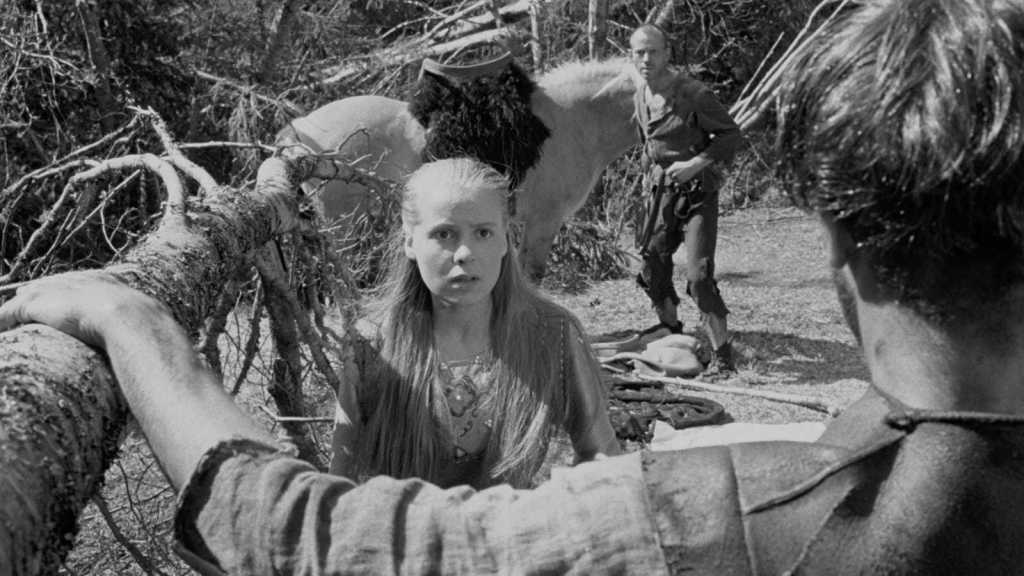
Dreyer’s masterstroke here was not to create a conventional biopic. We see nothing at all of Joan’s finding of her faith, her campaign against the English or exploits on the battlefield. Instead, we witness only the final days of her life, pulled up as a heretic before a biased and arrogantly superior ecclesiastical court. We first see her not as a strong figure (or even defiant) but a frightened girl creeping into frame, dwarfed by spears and towered over by a priest. If the French producers were expecting a triumphant eulogy to their recently beautified national saint, they had a shock.

Mind you, they had plenty of shocks already. Dreyer’s film used one of the most expensive sets ever built. Seven million francs were shelled out on an intricate medieval castle and courtyard, full of interconnecting passage ways. Dreyer’s surviving model of the set is impressive. You have to assume the real thing looked impressive as well, because the film almost never shows it. The Passion of Joan of Arc takes place in tight, fixed, searching close-ups – most strikingly of Joan but also of her interrogators and the witnesses of her martyrdom. The epic is pulled down to the tightest and most intimate framing of all: the human face, with all its blemishes, imperfections and dizzying emotions.

Those emotions play most sharply across the face of Renée Jeanne Falconetti. Falconetti had performed briefly in one film eleven years previously, but this was effectively her only work on camera. And it is extraordinary, one of the most searing, memorable performances in the history of cinema. You will never forget the fixed glare of her eyes, the devotional joy in her face and the self-accusatory pain in those same eyes when she briefly recants. Dreyer and Falconetti worked closely together to chart every single moment of the complex array of emotions.

Hope, despair, defiance, fear, self-loathing, determination, shrewdness, timidity – all these expressions form both in micro and in carefully held shots that allow Falconetti to naturally move from one to another. This is one of the few films that really has the patience to record thinking. We see realisations dawn upon her, her face slowly changing to process them and then (frequently) her eyes filling with genuine, heart-rending emotion. It becomes an intense – painful – study in powerlessness and vulnerability, dappled with little moments of hope. Her joyful face when the shadow of a window forms a cross on the floor is almost unbearable.

Not least, because as she stares enraptured at this shadow, we cut back and forth to her interrogators forging a letter from the Dauphin to further break her spirit. Dreyer introduces the priestly interrogators with one of the few motion shots, a long tracking shot panning across the rows and rows of well-fed, comfortable men who are about to stand trial over this young woman. The close-ups reveal as much about the priests as it does Joan. A complacent, arrogant Bishop smirks while he picks his ear. Others snigger and stare in disgust at this abomination.

But Dreyer’s film is remarkable for how much scope he gives many of the priests. We see some of them begin to form serious doubts as Joan’s sincerity flies in the face of their expectations. Schutz’s Canon – writer of that fake letter – doubts grow, finally seen sadly turning away as she is prepared for burning. Even Silvain’s Pierre Cauchon isn’t a sadist, or really a bully – just someone who can’t imagine a world in which he is wrong. It’s what leads him to push and push, sometimes with a resigned unease, willing Joan to recant. Some burn her sadly: but burn her none-the-less.

Dreyer’s film though is a passion – and, like the medieval plays that inspire it, it wants to take us on a journey to understand the power of Joan’s faith and nobility of her martyrdom. The priests convey us and Joan to the torture chamber – one of the few wide shots Dreyer uses, to show us the extent of the ghastly devices. A giant breaking wheel is turned with increasing, horrifying speed, its many spikes blurring, as Cauchon demands Joan recant. It drives her into a fainting fit and she is bled. A real AD gave up his vein to produce shockingly, horrifyingly genuine spurts of blood.

Dreyer’s claustrophobic close-ups are not designed to throw us into Joan’s POV, but to make us feel as trapped as she does. It’s striking that many of the close-ups can’t be either Joan’s perspective or the priests. There isn’t always continuity between them – we’ll cut from a full-on view, to a side-on one, a camera angle above and then below, staring up or glaring down. The effect is less about putting us into the eyes of its characters, than to make us feel like a spirit in the room, powerless to intercede. There are no establishing shots for geography, only the onslaught of faces shouting at the camera or starring with confessional pain at the lens.

Which helps even more with the sense of devotional mystery play Dreyer is aiming to create, using the language of cinema in ways no theatre-maker ever could. As Joan is mocked, and garlanded with a false crown, by braying English soldiers, we feel as trapped as she does. When her hair is sliced away, the shears feel uncomfortably close, but just as traumatising is the agony of guilt on Falconetti’s face, at the realisation she has turned her back on her God.

It’s been said watching the film is like watching, as if by a miracle, actual documentary footage of the trial. This realism is one of Dreyer’s master-strokes. So many other directors would have allowed touches of medieval pageantry, of poetry among the stark images. The closest we get to this is a doubtful Joan starring at freshly dug up skull, from the eye socket of which wiggles a worm, while deciding whether to confess. Other than that, the lavishness (that perhaps the producers expected) is nowhere to be seen, helping make the film as punishing and (finally) moving to watch as it is.

The final burning offers no release. The camera maintains its focus on Joan, who quietly passes the rope to her executioner so he can bind her to the stake, then turns her eyes one final time to heaven before her face is obscured in smoke and flames. Dreyer’s camera doesn’t flinch, and its fair to say Joan’s death is as horrifying as anything caught on screen. An alarmingly life-like body blackens, burns and shrivels in uncomfortable mid-shot. In a stunning swinging camera shot, soldiers prepare weapons to disperse the crowd. Dreyer’s camera doesn’t shy away from this atrocity either: bodies are battered, a fallen woman stares sightlessly in the camera, screaming mothers run with children in their arms, a cannon pans across the camera and fires into the crowd. The smoke of the burning – to which we constantly cut back to – fills the screen. It’s bleak and hellish.

This is truly a passion, a sense of the ascension of the spirit through the dread of pain and suffering. And we feel every moment of it through the uncomfortable but profoundly moving immersiveness of Dreyer’s camera – and the breathtaking camerawork of Rudolph Maté – and the astonishing raw performance of Falconetti. The Passion of Joan of Arc sears itself onto your memory, a visceral, unique piece of film-making unparalleled in the history of the medium.

The Conformist (1970)

The Conformist (1970)

Freud mixes with politics in Bertolucci’s stunning political-psychological thriller, one of the greatest films ever made

Director: Bernardo Bertolucci

Cast: Jean-Louis Trintignant (Marcello Clerici), Stefania Sandrelli (Guilia), Dominique Sanda (Anna Quadri/Minister’s Lover/Prostitute), Gastone Moschin (Manganiello), Enzo Tarascio (Professor Luca Quadri), Fosco Giachetti (Colonel), José Quaglio (Italo Montanari), Pierre Clémenti (Lino Semirama), Yvonne Sanson (Guila’s mother), Milly (Marcello’s mother)

At age 29, Bertolucci made one of the greatest films of the 20th century. The Conformist is a film of uncertain illusions, half-seen shadows dancing on the wall of a cave. Each viewing unfolds new perspectives and interpretations. But each is rewarding, such is the magisterial grace the story is told with, and the radiant beauty of the film itself (a clear, massive, visible influence on Coppola’s Godfather films).

In 1938, a young Fascist Marcello Clerici (Jean-Louis Trintignant) is commissioned by Mussolini’s government to arrange the assassination of his former philosophy professor, dissident intellectual Luca Quadri (Enzo Tarascio) in Paris. Marcello longs for a “normal life”, obsessed with the fear that personal flaws, rooted in childhood trauma, will expose him. He marries the unexpected woman – the garrulous and ingenuous Guilia (a superb, guileless Stefania Sandrelli) – and joins the Fascists. But he is shaken by his fascination with Quadri’s wife Anna (Dominique Sanda).

Bertolucci’s film is nominally a political thriller. It exposes the brutality of fascism, but its alleged heroes are ineffective, bourgeoise left-wing dissidents. But really this is a Freudian deep dive into the character of Marcello and how he has sought to “conform” his whole life.

The Conformist is like sitting in on a prolonged psychotherapy session, Marcello’s past, present and future stripped down to their components, with the viewer invited to theorise how they assembled in the way they have. The film’s non-linear structure is crucial for this – and Bertolucci was vocal on the vital wisdom of editor Franco Arcalli. The narrative was reconstructed around the day of the assassination and Marcello’s car journey to it – with flashbacks inspired by events along the way.

The film is a revue of Marcello remembering his recruitment, the days before his marriage and the childhood trauma of sexual awakening and murder that haunts his inner fears. Most of all we see unspool the events that directly brought him to sitting in this car, on this day, driving towards the site of an assassination. These component parts shift and rearrange themselves to form new patterns about how we understand Marcello and the choices he makes.

The film’s theological pivot is Marcello and Quadri’s discussion of Plato’s cave (read about it here), where men chained in a cave understand the world only from the shadows of objects outside which they watch on its walls. But there are no easy conclusions. Are the fascists the chained men? Or has Marcello chained himself away and only interprets the world through shadows? Is Marcello so disjointed he can only interpret emotions based on his understanding of shadows of them?

Or is this pushing us to consider we are watching a film: a thing made of light and shadows. Imagery constantly reminds us of this fact. Light streams through trees, pillars and windows like light from a projector. Views outside of train windows resemble back projection. Marcello watches a radio performance from a recording booth, the window of which literally resembles a cinema screen. Constructed realities are the language of this medium – and Marcello is perhaps applying the same phraseology to his life. He builds a narrative, just as we all do, making himself bland and forgettable.

Marcello dreads the discovery not only of his crime, as a 13-year-old, of shooting and killing a seductive chauffer (played by Pierre Clémenti), but also the sexual longing it awakened in him. This horror of homosexual yearnings – and fear at being caught for murder – has, perhaps, led to a reflexive desire to hide in the crowd: to conform. Understanding this leads to us seeing Marcello, for all his coldness, as a strangely tragic, repressed figure, hiding from himself and others. His face is often obscured, or seen behind glass and mirrors. He’s always slightly distant from us.

This void is beautifully captured in Trintignant’s compelling performance. He bottles genuine emotions within himself, that at rare moments are released like small explosions. He clings to a hat that hides his face and seems barely aware of his desires. Sensuality and nakedness fascinate and alarm him. Fascism is a large, empty illusion he clings to. In the film’s only touch of heavy-handedness Italo, who recruits him, is blind. You feel something for Marcello, but are also repelled by his studied artificiality. His whole life is a carefully framed pose, like those he strikes when handed a gun before stroking his hair (a repeated gesture) and running off to find his hat.

The one thing that seems to affect him is the fascination – attraction seems too strong a word – he feels for Anna Quadri. Laying the groundwork for the sudden impact she has on Marcello, Dominique Sanda appears twice earlier as unconnected characters (both prostitutes). Anna, smart, bisexual, knowing herself and others far more than anyone else, sees straight through Marcello. How much is her seduction of Guilia an attempt to titillate and neutralise Marcello? At one point, she seductively touches the laughing Guilia, while staring at the door where Marcello (and the camera) stand in the shadows, knowing he is watching. Does Marcello long for her sexually, spiritually or because it feels like he should do? Answers are myriad.

These are expanded by the constructed beauty of Storaro’s photography. Bertolucci’s mastery of camera movements is clear (there are tracking shots of breathtaking grace, including a long drift along wind-blown leaves that Coppola outright pinched) and he knows when to use angles that unsettle (including a Dutch angle that suddenly, stunningly rights itself) or feel voyeuristic. Storaro’s shoots with ravishing beauty that subtly colour codes emotions, moods and locations and stresses the constructed nature of film narratives.

Italy is a land of imperious, grandiose Fascist architecture: towering modernist rooms, cold marble and neo-classicism, shot with whites and striking starkness. Paris is awash in softer – but also cold and damaging – blues that feel more natural but unsettling. Moments where Marcello touches on his longings (or at least persuades himself he does) drip with yellows. It looks gorgeous, but also fits with themes of invented kaleidoscopes, being re-shaken to construct a world.

The film builds towards a scene of genuine horror. The assassination is a bleak nightmare in the snow. You can never forget the image of Sanda – her face contorted with panic, desperation and hate – clawing and screaming at the window of Marcello’s car while he just sits. Is he torn between indecision and fear, or does he feel nothing? Your ideas will change, but your horror at Anna’s desperate, hand-held-shot, futile flight through the woods like a deer pursued by hounds never will.

The film’s final coda re-opens mysteries. Marcello discovers things that make him question if his life of conformity (and the price he has paid for it) was even necessary. The final shot sees him sitting, a flame behind him, starring at a wall (of course!) before turning to – well to look at us? Or is he looking, at last, at the world he has only studied from it shadows? It’s unclear. Deliberately so.

What’s clear is that The Conformist is crammed with truly extraordinary images (from that haunting assassination to a beautiful Brueghelesque late-night dance between Anna and Guilia, everything sticks with you) and challenging ideas that carry no easy answers. Bertolucci’s film invites deep examination and analysis and presents possible suggestions, but no answers. It’s what makes it an extraordinary classic, a fascinating study of psychology and humanity.

Hell and High Water (1954)

Hell and High Water (1954)

Action below the waves in this dutiful, for-the-money thriller from Samuel Fuller that lacks imagination or freshness

Director: Samuel Fuller

Cast: Richard Widmark (Captain Adam Jones), Bella Darvi (Professor Denise Gerard), Victor Francen (Professor Montel), Cameron Mitchell (“Ski” Brodski), Gene Evans (Chief Holter), David Wayne (Tugboat Walker), Stephen Bekassy (Neumann), Richard Loo (Hakada Fujimori), Wong Artarne (Chin Lee), Henry Kulky (Gunner McCrossin)

Few films start with a bigger bang than Hell and High Water: a nuclear explosion. What caused it? The film winds back to tell us. Retired submarine captain Adam Jones (Richard Widmark) is hired by a cabal of intellectuals and scientists working to maintain world peace. Somewhere on an island off Japan, the Commies are working on a secret nuclear bomb. Jones – in return for a fee – will shuttle Professors Montel (Victor Francen) and Denise Gerard (Bella Darvi) to investigate. Cue submarine duels, personality clashes, romance and shoot-outs.

To be honest, nothing in Hell and High Water lives up to that bang at the start. Samuel Fuller took on the film as a favour to producer Darryl F Zanuck, but had a low-opinion of the result (labelling it his worst film). Fuller rewrote the script, added a lot of his compulsive drive to the direction and handled it well – but it feels like a “gun for hire” film. Goodness only knows what Fuller made of Spielberg telling him in 1979 he loved it so much he carried a print of it in his car (perhaps “Have you not seen Pickup on South Street?”)

Hell and High Water is a serviceable men-on-a-mission film that sneaks in a few interesting beats, but otherwise goes for well-shot action and predictable events over invention and insight. It’s anchored by a grumpy Richard Widmark (who thought the script was crap and co-star Darvi couldn’t act) as a hard-to-like hero. Never-the-less Jones’ ruthless mercenaryism is the film’s most interesting beat – even if it is a repeat of the same actor’s attitude in Pickup on South Street, right done to mouthing almost the same contemptuous line about ostentatious flag wavers. Jones does his job professionally – and he’s got no truck with his country being dishonoured or attacked by Commies – but his main concern is always the $50,000 fee he’s been promised.

Also paid off are the whole crew who, in the film’s other interesting beat, are a regular united nations all of whom treat each other with equality and respect (the only people not represented here are Black people). We’ve got a German, a Japanese, a Frenchman, several Americans – considering only nine years previously all these nations had been working over-time to kill each other, it’s great to see the team on the ship working as a tension free-unit. We even have a Chinese sailor – who entertains his fellow crew with improvised ditties – becoming a crucial hero.

Fuller also shoots the sub action – a mix of models and trick photography – very well. The angles he uses of the subs underwater, in particular their turns, and the sweaty look of those underwater (and the increasing tensions) influenced several future films. All the submarine lingo you’d expect is trotted out with real commitment (“Right full rudder!”) and every box is carefully ticked, from sinking the bottom, to the costly rush to close a bulkhead. The torpedo fights are well-staged and whenever the film dives it’s at its best.

Where it is less so is whenever the film dwells on its characters. It tries to push the envelope a bit by introducing a female professor who is assured, competent, super-smart and gets stuck in with helping out when things go pear-shaped. She’s played by Bella Darvi, a protégé (and more) of Zanuck, who he was determined to elevate to stardom. Despite Widmark’s criticism, she’s fine here, even if she struggles to convey the charisma the role needs, often falling back on slightly grating over-earnest, head-girl smartness. What fails is the complete lack of chemistry between her and Widmark, their half-hearted, dutiful romance (probably mostly Widmark’s fault).

You’ll feel sorry for her though as the crew – and Jones – eye her up like a piece of meat when she arrives. Of course, this dated sexual leering is par for the course, but is still more than a little uncomfortable. But this is still the era when a sailor taking his top off to push his tattoos into a woman’s face was funny rather than a crime. The film does gives Darvi’s Professor a lot of proactivity and does generally take her side – even if she, inevitably, needs to learn our hero knows best.

Hell and High Water charges through to a decent ending, with just the right mix of self-sacrifice, tension and pay off. Victor Francen gives the films best performance as an illustrious, brave French scientist. But it never feels like anything more than a dutiful, for-the-money film. There is none of Fuller’s fire or feeling here, no real imagination or freshness in the ideas or concepts. It hits all the beats, ties things up with a bow and sends you home – but its very hard to really remember anything distinctive about it when the credits roll.

Waiting Women (1952)

Waiting Women (1952)

Bergman experiments with form and genre in this fascinating collection of female-led short stories

Director: Ingmar Bergman

Cast: Anita Björk (Rakel), Eva Dahlbeck (Karin), Maj-Britt Nilsson (Marta), Birger Malmsten (Martin Lobelius), Gunnar Björnstrand (Fredrik Lobelius), Karl-Arne Holmsten (Eugen Lobelius), Jarl Kulle (Kaj), Aino Taube (Annette), Håkan Westergren (Paul Lobelius), Gerd Andersson (Maj), Björn Bjelfvenstam (Henrik Lobelius)

Waiting Women is another early step in Bergman becoming one of the great directors in cinema. It’s easy to feel it’s a film worth seeing largely for completeness sake – I certainly felt that, seeing this unknown nesting at the bottom of a BFI box set containing Wild Strawberries, Smiles of a Summer Night and The Seventh Seal. But Waiting Women is a playful and inventive film that sees Bergman experimenting with form and genre and show-piecing his inventive use of the camera (it’s a key reminder this famed wordsmith also worked with two of the most gifted cinematographers in movie history, Gunnar Fischer and (later) Sven Nykvist).

Three women sit waiting at a country-side retreat (echoes of the holiday home in Wild Strawberries) waiting for their husbands (three brothers) to arrive. While they wait, they share stories. Rakel (Anita Björk) talks about her husband Eugene’s (Karl-Arne Holmsten) suicidal response to discovering her affair with childhood friend Kaj (Jarl Kulle). Marta (Maj-Britt Nilsson) remembers keeping her pregnancy from her now-husband Martin (Birger Malmsten), who she met thinking he was a penniless artist rather than the son of an industrial power-house family. And Karin (Eva Dahlbeck) remembers a night after a function which she and driven husband Fredrik (Gunnar Bjornstrand) spent trapped in a lift and almost rekindled the spark in their marriage.

Bergman’s takes these three stories and presents each in strikingly different ways. The first he packages as a full-blown romantic melodrama, with heightened passions, elaborate threats of death and dramatic proclamations of affection and desperation. The second shifts gear into a moody expressionistic drama, almost a silent-movie, with minimal dialogue and the scene shifting from striking shadow-play on hospital walls to silent comedy in a Parisian nightclub. The third caps the film with a single-location farce with witty wordplay and a dollop of sadness and regret.

It makes for a film that constantly surprises you – and a director looking to experiment and stretch his artistic legs, finding new ways of expressing himself in film. (He even pops up for a Hitchcock-like cameo!) It’s also three entertaining (in different ways) short stories and another, superb, Bergman female-centric film. Because, make no mistake, our sympathies are all with the women, whose stories leave you with more than a little impression – for all they have joyfully prepared the house for their husbands – that each of them are not leading the lives they might have wished.

The first story is the most conventional – perhaps because Rakel’s hormonal love-affair with a long-lost school friend feels like a twist on Bergman’s Summer Interlude. But all is carefully dialled up to eleven in a romance that would not feel out-of-place in Emily Brontë. The flirtatious lust between Rakel and Kaj – centred around a joint trip to a bathing house which drips with illicit sexual energy – simmers. There is an early Chekovian introduction of a gun, before Kaj’s essential coldness is revealed and Eugen’s shock swiftly turns to anger and suicidal resentment. It’s a marvellous Bergman scripting touch that Eugen always feels like the sort of man who will shoot himself to make his wife feel bad about herself rather than because of his own pain.

Bergman shoots it with brisk tracking shots interspersed with close-ups and allows the action to become increasingly bombastic as it builds towards its melodramatic conclusion of Eugen shuttered away in a boat house, threatening to end it all. It makes for a striking gear change as our second story begins, and the visual mastery of Bergman and Fischer’s partnership comes to the fore in a middle-chapter that homages the Silent Masters. Marta’s memories of her pregnancy and her meeting with her husband, begins with the nightmareish image of a face behind frosted glass, distorted out of all recognition (Bergman, as always, the lost great-horror director) before she finds herself in a hospital ward, breathing in anaesthetic gas, and seeing the shadows of the branches from the tree outside, twist and dance like possessive hands on the walls around her.

Played with a sympathetic sweetness, tinged with just the right touch of edgy defiance, by Maj-Britt Nilsson, Marta’s memories of meeting her husband in Paris plays out in her memory like an expressionistic film. In a Parisian nightclub, the camera ducks and swerves around exotic dancers, beautiful compositions of body and movement in every frame. She drops her GI boyfriend for a Martin after a series of surreptitious glances across the room and passed notes. Their courtship and early relationship in his blissful studio play out like a romance – until his family arrive with a chilling explosion of words about expectations and duties that shatter the illusion. The chapter closes with something that could be either memory or dream – Martin and Marta, with the warmth of their early days returned, on a beach together. Reality or regret? Bergman gives reasons to believe both.

The final story is the most enjoyable, lightest and also (in its own way) saddest. Beautifully shot largely in a single confined location – and this is a workshop for Bergman to build his confidence with composition – it gains hugely from the witty and controlled performances of Dahlbeck and Björnstrand as the austere married couple. Home truths and flashes of attraction seep out – and Bergman makes us feel for a moment that a corner has been turned when they return (at last) to their family home. It’s all an illusion though – its still Bergman after all – as the mood is shattered by Fredrik’s almost immediate resumption of his professional duties after a chance phone-call.

If its one thing you can pick up from these three stories, its that finding love, contentment and satisfaction is difficult for women. As three very different women, Björk, Nilsson and Dahlbeck are all superb, and the little hints of sadness Bergman gives all of them turns what could be a collection of shaggy dog stories into something suddenly, surprisingly, profound. Yes they are waiting – but is it for their husbands, or for the lives they (privately) might wish they had? As Marta’s sister Maj (Gerd Andersson) considers elopement with Marta’s nephew Henrik (Björn Bjelfvenstam), the normal expectations of discouraging such an action are challenged. After all, why shouldn’t Marta try for happiness? What’s the worst that could happen: that they could gain wisdom (as the other women have done?) from a summer of forbidden and confused love? Perhaps Bergman wanted to find out: his next film was the romantic first-love fable that turns sour Summer with Monika.

Black Panther: Wakanda Forever (2022)

Black Panther: Wakanda Forever (2022)

Grief and loss are the beating heart of this tender and heartfelt Marvel film, mixed with standard action tropes

Director: Ryan Coogler

Cast: Letitia Wright (Shuri), Lupita Nyong’o (Nakia), Danai Gurira (Okoye), Angela Bassett (Queen Ramonda), Tenich Huerta Mejía (Namor), Dominique Thorne (Riri Williams), Winston Duke (M’Baku), Martin Freeman (Everett K Ross), Julia Louis-Dreyfus (Valentina Allegra de Fontaine), Florence Kasumba (Ayo), Michaela Coel (Aneka)

There is one thing you can never imagine – and never want to – having to plan for in your franchise. The tragic loss of your lynchpin. For Black Panther that man was Chadwick Boseman, and his heart-breaking early passing hangs over the film like a shroud.

Black Panther: Wakanda Forever is two films in one. One is a standard Marvel adventure film, with gags, set pieces and careful groundwork laid for future entries. The other is a heartfelt eulogy, a processing of the raw shock the people making the film – and many watching it – felt at the loss of this fine actor. In universe, T’Challa (Boseman) has passed away. His sister Shuri (Letitia Wright) blames herself for failing to save his life and his mother Queen Ramonda (Angela Bassett) has become protective and unrelenting in her judgements.

With its monopoly on vibranium, Wakanda is now the most powerful nation on Earth. Other powers want a piece of that apple – and the US are plumping the deaths of the oceans for vibranium. But their search intrudes on a secret underwater civilisation led by wing-footed, super-strength Namor (Huerta Mejía). Namor threatens to unleash destruction unless Wakanda deliver him the scientist who created the US’s vibranium detector – who turns out to be a college student genius with Tony Stark vibes, Riri Williams (Dominique Thorne). When Shuri refuses to hand her over, Namor states he is coming for the surface – and will destroy Wakanda, a country he cannot trust.

Black Panther: Wakanda Forever is bookended by two heart-breakingly genuine moments of emotion. The death of T’Challa (off screen) and his funeral – a grief stricken, beautifully filmed funeral procession – carries a great deal of genuine rawness. A final montage of shots of Boseman, presented as the memories of Shuri finally coming to terms with her brother’s death is moving. The strongest parts of the film are these human moments. Wright has been open at her shock and pain at Boseman’s death and this translates beautifully in her affecting performance.

These adjustments to the script are the strongest parts of the film. Letitia Wright and Angela Bassett provide subtle, delicate work as two people affected by grief in very different ways, but both now more reckless, protective and retributive than before. The responses, guilt and pain of several characters carry real force and leave the deepest mark on the audience. It also builds a subtle “passing the torch” narrative, as Wakanda fears they have seen the last of their “Black Panther” who protected their nation through history.

Away from this, the film settles into being a more traditional Marvel franchise extender. Rightly much time has been given to the real-life tragedy, but this means much of the remainder of the plot feels rushed. Our new antagonists are hurriedly introduced – so much so that leader Namor (well played by Tenich Huerta Mejía with a charisma that covers an under-written part) introduces his people’s entire culture in an awkward info dump an hour into the film. Not a single other character of his merman race gets so much as a name (as I can remember) let alone a personality.

Despite being a slightly silly concept of an Atlantan (but definitely not Atlantis because that’s already been claimed by another franchise) underwater city with water pressure having given its inhabitants super-human strength, it is another strong commitment to diversity. These people descend from the Mayan civilisation, meaning they share the same history of persecution by the West as the African nations Wakanda represents. It should make them natural allies, right?

Of course, it doesn’t as this is a film that pivots on the mistakes and miscalculations of political leaders and how these force them into war. The film makes its point about political rivalries early with Ramonda giving the French and US an almighty ticking off at (a surprisingly small) UN for their ruthless attempt to obtain vibranium for themselves. However, Black Panther: Wakanda Forever dodges really delving into the most interesting implications of this.

Because there is a kernel of a really interesting, challenging idea here. In many ways Wakanda behaves with exactly the same domineering arrogance as the Western powers they criticise. The Wakandans take unilateral decisions for the world because they know best, treat other nations like recalcitrant children and horde the world’s most powerful resource for themselves. They are this close to a benign, dictatorial state. But the film isn’t interested in exploring this.

Bringing Wakanda and Talokan into rivalry on the grounds of Talokan seeing them as potential oppressors – as the most powerful among the surface nations they have always feared would crush them – would have been more interesting than the confused, convoluted “with us or against us” war we end up with. But I understand that a film, which prides itself on celebrating African culture, is not going to want to be seen as undermining any of that with something sharper.

Besides, this is all a set-up for the inevitable large scale action sequences. The finest is a haunting attack on a ship, where the Talokans use their siren voices to inspire the crew of an American black ops ship to drown themselves. There’s a decent car chase, some well-choreographed fights a pitched battles that thrill. It’s also notable that the loss of Boseman has led to this franchise being dominated by women of colour, all of whom deal with the sort of dilemmas and consequences that are normally the preserve of male (and white) comic-book heroes.

But the film’s heart is in the personal moments – and more interesting when looking at Shuri’s protective affection for Dominique Thorne’s plucky (sometimes overly so) inventor. It’s also interesting that this is a film that flirts more than I was expecting with its leads choosing anger and vengeance, over forgiveness and conciliation. Shuri and Ramonda lash out, with dangerous consequences, and express minimal regret. Black Panther: Wakanda Forever deserves points for being willing to tackle the negative implications of grief.

That’s the strength of the film, just as a pain of Boseman’s death is the beating heart. Black Panther: Wakanda Forever is overlong and skips more challenging ideas, but it is also shot through with genuine grief. It’s not perfect, but it’s real, well-meaning and (for all its silliness and bombast in places) has a heart firmly in the right place. When a Black Panther rises in the final act, you will feel the film has earned it.

The Draughtsman’s Contract (1982)

The Draughtsman’s Contract (1982)

Cryptic puzzles abound in Greenaway’s debut, a striking, oblique country house murder mystery (with bodily fluids)

Director: Peter Greenaway

Cast: Anthony Higgins (Robert Neville), Janet Suzman (Virginia Herbert), Anne-Louise Lambert (Sarah Talmann), Hugh Fraser (Mr Talmann), Neil Cunningham (Thomas Noyes), Dave Hill (Mr Herbert), Michael Feast (Living statue), David Meyer & Tony Meyer (Poulenc brothers), Nicholas Amer (Parkes), Susan Crowley (Mrs Pierpont), Lynda La Plante (Mrs Clement)

Peter Greenaway’s work often feels more like complex, intellectual art projects than films. They are dizzying, mystifying morasses of symbolism, veiled hints, numerical games, puzzles and oblique references, all wrapped up in a stunning visual originality that speaks volumes for Greenaway’s instincts as an artist. All of which means to say, don’t come to a Greenaway film expecting such comforting things as plot or characters. The Draughtsman’s Contract was his first ‘narrative’ feature film and is still (perhaps) the finest example of his complex, challenging (and often, let’s be honest, frustrating) style. Constantly keeping you in your toes, there are few films like it out there.

Its 1694 and famed draughtsman Mr Neville (Anthony Higgins) is approached by country lady Mrs Hebert (Janet Suzman) to create twelve drawings of her husband’s expansive house and gardens, while her husband is away in London. Neville is less than interested in the commission – until Mrs Herbert agrees to his unusual terms that he will have complete control over the house and access to her person at any time that he wishes to “take his pleasure”. Neville sets about his drawings with the detailed fanaticism of a man determined to capture reality exactly as it is: but strange items and objects keep appearing in his panoramas, dutifully reproduced in his drawings. Mrs Herbert’s daughter Mrs Talmann (Anne-Louise Lambert) inveigles Neville into her own ‘contract’ for ‘taking her pleasure’. Is there is something going on in this house that Neville is unaware of?

Greenaway described the film as, in part, an Agatha Christie style murder mystery, with the unloved, bullying husband Mr Herbert as the victim. But then, in true Greenaway style, he also stated any explanation of the identity of the killers, their motives or indeed anything that could explain the crime was unnecessary because the clues were all there and any half-way intelligent viewer could figure them out. In many ways it’s a huge pleasure to have a director who treats his audience with such respect. It’s also an indication, perhaps, that plot was also the thing he was least interested in.

The Draughtsman’s Contract is a fascinating, immersive, coldly intellectual but endlessly puzzling film. Visually it’s like an art-history banquet. Images inspired by a host of the greats (and some lesser knowns) abound. From the film’s opening with its Caravaggio candle-lit interiors to its Hogathian interior shots, it comments throughout on the differences in art between representation and imagination. Neville believes art to be defined by its ability to capture reality: the idea of creation and invention is almost anathema to him, his art a careful preserving of events. It’s why he controls the conditions he paints in so absolutely and why he powerlessly includes the random pieces of clothing (among other things) that appear in his tableaus.

What is happening here? It’s clear something is going on. What slowly becomes clear to us as well is, that for all his slightly repellent arrogant and confidence, Neville has no idea what it is, or even perhaps that anything is happening at all. For all his bragging of his magnificent eye and ability to immediately perceive the smallest change he pretty much misses everything of consequence in the film. He detects no real ulterior mystery here because he seems to lack the imagination to grasp one, so preoccupied is he with his arrogant enjoyment of his commission’s benefits.

Greenaway presents Neville as the sort of pedestrian, camera-obsessed film-maker I imagine he scorns. Neville sets up his easels and perspective device (which even has a viewfinder) like a movie camera, obsessively fiddling with its set-up with never a thought for the deeper truth behind his striking images. Is this a comment on the lack of imagination in film-makers? Is Greenaway saying they are as bluntly obsessed with the beautiful cross-hatching of details stops them from creating something truly visually striking, or discovering the “spiritual truth” behind the details?

It’s that failure to pick up the spiritual truth that is Neville’s downfall. Slowly we realise the house’s owner is unlikely to return alive. The curiously artificial behaviour of everyone in the house, their sterile, detailed lives and obsessions with form, becomes overwhelming sinister. Neville however, charges about, aggressively pushing Mrs Herbert through sexual encounters (she even vomits after their first one – no Greenaway film is complete without every excretion the human body can produce), provoking her impotent son-in-law Mr Talmann (a vilely aristocratic Hugh Fraser) and endearing himself to no-one. It never occurs to him he might be being used.

Very few answers are spoken in the film. It’s left to us to figure out who might have committed the murder, and largely to surmise why two childless women allow Neville to take such liberties with them at a time of strict inheritance laws that denies rights to childless women. An elaborate trick is being played on Neville, dependent on his arrogant assumption that he is in charge. In fact, in his black clothes, loud voice and lack of over-elaborate hair and make-up, he is an out-of-his-depth outsider, even as he behaves with the rumbunctious confidence of a man at the top of the hierarchy.

Greenaway’s film is full of small curiosities that largely go unnoticed. Small details in the house are clearly out of period. A small boy sketches what looks like spaceships. Above all, the house’s grounds are populated by a nude living statue (played in a performance of physical dexterity by Michael Feast), painted grey, who seems to see and hear everything but is invisible to all. As to what this means, who can really say (Greenaway ain’t telling), although in true Greenaway style we get to watch him piss. Is it perhaps a comment on the increasingly obvious things Neville is missing? Or a sort of holy fool or Puck-figure, observing the mayhem with fascination?

This is a film that can get frustrating as its oblique conversations work overtime to obscure their meaning and intent. But it’s so marvellously, and intricately, assembled it just about gives you enough to fascinate to balance. The painterly shooting style – often with a static camera – is visually striking, as is the overblown grandeur of costume and design. Michael Nyman’s score – a remix of Purcell – is astoundingly good, subtle themes accompanying each action. The film descends into a bleakly terrible ending, that could sit comfortably in the worst kind of folk horror, as Neville discovers just how little he really saw while he was looking.

But it’s really an experience more than a film. Like a slice of recorded life carrying a deep allegorical message of mankind’s darkness in a way Greenaway, bless him, has the confidence we will get. There is a magnetic performance from Anthony Higgins, whose bombast and pride still somehow makes him just-about-sympathetic. An oblique commentary on art and life, The Draughtsman’s Contract offers no easy answers (or any answers at all really) but is full of images, moments and concept that will fascinate, appal and certainly stick with you long after it’s blackly nihilistic ending.

Nosferatu (1922)

Nosferatu (1922)

Cinematic vampires are established – along with most of the finest horror filmic ideas – in Murnau’s iconic and masterful silent epic

Director: FW Murnau

Cast: Max Schreck (Count Orlock), Gustav von Wangenheim (Hutter), Greta Schroeder (Ellen Hutter), GH Shnell (Harding), Ruth Landshoff (Ruth Harding), Gustav Botz (Professor Sievers), Alexander Granach (Knock), John Gottowt (Professor Bulwer), Max Nemetz (Captain)

Dripping with menace, a ghastly figure rises to spread his influence across the whole world. In a similar way, FW Murnau’s Nosferatu has wormed its way into the public consciousness, with its iconic film-making beauty, laced with menace and horror – and its iconic vision of the vampire as a creature of disgusting, animalistic viciousness still carries a ghoulish impact on vampire movies today. Murnau’s film is an extraordinary piece of bravura film-making, a breath-taking example of pictorial beauty, crammed with nightmarish imagery that cements itself into your brain.

If the plot sounds familiar, you share the view of Bram Stoker’s widow. Hutter (Gustav von Wangenheim) is arrives in Transylvania to finalise a land deal with Count Orlock (Max Schreck). But, staying in Orlock’s terrifying castle, Hutter starts to dread that his nocturnal, deformed host with the long teeth and nails might have more to him than meets the eye. Orlock wants to move to Hutter’s home in Wisborg to put himself out in the world – but increasingly also due to his fascination with a picture he finds of Hutter’s wife Ellen (Greta Schroeder). Leaving Hutter imprisoned, Orlock (coffins and rats in tow) climbs on board the Demeter and sets sail. Any wonder Florence Stoker sued?

It’s nearly a miracle we even have Nosferatu today. Florence Stoker won every single court case she ever fought against the filmmakers, with the verdict almost invariably being that the negative should be destroyed. Thank goodness we do have it though, as this is not only the finest adaptation of Dracula ever made but also a landmark horror film whose reputation has only grown. Murnau created a film that is darkly insidious, worming its way inside your head just as Orlock inveigles his way into Wisborg, marking forever everything it touches.

It’s remembered often as the height of German Expressionism: but really Murnau’s film is one of classical, painterly beauty. Although he can certainly use the power of montage effectively when he wants to – witness the thrilling cross-cutting as both Hutter and Orlock race back to Wisborg, one by sea, one by land – Murnau’s real power here is in his compositions. Few people could shoot vistas – be they town or country – with soulful searchingness like Murnau. From its opening shot of the Wisborg square, through its haunting visions of the Transylvanian countryside (shot with slow pans that drip with unease), this is a film that finds unsettling tension in the beauty of our surroundings. Throw in compositions inspired by painters like Caspar David Friedrich and (in a group of scientists gathered around a corpse) Rembrandt, and Nosferatu takes its place in the story of art.

But it also has a place firmly in the story of terror. That’s due, above all, to the terrifying design of Orlock himself. Played with a rigid unknowability by Max Schreck – the mystery of what motivates Orlock remains exactly that – Orlock looks like something out of the deepest reaches of our subconscious nightmares. Rat like, wizened, with ghastly elongated nails and teeth and a stillness that feels both hunched and rigid all at once, he is a natural predator. It’s surely no co-incidence that he resembles the rats that travel with him in the Demeter, and the interpretation of his attacks by the townspeople link us to what this spirit is: death itself, unreasonable and unstoppable.

Murnau often frames him in arches and doorways, as if he was constantly positioning himself in coffins. There are innumerable flourishes to cement the awful terror he carries. In one sinister sequence, he seems to rise, utterly straight and rigid, from his tomb. He appears to a sailor on the Demeter like a nightmarish transparent figure. Hutter opens his door at night in the castle to see Orlock standing outside, like a wolf waiting to strike. In one chilling sequence, the camera watches up from the hold of the ship as he haltingly walks, framed by the rigging, to consume the unseen ship’s captain. Ellen will stare out of her window at night to half see him in an upper corner of the building opposite, watching her. Orlock’s claws reach into everything from The Exorcist to BBC adaptations of MR James ghost stories.

There is seemingly nothing human about him. At night he transforms into a wolf – and Murnau went to great lengths to secure not a wolf, but a hyena as this night-time abomination, its twisted, grinning features and distinctive face reminiscent of Orlock’s own dreadful form. What motivates him? We are given no insight into what might influence or inspire him, the way we are with Dracula. Unlike Dracula he lives alone in his castle – no brides for company here. His victims are consumed and die: none turn. He expresses no interest in the wider world and seems focused on people solely as commodities to consume.

The one difference might just be Ellen. As Orlock goes to kill Hutter on his final night at the castle, Ellen awakens thousands of miles away in Wisborg, as if she knows her husband is in danger. And Orlock seems to sense it too. In a beautiful example of cross-cutting, Ellen is at the right of the frame starring to the left in Wisborg, while Orlock is at the left of the frame starring back to the right in Transylvania. It feels like they are looking at each other, even though of course they can’t be – and it forms a link between them whose motives are kept deliberately unclear. Does Orlock want to consume or ravish Ellen? Is she repelled or intrigued by this monster? While the film downplays the sort of sexual fascination that later Dracula films (and the novel itself) would play to the hilt, there are touches of it there (not least in the strangely chaste marriage between the Hutters).

Murnau experiments beautifully with the burgeoning language of cinema. The frame is given a tint at every shot to tell us when in the day we are: daylight is tinged in yellow, dusk and dawn in red and Orlock moves freely in the blue-tinged night-time. The camera is frequently fluid. There are some quite gorgeous – and terrifyingly unsettling – shots of the Demeter sailing, seemingly uncrewed, at sea (its sails filled with Orlock’s monstrous breath) then drifting controlled but abandoned into Wisborg harbour. As Hutter rides to Orlock’s castle the screen shifts to photo negative, as if he is crossing some terrifying boundary. Only one invention doesn’t pay off today: to Murnau, sped-up film was disjointed, unsettling and terrifying. To us it’s Keystone’s Kops stuff: watching Orlock’s carriage speed around is likely to raise a surprised titter, rather than a gasp of terror.

Other elements of Nosferatu have also not aged as well. The acting is frequently performative and stagy and varies wildly in style. Von Wangenheim and Schroder strike poses, Granach’s Renfield-like Knock goes wildly over the top. Shreck’s work is often done by the make-up, although his chilling stillness carries strength. It also takes surprisingly little from Dracula in terms of themes: any references to technology, the key weapon against the count, are dropped – even van Helsing is turned into a clueless dolt; the Lucy Westerna figure is little more than an extra; the victims are almost exclusively men and the response to Orlock’s ”plague” is medieval terror not modern reason.

But Nosferatu rides above this because it is such a chilling, elemental film about death and oblivion. It can only end with that as two characters are absorbed into a dance of death that closes the film (Murnau even stages what looks like a literal dance of death at one point, as enraged townspeople chase an escaped Knock, convinced he is to blame). The association of Orlock specifically with a plague, rather than a homicidal or sexual threat, is telling: this is vampirism as a destructive danger that strikes without reason, and leaves nothing (not even a dark afterlife) in its wake. It feels like a very post-World-War-One vampire story, where whole communities are left destitute by a terrifying event outside of their control.

Nosferatu looks simply sublime, and is the work of a master-director using his craft for the first time to make something truly unique, magical and genre-defining. Horror would wear a different face after Murnau’s masterpiece: a drained, pale, toothy grin that stares fixedly at us from across the void of our nightmares.

Elvis (2022)

Elvis (2022)

A brash, confident exterior hides a more sensitive and tender film – rather like its subject

Director: Baz Luhrmann

Cast: Austin Butler (Elvis Presley), Tom Hanks (Colonel Tom Parker), Olivia DeJonge (Priscilla Presley), Helen Thomson (Gladys Presley), Richard Roxburgh (Vernon Presley), Kelvin Harrison Jnr (BB King), David Wenham (Hank Snow), Kodi Smith-McPhee (Jimmie Rodgers Snow), Luke Bracey (Jerry Schilling), Dacre Montgomery (Steve Binder)

You know someone has reached an untouchable level of fame, when their first name alone is enough for everyone to know who you’re talking about. Few people are as instantly recognisable as Elvis. He had such impact, that the world is still awash with impersonators decades after he died. He’s an icon like few others – perhaps only Marilyn Monroe can get near him – and if Baz Luhrmann’s ambitious, dynamic biopic only at times feels like it has really got under his skin, it does become an essential, tragedy-tinged tribute to a musical giant.

Its slight distance from its subject is connected to Luhrmann’s choice of framing device. This is the life of legend, as told by the man behind the curtain who pulled the strings. The film opens in the final moments in the life of Elvis’ manager, Colonel Tom Parker. Whisked to hospital after a terminal stroke, Parker sits (hospital gown and all) in a Las Vegas casino (standing in as his own personal purgatory), bemoaning that everyone blames him for Elvis’ death and he never gets the credit for giving the world the genius in the first place.

Like a mix of Salieri and Mephistopheles, Parker is a poisonous toad, a cunning “snowman” who spins spectacles at travelling fairs with Elvis as his ultimate circus “geek”, a peep show for the whole nation. Played by Tom Hanks under layers of prosthetics, with a whining, inveigling voice and a mass of self-pitying justifications, he is an unreliable narrator who we should be careful to listen to (a neat way of justifying any historical amendments). It also helps prepare us for one of the film’s main themes: Elvis is a man so trapped by what others want, he doesn’t even get to tell his own life story.

You can’t argue Luhrmann isn’t a polarising film maker. Elvis starts, as so many of his films do, with an explosion of frentic, high-paced style. The camera sweeps and zooms, fast cuts taking us through the final fever dream of the dying Parker, 60s-style split screens throwing multiple Elvis’ up on the screen. It’s a loud, brash statement – much like that visual smack in the face that opens Moulin Rouge! You either love or loath Luhrmann’s colourfully brash style – love it and you are in for a treat.

Like Luhrmann’s other films, the attention-grabbing start is our doorway into a sadder, quieter, more reflective film. The early sweep of the camera, zooming in to Parker’s eyes and whirligigging around his giggling frame as he wheels himself through a casino, the transitions to comic-book style visuals, the location captions that loom over the scenes… it all builds to a sad, depressed and trapped Elvis sitting alone in his hotel room in America’s city of sin. Elvis is a film about an abusive relationship between two people, where the victim can’t imagine life without his Svengali. It’s Romeo and Juliet – but if Romeo was a poisonous succubus draining the lifeforce of Juliet.

Luhrmann is a master of quick establishment and has the confidence to make scenes that really should be ridiculous, work wonderfully well. The key musical influences on Elvis – the blues and Gospel – are introduced in a neat scene which shows the young Elvis moving from one to another on the same afternoon. His first performance captures the world-changing impact of the sex appeal of those swivelling hips by Luhrmann cutting to women, almost surprising themselves, by jumping out of their seats screaming and then looking around stunned at their reaction, before screaming again. It conveys whole themes in cheekily constructed vignettes like this.

It’s the same with stressing the obligations and influences that fill Elvis’ world. His dependence on the affection of a series of women – from his tough but demanding mother (strongly played by Helen Thomson) and then his loving but frustrated wife Priscilla (Olivia DeJonge) – is equally well established, as is Parker’s skill in sidelining these figures. The film deftly explores Elvis’ musical influences and that his success partly stemmed from being a white man singing black music. It’s an attraction Parker instantly picks up, and if the film does skirt over some of the more complex feelings of the black community towards this white singer, it does make Elvis’ debt to them hugely clear.

Luhrmann’s film takes a cradle-to-grave approach but manages to be a lot more than just jukebox musical. While there are performances – impressively staged and recreated – the music is used more to inspire refrains and ideas in the score rather than shoe-horned in as numbers. It’s a skill you wish the script had a little more of at times. Elvis doesn’t always quite manage to tell you about the inner life of this icon. We begin to understand his dreams of leaving a mark, but little of his motivations. His feelings for his wife are boiled down to a simple lost romance and his opinions on everything from politics to family dynamics (both subjects the real Elvis was vocal about) remain unknowable.

But this is film that focuses on the tragedy of an icon. And it makes clear that Parker – whose bitter darkness becomes more and more clear from the beginning – was responsible for crushing the life from a man who he turned into a drugged showpony, in a glittering Las Vegas cage. Parker and Elvis’ first meeting is a beautifully shot seduction atop a Ferris wheel, and helps cement in the viewer’s minds the power this man will have over the King’s life and career.

Crucial, perhaps above all, to the success of the film is Austin Butler’s extraordinary, transformative performance. This is sublime capturing of Elvis’ physicality, but he matches it with a beautifully judged expression of the legend’s soul. His Elvis is always completely believable as the most famous man on the planet, but also a conflicted, slightly lost man under the surface, lacking the confidence to build his own destiny. Butler’s recreation of Elvis’ singing is extraordinary and his performance bubbles with an unshowy tragedy. He breathes life into this larger-than-life icon in a subtle and eventually deeply affecting way that will make you want to throw an arm around his shoulder.

Luhrmann’s film ends a world away from its bright beginning. We’ve seen Elvis triumph, but we’ve also seen him buffeted by events, never really becoming their master. Elvis becomes a highly emotional tribute to a man who gave us so much, but was prevented from giving more. When the real Elvis appears on screen, singing Unchained Melody with passion, it’s undeniably moving. Even more so because we get a sense that performances like this was what we wanted to be doing. Luhrmann – and Butler, whose work cannot be praised enough – may not always manage to make us know the King as completely as we could, but it certainly makes us care deeply and share his regret.

Secrets and Lies (1996)

Secrets and Lies (1996)

Hard truths and deep emotion combine with Mike Leigh’s warmth and humanism in this powerful, spectacular film

Director: Mike Leigh

Cast: Timothy Spall (Maurice), Phyllis Logan (Monica), Brenda Blethyn (Cynthia), Claire Rushbrook (Roxanne), Marianne Jean-Baptiste (Hortense), Elizabeth Berrington (Jane), Michele Austin (Dionne), Lee Ross (Paul), Lesley Manville (Social worker), Ron Cook (Stuart), Emma Amos (Scarred girl)

“Secrets and lies. We’re all in pain! Why can’t we share our pain?”. These words come from family photographer Maurice (Timothy Spall), fighting a losing battle against his own pain while doing his best to hold his family together. It’s the mission statement for one of Mike Leigh’s most powerful films, a heart-rending drama that left me tearful. This is as gut-wrenching as Leigh can get, with actors delivering performances that feel ripped from their souls. Despite this, it gets me because this is a hopeful film about the power of love, whose anguish builds from watching what could (and should) be a loving family, failing (almost until the end) to share pain long suppressed due to shame.

That family are the Purley’s. Maurice is a successful photographer with a charming house in suburbia, dotingly maintained by his perfectionist wife Monica (Phyllis Logan). Sister Cynthia, who effectively raised Maurice, remains a working-class single-Mum to 21-year-old Roxanne (Claire Rushbrook). This class difference fuels resentments between Cynthia and Monica.

Unspoken secrets abound. But our first introduction is middle-class black optometrist played by Marianne Jean-Baptiste, Hortense Cumberbatch. (A running joke in the film is everyone’s unfamiliarity with this surname – how times change!). Hortense was adopted and now, with both her parents dead, wants to make contact with her birth mother. That birth mother – to her shock – is Cynthia, who gave birth to Hortense at 15. The relationship between Hortense and Cynthia becomes a catalyst for searing revelations, and shattering of emotional barriers, in the Purley family.

Leigh’s film is a triumph of his quiet, observational, unobtrusive directorial style, grounded on a deep and profound understanding of people and their strengths and foibles. As with his earlier films, the characters were developed after an intensive rehearsal process, with the actors given information only when their characters were. Secrets and Lies takes his approach to everyday life to its zenith, finding levels of tragedy (and warmth) in the simple pain of carrying on that other dramas can only dream of.

It is about how hopes can be both sustaining and damaging. A refrain heard in the movie is “You can’t miss what you’ve never had”. Au contrarie. The film is stuffed with people deep in grief about, or desperate to find, things they’ve never had. Hortense wants to discover where she came from. Cynthia’s life is one of lonely disappointment, resenting the domestic contentment of Maurice and Monica. Maurice and Monica are anguished by their childless marriage, Monica resenting Cynthia for having had the child she longs for. Roxanne wants a stable family, resenting her mother’s clumsy confirmation seemingly everyday that her birth was an accident (even if not a regretted one).

But, in typical British style, no one can talk about any of this. Instead, the Purleys cling to impressions of what the other family members are like. Monica sees Cynthia as a hopeless deadbeat, who can’t care for her children. Cynthia sees Monica as a snob, who stopped Maurice having a child. Roxanne sees Cynthia as constantly disappointed in her, Cynthia sees her as difficult, rebellious young woman unable to look after herself. And Maurice attempts to hold all this together, positioning himself as a jovial head-of-the-family, and whacking down any pain of his own.

Hortense, by comparison, is a model of well-adjusted upbringing. Leigh’s film doesn’t let us see much of her family – we witness her (non-adopted) siblings feuding over an inheritance – but the film constantly enforces the love she got from her parents, from the film’s beautifully staged opening at her mother’s funeral to her smiling reminiscences of parents (flaws and all) who did their best, were honest with her and taught her she was loved. Seen in conversation with her best friend Dionne (a neat single scene cameo by Michele Austin), she’s humane, warm and self-aware enough about her hopes and failings.

But she also has the fixated determination of the middle-classes – the sort of go-getting attitude completely alien to Cynthia, to whom events always happen rather than being something she starts. She disregards the advice of a social worker (a wonderful cameo of rushed professionalism, tinged with just enough genuine care by Lesley Manville) to make contact through social services and instead takes the plunge to contact Cynthia herself.

One of Secrets and Lies many strengths is its open-eyed honesty about the joy and pain of adoption. Hortense, as noted, found a loving family through adoption. But still she wants to know, why did her mother not even hold her when she was born? The answer isn’t simple, as Cynthia’s devastated reaction to the question shows: because if she held her, she would never have let go. This is the emotional centre-piece of an emotionally devastating but deeply uplifting scene at the centre of the movie as Hortense and Cynthia meet for the first time.

Shot in a café in a single near-seven-minute uninterrupted take with a stationary camera (a stylistic choice Leigh repeats at a family BBQ later in the film, as we wait for inevitable secrets to flood out), this is an acting masterpiece. Blethyn and Jean-Baptiste (both Oscar-nominated) give extraordinary performances throughout, but achieve the sublime here. Blethyn delivers nearly every line as if it was being pulled out of her soul by pliers, at points convulsed with teary shame unable to look Hortense in the eye: Jean-Baptiste, so assured throughout, is quiet, almost abashed but clinging to a professionalism to help resolve facing emotion head-on (right down to sitting next to Cynthia rather than opposite her).

Emotionally truthful performances run throughout. Spall is superb as a man who is no pushover – he quietly but determinedly shrugs off a drunken former mentor (a neat cameo from Ron Cook) asking to be given a chance – but who will bend over backwards to accommodate those he loves. Logan battens down hysterical guilt and grief under a house-proud fussiness. Rushbrook is a cauldron of resentments under a surly exterior. The relationship between Cynthia and Hortense – beautifully played by both actresses – quickly becomes one of genuine affection, for all their vast differences.

The film builds towards a celebratory BBQ for Roxanne’s birthday – which Cynthia brings Hortense to, claiming her as work friend. Leigh uses a long take as the family eats (we, the audience, constantly awaiting the emotional walls to break) before a devastating sequence as one after another family secrets come tumbling out, shattering emotional reserves, characters clinging to each other for comfort in floods of repressed tears, stunned onlookers open-mouthed.

It’s a scene of huge emotional impact – I cried – as regrets, loss and resentments built from years of understanding tumble out. But it’s hopeful, uplifting almost, because this is not the end. It’s a start. It’s very clear that, having finally said what they are really feeling, the extended family can move in a way that was impossible at the start. That they are closer now than ever. Hortense is the agent of positivity, and Leigh’s film closes with a quiet scene with Roxanne that suggests they have every chance of forming a warm, genuine, relationship.

Secrets and Lies is a superb film, a masterclass observation and domestic near-tragedy, powered by extraordinary performances of lived-in reality from the actors, that carries emotional strength but also has a rich vein of hope running through it. It is one of Leigh’s masterpieces.

The Grand Budapest Hotel (2014)

The Grand Budapest Hotel (2014)

Luscious visuals, hilarious gags mix with an air of sadness and regret in Wes Anderson’s masterpiece

Director: Wes Anderson

Cast: Ralph Fiennes (M. Gustav), Tony Revolori (Zero), F. Murray Abraham (Mr Moustafa), Mathieu Amalric (Serge X), Adrien Brody (Dmitri), Willem Dafoe (Jopling), Jeff Goldblum (Deputy Kovacs), Harvey Keitel (Ludwig), Jude Law (Young Writer), Bill Murray (M. Ivan), Edward Norton (Inspector Henckels), Saoirse Ronan (Agatha), Jason Schwartzman (M. Jean), Léa Seydoux (Clotilde), Tilda Swinton (Madame D), Tom Wilkinson (Author), Owen Wilson (M. Chuck)

I wrote recently I could forgive the flaws I’ve found in Kurosawa’s work, for the majesty of Seven Samurai. I can totally say the same again for Wes Anderson. He is a director I’ve sometimes found quirky, mannered and artificial – but God almighty he deserves a place in the pantheon for directing a film as near to perfection as The Grand Budapest Hotel, a delight from start to finish, as beautiful to look at as it is whipper-snap funny, as heart-warming to bathe in as it is coldly, sadly bittersweet. After three viewings I can say it is, without a doubt, a masterpiece.

Like many Wes Anderson films, its storyline is eccentric, halfway between fantasy and absurdity. In 1932, in an opulent hotel, The Grand Budapest, concierge Monsieur Gustav (Ralph Fiennes) is the pinnacle of his trade: precise, fastidious, perfectionist, he can fix anything anywhere – opera tickets, the perfect table placement and a night of passion at any time for the elderly widows who visit his hotel. When one of them, Madame D (Tilda Swinton) dies leaving him a priceless painting, Boy with Apple he suddenly finds himself framed for her murder. Only his ingenuity, and the dedicated help of his protégé, best friend and surrogate brother/son, lobby boy Zero (Tony Revolori) will save him.

You can’t escape on the first viewing that The Grand Budapest Hotel is an extraordinarily funny film. Crammed with superb one-liners, it’s a showcase for a breathtakingly, blissfully funny performance from Ralph Fiennes whose comic timing is exquisite and whose mastery of the perfectly structured monologue of flowery language is as spot-on as his ability to deliver a crude punch-line. Anderson fills the film with clever sight-gags, bounce and a supreme sense of fun. You’ll laugh out loud (I frequently do, and I remember most of the gags) and wind back to watch them again.

But what lifts this is the wonderfully evocative, elegiac piece this beautiful film is. For all its comic zip, it unfolds in a romanticised past already a relic in 1932. We can’t escape the rise of Fascism that fills the film. Jack-booted soldiers accost and hunt Gustav and Zero. Adrien Brody’s furious heir to Madame D looks like a Gestapo officer, and his vicious heavy Jopling (Willem Dafoe so weathered, he looks like he’s been beaten by a carpet duster) has a stormtrooper menace. En route to Madame D’s funeral, Zero is nearly dragged off the train to be lynched by fascist thugs for being an immigrant and The Grand Budapest is taken over by this dreadful movement, filled with Mussolini-inspired ZZ insignia and blackshirts.

Under the jokes, the world Gustav represents has already died and been buried. We are never allowed to forget we are marching, inexorably, towards a very real-world war that will rip apart this fictional country and leave millions dead. Gustav’s gentile old-school charm ended with 1920s: and he sort of knows it. Fiennes, under the suaveness, conveys a man who falls back into potty language when he can no longer maintain his assured confidence that a straight-backed, polite assurance will solve any problem or a poetic reflection will allow them to put any unpleasantness behind them. Those days are gone and it makes for a deep, rich vein of sadness just under the surface.

It’s particularly acute because it’s made clear this is a memory piece. Anderson constructs the film like a memory box. It has no less than three framing devices. It opens and closes with a young woman in 2014 visiting a monument to a great writer, the author of the book The Grand Budapest Hotel. From there we flash back to the author (a droll Tom Wilkinson) in 1985 recounting how he met the man who inspired the novel, before heading again to a flashback to the 1960s where the young author (Jude Law) meets the man we discover is an older Zero (F Murray Abraham) who recounts the story we then watch. Each layer of the film descends deeper into Anderson’s artificial, carefully structured visual style, with its heightened sense of reality.

Old Zero – beautifully played by F. Murray Abraham – is introduced as a man of acute loneliness and sadness, who tells us early on the woman his young self loves, Agatha (a radiant Saoirse Ronan) will die and shuffles around the nearly abandoned The Grand Budapest (now a concrete nightmare of Communist architecture) with only his memories for comfort. No matter how jovial and bright the events of the 1930s are, we can’t forget that these are the reflections of a man full of regrets.

When old Zero’s narration turns to remembering Agatha, the lights around him dim: Agatha even enters the narrative almost by the side door: Gustav is arrested and imprisoned before she appears, along with a series of flashbacks-within-flashbacks to Zero and her meeting and her first meeting with Gustav, as if Zero had to steel himself to remember her (as reflected in Abraham’s tear-stained face). Later, when remembering the fates of Gustav (his best friend) and Agatha (the love of his life) he almost draws a veil over it (even their final scenes in flashback play out in monochrome). There is a deep, moving sense of humanity here, a powerful thread of grief that adds immense richness.

But don’t forget this is also a funny film! Anderson is an inventive visual and narrative director at the best of times, and here every single beat of his playful style pays off in spades. The entire 1930s section of the film (the overwhelming bulk of the narrative) plays out in 4:3 ratio, which to many other directors would be restrictive, but seems a perfect fit for a director who often composes his visuals with the skill of an expert cartoonist. The frame is frequently filled in every direction when within the grandeur of the hotel, but then feels marvellously restrictive for Gustav’s prison cell or the train compartments that seem to constantly carry Zero and him to disaster.

Anderson’s wonderfully precise camera movements also reach their zenith here. His camera is deceptively static, often placed in a series of perfectly staged compositions that places the characters at their heart, frequently looking at us. But then the camera will turn – frequently in a fluid single-plain ninety degrees to reveal a new image of character. There are Steadicam tracking shots that are a dream to watch. It’s combined with some truly astounding model shots (parts of the set are not-even-disguised animated models and miniatures, adding to the sense of fantasia) and the detail of every inch of the design (astounding work from Adam Stockhausen and Anna Pinnock) is perfection. The film is an opulent visual delight.

It’s a film of belly laughs and then moments of haunting sadness. But also, a wonderful celebration of friendship. The bond between Gustav and Zero is profound, natural and deeply moving – grounded, fittingly, in adversity from the agents of a hostile, oppressive state – and carries real emotional force. Newcomer Tony Revolori is hugely endearing as naïve but brave Zero, making his way in this new world (fitting the theme, he left his homeland after his family was destroyed by war) and sparks superbly with Fiennes and Ronan.

There is a wonderful beating heart in The Grand Budapest Hotel, amongst the farce, perfectly timed gags and cheekiness, that makes it a rich film you can luxuriate in. Anderson’s direction is faultless, Fiennes is a breathtaking revelation, both hilarious, affronted, decent and fighting the good fight. Gorgeous to look at, thought-provoking and laugh-out loud funny it’s a dream of a film.