Category: Environmental film

Evil Does Not Exist (2024)

Evil Does Not Exist (2024)

Haunting, enigmatic parable on nature and modern society that leaves a lingering impression

Director: Ryusuke Hamaguchi

Cast: Hitoshi Omika (Takumi Yasumura), Ryo Nishikawa (Hana Yasumura), Ryuji Kosaka (Takahashi Keisuke), Ayaka Shibutani (Mayuzumi Yuuko), Hazuki Kikuchi (Sachi Minemura), Hiroyuki Miura (Kazuo Minemura), Yûto Torii (Tatsuki Sakamoto), Takako Yamamura (Yoshiko Kizaki), Takuma Nagao (Tomonori Hasegawa), Yoshinori Miyata (Akira Horiguchi, Takahashi), Taijirô Tamura (Ippei Suruga)

Imagine a beautiful Japanese mountain village, where the water is so clean, jugs of are taken straight from the stream to the local restaurant where its unique taste adds to the food’s beauty. Everything here is in careful harmony. Until a corporation reckons it’s the perfect site – keen to exploit, while it can, lingering Covid subsidies – to build a glamping site with a 95% effective septic tank (because that’s fine with government regulations). The corporation hosts a charade of a consultation where the plans are rejected by the community, unconvinced by the ‘trickle down’ wealth promised and more concerned with that 5% sewage being tipped into their gloriously pure water supply.

Perhaps the point of Evil Does Not Exist is that there is no real malevolence here. The corporation that wants to effectively shatter the harmony of this community isn’t doing it because they are cruel, they’re just doing what they do to create profits. And they genuinely don’t really see the problem because with a classic lack of empathy they’re convinced what is good for them is good for everyone. And that deep-down everyone shares their outlook. The villagers are just angling for a bigger pay-outa and they don’t really need to fix the septic tank because it falls within the rules and the water will still be okay with a little bit of sewage in it.

Evil Does Not Exist it seems, because most of the bad stuff happening in the world is because of empathy-free systems, people not really caring about impact of their actions and a general lack of interest in long-term impacts over short-term gain. Hamaguchi’s beautifully filmed, Godard-inspired (from title fonts, to shooting-style to Hamaguchi’s use of non-professional actors) environmental parable carefully and subtly deconstructs a world where the beauty of nature can be rinsed away simply out of a sense of inevitability and quick-buck expediency.

Originally envisioned as a short film that would showpiece the beautiful orchestrations of its composer Eiko Ishibashi, Hamaguchi expanded it as he shot more and more material, eventually developing it into a fascinating and open-ended parable about our relationship with nature. Nature here is an elemental and unknowable force: the first five minutes of the film is a sustained tracking shot through the trees, the only sounds we hear being Ishibashi’s music. It’s almost ten minutes before we hear any dialogue. The village’s ‘odd-job man’ Takumi (Hitoshi Omika) is very much one with the natural world around him, taking only what he needs and living in gentle, stoic harmony with the environment.

Hamaguchi’s film – utilising his careful, Ozu-inspired camerawork and Godardian love of realist observation – creates a natural world which is both beautiful and hauntingly mysterious. In the film’s calm shots of nature, the forest becomes a haven but one strangely inhuman. There is a feeling of unknowable, unrelatable forces in this world, an organic Gaia understanding that the villagers are unconsciously plugged into, which governs the ‘rules’ of existence. It’s an understanding utterly inaccessible to those who arrive from the city and want to pave paradise and put up a parking lot.

Evil Does Not Exist pivots around its consultation meeting, which takes place in a town hall, chaired by initially bored consultants going through the motions with a slide deck they don’t understand and a ring-binder of notes they are unfamiliar with. As the villagers quickly discover (their adroit questioning taking the under-prepared consultants off guard), this consultation is a sham – anyone with any control over the fate of the project isn’t there and the glamping site is happening regardless of anyone’s feelings. All this meeting is about (as the head of the company later says, dialling in to chat to his consultants on a video call) is demonstrating the company has ‘listened’ and to tweak a few token issues (it’s telling that the head of the company describes the disastrous meeting as a complete success). None of this is evil of course: it’s just the bureaucratic acquisitiveness of the modern world, which values procedures and rules over impacts and end results.

Both consultants however find themselves taken with the village. But Hamaguchi demonstrates this is always rooted in a patronising sentimentality that’s as much about themselves as it is the actual village. Takahashi (Ryuji Kosaka) in particular, a disaffected company drone, spontaneously decides he can just jack it all in and become a skilled man of the wilderness like Takumi. Takahashi comes across as an embarrassing romantic, identical in many ways to the likely glamping customers (who want a sense of the nature without actually living there). He’s hideously clueless about the fauna of the forest and his practical skills (captured in a hilariously awkward attempt to chop wood) are woefully inadequate. None of this stops him from assuming he can fit right in on a whim with no preparation or training. Takumi’s just an odd-job man, how hard can that be to pick-up?

It doesn’t kid Takumi, who stares at him with an impassive face that hints at a range of emotions from contempt to humorous indulgence. Perhaps he’s aware that Takashi (again patronisingly) sees him less as an individual and more as his personal Yoda, placed on earth to mentor Takashi’s personal growth: to the outsiders the village and its inhabitants are always filtered through what they can do for them. Takashi’s patronising expectation that Takumi will welcome a ‘student’ isn’t wildly different from the company’s view that Takumi can be won over to supporting the project because they’ve offered him a job and a semi-decent salary.

This all culminates in a mysterious, open-ended conclusion which sees Hamaguchi lean into hints of folk-horror. Does the conclusion of Evil Does Not Exist show the dangerous consequences of mankind’s interference of nature on the most innocent? Does Takami represent a resentful natural world biting back? Questions hang over the film’s cryptic ending, which has been neatly foreshadowed throughout.

Evil Does Not Exist has a quietly hypnotic quality to it, but also a haunting chill behind its beautiful imagery. But it also asks subtle but intriguing questions about our link to nature and how a myopic focus on our own interests and needs inadvertently damages the world far more than actively ‘evil’ acts ever could.

EO (2022)

EO (2022)

Skolimowski’s passionate call for animal rights is a modern Au Hasard Balthasar

Director: Jerzy Skolimowski

Cast: Sandra Drzymalska (Kasandra), Tomasz Organek (Ziom), Lorenzo Zurzolo (Vito), Mateusz Kościukiewicz (Mateo), Isabelle Huppert (Countess)

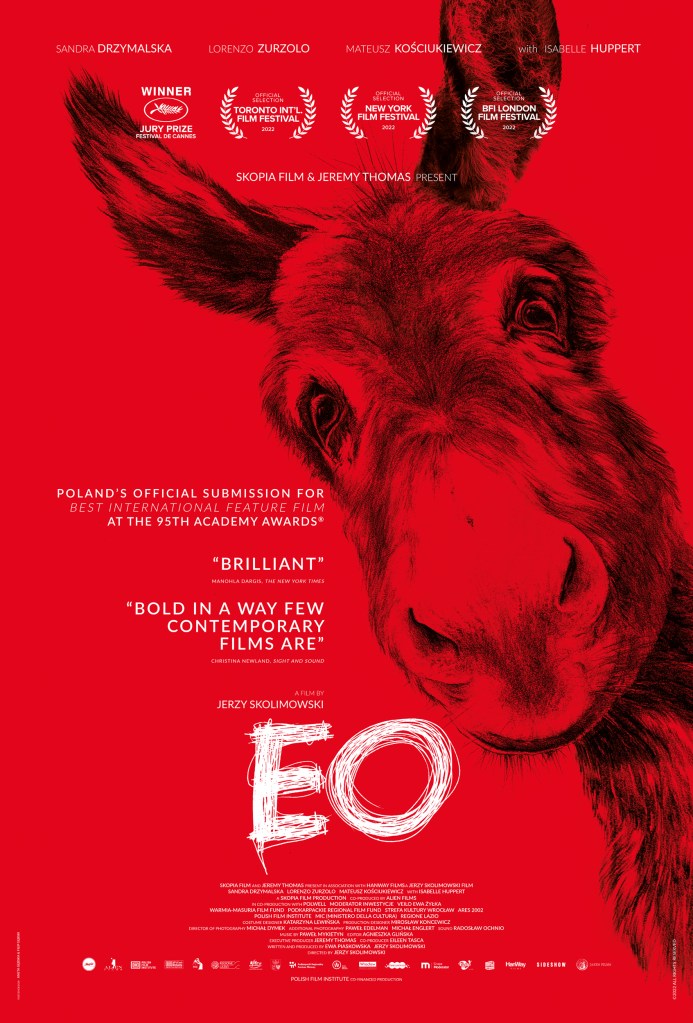
You can make a lot of judgements on humanity, based on how it treats animals. EO, a poetic and deeply heartfelt film, makes a passionate plea for kindness and respect in our treatment of the natural world, qualities it all too often finds lacking. In that sense, it’s surprisingly different from its ancestor Robert Bresson’s Au Hasard Balthasar. Where Bresson turned the rite-of-passage of a donkey into a Calvary-like journey, with the donkey a poetic substitute for Christ, Skolimowski’s film presents a donkey who is nothing more or less than a donkey, but whose experiences become universal for our treatment (and mistreatment) of animals.

We first meet EO as a circus performer, working closely performing tricks with Kasandra (Sandra Drzymalska). When the circus’ finances collapse, under the demands of animal rights activities EO is taken from his home and deposited in a sanctuary where he feels unsettled and uncertain. From there, his life becomes migratory as wanders encountering violent football hooligans, exploitative mink farmers and the odd decent person, progressing towards an abrupt fate that parallels Bresson’s Balthasar.

Even more so than Bresson’s work, Skolimowski’s EO front-and-centres its donkey star. Among many things, EO is a strikingly beautiful art film. The camerawork – shot by two DPs who pull the film together into a beautifully consistent visual style – is radiant, presenting a series of luscious 4:3 images which capture both the beauty of nature and the starkness of man’s presence in it. Several scenes are shot with a slightly frog-eyed lens, its blurred wet-looking edges suggesting EO-perspective POV shots. Skolimowski presents several sequences with a red-tinged dream-like quality, that suggests EO’s own day-dreams – soaring vistas, locations that visually merge together, flashes of his circus life. All this pushes EO himself into the film’s lead role, a real character.

But yet no attempt is made to anthropomorphise this animal. Although the camera lingers over EO’s face, his emotions are left entirely for us to interpret. In many ways, EO is a proof for that old editing test: show the same neutral face followed by a series of contrasting happy and sad events, and the mind will interpret that neutral face as holding different emotions. That is what EO does marvellously. Perhaps we just imagine EO’s joy at seeing Kasandra again (she is certainly moved – drunk, but moved). Perhaps his fear and discomfort in his new animal shelter home is us reading in what we might feel in his place. When EO kicks a mink battery farmer in the face, do we feel he’s angry because we are? There are no answers from EO: he’s just a donkey.

Nevertheless, he is a donkey on a journey and Skolimowski’s film is a surprisingly sharp-edged fable, deeply critical about our unthinking, brutal exploitation of animals. To too many of us, the film argues, their rights are not worth considering – they are dumb creatures good to work until they are too difficult to keep alive or we wish to use their bodies for something else, from clothing to food. EO’s encounters with humans invariably see him being used for their own needs, rarely considering what the desires of the donkey might be.

Skolimowski establishes from the film’s opening, with its animal rights activists who are (surprisingly considering the film itself is an act of animal rights activism) smug, self-righteous and so convinced they know what is best for EO that they are crucial in separating him from the only human in the film who cares for him. Far from ill-treated in the circus, it gives EO a home, love and a purpose. The instant he is removed from this circus, all three of these elements disappear from his life.

Not that Kasandra is an unequivocally positive influence in EO’s life. Settled onto a farm – again we read depression into his refusal to eat, although maybe EO’s just not hungry – EO’s new surroundings are not unpleasant (in fact, the farm seems to be partly about helping disabled children connect with animals, in a sweetly touching sequence). Kasandra gate-crashes one night, drunk, feeds EO a muffin and then disappears over the horizon. Her presence does enough to cause EO to follow her, escaping from his pen and walking out into the Polish countryside.

This pilgrimage through a forest and shooting range (laser guided hunters track wolves, EO at one point starring at a dying wolf, left to bleed out from the hunt), leads eventually to a village football game where EO’s braying causes one side to miss a crucial penalty. Suddenly EO is flotsam in a hooligan-tinged battle between rivals. The winners adopt him as a sort of comedy mascot, before forgetting him in their drunken haze. Hooligans from their rivals beat EO nearly to death, in a twisted act of revenge. EO has no say in either side of this war, merely becoming a passive and innocent war-ground that humans can exact their primal instincts on.

Treatment of animals is increasingly, cruelly, exposed. Nursed back to health by a vet (a worker at the hospital matter-of-factly asks why they don’t put EO down), he is sold to a mink farm that feels like nothing less than a brutal prison, where animals live in misery until their inevitable skinning to make a scarf. Trafficked across countries with horses, EO is again adopted by a stranger who uses him as a sounding board for his own concerns (this happens arguably three times: Kasandra arguably sees EO’s as a sentimental toy, a drunk unties EO before the fateful football ground because he wants his “friend” to be free and Vito uses him to stave off loneliness). This is as nothing compared to the film’s bleak ending – a terrifying view of the ruthlessness we push animals towards their fate.

EO is so masterful at front-and-centring the experience of an animal, and investing it with immense interpretative empathy, that it means the film actually drags when humans enter the frame. The film feels like it has to include scenes with humans in to bulk up it up to feature length (a better EO would surely be about 60 minutes long). A Polish truck-driver (Mateusz Kościukiewicz) playfully flirts before discovering man is just as inhuman to man as he is to animals. Vito and his mother-in-law, Isabelle Huppert’s countess, play out a small-scale human drama which seems trivial and uninteresting compared to the animal message that dominates the film.

Perhaps this is because EO succeeds so utterly in making us care and even (perhaps) understand the perspective of an animal. It’s a superb act of interpretative art – filmed with an astonishing visual beauty and with a gorgeous score of Pawel Mykietyn – and warm empathetic understanding. It also builds into a surprisingly moving and powerful message on the importance of treating animals with the same dignity and kindness that we would expect to be treated with ourselves. It makes for a thought-provoking and immersive film, that emerges successfully from the shadow of its forbear.

Avatar: The Way of Water (2022)

Avatar: The Way of Water (2022)

Cameron’s film makes a huge splash despite its soggy plotted, flooded run-time

Director: James Cameron

Cast: Sam Worthington (Jake Sully), Zoe Saldaña (Neytiri), Sigourney Weaver (Kiri Sully), Stephen Lang (Colonel Miles Quaritch), Kate Winslet (Ronal), Cliff Curtis (Tonowari), Jamie Flatters (Neteyam Sully), Britain Dalton (Lo’ak Sully), Timothy Jo-Li Bliss (Tuk Sully), Jack Champion (Spider), Bailey Bass (Reya), Filip Geljo (Aonung), Duane Evans Jr (Rotxo), Edie Falco (General Frances Ardmore), Brendan Cowell (Captain Scoresby), Jermaine Clement (Dr Ian Garvin)

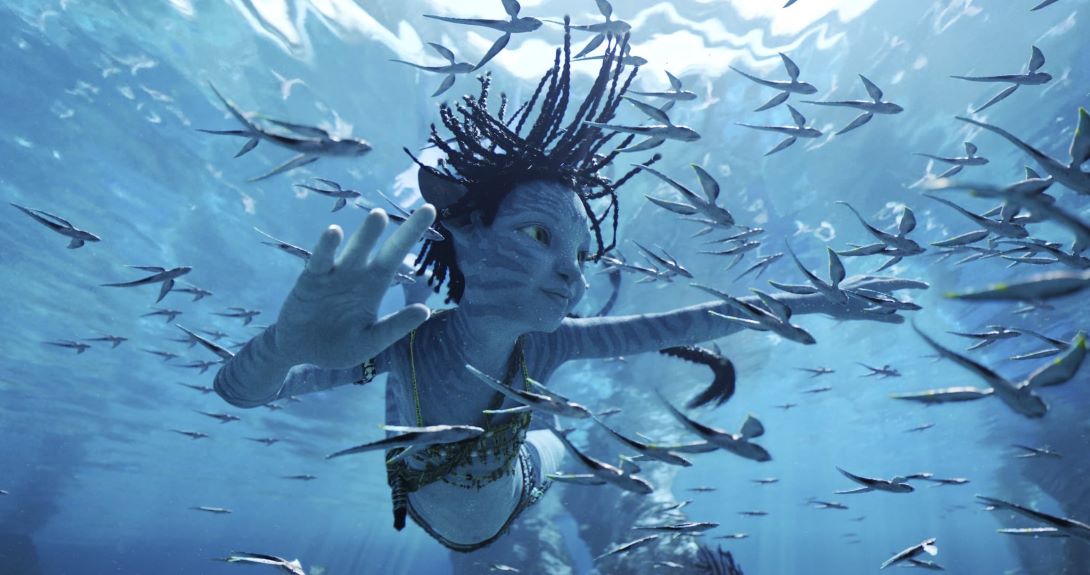
After thirteen years it finally arrived. The sequel to a film that seemed to leave no cultural impact, Avatar. People were convinced it would flop. But they say that about all Cameron films. And, if anyone should have learned anything from Terminator 2, Titanic and Avatar it was don’t bet against Cameron. If Avatar 2’s purpose was to make an awful lot of money, it has succeeded in every level. If its purpose was to make a strong and entertaining film… I’m not so sure.

About the same amount of time has passed on Pandora and Sully (Sam Worthington) and Neytiri (Zoe Saldaña) have raised a family of four children, including Kiri (Sigourney Weaver) born from the avatar of their friend Grace. They have also raised Quaritch’s son ‘Spider’ (Jack Champion) among them. Then the humans return… a bloody war begins, with Sully leading a guerrilla campaign. The company resurrects Colonel Quaritch (Stephen Lang) as a Na’vi super soldier to fight on their own terms. After Spider is captured, Sully and his family flee to live among the Metkayina, a sea-living tribe. But they can’t escape the war and its dangers.

As Avatar: The Way of Water is garlanded with praise and Oscars nominations, I feel like we are all part of a wide conspiracy of silence. So desperate are so many to keep viewers handing over their cash at the box office, that a film completely designed to be seen on the big screen (and this really is) is being praised to the skies by some as a masterpiece. It is not. It’s not even the best Avatar film. Instead, Avatar 2 is a visually impressive but hellishly long, predictable re-tread of the first film that stuffs the eyes with CGI wonders but leaves not a jot for the heart.

I was reminded part way through the overlong runtime that Cameron once made imaginative, thrilling sequels that completely reset the table. Aliens reinvented a haunted house horror movie as a pulsating action film. Terminator 2 turned a chase story into ramped up family story that mused on destiny. Avatar 2… basically tells exactly the same story, but with a familiar generational family conflict storyline and lots of water. It has the same environmental messages and anti-corporation vibe. When this lands, it works. A whale hunt is shot in terrifying detail, a giant mother whale creature brutally trapped and eviscerated for a small cannister of fluid extracted from its brain. This is also probably the most effective sequence and the one that moved me the most.

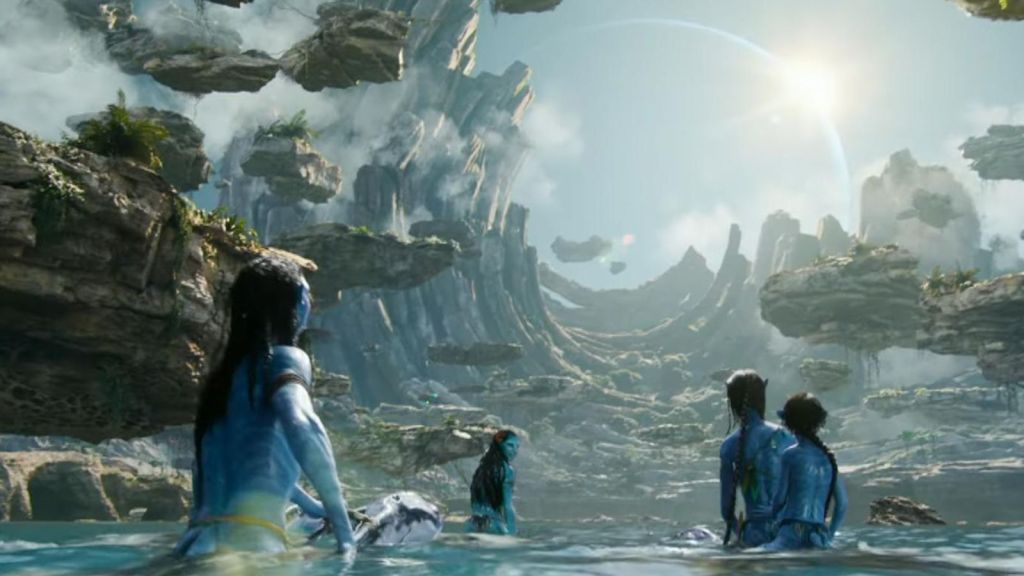
The effects do look impressive. There is no denying that, and the motion capture that turns the actors in blue giants is totally convincing. These Na’vi look and feel like flesh and blood beings. The visual imagination that creates this world, with its sweeping vistas and eclipse-kissed sky not to mention the myriad exotic creatures that populate it are stunning. If Avatar 2 deserves praise it’s for that. Pretty much every single frame looks like it cost a million dollars.

Unfortunately, it often also has a sheen of unreality. I became desperate for something real to appear on screen. But when only one character out of ten is not an effect, you don’t get much of that. On top of which the decision to film in slick, blur-free 48 frames per second means everything glides across the screen with the perfect-focused quality of a videogame. Don’t know what I mean? Try looking at things around you while moving your head at moderate speed. What do you see? Blur. Blur is real. The perfect focus of this world clues you up in every second that nothing in it is real.

The lack of reality eventually starts to remind you of The Phantom Menace. In fact, the only thing really separating this from that disaster is that James Cameron is a master director of epic, visual cinema. The film-making here, as a technical exercise , is beyond reproach. And few directors shoot action scenes with as much skill and raw excitement as Cameron. I can’t fault anything about that, even while I struggled to care as they dragged out over a huge chunk of time.

But Cameron’s weakness as always been the writing. He is a flat and unimaginative writer of dialogue – the Na’vi dialogue is awful flicking from ponderous (“We Sully’s stick together. That is our greatest weakness. And our greatest strength!”) to painfully bad (the number of “Bros” and “Dudes” from the Na’vi teenagers is fist-bitingly awkward, like your Dad trying to be down with the kids).

That’s not mentioning the fact that it’s so similar to the first film. The earth people return, war starts and eventually our heroes travel to a new part of Pandora where, just like Jake in the first film, they go through a training montage to learn the “way of the water”. This takes up most of the middle act. That’s not forgetting the huge number of themes and characters reshuffled and represented.  We build towards a clash very similar to the first film at the end. Nothing here feels fresh, everything feels like a retread. Our villain is resurrected as a Na’vi but, despite almost being defined by his racism in the first film, he doesn’t bat an eyelid at this.

There is a vague attempt to transfer Sully’s “torn between two cultures” storyline to Spider. But this character remains terminally under-developed and the film’s attempt to explore the father-son dynamic between him and Quaritch is so rushed, you wonder if Cameron was interested (odd since it’s crucial to the final act). Instead, we get a huge amount of generational clash in the Sully family, with Jake butting heads with his second son who struggles with being “the spare” (oddly appropriate right now), a hot head who gets everyone in trouble. These play out with a reassuring predictability, so much so that if I asked you to guess the fates of those involved you probably could.

There are bizarre logic gaps. Quaritch and his soldiers have been resurrected to destroy the Na’vi resistance – but instantly drop this for a personal vendetta against Sully (no one seems to care about the resistance after the first half an hour). When Spider is captured, Sully and gang don’t give a damn or even consider rescuing him. Sully doesn’t want to put the forest Na’vi in danger by staying – but doesn’t care about moving that danger to the water people.

Above all it’s frankly hellishly long, fully of trivial culture clash stuff and just the fact that the people in at are giant and blue or that it looks fabulous doesn’t make it good. Instead, Avatar 2 is a re-tread that feels like its treading water, spinning plates and repeating rather than reinventing. I’d rather watch the original again which, while it wasn’t inspiring, at least felt new.

Avatar (2009)

Avatar (2009)

Cameron’s monster-hit is an exciting slide of traditional story-telling, that had less cultural impact than you might expect

Director: James Cameron

Cast: Sam Worthington (Jake Sully), Zoë Saldana (Neytiri), Stephen Lang (Colonel Miles Quaritch), Sigourney Weaver (Dr Grace Augustine), Michelle Rodriguez (Trudy Chacón), Giovanni Ribisi (Parker Selfridge), Joel David Moore (Dr Norm Spellman), CCH Pounder (Mo’at), Wes Studi (Eytukan), Laz Alonzo (Tsu-tey), Dileep Rao (Dr Max Patel)

Why is Avatar so easy to mock? It’s the second biggest box office hit ever (Cameron holds slots two and three with this and Titanic:only Avengers: Endgame grossed more). But its cultural impact feels wide but not deep. As FOUR more Avatar films start to arrive from 2022, the question remains: why has no-one really talked about Avatar since 2009?

Perhaps it’s because there isn’t really much new or unique in Avatar, beyond the magic of its visuals and the magnificent showmanship of Cameron. For all the striking blue design of the aliens, their story was too reminiscent of too many other things. The script lacked punch, distinctive lines and unique characters. There was little to quote and few truly original pivotal moments that could be embraced by our cultural memory. Narratively and structurally, it’s all a little too safe, predictable and conventional.

 Avatar partly became a “must see” cinematic event, because it was the film that finally nailed 3D. Maybe it is the best 3D film ever made. I don’t know, I’ve only ever seen it in 2D. To be very fair, Cameron doesn’t fill the film with crappy shots of things pointing at the camera. Instead, concentrating on telling a cracking (if predictable) story and filling the screen with beautiful, imaginative imagery that works in any dimension.

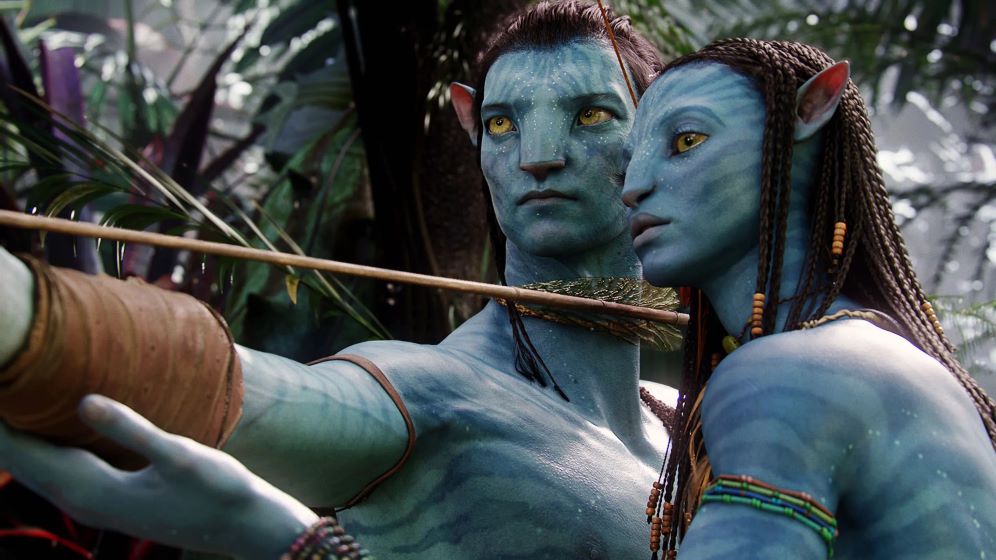
Avatar’s imagery is so striking because it’s set on the magical alien world of Pandora. In 2154, with Earth’s resources depleted, mankind has struck out into the stars – and Pandora is a rich seam of an insanely valuable mineral called unobtanium (chuckles presumably intended). Pandora is a carefully balanced biosphere, peopled by exotic animals and 10-foot, blue-skinned natives called the Na’vi. Pandora’s atmosphere is poisonous to humans, so scientists – led by Dr Grace Augustine (Sigourney Weaver) – use Na’vi “avatars”, operated by genetically matched humans, to explore. The mission is carefully balanced between science and financial exploitation by a sinister corporation, backed by mercenary army, led by the fanatical Colonel Quaritch (Stephen Lang).

Into this magical set-up drops paraplegic ex-marine Jake Sully (Sam Worthington), taking the place of his dead scientist brother because he is a genetic match for a freshly grown Na’vi avatar. With this warrior background, Jake is welcomed by the Na’vi, becoming an ambassador to the people. But Jake’s loyalties split as he finds a purpose in Na’vi life he has long since lost on Earth – and as he falls in love with Na’vi warrior Neytiri (Zoë Saldana). When the company decide to destroy the Na’vi’s home to gain access to the rich unobtanium deposits beneath, which side will Jake back?

It’s not hard to guess. At heart, Avatar fits very neatly into a series of Dances with Wolves-esque films, in which a wounded and lost (white) soldier finds a spiritual peace and solace with a native people, eventually rising up to fight for their rights against his own people. Avatar also finds roots in The Mission, with the scientists as the missionaries fighting alongside the natives (although with much better results), the conclusion of Return of the Jedi and Cruise’s The Last Samurai. Not to mention more than a few stylistic and plot echoes from Cameron’s own Aliens (you can even hear them at several points in Horner’s score), from technology (those stomping war suits) and cocky marines lost in a world they don’t understand (except this time, we love to see them killed off).

Avatar doesn’t challenge you, presenting its humble message of environmentalism and peaceful co-existence within a familiar framework where military forces and corporations are very bad and enlightened missionaries and Indigenous people are good. It entertains because it’s told with such skill. Cameron, while never the greatest screenwriter in the world, knows how to marshal his clichés and standard narrative tricks into something exciting and involving.

It also helps that the stock characters he creates a played with such forceful engagement by the actors. Stephen Lang is a growlingly hateable racist, delighting in the prospect of genocide, while Giovanni Ribisi’s corporate boss is a snivelling opportunist who couldn’t care less about the impacts of his actions. Opposite them, Sigourney Weaver gives huge weight to a fairly standard irritated-boss-turned-mentor role as the head scientist, Sully’s bridge to learning the Na’vi way. As Sully, Sam Worthington is not the most charismatic performer but he has an earnest intensity and emotional honesty that helps us invest in his pre-Pandora misery and his growing love of his adopted home.

Cameron’s greatest achievement though is the vision he creates for the Na’vi. All are played by actors using cutting-edge (and still impressive now) motion capture. Cameron builds a whole world for these people: a language, belief system, culture and bond with the environment. Sure, it’s heavily inspired by Indigenous American culture, but it feels real. Its bought to the screen with grace and tenderness and gains a huge amount from Zoë Saldana’s committed and emotionally open performance as Neytiri. Cameron so successfully builds a bond between audience and the Na’vi that you feel your heart wrench to see mankind tear their beautiful world apart.

It’s that emotional connection Cameron successfully builds that helps make the film work. After all we’ve all seen effects stuffed films before, but they don’t all become monster hits. And if the film was a dog, all the 3D magic in the world wouldn’t have helped. Few directors have as much skill with threading emotional bonds within the epic as Cameron. He shoots Avatar with a stunning majesty, carefully placed shots and graceful, almost traditional, editing help to build a sense of magic and wonder around the awe-inspiring alien vista. Avatar has a lot of action, but it never feels like just an action film: it’s a relationship drama, inspired by the beauty of its setting, with action in it.

More people have mocked Avatar with comparisons to the visually and thematically similar Fern Gully: The Last Rainforest than have actually seen Fern Gully. Narratively it does little new or unique and offers very little surprises. But its visuals are stunning and Cameron’s superb direction knows how to engage you. Clichés last because they carry a sort of truth: Avatar uses these truths to help you invest in a gripping, if conventional, story. But it’s also why its impact over time has been so slight – there aren’t any new ideas for viewers to tie themselves to and almost nothing that stands out as a unique cultural reference point – even if the conventional plot helped make it a short-term monster hit. But it’s also why it still makes for enjoyable rewatching.

Don’t Look Up (2021)

Don’t Look Up (2021)

A host of stars tell us the world us coming to an end in this self-satisfied film

Director: Adam McKay

Cast: Leonardo DiCaprio (Dr Randall Mindy), Jennifer Lawrence (Kate Diabiasky), Rob Morgan (Dr Teddy Oglethorpe), Meryl Streep (President Janie Orlean), Cate Blanchett (Brie Evantree), Jonah Hill (Jason Orlean), Mark Rylance (Peter Isherwell), Tyler Perry (Jack Bremmer), Timothée Chalamet (Yule), Ron Perlman (Colonel Benedict Drask), Ariana Grande (Riley Bina), Scott Mescudi (DJ Chello), Himesh Patel (Philip Kaj), Melanie Lynsky (June Mindy), Michael Chiklis (Dan Pawketty)

Climate Change. It’s the impending disaster where we stick our head in the sand and pretend it’s not incoming. Governments have been told for decades our carefree use of fossil fuels and slicing down of rainforests will have a cataclysmic impact. But it’s always easiest for governments and people to just say “nah” and not let those thoughts get in the way of our everyday lives. Adam McKay’s satire Don’t Look Now takes these trends of indifference, disbelief and denial climate scientists have faced their whole careers and reapplies them to a comet-hits-the-Earth disaster movie.

So, when Michigan State University astronomers Dr Randall Mindy (Leonardo DiCaprio) and Kate Diabiasky (Jennifer Lawrence) spot a hunk of ruck the size of Everest on a collision course with the Earth they are met with a chorus of… yawns, memes and flat-out denials. The Trumpian President (Meryl Streep) is only interested in her donors, the mid-terms and dodging the fall-out from a host of scandals. The media – represented by Fox News style anchors Brie Evantree (Cate Blanchett) and Jack Bremmer (Tyler Perry) – aren’t interested in a story they can’t process down into a feel-good social media meme. And even when people start to listen, plans to destroy the comet are benched in favour of a wildly risky scheme, dreamed up by Steve Jobs/Elon Musk style tech billionaire Peter Isherwell (Mark Rylance) to mine the rare ores it contains for money. What could go wrong?

I can see what Adam McKay is aiming for here, to create a sort of Dr Strangelove for climate change, where the great and the good we are counting on to get us through a crisis, turn out to be the blinkered morons who end up causing it. There are moments where it sort-of hits on a rich mixture of farce and genuine anger. Moments where first Kate then Mindy – thelatter with lashings of Howard Beale – melt down on National TV, apoplectic at the comet-denying indifference of millions of people stand out as both hilarious and also compelling.

But, like a lot of McKay’s would-be satirical attacks over the last year, on finance and politics, the message sometimes fails to land because of the heavy-handed, self-satisfied, smug tone of the delivery. Don’t Look Up frequently isn’t very funny – and yes I know it ends with the world being destroyed due to everyone’s indifference and incompetence – and it ladles most of the blame on obvious targets. It’s takedown of Trump – here represented by Meryl Streep – is basic, it hits open goals with the agenda-driven bias of American news reporters and takes pot-shots at messianic tech billionaires. A real punch would perhaps have focused in more on how all the mindless, unfocused greed and ambition of these people is fed by the bland, social media focused, sound-bite obsessed shallowness of the masses. But Don’t Look Up remains focused on the big people.

So focused in fact that, even in this satire, only America has the wherewithal to launch a mission against the comet. A joint Russian, Chinese and Indian mission fails to get off the ground and other world leaders are noticeable by their absence. We never really spend time with any normal people. While much of the blame does lie with governments not taking a lead, we do live in a world where normal people are radicalised by reading about nonsensical mush like QAnon through chat rooms. Imagine a satire that looked at how ordinary people can be made to believe wild theories rather than the evidence of their own eyes as a comet heads towards Earth? Instead Don’t Look Up wants to stick with something vaguely comforting – that there are big, selfish, elites running us who act out of greed and stupidity and they carry all the danger (and the blame).

Where the film is strongest is the doubt and nonsense thrown at scientists. Mindy and Diabasky are first ignored by the administration because they aren’t Ivy League. Attempting to leak their findings on the TV, they are overshadowed by an on-air-proposal of a celebrity DJ to his singer girlfriend and when they hit the news, the only takeaway is that Mindy is ‘cute’, while Diabasky is a freaky angry woman, ranting about the world ending (she’s a meme in minutes). At every point the science is questioned or put on the same level as gut feelings and political agendas. Even their campaign to encourage the world to “Just Look Up” to see the impending catastrophe is countered by the President’s “Don’t Look Up” campaign that persuades millions of people the comet isn’t real.

Really rule by social media and the dumbing down of humanity should be the main target here. A comet isn’t even a great metaphor for climate change – which is gradual, can’t be just blown up and needs to be prevented by society making changes to the way we live. In some ways, by replacing climate change with a comet, even the film is acknowledging its not sexy or exciting enough – and that it doesn’t want to turn its critical fire on millions of people who would rather turn the heating up or drive to the corner shop rather than push to make changes in their lives.

So, it’s easier and simple for McKay to create a cartoon freak show of easy targets and bash them rather than tackle the underlying causes of climate change – that our world and its population wants to have its cake and eat it, and governments for generations have been too focused on the here and now to ever worry about the years to come. So funny as it can be to see Streep Trump it up, or Rylance channel his softness into insanity, or Hill play another of his mindless frat boys turned power brokers, the film doesn’t feel like it really goes for the real causes of climate change: our own culture. It takes hits at our social media simpleness, but not at our short sightedness.

McKay does at least direct without much of the fourth-wall leaning flashiness of his earlier works, and there are committed – if not exactly stretching – performances from Lawrence (whose characters checks out in despair at the shallowness) and DiCaprio (who is seduced by fame, power and Blanchett into becoming an apologetic mouthpiece for the administration). But Don’t Look Up is a little too pleased with itself, a little too focused on easy targets and doesn’t do enough to spread the blame wider. It stills see many of us as victims or mislead – when really we are as to blame a everyone else.

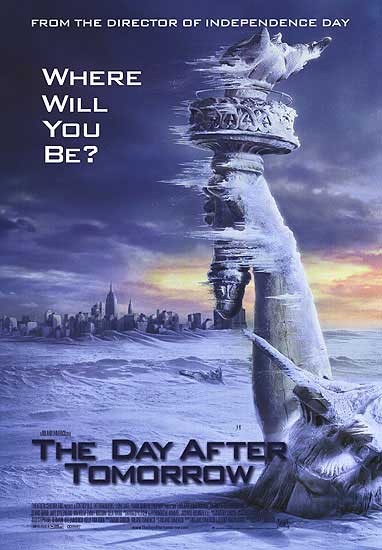
The Day After Tomorrow (2004)

Our heroes undergo one hell of a cold snap

Director: Roland Emmerich
Cast: Dennis Quaid (Jack Hall), Jake Gyllenhaal (Sam Hall), Ian Holm (Professor Terry Rapson), Emmy Rossum (Laura Chapman), Sela Ward (Dr. Lucy Hall), Christopher Britton (Vorsteen), Arjay Smith (Brian Parks), Dash Mihok (Jason Evans), Jay O Sanders (Frank Harris), Adrian Lester (Simon), Kenneth Welsh (Vice President Raymond Becker)

I have to confess there are certain genres I have a weakness for. One of these is the big-budget disaster movie. For some reason, nothing helps me relax or unwind more of an evening than watching some of the great landmarks of the world being destroyed or seeing hundreds of people fleeing before a tsunami/pyroclastic flow/asteroid impact/tornado etc. There is clearly something wrong with me.

The Day After Tomorrowfits very comfortably into this trope, offering up some totally predictable and entertaining-enough thrills combined with total ‘scientific’ nonsense. Thanks to man’s foolishness, the climate of the Northern hemisphere is changing, and only Professor Jack Hall (Dennis Quaid) knows that it’s happening (although to be fair he does say it will take place across hundreds of years). But gosh darn it doncha know, suddenly those projections are revised to “the next six to eight weeks!” Cue cold snaps of -100°F dealing out death in Scotland, brick sized hail bashing in heads in Tokyo, and a tsunami taking out New York. Of course Hall’s son (a game Jack Gyllenhaal) is trapped in New York so Hall mounts a rescue mission…

The world-destroying scenes are suitably high scale and dramatic, with Roland Emmerich showing his usual efficient martialling of special effects. Emmerich doesn’t get quite the credit he deserves – as a B movie hack director, he’s very good at keeping the viewer fully aware of what’s happening all the time and to whom, and very rarely labours any particularly point. He also has a goofiness about him, when directing this sort of nonsense, that encourages you to disengage critical faculties and join him for the ride. Don’t get me wrong, he’s no Hitchcock – but compared to Michael Bay, he’s David Lean.

The story doles out the expected personal dramas amongst the chaos. Its main issue is that “weather” doesn’t make the most relatable nemesis ever committed to screen. To cover this, some timber wolves are introduced into New York to terrorise Gyllenhaal and his trapped student friends (Emmerich, bless him, carefully stages a scene earlier where befuddled zookeepers stare aghast at an empty wolf pen and comment “The wolves are gone!”). To be honest, though, these animals are a bit dull – what people will really remember are the desperate dashes to get somewhere warm while another “death-on-contact” cold snap speeds towards our heroes. As most of this stuff happens in the first half of the movie, the second half can rather drag – with the Northern hemisphere effectively destroyed early doors, what else is there left to show?

Emmerich does have some fun with politics. One of the joys of the disaster film (I find) is the inevitable crowd of characters who denounce any chance of the disaster occurring. Emmerich goes one better here by having the President and Vice-President vocally and visually imitate then-office-holders Bush and Cheney. The facsimile Bush even defers to his facsimile Cheney. It makes for some heavy-handed digs at their Presidency’s lack of impetus on climate change, and general perceived weakness, but hey at least the film is using blockbusting to make some tongue-in-cheek political points.

The characters are all pulled from the stock. Quaid does his usual decent job as the guy you hire for this sort of film when your first choices are unavailable, but he never lets you down and brings a lot of dignity to the ludicrous concept. Gyllenhaal and Rossum are rather sweet as smart teenagers (gotta like a film where all the young characters are bookish nerds). Smith gives some good comic support. Ian Holm and Adrian Lester manage to keep a straight face and provide a lot of dignity to roles that must have been little more than picking up paycheques.

Disengage brain, settle back and enjoy the carnage. Emmerich is like an eager-to-please student proudly presenting his work on parents’ day. The great thing about him is that you know he is a booky, geeky type (like his heroes here) and he’ll never do anything to offend you.