Category: Films about obsession

Caché (2005)

Caché (2005)

Haneke’s fascinating puzzle is a profound and challenging modern masterpiece

Director: Michael Haneke

Cast: Daniel Auteuil (Georges Laurent), Juliette Binoche (Anne Laurent), Maurice Bénichou (Majid), Lester Makedonsky (Pierrot Laurent), Walid Afkir (Majid’s son), Annie Girardot (Georges’s mother), Daniel Duval (Pierre), Bernard Le Coq (Georges’s boss), Nathalie Richard (Mathilde)

Is any film more aptly named than Caché? Haneke’s film keeps its cards so close to its chest, it’s entirely possible revelations remain hidden within it in plain sight. Caché famously ends with a final shot where a possibly crucial meeting between two people we’ve no reason to suspect know each other plays out in the frame so subtly many viewers miss it. It shows how Haneke’s work rewards careful, patient viewing (and Caché is partially about the power of watching and being watched), but also how unknowable the past can be. It’s a chilling and engrossing film that fascinates but never fully reveals itself.

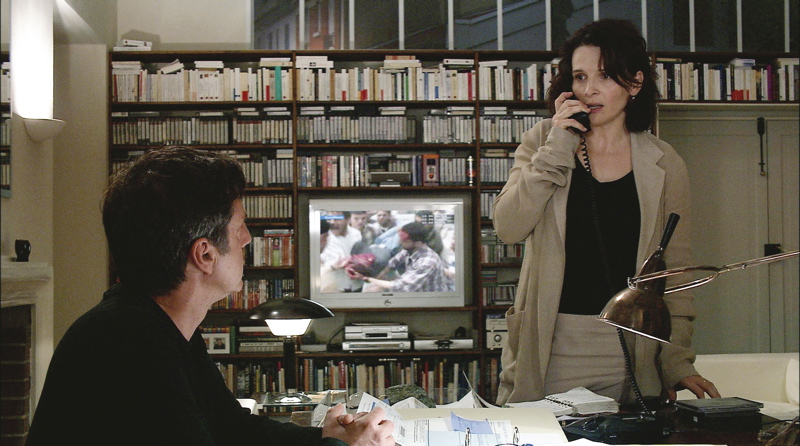
Georges Laurent (Daniel Auteuil) lives a life of success. A wealthy background, host of a successful TV literary debate show and living in an affluent suburb of Paris, he’s married to publisher Anne (Juliette Binoche) and father to young champion swimmer Pierrot (Lester Makedonsky). But there’s a serpent in his Garden of Eden. Georges and Anne are plagued by a stream of videos arriving at their house. These show long, static shots of their home and are accompanied by crude, graphic drawings. Someone is watching their house and the dread that this could escalate at any time is consuming them. But does Georges know more – do the messages chime with guilty memories in his past?

Haneke’s film is a multi-layered masterpiece, a haunting exploration (free of clear answers) into the things we prefer to forget, the hidden horrors we supress. It’s a film all about the shame and guilt buried amongst the everyday. Haneke even shoots the film on hi-definition video so that the surveillance footage of Georges and his home visually merges with the ‘real’ images of the couple. Within that, Caché starts to unpack the hinterland we hold as individuals (and, quite possibly as entire nations) of the guilts of our past that keep bubbling to the surface to bite us.

Caché is shot through with Haneke’s genius for menace and veiled threat. Can you imagine anything creepier than a camera set up outside your home, filming everything you do – but never knowing where it is? It’s an invasion of privacy that is insidious and covered in the additional menace that, at any time, it could escalate to something worse. The creeping, invasive tyranny of surveillance is in every inch of Caché, its omnipresence giving every interaction the feeling of being watched (something Haneke plays up – watch a man watching Anne when she sits in a café with a friend).

So gradually the book-lined world of the Laurents becomes a base under siege, a feeling amplified by Haneke’s mix of smooth camera movements adrift from establishing shots: constantly the camera glides through a space where we feel we neither truly understand the geography or are confident about the time. It’s accentuated by the window-free room the Laurents largely inhabit. In fact, their whole home feels window free, with curtains frequently drawn and rooms plunged into darkness, the family throwing up a shield to protect them from the outside world.

Or is it to cut them off from the unpleasant facts of life? It becomes clear Georges has built a world around himself, where he is the hero and all traces of the unpleasant or disreputable in his past have been dismissed to the dark recesses of memory, never to be accessed. Played with a bull-headed arrogance by Daniel Auteuil, under his assurance Georges is prickly and accusatory, liable to lash out verbally (and perhaps physically, considering the threat he carries in two key scenes). Auteuil masters in the little moments of startled panic and stress that cross Georges’ face, a man so used to a world that matches his needs, that anything questioning that is met with rejection.

It’s why he lies to Anne about his growing suspicions about the source of the tapes. The cartoons hint at a series of (deeply shameful) interactions, when he was a child in the 60s, with a young Algerian boy, Majid, who his parents considered adopting after the death of Majid’s parents. It was Georges lies that forced this boy out of his perfect farm-house into the cold-arms of the unfeeling French orphanage system. This is the original sin of Georges’ life, arguably the foundation of his success – a guilty secret that so haunts and disgusts him, even the slightest mention of it brings out the muscular aggression he otherwise keeps below the surface.

Of course, it’s hard not to see an echo of France’s colonial past. One of the things that works so well with Caché, is that this subtext is there without Haneke ever stressing it. Just as Georges’ lies forced Majid into a life of depression and misery, so France’s treatment of Algeria is the terrible shame the nation would rather forget. Majid’s parents died in a famously brutal stamping out of an Algerian protest in Paris in October 1961 (the deaths of over 200 people at the hands of French government forces only came to light decades later). The anger many show when presented with inconvenient, horrible past deeds (both personal and national), only feels more relevant today with our culture battles over history.

Georges sees himself as a victim of a vicious campaign. But, when Georges meets Majid, played with startling vulnerability by Maurice Bénichou, he seems light years away from the sort of man who could possibly be capable of such a campaign. Indeed, when a video of Georges encounter with Majid is widely shared, it is Georges (as even he admits) who appears the bully and aggressor. Majid has been demonised in Georges’ memory – in his nightmare he becomes an axe-wielding monster-child – but he’s an innocent, who had everything taken from him in a micro-colonialist coup carried out by a 6-year-old Georges. A coup the adult Georges has let himself forget, making him little different from France itself. (We are reminded the cycle continues, with constant background news footage of Iraq, ignored by the Laurents.)

The mistakes repeat themselves, but they don’t trouble the complacent middle-classes who benefit from them. Georges will even use his influence to have Majid and his son bundled into a police van. Of course it leads to an outburst that will shake this world up. Haneke’s films have always been realistic when it comes to the visceral horror of violence, and Caché contains an act of such shocking violence that it will leave the viewer as speechless and distressed as the witnesses.

And still the question hangs: who? It could be anyone. At one-point Georges storms out of his front door to confront the mystery video-sender, only to return to find a video wedged in the door. It’s literally impossible for this video to be placed without him seeing it done. Haneke is so uninterested in the whodunnit part that, perhaps, he’s implying the perpetrator is the director himself, using the mechanics of film-making to entrap the guilty parties. It fits with the coldly intellectual steel-trap part of Haneke’s mind, the part that uses films (like Funny Games) to tell off and preach. What other director would be more likely to set himself up as unseen antagonist in the film?

And does Georges learn anything? He will continue to confront characters who challenge his world view and dispatch (like nations) his guilt to the recesses of memory. His begrudging peace with his wife – a superbly restrained Juliette Binoche, increasingly resentful at her husband’s secrets – seems built on the shaky ground of their continuing mutual comfort. And suspicions linger over his son, an increasingly hostile figure who (just perhaps) is learning more about the flaws of his parents than they would be comfortable with.

Of course, this might all be open to interpretation from multiple angles. After all the film is called Caché. Haneke has hidden enough subtle implications in it that it can reward analysis from multiple angles. Shot with his characteristic discipline that suggests a dark, creeping fear behind every corner, it’s a masterclass in suggestion and paranoia. Brilliantly unsettling and constantly reworking itself before your eyes, it’s a masterpiece.

The Killer (2023)

The Killer (2023)

Fincher’s lean, spare film is a perfectly constructed thriller and an intriguing character study

Director: David Fincher

Cast: Michael Fassbender (The Killer), Tilda Swinton (The Expert), Charles Parnell (The Lawyer), Arliss Howard (The Client), Kerry O’Malley (Dolores), Sophie Charlotte (Magdala), Emiliano Pernia (Marcus), Gabriel Polanco (Leo), Sala Baker (The Brute)

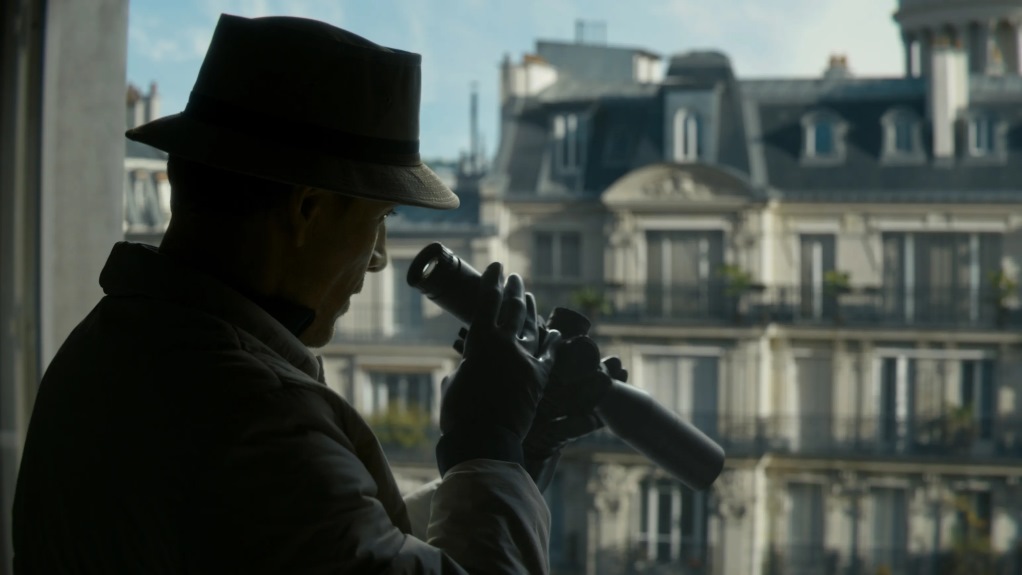
A man sits in monastic silence, starring out of a window at the best hotel in Paris that money can buy. He moves only to sleep, exercise with a monotonous rigour and consume a carefully calculated daily calorie amount from McDonalds. He wears gloves all the time, never moves from the sheeting he lays across surfaces and sometimes assembles and reassembles his rifle. He’s a nameless hitman for hire (Michael Fassbender) and a freak accident on this job will shatter his world of pristine order and leave him hunted by his employers and on a campaign of revenge to guarantee his safety.

The Killer is a lean, slimmed-down thriller full of Fincher’s love for procedure and detail, that delights in every beat of its detailed look at how a professional killer might go about his daily business. Be it lock-ups crammed with mountains of equipment, from guns to false number plates and endless zip-bound folders of fake IDs (all using character names from 70s and 80s TV shows) to the practised ease with which he penetrates even the the highest security building with an Amazon purchased card copier and light-fingered pick-pocketing. All of it assembled with Fincher’s pin-point precision and clockwork eye for detail.

On the surface, you might expect The Killer to be a sort of twist on Le Samouri, Melville’s look at a zen-like hitman. The Killer seems to fit much of the bill. Embodied with an athletic suppleness by Fassbender (his body seems to be almost elastic in the parade of physical stretches and exercises he performs, not to mention the fingertip press-ups he relentlessly pumps his whipper-thin body through). But Fincher gives us a seemingly never-ending insight into the Killer’s inner-mind, via a prolonged (near continuous) monologue of his inner thoughts, ideologies and mantras that dominate much of the film (the first twenty minutes plays out in near on-screen silence, just watching Fassbender and listening to his voiceover).

What’s fascinating is this interior monologue is only a shade away from a stream of corporate middle-management think. (It’s even implied the Killer was originally recruited while training as a lawyer). There are mantras with the air of an assassin’s version of positive thinking (“Stick to your plan. Anticipate, don’t improvise. Trust no one. Never yield an advantage. Fight only the battle you’re paid to fight.”) and passive-aggressive demands to hit a personal standard (“Forbid empathy. Empathy is weakness. Weakness is vulnerability.”). Far from the glamour of an unknowable force acting to a mystical code, this Killer sounds alarmingly similar to a self-doubting white-collar worker using Sun Tze to plan out his pitch meetings.

Beneath the sheen of Fincher’s beautifully dark film, is the suggestion we are watching a character study of a man perhaps only partially aware that his life, and his inner picture of who he is, is falling apart. For starters, despite his mantra of perfection and continued assurance of ‘every detail covered’ and ‘every angle anticipated’, our Killer makes a host of errors. Almost everything we see him do goes wrong in some-way: from that initial hit that takes out the wrong target, to stabbings that leave victims bleeding out faster than he intended, doses of knock-out drunks that are incorrectly calculated, house invasions that fail to surprise the victim… The mantra is clearly an ideal not quite a reality and the Killer’s greatest strength actually turns out to be his ability to improvise in unexpected circumstances.

In addition, for all he maintains he acts only professionally and things are never personal, the entire film chronicles a campaign of revenge in which he takes out a host of targets for personal reasons. The idea of the killer as a man separate from connections is already shattered from his obvious distress, returning to his home in the Dominican Republic after his botched hit, to find his girlfriend seriously assaulted and hospitalised. Michael Fassbender’s mastery of micro-features throughout the film, suggests waves of doubt and insecurity flooding behind the eyes of a man who has tried to master himself as an unfeeling violent limb of faceless masters.

As such, The Killer is a sort of pilgrim’s progress of a man discovering small, unexpected elements of himself while as impassively as possible knocking off anyone he considers a threat (effectively anyone who might know where he lives). No attempt is made in this to make the Killer entirely sympathetic – he ruthlessly kills at least one completely innocent person, and doesn’t hesitate to murder those he has identified, no matter how much he might sympathise with them.

But the monastic chill he aspires to is cracking. You can see it in his conversation with “The Expert” played with a mix of relish and resignation by Tilda Swinton. A professional killer like him, the Expert has not let this stand in the way of “a normal” life outside her trade. She’s married, is a popular regular at a posh restaurant and has achieved a level of compartmentalism the Killer can only dream of. Is the envy and self-doubt in his eyes as he listens to her emotionally articulate reflection on the life they have chosen?

Fincher’s film quietly explores this alongside some skilfully assembled sequences. In many ways the film mirrors its lead character: limber, dedicated, obsessive, executing its sequences with clockwork exactitude and following a fit-bit like a metronome. But it’s also a dark character study of a man (perhaps) realising how empty he has made himself, drowning out doubts with the music of The Smiths. Fassbender is the perfect actor for this, few matching his skill to be both blank and overflowing with suppressed emotion at the same time.

It makes The Killer a fascinating film, a Fincher film that feels at first like a minor work but offers more and more depths for reflection. On one level an auteur John Wick, which brilliantly outlines each trick of its expert lead character. On another level, a sort of dark character study of a man in the midst of an epic breakdown, falling back on mantras and mottos, processing his doubts and guilt through the only thing he really knows how to do: kill people.

Murphy’s War (1971)

Murphy’s War (1971)

This heavy-handed anti-war Don Quixote story is far from a success

Director: Peter Yates

Cast: Peter O’Toole (Murphy), Siân Phillips (Dr Hayden), Phillipe Noiret (Louis Brezan), Horst Janson (Captain Lauchs), John Hallam (Lt Ellis)

In the dying days of World War Two, the merchant ship Mount Kyle is sunk in the Venezuelan Orinoco by a German U-Boat. Surviving the machine-gunning murder of the crew is Irish engineer Murphy (Peter O’Toole), who is treated at a Quaker mission by Dr Hayden (Siân Phillips). Murphy at first seems happy to be out of the war: but that changes, after the murder of fellow survivor Lt Ellis (John Hallam) by u-Boat captain Lauchs (Horst Janson), hunting the survivors. Murphy, assisted by Frenchman Louis (Phillipe Noiret), decides to take revenge, kitting out a crashed bi-plane to launch a series of increasingly obsessive attacks on the u-Boat with Murphy succumbing to a vendetta.

Peter Yates takes an action-adventure novel and adjusts into an anti-war epic that becomes increasingly shrill as it reaches its nihilistic ending. This shift led to several clashes between Yates and the film’s producer Michael Deeley, who was looking for a box-office hit with a charismatic star. While Yates’ film is complex in its eventual structure, the overall impact of the film is confused and blunted, its sympathies mixed and logic often flawed. It has its moments but doesn’t quite work.

As part of its anti-war set-up, Yates believed it was essential to humanise the German sailors (after all, he wanted the viewer to feel unease at Murphy’s destructive crusade). Unfortunately, creates a dissonance in the film. The first thing the German sailors do is ruthlessly machine-gun the Mount Kyle’s sailors as they tumble into burning waters. Graphically shown is every beat of the fear, as charred machine-gunned bodies fill the frame while the Germans show not a moment of regret (indeed we next see them celebrating the Captain’s award of an iron cross). The captain murders Lt Ellis with a face filled with regret, but his execution involves bullets causing Ellis’ body to jerk in its graphic death throws. How are we supposed to sympathise with them after that?

The focusing on such brutality fits the anti-war hell the film wants to lay out. But it fatally undermines the film’s aim to sure Murphy’s campaign to destroy the u-Boat as an obsessive and destructive campaign. With no reason given for the brutal war crimes committed by the u-Boat (for good measure they also machine gun the Quaker settlement, killing many of the villagers), its hard not to feel that actually Murphy has a point and that these guys deserve punishment. Would a throwaway line about a secret German mission or a need to hide have hurt the film?

The film can’t have it both ways. It can’t luxuriate in the destruction and murder war soldiers commit and then ask us to sympathise with these same soldiers when their death is threatened by another obsessive soldier on a quest for revenge. In a better developed film this sort of clash of sympathies might feel more natural. Instead, the Germans are either monstrous or sympathetic depending on the needs of the scene while Murphy himself makes an awkward shift late on from a guy with righteous anger into a destructive figure we are invited to condemn.

This is a particular shame as there is a lot in Murphy’s War to admire. Yates directs with an assurance and sense of epic scale. The Venezuelan scenery is shot with a real beauty by Douglas Slocombe and the film is edited with a professional excellence by future-Bond-director John Glen. The film’s first half hits a “boy’s own adventure” tone very effectively – making the later shift into 70’s anti-establishment nihilism more awkward – with inventive sequences as Murphy, McGiver-like, reassembles the downed biplane and jerry-rigs some home-made bombs.

A big part of any success is the charismatic performance of Peter O’Toole, who tears into the role of this Irish rebel with relish. Mixing insouciant wit with a bitter irony that slowly gives away to a sociopathic gleam as obsession takes hold, this is an excellent performance. O’Toole manages to make a character who is, in many ways, slightly incoherent work effectively. After all this rebel we hear condemning war with counter-culture cool, who fights to the bitter end; a guy who expresses indifference for his colleagues but goes to unimaginable lengths to avenge them. These contradictions don’t feel naturally developed, but ideas that are put in place to ease the plot.

Saying that, the film has some interesting beats as Murphy collapses more and more into Don Quixote like obsession, tilting at his underwater windmill. (Yates clearly had a passion for this angle as he would make two attempts to make a film of Don Quixote before finally making a TV version in 2000). O’Toole is perfect for this increasing severing from reality and as his Sancho Panza, Phillipe Noiret contributes a warm, humane performance as reluctant Louis, who silently acquiesces in a campaign he clearly feels is misguided and delusional. Equally good is Siân Phillips, balancing exasperation and affection for Murphy, finally unable to brake through his walls of aggression.

There are good ideas and moments in Murphy’s War but its poor-plotting (its story is also strikingly slight, with the preparation of the biplane and its test flight filling an elongated stretch of the film) and jumbled mix of adventure and anti-war sentiments eventually fatally undermine its effectiveness. Despite fine work from Yates and a charismatic and highly watchable performance from O’Toole it’s, at-best, an interesting failure.

M (1931)

M (1931)

Lang’s masterpiece, a thrilling and complex crime drama that explores the horrors of crime and mob justice

Director: Fritz Lang

Cast: Peter Lorre (Hans Breckett), Gustaf Gründgens (Safecracker), Otto Wernicke (Inspector Lohmann), Ellen Widmann (Mother Beckmann), Inge Landgut (Elsie Beckmann), Theodor Loos (Inspector Groeber), Friedrich Gnaß (Franz, the burglar), Fritz Odemar (Cheater), Paul Kemp (Pickpocket), Theo Lingen (Conman), Rudolf Blümner (Beckert’s defender)

A murderer prowls Berlin’s streets. For weeks children have been murdered and the citizens are at fever pitch. The police are desperately trying every weapon in their investigative arsenal. The heightened police presence on the streets hampers the lives of regular criminals: they too decide to take matters into their own hands, pooling their resources to catch the killer. And the killer himself? Not a mastermind, but a peculiar, timid man (Peter Lorre), a slave to uncontrollable impulses.

All this forms Fritz Lang’s masterpiece, his first sound film and one of the greatest German films of all time. A rich, psychologically detailed procedural thriller it is a stunning indictment of mob violence, a detailed look at the flawed assumptions of the official forces and an unflinching look at the horrific personal impact of crime. Lang’s film is extraordinary, a brilliant mix of impressionistic insight and documentary realism covered in an all-revealing social tapestry. It’s gripping and extraordinary.

Lang’s film was heavily inspired by real-life cases, most notably Peter Kürten (“the Vampire of Dusseldorf”) and the structure of the Weimar police department. Just like the real Berlin, his fictional one has a criminal underworld governed by a sort of German mafia, the Ringvereine, who a bizarre social set of rules among criminals. M tied into debates around the death penalty: was it right to take a life, even for unspeakable crimes? Is a life in a psychiatric prison fair for the murderer of several children? M is fascinating as it provides enough ambiguity to support either side (Goebbels claimed, when watching it, that it was a sure sign that Lang would become “one of us”).

This stems from Lang’s superbly detailed, anthropological filming style, which throws the viewer into the centre of a world that feels extremely real. Streets are lined with beggars and an array of adverts, posters and political messages. The camera prowls down streets and over tenement blocks, catching shadows and gets lost in cigarette smoke. It captures every detail of the Berlin police department: forensic labs that breakdown fingerprints, annotated maps, criminal psychologists pontificating on the intellectual make-up of the killer based on his handwritten notes to newspapers. Detective Lohmann (an increasingly harried Otto Wernicke) puffs cigars, pulls together facts and fails to make any real progress, looking increasingly buffeted by events rather than controlling them.

It’s one of the film’s subtle criticisms of the political situation at its time. The official forces have every resource going, but seem powerless. Instead, Lang contrasts them ever more closely with the criminal underworld or use brute, uncontrolled, unordered force to tackle the problem. Is it my imagination, or is there the stench of Nazism in this group? Their nameless leader (Gustaf Gründgens) strides, with a leather-clad firmness, emotionlessly forward, fixated on the end result – despite, with at least three murders on his score card, arguably not being that different from the man he’s chasing killer. He instructs the criminals to effectively throw a dictatorial cordon around the city, their solution being stamping out freedom and taking unilateral action.

Lang’s film is sharply critical of the kneejerk horrors of this mob justice. Crowds are whipped up by press coverage (which they excitedly read, the papers hitting the streets with a special edition after every murder) into a mob desperate to lash out, crowding around posters offering rewards for catching the killer. A man giving the time to a child in the street is nearly lynched, a raised camera angle reducing him to a tiny figure compared to his aggressor towering over him. A group of people playing cards in a bar descend into blows after one accuses the other of behaving suspiciously. The criminal put together a show trial (with a token, powerless defence counsel) where the killer is allowed a few brief words before his pre-ordained lynching (no legality with Nazism).

Again, it’s hard not to consider the growth of street violence in Germany in 1931, an atmosphere where justice was slowly dying as the Nazi party argued people had the right to take violent action against those who they see as enemies of the state. The criminal organisation here are worryingly efficient and organised. Lang brilliantly intercuts between two meetings, both in smoke-filled rooms, as the police and the criminals plan their operations. Sentences started in one location are finished in another. Complementary camera angles echo each other. In the police meeting there are also calls for unilateral action. Lang criticises the authorities who are active but ineffective (and some sympathetic to the criminal’s viewpoint), as much as the brutal mob justice of the criminals.

And the killer himself? Brilliantly played by Peter Lorre (who resembles a perpetually frightened paedophilic toad), Hans Breckett is weak, feeble, as scared of himself as he is of others, unable to understand or control his urges. He is driven by a whistling tune of In the Hall of the Mountain King for Grieg (a whistling that he sometimes produces, at others seems to hear around him) and consumes the things he desires – be they apples, drinks or children – with an impulsive immediacy. His letters to the papers suggest he is desperate to be seen. But when he is, chased by the crowds, he’s weak, terrified and utterly unimposing, trembling amongst the flotsam of a factory almost indistinguishable from the debris around him. At his trial he attempts to vindicate himself with a whining desperation. But, as Lang quietly suggests, do we have the right to kill him?

After all, Breckett is almost certainly a war veteran. He shares that with several other characters – as we are reminded by beggars with wooden limbs. Maybe his split personality – perhaps that’s why he stares with curiosity at his own face in the mirror, as if he doesn’t recognise himself – is a relic of a conflict where men were encouraged to kill, then returned back into society where expected to do the opposite. Perhaps the same feelings also lie behind the ease so many people have with mob justice – and also those in the criminal jury who show some sympathy for Breckett’s forbidden urges.

As well as balancing these complex ideas, Lang’s film is also a masterpiece of visual and aural technique. A child’s death is suggested by a newly orphaned ball rolling into frame. A gorgeous hand-held camera shot wanders through the beggar’s bar, where beggars gather used cigars, rescued sandwich fillings and sign up to be the criminal’s eyes on the street. Sound transitions between scenes are handled with an extraordinary confidence. The silence of armies of policeman walking through the streets turning into burst of noise as they move through raids. The Grieg leitmotif is used to brilliant effect.

Lang’s film though never forgets the victims. we start and end with the parents. The mother of the film’s first victim, Elsie Beckmann, waits with increasing panic in her apartment, each knock of the door promising her daughter’s return but disappointing (we’ve already seen Elsie disappear, hand-in-hand, with Breckett’s whistling shadow). It’s to her the film returns to her at the end, her tear-stained face telling us no sentence will bring back the dead. Appearing over a wordless scene of Beckett’s actual trial (the result of which we never discover), its Lang’s subtle reminder that mob justice brings only false satisfaction, that killing never heals the wounds of loss and our effort would be better directed to protection rather than revenge. It’s a message that feels particularly poignant in a German film made in the final years before Nazism would lead the country into devastation.

Filled with stunning film-making confidence, mixing documentary realism and brilliantly confident visual and audio mastery, Lang’s M could be argued to be one of the greatest film noir detective dramas ever made – and also a brilliantly insightful look at human and social nature. M is a masterpiece, as gripping and relevant today as it was Lang filmed it.

The Omen (1976)

The Omen (1976)

Extremely silly horror with a great score, more interested in inventive deaths and genuine fear or dread

Director: Richard Donner

Cast: Gregory Peck (Robert Thorn), Lee Remick (Katherine Thorn), David Warner (Keith Jennings), Billie Whitelaw (Mrs Baylock), Patrick Troughton (Father Brennan), Leo McKern (Carl Bugenhagen), Harvey Stephens (Damien Thorn), Martin Benson (Father Spiletto), Robert Rietty (Monk), John Stride (Psychiatrist), Anthony Nicholls (Dr Becker), Holly Palance (Nanny)

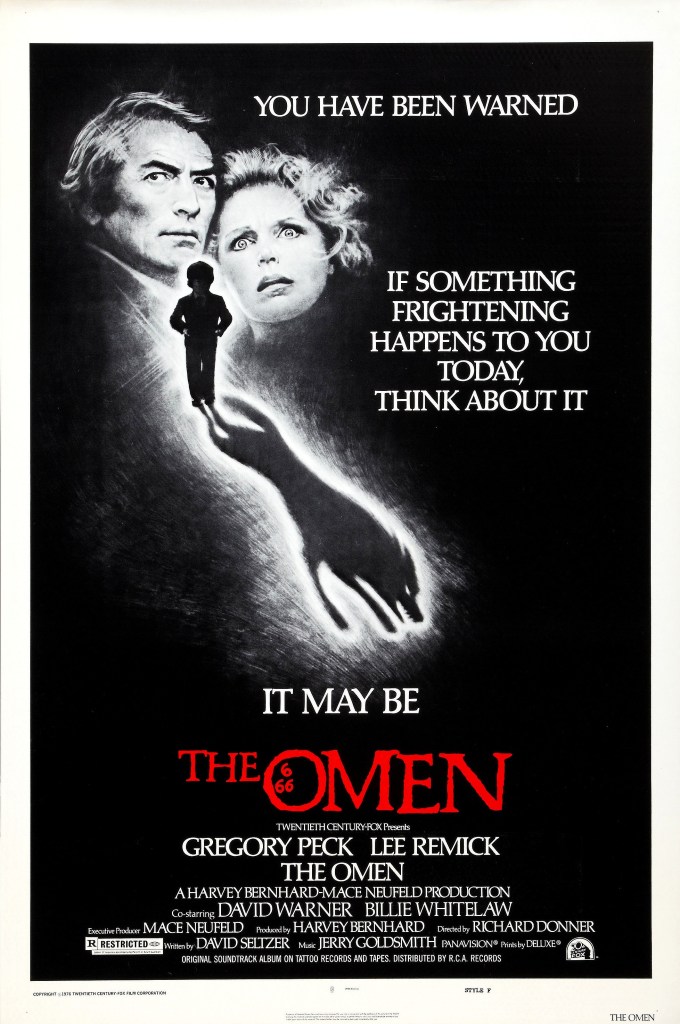
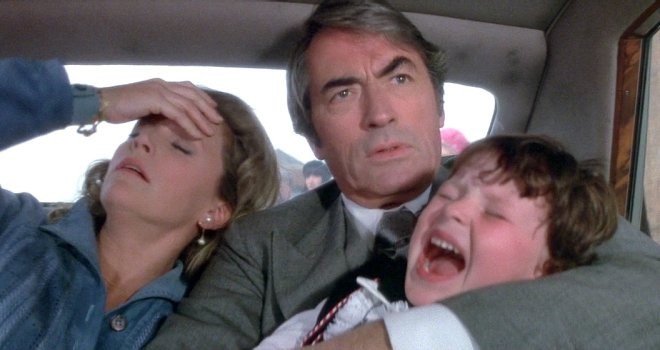
“Let him that hath understanding count the number of the beast; for it is the number of a man; and his number is 666.” One of the sweetest things about The Omen is that the number of the Beast was considered such an unknown concept to original viewers, that its painstakingly explained to us. In some ways The Omen is quite sweet, a big, silly Halloween pantomime which everyone involved takes very seriously. If The Exorcist was about tapping into primal fears, The Omen is a gory slasher (with a cracking score) that’s about making you go “Did you fucking see that!” as actors are dispatched in inventively gory ways. It’s brash, overblown and (if we’re honest) not very good.

Robert Thorn (Gregory Peck, selling every inch of his innate dignity for cold, hard lucre) is an American diplomat told one night in Rome that his pregnant wife Katherine (Lee Remick) has given birth to a stillborn child. “Not a problem” he’s told by an absurdly creepy Priest (Martin Benson) – just so happens there’s another motherless new-born child in the hospital tonight so he can have that one, no questions asked, and his wife need never know. Flash forward five years: Thorn is Ambassador to the Court of St James and young Damien (Harvey Stephens) is a creepy kid, with few words and piercing stare. In a series of tragic accidents people start dying around him. Could those people warning Thorn that his son is in fact the literal anti-Christ himself, be correct?

Want to see how powerful music can be? Check out how The Omen owes nearly all the menace it has to it imposing, Oscar-winning score from Jerry Goldsmith (wonderfullyGothic full of Latin-chanting and percussive beats). It certainly owes very little to anything else. The Omen is an exploitative, overblown mess of a film, delighting in crash-zooms, jump-cuts and extreme, multi-cut build-ups to gore. Richard Donner never misses an opportunity to signpost an approaching grisly death, by cutting between the horrified face of the victim, the object of their demise and then often back again. For the best stunts – including a famous demise at the hands of a sheet of glass – Donner delights in showing us the death multiple times from multiple angles.

This slasher delight in knocking off actors – people are hanged, impaled, crushed and decapitated in increasingly inventive manners – is what’s really at the heart of The Omen. None of this is particularly scary in itself (with the possible exception of the hypnotised madness in the eyes of Holly Palance’s nurse before her shocking suicide at Damien’s birthday party) just plugging into the sort of delight we take in watching blood and guts that would be taken in further in series like Halloween (which owed a huge debt to the nonsense here). Donner isn’t even really that good at shooting this stuff, with his afore-mentioned crude intercutting and even-at-the-time old-fashioned crash zooms.

With Goldsmith’s score providing the fear, The Omen similarly relies on its actors to make all this nonsense feel ultra serious and important. They couldn’t have picked a better actor than Gregory Peck to shoulder the burden of playing step-dad to the Devil’s spawn. Peck has such natural authority – and such an absence of anything approaching fourth-wall leaning playfulness – that he invests this silliness with a strange dignity. Of course, Atticus Finch is going to spend a fair bit of time weighing up the moral right-and-wrongs of crucifying with heavenly knives the son of Satan! Peck wades through The Omen with a gravelly bombast, managing to not betray his “for the pay cheque” motivations, and investing it with his own seriousness of purpose.

Peck’s status also probably helps lift the games of the rest of the cast. Lee Remick may have a part that requires her to do little more than scream (and fall from a great height twice) but she does manage to convey a neat sense of dread as a mother realising her son is not quite right. David Warner gives a nice degree of pluck to a sceptical photojournalist (while also bagging the best death scene). Troughton and McKern ham it up gloriously as a drunken former devil-worshipping priest and an exorcist archaeologist respectively. Best in show is Billie Whitelaw who filters her Beckettian experience into a series of chillingly dead-eyed stares as Damien’s demonic nanny.

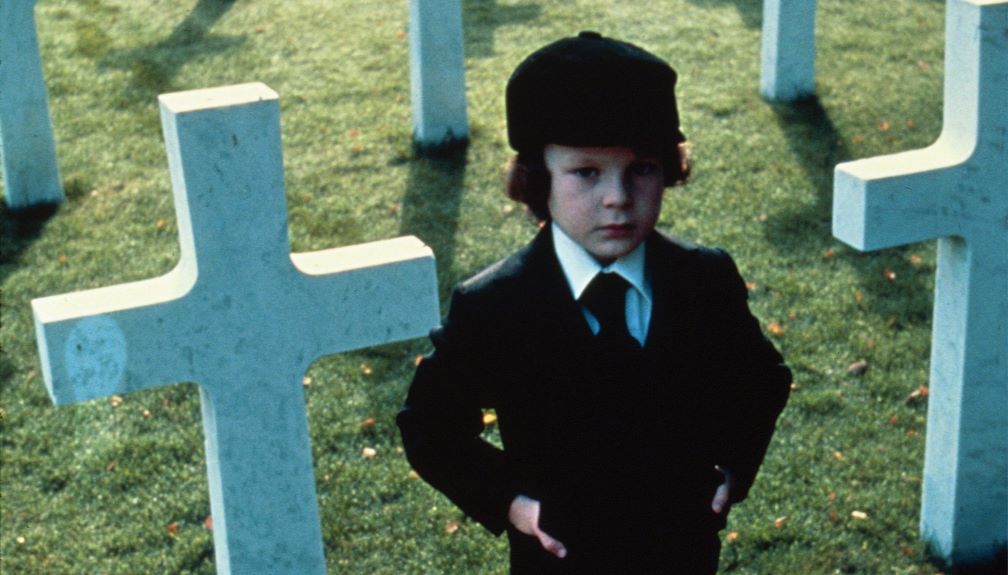
The Omen does make some good hay of its neat paedophobia. Harvey Stephens with his shaggy hair, impish smile and pale skin (not to mention darkly sombre wardrobe) looks like your worst nightmare – he’s creepy enough that the film doesn’t need to gift him a vicious rottweiler as well. Donner’s decision to never have Damien show a touch of any real emotion for most of the film also pays off, meaning even something as silly as Damien inflicting slaughter from behind the pedals of a child’s tricycle seems scary.

Of course, if Damien was savvy enough to present himself as a bright and sunny child perhaps Troughton, Warner, McKern and co would have struggled to convince Peck he was the Devil’s seed. In that sense he takes after his dad: Satan loves an over-elaborate death, and from a storm herding one victim to a fatal impalement under a tumbling church spire to popping the handbrake of a glass-bearing van for another, no trouble is too much for Satan when bumping off those who cross him. (The Omen could be trying to suggest that maybe everything is a freak accident and Thorn goes wild and crazy with grief – but that Goldsmith score discounts any possibility other than Damien is exactly what we’re repeatedly told he is.)

The Omen trundles along until its downbeat, sequel-teasing ending, via a gun-totting British policeman who sticks out like a sore thumb in a country where the cops carry truncheons not pistols. Donner balances the dialled up, tricksy, overblown scares with scenes of po-faced actors talking about prophecies and the apocalypse, all shot with placid straight-forwardness. There is a really scary film to be made here about finding out your beloved son is literally a monster, or how a depressed father could misinterpret a series of accidents as a diabolical scheme. But it ain’t The Omen – this is a bump-ride of the macabre. The Devil may have the best tunes – but he needs to talk to his Hollywood agent.

Persona (1966)

Persona (1966)

Bergman’s masterpiece, a fascinatingly brilliant Rorschach test that challenges and rewards the viewer

Director: Ingmar Bergman

Cast: Bibi Andersson (Alma), Liv Ullman (Elizabet Volger), Margareta Krook (Doctor), Gunnar Björnstrand (Herr Volger), Jorgen Lindstrom (Boy)

Even Bergman considered Persona a moment he “had gone as far as I could go…touched wordless secrets that only cinema can discover”. Persona, Bergman’s most consciously artistic and psychologically challenging work is a mass of contradictions and puzzles that defies easy categorisation (even Bergman claimed to be only half sure what definitively was happening). A whirling mix of themes, haunting moments and unknowable incidents all within a framework that constantly reminds us we are watching a film, Persona has been influencing, challenging and fascinating viewers for over 60 years. If cinema’s Everest is Citizen Kane, Persona is its K2.

The plot seems simple. Famed actress Elizabet Volger (Liv Ullman) fell silent for a minute during a production of Electra, then carried on. A day later she stopped speaking and hasn’t spoken since. Her doctors can’t find an answer so she is sent to an island to recuperate, with the support of a nurse, Alma (Bibi Andersson). On the island, Alma fills the silence with long monologues that become more and more confessional, intimate and personal. Does Elizabet betray these confidences in a letter to her doctor? Does Alma plot revenge? Are these events even happening? As the personalities of the two women blur, merge, swop and consume each other the film fractures (at one point literally so) until we are left as uncertain of who and what is real as perhaps the women themselves.

There is, in some ways, no understanding Persona. It perhaps best resembles a cinematic Rorschach test. I’d argue it’s a fool’s journey to stare at it for a definitive answer. Different days, different moods, different conditions will make the picture re-shape and resemble something else. Bergman has created a film devoid of traditional ‘clues’, that provides no trace of an ‘answer’, but instead asks – demands? – us to take away only what we choose.

Throughout, Bergman makes it vitally clear film is a constructed, artificial representation of reality. Persona starts and ends with film literally spooling through a projector, the arc lights cranking up to project a reality. The opening prologue is a host of suggestive images which may, or may not, relate to what we are about to watch. Their meaning is almost deliberately vague – much as the epilogue’s brief shot of Bergman and crew shooting the film is – but it lets us know beyond doubt this is a subjective presentation of a series of images, not real life. Perhaps reading meaning into it is as impossible a task as trying to interpret the contents of a library from the page of a single book.

Which is to say, I think Bergman is both inviting us to interpret the film but also warning us that this isn’t a jigsaw, but a deliberately obtuse and open-ended work, our experience of it controlled by the director. Film is after all a dream – a world where we think we move freely, but in fact we never do. Which might make you think Persona is Bergman’s punking the world, a Thermot’s Last Theorem designed to infuriate. It isn’t because it’s made with such grace, humanity and honesty.

To understand Persona you can only discuss – and wonder – at the complex, multi-layered themes and decide which speaks most to you on the day. A lot of this boils down to how you are affected by the breathtaking, seismic performances from Andersson and Ullman. Playing two characters whose identities merge, shift, mirror and absorb each other both performers give outstandingly intelligent, infinitely challenging and unreadable performances. For Andersson the film is virtually a monologue, where the more Alma talks, the more our grasp on who (or what?) she is slips through our fingers. Ullman’s impassive face, awash with micro-expressions (caught in scintillating close-ups) constantly disorientates – is that a sneer or a smile? Is that head-turn impatience or a desire to know more?

At several points I find myself falling into the trap Bergman lays of wanting to categorise the film, as I became convinced first one than the other of these women was just an element of the psyche of the other. It’s not as simple as that. They are both the same and different, two people and one. Bergman frequently frames their bodies overlapping and, in one horrifying moment, their face literally merged half-and-half. Elizabet, we think at first, is a near vampiric figure sucking the life out of Alma, drawing confessions from Alma to restore herself. Then Elizabet becomes a ghostly figure, moving in the margins of Alma’s life, a horrific silent figure from her subconscious holding her back. Then you feel Alma to be nothing more than Elizabet’s id, demanding her right to be independent.

The unreadability of the film becomes ever more acute at the half-way point. After an enraged Alma deliberately leaves Elizabet to cut her foot on glass, the film pauses, burns away and then restarts with an echo of its earlier montage. Has the story restarted? Did all or any of what went before actually happen? Or is everything from this point a cinematic fantasy? Later in the film Bergman throws in a sequence with Alma and Elizabet back in the hospital before returning to the island – is this a flashback or a dream or a vision or something else entirely?

Bergman’s mastery of horror comes to the fore. The haunting repeated shot of Elizabet embracing Alma from behind, the two of them starring into a mirror (and the camera) at times seems sexually charged, at others disturbingly possessive at others supernaturally controlling. Is Bergman’s point that the context of an image can change its meaning? These hazy definitions of truth and reality lie throughout. The confrontations between the two taking on an increasingly surreal nature.

In a stunning sequence, Bergman repeats the same Alma monologue twice, one focused solely on Elizabet (her face contorted with pain as she hears of her rejection of a child), the second on Alma (now dressed identically to Elizabet), Alma’s bitterness now taking on a totally different light. Alma, back in nurses’ outfit, confronts Elizabet screaming that she is her own person even as her words collapses into an incoherence that might as well match Elizabet’s silence. Which is projection and which reality? When they leave at the film’s end, do they go their separate ways or merge? Does Alma imagine herself with Elizabet’s husband, or when Elizabet’s husband recognises Alma as his wife is he tipping the nod to us?

Bergman gives no clear reasons for Elizabet’s silence. It could be connected to horror at the world’s terrors (Vietnam and the Holocaust are referenced). It could be shame at her own post-natal depression. It could be that the silent Elizabet is a projection of the Alma-Elizabet’s own turmoil and isn’t real in the first place. After all the hospital we are introduced to Elizabet in doesn’t feel like a real place but a sparsely dressed film set (and shot like it).

Sex weaves it’s way tellingly through the film. The sexual bond between Alma and Elizabeth, physically, seductively close and possibly sleeping together is clear. Alma relates a hugely erotic monologue about an orgy she and a friend initiated on a beach, the only time she describes herself a purely happy and content. Is this her memory or a fantasy of Elizabet’s? If Alma is Elizabet, is this what she longs for or the thing she finds missing now from her own life? Alma talks of wanting a family – but in a haphazard, casual way and has already had an abortion. Elizabet has a son but doesn’t want him – is Alma what she dreams she could be, or is Elizabet the truth Alma doesn’t want to face? At various points both, all or nothing of the above could be true.

The film opens with a mysterious boy starring at a blurred series of images of female faces. We never learn who he is (theories abound from Elizabet’s son to Bergman himself). He wakes seemingly from the dead, but perhaps he is given life by the film. Perhaps, Bergman is saying, Alma and Elizabet are themselves given life only by the film. That both of them are fictious illusions, as unreal as the blurred pictures on the wall. Persona is the sort of film only a director of pure courage could have made. An object that fascinates and frustrates but always leaves you wanting to reconsider and reposition it to see if the picture becomes clearer or if new truths are presented if you look at it from a different angle. Maybe Elizabet is a succubus. Maybe Alma is an angry inner self, longing to escape and liver her own life. Maybe Alma is the silent actress. Maybe Elizabet longs for the simpler life of the nurse. Perhaps every single idea is true and perhaps none of them are. That’s part of the mystery that makes Persona one of the greatest films ever made.

The Lesson (2023)

The Lesson (2023)

Sinister family mystery, full of good moments that don’t come together into something that really works

Director: Alice Troughton

Cast: Daryl McCormack (Liam Sommers), Richard E. Grant (JM Sinclair), Julie Delpy (Hélène Sinclair), Stephen McMillan (Bertie Sinclair), Crispin Letts (Ellis)

Liam Sommers (Daryl McCormack) strides onstage for an interview about his literary debut, that has set the world alight. How did he get the inspiration to write about a domineering patriarch in a rich country house? Flashback to Liam’s summer spent as an English tutor to Bertie (Stephen McMillan), who is trying to get into Oxford to impress his domineering father JM Sinclair (Richard E Grant), Britain’s leading literary novelist. The Sinclair household bubbles with suppressed grief over the accidental drowning of JM and Hélène’s (Julie Delpy) older son Archie in their private lake. As Sinclair puts the finishing touches to his new novel – and ropes in Liam to help him as “final lap amanuensis”, what secrets will Liam uncover about this family?

The Lesson revolves heavily around its oft-repeated pithy mantra from JM Sinclair – “Great writers steal”. So often is this repeated, that it drains much of what little surprise there might be about the true origins of JM Sinclair’s latest tome. It’s a fitting mantra from the film that feels like a mood piece, assembled from little touches of other filmmakers (Kubrick for starters), reassembled into something just a little too pleased with its reveals and secrets-within-secrets structure, but is well enough made that you are willing to cut it some slack.

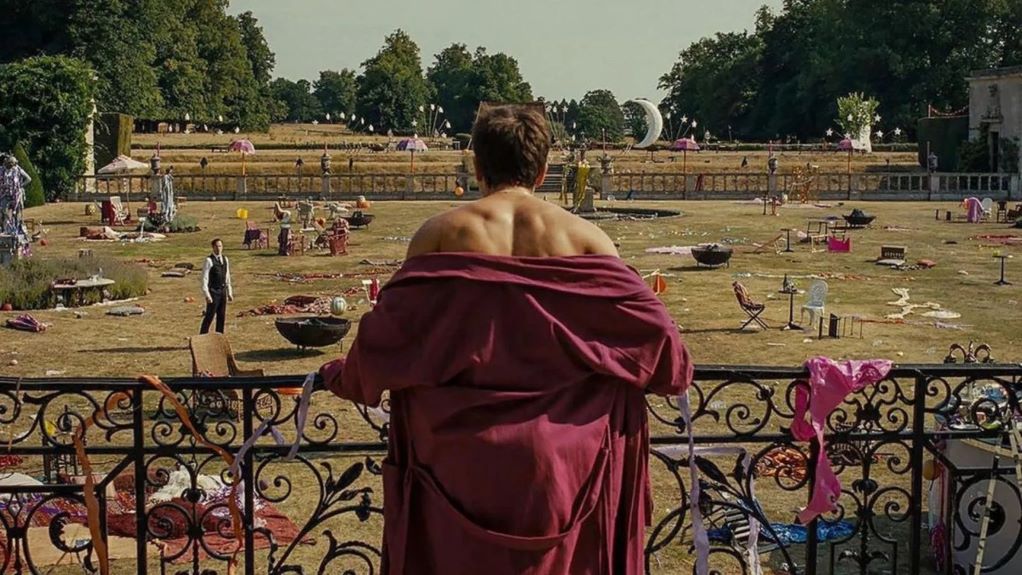
Effectively all filmed in a single location, the Sinclair’s luscious house (a mix of the modern and the classical) set amongst rich private grounds, it’s well directed by Alice Troughton, who makes effective use of angles and transitions (particularly its cuts back and forth between the working practices of Sinclair and would-be novelist Liam, which subtly stress both their similarities and differences) to enhance mood and an air of unknowable menace. The camera drifts with a chilling intimacy across the fateful lake, giving it a sense of ominous power and mystery.

The film is at its strongest in its opening sections (like Sinclair’s novel, it is divided into three parts with short prologues and epilogues). Within a self-contained theatrical space, tensions and resentments between the family are carefully but not pointedly outlined. The father who switches between indifference, annoyance and gregarious enthusiasm. The mother who feels like both a dutiful supporter and a resentful slave. The prickly, difficult son scared of affection, who attempts (unsuccessfully) to ape his father’s authoritarianism, but is crying out to be hugged. Troughton skilfully cuts between these characters, frequently positioning them at opposing sides of the frame, setting them at visual odds with each other.

In the middle of this, Liam becomes an out-of-place, equally unreadable presence. Very well played by Daryl McCormack, full bluntness mixed with inscrutability, Liam is impossible to categorise and totally outside the upper-class formality of the Sinclair home (with its servants, home fine-dining accompanied with classical music and casually displayed artwork). He’s Irish, working-class, Black and sexually ambiguous. But he’s also hard for us to read: is his admiration for Sinclair something that could tip into resentful violence? Does he really like Bertie, or does he see him as a tedious, brattish child? As the prologue sets up, is he an innocent or a destructive, vampiric presence?

These beats are neatly set up in The Lesson’s opening parts, added to by the presence of a Pinteresque butler (a fiercely polite Crispin Letts) whose status and loyalties prove equally hard to read. Liam’s slowly becomes an intimate figure in the house, moving from a servant occasionally allowed to dine with the family, to Sinclair’s IT consultant, proof-reader and one-sided sounding-board for conversations about his novel, becoming an object of sexual fascination for Bertie and Hélène and given the late Archie’s clothes to wear (adding an Oedipal frisson to his flirtation with Hélène).

Ambiguity however slowly gives way as The Lesson continues, as it fails to weave its initial jarring mood into a reveal that feels truly satisfying, logical or surprising. This effect is magnified by the fact the more time we spend with Sinclair, the more it’s made clear he is less complex than we think, but simply an egotistical monster. Richard E Grant has huge fun with this larger-than-life braggart, a man so competitive that he feels compelled to aggressively slap down Liam’s draft novel as “airport trash” and smilingly telling him he has “done him a favour” by encouraging him not to write. But Sinclair’s monstrous, bullying self-importance sign-posts a little too clearly where the plot is heading.

The final reveal that we have been witnessing a secret plot unfold in front of us feels like a flawed attempt to add a narrative coherence to a series of events that would be impossible to pre-plan. This also relies on chance events and skills (events hinge on Liam’s near-photographic memory). The final ‘answer’ is also too clearly sign-posted from the opening, leaving you expecting a rug-pull that never comes.

The Lesson has a good sense of atmosphere in its opening half and some strong performances – Julie Delpy is very effectively unreadable as the enigmatic Hélène – but for all its sharp direction, its plot is too weak to be truly rewarding on a first viewing or give you a reason to want to return for a second lesson. Despite some good scenes, a bravura Grant and a subtle McCormack, the resolution of its quiet atmosphere of tension and inscrutability doesn’t quite ring true.

The Silence (1963)

The Silence (1963)

Bergman’s third film in his “faith” trilogy, is an intriguing Sartresque puzzle

Director: Ingmar Bergman

Cast: Ingrid Thulin (Ester), Gunnel Lindblom (Anna), Jörgen Lindström (Johan), Birger Malmstein (Waiter), Håkan Jahnberg (Hotel porter)

Two sisters, Esther (Ingrid Thulin) and Anna (Gunnel Lindblom), mother to ten-year-old Johan (Jörgen Lindström), are travelling home on a train through Europe. Ester, a translator, is already ill and her health takes a sharp downturn, leading to the group being forced to rest in a hotel in a town called Timoka, in an unnamed (fictional) European country. Anna resents what she sees as the judgemental expectations of her older sister and sees her obligation to care for her as a burden. Over a few days in the hotel, the two sisters move awkwardly around each other, avoiding addressing their problems while struggling in a country where neither of them speak the language.

The Silence was the third, and final, film in Bergman’s loose thematic trilogy on the absence of God in the modern world. It’s also possibly his most bleak and Sartre influenced work so far, a film of oppressive silence (devoid of music, the only noises coming from objects in the rooms of the hotel) with events occurring in a disturbing, slightly surreal world, where the normal rules of human interaction seem to be hold. Perhaps that’s because the characters move, like ghosts, through a world where they have no ability to communicate other than stumbled words and hand gestures, residing in a hotel where there seems to be no timescale on how long they are (or have been) there.

It also feels like an entrée to Persona, Bergman’s next major work. Like that, The Silence revolves around a symbiotic relationship between two women, who together seem to form two halves of one personality. Esther is intellectual, reserved but also vulnerable and adrift, dependent on others for help and frequently resorting to drink to dull her pain. Anna is more earthy, sensual but insecure, resentful and feels judged by others, finding temporary peace in casual sexual encounters. Both sisters are locked in a relationship that feels both disconnected and mutually dependent, constantly clashing with each other but living in worlds defined by their feelings for the other.

They are played majestically by two performers at the height of their powers. Thulin seems cold but conveys great depths of pain and suffering beneath what seems like her confidence and assurance. Thulin’s expressive face communicates great emotional turmoil, even with only the slightest movements and gestures. It’s a beautifully delivered performance of a woman who is unknowable, distant, difficult but also highly sympathetic. Lindblom’s physical assurance is counter-balanced by the great uncertainty she manages to communicate in every beat of Anna’s life. Her general demeanour of icy chill, interrupted with emotional breakdowns which alternate rage with tears and hysterical laughter, is faultlessly delivered.

These two characters increasingly feel trapped inside a world where they can’t easily communicate, with the threat of turmoil constantly rumbling on the margins. This unnamed country teeters on the edge of war – tanks and other military equipment make constant intrusions on the streets and the train tracks and the rumble of planes can be heard in the air. They are also rendered increasingly mute and isolated by their inability to speak the language. Communication with people around them is impossible and understanding is only fractured.

This is where Bergman’s views on God slowly take their form. For, as he observed in other films in the trilogy, what is this world but one where we strain in vain for the voice of God? Isn’t that like being adrift in a country where the language is unknown? And if, as Bergman so heartily expresses elsewhere, God is love what does it mean that this film revolves around character who have such negative to indifferent opinions on others. Ester may love – as she argues – Anna, but Anna has interpreted this love as smothering and oppressive her whole life and rejects Anna utterly. Anna seems disinterested in her son Johan (who Ester yearns to be closer to, but can never quite find the way to close the gap) and impatient with her sister. Not only are the characters trapped in a world of silence, they are also trapped in circles of loveless relationships.

It’s striking then that this was Bergman’s most sexual film so far. Bizarrely – for a film as austere, glum and challenging as The Silence – it was a box-office hit. This was, in large part, connected to its comfort with sex scenes. Anna watches a couple sat next to her having passionate (and beautifully lit) sex in an opera house, before engaging in wordless (of course) intercourse with a waiter (Anna even mentions the benefits of the man not understanding a word she says). The more frustrated Ester masturbates alone – no coincidence that she later speaks of her disgust with the sexual act and its bodily fluids. This is a film without love but with a lot of base, meaningless, carnal love in it – all part of a Godless world leaning into its nihilistic close.

The Silence is extraordinary in its filmic confidence. It’s exquisitely shot by Sven Nykvist, his camera (far more mobile than almost any time before in Bergman) tracks down corridors and through rooms of its luxurious but chillingly empty hotel (you can see The Silence’s influence on Kubrick’s The Shining). It uses light, shade and shadow in strikingly meaningful ways, arcs of light suggesting a host of underlying emotions and unspoken longings.

The Silence is a film that invites analysis and theorising, partially because its characters speak in such gnomic, Bergmanesque mysteries. Some have theorised Johan is in fact Ester’s child, raised begrudgingly by Anna, now longed for by his real mother at her end. Some have suggested Ester and Anna are such contrasting sides they may in fact be the same person (traces of Lynch’s Mulholland Drive) others see an incestuous longing in Ester for her sister. Bergman increases the unknowing mystery by presenting much of the film from the perspective of the precocious (not many children read Turgenov) but innocent Johan, a child who sees but cannot interrogate the actions around him.

It makes The Silence feel like a bridge from one era of Bergman to the next. The last hurrah of his spiritual study, before a series of films that would explore the interconnected lives of women whose desires, needs and dependencies motivate and merge into each other. That makes it a fascinating and vital milestone in Bergman’s development – as well as another extraordinary, haunting and fascinating work from a great director.

Shine (1996)

Shine (1996)

Middle-brow and safe biography that takes easy choices and makes reassuring points

Director: Scott Hicks

Cast: Geoffrey Rush (David Helfgott), Armin Mueller-Stahl (Peter Helfgott), Noah Taylor (Young David Helfgott), Lynn Redgrave (Gillian), Googie Withers (Katherine Susannah Prichard), John Gielgud (Sir Cecil Parkes), Sonia Todd (Sylvia), Nicholas Bell (Mr Rosen), Alex Rafalowicz (Child David Helfgott)

A hugely talented pianist, David Helfgott (played by Noah Taylor then Geoffrey Rush) trained at the Royal College of Music in the late 1960s but developed schizoaffective disorder, a condition that stalled any music career. What happened next is debated, but according to Shine years of mental institutes and sheltered housing eventually led to rediscovery and a life turned round by marriage to Gillian (Lynn Redgrave). This provided a happy home to Helfgott, who had grown up under the domineering hand of his father Peter (Armin Mueller-Stahl), a Polish-Australian who had narrowly escaped the Holocaust and disowned his son after he travelled, against his wishes, to Britain.

Shine repackages Helfgott’s life into a crowd-pleasing triumph-against-adversity biopic which plays fast and loose with facts. Shine makes no mention of Helfgott’s first marriage, it’s portrayal of his father as a misguided tyrant has been disputed by other members of Helfgott’s family and the level of estrangement Helfgott had from his family (his brother claimed David continued to live with the Helfgott family after his return) has been strongly disputed. Shine smooths off all rough edges and emphasises dramatic potential in others to create its stereotypical heart-warming tale.

What it also does is turn Helfgott’s life into a middle-of-the-road biopic, a highly convention film full of expected arcs (struggle, triumph, collapse, triumphant return) and directed with a middlebrow assurance by Hicks. It’s a film that flatters to deceive, offering only cursory insight into its subject and ends with a sentimental scene in which we are all-but-invited to join the characters in a standing ovation for a Helfgott comeback performance (which the film doesn’t even show us).

Shine has almost no interest in Helfgott’s illness, what bought it on, how it developed or what he and those around him did to help him function in society (his marriage to Gillian gets barely ten minutes of the film’s runtime). It has very little interest or insight into music – other than Rachmaninov being ‘very hard to play’ and some guff about finding the heart behind the notes which sounds full of import because anything said by John Gielgud sounds important. It takes a fascinatingly conflicted character like Peter Helfgott and bends over backwards to make him as two dimensional as possible, with only a brief throw-away line that leans into how quite possibly his views on the importance of family might just have been affected by the slaughter of the rest of his in the Holocaust. Everything is designed to make us feel that standing ovation is earned.

The film gets a much better performance than it deserves from Armin Mueller-Stahl as Peter Helfgott. Here is an actor with more compassion and insight into his role than either the film or the director has. On the surface everything Peter does is appalling; controlling what his son plays, demanding he wins competitions, blocking opportunities for progress, beating him in a rage twice and throwing him out of the house. But Mueller-Stahl plays the fragility and vulnerability under Peter exquisitely. This is a man so terrified about losing his family that he goes to extraordinarily damaging lengths to hold it together. So much so he destroys it.

And you understand that in every moment of Mueller-Stahl’s sensitive and immaculately judged performance. He looks at his son with tenderness and adoring love. His eyes dance with fear at the prospect of David going out alone into a world he thinks is dangerous. Its fear that leads him to react with violence – the terror of weakness pours from Mueller-Stahl. It’s a rich, layered, superb performance which seems almost smuggled into a film that does it’s very best to present Peter Helfgott as a controlling, destructive bully who (it believes) was the root cause of David’s illness.

The drama of the film – most of its first hour – revolves around the clash between this domineering father and the young Helfgott, played by Noah Taylor. It tells a very familiar story: the quiet, but talented son and the monster behind him, but does it solidly enough. Quiet, mumbling and shy – but with subtle traces of condition we know will seize him later in life, Taylor is marvellous. The training sequence at the Royal Academy, again familiarly reassuring for its pupil-mentor set-up, also allows a lovely showcase for an-almost-swansong role for Gielgud, sparkling, wry and charming.

It’s strange than that the Best Actor awards were poured onto Geoffrey Rush who only appears in two scenes before taking over the role at the 67-minute mark (of a 100-minute film). Rush, then unknown internationally, gives the sort of grand performance beloved of awards ceremonies. I admire Rush enormously: but Shine is all technique and no insight. Rush twitches, talks at a thousand miles a minute and plays the piano like a natural. Never once is he given the opportunity to really get inside what motivates Helfgott. He doesn’t even get the main dramatic meat of the film (he shares one brief scene with Mueller-Stahl). It’s ironically like a note-perfect but professionally smooth piano recital: the sort of role you feel Rush could actually have done standing on his head.

Shine even fudges moments of stand-up-and-cheer. Helfgott has been told he cannot play a piano because it affects his nerves. We frequently see him starring wistfully at a piano. The film opens with a rain-soaked Helfgott barging into a closed café hoping to be allowed to use the piano. The film is clearly building towards the moment when Helfgott plays the piano in that café, wowing the clientele with his virtuosity after a clumsy initial test playing of a few keys. We should have been wondering: does he still have it after all these years? We’re not because Hicks has thrown away Helfgott’s first playing of the piano in years five minutes early by having him hammer the keys with brilliance in a piano in his hostel (the instrument subsequently locked by his annoyed host). Why not have the piano locked from the start, sitting in his room, present but out of reach? Wouldn’t that have made it even more triumphant when Helfgott played like a master in that café one evening?

It’s cack-handed moments like that exposes the weakness in Shine, a film that flatters to deceive, offering only the most conventional and safe perspectives on a life. It boils things down to goodies and baddies and simplifies mental problems into being solved by just a little love and affection.  It’s a film that wants us to applaud Helfgott – and, by extension, to feel better about ourselves. But Shine offers very little in the way of insight or understanding and boils all its events down into easily digestible narrative homilies. It’s middle-brow filmmaking of the middlest kind.

Cross of Iron (1977)

Cross of Iron (1977)

Grim war film, full of blood and horror, but lacking the depth it needs to really make an impact

Director: Sam Peckinpah

Cast: James Coburn (Sergeant Rolf Steiner), Maximilian Schell (Captain Stransky), James Mason (Colonel Brandt), David Warner (Captain Kiesel), Klaus Löwitsch (Krüger), Vadim Glowna (Kern), Roger Fritz (Lt Triebig), Dieter Schidor (Anselm), Burkhard Driest (Maag), Fred Stillkrauth (Reisenauer), Michael Nowka (Dietz), Arthur Brauss (Zoll), Senta Berger (Eva)

If War is Hell, it makes sense that Sam Peckinpah eventually bought it to the screen. Cross of Iron is, perhaps surprisingly, his only war film. But, in a sense, Peckinpah’s grim explorations of the brutal realities of violence made all his films war films. And what better setting for his grim eye than the gore and guts of World War Two’s Eastern Front. If war has any rules they fell silent in this hellish clash where no quarter was given and no decency could be found.

Sgt Steiner (James Coburn) knows this. A grizzled soldier, who despises war, Nazism and officers, he fights through the horrors of the front to protect his men. As the Wehrmacht flees, crushed by the late 1943 advance of the Russian army, the only hope is the vain chance of staying alive. But Steiner’s new commander, Captain Stransky (Maximilian Schell) has other ideas: a Prussian elitest, he’s here for an Iron Cross and the fact he’s inept, cowardly and inexperienced isn’t going to stop him. The clash between Steiner and Stransky will leave a trail of futile bodies in its wake.

Cross of Iron may well just be the grimmest war film this side of Come and See. Shot on location in Yugoslavia, Peckinpah films the Eastern Front as a muddy, chaotic mess where no one seems to have the faintest clue why they are there or where they are going. Soldiers huddle in shallow trenches, officers sit in dusty, crumbling bunkers, the sound of machine guns and the explosion of artillery forms a constant backdrop. Battles are smoky, horrific events with bullets flying, ripping through bodies that explode in squippy mess. Bodies are strewn across the battlefield. Even in the progress to the front lines, tanks absent-mindedly roll over bodies left ground into the muddy dirt.

Peckinpah brings his unique eye for violence to bear. Violence frequently takes place in slow motion, bodies twisting and turning in a crazed dance that seems to go on forever as bullets rip through them. The camera never flinches from the blood of war and the films throws us right into the middle of brutal firefights, tracking through smoky, muddied fields full of bodies. The soundtrack is punctuated by distant artillery gun fire. There is no heroism and the sole focus is staying alive. The soldiers have no interest in politics, no passion at all for the war – only one of them, the smartest dressed, is a Nazi. It’s simply something they vainly hope to survive to see the end of. Even the grizzled veteran Steiner hates the killing, hates the violence, hates the waste.

It makes us loath even more Maximilian Schell’s puffed-up braggart Stransky, a man born wearing an officer’s uniform but hopelessly ill-suited for it. Under fire at his first attack, Stransky is hopeless, reduced to bluntly stating the obvious (“My phone is ringing!”) and confusedly rambling about attacking, withdrawing and counter-attacking all in the same breath. Schell was born to play Prussian primma donnas like this, and he gives Stransky a real cunning and survival instinct. Despising Nazism – he sees himself as above the crudeness of the party – he’s a born manipulator, skilfully deducing the sexuality of his aide to blackmail him, but also a rigid stickler for the rules unable to comprehend a world where he isn’t on top.

He’s the antithesis of Steiner, who has everything Stransky wants: respect, glory, guts. Coburn is, to be honest, about ten years too old for the role (his age particularly shows during his brief respite in a base hospital, where he has a convenient sexual fling with Santa Berger’s nurse), but he’s perfect for the hard-as-nails humanitarian, who hides under the surface deep trauma at the horror he’s seen. Steiner is the natural leader Stransky wants to be and has the Iron Cross Stransky wants. Worst of all, Steiner doesn’t give a shit about the medal, when it’s the be-all-and-end-all for Stransky.

Stransky is so out of step, even the veteran front-line officers think he’s despicable. Colonel Brandt (a world-weary James Mason) scoffs “you can have one of mine” when he hears of Stransky’s dreams while his cynical aide Kiesler (a scruffy, shrewdly arch David Warner) takes every opportunity to show his disgust. Stransky is ignored by the soldiers and is rarely filmed away from his bunker, where he reclines on his bunk like an emperor and avoids any trace of conflict.

So, he knows nothing of the horrors of Steiner’s war. We however do. Cross of Iron opens with a successful raid on a Russian encampment. One of the victims, a young soldier his body torn apart by a mortar, is met with barely a reaction by the soldiers (“We’ve seen worse” says Steiner). Another captured Russian boy is later released by Steiner – and promptly machine-gunned in front of him by advancing Russian soldiers. Caught behind the lines, Steiner’s men are picked off one-by-one despite his desperate efforts to keep them alive.

Cross of Iron went millions over budget – largely due to Peckinpah’s chronic alcoholism (he binge drank every day while shooting and spent days at a time unable to work) – and as a result the ending is abrupt and overly symbolic. (Peckinpah and Coburn had about an hour to cobble it together and shoot it before the filming wrapped up). Peckinpah throws in some clumsy fantasy sequences (especially during Steiner’s fever dreams in hospital) and overly heavy-handed reaction shots from Coburn, overlaid with quick cuts to various horrors or shots of lost friends, which over-stresses the horror of war.  Much as Cross of Iron skilfully shows the grimness of conflict, it doesn’t balance this with real thematic weight and depth like, say, The Wild Bunch does.

It’s part of Cross of Iron’s flaws. Under the surface, I’m not sure that Cross of Iron has much more to say, other than war is hell. And with Peckinpah’s work here, there is a sort of satanic, indulgent glee in all that mayhem and slaughter, the bodies riddled by bullets. Peckinpah is a sadistic preacher, the sort of sermoniser who is so keen to tick off the evils of the world, that he doesn’t want to miss a thing. The film feels a little too much at times as a grungy, exploitation flick yearning for art.

But it still has a visceral impact that makes it stand out as grizzled war-film, helped by a granite performance by Coburn, with just enough vulnerability beneath the growls. A tough watch and a flawed film, that lacks the real insight and psychological depth it needs, but with some compelling – and shocking – moments.