Category: Films about revenge

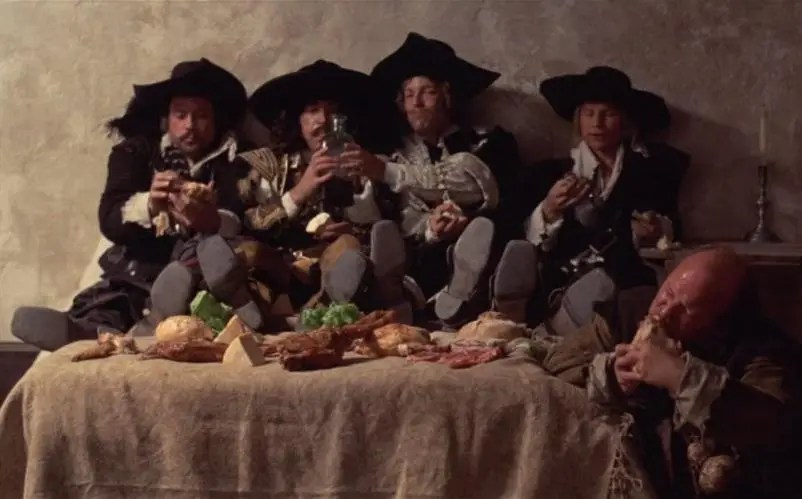
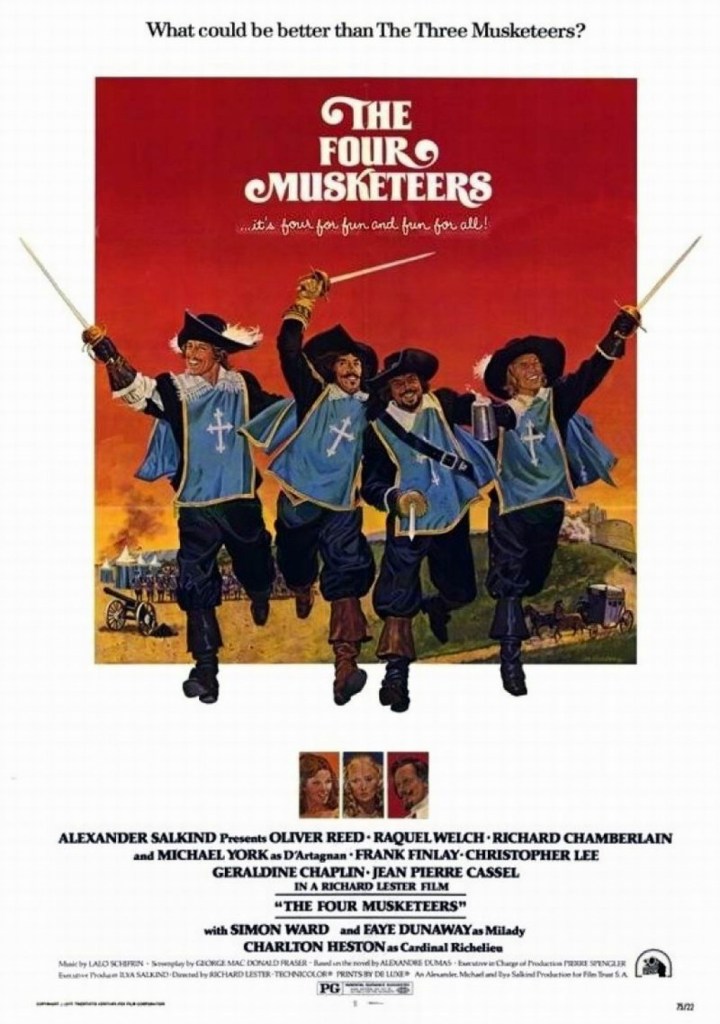
The Three Musketeers (1973) / The Four Musketeers (1974)

The Three Musketeers (1973) / The Four Musketeers (1974)

A film of two halves, in more ways than one: the swashbuckling original and its dark sequel

Director: Richard Lester

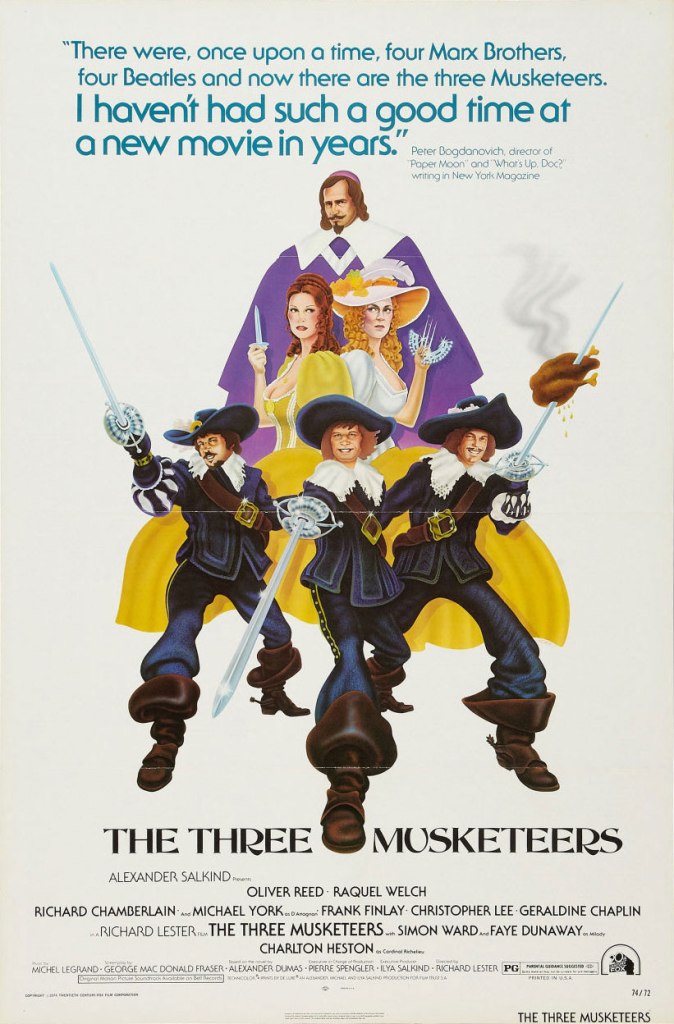
Cast: Michael York (d’Artagnan), Oliver Reed (Athos), Frank Finlay (Porthos/O’Reilly), Richard Chamberlain (Aramis), Raquel Welch (Constance Bonacieux), Jean-Pierre Cassel (Louis XIII), Geraldine Chaplin (Anne of Austria), Charlton Heston (Cardinal Richelieu), Faye Dunaway (Milady de Winter), Christopher Lee (Count de Rochefort), Simon Ward (Duke of Buckingham), Spike Milligan (Bonacieux), Roy Kinnear (Planchet), Georges Wilson (Captain de Treville)

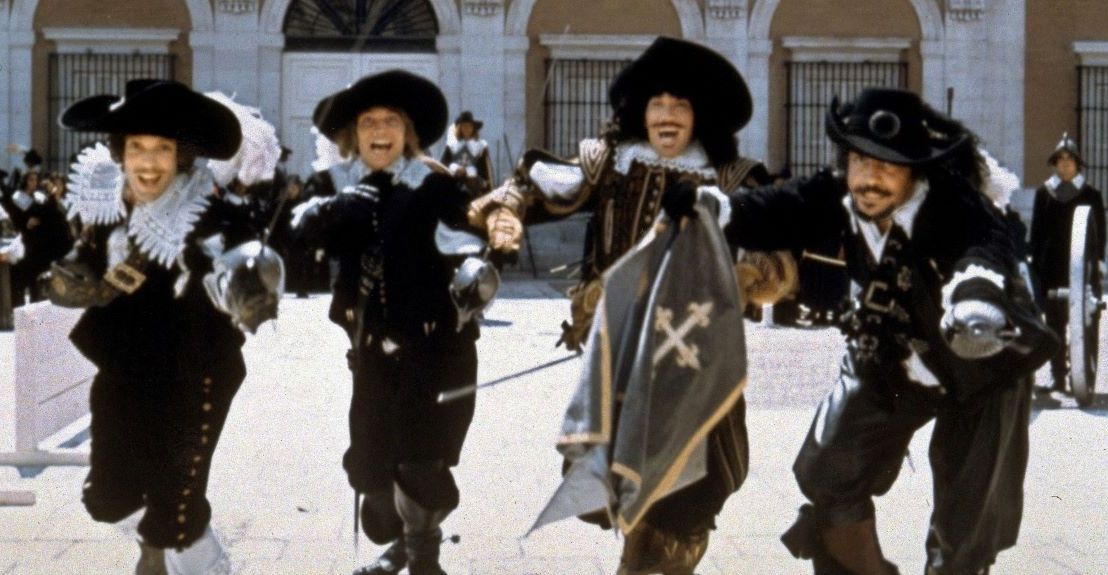
All for one and one for all! The Three Musketeers is probably the greatest adaptation of Dumas’ rollicking classic, a wonderful mix of swashbuckler, romance and Hellzapoppin comedy, that never takes itself particularly seriously and is crammed with actors having a whale of a time. It’s not quite a send-up, but it’s also not quite a straight re-telling either. Instead, it’s gunning all-out for entertainment – and it succeeds most of the time.

d’Artagnan (Michael York) arrives in Paris in 1625 desperate to join the musketeers. After various adventures along the way – including a rivalry with suavely villainious Rochefort (Christopher Lee) – the impulsive young man forms a friendship (after bumps in the road) with the famed musketeers Athos (Oliver Reed), Porthos (Frank Finlay) and Aramis (Richard Chamberlain). Falling in love with the unhappily married Constance (Raquel Welch), maid to Queen Anne (Geraldine Chaplin), d’Artagnan and his friends are dragged into foiling a plot by the ambitious Cardinal Richelieu (Charlton Heston) to use the ingenious Milady de Winter (Faye Dunaway) to expose the Queen’s infidelity with the Duke of Buckingham (Simon Ward). Will our heroes manage to foil the scheme in time?

The Three Musketeers adapts the first third or so – the most famous and by far the most enjoyable part – of Dumas’ novel. With an irreverent script by Flashman author George MacDonald Fraser, its framed as a rollicking romp with a tongue-in-cheek humour. Richard Lester, famed for his cheeky Beatles comedies (and the film was originally envisaged as a vehicle for the Fab Four), added his trademark scruffy, opportunistic comedy.

The film is awash with muttered asides – many of them well delivered by Roy Kinnear’s exasperated servant Planchet – that are only just picked up by the sound mix. My favourite? d’Artagnan bursting into a room full of guards, yanking a rug with a yell in an attempt to upend them, succeeding only in tearing the corner off it, then immediately jumping out of a window, leaving the bemused guards one of whom plaintively mutters “He’s torn our carpet” – I find this funny on multiple levels, from York’s all-in energy to the stillness of the shot, to the underplayed sadness of the punchline.

Lester’s film is full of long-shot gags – passengers in litters being dropped in a lake, d’Artagnan swinging on a rope to knock someone off a horse, missing and falling in the mud or his jump from a third storey window only to immediately reappear having landed on a (anachronistic) window cleaner cart. While the film does have its moments of drama, danger and intensity, it doesn’t ease up on visual humour, or gags (“This ticket is for one man” “I am one man. This is a servant”). It’s all part of Lester’s plan to make a fast-paced, pantomimic entertainment in which nothing is intended to ever be too serious.

It’s all played with maximum commitment by the cast, all of whom buy into the films’ tone. Michael York leaves very little in the locker-room with a performance full of youthful bravado, lusty hurrahs and naïve, winning eagerness. It’s a very hard balance to get right but he is never overbearing, but provides a relatable, likeable lead. He’s physical commitment to a series of Buster Keaton style gags is also commendable. He sparks a rather sweet romance with Raquel Welch, who is not the world’s strongest actress, but gamely delivers a series of pratfalls as the eternally clumsy Constance.

Around these two, a series of experienced actors delight in larger-than-life roles. Reed brings a surly intensity to Athos, a reminder of how great a career this charisma laden actor could have had. Finlay gives a Falstaffian joie de vivre to Porthos. Chamberlain (with little to do) strikes a gamely romantic figure as Aramis. As the baddies, Heston clearly enjoys subverting his grandiosity as the scheming Cardinal, Dunaway has a kittenish sensuality as Milady and Christopher Lee is so perfect as the debonair Rochefort that his eye patch (unmentioned in Dumas) has become de rigour for every Rochefort performance afterwards.

The Three Musketeers is crammed with swashes being buckled. The sword fights come thick and fast and are all shot in a series of impressive locations (the camera work of David Watkin, design of Brian Eatwell and costumes of Yvonne Blake do a wonderful job creating a sumptuous period setting). At times they do look a little ragged today – producers the Salkinds ran a tight budget, and there are multiple reports of the slightly-under-rehearsed fights leading to near-serious injury (this slapdash preparation would lead to tragic consequences when Roy Kinnear was killed on the belated second sequel 15 years later). But the actors enter into them with a firey commitment (a little too much so in Reed’s case according to the terrified stuntmen) and rumbunctious energy that really sells these as gripping action. They are also give a certain air of peril that gives just enough weight to the film.

The Three Musketeers has moments of dated clumsiness – the bizarely arty slow-mo opening with blurred motion feels totally out-of-keeping with the rest of the film – and not all the jokes land (Spike Milligan in particular is completely over-indulged in the film’s least successful comic moments). Not every performance works – Chaplain in particular is weak as Anne of Austria – and not all the jokes pay off. The musical score by Michael Legrand, catchy as it is, sometimes overeggs the “isn’t this all such fast-paced fun” angle. But the stuff that lands, really does well and there is more than enough fun, action, adventure and rollicking good humour to keep you entertained on a weekend afternoon.

And then there were two (or rather four)

There is always a twist in the tale. At some point while making The Three Musketeers the Salkinds realised they would never get it ready for the Paris premiere. But they could get half the film ready. So, they released that and cheerily announced at the end a sequel was already in the can. Problem was no one had mentioned it to the cast, who discovered they had shot an entire movie for free. A court case exploded, which the Salkinds lost, settling with actors and leading to a new clause being inserted into all contracts for actors preventing such a dodge happening again.

The Four Musketeers covers the second, less famous, much less fun part of Dumas’ novel. Rather like novel, it’s a rambling affair that lacks the compelling narrative thrust (We’ve got to get those diamonds and save the Queen!) which made The Three Musketeers so entertaining. It doesn’t help that its also considerably darker, serious and bleaker as bodies pile up and things get serious.

This makes the sequel a very different beast to the first. Energetic heroism prevented villainy in the first film, but here it often fails . Milady (Faye Dunaway) has sworn revenge and is ordered by Cardinal Richelieu (Charlton Heston) to assassinate Buckingham (Simon Ward). Along the way she kidnaps Constance (Raquel Welch) and seduces d’Artagnan (Michael York) seduced. The Musketeers rescue Constance, fight at La Rochelle and do their best to defend Buckingham – but nothing goes to plan, especially after Athos (Oliver Reed) realises Milady and his criminal ex-wife (thought dead) are one-and-the-same.

The Four Musketeers keeps up the humour, but it is frequently at odds with the darker film it sits in. Gone is the high-paced musical score of Michel Legrand, replaced with a lyrical series of melodies by Lalo Schifrin. It’s telling that Welch – whose comic clumsiness was a large part of the first movie – appears only briefly here. Similarly, Cassell’s shallow monarch (dubbed by Richard Briers) pops up just once, Roy Kinnear’s Planchet isn’t in the first hour and Spike Milligan’s free-wheeling improvisation is missing completely (in that case, no bad thing).

The film feels tonally at odds with the first film and even, at times, with itself. The Three Musketeers was full of sword fights but no deaths – here sword strokes are lethal. As the Musketeers comically bounce around at La Rochelle sight gags abound – but it feels at odds with a film where the death is very real. The more realistic feel means some set pieces – such as Rochefort and d’Artagnan fighting on an inexplicably frozen lake in the height of Summer – become harder to swallow.

Some performers do flourish. Oliver Reed comes into his own as an increasingly dark and vengeful Athos, giving into temptations of shocking revenge. Faye Dunaway laces her role with cold, murderous fury. They have most of the film’s most compelling scenes – but the incredibly dark ending (which involves our heroes actively perpetrating judicial murder with a terrified victim) while loyal to the book, feels far too heavy for a pair of films that started with Buster Keatonish comedy.

The loyalty to the book and the commitment to follow it is partly to blame. There is a reason why most adaptations chuck away this section of the book. It lacks a clear narrative line for emotional connection and is highly episodic. d’Artagnan, in the book, does indeed sleep around after Constance disappears – but when the film requires their relationship to be the emotional heartbeat, is it a good idea to have him jump into bed with two women within days of her disappearance?

Lester announces the more sombre parts by filming them in a very framed, artful way inspired by the old masters, with a static camera and medium shot, reliant on Schifrin’s maudlin music. He’s far more at home with the comic business delivered by Finlay (very good) and Chamberlain (still with nothing to do). At other points he surrenders initiative to legends like Heston (suavely menacing), Lee (whose Rochefort steps up a level in lip-curling contempt) and Dunaway.

The finest thing on display are the sets and the sword fights, which are even more desperate, ragged and violently dramatic than last time (when Rochefort and d’Artagnan stop in one to take a breath, you are not remotely surprised given the total commitment we’ve seen). The action set pieces all look really impressive and staged with confidence and brio. It’s just a shame that much of the rest of the story feels like its being told by a natural comic trying hard to be King Lear, but not able to resist throwing a few gags in. It makes for an entertaining, but tonally messy film that feels it has come from a totally different place than its flawed but fun predecessor.

John Wick: Chapter 4 (2024)

John Wick: Chapter 4 (2024)

It’s got almost no plot but what it does have is mesmeric, balletic fighting – for three hours

Director: Chad Stahelski

Cast: Keanu Reeves (John Wick), Ian McShane (Winston Scott), Donnie Yen (Caine), Bill Skarsgard (Marquis Vincent Bisset de Gramont), Laurence Fishburne (The Bowery King), Clancy Brown (The Harbinger), Hiroyuki Sanada (Shimazu Koji), Shamier Anderson (Mr Nobody), Lance Reddick (Charon), Rina Sawayama (Shimazu Akira), Marko Zaror (Chidi), Scott Adkins (Killa Harkan), Natalie Tena (Katia)

John Wick (Keanu Reeves) wants revenge against The High Table, the shadowy criminal organisation that (for various reasons) wants to punish him for various transgressions. The High Table are raising the stakes, giving the psychotic Marquis (Bill Skarsgard) carte blanche to destroy John, including levelling the Continental hotel of John’s ally Winston (Ian McShane). With destruction all around him, hunted by two deadly assassins the blind (and old friend) Caine (Donnie Yen) and the relentless dog-loving Nobody (Shamier Anderson), John’s only chance of survival is an arcane ritual duel between him and the Maquis.

John Wick: Chapter 4 is, in many ways, less a film and more an experience. Over stretched at nearly three-hours, its effectively three mammoth fights scenes (in Osaka, Berlin and Paris) loosely stitched together with a plot that doubles down on the arcane ritual of the franchise’s criminal underbelly. It was also a massive hit, the franchise’s biggest yet. Why? Because John Wick: Chapter 4 speaks a little bit to all of us who are bored with endless big-budget, special effects filled action films where nothing is real.

In John Wick: Chapter 4 you watch real people – stunt men and actors who have clearly trained for eons – set about a series of awe-inspiring action set-pieces with stunning realism. There is the same visceral thrill of watching Reeves dish out beatings as there was watching Gene Kelly dance steps: in both cases we are watching a master at work, turning his expertise into cinematic realism in front of our eyes.

So, in some ways, it doesn’t matter there is no real plot in John Wick 4 or that the characters are lightly sketched. Because we are here for elaborate, stunt filled fight scenes in the Osaka Continental. To see Donnie Yen move with the fluidic grace of a ballet dancer. To be gripped by Reeves punching his way through a brutal brawl with a fat-suit clad Scott Adkins (a martial arts superstar himself) in a neon lit Berlin nightclub. To watch Reeves fight his way up the Rue Foyatier steps, fall back down them, then fight back up again. Why these things are happening doesn’t really matter. It’s about the beautiful realism of watching actors actually do them.

That’s what powered this film to a record-breaking haul. Its why Reeves spent time in development, Steve McQueen like, ripping lines out of the script (he says little more than 500 words in the whole three hours). Who wants to see a monologue when a Reeves weary half-shrug on having to fight his way back up those stairs speaks volumes? When we need a break from the action, the script throws in some tense verbal show-pieces that Skarsgard chews up as a politely psychotic bully or McShane and Fishburne riff on with cod-Shakespearean grandeur.

It’s all thrown together with a great deal of style by Chad Stahelski, who has grown in cinematic confidence the more of these films he has directed. It takes some balls to effectively open the film with a homage to one of the most famous edits of all time from one of the greatest films ever made, as Fishburne blows out a match to cut to the desert sun rising. But then, I’m here for a film that wears its love for Laurence of Arabia on its sleeve (and even shoots a sequence on the actual location of Lean’s classic). Alongside this, Stahelski continues to find new ways to shoot this mayhem: from tracking shots, Steadicam immediacy to a sprawling birds-eye view (inspired by computer games) that tracks Wick taking out a building full of baddies.

There are a few thematic links in the film that brings the series full circuit. Wick’s two frenemies are reflections of himself. Donnie Yen – very cool – reflects Wick’s love for family, with his “doing the bare minimum” actioning to protect his daughter, while Shamier Anderson’s softly-spoken Nobody reflects Wick’s famous dog love. John Wick: Chapter 4 also hints at the existential crisis of its hero – when you are literally taking on the entire criminal world, leaving hundreds of bodies in your wake, what chance is there that this will ever end?

It’s these little grace notes that keep the film grounded enough for us to care about Wick while he slices his way through another army of thugs. But it’s not why you are there. John Wick 4 can easily – perhaps best – be watched in chunks. Soak in one action scene, have a breather, and then throw yourself into another. Because these are some of the best, coolest, most relentless action scenes you will ever see, executed with a stunning skill. And that is what differentiates John Wick at a time when everything else feels sterile. There might be far too much of it, but at least it is life.

Hardcore (1979)

Hardcore (1979)

Familiar ideas from better films are mixed together in this revenge thriller

Director: Paul Schrader

Cast: George C Scott (Jake van Dorn), Peter Boyle (Andy Mast), Season Hubley (Niki), Dick Sargent (Wes De Jong), Leonard Gaines (Bill Ramada), Dave Nichols (Kurt), Gary Graham (Tod), Larry Block (Detective Burrows), Ilah Davies (Kristen van Dorn), Marc Alaimo (Rattan)

A man prowls the urban streets, his face fixed with disgust at their degeneration, looking for a soul to save, the whiff of potential violence strong on him. He hunts for a lost family member, in an obsessive quest where it’s not even sure he will want to take her back even if he finds her. If that makes Hardcore sound like a remix of Taxi Driver and The Searchers… well that’s because it is. Schrader’s film is a well-made, initially well-executed riff on familiar themes that eventually tries to settle for something far easier to digest, with an ending that stinks of a shallow Chinatown.

Jake van Dorn (George C Scott) is a devoutly Calvinist businessman in Michigan. A single father, whose wife has left him, his beloved daughter Kristen (Ilah Davies) disappears one day after a church-sponsored visit to California. Van Dorn leaves no stone unturned to investigate, eventually hiring sleazy PI Andy Mast (Peter Boyle), who discovers an 8mm porno film starring Kristen. Was she kidnapped? Is she in danger? Van Dorn will find her, throwing himself into the seedy world of porn in an obsessive quest where no line will be uncrossed until he brings his daughter home.

There are many things to admire in Hardcore. Shot by Taxi Driver veteran Michael Chapman, it’s immersive seedy view of the underbelly of California is extremely striking. Schrader also quite neatly counterpoints this with the picket-fence conservatism of van Dorn’s stomping grounds at home. Van Dorn starts as a man who expresses hesitation that a shade of blue in his office might be too garish, and ends donning fake wig and moustache alongside loud shirt to pass as a porn baron.

What’s interesting about Hardcore is that, even though its actually Schrader’s second film, it feels like an over-anxious debut. It’s blatant stylistic and thematic call-backs to Taxi Driver­ – hammered home as we watch van Dorn cruise the streets of California, the porn shops and theatres neon signs reflected in his windows – makes you feel Schrader wished he had held on to the rights to direct that film himself. It’s extremely on-the-nose pinching of most of the structure of The Searchers feels like a loving tribute from a director yet to find his own voice.

Schrader however does an excellent job with much of the film’s first half. The oppressive tension build-up from the moment Mast arrives (Boyle’s casting, of course, being another eerie reminder of Taxi Driver) really grips. Scott’s stunned, shattered and increasingly appalled, primal reaction to watching his daughter in a porno is delivered with the sort of gusto and commitment that only a great actor can pull off. His increasingly-obsessive, won’t-take-no-for-an-answer delve into the world of porn – from knocking shops to porn film sets – has just the right sense of van Dorn slowly developing into a time bomb that could go off, while never losing our sympathy.

Hardcore is contemptuous of porn. Sharing van Dorn’s perspective of the industry, the film cements the industry as being based in a Danteish circle of hell, with violence, exploitation and misery round every corner. Schrader also enjoys poking fun at the porn industry and the film industry (a flashy porn director trained at UCLA, much like Schrader’s contemporaries). Searching for witnesses, van Dorn sets up fake auditions for a new porn movie, attended by a series of optimistic, hopeful guys with show reels and CVs. The money-first producers look and sound like any other Hollywood executive – it’s just they openly trade in skin.

The problem is Hardcore can’t settle for this: as if worried that poking some fun at the seedy industry might get in the way of us relating to the gut-punch horror van Dorn feels. In the second half, Schrader sets up (out of the blue) a snuff film premise, with an anonymous big bad behind it all (a figure so undeveloped that the most interesting thing about him is he’s played by Marc Alaimo who played Deep Space Nine’s villain Gul Dukat) just so we can have someone so obviously unspeakable that we have no mixed feelings at all when the violence kicks off.

Which is a shame because Hardcore looks, for a moment, like it is about to go somewhere more interesting. Van Dorn is broken from his obsessive focus only by meeting with Niki (played with just enough ballsy cuteness by Season Hubley), a girl on the margins of the industry dreaming of an escape. The two of them are drawn together in unexpected ways: she respects his religion in a way no-one else does, while van Dorn becomes the only man who doesn’t see her as a sex object, treating her with a fatherly gentleness you suspect he never showed his actual daughter. The film’s ruthless jettisoning of this plotline strives for hard-nosed reality, but ends up feeling like a too obvious attempt at pathos.

Despite all this Hardcore has its moments, not least thanks to George C Scott’s fire-cracker performance in the lead. Scott may have hated Schrader (allegedly begging him to never direct a film again), but he breathes life into this Ethan Edwards-Travis Bickle clone, making van Dorn just the right mix of pained, aggrieved and dangerous. Unfortunately, the film settles for something far more conventional, a revenge thriller with an obvious and inarguably horrible character created solely to make us feel good when he is dispatched.

The Piano (1993)

The Piano (1993)

Searing emotion, passions and fascinating enigmas abound in Campion’s brilliant landmark masterpiece

Director: Jane Campion

Cast: Holly Hunter (Ada McGrath), Harvey Keitel (George Baines), Sam Neill (Alisdair Stewart), Anna Paquin (Flora McGrath), Kerry Walker (Aunt Morag), Genevieve Lemon (Nessie), Tungia Baker (Hira), Ian Mune (Reverend), Peter Dennett (Head seaman), Cliff Curtis (Mana)

What’s really striking about The Piano is how literary it feels, despite the fact it’s an entirely original cinematic work. Every moment of Campion’s intelligent, beautifully constructed, often enigmatic and unreadable film feels like it has been plucked from the pages of a lost Booker Prize winner. Juggling themes of feminism and sexual awakening alongside colonial and masculine thinking, it’s a richly beautiful film awash with superb performances and a heightened, literary reality buried inside a film grounded in the mud and squalor of reality. It remains Campion’s finest achievement.

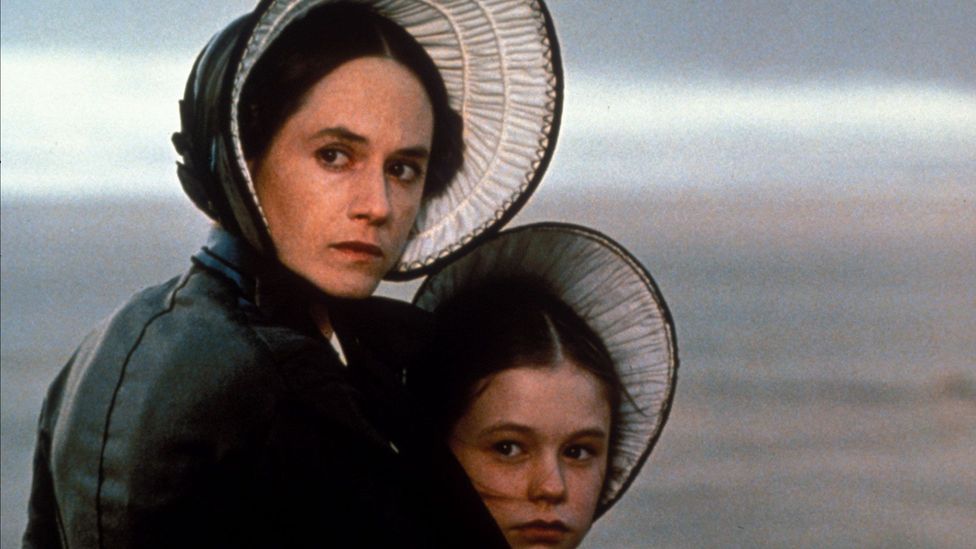
Ada McGrath (Holly Hunter) and her nine-year-old daughter Flora (Anna Paquin) arrive on the coast of nineteenth-century New Zealand. Having refused to speak since the age of six, Ada communicates through sign language and the precocious Flora. Silent in person, her treasured piano gives her a voice and allows her to express passions she otherwise keeps carefully controlled. Ada is to marry landowner Alisdair Stewart (Sam Neill), but he baulks at carrying the huge piano from the shore to his home through the forest. Instead, it falls into the possession of neighbour George Baines (Harvey Keitel). George, besotted with Ada, offers her the chance to earn it back one key at a time, in return for allowing him to “do things” while she plays it in his house. The arrangement leads to a complex, sexual love triangle between Ada, George and Alisdair that will see passions explode.

I wonder sometimes if The Piano is a bit of a problem for some campaigners today. You can discover plenty of retrospective reviews that find it hard to mask their disappointment that the film doesn’t offer a more pointed condemnation of its two male characters. Many want The Piano to show Ada rejecting Alisdair as a repressed potential rapist and George as a manipulative sexual predator. But Campion is telling a far more nuanced, feminist story than this easy-to-swallow structure. The Piano is not about pigeon-holing people into easily definable roles. Rather it looks at how unexpected bonds can rise and how darker, deeper passions can flair in unexpected ways.

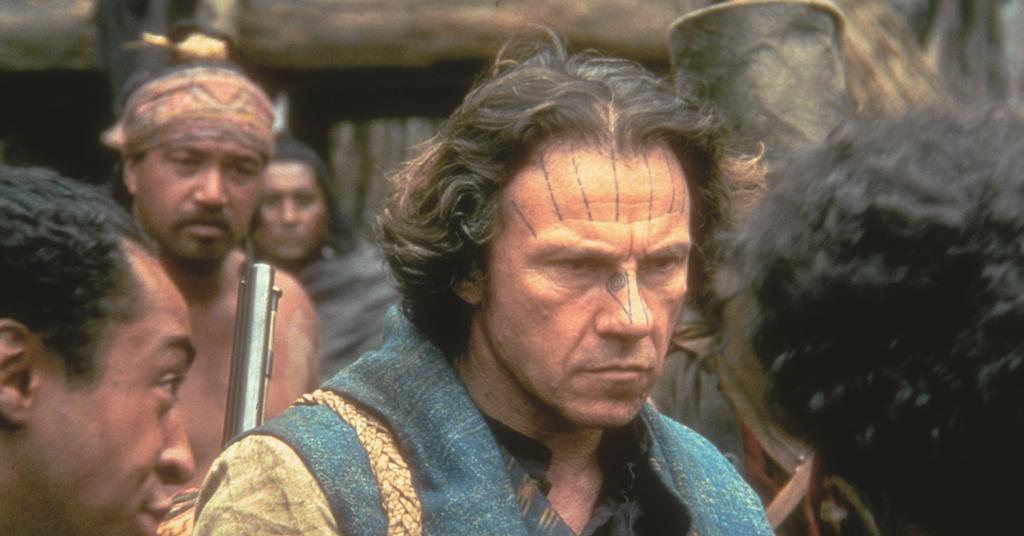
Because George’s at-first manipulative, outrageous offer actually awakens something unexpected in Ada. George is perfectly played by Keitel as outwardly a lump of inarticulate, labouring flesh but inwardly far more sensitive and strangely poetic – and his desire is based as much on a curious romantic longing and a sensitive fear of rejection. His requests are often based around the briefest of physical touches, the desire to see Ada’s shoulders and legs. He’s timid, shy and becomes increasingly open about his feelings for her.

Even more strikingly, Ada discovers that (after initial shock) she enjoys the bartering negotiation of the arrangement (offering more in-depth contact for a higher number of keys) and finds her ability to provoke desire in George both sexually liberating and exciting. So much so that, when George ends the arrangement (recognising that he cannot get what he really wants – Ada’s love – as long as it stands), her reaction is one of anger, more like a spurned lover, then a relieved victim.

This simmering desire is at the heart of Campion’s passionate work. Rewatching it’s striking how vital touch is in the film, how much it is linked to emotional and sexual connection. Campion focuses in extreme close-up on George stroking Ada’s skin through a tiny hole in her stockings – to her initial shock and increased pleasure. The slightest contact of hands between these two carries an emotional and sensual charge. It’s exactly the lack of this that becomes impossible not to notice in the relationship between Ada and Alisdair. Contact between them is minimal and when it occurs it carries darker meanings: most obviously the impotent, frustration Alisdair half-heartedly uses with Ada, then in the rain-soaked fury he will unleash when her betrayal is revealed.

Ada increasingly uses touch to control. She caresses and strokes Alisdair’s naked body at night – never allowing him to touch her in return – both to manipulate him but also, partly, to satisfy her own newly-discovered itch for sexual power, just as she grew to give herself over totally to the hold she had over George. Dressed in restrictive black, that covers almost her whole body, The Piano is about a flowering of a newly confident and sexually awakened woman from a repressed shell.

The language of the body ties into this. Campion reverses the expectations of nudity. Instead, it’s the male form of George we first – and almost predominantly – see. It turns this physically imposing man into someone vulnerable and sensitive. Like a romantic lover, he cleans the piano naked. He will reveal his body to Ada with shyness. When they first make love, he focuses on her pleasure rather than his own. He contrasts with the stiff-backed Alisdair, trapped in his formal clothes (compared to George’s indigenous tattoos and garments) who, even when Ada seduces him, uncomfortably tries to pull his trousers up over his bare buttocks.

Alisdair – superbly played by Sam Neill in a challenging role – is not a bad man, just a deeply unimaginative, repressed and self-satisfied one. He sees a woman’s duty as wife and nothing else. Just as he can only see the Māori on the land around them as simple savages, clinging to naïve superstitions (he cannot understand why they do not wish to sell or farm the land their ancestors are buried on), so he can find no common ground with Ada. He’s even subconsciously aware the piano is a means of emotional expression she refuses to share with him, causing him to do everything he can to remove it from his house with the same loathing he would have for a rival. But he’s also a timid, needy soul – witnessing George and Ada coupling, he watches from his concealment with a curious mix of envy, longing and sadness at something he will never have.

The Piano places Ada at the centre of this complex junction of feelings and emotions. Played with awards-laden brilliance (including the Oscar) by Holly Hunter, this is a woman who never speaks but whose complex emotional journey is always clear. Stubborn, difficult and demanding, we learn this is defence mechanism against a world she has so cut herself off from, so much so she has literally refused to speak for decades. Her piano is the only outlet she allows herself in a world with strict rules for women. Finding something alternative to this is a frightening and alluring prospect.

It’s one not necessarily understood by her daughter Flora (a brilliant Oscar-winning performance by Anna Paquin) who is so precocious in some ways – forcefully communicating her mother’s wishes – and so young in others. Flora understands little – with fateful consequences – of the emotional and sexual tangles around her and, like a child, often accepts the path of least resistance. She also sees the strong bond between mother and daughter as threatened by the presence of George – in a way she cannot comprehend, even after spying their intimacy together.

Campion’s film superbly ties these literary themes into a film of complex enigma and aching beauty (it’s beautifully filmed by Andrew McAlpine). The film is aided enormously in its emotional charge by the radiantly lyrical score by Michael Nyman (his distinctive sound makes the film sound like the finest film Peter Greenaway never made). The Piano offers challenging, thought-provoking and intriguing scenes at every turn, powered by a brilliant script and wonderful performances. Avoiding the obvious, it’s power and reputation has rightly only grown in the decades since its filming.

Ivan the Terrible Parts 1 & 2 (1944/46)

Ivan the Terrible Parts 1 & 2 (1944/46)

Eisenstein’s final film sees him bravely turn Stalin’s dream project into a criticism of his whole regime

Director: Sergei Eisenstein

Cast: Nikolay Cherkasov (Ivan Vasilyevich ‘the terrible’), Serafima Birman (Efrosinia of Staritsa), Pavel Kadochnikov (Vladimir of Staritsa), Mikhail Zharov (Malyuta Skuratov), Amvrosy Buchma (Alexei Basmanov), Mikhail Kuznetsov (Fyodor Basmanov), Lyudmila Tselikovskaya (Tsarina Anastasia), Mikhail Nazvanov (Prince Andrew Kurbsky); Andrei Abrikosov (Philip, Metropolitan of Moscow)

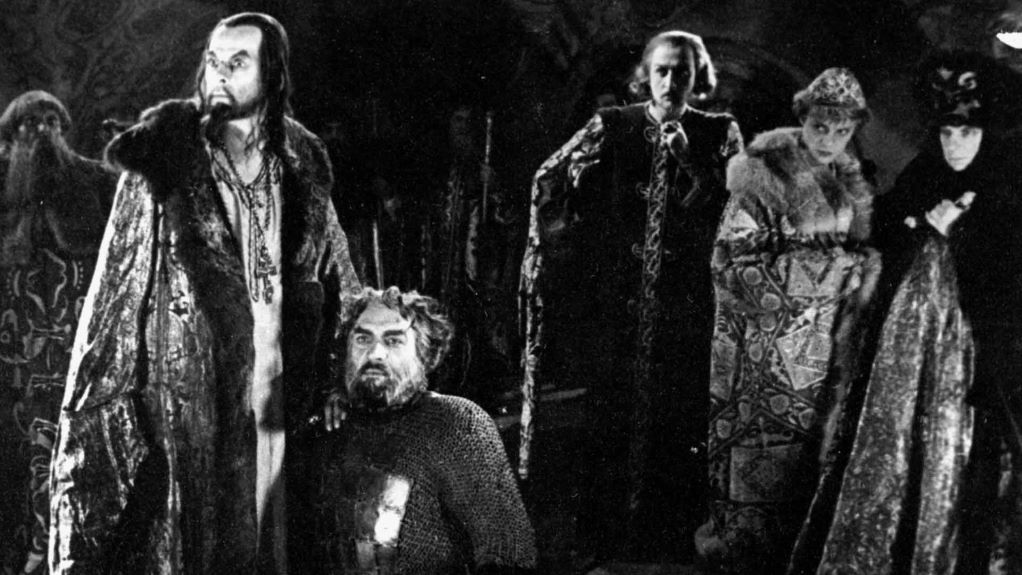
The Soviet Union is at war, but Sergei Eisenstein is riding high. Fully restored to favour with the powers-that-be in the USSR with his flashy-but-traditional propaganda pic Alexander Nevsky, the master-of-the-montage was personally selected by Stalin to direct a three-part epic on the dictator’s hero, Ivan the Terrible. (You might wonder what attracted the paranoid, bloodthirsty dictator to a strong man Tsar best known for ruthless purges…) Stalin wanted an epic painting Ivan as a hero, who sometimes did bad things for the right reasons, all wrapped up in a neatly accessible package.

And he almost got it. Part 1 was met with acclaim and the Stalin Prize. Presenting Ivan as a successful politician and soldier, a true strong man binding the nation together and winning the admiration of his people, outfoxing his enemies at court (even though they successfully secretly murder his wife Anastasia), who retreats into Cincinnatus-like retirement only to be dragged back to save the country. It was the General Secretary’s wish-fulfilment wet-dream. Then came Part 2.

Part 2 was was immediately locked away in the vaults and all work on Part 3 ended instantly (every frame of footage shot was burned). If Part 1 was the dictator’s ideal Ivan-as-Stalin, then Part 2 was Ivan-as-Stalin that he definitely didn’t want to see. Now Ivan was ‘the Terrible’ doubling down on his nickname. Even worse, he did this while appearing unhinged, paranoid or (worst of all) manipulated by his poisonous advisors, none more so than jovial Beria-like Malyuta Skuratov (Mikhail Zharov). This Ivan rubbed out opponents, used terror as tool and focused all his anger and vengeance on those around him. Not something Stalin wanted to see, or was going to let anyone else see. Part 2 only emerged in 1958 ten years after Eisenstein’s death and 5 years after Stalin’s.

What the world ended up with, after they were allowed to see it, is a strange and hard-to-categorise film which has divided opinion for decades. To some it’s an artistic masterpiece, a triumph of symbolism and suggestion, with every shot crammed with intelligent and informed call-backs to artistic, psychological or sociological thinking. To others, it’s a somewhat turgid, hard-to-follow mess that serves as final expression of Eisenstein’s lack of interest in plot and character, not helped by his directions to the cast to echo Japanese theatre Kabuki style acting full of striking poses.

But you can’t deny the courage it must have taken Eisenstein to make this film. To have the guts to present something that deviated away from what history’s most ruthless dictator wanted and try and locate in it an unavoidable (if soft-pedalled) criticism of Stalinism. And can you blame Eisenstein if he tried to hide some of this behind art references and psychological games? Ivan the Terrible isn’t exactly easy – or fun – watching, but sometimes you just need to tip the hat to someone who has the guts to do things like this.

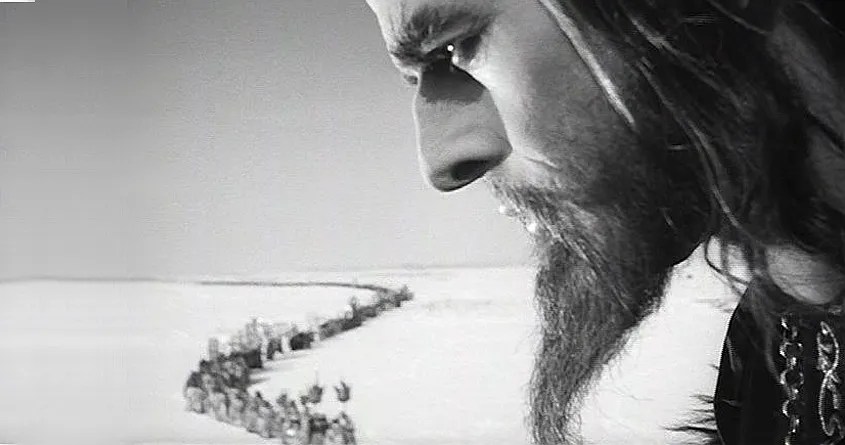
And there is plenty to admire in it. Eisenstein isn’t always recognised for his ability with the composition of shots – after all he’s the fast-cutting director’s dream – but Ivan the Terrible plays right back to his roots as a painter and designer. There are gorgeous shots here, my favourite being a looming close-up of Ivan’s face while behind him a never-ending procession of Russians slog through a white-out landscape to beg him to take back the throne. Ivan’s palace is a subterranean series of mole-like caverns, lavished with truly striking (and highly symbolic) devotional art. Firey angels are plastered across the walls above Ivan while plotting Boyars are shot huddled under mighty frescos of Death. The shadow work is extraordinary: light casts imposing, monstrous, giant black curtains. Astrolabe shadows dominate walls and advancing figures cast mighty shady pools in front of them.

Eisenstein takes his montage and arty suggestiveness of his editing work in Battleship Potemkin and October and translates it into images. The images do the work his banned formulist leanings had. Every image is rigidly thought-through and designed to make a specific implication or inference. It turns Ivan the Terrible into something ripe for analysis and exploration, the sort of film you could happily spend hours deconstructing.

It’s a film crammed with symbolism – some of it, if I’m honest, a little too clever-for-its-own-good. There are references to the work of Holbein, Botticelli, Rublev and a host of mythological figures. Sexual imagery is thrown in with blasting cannons at the siege of Kazan. It uses mirroring and contrasts throughout. Ivan’s coronation that opens in Part 1 will be echoed in a mock coronation of his would-be successor Vladimir (a fine performance of child-like simplicity and sweetness from Pavel Kadochnikov) in Part 2. As a child, Ivan will witness the death of his mother caught in the light of the doorway, very similar to the light in the doorway Vladimir will walk through to his death.

Characters are constantly positioned in framing that suggests (or hammers home) their personalities, motivations and desires. Vladimir will be cradled in his arms in a confessional Freudian clinch with first his mother and then (in an identical shot) with Ivan. The mock jovial Malyuta is given the physicality of the faithful dog he claims to be, while the villainous Efrosinia (a pantomimic, hissable Serafima Birman) rises from the ground like the serpent she feels like in almost every scene. Most of these characters are drawn in the broadest, most unsubtle strokes. It makes for some laughably unsubtle moments, but also a sort of primitive energy.

Unfortunately, it is also a film that dumps traditional narrative and characterisation for something highly stylised and impressionistic. Nowhere is this clearer than in Nikolay Cherkasov’s performance as Ivan. Constructed of a series of wild-eyed poses that would not look out of place in a silent movie, this is an over-the-top performance of hyperbolic mannerisms that probably has to be seen to be believed. There is nothing natural about this at all. It is all deployed to create a series of artistic poses and effects: what it is not designed to do is create a character we can relate to or understand.

Maybe this is how Eisenstein hoped to get away with implicit criticism of Stalinism? Ivan endorses the purges that happen, but we don’t seem him organising and initiating them. Was that, to Stalin, the worst crime of all – after all a strong man leads, even if his leadership is cruel. It’s also why, perhaps, he turned Malyuta into a jovial fixer (nevertheless Mikhail Zharov gives the film’s finest performance) rather than the ruthlessly ambitious killer he was. Part 2 shows an Ivan who allows executions not just out of ruthless paranoia but also a weakness of personality. Of all things, Stalin couldn’t take that.

Ivan the Terrible rockets along with very little sense of time, narrative or coherent, logical sense. Between the first and second scenes not only do years go by, but Cherkasov’s appearance changes so much it will take the viewer a few minutes to work out who he is. Characters sometimes go several scenes without being named. There is a Shakespearean pace to the narrative, even if it frequently flies over events, motivations, timescales and locations so quickly it’s hard to follow. It’s highly stylistic acting styles frequently make it hard for modern audiences not to raise a snigger.

Eisenstein was perhaps a little too keen to be seen as an artist, and Ivan the Terrible is at times – a bit like October – watching an overly enthusiastic art student showing you just how clever they can be. But, for all that, it’s intriguing and even if it’s not exactly entertaining, it offers many opportunities for intriguing analysis. And the very fact he dared to make a film that criticised Stalinism and then show it to Stalin is always going to be worth something.

Beau Travail (1999)

Beau Travail (1999)

Denis poetic, art-house classic is intense, searing and transformative, crammed with beautiful images

Director: Claire Denis

Cast: Denis Lavant (Adjudant-Chef Galoup), Michel Subor (Commandant Bruno Forestier), Grégoire Colin (Légionnaire Gilles Sentain), Richard Courcet (Légionnaire), Nicolas Duvauchelle (Légionnaire)

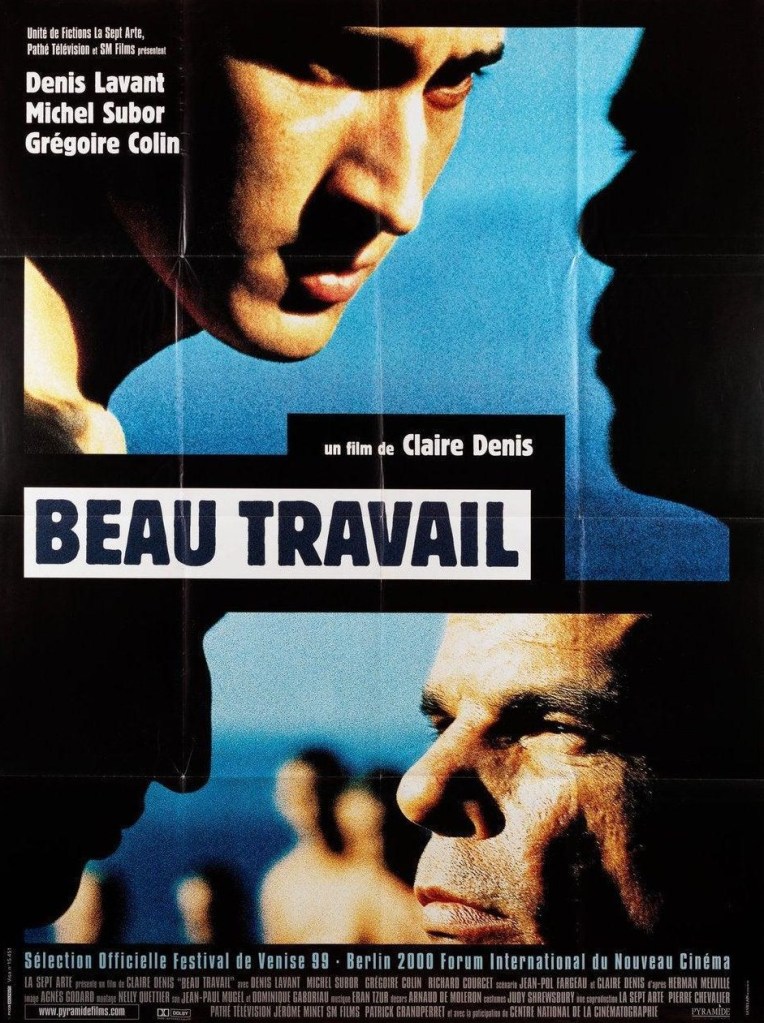
I think it’s fair to say Beau Travail will not be to everyone’s taste. For every person (a bit like me) who comes out of the film humming ‘Rhythm of the Night’, they’ll be another who will never have made it far enough into the film to even understand why anyone would. Denis’ poetic film, shot like a combination of art project and choreographic exercise almost wilfully foregoes plot and character in favour of experience. Framed around a voiceover that could be almost anything from a diary, to a letter to a suicide note, Beau Travail is a film that wants you to be as uncertain about its aims and intents, as its lead character is about his own.

Denis’ film is a remix of several literary sources, most notably Melville’s Billy Budd – though you can also make a case that there is more than a trace of Othello in there. Set in a French Foreign Legion unit based in Djibouti under the command of veteran Forestier (Michel Subor), our focus is his Adjudant-Chef Galoup (Denis Lavant). Galoup is a rigid stickler for duty and an obsessive legionnaire, distant from those around him. He takes an almost instant, irrational, dislike for new recruit Sentain (Grégoire Colin) who can form easy rapport with those around him. Galoup schemes to destroy Sentain. In a framing device, Galoup recounts the story having left the Foreign Legion.

It should probably be restated that this brief summary of the plot pretty much covers every detail in this brief but poetically open-ended film. It takes over a third of the film’s runtime for the unexplained conflict at the film’s heart to even begin and Denis scrupulously avoids anything you could categorically call an answer. Which in a way is an answer in itself. Because Beau Travail is, it is easy to forget, a memory piece. It’s framed with Galoup remembering his career in the Foreign Legion, and everything we see in the film is filtered through his recollections. How reliable are these? How much do the strangely intricate, beautifully choreographed desert training sequences reflect reality and how much are they the result of an unreliable narrator?

Perhaps Galoup’s motiveless loathing for Sentain is rooted in his own inability to understand himself and his own longings. Embodied in a performance of immense physical exactitude by Denis Lavant, Galoup is a tightly drawn spring, a mass of careful, well-chosen movements. He’s naturally content with the labours of the French Foreign Legion: scrupulously ironing creases into his clothes, making his bed with careful perfection, striding through the desert wilderness. At the nightclub with his men, he’s a distant observer – he can’t even really take part in their campfire sing-alongs. He only finds physical ease in their ritualised training sequences.

These training sequences are extraordinary, more like Gene Kelly dance sequences than anything you might associate with training. While in the dance clubs the men are awkward movers, on the training field they have sinewy grace. Ritualised fight training sees their bodies move through pre-set positions with a striking, musical beauty. Even back and leg stretches see twenty men moving with perfect co-ordination in the desert sand, leaving matching trails in the dust.

There is a reason why the title translates as Beautiful Work. The film is a continual stream of military tasks in the desert, most of which seem pointless. Camps are built, holes are dug, rocks are smashed. It’s combined with a series of domestic tasks treated with an equal almost fetishistic relish. Men whip water from their laundry as they peg it up to dry. In unison they iron their shirts into a perfect finish. Potatoes are peeled with casual ease. The training they undertake, powering through assault courses, sees them move with a graceful physical ease. There may never seem to be a point to all the things they do but it’s done with a real beauty. You can totally imagine this idealised vision of unison is exactly how Galoup would want to remember his days in his beloved Legion.

Denis’ transformation of Galoup’s memories of the Legion’s work into unspoken dance sequences, also points towards the increasing homoerotic undertone. This feels like more than a clue about Galoup’s undefined hostility to Sentain who is in many ways a spiritual brother-in-arms. But Lavant’s simmeringly intense, buttoned-up (literally) Galoup could never express such feelings. Is that why some of these training sequences that he remembers feel oddly sexualised? A wrestling practise session, bare-chested, feels like nothing less than aggressive competitive hugging. In one training session Galoup and Sentain walk around in an ever-decreasing circle in what feels like the entrée to a tango or a romantic clinch.

It’s not just Galoup. Michel Subor’s professional soldier Forestier watches the topless training sessions with an unspoken (unrealised) fascination. Galoup’s idolisation of his commander – he even carries a dogtag bracelet of Forestier’s in his exile like a totem – is another motivation, jealousy clearly on his mind as his commander takes a shine to the brave new soldier. Galoup it’s suggested is a man who barely understands himself, let alone others, lashing out with violence and aggression at others due to longings he barely feels or understands in himself.

All of this plays in Denis’ slow, observant, film full of carefully composed cross-cuts taking us in and out of the camp and nearby town and throws up a chorus of Djiboutian women who observe the men and interject at crucial points. Beautifully shot by Agnes Godard, it’s a film of striking images often beautifully composed into intriguing montages that go from nightclubs, to deserts, to seemingly abandoned military vehicles. It is I think vital, at every point, to remember that everything we are seeing is being framed through the memories of a man who, Denis implies, is deeply repressed in (possibly) several ways.

Frequently we see scenes Galoup can have no knowledge of. Others– like Sentain finally provoked into striking his senior officer – are played out with a near-dream like unreality. The eventual fate of a character in the desert could be wish-fulfilment for Galoup – after all he could have no idea. Does he imagine his Legionnaires singing to him as he boards his flight to exile? Above all, as he wanders without purpose through the streets of Marseilles, what is he intending to do? Why is he writing his reflections (if you can call such vague narrative interjections that)? Is it an elaborate suicide note?

All of this comes to a head in Denis’ fascinating and beautifully striking final scene. As Galoup lies on his bed – perfectly made – gun in hand, the camera pans across his body to focus on one of his arm muscles twitching rhythmically. Then we cut to Galoup in that Djubati nightclub: but now he looks like a different man, casually dressed, relaxed – and he explodes into a no-holds-barred dance to Rhythm of the Night, full of the frentic, effortless, improvisationary energy he’s denied himself utterly. Is he imagining a fraction of the life he could have had if he was able to embrace feelings and emotions in himself he can barely understand? (A critic observed, Galoup may be so repressed the closest he can get to imagining being gay is relaxed dancing.) Denis told Lavant to dance ‘as if between life and death’. Is this his idea of an afterlife?

Beau Travail won’t be for everyone – and even at its slim 93 minutes, it’s refusal to interject much in the way of pace or characterisation (aside from Galoup, almost every other character is a cipher and Galpoup has crushed almost any trace of personality in himself). But go into it expecting not a throbbing tragedy (as I did at first) but instead something almost akin to a half-remembered dream and it will provide an experience you will be eager to revisit and explore.

Further reading

Jean de Florette & Manon des Sources (1986)

Jean de Florette & Manon des Sources (1986)

Luscious scenery and combines with fine acting to produce a sort of French Merchant Ivory

Director: Claude Berri

Cast: Yves Montard (César Soubeyrnan), Daniel Auteuil (Ugolin), Gérard Depardieu (Jean Cadoret), Emmanuelle Béart (Manon Cadoret), Elizabeth Depardieu (Aimée Cadoret), Ernestine Mazurowana (Young Manon), Hippolyte Girardot (Bernard Olivier), Margarita Lozano (Baptistine), Yvonne Gamy (Delphine)

At the time this double bill (which I’ll refer to as Jean de Florette unless specifically referring to the sequel only) were the most successful foreign language films ever released. Shot over seven months, they were also the most expensive French films ever made and garlanded with awards, including a BAFTA for best film. Jean de Florette turned Verdi into the soundtrack for France, while its photography transformed the rural idyll of Provence into a major tourist destination and the dream location for holiday homeowners. The films themselves remain rich, rural tragedies, gorgeous French heritage films, a sort of French Gone with the Wind replayed as Greek tragedy.

Told in two parts – although designed as one complete movie – they tell a story of how greed destroys lives in 1920s rural Provence. César (Yves Montard) is the childless landowner whose only hope of a legacy is his hard-working but dense nephew Ugolin (Daniel Auteuil). Ugolin dreams of growing carnations but the perfect land is frustratingly not for sale. When an argument with the owner leads to his accidental death, the land falls to Jean Cadoret (Gérard Depardieu) hunch-backed former tax collector from the city and son of Florette, the girl who broke César’s heart decades ago when she left the village while he impulsively served in the foreign legion.

César and Ugolin resent Jean – Jean of Florette as they call him – and hatch a plan to see his dream of a rabbit farm fail. They secretly block up the spring on Jean’s land and keep his connection to Florette a secret from the rest of the village, encouraging them to see him as an outsider and hunchbacked bad-luck charm. Ugolin befriends the decent, optimistic and hard-working Jean and watches the farm disintegrate. A decade later, in Manon des Sources, Jean’s daughter Manon (Emmanuele Béart) plots revenge for her father on Ugolin and César.

Jean de Florette and Manon des Sources were adapted from Marcel Pagnol’s novel – written, ironically, after Pagnol’s film Manon des Sources was butchered down by the studio in 1952 from four hours into an abbreviated two. It’s a richly filmed, luscious picture crammed with gorgeous locations, sweeping camerawork and marvellous score that riffs on Verdi. It’s an entertaining story of injustice and comeuppances. It’s first half (Jean de Florette) is an, at-times painful, unfolding of Jean’s inevitable failure. The second (Manon des Sources) sees all those chickens come home to roost as Manon’s suspicions about César and Ugolin’s duplicitousness are confirmed.

But what perhaps made Jean de Florette as successful as it was, is its mix of Merchant Ivory and BBC costume-drama. Many outside of France essentially took it as art because the characters spoke French. But Jean de Florette is a tasteful, classy, very well-made prestige package designed to be easily digestible. Claude Berri marshals events with the skill of a natural producer – he’s effectively a sort of French Richard Attenborough with a great deal of natural talent with actors, but without the true inspiration of the greats. You couldn’t mistake Jean de Florette as something made by Carné let alone Godard or Truffaut. It’s decidedly too carefully, tastefully made for that.

Which is not to say it isn’t in many ways a very fine film. Its construction is well-executed across its two parts. Berri makes clear that – for all the film showed a picture post-card view of France, encouraged to promote tourism and ‘traditional values’ by the government – the village our film is centred around is rife with prejudice and underlying hostility. It’s all too easy to for them to take against Jean: not only he is an outsider, he’s a tax-collector and a hunchback to boot. Prejudice naturally sets them against him (the villagers gleefully watch this “city man” destroy himself vainly trying to turn his dry land fertile). Manon des Sources makes clear the whole village at the very least suspected the spring had been deliberately dammed but effectively couldn’t be bothered to help.

It’s not a surprise as Jean’s techniques are totally alien to the traditionalists. Played by Depardieu with a wide-eyed enthusiasm, guileless honesty and trust, Jean takes on farming as if its another mathematical problem. He has books full of calculations and productivity rates he expects to hit, covering everything from rabbit breeding to the daily amount of soil and water needed for crops. He is prepared for anything except the cruelty of humans and the weather (Berri makes clear that, even with one arm tied around his back by the spring being blocked, he nearly manages to pull it off).

Instead, his super-human efforts come to naught. Forced to walk miles a day to carry gallons of water back to his farm to irrigate his land, he starts to resemble the weighted down donkey he drags with him. Rubicons are crossed one by one: even his wife’s necklace is eventually called on to be pawned, for all his promises that it would never come to that (fitting the Zolaish tragedy here, the necklace turns out to be worth sod all). Ugolin does everything he can to befriend and support Jean without helping him, even ploughing the land for him when Jean comes close to finding the hidden water supply. The events beat down Depardieu, here in one of his finest “man of the soil” peasant roles, until he is literally left shouting at the heavens, imploring God to give him a break.

This makes is all the easier to despise César and Ugolin, especially as Berri cuts frequently to these hypocrites giggling at their own deviousness and Jean’s suffering. It makes Manon des Sources – arguably the even more rewarding part – all the more satisfying as we watch the two of them slowly destroyed, events replaying themselves from the other direction. Manon des Sources features a performance of Artemis-like grace from Emmanuelle Béart as the older version of Jean’s daughter (the younger noticeably never trusted Ugolin), whose beauty enraptures Ugolin and who in turn dams the source of the village’s water to expose the crimes against her father.

It leads to a series of shattering reveals that break César and Ugolin from their satisfaction and complacency. These two villains are portrayed in masterful performances by Yves Montard and Daniel Auteuil. Under buck teeth and a foolish grin, Auteuil is sublime as a man who has it in him to be decent but is all too easily led by his forceful uncle. He regrets his actions, while never making an effort to reform and reverts all too easily into a love-struck Gollum, spying on Manon and literally sewing her lost ribbon into his skin. He’s a pathetic figure.

Montard has the juiciest part, which flowers into one of true tragic force in Manon des Sources. César is a man whose life of regret and loneliness has turned him into a bitter old man, grasping, greedy and hungry for a legacy. He treasures the few possessions he has of Florette – faded letters and a single hair comb – like relics and subconsciously can’t bring himself to actually meet her son. Suppressed sadness makes him every more tyrannical and foreboding. But Manon explodes this exterior, as events and revelations strip away all he holds dear. It culminates in a breath-taking sequence of raw grief from Montard – which depends on the magnetic power of his eyes – as his last delusions are stripped away and the true horror of his actions exposed to him.

It’s this emotional power that gives the two parts of Jean de Florette its force and impact and lift it the higher plain of its costume drama roots. It may be a very self-consciously prestige picture, designed to appeal to the masses, but Berri’s conservative style is matched with a great skill of drawing powerful performances from the actors. He does this in spades with his four leads and events eventually gain, through their performances, some of the force of a Provence Greek Tragedy. Jean de Florette manages to avoid melodrama and provides real dramatic meat and, while it is not high art, it’s certainly very high drama.

The Virgin Spring (1960)

The Virgin Spring (1960)

Revenge, violence but also a touch of hope abound in Bergman’s haunting Oscar winning classic

Director: Ingmar Bergman

Cast: Max von Sydow (Töre), Birgitta Valberg (Märeta), Gunnel Lindblom (Ingeri), Birgitta Pettersson (Karin), Axel Düberg (Thin Herdsman), Tor Isedal (Mute Herdsman), Axel Slangus (Bridge-keeper), Allan Edwall (Beggar), Ove Porath (Boy)

Spoilers: If you can spoil a Bergman classic, the full content of the film is discussed below

If a film cemented Bergman as the master of misery, it was his Oscar-winning The Virgin Spring. On the surface, a grim fable of rape revenge shot in wintery horror, it’s hard to imagine most people nerving themselves to watch it based on a synopsis. But they would be missing out. The Virgin Spring is, for all its hard-hitting violence and cruelty, a surprisingly hopeful film. Like the best of Bergman, it’s profoundly challenging, searching and operates on multiple levels – but rewards the viewer with splashes of strange optimism that feel a world away when it opens. It’s one of his truly great films.

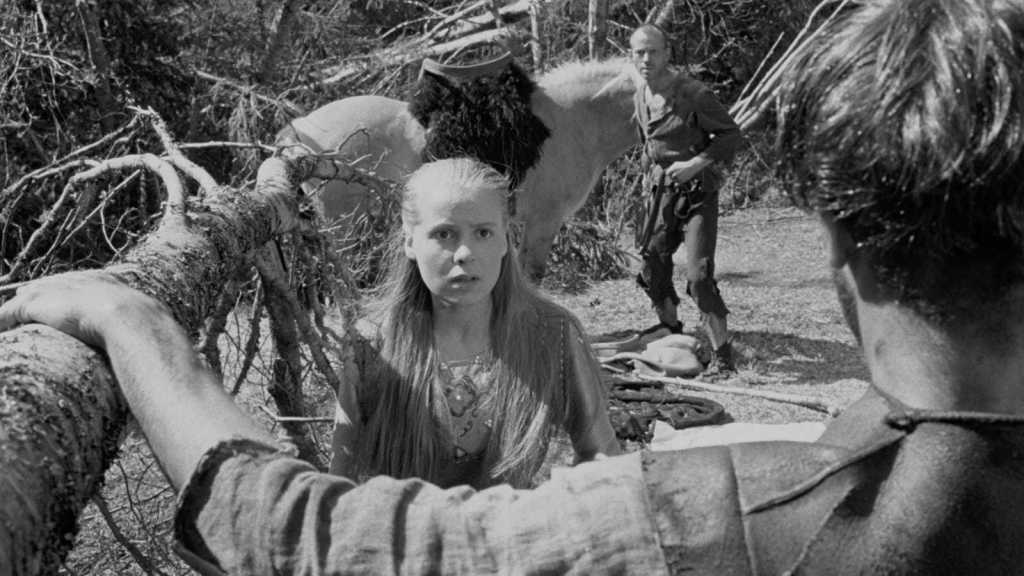
Set in medieval Sweden, Töre (Max von Sydow, magnificently, chillingly grief-stricken) is a prosperous and devotional Christian farmer, in a cooling marriage to Märeta (Birgitta Valberg). The light of his life is his daughter, the beautiful Karin (Birgitta Pettersson). One day, Töre tasks Karin to travel to the Church (half a day’s ride) to deliver some candles. She travels with Ingeri (Gunnel Lindblom – bitter, damaged and brilliant), a pagan servant girl, heavily pregnant and resentful. Along the way they two are separated and Karin meets with three peasant brothers in the forest, who share her meal with her before the two adult brothers (Axel Düberg, Tor Isedal) rape and murder her. The brothers walk on and take shelter that night in Töre’s hall. When he discovers their deed, he murders them all (even the innocent youngest brother, a boy) then, horrified, pleads to God for forgiveness. At which point a spring, bursts forth where Karin was killed.

Not exactly a bundle of laughs. But this is powerful, compelling film-making from Bergman. His influence on horror has been overlooked, but The Virgin Spring show how much he inspired everything from shlock to The Exorcist. This is a tense, unbearably so, film which twice draws out the long build-up to shocking violence in a way that would make Sergio Leone proud. Played out in a beautifully moody, bleakly cold and wintery visual style from Sven Nykvist (his first collaboration with Bergman) and often in an atmospheric mix of silence and natural sound, you can feel your stomach knot as the inevitable transgressive act looms ever closer.

The film pulls no punches, while never being exploitative. The rape and murder of Karin (excellently played with just the right mix of innocence and spoilt certainty by Birgitta Pettersson) unfolds with a cold matter-of-factness, as she slowly realises these men are far more dangerous than she imagined. The event is hard-to-watch for its simplicity rather than its graphicness, and for the cold indifference of its perpetrators who act on a whim. It takes place almost in silence and the killing (mercifully off-camera) is more because they don’t know what to do next. Mix that in with the terrified stares of Ingeri from afar, and the shell-shock of the younger brother (who vainly tries to bury Karin with dirt before running away), makes a scene devoid of sensationalism but terrible to watch.

It’s reflected in the film’s later act of violence. The brothers having tried to pass off Karin’s blood-stained dress as their (imaginary) sister’s, sell it to Märeta (who instantly recognises a garment she stitched herself, even as she’s asked to admire the handiwork), are locked in the hall while they sleep. Töre’s slaying of them, however, never feels triumphant. Instead, the Christian Töre abandons his faith to embrace pagan revenge. Like a priest before a blood sacrifice he dresses himself in butchery gear, discards a sword for a smaller knife, carefully prepares the room for the brothers to wake and then sits, idol-like, in his chair waiting. This is a damning ritualistic insight into how our faith – the faith Töre was so proud of – can drop away to reveal our vengeful simplicity below.

The fight that ensues feels like something from the nether-regions of hell. One brother is skewered, arms wide, to Töre’s chair. Another is stabbed under Töre’s body weight – shot in a way reminiscent of Karin’s rape, with the flames of the fire dancing between them and the camera – his body left to burn in the fire. Their brother – a child – runs to Märeta for protection, yet Töre hurls him against the wall breaking his neck. There is no triumph. Töre speaks not a word – the brothers die having no idea who he is. Töre is left starring at his trembling hands in shock, as if waking from a dream not recognising the man he has become who turned his back on every article of faith he held dear.

It’s a film that shows the impact of grief and trauma. From the terrified face of the youngest brother – shovelling dirt on a dead body with tear-stained eyes – to Töre’s shell-shocked realisation his daughter is dead. Deep down, people blames themselves. Märeta believes she is being punished for envying Karin’s closeness to her father. Ingeri believes she has cursed Karin to suffer the same shame as her. Töre, perhaps, feels guilt at his own semi-incestuous closeness with his daughter. Why else does he struggle to bring down with his bare hands a new-planted birch tree (in beautifully haunting medium shot), cutting branches from it to flay himself in a sauna before he takes his revenge? It’s both punishment for past and future sins.

This is also a film that challenges us to decide whether brutal revenge is justified. The build-up to the murder of the brothers is very similar to the murder of Karin. A long meal, shared, even with similar food – so similar that the innocent younger brother vomits at the memories it brings back. This young boy is the death of innocence in this world. Betrayed into crime by his vile elders then forced to pay a terrible price for a deed he was powerless to stop and left him deeply distressed. How can we really triumph in Töre’s killing, when we see it performed so violently at such a price?

Bergman tests throughout how far faith goes, and questions what power God has. The film opens with two pleas, to two very different Gods. Ingeri pleads to Odin to punish the virtuous Karin, who in Ingeri’s eyes is a working rebuke for her wedlock-free pregnancy. Töre prays to a Dürer style carved cross for God to keep their household safe. Only one deity delivers: and rightly Töre will plead at the film’s end “You see it God, you see it…you allowed it. I don’t understand you.” Töre has even mirrored the rapists, in murdering an innocent. He repents later, but is a heathen in the moment.

Paganism is strong in The Virgin Spring. But it is not good. Ingeri separates from Karin when she meets a half-blind bridge-keeper, in a house full of ravens, in the wood. The man ticks every box for representing Odin and conveys dark promises of powers beyond mankind. But he is a vile, Devilish figure who takes an impish delight in cruelty and mischief. Ingeri’s departure from him coincides with Karin’s encounter with her killers – as if these demonic sprites had been conjured up by Odin to punish Ingeri by providing her with exactly what she asked for.

Why then is a film so grim, so cold, so difficult and challenging also feel strangely hopeful? Odin has won and Töre has turned his back on Christian faith to embrace cold, merciless, pagan violence. But as Töre pleads for forgiveness a spring bursts forth from below the point where Karin’s head lay. Suddenly, water pours out of the ground. Light bathes the clearing from above. Ingeri washes her face and hands, cleaning symbolically the parts of her that made those pagan pleas. Suddenly, from nowhere, the film presents an intense moment of spiritual hope that I found surprisingly moving. Rarely has something so grim, felt so cleansing at its close. Perhaps viewers need the simple, honest refreshing splash of water to help themselves after. That’s what helps makes The Virgin Spring difficult, uncomfortable but essential.

Mulholland Dr (2001)

Mulholland Dr (2001)

Surrealist, dream-like images fill a film that’s wilfully complex, perplexing and probably Lynch’s masterpiece

Director: David Lynch

Cast: Naomi Watts (Betty Elms/Diane Selwyn), Laura Harring (Rita/Camilla Rhodes), Justin Theroux (Adam Kesher), Ann Miller (Coco), Mark Pellegrino (Joe), Patrick Fischler (Dan), Michael Cooke (Herb), Dan Hedaya (Vincenzo Castigliane), Angelo Badalamenti (Luigi Castigliane), Michael J Anderson (Mr Roque), Monty Montgomery (The Cowboy), Lee Grant (Louise Bonner), James Karen (Wally Brown), Chad Everett (Jimmy Katz), Melissa George (Camilla Rhodes), Billy Ray Cyrus (Gene), Lori Heuring (Lorainne Kesher)

Spoilers: I’ll be discussing in detail the plot (if you can call it that) including its final act reveals which are crucial for understanding the film. So watch it first!

Where do you begin? Mulholland Drive feels like the culmination of Lynch’s work, a perfect boiling down of Twin Peaks, Lost Highway, Wild at Heart and Blue Velvet into a surrealistic meditation on Hollywood, wish-fulfilment, dreams and reality. It’s both wilfully inaccessible and surprisingly clear, both coldly cruel and achingly tender, full of hope and devoid of happiness. It’s tough, cryptic, engrossing viewing and unpeels like an onion (and likely to have the same effect on you as that vegetable). Every scene may mean everything or nothing, but there is not a moment of it that isn’t darkly, thrillingly engrossing.

It starts with a car crash on Mulholland Drive – but not before a stream of seemingly disconnected images that only later reveal their importance, including a women on a bed and a dizzying array of disconnected jittybug dancers drifting across the screen like paper cut-outs before a purple background. The car crash involves a mysterious woman ‘Rita’ (Laura Harring) who narrowly escapes being murdered but is left with amnesia. She stumbles to the house of Betty (Naomi Watts), a newly arrived girl in Hollywood, eager to become an actress. With only a bag of money and a mysterious blue key to go on, Rita and Betty search to find out who Rita is. Meanwhile, director Adam Kesher (Justin Theroux) finds his film (which Betty wants to audition for) being taken over by gangsters. Did I also mention an incompetent-but-brutal hitman, a supernaturally omniscient albino cowboy and a monstrous goblin-like hobo who lives behind a diner and can kill on sight?

Mulholland Drive grew out of Lynch’s plans for a new Twin Peaks style TV series. He shot a pilot, the footage from which takes up much of the first two thirds. Like Twin Peaks it was full of mysterious alleyways to be explored: it’s amnesiac lead, mysterious money and blue key, shadowy gangsters (even led by Twin Peaks veteran Michael J Anderson, here in a Red Room style hide-away, his head attached to a prosthetic body), creepy supernatural nightmare elements. Alas, the executives hated it (it wasn’t exactly Desperate Housewives), but French investors stepped in to fund Lynch turning it into a surrealist movie, with an additional half an hour of footage to an ending (of a sort).

A sort of ending is what we get. Mulholland Drive is a famously confusing, impenetrable film. But to me it seems clear. Lynch’s solution was to turn all the pilot footage into a bizarre and terrible dream – and latch on an ending set in the ‘real world’ which re-presents characters, events and throwaway moments in surprising new lights, leading us to radically reinterpret everything. Effectively, the first two-thirds are the guilt-ridden nightmare of Diane (Watts again), a failed actress in Hollywood who paid for a hit on a star actress Camilla (Harring again) who she believes seduced and spurned her. In her dream, Diane reimagines both herself and Camilla exactly as she wishes they were: herself unspoilt by Hollywood with preternatural talent, Camilla as an amnesiac utterly reliant on her.

What we have here is dreams as wish fulfilment: and what city is more about that, than Hollywood? Mulholland Drive plays as the dark underbelly of Sunset Boulevard (pretty dark and bitter already!). Lynch’s Hollywood is a vicious, heartless, bloody place, where cruelty and death are commonplace. In ‘the dream’ the gangsters – terrifying cameos from Hedaya and composer Badalamenti, the latter dribbling inadequate coffee from his mouth during a meeting in a grotesque power play – call the shots. Reality might be worse. This heartless factory of dreams chews up and spits out innocents like Diane, turning her from naïve and optimistic into  bitter, twisted shell, emotionally maladjusted, locked in her apartment tearily in thrall to her worst instincts.

It makes sense in a way that the film is dominated (probably) by a dream. Hollywood is the town of stories, and it’s perversely logical that the unreality should feel so detailed, engrossing and narratively compelling while what is (probably) reality is fragmented, mundane and laced with cruelty. To the people of films, stories are richer and more freeing than anything that happens in real life and infinitely more comforting.

Comfort is what our dreamer wants. Naomi Watt’s Betty seems like a cliché of a small-town girl, swept up in the big city. Full of aw-shucks charm, the eagle-eyed will spot little moments of strength that feel out of character. There are micro-flashes of anger and she’s determined to break into a mysterious, abandoned house to find a clue when Rita runs. She’s a gifted actress, turning a mundane script in an audition (a script she and Rita laugh at) into a simmering performance of sexual control that stuns the room. But this is a multi-layed performance, just one facet of a whole.

Because Betty’s talent is recognised in the way her ‘real-world’ counterpart Diane – stuck in small supporting roles, gifts from Camilla – never is. There are touches of this in that audition: the director is the least involved and speaks only in vague bullshit. Its not just that talent recognition: in the dream she can turn her lover Camilla, an independent and (perhaps) selfish figure, into someone so dependent on her that she literally doesn’t even know who she is. She even turns the man Camilla leaves her for, into a deluded, humiliated cuckold in thrall to gangsters.

Lynch’s crafting of this dream is flawless. He can mine tension from even the smallest moments. Innocuous events – two men sitting in a diner, a kind old couple in a cab, a business meeting, a singing audition – drip with menace and unknown horror. His camera frequently, almost imperceptibly weaves, as if held floating in space. Logic jumps and sudden transitions abound. Lights flicker and time never obeys rules. He is also a master of black humour: a hit-job gone wrong (with bodies and a vacuum cleaner joining the carnage) is hilarious, as is Kesher’s unexpected arrival home to find his wife in bed with a muscular pool cleaner.

Mulholland Drive is also a sensitive and highly emotional romance story between two lost souls. Betty, naïve and helpful and Rita, who clings with gratitude and adoration to the woman who helps her. Moments of sexual tenderness between these two are shot with erotic beauty: contrasted sharply with the more sordid, aggressive couplings between them in ‘reality’.

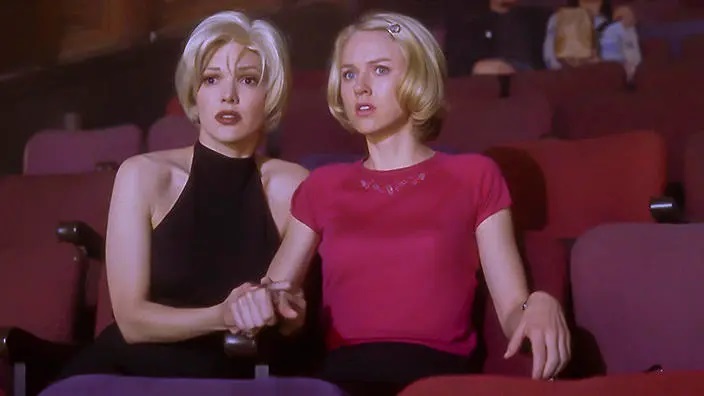
But these mix with moments of chilling, unspeakable horror. The hideous goblin living behind a diner, an embodiment of all that is cruel, evil and twisted, later clutching a box the releases the furies themselves seem to leap from. Is this a dark expression of the dreamer’s own guilt (which seems to be transferred to “Dan” a man we see literally dying of fright in a diner that becomes crucial later)? The Cowboy, who may or may not be of this world, glanced at two dreadful moments (just as he promises) seems to guides the dream. And the Silencio club, a theatre of the bizarre, disturbing auditory and visual twists and turns that serves as the gateway between dream and reality – something Betty subconsciously knows, vibrating in terror in her seat, knowing this fantasy she has crafted is under siege from dark elements of the truth demanding she acknowledge them.

Mulholland Drive deconstructs itself at every turn, aided by Lynch’s wonderful, hypnotic surrealistic touches. What’s beautiful about it, perhaps, is it leaves it very much up to you. For me, the desire for dreams to be fulfilled is crucial. It’s all captured in Watts and Harring’s multi-layered performances, their versions of the same women contrasting and complementing each other. Lynch allows their personalities to blur both in character and in visuals (Rita ends up in a matching wig in touches of Vertigo while the film’s blurring of two personalities echoes Bergman’s Persona, including a homage via a shot where both faces seem to merge into one).

An intense, fascinating dream-like exploration of several classic Lynchian themes, Mulholland Drive is his finest, most rewarding film. One which, whatever interpretation you place on its events, grips and challenges you at every moment, full of scenes which spark a mixture of imagination, horror and intrigue. Powered by two wonderful performances at its lead, both with just the right mix of reality and fantasy about them, it’s an extraordinary film.

Intolerance (1916)

Intolerance (1916)

Scale and sensation fill the screen in this ground-breaking epic that has to be seen to be believed

Director: DW Griffith

Cast: Mae Marsh (The Dear One), Robert Harron (The Boy), Constance Talmadge (The Mountain Girl), Alfred Paget (Prince Belshazzar), Bessie Love (The Bride of Cana), Walter Long (The Musketeer of the Slums), Howard Gaye (Jesus Christ), Lillian Langdon (The Virgin Mary), Frank Bennett (Charles IX), Josephine Crowell (Catherine de Medici), WE Lawrence (Hendi de Navarre), Lillian Gish (Woman Who Rocks the Cradle)

Even today I’m not sure there is anything like it. (Perhaps only the bizarrely OTT Cloud Atlas gets anywhere near it). DW Griffith’s follow-up to his (now infamous) smash-hit success The Birth of a Nation would not just be a melodrama with a social conscience (as he originally planned). Instead, it would be a sweeping epic that have as its theme humanity itself. Intolerance (captioned “Love’s Struggle Throughout the Ages”) would intercut four timelines simultaneously, each showing how prejudice, envy, and rage had shattered lives throughout the history of mankind.

Griffith wanted to make the biggest film ever. The sort of sweeping spectacle that would confine all other competitors to the dustbin of history and cement himself as the new media’s master visionary. Intolerance is certainly that, a film of dizzying technical and narrative scale. Never before had a film thematically intercut between four unlinked but complementary timelines. Nothing links these stories other than theme: all four play out in parallel, events in one reflected in another. Essentially, it’s like a massive book of fables where all the pages have been cut out, reorganised and handed back to you.

Intolerance started life as The Mother and the Law. This social-issue drama followed a young couple – the Dear One (Mae Marsh) and the Boy (Robert Harron) – forced to flee their factory community for the big city, after the brutal crushing of a strike. There, the Boy is sucked into the circle of a local gangster The Musketeer of the Slums (Walter Long). He renounces it all for love, before he is framed for theft and imprisoned. Then the couple are stripped of their baby and he is arrested again for the murder of the gangster (actually done by his moll). Will the sentence be revoked?

This is still the backbone – and takes up the most of the film’s runtime. But the one thing it didn’t really have is spectacle. A lot of it happens in rooms (bar a last-minute train and car chase). As well as expanding the film’s scope, Griffith also wanted to dial up the scale. Intercut with this are three grandiose historical narratives. In the largest, Griffith had the whole of Babylon rebuilt just so he could film its fall (after betrayal from the priests), despite the struggles of the Mountain Girl (Constance Talmadge) who is in-love-from-afar with Prince Belshazzar (Alfred Paget). We also get the St Bartholomew Day’s Massacre of 1572, as French Catholics butchered their Protestant neighbours. And finally, just to dial up the import, we get the last days of Jesus Christ.

The scale of it! The sets of Babylon have to be seen to be believed. Huge, towering structures so large they dwarf elephants and the thousands of extras thrown in for scale. The camera pans slowly up to stress their gigantism and zooms in slowly in tracking shots to pick out a specific face among thousands. The siege of Babylon plays out like a real military action: armies of extras play out a choreographed battle on multiple levels of the walls while elephants push siege engines into place. Some nifty special effects allow on-screen beheadings and for us to see swords, arrows and spears plunge into bodies. It’s genuinely exciting and influenced every siege you’ve seen on film since.

This scale isn’t just restricted to Babylon. The modern plotline brilliantly recreates strike action by the masses, including a brutal put-down by private and government forces. Questing for a late pardon for her husband (who is literally walking towards the gallows while they do), the Dear One and a kindly policeman hop into the fastest car they can find to chase down the Governor’s train. In 1572, the streets of Paris are skilfully recreated – as are the grand palaces – and the action of the massacre is shot with an intense, Bruegelesque immersion. Jesus is mocked by a large crowd as he drags his cross through the streets before being crucified on a bloody-sky kissed hill with flashes of terrifying red lightening.

The huge scale is also carried across in Griffith’s narrative. This was intended as important film-making with a capital I. Griffith’s film is in places surprisingly anti-authoritarian and firmly on the side of the little guy. The modern strike is caused by a factory wage cut. Why? Because more money is needed for the firm’s charity work and it needs to come from somewhere. The charity workers are, to a woman, shown as judgemental, smug and causing more harm than good from their arrogant assertion that they know best. Homes are broken up, jobs are sacrificed and mothers judged “not good enough” separated from their children. All in the name of a moral crusade that’s more focused on prohibition than protection.

In Babylon, the priests of Bel are weasily, bitter, power-hungry figures, furious at the arrival of the new female God Ishtar, selling the city out to the barbarian hordes to preserve the old religion. The French court are certain the only way to guarantee peace (but really their own positions against the Hugenout faction) is to kill them all. Jesus’ presence is met with stern-faced priests wondering what they can do to get shot of this trouble-maker. We are always invited to sympathise with humble, simple people who want to make their own choices: Brown Eyes (Margery Wilson), a Hugenout daughter hoping to marry, the boisterous Mountain Girl, the loving Dear One and the Boy.

To keep this feeling like a universal fable of hope, names are kept as non-specific as these. Small human moments abound. Brown Eyes is as giddy as schoolgirl on the day before her wedding. Henry IV weeps and nearly vomits after being brow-beaten into ordering the massacre. The Mountain Girl – dragged to a market fair for her obstinacy – decides the best way to put off husbands is to chow down on onions. The Dear One and the Boy go on a charming date, at the end of which she pleads for the strength of character to resist the temptation to let him into her flat before they are married. It’s these little beats of humanity that help sustain the scale.

Intolerance is connected together with a series of captions – frequently badly-written and pretentious (e.g. “The loom of fate wove death for the father”) – and via a recurring image of a woman rocking a cradle, which I think represents the circle of life. The editing between the storylines is masterful though and the film’s pace and structure is generally so well maintained that your understanding of when and where we are is never challenged for a moment.

There have been claims Griffith’s more human epic was a correction to his Birth of the Nation. But that’s to misunderstand the sort of era Griffith came from. In his Victorian background, it was in no-way a contradiction for a man to be both a white supremacist and a sentimental liberal. Griffith believed the South were victims of the Civil War and the ‘unjust’ Reconstruction and felt Intolerance was a logical continuation of that theme. A few of his prejudices are on show here anyway. The only black faces are sinister heavies among the ‘barbarians’ attacking Babylon. Henry of Navarre is a limp-wristed sissy. The female reformers are all ugly harridans (the caption even tells us “When women cease to attract men they often turn to reform as a second choice”). Intolerance is an interesting reminder that a director we now think of today as American cinema’s leading racist was that and a man who passionately believed in social justice. Contradiction is the most human quality we have.

There may be a little too much in Intolerance considering its crushing run-time (the Jesus scenes could be cut with no real loss at all), but generally it hits a balance between pomposity and entertainment. It has plenty of violence and naked ladies (the harem of Babylon is shown in detail – it’s pre-Code folks) to keep the punters entertained, along with charm (though you need to look past the pose-taking, broadness of the performances). Griffith has a way with little shots: there is a lovely track into the face of the Dear One as she silently mourns. The chase in the modern plotline is genuinely tense while the massacre of the innocents in 1572 actually horrifying.

Above all, Intolerance set the table for epic cinema in exactly the way Griffith intended. While it is full of big ideas – at times clumsily presented – it’s also full of breath-taking spectacle that has influenced generations to come. For that reason, if nothing else, anyone interested in film should see it.