Category: French films

Quai des Brumes (1938)

Jean Gabin and Michèle Morgan are star-crossed lovers in Quai des Brumes

Director: Marcel Carné

Cast: Jean Gabin (Jean), Michel Simon (Zabel), Michèle Morgan (Nelly), Pierre Brasseur (Lucien), Édouard Delmont (Panama), Raymond Aimos (Quart Vittel), Robert Le Vigan (Le peintre), René Génin (Le docteur), Marcel Pérès (Le chauffeur), Léo Malet (Le soldat), Jenny Burnay (L’amie de Lucien)

It translates as “Port of Shadows” and it’s the shadows you are likely to remember in this noirish tinged classic of French cinema. A major success story when it was released in France, it also stands as some sort of milestone as being one of the few films condemned by both the pre-Vichy French government and Nazi Germany. More pleasingly, it’s also a firm testament to the brilliance and vibrancy of pre-War French cinema and the creative imagination of Marcel Carné.

Jean (Jean Gabin) is a soldier on the run, deserting his regiment to lead his own life in South America. Arriving in the port of Le Havre, he ends up in a run-down bar on the edge of the town where he meets the beautiful young Nelly (Michèle Morgan) a woman on the run herself from two unpleasant men. The first is local gangster Lucien (Pierre Brasseur) a braggart with whom Jean has already had a few run-ins. The other, even more dangerous, is Zabel (Michel Simon) Nelly’s godfather, a ruthless man under a genial façade who is obsessed with Nelly. Jean and Nelly fall in love, but how far will Jean go to put his own hopes for the future in doubt to protect Nelly?

Shadows dominate Carné’s beautifully atmospheric film. Jean emerges as if from nowhere on the road to Le Havre – nearly run over by the truck driver who picks him up. The bar is buried in the mists of the town. Shadows loom from every building and throw most of the city into a mysterious half-light. The action largely takes place in backrooms and cellars. Every frame tells you from the start things will not turn out well, with every decision carrying an underplayed air of foreboding. You can just tell every moment is putting another nail in the coffin of Jean’s chances of escape to that new life. The film is a brilliant slice of noir, expertly assembled with an artist’s eye by Carné, one of the most overlooked genius directors of his era. 

This darkened, gloomy style of the picture echoes the intentions of Carné and his regular collaborator, scriptwriter Jacques Prévert. The focus on the picture is the individual – in this case Jean and Nelly –trying to escape the control of both the state (the army) and also the domineering bullies that hold the local power (Lucien and Zabel). It’s no coincidence that Jean is an army deserter, and there is no sense of guilt on his part or even a fraction of recrimination is aimed towards him from anyone he encounters. Jean himself talks despairingly of the grim reality of killing and his wish to make his own choices. Carné was originally to make the film in Germany, but Goebbels was not having any film made in Berlin where the hero was an army deserter. 

So instead the film was shifted – wisely – back to France, not the French government was that happy either. With Carné and Prévert’s vision of a listless, tired, corrupted France where people like Jean simply refuse (it seems) to do what they are told, and where the few representatives of local government we meet are trivial non-entities, it’s not a surprise that the film was soon being blamed for sapping French spirit. As a sop to the French criticism of the script (and many of the films backers were desperate for its downbeat nihilism to be replaced by a more conventional upbeat, romantic ending) Jean does at least show respect for his army uniform – despite everything it’s never dirty, and when he takes it off its neatly folded. Today it seems even more like an impressionistic touch.

It’s the nihilism that runs through the film. We know Jean is good guy – he encounters a dog on the road to Le Havre that follows him with a singular devotion, unable to bear being parted from him – but the film itself has a shadowy feeling of despair and destruction throughout. Jean feels like a doomed hero from the start, a passive figure despite his bravado, who impulsively drifts from event to event – it’s when he chooses to become engaged that he dooms himself. Nelly is seemingly at first a femme fatale – and her reveal is a masterstroke of cinema – but really she’s as much a victim as Jean, someone very vulnerable, lonely and scared who wants a way out but can’t see how to even begin to find one. But then even the nemesis that runs through the film is low-key and trivial – Lucien is a joke, while Zabel for all his creepiness is also little more than a novelty gift shop owner.

The power of the film comes from seeing these two trapped figures surrounded by a world of darkness, listless depression and emptiness. And of course from the performances. The film is a reminder again that at this time Jean Gabin may well have been the greatest actor in the world. With a cigarette dangling, raffish cool under a surly salt-of-the-earth taciturnity, he turns Jean into the sort of enigmatic noir-hero years before the term was evented. Dripping with charisma in every frame, he’s both a Bogartish cynic and a De Niroish slice of muscle, a working class martyr. Nearly as good is Michèle Morgan, vulnerable and yearning into a surface of sexy cool. The two make a winningly attractive pair, not just sexy but with a growing romantic feeling.

It’s no wonder Jean throws himself into threatening and roughing up the pathetically weasily Lucien (Pierre Brasseur very good as a weak-willed bully who can lash out with the viciousness of a child) and squaring up to domineering Zabel. Michel Simon is terrific as the grandfatherly shop owner whose own dark obsessions and possible perversions become harder and harder to ignore. These two very different threats stand at opposite ends of the film and both contribute to its bleak ending.

Because of course Jean isn’t going to make that boat. The act of violence the film finally unleashes – after all that foreboding warning that it’s coming – is suitably shocking in a 1930s way, while the eventual fall of Jean is both fitting and also tragic in its low-key abruptness (it was later echoed by Brian de Palma in Carlito’s Way). With its gloomy atmosphere, its grim foreboding but also passionate love story at its heart, Quai des Brumes is a classic of French poetic realism.

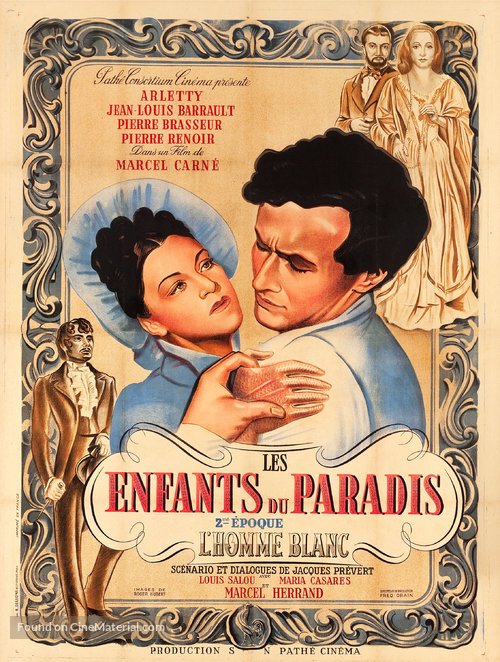
Les Enfants du Paradis (1945)

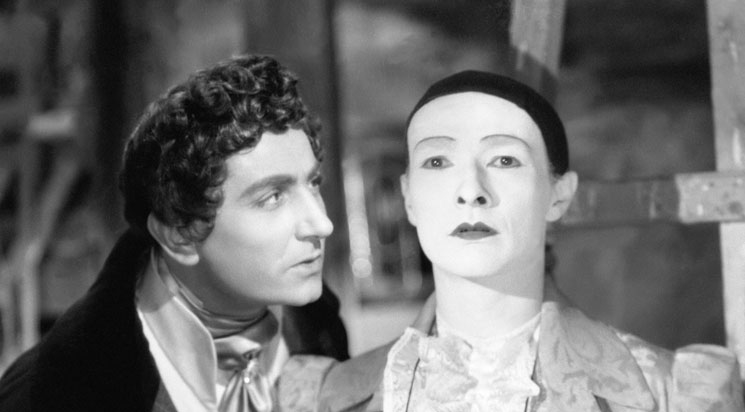
Jean Louis-Barrault mimes up a storm in French masterpiece Les Enfants du Paradis

Director: Marcel Carné

Cast: Arletty (Claire “Garance” Reine), Jean-Louis Barrault (Baptiste Deburau), Pierre Brasseur (Frédérick Lemaître), Marcel Herrand (Pierre-François Lacenaire), Pierre Renoir (Jéricho), María Casarès (Nathalie), Louis Salou (Comte Édouard de Montray), Gaston Modot (Fil de Soie), Fabien Loris (Avril), Marcel Pérès (Director of the Funambules), Pierre Palau (Stage manager)

Les Enfants du Paradis is France’s Gone with the Wind or Casablanca – a beloved classic that holds an unshakeable place in any list of great French films. And you can’t argue with that, this is the sort of gem of a film that should be watched and seen by anyone who loves movies. Carné’s magisterial epic hums with a mix of romance and drama, comedy and tragedy, hope and despair. It not only captures the magic of theatre, but also the different shades and variations of love and lust. A totemic expression of art and life, it opened immediately after the liberation and ran for 54 solid weeks in Paris.

Set in the Parisian theatre scene of 1820-1830, the film charts not only the early foundation of French theatre, but also four very different men who all share a love for one enchanting, elliptical and magnetic woman, the mysterious Garance (Arletty). These men (all fictionalised versions of real people, except de Montray) are pioneering mime artist Baptiste Deburau (Jean-Louis Barrault), aspiring classical actor Frédérick Lemaître (Pierre Brasseur), ruthless artiste and criminal Pierre-François Lacenaire (Marcel Herrand) and arrogant Comte Édouard de Montray (Louis Salou). The lives and feelings of these five characters clash and interweave over ten years.

In many ways, it’s a miracle that Carné’s film exists at all. It was shot on a high budget in occupied France. Filming was disrupted by the war and the peace – the actor originally playing small time hustler Jéricho was sentenced to death for collaboration and fled the country to be replaced by Pierre Renoir (son of the painter, brother to the director) – and its star Arletty was in prison for having an affair with a German Luftwaffe officer when the film was released. The film was split into two as Nazi rules prevented any films from being longer than 90 minutes. Half the vast number of extras were members of the Resistance using the film as cover. Its skilled art director Alexander Trauner and composer Joseph Kosma were secret Jews (Trauner was living under a false name with Carné). Filming delays struck the production time and time again. How did this get made?

Well it’s a wartime miracle, and a gift to any film-lover because Carné’s film is a magisterial achievement, a beautifully paced epic that mixes spectacle with human emotion. It looks simply sublime. Trauner’s set and design are astonishingly ambitious and real, beautifully bringing to life both the streets of Paris and the theatre of the early nineteenth century. The detail and costumes are sumptuous and the world it invokes all-consuming. You can see why the film was considered an almost unbelievable folly to mount during wartime. But it creates the perfect bustling, real life drama for Carné’s poetic story to be built around. 

Carné worked with Jacques Prevert, possibly France’s greatest screenwriter, on the script and crafted a romantic epic that manages to seem timeless. In its sweep and detail it shows every stratum of French society, and shows the same human emotions drive us all from high to low, no matter the background. On top of that, it mixes a romantic sweep with a real understanding of the selfishness, greed and flaws of humanity. Prevert’s script juggles the narrative balls of all these characters and uses each of them to show different facets of the passion and obsession of love. 

Carné’s camera works beautifully, exploring Trauner’s set brilliantly to recreate beautifully the beginnings of French modern theatre. He knows when to keep the camera simple, and when to use extravagant shots: his opening crane shots through the bustling streets of Paris are superb, as is the carefully static camera that captures Barrault’s early mime routine. He has a wonderful understanding of the backstage world of theatre: very few other films have captured the mood and atmosphere of life behind the scenes. He also is perfectly at home with Prevert’s literary and witty script, packed with good lines. There are superb scenes from start to finish – despite its length, everything feels essential and the pace never slackens, because each moment teaches us something about character or deepens our understanding of their relationships and the world of the film. This is possibly one of the paciest and leanest three-hour films you will ever see.

At the centre of all this is Arletty as the mesmerising Garrance. Arletty juggles a hugely difficult role: Garrance is, in some ways, with her desire for liberty, her strong will, her mysteriousness, her desire for independence clashing with her sense of being bent to the will of men, an expression of France herself, following in the footsteps of Delacroix’s Liberty or Joan of Arc. Arletty’s performance is fine, playing up to this legendary unknowability, although I will say she is (whisper it) at nearly 50 too old for the part (in high definition she looks noticeably older than most of the men courting her). I must confess re-watching it that I would have loved the astonishingly talented María Casarès to play the role (she is exceptionally heartfelt and tragic as Baptiste’s devoted but unloved wife-to-be), but it’s a very hard part, a role that has to be everything to all the men in the film, but also whose true desires (under the masks she must wear) are hard to know. 

Arletty’s slightly stagy and theatrical, mannered performance is perhaps shown up as well by the more genuine and enjoyable performances around her. As mentioned, Casarès is sublime as the tragic Nathalie. Pierre Brassuer is extraordinarily entertaining and larger-than-life as Lemaître, a bon-vivant with ambition but who is willing to accept that life moves on and relationships change. Marcel Herrand is wonderful as Lacenaire, a character of immense shades of grey, part ruthless crook, part bitter cynic, part romantic. Lacenaire’s actions defy characterisation but constantly feel true, and Herrand plays the role with a sly wit tinged with danger that I love.

Jean-Louis Barrault, himself a famous mime artist, is physically perfect as Baptiste – his mime sequences are extraordinary in their detail and grace – and he makes for a fascinating nominal lead. A romantic in some ways, a nervous young pup who idealises Garrance (while Lemaître sees her more as an equal partner, Lacenaire a kind of protégé, and the Comte as property who can be brought and sold) who turns down advances offers from Garrance due to his idealised view of her, his development is fascinating. Starting as our romantic lead, Prevert and Carné slowly reveal that the years turn him into someone approaching a selfish obsessive, barely able to function when Garrance is near, who jilts his wife and child in a heartbeat when he has the opportunity to see her, an obsessive who will sacrifice others without a thought to feed his fire. 

Does Garrance return this love? Perhaps yes, it’s one of the mysteries of the film. This is, after all, a world abounding with actors and liars, where people take on personalities all the time. A blind beggar gleefully shows his disability is a façade when someone buys him dinner. Pierre Renoir’s hustler Jéricho has as many nom-de-plumes as he does dodgy deals. Garrance perhaps recognises in Baptiste the only one of her potential lovers who has no desire to bend any part of her to his will – Lemaître will place his ambition first, Lacenaire would have her a partner in crime, the Comte would control her every move – and maybe this is what draws her to him. 

But the romance in the film is never that simple: instead it’s as likely to cause harm as happiness. Carné’s beautiful and wise film shows love is never simple and romance is never as harmless as we might like to think. The dialogue is perfectly assembled, the acting superb and every shot of the film is beautiful. Les Enfants du Paradis is a classic must for lovers of film, but also for lovers of theatre – its recreation of early nineteenth-century theatre is perfect – and a film that you can watch and enjoy time and time again.

Jules et Jim (1962)

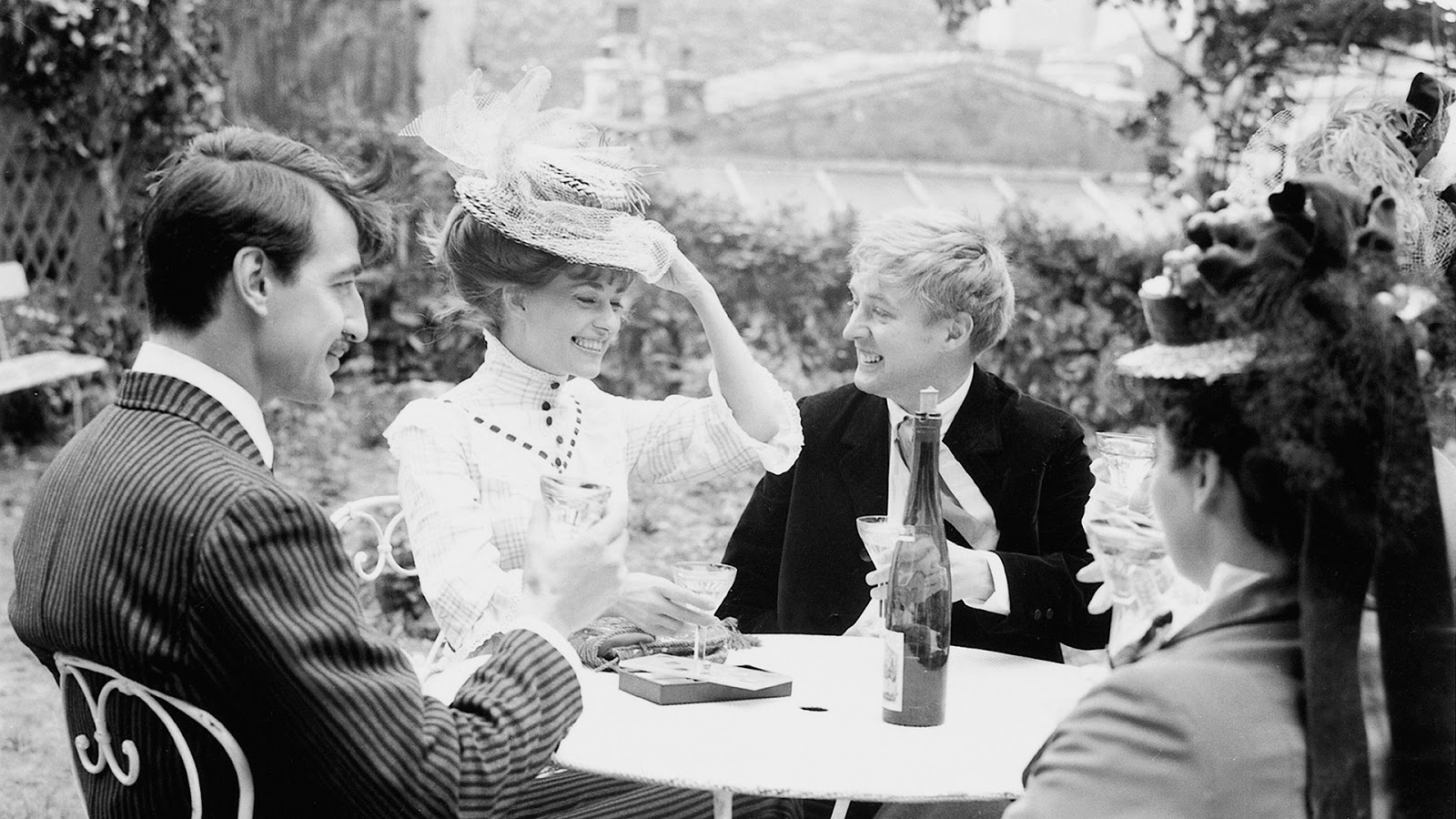
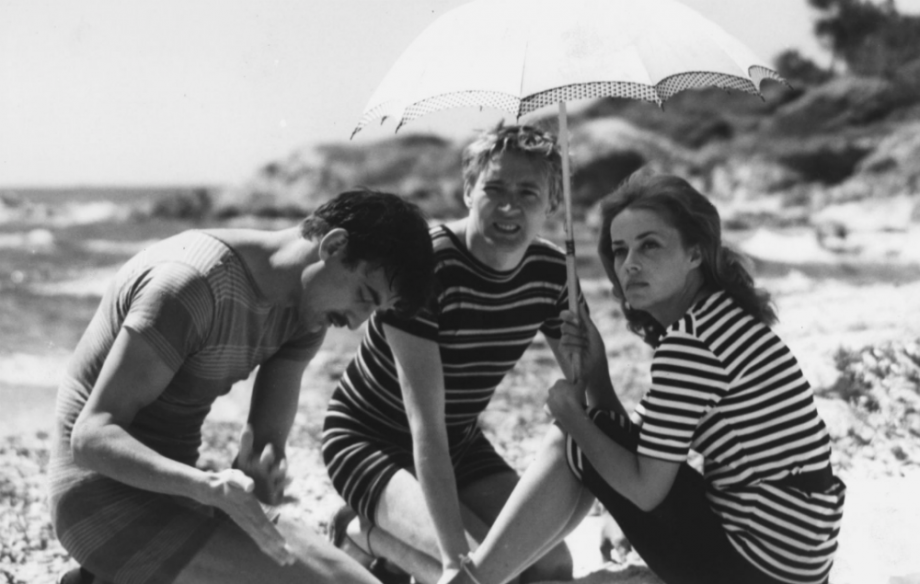
The film that launched a thousand menages: Jules et Jim

Director: François Truffaut

Cast: Jeanne Moreau (Catherine), Oskar Werner (Jules), Henri Serre (Jim), Vann Urbino (Gilberte), Boris Bassiak (Albert), Marie Dubois (Thérèse), Michel Subor (Narrator)

Of all the films of the French New Wave, Jules et Jim was the one that really captured the global imagination. Its success rode came not only from its embracing of the new French style, but also from the way it captured some of the mood starting to build across the world in the 1960s. Truffaut’s third film, it turned its then 29-year-old director into one of the most renowned directors in the world. Filmed with verve and imagination, it still holds up brilliantly today as well.

In Paris in the years before the First World War, French bohemian Jim (Henri Serre) and shy Austrian writer Jules (Oskar Werner) become best friends. They share everything – the arts, sport and occasionally women – and the bond between them is unshakeable. When both men meet Catherine (Jeanne Moreau), a free-spirited, extremely bohemian young woman, they both fall in love – although the infatuated Jules is the first to admit it. Both men fight for their countries in the Great War and return to civilian life: Jules marries Catherine and they have a daughter. But home life cannot keep Catherine bound down, and a visit to Jim throws the three of them into a curious but warm menage-a-trois. But can such bliss last forever?

Truffaut’s film is playful, vibrant and overflowing with style. While other French New Wave films prior to this had focused on sending the camera out into the streets and capturing the lives of everyday Parisians, Truffaut’s film mixes this with period trappings. Utilising the dynamic camera work of his peers, Truffaut throws in carefully selected newsreel footage and still photography. But all this material is edited with modern forcefulness, Truffaut using a range of freeze frames, wipes, dolly shots and several other editing and camera tricks to make this period story feel astonishingly fresh. The film is fast paced and brilliantly made, and Truffaut’s camera roves like an engaged but playful observer – a feeling added to by the use of a subtly wry narration.

According to legend, Truffaut found a copy of Henri-Pierre Roché’s semi-autobiographical novel in a charity bin and fell hard for the book. It’s a mark of Truffaut’s ability to judge the time he lived in, that he saw how clearly this story of bohemian free love in the 1920s would speak so strongly to the atmosphere of the 1960s. It’s a story that feels more dated today – and at times it’s hard not to feel a little bit annoyedby the very knowing, arty, exhibitionism of its characters, and the way they are very consciously living life as a performance – but it chimed like a bell back then. And the slight air of artificiality about many of the characters throughout gives even more of a jar of real emotion when they respond naturally to tragic and upsetting events.

Truffaut’s film – blessed with a simply sublime score from Georges Delerue, which captures the tone of the film perfectly – becomes a brilliant exploration of the freedom and imprisonment that comes from living your life for every new experience, and never settling. All three of the characters, to various degrees, refuse to settle for convention but are constantly striving for a marvellous new experience. Even the character least affected by these feelings, the more sensitive and weaker Jules, is willing to adapt and change his life constantly just so he can remain part of this circle and keep Catherine (with whom he is besotted) in his life.

Ah yes Catherine. Jeanne Moreau gives the sort of performance here that seems to define an entire generation. Again, today, Catherine’s constant striving for new experiences and addiction to the buzz of infatuation comes across at times as (to be honest) selfish. But she is also an electric figure, overflowing with life and joie-de-vivre. Moreau’s every scene is breathtakingly eye-catching – and Truffaut recognises this with carefully timed freeze-frames where the camera seems to soak in her beauty and dynamism as much as Jules and Jim. Moreau’s performance is truly iconic, like a force of nature, almost impossible to categorise – she is loving, selfish, brave, scared, flirtatious, bashful – and impossible to repeat.

It’s also clear why someone as unpredictable and all-consuming as Catherine gains the ever-lasting devotion of two close friends. Truffaut brilliantly captures both the hopeless devotion of these two men to this woman, and also the slight tinge of unspoken sexual bond between each other. Both men delight early in the film in each other’s permanent company, of this fact being recognised by all, and write each other poetry and stories. The film implies the fascination and longing both men have for Catherine, but also suggests that the strongest, most lasting bond is the one between the two men. Perhaps it is this that makes them so willing to settling into their menage – and certainly why, as Catherine’s interest in first one then the other waxes and wanes, it is each other’s company that they start to long for.

Of course that doesn’t mean that Jules doesn’t stay devoted to Catherine, a woman who gives him days of sunshine mixed with weeks of polite warmth. Oskar Werner is brilliantly sweet, gently naïve and vulnerable as Jules, filled with wit and tenderness but one of life’s passengers. He’s a man who follows rather than leads, or moves between the two other people in his life following the lead of first one or the other. The stronger willed Jim, played with a hardness and worldly realism by Henri Serre, is the one who both has the strength of character to hold Catherine longer and the will to turn away from her (even if for a short time).

The first half of the film is a marvellous explosion of relaxed joy, of pre-war innocence and youthful exuberance. It’s truly a young person’s film – and Truffaut’s  dynamic filming, inventive framing and giddy editing really captures this – and the film progresses much as life does into a middle age still clinging to the freedom of youth (like Europe attempting to recapture the innocence before the Great War) before beginning the descent towards the horrors to come of the 1930s. The film’s tragic conclusion has the sadness of a world lost, touched with the ridiculousness that seems inevitable for its exhibitionist characters. It makes for a marvellous and breathtakingly giddy ride, that (even if it looks at time dated in its very 1960s vibe) still carries a great deal of delight, joy and above all fun. Truffaut’s greatest achievement and most famous film still makes for a quite a calling card.

À Bout de Souffle (1960)

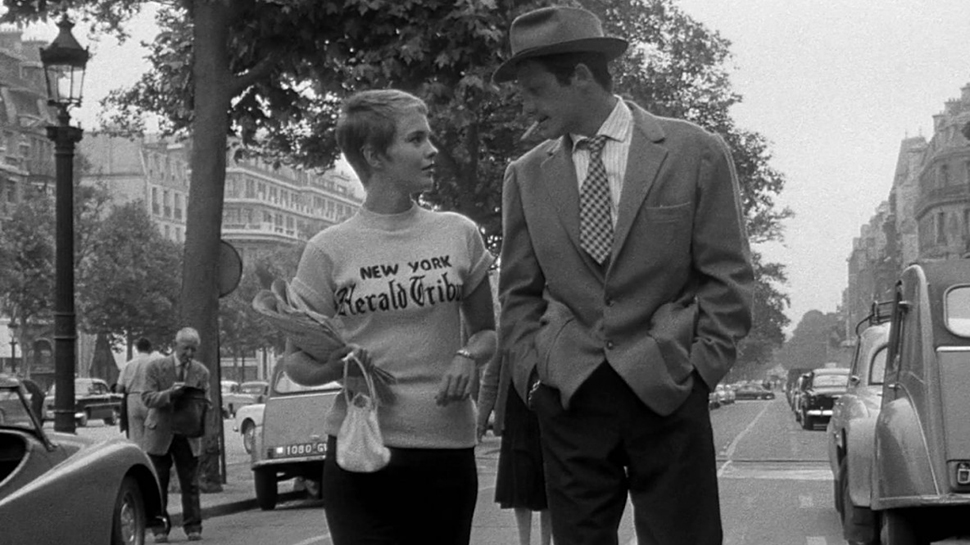
Jean Seberg and Jean-Paul Belmondo get obsessed with their own images in À Bout de Souffle

Director: Jean-Luc Godard

Cast: Jean-Paul Belmondo (Michael Poiccard), Jean Seberg (Patricia Franchini), Daniel Boulanger (Police Inspector Vital), Henri-Jacques Huet (Antonio Berruti), Roger Hanin (Carl Zumbach), Jean-Pierre Melville (Parvulesco), Liliane David (Lilane)

The French New Wave emerged from a group of film critics from influential magazine Cahiers du cinema in the 1960s, led by Francois Truffaut (who contributed a four page story outline to this film, although Godard later minimised his contribution as much as possible). The movement believed the director was the “author” of the film, stamping their personality on it. Packed with references to classic Hollywood movies, the films were shot with an improvisational lack of formality (that often hid brilliant cinematic technique) inspired by Italian neo-realism.

Breathless, Jean-luc Godard’s revolutionary masterpiece, was one of the central films in this school of filmmaking. It followed the last few days of Michael Poiccard (Jean-Paul Belmondo). A young man drifting through a life of petty crime, who idealises Humphrey Bogart’s style, he one day steals a car; it happens to have a gun in it, and in a moment of casual indifference he shoots a policeman trying to arrest him and flees. In Paris, while being hunted by the police, he reunites with his girlfriend, American student Patricia Franchini (Jean Seberg), and their self-absorbed relationship plays out under the shadow of the police net getting tighter and tighter.

Jean-Luc Godard’s film was hugely influential, as it seemed to re-write the rules of how films were to be made. Godard’s film is down and dirty, it’s almost guerrilla, but filmed with a wonderful, improvisational beauty. Shots are hand-held and dynamic, the action is all filmed on location, the framing is rough and ready, the camera gets up close and personal with the actors, throwing us in with them with an overwhelming sense of realism. The whole film feels irreverent, casual and cool, and gets a wonderful sense of urban Paris. It magnifies and reflects the very qualities the lead characters believe they have themselves.

Godard’s most influential touch was the use of jump cuts within scenes, with action jumping from moment to moment within a scene seemingly spontaneously, giving an impression of constant movement and ripping out the sense of time between actions. It also gives a sense of the film always driving forward, bouncing from beat to beat. According to rumour, this influential use of editing was a happy accident. The original cut of the film was well over two hours, and the distributors wanted something less than 90 minutes. Rather than cut whole scenes, Godard cut the small moments of movement or peace in scenes, giving the film a jagged freshness.

The whole film is full of these moments, the jumps over silences and conversational gaps, jumps in time lags between walking from point A to point B. It really works as well. The exterior scenes buzz with an exciting freshness. The long second act, basically nothing more than a conversation in a bedroom between the two leads, is edited almost like an action scene in a modern film – perfect for the self-dramatising energy the two characters are leading their lives with.

It’s those two leads who really help to make the film. Seberg picked up a quarter of the film’s budget to be the “name” lead, and she brings the film a soulful but distant sense of coolness. Belmondo was the real find, turning himself overnight into a mega star. In the sixties these were the people that your cool student wanted to be. Belmondo nailed his sense of iconoclastic cool in the opening moments – particularly when turning casually to the camera while driving his stolen car, to involve us personally in the story of his own life that he is constructing.

You can see how the performances (and characters) of the two leads had such impact on filmmaking. Energetic but also listless, contemptuous of authority and certain that whatever the world has in store for them it is definitely something more, self-absorbed and selfish, immature and convinced that their lives are more important that the average people around them – they are the predecessors of Bonnie and Clyde, of the young killers in Badlands. And nothing seemed to capture the counter-culture cool than Belmondo with a cigarette dangling from this mouth, apeing Bogart. 

But both lovers are equally selfish and obsessed with their own stories. Or rather, self-consciously living their lives like they are in a narrative – in fact you could say that the film predicts the self-obsession of the social media age. Michael lives a life that is all an entirely constructed front. He’s a would-be gangster, with a carefully studied front of gritty cool. He spends endless time making sure that his look, his clothes, his postures, his manners are always spot-on. He constantly keeps up a stream of consciousness narrative about his own life and situation, positioning himself as the sort of representative of modern American hip.

And Patricia is the same. Although at first she seems the more natural and grounded of the two, it’s clear her self-obsession is just as profound (if not more so) than Michael’s. Patricia constantly reviews and rebuilds the narrative of her own life, discussing her romantic life like it was a carefully constructed fiction, or some sort of hyper-cool Mills and Boon. “Do I love you? Should I love you? Can I make myself not love you?” Patricia’s construction of her own narrative – and her desire to shape and control it completely – makes her as completely artificial as Michael is. 

She’s so determined to construct her own narrative, that she shrugs off a string of revelations about Michael as if they didn’t exist. He’s a killer? Okay. He’s got at least two names? Hardly matters. He’s married? Nobody’s perfect. When deciding to betray Michael to the authorities, the action seems almost motiveless, but it quickly becomes clear that it is led by her latest review of the life situation and deciding it’s not what she wanted. Surrendering Michael to the law is her chance to say “No, I shape the story here – and I get to control who I feel love for, no one else”. By betraying Michael she is cutting a part of a life narrative out like she was removing a tattoo, something that she is not sure she wants any more but finds hard to remove.

One area where I do struggle with the film now is the attitude it has to its heroes. I think it wants us to kind of admire Michael – for all his faults – as some sort of unconventional hero looking to lead his life. I struggle to feel the engagement with a guy who is literally a murderer as much as the film wants me to – but I think this is the result of a major change from the more rebellious 1960s, to our changed times today. But then I’m also not sure that the film has as much heart as it wants to have – its characters are so consciously artificial that you never really get a sense of them as human beings. They are always characters, never people – and the film is always focused on their constructed images rather than anything real for you to invest in. There is much to admire, and not much to love.

And that doesn’t change the influential nature of the film. While it’s easier to admire the film than to love it – for all the strength of the performances, the characters are selfish fantasists – and its technical achievements sometimes distance as much as they throw us into the action, it’s still brilliantly put together. It’s masterfully made, and while I’m not sure it really has any heart, it’s got enough energy, force and urgency to make dozens of films.

The Wages of Fear (1953)

Yves Montard and Charles Vanel struggle to collect The Wages of Fear

Director: Henri-Georges Clouzot

Cast: Yves Montard (Mario), Charles Vanel (Jo), Folco Lulli (Luigi), Peter van Eyck (Bimba), Véra Clouzot (Linda), William Tubbs (Bill O’Brien), Darío Moreno (Hernandez), Jo Dest (Smerloff)

You’re stuck in a dead-end town without the money to get out. There’s been an accident at the local mining company that runs the town. They need to get super-duper, explosive material up there to blast the mine and prevent a fire spinning out of control. The only way to do it is in a truck up a bumpy hill road in the blazing sunshine. The company will pay a small fortune to anyone desperate or stupid enough to do it. Would you collect these Wages of Fear?

That’s the conceit in Clouzot’s slow-burn, tension-packed masterpiece. Mario (Yves Montard), along with several others, is stuck in a dead-end desert town in South America unable to afford the air fare to escape. Mario befriends an ageing gangster Jo (Charles Vanel), now also stuck in the town, and the two of them are tempted to drive trucks full of nitroglycerine (which can explode when hot or under the slightest jolt or pressure) to help put out a massive fire at the local American-owned oilfield. Along with Bimba (Peter van Eyck), a German, and Luigi (Folco Lulli), an Italian, they drive trucks up there – but the pressure affects the men in different ways and the dangers of the drive make it highly unlikely that they will all make it.

The Wages of Fear is the classic slow-burn leading to (literally) explosive tension. It’s almost a full hour into the film before the nitroglycerine makes an appearance, but after that the film lays a constant series of dilemmas in the way of our heroes as they try to make their way 300 miles to the oilfield. Never before has the slightest jolt of a car, or the smallest pot hole, been more wracked with danger. Is it any wonder each of the men go a little insane: who could do this and not be a little cracked in the head?

Clouzot directs this with a sublime brilliance. The film is a masterclass in subtle build-up. The opening act of the film establishes the characters of Mario and Jo (and to a lesser extent Bimba and Luigi). We see them in their natural habitat, and learn to understand their characters so thoroughly, that we are genuinely surprised and a little unnerved about how much they change over that long and dangerous 300 miles. Yves Montard’s Mario is a quintessential cool customer – hanging at bars, treating his girlfriend Linda (Vera Clouzot, the director’s wife) with a distant disdain – but he’s also a man easily influenced, prone to hero worship not least to new-guy-in-town Jo, on whom he has a massive man-crush.

Jo, played with a sustained brilliance by Charles Vanel, is the big fish in the small pond, a small-time gangster lording it over his fellow town-dwellers with an unruffled arrogance. Jo has no interest in anyone else and claims Mario’s allegiance as his right – in fact he takes delight in provoking Luigi, Mario’s previous best friend (crush?). He watches with amused detachment when Mario drops Linda to spend time with him. He openly provokes a fight in a bar with Luigi (Clouzot’s first sequence of bubbling tension, brilliantly shot with an unease and unpredictability that could see almost anything happen once a gun emerges) and makes a big show of his past relationship with O’Brien the oil company representative. 

The stage is set for us to see Mario as too laid-back, distracted and indolent to succeed and Jo as a collected, calm and controlling presence made for drama. So it works even better to see these two men change position as the journey continues and fear grabs Jo in a way that seems to surprise even him. Mario, meanwhile, becomes almost ruthlessly focused in his determination to see the mission through to its completion, and increasingly distant from those around him. Because in these life and death situations, there is no time for fear or to mollycoddle the concerned. When a single mistake could kill you all, you can’t afford to waste time on someone too scared to carry on.

Mind you, the opening section of the film brilliantly establishes the desperation these people feel to escape from this dead-end town. A young man, not selected for the driving operation, hangs himself in despair. Bimba states that the slightest horseplay or distraction on his trial run with the truck during the selection process will lead to deadly consequences for the joker – and he’s not fooling around. O’Brien of the oil company makes it clear that the mission is almost certainly suicide – and that the company basically doesn’t care at all about the fates of those selected to go on it: they are completely disposable.

Those selected are both lucky and unlucky – and Clouzot uses a brilliant early sequence to establish the danger of the nitro. O’Brien calmly takes a small sample of it in a shot glass and spills it to destructive effect. As one reviewer said, “you sit waiting for the theatre to explode”. Part of this is the way Clouzot uses the men in the film: they are very much rats on a running track, trapped in a route full of danger, with no release or relaxation from the deadly load they carry. Extraordinary sequences abound in the film’s second half, like a whistle-stop our of tension set-pieces from films.

The dangers of everything are doubled because the characters are driving a portable bomb. Moving over a bumpy road – terrifying. Driving round a tight corner on a rickety wooden platform over a cliff – tense enough normally, even more so now. Encountering a road block with a giant stone – guess we need to use some of this incredibly reactive stuff (a brilliant scene as Bimba tenderly pours a small amount of nitro into a drilled hole and rigs up a fuse). Crawling the truck through an oil slick – sublime. And it works so well because the film makes clear that our heroes have no choice at all, they simply must get the money that will come from finishing the mission.

Clouzot totally understands the personal dynamics that underpin these crisis situations. Bimba and Luigi slowly overcome distance to find a real bond between them. Meanwhile Mario and Jo’s relationship disintegrates, as Jo’s cowardice leads to Mario treating him with increasing disdain, contempt and finally disgust. Mario himself becomes increasingly adamantine, fixed on the mission’s success at the exclusion of all other concerns. 

Clouzot ends events with a supremely ironical touch, almost darkly comic – but then somehow not a surprise in this film where life is cheap and can literally blow up in your face at any moment. Sublimely directed, and a masterclass in tension and subtle character development, it features a brilliant performance from Charles Vanel and constantly rewards viewing. The Wages of Fear are high – but their price can be even higher.

The Battle of Algiers (1966)

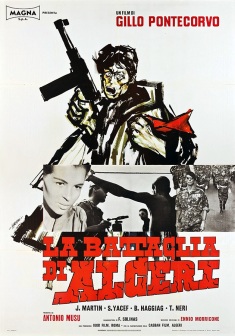
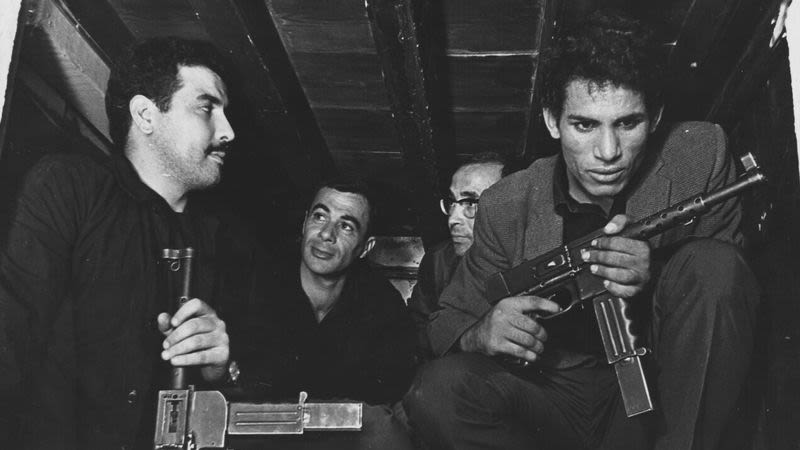
The French military move into Algiers in Pontecorvo’s neo-realist masterpiece The Battle of Algiers

Director: Gillo Pontecorvo

Cast: Jean Martin (Colonel Mathieu), Yacef Saadi (Djafar), Brahim Hadjadi (Ali La Pointe), Tommaso Neri (Captain). Ugo Palette (Captain), Fusia El Kader (Halima), Mohamed Ben Kassen (Petit Omar)

Sometimes, when watching The Battle of Algiers, you have to catch yourself and remember everything you are watching was staged rather than real footage. That right there is the greatest strength of this film, and its ongoing legacy. It feels more real than the news, it looks more authentic than reality. Match that with the fact that (and it says a lot for the world that this is the case) its themes remain painfully resonant today, and you can see why it has had such a lasting and profound impact on film-makers.

Pontecorvo’s film dramatises (although that almost feels like the wrong word) events in Algiers, capital city of French Algeria, from November 1954 to December 1957 when the Algerian War of Independence turned the city into a near warzone, with its hub being an increasingly brutal struggle for control of the Casbah between the French authorities (and then army) and the Algerian National Liberation Front (FLN) cells. 

That description only gets a flavour of the film, which reconstructs the story with a truly awe-inspiring immediacy that feels like a slice of real life. The film has a fearless willingness to depict the dangerous struggle and violence in a combat between terrorists and soldiers. So we get violence on both sides, torture, murder, beatings, bombings of young civilians and other acts of brutality, all chronicled with a documentary realism that never feels exploitative or distasteful.

The film is often hailed as being scrupulously even-handed. I’d argue it isn’t quite – what it does do is recognise that both sides are human. The cause of Algerian independence is clearly one the film finds sympathetic, and while it shows acts of terror from the Algerians, the real acts of violence and prejudice come from the French authorities and citizens. The film doesn’t turn the Algerian terrorists into unspoilt martyrs, but it certainly regards their cause as right. So it can show them killing civilians and engaged in acts of violence, but still admire their cause (the film was made with the involvement of several former members of the NLF both in front of and behind the camera).

The film’s depiction of the French soldiers also gives more of an impression of even-handedness. These soldiers are not brutal or sadistic, but functionaries doing about a job (just following orders?) with a ruthless efficiency. The casting of Jean Martin (the only professional actor in the film) as French commando leader Colonel Mathieu also perhaps weights things, as Martin gives an engaging, morally conflicted performance, and the film lays great stress on Mathieu’s own experiences during the Second World War in the French Resistance and (it’s implied) in a concentration camp. 

The French soldiers go about their task of pacifying the terrorists with a campaign of capture, enhanced interrogation and systematic elimination of cell leaders, using their superior resources and training, in a way that the CIA (which screened the film for its agents in 2003 to help them understand terrorist cells) described as being a complete success militarily, but a total failure politically. It stamps out the Algerians in the Casbah, in a way that reduces casualties and restores order – but totally fails to win over the precious hearts and minds.

And Pontecorvo knows it’s hearts and minds that his film is all about. His camera immerses us in the heat and tension of the Casbah, picking out the faces of the non-professional extras (and actors) that populate his film, showing the bubbling tensions and resentment slowly building in a population that doesn’t start out as bitter and extremist, but becomes more and more so as the French stamp out the Algerian independence movement. People swirl around the action, increasingly objecting to the strict control procedures that segregate the Casbah from the rest of the city, and at several points crowding into potentially violent mobs, spurred on by some members of the NLF.

The NLF also has little compunction in the tactics it has to employ in order to stand any chance against the French. Pontecorvo frames the film around the experiences of Ali la Pointe (a striking performance from non-professional Brahim Hadjadi). It opens with la Pointe trapped by the French soldiers, flashing back to his initial recruitment, radicalisation and increasingly pivotal role as a cell leader under more the more urbane and political Djafar (Yacef Saadi, another non-professional playing a version of himself). 

La Pointe is our audience surrogate – and it’s surprising how we find ourselves drawn towards him. Especially since within the first 15 minutes he’s moved quickly from murdering gangsters in the Casbah to shooting cops and leading riots. Pontecorvo shoots and edits these moments of terrorist action and planning with a Hitchcockian skill. One particularly brilliant sequence follows three NLF women being selected, prepared for, traveling to and carrying out a series of bombings of cafes and bars in Algiers (the victims at one seem to be exclusively teenagers and young people).

The film is full of moments like this, all filmed with a gripping down-to-earth black-and-white realism, buzzing with tension. It’s brilliantly assembled and totally compelling, a documentary slice of Italian neo-realism that presents a fascinating look at the dangerous politics of resistance and occupation. The French military’s heavy-handed tactics are totally effective – even torture is shown to yield enough results to justify its use – but they are also completely wrong, morally repugnant but executed by soldiers going about their duty with no bitterness (Mathieu frequently tells the press that he hopes for a bright future for Algiers and even doubts the wisdom of occupation in the long run).

Pontecorvo’s film remains alarmingly prescient and relevant today – and it’s actually a little scary how little the world has changed. You can just as easily imagine the same events happening in Iraq or Afghanistan today. It’s told here with no sensationalism but a mostly objective even-handedness, that makes clear the side it favours but doesn’t demonise the other. As a slice of history turned into film it’s impeccable.

Three Colours: Red (1994)

Irène Jacob gives a soulful performance in Kieślowski’s crowning achievement Three Colours: Red

Director: Krzysztof Kieślowski

Cast: Irène Jacob (Valentine Dussault), Jean-Louis Trintignant (Joseph Kern), Jean-Pierre Lorit (Auguste Bruner), Frederique Feder (Karin), Samuel LeBihan (Photographer), Marion Stalens (Vet), Teco Celio (Barman)

Spoiler warnings: I wouldn’t usually do this for a film that was made over 20 years ago, but discussing this film is almost impossible without covering the entire plot so – be warned! This is a rich viewing experience you should discover for yourself.

Kieślowski’s great trilogy wraps up with Three Colours: Red, a fascinating, moving, intriguing puzzle of a film that opens itself up to countless interpretations. It’s a film that seems to be about a great many things, but wears its intelligence and insight very lightly, never hammering points home or getting too wrapped up in its own smartness. It’s primarily a story and never forgets that. It also pulls together threads and themes from the entire trilogy hugely effectively. It’s a great movie.

Valentine (Irène Jacob) is a student in Geneva, funding her time at university through part-time modelling. After accidentally hitting (but not killing!) a dog with her car, she meets the dog’s owner, retired judge Joseph Kern (Jean-Louis Trintignant). Joseph is spending his time in isolation from the world, listening to his neighbours’ phone calls, more out of a judge’s habit of finding out secrets than any truly malicious intent. Valentine challenges this blatant disregard of privacy, and she and Joseph begin to form an increasingly strong bond. 

Red is a beautiful film, wonderfully made and rewards constant analysis. Kieślowski described this as the hardest film of the trilogy to write, and you can see why. Dealing with themes of fraternity, it ties this in closely with love (romantic and otherwise). The entire film shows the strengths of people coming together, specifically Valentine and Joseph who develop a bond that enriches their lives. This is contrasted throughout with Valentine’s domineering boyfriend on the other end of the phone-line, and modern communication in general that builds distance between people. Joseph, a man distanced himself from all others, finds his humanity once he opens himself to considering other people as people.

Kieślowski’s film also plays interesting games with narrative and time. A seemingly minor character, Auguste, a lawyer training to become a judge, is slowly shown to share a huge number of life events with Joseph’s youth. The question that bubbles over the film is, is this a coincidence or are Auguste and Joseph somehow linked? Is Auguste in some way the same person as Joseph – some sort of reincarnation? Is this fate or chance or mere coincidence? Is Joseph, living like some lonely old-testament God in complete isolation, somehow trying to move events to correct errors in the past – to try and find some contentment for Auguste (whose conversations with his girlfriend he has been listening to) so that he avoids the life Joseph has led?

I like this idea. It appeals a lot to me, not least as I started to feel that Joseph was almost some sort of Prospero, using phone taps as his own private Ariel to know everything happening around him and then (more benignly perhaps than Prospero) using this to improve the lives of those close to him. Perhaps. There is even a seemingly magic storm at the end of the film that brings several characters together, not least the leading couples from the previous two films in the trilogy. It’s also a storm that, it is suggested, will bring Valentine and Auguste together.

It’s a romantic flourish at the end of the film that speaks of the possibilities for the future (though typically of this intriguing series, it’s a flourish that comes out of a ferry accident that kills over a thousand people – you can’t get something for nothing in this world, and no romantic story is straight forward). It’s also a natural development of the strong romantic link between Joseph and Valentine. If Joseph and Auguste are (essentially) versions of the same person, it’s a further suggestion that (in another life) Joseph and Valentine would certainly have fallen in love (to match the platonic love that develops between them). This interpretation of love joining people together is seen as well in the lead couples from Blue and White also surviving the accident.

Or is this all coincidence? Kieślowski plays the mystery and depth so lightly – lets these points float out or be lightly stated without tub-thumbing – that it leaves it all gently to the viewer’s imagination. You can make of it what you will: the story works just as effectively if you ignore all the things I just discussed. Joseph as the isolated, austere man who finds a warmth in himself awakened by the generosity and compassion of Valentine. All this stuff could just be the working of chance.

But either way, the film is about fraternity: people coming together, and communication and compassion making us human. Irène Jacob is wonderful as the endearing, romantic and empathetic Valentine, her brightness and humanity shining through. Jean-Louis Trintignant is superb as the judge, whose careful veneer of distance and coldness is punctured throughout the film. The scenes these two share are beautifully done: conversations that throb with emotion under the surface. Kieślowski again directs these scenes with a masterful minimalism, using differing heights and levels (they are very rarely on the same level, usually one sits or stands above the other) to show the dynamics subtly change between the two. These height differentials – with Valentine often kneeling at Joseph’s feet – also suggest a growing intimacy between the two characters. 

Technically the film is a marvel. It is lusciously filmed by Piotr Sobociński. The presence of red throughout is very well done and adds a poetic brilliance to the images. Kieślowski in particular shoots sunrises and sunsets with an astounding beauty, and uses light to add a huge emotional depth and beauty to private conversations. Zbigniew Preisner’s score is marvellous, a lyrical, beautiful series of compositions that rewards constant re-listening.

Red is a marvellous, thought-provoking and humane film crammed with wonderful and involving ideas, and brilliantly gives you loads to think about both narratively and thematically. It’s a warm and moving story, with darker elements that make those parts seem richer. With two marvellous performances at its centre, it’s brilliantly directed by Kieślowski (who tragically died shortly after the film’s release), with grace, poetry and passion. It looks wonderful, it sounds marvellous and it always make you think. It’s a masterpiece.

Three Colours: White (1994)

Zbigniew Zamachowski confronts the problems of revenge in Kieślowski’s Three Colours: White

Director: Krzysztof Kieślowski

Cast: Zbigniew Zamachowski (Karol Karol), Julie Delpy (Dominique Vidal), Janusz Gajos (Mikolaj), Jerzy Stuhr (Jurek), Aleksander Bardini (Lawyer), Grzegorz Warchol (Elegant man), Cezary Harasimowicz (Inspector), Jerzy Nowak (Old farmer), Jerzy Trela (Monsieur Bronek)

The second film in Kieślowski’s ambitious thematic trilogy probably couldn’t be much more different from the first. Whereas Blue was a romantic tragedy, this is a sort of bitter comedy, a kind of anti-farce if you like. Here, the themes of equality are much more about getting even rather than all men being equal. Just as Blue looked at the negativities of liberty, this looks at the dark side of equality, and the blinkered tunnel vision we follow in order to get ourselves even.

Polish hairdresser Karol Karol (Zbigniew Zamachowski) is divorced in Paris by his French wife Dominique (Julie Delpy). In quick succession, Dominique strips him of his home, access to their bank account, his passport and his share of the business, and takes another lover. Reduced to homeless penury on the streets of Paris, Karol finally finds a way to get home to Warsaw by befriending sad-sack successful businessman Mikolaj (Janusz Gajos), a fellow Pole, on the Métro. With Mikolaj’s help, Karol finds himself back home and soon in a position to start scheming his revenge.

White is, let’s be honest, a lot less of a triumph than Blue. That was a film that combined stunning visuals, directorial invention, profound depth and emotion. It was a story that looked at universal themes from a fascinating series of new angles. White,however, is more of a shaggy dog story. It feels like it’s aiming for some sort of Chaucerian fable, but it never really goes anywhere in particular, and it never really engages as much as it should while it tries to get there. While it’s not unentertaining film, it’s at best a good one rather than a great one.

My main problem is that Dominique’s character just never clicks. Why does she do the things she does? No idea. We are never given any insight into her character – she remains a cipher, bordering on a trope of the wicked beautiful seducer. Why does she jilt Karol? Surely it can’t be because of his (rather obvious) impotence ever since he arrived in France, and felt isolated in his new home? Why does she take such a delight in persecuting him, even down to audibly having sex with her lover when he calls her (“Perfect timing” she says before getting frisky)?

It’s hard not to get the sense of a film which has a slight suspicion of women. I don’t imagine that this a suspicion Kieślowski  in any way shares – sensitive and humane portrayals of women are central to his films (not least Blue) – but when the only female character in this is the distant and unknowable Dominique it’s not good. Without any sense of why she has done the things she does, it’s hard to feel comfortable with the semi-comic destruction of her Karol plans.

But then that is part of the film’s point: Karol is obsessed (without even really knowing it) with his wife. Not even so much with revenge for that matter – just getting the chance to take on his wife in a one-sided struggle makes him feel closer to her. The only possession he takes home from Paris is a bust that reminds him of his wife (and which he painstakingly repairs after it is smashed to pieces). Much as tries to build a new life, it’s a monofocus – he only gets what he gets in order to use the resources against his ex-wife. 

So equality is in Kieślowski’s design, not a good thing. Shy, sweet Karol basically ends up entrapping himself and his wife in equally frustrating positions: she in prison, he faking his own death without a penny. What was the point for Karol? No wonder he looks up at her in prison with tears rolling down his face – he’s still in love and he’s got nothing to really show for his equality, other than their joint misery.

All of this sits alongside Kieślowski’s brilliant understanding of post-Cold-war Poland, a bustling land of opportunity to make a quick buck, where simple peasant farmers can be bamboozled out of their land by smarter guys who know businesses from the West are just dying to buy up properties. Karol shares this understanding of Poland. No wonder he’s all at sea in the rest. The instant he arrives back he’s delighted, relaxed and more confident – “I’m home!” he cries joyfully, even when his first view on arriving in Poland is a mass rubbish dump. 

Moments like that show Kieślowski’s dry comedy. There are plenty of other moments, helped by Zamachowski’s pretty lovable performance of the naïve-but-growing-in-confidence Karol. Karol and Mikolaj (an excellent Janusz Gajos) put together quite an excellent double bill of bromance laced with darker themes of depression (it’s no real surprise who Mikolaj is talking about when he tells Karol that he will help him if Karol can help his “friend” who wants to die but can’t kill himself). Karol’s hapless fate in Paris raises a few smiles, as does his surreal escape stuffed in a suitcase.

But there aren’t quite enough of them. Too much of the film either doesn’t connect or hold together. I could have certainly done without Karol’s sexual prowess returning once he is confident and rich in Poland (yawn!). Dominique’s non-character remains a serious problem, and there just isn’t enough meat on the bones here. Compared to the richness of the first entry in the series, this feels remarkably empty. It’s also a lot less visually arresting and imaginatively done than the first film: I’m already struggling to remember any of the visuals.

Kieślowski may well have wanted a sort of anti-comedy to be the pivot of his trilogy, but it doesn’t really work here. He ends up with something that feels so slight and underdeveloped that it doesn’t stick with the viewer, and doesn’t engage them either. While it has moments, as you would expect from a great director, and some very good actors, it doesn’t have nearly enough of them.

Three Colours: Blue (1993)

Juliette Binoche seeks liberty from grief in Krzysztof Kieślowski’s masterpiece Three Colours: Blue

Director: Krzysztof Kieślowski

Cast: Juliette Binoche (Julie de Courcy/Vignon), Benoît Régent (Olivier Benôit), Emmanuelle Riva (Madame Vignon), Florence Pernel (Sandrine), Guillaume de Tonquédec (Serge), Charlotte Véry (Lucille), Yann Trégouët (Antoine), Hélène Vincent (La journaliste), Zbigniew Zamachowski (Karol Karol), Julie Delpy (Dominique)

There are few foreign language films that have cemented themselves in film’s cultural history more than Kieślowski’s Three Colours Trilogy. These three inter-linked films – made with French and Polish money – looked (individually) at themes of Liberty, Equality and Fraternity, while using a colour palate and design that reflected one colour of the French flag each. The first film in this interlinking trilogy is Blue, a sombre, intriguing, intimate drama that perhaps wears its intelligence a little heavily on its sleeve.

Julie de Courcy (Juliette Binoche) is the only survivor of a car crash that kills her husband, a famous composer, and her daughter. Lost in grief, Julie decides that she will separate herself from the world and live entirely independently. She rents out her home, distances herself from friends, takes back her maiden name and destroys what she believes to be the only copy of her husband’s final composition – a concert for the unification of Europe. But Julie finds that liberating herself from all worldly connections is not as easy as she hoped.

Blue is a heartfelt, gentle film that throbs with emotional intensity, much of it coming from Binoche’s searing performance of a woman consumed with a mixture of grief and survivor guilt, who sees complete isolation and “liberty” from all connections as the only chance for sanity. Kieślowski’s direction is masterful – patient, stable, quiet and with a brilliant eye for small details. The film is crammed with small moments that speak of peace and quiet reflection – from watching a lump of sugar being soaked in tea, to lingering studies of everything from rooms to streets. 

The opening sequences of the film convey this masterful confidence from Kieślowski. The camera is a still observer, alternating between subtle POV shots and gentle, perfectly placed observation of Julie. Every moment of the shocking discovery of Julie’s loss is wonderfully assembled – from the stumbling news from the doctor, to the crackling mini-TV on which she watches her family’s funeral being broadcast. Quietly we see Julie return to her own home – and Binoche bottles up emotion with a resolve that suggests as much her determination not to engage with the pain as it does self-control. No wonder her housekeeper bursts into tears at the fact that Julie isn’t crying.

This all ties in very interestingly with the film’s theme of liberty. Conventionally, we would have had Julie escaping from something to find her own life. Kieślowski’s film more interestingly explores the positive and negative of liberty. Julie chooses freedom from all of life’s connections – but this is shown constantly to be not only impossible, but also less than healthy. Her surface liberty is instead crushing her under the pressure of isolation.

At the same time, the film is partly about Julie learning to free herself from her survivor guilt. Cutting herself off from the world denies her a genuine emotional connection with her husband’s friend Olivier (a puppy doggish Benoît Régent). In the first months of her guilt she sleeps with Olivier, hoping it will get her a bit of peace (it doesn’t). Inevitably, as Julie finds out more about her husband’s life – and as we find out that his music output was heavily reliant on Julie’s secret collaboration – the film becomes a question of whether Julie will allow herself the liberty from her past to continue living.

Because in a way this is an anti-tragedy: it starts with a trauma and is about the survivor learning to continue her life. Kieślowski peppers the film with moments of falling, from items to bungee jumpers on the TV. Slowly, these images of falling progress to include being caught, or shots of the bungee cords snapping the person back from oblivion. It’s a neat, subtle continual reference to Julie’s unconscious search for support.

Particularly as it’s made clear that Julie’s entire personality is all about giving, about loving and supporting people. From her silent collaboration with her husband, to her patient caring for her mother suffering from increasing dementia (another perverse form of liberty), to her forming a reluctant friendship with an exotic dancer in her block of flats (who the rest of the tenants are trying to drive out), it’s clear that Julie’s attempt to distance herself is never going to truly work. A character late on even tells her that her husband had always described her as kind and forgiving – qualities Julie learns to re-embrace. 

The wider world that Julie is trying to escape is represented brilliantly throughout by the score of her husband’s (her?) music for Europe. This score – a richly exuberant piece of music by Zbigniew Priesner – constantly intrudes into the action, accompanied by moments where Kieślowski seems to suggest time has stopped as Julie becomes lost in her reflections. Kieślowski uses colour changes and slow zooms to suggest throughout these beats where Julie temporarily becomes lost in the past and memories. The continual presence of the music is perfectly done.

The one element I was less keen on was the over use of blue. From filters on the camera, to backlighting, to objects present in every frame, there is a lot of blue in this movie – every shot has something blue in it. Although this is clever, and clearly thematically intentional for the whole trilogy – I’ve got to be honest spotting this stuff probably took me out of the film at moments. I imagine on a second viewing this will be dramatically reduced – but it’s one of those curses of a trilogy of films that have been so hyped up on the arts circuit, that you are aware of some of its subtle tricks so much that they cease to be subtle.

But Three Colours: Blue is still a masterful, quiet study of grief, loss and yearning, that avoids the obvious and explores different types of liberty and freedom. Binoche is brilliant in the lead role, and Kieślowski sears the brains with images (I still wince remembering a sequence where Julie deliberately scrapes her knuckles over a wall she walks past) and his direction is impeccably sensitive and unshowy, letting the film speak for itself. I can’t wait to watch the other two films in the trilogy – and see how this might affect my views on this first one.

Day for Night (1973)


Jean-Pierre Léau and Jacqueline Bisset are the leading actors in FrançoisTruffaut’s film making masterpiece Day for Night

Director: François Truffaut

Cast: Jacqueline Bisset (Julie Baker), Jean-Pierre Aumont (Alexandre), Valentine Cortese (Séverine), Jean-Pierre Léaud (Alphonse), Dani (Lilane), François Truffaut (Ferrand), Alexandra Stewart (Stacey), Jean Champion (Bertrand), Nathalie Baye (Joëlle), David Markham (Dr Nelson), Nike Arrighi (Odile), Bernard Ménaz (Bernard)

François Truffaut is perhaps the greatest example of a critic turned film maker. A noted French film expert, he made a splash when he turned to film directing and became one of the leading figures of the French New Wave. This movement was seen as a rejection of old-school, literary melodramas of French cinema, instead embracing social issues and using the techniques of cinema in new and imaginative ways. Truffaut later stated though he was not a revolutionary, but a man who wanted to make stories that were important to him, using all the tools of cinema available. And as a man who loved cinema – and worshipped the great directors of yesteryear – what story could be more important to him than the making of films themselves?

Day for Night (the term means to place a filter on the camera in order to shoot scenes set at night, during the day) is set during the production of Meet Pamela, a melodrama starring gentlemanly screen icon Alexandre (Jean-Pierre Aumont), increasingly fragile screen diva Séverine (Valentine Cortese), neurotic young star Alphone (Jean-Pierre Léaud) and British film star Julie Baker (Jacqueline Bisset) recovering from a nervous breakdown. The film is directed by Ferrand (Truffaut himself), working in close collaboration with the crew (many of them played by the real life crew of Day for Night) not least passionate cinephile script-editor Joëlle (Nathalie Baye). The film is plagued by compromise, reshoots and actor-induced difficulties, with Ferrand and his crew constantly forced to rewrite and adjust the story to compensate.

Day for Night is partly a gentle, satirical farce on movie-making (it even has a documentary camera crew, following events around), but really it’s a deeply romantic, wonderfully engaging, desperately sweet homage to cinema and movie making itself. In fact, I can’t imagine anyone who loves movies not loving this film. It’s a charming warts-and-all, behind-the-scenes look at how a movie is made, and what motivates the people who make it. The fact that it’s really funny, and has some wonderfully engaging characters in it, is the icing on the cake.


Truffaut places himself at the centre of the film in more ways than one. Obviously he’s playing the director – the still-centre of the film, who constantly must address and overcome a string of practical problems, from actors disappearing to malfunctioning props and (in one stand-out moment) a cat who refuses to lick milk from a saucer. But the film also places Truffaut the man at its heart: Ferrand’s love of cinema is Truffaut’s own. Three times we see Ferrand dreaming at night (it’s possible it’s even the same night – each set-up is the same). We see snippets of the dream before its full content is revealed: it’s a memory of the boy Ferrand (based on Truffaut’s own childhood) going to cinemas at night to steal still photos of Hollywood masterpieces (in this case Citizen Kane). Cinema is such a powerful, all-embracing part of Truffaut’s life that even as a child he had to worship at its alter, and commit theft to take a small part of it home with him.

This love of cinema runs through the whole film. Joëlle (a truly wonderful performance from Nathalie Baye: smart, sweet, engaging and sexy) can imagine leaving a man for a film but never vice-versa. The props man, Bernard, loves the tricksy solution search to overcome filming problems – and clearly carries a yearning to be on screen himself. The film is packed with longing stories of the golden age of Hollywood: at one point Ferrand drives around his set, bemoaning the loss of the era of studio-made films. It’s a film that celebrates the artisans of film, perhaps even more than artists. It’s an insight into what all those little jobs on the credits actually are, and the heroes are frequently carpenters, script editors, assistants, soundmen, extras directors… In fact all the problems of the film are caused by the actors themselves, the self-absorbed public face of an industry that is built on the love and dedication of the working people behind them.

The actors in the film do, however, contribute most of its comedic and romantic elements. Neurotic, needy matinee idol Alphonse (Jean-Pierre Léaud in a neat performance of childish self-obsession), fawns possessively over his girlfriend Liliane, who he treats as part lover, part sister, part surrogate mother. Frequently he disappears or melodramatically announces that he is finished with acting. He contrasts nicely with Alexandre (a gentlemanly and endearing Jean-Pierre Aumont), who goes through the film with a professional calmness, laced with charm, who is never late and never causes any trouble, but enjoys gossip – and quietly lives with a far younger male tennis player.

Jacqueline Bisset (again hugely engaging – it’s hard not to fall in love with the people in this film) perfectly captures both the attractive likeability and vulnerability of the person who lives their whole life in the spotlight, in a thinly veiled portrait of Julie Christie. She has a natural ease with the assistants and crew – but it’s her fragile mental state that has the insurance companies worried. It’s easy to see why she might feel like that, as the film set is a hot bed of flirtation and casual one-night stands – at one point even called out as such by an outraged assistant-director’s wife. What’s “nice” about the affairs though is their relative lack of long-term drama – short term tears and tantrums are swiftly forgotten, as everyone pulls together to make the film.

The drama of film creation is the magic here. The film is bookended by elaborate set-ups for a street scene (the film even playfully doesn’t reveal at first that what we are seeing is a film-within-a-film) – one carefully rehearsed, the other reshot with the set covered in snow to help cover up the reasons for an urgent reshoot. A scene between the father and the daughter-in-law is conceived, written, rehearsed and shot in one sequence – all in response to Ferrand and Joëlle’s perceptions of the dynamics between the actors. Ferrand, behind his quietness, is ruthless in using things for the film – one character finds their heartfelt confessions about the emptiness of life pushed under their door the next day as lines integrated into the script. It’s not cruel – and that’s the best thing about this film, it’s never cruel or bitter – it’s just the way of the game, the way we struggle to create art.

And the struggle is what is clear here. Ferrand bemoans in voiceover that every film starts with him wanting to make the best film he can, but always seems to end as a salvage job. Much time is spent setting up a complex ballroom sequence, which circumstances later require to be cut. Séverine (a winningly bright performance of diva self-parody from Valentina Cortese) frequently struggles with lines and blocking, regularly bringing the film to a halt – at one point her lines are stuck on a wall out of camera shot. It’s another example of the exposure of film magic – at one point a window and part of a wall is built on a scaffolding to give the impression of a building – only what will appear on camera is built, everything else is scaffolding. 

Interestingly, the film all this effort and work is being put into looks like a pretty forgettable melodrama. It’s in many ways another piece of comedic self-parody – Truffaut’s Ferrand is filming a thinly veiled version of Truffaut’s own The Soft Skin (I’m indebted to the Criterion Collection blu-ray special features for that titbit) – but it’s also a sign of how art and compromise go hand-in-hand. The final film is hewn from the circumstances of its making: it might not be what was intended at the start, but it’s the best we can do with the marble the artist has been given. Sure Meet Pamelalooks pretty average – but the important thing is the love invested in making it. If this goes into an average film, the same level (perhaps more) goes into a great one.

Day for Night is the perfect film for film aficionados. It’s warm, funny and moving. It’s crammed with wonderful performances. It’s shot with a playful expertise. It has a marvellous score by Georges Delerue – part actual score, part score recordings for Meet Pamela – and Truffaut keeps the whole light confection perfectly intact, never letting it burst or sink. It’s a masterclass in film crafting, which is about the craft behind making a film. It’s like peeking behind the magic curtain. It’s brilliant.