Category: Historical biography

The House of Rothschild (1934)

The House of Rothschild (1934)

Old-fashioned historical melodrama with a well-meaning, earnest political message

Director: Alfred L Werker

Cast: George Arliss (Nathan Rothschild/Mayer Rothschild), Boris Karloff (Count Ledrantz), Loretta Young (Julie Rothschild), Robert Young (Captain Fitztoy), C. Aubrey Smith (Duke of Wellington), Arthur Byron (Baring), Helen Westley (Gudula Rothschild), Reginald Owen (JC Herries), Florence Arliss (Hannah Rothschild), Alan Mowbray (Prince Metternich), Holmes Herbert (Roweth)

It’s 1814 and things are looking tight for the international banking house of Rothschild. With the Napoleonic Wars over, partly thanks to Rothshild financial support of Wellington’s armies, Nathan Rothschild (George Arliss) is pitching to underwrite the loans to help restore France. Problem is, now the merde is out of the European fan, many of the Powers-That-Be don’t want to continue working with a Jewish bank. Led by scowling antisemitic Prussian Count Ledrantz (Boris Karloff), the Rothschilds bid is unjustly rejected. Rothschild outmanoeuvres his enemies to win the contract back, but it leads to a series of revenge pogroms in Prussia. Things change though, when Napoleon escapes from Elba. As all roads lead to Waterloo, will Rothschild back the Allied powers or throw in his lot with Napoleon?

The House of Rothschild is a very well-meaning, old-fashioned historical melodrama, that takes a strong stance against antisemitism. It clearly has more than half-an-eye on events in Germany in the 1930s. As the film’s Prussia of 1814 sinks into mobs hurling stones through windows, smashing up shops and chanting for the expulsion of Jewish people, while families flee across the body leaving their possessions behind (all while the self-satisfied, archly cold Ledrantz pushes his agents to provoke the people to yet more outbursts), surely many people would have seen parallels with Hitler’s Germany.

Throughout the film, the accusations of antisemites are pointedly broken down and strongly rebutted or placed into context. Why do the Rothschilds work in money? Because they are literally banned from any other profession. And money is the only tool they have to defend themselves against 2000 years of persecution; persecution that has made the Rothschilds feel a true affinity for their fellow Jewish people. Indeed, Nathan Rothschild feels a duty to stand firm and do anything he can to help his people: and if that means a bit of financial chicanery or applying heavy pressure to the European powers, then so be it. There is a greater good here when lives are at stake.

The scourge of racism is strongly displayed throughout the film. It opens with a prologue as Nathan’s father Mayer (George Arliss pulling double duty, under a pile of make-up and a wig) struggles to hide his justly-earned fortune from being stolen by corrupt tax collectors who call him ‘Jew’ and smugly tell him the amount he owes to the government is whatever they say it is. It’s a ferocious piece of open antisemitism, but it has genteel echoes when Nathan is later snubbed for an invite to a ball to celebrate Wellington’s victory (a victory he largely paid for) since Jewish people aren’t welcome at such events.

The House of Rothschild places its laudable anti-persecution aim into a very traditional, old-fashioned, costume drama that wouldn’t look out of place on the Victorian stage. It was a passion project of George Arliss’ (who cared deeply about its message), but also fit wonderfully well inside his wheelhouse. You can see its deep similarities to Arliss’ Oscar-winning vehicle Disraeli. Just as there, he plays a twinkly elder statesman, with a touch of the rogue but overflowing with decency and honour. Despite being seen as a suspicious outsider, he out-plays his rivals in an international conspiracy while casting an avuncular eye over a love affair in the family: in this case between his daughter (Loretta Young) and gentile British cavalry officer Captain Fitzroy (a fairly wooden Robert Young). Both films end with our hero celebrated by royalty at a grand ball, while cementing a loving marriage with his wife (played again by Arliss’ wife Florence).

Arliss is, of course, very good in a role tailor made for his mix of playful charm and speechifying. Much of the film is essentially dominated by Arliss, who delivers with his customary skill (even if his performance as Mayer is more than a little ripe) and if his performance feels more than a little like Disraeli #2, his comfort in front of the camera and the naturalness he brings to the role help enormously. Under the playful exterior, Arliss also finds a strength and determination, powered by a real moral fury at the injustices, slights and (eventual) violence perpetuated upon his people.

Few other actors get much to play with here. House of Rothschild is heavily fictionalised, from its invented nemesis in Count Ledrantz (Karloff is good value as the scowling racist) to the build-up to the Waterloo campaign. However, for history buffs like me, there is a fair bit of delight in seeing a parade of great European statesmen pop up in cameos. From Tallyrand to Metternich to Lord Liverpool, these powerhouses of politics fill out the margins, even if they barely come to life as characters. If there is an exception, it’s the customary gruff no-nonsense military bearing C. Aubrey Smith gives Wellington (here a man firmly on the side of decency and honour).

The romantic sub-plot is very disposable, despite the best efforts of all involved. It briefly overlaps with the film’s main themes – Rothschild is less than happy with his daughter marrying a gentile, while he suffers a parade of humiliations from Fitzroy’s compatriots – but otherwise provides little real drama. The various conspiracies are largely resolved through some ingenious Rothschild speeches. The film’s main success is always the creeping dread of antisemitic violence, a candle it keeps alive throughout its old-school, costume-drama melodrama, with just small drops of directorial and cinematic invention. It’s the main reason for remembering a film that’s entertaining enough, in a gentle, classic Hollywood biopic way. It never reinvents the wheel, but it’s passionate about the people who find themselves ground beneath it.

Note: Considering all that, it’s particularly sickening to note that footage from The House of Rothschild of Arliss in full Mayer Rothschild make-up was pinched and repurposed for Joseph Goebbels’ vile antisemitic epic, The Eternal Jew.

Disraeli (1929)

Disraeli (1929)

Early talkie gives a melodramatic insight into a Victorian stateman, with an Oscar-winning star turn

Director: Alfred E. Green

Cast: George Arliss (Benjamin Disraeli), Doris Lloyd (Mrs Travers), David Torrance (Lord Probert), Joan Bennett (Lady Clarissa Pevensey), Florence Arliss (Lady Beaconsfield), Anthony Bushell (Lord Charles Deeford), Michael Simeon Viscoff (Count Borsinov)

Based on an Edwardian melodrama, Disraeli was the sound debut of George Arliss, a highly acclaimed British actor with a successful silent career. Unlike other silent actors, Arliss’ theatre training made him ready made to have his voice be heard around the world and his Oscar for Best Actor saw him ride the crest of the sound wave. Today, the film looks inevitably quite primitive, so careful to get the sound recorded that its camera barely moves from its fixed position in the ceiling-free sets. But Disraeli, for all this, is rather entertaining if you settle down to it despite its stodgy set-up still deeply rooted in its Edwardian melodrama roots.

It’s odd to read some reviewers describing Disraeli as a dry history lesson: there is almost nothing historical about the plot of Disraeli. While Disraeli did arrange the purchase of a controlling share in the Suez Canal, I can assure you he did not do it while dodging Russian spies in his own home, balancing a series of daring financial moves, laying cunning traps for scheming Russian agents or playing match-maker for his young protégé. Far from a history lesson, Disraeli is really a sort of Sherlock Holmesish thriller, with Disraeli recast as a twinkly wise-cracker constantly several steps ahead of everyone else. It’s a playfully silly set-up rather disconnected from history – and certainly far more fun than the actual dry history of financial and diplomatic negotiations.

Disraeli is a surprisingly well-scripted (as far as these things go) play, which mixes some decent jokes and creative set-ups with a liberal use of phrases from the eminently quotable Disraeli himself. You can’t argue with the wit of Disraeli (the man famously had dozens of entries in the Oxford Dictionary of Quotations) and the film bounces several bon mots around (‘That’s good. Perhaps I’ll use it with Gladstone’ Disraeli even comments on one of his own lines). There is wit in other moments, not least Lord Charles’s (Anthony Bushell) proposal to Lady Clarissa (Joan Bennett) which dwells so much on his charitable good works rather than any affections that Lady Clarissa is moved to comment she expected a proposal “not an essay on political economy”.

You can see its melodramatic roots all the way through. Secret talks about the canal are held in Disraeli’s house, in open earshot of a Russian spy Lady Travers (Doris Llloyd), who we later discover Disraeli is carefully leading on. Like a cunning Edwardian detective, Disraeli role-plays illness at one point to delay Lady Travers and resolves a last minute disastrous collapse in his payment scheme for the Suez shares with a swaggering bluff that he delightedly tells his amazed allies about the moment the duped Governor of the Bank of England (forced against his will to back the scheme) leaves the room. All this in a largely single-room setting: this is pure Edwardian theatrical melodrama bought to screen, not history.

It’s similar in its picture of history, here re-worked to position Disraeli as the sort of maverick hero we can immediately recognise from films. Disraeli is established as an outsider who no one in the establishment trusts (never mind he was the leader of the firmly establishment Conservative party, or that his rival Gladstone was seen by the crusty banker types in this film not as their saviour but as a dangerous radical). Despite being referred to as Lord Beaconsfield several times, he sits in the commons to face down Gladstone (an uninspired cameo by an unbilled actor). He is displayed as the sort of negotiating and diplomatic genius whose insights can only be responded to in wonder by Lord Charles, his dim Watson.

Like Sherlock Holmes, he lavishes Charles with backhanded compliments (specifically that his rigid honesty makes him the perfect agency for a secret mission because no one could believe he was up to lying). Like many Edwardian theatrical leads, he’s also an intense romantic. Not only deeply in love with his wife (played by Arliss’ wife Florence) but also at least as interested in making sure Charles and Clarissa end up happily married. Arguably none of that relates to the real Disraeli, a largely scruple and principle free opportunist with more than a few similarities to Boris Johnson (but with a sense of personal honesty and decency, Boris can only dream of).

The main point of interest today is George Arliss’ performance. For all its clearly a version of his stage performance, it’s still very engaging and charismatic. Arliss may deliver some of his lines like they are theatrical asides, and his mugging to a non-existent audience in Disraeli’s fake fitness is (while funny) clearly something that worked much better on stage. But he is twinkly, captures the shrewd intelligence of Disraeli and utterly convinces as a man who could run circles around everyone else. Arliss invests both the speeches and the dialogue with a genuine playful wit and a heartfelt honesty which works very well.

It’s entertaining and he looks very comfortable in front of the camera and he’s head and shoulders above the rest of the cast in terms of the light-and-shade he gives the dialogue. While the rest of the cast deliver their lines with the sort of forced formality that focuses on making sure the mic picks up every word, Arliss performs his lines. He’s got a sharp sense of comic timing, wheedles and boasts with real energy and isn’t afraid to chuck the odd line away. It’s a sound performance probably years ahead of its time.

The rest of the film is very much of its era. Green’s direction is incredibly uninspired. The camera set ups are very basic. The problems of sound can be seen throughout: from the awkward positions and formality of the camerawork to the occasional line flub that creeps into the soundtrack. Disraeli can look a lot like a filmed play, largely because it’s been set-up with such little focus on visuals. It’s reliance on title cards between scenes shows how fixed it still is on the clumsier parts of silent film-making. You could say, without Arliss, there would be very little to actually recommend it, for all there is the odd good line. But with him, it manages to be a little bit more than just a historical curiosity.

The Apprentice (2024)

The Apprentice (2024)

Heavy-handed anti-Trump message is made to almost work by two excellent performances

Director: Ali Abbasi

Cast: Sebastian Stan (Donald Trump), Jeremy Strong (Roy Cohn), Maria Bakalova (Ivana Trump), Martin Donovan (Fred Trump Snr), Catherine McNally (Mary Anne Trump), Charlie Carrick (Fred Trump Jnr), Ben Sullivan (Russell Eldridge), Mark Rendall (Roger Stone), Bruce Beaton (Andy Warhol)

No one has dominated recent global discussion more than Donald Trump. The Apprentice aims to expose how he was formed – inevitably, you can’t move for reviews referring to it as a Supervillain Origin Story – but really, it’s being sung for the choir and I’m not sure it really adds anything to the international conversation. I can’t imagine this film shifting the dial at all (which indeed it didn’t): if you hate Trump (and I am not a fan), it’s gonna confirm everything you think already and then some. If you are a supporter you’ll probably think it’s a shrill hatchet job. Both sides might well agree Abbasi’s film is a little hectoring.

Picking up in the late 70s, and running through the all-consuming Greed-is-Good Reaganite America, The Apprentice charts the friendship between up-and-coming would-be-property-mogul Trump (Sebastian Stan) and ruthless McCarthyite legend lawyer Roy Cohn (Jeremy Strong). Cohn takes Trump under this wing, teaching him his three rules for success (always attack, never apologise, always claim victory no matter what). Under this guidance, Trump becomes the figure of bombastic, selfish egotism we see today – while Cohn, afflicted with AIDS, shrinks under his protégé’s shadow.  

Watching The Apprentice I was reminded of Oliver Stone’s Nixon – and not in a good way. Stone is no supporter of Nixon, but his film is a surprisingly generous Greek Tragedy which plays fair with the 37th President, acknowledging his strengths as well as his chronic character flaws. The Apprentice abandons any attempt to do the same by the halfway point. Part of that may well be that Trump is an infinitely more shallow, less complex, less accomplished figure than Nixon. But if The Apprentice had dared to find anything a little deeper in Trump (his complex relationship with his family would have been good for this) it might have had more impact.

Instead, it’s a Faust story where the power balance shifts from Mephistopheles to Faust. At first Cohn is all powerful, tempting Trump with the power and influence to transform him from two-bit rent collector to king of the world. But the more confidence Trump gains, the more he dwarves Cohn. And the more Cohn is slowly eaten away by weakening powers and the AIDS he refuses to acknowledge he has, the smaller and more desperate he seems. It’s almost a succubus tale, with Trump draining Cohn so much he ends the film passing off his mentor’s mantras as his own invention.

The film’s most interesting section by far is it’s opening hour. It’s the only part that presents us with a Trump we don’t know already. In an excellent, Oscar-nominated, performance Sebastian Stan not only captures Trump’s mannerisms he also searches under the man’s shallow surface. Stan makes the young Trump bashful, eager-to-please, over-awed by power and nervous in high society. Seeing a naïve, fragile, uncertain Trump whose father doesn’t love him is genuinely interesting – especially since we all know the cast-iron certainty he has today. It could have done with more of this, trusting us to lay our knowledge of the man today on top.

The main factor that really lifts The Apprentice our two leads. Both Stan and Strong find an emotional depth and insight in their characters (while never absolving them) that makes them more three-dimensional than Abassi’s film wants to make them. Jeremy Strong is particularly superb (and also Oscar-nominated) as Cohn. Whipper-thin, tanned, his head aggressively jutting forward he resembles a sort of angry ferret. Strong brilliantly captures the vicious contradictions in Cohn – the Jewish antisemite, the gay homophobe – and his demonic, but Strong brilliantly unpeels Cohn’s weakness. Trump absorbs all Cohn’s vices (and then some), but none of his few virtues – personal loyalty, patriotism. Strong never makes Cohn sympathetic, but also displays his pain, unhappiness and possibly even guilt, as he realises this uncaring monster will even consume his creator. (Strong’s final scene of the dying Cohn confronting Trump’s indifference one last time is superbly played).

Abbasi’s film is well-made – the photography frequently degraded to appear like grainy camcorder footage – and its filmed with a handheld, pacey immediacy. It captures the excess Trump lives in, with its golden surfaces and more-is-more bling. All of this is aimed at exposing the future President as overwhelmingly self-occupied, amoral and cruel, interested only in himself and seeing morals. None of that is a major surprise and Abbasi is a little too delighted with pricking Trump’s fragile ego, portraying him as impotent, sniggering at his hair loss and weight gain (although this allows a neat gag, with Trump telling a doctor the body has a limited amount of energy so exercise is actually bad for you – something he refuses to accept is not true).

Trump’s treatment of Cohn is the tip of the iceberg of the depths of Trump’s personal behaviour the film gleefully shows. Trump’s penchant for self-aggrandising speeches, his kneejerk homophobia about AIDS (his fear of catching it by touch leads to him fumigating items Cohn has touched), his indifference about relationships (swindling his father and dropping his alcoholic brother) all get ample coverage. He pursues Ivana (a very good Maria Bakalova) with a passion then, having got her, treats her only as something he can brag about (particularly her ‘improved’ breasts), becomes jealous of her growing fame. It overplays its hand by dramatising the disputed rape of Ivana by Trump – a crime so serious you feel it should be beyond question and not be treated as part of a parade of personal faults, never to be referenced again.

But that’s because The Apprentice never knows when to stop. If it had the courage to expand its opening hour, to explore the malign effect of Cohn on this ambitious young man, with a coda showing the fall of Cohn in the shadow of the Trump we recognise – it would have been a more interesting film. Instead, it seems designed to hammer home a political agenda rather than provide drama or insight making it more heavy-handed and obvious than it needed to be. Aside from the two marvellous performances from Stan and Strong, there is actually very little really here.

Queen Christina (1933)

Queen Christina (1933)

Garbo is at her best in this luscious, romantic, beautifully filmed historical epic

Director: Rouben Mamoulian

Cast: Greta Garbo (Queen Christina), John Gilbert (Antonio Pimental de Prado), Ian Keith (Count Magnus Gabriel De la Gardie), Lewis Stone (Axel Oxenstierna), Elizabeth Young (Countess Ebba Sparre), C. Aubrey Smith (Aage), Reginald Owen (Prince Charles Gustav), David Torrence (Archbishop), Gustav von Seyffertitz (General), Akim Tamiroff (Pedro)

What could be more perfect casting than Garbo as Queen of Sweden? In Queen Christina she plays the eponymous queen, daughter of legendary martial monarch Gustavus Adolphus, killed in the never-ending European bloodbath that was the Thirty Years War. Coming to the throne as a child of six, almost twenty years later she’s ready for peace in Europe. But, after a lifetime of duty, she’s also ready for something approaching a regular life. But her lords need her to do something about providing an heir, ideally by marrying her heroic cousin Charles Gustav (Reginald Owen) despite the fact she’s conducting her latest secret affair with ambitious Count Magnus (Ian Keith). One day Christina sneaks out of town, dressed as a man and meets (and spends several nights with – the disguise doesn’t last long) Spaniard Antonio de Pradro (John Gilbert) in a snowbound inn. Returning to court she has a difficult decision: love, duty or a bit of both?

Queen Christina is a luscious period romance with Garbo in peak-form. It’s a masterful showpiece for a magnetic screen presence and charismatic performer. Queen Christina gives Garbo almost everything she could wish: grand speeches, coquettish romance, Twelfth Night style romantic farce, domineering regal control and little-girl lost vulnerability. Garbo brings all this together into one coherent whole, and is a dynamite presence at the heart of Queen Christina. Garbo nails the show-stopping speeches with regal magnetic assurance, but will be delightfully girlish when giggling with lovers. Her nervousness that her femineity could be unmasked in any moment with Antonio in the inn is played with a charming lightness that’s deeply funny, while the romantic shyness and honesty she displays with him is pitched just right. Garbo also manages to make the queen never feel selfish even as she is torn between desire and duty.

She’s at the centre of a beautifully assembled film, gorgeously shot by William H Daniels, with dynamic camera movements, soaking up the impressive sets and snow-strewn locations. Rouben Mamoulian’s direction is sharp, visually acute and balances the film’s shifts between drama and comedy extremely well – it’s a remarkable tribute that considering it shifts tone and genre so often, Queen Christina never feels like a disjointed film or jars when it shifts from Garbo holding court in Stockholm, to nervously hiding under her hat in a snowbound inn to keep up the pretence she’s just one of the guys. (How anyone could be fooled for even a moment into thinking Garbo was a boy is a mystery).

It’s a relief to Antonio to find she isn’t one of the guys, since he’s more than aware of the chemistry between the two of them when he thinks she is one. There more than a little bit of sexual fluidity in Queen Christina, with Garbo’s Queen clearly bisexual, sharing a kiss with Elizabeth Young’s countess in ‘a friendship’ that feels like a lot more. Even before escaping court, Christina’s clothes frequently blur the line between male and female, as does the way she talks about herself. She is after all, very much a woman in a man’s world. Garbo brilliantly communicates this tension, her face a careful mask that only rarely slips to reveal the strain and uncertainty below the surface. You can see it all released when she stands, abashed, nervous (and unequivocally not a boy) in front of Antonio, as if showing her true self to someone for the first time.

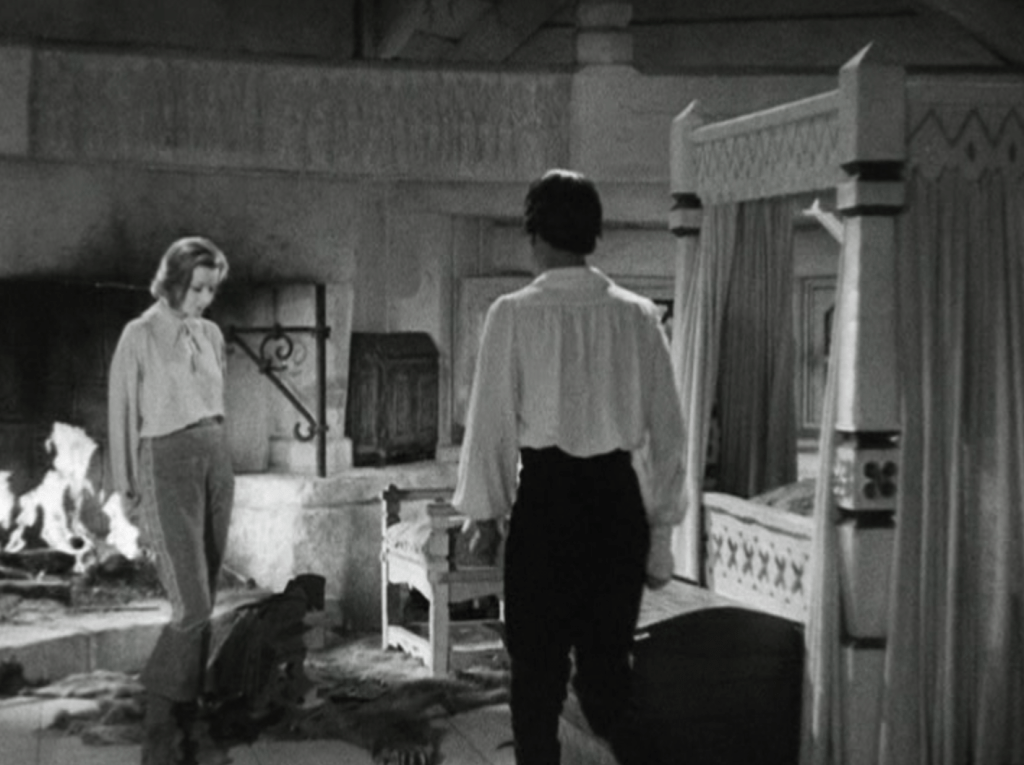
Seizing not being the figurehead of state but her own, real, individual is at the heart of one of Queen Christina’s most memorable sequences. After several nights of passionate, romantic love making with Antonio, Christina walks around the inn room where, for a brief time, she didn’t have to play a role. With metronomic precision, Mamoulian follows Garbo as she gently caresses surfaces and objects in the room, using touch to graft the room onto her memory, so that it can be a place she can return to in her day-dreams when burdened by monarchy. It’s very simply done, but surprisingly effective and deeply melancholic: as far as Christina knows, the last few days have been nothing but in an interim in a life where she must always be what other people require her to be, never truly herself.

But then if she never saw Antonio again, there wouldn’t be a movie would there? He inevitably turns up at court, presenting a proposal from the Spanish king – which he hilariously breaks off from in shock when he clocks he is more familiar with the Queen than he expected. John Gilbert as Antonio gives a decent performance – he took over at short notice from Laurence Olivier, who testing revealed had no chemistry with Garbo – full of carefully studied nobility. He and Garbo – not surprising considering they long personal history – have excellent chemistry and spark off each other beautifully. He also generously allows Garbo the space to relax as Christina in a way she consciously never truly does at any other point in the film.

The rumours of this romance leads to affront in Sweden, from various lords and peasants horrified at the thought of losing their beloved Queen – and to a Spaniard at that! (Queen Christina makes no mention of the issue of Catholicism, which is what would have really got their goat up – an Archbishop shouts something about pagans at one point, but he might as well be talking about the Visigoths for all the context the film gives it). The shit is promptly stirred by Ian Keith’s preening Count Magnus, making a nice counterpart to Gilbert’s restrained Antonio. It also allows another showcase for Garbo, talking down rioting peasants with iron-willed reasonableness only to release a nervous breath after resolving the problem.

Queen Christina concludes in a way that mixes history with a Mills-and-Boon high romance (there is more than a touch of campy romance throughout). Mamoulian caps the film with a truly striking shot, the sort of image that passes into cinematic history. Having abdicated into a suddenly uncertain future, Christina walks to the prow of the ship carrying her away from Switzerland. Mamoulian holds the focus on Garbo and slowly zooms in, while Garbo stands having become (once again) a literal flesh-and-blood figurehead, her eyes gloriously, searchingly impassive leaving the viewer to wonder what is going on in her head? Is she traumatised, hopeful, scared, regretful, determined? It’s all left entirely to your own impression – and is a beautiful ending to the film.

Queen Christina was a big hit – bizarrely overlooked entirely at the Academy Awards, which makes no sense to me. It’s beautifully filmed by Mamoulian who finds new, unique angles for a host of scenes and at its heart has a truly iconic performance by Garbo. If you had any doubts about whether she was a great actress, watch Queen Christina and see how thoughts and deep emotions pass briefly across her face before being replaced by a mask of cool certainty. It’s a great performance from Garbo and a lusciously conceived historical epic.

United 93 (2006)

United 93 (2006)

Heartfelt, gripping and traumatic recreation of 9/11, superbly directed and edited

Director: Paul Greengrass

Cast: Christian Clemenson (Tom Burnett), Cheyenne Jackson (Mark Bingham), David Alan Basche (Todd Beamer), Peter Hermann (Jeremy Glick), Corey Johnson (Louis J. Nacke, II), Daniel Sauli (Richard Guadagno), Richard Bekins (William Joseph Cashman), Michael J. Reynolds (Patrick Joseph Driscoll), Peter Marinker (Andrew Garcia), David Rasche (Donald Freeman Greene), Erich Redman (Christian Adams), Khalid Abdalla (Ziad Jarrah), Lewis Alsamari (Saeed al-Ghamdi), Jamie Harding (Ahmed al-Nami), Omar Berdouni (Ahmed al-Haznawi), Ben Sliney (Himself), Patrick St Esprit (Major Kevin Nasypany), Gregg Henry (Colonel Robert Marr)

On 11 September 2001, the world changed. A glance at the Manhattan skyline brings back memories of the Twin Towers, now memorials to the thousands killed. United 93 is a memorial of another sort, an outstanding docudrama following the fateful journey of the only hijacked plane which didn’t hit its target. The passengers of United Airlines Flight 93 bridged two worlds: when they left the ground, American Airlines Flight 11 was four minutes from the North Tower. Just over an hour later, the passengers made their desperate attempt to seize control of their plane in a world a million miles away from the one they took off in. United 93 catches the terror of that moment where no one could comprehend events. Our full understanding only makes the film more heart-racingly, terrifyingly tragic.

Greengrass had pioneered this style of filmmaking in the past – most notably Bloody Sunday, his recreation of the 30 January 1972 firing on a civil rights march in Derry by British soldiers. For United 93 he approached events in rigorous detail, after copious research and hours of discussion with family members, air-traffic controllers and military responders (many of whom play themselves in the film). FAA operations manager Ben Sliney (9/11 unbelievably his first day on the job) even plays himself in a key role. The passengers were played by a series of unknown supporting players – correctly it was judged it would have felt wrong if the likes of Clooney or Pitt had led the fightback.

United 93 marries this careful recreation of events with the masterful tension-building of a skilled director. United 93 is highly immersive film in its fast-paced, handheld camerawork and sharp editing (much of this team also worked on Greengrass’ Bourne films). Greengrass understands he doesn’t need to resort to melodrama or manipulation to make us feel it. We learn little about the passengers, the early camerawork and editing stressing their everyday anonymity. But knowing their fate, it’s impossible not to wish you could warn them. When a passenger sprints to make the flight, you want to stop him. When the plane’s door closes, it’s gut-wrenching.

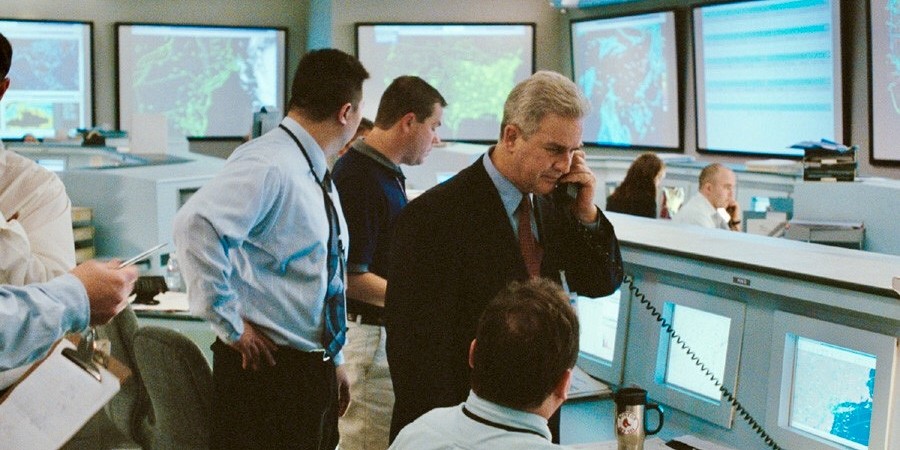
United 93 splits its narrative into two halves. The first focuses on events on the ground – while on the flight, the passengers are largely unaware the largest terrorist attack in history is happening around them. Those on the ground can’t even find the procedure guide for a hijack, never mind the unthinkable idea of planes converted into flying bombs. There was no playbook for 9/11, which becomes all too clear throughout the chair-arm grasping tension of watching people try to interpret events we know inside-out. Alongside this, Greengrass keeps carefully within the bounds of taste – the collision with the South Tower is seen from air traffic control at JFK, the camera panning across to watch the horrified faces of the crew at the moment of impact, the world changing before their eyes.

Greengrass doesn’t shirk on the chaos, uncertainty and disbelief that crippled decision making and the response to the unfolding horror. United 93 matches the lack of clarity on the day, throwing us into this pressure cooker of misinformation. The report of the number of hijacked planes zig-zags from three to a possible twelve (it is confidently reported as five consistently by the military). American Airlines 11 is consecutively reported: crashed, missing, presumed flown into the North Tower, unaccounted for and finally airborne. There are terrifyingly small number of military response planes jet available (barely enough to patrol Brooklyn, let alone the East coast). Air traffic controllers try to interpret garbled communications from hijacked (or possibly not) planes.

What emerges – a point Greengrass strives not to present politically – is the complete absence of central direction. Much of the response is disorganised – the inability to locate a missing military liaison means FAA and Eastern Air Defence barely communicate for a large chunk of the disaster – and air traffic controllers across multiple states only share information on their own initiative. Any political leadership is completely absent: the commander of Eastern Air Defence spends almost the entire crisis on the phone desperately trying to locate the President or Vice President for rules of engagement against hijacked passenger planes. Ben Sliney is forced to take a unilateral (way above his paygrade) decision to close American airspace.

This lack of central direction is eventually what motivates the passengers, as they slowly realise through phone calls with loved ones on the ground, exactly what their captors intend. As Tom Burnett says, no one is coming to save them. Most of the second half takes place entirely on United 93 as we watch in real time the passengers grapple with a simple choice: die when the plane hits its target or risk their lives to retake it. Greengrass makes clear their aim is to survive – one of the passengers, a light aircraft pilot, is picked to fly the plane. What’s superb about United 93 is that these actions are both astonishingly brave, but also realistic. United 93 doesn’t turn the passengers into superhuman martyrs and avoids Hollywood-ised speeches – even Todd Beamer’s ”let’s roll” is a throw-away line. Instead, it makes them ordinary, brave people doing all they can to stay alive. (Although the film’s interpretation of one German passenger, convinced cooperation with the terrorists will save them, rightly drew criticism for its unfair judgement)

United 93 similarly avoids definitive statements about the terrorists. It isn’t afraid to show their misguided faith. It even shows cell-leader Ziad Jarrah calling his girlfriend to tell her he loves her. But it doesn’t shirk on their ruthless fanaticism, from their murder of the pilots to the suicidal determination of their last stand against the passengers. Greengrass’ film argues the hijackers failed due to their inexplicable delay of almost 46 minutes to hijack the plane (the other cells carried out their hijacks almost as soon as the seatbelt lights were off), suggesting Jarrah lost his nerve. It’s this delay – leaving them 50 minutes’ flight from their presumed target (the Capitol) rather than 20 – that gave the passengers time to understand their situation and make a plan to try and save themselves.

The final desperate struggle to reclaim the plane is a brutal, extremely hard to watch, superbly executed sequence, made immeasurably worse by the fact we know it will fail (the film’s final shot pans away from a close-up of a desperate struggle for the plane’s steering wheel to the ground moving closer). Greengrass presents the facts as they are and by doing so makes it even more powerful. A polemic that went overboard in patriotic hagiography would have carried less impact. United 93 is overwhelmingly, unbearably moving because it forces us to imagine what we would do in that situation. It’s a film made up of the confusion, fear and grim, desperate determination of ordinary people, and in the end few things have more impact with a viewer than that.

Lee (2024)

Lee (2024)

Kate Winslet plays with passion in an otherwise rather safe and traditional biopic

Director: Ellen Kuras

Cast: Kate Winslet (Lee Miller), Marion Cotillard (Solange d’Ayen), Andrea Riseborough (Audrey Withers), Andy Samberg (David Scherman), Noémie Merlant (Nusch Éluard), Josh O’Connor (Interviewer), Alexander Skarsgård (Roland Penrose), Arinzé Kene (Major Jonesy), Vincent Colombe (Paul Éluard), Patrick Mille (Jean D’Ayen), Samuel Barnett (Cecil Beaton), Zita Hanrot (Ady Fidelin)

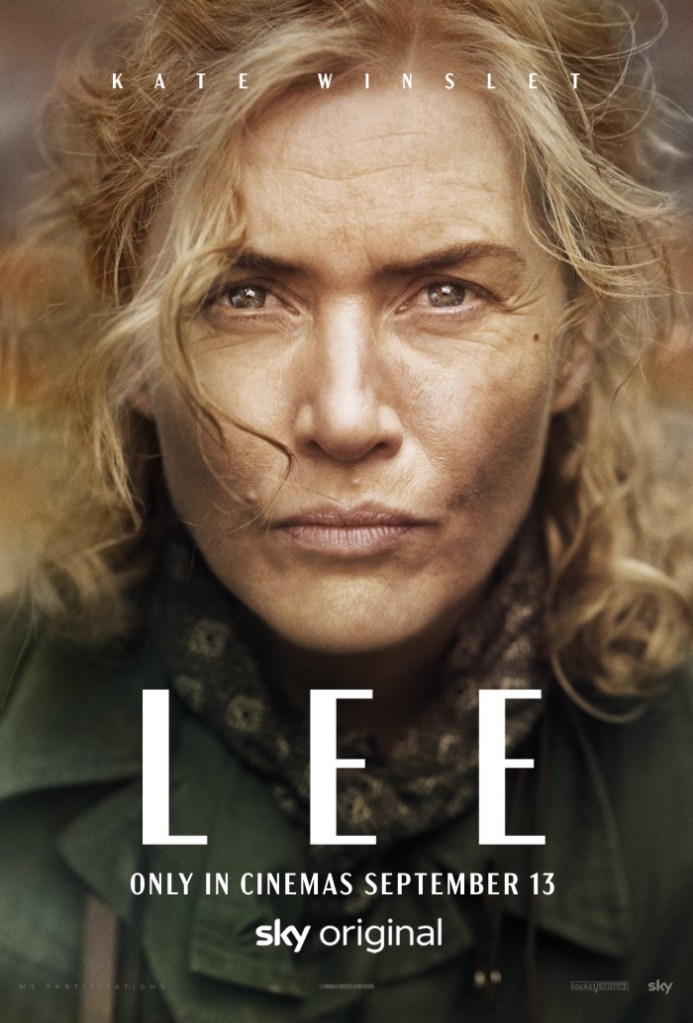
“War? That’s no place for a woman!” That’s the message photographer Lee Miller (Kate Winslet) received when she applied to head to the Western Front for Vogue in World War Two. An experienced artist and photographer, with a strongly independent mindset, Miller wasn’t taking no for an answer: her stunning images of the horrors of war and the Holocaust would become a vital historical record.

That’s the key message of this well-meaning, rather earnest, slightly old-fashioned film, a callback to hagiographic biopics of yesteryear. It’s told through a framing device of an older Lee being interviewed in the 70s. The interviewer is played, in a thankless role, by Josh O’Connor (the character’s identity is a late act reveal that most viewers will probably guess early) and his dialogue is awash with either the sort of “and then you married and left France and moved back to London where you became the first woman photographer hired by Vogue” narration that links time-jumped scenes together, or blunt statements about Lee’s emotional state (“you must have been very frustrated”) that Winslet is definitely skilled enough to do with her face alone.

This was a passion project for Winslet, who spent a decade bringing it to the screen and which she bailed it out during a funding wobble, and she is the main reason to watch Lee. This strong-willed, take-no-nonsense bohemian turned hardened professional is a gift for Winslet, but she also gives Miller a strong streak of inner doubt and fear. Under her force-of-nature exterior, there is a strong streak of vulnerability in Miller, her life marked by past trauma. Winslet lets this rawness out at key moments, bringing great depth and shade to a character who could otherwise be blunt and difficult, and the film works best when it gives her free reign.

It’s unflinching but also tasteful in its depiction of war. Experienced cinematographer and first-time film director Ellen Kuras shoots its grimy, hand-held immediacy with an intensity that makes a lot of the film’s limited budget. Lee’s dirt and dust-sprayed combat scenes – with Miller dodging explosions and bullets to get into position to get the perfect shot – are tensely assembled and make a punchy impact. But Lee also knows when not to show us things, and its visual restraint when Miller and colleague David Scherman (Andy Samberg) photograph the horrific aftermath of Buchenwald and Dachau is admirable, the camera focusing on the characters’ stunned faces as they capture the terrible moments, with the horrific reality just out of focus.

There are some fine moments in Lee, which makes it more of a shame that so much of it feels safe, predictable and unchallenging. Lee focuses on Lee Miller as an artist and downplays her daring, unconventional life. Tellingly it’s adapted from a biographer by her son, titled The Lives of Lee Miller, which chronicles her life of constant reinvention. This is after all a woman who maintained a relationship with her Egyptian husband in the 30s, after meeting her second husband Roland who himself remained married for several years (they only married in 1947). She was a model, a surrealist artist, photographic pioneer, ahead of her time. That’s rinsed out to make her more conventional.

In the film, she and husband Penrose (a generously low-key performance from Alexander Skarsgård) have an uncomplicated meet-cute in a French villa owned by a friend (an extended cameo by Marion Cottillard) – admittedly it as at an outdoor picnic where Lee and others sunbathe topless – before settling into a life of middle-class suburbia (right down to Lee cooking meals for Roland when he returns from work). Hints that she has a consensual affair with Scherman linger, but the film seems prissily determined to reposition Lee as a far more conventional person than she really was. It’s a conservative attitude that comes from a good place – focusing on the work not the gossip – but it also makes her feel less unique or challenging than she was.

With the work as its focus, it’s surprising Lee doesn’t make more of the extensive collection of masterpiece photos Miller took. Although an inevitable credits montage shows how some of these were re-created for the film, actually including the images in the film itself might have carried more power and placed Miller’s work more prominently at its heart.

Lee also fumbles slightly with its final revelation of Miller’s past trauma. Shocking as this is, attempting to suggest what happened to Lee in her teens is on the same scale as the Holocaust or that she has a unique understanding of an act of ethnic genocide because she suffered in the past stinks. It’s especially notable since Lee does an excellent job of showing the quiet distress the Jewish Scherman feels as he realises only an accident of geography saved his life. Andy Samberg, in his first dramatic role, is extremely good in a role that clearly carries a very personal feeling for him.

Lee has things going for it, not least Winslet’s barn-stormingly committed and passionate performance. But in the end, it turns its lead character into someone who feels less provocative and revolutionary than she was. Its safely traditional structure and narrative approach turn her into a “role model” and make Lee the sort of middle-brow biopics Hollywood churned out in the 80s. It’s solid, interesting but essentially safe and forgettable.

Mississippi Burning (1988)

Mississippi Burning (1988)

Earnest drama about racism, whose narrative perhaps focuses on less important issues and people

Director: Alan Parker

Cast: Gene Hackman (Agent Rupert Anderson), Willem Dafoe (Special Agent Alan Ward), Frances McDormand (Mrs Pell), Brad Dourif (Deputy Sheriff Clinton Pell), R. Lee Ermey (Mayor Tilman), Gailard Sartain (Sheriff Ray Stuckey), Stephen Tobolowsky (Clayton Townley), Michael Rooker (Frank Bailey), Pruitt Taylor Vince (Lester Cowans), Kevin Dunn (Agent Bird), Badja Djola (Agent Monk)

In June 1964 three civil rights workers – two white New Yorkers Andrew Goorman and Michael Schwerner and a black Mississippian James Chaney – were arrested, released and then murdered by Neshoba County law officials working alongside KKK white supremacists. An FBI investigation (codenamed Mississippi Burning) revealed the crime, arrested the criminals and managed to convict several (but not all) of them on the federal charge of violating civil rights (convinced the state charge of murder would lead to acquittal from racist juries). Mississippi Burning fictionalises this true-life atrocity into a hard-hitting thriller, mixed with the conventions of crime drama.

It’s directed by Alan Parker in the style of Midnight Express, pulling no punches in chucking the vileness of the KKK up on screen. During the course of Mississippi Burning we see Black people chased, beaten, flung out of moving cars onto the street, lynched and a praying child kicked in the face by a KKK thug. Rightly, the murderers are a vile parade of bullies, cowards and knuckle-dragging monsters portrayed by a group of actors (Dourif, Rooker, Sartain and Vince among them) used to going all-in on portraits of the scum of humanity. It’s a tightly directed, intense film – with a repetitively pounding score by Terry Jones – with Oscar-winning photography by Peter Biziou capturing the flame-lit night-time atrocities these repulsive people execute on innocents.

Mississippi Burning is undoubtedly well-made, with a very earnest message behind it. It’s impossible to fault its rightful disgust at the appalling injustice and racism, but you can’t help but feel it’s focusing its heroic lens on the wrong part of the story. It drew fire at the time for its fictionalisation of almost every element – wisely so in its portrayal of the initial crime, where their names and exact nature of their murder are altered – and the way this pushed the FBI (an organisation that had in many cases actively worked against civil rights) into a traditional heroic role, while reducing the Black people to passive recipients of beatings or kind words from whites. It’s hard not to feel today that, for all the skill of the film, the impact of those decisions have magnified the film’s flaws over time.

At heart, Mississippi Burning uses the conventions of a mis-matched buddy-cop investigative drama to add narrative drive to a social issues film. The two FBI agents are played so well by Gene Hackman and Willem Dafoe, you barely notice both are stock roles straight out of central casting. Hackman gives such energy and life (with a lovely touch of shame that his own past conduct, as a Southern sheriff was presumably only a degree better than the people he’s investigating) to his role as no-nonsense, veteran maverick who understands the streets, that he transforms this cliché into a real person. Similarly, Dafoe plays the by-the-book, stuffy superior who has too learn rules-bending sometimes break the case, with such commitment you forget how role familiar it is.

The personal narrative of the film revolves around whether these chalk-and-cheese investigators will overcome their initial iciness – they address each other formally throughout the film and butt-heads frequently on the conduct of the investigation – to become a team which feels odd for a film where the other stakes (violent institutional racism) are so large. In many ways an alternative cliché – two disconnected investigators investing more in a case based on the injustice they see and the witnesses they talk to – might well have served it better and also reflected contemporary complaints that the FBI was more interested in the letter than the spirit of the law. Mississippi Burning does, at times, address this by having characters explicitly ask if the FBI would even lift a finger if two of the victims weren’t white. But seeing as the film generally considers raising the question the same as engaging with it, it doesn’t go anywhere.

The film requires the agents to undertake mis-steps in order to educate the audience (would Dafoe’s character really be as ignorant about the nuances of segregation as he frequently is here?) and blunder about for much of the early acts, most notably Dafoe’s public conversation with a Black man in a diner, that inevitably leads to the poor man kidnapped and beaten by the KKK. But on the whole, the FBI are presented as noble straight-shooters, aghast at the state of affairs in the South, rather than a body run by the morally-ambiguous J Edgar Hoover.

It also means Mississippi Burning relegates its Black characters to passengers and passive victims, reliant on white people for protection and vindication. While it would be false to claim the system in the South didn’t leave Black people largely powerless, the film’s failure to introduce a single memorable character giving voice to the Black perspective of a series of crimes that happened to them feels more and more uncomfortable as the film ages (particularly as the film’s hopeful ending very much places racism as a problem in the past, not a dilemma America continues to face).

The film’s real conscience (and the victim given most development) is instead Frances McDormand as the wife of Dourif’s vile racist sheriff. Parker’s film subtly indicating her lack of racism early (she consoling touches the arm of a Black man), and McDormand (who is excellent) brings real force to her pained, frightened longing to do the right thing. She contrasts neatly with the committed vile cowardice of Dourif, Rooker’s swaggering bullying and Stephen Tobolowsky’s Hiterlian racism as a KKK Grand Wizard. Parker successfully makes these guys so repulsive, that when Hackman’s Anderson gets free reign to intimidate, rough-up and bully them back it carries real satisfaction. But the film making the most developed victim of the film’s KKK a white, gentile feels more like filmmaker concerns that otherwise the bulk of the likely audience may otherwise have trouble relating to the bulk of the victims.

Mississippi Burning tries to be hopeful. This extends to some slightly forced moralising – the suicide of one character is attributed to guilt at the crime, rather than the more likely guilt at having ‘betrayed’ his fellow KKK – and a general sense that Mississippi is on the road to peace, feels a bit of a stretch for a region that had decades of continued unrest ahead. Saying that, in its sometimes clumsy way, you can’t doubt its power and its righteous disgust at racism. It’s well directed and has some excellent performances – Hackman and McDormand were both Oscar nominated – but it feels like a film that only focuses on part of an overall picture and not always the right part.

Napoleon (1927)

Napoleon (1927)

Gance’s monumental film takes the breath away, packed with innovation, invention and drama

Director: Abel Gance

Cast: Albert Dieudonné (Napoléon Bonaparte), Edmond Van Daële (Maximilien Robespierre), Alexandre Koubitzky (Georges Danton), Antonin Artaud (Jean-Paul Marat), Abel Gance (Louis de Saint-Just), Gina Manès (Joséphine de Beauharnais), Vladimir Roudenko (Young Napoléon), Marguerite Gance (Charlotte Corday), Yvette Dieudonné (Élisa Bonaparte), Philippe Hériat (Antoine Saliceti), Max Maxudian (Barras), Annabella (Violine Fleuri), Nicolas Koline (Tristan Fleuri)

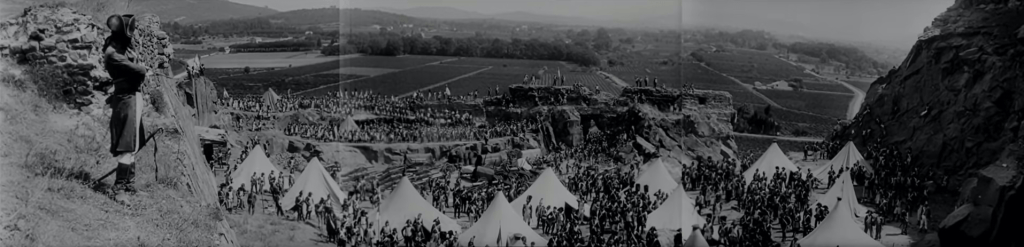
There is a marvellous quote from Victor Hugo when he wrote about the young life of the most famous Frenchmen who ever lived: Déjà Napoléon perçait sous Bonaparte. Which roughly translates as ‘already Napoleon was bursting through Bonaparte’ – or to put it another way, the man was already being consumed by the legend. That idea dominates Abel Gance’s extraordinary, epic, retelling of the Young Napoleon’s life, an origins story that sees a young man become increasingly distant and legendary before our eyes. Gance’s film may be resolutely old-fashioned in its historiographical approach, but is revelatory in its cinematic flair and invention, with almost every scene demonstrating Gance pushing the medium in new directions.

Napoleon was planned as only the first of no-less-than six films that would cover the cradle-to-grave story of the man who defined his whole era. Such was Gance’s ambition through, that even across five hours he felt he had only scratched the surface of the first 27 years of Napoleon’s (Albert Dieudonné) life from his childhood education (snowball fights and all) at Brienne – where he is seen as a Brutish Corsican outsider – via the French revolution, his failed attempt at revolution in Corsica, his successful siege of Toulon and promotion to General at 24, nearly losing his life in The Terror, Thermidor and his crushing of the Vendemaire uprising, marriage to Josephine (Gina Manès) and the beginning of his campaign in Italy.

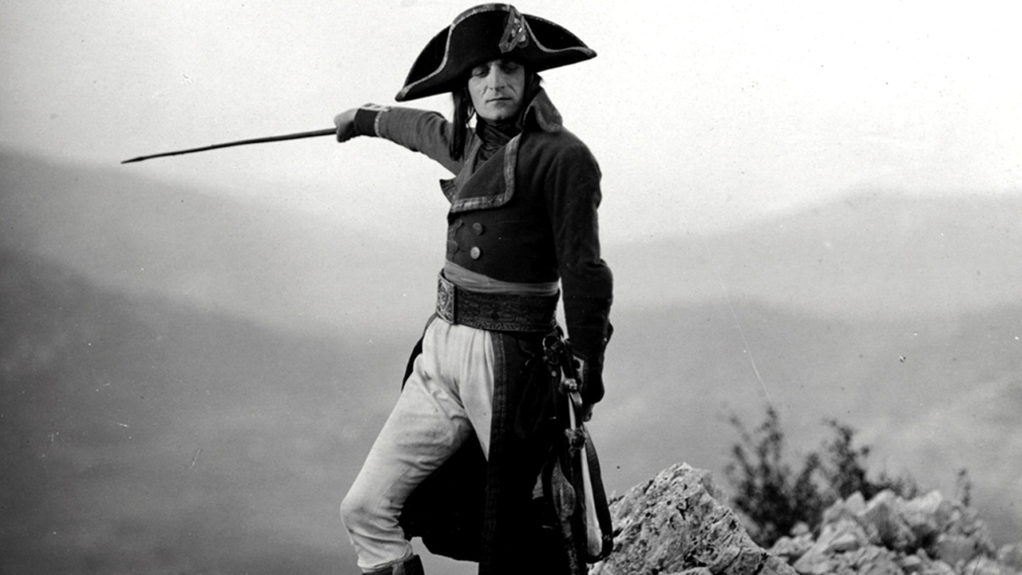
Gance unfolds this in a film brimming with cinematic verve and invention. Much like its lead character, it is a seismic and larger-than-life (literally so in its most famous innovation, the three frame wide-screen effect achieved for its final twenty minutes). Napoleon practically defines the notion of historical epic, reproducing many at historical events at a 1:1 ratio. At its centre is a magnetically hypnotic (almost literally) performance from Albert Dieudonné (so enamoured with the role, he was buried in his costume) juggling the impossible by suggesting some of the many shades of this fascinating figure, part revolutionary, part tyrant, part romantic, part war-monger.

There is something truly striking and original in every frame of Napoleon. Gance presents a picture of the famous general more than touched with an old-fashioned Great Man theory of history, but still suggests he is almost two men in one. He is Bonaparte, the slightly-chippy, awkward young man who clumsily woos Josephine (barely sure where to do with hands, tugging shyly at his sash), struggles to get noticed in a map-making office and finds it challenging to make friends, either at school (where he is a painfully serious outsider) or as an adult. But he is also Napoleon, the totem of history who Gance frequently frames as almost communing with a historical version of himself.

This Napoleon bursts from the awkward Corsican shell of Bonaparte. Gance frequently frames him almost confronting the camera, light shimmering around him to form halos, with a piercing stare that freezes people into place. He comes to identify himself with the flag and the revolution. So much so that, in his escape from Corsica, he will be borne across the seas by a tricolour jerry-rigged into a sail and visualise himself being hailed by the executed ghosts of the revolution as its natural heir. Indeed, the film ends with Napoleon atop a mountain starring into a montage of his future achievements, as if he was bending history around him.

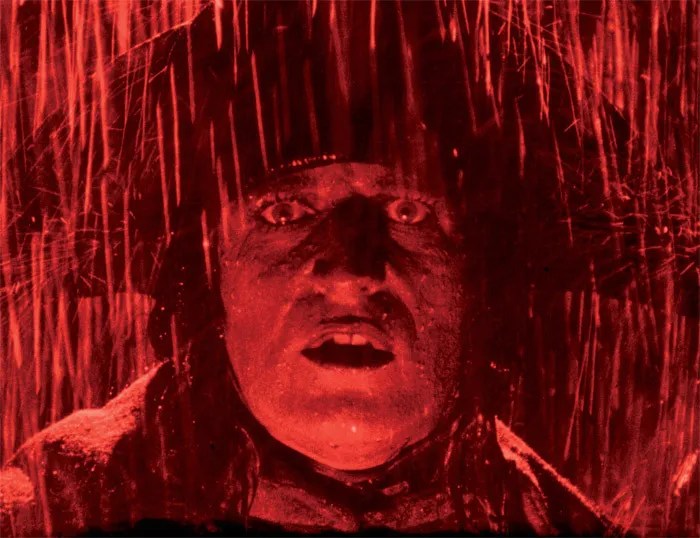
Which isn’t to say Gance sees him as a constantly sympathetic figure. While there is no question he is a force of nature – he controls the frame, frequently centred and when the camera moves (such as the careering gallop that takes him to Italy) he is always at the eye of its propulsive tracking shots – he is also an imposing, even scary figure, distant and cold. In dyed red frames, he looks positively demonic, such as when he looms forward out of the rain in Toulon, his face filling the frame to demand relentless attack. His self-identification with the revolution becomes monomaniacal.

Gance re-enforces his distance from normal human reaction by returning constantly to the Fleuri’s, a working-class family who shadow the Great Man (Violine loves him hopelessly and her father and brother worship him) but whom he never notices. It’s part of him being crafted into marble before us – with all the terrifying lack of human understanding that suggests. Throughout he’s shadowed by an eagle, a visual representation of his mystical, greater-than-human nature, a bird of destiny that drives him relentlessly on. He’s contrasted constantly with other would-be leaders: the itchy Marat, the empty windbag Danton and (most noticeably) the curiously ineffectual Robespierre, an uncharismatic man who can’t control a crowd, is lost behind darkened glasses, follows the orders of others and is comically dwarfed by an eagle statue not elevated by it.

Gance’s history has a slight school-book Victorianism to it. He’s very proud of “historical” facts – quotes and events are frequently branded with the on-screen phrase “(Historical)” so we can see his behind-the-scenes research – and has more than a little love for irony. Of course, the final island covered in school-boy Napoleon’s geography class is “St Helena”! Of course, the English sailor who spots him escaping from Corsica (and is refused a request to sink his ship) is Nelson! The film is littered with cameo appearances from later Napoleon rivals and allies. There is also a darker irony playing here: we know that when Napoleon is praised by the ghosts of the revolution that, far from protecting it, he will in fact become its final destroyer.

But what really singles out Napoleon is it’s intense, cinematic inventiveness. It’s an explosion of unique, fascinating images packaged into a single film. Gance reinvented the wheel multiple times on this one, not least on his of ghostly images and cross-fades. To achieve this – such as the ghostly appearance of the Great Revolutionaries in an otherwise empty Assembly Hall, he re-exposed the same film multiple times (sometimes as many as twenty) to achieve the effect. The same for Napoleon’s schoolyard fights, a single sequence with the screen split into nine squares each showing a different moment in time achieved by covering different parts of the frame for each exposure.

Gance’s camera is strikingly mobile, his editing frequently thrilling and thought-provoking. The famous sequence of Napoleon’s escape from Corsica is superbly intercut with the clash in the Assembly that will lead to the execution of the Gironists. The swaying of the ship is increasingly echoed by the swaying and eventually full-blown swinging of the camera in the Assembly room. Both events merge together through cross-fades. The camera whips through some scenes with real pace and aggression – witness the fast-paced tracking shots that follow Napoleon to Italy.

That’s matched as well with imaginative scenes of quiet beauty. The young Napoleon quietly communing with his pet eagle. The marvellous “shadow marriage” Violine conducts with a cardboard doll of Napoleon, positioned to cast a full-length shadow on the wall. There are moments of black humour – the coffin Robespierre and Saint-Just keep the death sentences they’ve passed in – and moments of soaring, lyrical inspiration such as the first singing of the Marseilles which takes on a mystical quality. To achieve this, Gance pushed the camera places it had never been before, patenting new techniques and devices to achieve frames, angles and cross-fades never seen before.

The most stand-out being the astonishing three-frame wide-screen effect. Perfectly mapped, with the small distortion in the joins almost adding to the power, this creates Panavision decades before Hollywood had even coined it. It creates awe-inspiring vistas of Napoleon’s Italian army – although the battle scenes Gance shoots are often cruel and dirty, with bodies twisted and crushed by the violence of war – but it also allows Gance to present three different images side-by-side, something he exploits to maximum effect in the closing moments that presents a giddyingly cut (it’s Eistensein-influence is clear) montage of past moments in the film that have led up to the Napoleon we see standing on a mountain before us starring into the future.

For Gance through, it is a future that wouldn’t come. Napoleon was not a success – perhaps people couldn’t quite process the scale of it, perhaps the money-men were terrified that Gance had spent the budget of six films on one and still hadn’t got round to Austerlitz, Borodino and Waterloo. The film was butchered and tinkered with for decades before it was reborn. And what a relief, because this is a stunning epic, which (for all its narrative simplicity) has something to wonder at in every frame. An extraordinary film, which everyone should see at least once.

The Story of Louis Pasteur (1936)

The Story of Louis Pasteur (1936)

A visionary struggles against the blind in this genre-defining slightly cosy biopic

Director: William Dieterle

Cast: Paul Muni (Louis Pasteur), Josephine Hutchinson (Marie Pasteur), Anita Louise (Annette Pasteur), Donald Woods (Dr. Jean Martel), Fritz Leiber (Dr. Charbonnet), Henry O’Neill (Dr. Emile Roux), Porter Hall (Dr. Rossignol), Raymond Brown (Dr. Radisse), Akim Tamiroff (Dr. Zaranoff), Halliwell Hobbes (Dr. Joseph Lister), Frank Reicher (Dr. Pfeiffer)

Jack Warner was convinced no one would want to watch the life story of some crusty old scientist. But Paul Muni insisted they would – and he was a star – so with a threadbare budget and host of re-used costumes (many not from the correct period) and sets The Story of Louis Pasteur came to the screen – and much to Warner’s surprise was a hit. It can look like an oddly cliché-ridden affair today: until you realise many biopic tropes we’re used to were virtually coined here.

The Story of Louis Pasteur remixes huge portions of Pasteur’s life to make it more dramatic: the man who was the leading scientist in France for almost thirty years is repackaged as an outsider and laughing stock, constantly scorned by the medical establishment until (but of course!) he is triumphantly hailed as a genius by the same doctors who mocked him for years. Sound familiar? The film charts Pasteur’s efforts to discover vaccines, first for anthrax in sheep (leading to a famous test where 25 sheep were vaccinated and 25 were not, then all of them exposed to the disease, killing all the unvaccinated sheep) then rabies in dogs and treating those bitten by rabid dogs. Pasteur uses his unparalleled knowledge of microbes which (but of course!) every other doctor says cannot possibly have anything to do with infection.

There is a lot to enjoy in The Story of Louis Pasteur, an undeniably old-fashioned “Great Men” view of history that manages to turn bacteriology into effective entertainment. It recasts history into an easily digestible tale of visionaries and scoffers – but, crucially, no real baddies – crafting a series of small steps towards scientific discoveries into flashes of inspiration and triumphant revelations. Science is made simple, plain and understandable with Pasteur to talk us through a few shots of microbes under microscopes. At its centre we have a stubborn maverick determined that it is his way or the high-way and who won’t listen for a second to anyone questioning his theories.

There is something rather touching about the film’s admiration for science and celebration of an altruistic quest to make the world a better place. It carefully outlines the dangers of surgery and poor hygiene in medical practice – it opens with a doctor murdered for failing to save his killer’s wife, the reason for his failure pretty clear from the haphazard way he chucks medical equipment into a bag (dropping some of it on the floor en route). This lack of hygiene affects rich and poor (even Duchesses are not safe), in particular women in childbirth. Its truly the enemy of mankind, as a caption explaining the 1870 war stresses (European squabbles being a distant second). This is a problem that is truly noble to take on.

And it motivates Pasteur. Paul Muni is on Oscar-winning form as Pasteur, brilliantly precise and superbly conveying great intelligence mixed with an arrogant self-assurance. But Pasteur’s egotism comes not from vanity but from simply knowing more of which he speaks than anyone else. He’s also a man consumed by a sense of duty to the world: when his work can literally save lives (be they either animal or human) he will not let scorn stand in his way. Muni captures all this wonderfully, creating a prickly man with a playful streak determined to do the right thing the right way (Pasteur may disagree with his critics, but woe-betide their assistants disrespectfully doing the same).

Dieterle’s film crafts a series of excellent set-pieces to present Pasteur as a visionary ahead of his time. To make this really land, he’s therefore completely altered into being seen as a crank and pariah by everyone around him, rather than the influential scientific leader he actually was. This might be poor history, but it’s much better drama. From a furious encounter with Napoleon III (who won’t wear the idea his hand-picked doctors might be wrong about sterilization) to the Medical Academy publicly poo-poohing Pasteur’s outlandish ideas that vaccines might prevent anthrax. To give a face to this mocking of Pasteur (from an establishment we are told is totally wrong on every count) the film invents Dr Charbonnet (well played by Fritz Leiber), an honest but pig-headed critic who exists to be wrong (for noble reasons) on almost every single issue.

Noble as important: this film want to stress everyone acts for decent reasons, so that its final celebration of Pasteur is unblemished by deeply personal rivalry. Charbonnet and Pasteur are both framed as decent men and their relationship allows for plenty of fun melodrama, such as Charbonnet injecting himself with Pasteur’s (fortunately for him) weak rabies sample to ‘expose’ his ideas. When Pasteur’s daughter falls ill in childbirth, but of course Charbonnet is the only doctor available: he humours Pasteur’s sterilisation rules in exchange for a signed letter from Pasteur rubbishing his own theories (Muni’s shuffling flash of conflict that flows across his face at this moment is very well done). But of course, Charbonnet and Pasteur eventually reconcile in honour and decency.

This forms a fun thread throughout the movie, that’s never less than well-staged by Dieterle, with pace and energy. The anthrax test is very dynamic – all celebrating crowds and circus side-shows – and the dramatic appearance of a host of Russian peasants (led by Akim Tamiroff’s bombastic doctor) desperate for a cure for rabies-induced sickness is well-executed. Some beats work less well than others. Donald Woods gets dealt a rotten hand as the dull son-in-law of Pasteur. The women in Pasteur’s family get even worse, with most of Josephine Hutchinson’s lines being of the “stop trying to cure anthrax and come to bed Louis” variety. The costumes are bizarrely all-over-the-place (the women look more like Southern Belles) and there is a reassuring cosiness about everything.

But that’s also one of its most successful features. The Story of Louis Pasteur is a little twee – but it’s also effective. It’s why it laid down a template that worked for countless films that follow (A Beautiful Mind pretty much follows its model and won an Oscar for it 65 years later). That’s because there is also a feel-good factor to see someone who is, without doubt, in the right triumphing over the stubborn. With a great performance by Muni, it’s a rewardingly entertaining biopic.

Golda (2023)

Golda (2023)

Undramatic saga of Middle East history that fails to bring seismic events to life

Director: Guy Nattiv

Cast: Helen Mirren (Golda Meir), Camille Cottin (Lou Kaddar), Liev Schreiber (Henry Kissinger), Rami Heuberger (Moshe Dayan), Rotem Keinan (Zvi Zamir), Lior Ashkenazi (Lt General David Elazar), Dvir Benedek (Major General Eli Zeira), Ed Stoppard (Major General Benny Peled), Dominic Mafham (Lt General Haim Bar-Lev), Emma Davies (Miss Epstein), Ohad Knoller (Major General Ariel Sharon)

I’m sure you couldn’t have picked a worse time to release a film celebrating Israel’s fight against the Arab nations than November 2023. As the world looks on in horror at the latest cycle of violence engulfing Gaza, it hardly feels like the right time to kick back and cheer as Israeli forces fight for their country in the 1973 Yom Kippur War. But, even without that, Golda is fatally undermined by being a turgid, dull biopic where despite the volume of events little is made either engaging or interesting.

Golda Meir (Helen Mirren) is Prime Minister of Israel, managing the country’s military response after the combined forces of Egypt and Syria launch a surprise attack on the Golan Heights and Sinai. After intelligence failures leave Israel on the back foot, Meir must plan Israel’s counter-offensive, deal with the moral complexities of sacrificing soldiers, and work diplomatically to ensure the continued support of the US via Secretary of State Henry Kissinger (Liev Schreiber), all while dealing with cancer. All of this is told through the intermittent use of a framing device, where Meir is being interviewed by a 1974 committee investigating those intelligence failures.

Golda is obviously apeing Cuban Missile Crisis political thriller Thirteen Days, with its focus on a tight timeline, generals in cigarette-smoke-filled rooms making tough calls, and the dilemmas faced by an elected leader trying to ensure their country’s survival. Unfortunately, where Thirteen Days mixed history lesson with genuine drama, Golda just feels like it takes thirteen days to watch. How did they manage to make such a seismic conflict as dull as this?

There was a bit of controversy initially on casting the non-Jewish Helen Mirren. That can be largely forgotten, not least because Mirren is by some way the best thing in the film, gravelly and conveying the unbearable pressure on Meir. She even gets to show her human side, with sweet scenes with her loyal assistant (well played by Camille Cottin) and a plate of borsch and an offer for Henry Kissinger (a decent Liev Schreiber). Mirren is caked under various prosthetics but does a good job.

But the rest of the film is a dull mess with its flat, lifeless script singularly failing to add tension or drama. The film feels like a box-ticking exercise, from flat conversations on various troop movements to the casualty figures Meir dutifully records in her notebook. Only rarely does the film bring any of this viscerally to life (such as the increasingly crowded morgue Meir walks through to receive her cancer treatments). Events at the front are given no human face to draw us into the crackly reports coming in over radios, and there is little sense of characters having to debate and choose between different courses of action under huge pressure. Keeping the action contained within just a few indoor locations serves to make the film feel cheap rather than claustrophobic.

Our only glimpse of the front is to see Dayan fly over the Golan Heights (and promptly vomit in guilt). Discussions in briefing rooms get bogged down in establishing who someone is and what they are in charge of, rather than communicating the stakes. So, we get various uniform-clad actors spouting reams of geographical locations, division numbers and military statistics, accompanied by maps where the odd cigarette lighter stands in for various armies. Somehow, despite the volume of talking, its nearly impossible to understand any of this, so poorly is it communicated visually.

That’s before we get started on the film’s one-sided lack of historical context. A brief series of captions that opens the film runs down an Israeli-only perspective of the country’s history. The crucial background of the 1967 war – a pre-emptive strike by Israel that seized the land now being attacked in 1973 – is completely ignored. It’s never made clear that the Arab nations argued they had launched their attack in response to 1967, and no wider context is given.

This feels particularly awkward considering recent events (in late 2023) threw the conflicting narratives in the region even more into the limelight. Both Arabs and Israelis have legitimate cases. But a film that focuses on one side only and whose only Arab voice is a radio intercept of a Syrian gleefully celebrating the “death of the Zionists” hardly feels like it is making a mature and sensitive statement about the Middle East conflict.

It means the film’s final celebration that the war led to the peace agreement between Egypt and Israel – including the recognition of Israel by Egyptian Premier Sadat – rings hollow. Peace, as a topic, is never raised in the course of the film (so hardly feels like a thematically correct ending) and its celebration at the end feels like a fig leaf to suggest an “upbeat” ending, when 1973 was effectively just another round in a war that was to continue (with increasingly horrific impact on civilians on both side) for the rest of all our lifetimes so far.

Golda fails as drama, fails as history and fails as a film. It’s a mess.