Category: Historical epic

Gandhi (1982)

Ben Kingsley excels as Gandhi in Richard Attenborough’s Oscar winning epic

Director: Richard Attenborough

Cast: Ben Kingsley (Mahatma Gandhi), Rohini Hattaggadi (Kasturba Gandhi), Roshan Seth (Jawaharlal Nehru), Pradeep Kumar (VK Krishna Menon), Saeed Jaffrey (Vallabhbhai Patel), Alyque Padamsee (Muhammad Ali Jinnah), Virendra Razdan (Maulana Azad), Candice Bergen (Margaret Bourke-White), Edward Fox (Brigadier General Reginald Dyer), John Gielgud (Lord Irwin), Trevor Howard (Judge Broomfield), John Mills (Lord Chelmsford), Martin Sheen (Vince Walker), Ian Charleson (Reverend Charles Andrews), Arthul Fugard (General Jan Smuts), Geraldine James (Mirabehn), Amrish Puri (Khan), Ian Bannan (Senior Officer Fields), Richard Griffiths (Collins), Nigel Hawthorne (Kinnoch), Michael Hordern (Sir George Hodge), Om Puri (Nahari)

In 1962, Richard Attenborough was approached by Motilal Kothari, an Indian civil servant, who believed Attenborough was the man to bring the life of Mahatma Gandhi to film. All this despite Attenborough having never directed a film. But the life of one of history’s greatest men, and passionate advocate of peace and non-violence, spoke deeply to the socially-engaged Attenborough who dedicated 20 years of his life to bringing the film to the screen, immersing himself in Indian culture along the way and winning the support of Nehru (until his death delayed the project again) and Gandhi’s family. The eventual film was a huge success, cementing the public perception of Gandhi and beautifully capturing both the importance of the story, and its emotional heart.

Opening with Gandhi’s assassination in 1948, the film covers in flashback his life from combatting anti-Indian prejudice in South Africa as a young, British-trained, lawyer to his return to India and long involvement in the campaign to win India its independence from the British Empire, stressing non-co-operation, his eventual success but also his failure to hold the Hindu and Muslim parts of the country together and his attempt as “father of the nation” to put an end to religious violence, a failure that will eventually lead to his assassination. 

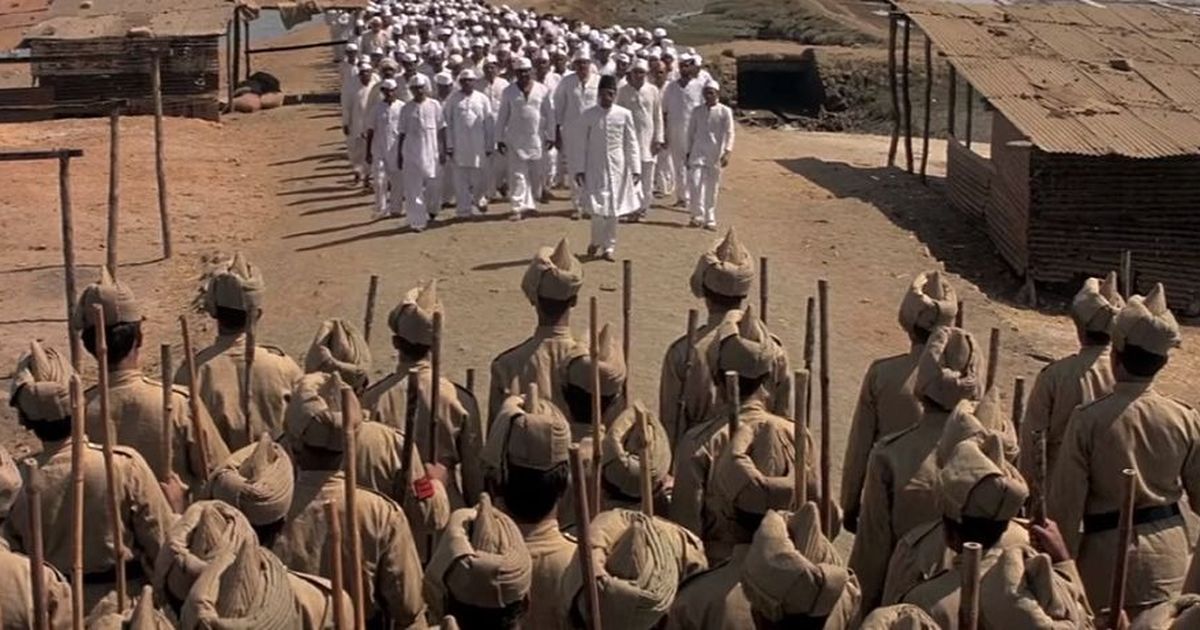
Attenborough’s grand, epic film marshals thousands of extras to bring to life pages of history. At times events fly by with speed, but Attenborough never loses sight of the emotional heart of the story – both Gandhi and the status of Indians as not being masters in their own home. Attenborough directs scenes of real power, most strikingly a heart-rending peaceful march on a salt works (the tax on salt use being a major burden on many poor Indians) that culminates in line after line of peaceful Indian protestors walking calmly forward to be beaten down by soldiers. Despite being the grandest and largest of films, it allows questions of pure morality and decency to lie at its heart and, supported by a parade of British acting greats, keeps the Indians at the heart of their own story and the masters of their own destinies.
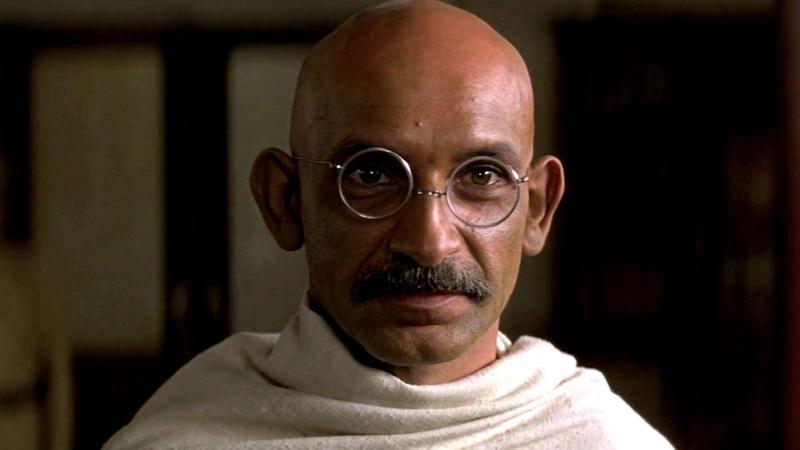
The film’s impact though may be directly connected to the gloriously transcendent performance of Ben Kingsley in the title role. For years it was believed the film could only work with a British actor in the title role – imagine how it would be received today if Gandhi had been played by (as it nearly was) a browned-up Anthony Hopkins or John Hurt (who famously told Attenborough he looked absurd). Instead half-Indian unknown RSC actor Ben Kingsley took the role. Kingsley so completely and utterly immersed himself in Gandhi – everything, the physicality, the morality, the voice, the intellectualism – that not only has he become so completely associated with the role but it’s hard to imagine anyone else playing it.

Ageing almost 50 years over the course of the film, Kingsley’s Gandhi is above-all moral, softly-spoken, observant and considerate – the very spirit of the original man seems to be up on the screen. Far from the sort of histrionics you might expect from a subject of an epic movie, Kingsley is not afraid to be quiet, gentle even underplayed. He completely understands that the charisma and power in Gandhi laid in his moral authority, not his speech-making, but his careful example-setting of even-handedness, patience and desire for peace. 

But Kingsley is also willing to show Gandhi as shrewd and stubborn, even while mixing it with both a deep pain at the loss of life. Kingsley is superbly good at the smaller quieter moments – he wrings heart-rending force from the loss of his wife (a similarly impressive and quietly authoritative performance from Rohini Hattaggadi), which partly works because the film quietly centres the truth and faith in their marriage. This is extraordinary work from Ben Kingsley, that seems to carry not just the entire film but the sense of a nation.

Attenborough though was a director who was at his best when working with actors, and his ability to coax truthful and heartfelt moments from quiet scenes are what gives the other sequences the emotional force to make them work. Attenborough seemingly called in every favour to assemble the supporting cast that backs up Kingsley, many of them juggling only a few scenes. Among the stand-outs we have a martially certain Edward Fox as General Dyer, an archly arrogant John Gielgud and a frustrated John Mills as viceroys, Trevor Howard representing decent British rule as an honest Judge and Martin Sheen as a reformist minded journalist. That’s to overlook dozens of others in small roles, all of them clearly committed to the intention of the project.

The film though allows the Indians themselves to take centre stage, even if it is easy to criticise some of the simplifications of many of the issues that would eventually culminate in partition. The film has a clear hostility towards the idea of religion, seeing it as the root of much of the violence that erupted in India in the last years of Gandhi’s life. While Roshan Seth is excellent as Nehru, the character is portrayed more as the faithful follower of Gandhi than the shrewd politician in his own right (it’s a role most of the other leading members of congress are also placed in). Alyque Padamsee carries a high level of charisma as Jinnah, founder of Pakistan – but the film can’t quite resist painting him into the corner as a semi-villain, ignoring Gandhi’s desperation to get Jinnah to invest in a united India.
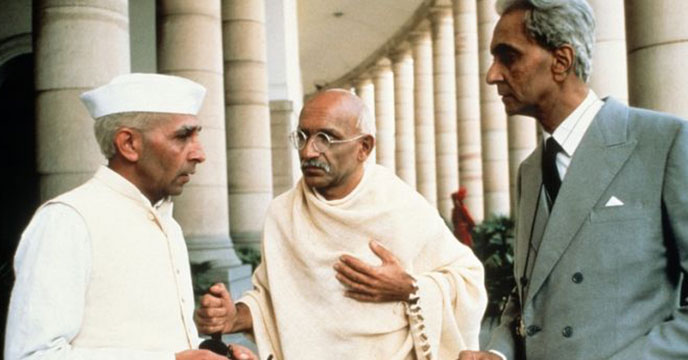
It’s part of what has been seen since as the film’s more hagiographic stance towards Gandhi. Certainly later historiography has outlined a few shades of grey in Gandhi – although I would argue that seeing him as a man and not a saint only heightens (similar to Mandela) the awe at what he went on to achieve. The film’s whistle stop tour of Indian history – taking in every major event and personality, some in a matter of moments – looks particularly old-fashioned now with our current trend being biographical films that focus only on crucial moments, not the whole life. It adds a slight air of schoolboy history to the project, an unfortunate side-effect of the passionate earnestness with which the story is told.

But then even in 1982 – when it lifted 8 Oscars including Best Picture, Director and Actor and most of the technicals – it was seen as slightly old-fashioned. Attenborough has generously repeatedly said that he believed Steven Spielberg was more deserving of Best Director for ET. And it’s true that Attenborough was in many ways a producer at heart with these epics than an inspired director like Lean. His marshalling of crowds, finances and simply forcing the will together to make the picture – and to allow it to focus on Indians rather than Westerners – is a tribute to his organisational skills. His strengths as a director were more in performances, and as with many of his epic films the most memorable moments are smaller, intimate ones. The larger moments are shot with an assured professionalism rather than inspiration, but Attenborough understands how to wring emotion from moments and how to let character drive action.

Gandhi works above all because even today you can see it is a passionate labour of love, that everyone involved in clearly believed in passionately. It may well be that at times it is workmanlike or simplistic – and covers the sweep of history with an earnest completeness, even while it is unafraid to be critical certainly of the British – but it still invests it crucial moments with humanity, life and deep emotion. You can’t help but be moved by it – and you are instantly stunned by the sheer brilliance of Kingsley as Gandhi, one of those performances like George C Scott as Patton which seems more like the man than the real thing. Gandhi may be old fashioned, but that’s not a crime when the quality is still there.

Amistad (1997)

Djimon Hounsou excels as a slave longing for freedom in Amistad

Director: Steven Spielberg

Cast: Djimon Hounsou (Sengbe Pieh/Joseph Cinqué), Matthew McConaughey (Roger Sherman Baldwin), Anthony Hopkins (John Quincy Adams), Morgan Freeman (Theodore Joadson), Nigel Hawthorne (President Martin van Buren), David Paymer (John Forsythe), Pete Postlethwaite (William S Holabird), Stellan Skarsgård (Lewis Tappen), Razaaq Adoti (Yamba), Abu Bakaar Fofanah (Fala), Anna Paquin (Isabella II), Chiwetel Ejiofor (James Covey), Peter Firth (Captain Fitzgerald), Jeremy Northam (Judge Coglin), Xander Berkeley (Ledger Hammond), Arliss Howard (John C Calhoun)

After the American Revolution, independence left one issue in America that would profoundly split the country: slavery. This was a land divided, between abolitionists and plantation owners, the more emancipation-minded North and slave states of the South. Slavery was – and remains – the ugly stain on the American soul. Steven Spielberg’s film uses a significant court case of its day to shine a light on these contrasting and conflicting priorities in American society throughout much of the early 19th century, that would eventually lead to civil war.

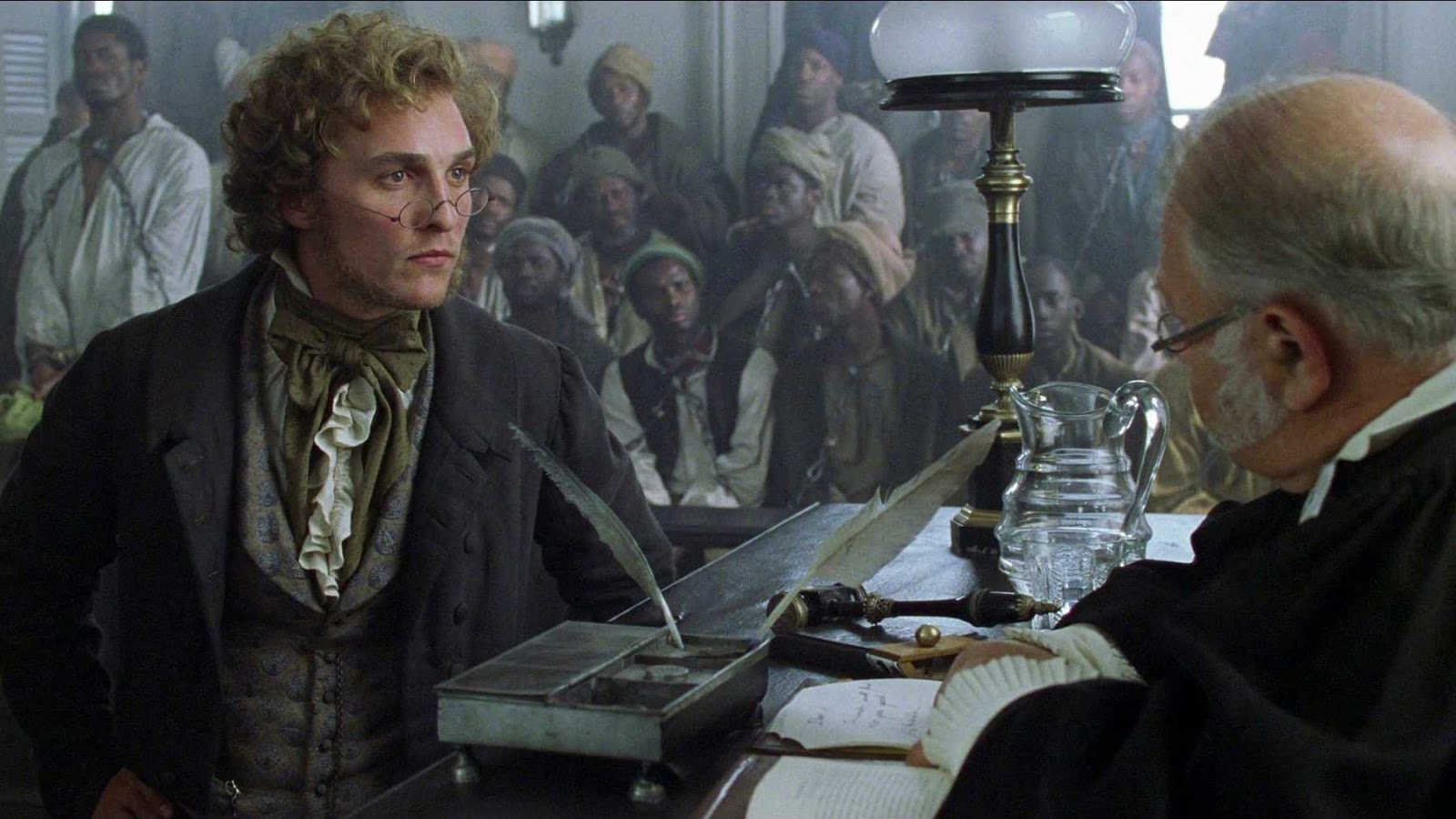
The film tells the true story of the slave revolt on the Spanish slaver ship Amistad. Here the slaves, led by Joseph Cinqué (Djimon Hounsou) escaped captivity, rose up and killed most of the crew (leaving just two men alive to sail the ship) and tried to return to their home in Sierra Leone. Arrested by an American naval ship while collecting fresh water, the slaves are transported to Connecticut where they find themselves on trial as escaped slaves, facing charges of piracy and murder. Their cause is taken up by Northern abolitionists Lewis Tappen (Stellan Skarsgård) and his black associate Theodore Joadson (Morgan Freeman), and their lawyer Roger Sherman Baldwin (Matthew McConaughey) a property lawyer. However, the case’s international implications for slavery attracts the concern of President Martin van Buren (Nigel Hawthorne), eager to support the prosecution, while former President John Quincy Adams (Anthony Hopkins), a lawyer and opponent of slavery, offers his advice to the defence.

Spielberg’s film has just the right balance of human interest and humanitarian concern to overcome its slight air of a civics lesson. Although largely a courtroom drama, what the film is really trying to do is capture in one moment the troubling contradiction of the land of the free built on slaves, and give a voice and empathy to the slaves themselves. 

Although some have criticised this as a “white saviour” film, I feel that’s unfair. This is a film that starts and ends with Cinqué’s story and filters America through his perception. We can well understand why he rages at his lack of comprehension of laws that can be adjusted, court decisions overturned or how words can be twisted to take on other meanings. A film front and centred, say, by Matthew McConaughey’s Baldwin and focusing on journey from seeing this as just another case into a crusade would be a white saviour film. Instead the white characters drop in and out of the story as the narrative requires, and it’s the struggles and courage of the black characters that form the heart of the narrative.

Spielberg also brings to life the cruelty and inhumanity of slavery and what it does to all of us. The film opens with the confined, appalling conditions of the slave ship while Cinqué (with hands running with blood) tries to release a nail from the wood which he will use to free himself from his chains. The film intriguingly opens without the African characters being translated – giving us a sense of their isolation and perhaps also stressing how different they are from the Western “civilisation” that has taken them from their homes. 

It isn’t until half way through the film, until a translator is found for Cinqué, that the film gives us the backstory that Cinqué has struggled to communicate. Spielberg spares no punches in showing the violence of abduction, the brutality and casual slaughter of the slavers, the starvations, the floggings that end in blood sprayed death, the cramped conditions practically designed to weed out the weak. A mother chooses drowning for herself and her child rather than life on the ship. Later the slavers chain unwanted slaves to a bag of rocks and cast them overboard to reduce their cargo load. If there was any doubt about the heart-rending evil behind slavery, it’s removed from your mind.

It also serves to hammer home the injustice of America’s own system. Under political pressure – van Buren is worried about the reaction of both Spain and the Southern States to the Africans being found innocent – the trial encounters interference and appeals every step of the way. It’s a system that prides itself on being the greatest in the world, but shows time and time again how it can be weighted against the weakest. The courtroom scenes – skilfully directed and played – show time and time lawyers valuing obscure property laws above right and wrong. And we are brought time and time again to the reactions and lack of understanding of the African characters, who come from a society where there is no equivocation and no words equivalent to “usually” or “perhaps”.

The film perhaps does take a little too long over its various legal machinations, and could do with losing a few minutes here and there. But that would be to sacrifice its many strengths. Looking wonderful, with a marvellous score by John Williams (riffing on the American pipes and African tribal influences), one of the strongest acting companies Spielberg ever assembled does outstanding work. Carrying much of the film is Djimon Hounsou, who makes Cinqué anything but a victim – he is a proud, defiant and intelligent man, humble enough about his qualities but quick to act to defend his rights. Uncowed but infuriated by the situation he finds himself in, he is never a passenger but at all times a key figure in his own liberation, even if his legal case must be fought by whites.
McConaughey enjoys himself under a bad wig, glasses and dirty teeth as the lawyer Baldwin, ambitious but with more than an air of decency. Postlethwaite is at his quietly authoritative best as his opposition counsel. Freeman lends the film a large part of his grace and dignity in a small, observant part of the freed-slave turned abolitionist, with Skarsgård more political as his white colleague. Hawthorne makes a van Buren a slightly flustered, impatient figure. Peter Firth demonstrates a great contempt for slavery behind an imperious exterior.

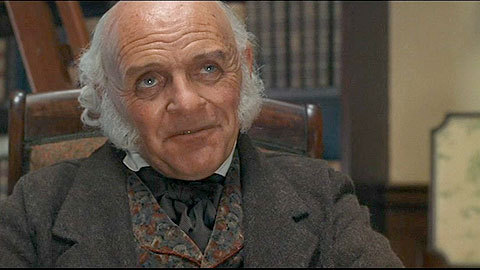
The film’s highlight performance though is Hopkins’ Oscar-nominated turn as John Quincy Adams. Adjusting his physicality to match the ageing ex-President, Hopkins captures his slightly nasal Massachusetts twang and adds a significant amount of twinkly charm and wry shrewdness to this adept political operator. A large chunk of the film’s final 20 minutes is given over to Hopkins, with the highlight a long monologue of Adams speech to the Supreme Court (in actuality a speech over eight hours in length!), that is a tour-de-force of skilled showmanship. It’s Hopkins’ last great performance of the 1990s. 

Spielberg’s Amistad is a superb courtroom drama but also a heartfelt condemnation of the inhumanity man can show to man. It never forgets either that while this was a victory, it was only a skirmish not the war. While the film at times overplays the inevitability of Civil War (which did not exactly start over this issue), it skilfully shows the divide in the American culture between abolition and slavery – and how many felt for the first cause, but feared the supporters of the second so much they would rather not address it. Either way, Amistad may at times be a little dry – but that gives its moments of emotion even more force.

Glory (1989)

Morgan Freeman and Denzel Washington are among the first black American soldier in Glory

Director: Edward Zwick

Cast: Matthew Broderick (Colonel Robert Gould Shaw), Denzel Washington (Pvt Silas Trip), Cary Elwes (Major Cabot Forbes), Morgan Freeman (Sgt Major John Rawlins), Andre Braugher (Cpl Thomas Searles), Jihmi Kennedy (Pt Jupiter Sharts), Cliff De Young (Colonel James Montgomery), Alan North (Governor John Albion Andrew), John Finn (Sgt Mulcahy), Bob Gunton (General Charles Garrison Harker), Jay O Sanders (General George Crockett Strong)

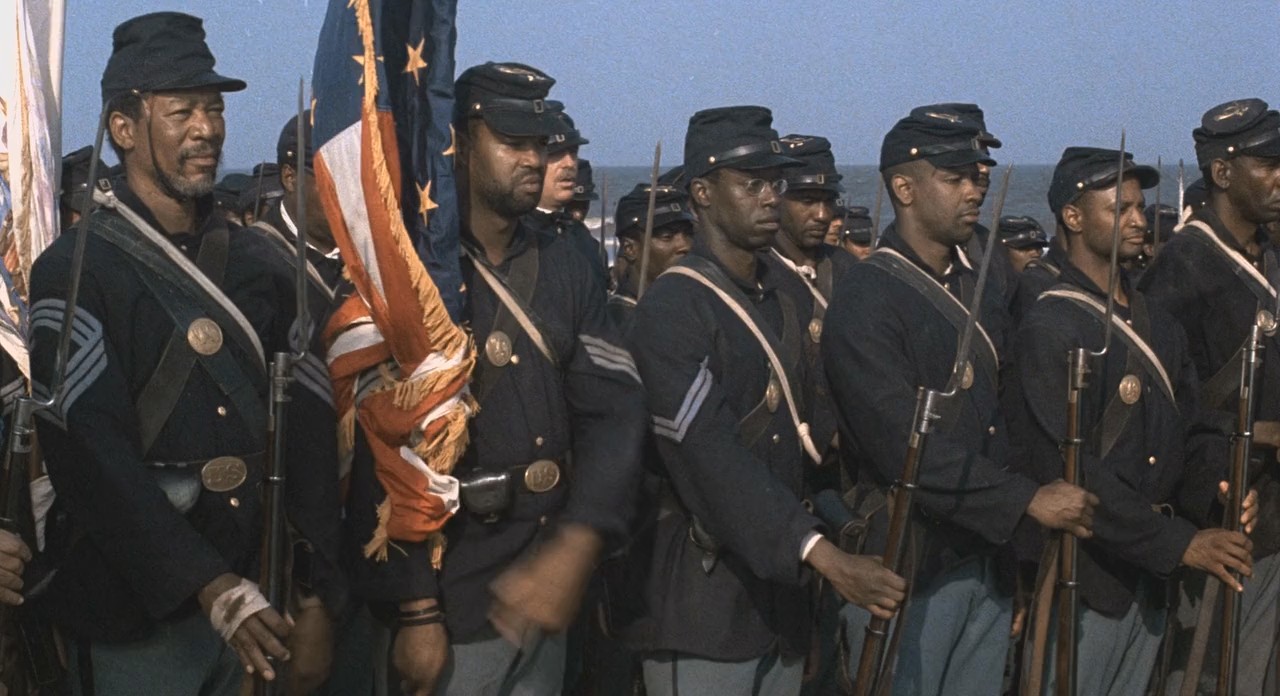
The American Civil War started over slavery, but it took a long time for either side to admit it was a fight about slavery. Racism abounded on both sides, and it was a fight in which black Americans may have been the subject, but were rarely invited to join. Glory covers this point of history, and specifically the first all-black regiment and its struggle to be recognised as equal to the other regiments in the army. 

Wounded at the Battle of Antietam in September 1862, Robert Gould Shaw (Matthew Broderick) returns home to Massachusetts and accepts command of the first all-black regiment, which is currently being raised by abolitionists in the state. With his friend Cabot Forbes (Cary Elwes) as second-in-command (no one was progressive enough to actually allow black officers for the regiment), he recruits a wide range of black Americans, from free-man and bookish intellectual Thomas Searles (Andre Braugher) – an old friend of Robert and Cabot – to former slaves such as the wise John Rawlins (Morgan Freeman) and the resentful Silas Trip (Denzel Washington). Training is a struggle, with the army denying the regiment supplies and support, and it’s an equal struggle when they reach the front line to be recognised for duties other than looting and latrine digging. Will the Massachusetts 54th be given the chance to prove itself in the front line – and establish a black man can fight as hard and bravely as a white man can?

Edward Zwick’s beautifully filmed, carefully re-created historical epic set the tone for much of his future career. It’s an often overly-sentimental film straining for a very self-conscious sense of importance, weighed down by the pride at the “message” it is carrying. It often does hit the mark with presenting scenes that carry emotional force – but then seeing as it treats nearly every scene as being a “moment” that should move us (with James Horner’s choral manipulation working double time to get us experiencing feelings), it’s no wonder that it succeeds sometimes.

Which is not to say the message it presents isn’t an important one. Black Americans have often been pushed into the margins of American Civil War history. Or worst of all presented as the victims, reliant on the courage and bravery of the abolitionists of the North to save them from slavery in the South. Until Glory it was very rare for anything to push their stories front and centre – or to tell a story where former slaves were allowed to fight their own battles and choose their own destinies. 

It’s one of the strongest marks of the film: these are soldiers unlike any other, who enter battles with less concern about their own survival, and more about having the chance to live as freemen and to make a mark on the world. To show that they, and people like them, could do just as a white man could do. And if they had to die to do that, better to live a day on their feet as freemen then a lifetime on their knees. It’s the principle emotional message of the film, and something Zwick translates with some skill, even if he frequently overeggs the pudding while doing so.

However, with such a strong message, it’s a shame so much of the film is filtered through the experience of its white lead character. For many of the films of the 80s and 90s dealing with these issues – Cry Freedom, the Steve Biko biopic, with Biko as a supporting character to his white South African journalist friend, being perhaps the key example – it was essential to have a white man at the centre, as if worried that audiences couldn’t understand the story they were seeing unless they had it filtered through the perception of someone who looks a bit more like them.

Matthew Broderick takes on the lead role here of Shaw – with the film giving a significant slice of its running time to its coming-of-age theme of Shaw learning to become a leader of men – and while the character is meant to be callow and an unlikely Colonel, it doesn’t help that Broderick lacks the charisma for the part. Perhaps he is a little too lightweight an actor for such an enterprise, for a film that demands greater force of character (you can imagine Tom Cruise doing a much finer job in the role).  Similarly, the familiar beats of a young man learning how to lead feel trivial compared to the life-and-death issues facing his soldiers.

But too often Zwick’s film returns us to Shaw’s point-of-view, the narrative filtering so much of the action through his perceptions and decisions that the black soldiers become supporting actors in their own stories. Broderick is not helped by the soldiers being played by some of the finest American actors of the last 30 years. Braugher is fabulous in the thankless role of the bookish man who must grow a spine. Morgan Freeman established a persona – the wise and level headed older man, who will not let hate and fury define his life and his choices – that would last him for the rest of his career, and is superb (his Oscar nomination for Driving Miss Daisy is probably the only thing that led to him not getting a nod for this film).

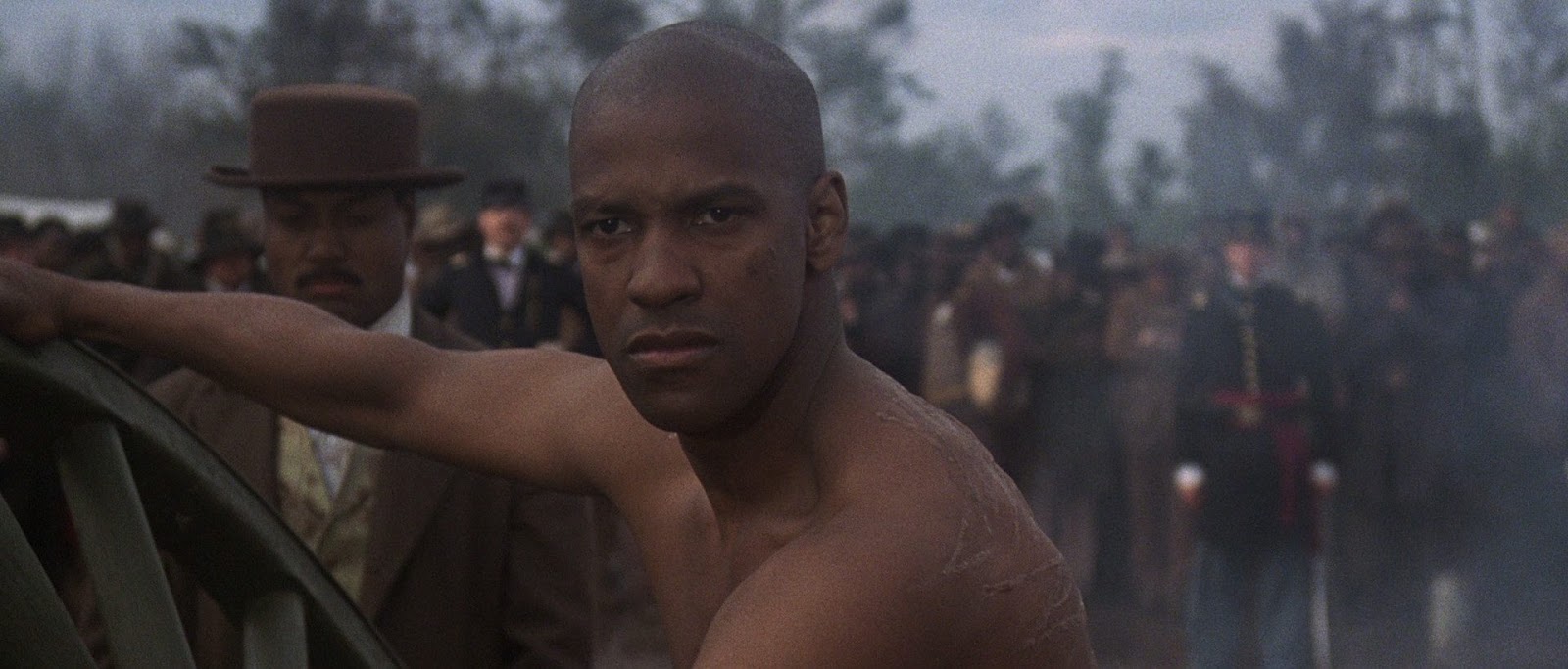
Denzel Washington took home an Oscar as the bitter, angry Trip – and it’s the sort of role an actor seizes with relish. Washington fills every frame with his rage at the system, his inarticulate, indiscriminate anger lashing out in every direction. It’s the fury of a man who has had all his choices taken from him in life, and would rather destroy things than run the risk of allowing himself to become committed to something, or form a bond. Washington probably won the Oscar alone for the astonishing scene where he silently, defiantly accepts a whipping (on a body covered with scars) for missing a curfew. He’s an elemental force of nature in the film.

There is plenty of strong stuff in Zwick’s work, but the film itself overplays its hand frequently. Moments of emotion are played so heavily to the hilt they sometimes fail to have an impact. It wants you to know at every turn that you are watching a film with an important social message – and the speechifying at points put into the mouths of the characters runs dry. While superbly made – veteran photographer Freddie Francis’ work is beautiful (and Oscar winning) – it’s a heavy-handed, overly pleased with itself film that knows all too well that it is about an important subject. While sometimes it lands – often in quieter moments, particularly those where Freeman and Washington are allowed to simply be human without overindulgent music cues hammering home the emotions – at others it comes across as too much.

Once Upon a Time in America (1984)

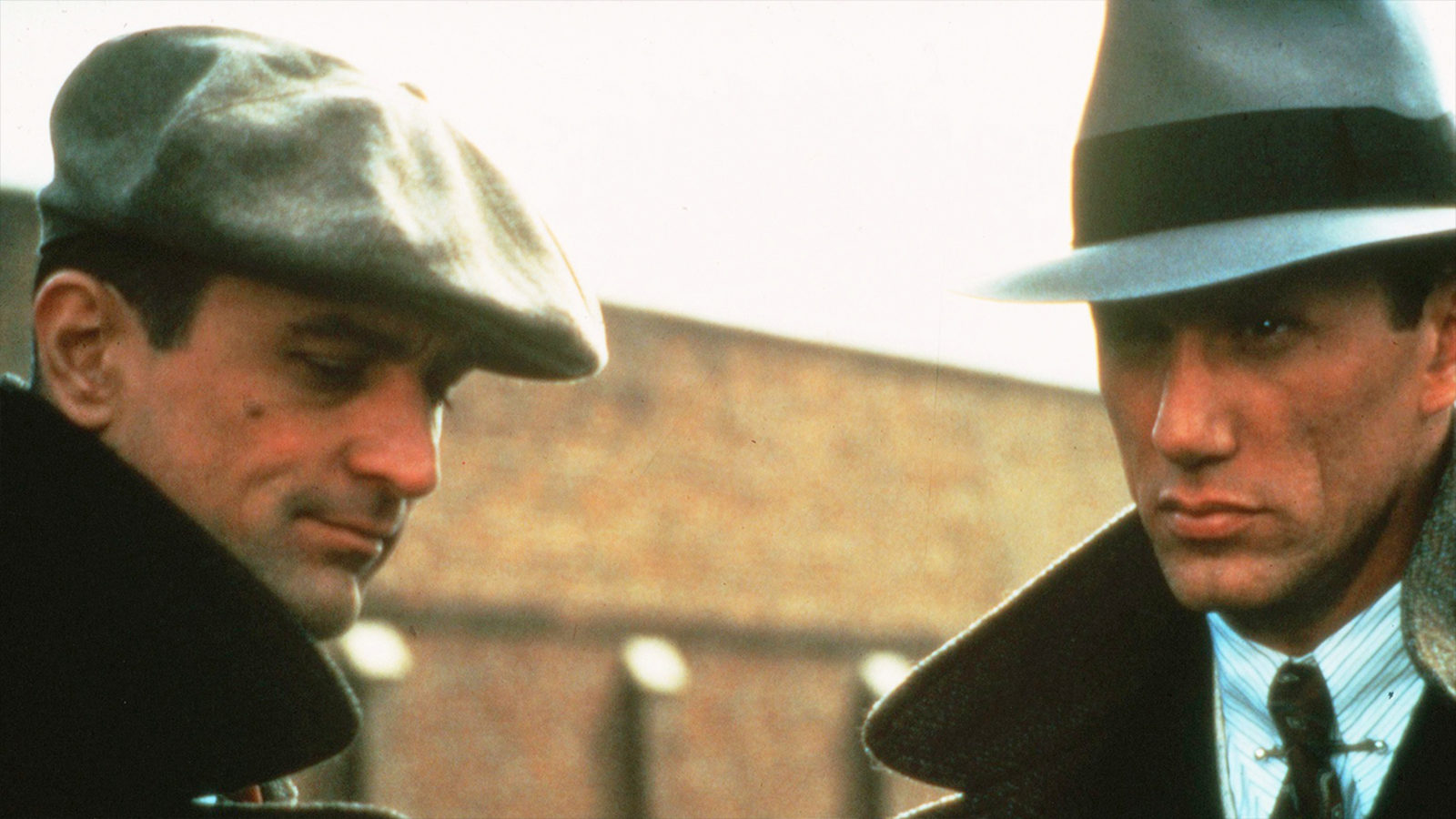
Robert De Niro and James Woods are gangsters in Sergio Leone’s sprawling indulgent masterpiece Once Upon a Time in America

Director: Sergio Leone

Cast: Robert De Niro (Noodles), James Woods (Max), Elizabeth McGovern (Deborah), Joe Pesci (Frankie), Burt Young (Joe), Tuesday Weld (Carol), Treat Williams (Jimmy O’Donnell), Danny Aiello (Police Chief Aiello), Richard Bright (Chicken Joe), James Hayden (Patsy), William Forsythe (Cockeye), Darlanne Fluegel (Eve), Scott Tiler (Young Noodles), Rusty Jacobs (Young Max), Jennifer Connelly (Young Deborah)

It had been thirteen years since Leone had made a film. During this time he turned down The Godfather in favour of his own dream of filming Harry Grey’s novel The Hoods. The final film, Once Upon a Time in America, seems destined to live in the shadow of The Godfather, from its settings and many of its themes through to its graphic design and cast. It’s a challenging, over-indulgent, sometimes difficult film that, never-the-less has its own sense of hypnotic power to it.

Told in a partly non-linear style, it opens with Noodles (Robert De Niro) a Jewish gangster on the run from thugs in 1930s New York days after the fall of prohibition. With his friends and his girl dead and his money stolen, Noodles flees the city – returning only in 1968 after a mysterious summons suggests his past is not as buried as he thought. Within this, the film weaves an intricate series of flashbacks that fill in the story of Noodles and his friend Max (James Woods) turning their teenage gang of hoodlums into an effective crew, muscling in on the money that can be made from prohibition. Carrying the story from 1918 all the way back to 1968, we discover why Noodles was on the run, what the money was, where it’s gone and who or what summoned him back to life.

Leone originally envisioned the film as a two-part epic: two films of three hours length. His original cut was almost ten hours long, cut down to six and then finally to just over four. This cut was released to critical acclaim at Cannes – but was still too long for the producers, concerned about making their money in America. To the fury of the cast (James Woods continues to be vocal about the butchering of the film), and the heartbreak of Leone, the film was cut again to just over 2 hours before its release in the States – a move that rendered it nearly incomprehensible and led to reviews that labelled it one of the worst of the year. Only with the much late release of the European cut (and work continues to restore something closer to Leone’s six hour cut) did the film find acclaim.

But you can see why the producers worried. Leone was never a director who felt the need to get where he was going quickly. As his films became ever more dominated by his love for artful compositions, meditative longeurs and drawing the tension out for as long as possible, so their running times ballooned. Leone matched this with a yearning to tell a story that was to be nothing less than about defining “America” – or at least, give a symbolic weight and depth to the Americana he loved. The film is overflowing with the feel of Old Hollywood gangster films and classic imagery of the immigrant experience in Manhattan. It’s like a brilliant coffee-table album bought to life and covered with blood.

So Once Upon a Time in America is a slow, lethargic even, film that takes its time to build up a picture of an immigrant community drawn together through bonds of culture and shared past that are nearly impossible to express – but fractured by the greed and capitalism of the American Dream, temptation to make an even bigger killing leading to old loyalties being sacrificed. Leone juggles some big ideas here, and if the film never quite comes to grips with any of them as it charts the fractured relationship of Max and Noodles, from brothers-in-arms to ambition, pride and private frustrations leading to betrayal it’s never less than strangely engrossing. 

In many ways this is a hugely indulgent film, but it is also remarkable (strangely) for how restrained and elegiac it is. The razzamatazz of some of Leone’s Westerns are mixed in with a golden age romantic view of the past – and its lost opportunities and loyalties – in a film particularly fascinated with the coming-of-age of young men. The film is nothing less than an old man taking a ruminative journey through the past (both Leone and Noodles in his memories), looking back at a life time of bad choices and lost chances. It all makes for one of cinema’s greatest mood pieces ever, with faultless period reconstruction, but also a piece that for all its focus on personal lives at cornerstones of histories, makes its characters seem strangely impersonal.

Part of that lies in Leone’s clear love for the film’s long second act (nearly a third of its runtime), which charts the young Jewish hoodlums teenage lives in 1918 New York – their meeting, first scores, rivalries with other gangs and inevitably the loss of virginity. For all its overextended backstory, the section of the film hums with love and elegiac romance. It’s the richest part of the film. There is a beauty in beats of the watching the boys encounter everything from first crime to first love – and easy as it is to mock a good 3-4 minutes watching one of them eat a cake intended as an offer in exchange for a first sexual experience with the local floozy, moments like that have an innocence and a beauty to them that Leone really captures.

It’s a shame that it’s the back-end of the film that suffers – and its plot and narrative drive. It feels like Leone fought to keep the beauty of this early section and sacrificed drive and narrative later. The fracturing of the relationship between Max and Noodles is less clear, and their adult characters never quite come into focus. Perhaps there isn’t quite room for actors in the long sequences of wordless silence and atmosphere, punctuated by bursts of shocking violence, in Leone’s world. Certainly the cut doesn’t help, with most of the supporting cast (Joe Pesci, Treat Williams, Burt Young, Danny Aiello) reduced to little more than one scene each, their storylines – particularly a crucial Teamsters plot – barely making any sense.

Max’s growing distance from Noodles is perhaps rooted in everything from his ambition being frustrated by Noodles small-time viewpoints, perhaps even in suggestions of a frustrated homosexual love for the defiantly straight Noodles. James Woods does very well to piece to together a suggestion of deep psychological unease and confusion in a character who remains unknowable, a man to whom loyalty is everything until it isn’t.

As Noodles Robert De Niro anchors the film with one of his quietest, most reflective performances. Noodles is a deeply flawed, low-key, humble character who carries in him a capacity for self-destructive and vicious violence. Leone’s film suggests Noodles is perhaps troubled by feelings and longings he can’t begin to understand or appreciate. He is a romantic character, deeply infatuated with both Max and his childhood sweetheart Deborah, but unable to express or communicate his feelings until it is far too late, a man traumatised by emotional connection.

Not that this excuses Noodles for his actions, particularly towards women. If there is one troubling aspect of the film it is its attitude towards women. There are two prominent women in the film, both of whom are raped. One of them, Carol, is a shrewish temptress, who deliberately provokes Noodles to rape her and is then shown enjoying it. The second rape, this time of Deborah, comes from Noodles after a romantic date where he has finally done everything right. While Leone shoots the scene with an almost unwatchable grimness – Elizabeth McGovern’s screams and distress make for very hard viewing – the film still asks us to feel not only for her pain, but also (perhaps more so) Noodles regret. Further when they encounter each other late in life, Deborah matches him in sadness at chances lost – an unlikely reaction you feel for someone who has suffered as traumatic experience as she has. 

But then to Leone perhaps this is part of the corruption of America – or rather the vileness of gangsters. The gangsters are a grotesque bunch in this film, killing without compunction, torturing, stealing, using violence as second nature. Loyalty is barely skin deep and arrogance abounds. There is no romantic sense of family behind it all – perhaps the thing Leone rejected most from The Godfather – just a series of people on the make and on the take. 

But for all its faults and over extended length the film is increasingly hypnotic and engrossing, Leone’s understanding of mood being near faultless. While the ideas are perhaps not quite pulled into sharp focus in the film – and leave the audience having to do a lot of supposition – it still works over time. And the film has so many astonishing merits – from its awe-inspiring shooting and production to the sublime score from Ennio Morricone that gives the film even more poetic depth – it more than merits its existence.

And of course there is the cheeky sense Leone throws in that some – or indeed all – of what we are seeing may not even have happened. The film opens and closes with Noodles in an opium den, stoned out of his mind, in the 1930s. In the opening he lies there, haunted by the sound of a ringing phone (the memory of the phone call he made betraying Max), and we see him arrive at the film’s end taking his first puff and lying back with a grin. Is the film’s off-kilter 1968 even real? Or just an opium den dream? Is the past – and the film’s disjointed narrative flying back and forth – just a stoned man lost in his own fantasies? Who knows? What we do know is that Leone’s indulgent epic is a flawed but genuine masterpiece – and the opium fantasy angle may just be the perfect cover for the fact more than half the film is on the cutting room floor of history.

The Good, the Bad and the Ugly (1966)

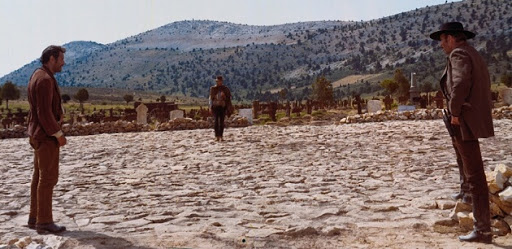
Clint Eastwood is the Man with no Name in The Good, the Bad and the Ugly

Director: Sergio Leone

Cast: Clint Eastwood (“Blondie”/The Man With No Name), Lee Van Cleef (“Angel Eyes”), Eli Wallach (Tuco), Aldo Giuffrè (Union Captain Clinton), Mario Brega (Corporal Wallace), Luigi Pistilli (Father Pablo Ramírez), Al Mulock (Elam, one-Armed Bounty Hunter), Antonio Casas (Stevens), Antonio Casale (Jackson/Bill Carson), Antonio Molino Rojo (Captain Harper)

The Good, the Bad and the Ugly closed out Sergio Leone’s “Man with No Name” Western trilogy, the role that turned Clint Eastwood into a star. Unlike the other two films in the Dollars series, TGTBTU was shot on a larger and more expansive budget, and showed Leone stretching himself into something more than a peddler of Americana pulp. This was a film that was as much an artistic statement as it was an entertainment – perhaps more so. 

The plot of the film is very simple – considering its extended runtime. Three bandits and hired guns are on a quest for buried gold, while all around them the American Civil War rages. The bandits are: “The Good” (Clint Eastwood) – the taciturn “man with no name” who has more of heart than he lets on; “The Bad” (Lee Van Cleef) – known only as “Angel Eyes”, a stone-cold killer with no soul at all; and “The Ugly”, Tuco (Eli Wallach), a larger than life Mexican bandit, scruffy, scuzzy but with plenty of joie de vivre. The money is hidden somewhere out in a graveyard in the West – but who is going to get there first?

TGTBTU is Leone at a midway point of his career. Tonally the film falls between the more straightforward thrills of the first two Dollarsfilms, and leans closer towards the artistic epic canvasses that Leone would paint in his Once Upon a Time… films. Perhaps this is why TGTBTU is possibly the most popular of all Leone’s films, it’s more entertaining than either of the latter two but has more thematic depth than the earlier two. But that doesn’t change the fact that, watching it, I feel this is reaching for a moral and thematic richness and complexity that is just beyond Leone’s grasp. He’s straining for this film to be something more than his earlier films – and I’m not sure that’s something he manages to do. 

But let’s focus on what the film does right, which is a hell of a lot. This is the film where Leone really found his voice and ran with it. It’s a hyper real world he creates of the Old West, with a tone of artificiality about it. Part of that comes from the odd disconnect you get from the European actors and the dubbed voices that overlay them (not always completely accurately), but it’s there in every inch of the style of the film.

It’s an explosion of style, with artificiality frequently alongside reality, all thrown together into a sort of crazy Western world where everything seems to be happening at once (from bandit towns to the Civil War), and you could turn a corner and end up in either a desert, a battle field or a town under siege. His style is heightened, and makes for some wonderful shots, not least the way first Blondie and later Tuco’s banditos seem to drop into a wider frame, expanding the world suddenly as we watch it. 

Leone’s a director who practically invented the term “operatic” for cinema. His gun battles are 99% build up and 1% action, and it’s the simmering tension of those build-ups that really make his films stick in the mind. If you think of it, you’ll imagine that iconic Ennio Morricone score (recorded before the film was shot, so Leone could shoot the film to match it – composers dream of having such licence today!), followed by slow series of escalating cuts. Leone will cut to hands approaching triggers, then close ups of faces, then long shots for context, then all of these again and again, each time the hands getting closer, the close-ups getting tighter, the long shots being more prolonged, all of it about building the tension and then BANG the shooting is done in seconds.

The film was criticised for being violent at the time, but it’s more like extremely tense. You can see why Tarantino sites Leone as his master. Watch that introduction sequence for Angel Eyes, a long, quiet scene where he eats a peasant’s food while questioning him and then ends by a sharp series of shootings that leave the family devastated. It’s the style Tarantino was going for in Inglourious Basterds and a tone establisher for Leone. You always know the violence is coming, and you know it will be quick and merciless when it does, but the film makes you sit tensely waiting for it for minutes at a time. The violence when it comes is often cold and those who carry it out are cynics and thieves rather than heroes and villains.

It makes for a sprawling, epic, even rather unfocused film at times – and it means the runtime is hopelessly overextended at over three hours uncut – but it’s also what interests Leone. He sees a world where killers are cool, calm, calculating and don’t go in guns blazing. Where intimidation is an art and micro-calculations occur before any trigger is squeezed. 

And these ruthless killers are in a world of violence all around them. Around the edges of the film’s narrative, the world of the Civil War rages, claiming lives left, right and centre. It’s here that Leone targets a thematic richness that I don’t feel is completely successful. There are elements that work – and the Union prison camp that Blondie and Tuco end up in (staffed by sadistic guards under the guidance of Angel Eyes) is the best of them. Clearly paralleling Nazi extermination camps in the herding of prisoners, the trains that carry them to certain death, the brutal beatings and the Yankee soldiers who are forced to play music (literally for their lives) to cover the noise of those beatings, you can feel Leone’s anger at the horror mankind unleashes on itself. 

But it’s heavy handed at places and makes its points too bluntly, dropping them into the film rather than weaving them neatly into the overall narrative. Towns and villages are bombed out and dead men lie on the edge of roads, but it doesn’t really get tied into an effective contrast with the central treasure hunt narrative. This is Leone straining for greatness, but not having the chops to get there yet. Blondie may bemoan the pointless slaughter of civil war – and even comfort a dying soldier – but these beats could be removed from the film without affecting its overall impact. Leone’s real love is Americana pulp, and his focus on this sometimes gets in the way of achieving his wider aims.

Perhaps that’s also because the impact gets lost slightly in the film’s great, sprawling length – and Leone’s lack of discipline, his insistence in taking everything at his own pace (often a slow dawdle through details), while it works really well for some sequences it also gives us others (such as Tuco running through a graveyard) that seem to last forever for very little impact.

Leone also increasingly became more a director with epic visuals in which characters are only details, with this film. Eastwood – reluctant to return in any case – especially feels like a much blanker presence in this film, coasting through his role almost on autopilot. Although you could say he generously cedes much of the limelight to Eli Wallach, who roars through the film as Tuco. Wallach’s eccentric but heartfelt performance – full of odd mannerisms but underscored with a genuine emotional vulnerability at points matched with a childlike enthusiasm – becomes central to the enjoyment of the film (he’s really the lead character). Van Cleef meanwhile drips demonic, cold menace behind unflinching (Angel) eyes.

Leone’s epic work is a sprawling, over extended, self-indulgent epic that mixes moments of pure cinematic entertainment with heavy handed digressions into man’s inhumanity that are a little too on-the-nose and unthreaded into the central plot to carry as much impact as they should. But it remains one of the most popular films of all time partly because what it does well, it does better than almost anyone – those long, tense build-ups, that electric energy that Wallach represents, the otherworldly artificiality mixed with cold reality. The Good the Bad and the Ugly is Leone’s crowning achievement, and for all its flaws, it still packs a punch.

Mutiny on the Bounty (1935)

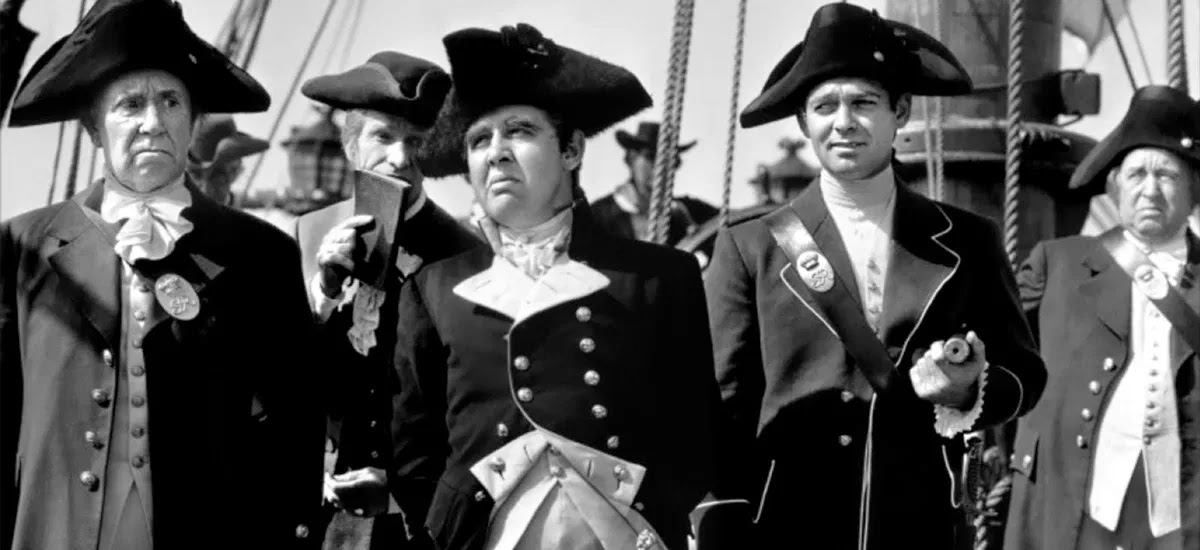
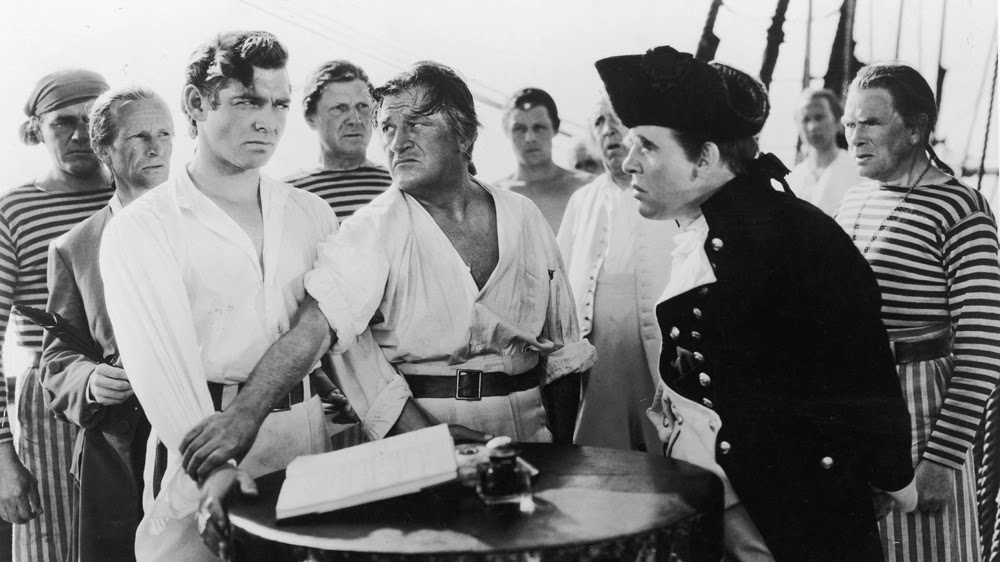
Laughton and Gable go head to head in Mutiny on the Bounty

Director: Frank Lloyd

Cast: Charles Laughton (Captain Bligh), Clark Gable (Lt Fletcher Christian), Franchot Tone (Roger Byam), Herbert Mundin (Smith), Eddie Quillan (Ellison), Dudley Digges (Bacchus), Donald Crisp (Burkitt), Henry Stephenson (Sir Joseph Banks), Francis Lister (Captain Nelson), Spring Byington (Mrs Byam), Movita Castaneda (Tehani), Mamo Clark (Maimiti), Byron Russell (Quintal), David Torrance (Lord Hood)

“They respect but one law – the law of fear…”. So hisses Charles Laughton as the definitively monsterish Captain Bligh in this Oscar-winning version of the most famous mutiny ever. It’s the quintessential adventure on the high-seas motion picture (never mind that the actual ship used could only get a few miles off the coast), but it’s also a feast of good acting and Hollywood class: the only picture to get three nominations for Best Actor, as well as the last Best Picture winner to only win one Oscar. It cemented the ideas around Bligh and Fletcher for generations.

Heading out on a two-year voyage in 1787 to transport breadfruit from Tahiti to the West Indies, the Bounty sets sail from Portsmouth with several members of the crew freshly press-ganged. In command is self-made man Captain William Bligh (Charles Laughton), while his second-in-command is gentleman Fletcher Christian (Clark Gable). A pair of fine sailors, the two of them are separated only by their methods. Fletcher is a man of the people, a motivator with a firm hand. Bligh is a man with just a firm hand, who never uses a dozen lashes of the crew when two dozen will do. Fletcher becomes more and more alienated by Bligh’s ruthless methods.

Frank Lloyd bought the rights to a novel that fictionalised the mutiny (introducing Roger Byam, a fictional version of Peter Heywood who later become a Post-Captain in the navy) with the intention of directing and playing Bligh himself. Fortunately he was persuaded to step aside on the acting front for Laughton, who is seized the part with relish.  Shoulders scrunched and neck jutting his head forward, with his lip curled, this is a Bligh constantly on the look-out for offence, a martinet whose anger stems from a self-loathing within. A chippy middle-class boy made good, he’s determined to enforce the letter of the law, and while a bully with no empathy he’s not exactly a bad man, just a bad captain. Laughton’s performance simmers with bitterness and a relish for being obeyed.

He makes a neat contrast with Clark Gable at his matinee idol finest. Worried about taking the role because it demanded the shaving of his lucky moustache (no facial hair in the navy), Gable gifts Laughton the flashier role to play the decent hero with only the best for his fellow man at heart. Gable’s Christian is decent, understanding, a natural leader who has a firm eye for justice. Not even bothering with the British accent, but settling for a mid-Atlantic ease, Gable is the Hollywood superstar to his core, his Christian the quintessential romantic ideal.

Between the two of them runs Franchot Tone’s Midshipman Roger Byam. Tone is the often forgotten third nominee for Best Actor, but he has in many ways the trickier part, which he handles with aplomb: the naïve young man who wants to serve his captain and his country, but also understands that his captain is not a man of justice. Tone gets the film’s highlight, a final speech to the court martial that helps make everything turn out alright, but his tortured pleading for justice and moral righteousness is delivered with a humble and effective forthrightness.

Lloyd has these fine performances (plus some great work from Mundin, Crisp, Digges, Quillan and others as assorted ship’s crew) and sets them all out perfectly on a film that captures the heart of the epic. The ship is brilliantly constructed and assembled, and Lloyd’s film reconstructs everything from day-to-day travails on sea to the impact of storms. The mutiny when it comes is shot with an Eisensteinesque immediacy, while he also manages to shoot Tahiti with a dreamlike paradise sheen. He paces perfectly the growing sense of tension and unresolvable fury between Bligh and Christian. 

And he certainly gets a brilliant sense of the cruelty and sustained violence of Bligh’s rule on the boat, as floggings come thundering down on the backs the sailors – often for the very meanest of reasons. A keelhauling (despite one moment of laughably bad model work) is brutal in its harshness. Bligh’s first act on boat is to flog a dead man (after all death doesn’t wipe out the need for punishment) and he goes from there. The film does give time to admire Bligh’s seamanship – and reconstructs surprisingly well his awe-inspiring open boat trip over 4,000 miles to take him and loyalists back to a safe port. Meanwhile Christian heads for the safety of Tahiti, a blissful series of images of our decent sailors enjoying homespun pleasures and hot Tahitian wives.

Of course it’s not actually what happened really. Bligh was a difficult, priggish and rather cold person with low personal skills but he wasn’t the monster he seems here. Christian had a certain aristocratic pull over the men, but he was also probably far more twitchy, young and stupid than the assured, experienced sailor he is here. Bligh’s ship wasn’t the bastion of cruelty it is here (punishments seemed in line with the rest of the navy, or even a little less according to the log), but Bligh’s lack of understanding of how men work and his endless drive, matched with his sailors’ seduction by the charms of an easy life on Tahiti perhaps led to the outbreak. Either way Bligh definitely didn’t command the HMS Pandorato hunt the sailors down, nor did the investigation into the matter end with him being snubbed as a wrong ‘un by Lord Hood.

But hey, if you know that this is legend printed as fact it’s fine. Because Lloyd’s film is still superbly entertaining, has three excellent performances among a fine ensemble cast and while its version of Bligh may be a monster made up, Laughton invests him with enough humanity and self-loathing you’ll despair at his poor choices as much as you’ll hate his cruelty. Prime Hollywood entertainment, perfect for any time.

The Godfather Part II (1974)

Al Pacino defines his career (and film history) as The Godfather Part II

Director: Francis Ford Coppola

Cast: Al Pacino (Michael Corleone), Robert Duvall (Tom Hagen), Diane Keaton (Kay Corelone), Robert De Niro (Vito Corleone), John Cazale (Fredo Corleone), Talia Shire (Connie Corleone), Lee Strasberg (Hyman Roth), Michael V. Gazzo (Frank Pentangeli), GD Spradlin (Senator Pat Greary), Richard Bright (Al Neri), Gastone Moschin (Don Fanucci), Morgana King (Mama Corelone)

For what shall it profit a man, if he shall gain the whole world, but lose his soul? It’s the question that drives this triumphant, Oscar-laden, sequel to Coppola’s cinema-defining masterpiece, The Godfather to create what is, without doubt, the greatest one-two punch in cinema history, two films that develop and contrast each other naturally it’s very easy to consider them as one perfect film.

It’s 1958 and Michael Corleone (Al Pacino) has seen his power grow to control Crime across several states. However problems confront him including rivalry from Hyman Roth (Lee Strasberg) his business partner, a disaffected capo Frank Pentangeli (Michael V Gazzo) talking to a Senate investigation and growing tensions in his marriage to Kay (Diane Keaton). The story is intercut with the rise to power of his father Vito (Robert DeNiro), a man raising his family in Little Italy and realising the temptations of a life of crime.

Happy with just one Godfather film, Coppola only agreed to a second in return for a pile of cash and complete creative control. He used that to create a film even deeper, richer and mesmeric (perhaps) than the first film. While The Godfather is high grade pulp fiction, shot and assembled with arthouse skill and layered with depth, Part II is a profound family saga, an arthouse epic spliced with rich vein of pulp fiction at its heart. A multi-generational story that illustrates the dark corruption at the heart of America from top to bottom, it also demonstrates the stark differences in personality and action between two ruthless, authoritarian father figures who do all that they do in the name of family, one of whom sees that family prosper and grow around him, the other who destroys everyone near to him.

Coppola’s film removes much of the slightly cuddily family element from the Corleone family to show a darker, bleaker, chillier movie than its landmark predecessor. Coppola uses his control to expand and deepen the Corleone saga both in the past and present, but also in the dark hearts and secrets of a family built on crime, extortion and murder. It’s a thematically rich, engrossing and beautifully assembled piece of film-making. Exquisite in every touch and beat, completely convincing and breath-taking in its confidence it is clearly the greatest sequel ever made.

The film charts the final descent of Michael Corleone into the dark recesses of his own worst desires and instincts. The brutal, unforgiving, unrelenting coldness and absolute certainty matched with the overwhelming hunger to win that has left him hollowed out and unrecognisable from the naïve, idealistic young war hero we were introduced to at the wedding that opens The Godfather. Of course, even at the start of the film, as Michael holds court with a chilling coolness and maintains only awkward contact with his family – all of whom must submit to him and his wishes or face lethal consequences – it’s clear that the man who talked of “it’s my family Kay, it’s not me” is a long, long way away.

During the film we see Michael seem to harden even further, an adamantine chillness captured superbly by Al Pacino. In, without doubt, the greatest performance of his career, Pacino restrains bar maybe three times, the explosive energy and ferocity that has been the hallmark of his career (a feat that allegedly made him physically ill). Instead, he presents a Michael who is an almost pathologically cold fish, a fiercely intelligent, scheming observer with eyes that observe and understand everything, jet black boreholes that suggest only whirlpools of emptiness behind them. He’s unrelenting, lacks any doubt and (it becomes clear) has not a vestige of pity left in him, with empathy forced out of his body like water from a squeezed sponge. Pacino prowls every frame like a quiet tiger, oozing sharpness, intelligence and lethal, ruthless ambition.

Everything is done to protect and secure his family and its legacy, but each action seems to strip him one by one of everyone he claims to be protecting. His children seem to live in intimidation and later terror of him. His wife turns from misery to loathing to being ejected from the family home, even aborting her pregnancy to prevent herself bringing another Corleone into the world (a reaction that leads to a final, relationship severing explosion of rage from Michael). His brother Fredo, poor sweet, foolish Fredo, is sacrificed to an unrelenting desire for revenge. The man who did everything for “the family” ends the film by having his last surviving brother executed. The brother who, the film’s coda reveals, was the only member of the family to support his signing up for service in World War Two.

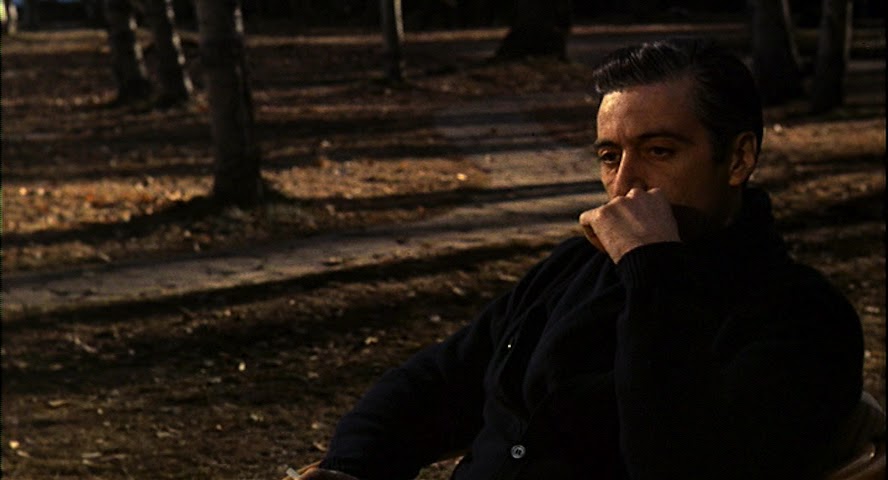
As Coppola’s camera drills into the face of Michael, cold, greying, alone in an autumnal garden – and how often the film simply studies the ruthless calculation of Michael, the man who understands every move everyone makes before they even make it – you know we are looking at a man who has damned himself, who has destroyed everything who claims to hold dear while working to protect it.

Brilliantly, Coppola intercuts the storyline of Michael’s damning collapse into complete moral damnation with the rise of his father. The Young Vito Corleone – played with Oscar-winning skill by De Niro who superbly channels the basic facets of Brando’s performance mixed with his own charm – arrives in America to find it a land as in thrall to the rule of the gangs as his hometown in Sicily. Like Michael in the first film, he is tempted by the world of crime and finds he has a natural aptitude for it: like his son he is a man who people follow, and the man who has the will to do what must be done. Like him he is an empire builder who commands respect and honour.

But unlike his son, he is a man capable of warmth, of empathy. He is man who can be playful, who respects others, who can feel forgiveness, who sees others as people, not just (as Michael does) simply being tools to be manipulated. Vito may be a murderer like his son, but he loves his wife, he loves his children and he can form bonds with them – natural, warm, loving bonds – that Michael can only dream of doing. For Vito it is all about the family, and providing for them is what inspires his actions. For Michael it’s words, but for Vito – it is everything.

Coppola masterfully intercuts these two storylines so they brilliantly comment and contrast with each other. Each step of Michael’s struggles to overcome the plots around him, are perfectly bookended with contrasting moments of Vito’s own rise to power, and the bonds of loyalty he builds even as Michael destroys those own bonds in his own life.

But then Michael is dealing with high stakes. While Vito’s early life shows Mafiosi running Little Italy, and calling the shots on the neighbourhood, a local tradition inherited en masse from the mother land, Michael moves in the worlds of government corruption. The empire we see Vito start to build is destined under his son to interfere in the rule of whole countries in Cuba, and commit unspeakable crimes to bring Senators and witnesses under their control in Senate Hearings into Organised Crime.

Coppola had intended the storyline around the reluctant family witness to be Clemenza, but Richard Castellano famously refused to reprise his role unless he was allowed to write his own dialogue. (The Godfather Part II was blighted with actor disputes: Brando refused to reprise his role in the film’s coda, while James Caan was paid more for a day’s work than he was for the whole of the first film). Instead the role was passed to Michael V Gazzo (Oscar nominated) as Frankie Pentangali, a loud-mouthed Capo manipulated into thinking he has been betrayed by the family. This threat hangs over the second half of the film – but Michael barely seems to break sweat under interrogation.

He has more problems with the Meyer Lansky inspired Hyman Roth (played by Pacino’s teacher, the legendary Lee Strasberg – also Oscar nominated). Roth it is who immerses Michael in a corrupt takeover of the Cuban government by the Mafia – an attempt foiled by the revolution – and Roth who becomes his nemesis, an old man in a hurry, who believes he can match the ruthlessness of this man without a soul. Coppola’s scenes of Cuban excess – not to mention the danger on the street as the country starts to tear itself apart – are of course masterful.

Cuba destroys Fredo, a snivelling John Cazale (inexplicably not nominated, despite extraordinary work here – never mind nomination he arguably should have won). Cazale’s Fredo is endearing but simple, a fundamentally weak man in a family of wolves, whose guilt is almost embarrassingly easily unveiled. Petulantly – but terrifyingly – raging late in the film at Michael at being passed over, he sits (sweaty and veins throbbing) in a reclining chair that bounces on each point he makes – a simple touch that makes him seem more and more impotent and pathetic every second.

The film echoes much of the structure of the first film, but here retold with a chilling coldness as the warm heart that – for all his crimes – Vito bought to this family is removed. The opening family event, Anthony’s confirmation, is a public show with no personality at all, where the Italians feel all at sea, their culture not known or cared for. Doors are closed on Kay with an alarming regularity – their marriage is so non-functional that even at the start they seem to have very little to say to each other. Vito returns to Sicily, as Michael did, but this time to extract revenge for his parents not to fall in love. The ending of the film culminates in a dark, ruminative and tragic hinged cleansing of Michael’s – crucially not the families but Michael personally – enemies.

The film is blessed with a brilliant array of supporting turns, from Diane Keaton’s soft-faced sadness masking deep and lasting resentment as Kay, to a flashily amusing tone from GD Spranlin as the greasily corrupt Senator. Robert Duvall does unsung but powerful work as a Tom Hagen coldly loyal, perhaps even in slight fear of his adopted brother, but despite his seeming decency willing to carry out truly terrible deeds for the family. Talia Shire (also nominated) is great as the rebellious Connie who pleads in vain for Fredo’s salvation.

This is all beautifully packaged together by Coppola into a film that meditates on the building and the destruction of a family, two stories neatly told together in parallel, with each echoing the other. It is a film shot at a riveting but controlled pace, that uses the classical filmic style of the original but mixed even further with the genius shooting of Gordon Willis to add a dark tinged 1970s style to ever shot. The film is an art house classic, but also a superb plot boiler, a gangster film that tells us profound truths about the attitudes that make us men and those that destroy us, just as it suggests that the darkness at the heart of crime will eventually consume the very thing it starts out to protect (even if it does take generations). While it is not as entertaining or engaging perhaps as the first film – it is perhaps an even greater achievement, a superb triumph of atmosphere and tone and a terrifying insight into the darkness that man can achieve.

For at the end Michael has won utterly. But he is also utterly defeated.

1917 (2019)

George MacKay is lost in the horrors of war in Sam Mendes’ one-shot 1917

Director: Sam Mendes

Cast: George MacKay (Lance Corporal Will Schofield), Dean-Charles Chapman (Lance Corporal Tom Blake), Benedict Cumberbatch (Colonel Mackenzie), Colin Firth (General Erinmore), Richard Madden (Captain Blake), Andrew Scott (Lt. Leslie), Mark Strong (Captain Smith), Claire Duburcq (Lauri), Daniel Mays (Sgt Saunders), Adrian Scarborough (Major Hepburn), Jamie Parker (Lt Richards), Michael Jibson (Lt Hutton), Richard McCabe (Colonel Collins)

No film can even begin to capture the unspeakable horror of war, and those of us who have never been in the middle of it can only imagine what it must have been like for those who have. Based on the experiences of his grandfather Alfred, Sam Mendes’ World War I story tries to immerse the viewers in the experience by staging a film designed to play out in real time, in two epic takes (actually a series of very long takes seamlessly spliced together). It’s a technical accomplishment, but also a film partly dominated by the precision of its construction rather than the emotion of its telling.

One day in April 1917, two young Lance-Corporals, brave and selfless Tom Blake (Dean-Charles Chapman) and more war-weary Will Schofield (George MacKay) are tasked with a desperate mission by General Erinmore (Colin Firth). The next morning, a British regiment will walk into a trap set by German forces. Blake and Schofield must take a message through no-man’s land, cancelling the regiment’s planned attack, or 1,600 men will die – including Blake’s brother who is serving with the regiment. 

Mendes’ film is a triumph whenever it is in motion. The time-limited race to travel across miles of hostile land – through no-man’s land, booby-trapped abandoned trenches, hazardous open fields and ruined towns that have become battlegrounds – works a treat whenever our heroes are constantly moving forward. Drawing a strange inspiration from Lord of the Rings, with its quest structure and Schofield as a Samwise to Blake’s Bilbo, the film is compellingly completed with the over-the-shoulder, walking-alongside intimacy of the camera work that follows every step of this journey, that never pulls ahead or shows us something that the soldiers can’t see and keeps us nearly constantly (bar one stunning shot of a ruined town lit only by firelight and early dawn) at the level of the soldiers.

It’s an epic experience film, and Mendes’ camerawork and ingenuity in the shooting create the impression of a one-take film – some shots seem to travel at least a mile, through winding trenches, with our heroes. The effect is justified by the desire of the film to throw us into the experience of the soldiers and to create the impression that we are sharing a journey with them – and hammers home the time pressure these men are operating under as we experience everything first hand, including the only undisguised cut (and time jump) in the film. The horrors of the war are superbly shown – dead bodies, many bloated or deformed by exposure, litter the frame but tellingly bring little comment from the soldiers, demonstrating how accustomed they have become to such sights. Each frame seems covered with muddy surfaces, and sharp freezing chills. Technically it’s a marvel, and you have to admire Mendes’ ambition in even attempting such a thing. 

Perhaps, though, that is one problem with the film. You are so impressed with the showy intelligence and grace of the camera movements, the ingenuity needed to keep the camera rolling through takes lasting ten minutes or more and travelling miles at a time, that move in and around confined rooms and trenches, that you at time spend as much (if not more) time marvelling at the brilliance of the film making as you do feeling the emotion of the story. While the long takes add immeasurably to the many moments of peril, dread and terror that the characters go through (helped also by Thomas Newman’s eerily unsettling score), they also become as much about admiring the technical brilliance as they are investing in the story.

Of course, the story has been boiled down to something very simple and elemental – and it avoids many clichés you half-expect from the start. But the film itself gets slightly less interesting when the relentless march forward stops, when the characters slow down or take moments of reflection. A section in the middle of the film where the action pauses around a young French woman hiding in a bombed out French town doesn’t quite work, and has a slight air of spinning plates – you could have allowed a longer break in the single take effect to take us from one event to another. In fact you wonder if a film that had more of a time jump or had been constructed around 3-4 clear long takes with time jumps might have worked better.

This is not to criticise the two actors who embody the leads. George MacKay is superb as a soldier who experiences immense suffering and torment on a journey he is less than willing to undertake from the first, and finds himself opening up his emotions and feelings more and more as the film progresses. Dean-Charles Chapman is a good match as a slightly more naïve youngster, desperate to do the right thing and selfless in his courage. These two move on a journey that essentially sees them handed over from one big-star cameo to another (something that is sometimes a little distracting, if necessary to allow these brief appearances to have character impact) with Firth, Strong, Cumberbatch, Madden et al all delivering terrific work in a few short minutes on screen.

Mendes’ direction technically is faultless, and the style chosen really adds huge and unrepeatable visual benefits, all superbly caught by Roger Deakins’ sublimely beautiful photography. At one moment a flare is fired – and we see it arch out of shot and then repair behind us in real time as the characters move forward. At another, an aerial dogfight goes from distant to alarmingly close. The countryside recedes hauntingly as a ride is hitched from a motorised regiment. 

The single-take effect does make it far easier to relate in these moments to the soldiers. It works less well at smaller moments – and arguably could have been replaced by a more conventional style here to give even more impact to the rest – but its execution is perfect. Maybe too perfect, as it doesn’t always make room for the heart. Hollywood’s directors seem more and more drawn to the long take for the immersive, big-screen quality they carry – four of the last five Oscars have gone to directors whose films are almost entirely made up with them. But they create – as is sometimes the case with 1917 – something that is a product for the largest screen, immersive experiences that perhaps lack rewarding depth on later revisits.

The King (2019)

Timothée Chalamet is the war like Henry V in the confused The King

Director: David Michôd

Cast: Timothée Chalamet (King Henry V), Joel Edgerton (Sir John Falstaff), Robert Pattinson (The Dauphin), Sean Harris (William Gascoigne), Thomasin McKenzie (Queen Phillippa), Ben Mendelsohn (Henry IV), Tom Glynn-Carney (Henry “Hotspur” Percy), Lily-Rose Depp (Princess Catherine), Dean-Charles Chapman (Thomas, Duke of Clarence), Thibault de Montalembert (King Charles VI), Tara Fitzgerald (Hooper), Andrew Havill (Archbishop of Canterbury)

This is a story that is pretty familiar to most people now – after all, Shakespeare’s play has probably been being played somewhere in the world for most of the last 500 years. Edgerton and Michôd collaborated on the story and script of this restaging, or reimagining, of Shakespeare’s epic of the wayward fun-loving prince turned hardened warrior king. Despite being handsomely filmed, and impressively shot, this makes for an odd and unusual film which falls between the two stools, as it is faithful to neither history nor the Shakespeare original.

The rough concept remains the same. Prince Hal (Timothée Chalamet) is not just a young man who has fun in the taverns of London, he’s also quite forward looking in his attitudes, and just can’t understand why he should be made to carry on the rivalries of his father, the fearsome Henry IV (a broodingly miffed Ben Mendelsohn) or why he should continue the wars that the council pressures him into. When he becomes king, however, Henry is persuaded by his counsellor William Gascoigne (Sean Harris), that the path to peace for the realm – and safety for his subjects – can only be through unifying the kingdom by war with France. Appointing the only man he trusts – his old drinking companion and famed soldier Sir John Falstaff (Joel Edgerton) – as the Marshal of his armies, Henry heads to France where destiny awaits.

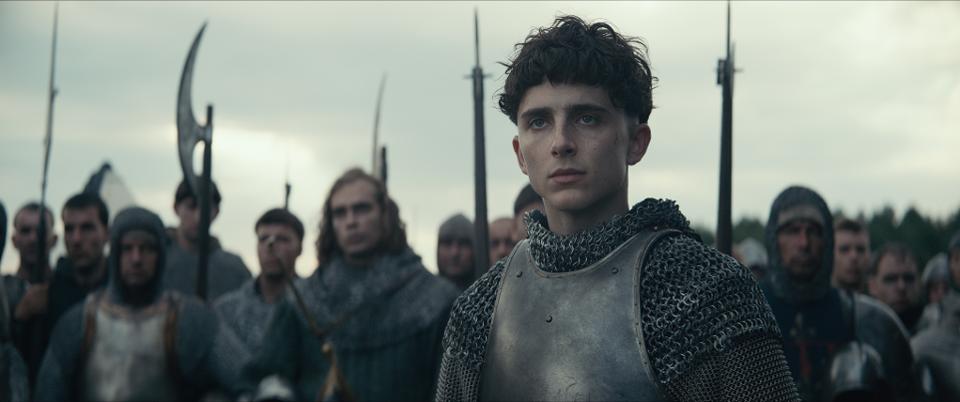
Michôd’s film is at its strongest when it focuses on the visuals and the aesthetic of its age. It’s beautifully shot, with several striking images, from execution courtyards to the battle of Agincourt itself, which takes place in an increasingly grimy field. The battle itself ends up feeling more than a little reminiscent of ideas from Game of Thrones – in fact a few core images are straight rip-offs from the famous “Battle of the Bastards” episode – but it at least looks good, even if there are few things new in it. The costumes and production design don’t feel like they strike a wrong note either with the grimy, lived-in feel.

More of the issues come around the script. The film’s concept of Henry initially as this rather woke modern king – he just wants peace and to give up these tiresome obsessive conflicts of his father – who slowly becomes more colder and ruthless as the film progresses does at least make thematic sense in the film, but it still rings a little untrue. Much as I would like, it’s hard to believe that any prince like this could ever have existed at the time, and so cool and calculating is Chalamet’s performance from the first that he never feels like a genuine, young, naïve princeling whom we can sympathise with early on. 

It makes the film’s arc rather cold, and Hal an even more unknowable character than the film perhaps even intends. There is very little warmth or genuine friendship between Hal and Falstaff, and Hal moves so quickly to the imagining (and enacting) of war crimes during his time in France that his descent towards potential tyrant feels far too sharp to carry impact. Even in the early days of his reign he’s swift to have potential destablisers in his court executed with no mercy. Where is the fall, if he is such a cold fish to start with? And with Chalamet at his most restrained (like the royal baggage and the accent are a straight-jacket around him), how can an audience invest in him? 

And what are we supposed to be making of this anyway, since the film is at equal pains to suggest that the king may be the subject of manipulation and lies that force his hand into war? This Henry, we learn, values truth and honesty highest – but this doesn’t stop him getting pissed when met with counter-arguments from his advisers (even Falstaff) or reacting with cold fury and disavowal when things don’t go his way. It’s a confusing attempt to add an ill-fitting modern morality to a king who essentially in real life spent most of his life at war, and was to die on campaign in France still trying to cement his rights at a young age.

Edgerton and Michôd’s script fails to really square this circle, and all the attempts to have its cake and eat it (the peace loving king still manages to kick arse, including killing Hotspur in single combat thus averting the Battle of Shrewsbury from ever happening) don’t quite pan out. Edgerton writes himself a decent role as Sir John Falstaff, here reimagined as a million miles from the drunken, cowardly knight into a courageous and hardened soldier who has no time for the compromises and deceit of court (in contrast to Henry’s other advisor, the Machiavellian Gascoigne played with a playful archness by Sean Harris). Making Falstaff a respected figure like this rather flies in the face of the logic of why Henry IV is so annoyed about his son spending time with him, but never mind.

It’s not really Shakespeare and it’s not really history. It sticks closest perhaps to Shakespeare in its portrayal of the French as arrogant fops – led by Robert Pattinson going delightfully OTT as the Dauphin – but it never really quite works out what it wants to be. With its Game of Thrones look and feel, and prince who is both great warrior and reluctant warlord, peace-lover and ruthless executor of his enemies, it feels scattergun and confused rather than coherent and whole.

Henry V (1944)

Once more unto the breach with Laurence Olivier as Henry V

Director: Laurence Olivier

Cast: Laurence Olivier (Henry V), Renée Asherson (Princess Katherine), Robert Newton (Pistol), Leslie Banks (Chorus), Felix Aylmer (Archbishop of Canterbury), Robert Helpmann (Bishop of Ely), Nicholas Hannen (Exeter), Ernest Thesiger (Duke of Berri), Frederick Cooper (Nym), Roy Emerton (Bardolph), Freda Jackson (Mistress Quickly), George Cole (Boy), Harcourt Williams (King Charles VI), Russell Thorndike (Duke of Bourbon), Leo Genn (Constable of France), Francis Lister (Orleans), Max Adrian (The Dauphin), Esmond Knight (Fluellen), Michael Shepley (Gower), John Laurie (Jamy), Niall McGinnis (MacMorris), Valentine Dyall (Burgandy)

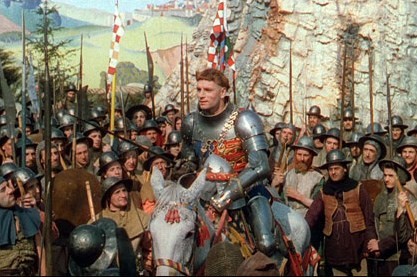
Olivier’s pre-eminence as the leader of the acting profession in Britain for a large chunk of the last century probably found its roots in his imperiously sublime production of Henry V, the first time he directed a film, but also the point where it seemed that Olivier and the country of Britain seemed to be almost one and the same. Filmed as a propaganda piece, heralding the indomitable spirit of the British in the face of foreign wars, Olivier’s film is a triumph that also set the tone for what the public expected from Shakespeare films for decades to come. 

Originally Oliver balked at the idea of directing the film, approaching William Wyler to take the job on. But Wyler, rightly, knew he could never bring the Shakespearean understanding to it that Olivier could, so the soon-to-be Sir Laurence took the job on himself – meaning he directed, co-produced, co-adapted and starred in the film. I’m not sure anyone else could have done it – or invested the entire project with such certainty, such confidence, such power of personality that the entire project flies together into a sweeping, brightly technicolour treat of pageantry and theatre.

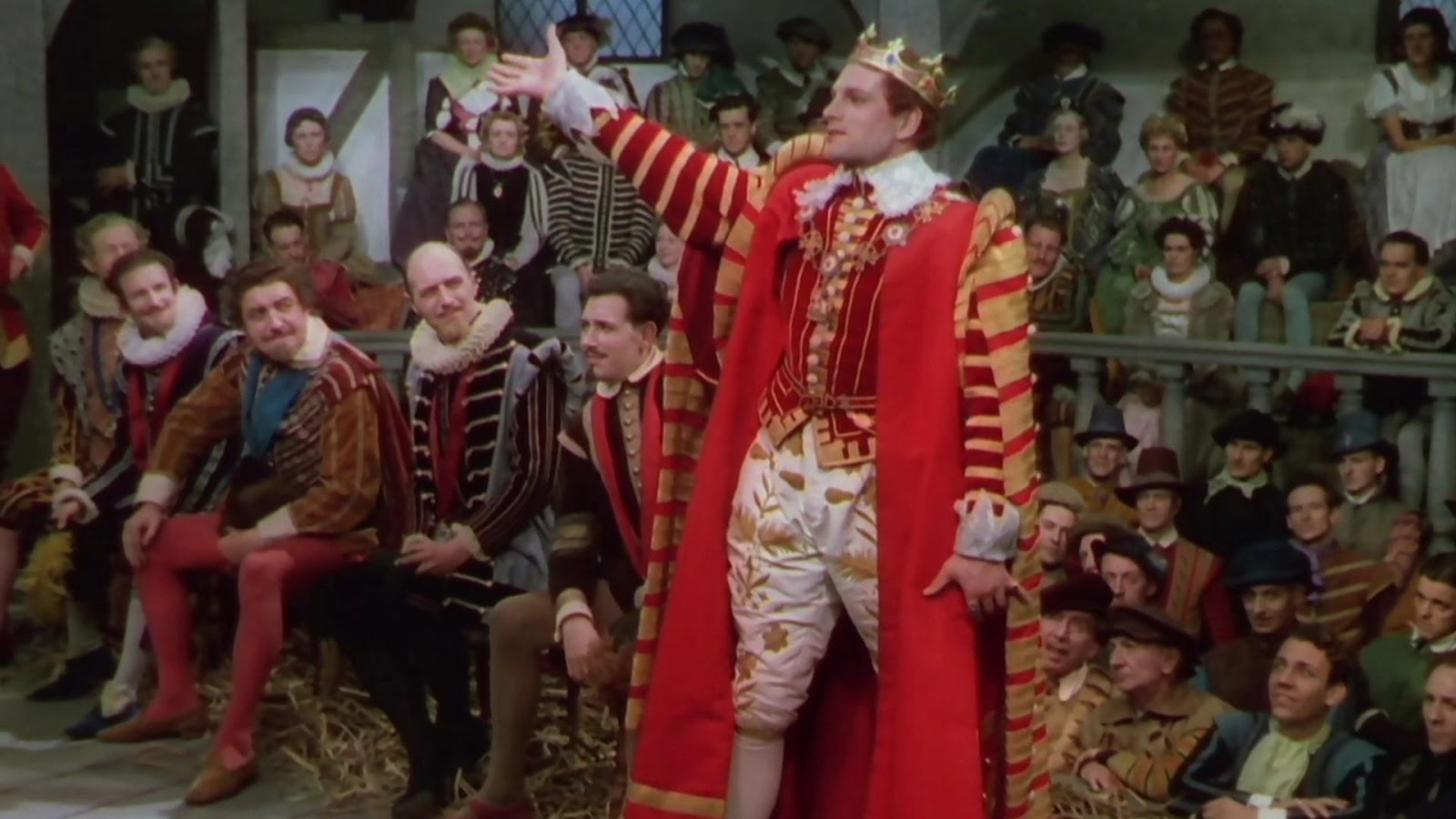
Olivier’s concept for the film is ingenious – and influential. Taking as its cue the words of the chorus (delivered with a archly bombastic confidence by Leslie Banks), the call to “let your imaginary forces work”, the film is set initially in a genuine Elizabethan era staging of Henry V (including unfortunate rain downpour after the first scene).Slowly, it develops over the course of the film from set to cinematic sound stage (still designed with influence from medieval illustrations) and finally into a realistic location setting for the Battle of Agincourt, before turning heel and repeating the journey back until the film ends again in the Globe theatre, with the actors taking their bow (and the female characters now played by fresh-faced boys). It’s marvellously done, and a neat play on the limitations of both film and theatre, and a testament to the powers that imagination can have to expand the world of what we are presented with.

The style of the play develops as we watch it, becoming more natural and restrained as we get closer to Agincourt, then progressing gently back the other way. The opening scenes play Canterbury and Ely’s long-winded legal argument in favour of war for laughs (with neat comic timing by Felix Aylmer and Robert Helpmann), with an avalanche of papers across the stage, Canterbury frequently lost in his exposition and Ely (and even Henry) having to prompt him with precise points. This is a nice set-up for the comic characters of the play, Falstaff’s old retainers here are the very picture of high-spirited, rowdy common folk (though I must say Robert Newton’s high-energy, gurning Pistol is a bit of a trial, even if it perfectly captures the playing-to-the-cheap-seats mania the role seems to require). 

This comic exuberance (and the stuff with Canterbury is genuinely quite funny) gives a perfect counterpoint for Laurence Olivier to perform Henry at his imperious best. Olivier was an actor who invested his Shakespearean delivery with far more naturalism than he is often given credit for, and his Henry here has more than enough true feeling, emotion, determination, courage, bravery and nobility behind his almost sanctified greatness. And of course you get Olivier’s outstanding delivery, that wonderfully rich voice with just a hint of sharpness, delivering the lines not as just poetry, but as true moments of invention. Olivier also has the mastery of the small moments – and Henry doesn’t get much of those – with two particular favourites being the small cough in the wings to clear his throat before entering for his first scene, and that satisfied, exuberant smile at the curtain call at the play’s end. His Henry – the true warrior king of virtue – cemented perception of the character for decades to come.

True, Olivier never touches on Henry’s darker side. Olivier neatly cut anything that could introduce any shades of grey into the character: gone is the summary execution of the traitors at Southampton, cut are the references to naked newborn babes being spitted on pikes before Harfleur, nowhere do you hear the order to execute all prisoners at Agincourt. This is film-making with a purpose, to pushing the message of England, for good, against all. 

As a director, Olivier revelled in the possibilities of cinema, marrying it to theatre. For the large speeches, Olivier invariably starts small and close, and then pans sharply and widely out to turn the cinema into a theatre – also allowing the actors (often to be fair, himself) to not feel restrained by the intimacy of the camera, but to deliver the speeches as intended, larger than life and bursting with impact. Olivier’s confidence with the camera is striking, his film a celebration of sweeping shots, of carefully placed tracking shots, of well-delivered acting. The camera work in the Globe is beautifully done, a series of carefully selected angles and shots. The long panning shot over a model of London leading to the Globe that book-ends the film is beautifully done, and the confidence with which Olivier slowly transitions from artifice to reality is superbly well done.

The style of the piece is extraordinary, with its primary colours like a medieval book brought to life. There is some pleasing comic mileage from the French court, reduced almost to a man to being a bunch of camp moral weaklings. The courting of Princess Katherine (Renée Asherson, in a role intended for Vivien Leigh) has a playful charm to it (even if, as in the play, it’s probably a scene too far after the highpoint of Agincourt). But the heart of it is that long build to the campaign, for Agincourt to be brought to life (at huge expense at the time), a beautiful rendering and explosion of reality after the careful artificiality of the rest of the film, as if we really have got our imaginations working and brought it to life before us as the Chorus instructed.

The film established a regular Olivier company that would work with him on films to come. William Walton’s score seems to capture that mood of England at war and believing it was in the right. The cast – plucked from English theatre by Olivier – give striking performances, from Leo Genn’s stern Constable to Max Adrian’s bitter Dauphin, with Esmond Knight’s pernickety Fluellen leading the way for the English. Olivier is of course at the centre as the master conductor, a man who fitted so naturally into the role of leader that he basically seemed ready to take it on for the whole country, never mind just the film. Is there an actor around who was more suited and natural in positions of authority than Olivier? Who was so easily able to inspire and dalliance with genius? 

Turning Henry Vinto a patriotic celebration of England was what was needed, but turning Shakespeare into something that worked on film, that married the theatrical qualities with the cinematic sweep of the camera was exactly what the Bard needed to find a life on screen. Olivier’s daring was to strip down the play and work out what would work on screen and how to make that come to life. Doing so, he defined Shakespeare films for a generation.