Category: Historical epic

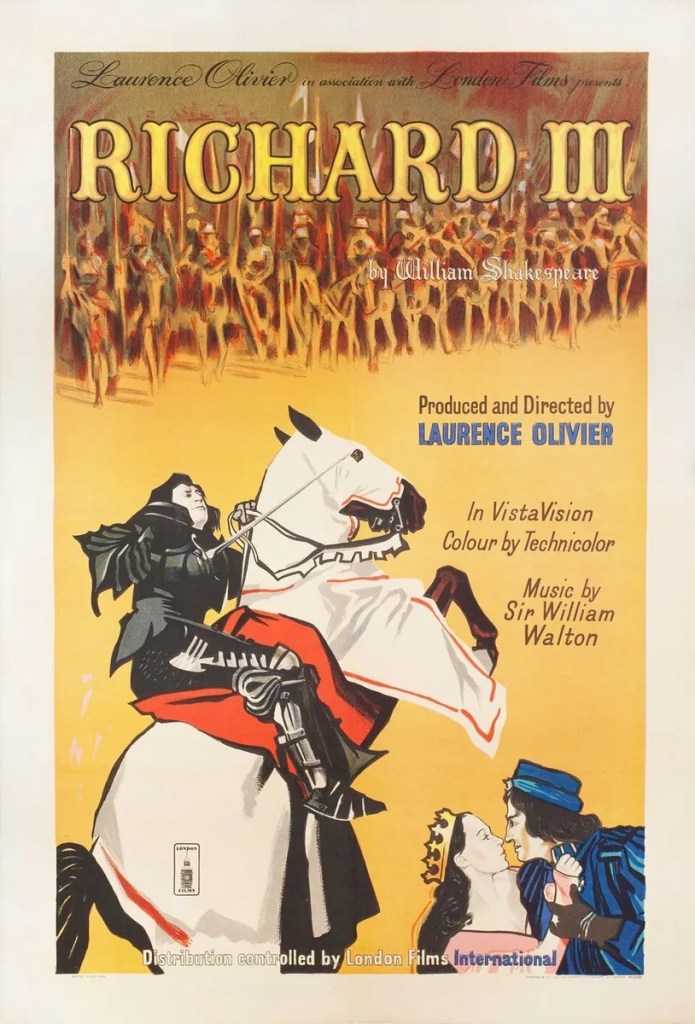
Richard III (1955)

Richard III (1955)

Olivier stamps his claim to Shakespeare’s greatest villain in this gorgeous theatrical epic

Director: Laurence Olivier

Cast: Laurence Olivier (Richard III), Cedric Hardwicke (Edward IV), John Gielgud (Clarence), Ralph Richardson (Buckingham), Claire Bloom (Lady Anne), Helen Haye (Duchess of York), Pamela Brown (Mistress Shore), Alec Clunes (Lord Hastings), Laurence Naismith (Lord Stanley), Norman Wooland (Catesby), Clive Morton (Lord Rivers), Douglas Wilmer (Dorset), Stanley Baker (Richmond), Mary Kerridge (Queen Elizabeth), Esmond Knight (Ratcliffe), John Laurie (Lovell), Patrick Troughton (Sir James Tyrell), Michael Gough (Murderer)

Olivier had played the greatest Shakespeare hero in Henry V and made Hamlet the most romantic princes of film. Having scaled those heights, did he also want to set the benchmark for Shakespearean villainy? Perhaps, with his vaulting ambition and competitiveness, he knew his clipped, precise tones and physical suppleness was perhaps best suited to playing the villain. What better role to prove it than the “poisonous, bunch-backed toad” himself, Richard III. Olivier bought to the screen a performance that would be as influential as his Hamlet (perhaps even more so), an embodiment of the role that all future Richards would be compared to.

I like to think of Richard IIII as a twisted inversion of Henry V. Like that film, the action is shot in lusciously beautiful technicolour, with beautiful costumes and a marvellously stirring, magnetic score by William Walton. It has courtly intrigues, a charismatic lead, the seduction of a young princess, many of the same actors and caps itself in a bravura battle shot on location. The only difference being that, instead of “the mirror of all Christian kings”, our lead is a twisted, remorseless killer who acts as his own Chorus to bring us on-side with his Machiavellian schemes. (There is a fun little opening message, stressing that this is a legend not the truth, that almost feels like an apology in advance to the Ricardian societies of today).

Olivier’s performance is the heart and soul of this film, and it’s possibly his finest cinematic (and certainly his finest screen Shakespeare) role. This Richard is openly – almost proudly – cruel and hypocritical, sociopathic in his amoral ease with the death and slaughter of his nearest and dearest (including his beloved wife, brother and nephews to whom he is sweetness and charm), overwhelmingly impressed with his own cunning and eagerly inviting us to share in his villainy. Olivier practically caresses the camera in his readiness to get close to us, forever turning towards it with a smile, quick aside or delighted breakdown of schemes to come. Olivier inverts his matinee idol looks into a stooped smugness (his costume, with its dangling sleeves, frequently makes him look like a spider) and his clipped vocal precision is dialled up to stress his heartless self-confidence.

Stare into Richard’s eyes and all we see is an uncaring blankness, the chill of a man who cares for nobody except himself. His sigil maybe a boar, but he resembles a wolf, devouring the Lords around him. Much of the first two thirds sees him keep a steady illusion of outward good fellowship. He comforts Gielgud’s Clarence with genuine care, greets Hastings like an old friend, is mortified and hurt by the suspicions cast on him by the Queen and her family, smiles with affection at his cousins. It means the moments where Olivier lets the mask slip even more shocking: the matter-of-fact abruptness he urges murderers not to take pity on Clarence, the whipped glare of pure loathing he shoots at the princes after an ill-advised joke about his hunched back or the imperious hand he shoots at Buckingham to kiss after being acclaimed by the crowds, harshly establishing the hierarchical nature of their ‘friendship’.

While the charisma of course is natural to a performer as magnetically assuring as Olivier – and this Richard is truly, outrageously, wicked in his charm – he also nails the moments of weakness. Having achieved the crown, Olivier allows not a moment of enjoyment of his feat, but his brow furrows into barely suppressed concern and anxiety that he may be removed by schemes exactly like his own. The threat of armies marching on him sees him first lose his temper publicly and then leap to cradle the throne in his arms like a possessive child. The morning of Bosworth, he even seems quietly shocked at the very idea that he could feel fear.

Richard III, despite its length, makes substantial cuts to the original play, including throwing in elements from Henry VI. Several characters – most notably Queen Margaret, whose major confrontation scene with Richard is lost altogether – are cut or removed all together. Olivier reshuffles the order of events, most notably shifting the arrest of Clarence to split up the seduction of Lady Anne. Richard’s late speech of remorse before the battle of Bosworth hits the cutting-room floor (Olivier’s Richard never seems like a man even remotely capable of being sorry for his deeds). Several small additions from the 18th century by Colley Cibber and David Garrick are kept in (most noticeably his whisper to his horse on the eve of battle that “Richard’s himself again”).

The film is deliberately shot with a sense of theatrical realism to it, Olivier favouring long takes so as to showcase the Shakespearean ease of the cast (much was made of the cast containing all four of the Great Theatrical Knights of the time in Olivier, Richardson, Gielgud and Hardwicke). The camera frequently roams and moves, most strikingly during the film’s first monologue from Olivier, where it flows from the coronation retinue outside the throne room, through a door, to find Richard himself waiting for us in the hall. It’s set is similarly theatrical, a sprawling interconnected building (with some very obvious painted backdrops) where the Palace of Westminster, the Tower of London and Westminster Abbey seem to be one massively interconnected building.

The film makes superb use of shadows, the camera frequently panning from our characters (especially Richard) to see their shadows stretch across floors and up walls. The claustrophobia of the interconnected set also helps here, making events seem incredibly telescoped (it feels like the film takes place in just a few days at most). It makes the court feel like a nightmare world completely under the control of Richard, who knows every corner to turn and can seemingly be in several different places at once. In that sense, filming Bosworth outside on location in Spain seems like a neat metaphor for Richard’s lack of control of events: suddenly he’s in a sprawling open field, where it’s possible to get lost and it takes genuine time to get from A to B.

Olivier may dominate the film with a performance of stunningly charismatic vileness, but he has assembled a superb cast. Ralph Richardson is superb as a supple, sly Buckingham, a medieval spin doctor whose ambitious amorality only goes so far. While I find Gielgud’s delivery of Clarence’s dream speech a little too poetic, there are strong performances from reliable players like Laurence Naismith’s uncomfortable Stanley and Norman Wooland’s arrogant Catesby while Stanley Baker makes a highly effective debut as a matinee idol Richmond. Claire Bloom superbly plays both Lady Anne’s fragility but also a dark sexual attraction she barely understands for this monster. Perhaps most striking though is Pamela Brown’s wordless performance as Mistress Shore (mistress first to Edward IV then Hastings), a character referred to in the play but here turned into a sultry, seductive figure who moves as easily (and untraceably) around the locations as Richard does.

Fittingly for a film obsessed with the quest for power, we return again and again to the image of the crown. It fills the first real shot of the film, bookmarking its beginning and end and frequently returns to fill the frame at key moments. With the films gorgeous cinematography, it’s a tour-de-force for its director-star and a strikingly influential landmark in ‘traditional’ Shakespeare film-making.

Cleopatra (1934)

Cleopatra (1934)

DeMille’s blockbuster is a fun, camp spectacle with plenty of his suggested sex and naughtiness

Director: Cecil B DeMille

Cast: Claudette Colbert (Cleopatra), Warren William (Julius Caesar), Henry Wilcoxon (Marc Anthony), Joseph Schildkraut (King Herod), Ian Keith (Octavian), Gertrude Michael (Calpurnia), C Aubrey Smith (Enobarbus), Irving Pichel (Apollodorus), Arthur Hohl (Brutus), Edwin Maxwell (Casca), Ian Maclaren (Cassius), Eleanor Phelps (Charmion), Leonard Mudie (Pothinos)

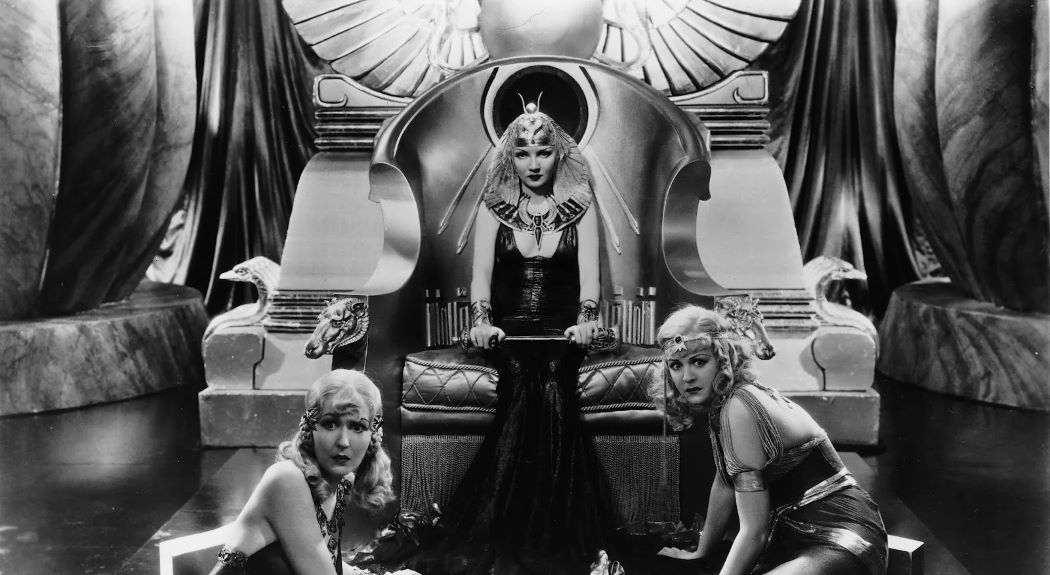
When a sand-and-sandals epic opens with a not-particularly-disguised naked woman cavorting erotically with incense, you know you are in Cecil B DeMille territory. Thirty years before the ill-fated Taylor-Burton epic, DeMille’s Cleopatra was the box-office hit of 1934. It was also a stompingly silly film, crammed with hammy performances and sexual imagery which it got-away-with in those pre-code days because it was an important historical subject taking place on humongous sets. But Cleopatra is also extremely good fun, a film so camply delighted in its naughtiness (and bowling along with such pantomimic energy) that it knocks spots off the turgid 1963 flop.

This Cleopatra follows pretty much the same structure (literally in half the time). Cleopatra (Claudette Colbert) is at war with her brother for the throne of Egypt. Smuggled into the presence of Julius Caesar (Warren William) wrapped in a carpet, she reveals the evil machinations of her rival Pothinus (Leonard Muddie) and seduces Caesar (possibly more with the prospect of controlling Egypt, since this Caesar is a power-mad cold-fish). When Caesar is dispatched by conspirators during the Ides of March, Cleopatra’s focuses on man’s-man Marc Anthony (Henry Wilcoxon) who is very open to her seduction. Before they know it though, the two are at war with envious technocrat Octavian (Ian Keith) who marches all of Rome to Cairo to crush the two. Bring on the asps!

DeMille shoots all this with relentless energy and pace, though not quite enough that you don’t notice the dialogue clunking out of the actor’s mouths (“You and your Friends, Romans, Countrymen…” a bitter Octavius observes about Anthony’s funeral oration). Cleopatra, like many of the Great Showman’s finest films (of which this is unquestionably one) gives us all the sex and smut we could possibly want, disguised in its classic setting. Cleopatra absolutely drips in lust and is crammed with suggestive imagery from top to bottom.

From that cavorting incense-carrier, we cut to the rooms Cleopatra has been kidnapped from. These look like nothing less than the aftermath of a kinky orgy, including a hog-tied servant who looks like he’s passed out in an asphyxiation sex-game. Colbert models a series of deep-dive dresses that leave little to the imagination. Poor, randy Marc Anthony doesn’t stand a chance (we know he’s a hot-blooded man because he never goes anywhere without his two barking greyhounds). Cleopatra even dresses at time like some musicals starlet, trailing billowing fabric behind her as she descends stairs.

Meeting her on her pleasure barge (this ship is practically Tardis-like in its interior dimensions) he’s treated to the sort of show that wouldn’t be out of place in Amsterdam’s Red-Light district. Scantily-clad ladies cavort, dancers dressed in skin-tight leopard skin are marshalled by a whip-carrying ring-master, while they cavort and engage in (literal) cat-fights until broken up by a crack of the whip. All the time Cleopatra reclines on a silk-covered bed, Colbert’s eyes flashing unmistakable “come hither” glances. No wonder the randy sod quickly finds himself going all-in on Egypt.

Along with sex, the film mixes in plenty of action. Caesar’s assassin is rather imaginatively filmed through a POV shot (“You? You too Brutus?!” Warren William intones in despair), as daggers fly in. The forthcoming battles are teased in an early scene where Caesar, bored with an Egyptian delegation, fiddles with various models of siege engines. All of these come into play in the film’s later sequences, that sees a parade of fast-cut war scenes overlaid: siege engines fire, armies plough at each other over deserts, ships clash at sea, men drown in agony. Much like the epic scale of Cleopatra’s court and barge, the film doesn’t skip on the epic conflict.

Between these two tent poles, we basically get a soap dressed to-the-nines in sandals, short skirts and armour. Claudette Colbert in a banner year (this was one of three hits she had, and she won the Oscar for It Happened One Night) is sultry, playful and if she never feels for even-one-minute like a figure from antiquity, at least she has that in common with the rest of the cast. She gives Cleopatra a charismatic energy that makes her believable as a figure round whom all else revolves. Wilcoxon plays Anthony with a thigh-slapping, hail-fellow-well-met quality. Warren William underplays as Caesar – which can make him look dull in a film as overblown as this – but makes for an effectively cold and calculating man.

Egypt, in its voluptuous naughtiness makes all Rome look rather dull though. Our capital is introduced in a house-party where the conspirators pose and moan like hammy matinee performers, stroking their historically incorrect beards, while the ladies bitch like New York housewives gleefully spreading catty gossip. Octavian is re-imagined as whining middle-manager, a weasily Ian Keith constantly moaning about never getting enough attention and clearly far-too inhuman to ever be stirred by Cleopatra the way the lusty Anthony is. With the frame of the film being classic antiquity, we can even pretend this is somehow serious drama when really it’s just Dallas.

These actors march their way through a series of break-ups and get-togethers, punctuated by moments of silly drama. (Cleopatra, Hamlet-like, even stabs Porthinus through a curtain seconds before he can assassinate Caesar!) But it all kind of works because you suspect nothing is really taken that seriously. DeMille is making a big pageant here, a walloping epic of lusty suggestion, powered by larger-than-life performances. It’s meant to fill you with excitement and awe, to make you gasp in awe. It doesn’t really matter that we get a shit-stirring King Herod (a smirking Joseph Schildkraut) or an Enobarbus who puffs like a regimental sergeant-major (C Aubrey Smith, giant of beard). It’s all about the spectacle, the drama and showmanship. And no one really does that sort of stuff better than Cecil B DeMille.

War and Peace (1956)

War and Peace (1956)

Tolstoy is boiled down in this epic and luscious but soapy adaptation of the greatest novel ever

Director: King Vidor

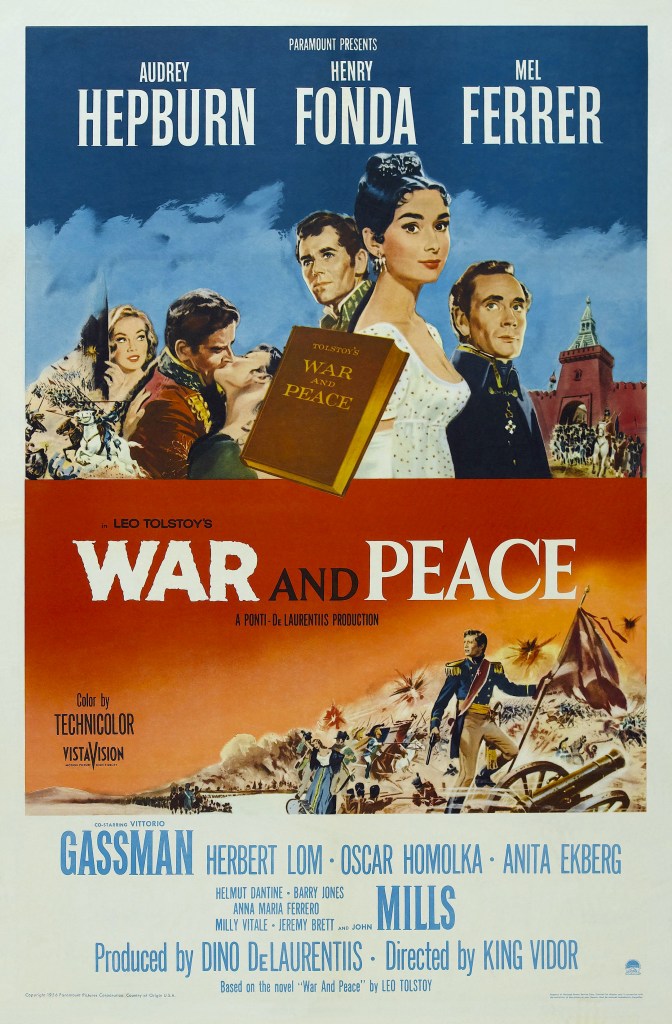
Cast: Audrey Hepburn (Natasha Rostova), Henry Fonda (Pierre Bezukhov), Mel Ferrer (Andrei Bolkonsky), Vittorio Gassman (Anatole Kuragin), Herbert Lom (Napoleon Bonaparte), Oskar Homolka (Field Marshal Mikhail Kutuzov), John Mills (Platanov), Anita Ekberg (Hélène Kuragina), Helmut Dantine (Fedor Dolokhov), Tulio Carminati (Vasily Kuragin), Barry Jones (Mikhail Rostov), Milly Vitale (Lisa Bolkonskaya), Lea Seidl (Natalya Rostova), Anna Maria Ferrero (Mary Bolkonskaya), Wilfrid Lawson (Nikolai Bolkonsky), May Britt (Sonya Rostova), Jeremy Brett (Nicholas Rostov)

Let’s just say it right from the start: you can’t do Tolstoy’s War and Peace in three hours. All you can hope for is the little chunk of it you’ve bitten on is the most succulent part. King Vidor’s War and Peace zeroes in on the elements of the book Hollywood is most comfortably reproducing: a golden-tinged romance between Natasha and Pierre and the sweeping epic spectacle of Napoleon’s soldiers surging towards Moscow and limping home in the snow. While War and Peace, bravely, barely cuts a single major character or development, almost every other theme Tolstoy attempted gets shoved to the margins. This makes it both a SparkNotes version of the Greatest-Novel-Written, but also a very earnest attempt to do the impossible.

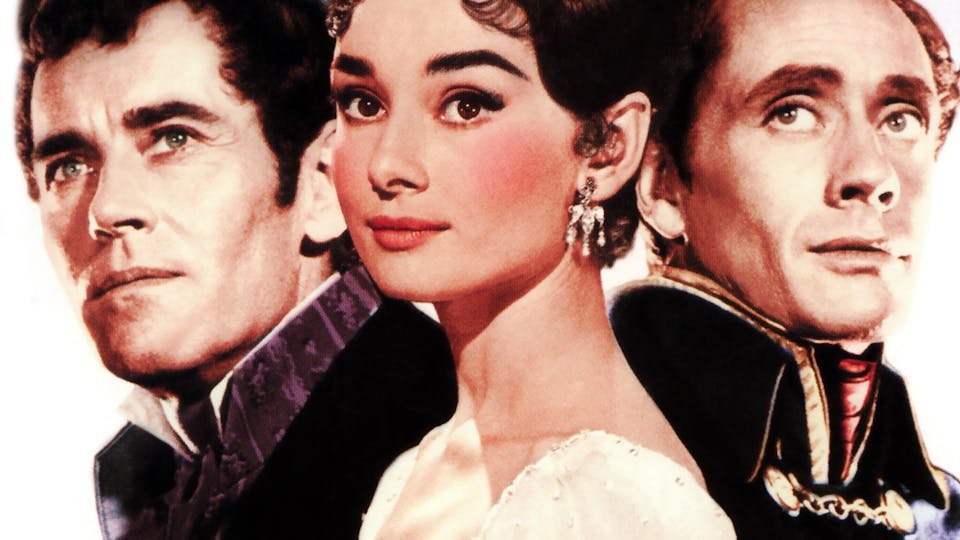
Tolstoy’s story stretched over seven years. The great Russian struggle against Napoleon is a backdrop to the lives of dilettante-turned-thinker Pierre Bezukhov (Henry Fonda), vivacious and impulsive Natasha Rostov (Audrey Hepburn) and stolid-but-thoughtful Andrei Bolkonsky (Mel Ferrer). Around them swirl other characters: Natasha’s warm-but-useless family, worthless womaniser Kuragin (Vittorio Gassman), his sister and Pierre’s faithless wife Hélène (Anita Ekberg), heartless roister Dolokhov (Helmut Dantine) and of course Napoleon (Herbert Lom) and his military antagonist, the pragmatic Kutuzov (Oscar Homoloka). Natasha falls in love with Andrei, betrays him then finds maturity caring for soldiers retreating from Napoleon, all while silently loved by Pierre.

This is compressed together into a film that certainly doesn’t feel like it is covering seven years despite its epic run-time. No one seems to age (just as well since everyone starts the film far too old) and the attempt to cover as much of the plot as possible means the film is moving forward so swiftly any sense of time is lost. It also means that the script frequently has to fill in the dots, communicating vital information that alters the lives of characters – major figures often die or are married off in short, easy-to-miss, sentences – and the ideas Tolstoy masterfully expounded about spirituality, destiny, fate, the quest for a life of meaning, are pretty much rinsed out in the plot focus.

War and Peace effectively reduces Tolstoy down into a sudsy romance against an epic backdrop. The romance is handled reasonably well, even if there is very little chemistry of any sort between any of the three protagnonists. Tolstoy’s rich leads, with the fascinating inner lives, are reduced to pen-portraits. There are odd moments where we have access to the inner thoughts and voices – sprinklings of voiceover dot around the picture – but they never feel real. Andrei has been robbed of the decency and warmth behind his thoughtfulness that attracts Natasha, while Pierre feels more like a second father or benevolent uncle than a soul mate.

This stripping down of Tolstoy’s complex characters to their bare principles fatally compromises all three lead performances. Hepburn comes off best, making a decent fist of Natasha Rostov. This is, after all, a character who embodies in her mix of passion, loyalty, fecklessness and self-sacrifice the very nature of Russia itself. No adaptation has ever managed to translate Tolstoy’s unplayable creation, but Hepburn has all the radiance and self-sacrificial guilt down pat. The film has to rush through her foiled elopement with Kuragin (Hepburn has more chemistry with Gassman than any of the others and their near elopement is artfully framed by Vidor with mirrors, reflections and a real illicit charge). Hepburn conveys the mesmeric impact this playboy has on Natasha and her selfish, tear-stained fury at the foiling of her disgraceful plans is laced with enough genuine guilt and pain by Hepburn to keep us caring. Hepburn skilfully translates this into a far wiser and more generous Natasha, placing others needs before her own.

By contrast, literally nobody reading the novel could picture Henry Fonda as Pierre (he’s the wrong age, shape, manner – there is nothing right about him at all), but Fonda does his best (as one reviewer at the time mentioned he’s one of the few actors who looks like he has read the book). He never convinces as the drunken playboy who gets into duels (he looks and sounds far too mature) and similarly doesn’t capture any of Pierre’s doubt and uncertainty (Fonda always looks like he knows exactly what he needs to do). It’s an intelligent reading for all that, but fundamentally miscast. Which is more than you can say about Mel Ferrer who turns Andrei into a stuff bore, ramrod straight and flatly monotone, an intellectual we never get interested in.

Honestly the film would have done better cutting more. Fonda is so unconvincing as the reckless young Pierre, they may as well have made him officially middle-aged to begin with. Similarly, Natasha’s brother Nicholas and his one-sided romance with cousin Sonya is given a mention so token its likely to confuse casual viewers. Andrei’s first marriage gets about five minutes and his sister Mary is reduced to a few dull scenes. Even John Mills’ thoughtful performance as Platanov strips out the characters worldview (and its profound impact on Pierre), turning it into one of simple, symbolic tragedy. It’s all the more noticeable when the film gets some stuff right, most notably Helmut Dantine’s bullying Dolokhov who war turns into someone with a sense of shame.

Faring much better are the historical characters. Like all War and Peace adaptations, this dials up the presence of Napoleon played with an excellent puffed-up grandeur by Herbert Lom, prowling with a swagger stick and collapsing into childish frustration, then silent tears as his plans for world domination collapse. Equally stand-out is Oscar Homoloka as scruffy realist Kutuzov.

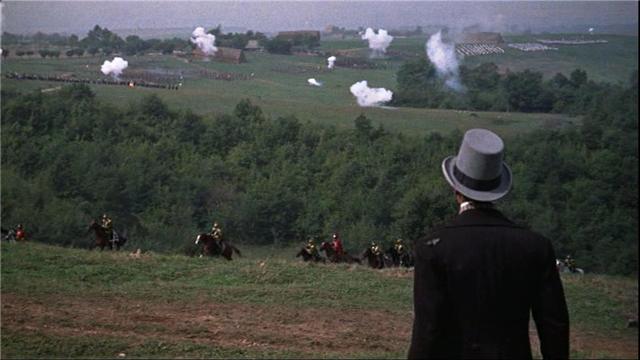
Vidor’s film may offer a simplified, romantic vision of the characters but he delivers on the scale. If you can bemoan the fact the peace leaves the characters neutered, the film completely nails the war.  War and Peace is a beautifully filmed by Jack Cardiff. From the sweeping vistas of the battlefield of Borodino, to the Dante-tinged flames at Moscow that cast orange light through the arches of a monastery where the Rostov’s take shelter, through the white-and-blue chill of the snow-covered retreat from Moscow, the film is an explosion of gorgeous colours. It’s also got the scale that old Hollywood loved. Borodino is restaged seemingly at 1:1 scale with a literal army of extras, soldiers and cavalry charging in their hundreds in long-shot and cannon fire peppering the land as far as the eye can see. Ballrooms are overflowing with extravagantly costumed extras and seemingly never-ending lines of Frenchmen march through the snow in the films closing moments.

It’s what this War and Peace is: a coffee-table accompaniment to the novel. You can look at the images it brings to life and the sweeping camera work Vidor uses to create nineteenth century Russia. But you’ll not understand anything that makes the novel great. In fact, to the uninitiated, you are likely to come away thinking the film must be a sort of high-brow Mills-and-Boon page-turner, a Gone with the Snow. What this tells us, more than anything, is that fifteen years on from the definitive Hollywood epic, Hollywood was still trying to remake it – and bringing Tolstoy to the screen was very much second to that.

Hamlet (1964)

Hamlet (1964)

Kozintsev’s masterful version of Hamlet is one of the greatest Shakespeare films ever made

Director: Grigori Kozintsev

Cast: Innokenty Smoktunovsky (Hamlet), Mikhail Nazvanov (Claudius), Elza Radziņa (Gertrude), Yuri Tolubeyev (Polonius), Stepan Oleksenko (Laertes), Anastasiya Vertinskaya (Ophelia), Vladimir Erenberg (Horatio), Igor Dmitriev (Rosencrantz), Vadim Medvedev (Guildenstern), Aadu Krevald (Fortinbras)

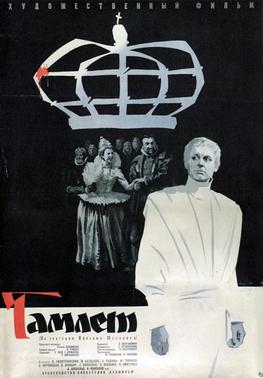
One of the main reasons Shakespeare remains timeless is that he can be shifted and adjusted through any society or perception and new riches will be discovered in his work. That’s why the, perhaps, greatest film version of Hamlet doesn’t even have an actual word of Shakespeare in it: Grigori Kozintsev’s epic, paranoia-tinged Hamlet with the dialogue translated into robust, poetic Russian by Boris Pasternak, takes huge liberties with the text but creates a richer, commanding and, above all, cinematic version of Elsinore than almost any other version yet made.

Kozintsev was a leading Russian theatre director who had written extensively on Shakespeare. He bought to his film both a brilliantly cinematic eye but also a comprehensive understanding of the play. Kozintsev’s Hamlet is filtered through Stalinist Russia. Where other Hamlets of the era focused on Freudian themes and the poet Prince, his Hamlet would be starkly, strikingly political.

Here Elisinore is a place devoid of privacy, where every word is overheard and every action watched. It’s controlled by Claudius as an eminence grise turned king, a smooth and assured political player who understands the machinations of power and the importance of appearance. Koznitsev’s rearranges Claudius opening speech into three discrete chunks. The first sees a herald reading out Claudius’ announcement of his wedding and the new regime to a crowded courtyard of peasants. We then cut to crowded room of Ambassadors of various European powers roaming, where we hear snippets of conversation each delivering a separate line from Claudius’ oration. Finally, the conclusion of the speech, and his plans for Fortinbras, is delivered by the king himself to a room of nodding courtiers. That’s imaginative cinematic translation of Shakespeare right there.

This is a Hamlet that lives and breathes the fear of living in an oppressive regime, under the thumb of a smiling autocrat. Mikhail Nazvanov’s Claudius charms but has a resolute, ruthless coldness behind his eyes. The court is drenched in paintings of the great leader – including one grand armoured horseback painting that looks like a Claudius head has been swiftly painted over his brother’s. Claudius controls all privacy in the castle: Koznitsev fills the film with shots of closing doors, lowered portcullises and a constant stream of background observers for every conversation. Only Claudius can gain solitude – tellingly he is the only character who speaks his soliloquy out loud, because he is the only character who knows for sure his words are for his ears alone.

This Elsinore is a castle where knowing too much is dangerous and the threat of being wrapped up in the wrong side of a purge is a very real one. Laertes’ aborted rebellion may see him forgiven – but the citizens who follow him to charge into the castle are escorted way, hands bound, never to be seen again. Claudius’ soldiers are increasingly visible presence in every doorway and corridor. When Hamlet unsettles the King with the Player’s performance, the courtiers practically fly away from the would-be dissident, as if worried that even the faintest contact could infect them with the same danger of exile and death that Hamlet is flirting with.

In this authoritarian production, our Hamlet is not the poet prince that so many Western productions at the time presented him as. Instead, portrayed with a chilling intensity by Innokenty Smoktunovsky, Hamlet is a dangerous man, filled to the brim with suspicion and resentment, who trusts nothing and confides to no-one. Rarely alone in this crowded Elsinore, he strikes a lonely figure, who finds isolation only on the cliffs staring out to the sea. His soliloquies are all internal voiceover monologues – less due to their internalised nature, and more that you feel he cannot risk speaking his feelings out loud (an impression created by his voiceover of his “Too, too solid flesh” speech delivered while Smoktunovsky moves through a crowd of courtiers).

Hamlet’s destructive bitterness is sparked by the Ghost. Cutting the first scene, Koznitsev introduces Hamlet and us to the Ghost at the same time. Unlike the smooth, ornately collared Claudius, the Ghost is an armour-clad rigid behemoth, his face almost completely obscured by his helmet. (There is a brief shot of his eyes which I would have removed – better that it had been kept completely distant from us). The camerawork stresses both its deliberation and size while Dmitri Shostakovich masterful score helps to build its sense of power and might (so effectively, that only a reprise of its theme is enough to suggest its reappearance to Hamlet later). It is a terrifying, other-wordly figure.

Smoktunovsky’s Hamlet barely ever raises his voice but has the intense determination of a man of natural action. Koznitsev has removed virtually every line that dabbles in doubt, uncertainty or hints even vaguely at delay. Smoktunovsky is merely biding his time for his chance at taking a hit at Claudius – a chance that will rarely come, in a court crowded with military protection for the King. He never forgives and even the slightest delay rouses him to anger rather than self-analysis. Koznitsev has trimmed out most of his lines with Horatio, who becomes an almost silent, scholarly observer and makes Smoktunovsky even more of a distant figure, liable to break out into dangerous violence at any moment, with no regard for the consequences.

The most visible of those consequences is Ophelia, who Smoktunovsky’s Hamlet uses coldly as a tool for probing the weaknesses of his enemies. Portrayed with a touching vulnerability by Anastasiya Vertinskaya, Ophelia is likewise never alone, unable to escape a crowd of duennas, who train her in dancing like a clockwork toy. Polonius (here an arch and scruple free political fixer, played by Yuri Tolubeyev) shows almost no interest in her at all, bluntly dismissing her and her distress when his need for her is done. After his death, she is literally locked into a metallic corset by her maids and covered by a gauzy funeral dress – even her clothes are cages. Her madness scene inevitably takes place in a room full of soldiers: even at the end she cannot escape the eyes of strangers.

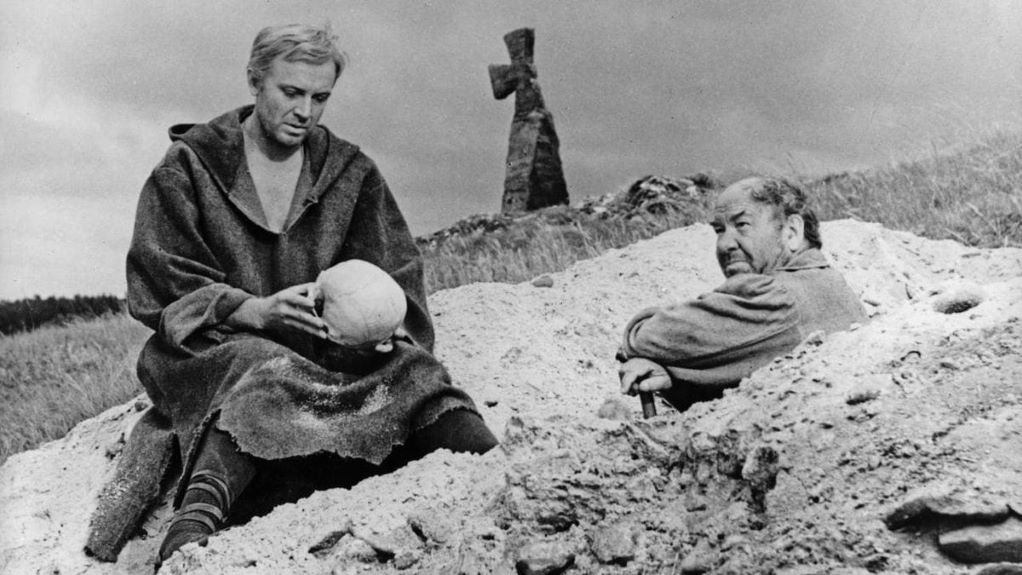
In the cold, Bergmanesque quality of Koznitsev’s film (the players, in particular, look like they have rolled in from The Virgin Spring), the stoney castle on the cliff (despite its renaissance, wood-lined interiors) is an imposing, terrible place. After the death of Polonius, Hamlet is dragged into (essentially) a show-trial (including a stenographer) before being dispatched to England. Rosencranzt and Guildernstern are empty-headed, ambitious minor officials who Hamlet displays not a moment’s hesitation in dispatching to their deaths. The only moment of reflection Smoktunovsky affords Hamlet is over Yorick’s skull – and even then, the cut suggests his focus is on the lost opportunities of great men. Certainly, Smoktunovsky’s grief over Ophelia is as much motivated by Laertes’ ostentatious show of public grief as sadness (and certainly not guilt, which he lacks entirely).

Koznitsev’s supremely visual film, beautifully designed and shot, reorders and reworks the text to maximum effect to continuously stress Hamlet’s highly political nature. It does mean characters like Gertrude fade into the background, but it repositions Elsinore highly effectively as a dangerous, ruthless place where life can be cheap. Like Stalinist Russia, the wrong word can condemn you and even our hero is as much a potential dictator as our villain. Hamlet is the most imaginative, revelatory and intelligently distinctive reading of the play on film, a production that interprets the play rather than just presenting it. It is a masterclass in adapting the Bard for the screen.

Watch the film here!

1900 (1976)

1900 (1976)

Bertolucci’s bloated, self-indulgent and simplistic film is a complete mess

Director: Bernardo Bertolucci

Cast: Robert De Niro (Alfredo Berlinghieri), Gerard Depardieu (Olmo Dalco), Dominique Sanda (Ada Fiastri Paulhan), Donald Sutherland (Attila Mellanchini), Laura Betti (Regina), Burt Lancaster (Alfredo Berlinghieri the Elder), Stefania Sandrelli (Anita Foschi), Werner Bruhns (Ottavio Berlinghieri), Stefania Casini (Neve), Sterling Hayden (Leo Dalco), Francesca Bertini (Sister Desolato), Anna Henkel (Anita the Younger), Ellen Schwiers (Amelia), Alida Valli (Signora Pappi)

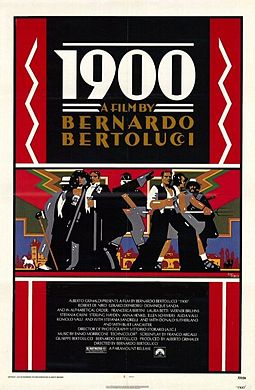
After The Conformist and Last Tango in Paradise, Bertolucci could do anything he wanted. Unfortunately, he did. Perhaps the saddest thing about 1900 is that you could watch The Conformist twice with a decent break in-between during the time it would take you to watch it– and get a much richer handle on everything 1900 tries to do. Bertolucci went through a struggle to get his 315-minute cut released: perhaps the best thing that could have happened would have been if he had lost. Not only would the film be shorter, but it would be remembered as a lost masterpiece ruined by producers, rather than the interminable, self-indulgent mess we ended up with.

1900 – or Twentieth Century to literally translate its title Novecento – follows the lives of two very different men. Born minutes apart in 1901, Alfredo (Robert De Niro) is the grandson of the lord of the manor (Burt Lancaster), while Olmo (Gerard Depardieu) is the grandson of Leo (Sterling Hayden), scion of a sprawling dynasty of peasants. They grow up as friends, Olmo becomes a socialist and Alfredo an indolent landlord and absent-minded collaborator with the fascists, embodied by his psychopathic land agent Attila (Donald Sutherland). Their small community becomes a symbol of the wider battle between left and right in Italy.

In many ways 1900 is an epic only because it is extremely long and beautifully shot in the Bologna countryside by Vittorio Storaro. In almost every sense it fails. It offers nominal scale in its timeline, but its attempt to become a sweeping metaphor for Italy in the twentieth century falls flat and it focuses on a small community of simple characters, many of whom are ciphers rather than people. All of Bertolocci’s communist sympathies come rushing to the fore in a film striking for its political simplicity. It never convinces in its attempt to capture in microcosm the forces that divided Italy between the two world wars, nor invests any of its characters with an epic sense of universality.

Instead Bertolucci presents a world of obvious questions and easy answers. Every worker is an honest, noble salt-of-the-earth type, working together in perfect harmony to fight for rights. Every single upper-class character is an arrogant, selfish layabout, caring only about their back-pockets and the easy life. Bertolucci suggests fascism only arose in Italy as a means for the rich to control the poor, and never allows for one moment the possibility that any working-class person was ever tempted to take their side. It never rings true. (Bertolucci skips a huge chunk of the fascist 30s and 40s, possibly because this fantasy would be impossible to sustain if he actually focused on the history of that era.)

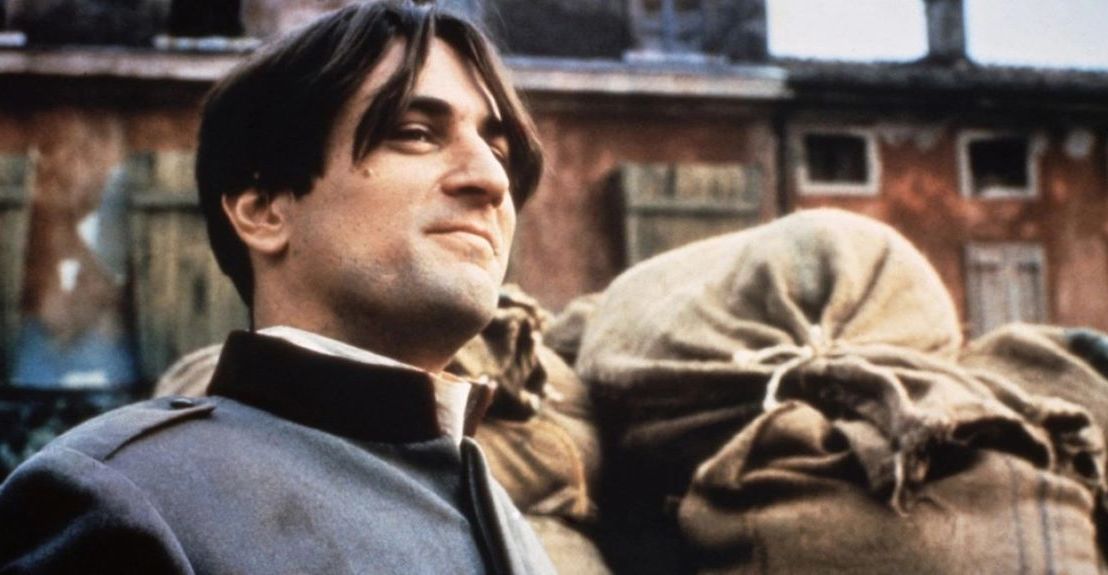
Bertolucci uses his two protagonists to make painfully on-the-nose comparisons between working class and rich with De Niro’s weak-willed Alfredo always found wanting compared to Depardieu’s Olmo. Even as children, Olmo is braver, stronger and smarter. Olmo has the guts to lie under the moving trains (Alfredo runs), Olmo stands up for what he believes in (Alfredo looks away), Olmo puts others first Alfredo whines about his own needs. Hell, Olmo even has a bigger cock than Alfredo (something they discover comparing penises as children and re-enforced when as young men they share an epileptic prostitute and she ‘tests’ them both).

The upper classes hold all the power but can do nothing without the working class. During the 1910s, a strike by the workers on the Berlinghieri leaves the clueless rich unable to even milk their moaning cows (they buy milk instead). Sterling Hayden’s peasant patriarch is a manly inspiration to all, while Lancaster’s increasingly shambling noble is literally and metaphorically impotent (Lancaster’s role is like a crude commentary on his subtle work in The Leopard). At one point he even pads around barefoot in horseshit to hammer home his corruption. (Incidentally this is the only film where you’ll ever see a horse’s anus being massaged on camera to produce fresh shit to be thrown at a fascist.)

For the rich, fascism is the answer. Continuing to shoot fish in a barrel, Bertolucci scores more easy hits by presenting our prominent fascist as an out-and-out psychopath. Played with a scary relish by Sutherland – in the film’s most compelling performance – no act of degradation is too far for Attila. Along with his demonic partner-in-crime Regina (a terrifyingly loathsome Laura Betti), he routinely carries out acts of violence, horrific murder and child-abuse, even literally headbutting a cat to death while ranting about the evils of socialism.

The poor meanwhile are all good socialists. Olmo, decently played by Depardieu, and his wife Anita (an affecting Stefania Sandrelli) rally the workers to stand against charging cavalry and protect their rights. Bertolucci even has Depardieu flat-out break the fourth wall for a closing speech, spouting simplistic platitudes direct to camera about the inherent wickedness of the landowner. Depardieu at least seems more comfortable than De Niro among this Euro-pudding (every actor comes from a different country and the soundtrack is a mismatch of accents and dubbing, not least Depardieu himself). Rarely has De Niro looked more uncomfortable than as the empty Alfredo, a role he fails to find any interest in, like the rest of the actors never making him feel like more than a device.

Bertolucci, stretching the run-time out, also embraces numerous tiresome excesses. Rarely does more than 20 minutes go by without a sex scene or a sight of someone’s breasts or sexual organs. From children comparing penises, to Depardieu performing oral sex on Sandrelli (just outside a socialist meeting), to De Niro and Depardieu getting hand-jobs from a prostitute, to Sanda dancing naked and high on cocaine or the revolting exploits of Attila and Regina, nothing is left to the imagination. As each goes on and on Bertolucci ends up feeling more like a naughty boy than an artist, so praised for his sexual licence in Last Tango that he feels more is always more. The excess doesn’t stop with sex either: at one point a worker silently cuts his ear off in front of a landowner to make a point about his stoic nobility.

1900 eventually feels like you’ve stumbled into a student debating club, where a privileged student drones on at great length about the evils of the rich, while quaffing another glass of champagne. It has moments of cinematic skill – some of its time jump transitions, in particular a train passing through a tunnel in one time and emerging at another, are masterful – but it’s all crushed under its self-indulgence. From its length to its sexual and violence excess, to its crude and simplistic politics delivered like a tedious lecture, everything is crushed by its never-ending self-importance.

Oppenheimer (2023)

Oppenheimer (2023)

Nolan’s masterful musing on the morality of science is both challenging and compelling

Director: Christopher Nolan

Cast: Cillian Murphy (J Robert Oppenheimer), Emily Blunt (Kitty Oppenheimer), Matt Damon (General Leslie Groves), Robert Downey Jnr (Lewis Strauss), Florence Pugh (Jean Tatlock), Josh Hartnett (Ernest Lawrence), Casey Affleck (Colonel Boris Pash), Rami Malek (David Hill), Kenneth Branagh (Niels Bohr), Benny Safdie (Edward Teller), Dane DeHaan (General Kenneth Nichols), Jason Clarke (Roger Robb), David Krumholtz (Isidor Issac Rabi), Tom Conti (Albert Einstein), Alden Ehrenreich (Strauss’ aide), Gary Oldman (President Truman), Jefferson Hall (Haakon Chevalier)

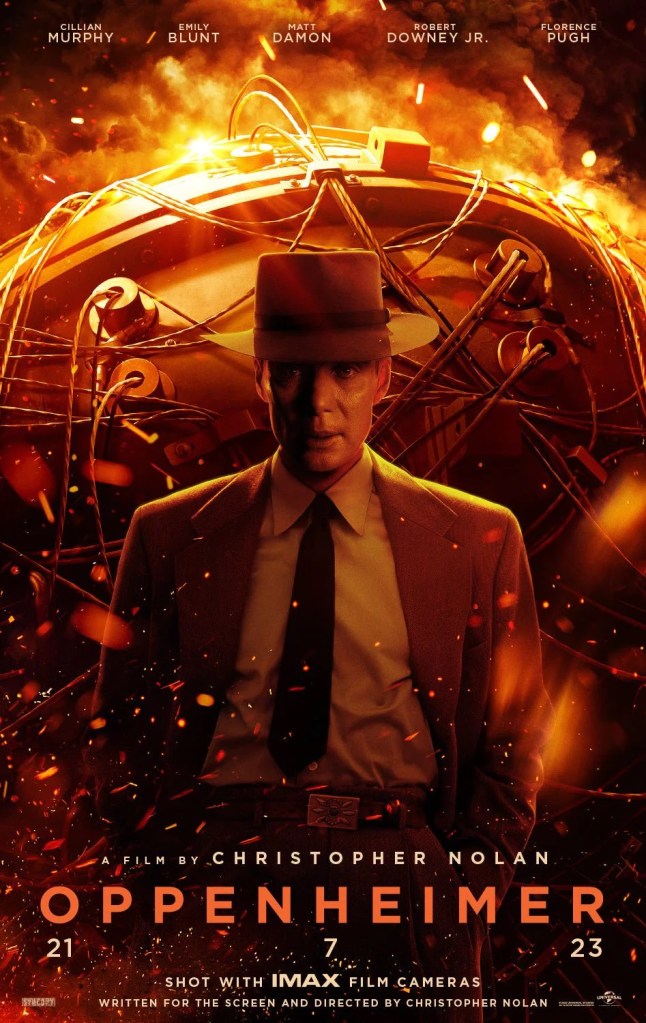
“I am become Death, the destroyer of worlds”. These words from The Baghavad Gita are synonymous with J Robert Oppenheimer, director of the Manhattan Project as he witnessed the destructive force of his creation, the atomic bomb. Fittingly, Nolan’s fascinating and ambitious film opens with a reference to Oppenheimer as Prometheus: the man punished for all time for stealing fire from the Gods. Oppenheimer uses everything from thriller to courtroom drama, to explore the moral responsibilities of science: if we can do a thing, does it follow that we must?

J Robert Oppenheimer (Cillian Murphy) is a Renaissance man and leading theoretical physicist who dabbled more than a little in left-wing politics. The woman he loves, Jean Tatlock (Florence Pugh), is a die-hard communist, the woman he marries Kitty (Emily Blunt) is a former party member, his closest friends are all members. Associations like these will later haunt him after he is approached by General Leslie Groves (Matt Damon) to use his organisational skills, political savvy and charisma to run the WW2 nuclear programme where maverick scientists work hand-in-hand with the army. Despite his position, Oppenheimer remains untrusted by many. In the aftermath of the war, these suspicions will be used by his opponents, among them Lewis Strauss (Robert Downey Jnr) ex-head of the Atomic Energy Committee, to bring about his downfall as Oppenheimer preaches disarmament.

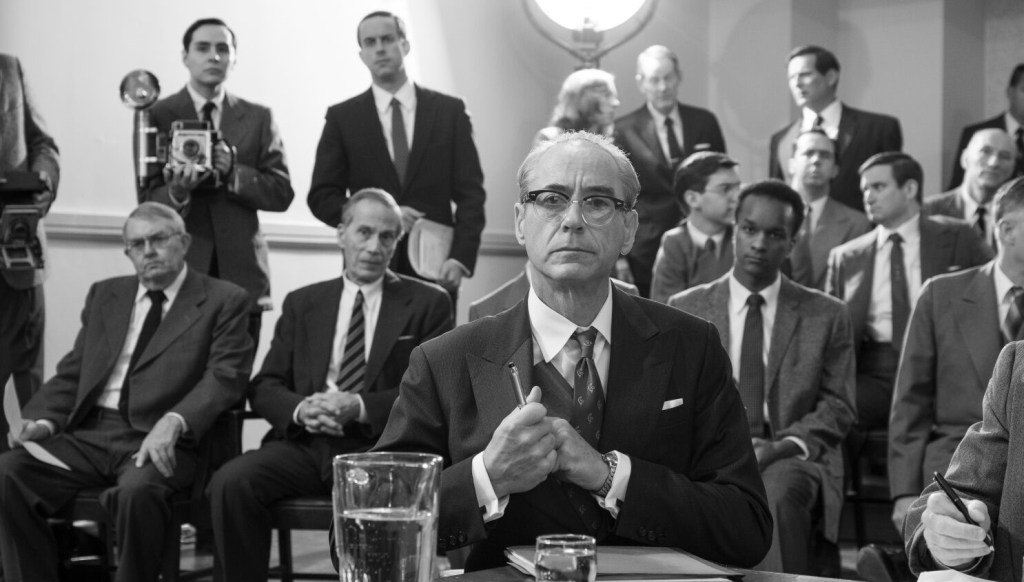
Much like Dunkirk, Oppenheimer is told in two timelines, intersecting with scenes replayed from different perspectives in subtly different ways. In “Fission” we see Oppenheimer, effectively on trial in 1954 for his security clearance, recount his life story, chronological flashbacks taking us through the development of the bomb. In “Fusion”, shot in gorgeous black and white, we follow the 1959 senate hearings to confirm Strauss in a cabinet post, and see his reminiscences of Oppenheimer’s post-war struggles to control the monster he has unleashed.

Oppenheimer is a brilliantly made, cinematically adventurous film: you would, of course, expect nothing less from a distinctive talent like Nolan. Brilliantly intercutting multiple timelines, it’s a film that is as much an experience as a story. This is a behemoth, filled with moments of flair and breath-taking use of sound and vision to affect mood. In particular, the film’s oppressive sound design bears down on the viewer like the pressure of the bomb itself. This means moments when we are released from its grip carry real impact. As Oppenheimer – already plagued with doubt – triumphantly announces the successful use of the bomb, the war-like celebratory pounding of scientists’ feet disappears from the soundtrack leaving Oppenheimer’s words echoing impotently around the room.

The pounding score and epic, sweeping camerawork (even more striking, since so much of the film takes place in small rooms filled with conversation) help Nolan to build up Oppenheimer’s mythic status and simultaneously strip him bare. Literally so at one point as, when questioned on his sex life in his hearing, Oppenheimer is seen naked in the room (as exposed as he must be feeling) answering questions with a naked Jean Tatlock astride him, staring into his wife’s eyes.

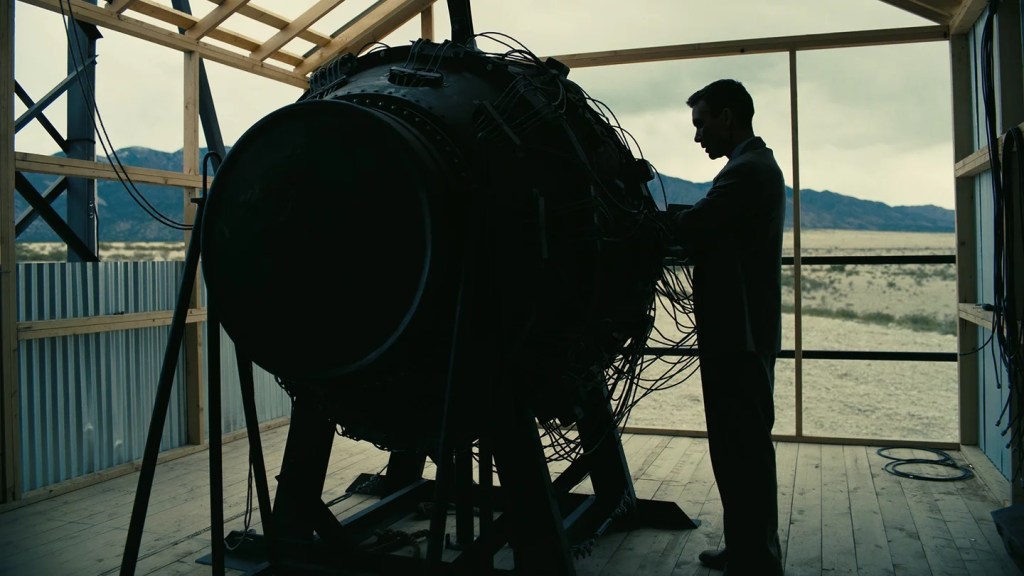
Oppenheimer labours, with the best intentions, to create a weapon before the Nazis. In its middle act, Nolan’s film focuses on the propulsive excitement of creation. The thrill of obstacles being overcome and solutions being found. The joy of a diverse team coming together for a single goal. We find ourselves longing for problems to be overcome, swept up in the desire for the endgame, as anxious as the scientists when it looks like rain will prevent the vital first Trinity test of the bomb.

Oppenheimer feels the same. Powerfully, intelligently and magnetically played by Cillian Murphy, this is a man who is a host of flaws crammed with impossible genius. A charismatic room leader, who is awkward in personal interactions. A charmer who rudely fails to remember his brother’s girlfriend’s name at a party. An inspiring leader who alienates people with ease. Murphy captures every inch of Oppenheimer’s staggering intellect and delight in intellectual problems, just as he also embodies the man’s arrogance and crushing self-belief.

So, it’s as crushing to him as it is terrifying to us, when the bomb explodes and the realisation hits us. Nolan’s sensory experience of a film fades down to silence as Nolan lets the camera float across the all-consuming fire of the silent explosion (the noise only comes when the shockwave hits) and suddenly the chilling implication of this terrible weapon becomes clear. This is a device that will kill millions. Oppenheimer knows it: he slowly shrivels into haunted guilt, Murphy seeming to shrink into himself as he finally understands what he has done.

Images of nuclear destruction both obvious (ashen bodies and nuclear flashes) and subtle (the out-of-focus vibration of background around Oppenheimer, as if sensing an approach shockwave) will haunt him and us for the rest of the movie. While many scientists – foremost among them Benny Safdie’s bull-headed Edward Teller and Josh Hartnett’s WASPish but decent Ernest Lawrence – feel little guilt. But Oppenheimer, and we, can no longer avoid questions of moral responsibility raised by those such as Niels Bohr (a quietly effective Kenneth Branagh).

Are there some discoveries better not made? Because once the genie is out of the bottle, it cannot be stuffed back in again. In this new world every world power must always have more. More bombs, bigger bombs, better bombs. And it explains why, like Prometheus, Oppenheimer must be punished. The tool of his punishment being his communist sympathies, embodied in his yearning attraction to Jean Tatlock (an under-used Florence Pugh). Nolan’s film is very strong on the terrifying paranoia of the secret state, where every word or association can be collected into a terrible portfolio of witnesses you cannot question, evidence you cannot see, testimony you cannot hear.

“Why don’t you fight” cries his wife Kitty, played with a dynamic, intelligent forcefulness by Emily Blunt. I could have done with a third act built more around Blunt’s starkly honest betrayal of a woman ill-suited to being a wife and mother, trapped in a world where that is all women can achieve (and which also trimmed a few witnesses from Oppenheimer’s trial). Why doesn’t Oppenheimer fight? Nolan has his theories, carefully seeded and confidently revealed.

Oppenheimer’s post-war clashes cover much of “Fusion”, anchored by a superbly under-playing Robert Downey Jnr (his finest work since Chaplin) as the outwardly avuncular, but inwardly insecure and bitter Strauss, who sees Oppenheimer as the embodiment of all the elitists who turned their noses up at him (no matter that Oppenheimer himself is an outsider, in a world of science run by WASPish types like Lawrence). Nolan’s film explores how morality is forgotten in an environment so rife with paranoia that the slightest expression of doubt is seen as treason.

Nolan’s film needs its vast runtime to keep as many balls in the air as it tries to. It’s probably a few too many balls. I would have loved more on Oppenheimer’s outsider status, as a Jew in American science (its not mentioned that the J stands for Julius, despite his claims it stands for nothing). Similarly, I would have welcomed more time to explore Oppenheimer’s complicated emotional life, in particular the fascinatingly complex relationship of some love, a fair amount of mutual respect and a large measure of mutual convenience with his wife Kitty.

But the film’s chilling musing on the horrors science can accidentally unleash while focused on progress is superbly explored and leaves a lasting impact. It’s a feeling that continues to be sharply relevant while we struggle with the implications of AI. Was there a need for the bomb? Perhaps there was. Were we ready for the bomb? No. And it is the failure of anyone, including Oppenheimer, to even consider this until it was too late that is the coldest warning in Nolan’s epic film.

The Three Musketeers (1973) / The Four Musketeers (1974)

The Three Musketeers (1973) / The Four Musketeers (1974)

A film of two halves, in more ways than one: the swashbuckling original and its dark sequel

Director: Richard Lester

Cast: Michael York (d’Artagnan), Oliver Reed (Athos), Frank Finlay (Porthos/O’Reilly), Richard Chamberlain (Aramis), Raquel Welch (Constance Bonacieux), Jean-Pierre Cassel (Louis XIII), Geraldine Chaplin (Anne of Austria), Charlton Heston (Cardinal Richelieu), Faye Dunaway (Milady de Winter), Christopher Lee (Count de Rochefort), Simon Ward (Duke of Buckingham), Spike Milligan (Bonacieux), Roy Kinnear (Planchet), Georges Wilson (Captain de Treville)

All for one and one for all! The Three Musketeers is probably the greatest adaptation of Dumas’ rollicking classic, a wonderful mix of swashbuckler, romance and Hellzapoppin comedy, that never takes itself particularly seriously and is crammed with actors having a whale of a time. It’s not quite a send-up, but it’s also not quite a straight re-telling either. Instead, it’s gunning all-out for entertainment – and it succeeds most of the time.

d’Artagnan (Michael York) arrives in Paris in 1625 desperate to join the musketeers. After various adventures along the way – including a rivalry with suavely villainious Rochefort (Christopher Lee) – the impulsive young man forms a friendship (after bumps in the road) with the famed musketeers Athos (Oliver Reed), Porthos (Frank Finlay) and Aramis (Richard Chamberlain). Falling in love with the unhappily married Constance (Raquel Welch), maid to Queen Anne (Geraldine Chaplin), d’Artagnan and his friends are dragged into foiling a plot by the ambitious Cardinal Richelieu (Charlton Heston) to use the ingenious Milady de Winter (Faye Dunaway) to expose the Queen’s infidelity with the Duke of Buckingham (Simon Ward). Will our heroes manage to foil the scheme in time?

The Three Musketeers adapts the first third or so – the most famous and by far the most enjoyable part – of Dumas’ novel. With an irreverent script by Flashman author George MacDonald Fraser, its framed as a rollicking romp with a tongue-in-cheek humour. Richard Lester, famed for his cheeky Beatles comedies (and the film was originally envisaged as a vehicle for the Fab Four), added his trademark scruffy, opportunistic comedy.

The film is awash with muttered asides – many of them well delivered by Roy Kinnear’s exasperated servant Planchet – that are only just picked up by the sound mix. My favourite? d’Artagnan bursting into a room full of guards, yanking a rug with a yell in an attempt to upend them, succeeding only in tearing the corner off it, then immediately jumping out of a window, leaving the bemused guards one of whom plaintively mutters “He’s torn our carpet” – I find this funny on multiple levels, from York’s all-in energy to the stillness of the shot, to the underplayed sadness of the punchline.

Lester’s film is full of long-shot gags – passengers in litters being dropped in a lake, d’Artagnan swinging on a rope to knock someone off a horse, missing and falling in the mud or his jump from a third storey window only to immediately reappear having landed on a (anachronistic) window cleaner cart. While the film does have its moments of drama, danger and intensity, it doesn’t ease up on visual humour, or gags (“This ticket is for one man” “I am one man. This is a servant”). It’s all part of Lester’s plan to make a fast-paced, pantomimic entertainment in which nothing is intended to ever be too serious.

It’s all played with maximum commitment by the cast, all of whom buy into the films’ tone. Michael York leaves very little in the locker-room with a performance full of youthful bravado, lusty hurrahs and naïve, winning eagerness. It’s a very hard balance to get right but he is never overbearing, but provides a relatable, likeable lead. He’s physical commitment to a series of Buster Keaton style gags is also commendable. He sparks a rather sweet romance with Raquel Welch, who is not the world’s strongest actress, but gamely delivers a series of pratfalls as the eternally clumsy Constance.

Around these two, a series of experienced actors delight in larger-than-life roles. Reed brings a surly intensity to Athos, a reminder of how great a career this charisma laden actor could have had. Finlay gives a Falstaffian joie de vivre to Porthos. Chamberlain (with little to do) strikes a gamely romantic figure as Aramis. As the baddies, Heston clearly enjoys subverting his grandiosity as the scheming Cardinal, Dunaway has a kittenish sensuality as Milady and Christopher Lee is so perfect as the debonair Rochefort that his eye patch (unmentioned in Dumas) has become de rigour for every Rochefort performance afterwards.

The Three Musketeers is crammed with swashes being buckled. The sword fights come thick and fast and are all shot in a series of impressive locations (the camera work of David Watkin, design of Brian Eatwell and costumes of Yvonne Blake do a wonderful job creating a sumptuous period setting). At times they do look a little ragged today – producers the Salkinds ran a tight budget, and there are multiple reports of the slightly-under-rehearsed fights leading to near-serious injury (this slapdash preparation would lead to tragic consequences when Roy Kinnear was killed on the belated second sequel 15 years later). But the actors enter into them with a firey commitment (a little too much so in Reed’s case according to the terrified stuntmen) and rumbunctious energy that really sells these as gripping action. They are also give a certain air of peril that gives just enough weight to the film.

The Three Musketeers has moments of dated clumsiness – the bizarely arty slow-mo opening with blurred motion feels totally out-of-keeping with the rest of the film – and not all the jokes land (Spike Milligan in particular is completely over-indulged in the film’s least successful comic moments). Not every performance works – Chaplain in particular is weak as Anne of Austria – and not all the jokes pay off. The musical score by Michael Legrand, catchy as it is, sometimes overeggs the “isn’t this all such fast-paced fun” angle. But the stuff that lands, really does well and there is more than enough fun, action, adventure and rollicking good humour to keep you entertained on a weekend afternoon.

And then there were two (or rather four)

There is always a twist in the tale. At some point while making The Three Musketeers the Salkinds realised they would never get it ready for the Paris premiere. But they could get half the film ready. So, they released that and cheerily announced at the end a sequel was already in the can. Problem was no one had mentioned it to the cast, who discovered they had shot an entire movie for free. A court case exploded, which the Salkinds lost, settling with actors and leading to a new clause being inserted into all contracts for actors preventing such a dodge happening again.

The Four Musketeers covers the second, less famous, much less fun part of Dumas’ novel. Rather like novel, it’s a rambling affair that lacks the compelling narrative thrust (We’ve got to get those diamonds and save the Queen!) which made The Three Musketeers so entertaining. It doesn’t help that its also considerably darker, serious and bleaker as bodies pile up and things get serious.

This makes the sequel a very different beast to the first. Energetic heroism prevented villainy in the first film, but here it often fails . Milady (Faye Dunaway) has sworn revenge and is ordered by Cardinal Richelieu (Charlton Heston) to assassinate Buckingham (Simon Ward). Along the way she kidnaps Constance (Raquel Welch) and seduces d’Artagnan (Michael York) seduced. The Musketeers rescue Constance, fight at La Rochelle and do their best to defend Buckingham – but nothing goes to plan, especially after Athos (Oliver Reed) realises Milady and his criminal ex-wife (thought dead) are one-and-the-same.

The Four Musketeers keeps up the humour, but it is frequently at odds with the darker film it sits in. Gone is the high-paced musical score of Michel Legrand, replaced with a lyrical series of melodies by Lalo Schifrin. It’s telling that Welch – whose comic clumsiness was a large part of the first movie – appears only briefly here. Similarly, Cassell’s shallow monarch (dubbed by Richard Briers) pops up just once, Roy Kinnear’s Planchet isn’t in the first hour and Spike Milligan’s free-wheeling improvisation is missing completely (in that case, no bad thing).

The film feels tonally at odds with the first film and even, at times, with itself. The Three Musketeers was full of sword fights but no deaths – here sword strokes are lethal. As the Musketeers comically bounce around at La Rochelle sight gags abound – but it feels at odds with a film where the death is very real. The more realistic feel means some set pieces – such as Rochefort and d’Artagnan fighting on an inexplicably frozen lake in the height of Summer – become harder to swallow.

Some performers do flourish. Oliver Reed comes into his own as an increasingly dark and vengeful Athos, giving into temptations of shocking revenge. Faye Dunaway laces her role with cold, murderous fury. They have most of the film’s most compelling scenes – but the incredibly dark ending (which involves our heroes actively perpetrating judicial murder with a terrified victim) while loyal to the book, feels far too heavy for a pair of films that started with Buster Keatonish comedy.

The loyalty to the book and the commitment to follow it is partly to blame. There is a reason why most adaptations chuck away this section of the book. It lacks a clear narrative line for emotional connection and is highly episodic. d’Artagnan, in the book, does indeed sleep around after Constance disappears – but when the film requires their relationship to be the emotional heartbeat, is it a good idea to have him jump into bed with two women within days of her disappearance?

Lester announces the more sombre parts by filming them in a very framed, artful way inspired by the old masters, with a static camera and medium shot, reliant on Schifrin’s maudlin music. He’s far more at home with the comic business delivered by Finlay (very good) and Chamberlain (still with nothing to do). At other points he surrenders initiative to legends like Heston (suavely menacing), Lee (whose Rochefort steps up a level in lip-curling contempt) and Dunaway.

The finest thing on display are the sets and the sword fights, which are even more desperate, ragged and violently dramatic than last time (when Rochefort and d’Artagnan stop in one to take a breath, you are not remotely surprised given the total commitment we’ve seen). The action set pieces all look really impressive and staged with confidence and brio. It’s just a shame that much of the rest of the story feels like its being told by a natural comic trying hard to be King Lear, but not able to resist throwing a few gags in. It makes for an entertaining, but tonally messy film that feels it has come from a totally different place than its flawed but fun predecessor.

Andrei Rublev (1966)

Andrei Rublev (1966)

Tarkovsky’s masterpiece is one of the greatest films ever made about art and creativity

Director: Andrei Tarkovsky

Cast: Anatoly Solonitsyn (Andrei Rublev), Ivan Lapikov (Kirill), Nikolai Grinko (Danlil Chyorny), Nikolai Sergeyev (Theopanes the Greek), Irma Raush (Durochka), Nikolai Burlyayev (Boriska), Yuriy Nazarov (Prince Yury/Grand Duke Vasily I), Rolan Bykov (Jester), Mikhail Kononov (Foma)

I’ve always been a Tarkovsky sceptic. But Andrei Rublev is a masterpiece. Perhaps only Tarkovsky could have made a film about an artist and never once show a paintbrush in action or design a film about creativity that drips with shocking violence. Andrei Rublev avoids the cliches of cradle-to-grave biography – helped by the fact we know almost nothing about this medieval icon painter – presenting instead a series of vignettes suggesting possible influences on the work of an artist. It makes for an intriguing, fascinating film, challenging but infinitely rewarding.

Tarkovsky’s film roughly chronicles 24 years (1400-1424) in the life of Andrei Rublev (Anatoly Solonitsyn). But this is far from a straight-forward narrative, and the episodes themselves often seem only loosely linked and the movement of time and location often feels hazy. In many of these scenes Rublev is often a quiet observer or a man searching for depth and meaning, uncertain of his own views, aspirations and how he wishes to express his faith.

Over the course of the film, he observes a travelling Jester (Rolan Bykov) punished for mocking the social order, debates theology with his mentor Theopanes the Greek (Nikolai Sergeyev), is tempted by a pagan orgy in the forest and witnesses shocking acts of violence (including taking a life himself) in a civil war between two feuding noble brothers. Eventually taking a vow of silence, it is his witnessing of the rapturous reception of the successful casting of a giant bell – and the relieved shock of the teenage bell-master (Nikolai Burlyayev) that confirms to him the spiritual importance of providing consolation and joy to others through religious art.

Shot in a luscious black-and-white, Tarkovsky’s film presents a series of beautifully composed images that constantly invites us to re-interpret and re-imagine what we are seeing. This is not history as picture-book or progressive story. This is Tarkovsky at his best, a sprawling dream that never tries to clumsily link events to artistic outcomes or obvious motivations, but to suggest how the atmosphere of the world can form an artist’s spirit.

This is a medieval world that feels immersive, grimy and real – but also hums with a gorgeous sense of possibility. Tarkovsky frequently shoots horses, his camera lingering on these free-spirited animals that represent the freedom nature can give us. A close connection with the natural world draws the characters in time and again: Theopanes sits contentedly and allows ants to swarm over his legs, the bell is born in a dug-out crater in the earth itself. Water recurs as a symbol of possibility and temptation: Rublev’s pupil Foma daydreams of flying while washing brushes in water and later meets his death in a river; Andrei spies the naked pagan celebration in the river, then averts his eyes when rowing past their inevitable arrest. In the film’s prologue an early balloonist flies across a river, while at its conclusion Rublev and Boriska crouch and comfort each other in a water-logged field. Nature is elemental, bringing characters closer to an understanding of themselves and others.

In contrast, Tarkovsky’s film is striking for presenting what a destructive, violent and brutal force the ambitions of man can be. A yearning for power and recognition time and again develops into of violence. The jester is consigned to beating and years of imprisonment due to the close-minded resentment of intelligent-but-uninspired monk Kirill (Ivan Lapikov). A group of stonemasons are brutally blinded in the forest (violence even corrupts nature) by the Grand Duke’s men for standing by their rights. Most strikingly, Andrei witnesses a brutal massacre (vividly shot with hellish detail by, the entire sequence echoing the Eastern Front in World War II) in the city of Vladimir, where the Grand Duke’s brother’s forces indiscriminately rape and slaughter the population (including a horde of survivors searching for sanctuary in the church Rublev has just decorated with icons) and brutally torture and murder a monk (culminating in feeding him a melted golden cross). Even the bell-makers labour under the threat of instant death should their work fail and the bell crack.

Tarkovsky perhaps suggests the possibility of beauty and violence goes hand-in-hand for all of us. I feel that is the message of his fascinating – but never clearly explained – prologue. Set in an unspecified time and place, a medieval balloonist takes to the skies while, on the ground, panicked villagers (seeing the flight as witchcraft) attack his assistants. The balloonist flies with joy over the river – then crashes to the ground (and probably his death). This Icarus fable is, perhaps, about the difficulties of reaching for the sublime when the world constantly wants to pull us down. There is little place for invention and creativity in an existence that places a premium on earthly concerns, where art is just another tool for maintaining the power of the elites and the masses fear change.

It’s what Rublev is straining to rebel against. He lives in a world – and it’s hard to resist the idea Tarkovsky was suggesting Soviet Russia was little different – where art is a tool of control, feathering the glory of the powerful. He struggles to paint a Last Judgement because, as he argues with fellow artist Danlil (Nikolai Grinko) he doesn’t want to create an image designed to terrify the masses into faith. The Duke’s motivation for painting his Church is to make it grander than his brother’s. The bell is cast as a show for foreign dignitaries. The jester’s performance is punished for its satire.

Andrei is contrasted with the more overtly intellectual – but uninspired and untalented – Kirill, played with surely resentment and self-loathing by Ivan Lapikov. Judgemental and arrogant, Kirill dreams of having his genius recognised (approached by Theopanes to work with him, he is more interested in having the offer repeated publicly than the work itself) and lashes out at both the jester and his own dog for having the sort of freedom he can never find in himself.

Temptation and vanity also stands in the way of achievement. Shot in a style reminiscent of Christ in the wilderness, Andrei is fascinated by  the pagan orgy he witnesses. He is similarly drawn, for reasons he seems not quite to understand, towards the beautiful holy fool Durochka (Irma Raush), who he will brutally defend from rape in Vladimir. A vow of silence – and a Sisyphean labour moving heated rocks around a snow-bound monastery – is his self-appointed punishment for both his dreams of glory and his yearnings for romantic couplings. Art can be challenging.

But its results can be beautiful and inspire higher feelings. In the aftermath of the massacre of Vladimir, Andrei imagines a discussion with the long-dead Theopanes (Tarkovsky skilfully shoots this sequence with Theopanes appearing at every turn Andrei makes) who scorns Andrei’s grief and guilt over his burned church icons (and the false clash their beauty makes with the brutal world around them) and proclaims their beauty is a purpose in themselves. It’s a feeling Andrei only understands when seeing the people react with joy to the casting of the bell.

The final bell sequence – which brings all characters together to witness – would in itself make a masterful short movie and is certainly the finest extended sequence Tarkovsky ever made and a wonder in its own right. Immersed in the detail – and offering a fine portrait of bullish determination and artistic dictatorialness from Nikolai Burlyayev’s laser-focused Boriska – shot with a striking series of long shots and edits (some of the birds-eye shots are extraordinary) Tarkovsky creates a sequence of inspiration and tension. The careful, omnious, build-up to see if the bell will ring creates the same joyful relief in the audience as it does the watching crowds. It’s also perhaps the finest example on screen of the strangely empty, nervous release the culmination of creativity can bring.

Andrei Rublev is a fascinating, challenging and deeply engrossing art-house picture that alone cements Tarkovsky’s position among the greats. Finding colour only at the end with a series of awe-inspiring studies of the details in Rublev’s paintings, it reaches a finer understanding of the struggles in the soul of the artist than hundreds of more traditional biopics. Solonitsyn is superb as the enigmatic Rublev, the film a brilliant pageant of events (much like the medieval passion play Rublev remembers witnessing) that uses incidents to give us a final picture of understanding. It becomes one of the most oblique but constantly thought-provoking explorations of artists ever made – and a film where hours of thinking only scratches the surface of its possibilities.

Wilson (1944)

Wilson (1944)

Well-meaning if slightly dry hagiography that struggles to turn history into drama

Director: Henry King

Cast: Alexander Knox (Woodrow Wilson), Charles Coburn (Professor Henry Holmes), Geraldine Fitzgerald (Edith Wilson), Thomas Mitchell (Joseph Tumulty), Ruth Nelson (Ellen Wilson), Cedric Hardwicke (Senator Henry Cabot Lodge), Vincent Price (William G McAdoo), William Eythe (George Felton), Mary Anderson (Eleanor Wilson), Ruth Ford (Margaret Wilson), Sidney Blackmer (Josephus Daniels), Madeline Forbes (Jessie Wilson), Katherine Locke (Helen Bones)

Darryl F Zanuck had a passion project: a biopic of the 28th President Woodrow Wilson. It would be both a tribute to a man, he felt, was overlooked and also a homage to current President Roosevelt – and a warning for the future. Like FDR, Wilson had introduced a raft of reforms and led the country in wars – and Zanuck was worried America would fudge the peace, just as Wilson had failed to get the Senate to endorse the League of Nations, leaving it a toothless lion.

Zanuck’s no-expense spared approach gives us a laudatory biopic that lavishes Wilson in euphoric praise, smooths off all his edges and presents him as a visionary and a near-flawless leader. The money was thrown into building elaborate sets and costumes – vast swathes of the White House and the Palace of Versailles were re-built on the sound stages of 20th Century Fox – and the script repackaged a series of major events interspersed with Wilsonian speeches. It was launched to a fanfare, was nominated (largely due to Zanuck’s influence) for ten Oscars (winning five) and was a box-office failure.

But is it a good movie? In truth, not quite. Despite the lavish production values, this is a dry, unimaginative and stately progression through its subject’s life. Henry King marshals events with the professionalism of an accomplished journeyman, but little inspiration. There is nothing striking, original or brave in a single minute of Wilson, but everything is perfectly framed and (considering its immense length) well-paced. King uses a series of low-angle shots to hammer home the magnificent detail of the sets and Alfred Newman’s score remixes a series of patriotic scores and heavenly-sounding choirs to build the impression of Wilson as secular saint.

But Wilson remains a largely undramatic movie, with an (Oscar-winning) script by Lamar Trotti that fails to inject drama or skilfully convey information. The warning signs are there in the film’s opening, with a group of New Jersey Democrats arrive to recruit Princeton head Wilson to run for Governor and clumsily give each other a potted precis of his CV and academic achievements while they wait for him to join them. Dialogue frequently info dumps historical research in our ears. Newspapers bluntly tell us in crude headlines what’s happening. Poor Thomas Mitchell’s entire role seems to be made up of running into rooms clutching telegrams announcing major events.

In amongst all this research though, we get very little idea of what Wilson actually stood for. There is virtually no time spent on his Governorship of New Jersey, other than a two-scene disagreement with the Democratic bosses whose power he breaks. On becoming President, his major legislative reforms are covered in a less-than-a-minute montage of signed bills. He consults his cabinet once or twice and, when war comes, walks a fine line between preserving American strength and not rushing into war. The final act of the film covers his failed battle for the League of Nations, the only policy the film invests any time into explaining.

For much of the rest of the time, this hagiography concerns itself with down-playing or skating over anything in Wilson that could be perceived as a flaw. Wilson here talks a good game of reform, equality and rights for all. In real life, he was a dyed-in-the-wool segregationist, sceptical about women’s suffrage as well as being an intellectually arrogant elitist who, later in his Presidency, began to see himself as a sort of vessel for God’s policies. While he was undoubtedly a highly effective moderniser and legislator, none of his faults make it to the screen.

Other areas are also carefully removed. Wilson was often accused of being heavily under the influence of advisors like “Colonel” House – House gets a one-scene cameo here. He ran for re-election in 1916 promising to keep America out of the war – this unfortunate broken promise is repackaged as Wilson sitting in the White House deeply regretting the campaign the party is running for him but stating there’s nothing he can do about it. His controversial re-marriage in 1915 to the much-younger Edith Galt (only two years after his wife died) is excused by his wife informing his daughters on her death bed that Wilson must marry again as he needs a wife. Wilson’s incapacity after a stroke in 1920 is down-played, while Edith (who effectively took over running the country for her husband in a constitutional scandal that would never stand today) states “I never made a decision without your knowledge and consent” while sitting with a sturdy Wilson.

All of this is played out in parallel with making Wilson’s rivals in the Senate mustachio-stroking schemers. None more so than Henry Cabot Lodge (well played by Cedric Hardwicke) who begins a career of animosity against the President after being made to wait for a meeting at the White House. In real life, Wilson refused any compromise offered by Lodge to get the League approved by the Senate, but here Wilson is a noble crusader foiled by political pygmies.

Saying that, the film benefits hugely from a very strong performance from Alexander Knox as Wilson, who not only looks and sounds exactly like the President, but perfectly captures his mannerisms. It makes you regret though the film is so little interested in Wilson’s personality or in building any picture of the humanity behind this leader. The rest of the cast have little to do other than state historical facts or stand to listen to Knox masterfully delivering Wilsonian speeches.

Wilson has a historical interest for Presidential buffs and, while it downplays the negatives around Wilson, it makes a very effective case for the President as a visionary leader (he was undoubtedly right about the League of Nations – even if his stance here is restructured into an FDRish self-determination for all nations). But this is a dry, stately film that never manages to turn the march of time into the thrust of drama. The Oscar-winning sets and photography look impressive, but its simplistic and hagiographic presentation of events eventually shakes your interest.

The Private Life of Henry VIII (1933)

The Private Life of Henry VIII (1933)

Carry on Henry as Korda’s comedic historical epic cements the popular perception of the monarch

Director: Alexander Korda

Cast: Charles Laughton (Henry VIII), Elsa Lanchester (Anne of Cleves), Binnie Barnes (Katherine Howard), Merle Oberon (Anne Boleyn), Wendy Barrie (Jane Seymour), Everley Gregg (Catherine Parr), Robert Donat (Thomas Culpeper), Franklin Dyall (Thomas Cromwell), Miles Mander (Wriothesley), Laurence Hanray (Thomas Cranmer), John Loder (Thomas Peynell)

“A Great Guy With His Chopper” was the tag-line for Carry On Henry starring Sid James as a smirking, rogueish Henry. But it might as well have been the tag-line for this Oscar-winning film, that pretty much cemented the public’s perception of Henry VIII as a lusty, fun-loving king, chucking chicken legs over his shoulder when he wasn’t busy marrying wives. Korda’s handsomely filmed Tudor epic is more knock-about farce than history but was the then most successful British film ever (the first to be nominated for Best Picture) and scooped an Oscar for Laughton as the Merrie Monarch.

The Private Life of Henry VIII skips over the meat of most Henry flicks. Catherine of Aragon is dead (the films comment on her in the opening credits describes her story as being “of no particular interest”, news to scholars of the English Reformation) and with Anne Boleyn (Merle Oberon) prepping for her head to be lopped off with a sword. From there history is left firmly behind as Bluff Hal flirts with Catherine Howard (Binnie Barnes) – who has eyes for his pal Thomas Culpeper (Robert Donat) – marries Anne of Cleves (Elsa Lanchester) who uggs up to get out of it – and ends up as a hen-pecked old guy under a blanket, bossed around by Catherine Parr (Everley Gregg).

For those interested in history, don’t expect to find out anything here. Despite walk-on parts for the headline names of the Henrician reign (Cromwell, Cranmer and others dance around the margins) and some impressive sets and Holbein-influenced costumes, this is really a cheeky-comedy, popping gags at the monarch’s famed lothario. Just as well then that the gags are all pretty good, the pace kept up and the energy of all involved adds hugely to the sense of fun.

A lot of that is, of course, led by Laughton as Henry VIII. Laughton charges around, hand on hips, legs splayed and peppers every other line with outbursts of crude laughter and childish tantrums. Laughton, in short, has a whale of time, piling into every scene with lusty relish. There is a twinkle in his eye throughout even the film’s most laboured gags (the sequence of Henry spitting and throwing food over his shoulder while bemoaning “There’s no delicacy nowadays…Manners are dead!” would easily outstay its welcome without his delighted playing of it).

What’s also striking about Laughton’s performance is the depth he gives it under the humour. Korda’s film wants us to enjoy the outlandish, larger-than-life qualities of the king, but it’s not afraid to look at the darker soul below the surface of the man many call “England’s Stalin”. Laughton’s Henry is a man who greets news of Jane Seymour’s death with a few brief seconds of sadness, before a shrug of the shoulders and a cheerful enquiry about his son. His tantrums and egotism constantly dance on the edge of tyranny. He manhandles lords and servants, screams and stamps when he doesn’t get his own way and shows not a jot of remorse or guilt at the deaths he causes (he’s even seen impatiently tapping a window waiting for the sword to fall on Anne).

Despite this though, you still sort of end up feeling sorry for him. Perhaps because Laughton manages to also make him feel strangely naïve and trusting for all his school-boy bluster. Henry is torn apart with grief at the betrayal of Catherine and Culpeper (something he really should have spotted as it is almost literally going on under his nose). Korda presents a few fairly serious scenes, after a lot of comedic banter, with Henry first assaulting those bringing him the news and then collapsing into a shuddering mess of tears. A beautifully-framed shot in his chapel, shows Henry berating himself for the faults of Catherine, Laughton’s tear-stained face communicating his “mea culpas” with a soft, regret-filled quietness.

But what’s stuck in the public perception is the comedy. The film’s finest – and central – sequence covers the short marriage with Anne of Cleves, inevitably played by Elsa Lanchester. She delivers a superb performance of physical and verbal comedic charm. Henry famously was ‘unattracted’ to Anne (I’ve always believed this syphilitic, obese, gouty man just couldn’t blame himself for his inability to get it up so claimed it was the woman’s fault). Legend of Anne’s ugliness have cruelly stuck, but the film presents it as a rather amusing pantomime of fake stumbles and gurning faces used by Anne to save herself from one-day heading to the block under this tyrant.

Laughton and Lanchester’s natural chemistry (the first of their multiple collaborations on screen) sees the real-life husband-and-wife at complete ease and the wedding-night game of cards are the most relaxed and hilarious in the whole film. “The things I do for England…” Henry mutters, but there is a suspicion these two are much better suited than history assumes.

Korda pulls this altogether into a true crowd-pleaser. There is a farcical energy to the crowds providing a wry commentary on the executions. The film is crammed with some gorgeous sets – Laughton’s first entrance is a straight-restaging of Holbein. A sequence where Henry utterly fails to sneak into Catherine Howard’s bed-chamber (due to guards announcing “the King!” around every corner) is quite wonderfully staged. The cast are very fine: Merle Oberon makes a huge amount of Anne’s shrewdness (in the film’s most historically accurate sequence), Robert Donat is very charismatic as Culpeper, Binnie Barnes suitably flirty and empty-headed as a sex-pot Catherine Howard (even if she is considerably older then the real Catherine).

The Private Life of Henry VIII pulls all its material together into a luscious farce, with the odd serious moment, that might not make any sense at all when compared to history but makes a lot of sense when you compare it to stage farce. This was the first – and best – Carry On Henry.