Category: Horror film

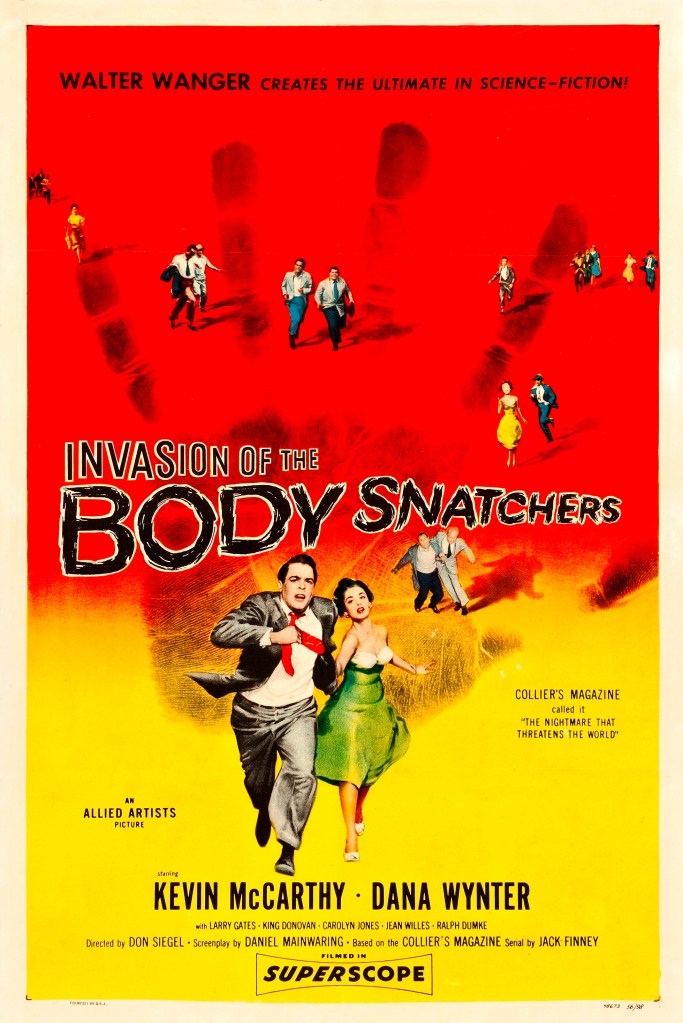
Invasion of the Body Snatchers (1956)

Invasion of the Body Snatchers (1956)

Paranoia in small-town America is superbly executed in Siegel’s creepy sci-fi thriller

Director: Don Siegel

Cast: Kevin McCarthy (Dr Miles Bennell), Dana Wynter (Becky Driscoll), King Donovan (Jack Belicec), Carolyn Jones (Teddy Belicec), Larry Gates (Dr Dan Kauffman), Virginia Christine (Wilma Lentz), Ralph Dumke (Police Chief Nick Grivett), Jean Wiles (Nurse Sally Withers), Bobby Clark (Jimmy Grimaldi)

‘Look, you fools, you’re in danger! Can’t you see?! They’re after you! They’re after all of us! Our wives, our children, everyone! They’re already here! You’re next!’

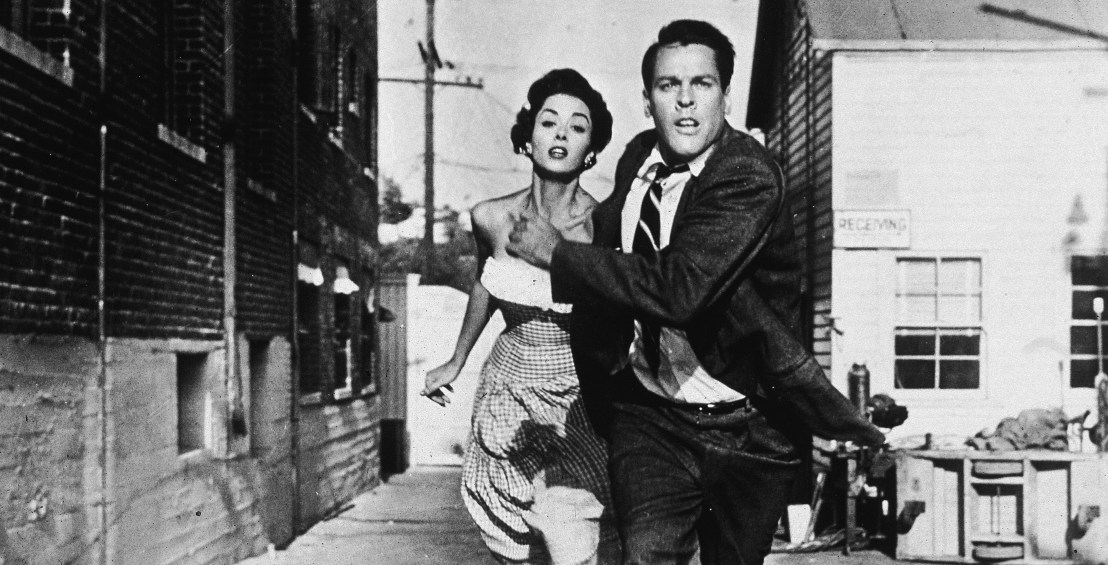
Those paranoid screams from Dr Miles Bennell (Kevin McCarthy) are part of the iconic conclusion of Don Siegel’s thrilling B-movie sci-fi conspiracy, full of the creeping horror of not trusting your own eyes or ears. It’s set in small-town Santa Mira, a sweet-as-apple-pie slice of Americana, where everyone knows everyone and life never changes. Until, of course, it does. Dr Bennell returns from a conference in Los Angeles to an epidemic of people claiming their loved ones are no longer their loved ones but that something about them is different. Bennell shrugs this off, more focused on his budding romance with fellow divorcee Becky Driscoll (Dana Wynter) – until he finds a clone of his friend Jack Belicec (King Donovan) growing in their home and faces the horrific truth: alien invaders are replacing people in the town with emotionless duplicates bent on world domination.

Siegal always claimed it was just a movie. That he wasn’t interested in political statements. You can believe that if you like, but Invasion of the Body Snatchers’ power stems from the terrible political and social parallels it draws with the real-world. The inversion reeks of 50s McCarthyite paranoia at communist infiltration, those suspicious Pinkos uninterested in individuality, only in protecting the system, where people are just cogs in its wheel. Even today, it still feeds on our fear of ‘the system’ absorbing us, crushing all that individuality we pride ourselves in having.

Even scarier at the time, Invasion doesn’t happen in the big city (where individuals are all getting lost anyway), but in that most American place of all, sacred small-town America, of picket fences and lifelong neighbours. If it can happen there, Invasions suggests, it really could happen anywhere. It’s one of many instances where Siegel makes the low-budget work effectively: in the same way he made a massive city full of people you don’t know the perfect space for a killer in Dirty Harry, he makes an intimate community the worst possible place to see people drained of humanity.

Invasions of the Body Snatchers uses that low-budget and limited locations to excellent effect. The bulk of the action taking place in the character’s homes and offices is actually more chilling. Watching a pod person mow a lawn, while his terrified niece (an effective performance from Virginia Christie) swears up-and-down he’s definitely not really her uncle, or a child running in terror from the home of his preternaturally calm mother is even more scary. That gets even more disturbing when our heroes discover replicas of themselves growing in their basements, or watch their small-town streets suddenly turn into a sea of emotionless duplicates.

There is also a hell of a lot snuck under the censor’s watchful eyes (maybe they only half-watched B-movies?) Its sharp screenplay includes plenty of surprisingly racy talk about between Bennell and Becky about his ‘bedside manner’ (‘that comes later’ he wryly tells her), or the fact that both of these characters talk openly about ‘going to Reno’, a popular euphemism at the time for divorce. For the time this is a surprisingly frank discussion of sex, not to mention the possibility of contented divorce (even Bennell’s nurse teases him about his flirtations with married ladies). What’s interesting is to consider is, if part of the appeal of the film is the horror of the familiar disappearing, perhaps the open acceptance of both divorce and sex suggests the process is already happening in different ways? Perhaps the safe world of picket fences is collapsing anyway, into something more permissive (and, who knows, plenty of people might well prefer that).

The creepy body-horror of the pods the duplicates grow in is also surprisingly disturbing for a 50s sci-fi. Splitting open to reveal the half-formed people inside, covered in foam, or the creepily serene complete copies that emerge, there is something deeply unsettling about it. No wonder Bennell’s instinct is to destroy them if he can with a garden fork, a surprisingly graphic choice. It’s hard to imagine a major Hollywood picture getting away with this sort of nightmare imagery.

It helps to build the terror of the film, which grows more-and-more relentless. Much of the final third of Invasion mixes a cat-and-mouse game with Bennell and Becky’s desperate flight from the town. It culminates in Bennell – in a scene really sold by Kevin McCarthy, who is the picture of (literally) square-jawed determination and reasonableness – disintegrate into just the sort of ranting lunatic (as he would do again in a cameo in the 1978 remake) the pod people decide they can let go, because ‘no one will believe him anyway’. Siegel shoots this sequence of paranoid ranting with a fast-cut mix of close-up and unsettling angles, as Bennell fails utterly to get anyone on the highway to slow down and listen to his warnings, like that nightmare of shouting when no one can hear you.

Perhaps it was too much for the producers, who added their own reassurance, introducing a framing device where Bennell recounts his tale to two reassuring figures of authority. I like to think Siegel – who uses visual metaphors for creeping paranoia and panic effectively throughout the film – deliberately shot these sequences as dully as possible (they remind me above all of the pedestrian final sequence of The Magnificent Ambersons) either so that we forget them (which we do) or perhaps to suggest their mundane nature implies these two-dimensional doctors and FBI agents might just be pod people themselves.

Despite the framing device, Invasion of the Body Snatchers is a tightly paced thriller, that builds in intensity throughout and uses its small-town setting as an excellent metaphor for the terrifying thought of your own family being invaded and subverted by a horrendous outside force. It makes for a compelling B-movie and leaves a deeply unsettling feeling behind: no wonder it has inspired so many remakes and reinventions. The terror of the people you know being the same and yet so completely alien and different, is going to have impact on every generation, no matter the context.

Pan’s Labyrinth (2006)

Pan’s Labyrinth (2006)

Superb fantasy film, full of heart, visual imagination and beautiful story-telling, truly one from the heart

Director: Guillermo del Toro

Cast: Ivana Baquero (Ofelia), Sergi López (Captain Vidal), Maribel Verdú (Mercedes), Doug Jones (The Faun/The Pale Man), Ariadna Gil (Carmen), Álex Angulo (Doctor Ferreiro), Manolo Solo (Garcés), César Vea (Serrano), Roger Casamajor (Pedro), Pablo Adán (Narrator/Voice of the Faun)

What do you do when your world is terrible? Sometimes the only way to survive is to embrace your own world, even if that world has its own darkness and terrors. Guillermo del Toro’s masterful Gothic fairy tale mixes the terrors of Francoist Spain with one of untrustworthy magic and monstrous spirits and compellingly balances bleak horrors with the chance of hope. Visually stunning, thematically rich and heartbreakingly emotional, Pan’s Labyrinth is a Grimm’s fairy tale bought shockingly up-to-date, a uniquely heartfelt film from a distinctive director.

It’s 1944 in the woods of Spain and the Reds are still fighting their lonely crusade against Franco’s fascists. Captain Vidal (Sergi López) is here to stamp out these rebels and has summoned his heavily pregnant wife Carmen (Ariadna Gil) and twelve-year old step-daughter Ofelia (Ivana Baquero) to his distant command post so that he can be present at the imminent birth of his son. Ofelia hates the punctilious and coldly obsessive Vidal (rightly so – he’s capable of coldy indifferent but shocking acts of violence) and escapes more-and-more into her fairytale books. One night, she wanders into an old maze and encounters a Faun (Doug Jones), who tells her she is the long-lost princess of the fairy kingdom and must perform three tasks to return home. Ofelia now exists in two worlds: an increasingly Gothic fairy one of and a real one of violence, ruled by her monstrous father-in-law.

Pan’s Labyrinth is a beautifully balanced film of multiple interpretations. It’s never clearly stated whether Ofelia’s fairytale world is ‘real’ of a product of her imagination. It’s clearly a way a scared girl could process real world traumas – the death of her father, the appalling Vidal, the horrors of war around her – with many elements of the fairy world reflecting things happening around her. But on the other hand, the mandrake root the Faun gives her to help heal her sick mother by placing it under her bed has an immediate impact and Ofelia’s magic chalk and the labyrinth itself offer secret doorways that allow her to escape Vidal in the film’s final act (or perhaps a by then disoriented and drugged Vidal is just mistaken). Essentially, you are left to embrace the idea you prefer – much as it is implied Ofelia herself chooses the version of her life she wishes to embrace.

Choosing for yourself and not blindly following orders is one of the key lessons of Pan’s Labyrinth. The ‘real’ world of Franco’s Spain is full of regimented orders to be blindly obeyed without question. In this it has the collaboration of the Church – at Vidal’s dinner-party, a subservient priest self-satisfyingly fills his plate with food while shrugging off concerns of the starving poor – and Fascism echoes Church mantras (one of Vidal’s lieutenants repeats the same propaganda ‘prayer’ to Franco over-and-over again while he hands out the bread ration to the cowed villagers). Franco’s Spain is one of order and regimen, where individuality and choice is stamped out.

And there are echoes of this in Ofelia’s fantasy world. Played with a gentleness, vulnerability and strikingly earnest decency by Ivana Baquero, Ofelia refuses to accept the world must be the way it is (unlike her mother who has sadly accepted it must). But her fairy world, the Faun – expertly portrayed by Doug Jones’ lithe physicality – is a far from gentle guide. Creaking from the wood he is formed from, he’s sinister, mixes vague statements with subtly presented orders and constantly holds information back while presenting Ofelia with tight rules for her tasks. Just as Fascism takes choice away real world, the Faun presents Ofelia with a book that reveals the future (but only one page at a time) and her tasks increasingly demand complete obedience, under the threat of punishment.

This is not a comforting world. Ofelia – who at one-point wears costumes reminiscent of those other famous children in dark, surreal and dangerous fantasy-worlds Alice and Dorothy – confronts a vile toad and, most chillingly, an albino child-eater with eyes in his stigmata hands who lives in a room decorated with nightmare reflections of the real horrors of the 40s (most strikingly a Holocaust-reminiscent pile of children’s shoes). For all its fantastical, it’s also very much a nightmare version of a real-world that could have been dreamed up by a child processing horrors.

Pan’s Labyrinth celebrates individuality and choosing for yourself. Ofelia’s story is one of increasingly taking her own choices: from refusing to accept her mother’s new husband, to escaping into her fantasy world (twisted as it is), to finally outright refusing the increasingly dark instructions of the Faun. It’s in doing this that she can eventually prove herself a true hero, someone who does not accept the established order but can make her own decisions.

This makes her a contrast to Vidal. Truly he is one of cinema’s most loathsome monsters. In a superbly controlled performance by Sergi López, Vidal isn’t repulsive because he is a larger-than-life, sadistic monster but because he is a small, inadequate bully who has controls his small world in order to make himself feel important. Vidal is obsessed with order and detail – introduced tutting at the 15-minute-late arrival of his wife, his office is filled with the gears of the mill and he fetishistically cleans his pristine uniform, shaves himself and repairs his father’s watch. This watch – the only memoir he has of his hero father, who died when he was a baby – is the root of his obsessions, Vidal desperate to become his father and pass on his own toxic legacy of ancestor worship to his son. It’s striking that, as Vidal’s world collapses around him, his clothing and body becomes more and more scarred, bloody and disordered – his external appearance resembling the monster within.

In Vidal’s world everything fits neatly into place, governed by his Fascist ideology. Carmen – a fragile Ariadna Gil, struggling to accommodate to a world of harsh choices – is of interest to him only because of the baby she carries. He operates the mill as a tightly organised regime, in which the rebels are unwanted ghosts in the machine. He uses violence ruthlessly but as a tool, not with sadistic relish. He brutally beats a suspected rebel to death with a bottle with robotic indifference and tortures suspects with a practised patter. To him, everything is justified if it is obeying an order. So much so, that he literally cannot understand the refusal of Dr Ferreiro (in one of the film’s most moving moments) to blindly follow orders, no matter the consequences.

Dr Ferreiro (a beautifully judged performance by Álex Angulo) is one of two figures whose independent thought Vidal is unable to recognise, even when they are under his nose. His maid Mercedes (Maribel Verdú, one of the passionate hearts of the film) is fiercely independent, the sister of the rebel leader and working subtly against Vidal. She forms a bond with the gentle Ofelia while showing that refusing to be part of a blind system is a crucial part of humanity. She also provides possibly one of the most satisfying moments in cinema during a confrontation with Vidal.

Del Toro’s film beautifully balances these fascinating ideas of choice and independence within its brilliantly evocative design. It’s a beautifully shot film, in a gorgeous array of Velazquez-inspired tones, its moody darks and blues gorgeously captured by Guillermo Navarro while its design work is extraordinary in its texture and detail. But it’s a classic because del Toro’s superb creativity and quietly emotional direction. Pan’s Labyrinth makes us really care for this child just as it makes us despise the cruelty of her step-father. Combined with gorgeous design, del Toro’s film truly comes from the heart, a loving, very personal tribute to the power of stories and individual choices. The film is so powerful, you even forget that it opens as it ends, and that we know in our heart-of-hearts how this journey will finish. Nevertheless, Pan’s Labyrinth ends on a note of joy and acceptance so pure, it could only be from the fantasy world not the real one.

The Sixth Sense (1999)

The Sixth Sense (1999)

Shyamalan’s opus has just enough to reward re-watching after the world learned its secret

Director: M. Night Shyamalan

Cast: Bruce Willis (Dr Malcolm Crowe), Haley Joel Osment (Cole Sear), Toni Collette (Lynn Sear), Olivia Williams (Anna Crowe), Donnie Wahlberg (Vincent Grey), Glenn Fitzgerald (Sean), Mischa Barton (Kyra Collins), Trevor Morgan (Tommy), Bruce Norris (Mr Cunningham)

Does this film have the most famous twist of all time? M. Night Shyamalan’s opus is so dominated by its final reveal (look away now) that Bruce Willis was is in fact a ghost, that every single viewing of it afterwards is focused on watching every second and seeing if you can spot the joins. I’m not sure if that has made for a long shelf-life or not for The Sixth Sense, an otherwise surprisingly sweet Stephen King-ish story of a child coming to terms with a miraculous power. Is there much more to The Sixth Sense by a third viewing though – can the magician’s trick land a third time?

I’d say just about. A year on from the shooting of famed child psychologist Dr Malcolm Crowe (Bruce Willis) by a former patient he failed to help, his traumatised wife Anna (Olivia Williams) has stopped speaking to him and Malcolm needs redemption. Could he find it with the case of troubled ten-year-old Cole Sear (Haley Joel Osment). Cole, despite his obvious good nature, is frequently moody and terrified by curious incidents. His mother Lynn (Toni Collette) despairs as Cole seemingly refuses to talk to her. Can there be truth in Cole’s belief that he can see, and talk with, dead people?

The Sixth Sense has the reputation of a supernatural chiller. But, bar a few jump scares as ghosts walk across screen to sudden, loud musical notes, it’s actually a far more gentle story. In Shyamalan’s world the ghosts are not malevolent or cruel – they are simply confused, lost souls (of course “some of them don’t even know they’re dead”) with unfinished business. They are, in other words, rather like the rest of us – and Cole’s realisation of this is actually rather sweet.

This humanity is the real triumph of the film, helped enormously by the untricksy care Shyamalan unfolds his story with. While almost every film he made since teetered from disappointment to disaster (with ever more desperate attempts to recapture the rug-pull zeitgeist to ever diminishing returns from increasingly savvy audiences), The Sixth Sense is a reminder of the road not taken. If Shyamalan had focused on small-scale, intimate character dramas like this he could have had quite the CV. His camera work is careful, often unobtrusive, gentle in its slow, immersive movement and he backs aware almost entirely from fast cutting. The Sixth Sense is really a spooky fairy tale.

It also creates an environment for four impressive actors to tackle four challenging roles. From Olivia Williams, whose marvellously detailed performance of utterly naturally not reacting goes a huge way to maintaining the film’s delicate tightrope to the (Oscar-nominated) Toni Collette, who superbly channels deep motherly love and pained helplessness under a blowsy exterior.

Bruce Willis (who only took the film on under contractual obligation) gives possibly his finest performance here. Suppressing his natural cocksure confidence into suppressed confusion and guilt, he convinces as an expert plagued with self-doubt. It’s a quiet, expressive performance that’s a tribute to the acting chops Willis had when he was moved beyond smirks.

It’s also a very supportive performance that helps bring the best out of a gifted child actor. Haley Joel Osment carries a large chunk of the film. He’s vulnerable and scared but also older than his years, alternating between the innocent excitement of a child and the weary reflection of a much older man. He creates a character you both want to comfort and also cheer for his growing strength. Shyamalan works with both actors to continually subtly shift the power balance between them without ever showing the film’s hand.

Because, of course, Cole knows the truth from the start – no one is better at spotting these things than him, and his unwillingness to speak to Malcolm within ear shot of others (such as during their first real consultation while his mother prepares dinner in the kitchen) speaks volumes. No wonder he keeps shooting him those looks of pity and concern which we, at first, interpret as fear.

You can’t escape that the film’s pretence, on repeated viewing, demands the viewer to reach some tenuous conclusions on how Ghosts operate. I think there is just enough there to suggest – from the sudden appearance and disappearance of ghosts – that they operate like we do in a dream, suddenly finding themselves in places with no memories of how they got there. They can move some objects, but only if they allow themselves to “see” them. They imagine what their own appearances are (the film implies Malcolm always appears in his blood soaked shirt to Cole, it’s just we see Malcolm’s perception of himself as a suited psychiatrist) and are subconsciously drawn towards people who can see them or who they have unfinished business with. The pretence just about sustains itself.

But is there more to the film than that? Pleasingly – and a little to my surprise – there is. While The Sixth Sense is more spooky than terrifying, that’s because it’s a film where helping and caring for people is the answer. No matter how horrific looking the ghosts seem, they are really scared people looking for help. This realisation – and the way Cole seemingly decides to commit his life to helping them – is actually extremely affecting. It’s a basic message of not judging a poltergeist by its cover, that really works.

It’s these beats that really work on a second or third viewing. I would trade the whole “he’s a ghost” twist for that gorgeous final scene between Collette and Osment in a car, where he finally confesses and shares a family secret from the grave to Collette’s initial confusion, anger and then emotional release. It’s a beautiful scene (it surely nailed Collette an Oscar nomination) and is the finest moment of Shyamalan’s career. It also shows the heart of the film – this is a parent-son film (with two parents), that’s about learning to love and accept. Everything else is really just set-dressing.

The magic trick (and Shyamalan hints at the sleight of hand he’s pulling by having Malcolm perform a similar distraction trick) may lose its mystique, but it then allows you to focus on the emotion that made you care about the trick in the first place. And, let’s be honest, the emotional heart is really what made the film a phenomenon. Any film can have a rug-pull twist – but it only really connects if people already cared about what they were watching. The Sixth Sense focuses on making sure we invest and it’s that which makes the film last, when all the glitz of the trick has faded.

The Omen (1976)

The Omen (1976)

Extremely silly horror with a great score, more interested in inventive deaths and genuine fear or dread

Director: Richard Donner

Cast: Gregory Peck (Robert Thorn), Lee Remick (Katherine Thorn), David Warner (Keith Jennings), Billie Whitelaw (Mrs Baylock), Patrick Troughton (Father Brennan), Leo McKern (Carl Bugenhagen), Harvey Stephens (Damien Thorn), Martin Benson (Father Spiletto), Robert Rietty (Monk), John Stride (Psychiatrist), Anthony Nicholls (Dr Becker), Holly Palance (Nanny)

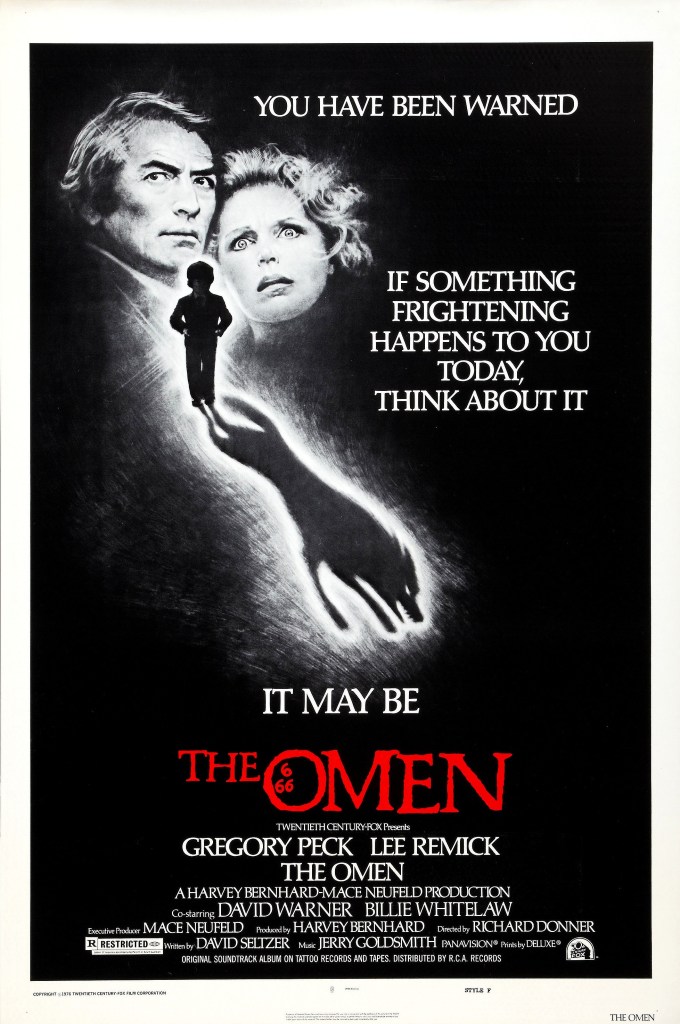
“Let him that hath understanding count the number of the beast; for it is the number of a man; and his number is 666.” One of the sweetest things about The Omen is that the number of the Beast was considered such an unknown concept to original viewers, that its painstakingly explained to us. In some ways The Omen is quite sweet, a big, silly Halloween pantomime which everyone involved takes very seriously. If The Exorcist was about tapping into primal fears, The Omen is a gory slasher (with a cracking score) that’s about making you go “Did you fucking see that!” as actors are dispatched in inventively gory ways. It’s brash, overblown and (if we’re honest) not very good.

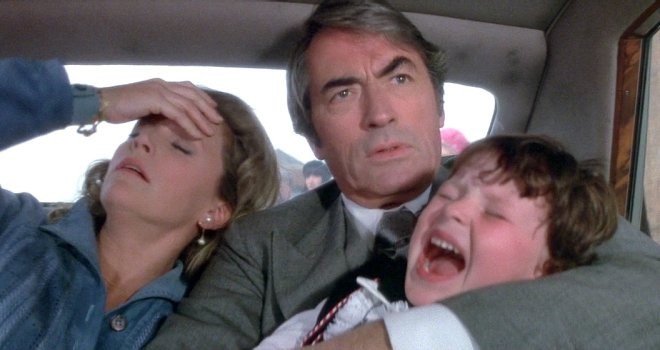
Robert Thorn (Gregory Peck, selling every inch of his innate dignity for cold, hard lucre) is an American diplomat told one night in Rome that his pregnant wife Katherine (Lee Remick) has given birth to a stillborn child. “Not a problem” he’s told by an absurdly creepy Priest (Martin Benson) – just so happens there’s another motherless new-born child in the hospital tonight so he can have that one, no questions asked, and his wife need never know. Flash forward five years: Thorn is Ambassador to the Court of St James and young Damien (Harvey Stephens) is a creepy kid, with few words and piercing stare. In a series of tragic accidents people start dying around him. Could those people warning Thorn that his son is in fact the literal anti-Christ himself, be correct?

Want to see how powerful music can be? Check out how The Omen owes nearly all the menace it has to it imposing, Oscar-winning score from Jerry Goldsmith (wonderfullyGothic full of Latin-chanting and percussive beats). It certainly owes very little to anything else. The Omen is an exploitative, overblown mess of a film, delighting in crash-zooms, jump-cuts and extreme, multi-cut build-ups to gore. Richard Donner never misses an opportunity to signpost an approaching grisly death, by cutting between the horrified face of the victim, the object of their demise and then often back again. For the best stunts – including a famous demise at the hands of a sheet of glass – Donner delights in showing us the death multiple times from multiple angles.

This slasher delight in knocking off actors – people are hanged, impaled, crushed and decapitated in increasingly inventive manners – is what’s really at the heart of The Omen. None of this is particularly scary in itself (with the possible exception of the hypnotised madness in the eyes of Holly Palance’s nurse before her shocking suicide at Damien’s birthday party) just plugging into the sort of delight we take in watching blood and guts that would be taken in further in series like Halloween (which owed a huge debt to the nonsense here). Donner isn’t even really that good at shooting this stuff, with his afore-mentioned crude intercutting and even-at-the-time old-fashioned crash zooms.

With Goldsmith’s score providing the fear, The Omen similarly relies on its actors to make all this nonsense feel ultra serious and important. They couldn’t have picked a better actor than Gregory Peck to shoulder the burden of playing step-dad to the Devil’s spawn. Peck has such natural authority – and such an absence of anything approaching fourth-wall leaning playfulness – that he invests this silliness with a strange dignity. Of course, Atticus Finch is going to spend a fair bit of time weighing up the moral right-and-wrongs of crucifying with heavenly knives the son of Satan! Peck wades through The Omen with a gravelly bombast, managing to not betray his “for the pay cheque” motivations, and investing it with his own seriousness of purpose.

Peck’s status also probably helps lift the games of the rest of the cast. Lee Remick may have a part that requires her to do little more than scream (and fall from a great height twice) but she does manage to convey a neat sense of dread as a mother realising her son is not quite right. David Warner gives a nice degree of pluck to a sceptical photojournalist (while also bagging the best death scene). Troughton and McKern ham it up gloriously as a drunken former devil-worshipping priest and an exorcist archaeologist respectively. Best in show is Billie Whitelaw who filters her Beckettian experience into a series of chillingly dead-eyed stares as Damien’s demonic nanny.

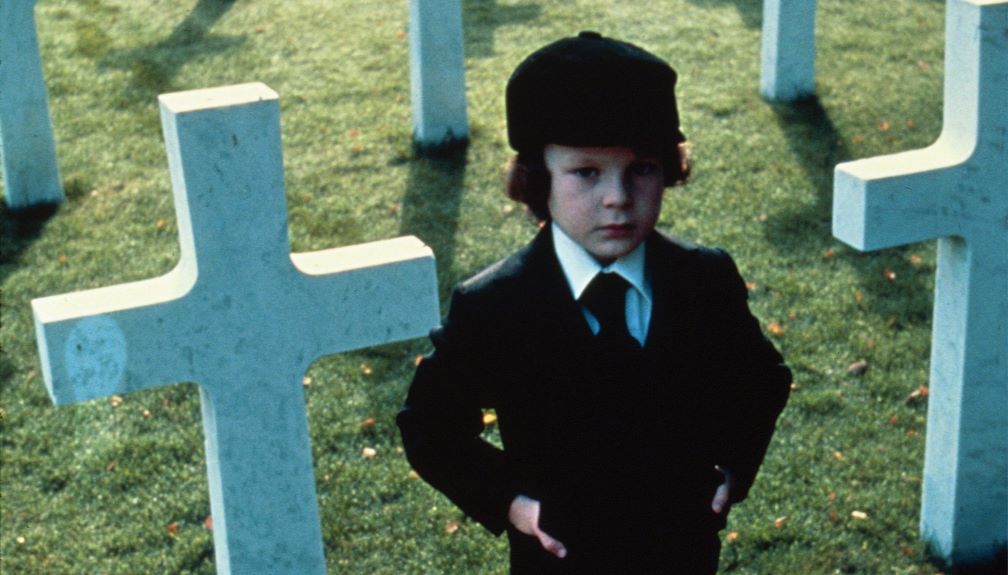
The Omen does make some good hay of its neat paedophobia. Harvey Stephens with his shaggy hair, impish smile and pale skin (not to mention darkly sombre wardrobe) looks like your worst nightmare – he’s creepy enough that the film doesn’t need to gift him a vicious rottweiler as well. Donner’s decision to never have Damien show a touch of any real emotion for most of the film also pays off, meaning even something as silly as Damien inflicting slaughter from behind the pedals of a child’s tricycle seems scary.

Of course, if Damien was savvy enough to present himself as a bright and sunny child perhaps Troughton, Warner, McKern and co would have struggled to convince Peck he was the Devil’s seed. In that sense he takes after his dad: Satan loves an over-elaborate death, and from a storm herding one victim to a fatal impalement under a tumbling church spire to popping the handbrake of a glass-bearing van for another, no trouble is too much for Satan when bumping off those who cross him. (The Omen could be trying to suggest that maybe everything is a freak accident and Thorn goes wild and crazy with grief – but that Goldsmith score discounts any possibility other than Damien is exactly what we’re repeatedly told he is.)

The Omen trundles along until its downbeat, sequel-teasing ending, via a gun-totting British policeman who sticks out like a sore thumb in a country where the cops carry truncheons not pistols. Donner balances the dialled up, tricksy, overblown scares with scenes of po-faced actors talking about prophecies and the apocalypse, all shot with placid straight-forwardness. There is a really scary film to be made here about finding out your beloved son is literally a monster, or how a depressed father could misinterpret a series of accidents as a diabolical scheme. But it ain’t The Omen – this is a bump-ride of the macabre. The Devil may have the best tunes – but he needs to talk to his Hollywood agent.

The Exorcist (1973)

The Exorcist (1973)

Unimaginable horrors seep into your mind in Friedkin’s hugely influential terrifying shocker

Director: William Friedkin

Cast: Ellen Burstyn (Chris MacNeil), Jason Miller (Father Damien Karras), Max von Sydow (Father Merrin), Linda Blair (Regan MacNeil), Lee J Cobb (Lt William F Kinderman), Kitty Wenn (Sharon Spencer), Jack MacGowran (Burke Dennings), Father William O’Malley (Father Joseph Dyer)

Growing up in the 90s in the UK it was easier to get your hands on a porno than a video copy of The Exorcist. For 12 years the film was banned because its influence was considered so insidious that it would inevitably lead to the corruption of the children who would (of course) dig out a copy to watch. Why was The Exorcist considered so powerful? After all no-one banned The Omen. Perhaps because there is something existential – unknowable, unexplained and unstoppable – at the heart of The Exorcist, while The Omen is a pulpy slasher about imaginatively bumping off Brit character actors. The Exorcist has a poetic nihilism, that reaches into your soul and takes a long-hard squeeze.

Hollywood actress Chris MacNeil (Ellen Burstyn) has problems. Her daughter Regan (Linda Blair) is growing increasingly unbalanced, suffering mood swings and saying the unsayable in grotesquely crude, sexual language. Doctors can’t find anything wrong with her. Above all they can’t explain her increased strength, contortions, the shaking of her bed and the freezing conditions in her bedroom. Could it be that Regan is possessed by a force darker than any we understand? After an unexplained death, Chris has no choice but to consult psychiatrist turned priest Father Damian Karras (Jason Miller) who reluctantly agrees that Satanic forces have taken control of Regan – and that an exorcism by himself and experienced Father Merrin (Max von Sydow) may be the only option.

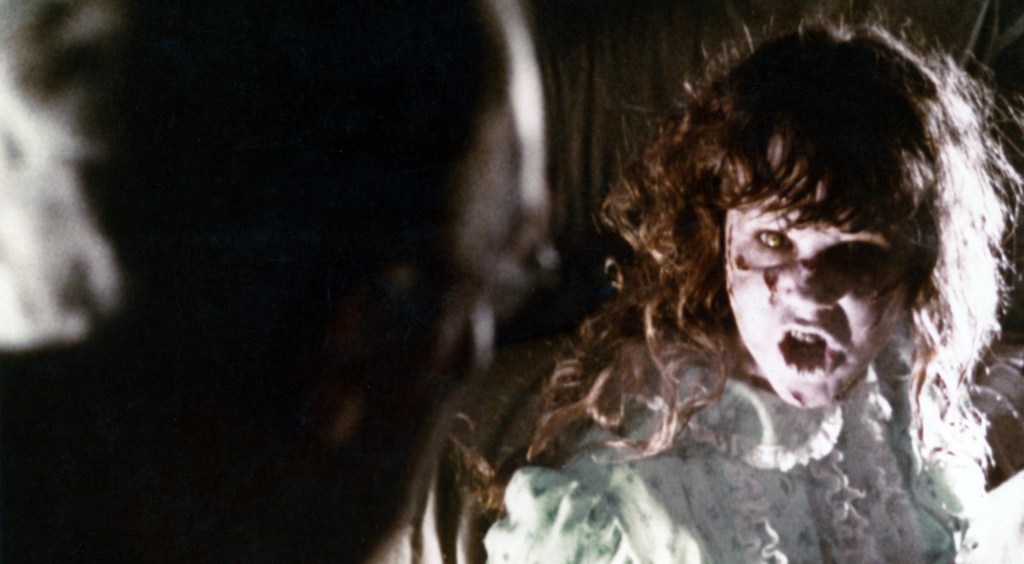
Adapted from a chilling novel by William Peter Blatty (who also wrote the screenplay and produced), The Exorcist is an all-consuming experience film, directed with immersive power by William Friedkin. Everything in it is designed to unsettle, disturb and dig deep into the fears of the viewer. What could revile us more than a child, her body twisted into the features of a revolting, malign spirit, spouting revolting, bile-filled rants and revelling in a twisted, macabre sexuality? All this wrapped inside a film that makes your skin crawl with its coldness, precision and drained out colours, where sound is unpredictable, discordant and unnatural and which offers very few answers.

The Exorcist does this in spades. It’s methodical and quietly repetitive in aspects of its editing and framing, constantly using visual and audio association to build dread. Friedkin’s prowling camera glides constantly through the MacNeil’s luscious townhouse, gliding up the stairs to Regan’s bedroom to reveal new horrors. Friedkin builds the dread, his camera first studying the shock and horror on the faces of the characters, before cutting to reveal the terrors they are looking at.

We move from subtle moments – Regan’s Ouija board, through which she communicates with imaginary friend ‘Captain Howdy’, whose glider jumps unprompted from Chris’ hands. The moments of chilling flatness in Regan, such as when she tells a visiting astronaut he “will die up there”. The violent, uncontrollable, impossible shaking of her bed. Regan’s astonishing strength that can hurl people across rooms. All this builds us towards the real grotesqueness: her deformity, her sex-obsessed rantings, impossible body contortions and her revolting sexual defilement of a crucifix. It increases in immediacy, graphicness and in its breaking of social convention, until you get the feeling you watching something that can only be classed as a revolting, all-pervading, all-corrupting evil.

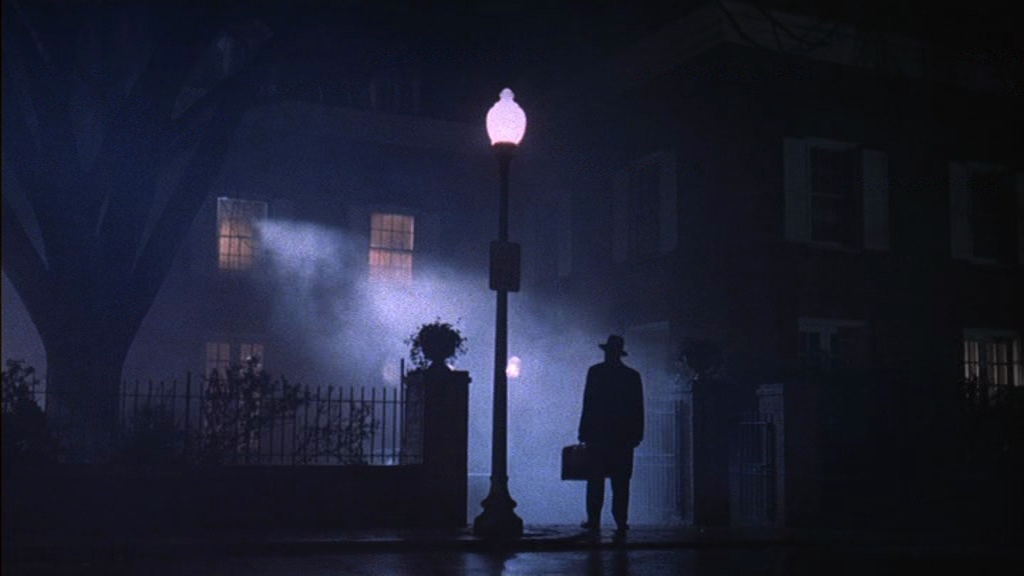
Evil is at the heart of The Exorcist. Friedkin superbly suggests a mystical, eternal clash between that and good at its heart. It’s opening sequence, with the discovery of the relics of the demon Pazazu in an Iraq is awash in suggestive menace: the percussive drum beat of the excavator’s tools, gusts of unexplained wind, the barking of battling dogs. A mist-filled skyline sees Merrin (and the granite faced von Sydow feels like a mythical figure) confronting a terrible statue of Pazazu. The moods –particular the audio features of this landscape – are echoed throughout the film, tying disparate locations together and subtly suggesting an age-long war that can never end.

That lies at the heart of The Exorcist’s ghastly appeal. Everything feels undefeatable, with regular streets and homes transfigured into places of inhuman dread. Little moments – a dog, a tramp, a train – take on echoes of sounds and sights associated with the demon. The brilliant repetitive use of Mike Oldfield’s Tubular Bells provides a mesmeric rhythm that always echoes the discordant tones of other sounds and sights. Friedkin plays this up with visual touches – subliminal imagery is used to flash horrors past us and the film plays with visions of suggestive unease. The demon similarly plays on underlying fears – of guilt, inadequacy and repressed desire – that it flings horrifically to the fore, through parroting the voices of others to changing its shape and appearance.

No wonder medicine is flummoxed. The Exorcist, considering its reputation, surprises for being such a slow-burn. It takes nearly two thirds of the runtime before the idea of the exorcism arises, during which we watch never-ending medical tests on Regan. Friedkin shoots these with a cold, impersonal professionalism (an angiography, with blood spurting from Regan’s neck, is almost unwatchable in its realism) which makes it feel even more powerless against the demon’s existential evil.

The Exorcist gently glides over narrative and logic gaps (not least the sudden onset of Regan’s worsening condition) because it retains a mystic power and the nightmare inducing dread of knowing exactly what is happening, but being unable to step into the film and tell the characters. It all leads perfectly into the exorcism scenes, when the film’s horror culminates in scenes of extraordinarily intensity, difficult to watch, with just the right amount of gore and suggestion.

Is The Exorcist about anything? That might be its greatest flaw. So enamoured is it with infecting us with dread, that it neglects to offer much that can give lasting spiritual or intellectual nourishment. Like a brilliantly constructed haunted house, it thrills but leaves you with little else to consider (other the costly struggle against evil). At heart, it’s a superbly well-made B-movie, a terrific horror-thrill ride where every single moment is masterfully designed to illicit an effect from the audience.

It’s helped by the superbly horrific make-up (not to mention von Sydow’s hugely convincing ageing) and effects whose practical realism increases their dread. Friedkin – at the height of his dictatorial auteurism – directed with little regard for cast and crew, focused on producing the desired effect. Guns were fired to illicit shocks. He slapped Father William O’Malley seconds before shooting a scene to make him look distressed. Burstyn and Blair both suffered lasting back injuries from being jerked around and the exorcism was shot in such refrigerator conditions, the actors couldn’t spend longer than fifteen minutes in the room.

But Friedkin’s determination to produce his vision through every means necessary worked. The Exorcist has a power few other films can dream of. The actors do their part: Burstyn’s increasingly raw pain and distress grounds it extremely well, Blair’s innocence makes her later horrors (voiced by a gravelly Mercedes McCambridge) even more disgusting, Miller is very good as the film’s eventual hero whose soul becomes a battle-ground, von Sydow invests Merrin with a rich hinterland.

They are framed with a film that is immediate, discordant and subtly grotesque. It leaves little to the imagination, but nevertheless encourages the mind to add its own horrors. It feels like the film itself can be a quiet demon, working its way inside to change you. It’s a horrific ride, and if it feels like it ends on a beat of grimness and desolation (despite Blatty’s intentions) that feels fitting for a film that may have little to truly say but affects viewers in a way few other films do. That’s why it was seen as having such power, because it invests deep, subliminal meaning and import to what could have been just (as its sequels are) an exploitation flick. That’s why it was banned.

Kwaidan (1964)

Kwaidan (1964)

Unsettling dread abounds in this beautiful, terrifying collection of ghost stories

Director: Masaki Kobayashi

Cast: The Black Hair – Rentarō Mikuni (Samurai), Michiyo Aratama (First wife), Misako Watanabe (Second wife); The Woman of the Snow – Tatsuya Nakadai (Minokichi), Keiko Kishi (Yuki-Onna); Hoichi the Earless – Katsuo Nakamura (Hoichi), Tetsurō Tamba (Warrior), Takashi Shimura (Head priest); In a Cup of Tea – Osamu Takizawa (Author), Noboru Nakaya (Shikibu Heinai), Seiji Miyaguchi (Sekinai)

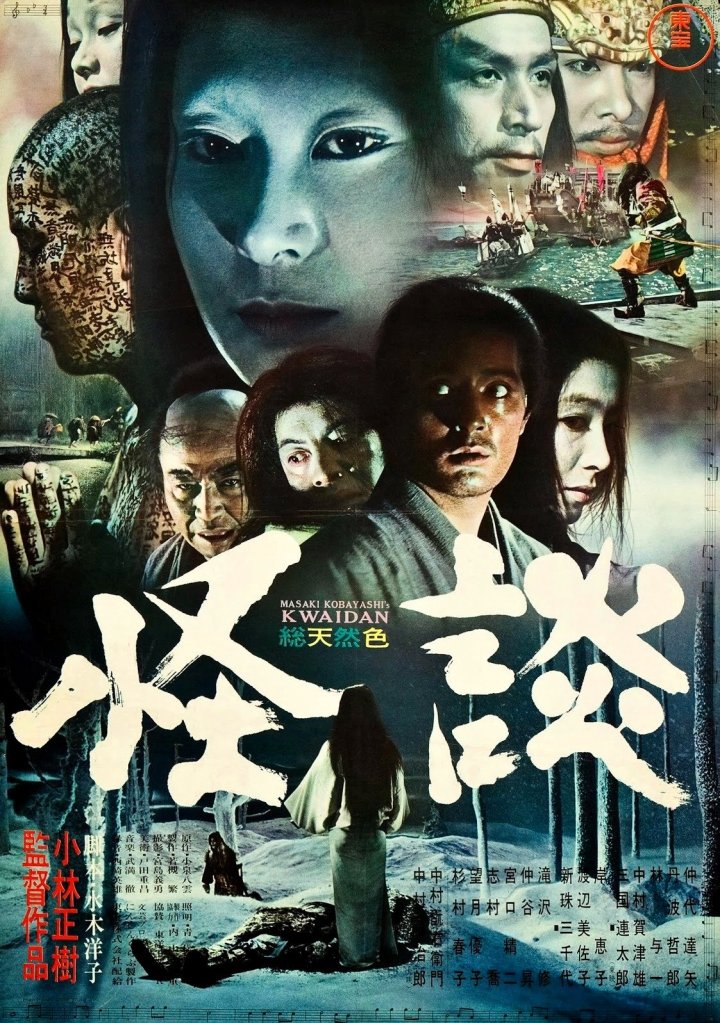
What is horror? For many people, it’s guts and gore. But I’ve always found far more unsettling the creeping terror of the unnatural, the unsettling dread of the unknown. The best ghost stories do this: the horror of encountering something that, by all logic, shouldn’t be there. The paralysing fear of coming face-to-face with something that surely cannot be real. The MR James style of ghost stories, where supernatural powers are unknowable and unrelenting. Kwaidan, Kobayaski’s collection of Lafcidio Hearn’s Japanese ghost stories, trades brilliantly in this – each of the stories contains moments of real spine-tingling dread that sent goosebumps racing over my body.

Kwaidan is built around four short stories, each separate but thematically linked. In The Black Hair, a samurai (Rentarō Mikuni) leaves his faithful first wife (Michiyo Aratama) for a loveless marriage with the daughter of a rich man. Realising his mistake, he finally returns to her but he stumbles into a haven that becomes a nightmare. In The Woman of the Snow, woodcutter Minokichi (Tatsuya Nakadai) encounters a terrible spirit (Keiko Kishi) in the forest who swears him to secrecy on pain of death – can he keep his silence from Yuki (Kishi again), the woman he marries? In Hoichi the Earless, Hoichi (Katsuo Nakamura) a blind ballad singer, is unwittingly hired by the spirits of a dead warlord. And in In a Cup of Tea, a samurai (Seiji Miyaguchi) is horrified when he sees a reflection that is not his own in a cup of tea.

Simple concepts – and in many cases you can see where this might be going just from the description – but the unnerving sense of dread and the uncontrollable inevitability of the supernatural horrors are what makes this truly terrifying. Kobayashi’s film is slow, careful, precise, and it is this very quality that contributes most effectively to its terror. As the camera moves slowly through unnaturally still and quiet locations, with a soundtrack made of a mix of silence and deeply unsettling, jarring chords and discordant sound from Toru Takemitsu, you actually feel like you want nothing more than to turn and run. Whatever Kobayashi’s camera is slowly edging towards showing us, we know it can’t be anything good. The expectation is a large part of the terror.

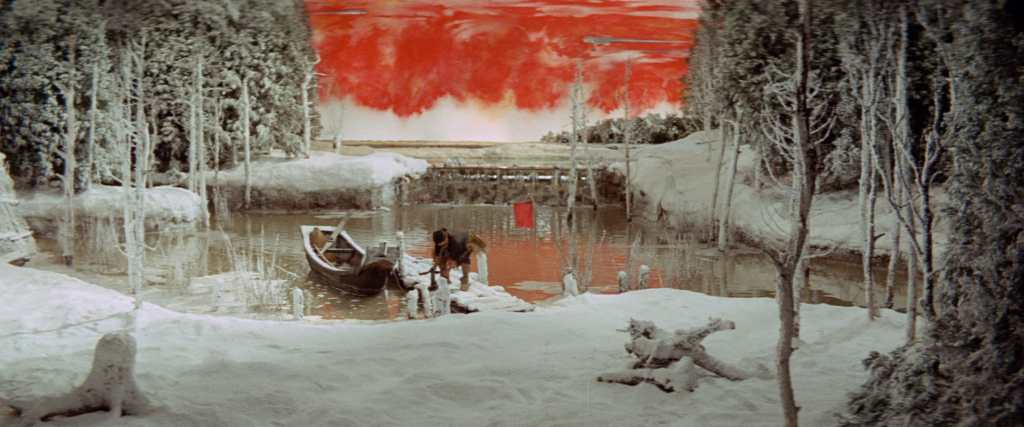
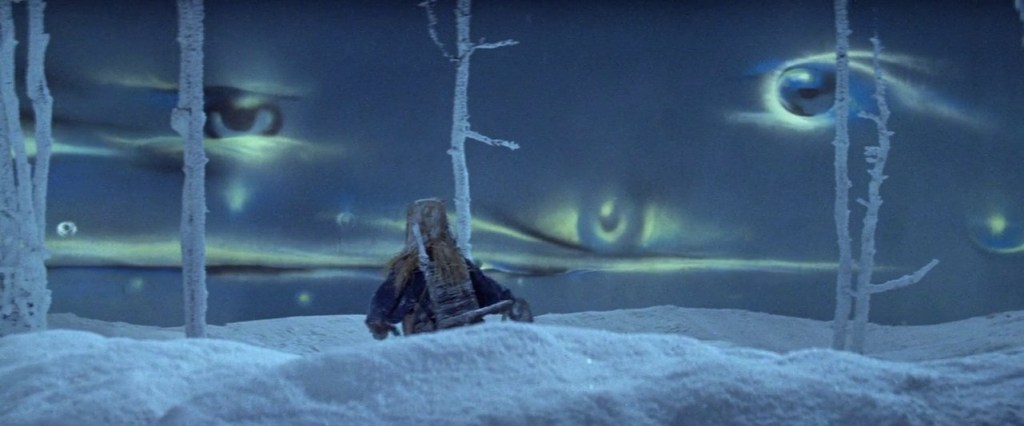
The unsettling world of Kwaidan is magnified by Kobayashi’s desire to control every element of the world he constructed. Bar a few shots of wave-lashed coasts and a Samurai riding competition (presumably too difficult to recreate inside), every scene was filmed inside a massive air-hanger studio. No attempt is made to disguise this. Instead, this exquisitely beautiful film makes a virtue of this to add to the unnerving sense of unreality. Skylines and backdrops are swirling whirlpools of paint and colour, never once trying to suggest a reality. Buildings, fields and even lakes subconsciously feel hemmed in by massive walls of painted unreality. It adds a terrifying fable quality – a nightmareish unreality – to the entire film.

It also makes Kwaidan a uniquely beautiful film. Not since Jack Cardiff’s work with Powell and Pressburger have scenery and backdrops looked as beautiful as this. Kwaidan is an explosion of gorgeous colours, used vividly and imaginatively to suggest mood, themes and threats. In The Woman of the Snow, the spirit seems to suck everything but blues and whites out of the palette – something we notice even more from the orangey skies that surround the woodcutter at every other point. The faded, paler colours in The Black Hair when the samurai returns to his first wife clue us in that all is surely not well. Splashes of red throughout spell danger – a coat, the lining of a pair of sandals, a torn flag, the lining of a cup, all of which the characters ignore.

They ignore these dangers at their peril. One of most dreadful things about the unsettling terrors of Kwaidan is that we can see the outcomes of their mistakes long before the characters do. The stomach-churning dread is waiting for it to happen. It’s executed to perfect effect in The Black Hair. The pompous samurai (a fine performance by Mikuni) is naturally due to be punished for abandoning his wife – and the faded home but unchanged wife he visits after years warn us well before him that horrors will follow. But Mikuni’s horrified shriek when confronted with the truth – and the staggering, nightmare-like, lack of control he seems to have over his body when he realises it (like a dream where you need to run but can’t) – makes this short chapter honestly one of the most unsettling things I’ve ever seen, a true Japanese MR James classic.

Equally fine is the second story The Woman of the Snow. It’s the most lusciously filmed of the four – its painted backdrops are Van Goghian works of art and the colour contrast between the warm summer and terrifying, pale blue winter is extraordinary. Its story is slight, but its spirit – Kishi moving with, again, a nightmarish precision that is deeply unnatural – is terrifyingly relentless. It offers no plot shocks, but the terror of inevitability, to excellent effect.

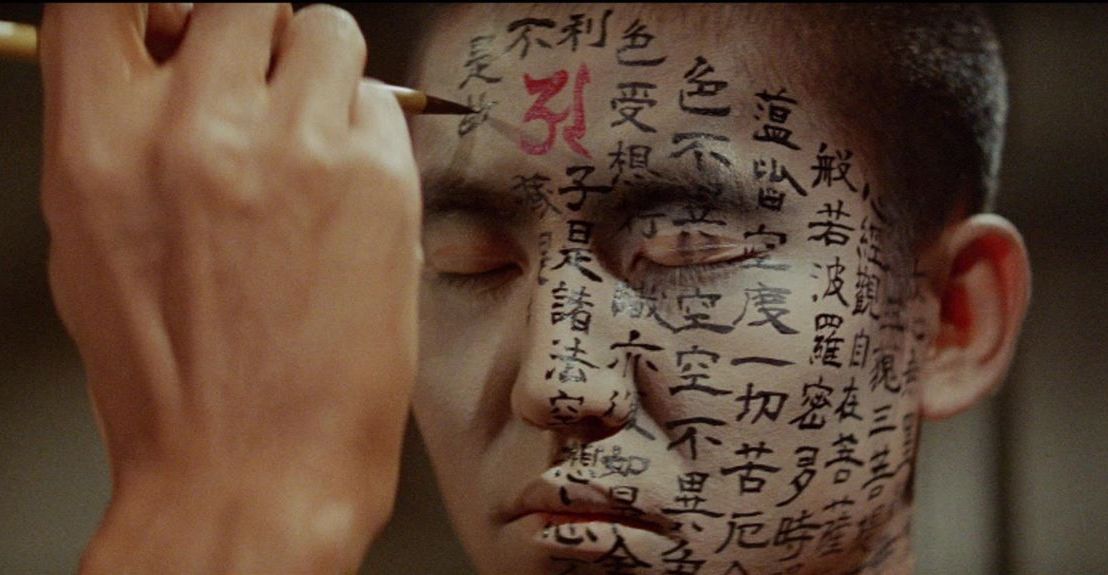
Kwaidan’s two final stories are less satisfying than these two masterpieces. Hoshi the Earless is very long – almost half the run time alone – and the story most dependent on an understanding of Japanese history. It recreates with a deliberately artificial beauty an ancient Japanese naval battle – clearly taking place in a water tank before a painted backdrop, but dreamlike in its execution, like a half-remembered vision, crammed with striking colours and images. The actual story of Hoshi is the least haunting, but provides Kwaidan’s most lingering cultural image, of a body covered (almost) from head to toe in writing to ward off spirits. Kwaidan concludes with a curiosity In a Cup of Toe a deliberately un-finished story – although the reason it remains unfinished provides Kwaidan with its final burst of shocking horror and another striking, unforgettable image of nightmarish dread.

Images of nightmarish dread abound in a film constructed intricately and deliberately artificially to heighten its sense of horror. The inevitability of many of the outcomes in its story detracts not one jot from the terror – if anything they add to it. Kobayashi’s direction is detailed, controlled, perfectly paced and wrings every last drop of unease from the audience. It’s a film that is long and slow, because the best terror often comes from the lingering slow-build – and its world of disjointed noises and sounds works perfectly to never allow the audience to relax. Kwaidan is an essential and masterful horror film, a collection of the sort of ghost stories that would make you run from the campfire.

Metropolis (1927)

Metropolis (1927)

Lang’s sometimes flawed science fiction epic is one of the most influential films ever made

Director: Fritz Lang

Cast: Brigitte Helm (Maria/The Machine), Alfred Abel (Joh Frederson), Gustav Frölich (Freder), Rudolf Klein-Rogge (Rotwang), Fritz Rasp (The Thin Man), Theodor Loos (Josaphat), Heinrich George (Grot), Erwin Biswanger (11811/Geogry)

It’s 1927 and for too long Hollywood had held sway over the movies. But there were plans in Germany to change that. The booming Weimar film community, arguably the artistic hub of World Cinema, felt they had a shot at claiming the sort of global success Hollywood had made its own. No expense would be spared to bring Fritz Lang’s science-fiction spectacular, Metropolis to the screen. It was met with such a muted reaction, that the original epic cut was sliced to ribbons, parts of the film lost for all time, and for decades it lived only in a mutilated form. But it was visionary and extraordinary enough to inspire virtually every single science fiction film that followed it.

Metropolis is a sprawling future city state, run by Joh Frederson (Alfred Abel). In it the rich live a gilded life in mighty skyscrapers, with private gardens, luxurious apartments and raucous parties. Beneath them – literally so – are the workers, living a Morlock-like life of drudgery in the factories and power stations that keep the lights burning. But all that could change: below ground Maria (Brigitte Helm) preaches hope for change, above ground Frederson’s son Freder (Gustav Frölich) falls in love with Maria and rejects his father’s way for the life of a prole. Frederson has a scheme of his own: to use a robot (Helm again) built by old friend (and one time rival for the affection of his late wife) the one-handed scientist Rotwang (Rudolf Klein-Rogge) to replace Maria and sow discord among a potential worker’s rebellion. But does Rotwang and his creation have a game of their own?

Lang had a brief to create a film that would be a box-office hit in America. No stone was left unturned in creating his epic. Metropolis took a staggering 17 months to film, running almost three times over its initial budget. It’s extended shooting schedule was a godsend for many of its extras, struggling to make ends meet while the Weimar Republic thrashed through the after-effects of hyperinflation. It’s a magnificent monument to Lang’s superb visual styling, marrying shadow filled expressionism with sweeping epic magnificence.

Metropolis’ strengths all lie in its stunning, inventive and breath-taking design work. That has been so inspiring, it has permeated vast swathes of our culture. Filmic visions of imposing, neon-lit, skyscraper packed modern Babels (Frederer’s headquarters is an art-deco reimagining of Brueghel’s Tower of Babel) all find their roots here: from Burton’s Batman to Scott’s Blade Runner. Any robot in the movies can chase its lineage back to Rotwang’s man-machine, as any mad scientist ancestor is  Rotwang (from Dr Strangelove to Back to the Future’s Doc Brown). It’s the film that invented steam-punk, with its piston-filled machines, staffed by boiler-suited workers (it’s inspiration for a zillion music videos is not surprising). Everywhere you look in Metropolis it might feel like you are seeing something familiar, when in fact you are witnessing its original generation.

Metropolis is a cat’s cradle of differing moods and designs, woven masterfully into a whole. Frederson controls the city from a penthouse suite, while his immediate staff and family live in swish, very 1920s apartments. This contrasts sharply with the industrial-punk of the factories, cathedrals of technological movement, full of gears, levers and men performing tasks with a robotic, convey-belt repetition under a series of clocks. There are real cathedrals, legacies of an old world, where God has been left behind by the new Gods of work and efficiency. Under the ground, the workers live in personality free tenement blocks and chiselled out caves, which echo churches. Rotwang works in a laboratory part Frankenstein’s layer, part bizarre lecture theatre, all seemingly housed in a ramshackle house that wouldn’t look out of place in a Hans Christian Anderson fairy tale.

A fairy tale is perhaps what Metropolis is, underneath all the astonishing technical sheen and directorial mastery. We follow a hero who exiles himself to live among the poor, eventually becoming their champion, with a damsel-in-distress he must rescue from a crazed wizard. The wizard even produces a magic imposter, who threatens to bring disaster. Metropolis’ plot often proceeds with the illogical progression of a fairy tale, with characters frequently making veering changes in allegiance or unveiling dastardly schemes that appear from nowhere or make little sense.

It’s similar in Metropolis biggest weakness: it’s simplistic plot, wrapped up in a casually naïve politically theory that attempts to find a balance between left and right, but essentially boils down to “why can’t we all just get along”. It’s loud proclamation that “The Mediator Between the Head and the Hands Must Be the Heart” is so vague that it allowed the film to be embraced by the left as a proto-socialist film supporting worker’s rights and the right as a film that revealed the workers as a mob and the fate of the world best left in the hands of elites who know what they are doing.

It’s part of the simplistic view the film largely takes of character and story, which frequently feels like an after-thought behind the film’s sumptuous production values and Lang’s expressive camera work. It’s also not helped by some of the acting which, particularly in the case of Gustav Frölich’s hand-claspingly camp performance, mines the depths of silent-movie ostentatiousness. Saying that Brigitte Helm is chillingly, wickedly artificial and physically disjointed as the fake Maria (a far cry from her more simpering ‘good’ self) and Abel underplays effectively as Frederson. Klein-Rogge’s insane glare and conflicting lusts also make a strong impression.

But none so strong as Lang’s mastery of visual symbolism. Freder’s terrified vision of the ‘heart machine’ that sits at the centre of the city’s power, transformed into a terrible Moloch with workers literally fed into its gaping, firey maw. Those same workers from the film’s opening with Lang’s brilliant visual conceit of shuffling, shoulder-drooping figures lurching into a gigantic elevator that lowers them into the ground. Rotwang’s birth of the fake Maria is a masterclass in light and cross-cutting, as is the simmering eroticism of the fake Maria’s dance at an orgiastic night-club, the screen filling with the slathering faces of the man she has enchanted.

It mixes with the Gothic power Lang brings the film in its closing sequence, seemingly inspired by mystery plays with their deep-rooted sins bubbling to the surface to condemn those alive today. There are echoes back to this in Freder’s dreams of Metropolis as a modern Babylon (hammered home, once, by the lost scene of a monk preaching in the cathedral) and in Maria’s Joan of Arc like status among the working classes – a mantle taken to its logical conclusion by her metallic replacement who leads a doomed insurrection. Again, all these concepts and influences are effortlessly held together into one magnificent whole by Lang’s fluidic, beautifully paced direction.

Metropolis lives today as a monument to creative science fiction film-making – it is the most ambitious and most influential science-fiction film ever, except perhaps 2001 and (in a very different way) Star Wars. It may be politically simple and its story may veer in unplanned directions and strange cul-de-sacs, but as a piece of visionary cinema it is nearly unparalleled. Even its existence today as a reconstructed, corrupted version of itself (after hours of footage were considered lost for decades) doesn’t not dim or diminish its mastery.

Vampyr (1932)

Vampyr (1932)

Dreyer’s vampire movie is enigmatic, dream-like, surreal and disturbing

Director: Carl Theodore Dreyer

Cast: Julian West (Allan Gray), Maurice Schitz (The Chatlain), Rena Mandel (Gisèle), Sybille Schmitz (Léone), Jan Hiéronimko (Doctor), Henriette Gérard (Old woman), Albert Bras (Old servant)

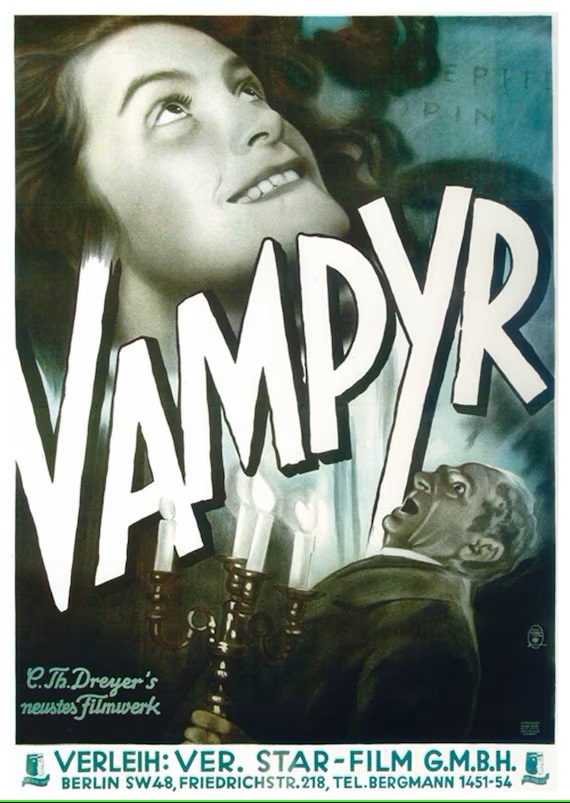
It feels like some sort of bizarre joke. What did Carl Theodore Dreyer direct after The Passion of Joan of Arc? A vampire movie of course! Vampyr for decades was seen as a curious footnote on Dreyer’s CV, so out-of-step with the rest of his filmography that cinematic experts have suggested it was nothing more than a naked attempt to turn a few coins at the box office (something which, like almost all of Dreyer’s work, is spectacularly failed to do). But this is the work of a master visualist film-maker: Vampyr is a vampire movie almost unlike any other, something so dark, surreal and unsettling that will haunt your nightmares.

Inspired by the work of Sheridan Le Fanu, Vampyr (subtitled The Strange Adventures of Allan Gray) follows the arrival of Allan Gray (Julian West) in a strange, secluded village where almost everyone seems to be in a trance, and a series of strange, unexplained events occurs. In the grand house of the lord of the manor (Maurice Schitz), his daughter Léone (Sybille Schmitz) lies dying and her sister Gisèle (Rena Mandel) can’t work out why. When the lord of the manor dies suddenly, West stumbles across what might be the truth: the terrible power of the undead, a mysterious creature that rises from its coffin every night to consume the living and send their souls to damnation.

Vampyr unfolds like something between a dream or a trance. It has lashings of the surreal in almost every scene, and it scrupulously avoids clear or even rational explanations. Events frequently happen for seemingly no rhyme or reason, dreams come to life, shadows gain mysterious powers and everything is designed to unsettle, confuse or mystify us. Camera movements seem designed to disorientate and confuse us about the geography of the locations in the film. It’s shot in a hazy slight blur (a deliberate effect by Dreyer and photographer Rudolph Maté) which adds to the sense that we are halfway between sleep and awake. It adds up to something unsettling, unpredictable but also hauntingly off-kilter.

Vampyr was Dreyer presenting a film the antithesis in almost every way to The Passion of Joan of Arc. He set up his own production company to make it – gaining funding from a Baron Nicolas de Grunsberg (who required that he play the lead role, under the pseudonym Julian West). Joan of Arc was filmed on huge sets, in stark close-up and a static camera, that would bore into every emotion of its characters. Vampyr would be shot on location with a constantly moving camera, performed by actors encouraged to perform as if hypnotised. Where one was about realism, the other would be about occultish fantasy, one about truth the other about concealment.

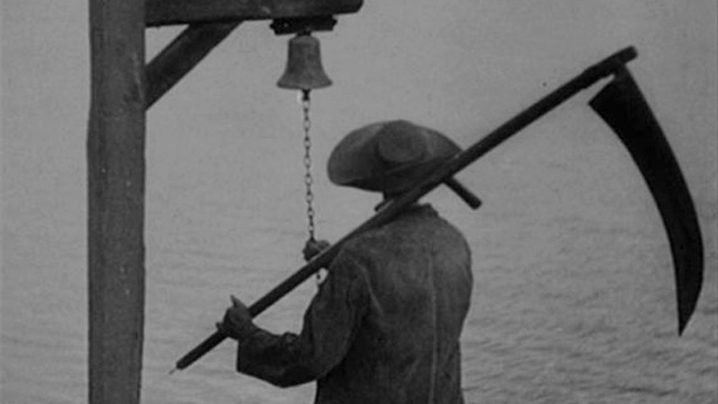
It ends with Dreyer creating a strikingly originally, deeply surreal and fascinating film, a vampire film in its way as influential as Nosferatu. While Murnau’s film would be unsettling in its painterly composition and the twisted, jittery movements of its lead,Dreyer’s would have the quality of a nightmare. From the start, images to unsettle and disturb the viewer are marshalled brilliantly. Gray’s arrival at his accommodation – with an unsettling, disturbingly long wait for a door to open – is intercut with shots of a mysterious man carrying a huge scythe waiting for a ferry to take him across the river. From such details, Dreyer imposes a sense of twisted unpredictability.

When Gray enters the house he will stay in, the camera seems to whip around the building, making sharp but smooth turns, constantly leaving us slightly disoriented as to where we are. It only gets worse for us as Dreyer throws in the first of a series of sequences where it is almost impossible to tell if what we are watching is real, a dream or something in between. Gray explores a nearby mill, the camera tracking smoothly away from him past a white wall, where we see shadows of a bizarre waltz play out to music, stopped only by the cry of a distant old woman for ‘Quiet!’. In the mill, Gray discovers an array of coffins, strange objects and the sounds of children and dogs – sounds which no one else can seem to hear.

Dreyer continues this unpredictable mise-en-scene throughout the film. The camera constantly focuses on the strange movements of shadows on floors and walls – scenes constantly play out only in shadow. The actors – nearly all of them amateur (and, to be fair, nearly all of them not great) – walk about as if in a daze, robotically delivering lines and as hazy and transmutable as the shadows. Gray even has a literal out-of-body experience, his ghostly double projection reflection separating from his body, to witness a dream (or premonition) of his own funeral.

This sequence is another chilling display of horror, as the ghost Gray opens a coffin to find himself inside – rigid and unable to move – before he finds himself in the coffin, witnessing the lid being screwed in (something we also witness from his POV), but able to see outside through a window in the lid. From this prone, trapped position he witnesses the coffin carried to the church and buried before he awakes. It’s but one nightmareish entombment we see in the film, another character facing the horrific fate of being buried alive under a mountain of freshly sieved flour, his hands grasping hopelessly for freedom above him.

Through it all we see nothing graphic – there is only one brief drop of blood – but everything remains unexplained and terrifying. Doors open seemingly unaided. Discordant sounds are heard (the film’s primitive, intermittent sound actually becoming a benefit for its unsettling effect) and its as if the whole world is collapsing in on itself into a small, nightmareish stumble around a house or garden in unpredictable, hard-to-interpret haze where nothing is as it seems and where everyone seems to be acting under a dark influence.

Dreyer’s Vampyr is horror in its most unexplained, unsettling and ungraphic style. It’s the fear of being trapped in a bad dream you can’t wake from, unfolding in a nightmareish atmosphere of unpredictability and terror where nothing is ever what it seems. Imagery and mood is crucial and Dreyer’s precise but ever-moving camera seems to float unnaturally through all the action. With its touches of the surreal and unpredictable it’s deeply unsettling, haunting and surprisingly effective. Far from a footnote, it shows the depth and ambition of Dreyer’s skill and cinematic vision.

Manhunter (1986)

Manhunter (1986)

Mann’s visually striking thriller doesn’t have quite the dark subversiveness it needs but is an unsettling thriller

Director: Michael Mann

Cast: William Petersen (Will Graham), Kim Griest (Molly Graham), Dennis Farina (Jack Crawford), Brian Cox (Dr Hannival Lecktor), Joan Allen (Reba McClane), Tom Noonan (Francis Dollarhyde), Stephen Lang (Freddy Lounds)

Before The Silence of the Lambs, there was an earlier attempt to bring the twisted world of Thomas Harris’ gothic thrillers to the screen. Michael Mann’s Manhunter has grown in reputation since its release, along with an increased regard for the visually stylised and cold modernism of Mann’s work. Truthfully, Manhunter lacks the Hitchcockian dark wit, and is far less effective at exploring the dark links between investigator and psychopath, than Silence of the Lambs. But it remains an intriguing – and often disturbing – curiosity.

FBI profiler Will Graham (William Petersen) is called out from extended leave by Agent Jack Crawford (Dennis Farina) to investigate chilling serial killer, the Tooth Fairy. The killer breaks into family homes and brutally murders the occupants, leaving bite marks and broken mirrors behind. Graham has an empathetic gift for understanding the mindset of killers, something he used to capture cannibalistic serial killer Hannibal Lecktor (Brian Cox), now imprisoned in a mental institute. Graham’s quest to catch the Tooth Fairy leads to him becoming ever more obsessive, including reconnecting with Lecktor to help profile the killer. Meanwhile the Tooth Fairy, Francis Dollarhyde (Tom Noonan), a lonely photo developer obsessed with William Blake’s Red Dragon and desperate to ‘become’ something greater begins his first meaningful relationship with blind colleague, Reba (Joan Allen).

Manhunter is set in a crisp, modernist world of clean, soulless buildings, glass fronted houses and offices and precise, featureless rooms. Mann and cinematographer Dante Spinnotti film everything with a series of tinges – strong, cool blues, drained out and striking whites, murky greens. All is designed to give the film a deliberately forensic feeling, like we watching something play out in a crime lab. It fits with a film that is fascinated with the procedures of investigating and profiling and delights in the intuitive, deductive leaps Graham makes.

Mann’s film attempts to draw parallels between Graham and Dollarhyde, both men uncomfortably in touch with their darkest, twisted impulses. As Hannibal Lecktor observes, Graham can so completely inhabit the interior world of killers, because he secretly longs for the buzz of killing himself. That’s easy to see in William Petersen’s focused, intense performance. Reluctantly dragged back in, Graham is noticeably unphased by the horrific crime scenes he witnesses (however much he is furious at the loss of life) and becomes ever more fixed and lean as the hunt continues, increasingly more-and-more like the obsessive prey-hunting psychopath he is investigating.

In doing so he sidelines his family – even putting them in danger – and increasingly cuts off human connections to feed his laser-focused quest. This contrasts him with Dollarhyde, a damaged, isolated and self-loathing man who flirts with the last vestiges of humanity. A man who sees nothing in himself that anyone could love, Dollarhyde becomes as giddy as a schoolboy when Reba sees him as a kind, attractive and decent man. Behind his eyes, Tom Noonan shows a quiet struggle between the obsessive monster, driven to destroy, and a man considering changing his path. This intriguing contrast between the family-man who leaves tem to hunt killers and the killer who flirts with settling down is a thread you wish the film had more patience to explore among its neon-lit, filtered style.

But Mann doesn’t quite have the patience to draw these threads together. Perhaps not helped by, skilled and intelligent as Noonan’s performance is, always presented Dollarhyde as an imposing, Frankenstein-monster style heavy rather than someone we invited to feel the sort of twisted empathy for that the film needs. We should be feeling something of what Graham says when he talks about feeling pity for the abused child and disgust for the twisted killer that child grew up to be. We never truly do.

Perhaps that’s partly because Dollarhyde is a character the film can never build up the same interest in, as it does with the looming shadow of Hannibal Lecktor (the spelling was unique to this film). Appearing only in three scenes, Lecktor dominates the film. Basing his performance on Scottish serial killer Peter Manuel, Cox brings the part a chillingly studied delight at his own intelligence with an air of quiet politeness which only vaguely masks his malice and cruelty. A ghost of a smile is behind every cruel, hurtful word and action he carries out and his every action is motivated only by a desire to harm. It’s a mesmerically terrifying, low-key performance that overwhelms the film.

It contributes to the film’s second half never really matching the first. As Lecktor recedes and Graham focuses on the Tooth Fairy, the lack of personal connection between hunter and hunted (and the film’s unease to draw too distinctive a comparison between them) makes the final hunt less compelling ironically than when the Tooth Fairy was an unknown, unseen adversary. Noonan’s most effective scene is his terrifyingly soft-spoken interrogation of smart-aleck reporter Freddy Lounds (a braggart Stephen Lang), but the film isn’t brave enough to give him enough potential humanity to make the character really interesting – or the Satanic charisma that Lecktor has.

Manhunter culminates in a disappointingly run-of-the-mill shootout (edited with a curiously ham-fisted jaggedness) and an unsatisfactory Graham family reunion that feels like it hasn’t got the energy or desire to explore any of the lasting impact the darkness we’ve discovered in our lead character would surely have. Manhunter not only changes the title of Harris’ book (there was fear that Red Dragon was too easy to mistake as a martial arts film), but it also benches the emotional and psychological obsession of Dollarhyde (even the character’s famous tattoos don’t appear in the film). It becomes a strikingly shot, intriguingly fast-paced thriller which doesn’t manage to make the psychological complexities its striving for either as fascinating or unsettling as it should. It has plenty to haunt you – its creepy POV home-invasion opening is nightmare-inducing – but Harris was better served by Lambs mix of playful dark-horror and focus on acute psychological insight.

Misery (1990)

Misery (1990)

Obsessive fans wanting to control the narrative is nothing new in this tension-filled King adaptation

Director: Rob Reiner

Cast: James Caan (Paul Sheldon), Kathy Bates (Annie Wilkes), Richard Farnsworth (Sheriff Buster), Frances Sternhagen (Deputy Virginia), Lauren Bacall (Marcia Sindell)

“I’m your number one fan”. Do any other words strike more fear into the hearts of celebrities? Stephen King’s Misery feels more and more ahead of the time. We live in an era where obsessed fans frequently take to YouTube (or obscure blogs – oh dear…) to shout their fury into the ether about how their beloved franchise has taken a wrong (i.e. counter to their head cannon) turn. Stephen King wasn’t a stranger to this: he’d already had fans in the mid-80s lambast his non-horror books. Misery takes it all a step further.

Successful novelist Paul Sheldon (James Caan) has written a series of Mills & Boon style Victorian romance novels about a character called Misery Chastain. Wanting to restart a career as a serious novelist, Paul retreats to the depths of Colorado to put the finishing touches to his new non-Misery novel. Driving back to New York, he has a car accident. With two broken legs and fractured shoulder, he is dragged from his car by nurse and fanatic Misery fan Annie Wilkes (Kathy Bates). Annie tells him not to worry: the phone lines will be back up soon and until then he can stay at her home. Until she discovers Paul has killed off Misery in his recently published book. A furious Annie makes it clear no one knows he’s there and that, if he ever wants to escape her secluded home, he’ll write a new Misery book to Annie’s personal specifications.

Misery is part horror, part deeply black comedy – a heightened fantasy of increasing paranoia powered by a superb performance by Kathy Bates that walks a fine line between grand guignol, farce and deluded tragedy. In many ways Annie, monstrous in her obsession, is a superb dark comic creation. She has an anorak-level obsessive knowledge about her passions, litters her speech with prudish replacement swear-words (“cockadoodie!”), bounces around the room with schoolgirlish excitement at having Paul in her presence and adores her pet pig (named, of course, Misery). Bates is energetic, wide-eyed and times kind of sweet.

But she’s also a chillingly ruthless and capable of great outbursts of rage and fury at the slightest provocation. A lonely woman with clear signs of being either bipolar or deeply depressed, sinking at times into “black dog” moods, stuffing herself with junk food in front of trashy TV, she relies on Paul’s books to give her a slice of the romantic, exciting life she feels she has missed out on. Like the most toxic fans today, she feels such emotion for the Misery books, she believes they belong to her personally – and if they deviate from what she wants it’s a personal affront. She is also so desperate to love and be loved, she takes a brutal control of the world around her, convinced that if she just works really hard the object of her admiration will admit he feels the same.

Bates is extremely good in a performance strikingly similar to Hopkins’ Lecter a year later (also, of course, Oscar winning). It’s a masterclass in actorly tricks, all deployed with triumphant expertise to create a character who is both darkly funny and terrifyingly controlling. Annie is so twisted that, in a way, doping Paul up on drugs and smashing his legs with a sledgehammer is like an expression of love. If he really understood what she was trying to do for him, how she knew the sort of books he should be writing, he’d never want to leave anyway right?

That leg smashing scene – and God it’s almost impossible to watch – is the height of Reiner’s taut direction that brilliantly makes this an endlessly tense chamber piece. The camera frequently shoots Annie from Paul’s prone position, meaning we are craning our heads up to look at her in exactly the same way he is. Later sequences, where Paul finally works out how to pick the lock of his room and explore (in his wheelchair) Annie’s kitsch-filled house with its shrines to her favourite celebrities, also place us on his visual level. Several scenes use tension effectively – you’ll catch your breath at the dropping of a model penguin, clench as Paul hides pills and knives around him for future escape attempts or sweat as Paul rushes to return to his room when Annie arrives home suddenly. But Reiner also threads in Hitchcockian wit throughout, amongst the tension.

It also gains a great deal from James Caan’s measured performance as Paul. Caan was last in a longlist of male actors offered the role (a sharp change from those days when Caan turned down roles that went on to win other actors Oscars) but willingly plays the passive, scared Paul with a low-key humbleness that works very well. He becomes someone who it is easy to root for.

Misery explores the lengths obsessive fans will go to to own their passions very well. Annie rejects Paul’s first attempt at humouring her with a new Misery book for its inconsistencies with previous novels (she clearly knows way more about it then him). That’s not even mentioning she demands he burns the (only) copy of his new non-Misery novel because “it’s not worthy of him” (being full of naughty words). It’s so good – and in a way prescient of where fandom is heading – it feels a cheap cop-out to also reveal Annie is a serial killer. Far more interesting is how quickly an unhealthy fixation could tip a maladjusted person from demands, to threats, to leg smashing fury.

Misery also fits a little too neatly into a trend – common at the time – of “regular guys” having their lives turned upside down by dangerous, deranged women (there are more than a few nods to Fatal Attraction and it’s not a surprise to hear Michael Douglas was offered the role). For all the dark skill Bates plays Annie with, we are rarely invited to sympathise with or understand her (she’s cemented as a freak with the discovery of her killer past) – again, how more interesting (and prescient) would it have been to just have a woman driven to extremes by obsessive monomania?

The film works best as a chamber piece. So much so, that any scene outside of the house feels superfluous – despite the excellent work from Richard Farnsworth as the local sheriff investigating Paul’s disturbance. Misery, with its abandoned house in the middle of nowhere, is sometimes a little too open in its huge debt to Psycho. But it’s ahead of its time in understanding the obsessive anger that lies under the surface of the darker elements of fandom – so much so you wish it had stuck to that.