Category: Literary adaptation

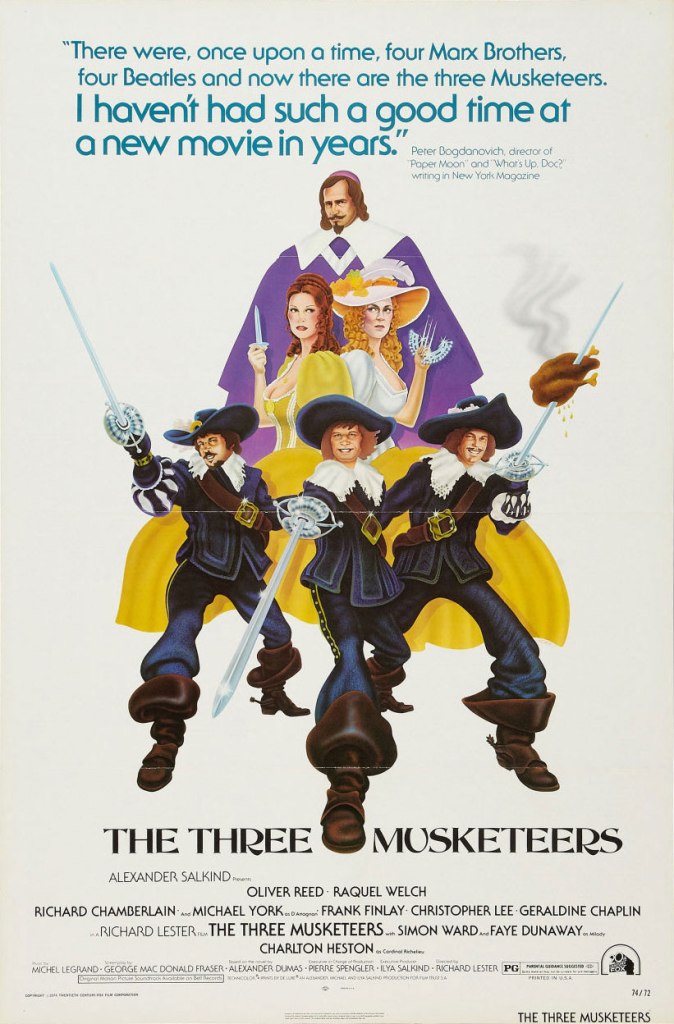
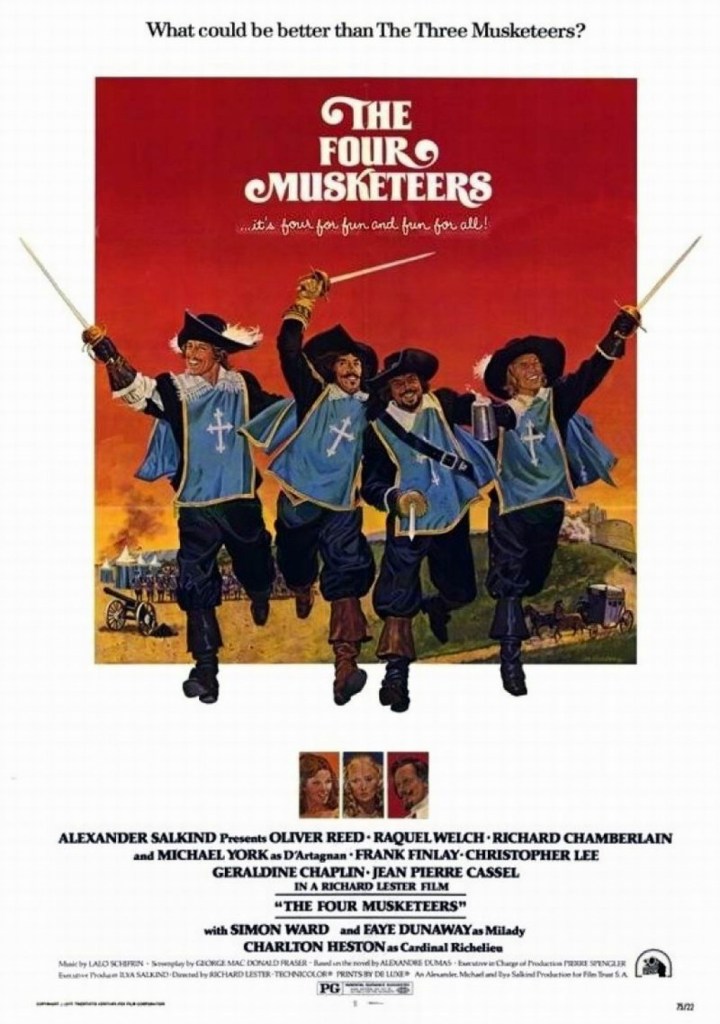
The Three Musketeers (1973) / The Four Musketeers (1974)

The Three Musketeers (1973) / The Four Musketeers (1974)

A film of two halves, in more ways than one: the swashbuckling original and its dark sequel

Director: Richard Lester

Cast: Michael York (d’Artagnan), Oliver Reed (Athos), Frank Finlay (Porthos/O’Reilly), Richard Chamberlain (Aramis), Raquel Welch (Constance Bonacieux), Jean-Pierre Cassel (Louis XIII), Geraldine Chaplin (Anne of Austria), Charlton Heston (Cardinal Richelieu), Faye Dunaway (Milady de Winter), Christopher Lee (Count de Rochefort), Simon Ward (Duke of Buckingham), Spike Milligan (Bonacieux), Roy Kinnear (Planchet), Georges Wilson (Captain de Treville)

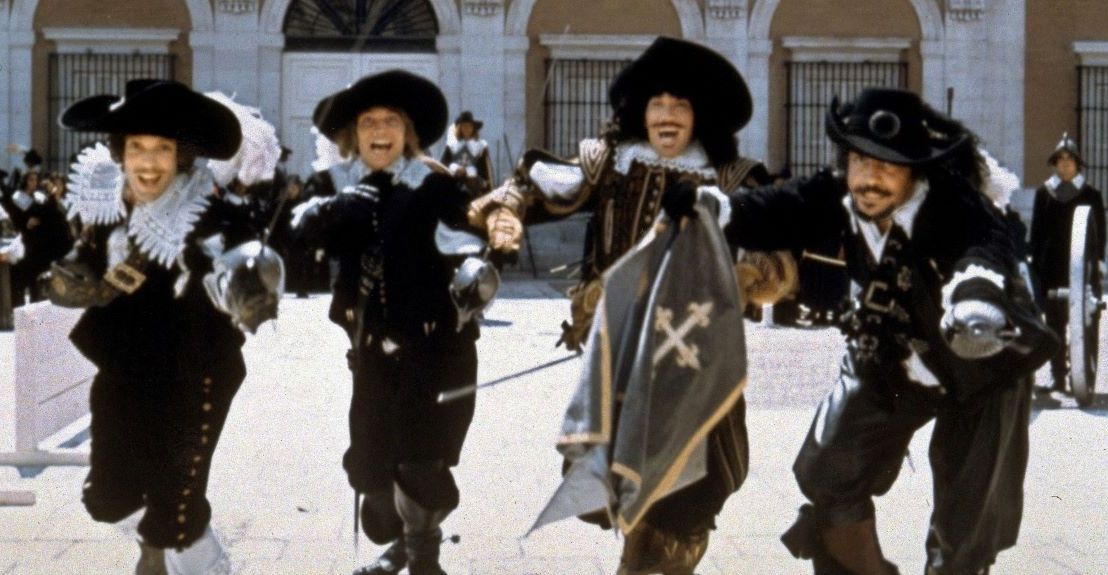
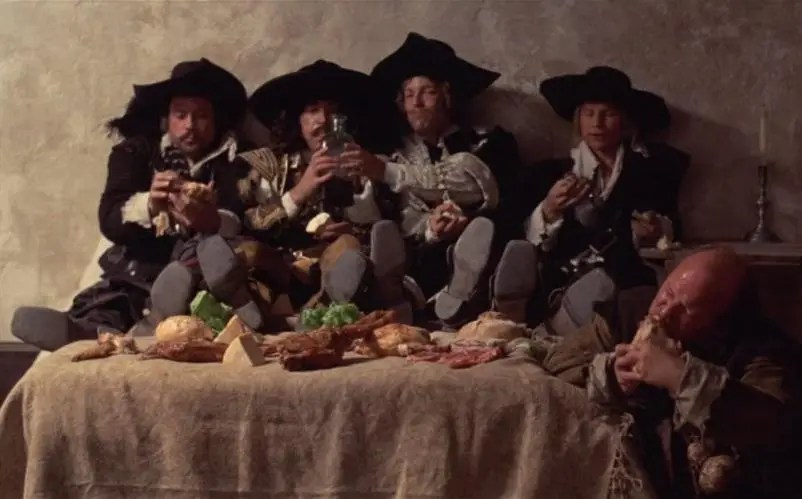
All for one and one for all! The Three Musketeers is probably the greatest adaptation of Dumas’ rollicking classic, a wonderful mix of swashbuckler, romance and Hellzapoppin comedy, that never takes itself particularly seriously and is crammed with actors having a whale of a time. It’s not quite a send-up, but it’s also not quite a straight re-telling either. Instead, it’s gunning all-out for entertainment – and it succeeds most of the time.

d’Artagnan (Michael York) arrives in Paris in 1625 desperate to join the musketeers. After various adventures along the way – including a rivalry with suavely villainious Rochefort (Christopher Lee) – the impulsive young man forms a friendship (after bumps in the road) with the famed musketeers Athos (Oliver Reed), Porthos (Frank Finlay) and Aramis (Richard Chamberlain). Falling in love with the unhappily married Constance (Raquel Welch), maid to Queen Anne (Geraldine Chaplin), d’Artagnan and his friends are dragged into foiling a plot by the ambitious Cardinal Richelieu (Charlton Heston) to use the ingenious Milady de Winter (Faye Dunaway) to expose the Queen’s infidelity with the Duke of Buckingham (Simon Ward). Will our heroes manage to foil the scheme in time?

The Three Musketeers adapts the first third or so – the most famous and by far the most enjoyable part – of Dumas’ novel. With an irreverent script by Flashman author George MacDonald Fraser, its framed as a rollicking romp with a tongue-in-cheek humour. Richard Lester, famed for his cheeky Beatles comedies (and the film was originally envisaged as a vehicle for the Fab Four), added his trademark scruffy, opportunistic comedy.

The film is awash with muttered asides – many of them well delivered by Roy Kinnear’s exasperated servant Planchet – that are only just picked up by the sound mix. My favourite? d’Artagnan bursting into a room full of guards, yanking a rug with a yell in an attempt to upend them, succeeding only in tearing the corner off it, then immediately jumping out of a window, leaving the bemused guards one of whom plaintively mutters “He’s torn our carpet” – I find this funny on multiple levels, from York’s all-in energy to the stillness of the shot, to the underplayed sadness of the punchline.

Lester’s film is full of long-shot gags – passengers in litters being dropped in a lake, d’Artagnan swinging on a rope to knock someone off a horse, missing and falling in the mud or his jump from a third storey window only to immediately reappear having landed on a (anachronistic) window cleaner cart. While the film does have its moments of drama, danger and intensity, it doesn’t ease up on visual humour, or gags (“This ticket is for one man” “I am one man. This is a servant”). It’s all part of Lester’s plan to make a fast-paced, pantomimic entertainment in which nothing is intended to ever be too serious.

It’s all played with maximum commitment by the cast, all of whom buy into the films’ tone. Michael York leaves very little in the locker-room with a performance full of youthful bravado, lusty hurrahs and naïve, winning eagerness. It’s a very hard balance to get right but he is never overbearing, but provides a relatable, likeable lead. He’s physical commitment to a series of Buster Keaton style gags is also commendable. He sparks a rather sweet romance with Raquel Welch, who is not the world’s strongest actress, but gamely delivers a series of pratfalls as the eternally clumsy Constance.

Around these two, a series of experienced actors delight in larger-than-life roles. Reed brings a surly intensity to Athos, a reminder of how great a career this charisma laden actor could have had. Finlay gives a Falstaffian joie de vivre to Porthos. Chamberlain (with little to do) strikes a gamely romantic figure as Aramis. As the baddies, Heston clearly enjoys subverting his grandiosity as the scheming Cardinal, Dunaway has a kittenish sensuality as Milady and Christopher Lee is so perfect as the debonair Rochefort that his eye patch (unmentioned in Dumas) has become de rigour for every Rochefort performance afterwards.

The Three Musketeers is crammed with swashes being buckled. The sword fights come thick and fast and are all shot in a series of impressive locations (the camera work of David Watkin, design of Brian Eatwell and costumes of Yvonne Blake do a wonderful job creating a sumptuous period setting). At times they do look a little ragged today – producers the Salkinds ran a tight budget, and there are multiple reports of the slightly-under-rehearsed fights leading to near-serious injury (this slapdash preparation would lead to tragic consequences when Roy Kinnear was killed on the belated second sequel 15 years later). But the actors enter into them with a firey commitment (a little too much so in Reed’s case according to the terrified stuntmen) and rumbunctious energy that really sells these as gripping action. They are also give a certain air of peril that gives just enough weight to the film.

The Three Musketeers has moments of dated clumsiness – the bizarely arty slow-mo opening with blurred motion feels totally out-of-keeping with the rest of the film – and not all the jokes land (Spike Milligan in particular is completely over-indulged in the film’s least successful comic moments). Not every performance works – Chaplain in particular is weak as Anne of Austria – and not all the jokes pay off. The musical score by Michael Legrand, catchy as it is, sometimes overeggs the “isn’t this all such fast-paced fun” angle. But the stuff that lands, really does well and there is more than enough fun, action, adventure and rollicking good humour to keep you entertained on a weekend afternoon.

And then there were two (or rather four)

There is always a twist in the tale. At some point while making The Three Musketeers the Salkinds realised they would never get it ready for the Paris premiere. But they could get half the film ready. So, they released that and cheerily announced at the end a sequel was already in the can. Problem was no one had mentioned it to the cast, who discovered they had shot an entire movie for free. A court case exploded, which the Salkinds lost, settling with actors and leading to a new clause being inserted into all contracts for actors preventing such a dodge happening again.

The Four Musketeers covers the second, less famous, much less fun part of Dumas’ novel. Rather like novel, it’s a rambling affair that lacks the compelling narrative thrust (We’ve got to get those diamonds and save the Queen!) which made The Three Musketeers so entertaining. It doesn’t help that its also considerably darker, serious and bleaker as bodies pile up and things get serious.

This makes the sequel a very different beast to the first. Energetic heroism prevented villainy in the first film, but here it often fails . Milady (Faye Dunaway) has sworn revenge and is ordered by Cardinal Richelieu (Charlton Heston) to assassinate Buckingham (Simon Ward). Along the way she kidnaps Constance (Raquel Welch) and seduces d’Artagnan (Michael York) seduced. The Musketeers rescue Constance, fight at La Rochelle and do their best to defend Buckingham – but nothing goes to plan, especially after Athos (Oliver Reed) realises Milady and his criminal ex-wife (thought dead) are one-and-the-same.

The Four Musketeers keeps up the humour, but it is frequently at odds with the darker film it sits in. Gone is the high-paced musical score of Michel Legrand, replaced with a lyrical series of melodies by Lalo Schifrin. It’s telling that Welch – whose comic clumsiness was a large part of the first movie – appears only briefly here. Similarly, Cassell’s shallow monarch (dubbed by Richard Briers) pops up just once, Roy Kinnear’s Planchet isn’t in the first hour and Spike Milligan’s free-wheeling improvisation is missing completely (in that case, no bad thing).

The film feels tonally at odds with the first film and even, at times, with itself. The Three Musketeers was full of sword fights but no deaths – here sword strokes are lethal. As the Musketeers comically bounce around at La Rochelle sight gags abound – but it feels at odds with a film where the death is very real. The more realistic feel means some set pieces – such as Rochefort and d’Artagnan fighting on an inexplicably frozen lake in the height of Summer – become harder to swallow.

Some performers do flourish. Oliver Reed comes into his own as an increasingly dark and vengeful Athos, giving into temptations of shocking revenge. Faye Dunaway laces her role with cold, murderous fury. They have most of the film’s most compelling scenes – but the incredibly dark ending (which involves our heroes actively perpetrating judicial murder with a terrified victim) while loyal to the book, feels far too heavy for a pair of films that started with Buster Keatonish comedy.

The loyalty to the book and the commitment to follow it is partly to blame. There is a reason why most adaptations chuck away this section of the book. It lacks a clear narrative line for emotional connection and is highly episodic. d’Artagnan, in the book, does indeed sleep around after Constance disappears – but when the film requires their relationship to be the emotional heartbeat, is it a good idea to have him jump into bed with two women within days of her disappearance?

Lester announces the more sombre parts by filming them in a very framed, artful way inspired by the old masters, with a static camera and medium shot, reliant on Schifrin’s maudlin music. He’s far more at home with the comic business delivered by Finlay (very good) and Chamberlain (still with nothing to do). At other points he surrenders initiative to legends like Heston (suavely menacing), Lee (whose Rochefort steps up a level in lip-curling contempt) and Dunaway.

The finest thing on display are the sets and the sword fights, which are even more desperate, ragged and violently dramatic than last time (when Rochefort and d’Artagnan stop in one to take a breath, you are not remotely surprised given the total commitment we’ve seen). The action set pieces all look really impressive and staged with confidence and brio. It’s just a shame that much of the rest of the story feels like its being told by a natural comic trying hard to be King Lear, but not able to resist throwing a few gags in. It makes for an entertaining, but tonally messy film that feels it has come from a totally different place than its flawed but fun predecessor.

Macbeth (1948)

Macbeth (1948)

Welles first Shakespeare film is a bizarre mix of inspiration and amateurishness

Director: Orson Welles

Cast: Orson Welles (Macbeth), Jeanette Nolan (Lady Macbeth), Dan O’Herlihy (Macduff), Roddy McDowell (Malcolm), Edgar Barrier (Banquo), Alan Napier (Holy Father), Erskine Sanford (Duncan), John Dierkes (Ross), Keene Curtis (Lennox), Peggy Weber (Lady Macduff), Lionel Braham (Siward)

Macbeth was Welles’ last hurrah in Hollywood before decades of self-imposed banishment and exile. He arrived at Republic Pictures – proud creator of B-movie Westerns, although also the home of a few John Ford classics most notably The Quiet Man – who were delighted to sign up a deal for a literary classic directed by America’s leading man of the theatre. What they ended up with was a film that’s such a bizarre mish-mash of brilliance, originality and amateurishness nonsense, that they were basically befuddled.

Welles shot the film, as contracted, within 23 days on old Westerns sets, with a budget od spit and boot polish. Welles was focused, more than any other film he’d worked on to that point, on visual imagery and total control of sound and audio. So much so he wasn’t fussed about recording any sound on set. All the actors pre-recorded their dialogue, under Welles’ strict instructions, and then silently lip synched while shooting the scenes. This gave Welles the freedom for a host of expressionistic, shadow-filled shots where the actors faces and mouths were frequently unseen – or longer shots where it was impossible to clearly see lips moving. It also made some truly rigid, uncomfortable performances (Jeannette Nolan was granted permission to record her sleepwalking scene ‘live’ so she could perform it with some semblance of conviction).

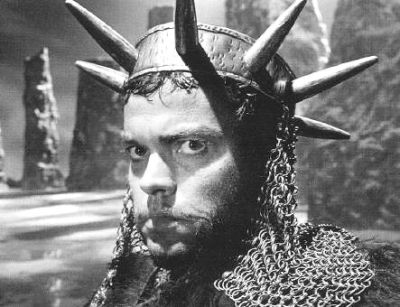
Macbeth was set in a Scotland somewhere between a fiercely traditional high-school production and a hodge-podge of influences from Celtic wizardry to Mongolian hordes. It’s shot on a dust-lined, cavern-filled panorama that frequently looks like a giant theatrical set or an empty multi-purpose wall-lined amphitheatre, with only a few scenes exchanging this for mist-filled heaths or low-ceilinged caves. The costuming and design is an eclectic mix: the murderers look like cavemen, some thanes wear kilts, Malcolm and his soldiers dress in medieval armour, Macbeth and Banquo look like fur-coated renegades from Genghis Khan. Welles himself would regret a bizarre crown which made him look like the Statue of Liberty.

There is a feeling that every idea was grabbed and thrown at the wall, in the expectation (hope?) that some of them would stick and lead to cinematic magic. There is a vague attempt to suggest Scotland is at war between Christianity and Paganism. A composite character, the ‘Holy Father’ parades around – chasing away witches, leading prayers for Duncan, taking dictation for Macbeth, warning Lady Macduff, rousing Malcolm – but with very little real sense that this ever adds up to anything logical or thematically clear. Welles merrily re-writes and transposes dialogue. Some works well – Banquo here seems far more of a potential partner than usual – others less so (Lady Macbeth turns up at the murder of the Macduffs for no clear reason).

But the stuff that works really works – and most of it is visual. The witches are shadowy figures, whose voices alter in cadence and pattern from scene to scenes (Welles had mixed male and female voices together to create an unsettling rhythm), their faces never seen. Inspired by his famous “Voodoo Macbeth” stage production, they craft muddy statues of Macbeth which they crown with a crude coronet. In one of the encounters with Macbeth, the camera pulls away to isolate Macbeth, lit in misty isolation. More Voodoo touches are seen in the hammering drum beats that greet Duncan to Macbeth’s castle.

Mist and expressionistic images dominate. Malcolm’s army urges from among the fog, carrying their branches from Birnam wood. The final battle is a series of isolated shots of characters, often the camera craning up to them or seeing them march towards it. Macbeth is frequently shot from below, to heighten his sense of being almost an ogre. When first seen as king, he sits, isolated and drunk at the top of a flight of stairs, making him seem less imposing and more weak from the start of his reign. He is haunted not only by Banquo’s ghost, but Duncan’s as well, Welles camera cutting to reveal his cavern dining room empty of everyone but the Macbeth and the ghosts of murdered friends, the camera tracking the shadow of his fingers along the wall to reveal the bleeding Banquo.

The entire production becomes like a drug-induced fantasy, something a near-catatonic Macbeth might just be imagining as his dreams are crushed by the cruel fate he feels destined to follow. Welles establishes a now popular idea of the play being a huge cycle: at this death, the witches announce “Peace, the charm’s wound up” the camera catching a sight of Fleance who seems destined to repeat the chaos. (“The charm’s wound up” not indicating an end, as often mis-interpretated, but a readiness to be enacted.)

The camera, freed of the need to capture dialogue on set, flies around roams around or moves with swiftness. Characters walk into shadows. Sequences – such as the murder of the Macduffs – are met with a parade of fast cuts and actors charging towards the camera. Music cues are carefully repeated, and lines carry across transitions. There are plenty of striking images, from a mass crowd praying for Duncan to a low-angle camera tracking a worried Macbeth in the aftermath of the murder.

But yet… this is also a curious dog’s dinner of a film. For every great idea, others (like the Holy Father) either don’t land or make no sense. Macbeth’s seduction of the murderers, interestingly shot over his shoulder at an imposing distance from his servants, is followed by a laughably badly acted and staged murder of Banquo. The actors all perform in, pretty much across the board, dreadful cliched Scottish accents. This accentuates the problem of lip synching on set, which renders nearly everyone in the film flat and strangely lifeless, stuck to replicating a performance from days ago.

This includes Welles himself. Macbeth is, by some distance, his least interesting film Shakespeare performance. His Thane is all surface and no depth and Welles’ decision to play him as a slave to destiny, frequently renders him catatonic, reading the lines with a Scottish lilt that travels by way of Dublin, with plenty of pace but no depth. Jeannette Nolan struggles slightly with Lady Macbeth, a decent match with Welles but lacking presence. There is barely a performance of merit among the rest of the cast: McDowell is dreadful, O’Herlihy all at sea, Barrier out of his depth. The bulk of the cast look and sound – in their traditional costumes and awkward, unconvincing accents – like high school students staging “the Scottish play” in the most “Scottish” way possible.

Welles, naturally, having shot the film promptly disappeared to Europe leaving notes and memos from a distance about how it should be assembled, some of which were promptly ignored by a supportive studio turn exasperated. Those in Europe were more respecting of the results, praising Welles for re-imagining the text and its expressionistic, fluid shooting style. In America, these elements were condemned a mess. Macbeth is a bit of both: good ideas sitting alongside amateurishness and nonsense. It’s most interesting by far as a silent film: there are images here that linger, from the witches mud statue to Lady Macbeth’s plumet to death. But as an overall package Welles would dwarf it with Othello and Chimes at Midnight, which combined good Shakespeare and good film-making. Macbeth is a struggle to marry expressionist film-making and literary grace that doesn’t always succeed.

Further reading:

My Brilliant Career (1979)

My Brilliant Career (1979)

Edgy and very good feminist film about a prickly and difficult woman struggling against a lack of choice

Director: Gillian Armstrong

Cast: Judy Davis (Sybylla Melvyn), Sam Neill (Harry Beecham), Wendy Hughes (Aunt Helen), Robert Grubb (Frank Hawdon), Max Cullen (Peter McSwatt), Pat Kennedy (Aunt Gussie), Aileen Britton (Grandma Bossier), Peter Whitford (Uncle Julius)

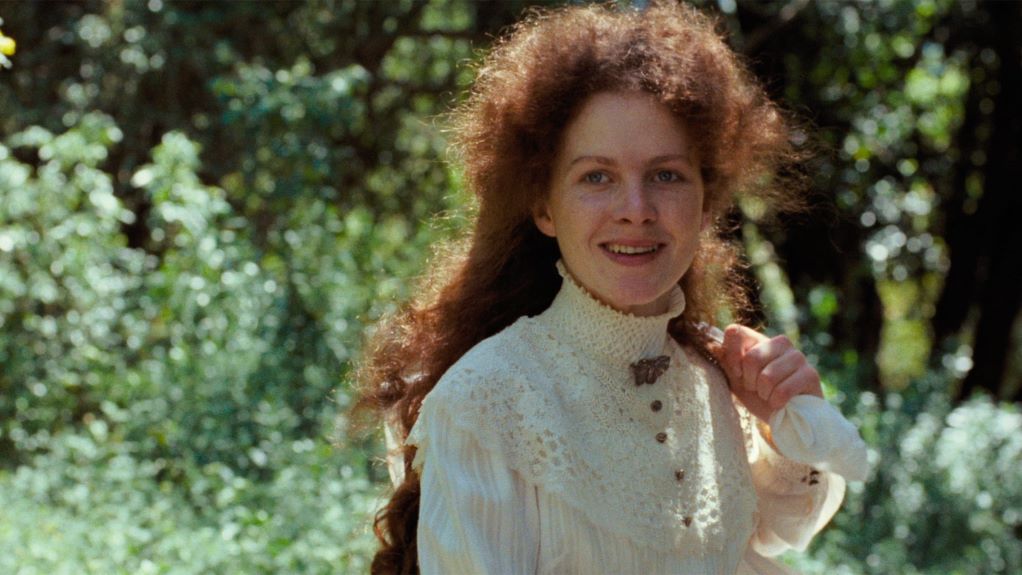
In turn of the century Australia, it’s fair to say women were not awash with choices as Sybylla Melvyn (Judy Davis) discovers. Growing up on a dust covered farm, she dreams of becoming something – an artist, a singer, a writer, a connoisseur of culture, anything rather than spending her life as a wife and mother. She is dispatched by her parents to her wealthy maternal grandmother (Aileen Britton), determined to scrub her up, shave off her rough edges and find her a good marriage. Sybylla resists, but much to her surprise finds herself attracted to old childhood friend, Harry Beecham (Sam Neill). But will Sybylla choose marriage over finding her own path in life?

Adapted from a semi-autobiographical novel by Miles Franklin (the pen name of Stella Maria Sarah Miles Franklin), My Brilliant Career was a feminist watershed in Australian cinema, also one of the first Australian films directed by a woman. Gillian Armstrong was fascinated by a story that, while a period piece, still spoke strongly to a time when women were moving out of stereotypical traditional roles they had been pigeon-holed into. My Brilliant Career is a costume drama that looks at the stark reality for women at the time (wife, mother or “spinster”). And while men could dream of lives of cultural and artistic fulfilment or economic ambition, women faced innumerable barriers.

The frustrations help explain why Sybylla is such a prickly, at times maddening, frustrated woman trapped in a constant stream of situations where her choices are narrow or she cannot decide what she wants. On her parents’ farm, her interest in art and classical music turns her into a sort of freakish bluestocking (or larrakin), her slow plonking of Schumann on the family’s out-of-tune piano sounding to them like sounds from the end of the world. Among the well-off hoi polloi of Australia, she seems scruffy and wild and her knowledge of working-class drinking songs and enjoyment of rough-and-tumble games and dancing lead to raised eyebrows (it’s telling she switches to playing the bawdy tunes of her parents’ local drinking hole on the grand piano of her grandmother’s house – she is an outsider everywhere she goes).

Sybylla is brought to life in a sensational, star-making performance by Judy Davis. Davis isn’t afraid to make Sybylla often difficult and even a little unlikeable. She’s capricious and often infuriatingly vague about what she wants. She has high-blown dreams of an artistic life, with no fixed idea about what that might mean. She is adamantly opposed to marriage, but flirts outrageously. She scorns the uncultured dirt of the poor but finds the fussy exactitude of the rich oppressive. She’s a mass of contradictory and confused impulses, all caught up in her limited opportunities: marry as everyone wants her to do and, even if she loves the man, say goodbye to the ability to make her own choices.

This is captured perfectly in Davis’ shabby impertinence. She makes Sybylla someone never afraid to speak her mind: smutty jokes at dinner tables, blunt refusals of “I’m-doing-you-a-favour” proposals. Davis makes her defiant and difficult, but also strangely vulnerable (she’s very sensitive about her appearance – not surprising considering barely a scene goes by without someone commenting on her plainness, freckles, messy hair or some combination of all three). Davis charges about the screen with a masculine tom-boyishness. She trudges through fields, clambers up trees, drives horse and carts with aggressive pace. She rarely looks comfortable in her clothes. She has a sharp, at times even cruel, sense of humour, never suffers fools and doesn’t allow anyone to talk down to her.

Armstrong’s film however makes clear this is all in the nature of the teething problems of a young woman still mystified about what she wants from life. And who can blame Sybylla at the unattractiveness of the various alternatives put to her (basically a range of glorified servant roles). She is even dispatched to serve as a governess to a group of scruffy farm children, again tellingly the only time she truly embraces the comfort of formal clothes, as if cementing her place as not among the mud. (This sequence does show Sybylla’s social flexibility as, much to her surprise, she forms a bond with these coarse workers.) It’s a situation made particularly difficult when she has two viable suitors thrust at her.

The first she can dismiss with ease – a pompous stuff-shirt played with smackable smugness by Frank Hawdon. The other is far more viable: a kindred-spirit of a sort played by an attractively charismatic Sam Neill. Harry and Sybylla capture in each other the exact qualities the other finds attractive but would cause long-term disaster in marriage. Sybylla is attracted to Harry’s humour and intelligence but would find his settled landowning life restrictive. Harry is drawn to Sybylla’s free-spirited independence but long-term would find it infuriating. Nevertheless, the temptation to marry is strong for both of them.

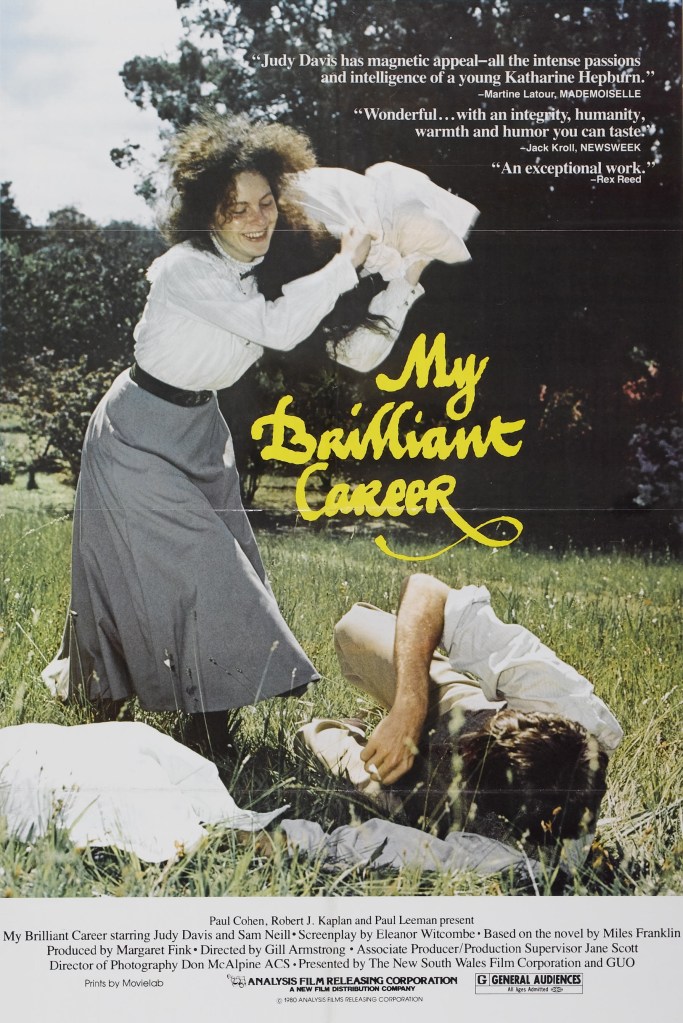
Armstrong’s film expertly builds the unspoken, awkward courtship between these two. They take it in turns to ignore and provoke jealousy in each other. When thrown together they go from surly silence into bawdy flirtation (including an epic outdoor pillow-fight across Harry’s farmland). The question always remains though whether marriage is the right choice for either of them. Not least as it would potentially end Sybylla’s dreams of exploring the world and her place in it.

My Brilliant Career is lusciously designed (by Luciana Arrighi) and beautifully shot (by Donald McAlpine). Gillian Armstrong brings a strong visual eye to the film – there are some superb compositions involving windows and walls creating visual barriers between characters and some terrific transitions (the finest being a cut that visually compares Sybylla’s beside her bed with her mother in her dining room at home). The film builds a wonderfully subtle feminist picture, with several women – Sybylla’s mother who has married for love and found poverty, her aunt (well played by Wendy Hughes) jilted by an unsuitable husband, her great aunt who chose freedom but is deeply lonely – presenting potential life paths that further illustrate the paucity of choice.

It makes for a prickly but eventually very involving film, with a sly wit, very well filmed that gradually makes us care deeply for a character who is initially as irritating and challenging for the viewer as she can be for the characters. With a brilliant performance by Judy Davis, My Brilliant Career is an important milestone in the Australian New Wave and a superb debut for Gillian Armstrong, that mixes strong thematic ideas and beautiful visuals.

A Tree Grows in Brooklyn (1945)

A Tree Grows in Brooklyn (1945)

Easy-going father-daughter sentimentality in Kazan’s debut, which softens up an already gentle novel

Director: Elia Kazan

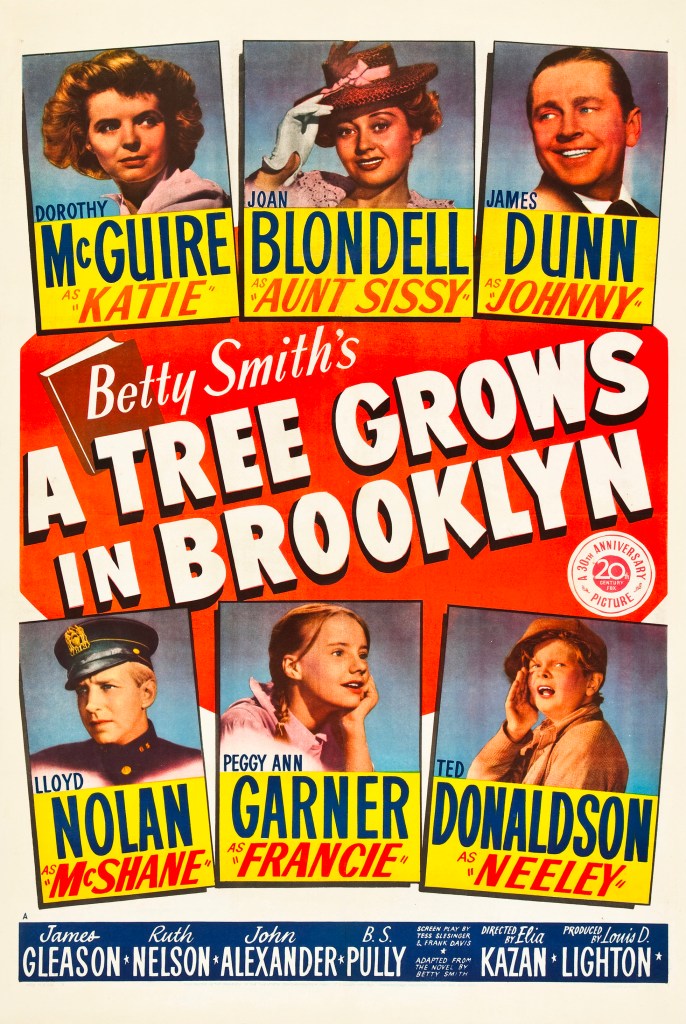
Cast: Peggy Ann Garner (Francie Nolan), Dorothy McGuire (Katie Nolan), Joan Blondell (Aunt Sissy), James Dunn (Johnny Nolan), Lloyd Nolan (Officer McShane), Ted Donaldson (Neeley Nolan), Ruth Nelson (Miss McDonough), John Alexander (Steve Edwards)

In 1912 an Irish-American family, the Nolans, struggle to make ends meet in Brooklyn. Mother Katie (Dorothy McGuire) keeps a close eye on the purse strings to ensure she can keep a roof over the head of her children: 13-year-old Francie (Peggy Ann Garner) and young Neeley (Ted Donaldson). Problem is, Katie also has a third child: her husband Johnny (James Dunn), a happy-go-lucky dreamer and “singing waiter” who is also a hopeless drunk. Johnny, with his “live-your-dreams” outlook on life, natural charm and instinctive understanding of people, is Francie’s idol. With another child on the way, and the Nolan cash reserves at breaking point, can the family hold together?

A Tree Grows in Brooklyn drips with sentimental, old-fashioned, easy-watching charm. Adapted from a best-selling novel by Betty Smith, it strips out most of the plot (which covers nearly 17 years rather than the single one featured here) and considerably waters down the original’s content. (It also, hilariously, avoids any appearance at all of the eponymous tree at the centre of the Nolan tenement block, which is cursorily referenced only twice.) Smith’s book was a semi-auto-biographical chronicle of a life of struggle survived by a daughter who flourishes, but the film is more of an optimistic fable of the triumph of family love.

It feels strange that this is the first film of Elia Kazan, who would become better known for hard-hitting, location-shot, method-tinged dramas rather than the tear-jerking charm here. Kazan was later sceptical about the film – highly critical of what he considered his overly theatrical staging, particularly of the scenes set in the Nolan home – and even at the time stated he was so unsure about what he was doing that the film was effectively co-directed by cinematographer Leon Shamroy. But Kazan’s skill with actors shines through and he invests it with a great deal of pace and emotional truth.

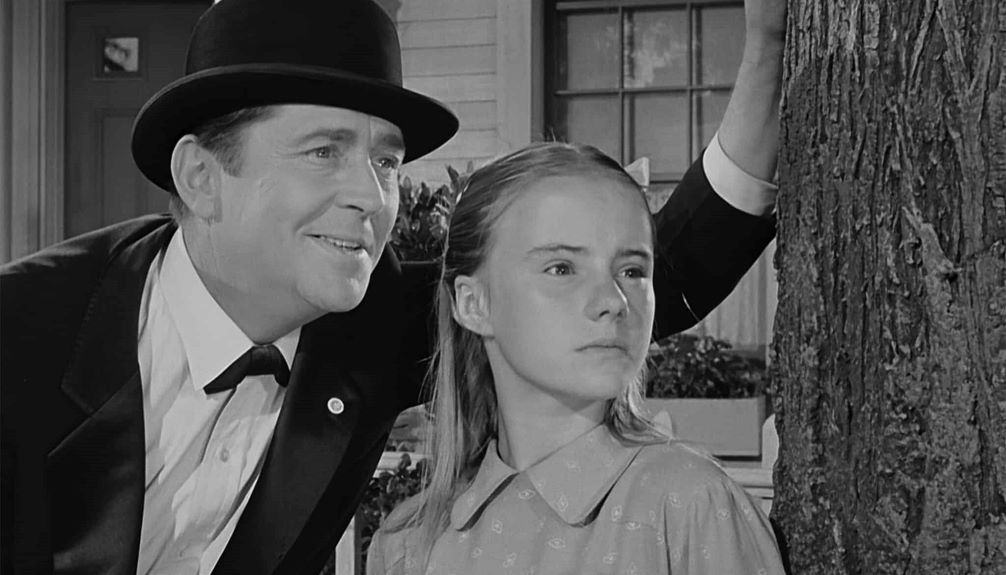
His main benefit is the very strong performances from Garner and Dunn in the film’s most important relationship. Both actors won Oscars (Garner the juvenile Oscar, Dunn for Best Supporting Actor) and it’s the loving meeting of hearts and minds between father and daughter that lies at the film’s heart. Francie is a young girl dedicated to education – slavishly, but obsessively, reading through the local library in alphabetical order, regardless of suitability of the books – who dreams of going to a better school and bettering her life. It’s a dream that her mother struggles to grasp – largely unable to see beyond the immediate needs of putting food on the table – but which her father understands and is desperate to support.

This bond is partly what leads to Francie’s idolising her doting dad. And Johnny is doting. He’ll do things her mother won’t dream of doing – including weaving an elaborate fantasy to win her a place at that better school. He’ll joke and laugh, sing songs and entertain her while indulging her artistic leanings. Unfortunately, he’ll also make promises to reform he won’t keep, stumble home late at night or be found, drunk in the street, having boozed away every penny he’s earned.

Dunn poured a lot of himself into this self-destructive dreamer. A vaudeville comedian who had a successful run of films with Shirley Temple in the 1930s, he had blown most of his fortune in bad investments. By the 1940s was struggling to find work with his drink problem widely known. But he was also charming, decent and kind, but seen to lack the drive to build a successful career. In effect, Johnny was a version of his own life, and Dunn not only nails Johnny’s charm but also laces the performance with a rich vein of sadness, guilt and shame, but still loved by all.

While Johnny jokes and laughs with the neighbours, Katie cleans the hallway of their tenement block to earn extra bucks and moves the family to a smaller room to save what money she can. Played with a fine line in drudgery and put-upon stress by Dorothy McGuire (in a role as thankless as Katie’s life is), Katie remains unappreciated by her daughter (who sees her as a moaner who won’t cut her father a break) and by her husband as being too obsessed with the purse-strings.

The major flaw, for me, of A Tree Grows in Brooklyn is that the film falls almost as uncritically in love with Johnny as Francie. Getting older it’s hard not to see Johnny as essentially irresponsible and selfish, a well-meaning but destructive force on the family, the cause of the poverty which has made Katie crushed, dowdy and increasingly stressed and bitter. She essentially suffers everything – skipping meals, slaving over multiple jobs, saying no to every desire Francie has – while Johnny flies in, cracks jokes, says yes to everything and disappears when its time to work out how to deliver.

A Tree Grows in Brooklyn, however, wants to tell a sentimental story of a father-daughter bond and hasn’t got too much time for Katie – or for making Francie really face the flaws in her father and the virtues of her mother (for all the film gives mother and daughter a late reconciliation). There is something fake about this (tellingly the book gives a sharper realisation for Francie and subtly changes Johnny’s fate to make it less idealised). But all edges are shaved off here and the family divisions are bridged as easily as poverty is eventually solved. (There is also considerable watering down of the liberated lifestyle of Katie’s sister, engagingly played by Joan Blondell).

It makes for a film that’s warm, comforting and essentially light and even a little forgettable. It’s all too easy to drop off in front of it on a Sunday afternoon. Try as you might, you can’t say that about other Kazan films. A little more grit to this would have increased its impact considerably.

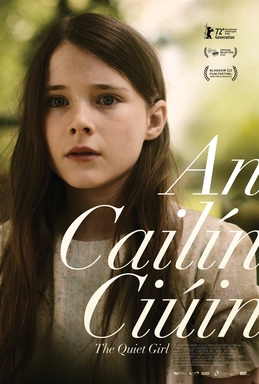
The Quiet Girl (2022)

The Quiet Girl (2022)

Stunning, low-key deeply-moving drama as a child flourishes with love in this Irish drama

Director: Colm Bairéad

Cast: Catherine Clinch (Cáit), Carrie Crowley (Eibhlín Kinsella), Andrew Bennett (Seán Kinsella), Michael Patric (Da), Kate Nic Chonaonaigh (Mam)

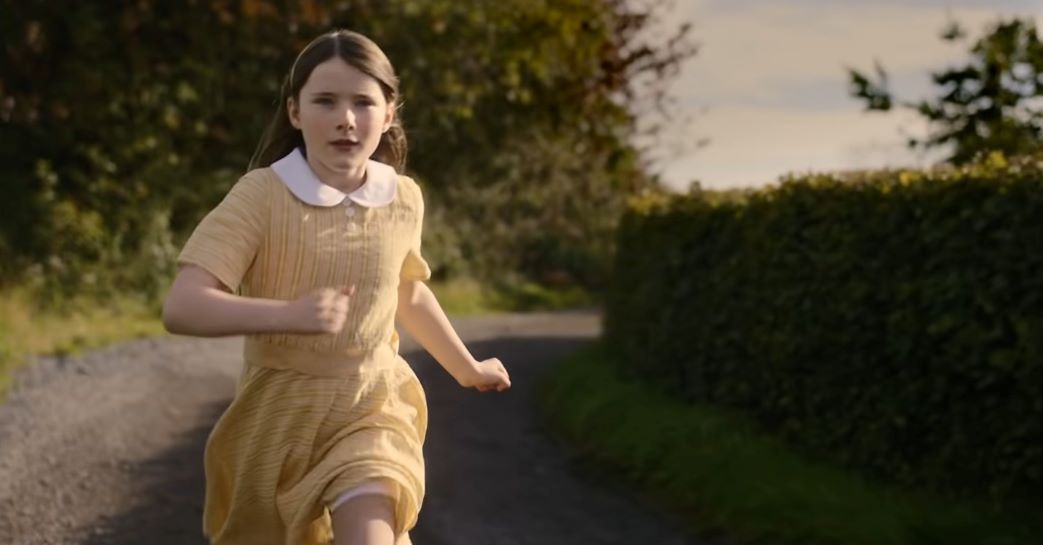
Childhood can be difficult. Even more so when the child knows they are an unwanted daughter, in an overlarge family overseen by an uncaring father (Michael Patric) more interested in the horses and the bottle than those his family. Cáit (Catherine Clinch) is a quiet child in early 1980s Ireland who has learned quietness because she knows no one cares what she has to say. When her Ma (Kate Nic Chonaonaigh) is expecting another child, Cáit is sent to stay with her Ma’s middle-aged cousin Eibhlín (Carrie Crowley) and husband Seán (Andrew Bennett) on their farm. There she finds a warmth, care and love she never knew at her home. But, though this is a house with warmth and “no secrets”, it is also a home where a painful loss is never spoken of.

Adapted from one of the finest short stories from Claire Keegan, one of Ireland’s leading novelists, The Quiet Girl became the most successful Irish film of all time and the first nominated for an Oscar. It’s no wonder: this is a beautifully made, carefully crafted and immensely moving film, overflowing with humanity and empathy that left me dapping my eyes.

Perfectly scripted and directed with a quiet controlled restraint by Bairéad, The Quiet Girl is a film that throbs with emotion, a collection of small events and everyday moments of kindness that bloom into moments of great resonance by the skilful empathy built up for this child. Throughout the film, shot in a Academy ratio 4:3, Cáit is frequently positioned in the centre of the frame. At first, in her home and school, this superbly stresses her isolation. Events bustle around her, family members casting shadows over her. She stares down and away from us and feels like the single fixed point in a world of motion. She sits unnoticed in the backseats of cars and watching her father drink in pubs. She is at the centre of our perception, but adrift in a sea of activity around her.

Bairéad superbly uses this device throughout to slowly bring characters and interactions to curve inwards and focus on Cáit much as we do. When she arrives at her aunt’s farm, for the first time the attention of others in the frame settles on her. Their eyes are on her, they speak to her, move to connect with her. The Quiet Girl is intensely moving as it shows the difference a change of scene can make, the warmth and love can make to a child who has known nothing like it.

This is in many ways a simple story, but the low-key tenderness which Bairéad tells it gives it immense power. Cáit – played with quiet gentleness by Catherine Clinch – is a sensitive, intelligent and caring girl who has never been allowed to flourish. It’s striking after the film’s first fifteen minutes showcasing the indifference she faces, how much your heart glows as Eibhlín talks to her, makes her feel comfortable, washes her and tucks her up in bed. It’s a world away from the neglect we’ve seen Cáit suffer.

This is a film where small acts of kindness bring tears to the viewers eyes. When Cáit wets the bed on her first night – too scared to use the toilet – Eibhlín immediately notes her fear (she expected punishment) and apologises for giving her “a mattress that weeps”. Eibhlín separates her from her uncomfortable clothes, teaches her basic household tasks, brushes her hair, encourages her to feel a part of their home. For the first time Cáit is treated not as a burden – or worse – but as a human being. This is brilliantly conveyed by Carrie Crowley as Eibhlín, who delivers a performance of immense emotional depth, both tender and kind but with a deeper layer of sadness underneath, the cause of which is slowly revealed.

Bairéad is sensitive about the home environment Cáit has emerged from. There are dark hints: her Da is, at best, a potentially violent drunk with a temper and Cáit is introduced first hiding in a field, then under her bed. Arriving at her foster home she has a fear of “secrets”. Eibhlín is quick to pick up on this, reassuing her there are no secrets here.

No secrets perhaps, but a pain never spoken of. Cáit’s room is decorated in train wallpaper and she sleeps in a child’s bed. She is dressed in boy’s clothes (“our old things”) only a few sizes too big for her. Seán finds her hard to look at, at first – but when, under her care, she wanders off he becomes panicked and distressed. The loss this sad couple suffered is clear to us and The Quiet Girl becomes a film of mutual healing. There is pain on both sides: a child with parents and parents without a child.

Seán’s growing bond with Cáit is wonderfully paced and deeply affecting. Gruff but kindly, Andrew Bennett’s performance melts the heart. From a biscuit placed without comment on a table to a run to the post-box that turns into a repeated game, their slowly flourishing love is simply beautiful. As he buttons her coat or the two of them race to sweep clean the cow shed, you’ll find it impossible not to be moved. Seán is slower to bond with the child than Eibhlín, but both of them find the pain in their heart slowly eased by allowing theirs to open to this quiet, caring child.

Of course, it is only a holiday that must end. Bairéad’s film ends with Keegan’s own, tinged with a slight ambiguity. But it’s a beautiful one for all that, a heart-rending tribute to emotional connection between people. Bairéad’s film has this empathy running through it like a pulse. Shot with an immense visual beauty that turns everyday objects into items of intense beauty – from tables to drains – The Quiet Girl is a deeply moving quiet masterpiece, which carries a low-key emotional impact that is hard to beat and impossible to forget.

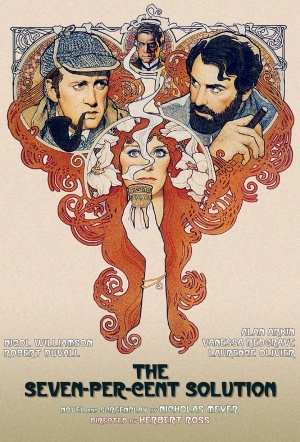
The Seven-Per-Cent Solution (1976)

The Seven-Per-Cent Solution (1976)

Affectionate and faithful Holmes pastiche that shines an interesting light on the Great Detective’s character

Director: Herbert Ross

Cast: Nicol Williamson (Sherlock Holmes), Robert Duvall (Dr John Watson), Alan Arkin (Dr Sigmund Freud), Laurence Olivier (Professor Moriarty), Vanessa Redgrave (Lola Devereaux), Joel Grey (Lowenstein), Jeremy Kemp (Baron Karl von Leinsdorf), Charles Gray (Mycroft Holmes), Samantha Egger (Mary Watson), Jill Townsend (Mrs Holmes), John Bird (Berger), Anna Quayle (Freda)

The magic of Sherlock Holmes is he is immortal. Doyle’s detective has been reshaped so many times since the publication of the canonical stories, that we’re now used to seeing him presented in myriad ways. It was more unsettling to critics – particularly British ones – in 1976, who didn’t know what to make of an original, inventive Holmes story that treats the characters seriously but is playful with the canon. Was this a parody or a new story? (Why can’t it be both!) Today though, The Seven-Per-Cent Solution stands out as a Holmesian treat, a faithful slice of gap-filling fan fiction.

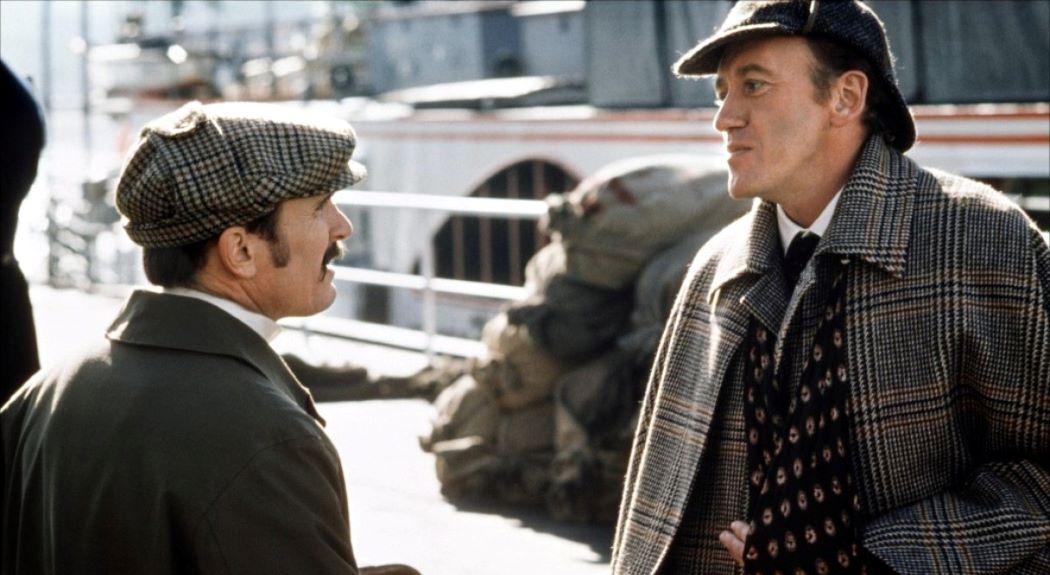
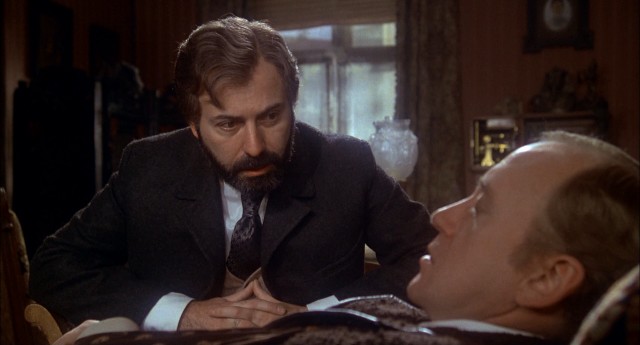
Based on a best-selling novel by Nicholas Meyer (who also adapted it), The Seven-Per-Cent Solution expertly reworks Doyle’s The Final Problem. Professor Moriarty (Laurence Olivier) is not the Napoleon of Crime, but a mousey maths tutor, the subject of Holmes’ (Nicol Williamson) cocaine-addled idée fixe. Worried about his friends dissent into addiction, Dr Watson (Robert Duvall) tricks Holmes into journeying to Vienna to receive treatment from an up-and-coming specialist in nervous disease and addiction, Dr Sigmund Freud (Alan Arkin). The treatment is a slow success – and the three men are drawn into investigating the mysterious threat to drug addicted glamourous stage performer Lola Devereaux (Vanessa Redgrave) that may or may not be linked to her fierce lover, the arrogant Baron Karl von Leinsdorf (Jeremy Kemp).

As all we Holmes buffs know, seven per-cent refers to Holmes’ preferred mix of cocaine, taken to stimulate his brain between cases and see off boredom. But what if that persistent cocaine use wasn’t a harmless foible – as Holmes tells the disapproving Watson – but something much worse? Kicking off what would become a decades long obsession with Holmes the addict – Brett and Cumberbatch would have their moments playing the detective high as a kite and a host of pastiches would explore the same ground – Meyer created a version of Holmes who was definitely the same man but losing control of himself to the power of the drug.

This short-circuited some critics who didn’t remember such things from school-boy readings of Doyle and hazier memories of Rathbone (those films, by the way, were basically pastiches in the style of Seven-Per-Cent Solution as well). But it’s a stroke of genius from Meyer, shifting and representing a familiar character in an intriguing way that expands our understanding and sympathy for him. Holmes may obsessively play with his hands and have a greater wild-eyed energy to him. He may sit like a coiled spring of tension and lose his footing. But he can still dissect Freud’s entire life-story from a few visual cues in a smooth and fluid monologue and his passion for logic, justice – as well as his bond with the faithful Watson (here bought closer to Doyle’s concept of a decent, if uninspired, man) – remain undimmed.

It helps that the film features a fantastic performance from Nicol Williamson. Few actors were as prickly and difficult – so could there have been a better choice to play the challenging genius? Williamson’s Holmes is fierce in all things. Introduced as a wild-eyed junkie, raving in his rooms and haring after leads, his behaviour oscillates between drug-fuelled exuberance to petulant paranoia. But there are plenty of beats of sadness and shame: Holmes is always smart enough to know when he no longer masters himself. When the mystery plot begins (almost an hour into the film), Williamson’s does a masterful job of slowly reassembling many of the elements of the investigative Holmes we are familiar with – the focus, the energy, the self-rebuke at mistakes and the excitement and wit of a man who loves to show he’s smarter than anyone else.

The film is strongest as a character study, in particular of Holmes. Its most engaging sections take Holmes from a perfectly reconstructed Victorian London (including a loving, details-packed recreation of 221B from production designer Ken Adam) to waking from a cold turkey slumber full of apologies for his cruel words to Watson. Seeing Watson’s quiet distress at Holmes state, and the great efforts he takes to help him, are a moving tribute to the friendship at the book’s heart. The clever way Meyer scripts Holmes’ ‘investigation’ into Moriarty (an amusing cameo from Laurence Oliver, his mouth like a drooping basset hound) sees him apply all his methods (disguise, methodical reasoning, unrelenting work) in a way completely consistent with Doyle but clearly utterly unhinged.

That first half serves as a superb deconstruction of the arrogance of literature’s most famous detective, who won’t admit the slightest flaw in himself. It’s still painful to see a frantic Holmes, desperate for a hit, causing a disturbance in Freud’s home and denounce Watson as “an insufferable cripple” (a remark met with a swift KO and later forgiven). Holmes’ cold turkey sequence is a fascinating sequence of nightmareish hallucinations, as he is plagued by visions of cases past (The Engineer’s Thumb, Speckled Band and Hound of the Baskervilles among them) and the eventual awakening of Holmes as a contrite, humbled figure very affecting.

Bouncing off Williamson we have the traditional “Watson” role split between that character and Freud. Robert Duvall is a very unconventional choice as Watson – and his almost unbelievably plummy accent takes some getting used to – but he gives the character authority without (generously) giving him inspiration. Limping from a war wound (another touch of the novels often missed until now), he’s dependable, loyal and goes to huge lengths to protect his friends.

But most of the traditional role is actually given to Freud, played with quiet charm and authority by Alan Arkin. Intriguingly the film places Freud as a combination of both men’s characters. He has the analytical mind of Holmes, investigating the subconscious. But he also chases after errands for Holmes, “sees but does not observe” during the case in the manner of Watson and eventually becomes an active partner in confronting the villains.

The actual mystery (taking up less than 40 minutes of the film’s runtime) can’t quite maintain the momentum, being a rather trivial affair (greatly simplified from the book) revolving around a cameo from Vanessa Redgrave as a fellow drug addict Holmes feels a touching sympathy for. Jeremy Kemp makes a fine swaggering bully, but his greatest moment is actually his pre-mystery anti-Semitic confrontation with Freud at a sports club, culminating in a Flemingesque game of real tennis between the two. If the film has any moment that tips into outright comedy, it’s a closing train chase that involves Holmes, Watson and Freud dismantling the train carriage to burn the wood as fuel.

But the real heart of the film is Holmes. Throughout the film we are treated to brief visions of the boyhood Holmes slowly climbing a staircase. What he saw at the top of that staircase is buried deep in his subconscious, with the final act of the film revealing all under hypnosis. It’s an intriguing motivator for all Holmes has become, just as it is surprisingly shocking. As Watson comments, the bravest act is sometimes confronting ourselves: The Seven-Per-Cent Solution treats the detective with huge respect, while pushing him into psychological waters Doyle would never have dreamed of. It’s why the film (and Meyer’s book) is a fascinating must-see for Holmes fans: it takes the material deeper, but never once forgets its loyalty to the source material.

Things to Come (1936)

Things to Come (1936)

HG Wells ultra-serious view of the future is stilted but also visionary

Director: William Cameron Menzies

Cast: Raymond Massey (John Cabal/Oswald Cabal), Edward Chapman (‘Pippa’ Passworthy/Raymond Passworthy), Ralph Richardson (The Boss), Margaretta Scott (Roxana Black), Cedric Hardwicke (Theotocopulos), Maurice Braddell (Dr Edward Harding), Sophie Stewart (Mrs Cabal), Derrick De Marney (Richard Gordon), Ann Todd (Mary Gordon), John Clements (Enemy pilot)

Alexander Korda was thrilled. He’d secured the rights to the legendary HG Well’s new novel. Even better the Great Man would work, hand-in-glove, with Korda’s team to bring The Shape of Things to Come to the screen. It would be a grand science-fiction hit, that would echo the success of American films based on Wells’ work (films, to be fair, Wells pretty much hated apart from The Invisible Man). It became a continual struggle before the final flawed-but-fascinating film arrived in cinemas.

Things to Come opens in the (then) near future in 1940 as war tears “Everytown” on Christmas Day and flies 100 years into the future. Bombing destroys the city and hurtles the world into over twenty years of never-ending war that leaves civilisation wrecked by carnage, advanced weapons and poisonous gases. A legacy of the war, “the wandering sickness” devastates the survivors, killing half the remaining population. In the ruins of Everytown in the 1960s, the Boss (Ralph Richardson) rises to take power, one of many warlords across the world being challenged by the “World Communications” alliance of engineers and scientists in Basra, Iraq. When they reshape the world, decades of progress lead to a new civilisation in 2036 aiming at the stars.

HG Wells saw Things to Come as a polemic, an ambitious and optimistic look at how mankind should progress, leaving behind war and politics to embrace rational thought and the quest for knowledge. Written at a time when tensions were high in Europe, it would show the world torn apart, devastated and reborn greater than it ever was before. Never-the-less at every point, the unambitious, myopic and power-hungry gather to hold back progress. What he didn’t really see it as was a conventional “drama” or those involved as “characters” more devices, ciphers and mouthpieces for his viewpoints.

Which helps explain the curious project that made it to the screen. Wells was guaranteed approval over the dialogue, which remains flat and heavy handed. Actors felt constrained within the sonorous phasing and over-written prose. It wasn’t helped by director William Cameron Menzies’ discomfort with dialogue scenes. Whenever two people stand around (which sums up the blocking) and chat, the film is frequently a little dull, settling for a semi-disguised lecture on humanity, science and progress. Korda correctly identified the dialogue problems and cut as much of it as possible.

In doing so, he snipped away much of the narrative framework of the film. In a film that flies forward through time and world-changing events, we frequently get confused about the exact details of who goes why and where and what makes characters do the things they do. Characters disappear and reappear, fly across the world in seconds, form and break alliances and argue and drop cases all on a sixpence. Raymond Massey later talked about how hard he found his character (a man and his grandson, bridging all timelines) to bring to life with dialogue largely devoid of emotion. Much of Things to Come can be dry-as-a-bone.

But yet… Away from the weaknesses of the script, much of Things to Come is quite awe-inspiring. While the characters might be a little flat, the energy of the film’s first two acts (in 1936 and 1966) offers a host of striking scenes and images. Things to Come remains powerful and horrifying when it looks at the darkness and damage of war. The 1936 bombing attack on Everytown still shocks with its superbly assembled shots of buildings exploding, crowds panicking, dead bodies slumped in cars, terrified faces and dead children in the rubble. Imagine watching this with the Blitz just a few years away. Menzies may not direct acting or dialogue with much inspiration, but his skill with visuals and editing is clear. The montage carrying the world over the next thirty years is a masterful mix of fake news-footage and technological innovation as ever more advanced tanks and airplanes roll past the screen. The film’s use of design and visuals is frequently haunting and impressive.

It carries across to the bombed-out design of Everytown in the 1960s. A shell of a city, where wrecks of cars are pulled by horses. Those suffering from “the Wandering Sickness” move like zombies through the city. Homes and buildings are gutted remains. Newspaper headlines – of newspapers that become ever more basic in printing and more expensive in price – had previously helped communicate the passage of events. Now the news is chalked up onto a board outside the home of the Mussolini-like Boss (the film’s finest performance of charismatic swagger and delusional power-mad greed by Ralph Richardson). Clothing is basic and functional, pulled together from scraps leftover from the war, in a world largely devoid of all technology.

This wasteland makes the futuristic designs even more striking. The “Wings Over the World” organisation – growing from the cradle of civilisation in Iraq – is sleek, metallic and efficient in its construction. When John Cabal (Raymond Massey) lands back in the 60s ruin of Everytown, he looks like a spaceman. He might as well be. His fleet of unimaginably vast airplanes have inspired visions of futuristic flight right up to the mighty airbases the Avengers operate in the MCU.

While you can snigger a little at the utopiaish version of the future – very Star Trek in its flowing robes and shoulder pads – it’s vision of subterranean cities full of everything from wrist communicators to widescreen TVs feels quite prescient. Everything is clear, polished and perfect – much of it doesn’t look a million miles away from an Apple store. While the villains of the future (a band of luddites led by Cedric Hardwicke) may be little more than paper tigers, given only the vaguest motivations, the grand engineering accomplishments of the future and their glances at the stars feel inspired in their detail and ambition.

It’s where Things to Come triumphs. It might not often have much to listen to, but every single scene carries a slice of design or visual interest. Its frequently assembled into effective – and even terrifying – montages. And its design of the future – based on Wells vision and bought to life by Menzies and his technical team – is a perfect mix of striking and prescient. Things to Come isn’t always the best drama, but as a forward-looking piece of design it’s truly memorable.

All Quiet on the Western Front (2022)

All Quiet on the Western Front (2022)

War is Hell in this impressively made but strangely unoriginal film, that looks the same and carries the same message as countless others

Director: Edward Berger

Cast: Felix Kammerer (Paul Bäumer), Albrecht Schuch (Stanislas “Kat” Katczinsky), Aaron Hilmer (Albert Kropp), Moritz Klaus (Franz Müller), Adrian Grünewald (Ludwig Behm), Edin Hasanovic (Tjaden Stackfleet), Daniel Brühl (Matthias Erzberger), Thibault de Montalambert (General Ferdinand Foch), David Striesow (General Friedrichs)

Perhaps no front-line fighting in history was more hellish than the mud-splattered sludge of death that were the First World War Trenches. Millions of men were fed through an industrial mincer of death, all for remarkably little gain. It was a tragedy born of ambition and pride. It’s cost on the young was beautifully captured by Erich Maria Remarque’s novel (an adaptation of which was one of the first Oscar winners) and it is bought to the screens again in this visceral German adaptation.

Paul Bäumer (Felix Kammerer) and his friends are naïve young men excited to serve in Spring 1917. Little do they know the blood-soaked, brutal reality of war. It’s soon thrust upon them when their first night in the trenches coincides with a catastrophic artillery attack. Skip forward a year and its November 1918. While Germany’s lead negotiator Matthias Erzberger (Daniel Brühl) tries to end the war, Paul and his mentor “Kat” (Albrecht Schuch) just hope to survive. But is there any hope?

All Quiet on the Western Front is raw, bloody and unflinching in its glance at the horrific realities of war. Shot with a cinematic beauty by Edward Berger that turns the mist filled world of no-man’s land into a sort of dreamscape that tips into a nightmare, it leaves no doubt about the brutal cost of war. Bodies are torn apart by explosions, shredded by bullets (even dead ones). Hand-to-hand combat is ruthless and there is not a jot of quarter given on any side. Everything is coated in a sheen of mud and blood, with dying men desperately gulping filthy water or left slumped where they fall.

The after-effects of war are horrifically shown. On their first night one of Paul’s friend is literally shredded by mortar fire. Bodies left on no-man’s land are peppered with bullets. The remains of a soldier is blasted out of his uniform, left hanging several feet up a tree. Paul and Kat discover a missing regiment of young recruits dead in an old factory, having removed their gas masks too soon. Tanks emerge from the mist, setting the ground shaking, rats fleeing before them, spewing death from their machine gun turrets, crushing screaming men under their tracks.

This is actually a fairly loose adaptation of the novel. The original prided itself on its lack of specifics: it’s never quite sure when or where it happens other than in the trenches. The soldiers fight in brutal battles in unnamed locations and simply live a day-to-day existence. This version make everything very specific: November 1918. Sub-plots around the armistice negotiations and the unwillingness of a die-hard Prussian General (a vilely arrogant David Striesow) to accept defeat expand the film beyond the novel’s original scope. However, this expansion never feels fully explored and at times detracts from the film’s richer, more intimate focus on the soldiers.

Berger’s film perfectly captures the sense of these boys being fed into a huge industrial meatgrinder in a cycle of death. The opening sequence follows a young soldier. He trembles with fear before going over the top, aimlessly fires his bullets and then grabs his spade to continue the charge and bludgeon a soldier. Cut to black before we follow the progress of Heinrich’s uniform. It is removed from his dead body, carted back to Germany, washed, repaired and then handed over to Paul as he signs up. Paul questions the name-tag inside: “Must have been too small. Happens all the time” the recruiting officer says, ripping it out. It’s all a production line.

Paul soon learns the truth. Felix Kammerer is excellent as this sensitive, enthusiastic young man (forging his father’s signature so he can join up) who sheds his innocence to become a battle-hardened warrior, succumbing to a mechanical, merciless violence in combat. He kills without hesitation and when guilt arrives – such as his killing of a French soldier in a fox hole – it leaves little long-term impact, so deadened has he become. Equally good is Albrecht Schuch, humane and worldly-wise figure as Kat. The bond – part brotherly, part father-son – is the film’s most affecting personal beat, and its most effecting scene involves Paul reading the illiterate Kat his mail.

There is much to admire here. But yet, while a technical triumph and immersive experience (even its score plays out with the organ-led heaviness of an artillery attack), I was less impressed with it than I expected. Perhaps that’s because it does or says nothing new. The original film was made by many people who were actually in the trenches. This film was made by people who grew up watching movies about wars. It’s frames of reference are subtly different, although its intentions are the same. Maybe that’s why I find it less affecting and less shocking than a film made 100 years ago.

For all its technical skill, the film is a continuation of visual grammar and thematic ideas established in countless films before. The blood-spattered immediacy of Saving Private Ryan. Tracking shots that remind you of 1917 and Paths of Glory. The on-the-streets fury of Black Hawk Down. The rumbling soundtrack of Dunkirk. It tells us War is Hell: but nothing else. Maybe that message is enough and it deserves repeating. But when the film expands the original like this, you want more.

The inclusion of the armistice works against it. The time jump means we lose any sense of the slow disillusionment of these men. Several key moments from the book – most notably Paul’s brief return to a home he can no longer relate to – have been stripped out. Setting the film in the last week of the war leads to a predictable ending that feels like its straining for even more pathos – of course there will be key deaths in the final minutes of the war. A more daring film might have looked more at how a harsh armistice and dark mutterings of betrayal led so many of these young men to hurl Germany back into war only twenty years later.

All Quiet on the Western Front is powerful, but its power is one of reiterating a familiar message. Berger’s film is wonderfully made but only follows confidently in the footprints of other (better) films. It avoids developing its message or context further and it’s expansion of the book’s plotline waters down the personal stories that made it so affecting. It’s grand, cinematic and powerful – but could have been more.

The Heiress (1949)

The Heiress (1949)

Is it love or is it avarice? Wyler’s sumptuous costume drama is a brilliant translation of Henry James to the screen

Director: William Wyler

Cast: Olivia de Havilland (Catherine Sloper), Montgomery Clift (Morris Townsend), Ralph Richardson (Dr Austin Sloper), Miriam Hopkins (Lavinia Penniman), Vanessa Brown (Maria), Betty Linley (Mrs Montgomery), Ray Collins (Jefferson Almond), Mona Freeman (Marian Almond), Selena Royle (Elizabeth Almond), Paul Lees (Arthur Townsend)

Pity poor Catherine Sloper (Olivia de Havilland). She’s seems destined forever to be the spinster, the last person anyone glances at during a party. Her father Dr Sloper (Ralph Richardson) can’t so much as walk into a room without gently telling how infinitely inferior she is to her mother. And when a man finally seems keen to court her, her father tells her that of course handsome Morris Townsend (Montgomery Clift) will only be interested in her inheritance. After all, there is nothing a young man could love in a forgettable, dull, second-rate woman like Catherine. He’s cruel, but is he right – is Morris a mercenary?

The Heiress was adapted from a play itself a version of Henry James’ Washington Square. It’s bought magnificently to the screen in a lush, sensational costume drama that comes closer than anyone else at capturing those uniquely Jamesian qualities of ambiguity and contradictory motives among the New American elites. Magnificently directed by William Wyler, it brilliantly turns a theatrical character piece into something that feels intensely cinematic, without once resorting to clumsy ‘opening up the play’ techniques. And it marshals brilliant performances at its heart.

Sumptuously costumed by Edith Head, whose costumes subtly change and develop along with its central character’s emotional state throughout the story, it’s largely set in a magnificently detailed Upper New York household, shot in deep focus perfection by Leo Tover, which soaks up both the reaction of every character and the rich, detailed perfection of decoration which may just be motivating some of the characters. Not that we can be sure about that, since the motives of Morris Townsend and his pursuit of Catherine remain cunningly unreadable: just as you convince yourself he’s genuine, he’ll show a flash of avarice – then he’ll seem so genuinely warm and loving, you’ll be sure he must be telling the truth or be the world’s greatest liar.

Catherine certainly wants it to be true – and believes it with a passion. The project was also a passion piece for de Havilland, and this is an extraordinary, Oscar-winning performance that delves deeply into the psyche of someone who has been (inadvertently perhaps) humiliated and belittled all her life and eventually reacts in ways you could not predict. Catherine is clumsy, naïve and lacking in any finesse. With her light, breathless voice and inability to find the right words, she’s a doormat for anyone. She even offers to carry the fishmonger’s wares into the house for him. At social functions, her empty dance card is studiously checked and her only skill seems to be cross-stitch.

She is an eternal disappointment to her father, who meets her every action and utterance with a weary smile and a throwaway, unthinking comment that cuts her to the quick. Richardson, funnelling his eccentric energy into tight control and casual cruelty, is magnificent here. In some ways he might be one of the biggest monsters in the movies. This is a man who has grown so accustomed to weighing his daughter against his deceased wife (and finding her wanting) that the implications of the impact of this on his daughter never crosses his mind.

Catherine is never allowed to forget that she is a dumpy dullard and a complete inadequate compared to the perfection of her mother. Richardson’s eyes glaze over with undying devotion when remembering this perfection of a woman, and mementoes of her around the house or places she visited (even a Parisian café table later in the film) are treated as Holy Relics. In case we are in any doubts, his words when she tries on a dress for a cousin’s engagement party sum it up. It’s red, her mother’s colour, and looks rather good on her although he sighs “your mother was fair: she dominated the colour”. Like Rebecca this paragon can never be lived up to.

So, it’s a life-changing event when handsome Morris Townsend enters her life. There was criticism at the time that Clift may have been too nice and too handsome to play a (possible) scoundrel. Quite the opposite: Clift’s earnestness, handsomeness and charm are perfect for the role, while his relaxed modernism as an actor translates neatly in this period setting into what could-be arrogant self-entitlement. Nevertheless, his attention and flirtation with Catherine at a party is a blast from the blue for this woman, caught mumbling her words, dropping her bag and fiddling nervously with her dance card (pretending its fuller than of course it is).

Her father, who sees no value in her, assumes it is not his tedious child Morris has his eyes on, but the $30k a year she stands to inherit. And maybe he knows because these two men have tastes in common, Morris even commenting “we like the same things” while starring round a house he all too clearly can imagine himself living in – by implication, they also have dislikes in common. (And who does Sloper dislike more, in a way, than Catherine?) Morris protests his affections so vehemently (and Sloper lays out his case with such matter-of-fact bluntness) that we want to believe him, even while we think someone who makes himself so at home in Sloper’s absence (helping himself to brandy and cigars) can’t be as genuine as he wants us to think.

As does Catherine. Part of the brilliance of de Havilland’s performance is how her performance physically alters and her mentality changes as events buffet her. A woman who starts the film mousey and barely able to look at herself in the mirror, ends it firm-backed and cold-eyed, her voice changing from a light, embarrassed breathlessness into something hard, deep and sharp. De Havilland in fact swallows Richardson’s characteristics, Sloper’s precision and inflexibility becoming her core characteristics. The wide-eyed woman at the ball is a memory by the film’s conclusion, Catherine becoming tough but making her own choices. As she says to her father, she has lived all her life with a man who doesn’t love her. If she spends the rest of it with another, at least that will be her choice.

Wyler assembles this superbly, with careful camera placement helping to draw out some gorgeous performances from the three leads – not to forgetting Miriam Hopkins as a spinster aunt, who seems as infatuated with Morris as Catherine is. The film is shaped, at key moments, around the house’s dominant staircase. Catherine runs up it in glee at the film’s start with her new dress, later sits on it watching eagerly as Morris asks (disastrously) for her hand. Later again, she will trudge up it in defeated misery and will end the film ascending it with unreadable certainty.

The Heiress is a magnificent family drama, faultlessly acted by the cast under pitch-perfect direction, that captures something subtly unreadable. We can believe that motives change, grow and even alter over time – and maybe that someone can love somebody and their money at the same time (perhaps). But we also understand the trauma of constant emotional pain and the hardening a lifetime of disappointment can have. It’s the best James adaption you’ll ever see.

Tinker, Tailor, Solider, Spy (2011)

Tinker, Tailor, Solider, Spy (2011)

We’re going on a Mole Hunt: Le Carré’s finest book is boiled down into an atmospheric and masterful spy thriller

Director: Tomas Alfredson

Cast: Gary Oldman (George Smiley), Colin Firth (Bill Haydon), Tom Hardy (Ricki Tarr), Mark Strong (Jim Prideaux), Ciaran Hinds (Roy Bland), Benedict Cumberbatch (Peter Guillam), David Dencik (Toby Esterhase), Toby Jones (Percy Alleline), John Hurt (Control), Kathy Burke (Connie Sachs), Roger Lloyd-Pack (Mendel), Svetlana Khodchenkove (Irina), Konstantin Khabensky (Polyakov)

Anyone taking on this, Le Carré’s finest novel faced a tough challenge. After all, arguably the definitive version already exists: the masterful, slow-burn, 1979 TV adaptation (one of my favourite films ever) starring an Alec Guinness so perfect as the rotund, inscrutable spy-master George Smiley that Le Carré stated he could no longer write the character without thinking of him. I’ve long been nuts for Tinker, Tailor: I rushed to the cinema to see this with an equally keen-friend about five days before my wedding (on my wife-to-be’s birthday!) because I was looking forward to it so much. (Despite this the wedding went ahead). It can’t match that Guinness version – but it runs it close.

It’s the height of the Cold War, and the respected head of the British Intelligence Services (‘the Circus’) Control (John Hurt) is forced out, along with his deputy George Smiley (Gary Oldman) after a rogue mission in Hungary goes disastrously wrong. Over a year later, Smiley is secretly recalled to lead a mole hunt. Someone at the top of the service is a Russian agent – but who? New head Percy Alleline (Toby Jones)? Or one of the deputies – Bill Haydon (Colin Firth), Roy Bland (Ciaran Hinds) or Toby Esterhase (David Dencik)?

The first inspiration here is the screenplay. When I heard the film was two hours long I was stunned: the TV series unfolded over nearly seven hours! But the script, by Peter Straughan and the late Bridget O’Connor (who tragically died of cancer during it’s making) is a masterpiece. It brilliantly and skilfully compresses and restructures the novel, boiling down scenes to their core. But yet, it never feels rushed. The script creates composite scenes – most brilliantly a flashback to a Circus Christmas party – which allows a vast range of sub-plots and characters to simultaneously unfold.

Alongside this, the film is superbly, atmospherically directed by Tomas Alfredson. Alfredson brings a sharp, outsider’s view to this public-school nightmare turned espionage hub. These are posh boys, running an exclusive club, which plays by punishing rules. Everyone constantly spies one everyone else and there is no moment of privacy. Alfredsen brilliantly explores the social and emotional impact of spying, trapped within a grim and oppressive 70s mileu of dirt, beige, fear and loneliness.

The film is brilliantly designed, capturing a vast array of 70s designs and shades. The Circus is an industrial office – with its centre piece an orange lined, sound-proof room. Streets are lined with political graffiti – at one point we see “The Future is Female” a nifty comment on the all-male institution we are watching. Communist Hungary is a post-industrial slum, hotel rooms crowded with papers, cigarette smoke and overflowing ash trays.

At the centre is Gary Oldman, simply brilliant as Smiley. Controlled, measured and deploying only as much energy is needed, Smiley adds a hint of Guinness to his voice and always seems in control. But this lugubrious Smiley bubbles with tension, driven by twin demons. The first is Karla, the Russian spy-master Smiley let slip through his fingers years ago, the subject of a maudlin late-night recollection to his assistant Guillam. Even more important is his wife Ann, the betrayer Smiley still loves to distraction, a half-sight of her enough to make him stumble and lose breath. We never see either of these clearly in the film, reflecting their status as the only characters Smiley never understands and can’t make cool, calm, passion-free decisions about.

Cold-eyed reason guides everything else he does. Oldman’s Smiley may be grandfatherly, softly-spoken and controlled, but he’s as ruthless (if not more so) than everyone else. Smiley is precise and patient. There is a beautiful character establishing moment: Smiley, Mendel and Guillam are in a car bothered by a wasp. Guillam and Mendel flap with futile energy: Smiley waits and then lowers the window slightly at the perfect moment to let the wasp fly out. It captures in microcosm Smiley’s investigation. But he’s not afraid to use force: quietly threatening Dencik’s trembling Esterhase with deportation (not even flinching as a plane lands behind him), ruthlessly mining witnesses for evidence and verbally lashing out bitterly at the mole.

Alfredson’s film zeroes in on much of the emotional impact on spying. Smiley is a man slightly lost in the world outside of spying: retired, he seems adrift walking the streets, swims alone, sits at home in his suit. He’s so deactivated he doesn’t even speak for the first 18 minutes of the film, when he is recalled to life. Smiley has suppressed his emotions so completely only the shadow of his wife can move him. His home is a strange shrine, so much so he even keeps the gifts her lover gives her.

Each of the characters suffers under their burdens, and the demands on them for secrecy and isolation. Mark Strong’s Jim Prideaux buries himself in guilt in a caravan and forms a friendship with a young boy he later realises he is crafting into the same secretive man he is. Guillam is quietly ordered by Smiley to end his relationship with his boyfriend and acquiesces in private tears. Connie Sachs lives in retirement like a mad woman in an attic, cradling her memories. Control dies alone in a hospital bed. Later the Mole clings to having “made his mark” to supress his guilt, while a man whose career is ruined walks into oblivion blank faced not even noticing the rain around him.

Tinker, Tailor, Soldier, Spy is full of moments like this, the high-price of dogged, dedicated work like spying. Alfredson’s coolly, beautifully shot film (by Hoyte van Hoytema) with its lyrical score by Alfredo Iglesias is a masterpiece of tone. This is a dark, dangerous world and we are constantly reminded of it, in between the muttered meetings in board rooms and dark corriders. Tom Hardy’s (wonderful) Ricki Tarr and Mark Strong’s deeply emotional Prideaux are spies-on-the-ground, face-to-face with dangers. Theirs is a world of brutal throat-cuts, eviscerations in a bath and sudden executions. The decisions played out in rooms like that orange-lined sound-proof office with its methodical, intricate ship’s clock, lead to death and violence.

The film is stuffed with beautifully composed shots and brilliantly edited (Dino Jonsäter’s cuts frequently carry us over brilliantly over transitions and segues that streamline the narrative perfectly). Despite cutting back and forth over multiple timelines, it’s always clear when we are (an ingenious device sees Smiley change his glasses in retirement, instantly grounding us in the timeline based on the pair he is wearing). The Christmas party scene – exactly the sort of bizarre public-school irreverent piss-up (where spies who fight night and day to destroy the USSR raucously sing communist songs with a Lenin-dressed Santa) is a superb distillation of character and plot beats and becomes, in many ways the emotional pivot of the movie. It’s a very inventive addition.

The film assembles a superb cast. Oldman, of course, leads from the front but there is not a weak turn in the cast. Hardy is gritty, bitter and jumped-up, Cumberbatch holding his tension down under professionalism, Strong drips quiet grief, Firth swaggers with superb, assured insouciance, Hurt is the book’s arch-spy-master come to life, Jones is full of preening pride, Burke lost in memories. If I’d like the film to be longer for any reason, it would be to see more of these actors.

Full of moody, seventies beauty and creeping paranoia, it’s also crammed with beautifully judged lines and incidental moments from the book. Alfredson’s atmospheric film has a profound emotional understanding of the cost of this life of isolation and paranoia. It took a couple of viewings, but this emerges from the shadow of my favourite TV series.