Category: Musician biography

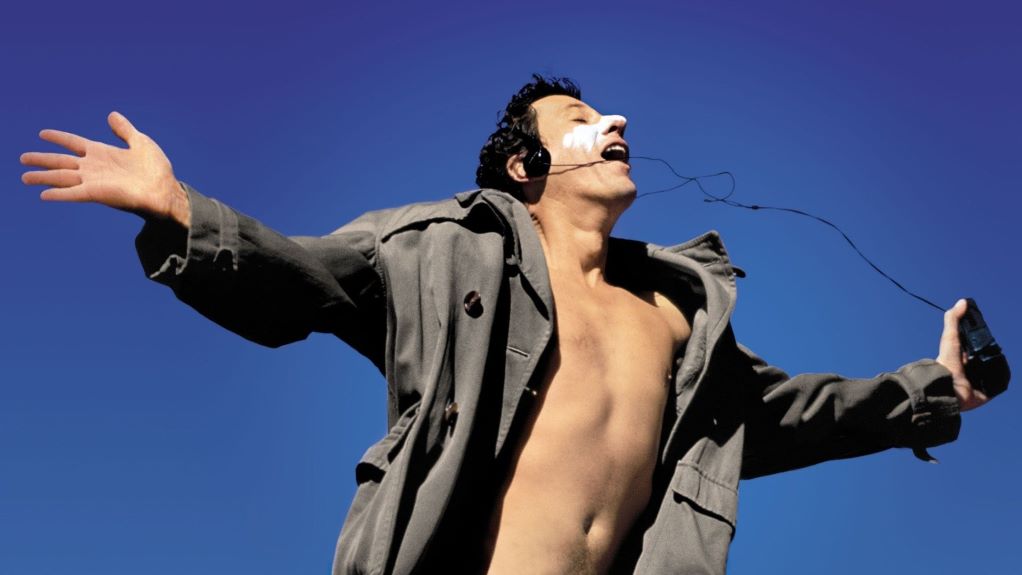
Bound for Glory (1976)

Bound for Glory (1976)

Beautifully filmed but psychologically and politically un-insightful film, easier to admire than enjoy

Director: Hal Ashby

Cast: David Carradine (Woody Guthrie), Ronny Cox (Ozark Bule), Melinda Dillon (Mary Jennings Guthrie), Gail Strickland (Pauline), Randy Quaid (Luther Johnson), John Lehine (Locke), Ji-Tu Cumbuka (Slim Snedeger), Elizabeth Macey (Liz Johnson), Mary Kay Place (Sue Ann), M. Emmet Walsh (Trailer Driver)
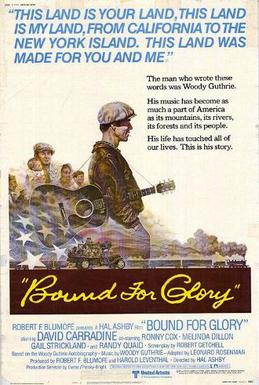
Woody Guthrie was a sort of poet of American folk music, his music influencing a generation of artists, from Bob Dylan onwards. His music spun a vision of the enduring strength of the working man and their rights to a share of the American Dream. It’s mythic stuff, so feels perfectly positioned to be spun into a modern fable in Ashby’s Bound for Glory. Coated in period detail, a sort of Grapes of Wrath by way of Barry Lyndon, it’s a lyrical piece of historical memory making with a nominal grounding in social and political issues. Is it a complete success? Perhaps it’s a film easier to admire than love.

It takes the title from Guthrie’s (David Carradine) biography, and follows his journey from Dust Bowl Texas in the 1930s to the hopes of employment in California, where he joins a mass of not-particularly-welcomed economic migrants. He discovers there an audience for his politically tinged folk music, but steadfastly refuses to compromise his principles. Actually, aside from these broad sketches and Guthrie himself, almost everything in this is essentially fictional. It’s a myth being spun, building a legend of a sort of John the Baptist of American folk music, a nostalgic vision of 30s America which makes little room for Guthrie’s actual politics.

Actually, that’s one of the most fascinating things in Bound for Glory. So keen is this to create a nostalgic view of an America from yesteryear, celebrating the perseverance of blue-collar America, it avoids talking in detail about anything Guthrie actually believed in. Although possibly not a card-carrying member of the Communist party, Guthrie was certainly at least a fellow-traveller. He had sharply left-wing, pro-worker, anti-capitalist views. His music echoed this – ‘This land is your land’ is actually about land ownership. But most traces of this have been carefully rinsed out of Bound for Glory.

That isn’t to say that it doesn’t take a deepe dive into Depression era America than any film since The Grapes of Wrath. Guthrie’s pilgrimage – and there is something distinctly Saintly about how he is presented here, making him more comfortable a figure than a left-wing radical – features plenty of dwelling on injustice and poverty. It opens in the ramshackle poverty of Dust Bowl Texas, where winning a dollar in a bet is potentially life changing. Migrants to California are at hurled from goods trains, then risk being shot (as one of Guthrie’s friends is) when attempting to jump on them as they puff past. They are barred entry on the road to California (in cars weighted down with their few possessions) if they can’t produce $50. The migrant camps are run-down, overcrowded and run by baton-wielding work-bosses who have complete power to decide who works and who doesn’t and don’t hesitate to wield their weapons to enforce their will.

Bound for Glory however avoids saying anything too firm against all this. It can carry sympathy for the plight faced by the working man but, much like The Grapes of Wrath, it’s terrified about saying or doing anything that could possibly be seen as promoting left-wing politics. Guthrie sometimes mumbles vague statements about the working man finding his slice of the American dream, but never anything too pointed about the fact that unfairness and having-and-have-noting is built into the system, like a spine in a body. The bravest shot the film takes is at a complacent priest, who smugly turns a hungry Guthrie away from his large church because he only hands out soup to people who have worked that day. Otherwise, the furthest it allows Guthrie to go is asking his wealthy lover (Gail Strickland in a thankless part) if she feels guilty having so much when others have so little. It’s the washed down, simplistic politics of the playschool.

And, to be honest, it robs Bound for Glory of much of its life and blood. It fails to replace this with a fierce personal story (like The Grapes of Wrath) and it never even attempts to make anything like a political statement as Ashby’s old collaborator Warren Beatty would do five years later with the similarly luminously beautiful Reds. Quite frankly, as Bound for Glory unrolls slowly and deliberately it does so with precious little fire and guts to it and (at times) very little interest. In other words, it’s very possible to sit and watch it and (while admiring it very much) kind of wish you were watching Rocky instead (as the voters for Best Picture at the Oscars that year clearly did).

It becomes instead a triumph of style, photography and design, rather than an enlightening biopic or making a statement about the Great Depression (other than it was tough). David Carradine hasn’t quite got the charisma to bring the vague threads Ashby gives him together. (Almost every single big name actor in Hollywood turned it down, which tells you something). Guthrie remains a vague, drifting blank, whose views and beliefs are undefined and to whom events frequently seem to just happen. Of the supporting roles (several women in particular get dull, thankless parts) only Ronny Cox gets something to get his teeth into as a musician turned union activist.

The real merits of Bound for Glory is it’s Barry Lyndon like recreation of a time and period. A lot of that is due to the breathtaking photography of Haskell Wexler – not for no reason was he the first person billed on the film. Wexler’s work is extraordinary, creating a sepia-toned view of Great Depression America that feels like its been taken straight from a photo library and placed on screen. Bound for Glory also astounded viewers at the time with the first Steadicam shot captured on screen, which starts with an aerial view, glides down to Guthrie and then follows him through a crowd of hundreds of extras to fail to be picked for a work party. It was the cherry on top of the Oscar-winning cake for Wexler.

It’s just a shame that these surface delights are all that really come to life. Other than that, this is distant, reserved and (in truth) slightly empty work from Ashby that presents the basic facts in a mythologised way that you feel removes much of the core truth. It turns a fascinating man of real conviction, into an unknown enigma, an Orpheus of the Dust Bowl who goes on a Pilgrim’s Progress that leads to (if we’re honest) nowhere in particular. It’s a film that strains a bit too hard for high art at the cost of passion or entertainment.

A Complete Unknown (2024)

A Complete Unknown (2024)

Engaging but traditional biopic, very well-made and full of knock out performances

Director: James Mangold

Cast: Timothée Chalamet (Bob Dylan), Edward Norton (Pete Seeger), Elle Fanning (Sylvie Russo), Monica Barbaro (Joan Baez), Boyd Holbrook (Johnny Cash), Scoot McNairy (Woody Guthrie), Dan Fogler (Albert Grossman), Norbert Leo Butz (Alan Lomax), PJ Byrne (Harold Leventhal), Will Harrison (Bob Neuwirth), Eriko Hatsune (Toshi Seeger), Charlie Tahan (Al Kooper)

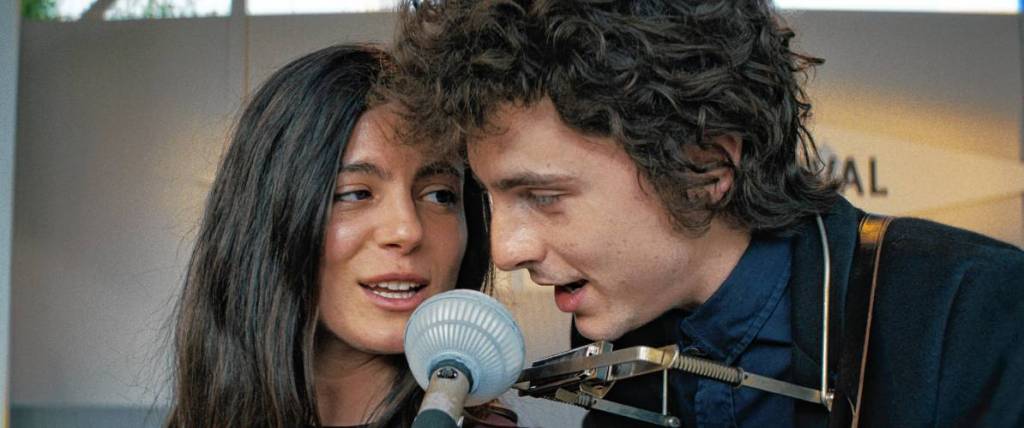
In 1961 Bob Dylan seemed to emerge from nowhere – or, if you like, from being A Complete Unknown – to become the big star of American music and the centre of a battle for the soul of American folk music. On one side, were the traditionalists – they loved Dylan’s thoughtful, lyrical ballads and use of guitar, harpsichord and other instruments. They believed Dylan could lead a whole new generation to traditional American music. On the other side were the modernists, inspired by rock and roll, and the new (electric) sound. A Complete Unknown is about Dylan’s – inevitable – journey towards exploring new music sounds, culminating in his strum-heard-around-the-world as he played an electric set at the Newport Folk Festival (to a mixed reaction to say the least).

That’s the meat of James Mangold’s traditional, but very well-made and enjoyable musical biography, a spiritual sequel to Walk the Line (with a decent, but drink-addled Cash here played by Boyd Holbrook). Much like that film, this tweaks and amends some historical facts, but manages to get close to the spirit of its subject all within a familiar biography set-up of early success, mid-way struggles and triumphant (of a sort) resolution. There is nothing in A Complete Unknown to surprise you but it’s still a highly enjoyable, very professionally assembled journey.

Its main success is the depth and insight with which it penetrates Dylan’s character. A Complete Unknown embraces Dylan’s enigmatic quality, not to mention his stubborn, relentless and obsessive focus on his music and the austere distance he can treat the world. This all comes across beautifully in Timothée Chalamet’s superb performance – not only a pin-point physical and vocal and impersonation, but also a soulful rendering of a poet who constantly pushed against being classified and categorised, bristling against ideas he should play certain songs certain ways.

The roots of the culture clash that will dominate the film are clear from the start when Dylan and Pete Seeger (Edward Norton) drive from visiting visited Dylan’s hospitalised idol Woody Guthrie (Scoot McNairy) and Dylan flicks through radio channels. Dylan finds interest in all the different music they encounter; Seeger smiles pleasantly and nods his head, but clearly can’t hide his patient disregard for the electric beats of rock and roll. It’s the platform for the surly discontent Chalamet so perfectly embodies as Dylan is expected to pigeon hole himself as a folk singer, who (as he puts it) stands with his acoustic guitar at a mic and sings Blowin’ In the Wind for the rest of his life. A Complete Unknown falls in love with Dylan’s passionate self-expression, his search for his own sound.

That search frequently makes Dylan a difficult person to spend time with. Awkward and hesitant with other people – Chalamet’s Dylan is constantly cautious about exposing too much of his inner thoughts and feelings – the poetic writer mumbles in monosyllables and responds to fame with a grudging disdain that seems him rarely remove his sunglass shield between him and the world. He has no interest in fame and is positively alarmed at adulation from strangers (there is a neat line when he is unrecognised by a street vendor and asked if he has kids to which he wearily replies ‘Yeah, thousands’). Match that with his ruthless determination to put his artistic calling above anything else, and you’ve got a man who verges on using other people.

It feeds into Dylan’s relationships. At his request, his girlfriend Suzie Rotolo is very-lightly disguised as Sylvie Russo, played with an emotional richness by Elle Fanning. The film skips the more difficult parts of their break-up – Dylan stated the only song he regrated was one he wrote about Rotolo’s abortion, calling himself a shmuck for doing so. But in doing so, the film steams off Rotolo’s contribution to Dylan’s writing and much of her own dynamic and interesting qualities. The original Rotolo, an artist, was an important sounding board: we don’t see a jot of that here, as she is repackaged into offering Dylan much-needed stability and security, dealing with movie-girlfriend insecurity about Dylan’s attraction to collaborator Joan Baez.

Dylan returns to Russo when he needs comfort at times of stress (from dropping in on her apartment – and waking her new boyfriend – late at night, to bringing her with him to the folk festival when he intends to turn electric) but Chalamet’s simmering self-focus makes clear Dylan at this stage can’t settle into a mutual relationship. It also comes between him and Joan Baez, played with dynamic charisma by Monica Barbaro, Despite their attraction and musical synchronicity, Dylan never sees her as a true artistic partner, even calling round one night for a booty call followed by private song writing using her guitar (she throws him out). On tour together, Dylan archly points out he writes the song and he leaves Baez hanging at a concert when he flat-out refuses to play the advertised favourites. The chemistry however is still there, within when it tips into aggression.

Dylan goes his own way, and if that means turning against surrogate fathers Peter Seeger and Woody Guthrie, then he will. A Complete Unknown features one of Edward Norton’s finest performances as a warm, tender and heartbreaking Pete Seeger (matched with a wonderful performance from Eriko Hatsune as Pete’s wife Toshi). Norton is brilliant at making Seeger – an environmentalist and gentle, accommodating advocate of folk music – a portrait of inevitable disappointment-in-waiting. There is a heart-rending moment where Norton beams as if all his dreams have come true as Dylan plays his first Newport festival: heart-breaking because we know Dylan’s next performance (where a guilty Dylan brusquely shrugs off Seeger’s gentle pleading to stay acoustic for just one more day) will see these dreams left in shattered pieces.

A Complete Unknown is a handsome, very well-mounted film from James Mangold, who has proved time-and-again that he can explore classic Americana with a freshness and energy few other directors can match. The film is perhaps overlong – probably due to the innumerable recreations of performances from Dylan, Seeger and Baez, all excellent but there are far too many – and it’s biopic approach is relentless traditional. But it’s filled with a parade of rich performances (with Chalamet outstanding), rolls along with energy, carries an emotional impact and will leave you engaged and entertained throughout.

Maestro (2023)

Maestro (2023)

Well filmed and acted Bernstein biopic, that doesn’t really get to the heart of its subject

Director: Bradley Cooper

Cast: Carey Mulligan (Felicia Montealegre), Bradley Cooper (Leonard Bernstein), Sarah Silverman (Shirley Bernstein), Gideon Glick (Tommy Cothran), Maya Hawke (Jamie Bernstein), Matt Bomer (David Oppenheim), Vincenzo Amato (Bruco Zirato), Michael Urie (Jerry Robbins), Brian Klugman (Aaron Copland), Zachary Booth (Mendy Wager)

You can’t fault his ambition. In bringing the family life of legendary composer, conductor and cultural icon Leonard Bernstein to the screen, Bradley Cooper pulls out all the stops in a medley of inventive staging mixed with single shot trust in actors. Maestro is, in many ways, a perfect capturing of Bernstein: dazzling, giddy film-making that never lets you really peek into its subject’s soul. It’s a hugely impressive sophomore effort, but not quite fully satisfying as a film.

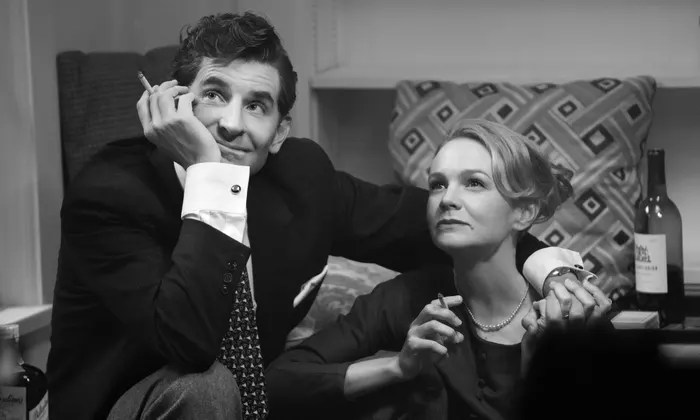
It opens with the life-changing night in 1943 when a 25-year-old Leonard Bernstein (Bradley Cooper) stands in (with no rehearsal) to conduct the New York Philharmonic at Carnegie Hall for a packed crowd and millions listening on the radio. From there, Bernstein never stops his ascent, becoming one of the world’s leading conductors and a composer who triumphs in every genre. He also marries successful actress Felicia Montealegre (Carey Mulligan), in a marriage full of mutual love and support. But Bernstein is the epicentre of his own fame, whose primary sexual attraction is to men. Over the decades, his marriage bends, fractures and reforms as Bernstein’s numerous affairs and party-filled lifestyle increasingly alienate the loyal Felicia.

Maestro is shot with all the zest and energy Bernstein himself was full of. Cooper keeps the pace the brisk and frequently transitions between scenes with a bravura trust that we can keep up. We see Bernstein receive the phone call for that fateful stand-in performance in his apartment: jubilant, he runs out the door (stopping only to playfully slap the bottom of his lover David en route), the camera taking an angle above to watch the pyjama-clad Bernstein run through a series of halls and emerge into the auditorium of Carnegie Hall.

It’s one of several transitions that mix reality and fantasy. Felicia will turn around from Leonard, during a flirty date in an empty theatre, to stride forward to applause from a packed audience. Felicia and Leonard run from a snobby garden party straight into a theatre (again with an overhead shot tracking them in a single smooth cut) where dancers from On the Town pirouette on stage as a visual representation of Bernstein explaining his work, the dancers eventually luring Leonard, Felicia and several other characters into an impromptu ballet. It’s a playful mix of reality and fantasy. At other times, the film skips years in seconds, successes dizzyingly referenced in throwaway lines.

The film’s focus is Leonard and Felicia’s complex, multi-layered marriage. Two people, in many ways soulmates, deeply stress-tested by Leonard’s frequent selfishness. Cooper, in a remarkable physical transformation (his capturing of Bernstein’s voice, mannerisms and conducting style is faultless) makes the composer a force of nature, high on his own genius: garrulously charming, a man who can focus all his attention on one person as easily as he can absent-mindedly drop another. The sort of man who excitedly introduces his fiancée to his lover David (a sensitive Matt Bomer) and then abashedly apologises immediately after for springing the news on him.

It’s part of the message of that On the Town ballet: living with Bernstein is a never-ending, dizzying pile of social engagements that doesn’t stop ever. Felicia feels she is ready for that: but the drift of Bernstein’s primary emotional commitment away from her and towards protégé Timothy Cothran (Gideon Glick) deeply hurts her. It’s part of Bernstein’s increasing lack of care to at least pretend to keep his promiscuity under semi-wraps, including awkwardly dismissing unspecified “rumours” that have distressed his daughter Jamie (Maya Hawke, very good) as nothing more than “jealousies”.

As Felicia, Carey Mulligan delivers what might just be a career best performance. Luminous, she makes Felicia savvy, loving but realistic about the “sacrifices” loving Bernstein involves. It’s a marriage where she is often in Bernstein’s shadow – at one point literally so, a shot showing Bernstein’s giant conducting shadow dwarfing Felicia in the wings. Mulligan’s performance mines deep emotional depths, Cooper frequently showcasing these in long, still takes. Most strikingly, a dynamite argument in New York after the opening of Bernstein’s Mass plays out in one visceral shot as Mulligan conveys the release of years of tension, in angry home truths. She is also heart-breaking during the film’s affecting chronicle of Felicia’s cancer, another striking single-shot scene showcasing Mulligan’s skill at letting all pain play behind her eyes while talking to visiting friends.

Maestro is about the underlying strength between these two who always turn to each other at hours of need or emotional triumph. Felicia’s successes on stage are shared with Bernstein, while it’s she who accompanies him (after their unofficial split) to his ground-breaking Mahler concert in Ely (another virtuoso sequence, directed and acted by Cooper with aplomb). Bernstein abandons his career – and all other relationships – to nurse Felicia, their bond finally something that could not be shaken by his thoughtlessness.

However, Maestro fails at times to really show how this relationship buckled. The giddying speed with which it moves through events means the middle act and, in particular, the sense of Bernstein’s numerous affairs gets lost. When Felicia finally does erupt, it’s easy to think it’s due to one late night and Bernstein holding his lover’s hand during the Mass premiere, rather than years of slow emotional distancing. It’s one time when a montage, stressing the repetitive nature of Bernstein’s self-obsession, would have really made a positive impact.

It’s also a film that focuses so much on the relationship, it leaves Bernstein himself a curious enigma. Strangely, despite sampling Bernstein compositions throughout the film, its almost as dismissive of his musical theatre work as it implies Bernstein himself was. West Side Story gets barely a passing mention, On the Waterfront is bundled up with “film scores” and almost nothing of the rest of his work is placed in any form of context. The epic Mahler concert in Ely is brilliantly restaged, but its artistic importance never explained and it’s easy to come out of the film not really appreciating either Bernstein’s cultural or musical impact.

Instead, Bernstein remains somewhat of an enigma, a charismatic figure who, for all the excellence of Cooper’s performance, remains a showman we never get to really know, someone capable of great care and intimacy (he’s extraordinarily tactile) for people, but also keeps them (and us) at a distance. The affairs have a veil tastefully drawn over them. There is very little overtly gay content in Maestro, which feels a conservative choice.

It’s hard not to think at times Cooper is more focused in Maestro on demonstrating his own directorial invention and pushing himself to never go for the obvious shot. Maestro is a dazzling dive into the playbox of film technique – it changes in aspect ratio and colour stock to reflect the cinematic era (though an odd decision for a film about a composer, that never explores his connection to cinema) and offers a host of interesting visual compositions and daring long-takes. Cooper and especially Mulligan are superb, but it’s a film that perhaps leaves more questions in the mind. A dazzling piece of film-making, but not always a dazzling piece of story-telling.

What’s Love Got to Do With It? (1993)

What’s Love Got to Do With It? (1993)

Tina Turner biopic sails into dark marital waters in a hard-hitting film

Director: Brian Gibson

Cast: Angela Bassett (Tina Turner), Laurence Fishburne (Ike Turner), Vanessa Bell Calloway (Jackie), Jenifer Lewis (Zelma Bullock), Penny Johnson Jerald (Lorraine Taylor), Phyllis Yvonne Stickney (Alline Bullock), Chi McBride (Fross), Jame Reyne (Roger Davies) Richard T Jones (Ike Turner Jnr)

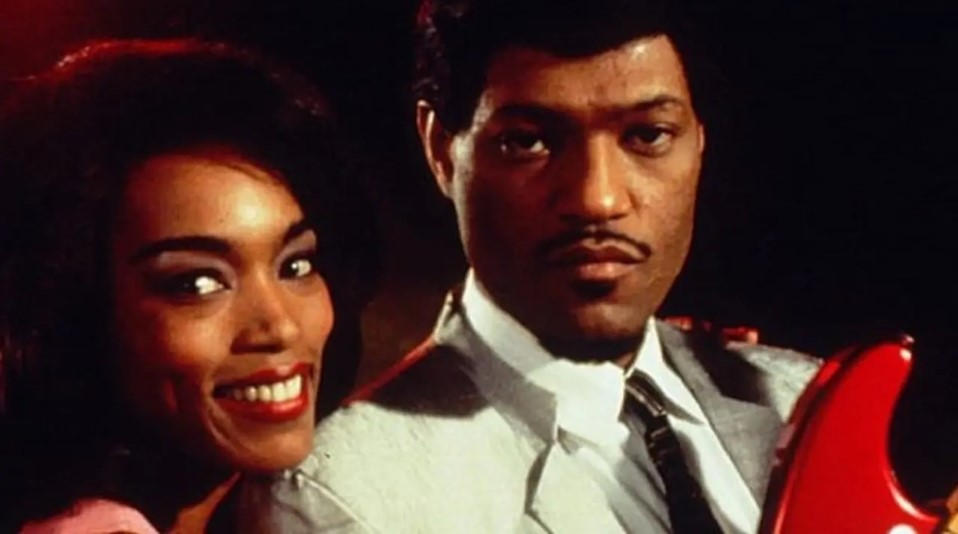
How did Tina Turner become the Queen of Rock ‘n’ Roll? The hard way. Possibly the hardest. Tina Turner’s relationship (and marriage) to her initial discoverer, Ike Turner, lasted almost twenty years after their first meeting in 1956. During that time, Ike helped form her style – and viciously beat and assaulted her on a regular basis, increasingly in drug-fuelled bouts of jealousy as her talent and fame surpassed his own. What’s Love Got to Do with It? sees Angela Bassett and Laurence Fishburne bring this biopic and spousal abuse drama to the screen.

Well directed by Brian Gibson, with neat mixture of mock-documentary and home video footage carefully spliced into the film, What’s Love Got to Do with It? is practically the dictionary definition of a tough watch. It doesn’t flinch in showing the escalating violence in the Turner marriage. Bleeding noses, black eyes, furious fists and a rape scene in a recording studio that is almost unbearably visceral, What’s Love Got to Do with It? indeed: this is marriage as Dantean hell.

Tina Turner later felt the film went too far in depicting her as victim, but also not far enough in showing the violence in their marriag[AN1] e. (Ike Turner, needless to say, was equally unhappy – but who cares.) What she praised though was Angela Bassett’s performance. Cast at short notice, Bassett worked overtime to master Turner’s vocal and physical mannerisms. It’s a nailed-on performance, but Bassett also completely drills down into the heart of a woman who finds herself lost in a situation outside of her control, terrified but discovering the inner strength needed to lead her own life.

It’s a hugely emotional performance. Bassett makes Tina fiery, determined and talented – but even the strongest person can find themselves trapped in (and defending) destructive relationships. Despite the early example of Ike’s previous girlfriend Lorraine (a very good Penny Johnson), driven to a suicide attempt by Ike, despite his vanity and jealousy being clear early on, (as well as his control freak desire to dictate every inch of her life ,including changing her name to Tina Turner without her agreement), Tina is captivated by Ike.

As their relationship deteriorates, for all his vileness, Bassett’s Turner defends and excuses her husband. Whether he beats her up at home in front of the kids (and brings a dress home later as an apology) or smashes a cake into her face in a restaurant, it’s never quite his fault. He’s fragile, he’s an artist, sometimes she just makes him mad. Bassett brilliantly shows how this Orwellian double think can settle in, so that a woman like Turnerstays with her abuser for 16 years of marriage, until she realises she can break free.

Bassett’s electric performance is perfectly complemented by Laurence Fishburne’s burning, self-pitying performance of weakness and insecurity masked by anger and fury. Fishburne turned down the film five times (it was Bassett’s presence that eventually persuaded him). He felt the film didn’t do enough to show why Turner became the man he did. To be fair, he’s probably right. Turner has an early scene where he speaks of his childhood trauma (a fig leaf for his bullying) which Fishburne gives a real humanity, and he invests the early sequences with charm and charisma.

But Fishburne, like Bassett, doesn’t slack on the energy. As cocaine and envy eat Ike up, his body language becomes more bear-like, his speech ever more mumbled. His eyes cloud over with a look of hate. Only actors who trust each other completely could play these appalling scenes of domestic violence with such complete and utter commitment. Both Bassett and Fishburne give a horrible life to these shocking and sickening moments of hurt and pain.

Both actors essentially elevate material that, at heart, is standard biopic stuff, built around the usual obstacles – albeit the obstacle this time is hideous domestic violence. We see the roots of Turner’s career, the early hits, the terrible turmoil, so appalling that the final act triumph really moves. Gibson recreates Turner performances with expertise, each packing a real punch. Bassett’s capturing of Turner’s performance style is spot-on and her lip synching is flawlessly convincing.

What’s Love Got to Do with It demonstrates how hard it is to escape abusive relationships. But, the film though doesn’t quite manage to fully build the real life behind the characters. I can get why Tina Turner felt the film positioned her as too much of a victim, as it prioritises this aspect of her life before all others. While it’s made clear that Ike lived a life in which he victimised a series of women, the film’s focus on this issue diminishes the other aspects of Tina’s life and the building of her own career, making her for a large part of the film a punching bag for an abuser.

So, the survival makes for deeply affecting viewing. To see Tina return the punches and flee from a hotel in LA to find refuge in another hotel (she was granted a free room by a deeply sympathetic hotel manager who can read between the lines). Her refusal to be scared when, like all bullies, Ike comes crawling back begging forgiveness and then switches smoothly to threats when that doesn’t work. And above all the triumph of her career. The only thing she wanted from the divorce was the name “Tina Turner” – she had bled for it. And we saw it. What’s Love Got to Do with It might be, in many ways, a standard biopic but with two such forceful performances it has special moments.

A Hard Day’s Night (1964)

A Hard Day’s Night (1964)

The Fab Four conquer the movies in this fast-paced and funny road movie

Director: Richard Lester

Cast: The Beatles, Wilfrid Brambell (John McCartney), Norman Rossington (Norm), John Junkin (Shake), Victor Spinetti (TV Director), Anna Quayle (Millie), Richard Vernon (Man on Train), Kenneth Haigh (Simon Marshall)

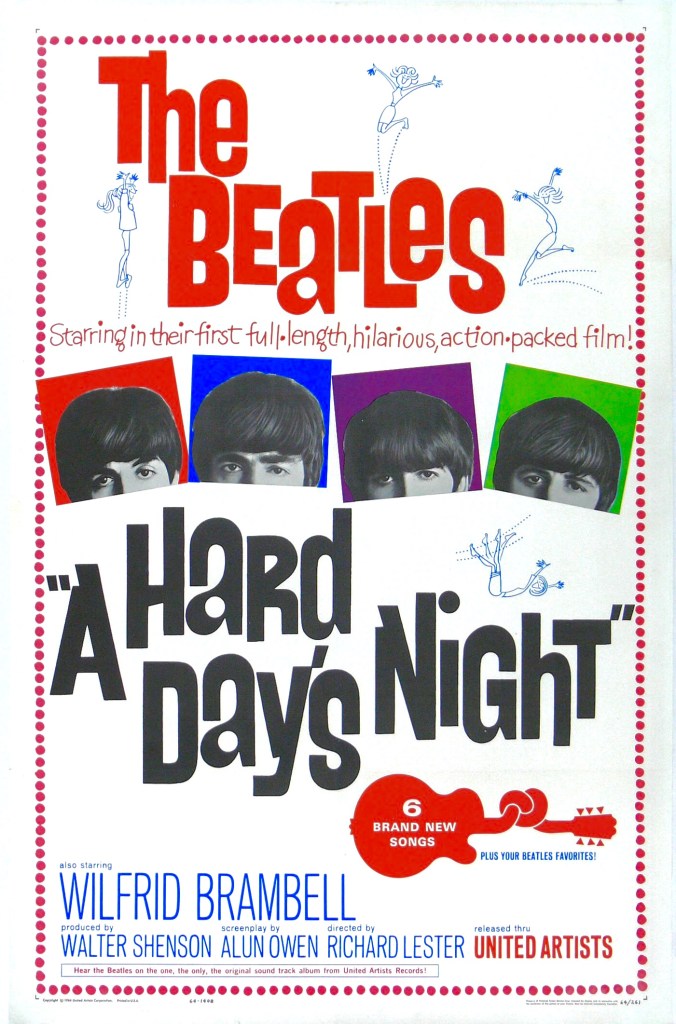
In 1964 they weren’t just the most popular music act: they basically were music. Everywhere they went they were met by crowds of screaming fans. They’d conquered America. They were no longer four lads from Liverpool: they were The Beatles. They were numbers 1-5 in the States, their last 11 songs had gone to number one, they were the most popular people on the planet. Of course, it was time for them to conquer the movies.

What’s striking is that A Hard Day’s Night could have been like any number of god-awful Elvis Presley films, with the King awkwardly playing a series of characters shoe-horned into plots based on songs. Richard Lester would do something different – and along the way he’d arguably invent the music video (when told he was the father of MTV, Lester famously asked for “a paternity test”) and the mockumentary all in one go. Lester placed the fab four into a day-in-the-life road movie, mixed with silent-comedy inspired capers and Marx Brothers style word play, in which they would play versions of their various personas in what basically amounted to a series of fly-on-the-wall sketches.

The film follows the gang in Paul’s (fictional) grandfather John (“Dirty old man” Steptoe’s Wilfrid Brimbell) complains move from “a train and a room and a car and a room and a room and a room”. (In a running gag lost on those not au fait with 60s British sitcoms, he is repeatedly called “clean”). In other words, we see the Fab Four shuttle to London, answer questions at a press conference, skive-off to prat about in a park then go through a series of rehearsals (with interruptions) before performing on TV and choppering off to their next appointment. It’s non-stop (even their night-off is filled with answering fan-mail – and pulling Grandad out of casino) work, work, work and any time outside is spent running from a mob of screaming fans. A Hard Day’s Night indeed.

Lester shoots this with an improvisational energy that feels like its run novelle vague through a kitchen-sink drama. He’s not averse to Keystone Kops style chases, sight gags and letting the camera bounce and jerk around with the actors. If things go wrong – ten seconds into the film George and Ringo fall over during a chase scene, get up and start running again while John laughs his head off – Lester just ran with it and kept it in. Everything feels like it has the casual, cool energy of just sticking the camera down and watching four relaxed, cool guys shoot the breeze.

It helps that he moulds four decent performances from a band that, let’s be honest, was never going to trouble the Oscars for their acting. Screenwriter Alun Owen – whose Oscar-nominated script is awash with pithy one-liners and gags – spent a couple of weeks with the boys and from that essentially scripted them four personas best matching their real-life attitudes. John becomes a cocksure smart-arse, with a quip for every corner. Paul an earnest, decent guy with a taste for wacky gags. George a shier, poetic type. Ringo the closest the band gets to a sad-sack loser, but also the most down-to-earth. Essentially, with these scripted “selves” the band were encouraged to relax and go where the mood takes them.

It works. Of course, it helps that the Beatles are (a) really cool and (b) totally relaxed with themselves, with Lester encouraging an atmosphere where the four feel less like they are acting and more like they are just being. There is an impressive naturalness about this film – really striking since it’s full of silly stuff, from the four hiding in a work tent to a car thief being roped in by the police to drive them through a chase – that means it catches you off guard. After a while you kick back and relax along with the people in it. That’s the sort of casual cool that’s impossibly hard work to pull off.

The musical sequences also feel spontaneous. When the Beatles bust out their kit and do a number on the train among the baggage it makes as much sense as them performing their stuff in the studio. It all stems from confidence – the sort of confidence that makes the group seem cheeky rather than cocky. There is a vein in A Hard Day’s Night of thumbing your noise at the posh, privileged world that was being gate-crashed by four working-class Scousers. It’s hard not to side with the Beatles when they tease Richard Vernon’s snobby city gent on the train (“I fought a war for you lot” he sniffs “Bet you wish you’d lost now” John snarks) or smirk at the deferential police eye these working class lads with suspicion.

What A Hard Day’s Night does best of all is make the Fab Four look like Four Normal Guys. They always look slightly dumbfounded by the pace of their life and the riotous reception from fans. They always seem like they’d be happier joking around or, as Ringo does when he bunks off for some time alone, wandering along chatting with people and dreamily watching the world go. They treat the media attention (and stupid questions) with straight-faced but ridiculous answers (“What do you call this haircut?” “Arthur”) and never feel or look like fame has corrupted them. Their manager Norm (a fine Norman Rossington) essentially treats them like four naughty schoolboys.

A Hard Day’s Night flies by in less than 90 minutes. It’s charm, wit and Lester’s sparkling imagery (the boys pratting around in the park did indeed inspire about a million MTV videos) and ability to shoot musical gigs in imaginative exciting ways makes it almost certainly the finest music-star film ever made – and inspired generations of comedies to comes. No wonder it made the Beatles number one at the Box Office and the Charts.

Shine (1996)

Shine (1996)

Middle-brow and safe biography that takes easy choices and makes reassuring points

Director: Scott Hicks

Cast: Geoffrey Rush (David Helfgott), Armin Mueller-Stahl (Peter Helfgott), Noah Taylor (Young David Helfgott), Lynn Redgrave (Gillian), Googie Withers (Katherine Susannah Prichard), John Gielgud (Sir Cecil Parkes), Sonia Todd (Sylvia), Nicholas Bell (Mr Rosen), Alex Rafalowicz (Child David Helfgott)

A hugely talented pianist, David Helfgott (played by Noah Taylor then Geoffrey Rush) trained at the Royal College of Music in the late 1960s but developed schizoaffective disorder, a condition that stalled any music career. What happened next is debated, but according to Shine years of mental institutes and sheltered housing eventually led to rediscovery and a life turned round by marriage to Gillian (Lynn Redgrave). This provided a happy home to Helfgott, who had grown up under the domineering hand of his father Peter (Armin Mueller-Stahl), a Polish-Australian who had narrowly escaped the Holocaust and disowned his son after he travelled, against his wishes, to Britain.

Shine repackages Helfgott’s life into a crowd-pleasing triumph-against-adversity biopic which plays fast and loose with facts. Shine makes no mention of Helfgott’s first marriage, it’s portrayal of his father as a misguided tyrant has been disputed by other members of Helfgott’s family and the level of estrangement Helfgott had from his family (his brother claimed David continued to live with the Helfgott family after his return) has been strongly disputed. Shine smooths off all rough edges and emphasises dramatic potential in others to create its stereotypical heart-warming tale.

What it also does is turn Helfgott’s life into a middle-of-the-road biopic, a highly convention film full of expected arcs (struggle, triumph, collapse, triumphant return) and directed with a middlebrow assurance by Hicks. It’s a film that flatters to deceive, offering only cursory insight into its subject and ends with a sentimental scene in which we are all-but-invited to join the characters in a standing ovation for a Helfgott comeback performance (which the film doesn’t even show us).

Shine has almost no interest in Helfgott’s illness, what bought it on, how it developed or what he and those around him did to help him function in society (his marriage to Gillian gets barely ten minutes of the film’s runtime). It has very little interest or insight into music – other than Rachmaninov being ‘very hard to play’ and some guff about finding the heart behind the notes which sounds full of import because anything said by John Gielgud sounds important. It takes a fascinatingly conflicted character like Peter Helfgott and bends over backwards to make him as two dimensional as possible, with only a brief throw-away line that leans into how quite possibly his views on the importance of family might just have been affected by the slaughter of the rest of his in the Holocaust. Everything is designed to make us feel that standing ovation is earned.

The film gets a much better performance than it deserves from Armin Mueller-Stahl as Peter Helfgott. Here is an actor with more compassion and insight into his role than either the film or the director has. On the surface everything Peter does is appalling; controlling what his son plays, demanding he wins competitions, blocking opportunities for progress, beating him in a rage twice and throwing him out of the house. But Mueller-Stahl plays the fragility and vulnerability under Peter exquisitely. This is a man so terrified about losing his family that he goes to extraordinarily damaging lengths to hold it together. So much so he destroys it.

And you understand that in every moment of Mueller-Stahl’s sensitive and immaculately judged performance. He looks at his son with tenderness and adoring love. His eyes dance with fear at the prospect of David going out alone into a world he thinks is dangerous. Its fear that leads him to react with violence – the terror of weakness pours from Mueller-Stahl. It’s a rich, layered, superb performance which seems almost smuggled into a film that does it’s very best to present Peter Helfgott as a controlling, destructive bully who (it believes) was the root cause of David’s illness.

The drama of the film – most of its first hour – revolves around the clash between this domineering father and the young Helfgott, played by Noah Taylor. It tells a very familiar story: the quiet, but talented son and the monster behind him, but does it solidly enough. Quiet, mumbling and shy – but with subtle traces of condition we know will seize him later in life, Taylor is marvellous. The training sequence at the Royal Academy, again familiarly reassuring for its pupil-mentor set-up, also allows a lovely showcase for an-almost-swansong role for Gielgud, sparkling, wry and charming.

It’s strange than that the Best Actor awards were poured onto Geoffrey Rush who only appears in two scenes before taking over the role at the 67-minute mark (of a 100-minute film). Rush, then unknown internationally, gives the sort of grand performance beloved of awards ceremonies. I admire Rush enormously: but Shine is all technique and no insight. Rush twitches, talks at a thousand miles a minute and plays the piano like a natural. Never once is he given the opportunity to really get inside what motivates Helfgott. He doesn’t even get the main dramatic meat of the film (he shares one brief scene with Mueller-Stahl). It’s ironically like a note-perfect but professionally smooth piano recital: the sort of role you feel Rush could actually have done standing on his head.

Shine even fudges moments of stand-up-and-cheer. Helfgott has been told he cannot play a piano because it affects his nerves. We frequently see him starring wistfully at a piano. The film opens with a rain-soaked Helfgott barging into a closed café hoping to be allowed to use the piano. The film is clearly building towards the moment when Helfgott plays the piano in that café, wowing the clientele with his virtuosity after a clumsy initial test playing of a few keys. We should have been wondering: does he still have it after all these years? We’re not because Hicks has thrown away Helfgott’s first playing of the piano in years five minutes early by having him hammer the keys with brilliance in a piano in his hostel (the instrument subsequently locked by his annoyed host). Why not have the piano locked from the start, sitting in his room, present but out of reach? Wouldn’t that have made it even more triumphant when Helfgott played like a master in that café one evening?

It’s cack-handed moments like that exposes the weakness in Shine, a film that flatters to deceive, offering only the most conventional and safe perspectives on a life. It boils things down to goodies and baddies and simplifies mental problems into being solved by just a little love and affection.  It’s a film that wants us to applaud Helfgott – and, by extension, to feel better about ourselves. But Shine offers very little in the way of insight or understanding and boils all its events down into easily digestible narrative homilies. It’s middle-brow filmmaking of the middlest kind.

Judy (2019)

Judy (2019)

A star turn is the only thing of note in this empty, uninsightful biopic

Director: Rupert Goold

Cast: Renée Zellweger (Judy Garland), Jessie Buckley (Rosalyn Wilder), Finn Wittrock (Mickey Deans), Rufus Sewell (Sid Luft), Michael Gambon (Bernard Delfont), Richard Cordery (Louis B Mayer), Darci Shaw (Young Judy Garland), Bella Ramsey (Lorna Luft), Royce Pierreson (Burt Rhodes), Andy Nyman (Dan), Daniel Cerqueira (Stan), Gemma-Leah Devereux (Liza Minnelli)

By 1969 Judy Garland (Renée Zellweger) was homeless, broke and stuck in a pill-and-alcohol fuelled depression. Desperate to provide a home for her children, she flew to London for a five-week booking at the Talk of the Town nightclub. Judy sees her, pushed beyond her physical and emotional limits, as she struggles to complete the run – or even get on stage – marrying the feckless young Mickey Deans (Finn Wittrock) and flashbacks to her memories as a Hollywood child star (Darci Shaw), under the punishing “mentorship” of studio head Louis B Mayer (Richard Cordery).

All this gets mixed together in Goold’s uninspired, sentimental and rather empty biopic that never really gets to grips with Garland’s personality, so desperate is it to shoe-horn her into a bog-standard narrative of redemption mixed with personal tragedy. Garland, I’m sure, would have hated it: she always pushed back against the idea that her life had been tragic (which this film whole-heartedly embraces) and the portrayal of her as a constantly misunderstood victim, generously one-sided as it is, boils her down into someone with no agency or control at all in her life.

As such, the most effective parts of this film are the flashbacks to her childhood, filming Wizard of Oz, living off diet pills so she can’t put on weight and working 18-hour days. All under the direction of a monstrously calm Louis B Mayer – a terrific performance of amiable, grandfatherly menace from Richard Cordery – who pleasantly tells her she is a dumpy child who must work like a dog to get ahead and owes everything to him. If the film gets anywhere to understanding Garland’s psychology, it’s in these scenes – I’d rather they’d made it about this than her swan song in England.

In the 1969 sections, the film continues to try and communicate that a life of constant work and pressure left Garland an emotional, physical (and possibly mental) wreck. It puts us on her side, stressing her vulnerability and desperation which she covers with brittle, demanding behaviour. But it’s too squeamish to show too much of her popping pills and downing more than the odd glass of vodka – despite the fact she’s clearly intoxicated for large parts of the film. It only briefly looks at how crippling anxiety affected her unwillingness to rehearse and implies her time in London was a lengthy period of unending servitude rather than a five-week booking singing her greatest hits (the film is hugely vague about timelines to increase the feeling of Garland’s powerlessness).

The film isn’t even smart enough to give us moments where other characters get a glimpse of the fragility under Garland’s prima donnai-sh petulance. Despite her treating both of them as a mix of underlings and informers, Jessie Buckley’s minder and Royce Pierreson’s pianist inexplicably become friends to the star part-way through the film. There is no scene to transition this, no moment of fragile tenderness they witness that makes them understand there is more to this demanding person than they initially thought. Instead, it feels like the narrative requires them to like her just as the audience is supposed to, so whoosh they like her.

The one affecting sequence sees a lonely Garland bumping into two gay fans (Andy Nyman and Daniel Cerqueira) and rather sweetly asking if they would have dinner with her (they are of course thrilled). Back at their apartment, they cook a disgusting looking omelette, play the piano and she listens as they are tearfully talk about their life of persecution in homophobic Britain. It’s gentle, sweet and the only time we (or she) get a real sense of what Garland means to people – these fans idolise her as a symbol of hope. Even this scene is undermined by (a) it not having any lasting impact on Garland as soon as it finishes and (b) these characters being shoe-horned into a blatantly emotionally manipulative ending almost unwatchable in its cloying feel-good-ish-ness.

The one thing the film has going for it is a committed, pitch-perfect performance by Renée Zellweger who captures the vocal and physical mannerisms perfectly. She won every award going including the Oscar. It’s an impressive study and she plays the moments of pain as committedly and rawly as the gentle, tender moments. She does everything the film asks of her, and it’s not her fault that it asks so little of her. There is no dive into Garland’s personality, no questioning that any of her ills were self-inflicted, no criticism for her not turning up for gigs where customers have paid a fortune to see her, no attempt to explore other perspectives on the impact of her actions or how she has become the woman she is.

Instead, Judy meanders towards its semi-feelgood ending without ever really letting us feel we’ve understood much about either this woman or her difficult life, other than framing her as a victim from a life of exhausting show-biz exploitation. Told within a story that is low on drama, pathos or humour, you end up wondering what point it was trying to make in the first place.

Elvis (2022)

Elvis (2022)

A brash, confident exterior hides a more sensitive and tender film – rather like its subject

Director: Baz Luhrmann

Cast: Austin Butler (Elvis Presley), Tom Hanks (Colonel Tom Parker), Olivia DeJonge (Priscilla Presley), Helen Thomson (Gladys Presley), Richard Roxburgh (Vernon Presley), Kelvin Harrison Jnr (BB King), David Wenham (Hank Snow), Kodi Smith-McPhee (Jimmie Rodgers Snow), Luke Bracey (Jerry Schilling), Dacre Montgomery (Steve Binder)

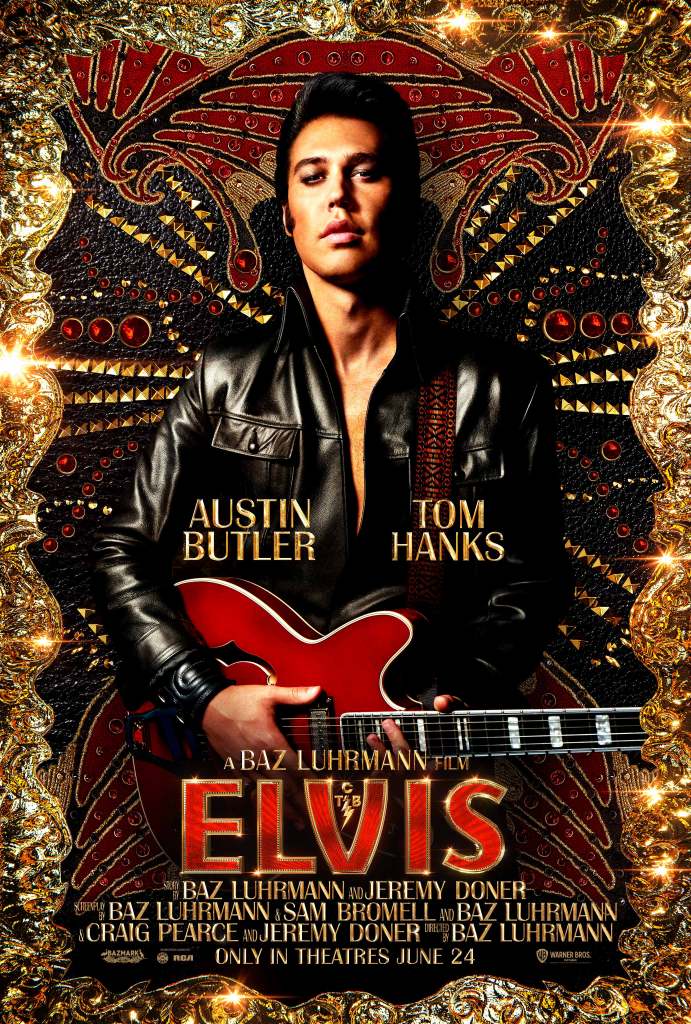
You know someone has reached an untouchable level of fame, when their first name alone is enough for everyone to know who you’re talking about. Few people are as instantly recognisable as Elvis. He had such impact, that the world is still awash with impersonators decades after he died. He’s an icon like few others – perhaps only Marilyn Monroe can get near him – and if Baz Luhrmann’s ambitious, dynamic biopic only at times feels like it has really got under his skin, it does become an essential, tragedy-tinged tribute to a musical giant.

Its slight distance from its subject is connected to Luhrmann’s choice of framing device. This is the life of legend, as told by the man behind the curtain who pulled the strings. The film opens in the final moments in the life of Elvis’ manager, Colonel Tom Parker. Whisked to hospital after a terminal stroke, Parker sits (hospital gown and all) in a Las Vegas casino (standing in as his own personal purgatory), bemoaning that everyone blames him for Elvis’ death and he never gets the credit for giving the world the genius in the first place.

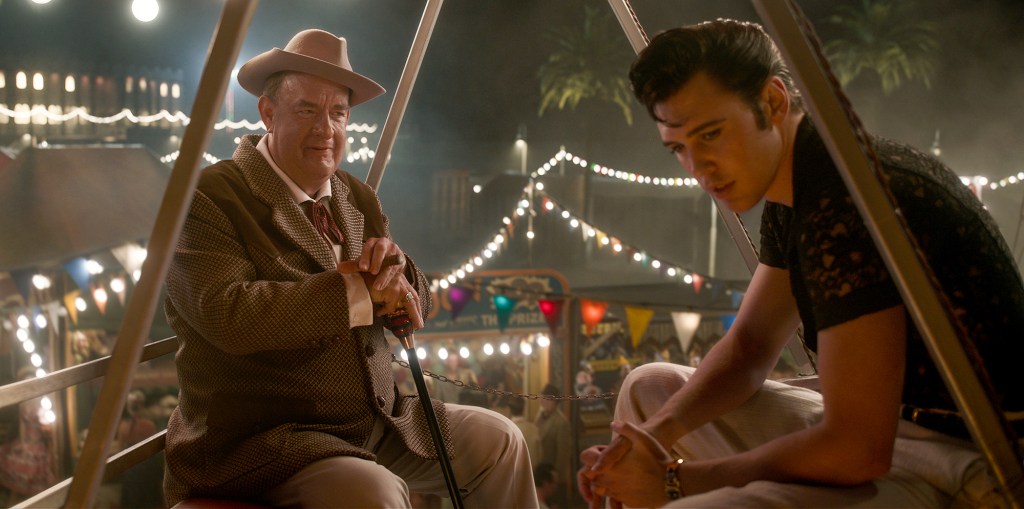
Like a mix of Salieri and Mephistopheles, Parker is a poisonous toad, a cunning “snowman” who spins spectacles at travelling fairs with Elvis as his ultimate circus “geek”, a peep show for the whole nation. Played by Tom Hanks under layers of prosthetics, with a whining, inveigling voice and a mass of self-pitying justifications, he is an unreliable narrator who we should be careful to listen to (a neat way of justifying any historical amendments). It also helps prepare us for one of the film’s main themes: Elvis is a man so trapped by what others want, he doesn’t even get to tell his own life story.

You can’t argue Luhrmann isn’t a polarising film maker. Elvis starts, as so many of his films do, with an explosion of frentic, high-paced style. The camera sweeps and zooms, fast cuts taking us through the final fever dream of the dying Parker, 60s-style split screens throwing multiple Elvis’ up on the screen. It’s a loud, brash statement – much like that visual smack in the face that opens Moulin Rouge! You either love or loath Luhrmann’s colourfully brash style – love it and you are in for a treat.

Like Luhrmann’s other films, the attention-grabbing start is our doorway into a sadder, quieter, more reflective film. The early sweep of the camera, zooming in to Parker’s eyes and whirligigging around his giggling frame as he wheels himself through a casino, the transitions to comic-book style visuals, the location captions that loom over the scenes… it all builds to a sad, depressed and trapped Elvis sitting alone in his hotel room in America’s city of sin. Elvis is a film about an abusive relationship between two people, where the victim can’t imagine life without his Svengali. It’s Romeo and Juliet – but if Romeo was a poisonous succubus draining the lifeforce of Juliet.

Luhrmann is a master of quick establishment and has the confidence to make scenes that really should be ridiculous, work wonderfully well. The key musical influences on Elvis – the blues and Gospel – are introduced in a neat scene which shows the young Elvis moving from one to another on the same afternoon. His first performance captures the world-changing impact of the sex appeal of those swivelling hips by Luhrmann cutting to women, almost surprising themselves, by jumping out of their seats screaming and then looking around stunned at their reaction, before screaming again. It conveys whole themes in cheekily constructed vignettes like this.

It’s the same with stressing the obligations and influences that fill Elvis’ world. His dependence on the affection of a series of women – from his tough but demanding mother (strongly played by Helen Thomson) and then his loving but frustrated wife Priscilla (Olivia DeJonge) – is equally well established, as is Parker’s skill in sidelining these figures. The film deftly explores Elvis’ musical influences and that his success partly stemmed from being a white man singing black music. It’s an attraction Parker instantly picks up, and if the film does skirt over some of the more complex feelings of the black community towards this white singer, it does make Elvis’ debt to them hugely clear.

Luhrmann’s film takes a cradle-to-grave approach but manages to be a lot more than just jukebox musical. While there are performances – impressively staged and recreated – the music is used more to inspire refrains and ideas in the score rather than shoe-horned in as numbers. It’s a skill you wish the script had a little more of at times. Elvis doesn’t always quite manage to tell you about the inner life of this icon. We begin to understand his dreams of leaving a mark, but little of his motivations. His feelings for his wife are boiled down to a simple lost romance and his opinions on everything from politics to family dynamics (both subjects the real Elvis was vocal about) remain unknowable.

But this is film that focuses on the tragedy of an icon. And it makes clear that Parker – whose bitter darkness becomes more and more clear from the beginning – was responsible for crushing the life from a man who he turned into a drugged showpony, in a glittering Las Vegas cage. Parker and Elvis’ first meeting is a beautifully shot seduction atop a Ferris wheel, and helps cement in the viewer’s minds the power this man will have over the King’s life and career.

Crucial, perhaps above all, to the success of the film is Austin Butler’s extraordinary, transformative performance. This is sublime capturing of Elvis’ physicality, but he matches it with a beautifully judged expression of the legend’s soul. His Elvis is always completely believable as the most famous man on the planet, but also a conflicted, slightly lost man under the surface, lacking the confidence to build his own destiny. Butler’s recreation of Elvis’ singing is extraordinary and his performance bubbles with an unshowy tragedy. He breathes life into this larger-than-life icon in a subtle and eventually deeply affecting way that will make you want to throw an arm around his shoulder.

Luhrmann’s film ends a world away from its bright beginning. We’ve seen Elvis triumph, but we’ve also seen him buffeted by events, never really becoming their master. Elvis becomes a highly emotional tribute to a man who gave us so much, but was prevented from giving more. When the real Elvis appears on screen, singing Unchained Melody with passion, it’s undeniably moving. Even more so because we get a sense that performances like this was what we wanted to be doing. Luhrmann – and Butler, whose work cannot be praised enough – may not always manage to make us know the King as completely as we could, but it certainly makes us care deeply and share his regret.

Tick…Tick…Boom! (2021)

Tick…Tick…Boom! (2021)

Joy and tragedy intermix in this extremely affectionate tribute to a musical theatre talent and his whole genre

Director: Lin-Manuel Miranda

Cast: Andrew Garfield (Jonathan Larson), Alexandra Shipp (Susan Wilson), Robin de Jesús (Michael), Joshua Henry (Roger Bart), Vanessa Hudgens (Karessa Johnson), Bradley Whitford (Stephen Sondheim), Jonathan Marc Sherman (Ira Weitzman), MJ Rodriguez (Carolyn), Ben Levi Ross (Freddy), Judith Light (Rosa Stevens)

When an artist dies young, you also mourn the loss of all the art still to come. There is an added tragedy when – like van Gogh – the artist dies on the cusp of achieving the recognition and respect they have toiled for so long to achieve. Jonathan Larsen spent over a decade struggling to get his work performed on Broadway – only to die of an undiagnosed heart condition the night before the previews for Rent (the musical that would win him a stack of posthumous awards, including a Pulitzer and a Tony) opened. Miranda’s film is a heartfelt, joyful celebration of Larsen’s life based on Larsen’s own autobiographical one-man rock musical.

Tick, Tick…Boom is all about the counting clock Larsen (Andrew Garfield) fears as his life starts to catch up with his own mapped out timetable for success. It’s 1990 and he’s turning 30, with his rock musical Superbia still only a glint in a workshop’s eye. As he keeps reminding us, at 27 Sondheim had already staged West Side Story. Is Larsen’s chance of making a success of writing musicals ticking away? Should he build a business career, like his school friend Michael (Robin de Jesús) has in advertising? Should he accept the offer of his girlfriend Susan (Alexandra Shipp) to give up on New York and start teaching in Massachusetts? Or should he keep powering away at his dream?

Lin Manuel Miranda has talked openly about how Larsen’s revolutionary work on Rent changed his understanding of what musicals could be. To him – and many others – Larsen is a key figure in the history of the American musical, paving the way to some of the great landmarks of the 21st century. Miranda’s film is soaked in a deep love for both the work of Larsen and musical theatre itself. This is a film made by a man who defines himself by his love for everything musicals – and it’s a love that echoes in every single frame of his film.

Miranda was the perfect man to direct the film – after all, perhaps only Hamilton has had as much revolutionary impact since Rent (just like Larsen, Miranda spent years toiling to get it staged). Working with screenwriter Steven Levenson, Miranda expands the original one-man musical (later versioned into a three-actor piece after Larsen’s death) into a beautifully assembled testament to a crucial few months in the life of its subject, as he subconsciously starts the inspiration that will lead (eventually) to Rent. The film takes the original score for Tick, Tick…Boom and complements it with other Larsen songs and material from Superbia to develop a rich, emotionally moving tapestry that brings Larsen storming vividly to life.

And a lot of that life comes from Andrew Garfield’s revelatory performance. Bearing a striking resemblance to Larsen, Garfield’s performance has an energy, litheness and openness to it, to a degree we’ve not seen before. His singing and dancing are graceful, dynamic and impassioned. He’s emotionally open, tender, delicate – but also, as so many artists must be, sometimes selfish, demanding and self-obsessed. It’s a performance of great joy and humour, making it even more moving to remember that ticking clock is literally counting down Larsen’s life. But this is not a tragic performance: instead it is a vibrant celebration, performed by an actor at the top of his game.

Garfield delivers wonderfully in the many songs, most of them unfamiliar. Tick, Tick…Boom is a little known musical – but Larsen’s sudden death gives it a prescient tragedy he was totally unaware of when he wrote it: he meant it was a clock counting down the end of his youth, but we know it’s actually knocking down the seconds of his life. Miranda stages the songs with all the scintillating freshness of a Broadway musical, with imaginative choreography, energetically engaged performances and at times a powerful emotional intimacy that delivers real impact.

It all works so well because of that love for musical theatre that it is dipped in. The cast is stuffed with cameos from Broadway actors – the song Sunday uses a virtual Who’s Who of the cream of Broadway – and Miranda places Larsen’s music at the very heart of the movie. It’s a film directed with a great deal of skill, but not a showy or flashy distraction. Instead, creative decisions in scenes are subordinate to the songs – so some take place in a realistic setting, some in a staged recreation of Larsen’s original performance of Tick, Tick…Boom, others in a heightened reality somewhere between a dream and a fantasy. Miranda’s trick is to make these contrasted styles all feel part of the same whole – and the joy with which all are filmed (even the sadder moments) is essential to this.

And there are some powerful moments of emotion here. Bubbling throughout the story is the AIDS crisis, which has literally destroyed the lives of several of Larsen’s friends. It is to have a very personal impact on his best friend Michael (a heartfelt Robin de Jesús). Larsen’s dwelling on this plague, where many blamed the victims, sees him scribble notes for key lines that will build Rent (Miranda has these appear on screen in hand-written text). Part of the self-criticism of Tick, Tick…Boom is Larsen acknowledging that his selfish desire for success as a protégé blinded him to the suffering of some of those closest to him. While I would have liked more direct tying of Rent into the film’s conclusion, this deconstruction of Larsen’s laser focus is well done.

Above all, Tick, Tick…Boom works because it is made so clearly by people who love musical theatre, for people who love musical theatre. The performances are sublime, especially Garfield who has never been better or more engaging, with de Jesús and Alexandra Shipp also excellent and Vanessa Hudgens standing out among the rest. Miranda’s film is a strikingly well-made and heartfelt labour of love, that will reward rewatching and uncovers the overlooked work of a major talent who died way too young.

Almost Famous (2000)

Almost Famous (2000)

Cameron Crowe turns his youth into a hip coming-of-age film with just enough sting among the sentiment

Director: Cameron Crowe

Cast: Patrick Fugit (William Miller), Billy Crudup (Russell Hammond), Frances McDormand (Elaine Miller), Kate Hudson (Penny Lane), Jason Lee (Jeff Bebe), Zooey Deschanel (Anita Miller), Anna Paquin (Polexia Aphodisia), Fairuza Balk (Sapphire), Noah Taylor (Dick Roswell), Philip Seymour Hoffman (Lester Bangs), Terry Chen (Ben Fong-Torres), Jay Baruchel (Vic Munoz), Jimmy Fallon (Dennis Hope), Rainn Wilson (David Felton)

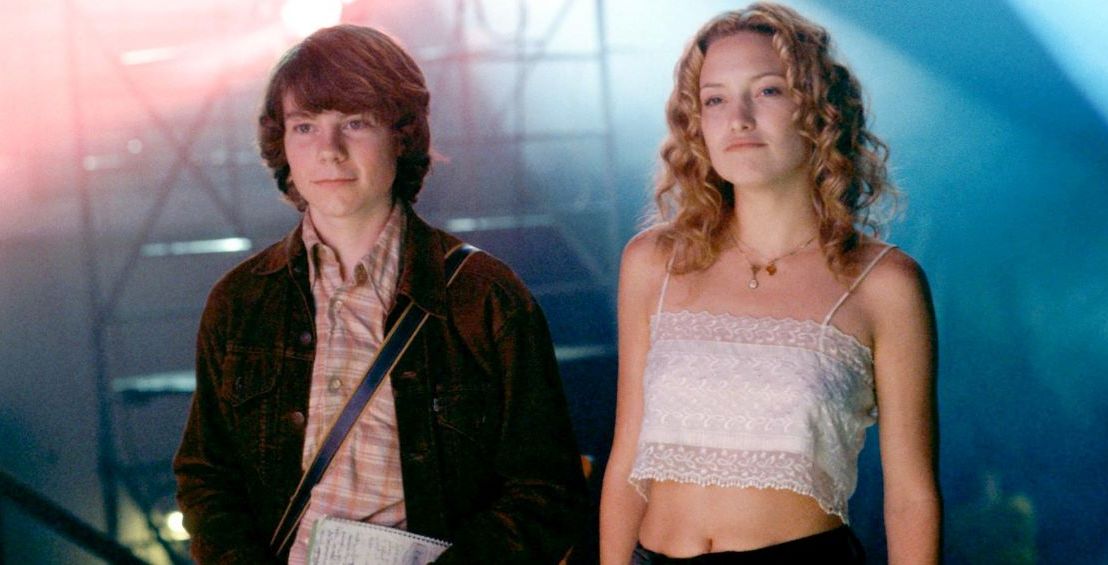
Cameron Crowe fictionalises his teenage years in the warm, affectionate Almost Famous, an endearing, heartfelt riff on the golden years of Rock ‘n’ Roll, when it felt like music could change the world and making the front cover of Rolling Stone was the greatest thing ever. Patrick Fugit plays William Miller (the Crowe substitute), a precocious 15-year-old would-be-music journalist recruited by Rolling Stone to write an article on Stillwater, an up-and-coming new band. Miller adores the music scene and is soon smitten with the lifestyle, Stillwater’s charismatic guitarist Russell Hammond (Billy Crudup) and most of all “Band Aid” (muse not groupie) Penny Lane (Kate Hudson).

Crowe’s film is a glorious reconstruction of the rock and roll scene of the early 70s – and I can imagine anyone with fond memories of it will find much to love here. It’s not just the fashions and hairstyles, but the glorious capturing of a mood. The whole film is a celebration of a time that felt freer and more idealistic, where the actions and words of a rock band could feel like the most important, beautiful thing in the world. The film is not just nostalgia but also a celebration of a mood of hopefulness that embodied an era.

It’s also a coming-of-age story, as a boy-becomes-a-man. Patrick Fugit is very endearing as a kid no one can quite believe is 15, even though every moment seems to hammer home his fresh-faced innocence. But then it’s not a complete surprise since, thanks to his strong-willed mother having moved him up a class at school and led him to believe he is older than he is. Nevertheless, this is the sort of trip that shapes someone, finding friendship, love, belonging, betrayal, righteous anger and acceptance along the way. All of this is backdropped by the shift of rock and roll becoming something corporations used to make a lot of money.

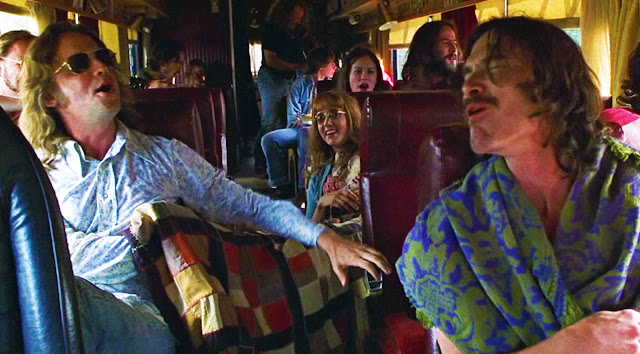
Stillwater are just on the cusp of this, still clinging to the fun of bussing from gig-to-gig, enjoying the mood, the songs and (of course) the girls. The film is also a celebration in a way of their coming-of-age, the tour starting in a ramshackle bus and ending on a sleek private jet, with accommodation switching from the bus to plush hotels. And along the way, they are trying to work out what they hell they are doing as much as William is. Perhaps that’s why the film feels like it captures the era so well – wasn’t everyone flailing around in the 70s trying to work out if they belonged to the hedonism of the 60s or what would become the Reagonism of the 80s?

But it’s still rock ‘n’ roll, best embodied by Billy Crudup’s charismatic turn as Band icon Russell Hammond. Crudup is all grungy magnetism and shuffling emotional gentleness under the surface of rock star swagger. Not that it stops him from moments of egotism, selfishness and pomposity. You can see why tensions are sometimes high in the band, with the rest of its members often seen as jut Russell’s support group (a band t-shirt causes fury when it shows Russell in the foreground with the other four as shadowy outlines behind him). Russell takes William under his wing, perhaps because he recognises the youth and fragility in William. Or maybe he just likes the hero-worship.

Because one of the dangers of getting close to these stars is getting sucked into hero worship. William is after all a journalist who needs to maintain objectivity. He’s even warned about it by his mentor, fabled music writer Lester Bangs (Philip Seymour Hoffman in a charismatic cameo) that the biggest danger is succumbing to the charms of the celebrity: these are after all, people who have made it their mission in life to be liked. They’re going to be good at it.

Getting in their airspace can be a dangerous place, as discovered by leading Band Aid Penny Lane, played with a luminous, radiant warmth by Kate Hudson. Penny is a devoted fan, enraptured with being part of the scene and with her self-proclaimed role as muse to the artists. Based on a personal friend of Crowe’s – and, one supposes, his real-life first love – it’s Penny who draws William into this life, looks out for him, cares for him (a favour he is to return in kind). She starts an affair with Russell – but is banished when Russell’s girlfriend rejoins the tour, jokingly traded in a card game with another band for a crate of beer (a reveal Hudson plays with a beautiful mix of devastation and valiant nonchalance). It’s not that Russell’s a bad guy, more that he can’t cope with complexities.

So, you can see why William’s Mum – played with a larger-than-life mix of bullish determination, smothering love and control-freak determination by Frances McDormand – is so worried about him. It’s a sign of the film’s overall warmth (and Crowe’s well-adjusted personality!) that McDormand’s character is treated with the same affection and admiration as everyone else and the love between mother and son is never in doubt. She is responsible for some of the film’s highlights, not least a phone call to Russell where her natural authority quickly reduces him to the overgrown schoolboy he is at heart.

And Almost Famous is a very funny film, riffing off various true life rock-and-roll road trip stories, from raucous parties to accidental electrocutions, like a slightly straighter version of Spinal Tap. It’s capped by a hilarious near-disaster plane flight, where the end seems in sight, leading to a series of ‘confessions’ that become more and more heated and factious as they go on. It’s a film that shows some of the warts of the characters – just as William’s article eventually will for Stillwater – but also their many, many beauty spots. People make mistakes and hurt each other, but life goes on – and we take the punches, but they don’t define us.

Perhaps that’s a big part of growing up: and it’s a growing-of-age film for three characters: William, Penny and Russell. All three of these characters find themselves drawn together, all of them spiritually so close. They hurt each other, betray each other, but they all love each other. It’s a hopeful message, a glorious celebration of a time and era.