Category: Presidential films

All the President’s Men (1976)

All the President’s Men (1976)

The greatest film about journalism ever made? This dense, detailed conspiracy thriller is a marvel.

Director: Alan J Pakula

Cast: Robert Redford (Bob Woodward), Dustin Hoffman (Carl Bernstein), Jason Robards (Ben Bradlee), Jack Warden (Harry M Rosenfeld), Martin Balsam (Howard Simons), Hal Holbrook (“Deep Throat”), Jane Alexander (The Bookkeeper), Stephen Collins (Hugh W Sloan Jnr), Ned Beatty (Martin Dardis), Meredith Baxter (Deborah Murrah Sloan), Penny Fuller (Sally Aiken)

If anything, even remotely, dodgy happens in politics than, quick as a flash, you can bet the suffix “gate” is added to it. It all stems from Watergate, the Washington building that was the location of the most disastrous attempted burglary in political history. Agents from the Committee to Re-Elect the President (CREEP to you and me) broke into the Democratic office on a dirty tricks mission. They got caught, Nixon and his cronies decided to cover it up and obstruct justice – and when the story broke, it broke Nixon and his Presidency as well.

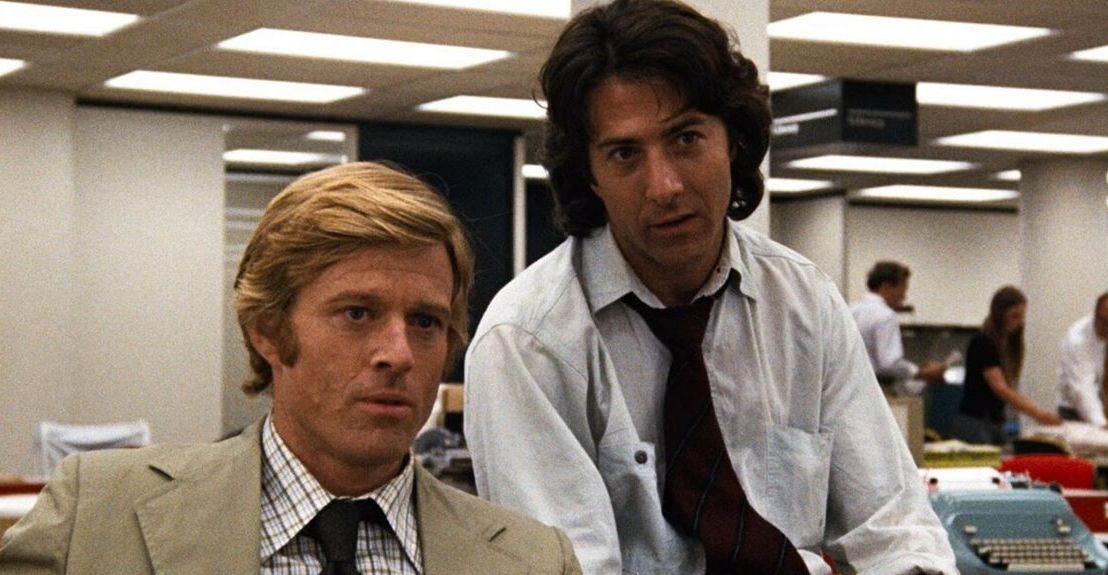
All the President’s Men covers the early days of how that story was broken by two junior reporters on the Washington Post: Bob Woodward (Robert Redford) and Carl Bernstein (Dustin Hoffman). Involved in the case from the night of the break-in, the film (adapted from the book by ‘Wood-stein’) covers their pain-staking investigation to work out what lies behind this burglary and, if there is a conspiracy of silence, how far up the chain of the Presidency it reaches. As well as winning the trust of sources, they must also persuade editor Ben Bradlee (Jason Robards) their reporting is rigorous and worth placing the full might of the paper behind them.

Produced by Redford, All the President’s Men is grounded in realism and the painstaking, methodical series of telephone calls, knocked doors, flicked reference books and sleepless sorting of facts and theories that lies behind investigative reporting. While never once slacking on the patience-defying, unglamourous, exhausting work, All the President’s Men may just have inspired more journalists to choose their career than any other film. This is journalism in all its freedom-of-speech, speaking-truth-to-power might and with Woodward and Bernstein already the most famous journalists alive, their glamour could only be doubled by being played by Redford and Hoffman.

The main obstacle All the President’s Men faced during its development was, how do you make the most famous political scandal in history suspenseful? After all (particularly in 1976) everyone watching the film knew more than the characters at every single step. The solution was fascinating. Not only does the film only focus on the second half of Woodward and Bernstein’s book – culminating in one of their biggest blunders – but the film would try and match the same confusion the journalists felt. All the President’s Men takes an already dense conspiracy – with a plethora of names and uncertain links – and works hard to make it more obtuse and obscure at every turn. Just like the journalists, mist surrounds us. Leads peter out. The focus shifts from scene-to-scene, from people to money. Nothing has been simplified or stream-lined. Instead, the film brilliantly captures the confusion the reports felt, making each revelation a beam of light.

It should, therefore, make the film disengaging and alienating. It’s quite the opposite. Alan J Pakula was already a master of 1970s American paranoia noir, and All the President’s Men is awash of the tension of questions answered and threats and dangers left hanging. There are shadowy implications throughout of dark forces at work, blocking our heroes. Potential witnesses seem terrified – in particular a CREEP book-keeper (a superb, Oscar-nominated, cameo of suppressed fear and nervy strength of purpose by Jane Alexander) who sits rigidly still, willing herself to share revelations.

Pakula’s film is tightly paced and frequently jumps over what could be otherwise clumsy narrative structures – the journalists frequently jump from A to C with the film avoiding functional scenes showing how they passed through B. With its quiet air of looming, indefinable menace – Gordon Willis’ photography makes for a superb mix of light and shade – All the President’s Men makes the unspooling of this conspiracy into pre-tension filled cinema.

It’s also a triumph of sound-mixing and editing. Sound levels drop in and out on key conversations – sometimes phrases are deliberately missed, at other times background sound drops out to sharply narrow our focus. The office of the Washington Post is a hive of background noise. Bernstein talks to a source and literally has to shout over a passing plane. The film sets its sound stall out with an opening eighteen seconds of grayish silent screen – until a crash like a gunshot reveals we have been starring at paper in a typewriter, the keys hammering letters in with earth-shattering impact.

It’s attention to journalistic detail is stunning. The offices of the Washington Post were recreated in detail, shot by Gordon Willis with a low-ceilinged brightness that contrasts completely with almost every other location in the film (in particular the car park, laid out with pillars that echo the office, where Woodward meets with shady informer “Deep Throat” it’s darkness where secrets are hid the polar opposite of a newsroom where secrets are revealed). In gripping single-takes, we watch Woodward conduct phone calls juggling sources (Redford even flubs a line at one point but works it seamlessly into the take) or Bernstein desperately track down sources for last-minute confirmations.
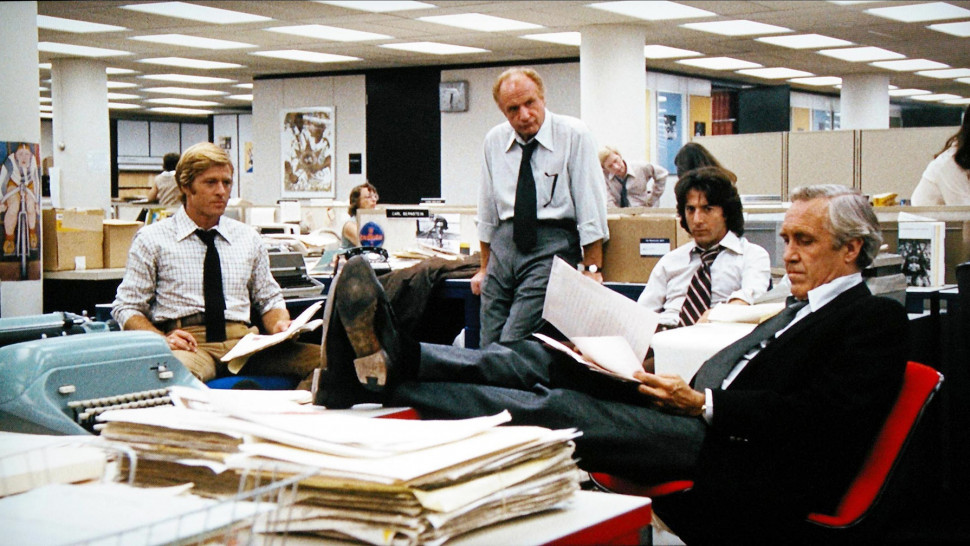
Willis uses a split dopter to brilliant effect. Effectively, this splits the lens in two – one half becomes a close-up, the other long-distance focus. It makes the screen a deeply unsettling mix of blur and crystal-clear clarity. So, while Woodward sits at his desk, we see blurred distance immediately around him – but on the other side of the screen far away other journalists clearly. Not only does this brilliantly create a sense of the endless bustle of the newsroom (also helped by the sound designs superb mix of typewriters and office noise) but also adds a visual metaphor of misty confusion that literally envelops our heroes.

All the President’s Men is a resolutely unflashy film for all of this. Its brilliance is all in its mastery of small details. It means more attention-grabbing shots – like the aerial shot of a circular library – carry even greater impact. The lack of flash also carries across to its stars, who have arguably never been better. Initially presented in two-shot exchanges (particularly in their first encounter over Bernstein rewriting Woodward’s text without his agreement), the two increasingly share the frame. Redford and Hoffman even learned each other’s lines so they could complete each other’s sentences – they almost become one character (‘Woodstein’).

The two actors were also wonderful contrasts, reflecting the two men they played. Redford, who worked hard to keep the project grounded, has a WASPY boy-scout decency and a relaxed unfussy star delivery, Hoffman the twitchy fiddling of the working-class reporter made good. Both actors have rarely been better. Equally good is the Oscar winning Robards who perfectly captures Bradlee’s avuncular professionalism while Holbrook is superbly enigmatic as the shadowy ‘Deep Throat’.

All the President’s Men demands attention like few other films – but it’s deliberately dense plot exactly matches the mystifying journey of the journalists themselves. It also turns journalism itself into a cause for typewriter knights (you could argue the downside of its legacy is journalism focused on ‘gotcha’ rather than informing). Pakula’s marvel is crammed with stunning sound and visual design and a lingering sense of paranoic fear. The film wants us to be as uncertain about what is happening as the characters – but in doing so it makes the greatest argument in favour of the power of journalism ever made by cinema.

Wilson (1944)

Wilson (1944)

Well-meaning if slightly dry hagiography that struggles to turn history into drama

Director: Henry King

Cast: Alexander Knox (Woodrow Wilson), Charles Coburn (Professor Henry Holmes), Geraldine Fitzgerald (Edith Wilson), Thomas Mitchell (Joseph Tumulty), Ruth Nelson (Ellen Wilson), Cedric Hardwicke (Senator Henry Cabot Lodge), Vincent Price (William G McAdoo), William Eythe (George Felton), Mary Anderson (Eleanor Wilson), Ruth Ford (Margaret Wilson), Sidney Blackmer (Josephus Daniels), Madeline Forbes (Jessie Wilson), Katherine Locke (Helen Bones)

Darryl F Zanuck had a passion project: a biopic of the 28th President Woodrow Wilson. It would be both a tribute to a man, he felt, was overlooked and also a homage to current President Roosevelt – and a warning for the future. Like FDR, Wilson had introduced a raft of reforms and led the country in wars – and Zanuck was worried America would fudge the peace, just as Wilson had failed to get the Senate to endorse the League of Nations, leaving it a toothless lion.

Zanuck’s no-expense spared approach gives us a laudatory biopic that lavishes Wilson in euphoric praise, smooths off all his edges and presents him as a visionary and a near-flawless leader. The money was thrown into building elaborate sets and costumes – vast swathes of the White House and the Palace of Versailles were re-built on the sound stages of 20th Century Fox – and the script repackaged a series of major events interspersed with Wilsonian speeches. It was launched to a fanfare, was nominated (largely due to Zanuck’s influence) for ten Oscars (winning five) and was a box-office failure.

But is it a good movie? In truth, not quite. Despite the lavish production values, this is a dry, unimaginative and stately progression through its subject’s life. Henry King marshals events with the professionalism of an accomplished journeyman, but little inspiration. There is nothing striking, original or brave in a single minute of Wilson, but everything is perfectly framed and (considering its immense length) well-paced. King uses a series of low-angle shots to hammer home the magnificent detail of the sets and Alfred Newman’s score remixes a series of patriotic scores and heavenly-sounding choirs to build the impression of Wilson as secular saint.

But Wilson remains a largely undramatic movie, with an (Oscar-winning) script by Lamar Trotti that fails to inject drama or skilfully convey information. The warning signs are there in the film’s opening, with a group of New Jersey Democrats arrive to recruit Princeton head Wilson to run for Governor and clumsily give each other a potted precis of his CV and academic achievements while they wait for him to join them. Dialogue frequently info dumps historical research in our ears. Newspapers bluntly tell us in crude headlines what’s happening. Poor Thomas Mitchell’s entire role seems to be made up of running into rooms clutching telegrams announcing major events.

In amongst all this research though, we get very little idea of what Wilson actually stood for. There is virtually no time spent on his Governorship of New Jersey, other than a two-scene disagreement with the Democratic bosses whose power he breaks. On becoming President, his major legislative reforms are covered in a less-than-a-minute montage of signed bills. He consults his cabinet once or twice and, when war comes, walks a fine line between preserving American strength and not rushing into war. The final act of the film covers his failed battle for the League of Nations, the only policy the film invests any time into explaining.

For much of the rest of the time, this hagiography concerns itself with down-playing or skating over anything in Wilson that could be perceived as a flaw. Wilson here talks a good game of reform, equality and rights for all. In real life, he was a dyed-in-the-wool segregationist, sceptical about women’s suffrage as well as being an intellectually arrogant elitist who, later in his Presidency, began to see himself as a sort of vessel for God’s policies. While he was undoubtedly a highly effective moderniser and legislator, none of his faults make it to the screen.

Other areas are also carefully removed. Wilson was often accused of being heavily under the influence of advisors like “Colonel” House – House gets a one-scene cameo here. He ran for re-election in 1916 promising to keep America out of the war – this unfortunate broken promise is repackaged as Wilson sitting in the White House deeply regretting the campaign the party is running for him but stating there’s nothing he can do about it. His controversial re-marriage in 1915 to the much-younger Edith Galt (only two years after his wife died) is excused by his wife informing his daughters on her death bed that Wilson must marry again as he needs a wife. Wilson’s incapacity after a stroke in 1920 is down-played, while Edith (who effectively took over running the country for her husband in a constitutional scandal that would never stand today) states “I never made a decision without your knowledge and consent” while sitting with a sturdy Wilson.

All of this is played out in parallel with making Wilson’s rivals in the Senate mustachio-stroking schemers. None more so than Henry Cabot Lodge (well played by Cedric Hardwicke) who begins a career of animosity against the President after being made to wait for a meeting at the White House. In real life, Wilson refused any compromise offered by Lodge to get the League approved by the Senate, but here Wilson is a noble crusader foiled by political pygmies.

Saying that, the film benefits hugely from a very strong performance from Alexander Knox as Wilson, who not only looks and sounds exactly like the President, but perfectly captures his mannerisms. It makes you regret though the film is so little interested in Wilson’s personality or in building any picture of the humanity behind this leader. The rest of the cast have little to do other than state historical facts or stand to listen to Knox masterfully delivering Wilsonian speeches.

Wilson has a historical interest for Presidential buffs and, while it downplays the negatives around Wilson, it makes a very effective case for the President as a visionary leader (he was undoubtedly right about the League of Nations – even if his stance here is restructured into an FDRish self-determination for all nations). But this is a dry, stately film that never manages to turn the march of time into the thrust of drama. The Oscar-winning sets and photography look impressive, but its simplistic and hagiographic presentation of events eventually shakes your interest.

Amsterdam (2022)

Amsterdam (2022)

Lots of quirk, whimsy and smugness, not a lot of interest or dynamism in this satirical mis-fire

Director: David O. Russell

Cast: Christian Bale (Burt Berendsen), Margot Robbie (Valerie Voze), John David Washington (Harold Woodsman), Robert De Niro (General Gil Dillenbeck), Chris Rock (Milton King), Rami Malek (Tom Voze), Anya Taylor-Joy (Libby Voze), Zoe Saldana (Irma St Clair), Mike Myers (Paul Canterbury), Michael Shannon (Henry Norcross), Timothy Olyphant (Tarim Milfax), Andrea Riseborough (Beatrice Vandenheuvel), Taylor Swift (Elizabeth Meekins), Matthias Schoenaerts (Detective Lem Getwiller), Alessandro Nivola (Detective Hiltz), Ed Begley Jnr (General Bill Meekins)

David O Russell’s has made a niche for himself with his ensemble awards-bait films, filled with touches of quirk and offering rich opportunities for eccentric, showy performances from actors. Some of these have walked a fine line between charm and smugness: Amsterdam tips too far over that line. Like American Hustle it’s a twist on a real-life event (opening with a pleased with itself “A lot of this really happened” caption) but, unlike that film, it fails to insert any compelling storyline, settling for a whimsical shaggy-dog story that frequently grinds to a halt for infodumps or lectures.

Set in 1933, just as Roosevelt has taken office, it follows three friends who formed a friendship for life in post-war Amsterdam. They are: wounded veterans doctor Burt Berendsen (Christian Bale) and lawyer Harold Woodsman (John David Washington) and socialite-artist-turned-nurse Valerie Voze (Margot Robbie). Berendsen and Woodsman lost touch with Valerie in the 1920s, but now they are all bought together after the murder of their respected former commander as part of a plot from various nefarious types to overthrow the government in a fascist-inspired coup.

Sounds gripping right? Well, Amsterdam fails to find any urgency in this. In fact, details of this plot and the political context it’s happening in are sprinkled around the film as if Russell kept forgetting what the film was supposed to be about. It’s almost as if he stumbled on an unknown piece of American history – a rumoured coup attempt, thwarted by being denounced by the ex-Marine General approached to lead it (here represented by De Niro’s ramrod straight General Dillenbeck) – but got more and more bored with it the longer he spent on it.

Instead, his real interest is in the faint overtones of Jules et Jim style thruple between Berendsen, Woodsman and Voze (though this is American not French, so any trace of homoeroticism is dispatched, despite the obvious bond between the two men). The most engaging part of the film is the Act two flashback to these three healing, dancing and bonding in post-war Amsterdam, in a “our troubles are behind us” bliss. Even if it’s self-satisfied in its bohemianism.

To be honest, even then, they have an air of smugness behind them. They pass the time singing improvised nonsense songs based on words pulled out of a hat and playfully posing in Valerie’s modernist artwork. Valerie is played with almost enough charm by Robbie for you to overlook she is a standard Manic Pixie Dreamgirl, the sort of babe who pulls shrapnel from bodies to turn it into artistic tea-sets as a commentary on the madness of war. She and Woodsman form a relationship (with the married Berendsen as a sort of – well I’m not sure what, but definitely not a sexual third wheel) and these blissful Amsterdam days are the times of their life. Russell is so keen for us to know it, that all three pop up in short cutaways at key moments to whisper “Amsterdam” direct to the camera, an affectation that fails to deliver the spiritual impact its straining for.

It’s better than the shaggy dog story around the conspiracy that fills the 1930s part of the storyline. This remains so poorly defined, that Bale has to narrate a concluding slideshow of clips and fake newsreel and newspaper coverage to explain what on earth has just happened. The lack of clarity about the stakes – and the general lack of seriousness or urgency anyone treats them with –fails to provide any narrative oomph. Instead, it drifts along from casual meeting to casual meeting, every scene populated with a big-name actor showboating.

There is a lot of showboating in this film. Bale, an actor with an increasingly worrying tendency for funny voices and tics, fully embraces the facially scarred, glass-eye wearing Berendsen, perpetually stooped with a war wound and prone to fainting from pain-killer overuse. It’s a showy, actorly performance with a licence to go OTT. Bale does manage to invest it with an emotional depth and vulnerability, but there’s more than an air of indulgence here.

Most of the rest follow his lead. Malek and Taylor-Joy sink their teeth into a snobby socialite married couple. Rock essentially turns his role as a veteran into a less sweary extension of his stand-up act. Myers and Shannon seize with relish roles as ornithologist spies (is this meant to be a joke about the origins of the James Bond name from the author of a bird-spotting guidebook?) Poor John David Washington ends up feeling flat with his decision to underplay (like he’s in a different movie) and only De Niro really manages to feel like anything other than an actor on holiday.

Russell wants to make a point about the continual corruption of the rich and how their hunger for more power will never be sated. There are some half-hearted attempts at attacking racism, with the ill treatment of black veterans, but it lacks bite or edge. His attempts to draw parallels with Trump are all too clear, but the film largely fails to integrate these ideas into the film. In fact, it ends up relying on voiceover lectures from Bale about dangers to democracy. It ends up like being hectored by an angry socialist after a student revue night.

The film is shot with a series of low angle shots and medium and close ups that eventually made me feel like I was watching it from the bottom of a well. A vague sepia-ish tone is given by Emmanuel Lubezki, but the film looks flat and visually uninteresting (so much so I was stunned to see $80million had somehow been blown on it, despite most of the cast working for scale). It drifts towards a conclusion, without giving us anything human to invest in (as Russell managed so well in Silver Linings Playbook or The Fighter) or providing the sort of caper enjoyment he delivered in American Hustle. Instead, it’s oscillates between smug and dull.

Clear and Present Danger (1994)

Clear and Present Danger (1994)

Tom Clancy’s door-stop thriller is turned into an involving conspiracy thriller that makes masterful use of Harrison Ford

Director: Philip Noyce

Cast: Harrison Ford (Jack Ryan), Willem Dafoe (John Clark), Anne Archer (Dr Cathy Ryan), Joaquim de Almeida (Colonel Felix Cortez), Miguel Sandoval (Ernesto Escobedo), Henry Czerny (Bob Ritter), Harris Yulin (James Cutter), Donald Moffat (President Bennett), Benjamin Bratt (Captain Ramirez), Raymond Cruz (Domingo Chavez), James Earl Jones (Jim Greer), Tim Grimm (Dan Murray), Hope Lange (Senator Mayo)

Tom Clancy’s Jack Ryan has always been the All-American hero (his slimy, besuited CIA rival even frustratedly snarls “you are such a Boy Scout”). Ryan is almost too-good-to-be-true: pure as the driven snow, incorruptible, a success at everything he does and a devoted family man. What chance does someone like that have in Washington? In Clear and Present Danger, Ryan is dragged into the War on Drugs, unwittingly becoming the front man for an illegal military assault team against the Columbian cartels, ordered by a US President on a vendetta for the death of a friend. When the truth comes out, you’ve got one guess who takes it on himself to save the soldiers who are hung out to dry by the suits in Washington.

We know he’ll do the right thing as well, because he’s played by Harrison Ford. Ryan is basically a blank slate as a character, so Ford’s straight-as-an-arrow everyman decency does most of the heavy lifting to establish who he is. As an action hero, Ford has the chops but his real strength is his ability to look frazzled, scared and muddling through – rather like the rest of us would. Ryan gets in some real scrapes here, from dodging missiles in an attack on a diplomatic convoy to desperately fighting for his life in a timber factory. Ford’s strength as an actor is to be both authoritative and also vulnerable – his willingness to look scared but determined works wonders.

Clear and Present Danger also gives plenty of scope for Ford to employ his other major empathetic weapon: the clenched jaw and pointed figure of moral outrage. He does a lot of both here, a central scene seeing Ryan confronting besuited rival Ritter (played by a weaselly, bespectacled Henry Czerny, the polar opposite of Ford’s clean-cut everyman-ness) earnestly telling him he broke the law and is heading to jail (laughed off). There can’t be an actor more skilled at getting you to invest in someone, to both simultaneously worry about him while being confident he will do the right thing. It’s a rare gift, and Clear and Present Danger exploits it to the max.

Ford is the centrepiece – and main strength – of a competent, well-made conspiracy thriller, directed with a professional assurance by Philip Noyce. It makes a good fist of translating Clancy’s doorstop novel – with its huge complexities – to the screen (although you might need a couple of viewings to work out the twisty-turny, backstabby plot, where wicked schemers turn on their own schemes). Noyce has a special gift for keeping dense technical and exposition scenes lively. At one point he cross-cuts a parallel investigation into a fake car bombing between Ryan (who flicks doggedly through textbooks) and his Cartel rival who employs gadgetry and computers. Plot heavy scenes like this are well-shot, pacey and capturing plenty of reaction shots, even if they only feature characters messaging each other on clunky 90s computers or walking-and-talking in shadowy metaphors.

Clear and Present Danger also successful juggles its Washington shenanigans, with parallel intrigue in its Columbia setting. There ruthlessly charming Cortes (played with a wonderful cocksure suaveness by Joaquim de Almeida) is scheming to takeover his boss’ (a blustering Miguel Sandoval) operation. These plot unfold both together and in parallel, allowing for a little bit of neat commentary contrasting the cartels and Washington. The film manages a bit of critique of America’s thoughtlessly muscular intrusion into the affairs of other countries, with a President turning a blind eye after passing on implicit instructions (but still with a boy scout hero who will sort it all out).

Noyce also pulls out the stops for a couple of brilliantly executed scenes. Great editing, sound design and committed acting makes a scene where Luddite Ryan races to print off incriminating evidence from a shared drive while technically assured Ritter deletes the files, edge-of-the seat stuff. Never before has racing to fill a printer with paper seemed more exciting.

That pales into significance with the film’s centre piece, a genuinely thrilling Cartel ambush on a US diplomatic convoy, with Ryan stuck in the middle. With perfect build-up – from James Horner’s tense score to the skilful editing – the attack (with Oscar nominated sound design) is hugely tense, leaves our heroes terrifyingly powerless and is flawlessly executed by Noyce and his crew. It makes the whole film a must watch all on its own.

It’s surrounded by several other well-handled action set pieces, featuring the Marines sent on a covert mission (and then hung out to dry). As the operation leader, Willem Dafoe plays very successfully against type as a (ruthless) good guy, as Clancy’s other regular character, uber-fixer John Clark. Dafoe also has the chops to go toe-to-toe with Ford, and like de Almedia’s charmingly wicked Cartel-fixer also serves as another neat contrast to Ryan’s decency-with-a-fist.

The film is rounded out by a troop of reliable actors. Anne Archer has little to do as Ryan’s supportive wife, but Donald Moffat is good value as the shifty President (communicating both intimidating authority and Nixonian survival instinct), Harris Yulin perfectly cast as a President-pleasing apparatchik and Raymond Cruz as an ace but naïve marine sharp-shooter. Clear and Present Danger has few pretensions to be anything other than an involving thriller – but that also helps make it a very enjoyable one.

Lincoln (2012)

Daniel Day-Lewis gives on the great transformative performances as Lincoln

Director: Steven Spielberg

Cast: Daniel Day-Lewis (Abraham Lincoln), Sally Field (Mary Todd Lincoln), Tommy Lee Jones (Thaddeus Stevens), David Strathairn (William Seward), Joseph Gordon-Levitt (Robert Lincoln), James Spader (WN Bilbo), Hal Holbrook (Preston Blair), John Hawkes (Robert Latham), Jackie Earle Haley (Alexander Stephens), Bruce McGill (Edwin Stanton), Tim Blake Nelson (Richard Schell), Joseph Cross (John Hay), Jared Harris (Ulysses S Grant), Lee Pace (Fernando Wood), Peter McRobbie (George Pendleton), Gloria Reuben (Elizabeth Keckley), Jeremy Strong (John Nicolay), Michael Stuhlbarg (George Yeaman), David Costible (James Ashley), Boris McGiver (Alexander Coffroth)

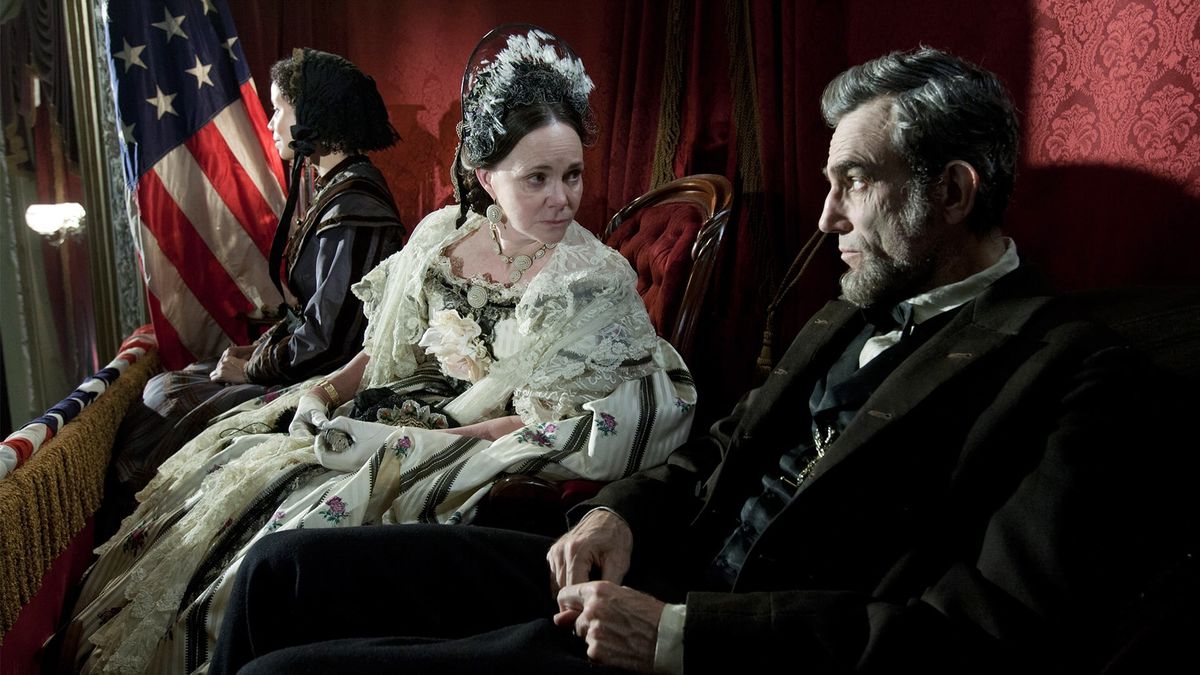
It took me three viewings until I felt I got Lincoln. Previously – in the cinema and the first time at home – I respected it. I admired the skill with which it was assembled. But I had found it hard to see it as much more than a critically acclaimed civics lesson, Spielberg at his most prestige. Returning to it the third time with the pressure well and truly off, suddenly I discovered a film I’d never seen before, an intensely dramatic telling of the perilous struggle to pass the Thirteenth Amendment to abolish slavery. A vibrant, beautiful and surprisingly intense story of how close Congress came to vetoing it. What had seemed a stuffy museum piece, instead came to life as a dramatic piece of cinema. It goes to show you should never be afraid to give something another go. Or two.

This biopic of Lincoln goes down a very modern route of avoiding covering the Great Man’s entire life. Instead it zeroes in on little more than a crucial month. It’s January 1865 – in what we know are the final months of the President’s life – and Abraham Lincoln (Daniel Day-Lewis) confronts a terrible choice. Civil war has torn America apart for year and peace may be on the horizon. But Lincoln fears a reformed America, with all its Southern slave states back in the fold, will find a way to end his Emancipation Proclamation and restore slavery to its height. To prevent this, Congress must ratify the Thirteenth Amendment to the Constitution ending slavery. But, with many in Congress worried that such an Amendment will end any chance of peace, Lincoln is in a terrible position. Should he sacrifice peace for abolition? Or vice versa? Either way, it will be a no-holds barred fight on the floors of Congress.

Spielberg’s film is near perfect in its shooting and editing, while its historical detail is brilliantly on-point. You couldn’t fault a moment of its making. However, what makes the film a success is the director’s skilful ability to combine graceful (even stately) old-fashioned film-making expertise, with a truly compelling sense of the passions and dangers we face when democracy is in action. And the overwhelming tension when the stakes are high and we have no guarantees of the end result. Another film – the stately civics lesson I once took the film for – would have shown the passage of the bill as a Whiggish inevitability, a progress filled march to a better world.

Lincoln isn’t like that. This is a film that shows politics then and politics now ain’t that different. For every principled man, there a dozen looking out for the main chance, marking time or who are too scared to worry about right and wrong. The Amendment is delivered not by impassioned oratory from the President. It’s carried by skilled floor management and the employment of a trio of political lobbyists with briefcases stuffed with cushy job offers in the rebuilt America.

Votes are brow-beaten out of people, threats and persuasion are used in equal measure. There is no winning people over with poetic oratory. At one point, Lincoln makes a simple and heartfelt plea for one congressmen to do the right thing: the guy votes against him. One of the film’s moments of triumph sees fervent abolitionist Thaddeus Stevens refuse to be provoked into expressing his true views on the floor, instead offering a statement that he does not believe in equality “in all things”, knowing any other answer will be used to build opposition against the bill. Is there any other film in American politics where one of the biggest cheer moments is one of our heroes compromising and spinning his true views into something far less threatening?

It’s all part of the film’s demystification of American history as not being something made from marble, but instead being real and true. If anything though, this sense of realism – of danger and the very real possibility of defeat – makes the final vote (a long sequence that almost plays out a congress vote in real time) both far more dramatic and also surprisingly moving. Because we appreciate every step of the backroom handshakes, fights, compromises and (let’s be honest) corruption and shady deals that got us here. And, more than anything, the film has made clear Lincoln is willing for this brutal war (the horrors of which, both in battle and bloody aftermath, intrude at key points in the film) to go on for as long as it takes, to ensure this Amendment.

Lincoln is the heart of the film: and it’s almost impossible to state how central Daniel Day-Lewis is to the film’s success. This is an extraordinary performance. I don’t think you can understate how venerated Lincoln is in the American memory. With his distinctive features and a permanent memory of him sitting like a marble God in the centre of Washington, it’s hard for many to imagine that this was ever a real man. But Day-Lewis has turned in a performance here that transforms Lincoln into a living, breathing man but never once compromises his greatness.

From the voice (a wispy lightness, a million miles from the deep, Shakespearean accent you would expect – and entirely accurate) to the ambling walk, to the film’s embracing of Lincoln’s eccentric monologing, his love of whimsy and jokes, his autodidact passion for language, his warmth and love for his family – and his righteous anger when frustrated by those who cannot see the big picture – this is extraordinary. Day-Lewis is compelling in a way few actors can be. His Lincoln is superbly human. Every moment is beautifully observed, but this is so much more than an actor’s tricks. His Lincoln is someone you can come out of the film convinced that he was talking to you, that you understand him as a human being not a cipher. I felt I knew and understood Lincoln more from watching this film than I ever had from a history book. It’s breathtaking.

Of course it inspires everyone else in the cast to give their best. The at times difficult marriage between Lincoln and his wife gives some wonderful material for Sally Field (easily her finest performance in decades). Mary Todd Lincoln is aware she will always be a disappointment for her husband as a partner, but equally feels that her public mourning for this lost child speaks of a deeper humanity than her husband. Loyal if questioning, she’s also abrupt and clumsy enough at times to be a liability.

Tommy Lee Jones is exceptional as Thaddeus Stevens, prickly, difficult but also morally pure (the film has helped rediscover the unjustly overlooked Stevens). Previous Lincoln performers Strathairn and Holbrook give very good support. James Spader is great fun as colourful lobbyist. Joseph Gordon-Levitt is all restricted ambition as Lincoln’s son. Jared Harris shines in a few scenes as Grant. Gloria Reuben has a few beautiful moments as Mary’s confidante Elizabeth Keckley.

Lincoln is a film shot with all the prestige of an American Merchant-Ivory, in love with the power of democracy. But it’s also open-eyed on how a system like America’s works, and how perilous delivering “the right thing” can be. Emotional and engrossing, it’s powered above all by a towering sublime performance by Daniel Day-Lewis who might as well be the 16th President reborn. It took me three viewings to see the richness here – but I am so glad I stuck it out.

Frost/Nixon (2008)

Frost Nixon header
Frank Langella and Michael Sheen face-off in famous interviews in Frost/Nixon

Director: Ron Howard

Cast: Frank Langella (Richard M Nixon), Michael Sheen (David Frost), Kevin Bacon (Jack Brennan), Rebecca Hall (Caroline Cushing), Toby Jones (Irving “Swifty” Lazar), Matthew MacFadyen (John Birt), Oliver Platt (Bob Zelnick), Sam Rockwell (James Reston Jnr), Clint Howard (Lloyd Davis)

If there is a bogeyman in American politics, it will always be disgraced President Richard Nixon. Because, however divisive Donald Trump is, Nixon will always be the king who was toppled, the man some consider a crook and a war criminal, others a gifted politician and negotiator. The truth is somewhere, as always, in the middle – but what seems inarguable is that Nixon was a man of deep personal flaws, which contributed considerably to his fall. Peter Morgan’s play explored the complexities of Nixon’s character through his famous TV interviews with British talk show host David Frost, a man with a few chips of his own. Ron Howard takes what was already a fairly cinematic script by Morgan, and produces a smoothly professional, entertaining and very well acted film.

After Richard Nixon (Frank Langella) has been forced into resigning, he is in the political wilderness. Watergate engrossed the world, with hundreds of millions of people tuning in to follow every detail. Who in television could resist those numbers? Certainly not David Frost (Michael Sheen), who believes if he can secure an exclusive interview with Nixon he could have a television package that could pull in millions of viewers, make Frost a fortune, and catapult him into the front ranks of TV interviewers. Slowly the project comes together. But both participants have a lot to prove: for Nixon this could be a chance of redemption; for Frost to prove he is more than a chat show host better suited to grilling the Bee Gees than the President. With both men underestimating each other, who will emerge on top in the interviews?

One of Ron Howard’s greatest strengths as a director is his ability to elicit fine performances from good actors. This is the real bonus he brings to this faithful adaptation of Morgan’s award-winning play. He presents it with a highly skilled professionalism and a refreshing lack of distraction that allows the audience to focus on the acting and the dialogue, its real strengths. Frost/Nixon is sharply written – with Peter Morgan’s expected mix of careful research and dramatic licence (most especially in a late-night phone call between the two men before the final day’s filming) – crammed with fine lines, well drawn characters and fascinating insights into both politics and television.

Perhaps Howard’s finest decision was to ensure the two stars of the play (in both the West End and Broadway) were retained for the film. Langella and Sheen’s performances – already brilliant in the stage version, which I was lucky enough to see – are outstanding here, both of them completely inhabiting their characters. The comfort and familiarity between the two performers are crucial – and ensure that the vital scenes between the two characters carry an electric charge.

Langella brilliantly captures the physicality and voice of Nixon, but also finds deep insights into the President’s tortured soul. He communicates Nixon’s sense of inadequacy and bitterness, his resentment at having to fight all his life for things others have been gifted. He balances this with Nixon’s pride and paranoia that constantly leads him to cheat others first. Langella’s Nixon, lost and bored in retirement, is desperate to regain his statue, but also tortured by a guilt and regret he can hardly bring himself to name. Under his robustness and confidence, lies deep shame and sorrow. It’s a brilliant capturing of perhaps the most psychologically complex leader America ever had.

Sheen is just as superb as Frost. As you would expect from an accomplished mimic, the voice is almost alarmingly accurate (he makes a better Frost than Frost did!). But just as insightful is his understanding of Frost’s psychology. Just like Nixon, Frost is a hard-working lad from a poorer background who has had to fight for everything he has. Sheen’s Frost is a phenomenal hard worker – producer, financier and star of his own career – who works hardest of all to appear an effortlessly confident dilettante. Sheen’s Frost balances immense pressures – facing personal and financial ruin – with an assured smile, keeping every plate spinning by never allowing a moment of doubt.

It leads into fascinatingly different attitudes to the interviews themselves. Nixon prepares in detail – and determines his best strategy is long winded answers that present his case and prevent attack. Frost is so focused on delivering the interviews that he sacrifices his actual interview preparation (certainly more so than he did in real life). Morgan uses the conventions of boxing dramas – corners, breaks between ‘rounds’, advice from their trainers – to capture a sense of gladiatorial combat.

However, the play is more complex than this. The reason why Frost struggles to land a glove on Nixon in earlier interviews on his domestic and foreign policies is that Nixon genuinely believes he is in the right – but (perhaps as Frost understood) the final interviews based on Watergate will see a more vulnerable Nixon as on that subject he knows he’s in the wrong. I suspect the real Frost knew that to get to Nixon on that final topic, he needed to be ‘softened up’ first to feel comfortable and produce a revelation.

Because the film is refreshingly positive in its view of television. A medium that films often attack for being trivial and boiling things down to soundbites and snippets, here acknowledges the strengths that can bring. A single snippet of an apologetic and crushed Nixon is worth thousands of words – and small moments can turn a TV programme from a failure to an event. Howard uses the power of the close-up at these moments to demonstrate how TV can zero in with a merciless gaze on a single moment. It’s a defence of the power of TV and its ability to reduce things down to moments.

Howard’s understanding of the strengths that lie at the heart of the play – and to tell the story simply – is what makes an already cinematic play translate wonderfully to the screen. With Langella and Sheen outstanding (with the supporting cast all equally excellent), the film entertainingly demonstrates the preparation and delivery of the interviews, while offering shrewd psychological insights into two men who had a lot more at a stake – and in common – than at first appeared. Professional, handsome and captivating, this is Hollywood movie making at its best.

The American President (1995)

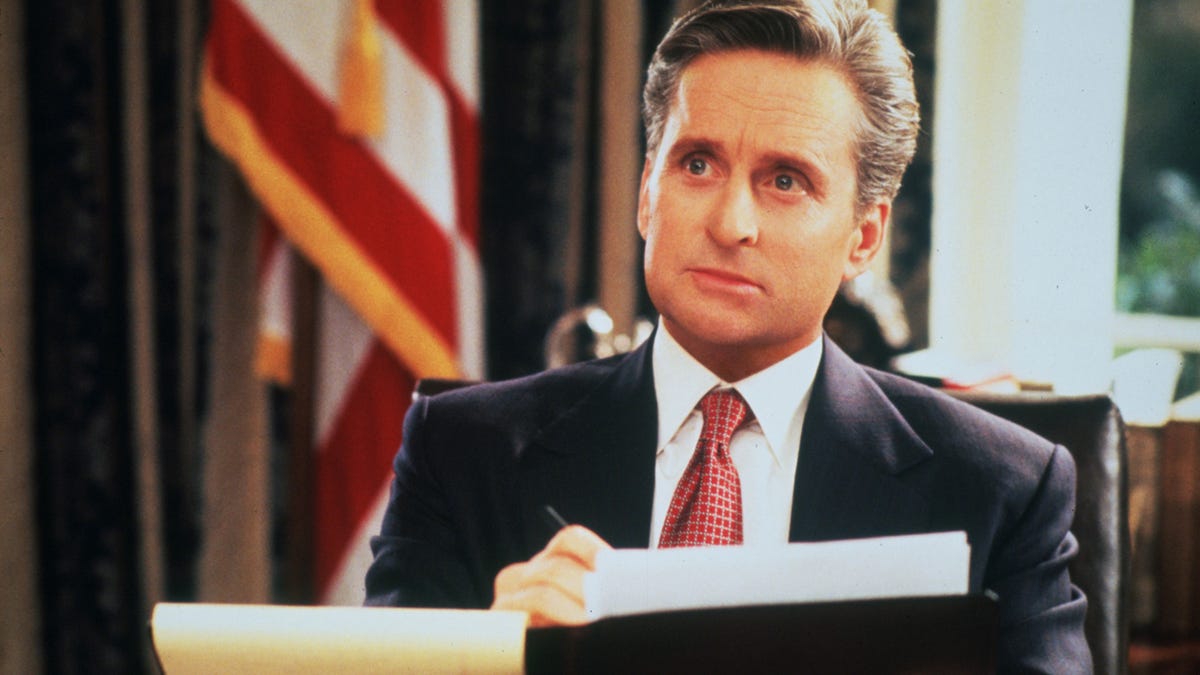
The buck stops with Michael Douglas in Aaron Sorkin’s dress rehearsal for TV, The American President

Director: Rob Reiner

Cast: Michael Douglas (President Andrew Shepherd), Annette Bening (Sydney Ellen Wade), Martin Sheen (AJ MacInerney), Michael J Fox (Lewis Rothschild), Richard Dreyfuss (Seantor Bob Rumson), David Paymer (Leon Kodak), Samantha Mathis (Janie Basdin), John Mahoney (Leo Solomon), Anna Deavere Smith (Robin McCall), Nina Siemaszko (Beth Wade), Wendie Malick (Susan Sloan), Shawna Waldron (Lucy Shepherd), Anne Haney (Mrs Chapil)

Taken solely on its own merits, The American President is a charming, witty romantic comedy which makes some shrewd (liberal-tinged) comments about American politics. But no-one is ever going to take The American President on its own merits. Because this Sorkin-scripted bundle of joy is so clearly a dry-run for The West Wing, it’s hard to watch it without spotting the roots of it here: everything from shared characters to scraps of dialogue. Perhaps only M*A*S*H stands with this film as so dwarfed by its spin-off.

President Andrew Shepherd (Michael Douglas) is a widower, raising his daughter Lucy (Shawna Waldron). Heading into the third year of his first term, he’s got a domestic agenda dominated by his new crime bill (although Shepherd won’t risk increasing gun controls). Charming, articulate and passionate – he’s also lonely. But his life changes when he falls for environmental lobbyist Sydney Ellen Wade (Annette Bening), their courtship seeing them fumble through “boy-meets-girl” when boy just happens to be the most powerful man in the world. Will the President’s popularity survive him dating someone outspoken and passionate? Or will it be a tool for his Republican rival Senator Bob Rumson (Richard Dreyfuss) to hit him on everything from family values to patriotism?

It’s impossible not to enjoy The American President. Sorkin’s playful, articulate and smart dialogue is of course an absolute triumph. The cast are extremely well-chosen. Few actors look as damn Presidential as Michael Douglas, not to mention carrying with them an air of impassioned authority and commanding bonhomie. Annette Bening is spot-on as exactly the sort of feisty and intelligent woman that would attract a liberal minded President, but turn off pundits and regular people. Martin Sheen was obviously so comfortable with Sorkin’s dialogue style that promotion to the President seemed inevitable (seriously it’s very odd watching the film and seeing Sheen not being treated like the President!). Michael J Fox’s entire career was revitalised by Sorkin tapping into the frantic, fast-paced comic energy that is the actor’s forte.

Rob Reiner’s direction is fresh, relaxed and perfectly complements the dialogue. We get a few West Wing style walk-and-talks (does this make Reiner the inventor of it?). The film superbly balances romantic comedy with serious political discussion on military intervention and proportional response (“the least Presidential thing I do”), the environment and gun control. It also gets a neat idea of the shady, and dirty, business of generating votes in the House – and the deals that need to be done to secure legislation. Reiner gets great stuff from the actors (Sorkin didn’t question his casting, since so many of them ended up in The West Wing) and keeps the momentum up beautifully.

The film has a lovely Capra-esque feel to it. Sorkin is even witty enough to lean on this by having Sydney discuss Capra openly with a White House security guard – also a lovely moment to establish Sydney’s genuineness and openness, as compared to the jaded I-don’t-care attitude of her colleague. There is a real feel in it – and of course this optimism carries across to The West Wing – that good people in the right place can change the world. That decency and compassion can trump (so to speak) the cynicism of Washington insiders. (The idea appeals to everyone – what is Donald Trump but a nightmare version of a plain-speaking man in Washington who says what he thinks?).

Balanced with some lovely comedy, it works extremely well. Along with the debate, Sorkin has a great feeling for the absurdity of the Leader of the Free World trying to work out how he can behave like a regular Joe and ask a girl out on a date. Simple ideas, from sending flowers to the etiquette of having someone stay over, are laced with difficulties. The film gets a wonderful sense of how the public eye can unjustly tear people apart – all drummed up by Dreyfuss’ eminently hissable villain.

There is some great chemistry between Douglas and Bening. Douglas is at possibly his most charming and authoritative here, effortlessly selling the lightness but also the powerfully effective speeches Sorkin crafts for him (his final press conference speech that effectively closes the film is a barnstormer). Bening, as well as being perfectly cast, walks a neat line between serious professional and girlish crush, that comes across extremely well.

It’s hard though, for all the film’s romantic charm, not to look at it through the filter of The West Wing. It’s both a first pass, and a historical curiosity. Sorkin recycled many of the ideas touched upon here (most noticeably Sheen’s President would spend an entire episode discussing proportional responses) and also expanded several characters. Douglas’ teacher turned President, widely read and with a liberal outlook, is a clear forerunner of Bartlett. Sheen himself plays a character who is all but Leo. Fox plays a character combining elements of Josh and Toby. Anna Deavere Smith is a CJ without those distinctive touches Allison Janney bought to the role. Names, plot developments, concepts are all recycled. Stylistic flourishes in the writing match.

The American President isn’t as good as The West Wing of course – few things are. But as a boiled down, Hollywood version with a romantic twist, it’s still pretty damn good.

JFK (1991)

Kevin Costner goes on a quest for the truth in Oliver Stone’s crazy but brilliant JFK

Director: Oliver Stone

Cast: Kevin Costner (Jim Garrison), Sissy Spacek (Liz Garrison), Kevin Bacon (Willie O’Keefe), Tommy Lee Jones (Clay Shaw), Jack Lemmon (Jack Martin), Walter Matthau (Senator Russell B Long), Gary Oldman (Lee Harvey Oswald), Joe Pesci (David Ferrie), Donald Sutherland (Colonel X), Laurie Metcalf (Susie Cox), Michael Rooker (Bill Broussard), Jay O. Sanders (Lou Ivan), Edward Asner (Guy Banister), Brian Doyle-Murray (Guy Banister), John Candy (Dean Andrews), Sally Kirkland (Rose Cheramie), Wayne Knight (Numa Bertel), Priutt Taylor Vince (Lee Bowers), Tony Plana (Carlos Bringuier)

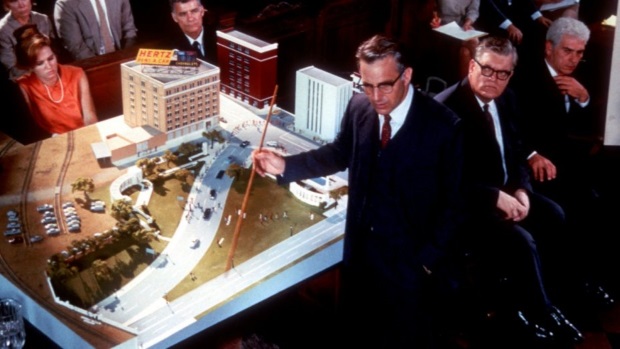
When great events happen, it’s hard for us to accept they might take place for random reasons. Rather than freak occurrences or boring individuals, we’d rather see them taking place due to an impenetrable web of shadowy figures. There is something in us that rejects randomness and embraces order. Conspiracy theories are the (ironic) result of these, with their exponents often the most passionate believers in the all-pervading genius of big government. Events like the death of President Kennedy can’t be because some nobody shot him. Instead it must be part of a wider junta of baddies, with every man you see merely a front for a cabal of the wicked. It’s hard not to be swept up by the lure of the conspiracy theories (they invariably have the best stories after all) – and Oliver Stone’s JFK is perhaps the definitive mainstream conspiracy theory essay.

Taking the campaign of Louisiana DA Jim Garrison (Kevin Costner) to find out the “truth” about the murder of President Kennedy, Stone’s film is part a fascinating presentation of half-truths and “might-have-beens” and part a sprawling mess of irresponsible nonsense. Either way it’s assembled with astonishing panache, a level of filmic skill that makes it (literally) almost impossible to tell whether what you are seeing is true and what is invention. Stone’s film superbly interweaves a variety of film stocks and effects to seamlessly splice together newsreel footage, Zapruder film and his own reconstructions so brilliantly it frequently becomes hard to tell which is which.

The same logic also applies to the script. JFK is frequently engaging and fascinating. But you have to remember that it is the equivalent of meeting the most literate and articulate street corner “End-of-the-Worlder”. Such is Stone’s skill he could, I am sure, have created an equally compelling film which would have you questioning the Moon Landings or the shape of the Earth. JFK throws an army of questions, objections and theories at the screen. And while it rarely provides much in the way of answers, only points that it wants you to think about, these theories frequently fascinate. Imagine JFK as a sort of video essay, linked together with dramatic scenes, with its points delivered by authoritative and trusted actors like Donald Sutherland, Jack Lemmon and Walter Matthau.

There is absolutely no doubting the technique of Stone here, or his mastery of the language of cinema. The work of Robert Richardson’s photography, with its myriad styles, and of Joe Hutshing and Pietro Scalia’s editing, pulling together a host of images, snapshots and flash cuts into an insidiously convincing whole, is breathtaking. Light in particular is superbly used, casting some characters in shadow, flaring up to (literally) blind others – light frequently plays across Garrison’s glasses, a visual metaphor for his own struggle to see the light. The speeches he writes for his characters are superbly done, and make their points with great skill – Sutherland (superb) has a hugely convincing story of military black ops action (and inaction) before and after the assassination that fills almost 20 minutes of screentime.

There are compelling arguments made about the ability of Oswald to fire the shots, the triangulation of fire, the spurning of an easier shot before the fateful turn, Oswald’s seemingly illogical movements after the shooting etc. etc. There is decent reasoning behind all of this, and the points are marshalled very well. But, like all extremist theories, suddenly it will turn into something just a little batshit (Lyndon B Johnson ordering the hit or some sort of cabal of Cubans, CIA, FBI and Secret Service working together to conduct a coup).

Much of Stone’s passion for finding the truth (the film’s mantra) is rooted in his own romantic view of Kennedy, as some sort of lost “Prince Who Was Promised”. To Stone, Kennedy would have withdrawn us from Vietnam (news I am sure to the President who started and escalated America’s involvement in it), ended the military industrial complex (contrary to his platform when elected of a stronger US military), bought the Cold War to an end (again, running against his sustained opposition to the Soviet Union) and introduced full Civil Rights (a cause he was lukewarm on at best – unlike his brother or his successor Johnson).

But Kennedy was a romantic figure who had the ability to invite people to invest him with whatever qualities they wanted (both good and bad), a magic cemented forever by his untimely murder. In reality there is no indication that JFK would do (or want to do) any of the things JFK argues he was assassinated for. But that’s all part of the magic of the conspiracy. Facts and events can be marshalled into whatever you want them to be. (Tellingly the only member of Garrison’s investigative team who questions these theories is shown to be a creep in the pay of the conspirators.)

So Kennedy can be a saint, and the film can outline (with no evidence at all beyond a series of coincidences and unlikely or random events) a grand vision of master schemers reshaping America over the body of a dead President. Does it really stand up? Well no of course not. But I will say it is compelling viewing – even if it is essential to keep an open mind about it. Stone later wished he had made clearer that much of the work here was pure fiction (and speculative at best). Certainly it’s a point to keep in mind.

Perhaps Stone should also have looked again at some of the other beats in the film. The film’s version of Jim Garrison as a kind of saintly campaigner for justice flies in the face of many (then and later) who believed the Louisiana DA a shameless self-promoter – an argument made easier to believe by the real Garrison’s cheeky cameo in the film as his ‘nemesis’ Earl Warren. No mention is made in the film that the case he brings against Clay Shaw was dismissed by the jury after less than an hour, and the film avoids explicitly showing his lack of evidence. Costner delivers the final speech, with its famous “back and to the left” commentary on what seems like Kennedy’s unnatural movement after being hit by a bullet and breakdown of the “magic bullet” (both theories now largely discredited), with aplomb, but the film puts a halo on Garrison which doesn’t really stand up.

But again at least it’s entertaining. Other parts of the film don’t even manage that: the baseline narrative that links up the various compelling conspiracy lectures is frequently dull, insipid and lamely written. Sissy Spacek has perhaps the most thankless role in film history as Garrison’s wife whose nearly every line is a variation on “Honey please stop reading the Warren Report and come to bed”. Even that though pales against the exploration of the 1960s gay scene in Louisiana (which Clay Shaw and his “fellow conspirators” were leading members of) which has an unpleasant stink of homophobia, playing into a host of deeply unpleasant (and false) stereotypes of gay people as perverted, promiscuous and preying on the straight. One suspects there was more than a little truth in the idea that Garrison’s fury at Shaw was at least partly motivated by homophobia.

These sequences work considerably less well today – and frequently go on far too long – but when the film focuses on its Kennedy theories it is at least compelling, even if it’s all rubbish. The film made it mainstream to believe Kennedy was killed by a conspiracy in which Oswald was, if he was involved at all, only a patsy. How different would the world have been if Oswald had lived and been made to explain why and how he killed Kennedy? But then chances are, being such an average an unremarkable man, people wouldn’t have believed him anyway.

Stone’s film is a triumph of agenda-led fantasy. Stuffed with faults it makes you at least ask questions – even if you wisely use those questions to affirm many of its points are questionable at best. But any film buff will love the skill it’s told with and the beauty of its technical assembly. Costner was perhaps a little too bland to drive the thing along (although the film uses his innate morality very well), but there are several good performances not least from Gary Oldman who is brilliant as put-upon, used but unknowable Oswald. Nuts, crazy and packed with compelling nonsense, it at least always encourages you to find out more about the actual history.

Amistad (1997)

Djimon Hounsou excels as a slave longing for freedom in Amistad

Director: Steven Spielberg

Cast: Djimon Hounsou (Sengbe Pieh/Joseph Cinqué), Matthew McConaughey (Roger Sherman Baldwin), Anthony Hopkins (John Quincy Adams), Morgan Freeman (Theodore Joadson), Nigel Hawthorne (President Martin van Buren), David Paymer (John Forsythe), Pete Postlethwaite (William S Holabird), Stellan Skarsgård (Lewis Tappen), Razaaq Adoti (Yamba), Abu Bakaar Fofanah (Fala), Anna Paquin (Isabella II), Chiwetel Ejiofor (James Covey), Peter Firth (Captain Fitzgerald), Jeremy Northam (Judge Coglin), Xander Berkeley (Ledger Hammond), Arliss Howard (John C Calhoun)

After the American Revolution, independence left one issue in America that would profoundly split the country: slavery. This was a land divided, between abolitionists and plantation owners, the more emancipation-minded North and slave states of the South. Slavery was – and remains – the ugly stain on the American soul. Steven Spielberg’s film uses a significant court case of its day to shine a light on these contrasting and conflicting priorities in American society throughout much of the early 19th century, that would eventually lead to civil war.

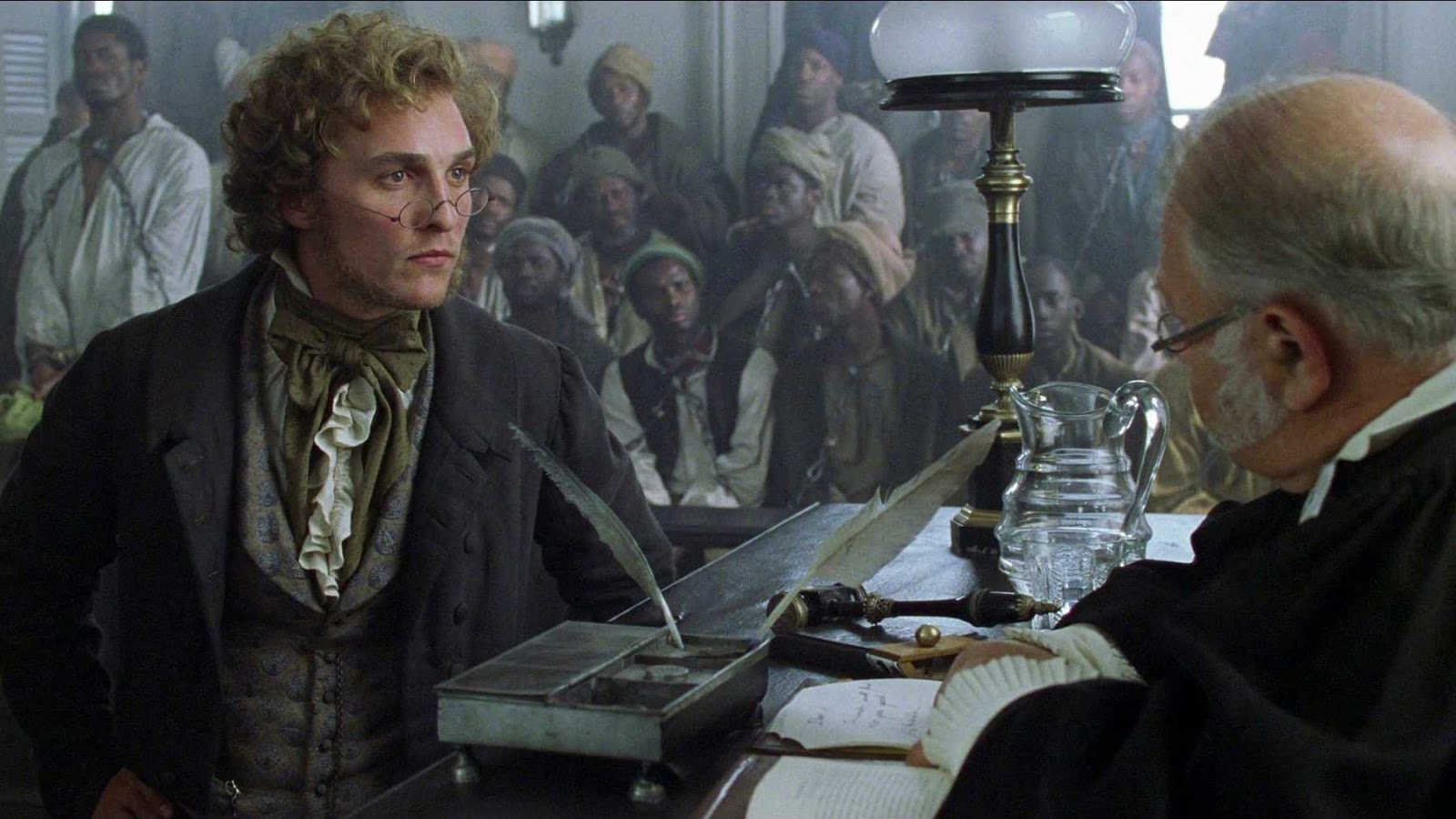
The film tells the true story of the slave revolt on the Spanish slaver ship Amistad. Here the slaves, led by Joseph Cinqué (Djimon Hounsou) escaped captivity, rose up and killed most of the crew (leaving just two men alive to sail the ship) and tried to return to their home in Sierra Leone. Arrested by an American naval ship while collecting fresh water, the slaves are transported to Connecticut where they find themselves on trial as escaped slaves, facing charges of piracy and murder. Their cause is taken up by Northern abolitionists Lewis Tappen (Stellan Skarsgård) and his black associate Theodore Joadson (Morgan Freeman), and their lawyer Roger Sherman Baldwin (Matthew McConaughey) a property lawyer. However, the case’s international implications for slavery attracts the concern of President Martin van Buren (Nigel Hawthorne), eager to support the prosecution, while former President John Quincy Adams (Anthony Hopkins), a lawyer and opponent of slavery, offers his advice to the defence.

Spielberg’s film has just the right balance of human interest and humanitarian concern to overcome its slight air of a civics lesson. Although largely a courtroom drama, what the film is really trying to do is capture in one moment the troubling contradiction of the land of the free built on slaves, and give a voice and empathy to the slaves themselves. 

Although some have criticised this as a “white saviour” film, I feel that’s unfair. This is a film that starts and ends with Cinqué’s story and filters America through his perception. We can well understand why he rages at his lack of comprehension of laws that can be adjusted, court decisions overturned or how words can be twisted to take on other meanings. A film front and centred, say, by Matthew McConaughey’s Baldwin and focusing on journey from seeing this as just another case into a crusade would be a white saviour film. Instead the white characters drop in and out of the story as the narrative requires, and it’s the struggles and courage of the black characters that form the heart of the narrative.

Spielberg also brings to life the cruelty and inhumanity of slavery and what it does to all of us. The film opens with the confined, appalling conditions of the slave ship while Cinqué (with hands running with blood) tries to release a nail from the wood which he will use to free himself from his chains. The film intriguingly opens without the African characters being translated – giving us a sense of their isolation and perhaps also stressing how different they are from the Western “civilisation” that has taken them from their homes. 

It isn’t until half way through the film, until a translator is found for Cinqué, that the film gives us the backstory that Cinqué has struggled to communicate. Spielberg spares no punches in showing the violence of abduction, the brutality and casual slaughter of the slavers, the starvations, the floggings that end in blood sprayed death, the cramped conditions practically designed to weed out the weak. A mother chooses drowning for herself and her child rather than life on the ship. Later the slavers chain unwanted slaves to a bag of rocks and cast them overboard to reduce their cargo load. If there was any doubt about the heart-rending evil behind slavery, it’s removed from your mind.

It also serves to hammer home the injustice of America’s own system. Under political pressure – van Buren is worried about the reaction of both Spain and the Southern States to the Africans being found innocent – the trial encounters interference and appeals every step of the way. It’s a system that prides itself on being the greatest in the world, but shows time and time again how it can be weighted against the weakest. The courtroom scenes – skilfully directed and played – show time and time lawyers valuing obscure property laws above right and wrong. And we are brought time and time again to the reactions and lack of understanding of the African characters, who come from a society where there is no equivocation and no words equivalent to “usually” or “perhaps”.

The film perhaps does take a little too long over its various legal machinations, and could do with losing a few minutes here and there. But that would be to sacrifice its many strengths. Looking wonderful, with a marvellous score by John Williams (riffing on the American pipes and African tribal influences), one of the strongest acting companies Spielberg ever assembled does outstanding work. Carrying much of the film is Djimon Hounsou, who makes Cinqué anything but a victim – he is a proud, defiant and intelligent man, humble enough about his qualities but quick to act to defend his rights. Uncowed but infuriated by the situation he finds himself in, he is never a passenger but at all times a key figure in his own liberation, even if his legal case must be fought by whites.

McConaughey enjoys himself under a bad wig, glasses and dirty teeth as the lawyer Baldwin, ambitious but with more than an air of decency. Postlethwaite is at his quietly authoritative best as his opposition counsel. Freeman lends the film a large part of his grace and dignity in a small, observant part of the freed-slave turned abolitionist, with Skarsgård more political as his white colleague. Hawthorne makes a van Buren a slightly flustered, impatient figure. Peter Firth demonstrates a great contempt for slavery behind an imperious exterior.

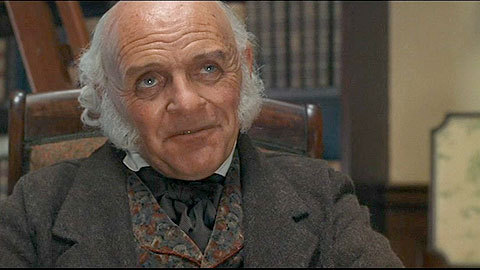
The film’s highlight performance though is Hopkins’ Oscar-nominated turn as John Quincy Adams. Adjusting his physicality to match the ageing ex-President, Hopkins captures his slightly nasal Massachusetts twang and adds a significant amount of twinkly charm and wry shrewdness to this adept political operator. A large chunk of the film’s final 20 minutes is given over to Hopkins, with the highlight a long monologue of Adams speech to the Supreme Court (in actuality a speech over eight hours in length!), that is a tour-de-force of skilled showmanship. It’s Hopkins’ last great performance of the 1990s. 

Spielberg’s Amistad is a superb courtroom drama but also a heartfelt condemnation of the inhumanity man can show to man. It never forgets either that while this was a victory, it was only a skirmish not the war. While the film at times overplays the inevitability of Civil War (which did not exactly start over this issue), it skilfully shows the divide in the American culture between abolition and slavery – and how many felt for the first cause, but feared the supporters of the second so much they would rather not address it. Either way, Amistad may at times be a little dry – but that gives its moments of emotion even more force.

Nixon (1995)

Anthony Hopkins triumphs as Nixon in Oliver Stone’s surprisingly sympathetic biopic

Director: Oliver Stone

Cast: Anthony Hopkins (Richard Nixon), Joan Allen (Pat Nixon), James Woods (HR Haldeman), Powers Boothe (Alexander Haig), Larry Hagman (“Jack Jones”), Ed Harris (E. Howard Hunt), Dan Hedaya (Trini Cardoza), Bob Hoskins (J. Edgar Hoover), Madeline Kahn (Martha Mitchell), EG Marshall (John Mitchell), David Paymer (Ron Ziegler), David Hyde Pierce (John Dean), Paul Sorvino (Henry Kissinger), Mary Steenburgen (Hannah Nixon), JT Walsh (John Ehrlichman), Sam Waterston (Richard Helms), Brian Bedford (Clyde Tolson), Tom Bower (Francis Nixon), Kevin Dunn (Charles Colson), Annabeth Gish (Julie Nuxon), Tom Goldwyn (Harold Nixon), Saul Rubinek (Herbert G Klein)

In 1995, there was one person the chronicler of the 1970s American experience, Oliver Stone, hadn’t covered: Richard M Nixon. The man who was the embodiment of the dark scar on the American consciousness, the grim, unlovable presence behind the war in Vietnam, the protests and the deep, never-ending wound of Watergate, who seemed to drag the country further and further into the abyss. The man who besmirched the office, the least popular president ever, the national shame. With Stone’s searing attacks on everything from Vietnam policy to the conspiracies behind the Kennedy assassination, you’d expect his film on Nixon to be a condemnation. What people didn’t expect was a film as strikingly even-handed as this, which recasts Nixon not as a gloating villain, but a Shakespearean figure, a Greek tragedy of a man destroyed by chronic character flaws.

Opening with a crushed Nixon, like a drunken Gollum cradling his precious, listening to his precious tapes in the bowels of the White House during his final days in office, the film is told in a fascinatingly non-linear style – loosely falling into two acts, cutting backwards and forwards in time. The first act covers most of Nixon’s career up to the presidency, focusing on his Quaker childhood and the influence of his mother Hannah (Mary Steenburgen), his defeat in the 1960 election to Kennedy and his years rebuilding his political standing. The second half takes a more linear approach, covering a Presidency becoming increasingly bogged down in the inept cover-up of Watergate and increasingly desperate attempts to save his presidency, intermixed with foreign policy successes.

What is really striking is that Stone’s movie finds a great deal of sympathy for this troubled and complex man. He’s a man who has greatness in his grasp, dedicated, intelligent and with vision – but fatally undermined by self-loathing, self-pity and a bubbling resentment about not having the love of the people. Like Lear raging against the storm, or Macbeth bemoaning the impact of his vile deeds, Stone’s Nixon becomes a sympathetic figure, even while the film makes no apologies for his actions, his aggressive bombing of Cambodia (the film notes at its end the bombing led directly to the massacres of the Khmer Rouge) or his failures to claim any responsibility for how he caused his own end.

Stone’s empathetic vision of Nixon is shaped largely by Anthony Hopkins’ titanic performance in the lead role. Hopkins makes no real effort – beyond teeth and hair – to look like Nixon, but brilliantly embodies Nixon’s awkward physicality and, above all, his angry, bitter, resentful personality. It’s not an imitation, but it totally captures him. Hopkins has got it, and the disintegration of Nixon over the course of the film into the shambling, miserable, twitching, even slightly unhinged mess he became in the final days of his presidency is astounding. 

It works because Hopkins never loses sense of the potential for greatness in Nixon – sure he’s socially awkward (Hopkins superbly captures Nixon’s awkward grin, his stumbling nervousness in conversation), but politically he’s assured, confident and has huge insight into realpolitik. His flaw is that he wants to be both the master politician and the people’s champ, to be Nixon and JFK, to have the people cheer him to the rafters. It’s a longing that turns to resentment, fuelling insecurity and fear, that causing him to be so afraid of being cheated that he cheats first and bigger.

It’s that potential for greatness that swims through Stone’s masterfully made, electric film. Stone’s love for mixing film stock, fake newsreel footage, snazzy camerawork, switching colour stock, stylistically eclectic sound and music choices and bombastic lecturing comes to the fore here – and I accept it won’t be for everyone. But for me it works. It’s a big, dramatic movie because it covers an epic theme. From its early echoes of Citizen Kane – the White House as Xanadu, those missing 18 ½ minutes of the tape Nixon’s “Rosebud” – through to the accelerated pace and film stock as events spiral out of the President’s control, it’s an explosion of style that really works, even if there are points which are too on-the-nose (a scene where Nixon’s dinner talk of war is interrupted by a steak that leaks gallons of blood as he cuts into it, is clumsy in the extreme).

Stone’s theories revolve around the true villain being the government-financial power system itself, a grindingly oppressive beast chews up and spits out the men who think they can ride it. Nixon may know about the danger of the system, but he’s as powerless as anyone else. Its tendrils extend everywhere, from the creepily domineering CIA chief Helms (Sam Waterston, unsettlingly intimidating in scenes restored in the director’s cut) to the shady Texan money interests (led by an excellent Larry Hagman of all people) who sure-as-shit want to get rid of that liberal, Cuban surrender monkey Kennedy, by any means necessary (“Say Kennedy dont run in 64?”). 

Nixon wants to control it, to do some good – and the film is excellent at stressing how Nixon’s poverty-filled Quaker background gave him a drive to achieve but also a chippy insecurity and moral standards from his imperious mother he can never hope to meet – but what hope does he have? In any case, his own deep moral failings doom any chance of forging his own goals, sucking him into a quagmire where long-running dirty deeds, shady deals and unedifying company consume him. “When they look at you they see what want to be. When they look at me they see what they are” Nixon complains to the painting of Kennedy, the rival whom he can never eclipse, the man born with all the advantages Nixon never had, the millionaire embraced by the people while the working-class Nixon is reviled. It’s these resentments that consume and destroy Nixon, and Stone presents this as an epic tragedy of a great politician, crushed by his fundamentally human flaws.

Around Hopkins, Stone assembles a brilliant cast. Joan Allen is superb as Nixon’s loving but insightful wife who won’t shy to speak truth to power. James Woods is perfect as the bullishly aggressive, fiercely loyal Haldeman. Paul Sorvino does a wonderfully arch impersonation of Kissinger, always keeping his distance. David Hyde Pierce makes a smoothly innocent but determinedly self-preserving John Dean, Powers Boothe a wonderful cold Alexander Haig. Only Bob Hoskins gives a performance slightly too broad as Hoover – but he still laces the role with a crackling menace.

Nixon is a great film, an explosion of style (perhaps at times a little too much), which painstakingly strips bare the President’s psyche – his doubt, guilt, bitterness, resentments and finally overwhelming self-pity. Powered by a titanically well-observed performance by Anthony Hopkins, who is just about perfect in every frame – every nuance feels real – Nixon is a wallow in the dark underbelly of America, which hints throughout at the even greater dangers that lie under the surface, the powerful system maintaining the status quo that sees presidents come and go, but never allows any real change. It’s a remarkable film.