Category: Presidential films

Young Mr Lincoln (1939)

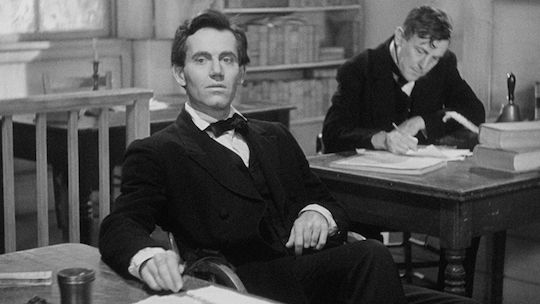
Henry Fonda excels in the origins story as the Young Mr Lincoln

Director: John Ford

Cast: Henry Fonda (Abraham Lincoln), Alice Brady (Abigail Clay), Marjorie Weaver (Mary Todd), Arleen Weaver (Sarah Clay), Eddie Collins (Efe Turner), Pauline Moore (Ann Rutledge), Richard Cromwell (Matt Clay), Donald Meek (Prosecutor John Felder), Eddie Quillan (Adam Clay), Spencer Charters (Judge Herbert A Bell), Ward Bond (John Palmer Cass), Milburn Stone (Stephen A Douglas)
John Ford is often called the mythmaker of America, the director who perhaps contributed more than any other to building a romantic vision of America’s roots and past. As an explorer of the legends and mythology that underpinned his country, it’s perhaps no great surprise that he directed a film about the American revered more than any other since the Founding Fathers – Abraham Lincoln himself.

Playing out over 10 years, the film follows Young Honest Abe (Henry Fonda) from his days of autodidactism with a law book in Illinois, through his love for, and the death of, Ann Rutledge (Pauline Moore) and his arrival in Springfield to practice law (which he does with a shrewdness mixed with the wisdom of Solomon). The bulk of the film’s plot focuses in particular on him representing two brothers accused of murder in a courtroom trial, where Lincoln’s wit, wisdom and determination see justice done.

Okay reading that subplot, it’s pretty clear that this is a fairly rose-tinted view of The Great Emancipator. Henry Fonda had put off playing the role, as he felt it would be like hewing a performance out of marble. It’s hard for non-Americans to even begin to understand the reverence with which Lincoln is almost universally held in America, but it runs through this film like sugar through a stick of rock. Lincoln throughout the film is maybe an increasingly canny operator with a mastery of winning people over and playing crowds large and small, but he’s also always right, always does the right thing and always has a warm regard and love for genuine real people.

If you made the film today it would probably be called Abraham Lincoln: Origins, as Ford shows Lincoln building up all the weapons that would become central to his political artistry. Fonda starts the film gangly and physically awkward, finding it hard to know what to do with his height or long arms while giving speeches (Fonda wore platform shoes to increase his height). But even at the start his words are warm and genuine, even if his delivery is awkward. It’s something he masters to a far greater degree by the mid-way point of the film, when he skilfully diffuses a potential lynch mob with wit, gentleness, calm and a bit of righteous shaming. By the time he hits the courtroom, he’s overwhelmingly confident in his physicality and able to match it up with his oratorical brilliance and his skill at using seemingly rambling, inconsequential stories to suddenly hit home a sharp and painful truth.

Fonda’s impressive performance as Lincoln makes the film. Fonda gives Lincoln not just these positives but also hints at his sharpness of mind and his cunning. Negotiating a legal disagreement between two farmers (which he does with such skill that both end up paying him), he not only gives a fair sentence, but shows how he is not above manipulating men to achieve his ends (and, in biting one of the coins that he is given, that he may be honest himself but he’s not always trusting). He has a romantic regard for the mother of his clients (played very well by Alice Brady), but can still gently patronise her with his romantic ideal of her as an ideal American mother.

But when the push comes, Lincoln is a man of principle, wrapped in a skilful performance. The idea of mob justice is anathema to him, while Fonda makes clear he’s smart enough to not say that outright but to guide the crowd to agree with him. During the selection of the jury for the courtroom scene, he will accept men honest enough to say they favour hanging for the guilty, but turn down equivocators or those who believe they are better than the accused men. During the trial scene, he erupts in moral outage when the boys’ mother is pressured into naming one of her sons as the killer so as to save the other from the death penalty.

But he’s also a clever and brilliant player of the game, able to charm both the working classes and the rich, even if he’s not comfortable with either. During the trial scene, his quick wit and relaxation run rings around the government prosecutor (a good role of absolute convictions from Donald Meek) and he easily wins the crowd over with a series of gags and light touches that also carry with them a real, deep truth. Ford is also able to show his ambition – over the grave of Ann Rutledge he lets the fall of a stick decide whether he will continue his career or stay at home, and he all too clearly lets the stick lean over one way before letting it fall (he even acknowledges this himself).

Ford’s film is only very loosely based on actual true events – only the final coup Lincoln uses to win the case is really based on fact. The film is covered with smatterings of what look now like clumsy droppings in of key facts or persons from Lincoln’s life – from the cowpoke who plays “Dixie” (“Sounds like a song you could march to” is Lincoln’s comment) to Lincoln meeting future-wife Mary Todd, to his legal (and romantic) rival being none other than Stephen A Douglas his later rival for the presidency. There could have been a lot more, but afraid that it would make the film ridiculous, Ford kept these to a minimum by simply refusing to shoot them (such as a planned scene where Lincoln met John Wilkes Booth).

It all works because the audience knows who Lincoln will become, and it’s told with an earnestness and a certain amount of pace. Ford however really crafts a modern American myth and it even ends in a suitably epic scale: having won the case, Lincoln strikes off for a walk up a hill, trudging into the distance while a storm brews, heading onwards and upwards away from us and into his future. Sure it’s corn, but it works.

Primary Colors (1998)

John Travolta and Emma Thompson are definitely not the Clintons in Primary Colors

Director: Mike Nichols

Cast: John Travolta (Governor Jack Stanton), Emma Thompson (Susan Stanton), Adrian Lester (Henry Burton), Billy Bob Thornton (Richard Jemmons), Kathy Bates (Libby Holden), Larry Hagman (Governor Fred Picker), Stacy Edwards (Jennifer Rodgers), Maura Tierney (Daisy Green), Diane Ladd (Mamma Stanton), Paul Guilfoyle (Howard Ferguson), Kevin Cooney (Senator Lawrence Harris), Rebecca Walker (March Cunningham), Allison Janney (Miss Walsh), Mykelti Williamson (Dewayne Smith)

In 1998, America was engrossed in what seemed like a never-ending series of scandals around Bill Clinton, with Clinton facing impeachment. The news was filled with Clinton-Lewinsky Scandal catch-ups seemingly non-stop. Surely in the middle of that, a film that charted earlier scandals about Slick Willie would be a hit? Well Primary Colors proved that wrong. A thinly veiled portrait of the Clinton run for the White House, based on a novel written by Joe Klein who followed the Clintons on the campaign, it tanked at the box office. Possibly due to audiences having Clinton-fatigue – but also perhaps because it’s a stodgy, overlong and slightly too pleased-with-itself piece of Hollywood political commentary.

The film sticks pretty close to real-life timelines. John Travolta is Arkansas Governor Jack Stanton (Travolta does a consistent impersonation of Bill Clinton both vocally and physically during the whole film), who’s running for the Democratic Presidential nomination, supported by his (perhaps) smarter, ambitious wife Susan (Emma Thompson, doing a neat embodiment of Hillary without impersonation). Eager young black political operator Henry Burton (Adrian Lester) is recruited to help run the campaign – and finds himself increasingly drawn into the secrets of the Stantons, not least Jack’s persistent infidelities that seem to go hand-in-hand with his empathy and genuine passion for helping people. As scandal builds on scandal, the campaign to run for President becomes ever more unseemly.

Primary Colors asks questions that, to be honest, are pretty familiar to anyone who has ever seen a Hollywood film about politics. We’re presented with a Clinton-Stanton who wants to help America to re-educate itself in a modern world, who weeps with emotion when hearing a man recount his struggles with literacy (a fine cameo from Mykelti Williamson), who wants to rebuild America’s economy and build opportunities for all. And at the same time, he can’t keep it in his pants, is quite happy to dodge as much as possible the consequences of his actions, and is blithely disinterested in the impact his infidelities have on other people. Essentially the film wants to ask: at what point does a man’s personal behaviour and morals start to outweigh his good intentions?

It just takes a long time to ask it. A very long time. Primary Colors is a film that could easily be half an hour shorter, and you would miss very little. It’s a stodgy, overlong, smug drama that takes a gleeful delight in how clever it’s being making a film about the Clintons that-isn’t-about-them. It’s weakened as well by using an overly familiar device of putting a naïve and well-meaning audience surrogate character at its centre. We’ve seen this growth of disillusionment before, but Adrian Lester (in a break out role) fails to make Henry Burton a really interesting character – he’s little more than a cipher that we can project our views onto, and Lester is too reserved an actor to make him a character we can effectively invest in as a person. Instead he becomes a largely passive observer that more interesting characters revolve around.

Those characters being largely the Stantons themselves. John Travolta does a very good impersonation of Clinton, but he offers very little insight into the sort of person Clinton is, his motivations or his feelings. Like the character, the role is all performance and you never get a sense of how genuine his goals are and how much ambition is his main driver. As scandals pile up, Travolta is great at capturing Clinton’s sense of hurt that anyone would question his morals (even as his actions display his fundamental lack of them), but the role is short on depth. 

Emma Thompson gets less to play with as Hillary. In fact, she disappears from the second half of the film, after an affair plotline between her and Lester was cut completely from the film (something that makes certain scenes, where actors are clearly responding to this non-existent plotline, amusing to watch). But she manages to make the role something a little more than impersonation, delivering a whipper-sharp, ambitious woman who has buried her resentments about her husband’s betrayals under a wish to achieve a higher goal.

The rest of the cast deliver decent performances, but the stand-out is Kathy Bates as a long-time Stanton friend turned political fixer, who sees her idealisation of the Stantons turn to bitter disillusionment. Bates at first seems to be delivering another of her custom-made “larger than life” roles, but as the stuff hits the fan she layers it with a real emotional depth and complexity. It’s a caricature role that she turns into something real, a woman who feels genuine pain at seeing her deeply held political convictions and ideals being slowly disregarded by her heroes.

But then we get her point. Don’t we all feel a bit like that when we think back about Bill Clinton? The more we learn about his affairs and sexual scandals – and the more that #MeToo develops our understanding of how powerful men can abuse their power to take advantage of star-struck young women – the less sympathetic he seems. The film too suffers from some really out-of-date views of male sexuality. Billy Bob Thornton’s political fixer exposes himself early on in the film to a female worker, but this is shrugged off as “banter”, as opposed to a criminal offence – and the film largely avoids giving any air time to Stanton’s principal victim, the teenage daughter of a black restauranter whom he may or may not have impregnated. Stanton uses his power to gain sexual favours – one of his earliest acts is casually picking up a gawky English teacher who’s giving him a guided tour of her school (a funny cameo from Allison Janney) – but this is largely categorised as a personal weakness that doesn’t impact his suitability for the Presidency, something that feels more and more uncomfortable.

However, Primary Colors’ real problem is that it is overlong and a little bit too pleased with its intricate reconstruction of semi-true events. Although there are funny lines and decent performances, the film lacks any real zip and it gives no real insight into modern politics (other than perhaps deploring the compromises politicians must make) or the Clintons themselves. Instead it settles for telling us things we already know at great length and making safe but empty points about modern America. Far from exploring a Faustian pact where we accept deep personal failings in politicians because we believe that, overall, they could be a force for good, instead Primary Colors is all about turning shades of grey into obvious clear-cut moral choices.

The Front Runner (2018)

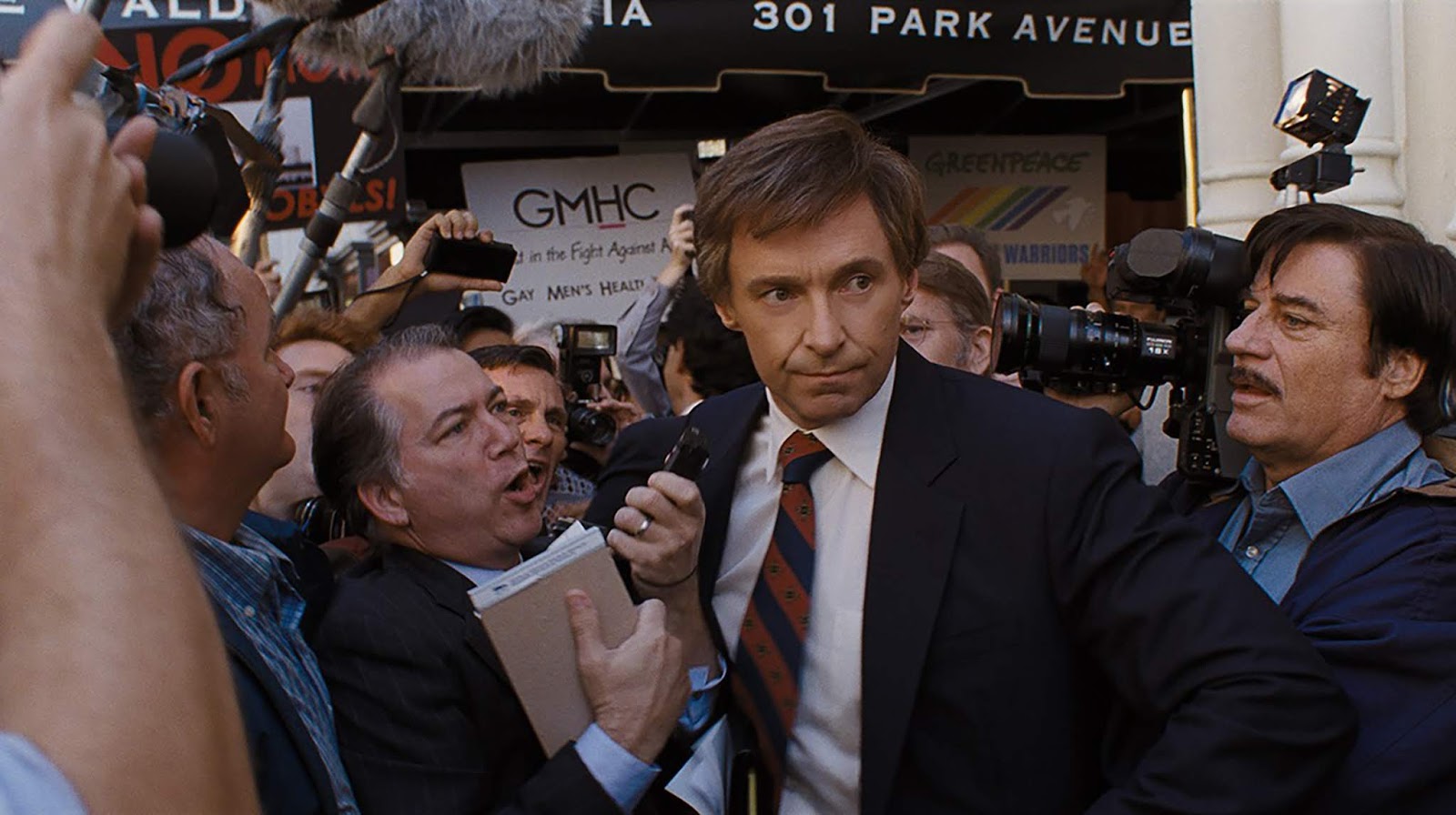
Hugh Jackman in the centre of a media scrum in misfiring biopic The Front Runner

Director: Jason Reitman

Cast: Hugh Jackman (Gary Hart), Vera Farmiga (Lee Hart), JK Simmons (Bill Dixon), Alfred Molina (Ben Bradlee), Sara Paxton (Donna Rice), Mamoudou Athie (AJ Parker), John Bedford Lloyd (David S Broder), Spencer Garrett (Bob Woodward), Steve Coulter (Bob Kaiser), Ari Garynor (Ann Devroy), Steve Zissis (Tom Fiedler), Bill Burr (Pete Murphy), Mike Judge (Jim Savage), Kevin Pollak (Bob Martindale)

In the 1988 Democratic primaries, Gary Hart (Hugh Jackman) was the man to beat: a telegenic liberal with an attractive programme of policies and a forward-thinking vision for America. No one could beat Hart. Except for Hart himself. A man with a history of affairs, he became embroiledin a sex scandal after an ill-advised friendship (the film is coy on taking a stance on whether this friendship was sexual or not) with a young woman, Donna Rice (Sara Paxton). Angrily denying anything was going on, Hart unwisely challenged journalists to follow him: which the Miami Herald did, soon finding Hart had skipped campaign events to invite Rice to come and stay with him at his Washington home for a long weekend… Cue a media snowstorm and an imploded campaign.

Reitman’s film is a pretty decent chronicle of this early media sex scandal. I say pretty good because it does what it sets out to do with a solid observation of the facts and a general even handedness between Hart and the media. However it never really quite sparks into life, and Reitman’s attempt to make this story into something with huge relevance for how the modern media has developed, and how the world of politics has led us to Trump, just doesn’t really work. 

What the film instead becomes is a slightly dry but enjoyable enough docu-drama, that covers a period of history that should feel tumultuous and should create a sense of setting the table for the future but doesn’t. The idea that it was only at this point that American politicians suddenly had interest from the press in their personal lives is nonsense for anyone who had even a passing knowledge of the careers of Kennedy and Nixon. The film’s attempt to make us sympathise with Hart is also undermined by the high-handed arrogance with which he treats even the slightest inquiry into his personal life from anyone, be it press to members of staff who simply want an explanation of why their leader consistently demonstrates such astonishing poor judgement.

This is despite a decent performance of charisma from Hugh Jackman, possibly better than Hart deserves. The film does demonstrate – amidst its general sympathy for Hart – his willingness to throw Donna Rice under the media bus and his stubborn refusal to acknowledge any wrong-doing on his own part. I can’t say I actually really felt much sympathy for him over the course of the film, which I’m not sure was the film’s intention.

Neither did I really feel the film really skewered journalism. I think it wants to lay a suggestion that this was the first descent on a slippery slope, where gutter press, personality led journalism led to only egotists of mediocre talent wanting to take on the challenge of running the country. Or rather, that we get the politicians we deserve. While you could say there is some merit in this, I’m not sure this film manages to present that fully (Hart’s behaviour is at least partly self-destructive and would have been in any era) or that it really establishes that we are living in the shadow of times like this. And the investigation into Hart’s lies and evasions is hardly gutter press journalism. Neither does the film make a real case for Hart being some sort of potential great leader: while he has some decent, liberal, ideas he’s also short-tempered, lacks focus and has a tendency to snap at or cold shoulder underlings.

A bit of spin in the movie is got out of Jack Kennedy’s numerous affairs not being covered by the press. And while that is true, this seems less because of a natural shyness of the press, but rather because Kennedy was more astute at making friends in the fourth estate, and more willing to share parts of his life outside politics with them for stories (essentially, he made news for the press, making them more willing to keep quiet about his adulteries, while Kennedy avoided doing anything too blatant that the press would find impossible to ignore). Hart’s real problem was less that he was in a more censorious or gutter press era, and more that he was inept at press (and people) management, treating those around him with high handed contempt, mixed with challenges and threats. The film could almost be a textbook on how not to use the media.

It’s telling Hart’s only real relationship with a reporter in the film is with a young, impressionable (and fictional) Washington Post journalist (played very well by Mamoudou Athie). Hart comforts him through a mild panic attack during a flight and they develop a friendship, which I think the film wants us to think the journalist betrays by asking Hart the difficult questions about his lack of faithfulness and proclivity for affairs (all pretty well documented historically). I’m not sure that is the case. Surely, by this stage almost any thinking human beingin the States was asking these questions, and by putting them to the candidate, surely this journalist was simply doing their job? The “tragedy” of Hart was his incompetence at working with people, rather than his questionable private activities being brought to light.

The film struggles with all these themes and I don’t think it really successfully tackles any of them. The case it tries to set out doesn’t really work and, despite some fine observational moments of politics in action and a good performance from Jackman, it never really takes flight as it should. It’s a decent effort but a misfire.