Category: Relationship film

Another Year (2010)

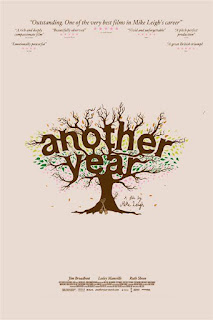
Another Year header
Ruth Sheen and Jim Broadbent are either a blissfully happy and kind or rather smug couple in Another Year

Director: Mike Leigh

Cast: Jim Broadbent (Tom Hepple), Ruth Sheen (Gerri Hepple), Lesley Manville (Mary Smith), Peter Wight (Ken), Oliver Maltman (Joe Hepple), David Bradley (Ronnie Hepple), Karina Fernandez (Katie), Martin Savage (Carl Hepple), Michele Austin (Tanya), Phil Davis (Jack), Imelda Staunton (Janet)

Tom (Jim Broadbent) and Gerri (Ruth Sheen) are a blissfully content middle-class London couple. He’s a successful geologist, she’s an attentive NHS counsellor. They divide their time between work, their allotment and socialising with friends. But many of their friends are disaster zones. Gerri’s work colleague Mary (Lesley Manville) is a divorcee who falls over herself to tell people how happy she is, but is clearly depressed with a drink problem. Similarly, Tom’s old uni friend Ken (Peter Wight) is a lonely alcoholic, seriously overweight and equally depressed.

The fascinating question at the heart of Mike Leigh’s heart-felt and beautiful film is: are Tom and Gerri a sweetly loving couple who go out of their way to support friends – or are they a desperately smug pair, facilitating those around them in self-destructive patterns? It’s hard to say either way: and that’s the beauty of Leigh’s honest, subtle character study which presents a single year in the lives of these characters.

It’s also, of course, superbly acted by the cast – all of them regulars in the work of Leigh. Broadbent and Sheen are brilliant as a couple completely content and happy in themselves and confident that they essentially have life sussed. They are kind, considerate and supportive of everyone. But how much is this genuine and how much is it performative? They fuss and smile to each other around the depressed and fragile Mary – but do nothing to help her change and improve her life, and merrily continue to fill the glasses of both her and the even more alcohol ravaged Ken.

When Tom’s sister-in-law dies, they rush to support his quiet, reserved brother Ronnie (David Bradley). They arrange every detail of the funeral and do everything they can to remove any burden from him. Tom is furious at the selfish and uncaring attitude of Ronnie’s son Carl (a grimly chippy Martin Savage) who seems convinced he is somehow being cheated by them. They bring Ronnie back to stay with them for a few weeks – but frequently leave him alone or allow him to sit watching their own insular conversations. Sure, they give him a home and support, but do they really care or are they going through the motions of people who want to believe they really care?

Wouldn’t a real friend of Ken, tell the obviously over-weight, permanently drunk, desperately self-loathing man that he has serious problems and help him change his life, rather than refill his glass at every opportunity? Or is it a sign of Tom and Gerri’s decency that they don’t see it as their place to tell other people to live their lives? In addition, Tom sticks loyally by Ken in a way very few people would – its clear during a golf game with Ken, Tom, son Joe (Oliver Maltman) and pal Jack (Phil Davis) no-one else wants Ken there – and gives him more warmth and attention than you suspect anyone else ever has. Does it just not occur to him a real friend would help Ken change his life?

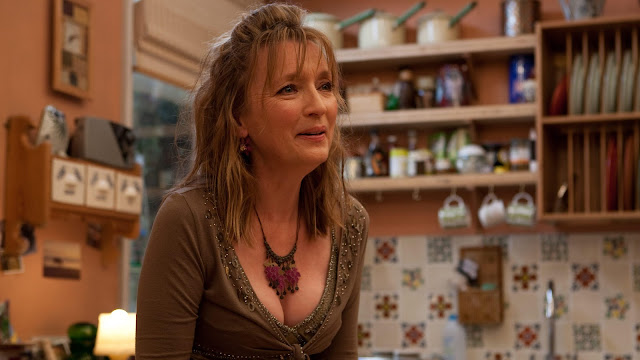
Above all, we see the frantic desperation and all-consuming anxiety, fear and neediness of Mary, played with a heartfelt and deeply moving frankness by a never-better Lesley Manville. Mary is a very sweet woman, who has lost her place in the world and clings to the idea – now long since departed from reality – that she is a young glamour puss, rather than a desperate, divorcee in her fifties. Tom and Gerri support Mary, making her a part of their lives. She is a frequent overnight guest in their house, has known Joe since he was little and relies on Gerri utterly for friendship.

But there is also a slight air of judgement with their treatment of Mary. Does having this all-too-obviously tragic case, this failure who is utterly emotionally dependent on them, make them feel better about themselves? What have they done over the years, for all those sympathetic ears and shoulders to cry on, to help Mary deal with the root cause of problems? While they are willing to listen at great length to her (often tedious and repetitive) conversation, they never once really step into help her effect real change.

Events bubble up as the lonely Mary begins to fixate on a fantasy of her forming a relationship with Joe. It’s implied everyone is aware of this, but politely do their best to hope the situation will go away. Manville is of course brilliant in playing the tragically self-deluded hope under this longing for a never-will-be relationship – particularly as she never once looks down on Mary, but plays with a real empathetic warmth, that helps us feel an immense sorrow for this woman, while still acknowledging she can be deeply frustrating.

And Mary perhaps has more warmth, and ability to connect naturally with people, than Tom and Gerri. This is suggested during a wonderful late scene with Ronnie (a brilliantly quiet David Bradley), where in a long conversation she forms more of a bond of him than we’ve seen Tom and Gerri, for all their patience, ever form. It’s impossible not to relate to Mary as she’s so clearly such a vulnerable person, desperate for love and human connection. Seeing her slow-motion collapse across the film is heart-rending. For all her flaws, she’s someone you are desperate to see happy.

Mike Leigh is able to capture all this in his beautifully observant film, perfectly placed, low-key but deeply affecting. There are never obvious beats and he is willing to show the positives as well as the flaws in every character. He never tips the deck either for or against Tom and Gerri, allowing us to judge them by their actions: they could be warm, friendly, open-house people who stick loyally to troubled friends most people would drop immediately; or they could be subconsciously using these tragic cases to feel even more blissfully happy with their own perfect lives. Leigh never tips it either way, and the breathtakingly emotional performances and beautifully played and written scenes mean that, even though the film is short on plot, it feels rich in character and emotion. It ends with a beautiful held long shot on Mary that, like the rest of this film, is deeply moving but also leaves you with more questions than answers. A triumph.

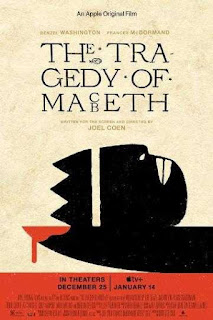
The Tragedy of Macbeth (2021)

The Tragedy of Macbeth header

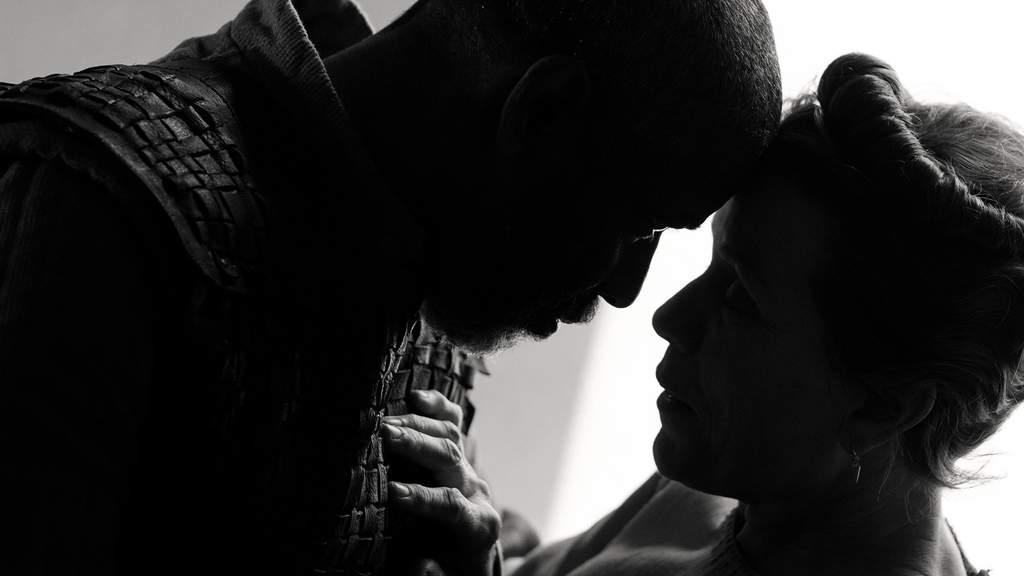
Denzel Washington and Frances McDormand are the Macbeths in this brilliant, noirish, superb Shakespeare film

Cast: Joel Coen

Director: Denzel Washington (Lord Macbeth), Frances McDormand (Lady Macbeth), Corey Hawkins (Macduff), Brendan Gleeson (King Duncan), Harry Melling (Malcolm), Bertie Carvel (Banquo), Alex Hassell (Ross), Kathryn Hunter (The Witches), Moses Ingram (Lady Macduff), Ralph Ineson (Captain), Stephen Root (Porter), Miles Anderson (Lennox), Jefferson Mays (Doctor)

Shakespeare on screen is difficult to pull off. Focus too much on the language and you end up with something more theatrical than cinematic. Zero in on the visuals and you lose what makes Shakespeare great in the first place. That’s not even to mention that films – with their huge audiences – tend to focus on simple, more traditional interpretations of a play that add little to interpreting it afresh. These are all problems avoided by Joel Coen’s The Tragedy of Macbeth which is bloody, bold and resolute and jumps straight into the upper tier of great Shakespeare films. Inventive, dynamic, gripping and excellently acted it succeeds in being both a creative production of the play and something truly cinematic.

Shot in a crisply clean black-and-white, the 4:3 frame frequently filled with rolling mist and stark white light (it’s superbly shot by Bruno Delbonnel), this is a Macbeth set in a Jan Kott inspired Samuel-Beckett-tinged wasteland, with Scotland a bleak, blasted country, its characters leading lives full of sound and fury that signify nothing. The Macbeth’s castle is an Esher like construction of perfectly formed empty rooms, towering walls and arches casting grim shadows and open ceilinged rooms allowing onlookers to observe everything. There are brilliant images: not least the handle to Duncan’s door which is strikingly lit to resemble a knife. Characters frequently emerge from the mist or the darkness to walk towards us and confess their darkest thoughts.

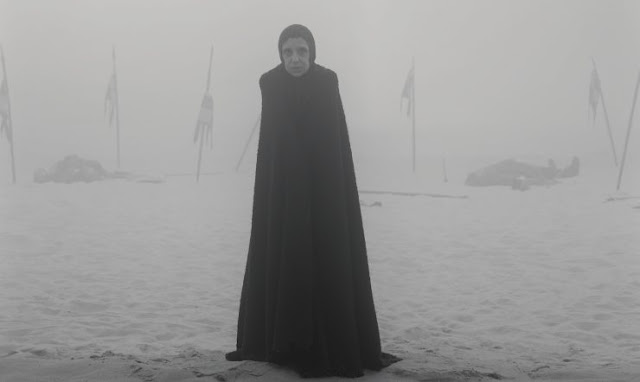
No Shakespeare film has better used set and location since Orson Welles’ Othello – a film this is sharply reminiscent of, with its brilliant use of angles and shade that constantly disconcerts the viewer (even leaving us confused at points on whether we are looking down or up). Coen also seems to have been inspired by Peter Brook’s grimly nihilistic King Lear film, with this Scotland being trapped firmly in a circle of destruction powered by the witches. All three are played by Kathryn Hunter, whose contortionist twisting and ability to switch her vocals on a sixpence from sing-song to a Gollumesque growl make them truly feel of the earth and yet not. Hunter is inspired casting – sometimes representing all three witches in a single schizophrenic body, at others playing all three at once. A brilliant image at one point shows her double reflection in a watery pool, turning her body immediately into a trinity.

Hunter’s movement is birdlike and agile – fitting since it’s suggested the witches can transform themselves into carrion crows, flying over Scotland picking bones clean of fresh. The first image is the three birds circling the Captain as he walks slowly across a beach to report to Duncan. Later Hunter perches on a crossbeam in another opened-ceiling room, subtly poking Macbeth on to greater monstrosities. There is a cycle of destruction here – and the film’s ending implies all this chaos is bound to start again.

Crucial to this is Ross. Following Polanski’s Macbeth – and again heavily inspired by Jan Kott – Alex Hassell’s unctuous Ross, ingratiates himself with all while happily engaging in acts of brutality. He personally executes Cawdor (by beheading), joins Banquo’s murderers, shows the way to the sacking of Macduff house and hands Malcolm both the crown and Macbeth’s severed head. But Coen takes it further again: rather than a cruel opportunist, this Ross seems to be an agent of the witches – or maybe even a witch himself. Hassell’s costume, with its curiously feminine robe and wing-like arms, echoes the witches and Ross moves smoothly from side-to-side even in the final acts, planting seeds of further destruction (including further implied murders) and collaborating directly with the witches to restart the cycle at the end.

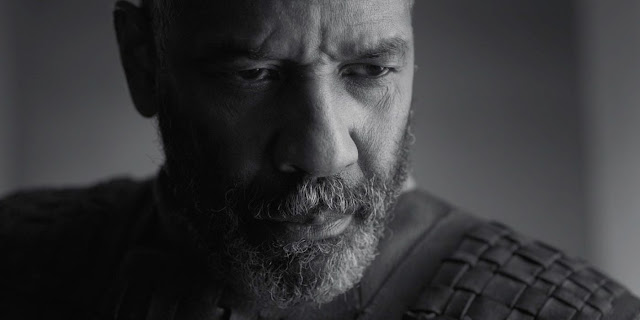
All this makes Macbeth and Lady Macbeth at times feel like rather tragic puppets at the heart of a terrible cycle of events they cannot control. It certainly fits with Denzel Washington’s balanced and intelligent performance in the lead. While Washington doesn’t mine as much weight and meaning from the text as the great stage Macbeths, he gives his line readings an unstudied naturalism and a dynamic and thoughtful rhythm (even if he is prone a little too much to the “soft-slow/fast” approach). His Macbeth is a weak, indecisive man, happy only when he is in action. Clearly ambitious from the start, he binds himself in knots thinking but, once a decision has been made, has no hesitation. Violence is an instinctive tool – he kills several people with no hesitation and a lightening aggression – but he’s lost without direction. He clings to the crown as if it will somehow give the things he has done meaning.

Washington’s performance shifts gears once Macbeth has decided to fully commit himself to those scorpions that fill his mind, becoming an unbalanced mixture of fatalistic and recklessly impulsive. No wonder he has less need for his wife. Frances McDormand is perhaps even better as a Lady Macbeth who sees the crown as her last chance for legacy in a world that has left her behind. McDormand really understands the way to mine nuance from the language. Frequently inpatient with her husband, she is decisive where he is not, but squeamish around violence in a way he isn’t. Both Washington and McDormand manage to suggest a great deal of unfulfilled sadness in the Macbeths, two people in the twilight of their years who pounce on a chance for a last hurrah but find themselves psychologically unsuited for the consequences.

The two leads are at the head of a uniformly strong cast. Hunter and Hassell are both superb. Bertie Carvel is a brooding but honest Banquo. Corey Hawkins a forceful but thoughtful Macduff, played with guilt and wise from the start on Macbeth’s villainy. Moses Ingram brings a lot of warmth to a striking scene as Lady MacDuff. Ralph Ineson’s delivery of the Captain’s speech is spot on. Harry Melling is an immature, stubborn Malcolm.

But the real star here might just be Coen’s direction. The brooding, overbearing beauty of the film is all part of its atmosphere of creeping intimidation and danger. There are some truly striking, haunting images: the flame lit murder of Banquo, a deranged Macbeth fighting a spectral hallucination of Banquo, water pouring down into the flagstones after Macbeth’s final visions of the future, the smoke and mist filled murder of Macduff’s children (a shot of Wellesian brilliance), Lady Macbeth standing before a sheer drop, the imaginative arrival of Birnam wood, Macduff and Macbeth’s final duel in a narrow battlements. This is a punchy, brilliant, beautiful, intelligent and unique reimagining of the play that mixes Shakespeare, visual and has something clear and unique to say about staging the play. Comfortably one of the greatest Shakespeare films ever made.

The French Lieutenant's Woman (1981)

The French Lieutenant's Woman header
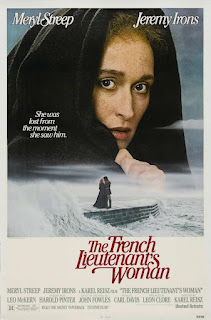
Meryl Streep and Jeremy Irons play star-crossed lovers (twice!) in The French Lieutenant’s Woman

Director: Karel Reisz

Cast: Meryl Streep (Sarah/Anna), Jeremy Irons (Charles/Mike), Leo McKern (Dr Grogan), Hilton McRae (Sam), Emily Morgan (Mary), Lynsey Baxter (Ernestina), Patience Collier (Mrs Poulteney), Penelope Wilton (Sonia), Peter Vaughan (Mr Freeman), Michael Elwyn (Montague), Richard Griffiths (Sir Tom), David Warner (Murphy), Gerard Falconetti (Davide), Colin Jeavons (Vicar)

Many books have been considered unfilmable. John Fowles’ The French Lieutenant’s Woman is a key member of that list. Part pastiche, part commentary on Victorian novels, Fowles not only has a narrator who acts as an ironic commentator on events, but also offers up three possible endings to its central romance, each radically different from the one before. Not easy to bring that to film! Adapting it, Reisz and Harold Pinter came up with the concept of mirroring the novel’s central relationship with a relationship between two actors playing those characters in a film being made of the novel. Got that?

So, Meryl Streep and Jeremy Irons play both the novel’s romantically entwined couple Sarah and Charles AND also Anna and Mike, two actors playing those very roles in a film of The French Lieutenant’s Woman, also engaged in a love affair. Both affairs end in radically different ways, mirroring two of the alternative endings in Fowles’ novel. Most of the films runtime sticks with the novels’ plot, where Charles – an ambitious young scientist – is drawn away from his promising engagement to a potential business partners daughter (Lynsey Baxter), by his romantic fascination with Sarah, a woman of ill-repute in Lyme Regis, the former mistress of a French Lieutenant.

Pinter and Reisz’s adaptation is a smart idea. But I feel it misses a trick. If they really wanted to adapt the book – with its intrusive narrator and alternative endings – then the real character to focus on from a film set is not the actors but the director and producers. If our framing device had been watching the rushes in the screening room, seeing differently edited scenes play out in contrasting ways, with producers and director commenting on the action and making decisions about which ending (Happy? Sad? Open-ended?) they stick on the end of the film. Sure, that would have opened itself up to potentially on-the-nose dialogue, but it would be a better representation of the novel and its ideas, and truly translate some of the books real strength (its unique narrative style) to film.

But that’s talking about something the film doesn’t do. What it does do is offer something that is basically a 80% adaptation of the novel’s plot, mixed with 20% short interjections of the modern-day storyline. Deliberately, the film contrasts the intense romance and deeply-felt passions of the Victorian storyline – where acting on desire carries with it a huge, life-shattering cost in disgrace and social expulsion – with the shallow, off-hand flirtations of the modern era, where the stigma of a sexual affair has ceased to exist.

While this is effective in making the Victorian sections carry even more weight, it does mean the modern sections (by design) are slighter and less engaging. Their semi-regular appearance – it isn’t until the final half hour that we get anything approaching a proper sequence set in the present day, with a beautifully played garden party hosted by Mike and his wife (a magnificent putting-on-a-brave-face performance from Penelope Wilton), which is a feast of stolen glances, averted eyes and strained conversation.

But in some places the split narrative works a treat, particularly in allowing flashes of the real life, more unrestrained passion of the ‘real’ people drop into the Victorian characters. In particular, a meeting between Charles and Sarah in the woods (highly reserved), cuts to Anna and Mike rehearsing the same scene (playful and flirtatious). When the rehearsal reaches a key point – Anna/Sarah falling and being caught by Charles/Mike, the film cuts so that Anna falls but then Charles catches Sarah falling. And the scene continues. Suddenly, the Victorian couple has a burst of the same sexual freedom the modern couple has. It’s a beautiful cut. Later, Sarah falls to the ground (pushed by Charles), and suddenly bursts out laughing – and it feels like she falls as Sarah, reacts as Anna, then rises again as Sarah – either way it gives a wonderful, modern energy to the moment.

The film is wonderfully shot by Freddie Francis, with luscious forest vegetation and whipping winds and seas on the Cobb at Lyme Regis. Simmering sexual tensions are caught in lingering gazes, gestures that carry things words cannot, careful reaction shots captured by Reisz, the trapping of several characters within the ephemera of over-decorated rooms (at one point Ernestina literally can’t escape a room because of the all the knick-knacks within it).

A lot of the mood comes from the two lead actors, who give masterful performances. It’s very easy to see Streep’s performance here as overly mannered: her accent is oddly toned and highly studied, and much of her performance as Sarah is wilfully artificial and arch. But that’s deliberate: the genius here is that Streep is playing Anna playing Sarah who is in turn constructing her own fictional Sarah. With her pre-Raphaelite looks and artistic leanings, Sarah is a woman out-of-time, yearning for the sort of choices and freedom Anna takes for granted, constantly pushed into roles society can accept her in (Governess, eccentric, ‘whore’ etc.). Does she use Charles or not? Streep brilliantly captures her enigmatic, unreadable spirit, the sort of person who interjects a retelling of a possibly invented backstory, with a playful twirl around a tree. Who sometimes despises herself, at others everyone else. In contrast, Streep makes Anna assured, quiet and confident, with the power to choose risks.

Just as good is Jeremy Irons, in only his second film role and here cementing the start of a career that would see him play a parade of restrained and very British men struggling with passions they can hardly understand. Charles’ fascination with Sarah is rooted in feelings both sexual and romantic that both fascinate and terrify him. His final surrendering to being true to himself, rather than what is expected of him, carries with it both a power and strange desperate bitterness. By contrast, Mike is a far more flighty, shallow-figure – an actor who perhaps is more in love with the feelings he is playing (and the character that inspires them in his character) than he is with Anna.

Reisz pulls all this together highly effectively, and the film is at its strongest when exploring feminism and the opportunities for women in Victorian England. Those are few and far between. Women have defined roles and expectations and someone who deviates from these – like Sarah – have no place. In addition, women are held responsible for provoking dangerous erotic feelings in men (from women of poor reputation like Sarah, to the prostitutes in a London street). The ability of Sarah to make her own choices and lead the life she wants to lead is the underlying theme of her story – and her motivations. Does she want, however she might feel, a relationship that would define her again as “wife” rather than being truly herself?

These are fascinating ideas in a film full of beautiful images – their first meeting on the Cobb in particular is beautiful – scored expertly by Colin Davis (with just a tinge of suspense in the music). The framing device gives little moments of insight and reflection – even if it is only an approximation of the novel’s effect – but the Victorian set story, and it’s buried passions and social commentary is what really compels, in a way that the slighter modern story (almost deliberately) doesn’t. Either way, it has two brilliant performances, an intelligent script and handsome direction by Reisz.

The Last Duel (2021)

The Last Duel header1
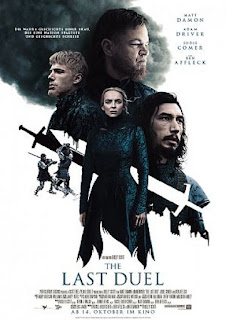
Adam Driver and Matt Damon fight The Last Duel in medieval France

Director: Ridley Scott

Cast: Matt Damon (Sir Jean de Carrouges), Adam Driver (Jacques Le Gris), Jodie Comer (Marguerite de Carrouges), Ben Affleck (Count Pierre d’Alencon), Harriet Walter (Nicole de Buchard), Alex Lawther (King Charles VI), Marton Csorkas (Crespin), Željko Ivanek (Le Coq), Tallulah Haddon (Marie), Bryony Hannah (Alice), Nathaniel Parker (Sir Robert de Thibouville), Adam Nagaitis (Adam Louvel)

The medieval era had its own solution for “He said, She said”. Let God decide via a fight to the death. After all, He would never let the injured party lose, would he? Scott’s The Last Duel is a dramatisation of one of the last French judicial duels, in December 1386, between Sir Jean de Carrouges (Matt Damon) and his former friend Jacques le Gris (Adam Driver), after Le Gris is accused of raping Carrouge’s wife Marguerite (Jodie Comer). Scott’s Rashomon-inspired film shows the events leading up to the duel from all three characters’ perspectives.

The three different stories we see are not radically different. Unlike Rashomon – which presented totally different versions of the same events, according to the prejudices or agendas of the storytellers – The Last Duel’s versions stress subtly different reactions or presents different fragments of an overall story. So, for instance, Le Gris and Carrouges remember different elements of a battle. Carrouges recalls the noble charge to save the innocent, saving Le Gris’ life in the final stages of combat. To Le Gris it’s a suicidal charge, in which he saves an unhorsed Carrouge’s life. After the rape, Carrouge remembers offering his wife sympathy; she remembers his anger and demand they have sex at once to “cleanse her” of the stain.

These mixed recollections work best when we see each of them remember a fateful reconciliation meeting between Le Gris and Carrouges (where Le Gris and Marguerite first meet). A wedge has been driven between them ever since Carrouges believed Le Gris cheated him out of both land and his father’s former position. When the two agree to try and put the past behind them, Carrouge asks Marguerite to give Le Gris a kiss of peace. He remembers her surprise and timidity. Le Gris remembers her as being quietly excited with a kiss that lingers. Marguerite remembers a kiss from Le Gris that lingers too long. Small moments like this are where the film is at its strongest, making its concept feel very relevant today in our world of accusation and counter accusation.

But these moments are few and far between. Most of the time there isn’t this subtle variation. Where the film is weakest is when we (frequently) see the same events, presented the same way, three times. While our perception of Carrouges changes – from the ill-treated noble he sees himself to the sullen, self-entitled whiner everyone else sees – our idea of Le Gris is fundamentally the same (blissfully self-entitled). Fundamentally, when we see events the first time, later versions only really tweak our perception of them rather than challenge it.

You can see this in the rape itself, which we first see from Le Gris’ perspective. The film shows Le Gris’ understanding of consent has been twisted by most of his sexual experience being court orgies with playfully protesting prostitutes. His pursuit of a genuinely unwilling Margeurite around her room echoes exactly the pretend-chases and “chat up lines” he’s used in those earlier scenes, so we understand it’s possible he doesn’t actually understand he’s raped her. But no viewer can see Le Gris’ version as anything other than rape. In fact, the only tangible difference when we see the event from her perspective is that her screams of “No” and “Stop” are louder and the camera focuses more on her anguished face. If the film is presenting any tension about whether this is a consensual encounter or rape, it ends the second we see Le Gris’ story.

This negatively effects the drama – and actually makes Marguerite’s version seem strangely superfluous. You start to feel we might as well see all three perspectives at the same time, as the narrative trick ends up adding little to the film – especially since the film categorically states Marguerite’s version is the truth. Why not just tell the whole film from her perspective in that case? It also doesn’t help that Marguerite goes last – which means until an hour into the film, the character we should be most engaged with and sympathetic towards has stood on the side-lines.

This is particularly unfortunate as the film is striving for a feminist message. The men are callous and self-obsessed, treating women as sex toys or assets – and are praised for it. Marguerite though is intelligent and principled, marginalised by her husband and condemned as a whore when she protests her rape. She pushes her case with determination, despite discovering she will be condemned to burn if Carrouge loses (he of course is only in his own honour). Her word is only good if backed a man, and she is powerless to defend her innocence.

It’s the lot of medieval women. Harriet Walter (rocking a bizarre appearance, straight out of David Lynch’s Dune) as Carrouge’s mother tells Marguerite the same thing happened to her, but she considered it pointless (and dangerous) to press charges. What we see of the judicial system is ruthlessly unjust and misanthropic, with women harangued to confess their guild for tempting men.

But it doesn’t quite click together. It’s a shame, as many scenes are highly effective. The rape – both times we see it – is alarming. The final duel is brilliantly shot and hugely tense, not least because Marguerite stands literally on the top of an unlit bonfire watching every blow. Scott’s shoots the film with the same blue-filtered beauty he gave to the early scenes of Kingdom of Heaven.

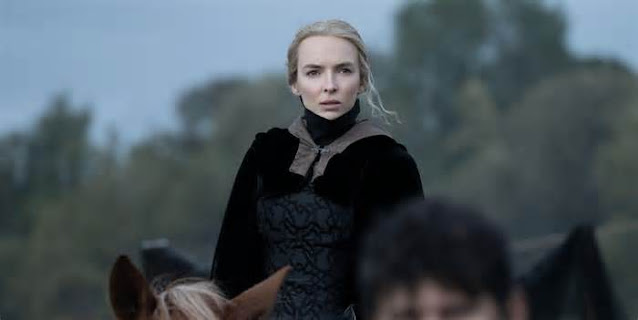
There is of course an oddness in seeing such American actors as Damon, Affleck and Driver in period setting. The accents are an odd mix: Comer basically uses her regular (non-Scouse) performance voice, Damon does a gravelly version of his own, Walter an American twang to match Damon, Affleck is halfway to plummy Brit, Driver flattens his Californian tones. Damon is pretty good as the sulky, surly Carrouge who gets less sympathetic the more we see him, Driver is suitably charming on the surface but selfish. Comer plays wounded injustice extremely well and brings a lot of emotion to a difficult role. Affleck has the most fun, flouncing around in a blonde wig as a lordly, hedonistic pervert who likes nothing more than belittling Carrouge.

The Last Duel is part way to a decent film, but it just lacks that little bit extra to make it really come to life. Its alternative versions of the truth don’t illuminate as much as they need to – even if they are at points pleasingly subtle in their differences. It has an admirable feminist message, but defers most of it to the second half of the film (were they worried about sidelining the famous male actors?) and it’s concern that we should not doubt Marguerite at any point does undermine its drama. Handsomely filmed, it doesn’t make the impact it should. Perhaps that’s why it was one of the leading box office disasters of the Covid Pandemic?

The Devil is a Woman (1935)

Devil is a woman header
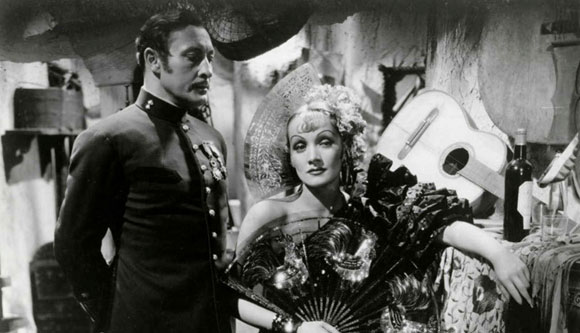
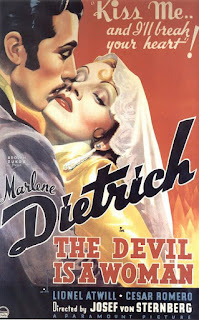
Lionel Atwill and of course Marlene Dietrich play out the final chapter of von Sternberg’s psycho-sexual fantasies in The Devil is a Woman

Director: Josef von Sternberg

Cast: Marlene Dietrich (Concha Perez), Lionel Atwill (Captain Don Pasqual Costelar), Edward Everett Horton (Governor Don Paquito), Cesar Romero (Antonio Galvan), Alison Skipworth (Senora Perez), Don Avarado (Morenito)

The Devil is a Woman has more than a whiff of being made after the Lord Mayor’s Show. It’s an impression not helped by the fact that it takes place in the aftermath of a town carnival, with Sternberg having apparently emptied the Paramount props cupboard of paper streamers. The Devil is a Woman is the final film made by Sternberg and Dietrich, a piece of contractual obligation for all concerned. Sternberg’s career deflated swiftly after it and the entire film has an autumnal sadness about it. No one seems particularly interested in what they are making, and it finds nothing new to say or do that Sternberg and Dietrich haven’t already done, other than set it in Spain (a decision that did not delight the Spanish government).

Dietrich is Concha Perez, a beyond ruthless, heartless, scheming, femme fatale who teases and uses men for her own ends with nary a second of guilt. Her web is starting to form around revolutionary Antonio Galvan (Cesar Romero). He’s warned off though by her former beau (victim?) Don Pasqual (Lionel Atwill), a middle-aged aristocrat who Concha effortlessly made dance to her tune and fund her many affairs, all while giving him just enough affection to keep him on board. Pasqual recounts his relationship with Concha in flashback – but will Antonio give a damn? Or is a duel on the cards between the two? Watch out Pasqual is an expert marksman…

For decades The Devil is a Woman was considered a lost film, until Sternberg provided one of the few copies of the film to the Venice Film Festival in 1959. This copy however did not contain the 17 minutes of footage cut from the film by Paramount (it’s a very short film, less than 80 minutes). Even found though, it’s a minor work, a little coda to seven collaborations between director and star, some of them iconic classics.

The film has all the foibles of Sternberg – and is a final indicator why this visual stylist found himself so hideously out of step in the era of the talkies. Dialogue and story are so secondary that you can’t help but notice their crudeness. When Sternberg has longer dialogue scenes, he shoots them with a cursory flatness that suggests he them over and done with as soon as possible. The passion of the film – what passion there is – goes into the visuals, whether it’s the streamer filled carnivals, the thundering rain that powers down on the duel or (of course) the sultry, painterly shots of Dietrich in luscious black-and-white.

The problem is that there isn’t really a truly striking visual in the film: perhaps Sternberg had used all his fire on The Scarlet Empress or maybe, after the disaster of that film, he was worried (or had been firmly told) that his final Paramount film had to have at least some semblance of the conventional to it. So, The Devil is a Woman is a conventional film with little flashes of imagination and visual skill – like the balloon that bursts to reveal Dietrich’s face (marksman to burst the balloon none other than Sternberg himself). It all adds to the end-of-an-era feeling that permeates the film.

The most interesting beat in the film is the feeling that we are watching yet-another on-screen playing out of Sternberg’s own psycho-sexual drama. Surely, he saw more than a bit of himself in Pasqual? The older, refined man, hopelessly infatuated with the beautiful, younger woman who drains him dry of money and prestige, but won’t commit herself to loving him? Pasqual the masochist who keeps coming back for more and more humiliation and sexual rejection? Hard not to think that there was more than a bit of Sternberg in Atwill’s performance – or that Concha’s late abandonment of Antonio to return to Pasqual was Sternberg’s own fantasy. Of course, it’s all Sternberg’s view, where he was very much the Henry Higgins. Dietrich would very well disagree.

The Devil is a Woman has its moments. Although often (despite being very short) rather slow – the long flashback-structure back story takes it time and then some – Sternberg can still find moments of beauty. Cesar Romero brings a lot more charisma and interest to the sort of handsome beefcake role John Lodge played in The Scarlett Empress. (In a bizarre advance in-joke Romero wears something very close to a Batman style mask at one point). Dietrich is given little to do other than be as cold as possible, but she manages to add depth and shade to her character. Atwill is rather good as the masochist Pasqual and the rain-soaked duel between him and Romero is worth the price of admission.

It can’t change the fact though that this is rather a sad coda to a great collaboration, an after-thought where it’s not clear that anyone was really interested in the content itself. It’s final shot is fitting: a chariot rides away into the sunset. It fits for this partnership – and effectively for Sternberg’s career which never achieved these heights again.

The Big Country (1958)

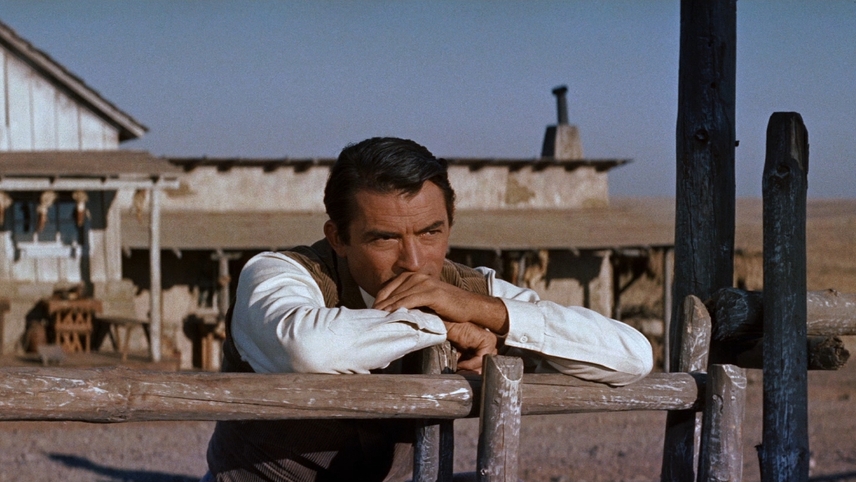
Gregory Peck rides into town in The Big Country

Director: William Wyler

Cast: Gregory Peck (James McKay), Jean Simmons (Julie Maragon), Carroll Baker (Patricia Terrill), Charlton Heston (Steve Leech), Burl Ives (Rufus Hannassey), Charles Bickford (Major Henry Terrill), Alfonso Bedoya (Ramon Gutierrez), Chuck Connors (Buck Hannassey), Chuck Hayward (Rafe Hannassey)

From the very first frame when that score kicks in, you know you are in safe hands. The Big Country is a big film, and big entertainment. When I re-watched it I hadn’t seen it for years. I loved it. It’s a slab of prime Hollywood entertainment, not perfect, but it’s one of those films that always delivers.

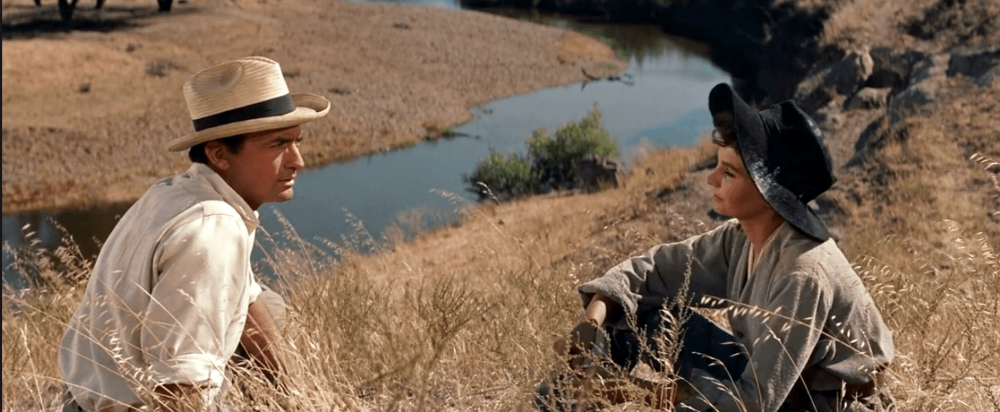
It’s the American West, and James McKay (Gregory Peck) arrives in town to marry Patricia Terrill (Carroll Baker), daughter of local landowner Major Henry Terrill (Charles Bickford) who is in the middle of a turf feud with patriarch of a cowboy clan, Rufus Hannassey (Burl Ives). This is a town where men-are-men and a harsh word is met with a sock to the mouth. It’s a world where McKay is out of step: a seasoned naval captain, with more experience than anyone, he couldn’t care less what people think of him and won’t be goaded into doing something foolish. His self-assurance and strength of character are interpreted as wimpy yellow-belly-ness by nearly everyone, including Patricia and Terrill’s macho foreman Steve (Charlton Heston). Only local schoolteacher Julie Maragon (Jean Simmons) understands him. But as events come to a head, only McKay has the strength of character to step up and try resolve things without mass bloodshed.

The Big Country is the classic set-up: a stranger in town, who has the guts to stand up. The only difference here, is that McKay has the guts to stand up and not conform to the macho bullshit being driven by the two feuding patriarchs. Both of these men are, of course, far more similar than they would admit, being perfectly contrasting personalities. Charles Bickford plays a genteel man with the principles of a thug, while Burl Ives plays a thug with the principles of a genteel man. No wonder they can’t get on, both see in each other qualities they most likely despise in themselves.

Compared to them, McKay looks like the very model of twentieth century liberal coalition building. Or at least McKay is a liberal who packs a punch, since it’s pretty clear Peck is probably the toughest son-of-a-bitch in the town. What’s glorious in McKay – and Peck’s sensational performance of reserved warmth and wry amusement, mixed with world-weary sufferance – is that you get a definite sense he’s seen way worse than this before. A man who has sailed around the world for decades, in the hardiest conditions, who has been keelhauled and saved men from sharks, recognises this for the slightly pathetic parochial dust-up it really is, and has no interest – or need – to put his life or the lives of others at risk to make crude points about his manliness.

If only, the film argues, we could all be as confident in our own skin. McKay keeps his cool in a way no-one in film, except perhaps Tracy in Bad Day at Black Rock, has managed so successfully. He laughs off his irritation at a hazing from the Hannassey’s – and makes clear, as the Terrill’s saddle up to fight back, that in doing so they are not acting in his name. He won’t make a fool of himself by trying to ride a wild horse in front of a crowd. He won’t rise to Steve’s provocation for a punch-up in front of the entire Terrill gang. McKay is a man who only needs to prove things to himself: so he’ll tame that horse in front of no crowd and swear the only witness to secrecy. He’s not one to brag.

And if it’s a fight that Steve wants, he’ll give him one on his own time and his own terms – those being a dusky morning in private. Wyler shoots one of the greatest fights of all time, an exhausting slugging match between Peck and Heston, played out mostly in long shot that soaks up the dawn Western atmosphere, as the two men fight themselves to an exhausted score-draw, with each punch landing with a punishing wallop. There is something very compelling about this unflashy, in-the-dust, clash of two alpha males, and the strange sense of respect that grows between them (as well as the dry wit of the script – “You certainly take your time to say goodbye”, Heston deadpans after this exhausting ‘I’m leaving but first this’ fight).

It also showcases how well Wyler uses sound (or the lack of it), the fight taking place often in a longshot silence that somehow makes the dusty scuffle even more effective. Silence also comes into play brilliantly to stress McKay’s isolation when first the Terrill men ride away to extract vengeance and then the disgusted Patricia closes the front door on him, leaving him standing in magnificent isolation on the porch. Silence will also come effectively into play during the late act ride of various characters through a white chalk lined gorge and to stress the danger that the kidnapped Julie is under when being held by the Hannassey’s.

The final act brings all the threats of danger and threat together into a brilliantly tense final confrontation. This sequence showcases, not only Peck’s granite principles and nobility, but also gives excellent opportunities for Ives to explore hidden depths in Old Hannassey (it surely helped him win the Oscar for Supporting Actor) and his dumb son Buck (excellently played with a swaggering arrogance by Chuck Connors) who is all mouth and no trousers.

Sure, at times the film overplays the anti-violence card. It’s particularly noticeable as it sometimes wants to have its cake and eat it, favouring probably a sort of gun-toting liberalism, of the “I could kill you but I want to make it so I don’t have to” variety. But then the film would be a heck of a less effective if we weren’t so convinced that Peck was as tough as they come and that his unwillingness to throw himself into events thoughtlessly is a mark of his unparalleled strength. Again, Wyler uses silence as effectively as sweeping camera movements and that brilliant score, to suggest moral strength.

There is probably very little tension about where the romantic plotlines are going, but both Carroll Baker and Jean Simmons are very good as two very different, but equally strong, women (although both women allegedly found Wyler’s perfectionist Kubrickian retakes on set extremely trying). But it still works a treat because of the strength of the acting, and its strongly scripted characterisation.

That and I’ve hardly mentioned the score, by Jerome Moross, which is powerful and famous you’ll instantly know it even if you’ve never seen the film. The Big Country is a Western where the hero has the strength to stick to his principles while still getting the job done. It’s superbly acted by Peck, with Simmons, Baker, Heston, Ives, Bickford and Connors all excellent in support. Wyler combines visual and a compelling story into a film that, while at points a little long, is still a bona fide classic. Again I’ll say: I loved it.

Wings (1927)

Charles Rogers, Clara Bow and Richard Arlen are in a wartime love triangle of sorts in the first ever Best Picture winner Wings

Director: William A Wellman

Cast: Clara Bow (Mary Preston), Charles Rogers (Jack Powell), Richard Arlen (David Armstrong), Jobyna Ralston (Sylvia Lewis), El Brendel (Herman Schwipf), Richard Tucker (Air Commander), Gary Cooper (Cadet White), Gunboat Smith (Sergeant), Henry B Walthall (Mr Armstrong), Roscoe Karns (Lt Cameron)

As the first ever Best Picture winner – and the only silent winner (until The Artist almost 85 years later) – Wings will always have a place in history. Is it the greatest silent film ever made? Of course not. In fact, it’s odd looking at Wings as a ‘Best Picture’ winner: with its rollicking action sequences, odd slap-stick comedy and slightly sentimental romance, it’s far more of a crowd-pleaser than the sort of film we think of as an Oscar winner. But it’s also filmed with an invention and verve that looks light years ahead of many other early winners – and a very enjoyable piece of story-telling.

It’s the First World War and Jack Powell (Charles Rogers) and David Armstrong (Richard Arlen) are both rivals for the affections of the beautiful Sylvia Lewis (Jobyna Ralston). Sylvia actually prefers David – but both she and David are too noble to let disappoint Jack when both men enlist as pilots. Jack has also failed to notice that his delightful neighbour (literally the “girl next door”) Mary Preston (Clara Bow) is in love with him, and that she is perfect for him. Jack and David train as pilots – a dangerous profession – and head for the front and become best friends and comrades in arms. Mary follows them to serve as a nurse – but Jack is still convinced he is in love with Sylvia, completely ignorant of the fact she is engaged to David. Will these romantic problems solve themselves, while the two men fly into dog fights in the skies?

Wings is a fabulous reminder of how dynamite and dynamic Hollywood could be before the Talkies and those years of reduced camera movement to capture live sound, with more stately editing and composition that continued to hold influence over film-making for much of the next fifteen years. I loved the visual invention of this film. Wellman pushes the camera into unusual positions and uses some truly unique shots. In an early scene Wellman straps the camera to a swing David and Sylvia are sitting in. We swing and sway with the swing, in an advance feel for what it’s going to be like in the dogfights to come. When Jack runs into frame, he actually looks wild rather than the characters on the swing (fitting considering his personality).

Wings is full of invention like this. It has a hugely influential tracking shot, which zooms across a number of tables and couples in a Parisian restaurant, getting closer and closer towards and intoxicated Jack and finally zooming in on his champagne glass. This is the sort of stuff you wouldn’t see in a Hollywood movie again for decades to come.

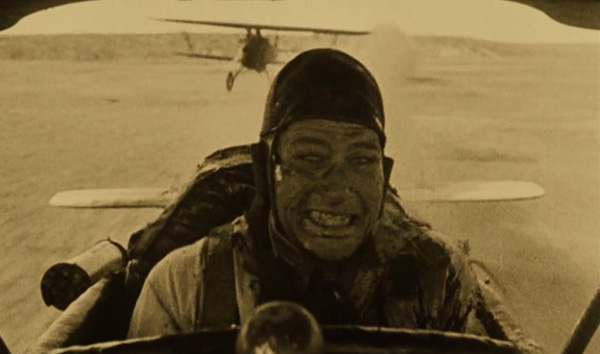
It all carries across into the dog-fighting scenes that will come. Wellman shot the film among the skies, with cameras following the action, others strapped to the planes to capture the actors faces (who are really up there!). Clouds are frequently used to communicate the speed the planes were moving at. Hundreds of stunt and military pilots took part in these re-staged battles which are still, despite the advances since, hugely impressive. Wellman, a former WW1 pilot, even took to the skies himself briefly when a pilot fell ill. Planes swoop, dive into clouds and plummet to the ground trailing smoke. It’s all shot with a boy’s own adventure and makes for gripping action.

The film is also a realistic look at the horrors of war, something Wellman was extremely aware of. When the action gets down into the trenches it doesn’t shirk in showing the costs of warfare, close-ups and tracking shots capturing the violence and human cost. Bodies slump in death. A tank looms over the camera. There are moments of realism: a sergeant, marching along the road, nudges a resting private only to discover (as his body slumps forward) that the man is dead. At first the sergeant marches on then he turns back, salutes and gently puts out the man’s cigarette. It’s a thoughtful little moment of human reaction in a film full of them.

It sits alongside an almost Pearl Harbor-esque plotline of romantic entanglements and confusion. Charles Rogers’ Jack is an enthusiastic, passionate but almost wilfully blind, bowled along with passion for anything that takes his interest from Sylvia to flying to his friendship with David. There is something quite sweetly old-fashioned – almost a fairy tale – about David and Sylvia keeping quiet about their love, so as to give Jack something to survive for. Richard Arlen is more restrained, but gives a decent performance. There is more than a hint of the homoerotic between Jack and David, the more exhibitionist acting style of the silent movies lending itself to an idea that the real love affair here is between these two rugged pilots (who wrestle, cuddle and even kiss), but that’s probably wishful thinking. Saying that though, the film is surprisingly daring: that French restaurant clearly has gay couples among its clientele (not to mention later a brief pre-code nude scene for Clara Bow).

But it’s still a straight-laced action film, where men are men with a key sub-plot of Mary’s unrequited love for Jack. Clara Bow, one of the biggest stars in Hollywood, landed top billing as Mary and you can almost feel her physical pain at her obvious devotion going unnoticed time and time again. Mary is basically a saint – and the film misses a chance to really explore her experiences as a Nurse on the Western Front – and to be honest her plot line is rather shoe-horned in to give a bit of feminine interest to an otherwise male-heavy plot.

It’s part of what makes Wings at times overlong. There is a slimmer two hour or so film about wartime flyers waiting in here, but Wellman’s film tries to do so much (war is hell, love, romance and rivals turned friends) that the run time balloons up to fit it all in. That stunning restaurant shot is part of an otherwise rather pointless extended “comic” sequence, involving Jack getting pissed and gleefully watching champagne bubbles (that fill the screen) before being saved from a French floozy by Mary, that outstays its welcome. The sequence largely exists to give Clara Bow something to do, but is neither particularly funny or memorable.

Certainly not compared to the action, or the moments of sadness and melancholia from the war. Gary Cooper, in one of his first roles, supplies a one-scene turn as an ace pilot who immediately dies in a training accident: we are never allowed to forget the dangers and loss of war. When our two heroes leave their lucky charms behind before flying out on one more mission, you know that things won’t go well. Wings ends with a tragic mistake and a sad homeward return coda where we really feel the cost of loss. It’s a film that maybe wrapped up in flag-waving heroics and daring-do, but has lots of genuine heart beneath the action. Sure, it’s overlong with a rather obvious romance, but it’s got more than a little brain among the thrills.

Sound of Metal (2020)

Riz Ahmed as sudden deafness means he can no longer hear the Sound of Metal

Director: Darius Marder

Cast: Riz Ahmed (Ruben Stone), Olivia Cooke (Lou Berger), Paul Raci (Joe), Lauren Ridloff (Diane), Mathieu Amalric (Richard Berger)

Spoiler Warning: Much of the end resolution of Sound of Metal is discussed here – so watch it first!

Ruben Stone (Riz Ahmed) is a recovering drug addict and drummer in heavy metal duo Blackgammon with his singer girlfriend Lou (Olivia Cooke). Touring together, their life is made up of performing gigs across the States. That changes overnight when Ruben suddenly loses his hearing, with a diagnosis confirming 80% of his hearing is gone and what’s left may only disintegrate further. With Ruben sliding into depression, Lou helps him find a place in a deaf recovering drug addict camp run by Joe (Paul Raci). There Ruben must learn to adjust to a life without hearing – and decide whether or not he will undertake a hugely expensive ocular implant surgery to try and restore some vestige of his hearing.

Sound of Metal is an extremely thought-provoking and highly immersive piece of cinema. It’s extraordinarily well-edited and shot and its sound design is faultless. I can think of few other films that so successfully throws the viewers into its main character’s experience. Much of the opening Act is a stressful, tense and even terrifying, watch as Ruben’s isolation, fear and frustration is powerfully communicated to the audience. An early morning routine is shown first from a “hearing” perspective then the next day in chilling silence. Sign language goes untranslated onscreen until Ruben has learnt it, we can barely see the notes Lou is forced to scribble to communicate with him. It all gives a powerful sense of the terror and loneliness of Ruben’s isolation.

The film also skilfully enters the debate around the treatment of disability. Joe’s colony is founded on the principle that deafness should not be ‘treated’ as an illness or a problem to be fixed, but instead as a part of a person’s identity, with presents challenges which can be rewardingly overcome. It’s an attractive and admirable idea, and the points the films make about removing the stigma and shame of disability (a perverse shame consumes Ruben about his deafness). But on the flip side, if you had lost your hearing wouldn’t you be attracted to a surgery that might help restore part of that? Is that wrong – even if it’s a betrayal of what Joe believes in?

The real issue is Ruben’s motivation for continuing to pursue surgery: because he is ashamed of being deaf. One of the beauties of the film is how it avoids straight forward and trite solutions to its problems. There are no simple answers and no Hollywood endings in Sound of Metal. All the characters make mistakes, and many remain unresolved. Obvious narrative tropes are side-stepped: it looks like Ruben is travelling the familiar arc of self-loathing into evangelical convert. This predictable narrative is avoided. Someone can still be a warm supporter of other people and yet also lie and cheat to make improvements in their own lives.

It’s the secondary plot in Sound of Metal: Ruben, an addict, becomes addicted to the idea of hearing again. Told early by a doctor – and the film is a damning indictment of the money-first nature of American healthcare – that a treatment might cure him, Ruben fixates on this. He ignores the risks (it will destroy his remaining hearing) and negatives (it will never be like actually hearing again) and disregards and ignores any other options. In turn, you can argue Joe – so concerned with his evangelical stance and maybe even a little smug in his purity – fails to identify Ruben’s personality flaws and places undue pressure on him to swiftly follow directly in Joe’s footsteps.

All of which makes Sound of Metal sound rather depressing. But it truthfully isn’t. It’s just a film that’s beautifully in tune with real life. It understands that relationships and friendships can change and drift apart over time, due to changes of circumstances, without heartbreak or resentment. That the person we need at a particular point in our life, might not be the person we need later in life. Ruben is a complex, troubled person, but he’s also a decent, good one quick to offer acts of great generosity and kindness. It’s the part of his personality that would make a good teacher of deaf children (a role he engages in with delight while living in Joe’s camp). But it sits alongside an addict’s tendency to put his own desires first and assume others will fit in with them.

In some ways the film is a dramatization of mourning. Ruben must learn to mourn the loss of his hearing and this ending of his dreams of becoming a star – even with his implants he will never have the same affinity for music as he had before. We see him go through shock, pain, anger, depression and the film shows him just beginning the process of acceptance and hope at its conclusion. But the film doesn’t lie about this being a difficult and challenging journey – and one where mistakes will litter the path.

As Ruben, Riz Ahmed gives an outstanding performance. Fully committed – he spent months learning to drum and speak ASL – Ahmed is powerfully emotional, and much of the film’s success in immersing us in the horror of finding yourself suddenly isolated, scared and confused is due to the rawness of his performance. Ruben is a man of strong feelings and loyalties, loving and caring but also angry and defiant. You understand every inch of his frustration, even if you sometimes want to slap him for being selfish. Just as good is Olivia Cooke as Ruben’s supportive and fragile girlfriend Lou. Paul Raci – son of death parents, playing a character heavily derived from his personal story – is superbly genuine as the caring but overly evangelical Joe, a mentor who blinds himself to things in his protégé he doesn’t want to see.

Sound of Metal is beautifully shot and filmed by Marder. It expertly builds our empathy with Ruben and his situation – helped hugely by Ahmed’s superb performance – and allows us to feel an uncomfortable fraction of what it must be like to find yourself suddenly isolated in the world. It enters with fascinating points on both side, into a very even-handed debate on disability and its treatment (or not), but never forgets it is also telling a very real, human and emotional story. Side-swiping conventional narrative tricks, it’s highly engaging, a superb piece of technical film-making and brilliantly done.

Blonde Venus (1932)

Marlene Dietrich can only save her husband…by cheating on him in Blonde Venus

Director: Josef von Sternberg

Cast: Marlene Dietrich (Helen Faraday/Blonde Venus), Herbert Marshall (Ned Faraday), Cary Grant (Nick Townsend), Dickie Moore (Johnny Faraday), Gene Morgan (Ben Smith), Rita La Roy (‘Taxi Belle’ Hooper), Robert Emmett O’Connor (Dan O’Connor)

For their fourth outing together, von Sternberg and Dietrich made for the first time a film set in the modern era. Not that it mattered – von Sternberg would still turn the setting into his typical fever-dream of hyper-reality. It works as always though, because von Sternberg is a master of style and Dietrich is a true superstar. There might not be much more to it than that – and there isn’t really in this melodrama – but that’s still more than enough.

Ned Faraday (Herbert Marshall) is an American chemist (although he sounds more plummy than King George) suffering from radiation poisoning. Fortunately, there’s a cure (this was a simpler time, before we knew there wasn’t any dusting yourself off from a deadly dose of radium) but it will cost. Ned’s German wife Helen (Marlene Dietrich) has to take to the stage again to earn the money to pay for it – but finally finds the real money is in essentially prostituting herself to playboy businessman Nick Townsend (Cary Grant). When Ned finds out his life has been saved due to his wife becoming a kept woman he is furious – and she heads on the run with son Johnny (Dickie Moore) as she’s terrified of losing custody of him.

The Blonde Venus of the title is Helen herself, that being her stage name. Blonde Venus is frequently punctuated by prolonged musical performances by Dietrich, filmed with a flowingly smooth camera by von Sternberg, now firmly able to marry movement and dialogue in his films (in a way Morocco fails to do). The most bizarre of these is “Hot Voodoo” which features exotic African-American dances and Dietrich emerging from a huge gorilla suit wearing a blonde afro. This sort of stuff is so strange that it still works as entertainment, and it strangely fits with von Sternberg’s dreamy approach to story-telling where everything feels a few degrees off reality.

Blonde Venus riffs on this fable like atmosphere pretty openly. It starts with Helen telling a story of how Ned and her first met. This opening shows Helen and several German women skinny-dipping in a pool in the days after the First World War (oh, those pre-Code days!) when they are approached by a group of American GIs, led by the completely un-American sounding Ned. They flirt, and the entire meeting feels very much like a fairy tale – which is exactly how Johnny takes it. The film will end with revisiting this story, this time the son wanting to use it as a comforting romantic vision to escape to. It’s all part though of how Blonde Venus is very consciously framing itself as fairy tale, a group of people living in a heightened reality that’s just outside of logic.

Pretty fitting as the plot leads into an almost bizarre sequence of Helen and Johnny on the run – Ned wants paternity (since his wife is now a floozy) so Helen and Johnny had down South into a Southern States of America which are bizarrely so unspecific in their setting they could be anywhere and later a Texas that looks like it’s come straight out of the Chinese market-place of Shanghai Express. Throughout the journey, like a Princess on the run from a wicked stepmother, Helen is pursed by policeman looking to find Johnny for a reward. Like an old morality tale, she is tipped into destitution (eventually arrested for vagrancy) but then almost as suddenly decides to turn her life around – literally the next scene she is in Paris, the belle of the French night club scene. This is the sort of rapid logic of a dream, and about as likely as a fairy tale would be in real life.

Alongside this fascinating narrative dreaminess, the film also carries a proto-feminist message. It sympathetically sides with Helen, a woman who has no choice but to prostitute herself in an attempt to save her husband’s life – only to be roundly condemned for it by the old stick-in-the-mud the moment he returns. Blonde Venus hardly warms either to Nick Townsend – played by a very raw Cary Grant, still years away from creating his persona in The Awful Truth – a selfish playboy who seems uninterested in consequences. By contrast, Helen is a martyr who consistently puts other people first and as a reward is branded a harlot and a bad mother. You can’t win.

As Helen, Marlene Dietrich gives another fine performance. By this stage, she was highly experienced before the camera and knew exactly how to achieve an impact on the audience. As Helen she is continually sympathetic but also a bright, confident and determined woman with a deep love and loyalty for her family. Dietrich works extremely well with her two male stars – although she rather overshadows both of them – and has an excellent chemistry with the kid. She nails the song and dance moments and her slight air of other-worldly mysticism lends itself very well to the fairy-tale feel of much of the film.

Blonde Venus is of course crammed with beautiful images and transitions. There is a lovely opening transition from that flashback to Ned and Helen’s first meeting to the modern day, where Helen’s body thrashing through the water slowly turns into Johnny beating water in his bath with his feet. The other worldly beauty of Helen’s run from Ned is beautifully presented, and von Sternberg draws some very good performances from his leads. It’s a very slight story – a classic melodrama – but its told with an artful skill that makes it a very rewarding watch.

Picnic (1955)

William Holden stirs up a small-town – and Kim Novak – in Picnic

Director: Joshua Logan

Cast: William Holden (Hal Carter), Kim Novak (Madge Owens), Rosalind Russell (Rosemary Sydney), Betty Field (Flo Owens), Susan Strasberg (Millie Owens), Cliff Robertson (Alan Benson), Arthur O’Connell (Howard Bevans), Verna Felton (Helen Potts), Reta Shaw (Irma Kronkite)

In a small Kansas town in the early 1950s, everything is sweet as apple pie. But under the surface, tensions bubble – and it only takes a stranger changing the status quo to make them explode. In William Inge’s Pulitzer-Prize-winning play – bought to the screen by original Broadway director Joshua Logan – that stranger is Hal Carter (William Holden), failed sportsman, actor and college drop-out, drifting into town looking for a new start from old friend Alan (Cliff Robertson). But Hal, an amiable screw-up, quickly puts himself in the middle of a love triangle between Alan and his girlfriend Madge (Kim Novak), the local beauty tired of being judged only by her looks.

All this eventually explodes into a series of furious confrontations where the true colours of various participants are revealed. In the 1950s Picnic looked like a criticism of the cosy conservatism of small-town America. But today, it actually feels more than a little nostalgic for the lost innocence of those times. Sure, some people in the town are less than sympathetic, or their lives have been crushed by the expectations of others. But generally, with its pastel colour palette and its generally fundamentally well meaning characters, it now feels a rather reassuring watch.

Like many films that pushed the envelope at the time, it also looks rather tame today. The film is strong on demonstrating the impact of the sexuality of a topless Holden on the women of the town – nearly all of whom go weak at the knees. But generally, the film’s sexual content now looks remarkably safe and gentle. A sense of powerful longing for something missing from their own lives does comes across strongly – Russell’s Mrs Sidney, worse for wear from drink, ends up feebly trying to pull up Holden’s trousers to look at his legs while dancing. But the sexual outbursts largely restrict themselves to that and a few passionate clinches.

Logan’s film throws in a few big visuals (such as the closing helicopter shot as a bus drives out of town) and clearly enjoys its location shooting, but remains stage-bound. Several scenes translate across exactly to backyard locations, the same sets in all but name that appeared on stage. It also struggles to fill the cinemascope screen, for all that James Wong Howe’s photography has a certain Autumnal beauty to it (you won’t see any vibrant greens, reds or yellows). In addition, many of the actors go for somewhere between naturalism and a mannered Broadway show-boating.

Perhaps the main issue is that film dwarves this slight and intimate story. Moments of intimacy that on stage you feel carry impact – heartfelt declarations and tortured confessions – don’t carry nearly so much on screen. In fact, the story ends up feeling rather slight and even predictable: the drifter has depths, but the town unfairly turns against him, the old-maid schoolteacher is deeply frustrated, the local beauty juggles depression, the good natured son of the local bigwig is a self-entitled bully. None of this really feels revelatory and, on screen, easily drifts by with little impact.

Logan’s stagy style also has a mixed impact on the acting with some going for a cinematic underplaying, and others inspired by a theatrical grandness to embrace the big moments. Leading the way in that camp is Rosalind Russell who gives a strong performance as the frustrated schoolteacher, but frequently allows herself to go a little too far in moments of emotional outburst. It’s particularly noticeable as she’s paired with Arthur O’Connell (reprising his Broadway role, and getting an Oscar nomination) who underplays with a quiet wit and honesty.

One of the film’s principle problems are with the two leads. William Holden gives a fine performance – fun-loving and kind but also cutting a rather sad and tragic figure behind the bonhomie – but is blatantly too old for the role. Hal is probably meant to be in his 20s – Holden was 37 and, with his craggy face, actually looks older. While it does add a level of Hal being increasingly irresponsible for his age, the part really means a charismatic youngster dripping sex appeal (think James Dean – Paul Newman was turned down for the part). Opposite him the inexperienced Kim Novak does, at times, give her line readings a striking genuineness but at others comes across as slightly wooden.

A stagy and slightly old-fashioned watch today, Picnic was nominated for several Oscars, but increasingly looks rather like a celebration rather than a gentle criticism of the small-town values it depicts.