Category: Social issue films

The Color Purple (1985)

The Color Purple (1985)

Spielberg’s film has many strengths but is a little too sentimental and can’t always grasp everyday horror

Director: Steven Spielberg

Cast: Whoopi Goldberg (Celie Harris-Johnson), Danny Glover (Albert Johnson), Adolph Caesar (Ol’ Mister Johnson), Margaret Avery (Shug Avery), Rae Dawn Chong (Mary ‘Squeak’ Agnes), Oprah Winfrey (Sofia), Akosua Busia (Nettie Harris), Willard Pugh (Harpo Johnson), Dana Ivey (Miss Millie), Desreta Jackson (Young Celie)

The Color Purple was Spielberg’s first foray into making ‘grown-up’ movies. He still seems like an odd choice for it today: author Alicia Walker was very hesitant, until ET proved to her Spielberg could make a film with empathy for a minority outsider. Producer and composer Quincy Jones actively courted Spielberg for the role – after all, this was a period where a mainstream film about the lives of Black people was rarely made without a white POV character (effectively, Spielberg filled that role instead). The Color Purple has several things about it that are hugely effective: but I found it much less moving than many others have. It feels like a film trying too hard, pushing its beats too firmly, sometimes timid and (interestingly) struggling to grasp the horror of relentless, everyday cruelty with the same understanding it gives explosive, violence.

Adapted from Walker’s Pulitzer-prize winning novel, it follows the life of Celie (Whoopi Goldberg) in the opening decades of the twentieth century. The victim of sexual abuse from her father (with whom she has two children, taken from her at birth) she is effectively sold to Mister Johnson (Danny Glover), a terminally inadequate man who violently takes out his frustrations on her. Forcibly separated from her beloved sister Nettie (Akosua Busia), Celie waits for years until she finds closeness with her husband’s lover, singer Shug Avery (Margaret Avery). Meanwhile, her adopted wider family encounter tragedy of their own, not least Sofia (Oprah Winfrey) the strong-willed wife of Johnson’s son Harpo (Willard Pugh) who unjustly finds herself persecuted by the law.

You can’t doubt the passion that’s gone into making The Color Purple. There is much to admire in it, not least the richness of its photography. Several sequences are profoundly affecting. The film constantly places Celie in a vulnerable position – the film’s opening constantly frames Celie and her husband together to stress his height and strength and to accentuate her vulnerability. This slowly inverts in the film as Celie starts to find a strength of character and independence. But the heightened trauma of her forced separation from her sister and the violence her husband is capable of is hard-to-watch.

It also works thanks to a subtle, low-key and tender performance from Whoopi Goldberg as Celie. With impressive restraint, Goldberg creates a woman beaten down by relentless misery who, for years, not only accepts domestic violence as something she deserves but as a regular part of the world (she even advises Harpo that he should exert control over Sofie with his fists). It’s genuinely affecting when, after over an hour, Goldberg finally smiles and begins to flourish as someone takes notice of her for who she is in her friendship with Shug. When years of pent-up fear and anger finally burst out of Celie, Goldberg really sells this cathartic moment that hits home all the more because of her quiet reserve of her performance.

In fact, the film is awash with fine performances. Danny Glover is very good as the weak-willed Mister Johnson, exerting the only power he has (domestic) with brutal force but treating others around him either with love-struck awe (Shug) or deferential fear (his father). Oprah Winfrey is excellent as a strong-willed, independent woman whose force-of-nature personality protects her at home but condemns her in a wider world that still revolves around racism. Margaret Avery carefully develops a woman who at first feels arrogant and self-absorbed into one revealed to be full of humanity (indeed it’s hard to understand what she ever saw in the pathetic Johnson). Adolph Caesar suggests sadism behind every sneer and muttered line as Mister Johnson’s appalling father.

These performances elevate a film that gets a lot right. The Color Purple understands how ashamed the abused can feel: from the guilt Celie feels at her father’s sexual abuse to the cowed, hollow person who feels she is ugly and worthless after years of oppression. It successfully displays a world where women are commodities, bought and sold by fathers and husbands with no say in their own lives. In this male-dominated world, Mr Johnson effectively rules his household like a plantation, treating his wife and children as he pleases. The camera doesn’t flinch when punches lash out.

But The Color Purple is also a sentimental film. Quincy Jones’ overly-empathetic score rings out over every scene, constantly telegraphic what we are meant to be feeling, choking the action. Some moments of humour land: a running-joke about the hapless Harpo falling through the roofs he tries to repair or Mr Johnson’s failed attempt to cook breakfast for Shug (and her furious rejection of this burnt slop) is refreshing. But the faint comic air given to Sofie’s post-jail employer Miss Milley, most crucially at her panic at the prospect of driving herself home alone leading her to insist Sofie breaks off re-uniting with her children after years of separation to take her home, works less well.

What’s fascinating about The Color Purple is that Spielberg, too me, can’t quite fully grasp casual everyday cruelty. Those petty acts of selfish cruelty, and the constant, demeaning talking-down and psychological cruelty of belittling people everyday. There is something about this relentless, unseen, low-key, damaging abuse that’s a little outside his world view. He understands the drama of slaps, punches and rapes but the everyday grind of an abusive partner effectively telling you every day you’re stupid and worthless is something the film can’t grasp (interestingly, the closest it can get to it is in trauma Johnson’s father has given his son). Tiny, reflexive, almost casual acts of cruelty and power play don’t quite land (in many ways, Johnson sleeping through his son’s wedding, is an act of cruel dominance not a gag) in the ways the violence does.

There has been criticism that a Black director should have taken on the project (and that’s fair) but really, I feel what this needs is a female director. Someone who could appreciate, in a way I don’t feel Spielberg quite can, the powerlessness of being a real outsider in a male-controlled world, constantly in danger. Because, in many ways, that constant disparagement is what has crushed Celine, even more than her husband’s fists. Instead the film is more comfortable with highlight moments of oppression, rather than continual misery. It can ‘t deliver on the grim grind of many years, it prefers the key moments that have immediate impact but lack the mortar binding them together.

It’s not the only part of the film where Spielberg blinks. The novel’s sexuality is stripped out, the romantic relationship between Shug and Celine almost completely ejected (you can feel the film’s discomfort whenever sex rears its head – Spielberg has never filmed sex with anything other than awkward embarrassment). It’s a loss of nerve Spielberg has acknowledged, in a film which leans hard into a sentimental and ‘all problems solved’ ending (that even gives a level of redemption to Mr Johnson that the novel avoided).

That’s the flaw with The Color Purple. There is something too well-planned and careful about it, a film building towards key points but which does that at the cost of a lot of the truth that underpins its characters. In the end it offers easier, more digestible versions of every theme it covers. It’s acting and filming is frequently first-class, but as a result I found it far less moving than I feel it should be.

Places in the Heart (1984)

Places in the Heart (1984)

Overcoming adversity and racism are themes not always successfully balanced in Benton’s family epic

Director: Robert Benton

Cast: Sally Field (Edna Spalding), Lindsay Crouse (Margaret Lomax), Danny Glover (Moze Hardner), John Malkovich (Mr Will), Ed Harris (Wayne Lomax), Amy Madign (Viola Kelsey), Yankton Hatten (Frank Spalding), Gennie James (Possum Spalding), Lane Smith (Albert Denby), Ray Baker (Sheriff Royce Spalding), Terry O’Quinn (Buddy Kelsey), De’voreaux White (Wylie)

Partially based on his own childhood memories, set in Texas 1935 as the Depression grips America, Robert Benton’s Places in the Heart is a tear-jerking tale of overcoming adversity, mixed with an earnest attempt to look at Southern racism. It’s often a little heavy-handed in the former, and a little fudged (if very well-meaning) in the second. Places in the Heart is a frustrating film with a genuinely engaging, engrossing story that, for various reasons, the film never manages to quite bring into focus, for all the undoubted skill in its making.

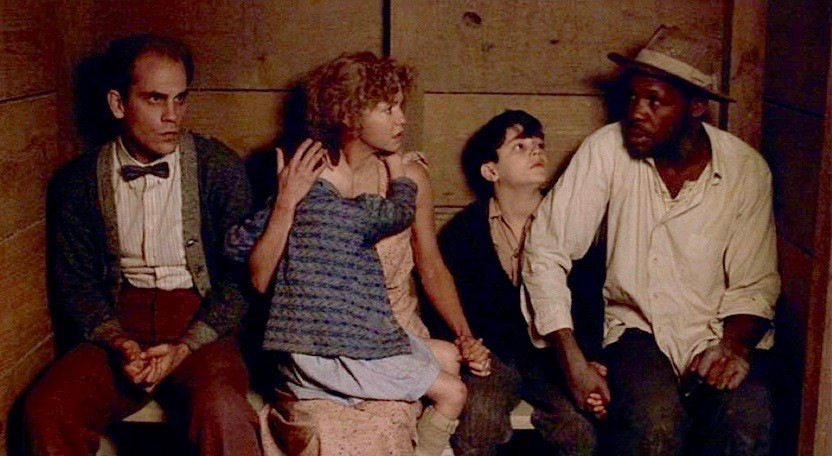
Sally Field plays Edna Spalding, a widow after her sheriff husband (Ray Baker) is accidentally shot and killed by a drunken Black teenager (promptly brutally lynched by the Klan the same day). With the bank pushing to foreclose on the farm she can no longer afford, poverty and homelessness seem certain until a chance meeting with Black drifter Moze (Danny Glover) offers hope. Moze is an experienced cotton worker, and he coaches Edna through getting the fastest cotton crop of the season (and the $100 prize for that feat). Edna and her children throw themselves into the task, and she starts to build a new family with Moze and blind war-veteran lodger Mr Will (John Malkovich). But will weather, the Klan and the banks allow it?

Benton’s film is, in many ways, a master-class in constructing a framework of highly impactful scenes. Places in the Heart is carefully paced with metronomic precision to give us an impactful, powerful scene roughly every ten minutes. From the shockingly sudden shooting of Sheriff Spalding and Edna cleaning his deceased body on her dining room table it gives us scenes that build perfectly to showcase high impact moments. Confrontations, tornadoes that place children in peril, triumphant confrontations with arrogant bankers and facing down corrupt cotton sellers, inevitable fireworks after a disastrous double date and heart-rending racist attacks. It’s a film almost completely constructed of tent-pole moments, to illicit maximum impact.

However, where it fails are the moments in-between. It’s so focused on nailing those big moments, that it allows the emotional journey that should inter-connect them (and make the story truly satisfying) to falter. The clearest example is Malkovich’s blind Mr Will: in no more than three scenes he goes from a man bitter at his disability, dumped on Mrs Spalding by a family who can’t be bothered to care for him, resenting her ‘hooligan’ children to risking his life to becoming their surrogate uncle. It’s a tribute to Malkovich that he sells this lightning fast emotional turn-around, but a more patient film would have spent this change feel organic (rather than, essentially, relying on a tornado act-of-God to complete the arc).

Similarly lightning fast work covers the bond between Edna and Moze: swiftly we go a few scenes from her greeting him with slightly less racist discomfort than her sister, to Jean-Valjean-like claiming she asked him to deliver to a friend the silver spoons he steals from her house, to him becoming another surrogate uncle to the kids and treated in the house like an equal (he notably doesn’t cross the door threshold for the first hour of the film). Now you can admire the efficiency here – for example, the film is good at establishing without fanfare the rope aids hung up around the farm to help Mr Will (vital for a later confrontation). But you can also regret that it is so keen to get to the emotionally cathartic moments, it skims on showing us the journey (after all, a one hundred mile walk seems less impressive if you only see the start and end).

Part of the problem is Benton keeps dragging us away from these engaging plotlines to wallow in a side-plot involving Mrs Spalding’s sister and her wayward husband’s affair with a school teacher. This storyline barely intersects with events on the Spalding farm, in no way serves as a commentary on events there (a braver film would have contrasted it with a romantic relationship between Edna and Moze, which you can be sure would not have been as genteelly resolved as that affair in a South as racist as this). All it really does – for all the efforts of Crouse (Oscar-nominated, presumably due to her husband-slapping confrontation scene), Harris and Madigan, it’s meandering, dull and feels pointless even while you are watching it.

And it always takes us away from the real interest on the farm. The depiction of triumph over adversity is fairly straight-forward – with a host of hissable strawmen, led by Lane Smith’s patronisingly sexist banker – but it’s told with such professional skill it can’t help but land.  Who doesn’t enjoy a woman who never believed she amounted to anything, suddenly discovering an inner-fire and sense of purpose she never knew. You may notice the similarity to Sally Field’s other Oscar-winning role (Norma Rae). Her performance here is cut from the same cloth, only this time she can’t find the same naturalness: she is frequently mannered, precise and actorly when she should feel raw, grounded and real.

The real daring interest here is the way the film tries to address racism. You can’t deny there is a certain romanticism in its looks at the Ol’ South, but its balanced with putting on screen something of the real horrors of racism. Perhaps even more shocking than the sudden shooting of Sheriff Spalding is the sight of young Wylie’s disfigured body dragged behind a truck full of gun-totting racists. (And that this is objected to, not for the violence, but for the poor taste of dragging a dead man to Spalding’s wake). Needless to say there is no investigation or punishment for this crime whatsoever.

Moze’s story captures some of the perils of being Black in Depression-era Texas. Danny Glover, in the film’s finest performance, perfectly captures both the anger of the unjustly oppressed and the fear (and shame of that fear) that death could come from the wrong word or looking at someone the wrong way. Moze constantly shuffles himself to the back, casting his-eyes down and changing the timbre of his voice to something slower and more humble when confronted with white men of power. It’s markedly different from the warmth, decency and sharp opinions he shows with people he trusts. And Places in the Heart’s most appalling moment is when he is confronted with the white-hooded face of the South’s ‘defenders’.

At times this sometimes over-balances a film that, at heart, wants to be optimistic. (As you can tell, all too clearly, from its bizarre, overly demonstrative, deliberately dream-like ‘we-can-all-be-the-same’ ending which must have felt meaningful to Benton but to me feels shockingly trite). Moze’s suffering is shown with real compassion, but he is still presented as a character who magically shows up at exactly the time he is needed and then disappears when his task is done. It’s a film that imagines a utopia where a desperate mother, a blind white man and a Black man can learn all men are equal, while struggling to accept that this is nestled in a land riddled with Klan racists where the n-word is so casually used it doesn’t even raise an eyebrow. In the end cold, hard reality is a little too much for Places in the Heart to digest.

The House of Rothschild (1934)

The House of Rothschild (1934)

Old-fashioned historical melodrama with a well-meaning, earnest political message

Director: Alfred L Werker

Cast: George Arliss (Nathan Rothschild/Mayer Rothschild), Boris Karloff (Count Ledrantz), Loretta Young (Julie Rothschild), Robert Young (Captain Fitztoy), C. Aubrey Smith (Duke of Wellington), Arthur Byron (Baring), Helen Westley (Gudula Rothschild), Reginald Owen (JC Herries), Florence Arliss (Hannah Rothschild), Alan Mowbray (Prince Metternich), Holmes Herbert (Roweth)

It’s 1814 and things are looking tight for the international banking house of Rothschild. With the Napoleonic Wars over, partly thanks to Rothshild financial support of Wellington’s armies, Nathan Rothschild (George Arliss) is pitching to underwrite the loans to help restore France. Problem is, now the merde is out of the European fan, many of the Powers-That-Be don’t want to continue working with a Jewish bank. Led by scowling antisemitic Prussian Count Ledrantz (Boris Karloff), the Rothschilds bid is unjustly rejected. Rothschild outmanoeuvres his enemies to win the contract back, but it leads to a series of revenge pogroms in Prussia. Things change though, when Napoleon escapes from Elba. As all roads lead to Waterloo, will Rothschild back the Allied powers or throw in his lot with Napoleon?

The House of Rothschild is a very well-meaning, old-fashioned historical melodrama, that takes a strong stance against antisemitism. It clearly has more than half-an-eye on events in Germany in the 1930s. As the film’s Prussia of 1814 sinks into mobs hurling stones through windows, smashing up shops and chanting for the expulsion of Jewish people, while families flee across the body leaving their possessions behind (all while the self-satisfied, archly cold Ledrantz pushes his agents to provoke the people to yet more outbursts), surely many people would have seen parallels with Hitler’s Germany.

Throughout the film, the accusations of antisemites are pointedly broken down and strongly rebutted or placed into context. Why do the Rothschilds work in money? Because they are literally banned from any other profession. And money is the only tool they have to defend themselves against 2000 years of persecution; persecution that has made the Rothschilds feel a true affinity for their fellow Jewish people. Indeed, Nathan Rothschild feels a duty to stand firm and do anything he can to help his people: and if that means a bit of financial chicanery or applying heavy pressure to the European powers, then so be it. There is a greater good here when lives are at stake.

The scourge of racism is strongly displayed throughout the film. It opens with a prologue as Nathan’s father Mayer (George Arliss pulling double duty, under a pile of make-up and a wig) struggles to hide his justly-earned fortune from being stolen by corrupt tax collectors who call him ‘Jew’ and smugly tell him the amount he owes to the government is whatever they say it is. It’s a ferocious piece of open antisemitism, but it has genteel echoes when Nathan is later snubbed for an invite to a ball to celebrate Wellington’s victory (a victory he largely paid for) since Jewish people aren’t welcome at such events.

The House of Rothschild places its laudable anti-persecution aim into a very traditional, old-fashioned, costume drama that wouldn’t look out of place on the Victorian stage. It was a passion project of George Arliss’ (who cared deeply about its message), but also fit wonderfully well inside his wheelhouse. You can see its deep similarities to Arliss’ Oscar-winning vehicle Disraeli. Just as there, he plays a twinkly elder statesman, with a touch of the rogue but overflowing with decency and honour. Despite being seen as a suspicious outsider, he out-plays his rivals in an international conspiracy while casting an avuncular eye over a love affair in the family: in this case between his daughter (Loretta Young) and gentile British cavalry officer Captain Fitzroy (a fairly wooden Robert Young). Both films end with our hero celebrated by royalty at a grand ball, while cementing a loving marriage with his wife (played again by Arliss’ wife Florence).

Arliss is, of course, very good in a role tailor made for his mix of playful charm and speechifying. Much of the film is essentially dominated by Arliss, who delivers with his customary skill (even if his performance as Mayer is more than a little ripe) and if his performance feels more than a little like Disraeli #2, his comfort in front of the camera and the naturalness he brings to the role help enormously. Under the playful exterior, Arliss also finds a strength and determination, powered by a real moral fury at the injustices, slights and (eventual) violence perpetuated upon his people.

Few other actors get much to play with here. House of Rothschild is heavily fictionalised, from its invented nemesis in Count Ledrantz (Karloff is good value as the scowling racist) to the build-up to the Waterloo campaign. However, for history buffs like me, there is a fair bit of delight in seeing a parade of great European statesmen pop up in cameos. From Tallyrand to Metternich to Lord Liverpool, these powerhouses of politics fill out the margins, even if they barely come to life as characters. If there is an exception, it’s the customary gruff no-nonsense military bearing C. Aubrey Smith gives Wellington (here a man firmly on the side of decency and honour).

The romantic sub-plot is very disposable, despite the best efforts of all involved. It briefly overlaps with the film’s main themes – Rothschild is less than happy with his daughter marrying a gentile, while he suffers a parade of humiliations from Fitzroy’s compatriots – but otherwise provides little real drama. The various conspiracies are largely resolved through some ingenious Rothschild speeches. The film’s main success is always the creeping dread of antisemitic violence, a candle it keeps alive throughout its old-school, costume-drama melodrama, with just small drops of directorial and cinematic invention. It’s the main reason for remembering a film that’s entertaining enough, in a gentle, classic Hollywood biopic way. It never reinvents the wheel, but it’s passionate about the people who find themselves ground beneath it.

Note: Considering all that, it’s particularly sickening to note that footage from The House of Rothschild of Arliss in full Mayer Rothschild make-up was pinched and repurposed for Joseph Goebbels’ vile antisemitic epic, The Eternal Jew.

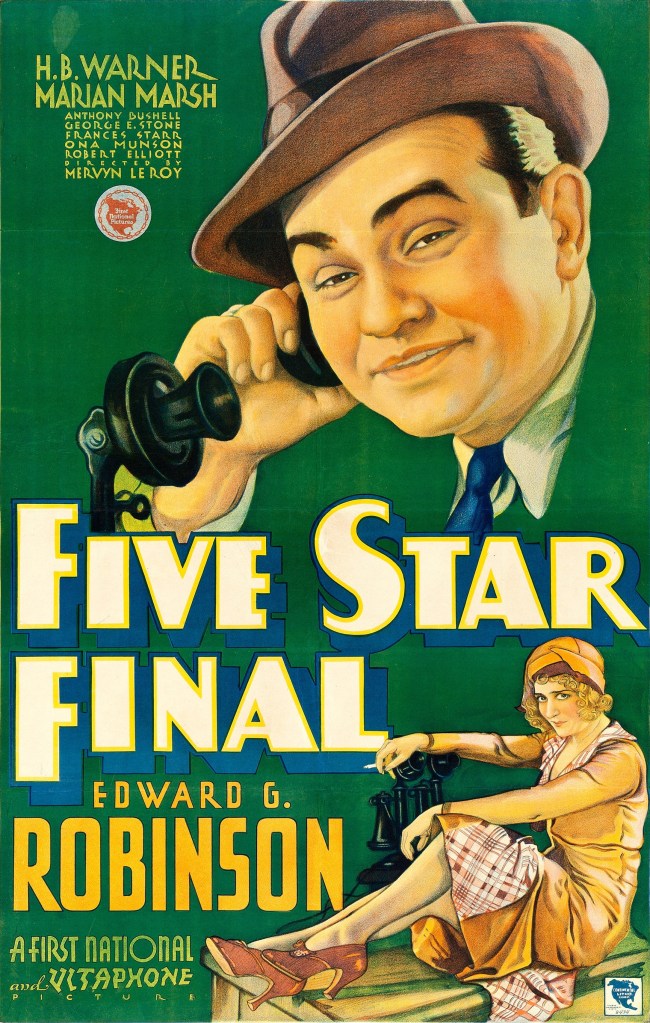
Five Easy Pieces (1970)

Five Easy Pieces (1970)

Nicholson gives a scintillating performance as a self-loathing soul in this searing drama

Director: Bob Rafelson

Cast: Jack Nicholson (Robert Eroica Dupea), Karen Black (Rayette Dipesto), Susan Anspach (Catherine Van Oost), Lois Smith (Partita Dupea), Ralph Waite (Carl Fidelio Dupea), Billy “Green” Bush (Elton), Irene Dailey (Samia Glavia), Toni Basil (Terry Grouse), Helena Kallianiotes (Palm Apodaca), William Challee (Nicholas Dupea), John Ryan (Spicer)

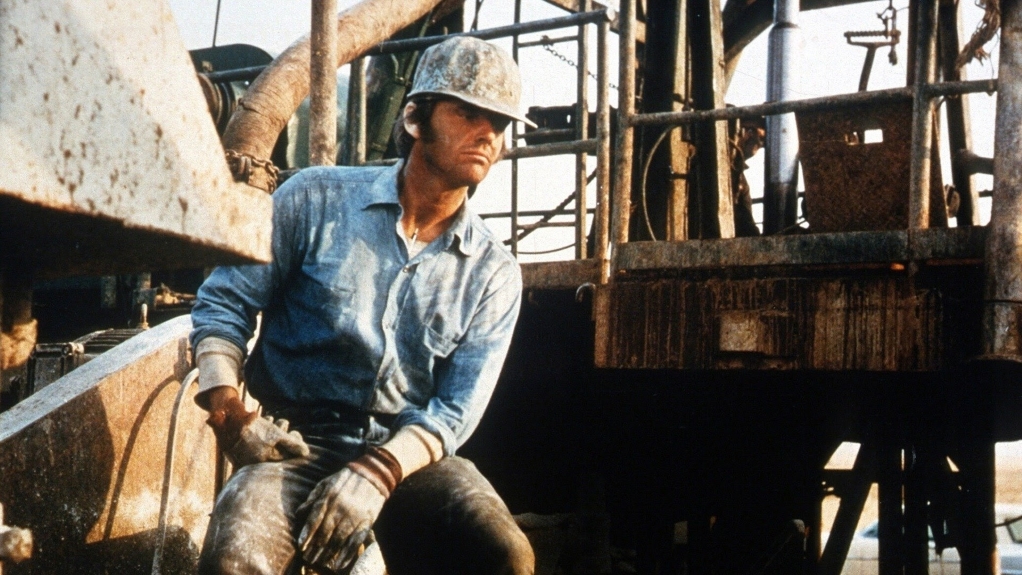
Robert Dupea (Jack Nicholson) is a man out of place. From a family of musical prodigies, groomed from childhood to become a leading concert pianist, he now works as an oil rigger out West. Turns out Robert isn’t content anywhere: he’s too rebellious for the upper-classes, too contemptuous to be part of the working classes. His life is one of running away, moving from place-to-place, avoiding emotional responsibilities, commitment and honesty, constantly seething with feelings he lacks the ability to process, unable to know what he wants with a self-destructive chasm a mile wide that swallows anyone that gets near it.

Five Easy Pieces is an intelligent, quiet, thoughtful character-study of a man who defies all possible labels and doesn’t fit comfortably into any pigeon-holes. Heavily influenced by the European artistes of the 60s, it’s a film that engages with class alienation in America more than almost any other, placing at its heart a man who refuses to compromise with anyone (to his own detriment) and whose selfishness and willingness to hurt other people constantly challenges the level of sympathy we are willing to give him. Despite this though, Rafelson has created a quiet domestic tragedy, with a man at its heart who is both unbearably selfish and unendingly vulnerable and scared at the world, who only knows how to react with bursts of resentful anger and whose instinct is to run away when things get either too tough or too involved.

Five Easy Pieces splits into three acts: the first sees Robert quietly snobbily bucking up against the working-class environment he’s chosen to live in; the second the long car journey to his family home while he struggles to find outlets for his tension; the third his return to the upper-class environs of his family where he can’t hide his contempt for their closeted privilege. What’s consistent is Robert is as constantly ashamed of himself as he is of his environs: a man of class and culture who longs to be working joe, a manual worker who yearns for sophistication around him. Robert’s tragedy is he can never square this circle.

It’s a role that calls for an actor at the top of his game, which it gets with Jack Nicholson. There is a moment near the start, where Nicholson does a little half-pivot skip while going round a corner into this home. It’s a small moment, but it’s a flash of something playfully real and endearingly childish that explains why we bear with him, even while he’s blowing things up around him. Nicholson’s performance is extraordinary. Robert has a constant simmering tension to him, but it’s a born of deep personal discontent. Nicholson perfectly brings to life a man constantly trying to seem assured, carefree and cool – but always with a nervous fear of what people think of him. Do the workers, and his friend Elton, realise he’s as posh as he is? Will his family look down on his waitress girlfriend?

One of the things Nicholson brings so brilliantly to Robert is his unease with talking: sure, he can barnstorm a self-righteous speech, but when it comes to actual conversation or talk about personal emotions he’s as timid and lost as a child. The idea of having roots is anathema to him (he’s perfectly willing to abandon Rayette when he thinks she’s pregnant) but it’s clear he also wants to belong somewhere. His tragedy is, as soon as he finds himself part a community all he feels is contempt for them – as if, like Groucho Marx, he can’t imagine joining a club that would have him as a member.

In fact, it becomes clear, Robert probably hates himself. He dismisses his accomplishments: inveigled into playing piano by his brother’s fiancée Catherine (a lovely performance of misguided sensitivity by Susan Anspach) he responds to her emotional reaction with dismissive rage, belittling his playing and questioning her feelings. It’s a mark, again, of the vulnerability and sensitivity Nicholson balances in this tempestuous, angry man that after this takedown we still believe she goes to bed with him. The tension of Robert’s loathing of himself never needs much to be released in anger against strangers: be it ranting at cars pointlessly blaring horns in traffic jams or an argument with a waitress who refuses to bring him toast that ends with glasses thrown petulantly across the floor. Nicholson never lets the pain of dealing with the world escape from Robert’s eyes, even when he’s at his most abrasive.

Robert’s inability to place himself in either world is perfectly captured in his relationship with waitress and would-be country singer Rayette, played with an endearing honesty and affection by Karen Black. If Robert could compromise, they would be well-suited: they both love music and share a sense of rootlessness. But he makes no real room for her. He can’t hide her contempt for her liking the wrong sort of music (country is no Chopin), he fills their house with little touches of art and scoffs at her inability to appreciate them; then he defends her working-class-honesty against his family’s snobbish friends while also being mortified by her artless, uneducated conversation among his family.

Fundamentally, Robert only cares for Rayette in relation to how she makes him feel about himself in the moment. She is a safe, undemanding comfort blanket – someone who will accept anything from him. His first instinct before returning to his family is to ditch her. Nicholson (in a superb sequence) shamefacedly mutters apologies between angry self-justifications while packing his bags – before a burst of self-loathing in his car sees him return. He then drags her across country only to park her at a motel while he sees ‘how things are’, clearly hoping she may decide to head home without him. When she instead turns up, he’s as ashamed of her as he as of his family’s wealth.

Like his siblings, Robert has never really grown up. His kindly sister Tita (a beautiful performance by Lois Smith) bounces around with enthusiasm, twiddles with a ping-pong bat with teenage glee while she flirts with her father’s nurse and seems utterly cossetted from the outside world. His brother Carl (Ralph Waite, very funny) has the distracted air of a natural eccentric, who has never had to engage with reality. But are they that different from Robert, who has a childish tantrum when he loses a bowling match? Five Easy Pieces suggests a difficult, distant relationship with his domineering father (now confined to silence in a wheelchair) in an astonishingly raw scene from Nicholson – but goes far from giving Robert a pass, his self-destructive self-loathing being far more of an inbuilt character flaw.

In fact, Robert suffers from an ennui that suggests he will never be happy wherever he lands – and he lacks either the self-knowledge or willingness to change. Above all, and it’s clear in every frame of Nicholson’s searing performance, Robert is a man who despises some part of himself so much, that all he can feel for those who show him warmth is contempt. After all, if he doesn’t care for him, why would anyone do so? It’s a pattern that is destined to leave him forever unhappy, forever hurting people, for ever lashing out. It’s a brutal honesty that makes Five Easy Pieces in some ways one of the bleakest, least hopeful of American films.

Hold Back the Dawn (1941)

Hold Back the Dawn (1941)

A potentially cynical drama becomes a sweet romance, with three excellent lead performances

Director: Mitchell Leisen

Cast: Charles Boyer (Georges Iscovescu), Olivia de Havilland (Emmy Brown), Paulette Goddard (Antia Dixon), Victor Francen (Professor van der Luecken), Walter Abel (Inspector Hummock), Curt Bois (Bonbois), Rosemary DeCamp (Berta Kurz), Eric Feldary (Josef Kurz), Nestor Paiva (Fred Flores)

Refugees flock at the USA-Mexican border, desperate to squeeze into the Land of the Free, only to meet with a stringent border control and tight rules on immigration quotas. No, it’s not a story from today – it’s from the 1940s, with Mexico awash with refugees from Europe, fleeing Hitler. But the USA only has a certain quota of refugees it will accept from each country – and Romanian Georges Iscovescu (Charles Boyer) finds he’s got no less than a five to eight year wait before his quota number will come up. His ex-flame Anita (Paulette Goddard) suggests there might be a way around this: if Georges can get married to an American citizen, he will fly through the border on a green card. Georges sets his eye on spinsterish teacher Emmy Brown (Olivia de Havilland) marrying her in a whirlwind romance – only to find feelings of guilt and growing affection for Emmy making his plan more difficult.

Hold Back the Dawn is well-assembled, well-paced mix of romance and black-comedy which pulls its jet-black punches in favour of a more conventional happy ending. Perhaps that’s why it was the last Billy Wilder script (working with regular collaborator Charles Brackett) he didn’t direct himself. You can imagine a director as prone to the cynical as Wilder, may not have settled quite as happily for the more optimistic and reassuring film Hold Back the Dawn becomes. Wilder was also unhappy with how he felt the film pruned back the more cutting political criticism of America’s immigration policy. As a refugee from Hitler himself, Wilder knew of what he was talking about.

However, that’s not to say Hold Back the Dawn isn’t awash with Wilder and Brackett’s patented mix of waspish character comedy and sharp dialogue tinted with more than a touch of arch cynicism. Mitchell Leisen’s success here, is to smooth the wheels to allow enough of this mix of black and absurdist humour to carry through a film you feel the studio has attempted to shoe-horn into being a conventional ‘love conquers all’ narrative (not least with its ending, which has the look and feel of a mix of hurried re-shoots and re-purposed footage to create a late upbeat ending, filmed after de Havilland was no longer available from her loan from Warner Brothers).

Hold Back the Dawn doesn’t shirk on the vicious, oppressive cycle of being stuck in a holding pattern waiting to be allowed into the US. Georges only gains his room in the overstuffed hotel because the previous tenant hangs himself (the manager matter-of-factly says he’ll have the room ready shortly). There is quite a lot of both dark humour (from Georges and Anita’s nakedly opportunist cadism) to little touches of high farce (a pregnant woman gaming the system to give birth on US soil) and the faintly surreal (a would-be refugee who might just be a descendant of honorary US citizen Lafayette). Throughout most of Hold Back the Dawn this never feels out of keeping with the slow-burning romance between Georges and Emmy.

A lot of this is also due to Charles Boyer’s highly successful performance in the lead role. Few actors were as skilled at mixing suave European class and louche rotter-ness than Boyer, and Georges is a gift of a part. A playboy stuck in a boring, dead-end purgatory of a town (one he aimlessly walks around time and time again to kill the hours), Boyer makes Georges believable charm personified – certainly enough to back the film’s implication he keeps himself afloat as a gigolo for tourists. Boyer’s arch voiceover relays every-step of the nakedly self-centred plan he initiates to squirm his way over the border. His performance is full of charm, tender shyness and love-struck adoration to Emmy, punctured throughout by Boyer’s canny side-eye to check on the effect of his shameless lies (there is a glorious moment when Boyer checks himself and cocks an eye when walking down a street, to make sure Emmy is following him).

The character works though because Boyer is a master at balancing this ruthless, self-serving charm with a general decency just below the surface that, no matter how hard he tries, he can never quite dampen down. It excels in the film’s middle act as the couple’s ‘spontaneous’ (so Georges can escape the notice of Walter Abel’s excellently shrewd immigration inspector) honeymoon in Mexico. Boyer brilliantly demonstrates through the slightest of vocal inflections and subtle shifts in body language (there is a point during a village fiesta where his face lights up with a genuine smile the like of which we have never seen before) that make us totally believe this is a man who, much to his surprise, is actually falling in love.

It helps with this that he shares scenes with such a winning presence as Olivia de Havilland as Emmy. Oscar-nominated, de Havilland takes a role (a spinsterish frump, who has never been loved) that could be ridiculous and makes it utterly and completely real. Throughout Georges initially cynical courting, there is a little sense of doubt throughout in de Havilland’s manner (she knows instant love is too good to be true), but such is her loneliness we can see and feel her willing herself into belief. As she does so, de Havilland lets the shy Emmy flourish into a woman of greater confidence, wit and burgeoning sexual desire (hilariously, the increasingly shamed Georges begins to event injuries to put off the consummation of this marriage). De Havilland makes Emmy a living, breathing person, someone miles away from the joke she is set up as initially: instead she is a genuine, true-hearted, increasingly brave woman whose decency and sense of warmth we grow to love as much as Georges does.

She makes an excellent contrast with Paulette Goddard’s ruthlessly amoral Anita. In one of her finest performances outside of her work with Chaplin, Goddard makes Anita utterly ruthless in seeking out what she wants and full of a hilariously honesty about her willingness to use anyone and anything to get it. She’s Georges even darker reflection, Goddard’s dialogue awash with brutal firecracker one-liners. But even she is capable at points of depth, a late act of petty cruelty awakening in her underlying feelings of sympathy and empathy that seem to surprise even her. It’s a lovely performance of darkly comedic ruthlessness.

These three leads all elevate a film that at times compromises on its vision of the harshness of the system these people are all stuck in. Hold Back the Dawn doesn’t want to make a statement as such – it wants to offer a more reassuring vision of hope and decency. This it does well: the film is even built around Georges pitching it as a possible film project to the actual Mitchell Leisen (effectively playing himself, on set shooting a real film with the real Veronica Lake and Brian Donlevy). After a start that suggests something darker and more dangerous, it ends as a comforting and safe picture – but one that works extremely well.

Sinners (2025)

Sinners (2025)

Coogler’s mix of political statement and horror flick is overlong but very effective

Director: Ryan Coogler

Cast: Michael B Jordan (Elijah “Smoke” Moore/Elias “Stack” Moore), Hailee Steinfeld (Mary), Miles Caton (Sammie “Preacher Boy” Moore), Jack O’Connell (Remmick), Wunmi Mosaku (Annie), Jayme Lawson (Pearline), Omar Miller (Cornbread), Delroy Lindo (Delta Slim), Li Jun Li (Grace Chow), Yao (Bo Chow), Buddy Guy (Old Samme)

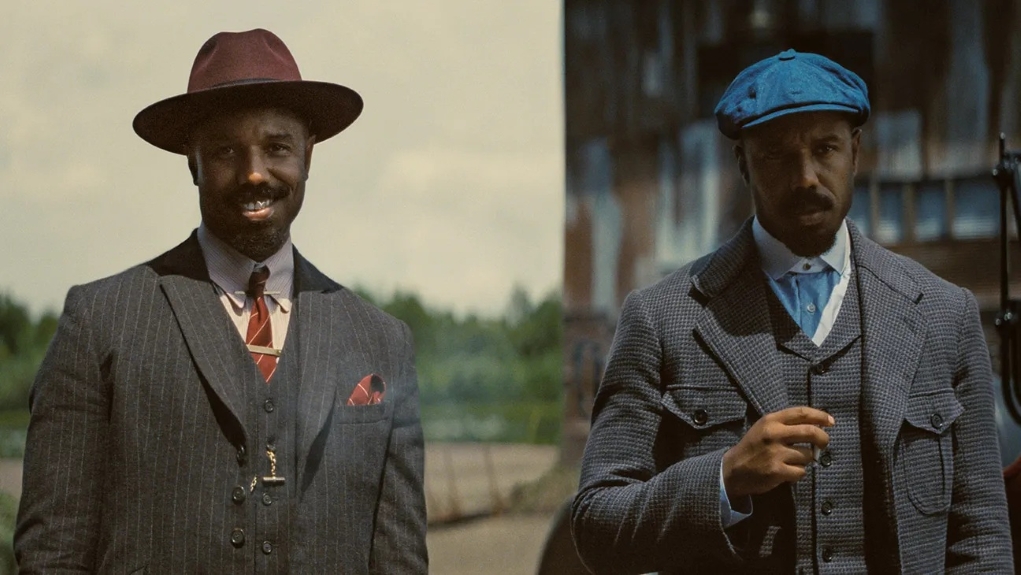
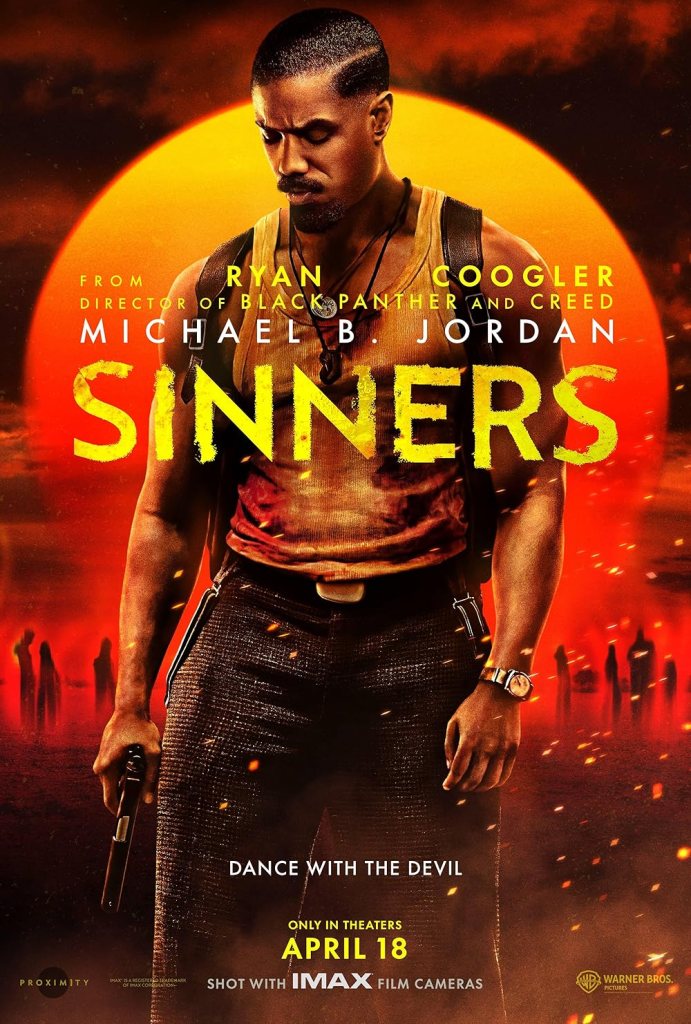
In 1932 twin brothers Smoke and Stack (Michael B Jordan, pulling double duty) return to the racist South of Mississippi after years of war service followed by time spent working for the gangs of Chicago. They dream of setting up a juke joint for the Black community, flying in the face the racism of local Mississippi. But the dangers of the KKK pale slightly, when their opening night coincides with the arrival of vampire Remmick (Jack O’Connell) who dreams of forming a new family of the dead – and wants to recruit Mississippi’s Black community, with promises of equality in his world they could never have in their own. Holed up in their juke joint, can the brothers and their families and friends survive a night long siege until dawn?

The basic set-up of Sinners is, to be honest, familiar. It delights in hueing close to Vampire mythology – garlic, wooden stakes, silver and sunlight are the key weapons here and the vampires are powerless to cross a threshold until they are invited – and the ‘base under siege’ that occupies the film’s final act is essentially taken direct from the sort of set-up John Carpenter excelled at in his heyday. What makes Sinners really stand-out is the richness of its character relationships and its social context.

That social context is, of course, the Jim Crow South. Sinners is a film steeped in the racial injustice of a particular time-and-place. In 1932, Black workers still pick cotton on plantations in exchange for wooden nickels. Families live in shanty towns and use different shops than the white folk (local goods dealers the Chow’s run two convenience stores, on opposite sides of the street, to serve their two clienteles). The danger of lynchings are everyday threats (Delroy Lindo has a haunting monologue, beautifully delivered, as Slim recounts the lynching of a former band partner, who unwisely produced his stuffed wallet at a train station). Virtually the only white people we see (other than Rennick) are KKK members.

In this world of radical injustice, it’s fascinating that Coogler suggests, in some ways, the afterlife of a Vampire is more just and fair than actual life. Rennick, himself the relic of a long-oppressed pagan Irish community, makes solid points about Smoke and Stack facing a losing battle trying to play by the white man’s game as entrepreneurs and would-be local businessmen. He even, genuinely, states he would be happy to kill the entire KKK just to wipe their hatred from the Earth. There is a certain truth in the fact that, in the legions of the undead, all are equal and race means nothing. That getting bit could be a doorway to a new world, free of racial oppression – even if it also seems to mean living in the sort of community Rennick alone crafts.

It becomes a fascinating idea, joined with the fact that Rennick also points out Christianity is a spirituality forced on the Black community. Unlike the blues music, that gifted young cousin to the brothers, Sammie (a lyrical performance in every sense from Miles Caton) plays so well it can cross the bounds of space and time joining Black souls together, the enslaved people didn’t bring Christianity with them across the water. It was forced on them, as much as the labour in the fields. Sinners isn’t quite brave enough to explicitly denounce the Church as just another wing of enslavement (even if Sammie’s preacher father uses trauma to hammer conversion on people, rather than offering comfort). But it does make clear that Sammie’s ‘coming-of-age’ is whether he will choose the culture of his ancestors or the culture of his oppressors.

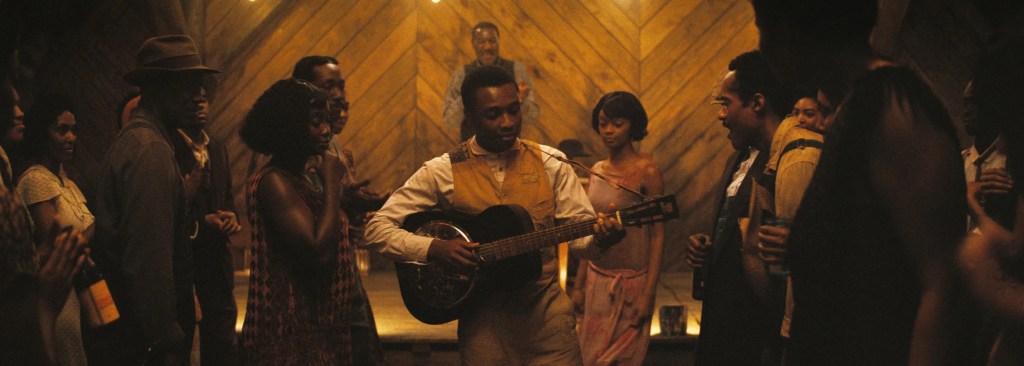
This is thought-provoking stuff – and Coogler does a superb job of threading it through the blood-spurting, neck-biting, stake-hammering action that fills up a large portion of the film’s conclusion. Sinners is dripping in Blues music, which artfully and beautifully wraps itself around the film to perfectly capture its tone and pitch. The sequence where Sammi’s music fills the juke joint, is transcendent in more ways than one, powerful and transporting in its musicality and passion (Ludwig Göransson’s score, created in partnership with several Blues artists and the actors is exceptional). Coogler matches it with one his trademark, virtuoso, one-take shots, the camera seamlessly weaving in and around the juke joint as our 1930s characters dance alongside modern club dancers and musicians as well as tribal African musicians of the distant past.

It also rewards more as Coogler takes his time throughout the film’s long opening act to really establish the characters and their relationships. You can argue that Sinners is over-indulgent in the sometimes overlong (well over an hour) long ‘recruitment’ sequence as Smoke and Stack assemble family and friends for their opening night. But this careful exploration of the closeness and warmth between these people – their loving sense of family, loyalty and sometimes painful shared history – pays off in spades when they begin one-by-one to turn to Rennick and then on each other. Coogler then makes these corruptions of the living into the hungry undead really sting, just as we feel the pain of those left among the living who must stake their nearest and dearest.

That carries further impact from the strength of the acting. Jordan, one of the most charismatic actors out there, gives a superb double-performance as the two twins, expertly sketching out their contrasting personalities and their deep love for each other. He makes Stack charismatic, gregarious and fun, and Smoke gruff, reserved but endlessly loyal and protective. They are too sharply humane turns, with Jordan so naturally playing off himself you forget both are played by the same actor.

Equally fine are the rest of the cast. Miles Caton is youthful idealism being shaken by traumatic events on the greatest night of his life. Wunmi Mosaku gives Smoke’s wife Annie a moral authority and deep sense of lingering grief. Hailee Steinfeld is vivacious but similarly burdened by disappointment and pain at chances lost as Stack’s one-time girlfriend that prejudice thwarted. Delroy Lindo’s soulful skill invests Slim with a real grace under the drunkenness. Even O’Connell, at times transformed into an Orlock-like nightmare, has a lonely humanity behind his ruthless, never-ending desire to build a new community (which he controls) around him.

There are powerful subtexts throughout here, even if parts of Sinners could at times benefit from a little tightening. Coogler effectively gives a rich hinterland to some familiar genre settings: and he surprises us with two codas, one rich in satisfying revenge violence the other with a rhapsodic melancholy which feel like natural ends for both their characters. Sinners mixes its Spike Lee influences with its John Carpenter ones with excellent effect, and is another firm reminder of the visual flair and piercing individualism of Coogler as director.

Johnny Belinda (1948)

Johnny Belinda (1948)

Small-town drama is a beautifully done exploration of prejudice with excellent performances

Director: Jean Negulesco

Cast: Jane Wyman (Belinda MacDonald), Lew Ayres (Dr Robert Richardson), Charles Bickford (Blackie MacDonald), Agnes Moorehead (Aggie MacDonald), Stephen McNally (Locky McCormick), Jan Sterling (Stella), Rosalind Ivey (Mrs Poggerty), Dan Seymour (Pacquet), Mabel Paige (Mrs Lutz), Alan Napier (Defence Attorney)

Small towns. Sometimes they’re safe, cosy little havens of the familiar. And sometimes they’re bitchy places of resentment and suspicion where everyone judges everyone else’s business. In an environment like that, it doesn’t pay to be different. Belinda MacDonald (Jane Wyman) is as different as they come: a deaf and dumb young woman, who (despite her intelligence and warmth) everyone assumes is a mentally deficient. Just as different, in a way, is Dr Richardson (Lew Ayres), a compassionate, well-educated man who forms his own opinions and is oblivious to other’s prejudices. Life’s going to be tough for this pair.

Dr Richardson is the only person in this small Canadian fishing town who can see the bright, vivacious young woman Belinda is. With his support, her father Blackie (Charles Bickford) rediscovers his love for a daughter, who he always blamed for her mother’s death in childbirth, while her austere aunt Aggie (Agnes Moorehead) thaws and proves her loyalty. Belinda will need them when she is raped by the popular Lucky (Stephen McNally) and trauma leaves her unable to remember who is responsible for the resulting child. The town, of course, blames Dr Richardson.

Johnny Belinda has all the ingredients of a melodrama: but it surprises as a mature, sensitive and moving story about real people. It’s amazing to see a 40s film this frank about rape and an illegitimate child, that lays not a finger of reproach on the victim, instead turning its fire on the small-minded judgements of those around her. It’s also striking it doesn’t define Belinda solely as a victim, either of deafness or rape. She gives birth to a child she dearly loves, refuses to let what’s happened haunt her and sees her life as one with blessings rather than curses. But neither is she an angelic character, being at times as capable of mistakes and quick judgements as the rest of us.

It helps that Jane Wyman (in an Oscar-winning turn) gives a perfectly judged performance. She’s never winsome or cloying, but fills Belinda with an uncomplaining grit to make the best of things, matched with a growing joy as her opportunities expand, from her discovery of sign language to the birth of her child. In complete silence (Wyman intensively learned sign), Wyman employs her expressive eyes to communicate a range of emotions from wonder to joy to fear to pain and grief (including a wordless rendition of the Lord’s Prayer). Belinda is a character we deeply empathise with, but never we nor the film treat her as an object of charity.

That also springs from Ayres’ Dr Richardson, a genial, kindly man whose inability to see the worst in people makes him a target-in-waiting for gossip. His less than regular attendance at Church has already raised question. Add his academic earnestness – and Ayres wonderfully embodies a man quietly passionate about making a difference – and you’ve got someone who doesn’t fit in a town that respects manly ruggedness. Richardson doesn’t pick up on this at all – just as he doesn’t even notice the clearly besotted devotion of his housekeeper Stella (an excellent portrait of quiet desperation by Jan Sterling).

Gossip is soon flying that Richardson is too close to Belinda. A trio of judgemental old woman, like Irish banshees, frequently stand on street corners to share little tit-bits of meanness.  The town punches down on outsiders, fitting people into insultingly simple brackets. It’s partly why immigrant shop-owner Pacquet (Dan Seymour) becomes the ringleader of a morality lynch mob: he’s all too aware it otherwise won’t be long before he’s the target again. No one, of course, can imagine for a moment that the carefree, rugged Lucky (Stephen McNally, a wonderful portrait of utterly smackable shallow vileness) could be the sort of cruel, cowardly cad he is.

A cad who takes notice of a newly confident Belinda – and not in a good way. Part of Johnny Belinda’s power is you can sense the latent danger in those eyes on a newly radiant and confident Belinda at a town shindig, the shy wallflower turned smiling young woman enjoying the music through feeling the vibrations of a violin string (a lovely moment, played with a real burgeoning wonder by Wyman). It’s a mark of the cruelty of the world that this confidence just makes Belinda a target for the vile Lucky.

Again, it’s a mark of Johnny Belinda’s success that the cruelty of what happens hits so hard. Rarely have I despised a film villain as much as Lucky, perhaps because he’s so weak, snivelling and arrogant – the sort of guy so arrogant and stupid he crows over the good-looks of his illegitimate son. He’s a picture of the real villains out there: the weak, stupid and shallow who always get passes from those around them.

Johnny Belinda creates deep, engaging characters. Charles Bickford’s Blackie is presented as first as a gruff, careless father. But the film – and Bickford’s performance – slowly unpeels him as a tender, caring and decent man. The sort of man whose first instinct is to protect, who delights in his unexpected grandson and is thrilled with the excitement of sign language. Similarly, Agnes Moorehead gives a terrific performance as a woman who seems at first a bullying harridan, but becomes a pillar of familial strength. (Both of them and Ayres were Oscar nominated, Johnny Belinda one of the few films to get nominations in every acting category).

This affecting story of people who feel real and three-dimensional, is well directed with restraint and care by Jean Negulesco (easily his finest film) and shot with a real beauty in its rugged Canadian sea-town visuals by Ted McCord. Max Steiner’s excellent score mixes emotional melody with sea shanty influences. It’s a world where intense but very real emotions help ground a story of rape, murder, scarlet letters and court cases into something that feels real and relatable.

Johnny Belinda feels like an overlooked gem, a sort of perfect example of Hollywood issue film where the ‘issue’ isn’t pounded over our head but built organically into the plot. One where characters surprise us with developments that feel real, embodied by a series of excellent actors at the top of their game. It’s a small gem that deserves to be better known.

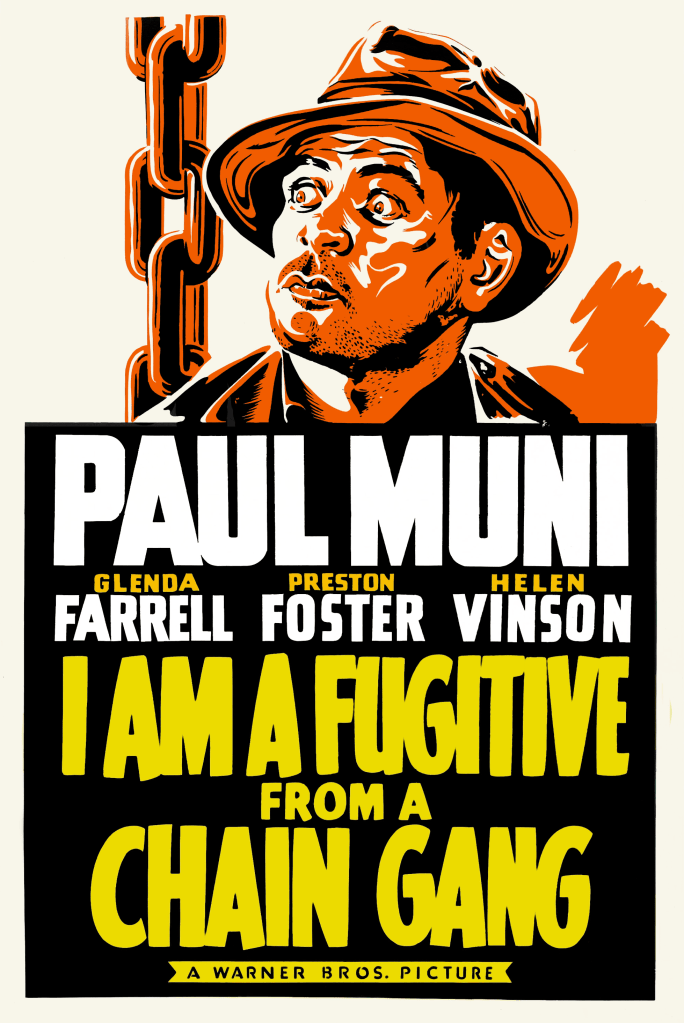
I Am a Fugitive From a Chain Gang (1932)

I Am a Fugitive From a Chain Gang (1932)

Pioneering social issues film remains an impressively mounted film, made with real passion

Director: Mervyn LeRoy

Cast: Paul Muni (James Allen), Glenda Farrell (Marie), Helen Vinson (Helen), Noel Francis (Linda), Preston Foster (Pete), Allen Jenkins (Barney Sykes), Berton Churchill (Judge), Edward Ellis (Bomber Wells), David Landau (Warden), Hale Hamilton (Reverend Allen), Sally Blane (Alice), Louise Carter (Mrs Allen)

What are prisons for? Just punishment or should they encourage reform and change? To many in the South, its clear prisons were solely about the former and had nothing to do about the latter. That, in fact, you couldn’t reform a criminal – after a prison sentence he would always inevitably come back for more. I Am a Fugitive from a Chain Gang, based on a true story, is all about exploring a dehumanising system designed to turn men into working animals, beaten for looking the wrong way. No chance of a pardon, just chain men to each other, shove a pickaxe in their hand and give them a thrashing if they stop swinging it against a rock for more than second.

Based on a memoir by Robert Burns, James Allen (Paul Muni) returns from fighting in World War One with dreams of becoming an architect. Instead, he finds the American workplace is not a welcoming place for a flood of returning soldiers, drifting from state to state for work. Until, in an unnamed Southern State, he accidentally ends up in the middle of a $5 theft and is sentenced to ten years on a chain gang. The prison is a hotbed of inhumanity, with prisoners frequently beaten, dehumanised and all but worked to death. After a year he escapes and finds his way to Chicago where he reinvents himself as a successful surveyor – only, years later, for a bitter wife to expose his secret. Can he trust the Southern State that his sentence will be commuted if he agrees to return and give himself up?

I Am a Fugitive from a Chain Gang was one of the first – and probably one of the best – 1930s social issues films. It’s a surprisingly hard-hitting look at a cruel system, which (although keen to make our hero an unwitting participant in a minor crime, rather than clearly guilty like Burns) passes a sympathetic eye on criminals, asking us to question whether, whatever their crimes, they deserve this system. A system where prisoners can be randomly thrashed near to death by a thick leather belt, where pausing at work will lead to an instant beating. Where a prisoner tied to a post by his neck is such an everyday occurrence, the film is happy to throw it away in a passing shot. It makes a strong case that how we treat prisoners says as much about us as I does them – and that, sadistic wardens quickly become little better than the men they guard.

LeRoy’s film also makes a strong argument that we talk-the-talk but rarely walk-the-walk when it comes to supporting servicemen. James Allen returns a decorated hero – but his family, former employer and patronising reverend brother assume he will happily return to grunt work on the production line. War has expanded his horizons and ambitions, given him the skills to better himself. No one wants to hear it. He’s not alone: many drifters are ex-servicemen and when he tries to pawn his medals a pawnbroker sadly shows him a bucket full of worthless service decorations. It’s an indication that everyone has an assigned role and place and they shouldn’t for one minute expect to step outside this.

It’s no wonder that the prison sentence treats men like animals – a point LeRoy makes by cutting between donkeys and men both being chained up ready for a day’s work. IAAFFACG makes clear in this system all men are equal in their inequality, cutting back and forth from Black to white prisoners as they are prepare for the days work. (The film does make clear there is a higher number of Black prisoners than white). Allen protests at first, but learns to shrug his shoulders and turn away like the rest do. A freed prisoner showcases this indifferent acceptance of suffering, leaving at the same time as a deceased one, hitching a ride on the cart sitting merrily on a fellow worker’s coffin, striking a match for his cigarette on it. LeRoy shoots the prison beds where the men sleep chained together with a forbidding moodiness and the wide-open spaces where they slave in the beating sun with a scale and sense of heat bearing down on us.

Allen won’t be beaten though. His escape is a beautifully filmed and edited sequence, show-casing the film’s triumphant use of sound. LeRoy’s camera tracks both Allen and pursuers as they flee through the undergrowth, adding pace and intensity to the sequence, soundtracked to the bark of the hounds following him. It’s a sound you really notice disappear when Allen hurls himself into a river, using a reed as an air pipe, hiding feet away from his pursuers, in a series of underwater shots that have a haunting power. It’s superbly done, full of tension and fear.

Escaped, first thing James does is buy a suit and have a shave. Instantly he is above suspicion – even while he is perfectly described be a flatfoot cop sitting next to him in the barbers, not a trace of suspicion is placed on to him (thanks for the ‘close shave’ Allen drily says). Now looking like a respectable middle-class sort, James Allen – under his new name of Allen James – suddenly finds opportunities heading his way, moving quickly up the chain at his new job in Chicago. In this world, outward appearances make the man: and a guy in a new suit is always going to get the sort of attention a down-and-out can only dream of.

So much is Allen now an ideal prospect, he is blackmailed into marriage by Glenda Farrell’s hard-faced Marie, a decision that will bite him hard when he makes eyes years later at the sweet Helen (Helen Visnor). He’s pulled back into the world he thought he had left behind, only to find its not changed at all: to the ‘justice’ system his new professional achievements count for not a jot. To them he’s still the same subhuman scum he was before, an even harsher regime swiftly initiated to drive any vestige of humanity from him, even in the face of a national campaign.

At the centre of this film is a superb performance by Paul Muni. Sure, you can see touches of Muni’s love for melodrama, the odd overdone reaction. But this is an emotionally raw, deeply touching performance. Muni gives Allen a superabundance of energy, enthusiasm and hope at the film’s start all of which slowly drains away. The horror builds behind his eyes: it’s no surprise that, re-sentenced to the chain gang, Muni’s face crumbles into genuinely affecting tears of fear and hopelessness. Slowly, despite himself, Allen becomes the toughened, cynical, damaged man the system assumes he was at the start, strangling the hope and optimism that characterised him at the start. It’s a sensitive, deeply humane performance, of humanity being chiselled away.

It results, of course, in the film’s striking (and famous) closing shot, the now fugitive Allen whispering from the shadows, all chance of making an honest life gone. IAAFFACG has already symbolically shown how this system has twisted Allen: having dreamed his whole life of being a bridge builder, one of his final acts in the film is to destroy a bridge as part of a desperate escape. IAAFFACG doesn’t overegg its social commentary, but leaves a strong and lasting impression of how treating men like animals becomes a self-fulfilling prophecy. Leave them no choice and a man must turn to crime: it’s as true for abandoned veterans as it is for chain-gang criminals. In making an appeal for a fairer, kinder world, IAAFFACG doesn’t miss that we are a long way from it right now.

Kitty Foyle (1940)

Kitty Foyle (1940)

Odd romantic fable, with a star-turn, that doesn’t seem to fully realise how judgemental and puritanical it is

Director: Sam Wood

Cast: Ginger Rogers (Kitty Foyle), Dennis Morgan (Wynnewood Strafford), James Craig (Dr Mark Eisen), Eduardo Ciannelli (Giono), Ernest Cossart (Pop), Gladys Cooper (Mrs Strafford), Odette Myrtil (Delphine Detaille), Mary Treen (Pat), KT Stevens (Molly)

“Ginger Rogers did everything Fred Astaire did…[but] backwards and in high heels”. So goes the famous quote about the famed dance pairing. But Ginger Rogers also did something Fred Astaire never did: she won an Oscar. That was Best Actress for Kitty Foyle, a reminder that Rogers was the girl-next-door who was a fine actor, accomplished dancer and natural comedienne. Rogers is great in Kitty Foyle, an otherwise fairly average, at times painfully dated ‘women’s picture’ where flashes of wit conceal character flaws the film is unaware of and a series of frequently depressing messages about love and women’s choices.

In the early 1930s, Kitty Foyle (Ginger Rogers) is a young Philadelphia woman enjoying the opportunities the new world of emancipation gives her. Working as a secretary for a small magazine, she and its editor Wynnewood Strafford IV (Dennis Morgan) fall in love – but he lacks the courage to propose to a woman far below his family’s social standing. Moving to New York, Kitty works in a fashionable department store and meets with Dr Mark Eisen (James Craig). The two begin a tentative relationship – until Wyn returns and proposes, which Kitty eagerly accepts.

However, since the film plays out in flashback from 1939, we already know the Wyn-Kitty marriage is doomed to divorce since Wyn is re-married (with a kid!). Indeed, we’ll learn Kitty left her marriage because she felt the social differences between her and Wyn were insurmountable, in her (secretly) divorced state becoming engaged to Dr Mark. Kitty Foyle plays out a cliffhanger question: which of these two men will Kitty choose? Of course, there is zero tension in this decision – is there any chance at all that in a Production Code film, Kitty will choose a rich married family man over a hard-working doctor who we are introduced to tending to the poor of New York gratis?

Nevertheless, Kitty Foyle is structed through a series of snow globe-inspired flashbacks, narrated by Kitty’s reflection (who objects to herself being tempted by Wyn’s offer – hammering home the implicit moral judgement the film soaks in, even Kitty’s reflection thinks she’s a hussy). These snow-globe framed flashbacks are one of the most interesting things about Kitty Foyle today – largely because, if you think of 40’s snow globe flashback films your mind immediately turns to Citizen Kane (both from RKO!). It’s hard not to wonder if Orson Welles and/or Herman J. Mankiewicz remembered the device when they put their script together?

The other most interesting thing about Kitty Foyle is that neither Kitty nor the film can even pretend to raise much interest in its Code-approved romantic figure, Dr Mark. Fair enough, since Dr Mark is a crushing prig and self-important bore. Played with a humour-free smugness by James Craig, he’s the sort of guy who enjoys sitting on buses passing superior medical opinions about those around him. On his first date with Kitty, he unilaterally cancels a dinner to sit at home and play cards – which he later reveals was a moral test for all his first dates to see whether a potential partner is a gold-digger (it’s amazing he’s single). We get very little sense he is remotely interested in the real Kitty, instead preferring an idealised version of her as a potential assistant-in-all-but-name. In nearly every sense, he’s is the sort of stuffy, self-important, worthy man most comedies of the era saw the heroine’s apologetically jilt to enjoy true love with Cary-Grant.

Of course, Wyn is no Cary Grant. Played by Dennis Morgan with a wonderful sense of shallowness, he’s far too easily-led behind his charm for that. Wyn is a weak man, who struggles to take responsibility for (or make) his own choices. That doesn’t change the fact that Kitty has a passion for him she never once raises for Dr Mark. Kitty Foyle essentially agues his weakness and social status as the scion of a banking family (he is, we are not allowed to forget, the third man to bear the name Wynnewood Stafford), could never make him an appropriate match for the reassuringly middle-class Kitty.

There is a real inverted snobbery around Kitty Foyle, where the upper-classes of Philadelphia (represented, among others, by Gladys Cooper as Wyn’s imperious mother) can only-just-about suppress their discomfort about Kitty’s lower standing. (Their suggestion, when presented with the fait accompli of Kitty-Wyn’s marriage is to suggest Kitty attends a finishing school). Saying that, the family don’t object to the marriage and (in their own way) their suggestions are based around helping Kitty. The two-way snobbery is neither they nor Kitty can imagine a middle-ground: she is just as adamant she will not change anything about herself, as they can’t imagine accommodating her middle-class interests. The film wants us to blame Wyn for his upper-class background and spreads a depressing message that the classes should never mix.

Brutal assumptions people make about each other are at the heart of Kitty Foyle – and the film has absolutely no idea about this. The film never once questions the character flaws of certainty that lead Kitty, Wyn and Mark to all reach (false) conclusions about others. Kitty brutally decides, no matter what Wyn says, that she will divorce him because she doesn’t believe he will give him his wealth. And maybe she’s right – but she never asks him and makes a series of selfish decisions about their life that he has every right to be at least involved in. Kitty Foyle sees absolutely no issue with this, which you can bet its bottom dollar it would if the shoe was on the other foot. The is probably the only romance from Hollywood’s golden age that condemns true love in favour of cold-headed pragmatism and sensible (not passionate) choices.

All of this doesn’t mean that Ginger Rogers isn’t very good, as she carries virtually single-handedly the whole film. Kitty is feisty, determined, smart, shrewd, funny and brave. It gives her opportunities for light comedy and serious emotions. She’s very funny in comedy sequences, such as Kitty’s accidental pressing of the burglar alarm rather than stock room button on her first day on the job in a New York department store (I blame the woeful design flaw in putting these poorly-labelled buttons right next to each other!). But she’s also quietly heart-breaking in the film’s final segment where she faces a series of painful events. Rogers invests these with a quietly melancholic sadness laced with real dignity. It’s a fine performance that lifts an otherwise mediocre film.

It’s also a mediocre film that opens with a jaw-droppingly anti-feminist sequence to explain why girls are working. A series of silent flashbacks play out in silent-film-style dumb-show openly mocking suffragettes and the misguided passions of women for freedom that took them away from a live of ease being looked after by doting husbands. The whole point seems to be how unwise they were to fight to be foisted into a world of hard work and not being given a seat automatically on public transportation. It left me wondering how far into this script Katherine Hepburn got before she turned it down?

A Dry White Season (1989)

A Dry White Season (1989)

A passionate, clear-eyed and largely unsentimental denunciation of Apartheid, the best of its kind

Director: Euzhan Palcy

Cast: Donald Sutherland (Ben du Toit), Janet Suzman (Susan du Toit), Zakes Mokae (Stanley), Jürgen Prochnow (Captain Stolz), Susan Sarandon (Melanie Bruwer), Marlon Brando (McKenzie), Winston Ntshona (Gordon), Thoko Ntshinga (Emily), Leonard Maguire (Professor Bruwer), Gerard Thoolen (Colonel Viljoen), Susannah Harker (Suzette de Toit), Andrew Whaley (Chris du Toit), John Kani (Julius), Richard Wilson (Cloete), Michael Gambon (Magistrate), Ronald Pickup (Louw)

The late 1980s saw a small wave of films denouncing the horrors of Apartheid in South Africa, a racist system founded on cruelty and injustice. Many of these films struggled with either being overly earnest or turning their (inevitably) white lead character into a saviour figure. A Dry White Season is perhaps the best of trend, perhaps because it focuses on a fictional story rather than real history (instantly gaining it the sort of dramatic latitude drained out of Cry Freedom) and directed by Euzhan Palcy, the first Black woman (then aged only 32) hired by a major studio, with a cast of the cream of Black South African actors, who knew all too well this world. A Dry White Season is also notable for its critical view of white South Africans who, bar a few exceptions, are presented as tribalist blind-eye-turners, furious at anyone who shakes their world view.

Ben du Toit (Donald Sutherland) is the epitome of smugly complacent Afrikaner (Sutherland even has a plump false belly, to hammer home his cosy self-satisfaction). A former rugby star, teaching white history in a private school, to him the system is always fair and if a Black man is arrested he must have done something wrong. That’s shaken when school gardener Gordon (Winston Ntshona) asks him for help, first after his barely-a-teenager son is beaten by police then again when the same son dies in custody after a protest. Ben’s first reaction is to shrug and say nothing can be done: the scales fall from his eyes when Gordon asks the wrong questions and is in turn murdered in custody by brutal Captain Stolz (Jürgen Prochnow). Working with campaigner Stanley (Zakes Mokae), Ben finds his entire world view falling apart as he is compelled to uncover the truth – to the fury of his wife, daughter, in-laws and colleagues who increasingly see him as a traitorous boat-rocker.

A Dry White Season doesn’t shirk on the violence of Apartheid. It says a lot that an early truncheon-wielding police assault on a township, and the scarred backside of Gordon’s son soon feels everyday. The student protest – many of its attendees literally no more than children – is met with lethal force from white soldiers carrying machine guns, indiscriminately shooting down children at point-blank range. Gordon is waterboarded and brutally tortured. Anyone who crosses the security forces faces violent assassination or fatal beatings. Palcy unflinchingly shows this horror – and frequently cuts away from atrocities to shots of the du Toit’s enjoying their wealthy, contented life of sports and garden parties. The impression is clear: underneath this contented life for the whites is a brutal, violent, repressive system supressing all rights for the many.

Palcy brings the sort of perspective perhaps only a Black film-maker could. There is no attempt in A Dry White Season to shelter the audience. Instead, we are exposed to the worst the system has to offer. Palcy adds impact with her casting of several extraordinary South African actors. Ntshona, Mokes and Kani among others had all experienced this themselves (Kani lost an eye in a police beating). Their performances are superb. Ntshona’s simple, honest bravery is deeply moving while Ntshinga is heart-breaking as his wife. Kani drips moral authority as a solicitor. Best of all Mokae’s activist Stanley is a superb portrait of warm, world-weary wit barely covering a life of fury.

What’s really refreshing is we expect the white characters to feel shame or guilt as the truth edges into their lives. This doesn’t occur: in fact, bar Sutherland’s du Toit and his young son (the same age as Gordon’s child – the film opens with the two of them playing together) all the white characters furiously protect the system. Sides are firmly picked and no blurring of the lines is tolerated. His daughter (Susannah Harker at her most Aryan looking) just wants him to shut up and stop spoiling things. Richard Wilson’s avuncular headmaster can’t hide his anger at du Toit’s ‘treason’. The police’s deference evaporates the second du Toit asks the wrong questions about the wrong people.

Even du Toit’s wife – memorably played with a raw harshness by Janet Suzman – progresses through irritation, horror to outright disgust at du Toit. Suzman – a South African who fled the country and long campaigned against Apartheid – pours all her anger into a show-stoppingly racist speech where she claims Black people are dangerous and don’t deserve any rights, that the Afrikan’s own South Africa and any violence against Black people doesn’t matter so long as the whites continue to live well. She represents a system supporting a boot stamping on Black faces for the rest of time.

It takes time for du Toit to realise there is no justice. Even after Gordon is murdered, he is convinced a trial will reveal the truth. He is of course, fantastically wrong – the trial being rigged from the start to produce a ludicrous suicide verdict. The trial is conducted by human rights lawyer McKenzie, played in a show-stopping cameo by Marlon Brando. Coming out of retirement to support the project (and working at union rate), Brando flexes his muscles one last time to deliver a charismatic, witty turn as a shambling Rumpole-like barrister who knows from the start his only result will be making the powers-that-be faintly embarrassed at their blatant injustice. If Brando’s support didn’t extend to learning his lines – he’s blatantly reading them from off cue cards or having them funnelled to him through a visible ear-piece – he’s still a stand-out in a sequence that makes abundantly clear just how complicit the whole system is in murder.

Sutherland – a fine performance of stunned, sad-eyed bemusement – makes du Toit a well-meaning men who realises he can never go back to his old life after peaking behind the curtain. It’s a nice touch in A Dry White Season that he never becomes a conventional white saviour: most of his actions lead to disaster, he’s reliant on Mokes’ Stanley and (other than his son) he fails to persuade anyone. But what chance does he have? Placy even shows many Black people have given up. At least one of Gordon’s torturers is a Black police officer and Gordon’s son and his friends open the film berating Black workers in a boozer that their apathy only props up the system. After Gordon’s death, a Black priest counsels turning the other cheek. But then the courage needed to protest is immense: Stanley smilingly states he long-ago accepted he was a dead man and it’s that which keeps him going.

A Dry White Season ends with a touch too much melodrama and a slightly too ‘Hollywood’ ending – but then it’s so relentlessly depressing that even a small victory is a relief. But, in the main, while sometimes rough and ready, it actually presents an important message with real dramatic force, stuffed with fine performances and a brutally realistic view of South Africa. It does give us some hope for the future: the only other white persuaded is du Toit’s young son: and it’s the young who are only hope for long-term change.