Category: Social issue films

Midnight Cowboy (1969)

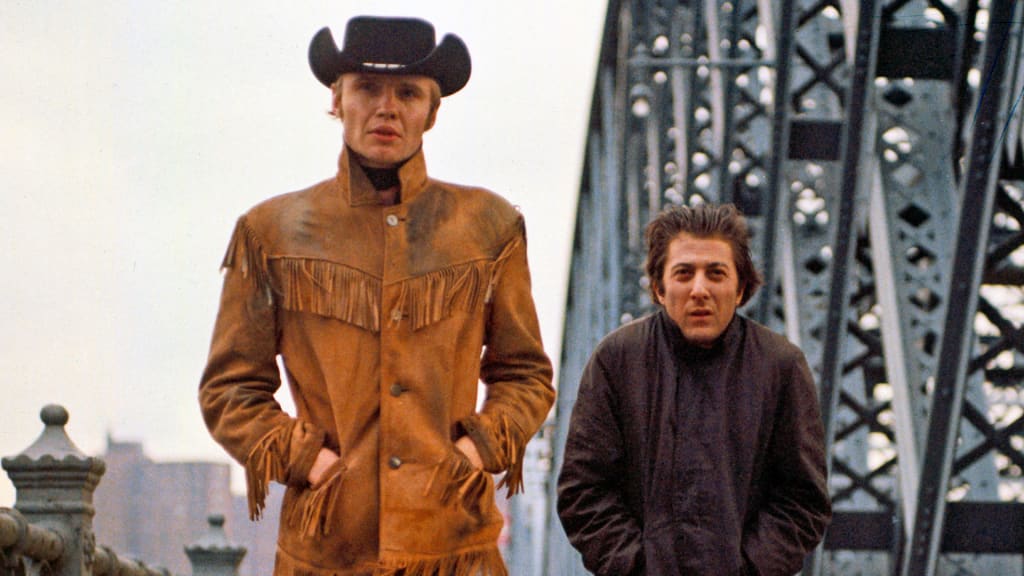
Jon Voight and Dustin Hoffman are an odd couple in the Big Apple in Midnight Cowboy

Director: John Schlesinger

Cast: Jon Voight (Joe Buck), Dustin Hoffman (Enrico “Ratso” Rizzo), Sylvia Miles (Cass), John McGiver (Mr O’Daniel), Brenda Vaccaro (Shirley), Barnard Hughes (Towny), Bob Balaban (Young Student), Ruth White (Sally Buck), Jennifer Salt (Annie)

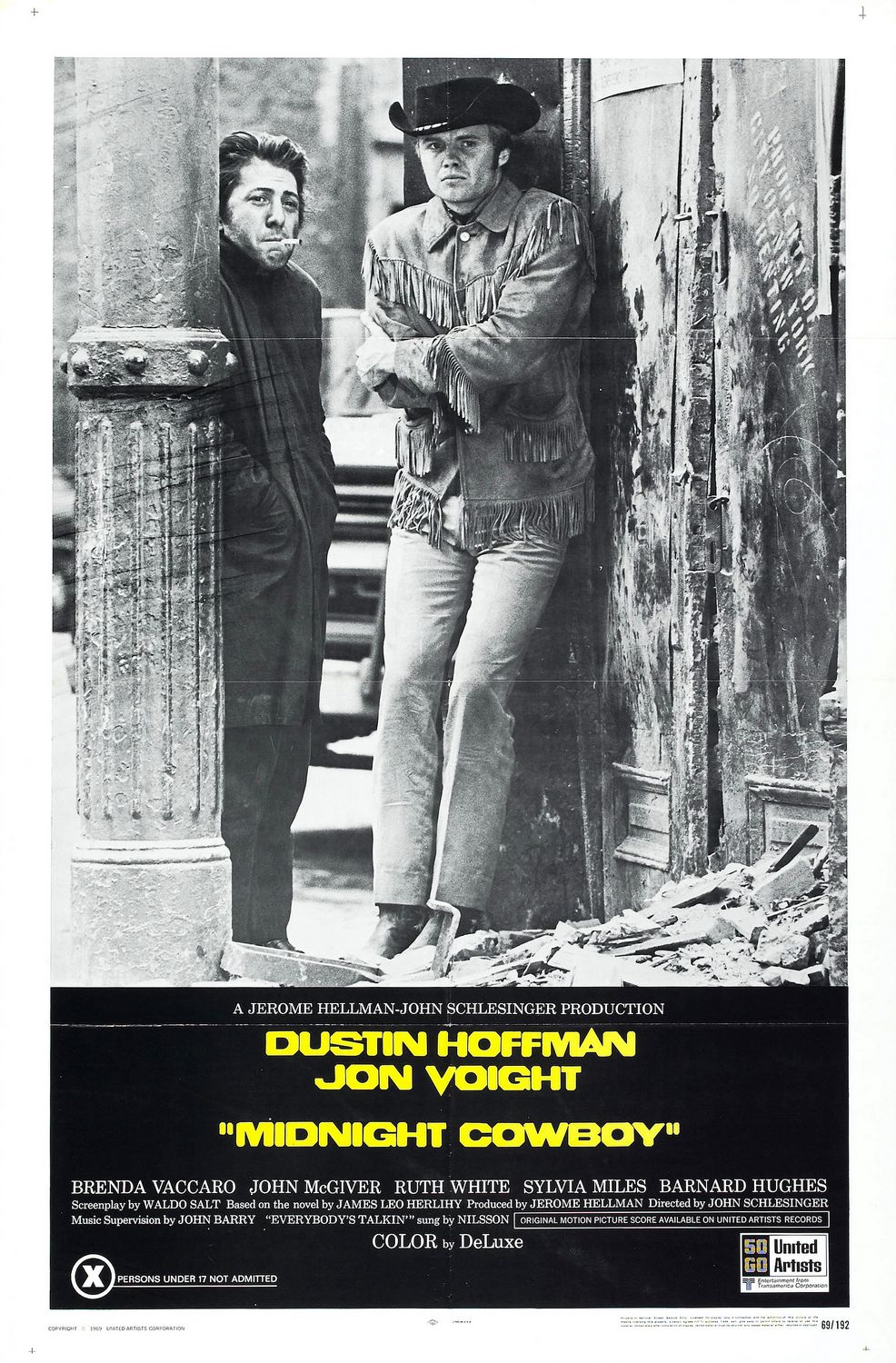
Even today it still feels like an odd Best Picture winner: two down-and-outs in the slums of New York, both trying to hustle, develop a strangely symbiotic relationship part brotherly, part semi-romance. It’s even more bizarre when you remember the year before the Academy had given the Big One to the super-safe family-friendly charms of Oliver! Still the only X-rated film to win Best Picture (though it looks hilariously tame for such a rating today), Midnight Cowboy is both the first step towards the fresh, modern film-making of the 70s and also a dated landmark of a particular era of film-making.

Joe Buck (Jon Voight) is the would-be Cowboy, escaping the hum-drum life of dishwashing in a run-down restaurant in Texas (not to mention a backstory darkly hinted at of a childhood of neglect and traumatic sexual encounters of the past) to make the trip to the Big Apple to find a new career – as a gigolo. After all he “ain’t a for-real cowboy. But [he is] one helluva stud”. Sadly making a career of sleeping with rich women for money ain’t half a lot harder to pull off than you might think. Not least when you are quite the naïve rube, certainly compared to more practised hustlers like “Ratso” Rizzo (Dustin Hoffman), a crippled, seriously ill born-and-bred New York who lives a hand-to-mouth on the streets desperate for each coin he can find. Both hustlers team up to try and make their wealth from Joe’s attractions – but life is tough for the desperate underclass of American society.

Released in 1969, the film stunned the States with Brit John Schlesinger’s insight into the dark underbelly of the American dream. Schlesinger, in a way few film makers before had, focused on the scuzzy poverty of the American loser, the two dreamers who fantasised about turning their lives around into the American ideal, but instead met failure and depression at every turn. This was a million miles from the “poor boy made good” vision of past films, or the sort of Capraesque spin of small-town guys winning out in the big city due to their inherent pluck and honesty. There’s none of that in Midnight Cowboy

Throw in Schlesinger’s style – the way his camera immerses you in New York with its “on the hoof” immediacy (Schlesinger couldn’t afford to get the streets closed, so simply shot the actors in medium or long-shot in real streets and locations, with real people) – and you got a vision of America you hadn’t seen before. The use of locations gives triumphant shots – Jon Voight emerging head and shoulders above the New Yorkers as he walks through bustling streets – and also moments that hum with authenticity. Most famously Hoffman’s “I’m walkin’ here” outburst when the actor was nearly mowed down by a taxi mid-shot while crossing a road. Midnight Cowboy takes you down in the gutter with these characters, and makes you feel part of their world. When we see the freezing poverty they live-in – in an abandoned apartment block – you practically shiver with them.

Throw in with this Schlesinger’s (and Waldo Salt’s fabulous script) careful and sensitive exploration of the bonds between the two men. Starting as strangers, both Ratso and Joe slowly find themselves drawn together in a symbiotic way that’s part soul mate, part unspokenly romantic. It’s implied throughout that the two characters feel a connection towards each other that they lack both the emotional and intellectual language to understand. But it’s there for the audience to pick up on, even if the sexuality of the two characters is something they seem barely able to understand (Joe’s sexuality is certainly far more fluid than he can even begin to grasp, while Ratso hurls around homosexual slurs so often you can tell he doth protest too much). These characters become inseparable, tending to each other (at one point an ill and soaking Ratso loosely embraces Joe, while Joe uses his shirt to dry his face and hair), sharing dreams and hopes for the future, forming a bond that goes way beyond questions of sexuality. For both of them it’s more than clear that an emotional bond like this is something alien to them both, a connection they have long feared in a cruel world.

Both actors excel in the two roles. Voight – in a career making performance – is understanding as a man who is naïve, easily fooled, caring but distant, who slowly begins to replace his wide-eyed innocence with a greater understanding of himself. Joe is a hopeless hustler – a failure as a seducer of women, and twice reduced to tragically mismanaged male prostitution, a stud who ends up paying his first customer to spare her feelings. The film carefully sketches in a backstory of emotional frigidity which adds context to a character who is charmingly selfish but learns to make a connection with another human being.

Hoffman was equally keen for the role, desperate for a part that would be the polar opposite of Benjamin from The Graduate. While Voight plays with a grounded naturalism and unaffected genuineness, Hoffman’s performance pushes the envelope of quirk. There is no end to the affectation of the role – scruffy, limping, sweaty, loud, twitchy – it’s a show-off of a role, with the moments of emotional vulnerability seized on with an actorly relish. But it still works because, despite it all, Hoffman communicates a genuine empathy and sorrow in the role, and because the performance bounces so well off Voight’s stiller, more balanced work.

The film works less well when it drifts away from this central pairing. The “marks” get short shrift, with the women in particular either hornily manipulative (Sylvia Miles, receiving a generous Oscar nod for five minutes work) or serenely wise (Brenda Vaccaro as a woman with more insight into Joe’s fluidity of sexuality than himself). Joe’s male marks are a tragically ashamed young student (Bob Balaban in an effecting debut) or full of messed up self-loathing (Barnard Hughes). 

Similarly, Schlesinger’s directorial flourishes may have looked like modern cinema verite at the time, but don’t half look like dated, heavy-handed touches today. Joe’s backstory – told in wordless sequences with different film stock – not only seem tiresome and alienating but also flimsy in the extreme in their psychological insight. Schlesinger’s satire on the Warholesque arty high-life of New York is heavy handed in the extreme, and its filming style outrageously clunky. The film’s psychological depth is thin and insight often blunted, while Schlesinger’s analysis of character often seems dependent on actors (some overindulged) rather than a true vision.

But despite that, Midnight Cowboy works because the characters are so rich and the insight into the life down-and-outs in New York still feels real. Voight and Hoffman (for all his indulgence) are excellent and the sexless romance between the two characters is intriguing and, by its conclusion, carries real emotional weight. While dated and lacking in as much insight as you might wish, it’s still a film that reflects on the damaging gap between dreams and reality, and the difficulty of casting the former aside.

Fat City (1972)

Stacy Keach and Jeff Bridges excel as boxers failing to live The Dream in Fat City

Director: John Huston

Cast: Stacy Keach (Billy Tully), Jeff Bridges (Ernie Munger), Susan Tyrell (Oma Lee Greer), Candy Clark (Faye), Nicholas Colasanto (Ruben), Art Aragon (Babe), Curtis Cokes (Earl)

The American Dream has an underbelly. For all those dreamers who find fame, fortune and glory in the Land of Free there are thousands who never made it. Thousands who stayed rooted at the bottom of the rung of the ladder and saw their dreams disappear and lives head into turnaround. Fat City – the good life, according to the slang of San Francisco, the crazy goal you’ll never achieve – is all about those left behind by their dreams.

Billy Tully (Stacy Keach) is a former boxer, now down on his luck and now possibly struggling with alcoholism. Ernie Munger (Jeff Bridges) is a young prospect who shows some promise in the ring. Both of them dream of getting into the limelight – but what hope do they have when it’s nearly impossible to turn your life around in smalltown America?

John Huston’s film is unflashily assembled, but carries a fundamental emotional power as it investigates with a simplicity and honesty the difficult dynamics of real life. It’s a film which has no pat answers, no simple solutions and doesn’t offer much in the way of hope. Which is not to say that it is a depressing vision of the world. Just a recognisable one. Because, sure, for most of us there isn’t any real chance of seeing our lives change. 

Huston’s film – brilliantly shot with a 1970’s muddy graininess mixed with flashes of revealing light by Conrad Hall – is wonderfully well observed and beautifully paced and keeps refreshingly loyal to its essentially downbeat vision of life. There is nothing forced in Huston’s well-paced touch and his embracing of the ordinariness of the drama and the lives of the characters. Because for both of them what we see in this film – and it ain’t much – is still clearly the high point of their life. Just getting into the ring and being beat (and only one fight in the film ends with one of our heroes winning – and even then he’s unaware of his win, he’s so punchdrunk) makes them something rather than nothing. These small moments are the best they can hope for.

Because both men have lives of nothingness in front of them. Keach’s Tully is a man whose best years are already behind them, but keeps up a touching air of hope and belief that maybe that could change, even while he drunkenly stumbles from one moment to the next. And maybe he did have something in the past – but he certainly doesn’t have something to come. Keach captures this superbly – like a reliable pro embracing what he feels might be the highlight of his career – investing Tully with a gentleness but also touch of fantasy, a man who can’t quite accept where his life is, but despite a lack of bitterness he’s still a man balancing fantasies. 

Jeff Bridges makes a perfect balance to this amiable failure of a man as Ernie, a young man who may well have more promise than Tully but lacks any sense of personal drive. He’s a friendly but empty shell. While Tully at least goes through spells of wanting success – even if he drifts and falls into alcoholic patches of non-achievement and becomes lost in recollections – Ernie has no desire. He’ll allow himself to be put forward but will do no work at all to push himself forward. He’s a young man with no hurry, a man who seems destined to never achieve anything because he has no desire to do so. It’s a great performance of amiable emptiness from Bridges.

But then you hope that Ernie won’t be heading to the alcoholism that consumes Tully and his romantic interest Orma. Played by an Oscar-nominated Susan Tyrell, Orma is the picture of a failed life, a semi-bloated, rambling alcoholic who oscillates between small insights and far more common drunken ramblings and bitter drunken whining but believes strongly in what she does. Huston’s film places her firmly as much of a drifter through life as Ernie in her way, taking up with Tully while her lover serves prison time – and moving easily and with little impact from one domestic set-up to another. Tyrell and Keach give outstandingly strong performances of drunkenness, never over-playing and totally convincing in their slurred speech, attempts to not appear as drunk as they are and emotional swings from calm to sudden and consuming fury.

But then what is there to look forward to in this life than the next drink? Certainly not the fights. For all the dreams of trainer Ruben (Nicolas Colosanto – very good) to find the next big thing, every fight we see is a tragic and painful affair mostly ending in defeat. Ruben drives carfuls of beaten, ring fodder from place to place, watches them get duffed up and then takes them home all the while dreaming of a title shot. It is dreams shared by Tully – even while we watch his slow, alcoholic fuelled body struggle to get through a few minutes of shadow boxing.

But then that’s the message of Fat City the anti-Rocky – and probably more realistic for it. Huston;s simple touch and pure vision help to make this one of his finest films, his unfussy and naturalistic camera encouraging truthful and powerful performances from his leads. And every small moment is full of it, including a marvellous wordless sequence that sees Tully’s Mexican opponent arrive in town (on a rundown bus), wordlessly check into a motel, piss blood and then head to the ring to be (only just) beaten – a moment of victory so fleeting and small it barely counts (and is only a hiatus on Tully’s return to shambling from bar to bar on the streets). The American Dream is a great thing – but for many people it’s just that: a dream.

Marriage Story (2019)

Scarlett Johansson and Adam Driver are an estranged couple in Marriage Story

Director: Noah Baumbach

Cast: Scarlett Johansson (Nicole Barber), Adam Driver (Charlie Barber), Laura Dern (Nora Fanshaw), Alan Alda (Bert Spitz), Ray Liotta (Jay Moratta), Azhy Robertson (Henry Barber), Julie Hagerty (Sanda), Merritt Wever (Cassie), Wallace Shawn (Frank), Martha Kelly (Nancy Katz)

It’s a scenario that more and more marriages in our modern world head towards – divorce. And it’s never easy to separate from something that has dominated your life for years, and the more that bonds two people together, the harder to pull them apart. As the film says, “it’s not as simple as not being in love any more” – and the complex emotional bonds that form between people, and the inability we have to switch these on and off like lights, are what drive Noah Baumbach’s film, heavily influenced by his own real-life divorce from Jennifer Jason Leigh.

Nicole Barber (Scarlett Johansson) is a former child-star who has built a career as a respected theatre actor in tandem with her husband Charlie Barber (Adam Driver), an acclaimed and visionary theatre director. Living in New York with their young son Henry (Azhy Robertson), their marriage is dissolving with Nicole frustrated at Charlie’s selfishness, just as Charlie is angered by what he sees as her refusal to take full responsibility for her career choices. As mediation fails, Nicole returns to LA for a role in a TV series, taking Henry with her. With divorce papers filed in LA, the couple engage in a cross-state legal battle for custody and finances, with their positions increasingly weaponised into hostile encounters by their respective legal teams. No one is coming out of this one unscathed.

Baumbach’s film is tender, sympathetic and offers a fine line of arch comedy and even farce (at points), that works over time to be as even-handed as it possibly can. The film’s sympathies are aimed not solely at husband or wife, but at the couple themselves wrapped up in the hostile, money-spinning world of divorce where, it’s strongly implied, the only real winners are the lawyers making thousands of dollars spinning out clashes as long (and as aggressively) as possible in order to cement their positions and keep their industry going.

The film is a solid denunciation of the entire industry that has grown up around divorce, where it’s seemingly impossible to find any arrangement alone without lawyers giving it a legal force, or to come out without that process consuming most of the wealth of the couple. Even worse in this case, the main battle-ground becomes the rights of each parent to access to their son, Henry’s college fund disappearing into a legal battle and the child becoming the centre of both fraught attentions and an unseemly competition for affection between both parents, effectively offering bribes for preferential responses from their son. All in order to prove that their link to him is the stronger.

The tragedy of all this – the way the system seems designed to turn personal relationships poisonous and bitter – becomes Baumbach’s focus. Brilliantly the film starts with a voiceover from both Nicole and Charlie in turn, over a montage, stressing the wide list of things they loved about their partner in the first place: part, it is revealed, of a mediation session that ends in disaster and Nicole’s walkout. But the closeness, the bond, the intimacy of these two people is revisited time and time again in the film. Legal dispute scenes and lawyer confrontations are followed by perfectly friendly home visits and regretful conversations. Legal meetings are bizarrely punctuated by coffee with conversation from the lawyers suddenly turning light and breezy. Then, as events hit a courtroom, moments like Charlie’s failure to properly install a car seat are spun out by lawyers as evidence of his risky disregard of his child’s safety while Nicole’s glass of wine after work becomes incipient alcoholism. 

For a film about divorce, it’s striking that it’s the process of divorce that turns the couple’s relationship increasingly toxic (culminating in a brutal scene where each throws increasingly personal and cruel abuse at each other for other five minutes). Sure there are resentments and anger at the front, but these are kept under reserve and still allow the couple to chat and negotiate amicably when they’re by themselves. As soon as the lawyers are involved, the mood steadily turns worse and worse. 

This is part of the film’s attempt to present the couple even-handedly. I’d say it only partially succeeds at this – with a 55/45 split in favour of Charlie, who is presented as the most “victimised” by the system, as the New York man having to prove he has a link to his now-LA-based-son. While Nicole does get a fantastic monologue (brilliantly performed by Johansson, full of regret, apology, anger and confusion) where she outlines Charlie’s selfishness, distance and probable (later confirmed) affair to her lawyer, the focus soon shifts to Charlie’s travails in the system. It’s him hit by a blizzard of demands from court and lawyer. It’s him who is separated from his son. It’s him who pays the biggest financial burden. It’s him who takes the biggest blows and has to bend his whole life to try and claim a residency in LA. It’s not a surprise Baumbach marginally favours his surrogate, but it does leave you wanting a few more scenes – especially in the latter half of the film – for the impact on Nicole.

However you keep on side with both halves of the couple thanks to the superb performances from Johansson and Driver. Johansson is both fragile and acidly combative, a woman who feels she has led someone else’s life for far too long. Driver is a bewildered gentle giant, but carrying a long streak of self-justifying self-obsession, clearly believing himself the only victim, but deeply hurt by the situation he finds himself in.

Supporting him are three very different lawyers. Laura Dern is on Oscar-winning form as Nicole’s brash, confident, ruthless defender with a smile so practised it’s hard to tell when it’s false or when it’s true. Alan Alda is endearing – but also gently out of his depth – as Charlie’s more conciliatory first lawyer (in one brilliant moment, Charlie interrupts a lengthy joke from Alda’s Bert during a sidebar with the frustrated put down “sorry Bert am I paying for this joke?”) while Ray Liotta channels De Niro roughness as his fiercely competitive second lawyer.

Marriage Story is a bittersweet, superbly made, moving but occasionally strangely funny story of a couple falling out of love and trying to find the way of converting that into a functioning co-parenting friendship. Throughout it’s not the couple, but the system making money from their dysfunction, that’s to blame in this marvellously written and superbly played drama.

Room at the Top (1959)

Room at the Top (1959)

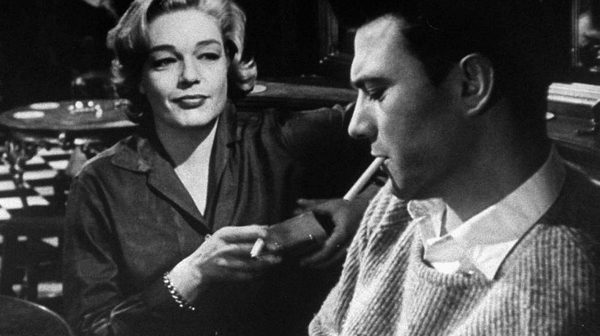
An ambitious man chooses between a damaging love affair and career in this fabulous kitchen-sink drama

Director: Jack Clayton

Cast: Laurence Harvey (Joe Lampton), Simone Signoret (Alice Aisgill), Heather Sears (Susan Brown), Donald Wolfit (Mr Brown), Donald Houston (Charlie Soames), Hermione Baddeley (Elspeth), Ambrosine Phillpotts (Mrs Brown), Allan Cuthbertson (George Aisgill), Raymond Huntley (Mr Hoylake), John Westbrook (Jack Wales), Richard Pasco (Teddy)

If there is one thing that preoccupied British cinema of the late 50s and early 60s it was class. How was a working class boy from the wrong end of the tracks supposed to pull himself up and make himself some room at the top? That’s certainly one of the many themes that you find in Jack Clayton’s sensational hit, nominated for a string of Oscars, but it’s also as much about how the search for that mystical nirvana that sees you invited for tea and crumpets at the conservative club, also means sacrificing huge shards of your own soul.

Joe Lampton (Laurence Harvey) arrives in the a Yorkshire town to take on a dreary, poorly-paid post in the Treasurer department of the local council – but has the bonus of being office work that gives him a chance at working his way up to the top. To that end he sets his ambitious cap at Susan Brown (Heather Sears), daughter of major local business magnate Mr Brown (Donald Wolfit). But Joe is also a man of his own passions, which fly in the face of his ambition, and he finds himself drawn towards married older French woman Alice Aisgill (Simone Signoret), who he meets at the local amateur drama club and who encourages him to surrender his ambitions and instead lead a life of contentment and happiness with her. Which possible life will Joe choose?

Perhaps the very first of what became the kitchen-sink genre, Room at the Top is beautifully filmed by Jack Clayton (as you would expect), but also brings the other major strength of this overlooked director to the fore, his ability with actors and to wring all-encompassing tragedy from the most everyday of circumstances. That’s what he does here, creating an almost epic scale of internal struggle for its hero, prickly as he is, drawn between two deeply conflicting goals, that asks what profits a man who gains the world at the cost of his soul?

Because, Room at the Top is that uniquely British film, that shows ambition and desire to better yourself often comes hand-in-hand with the sort of ruthless disregard of your roots, backgrounds and those around you in order to find your own path. Joe Lampton is a former POW, chippy, insecure, bitter, angry and determined to gain the sort of life he deserves. Of course it’s not hard to agree that he is more deserving than some of the tweedy, chinless fools around him and the sneers and condescension he receives from the officer class (his rival for Susan’s affections delights in calling him Sergeant, and reminding him constantly of his superior war record) is more than enough to motivate Joe.

What’s really striking about Joe therefore as how weak the character is. In undoubtedly the finest performance of his career, Laurence Harvey (a difficult and unreadable actor, with a style bridged between minimalism and woodenness) bravely shows both the bullish determination and the fundamental insecurity and weakness of Joe. A character who defines himself solely around what he feels he can achieve, he’s also a man completely unaware of what happiness is and how he to get it – and the thawing of her personality into something warmer and more loving with Alice, only serves to highlight how misguided and weakly he suppresses and kills such feelings in order to seize opportunities in life he feels entitled to.

It’s a rich contrast to Alice herself, a woman who is far braver and more certain about what she wants, and willing to fly against the conventions expected of her if it means she can gain happiness. The novel was adapted to turn Alice into a French ex-pat (married to a brutally cold RAF type played with an imperious selfishness by Allan Cuthbertson) solely so Signoret could be cast in the role – and it’s a match made in heaven. Simply wonderful, Signoret brings the part not only an imperious sexuality, but also a deep and lasting vulnerability under the surface of Euro-chill, a woman who we see opening herself up to the possibility of an affair becoming something truly lasting and deep, who has the courage to understand who and what she wants in a way Joe never can. 

The tragedy is in that inability of Joe to understand his yearnings. Clayton’s brilliantly subtle film demonstrates time and time again, contrasting its romantic freedom laced with passion when Joe and Alice are together with the stilfed, contained suppression and chill that the more buttoned up, angered Joe meets elsewhere. If Joe had the will and strength he would top fighting for the things he should want in order to seize the opportunities he actually wants. His tragedy is that he can’t – and can’t begin to understand himself, or acknowledge his desires, until it is too late.

This was all a deep shock – and carried real power – at the time when Britain was shifting out of post-war hierarchies into the freer 60s, and Room at the Top was a massive hit at the box office. But it made such impact because its attitudes feel so deep and real, and the simple, everyday tragedy it details of two relationships doomed for different reasons, bound together by the self-defeating ambition of its lead character. Because wherever he goes, Joe will have people like Mr Brown (Donald Wolfit is very good by the way, in a role far outside his usual style) constantly reminding him of his oik status, so any victory in inbuilt with failure. Joe’s ambition and intelligence serve largely to blind and deflect him from the things he really wants. A lesson for us all.

Missing (1982)

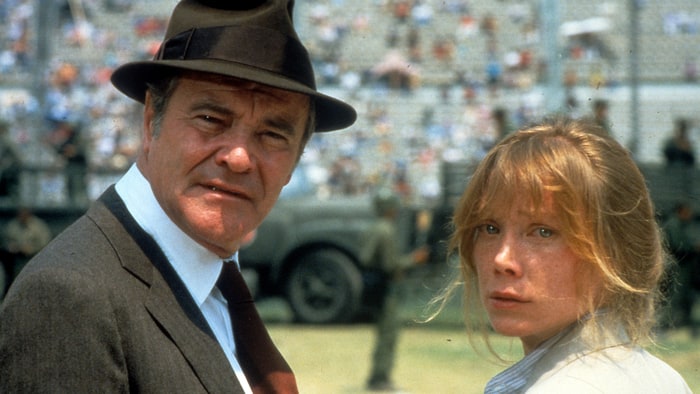
Jack Lemmon and Sissy Spacek are on a quest for the Missing

Director: Costa-Gravas

Cast: Jack Lemmon (Edmund Horman), Sissy Spacey (Beth Horman), John Shea (Charles Horman), Melanie Mayron (Terry Simon), Charles Cioffi (Captain Ray Tower), David Clennon (Consul Phil Putnam), Richard Venture (US Ambassador), Jerry Hardin (Colonel Sean Patrick), Janice Rule (Kate Newman), Richard Bradford (Andrew Babcock)

Politically motivated American films are few and far between, especially ones that take such a starkly critical view of American foreign policy. So it’s a testament to the respect given to Greek director Costa-Gravas that his first American film is an angry denunciation of America’s attitude towards Latin and South America and a criticism of the cosy assumption of so many of its citizens that the very fact of their being American will open all doors and make them invulnerable to harm. 

Set in the immediate aftermath of Pinochet’s military coup in Chile in 1973 (although for various legal reasons Chile itself is never named), young American journalist and filmmaker Charles Horman (John Shea) goes missing. His wife Beth (Sissy Spacek) is left alone in the increasingly dangerous city, while his father Ed Horman (Jack Lemmon) flies into the country. Ed assumes his government will swiftly work with him to solve the mystery, and that his son must have been wrapped up in some dodgy dealings to have gone missing. He is to be brutally disabused of both notions with a painful swiftness, as he finds he and his son are insignificant factors in America’s geopolitical interests.

Costa-Gravas’ film wisely avoids focusing too much on the details of Chilean politics, or the causes of the coup, or even really concentrating on the left-wing politics of many of the American citizens wrapped up in the coup. Instead it zeroes in on the human impact of loss and pain, and by focusing less on the politics of a coup but on the impact of it, it places the audience attention instead on the atrocities that military revolutions bring. Alongside this, Costa-Gravas places front-and-centre of the story not a firebrand liberal, or a left-wing polemicist, but a character who could not be more of a strait-laced conservative, a quintessential American who firmly believes his country is the greatest in the world and heads into a foreign land anticipating doors will be opened for him and his government is here to help. 

It’s vital for the film’s success that it’s the experience of Ed Horman that drives the film narrative. First appearing 25 minutes into the film, the rest of the narrative charts Ed’s growing shocked realisation that his government doesn’t give a damn about his son and, even worse, is more than happy to lie to his face about the level of their involvement. While Ed believes America to be the font of all goodness in the world, he is horrified to discover that it is at the centre of a far more shady world of realpolitik. And that his own complacent belief in the country, and unquestioning assumption that it can do no wrong, is part of what empowers its representatives to back murderous regimes. “If you hadn’t been personally involved in this unfortunate incident, you’d be sitting at home complacent and more or less oblivious to all of this” the Ambassador haughtily tells Ed, after the frantic father has angrily denounced America’s policies. And, from what we saw of Ed at the start, he’s right.

It’s a superb role of growing disillusionment and a stunned realisation that his own home-grown principles and believe in truth, justice and the American Way turn out to be just words. And Jack Lemmon is just about the perfect actor for it. This might be Lemmon’s finest performance, superb from start to finish, a perfect emobodiment of All-American principles that disintegrates into someone angry, bitter and disillusioned. But at its heart as well – and the films – is the very real grief of a father who has lost his son. Worse, a father who only feels he grows close to – and understanding of – his son after losing him. Lemmon’s performances mines every ounce of empathetic sympathy from the role, in a series of heartbreaking moments as Ed begins to realise just how much he has lost in a son he begins to feel he never gave a chance.

This very personal story is at the centre of the film, but Costa-Gravas never for one moment allows us to forget – or avert our eyes – from the horrors coups like this bring. By not naming Chile, it manages to make this the face of all brutal revolutions. As characters move through the streets, or squares, in controlled, carefully framed long-shots and takes we see all around, uncommented on by the camera, unfocused on by the director, the signs of brutality. Throughout the film the background action sees casual arrests, violence, assaults, book burnings, bodies being left in the street or thrown into trucks… All around ordinary people keep their heads down or run for terror. Curfews leave people trapped outside – Sissy Spacek (very impressive) as Beth is caught out and is forced to spend a night hiding in the porch of a hotel, while gun shots ring out around the city (a regular soundtrack for every scene).

The investigation into Charles’ disappearance is pushed forward not the embassy – which presents a series of acceptable faces of the new regime and a smiling reassurance that every thing is being done – but by harried and scared survivors and asylum seekers in European embassies, who tell snippets of the events they have seen, the deaths they have seen glimpses off, the horrors of detention centres. It’s finally dragged home to Ed and Beth as they are taken to an office block with every room containing executed corpses, some identified some not, the bodies piled on every floor of the building. 

In all this America – and shady military and industrial interests – are complicit, and the executions and deaths of citizens of this country (and a few Americans who unwisely mixed themselves up in it) are seen as acceptable collateral damage, the price of doing business to protect American financial interests. The Government is happy bed fellows with murderers and crooked officials, and the idea that the death of one American citizen is going to matter at all is nonsense. Costa-Gravas’ film has a firm point to make – but it makes it within the context of a very human and personal story. “They can’t hurt us, we’re Americans!” are Charlie’s final (on-screen) words: in this attitude he’s as naïve as his father, and he clearly believes just as much in the divine goodness and special status of his homeland. America has no special or outstanding moral character: it’s as mired in dirty world realities as anyone else. This rude awakening will cost the son his life and cause untold grief to his father as well as shattering all his cosy greatest generation idealism.

Scum (1979)

Ray Winstone finds prison life a tough proposition in Scum

Director: Alan Clarke

Cast: Ray Winstone (Carlin), Mick Ford (Archer), Julian Firth (Davis), John Blundell (Banks), Phil Daniels (Richards), Alan Igborn (Meakin), Alrick Riley (Angel), Patrick Murray (Dougan), Peter Howell (Governor), John Judd (Mr Sands), Philip Jackson (Mr Greaves), John Grillo (Mr Goodyear), Bill Dean (Mr Duke)

In 1977 Alan Clarke’s searing condemnation of the borstal system in the UK, Scum, was shot as a BBC Play for Today. Outraged at its content, pressure in the press led to the film being banned. But that didn’t change what an electric bit of work it was – and when talk turned to creating a film version, having a filmed version of the script already in existence that could be used as a pitch tool was invaluable. So was born the film version of Scum, with much of the same cast, a higher budget (although still tiny by comparison to other films) and a chance for Clarke to bring his uncompromisingly harsh vision to the big screen.

Three young boys arrive at a borstal: Davis (Julian Firth) is a sensitive youngster who ran away from his previous borstal, Angel (Alrick Riley) a black kid who suffers the systemic racism at every level of the system and Carlin (Ray Winstone) a hard man with a dangerous reputation, who punched a warden at his last borstal. On arrival, the three are identified as requiring being “broken” by staff: Davis is bullied, Angel abused and Carlin is placed at the mercy of the wing’s “Daddy” Banks (John Blundell), suffering beatings with the authorities turning a blind eye. The entire system is rotten to the core and, while Carlin eventually rises up to take over the position of “Daddy”, it changes little in a young offender’s prison rife with racism, sadism, violence, abuse and rape. 

Scum is almost unbelievably grim and pessimistic for this system of incarceration, finding nothing to redeem or excuse the system across its entire running time. The borstal is a wintery hell on Earth, with justice and sympathy nowhere to be seen. While the system claims to be helping its inmates (aged from early teens to early twenties) to find new skills and purpose in life, its real function seems to be trying to beat discipline and subservience into its inmates by all means necessary. While the Governor (a silkly patrician Peter Howell) may talk faith, duty and country he oversees a system where the wardens ruthlessly beat the inmates, encourage them to ‘discipline’ each other, turn a blind eye to violence and abuse, encourage an atmosphere of racial loathing and generally show no concern or interest in any boy’s problem that can’t be solved without punching them in the mouth.

It’s a world Carlin is dropped into, and he knows it well. Played by Ray Winstone with a chippy anger that never seems that far from bursting to the surface, Carlin might want at first to keep his head down but quickly accepts the only way to survive in this dog-eat-dog world is to be the top dog. There will certainly be no justice from the wardens, who beat him on arrival as a trouble-maker, and set the Wing’s alphas on him to break his spirit. Casually beaten in the middle of the night, it’s the bruised Carlin who is sent to solitary confinement for fighting while his attackers go free. He is joined by Davis, framed for theft and Angel, for whom being black seems to be crime enough (walloped by a warden, and spilling food across his room, he is sent down for keeping his cell untidy).

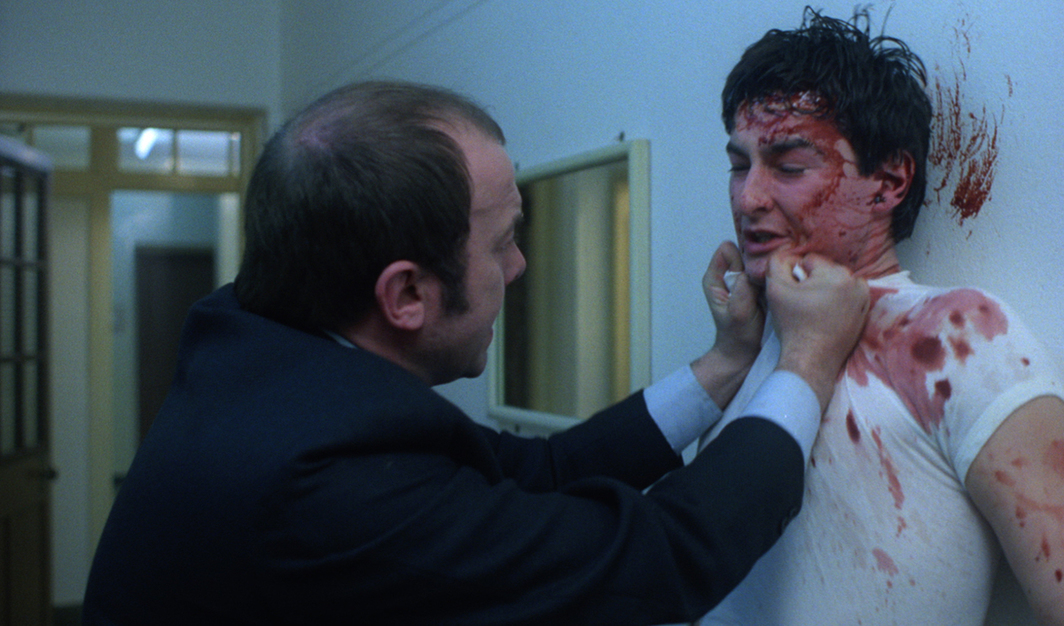
What’s striking in this film though is that, as much as we are meant to think Carlin might be the hero, Clarke is smarter than that. He carefully watches Carlin – a tight-control on Winstone’s face that promises retributive violence is on the way – for almost forty minutes adjust in this system, before he takes matters into his hand. The film’s most famous sequence – shot in one dizzying tracking shot that captures the immediacy of Carlin’s putsch – sees Carlin beat Bank’s weasily sidekick Richards (Phil Daniels) with two snooker balls in a sock, before heading up to his dormitory toilet to beat Banks black-and-blue (and bloody), the cut finally coming to show us Carlin (from Banks POV) screaming at him “I’m the Daddy now”. It’s a masterclass of a sequence, electric in its execution and gives a moment of pleasing oomph (for all its extreme violence) as it shows Carlin finally getting a bit of justice.

Only Carlin’s institution as the Daddy brings largely only a change of figurehead rather than real change. Sure Carlin isn’t quite the bully Banks is, but he’s an unashamed racist, a violent thug, who ruthlessly takes over the money smuggling operation Banks was running (but taking a higher cut) and takes control of another wing by beating its “Daddy” (another black inmate) with an iron bar. Carlin is also quickly adopted by the wardens, just as Banks was, agreeing to maintain peace and control in the borstal in exchange for certain privileges like his own room. Carlin may at first seem to us the angel of retribution – but he’s really a ruthless survivor who is perfectly happy with the status quo so long as he on the top of it.

But then no one has any interest in improving things. The governor is only interested in the appearance of gentility. The wardens couldn’t care less about the rehabilitation of the inmates so long as they have a quiet life. The inmates drift through their life there, never questioning the violence around them. The matron is well-being, but hopelessly rules-bound, whose concern for the boy’s welfare never develops into seeing them as human beings. It’s a systemic failure.

There are other perspectives of course. Possibly the most fascinating character is Mick Ford (replacing David Threlfall in the original production) as Archer, a precociously intelligent inmate in his early twenties, possibly the only one who has read the rulebooks and enjoys running intellectual rings around the wardens. Causing trouble in his “own little way”, he claims to be a vegetarian (requiring a complex set of arrangements to be put in place to feed him separately) and also unable to wear leather boots (requiring his own special plastic boots to be located) and provokes the bible-bashing Governor with thoughts of converting to Islam and Sikhism. 

But he’s also a smart cookie, who recognises (in a fascinating conversation with veteran warder Dukes) that the entire system is a trap, both for the inmates and the wardens, imprisoning them in a system where criminal acts are endemic, the wardens are trapped and brutalised by the system as much as the prisoners and the whole system manifestly fails to do anything other than inoculate Darwinian violence into its inmates (Archer is of course promptly put on report for this cutting analysis). The scene – a key part of the film’s argument – is also a tribute to the skilful writing of Roy Minton, whose script bubbles with both quotable and sadly realistic dialogue.

Clarke’s entire film is the exploration of this violence and the mixture of hypocrisy and denial down to outward condonation and support it receives from the Governor down to the wardens. Any proper review of the conditions in the Borstal is impossible, as it would rock the boat and fly in the face of the positive message the Governor wishes to promote about his institution. Effort is put into putting the boys at loggerheads with each other (usually on racial grounds) as a divide and rule. The weak are happily left at the bottom of the rung, not least the tragic Davis, a sensitive boy (marvellously played by Julian Firth with a heartbreaking vulnerability) totally failed by everyone around him.

Clarke’s final act spins out of a disturbingly intense rape scene of a young inmate (an act witnessed with a sneer by sinister warden Sands, a repulsive John Judd) – the scene a mix of careful filming to show nothing too graphic, and heart-rendering intensity in its vulnerability and violence. The victim is totally ignored, leading to tragic consequences – another difficult to watch scene which hammers home both the cruel indifference of the warders and the helplessness of the victim. The eventual riot this is all leading too is, however, painfully futile: scapegoats are selected at random and beaten senseless, the status quo is reinforced by a bland platitude speech from the Governor. 

Directed with fire and passion by Alan Clarke, a virtuoso of realism and master of social conscious, Scumis a masterpiece of anger, of boiling resentment against systems that do not work and do not care that they do not work. Packed with astonishing performances and some sublime camera work and film-making skill, it’s a must-see.

On the Basis of Sex (2018)

Felicity Jones does earnest, dedicated work in an earnest, dedicated film: On the Basis of Sex

Director: Mimi Leder

Cast: Felicity Jones (Ruth Bader Ginsburg), Armie Hammer (Martin Ginsburg), Justin Theroux (Mel Wulf), Kathy Bates (Dorothy Kenyon), Sam Waterston (Erin Griswold), Cailee Spaeny (Jane C Gisnburg), Jack Raynor (James H Bozath), Stephen Root (Professor Brown)

Ruth Bader Ginsburg is an extraordinary person, her pioneering work to bring about sexual equality in the USA something that has made an actual, permanent change to her country for the better. This biopic covers the early years of this campaign in the 1970s, and if it at times gets a little too bogged down in the conventions of these sort of biopics, it does tackle them with genuine passion.

At Harvard in the mid-1950s, Ruth Bader Ginsburg (Felicity Jones) is one of the first women allowed in to study law – and finds that she faces a battle to constantly prove that she deserves to be there. Her husband Martin Ginsburg (Armie Hammer), himself an accomplished lawyer, is endlessly supportive and encouraging, but Ruth continues to find that she struggles to be treated as an equal in the male dominated legal world of the 1950s and 60s. All this changes when her husband brings to her attention a tax case that discriminates against a male carer – and she realises this could be a vehicle to establish a precedent that American laws are unconstitutional when they discriminate on the basis of sex.

Mimi Leder directs a film full of warmth, respect and feeling for the importance of the story it is trying to tell. While it at times seems a tiny bit overwhelmed by the responsibility of bringing such a pioneering person’s story to the screen, it still manages to bring enough character and flair to it to make it an engaging watch. Perhaps you might feel at times you are only beginning to scratch the surface of RBG’s extraordinary life – but the film still treats you with the respect to assume that you can follow the legal arguments being outlined, even as it structures much of the film with clichés.

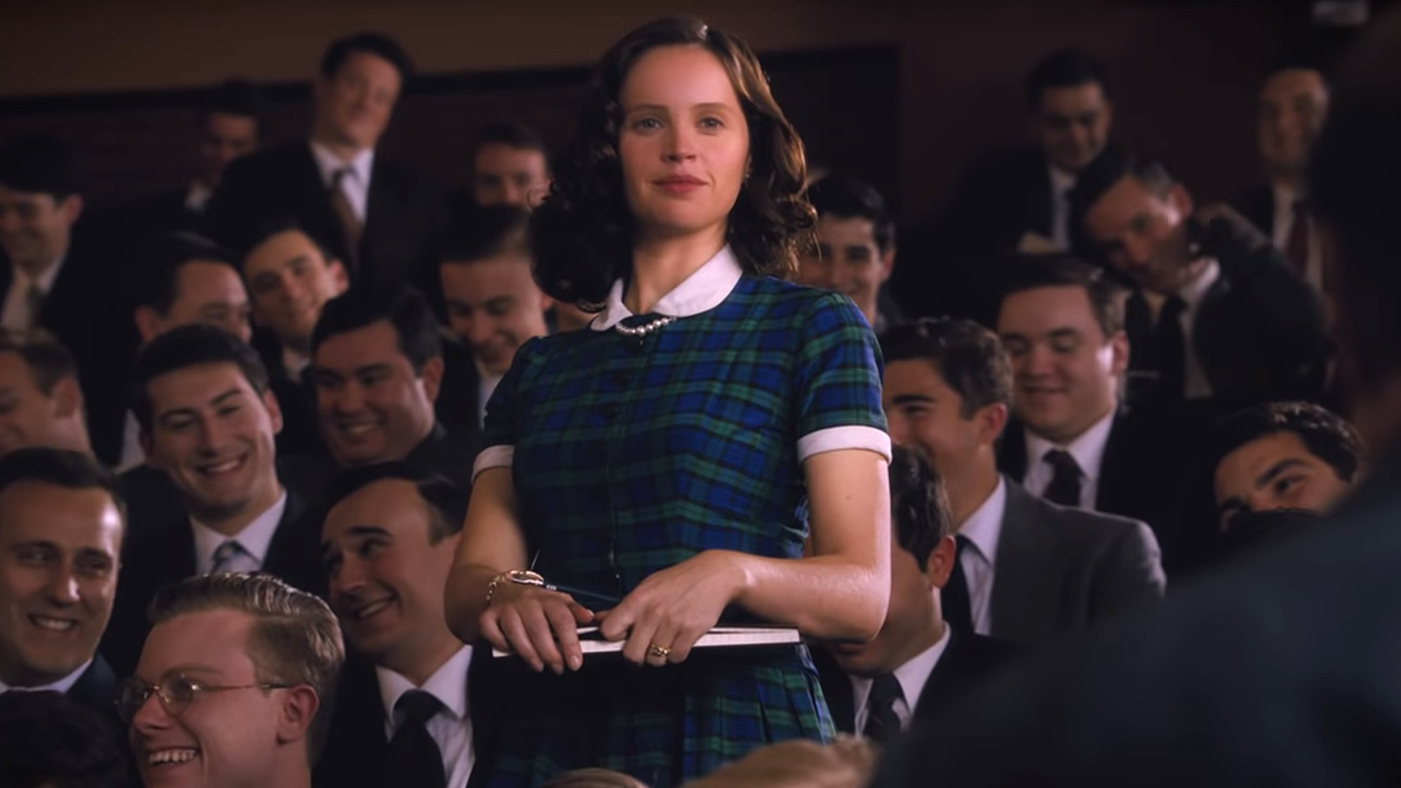
It does have some fine sequences in it though, not least a running visual image of Ruth walking up steps towards important buildings. The opening sees her lost in a crush of young male Harvard students, struggling to find her own space in a male dominated world. Later she climbs the steps outside the Court of Appeals, this time at the head of a progress of men following her behind. And finally the film bookends its opening Harvard steps sequence with Ruth – this time alone – climbing the steps of the supreme court: shots and cuts echo the opening of the film as Felicity Jones is slowly replaced by the real Ruth Bader Ginsburg.

Felicity Jones does a decent job as Ginsburg, although she struggles with a slightly awkward make-up job to age her up. She however captures the fire in Ginsburg’s belly and her passion to right wrongs, as well as the demanding intellectual ability that at times made her a domineering and difficult person. She doesn’t always find much wit in the role, but she really wins the empathy of the audience with the injustice she faces – not least from the very start having to justify why she has taken a place at Harvard from a man in the first place.

It helps as well that she has such a fine scene partner for so much of the film in Armie Hammer, who is excellent as her supportive, way-ahead-of-his-time husband Martin. Taking on most of the domestic chores – and combined with his own brilliant career – Martin was as much a fascinating figure as Ruth. Hammer plays with a joyful, charismatic relish, perfectly mixing intellectual curiosity with an innate decency. It’s also a generous performance that complements Jones perfectly.

The relationship between these two is the emotional heart of the film, frequently raising warm smiles from the audience. An early scene where Martin is diagnosed with cancer after collapsing during a game of charades tugs at the heartstrings, not least for the sudden pained look of panic that crosses Martin’s face as he collapses, and Ruth’s protective rush to his side. These two argue once in the film – and that an argument based around Martin encouraging Ruth to live the life she wants – and the film goes out of its way to show that their life together was an equal partnership, where both were determined to support and protect the other.

It’s a lovely relationship to place at the film’s centre – even if Hammer is essentially playing the supportive wife role that so many biopics of men have featured (Felicity Jones in The Theory of Everything for starters springs to mind!). That points at one of the weaknesses of the film: its predictability. Structurally it follows the route of many of these sort of biopics, with initial struggle, a cause, set-backs, pep-talks, sudden nerves before the eventual demonstration of triumph. Frankly nothing in the film narratively is remotely surprising, and Leder, despite a few touches of flair, largely directs with a workmanlike assurance.

Workmanlike is a little harsh, but is probably the film’s main weakness. While it’s well-played and has an excellent story – and, I will say it again, a script that largely expects its viewers to follow the legal points – it also can’t quite figure out a way to tell the story that doesn’t squeeze it into the biopic clichés that you’ve seen dozens of times before. Is that necessarily a bad thing? Not exactly: but it also makes the film at heart an engaging middle-brow drama, which seems a shame when Ruth Bader Ginsburg is anything but.

Made in Dagenham (2010)

Up the Women! British comedy wallows in nostalgia but tells a still relevant tale of sexual equality

Director: Nigel Cole

Cast: Sally Hawkins (Rita O’Grady), Bob Hoskins (Albert), Miranda Richardson (Barbara Castle), Geraldine James (Connie), Rosamund Pike (Lisa Hopkins), Andrea Riseborough (Brenda), Jamie Winstone (Sandra), Daniel Mays (Eddie O’Grady), Richard Schiff (Robert Tooley), Rupert Graves (Peter Hopkins), Kenneth Cranham (Monty Taylor), Nicola Duffett (Eileen), Lorraine Stanley (Monica), Roger Lloyd-Pack (George), Andrew Lincoln (Mr Clarke)

You’d like to think a film made ten years ago about a strike for equal pay in the 1960s would be more of a history piece than something that still carries real relevance today. But this is still a world where women are often paid less than a man, and where their work is often devalued or held as less “important” than their male counterparts. Made in Dagenham looks at all these issues with a rose-tinted, feel-good stance that aims to entertain first and make you think second. Nothing wrong with that, but it means the film is largely just a crowd-pleaser, when you feel it could be more.

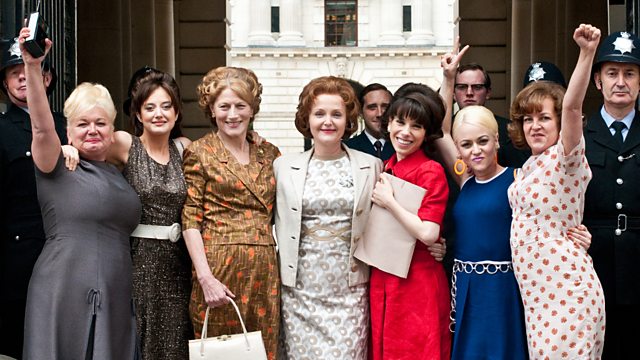
At the Ford factory in Dagenham, the female sewing machinists are not paid as skilled workers, and are forced to accept less work. Frustrated at the patronising attitude from their all-male union reps, and encouraged by foreman Albert (Bob Hoskins, lovely in one of his cuddliest performances), the women decide to go on strike for equal play, led by Rita O’Grady (Sally Hawkins). As public attention builds, the Ford owners in America mobilise for a battle and the strike attracts the interest of Secretary for Employment Barbara Castle (Miranda Richardson), someone who knows the struggles a woman faces in a man’s world.

It’s no great surprise based on the fluffy, charming tone of this film that Nigel Cole’s previous credit was Calendar Girls. (Also no surprise that, like that film, this has been turned into a crowd-pleasing stage musical.) William Ivory’s script deftly sketches out some familiar movie-dynamics for its characters, establishes clear heroes and villains, gives us a good sprinkling of information and “things to think about”, mixes in at least one tragic sub-plot and provides a steady stream of high points, heart-string tugging moments and punch the air moments. As a piece of writing playing to the masses, it’s pretty flawless.

It’s in love with the 1960s details, with nostalgia dialled up to 11, with a love of the look, feel and styles of the era and plenty of sound cues mixed in that will have you tapping your toes. It’s all designed for you to have fun, and if that means some of the deeper questions get a bit lost at points, that doesn’t really matter. 

And there is more than enough enjoyable material to be seen in setting up a series of bigoted or patronising men (gamely played principally by Kenneth Cranham and Rupert Graves) and seeing them knocked down. You could argue that a slightly braver film would touch at the implications of what Richard Schiff’s corporate big-hitter says about equal pay: make it more expensive to make cars here and we will make our cars somewhere else. (In fact it was pretty hard to forget that, watching the film today, as Brexit has already caused at least three major car factory closures in the UK. In fact the film is very happy to talk all about equal pay for women in the Western World but never even raises the question of how we are quite content to have people in the third world slave away in conditions far worse than this for a few pennies an hour.) But that’s not the film’s point, and instead it’s all about those male-female relationships. 

Sally Hawkins does a good job as a woman slowly growing a social and political awareness and then turning that new-found enlightenment on her own domestic life with well-meaning but of-his-time husband Eddie (a sweet but cluelessly sexist Daniel Mays). It’s all conventional stuff, but Hawkins and Mays play it very well.

The real meat actually comes from plotlines elsewhere. Rosamund Pike is excellent as a woman with a first in history from Oxford, reduced to wheeling out nibbles for her patronising husband and keeping her ideas to herself. Geraldine James and Roger Lloyd-Pack get the tragic plotline of a couple struggling with his post-war undiagnosed PTSD, which gets most of the heart-string tugging. 

Eventually all is made well by Miranda Richardson’s Barbara Castle, floating into the picture to wave a magic wand and save the women’s bacon. Richardson thoroughly enjoys herself in a rather cardboard role, at least two scenes of which are solid exposition, in which Castle’s lecturing of two uppity civil servants is used to introduce the political context. By the end you won’t be surprised that good triumphs. But it’s a film which largely only looks to put a smile on your face, and doesn’t really look at the wider implications or injustices of unequal pay. To the film’s credit it has a final montage of the real Ford women talking about their lives and the battles they had to be respected, which gives it a bit of extra depth. A truly brave film would have found a few minutes – and that’s all it really needs – to look at the wider issues (then and today) economically and socially, and to make us think a little. As it is this just entertains, which is what you want, but it could be more.

The Wife (2018)

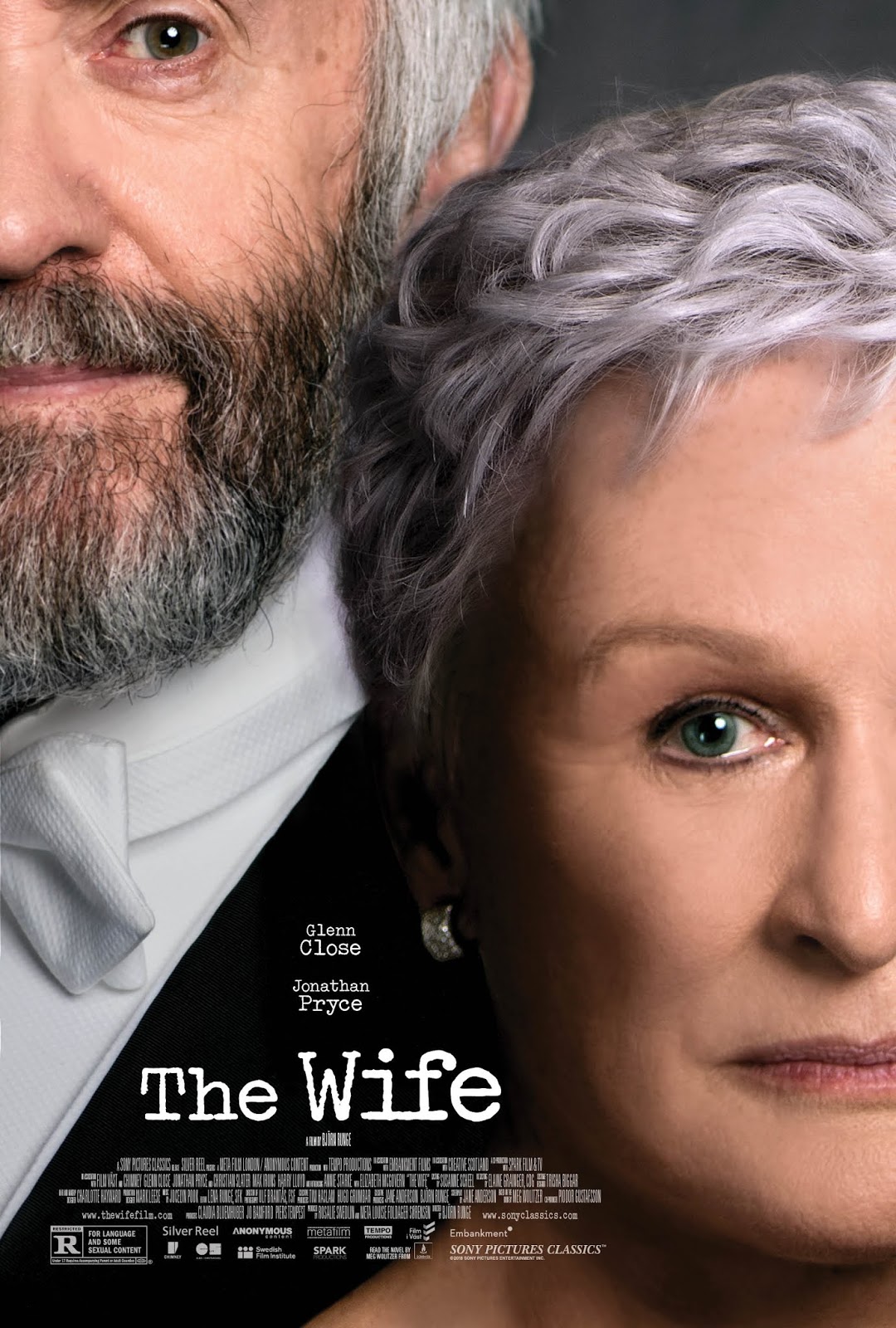
Glenn Close is the supportive but perhaps secretly resentful Wife of novelist Jonathan Pryce

Director: Björn Runge

Cast: Glenn Close (Joan Castleman), Jonathan Pryce (Joseph Castleman), Christian Slater (Nathaniel Bone), Max Irons (David Castleman), Annie Starke (Young Joan Castleman), Harry Lloyd (Young Joseph Castleman), Elizabeth McGovern (Elaine Mozell)

The old cliché used to be: behind every successful man, there’s a woman. The Wife explores just such a woman – and uses this story for a brilliantly structured, tightly written exploration of the tensions and sacrifices that underpin a partnership (and relationship) where the man is the sole public figure. In 1992, Joe Castleman (Jonathan Pryce) is a hugely successful novelist, being honoured with the Nobel Prize for Literature. Standing beside him at all times is his wife Joan (Glenn Close), silent, supportive, taking care of all her husband’s needs. But as her husband is surrounded by praise and flattery, has her patience finally begun to snap?

Much of the attention for The Wife has focused on Glenn Close’s performance as Joan. And while her performance is superb, there is much more to this film than that. This is a well written, brilliantly acted, carefully shot relationship drama that manages to explore interesting details about how sexism, gender expectations and the patriarchy turn some brilliant, intelligent and gifted women into ciphers who must hide their skills under a bushel. The Wife is an engrossing, small scale drama that leaves you with a lot to think about.

Runge’s camera is slow and subtle, carefully zooming into parts of the scene that don’t seem at first to be central, but are revealed to be so. Many of these moments centre around Joan, a woman quietly at the edge of scenes, ignored by people, responding only when required. She calmly follows her husband’s lead, while quietly tending his needs (reminding him of appointments, making sure he takes his medicine, apologising for his abruptness). 

This sort of framing requires a lot of quiet, “reaction” acting from Close – and she excels at this. Close’s performance is a masterclass in subtlety, her face a mask of micro-reactions that leave the viewer guessing at all times exactly what she is feeling about all of the events she witnesses. No scene covers this better than when she listens in on the line as her husband is informed of his Nobel prize – her face slowly, carefully, unreadably changes from delight and pride to something far more equivocal, her face frozen in a look of – well is it anger, horror, frustration? It’s impossible to tell. After that, the entire film is a study in interpreting the exact feelings this woman has for the behaviour of, and praise for, her husband. What does she feel about this? What does she really think? How far does loyalty to her husband stretch?

Muck-raking, sensationalist would-be Castleman biographer Nathaniel Bone (a wonderfully sleazy Christian Slater) has a good idea that there is a lot of anger there – and gambles in a series of offers and interjections that Joan’s loyalty only stretches so far. How far is she responsible for the literary success of her husband? Flashbacks carefully woven into the film show in the early sixties the young Joan (played very well by Close’s real life daughter Annie Starke) as a promising literary writer who falls under the influence of her charismatic professor, young Joe (Harry Lloyd a slightly awkward fit as the arrogant bohemian writer). In the boorish, Mad Men-ish 60s, Joan feels her chance of being recognised as a writer in her own right is close to zero – indeed she’s told to forget it altogether by a bitter former alumna of her Ivy League college, played archly by Elizabeth McGovern – so decides hitching her star to Joe, a promising potential author, seems the best option.

But how much of that promise can Joe actively achieve? And how much of a literary as well as a personal partnership is this marriage? And has Joe lost all track of this? It’s easy to overlook how essential Jonathan Pryce is to the success of this film, but his Joe is a wonderful creation, a bombastic, larger-than-life, selfish even slightly childish figure, everyone’s idea of the great artist, living the cliché of constant praise and a series of seductions. Pryce’s Joe is a domineeringly unattractive figure who slowly reveals his own emotional fragility wrapped in dependency – and the scenes with him and Close (that take up much of the movie) first hum with unspoken tensions and then later throb with the cathartic release of these feelings. 

Those scenes when they come – and you can tell they’re coming from the start – are fantastic. Close is on the top of her game here, utterly believable as a woman who over the course of a few days slowly begins to question every decision she has ever made in her life. What Close does so brilliantly though is to show the balance, the lack of certainty, the mixed feelings she has – that people who in some way infuriate her, also provoke great love in her. Pryce is just as fabulous as her equally aggrieved husband. There are moments in these late scenes that tip into melodrama and cliché – but the general thrust of the scenes is so strong, you feel it gets away with it.

Runge has directed a marvellous low-key piece of work that feels like it would make an excellent play. It raises questions on the place of women in the 20th century – and the film’s setting is crucial, as a Joan growing up 10 years later might well have had a very different life – and the film has a brilliant eye for the everyday sexism and patronising assumptions made by people about the wives of ‘great men’. Powered with two brilliant central performances, this film deserves to be seen as something much more than just Close’s vehicle to possible (but sadly not to be) Oscar glory.

Blue Collar (1978)

Yaphet Kotto, Harvey Keitel and Richard Pryor are working joes who want to stick it to the man in Blue Collar

Director: Paul Schrader

Cast: Richard Pryor (Zeke Brown), Harvey Keitel (Jerry Bartowski), Yaphet Kotto (Smokey James), Ed Begley Jnr (Bobby Joe), Harry Bellaver (Eddie Johnson), George Memmoli (Jenkins), Lane Smith (Calrence Hill), Cliff DeYoung (John Burrows), Lucy Saroyan (Arlene Bartowski), Chip Fields (Caroline Brown)

America doesn’t really have a director like Ken Loach. It’s one of the points raised on Indicator’s excellent (and essential) blu-ray release of Paul Schrader’s near Marxist drama about blue-collar car workers in Detriot. There aren’t many (or indeed nearly any) American films I can think of that take the stance of the working man like this one – or as angry, pissed off, furious and, in the end, as lacking in hope as this one. Which makes it sound like the sort of film you’d run a mile from actually seeing. Well you’d be wrong: this is a blistering, intelligent, witty drama crammed with brilliant scenes and great performances. On so many levels it’s something really quite special. It’s a shame no one saw it (I blame the publicity campaign – I mean look at that rubbish poster that basically suggests you are in for Pryor stand up routine).

In a car factory in Detriot, our heroes work in varying jobs on the production line. All of them are unhappy with their lot and feel they get precious little support (or concern) from the union that runs the shop floor. Zeke (Richard Pryor) is furious at the lack of equality and opportunity, as well as defrauding the inland revenue with a (literally) childish scheme to try and make ends meet. Jerry (Harvey Keitel) is drifting through his life, unable to afford the dentistry bills to give his daughter the braces she needs. “Smokey” (Yaphet Kotto) is an angry proto-anarchist who just wants to stick it to the man. When the three of them realise there is a safe (probably) full of cash in the union office, they decide to steal it. However, rather than cash, they find the safe full of accountancy records of the union’s dodgy money laundering arrangements with organised crime. The men decide to offer to sell it back to the union – and open up for themselves a world of trouble…

Blue Collar is a hard to categorise film. It’s a brilliant hotch-potch of several genres. It opens like a workers film, crammed with an angry wit (the opening half hour is very funny) with several scenes that acutely skewer the petty clashes of working life as well as the corner-cutting financial desperation of men trying to make ends meet. The opening scenes have the edge of a raw black comedy to them, mixed with observational realism. Then the film subtly changes over, becoming first through near-caper (the hilariously bungled attempt to steal the safe), into politics as the union and the men begin to shift alliances, into a straight classic 1970s conspiracy thriller (complete with late car chase and an outre death for one of the characters) before finally wheeling back round into a tub-thumbing condemnation of the “divide and conquer” plans of the ruling classes. 

That’s a lot for any one film to try and squeeze into a less-than-two-hour runtime, but Schrader manages it with aplomb, juggling this mix of styles and genres with such effective skill that you almost don’t even notice as the film grows increasingly darker and more dangerous as it progresses. The eye it has for the rhythms of factory life seems perfectly judged, and the mixture of hacks, place men, agitators and uncaring union men feels absolutely perfect. It also brilliantly captures, in his dialogue, the natural force (and crudeness!) of working men’s conversation, with a brilliant ear for the semi-articulate astuteness and poetry it can reveal. 

Schrader builds the pressures up in the film subtly and brilliantly, so that it seems both sudden and perfectly natural as the three men begin to buckle and turn on each other. This is where the Marxist message of the film starts to come in: even when working men have the whip-hand, their superiors will find a way to make them turn on each other, to make them unable to throw off the shackles that bind them as they are unable to work together. On top of this Schrader throws in a brilliant analysis of everyday racism and racial tension (all the union reps and their foremen are of course white), and there is an unspoken edge of racial divide in every conversation – indeed racism is just one of many weapons, the film argues, used to turn working men against each other. This really comes out in the film’s final scene, where two characters who had only warmth and affection for each other at the start are driven to turn on each other with an onslaught of racist fury.

Of course that clash probably carries a lot of its force from the fact that the three leads couldn’t stand each other on set. Pryor, Keitel and Kotto were each told that they were effectively playing the lead in the film and were unaware until signing on of the presence of the other actors. This billing tension was fuelled by their incompatible working methods: in particular Keitel, a theatre trained actor, preferred multiple rehearsals before takes while Pryor, a stand up comedian, preferred minimal or no rehearsal – and usually peaked on the second or third take. Throw in the drugs (that Pryor certainly was indulging in) on set and the three actors reached the point where they could barely stand to be in the same room together (one of the film’s best sequences, a single shot where they sit on the sofa for a long take and plan their next move, was only filmed because the three actors arrived separately, didn’t speak until the camera rolled, and then immediately left).

Did this edgy fury boil over into their performances and give them an extra fire? Certainly I don’t think any of them were better than they were here. Kotto has such an electric, bubbling fury to him, an anarchist’s delight at danger, that he feels like a force of nature. Keitel hadn’t been so gentle, reserved and bemused by the world for years, as an oppressed everyman. But the real electricity comes from Richard Pryor is a goddamn revelation as Zeke. What Schrader did so brilliantly here was to capture all the fire, energy and angry of a typical Pryor stand-up performance and channel it into a dramatic structure. An early Zeke rant against the unions is essentially a Pryor stand-up performance, and Pryor’s whole performance buzzes with an improvisational energy.

Zeke is the film’s key character. At first he seems the weakest and most desperate of the three men, the one most likely to fall into the role of victim. But as the events take hold of the three men, his character deepens and develops to reveal a shrewdness, a realism and even a coldness that the other men don’t possess. Unlike them, he sees events not as a chance to make a quick buck but as a genuine moment to change his life for the long term. And, underneath this, an understanding that as a black man opportunities for him are going to be few and far between. An electric confrontation between him and Jerry late in the film on Zeke’s porch hums with his fury driven realpolitik, Zeke’s understanding that opportunities are there to be seized and that sometimes the price paid is high.

Blue Collar gave Schrader a break-down when he made it. But its’ a masterpiece of political cinema, largely because it never really feels like a political film. Instead it feels above all like a domestic drama of friendship marred that explodes into a thriller., But it’s the understanding of the social situation of these men, of the reasons behind their actions and the intelligent analysis behind it, that makes it really work. It also gives you characters who feel real and in whom you invest, blessed as well (for all their clashes) with three career-best performances from the leads. It’s a brilliant film and in a just world should be seen as a landmark piece of film making.