Category: Spy thriller

Zero Dark Thirty (2012)


Zero Dark Thirty tries to raise questions and views, but dodges many of them

Director: Kathryn Bigelow

Cast: Jessica Chastain (Maya), Jason Clarke (Dan), Jennifer Ehle (Jessica), Mark Strong (George), Kyle Chandler (Joseph Bradley), James Gandolfini (CIA Director), Stephen Dillane (National Security Advisor), Harold Perrineau (Jack), Mark Duplass (Steve), John Barrowman (Jeremy), Joel Edgerton (Patrick), Chris Pratt (Justin)

Zero Dark Thirty is a deeply troubling film: a journalistic investigation into the hunt for Bin Laden, shot with an action thriller film ethos. It wears its factual accuracy and research with an ostentatious pride on its sleeve, but ducks out of making any judgement on the issues it presents, as if afraid to pollute the events it displays with editorialising. But some events demand discussion and a point of view: as one critic said, you wouldn’t make a film about slavery that focuses on the cotton output. Similarly, a film that drives us towards the killing of the vile Bin Laden should also challenge us more about the methods used to capture him, the extent to which we “became what we hunted”.

And I don’t buy that the film is challenging us to recognise this ourselves. It starts with recordings from the 9/11 flights (a moment which made me feel uneasy to say the least and many family members were also unhappy with), its lead character Maya is caught up in two bombings and an assassination attempt, her best friend (well played by Jennifer Ehle) is killed in a suicide bombing. All of this, along with the film’s omission of any exploration of the terrorists themselves, is encouraging us to look at a particular side of the argument. Cementing this is the end of the film which, despite caveats, has a “mission accomplished” feeling – it may not be flag waving, but it does want us to feel the professionalism of a job well done, reinforced by the tearful release of 12 years of tension from Maya. We are not being encouraged to question the attitudes or assumptions of the characters in front of us; we are being steered towards a particular view of these characters and events. Without an explicit endorsement, but implicit suggestions that ends may well have justified means.

Of course, 9/11 was an abomination – but setting the deck the way the film does means it makes it easier to condone the terrible things that the CIA do in this film to get the results it got. That’s the problem with the film’s “stanceless stance” – its patting itself on the back for not taking sides means it doesn’t acknowledge any depths to its facts, it gives no context. There are many, many issues and motivations, from both sides, behind the events we see here – but we don’t learn anything about any of them. Instead the film is like a Wikipedia page with brilliant photography and editing: a skilfully presented PPT deck that shows us what happens, but doesn’t feel like it tells us anything about why or how it happened.

Torture is of course the main issue here. The film opens with a gruelling extended torture sequence of almost 25 minutes. The information it yields directly is questionable, but it does eventually lead to a crucial name, which is backed up later by Maya watching videos of others undergoing “extreme interrogation” and saying the same name. Now, torture in something like 24 feels different: there at least (a) the whole world was a cartoon, (b) the danger was immediate (“a nuclear bomb will go off in thirty minutes dammit!”) and (c) there was a sense of conflict in its perpetrators. Neither is the case here.

That’s not a defence of 24, but here it’s full on psychological and physical assault over a sustained period of time with no identified imminent threat and no real sense that the torturers feel they are doing anything wrong (I guess the film is suggesting they have become deadened to it, but still would it hurt to say something along those lines?). And it actually happened, and not just to bombers and terrorist kingpins, but (in this film) to couriers and bankers. Surely that demands some sort of acknowledgement in the film that it was wrong? Instead the film fudges this and the torture of suspects is shown to contribute in some way to the successful delivery of Bin Laden; there is no real questioning of whether the value of the information it directly obtained justified its use.

Part of the problem of the film is that it was originally commissioned as a film about the hunt for Bin Laden – the US actually finding him rather screwed up the narrative. There are elements of that original film in there: a hunt for a chimera, an obsession with one man that blinds us all to the bigger picture: “You’re chasing a ghost while the whole fucking network grows all around you” Kyle Chandler’s character cries out with frustration at one point. Maya (and the film) slaps him down – it never questions whether Bin Laden was worth the focus and expense. But it hints at the repurposed nature of the film, which would have had to tackle this question head on before Bin Laden was found. Was this the best use of their efforts? Was there a benefit to the war on terror outside of the satisfaction of punishing Bin Laden? How in control was Bin Laden of the jihad by then?

It feels to me that this film is two films uneasily mixed together. One film wants to explore the nature of obsession, and wants to question if it’s worth catching one man at the cost of diverting attention from hundreds of others. The other film is a triumphant story of patience and dedication rewarded. You can’t help but feel that a film released prior to Bin Laden’s killing might have been a more interesting and profound piece of work, which could have looked at the nature and cost of obsession. Instead, history itself pushes the film into saying “well it had ups and downs but the ends justified the means eventually”.

None of this doubt about the final film is of course an apology for the appalling crimes of Bin Laden and his followers. And Zero Dark Thirty is, however you cut it, a very well made film and Bigelow is an extremely good director. Jessica Chastain invests a character almost devoid of personality, about whom we learn almost nothing, with an emblematic depth that makes her feel like a profound embodiment of American determination and will, like some sort of morally conflicted female Gary Cooper. The film also does feel like it has something to tell us about an America under siege – although again, by shying away from editorialising, it loses the chance to present a specific commentary on how 9/11 affected the country, and its sudden sense of vulnerability and unease in the world.

It’s a troubling film, a film that seems to be dodging taking a moral stand on areas. It could still have said “some of things that were done were bad but the end result was good”: that would have been fine. But by not making any statement at all, it feels like it’s dodging the issue, not challenging us.
The Bourne Legacy (2012)


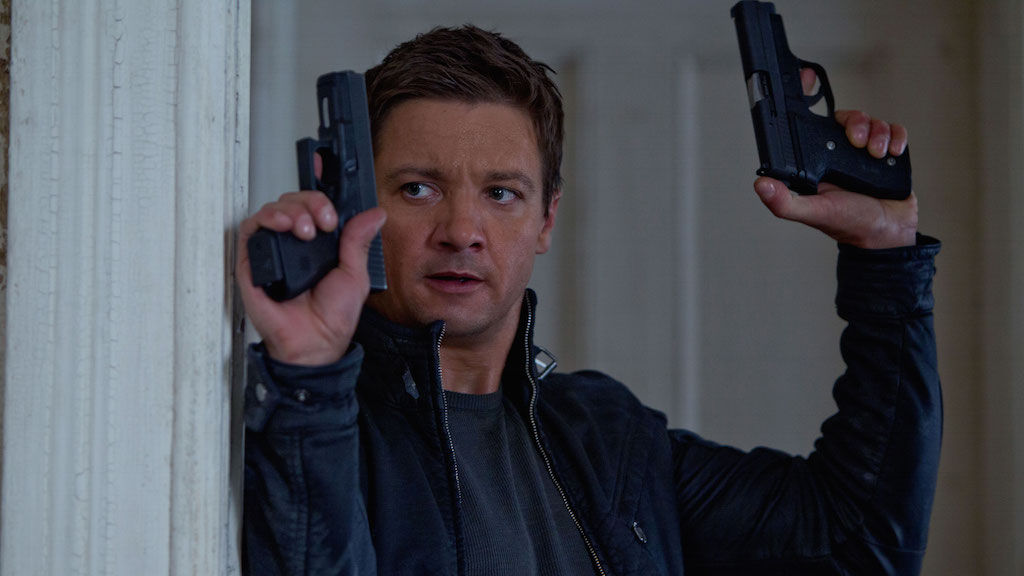
Even with two guns and Jeremy Renner’s face, Aaron Cross isn’t that interesting

Director: Tony Gilroy

Cast: Jeremy Renner (Aaron Cross), Rachel Weisz (Dr Marta Shearing), Edward Norton (Col. Eric Byer), Stacy Keach (Adm. Mark Turso), Dennis Boutsikaris (Terrence Ward), Oscar Isaac (Outcome #3), Joan Allen (Pamela Landy), Albert Finney (Dr Albert Hirsch), David Strathairn (Noah Vosen), Scott Glenn (Ezra Kramer), Donna Murphy (Dita Mandy), Michael Chernus (Arthur Ingram), Corey Stoll (Zev Vendel), Željko Ivanek (Dr Donald Foite), Elizabeth Marvel (Dr Connie Dowd)

What do you do when the people want more sequels to your film series but you can’t persuade the star and director (no matter how much money you offer) to make another film? Well you can either re-cast or you can put another character front and centre in a sequel. The Bourne Legacy goes for the latter approach and invents a new series of characters and shady CIA programmes so that we can put the old chase-and-fight formula back to work.

Aaron Cross (Jeremy Renner) has been mentally and physically enhanced as part of a series of CIA black ops, overseen by shady CIA bigwig Ed Norton. After the events of Bourne Ultimatum (which overlap with the first quarter of this film), the CIA cuts its losses and orders the deaths of all the agents (including Cross) and the scientists (including Rachel Weisz’s Dr Shearing). Of course both Cross and Shearing survive and go on the run. Despite the writing tying itself into knots to connect its story to the previous films, that’s the sum of the plot. Hardly gripping.

This strange historical curiosity spends the first half of its running time attempting to justify its existence. Extensive narrative hoops are jumped through and new footage carefully interwoven with clips from the previous two movies to try and suggest “a plot behind the plot”. It’s a mistake. No one needs to know why the film exists: we just want to get on with a cracking story. Instead we spend an inordinate amount of time unravelling this “sidequel” attempt at franchise expansion, meandering around unengaging and complex plotting that totally fails to engage the interest.

So long winded are these plotting gymnastics, it’s a good two-thirds of the way into the film before our villain becomes aware of our hero’s survival. Our hero never becomes aware of the villain (an unclear flashback is put into place so they share the screen) and only guesses at who is chasing him. This means the chase elements of the film never really click into place and lack anything for the viewer to invest in. The “hero” is an assassin whose objective is to keep hold of his enhanced intellect, obtained from drugs on the “programme”. Well good for him, but its hardly a sympathetic reason for us to root for him. He’s still an unrepentant killer.

This isn’t helped by the giggle-worthy flashback scenes of Jeremy Renner in his pre-enhanced state, where Renner seems to be aping Ben Stiller’s performance of Simple Jack in Tropic Thunder. In his enhanced state, Cross is fully aware he is an assassin and a willing volunteer – embracing the very dark secret Bourne was so ashamed of. Neither Cross nor Shearing ever have their actions questioned, or display any sense that they have done anything wrong – it seems clear that they would have continued their dirty deeds quite happily without the plot’s intervention. It’s fine to have morally compromised heroes in a film – but this film doesn’t seem to realise or comment on this at any point.

Whatever your views on the characters, the fact remains that this is a chase movie where the chase is not interesting, takes far too long to get started and never really gets the viewer feeling the tension. As an editor of action, Gilroy is no Paul Greengrass and the fight sequences have the same cold distance to them that the rest of the film has, a by-the-numbers series of clashes where it’s hard to really care what happens.

A brilliant cast of actors is totally wasted. Poor Jeremy Renner does his very best here – he has charm, he’s a charismatic performer, but this is a dull character who we are given no real reason to invest in. Rachel Weisz plays the sort of damsel distress (matched up with the “film scientist” trope) an Oscar winner surely can do without. Edward Norton as with so many other films makes his contempt and boredom with the film totally apparent. Allen, Finney and Straitharn have little more than single scene cameos. A host of great character actors (Isaac, Marvel, Stoll, Ivanek, Keach, Murphy) are totally wasted.

This is a dull, formulaic, unloved sequel that spends more time trying to place itself into the timeline of the previous movies than developing a storyline and characters we actually care about. It moves slowly from location to location, sprinkling in some inadequately filmed fights and chases, never once persuading us that we should care about anything that happens.

The Odessa File (1974)


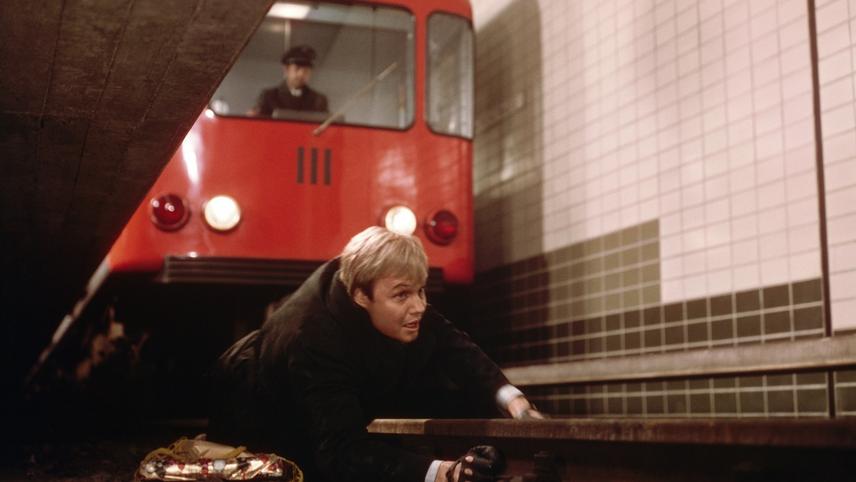
Jon Voight narrowly misses a train in The Odessa File

Director: Ronald Neame

Cast: Jon Voight (Peter Miller), Maximilian Schell (Eduard Roschmann), Maria Schell (Frau Miller), Mary Tamm (Sigi), Noel Willman (Franz Bayer), Derek Jacobi (Klaus Wenzer), Shmuel Rodensky (Simon Wiesenthal), Peter Jeffrey (David Porath), Klaus Löwitsch (Gustav Mackensen), Kurt Meisel (Alfred Oster), Günter Meisner (General Greifer)

One of the best thriller writers in the game is Frederick Forsyth. He never gets quite the credit he deserves, probably because he’s a very safe writer and he has certain character formulas which he reuses over again. But what his plots lack in depth, they more than make up for in the gripping intensity and extreme readability. A Forsyth plot barrels along and doesn’t let you rest for a minute.

The Odessa File is an adaptation of Forsyth’s journalistic style thriller, exploring the shady world of former Nazi war criminals, now hiding in new identities in positions of influence throughout the German republic. Set in 1963, Peter Miller (Jon Voight) is an idealistic young investigative journalist, who finds the diary of a recently deceased Holocaust survivor. Horrified by the stories of the Holocaust, Miller decides to hunt down the “Butcher of Riga” Eduard Roschmann (Maximilian Schell playing a real war criminal), a renegade Nazi recently spotted alive by the writer shortly before his death.

The Odessa File is an episodic film that carefully follows Miller’s investigation, at first alone, later as an undercover operative for Israeli intelligence. Each scene takes us step-by-step closer towards the final target (Roschmann), which means each scene introduces new characters and locations. The one consistent note we have is Voight, who is pretty good as the driven, idealistic (and arrogant) Miller, and he holds the film together rather well. Each of the tense set-ups works well as a self-contained little story, although it does mean that the overall arc of the film is less engaging than it should be. However, you are invested in wanting the investigation to succeed.

This is partly because the black and white flashbacks to the Holocaust are surprisingly effective from a film from the 1970s. Atrocities are implied and sensitively shown, in an unsensational way, but remain very affecting. Schell’s bombastic acting style also really works as a fanatical and sadistic Nazi (it also works very well in the film’s final confrontation). Combine this with the well-written, unembellished readings from the diary (good work from Cyril Shaps as the voiceover artist) and the film very sensitively establishes its anti-Nazi credentials early on.

Where it doesn’t really work is its whole Odessa plot. The shadowy group of Nazis proves laughably easy to penetrate. The network is then blown wide open seemingly within hours. There is a sub plot about the Nazis supplying missiles to Nasser to fire at Israel which is totally unclear (it has something to do with the factory Roschmann is now running). In fact, the whole organisation’s structure is unclear and the film lacks a real face for its antagonists. The film barrels along fast enough that you don’t notice it too much when viewing it, but reflecting on it afterwards everything makes slightly less sense, and the contrivances become far more glaring.

Other than Miller (whose motives the film is deliberately obscure about) not many of the other characters get a look in. In particular the female characters are little more than ciphers or “stop reading about the Holocaust and come to bed” girlfriends. The Nazis are all pretty interchangeable, although Noel Willman brings a nice sense of menace to a Nazi fixer. The strange intermixing of real and imaginary characters (including Simon Wiesenthal) is also a little odd.

But the story is exciting enough, and Voight’s earnest performance makes you care about Miller enough, that you’ll enjoy watching it. It’s not a classic like The Day of the Jackal (a perfect cinematic expression of Forsyth’s forward motion as a writer) but it’s going to keep you entertained for a couple of hours.

SPOILERS AHEAD FROM HERE!
I also think the final revelation of Miller’s motives is bungled and undermines the anti-Nazi message. It turns out Miller is primarily motivated by concluding Rorschmann murdered his father during the war. This immediately trivialises the horrors of the Holocaust – yeah, it was bad, but you can’t expect someone to go to all this trouble to hunt a bad man for that alone can you? It’s a problem in the book as well, but at least there, more weight is given to Miller’s anger at the war. Here he drops a few lines about the evils of Nazism, but it never quite snaps together.

This is a good, decent, sharp thriller – but it has its chances to be more than that, and it misses them.