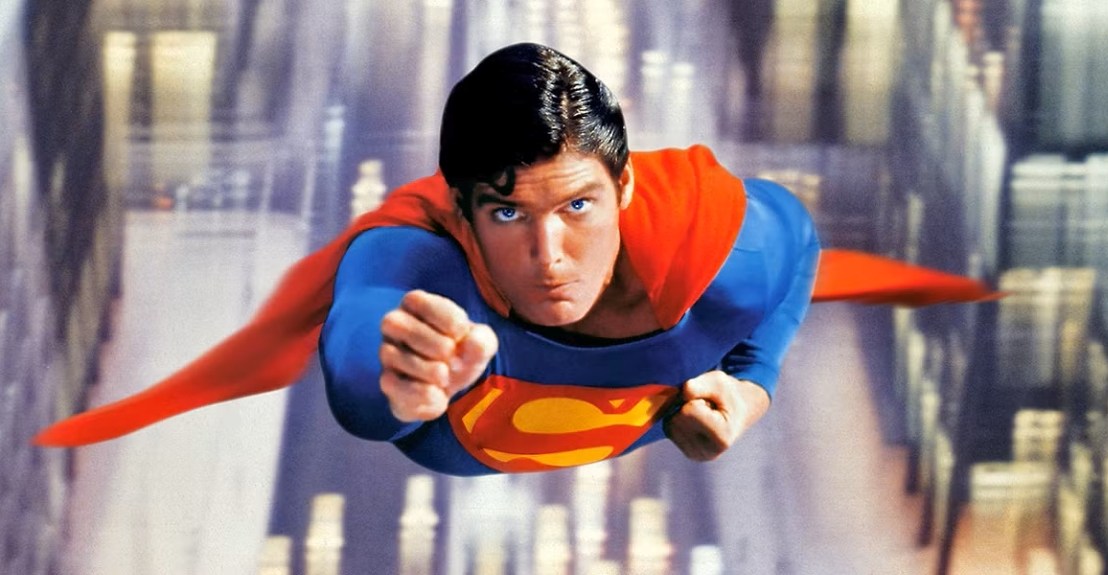
An odd mish-mash of styles and strange jumps in logic make this a less successful sequel
Director: Richard Lester
Cast: Christopher Reeve (Clark Kent/Superman), Gene Hackman (Lex Luthor), Ned Beatty (Otis), Jackie Cooper (Perry White), Sarah Douglas (Ursa), Margot Kidder (Lois Lane), Jack O’Halloran (Non), Valerie Perrine (Eve Teschmacher), Maria Schell (Vond-Ah), Terence Stamp (General Zod), Susannah York (Lara), Marc McClure (Jimmy Olsen), EG Marshall (President), Clifton James (Sheriff)
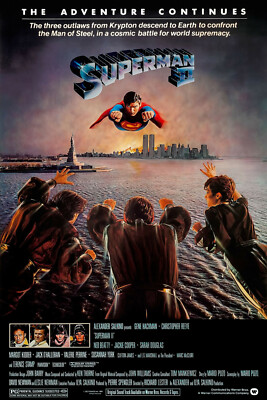
Superman started with Brando’s Jor-El condemning Kryptonian criminals General Zod (Terence Stamp) and his sidekicks Ursa (Sarah Douglas) and Non (Jack O’Halloran) to ‘living death’ in the Phantom Zone. Decades later, Superman (Christopher Reeve) accidentally releases them by deflecting a Parisian Hydrogen bomb into space. They arrive on Earth with the same powers as Superman, hell bent on revenge. Unfortunately, Superman is unaware of this, whiling away time in the Fortress of Solitude with Lois Lane (Margot Kidder) who has learned his identity. Sacrificing his powers to live a normal life, how will he stop the world’s population “kneeling before Zod”.
Superman II was to be filmed simultaneously with Superman. At least that was the idea. But as producers Alexander and Ilya Salkind’s tenuous control of finances spun further and further out of control, efforts refocused on finishing the first one. When that was a hit, work was due to re-start on Part 2. That’s where the trouble began. The Salkind’s relationship with director Richard Donner was already heavily on the rocks. Further disputes over the tone of the sequel – Donner claimed he wanted a serious film and that the Salkinds wanted a kid-friendly, gag-heavy chortle – led to Donner’s sudden sacking and replacement with the Salkind’s favourite director, Richard Lester.
To say the style of these two didn’t mesh would be an understatement. Donner was all about making the high-blown and ridiculous feel full of po-faced seriousness (you could say self-importance). Richard Lester, on the other hand, was the man who turned Juggernaut, a film about a murderous bomber, into a work-place black comedy. Any film that used an odd combination of both man’s material was probably doomed to be a Frankenstein’s monster, neither one thing or another.
That’s pretty much what Superman II is. In many ways, with Lester taking over 75% of the way through – and then looping back and re-shooting several scenes to ensure he had directed over 60% of the film and guarantee (after Donner refused to take any credit) that the film would have someone as a credited director – it’s a miracle it makes any sense at all. As it is, the tone varies wildly at times from scene-to-scene: a prat fall gets followed by a death, a romantic riff by a mortal threat. From it’s Parisian opening with its incompetent bombers (one of whom is played by Richard Griffiths of all people), through to its goofy comedy as villains trash a mid-Western town, each set piece is two thirds drama to one third farce. In addition, the long break in filming means the actor’s appearance switches and changes frequently and important plot developments suddenly spring out of nowhere.
A lot of that came from contract disputes. Original top-billed star Marlon Brando was suing the Salkinds, convinced they were stiffing him on his 11.75% box office share from Superman. Since Brando was entitled to the same share of this film if he appeared in it, every single frame of him was cut. Which would have been fine – if Brando’s Jor-El hadn’t been pivotal to a de-powered Superman regaining his powers. Lester had already re-shot several Fortress of Solitude scenes with the more amenable (and cheaper) Susannah York taking over as tutoring hologram. Clearly, they ran out-of-time – or just didn’t think anyone would care enough – about also getting her to reshoot a scene to take the place of the last vestige of Jor-El in the Fortress’ computer erasing itself to restore Clark’s powers. Instead, Clark just gets them back off-camera, no problem.
There are touches of this throughout the film. Hackman had refused to return after Donner’s firing, his scenes all too obviously finished by a stand-in with his back to the camera while another actor gives a nearly-but-not-quite impersonation of Hackman on the soundtrack. Several times scenes with Hackman suddenly stop, which feels odd – and then you realise they were impossible to finish. It also means poor Ned Beatty and Valerie Perrine also fade into the background or disappear (presumably because it would have been hard to do her scenes with the camera fixed behind a double’s back).
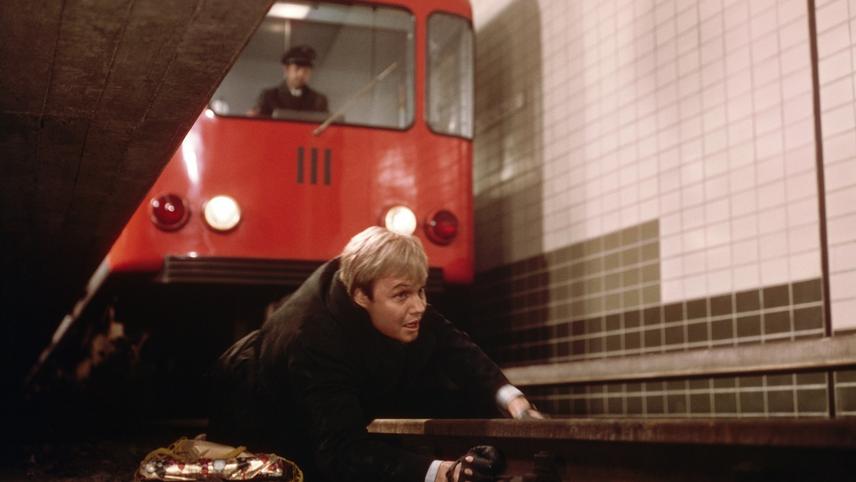
The thrown-together madness of the film can be seen in the bizarre story. Zod’s entire time on Earth seems to take place more-or-less in real time: arriving, terrorising a small town, capturing the White House. Meanwhile, Clark and Lois romance at Niagara Falls on a very poorly explained journalistic sting operation (including an embarrassing pre-fame Antony Sher as a lascivious hotel bellboy) and retire to the Fortress for a night of passion, a depowering and then travel from the North Pole to America (by boat and car presumably!), presumably all in the same day. You can’t blame the staff at the diner they stop at being flabbergasted at how many world-shattering events they’ve missed.
As to be expected, Donner’s grand, Fordian vision is sacrificed to Lester’s love for sight gags. Donner sure wouldn’t have used Zod and crew creating a mighty wind to blow away a Metropolis mob as an opportunity for ice cream cones, wigs and hen-picked husbands clutching telephones to be swept away. Throughout, people are forever crashing into puntastic advertising boardings or (a classic Lester touch) letting loose little muttered asides we only half catch. He even ropes in Clifton James to repeat his JW Pepper from James Bond performance in all but name.
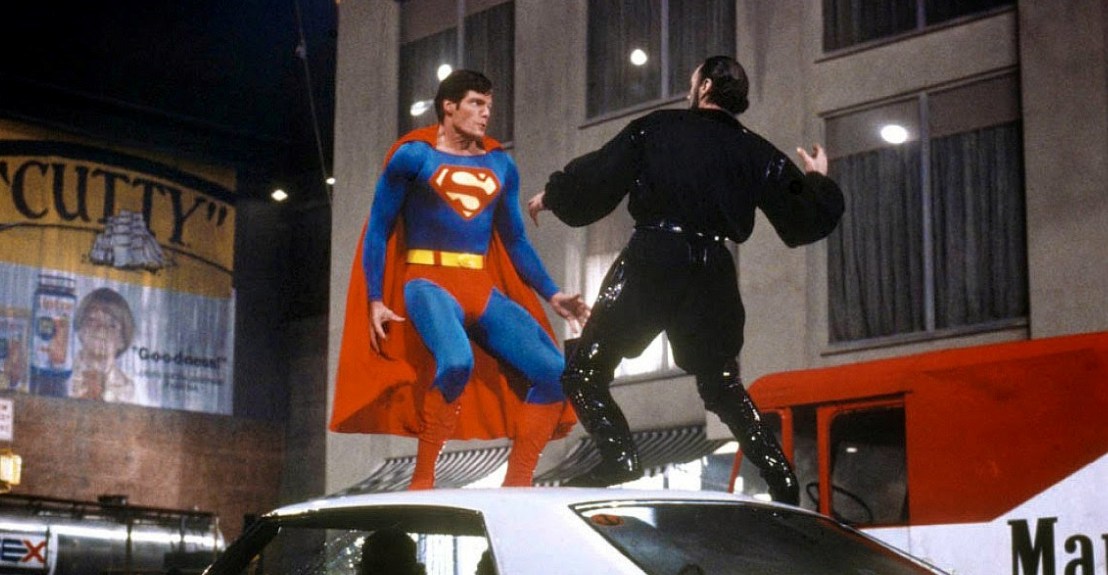
That final Metropolis fight is still impressive in places, despite its obvious sound-stage setting – it’s important to remember it’s the first time anything like this was ever attempted on screen. The actors work hard to maintain a sense of menace and danger from our villains, despite the odd dorky moment. One decision that works extremely well, is Stamp’s underplaying of Zod as a perpetually unimpressed aristocrat, almost immediately bored by his God-like powers. By not straining hard for laughs, Stamp is frequently the funniest thing in the film (and its most memorable performer).
Reeve and Kidder do their best, but the film gives them considerably less to play with. Largely because their relationship feels very rushed, Clark’s decision to de-power himself coming almost from nowhere and lacking any real explanation for why it’s necessary, and neither the script or character being quite nimble enough to not make both Clark and Lois’ reaction to his being duffed up in a bar fight feel like two people who suddenly feel like in losing Superman they’ve got the raw end of the deal.
Superman II powers itself on with a dorky sense of energy, but really it’s a bizarre hotchpotch of the grand and mighty and the ludicrous and silly, that frequently tries to put both in the same scene at the same time. Not surprisingly, it means a film that’s half Donner and half Lester ends up feeling much worse than if it had been made alone by either one of them. Which is not to say either of those films would have any good either.