Tag: Christopher Reeve

Superman II (1980)

Superman II (1980)

An odd mish-mash of styles and strange jumps in logic make this a less successful sequel

Director: Richard Lester

Cast: Christopher Reeve (Clark Kent/Superman), Gene Hackman (Lex Luthor), Ned Beatty (Otis), Jackie Cooper (Perry White), Sarah Douglas (Ursa), Margot Kidder (Lois Lane), Jack O’Halloran (Non), Valerie Perrine (Eve Teschmacher), Maria Schell (Vond-Ah), Terence Stamp (General Zod), Susannah York (Lara), Marc McClure (Jimmy Olsen), EG Marshall (President), Clifton James (Sheriff)
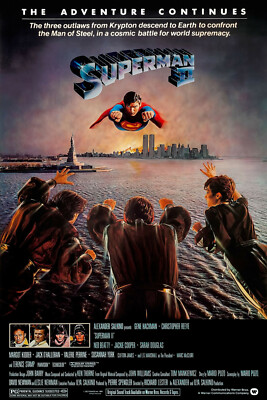
Superman started with Brando’s Jor-El condemning Kryptonian criminals General Zod (Terence Stamp) and his sidekicks Ursa (Sarah Douglas) and Non (Jack O’Halloran) to ‘living death’ in the Phantom Zone. Decades later, Superman (Christopher Reeve) accidentally releases them by deflecting a Parisian Hydrogen bomb into space. They arrive on Earth with the same powers as Superman, hell bent on revenge. Unfortunately, Superman is unaware of this, whiling away time in the Fortress of Solitude with Lois Lane (Margot Kidder) who has learned his identity. Sacrificing his powers to live a normal life, how will he stop the world’s population “kneeling before Zod”.

Superman II was to be filmed simultaneously with Superman. At least that was the idea. But as producers Alexander and Ilya Salkind’s tenuous control of finances spun further and further out of control, efforts refocused on finishing the first one. When that was a hit, work was due to re-start on Part 2. That’s where the trouble began. The Salkind’s relationship with director Richard Donner was already heavily on the rocks. Further disputes over the tone of the sequel – Donner claimed he wanted a serious film and that the Salkinds wanted a kid-friendly, gag-heavy chortle – led to Donner’s sudden sacking and replacement with the Salkind’s favourite director, Richard Lester.

To say the style of these two didn’t mesh would be an understatement. Donner was all about making the high-blown and ridiculous feel full of po-faced seriousness (you could say self-importance). Richard Lester, on the other hand, was the man who turned Juggernaut, a film about a murderous bomber, into a work-place black comedy. Any film that used an odd combination of both man’s material was probably doomed to be a Frankenstein’s monster, neither one thing or another.

That’s pretty much what Superman II is. In many ways, with Lester taking over 75% of the way through – and then looping back and re-shooting several scenes to ensure he had directed over 60% of the film and guarantee (after Donner refused to take any credit) that the film would have someone as a credited director – it’s a miracle it makes any sense at all. As it is, the tone varies wildly at times from scene-to-scene: a prat fall gets followed by a death, a romantic riff by a mortal threat. From it’s Parisian opening with its incompetent bombers (one of whom is played by Richard Griffiths of all people), through to its goofy comedy as villains trash a mid-Western town, each set piece is two thirds drama to one third farce. In addition, the long break in filming means the actor’s appearance switches and changes frequently and important plot developments suddenly spring out of nowhere.

A lot of that came from contract disputes. Original top-billed star Marlon Brando was suing the Salkinds, convinced they were stiffing him on his 11.75% box office share from Superman. Since Brando was entitled to the same share of this film if he appeared in it, every single frame of him was cut. Which would have been fine – if Brando’s Jor-El hadn’t been pivotal to a de-powered Superman regaining his powers. Lester had already re-shot several Fortress of Solitude scenes with the more amenable (and cheaper) Susannah York taking over as tutoring hologram. Clearly, they ran out-of-time – or just didn’t think anyone would care enough – about also getting her to reshoot a scene to take the place of the last vestige of Jor-El in the Fortress’ computer erasing itself to restore Clark’s powers. Instead, Clark just gets them back off-camera, no problem.

There are touches of this throughout the film. Hackman had refused to return after Donner’s firing, his scenes all too obviously finished by a stand-in with his back to the camera while another actor gives a nearly-but-not-quite impersonation of Hackman on the soundtrack. Several times scenes with Hackman suddenly stop, which feels odd – and then you realise they were impossible to finish. It also means poor Ned Beatty and Valerie Perrine also fade into the background or disappear (presumably because it would have been hard to do her scenes with the camera fixed behind a double’s back).

The thrown-together madness of the film can be seen in the bizarre story. Zod’s entire time on Earth seems to take place more-or-less in real time: arriving, terrorising a small town, capturing the White House. Meanwhile, Clark and Lois romance at Niagara Falls on a very poorly explained journalistic sting operation (including an embarrassing pre-fame Antony Sher as a lascivious hotel bellboy) and retire to the Fortress for a night of passion, a depowering and then travel from the North Pole to America (by boat and car presumably!), presumably all in the same day. You can’t blame the staff at the diner they stop at being flabbergasted at how many world-shattering events they’ve missed.

As to be expected, Donner’s grand, Fordian vision is sacrificed to Lester’s love for sight gags. Donner sure wouldn’t have used Zod and crew creating a mighty wind to blow away a Metropolis mob as an opportunity for ice cream cones, wigs and hen-picked husbands clutching telephones to be swept away. Throughout, people are forever crashing into puntastic advertising boardings or (a classic Lester touch) letting loose little muttered asides we only half catch. He even ropes in Clifton James to repeat his JW Pepper from James Bond performance in all but name.

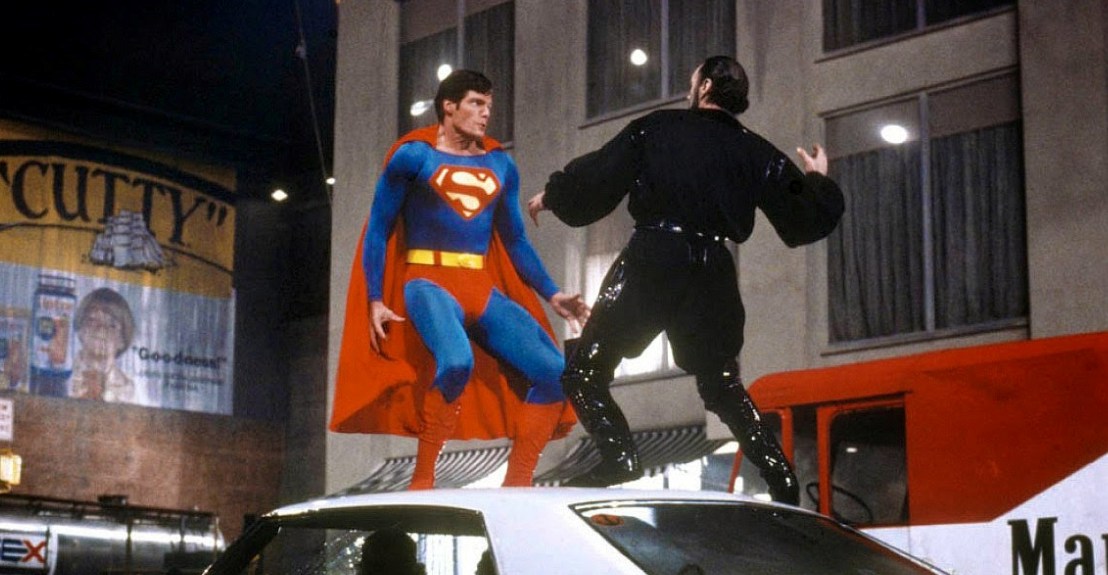
That final Metropolis fight is still impressive in places, despite its obvious sound-stage setting – it’s important to remember it’s the first time anything like this was ever attempted on screen. The actors work hard to maintain a sense of menace and danger from our villains, despite the odd dorky moment. One decision that works extremely well, is Stamp’s underplaying of Zod as a perpetually unimpressed aristocrat, almost immediately bored by his God-like powers. By not straining hard for laughs, Stamp is frequently the funniest thing in the film (and its most memorable performer).

Reeve and Kidder do their best, but the film gives them considerably less to play with. Largely because their relationship feels very rushed, Clark’s decision to de-power himself coming almost from nowhere and lacking any real explanation for why it’s necessary, and neither the script or character being quite nimble enough to not make both Clark and Lois’ reaction to his being duffed up in a bar fight feel like two people who suddenly feel like in losing Superman they’ve got the raw end of the deal.

Superman II powers itself on with a dorky sense of energy, but really it’s a bizarre hotchpotch of the grand and mighty and the ludicrous and silly, that frequently tries to put both in the same scene at the same time. Not surprisingly, it means a film that’s half Donner and half Lester ends up feeling much worse than if it had been made alone by either one of them. Which is not to say either of those films would have any good either.
Superman (1978)

Superman (1978)

First of the Superhero genre, a light and gentle film with simple black-and-white morality but very charming

Director: Richard Donner

Cast: Christopher Reeve (Clark Kent/Superman), Marlon Brando (Jor-El), Gene Hackman (Lex Luthor), Ned Beatty (Otis), Jackie Cooper (Perry White), Glenn Ford (Jonathan Kent), Trevor Howard (First Elder), Margot Kidder (Lois Lane), Jack O’Halloran (Non), Valerie Perrine (Eve Teschmacher), Maria Schell (Vond-Ah), Terence Stamp (General Zod), Phyllis Thaxter (Martha Kent), Susannah York (Lara), Marc McClure (Jimmy Olsen), Sarah Douglas (Ursa), Harry Andrews (Second Elder)

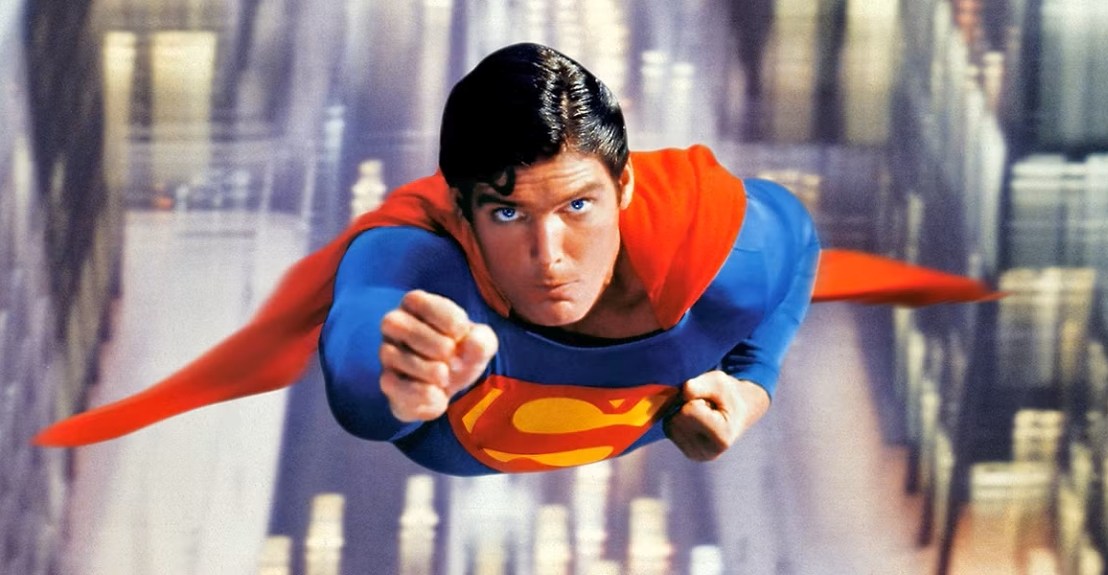
You’ll believe a man can fly! That was Superman’s punchy tagline for one of the first major attempts to bring a comic book hero to the screen. It’s also a landmark in special effects: after all the Man of Steel could fly faster than sound around the world, catch bullets, throw giant objects into space – he was going to need a mega special effects budget to do that. And of course, he would need an epic cinema screen to do it in, something producers Alexander and Ilya Salkind were determined to supply, with no expense spared (or, it seems, controlled) back stage, as a host of top-flight Hollywood hands were bought on board, led by Brando (picking up a record fee and 11% of the gross) for a first act cameo as Superman’s Dad Jor-El.

Superman’s plot tried to balance comic book lore, with some Earth-bound heroics to put our hero through his paces as he gently works out who and what he is. Sent to our world as a baby by his doting parents (Brando and Susannah York) with their world Krypton doomed to destruction, he’s adopted in the Mid-West by the Kents. Growing up and discovering his past, Clark Kent (Christopher Reeve) joins the Daily Planet as a plucky, mild-mannered reporter under lead investigator Lois Lane (Margot Kidder) – who he quickly gets a crush on (and who has a crush on Superman). While he saves people left, right and centre, criminal mastermind Lex Luthor (Gene Hackman) plans to fracture the San Andreas fault in the most hostile landgrab ever. Can Superman stop him?

Superman is structured into four clear acts and is all about putting into place the sort of thing fans of the comic book would have remembered from back-in-the-day. From the prologue in Krypton (including an extended set-up for the sequel, which was being shot simultaneously), via Clark’s teenage years, his arrival in Metropolis and the final San Andreas fault wrestling of the finale that sees Superman swooping around the Golden Gate Bridge and the Hoover Dam, every act rolls with heartfelt, comic book thrills from moment to moment. It’s all very light-weight – the villains, for all their dastardly plans, are goofy and any tragedy never really sticks when Superman can fly fast enough to turn back time – but there is also a gloriously old-fashioned innocence and decency about it.

Donner’s film goes for a mix between a David Lean-ish epicness, with sweeping Western vistas, soaring camerawork through the skies and Space Opera grandness, mixed with a screwball His Girl Friday aesthetic at the Daily Planet with Lois Lane as a fast-talking, story-fixated journo (like Rosalind Russell, only with more hanging off the side of dangling helicopters) and Clark Kent as a dopey, aw shucks mix of Gary Cooper and James Stewart. There is a nice screwball romance between Reeve and Kidder and surprisingly the two moods of the film hang together extremely well, aided enormously by John Williams’ epic score, whose fanfares stir just the right level of heroic wonder as Clark spins in phoneboxes from awkward Clark to unstoppable Superman.

It’s also a huge tribute to Christopher Reeve, who is both charmingly light and funny but also hugely endearing. It’s very easy to make someone so gosh darn perfect as Superman rather wearing. After all, the guy is scrupulously polite to everyone, never holds a grudge, always has a nice word to say and is as untainted by temptation as he is unbeatable in any situation. Basically, Superman is a character it’s very easy to get wrong, but Reeve leans into the everyday simplicity and humbleness. Clark Kent is essentially Superman exactly, but with his bashful earnestness dialled up and his resolute bravery carefully concealed. It’s a performance that really works.

It’s also a performance that plays only third fiddle in the billing. Which is to be expected in a Salkind film: these guys loved a big name. After all, they commissioned Mario Puzo to write the script because he was the most famous writer in the world. Donner called that script camp beyond belief (he claimed he didn’t use a word of it), constantly positioning the film in a more serious light. As befitted the high-brow crew, not least Geoffrey Unsworth as photographer. Top billing went to Brando, reading from cue cards as Jor-El, loaning the crystal set and glowing costumes his reputational seal of approval, while a host of classical actors (Howard, Andrews, Schell, York) flit around the edges as loomingly serious heads intoning grandiose lines.

Second billing went to Hackman as Lex Luthor who, like Brando, did the film as quickly as possible for a large pile of dollars. He dials up the comic ridiculousness as a foppish Lex Luthor. Not keen on shaving his hair (only briefly does he pop up a bald cap on), Hackman bounces comically exasperated dialogue off dim sidekicks Ned Beatty (even more OTT) and Valerie Perrine (giving good air-head glamour) and channels his inner used car salesman. Luthor of course isn’t really threatening at all – even if he does plan to kill millions – which feels about right for a film as playful and hopeful as this one.

He still causes enough havoc, requiring Superman to repair it with a neat mix of wire-work, model work and impressive miniatures, all put together with plenty of fast pace, awe-inspiring energy. Superman’s real enemy effectively becomes time itself – can he race around the world fast enough to save millions, fix the Fault and fish Lois Lane from deathly peril? – which also works very well for a film that positions the Man of Steel as a champion of decency, democracy and community spirit. Reeve gets a well-played moment of emotional torment in this, before the film settles back into its groove of gentle, crowd-pleasing reassurance that nothing really bad will happen.

Superman isn’t exactly a masterpiece. The flimsy lightness of the plot and it fast paced bounding from event to event makes it feel like a comic serial bought to life, where cause and effect aren’t necessarily important to understand. But it’s got a genuine sense of warmth and gentleness to it that perhaps explains why it made such an impact on those watching it. So much so, that every version of the character that followed on film would share major DNA with Reeve and Donner’s vision. I guess they really did make a whole generation of young filmmakers believe that a man could fly.

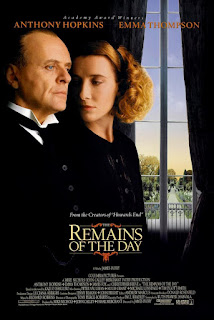
The Remains of the Day (1993)

The Remains of the Day (1993)

Hopkins and Thompson are marvellous in this masterful adaptation from Merchant-Ivory

Director: James Ivory

Cast: Anthony Hopkins (Mr Stevens), Emma Thompson (Miss Kenton), James Fox (Lord Darlington), Christopher Reeve (Congressman Jack Lewis), Peter Vaughan (Mr Stevens Snr), Hugh Grant (Reginald Cardinal), Michael Lonsdale (Dupont D’Ivry), Tim Pigott-Smith (Mr Benn), Ben Chaplin (Charlie), Patrick Godfrey (Spencer), Lena Headey (Lizzie), Pip Torrens (Dr Carlisle), Paul Copley (Harry Smith) Rupert Vansittart (Sir Geoffrey Wren), Peter Eyre (Lord Halifax), Wolf Kahler (Ribbentrop)

Kazou Ishiguro’s Booker-prize winning novel The Remains of the Day is one of my all-time favourites. So, it’s not a surprise I’m a huge fan of this masterful adaptation from the House of Merchant Ivory. I’m certain this is the apex of the team’s work. Mike Nichols had originally planned a film but, wisely, recognised when it came to making movies about repressed 1930s Brits, one team had a monopoly on how to do it best. Beautifully adapted by their regular screenwriter Ruth Prawer Jhabvala, The Remains of the Day is a wonderfully involving and deeply moving film.

Stevens (Anthony Hopkins) is a butler in a British country house purchased in 1956 by American Jack Lewis (Christopher Reeve). Keen to solve staffing problems (and for no other reason at all), Stevens journeys to the West Country to recruit the 1930s housekeeper, Mrs Benn nee Kenton (Emma Thompson). During the journey, he remembers his service for the previous owner, Lord Darlington (James Fox). An impeccable gentleman, Darlington dedicates himself to reconciliation between Nazi Germany and England, eventually tipping into an unwise dalliance with fascism and appeasement.

Stevens had no views on that though. In fact, he prides himself on his anonymity. The goal of his life is to maintain a dignified unobtrusiveness, ensuring the smooth operation of everything, leaving as little a mark as possible. Nothing can intrude on that: not his own feelings, the illness and death of his under-butler father (Peter Vaughan) and, above all, the unspoken romantic feelings between himself and Miss Kenton. The Remains of the Day is about duty and obsession and how a fixation on both can leave someone with little to show from a long life.

Stevens is living the lessons he learned from his father, an ageing powerhouse masterfully played by Peter Vaughan, who undergoes a physical collapse (from dripping nose to dropping trays) and bouts of forgetfulness, eventually dying on a night Stevens is too busy seeing to the sore feet of an illustrious French guest to spare a moment to visit him. It tells you everything about his character that this stiff-upper lipped commitment to duty is a source of pride to our hero.

There are few as curiously blank ‘heroes’ in literature than Stevens. The narrator of Ishiguro’s book is a dull, fussy, unbelievably cold man who has dedicated himself so fully to duty that he has let any emotional life wither and die on the vine – something he only realises far too late. It’s an immensely challenging role, bought to life masterfully by Hopkins. Hopkins astonishing skill here is to play all that repressed coldness on the surface, but also constantly let us see the emotion, longing and regret he is subconsciously crushing down play in his eyes and the corners of his mouth. Is Stevens even aware how much self-harm he is causing? It’s an astonishingly subtle performance.

So subtle in fact that the books conclusion – Steven’s tear-filled confession to a stranger late at night of all the mistakes he has made – was filmed but cut for being superfluous. Hopkins had done the lot, all the way through the movie, through acting skill. You can’t miss the struggle within him, not least the desperate, powerless longing he feels for Miss Kenton that, for oh-so-English reasons he can never admit to himself. Hopkins has the vocal and physical precision, but every gesture tremors with unspoken, barely understood longings. In fact, it’s a shock when he exclaims an angry “Blast” after dropping a bottle of wine (the real cause of his outburst being, of course, Miss Kenton’s announcement that she is getting married)

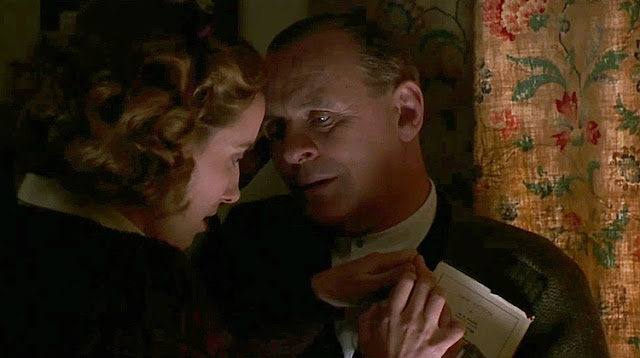
He and Miss Kenton conduct a professional relationship that blossoms into something like a friendship – but he consistently rejects her polite efforts to take it further. In the film’s most powerful scene, Miss Kenton enters his parlour and playfully tries to see the title of the novel he’s reading (a sappy romance). The playfulness tips into agonisingly awkward tenseness as Hopkins’ Stevens seems paralysed, his hand lingering inches from her hair but unable to bring himself to break decorum and fold her in an embrace – all while Miss Kenton continues her increasingly desperate semi-flirtatious banter. It of course ends with Stevens dismissing her: just as later he will take a snap of frustration as a signal to irrevocably cancel their late-night cups of cocoa together.

Emma Thompson is wonderful as a woman only marginally more in touch with her feelings and longings than Stevens is: aware that she, eventually, wants more from life, but unable to find the way of communicating the love she clearly feels for Stevens in a manner he can respond to. Instead, the two of them oscillate between a friendly, affectionate alliance and a discordant arguments (their only outlet for their passion), rooted in their inability to admit their feelings for each other. To further stress the point, both of them mentor young staffers (played by a very young Ben Chaplin and Lena Headey) who have the youthful “what the hell” to jack in all this for love.

Ivory’s wonderfully subtle film makes clear this is a turning point in history, the final hurrah for the this sort of deferential hierarchy. Stevens is the last of a generation of butlers, convinced that what their employers got up to had nothing to do with them – views not shared by Tim Piggot-Smith’s more grounded Benn, who chucks in his job working for a bullying blackshirt (who else but Rupert Vansittart?). Throughout the 1950s storyline, Stevens is constantly asked if he knew the infamous Lord Darlington (a sort of Lord Londonderry figure, hopelessly taken in by Hitler) – in fact, like Paul, he twice denies ever having known him.

And you can understand why, as the film has sympathy for Lord Darlington. As his decent, liberal god-son Reginald Cardinal (an excellent Hugh Grant) says, Darlington is a great asset for Germany precisely because he’s honest, well-meaning and motivated by a desire for peace. The fact that his leads him to consort with a host of Nazis, Blackshirts and the most appalling anti-democratic vestiges of the upper-classes (at one point, Stevens selflessly gives a performance of geopolitical ignorance so as to help demonstrate why men like him shouldn’t have the vote) is an unfortunate side-effect.

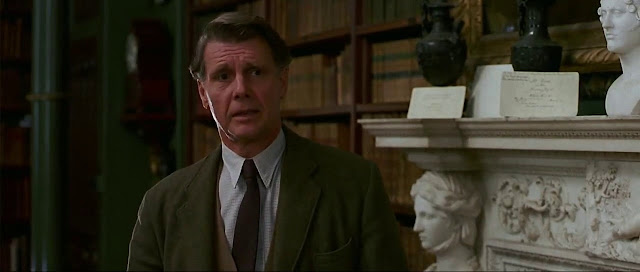
Played perfectly by James Fox, Darlington is misguided but genuine. As war approaches, he leads an increasingly hermit like life – camp-bed and paper-strewn, messy library – hosting conferences denounced by Jack Lewis (a fine Christopher Reeve) as a host of amateurs talking about a world they no longer understand. Beneath it all, Darlington is guided by fair play. So much so, it’s almost distressing to see him (under the influence of an attractive German countess) reading anti-Semitic pamphlets and sacking two refugee Jewish maids – an act he later regrets (far too late). This moment also reinforces Stevens’ compromised pig-headedness (not his place to judge!) and Miss Kenton’s fear to act (she’s horrified, but to scared of unemployment to hand in her notice).

All of this culminates in a series of scenes where emotions pour out of the actors, even while their words are banal and everyday memories and reflections. Ivory was never more confident and skilled behind the camera, and the film is a technical marvel, beautifully shot with a wonderful score from Richard Robbins. Hopkins is phenomenally good, simultaneously pitiable and smackable, Thompson is wonderful alongside him, Fox and Grant perfect – it’s a very well-acted piece. And a wonderfully perfect capturing of a classic modern British novel. No doubt: the best Merchant Ivory film.