Category: War film

Morocco (1930)

Morocco header
Marlene Dietrich and Gary Cooper romance in the heat of Morocco

Director: Josef von Sternberg

Cast: Gary Cooper (Legionnaire Tom Brown), Marlene Dietrich (Mademoiselle Amy Jolly), Adolphe Menjou (La Bessiere), Ulrich Haupt (Adjutant Caesar), Eve Southern (Madame Caesar), Francis McDonald (Sergeant), Paul Porcasi (Lo Tinto)
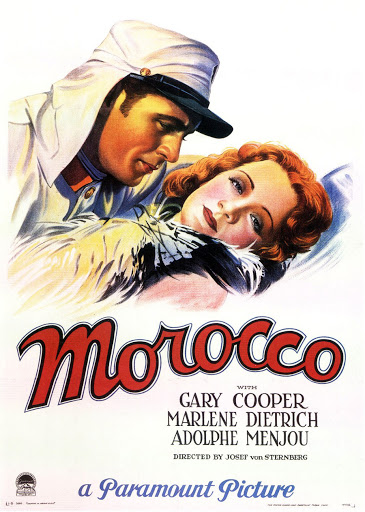
Josef von Sternberg was one of the greatest directors of early cinema – and Marlene Dietrich was his muse. Or was he her Svengali? Either way, they first worked together on German film The Blue Angel and such was the impression made by Dietrich, Hollywood was desperate to get her and von Sternberg together for a new picture that would channel her star power into ticket sales. Morocco is the picture they come up with, a romance tinged with heartbreak set in French occupied-Morocco around a Foreign Legion troop passing through town.

Dietrich was Amy Jolly, a woman of uncertain and shady past, new in town and making a living as a night club singer. There here routine encompasses everything from erotic singing in top hat and tails (complete with a bisexual vibe – you can tell this is pre-Code Hollywood?) to an apple selling singing routine. She’s loved by La Bessiere (a rather bland Adolphe Menjou), a stuffed shirt rich guy. But her heart belongs to man’s-man legionnaire Tom Brown (Gary Cooper), a toughened old soldier with a girl in every barracks town. Who will Amy end up with? Will she follow her heart or her head? Can she bear to live the life of a soldier’s mistress amongst the camp followers?

Writing it all down, there are probably few mysteries about the resolution you get from Morocco, which even at its 90 minute run time feels like an impossibly slim piece of fluff. But that hardly really matters when von Sternberg shoots the film with a romantic flourish and with Dietrich and Cooper as such compelling leads. It’s odd to think, looking at it now, that Morocco was acclaimed as one of the greatest films ever made on release (it’s not even the best or most lasting Dietrich/von Sternberg Hollywood collaboration of which there were five more to come).

But it lasts in history because it introduced Dietrich to the wider world. Von Sternberg took control over every aspect of her image to best present her to the world – including a torturous 45 takes of her first line (because after all the first line was the one that will make the first impression on an audience). Von Sternberg and cinematographer Lee Garmes choose lighting methods and angles that would enhance her features, and shot huge parts of the film to favour her (much to the annoyance of Gary Cooper, who resented von Sternberg’s shunting of him to the sidelines).
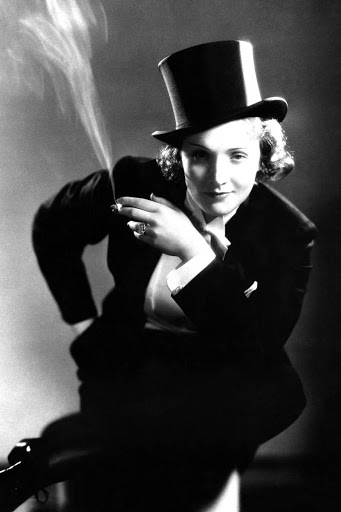
Von Sternberg was determined that Dietrich would make an impression: and she certainly did with her cabaret act, still probably the film’s highlight. Dressed in a striking male garb, her rendition of When Love Dies is sold on her confidence, sexual allure and tinge of bisexuality (viewers were scandalised and titalated that the routine ended with Dietrich playfully kissing a woman in the audience) to make a lasting impact. Von Sternberg lets the tension build as well by holding the camera calmly on Dietrich (in drag) while the audience at first boo before silencing and then being swept up in her performances. This is the approach taken for the rest of the film – and its rather weak plot – focusing on the a magnetic quality, the indefinable star quality some people have to just make you watch them.

It’s recognised by von Sternberg, who builds the film around her. It’s tempting to see Adolphe Menjou – the jilted would-be husband, in awe of the star – as a von Sternberg self-portrait, dressed as he is to resemble the director. But von Sternberg felt so confident over his control of Dietrich and her career, I suspect there is actually far more of him in lothario Tom Brown, the sort of man who may love a woman but also very much likes her to submit her will to his own. Brown may have his moments of decency – he wants Amy to have the best chance in life, which is clearly with La Bessiere rather than him – but he’s also an at times ruthless opportunist and adventurer, with a string of broken hearts behind him. Interestingly, considering their later films and her reputation, Dietrich’s Jolly is actually a fairly passive figure throughout the film, to whom events happen and who never feels in charge of her destiny. Perhaps more than a little of life drippling through to the screen?

Saying that the film has some bite in it, with the dialogue from Jules Furthman often rich, rough and ready, creating characters who speak at times bluntly but with a sort of urban poetry. Sadly, the dialogue scenes are often frequently the dullest in the film. Von Sternberg was still at the time a natural director of silent film, not the talkies. Hollywood itself had still not really learned how to do record dialogue and do camera movements at the same time, so most of the dialogue scenes are visually flat and rather forced (not helped by the storyline itself being often less then enthralling).

Where Morocco really comes into its own is when it falls back on visuals. As a director of pictures, von Sternberg is outstanding. The camera perfectly captures the bustle of the Moroccan market town. There is a beautiful sequence where Amy raises through a seemingly never-ending row of soldiers to try and find Tom. The Morocco in this film may bear almost no resemblance to the real Morocco – it’s clearly a Hollywood fantasy land – but it also looks at no time like it was shot on a Hollywood backlot. Tom Brown’s slow and sad browse through Amy’s dressing room, before deciding he should leave for her own good is hauntingly well done in near total silence, matched with beautifully empathetic camera moves. The final imagery, as our heroes head out into the sands of Morocco, is marvellous, a perfect collection of shots and reactions leading to an image for the ages.

And Morocco is a film of images strung together with a rather dull plot and a very stilted scenes of dialogue. Marlene Dietrich is at the centre of many of these images. This was her only Oscar nomination – but it’s not her finest performance. She’s still learning her craft and – above all you feel – still very much an elaborate prop for von Sternberg. The more they became something like equals the stronger the pictures would become. Gary Cooper was unhappy on the film – but actually his performance is remarkably strong and assured, dripping sexuality (von Sternberg also works a lovely little scene that pokes fun at Cooper’s height).

Morocco seems like a landmark of cinema that is of greater academic interest at times than it is dramatic. But when the dialogue fades away and the film is able to relax into the series of arresting images that make up most of it, it’s still a marvellous and intriguing work.
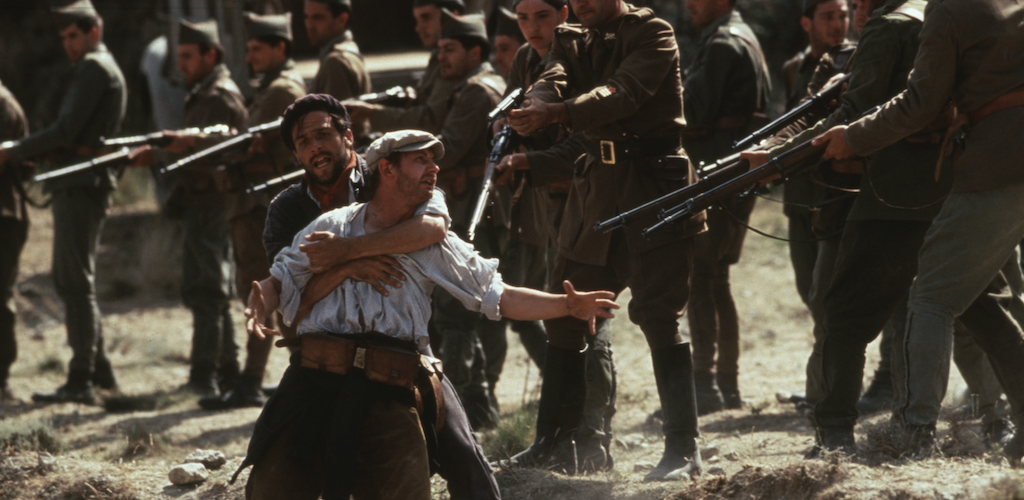
Land and Freedom (1995)

Ian Hart fights for Land and Freedom in Ken Loach’s impassioned Spanish Civil War drama

Director: Ken Loach

Cast: Ian Hart (David Carr), Rosana Pastor (Bianca), Frédéric Pierrot (Bernard Goujon), Tom Gilroy (Lawrence), Icíar Bollaín (Lawrence), Marc Martinez (Juan Vidal), Paul Laverty (Militia Member)

What do we really know about our elders? After David Carr passes away, his granddaughter finds a box full of memories from his time as a young man (Ian Hart) who went to Spain in 1936 to fight against fascism. His granddaughter uncovers a whole side of her radical grandfather she never knew – his passions, his love and the reasons for his disillusionment with the communist party.

If there was someone who was going to make a film about the Spanish Civil War, it would be Ken Loach. The Spanish Civil War is a totemic event for left-wing politics, where the dream of a truly commune-based left-wing government in Europe, by the people for the people, died in a long civil war with right-wing military forces. Loach’s film hums with anger at this missed opportunity and fury at the way these crusaders for justice were left high and dry by both the rest of Europe, and the Russian-controlled forces that should have been on their side.

The Spanish Civil War is a war that it’s easy to slightly forget – a dress rehearsal for World War Two but with a different result. It’s striking that this is one of the very few films – perhaps the only film – to really tackle it. Perhaps that’s because, for many, it’s a hazy and confusing combat with no clear goodies and baddies. On one side the left-wing forces were riddled with internal conflict, with many in thrall to Stalin, while the right-wing forces were anti-Stalin (good) but fascist (very bad). It’s a war that ended with an elected government overthrown in a military coup, tacitly endorsed by the Allied powers – not something that fits well with our narrative of the World War Two era.

It’s clearly a war where Loach has picked a side. His sympathies – and the film’s – are certainly not with the leadership of the communist party, who are portrayed as heartless, two-faced and only concerned with assuring Soviet control over the country. Instead he sides with the common working-class man, fighting in the trenches, full of idealistic passion and righteous anger. Loach’s film is unashamedly political, awash with ideas and idealism.

Not many other films feature at their heart an impassioned, semi-improvised, debate on the merits of forming a commune and economic self-determination. This scene, the key moment in the film, really works by the way, with the actors throwing in their contributions alongside extras, many of them veteran Spanish trade unionists. You can question the naivety of it – and also the way, as often, Loach tends to paint compromise as a vice nearly as bad as betrayal – but it makes for surprisingly compelling viewing. Because, if nothing else, it’s clear everyone, from the director down, really believes in the virtues of the politics being offered and the hope they bring – and that’s infectious.

It’s also because Loach is a highly skilled director who has carefully used the film to build our empathy with these brave campaigners. There are some truly impressive performances. Ian Hart is superb as the young David Carr, young, idealistic, funny, brave and angry. Rosana Pastor is just as good as the woman he loses his heart too, the sort of feminist warrior ideal that is the staple of films like this, but whom she makes feel exceptionally vibrant and alive. Loach throws us into the trenches with these guys, showing us their lives and loves, allowing us to follow them through triumph and loss. It’s a film that demands we respect and admire these people who came from far and wide to fight for what they believed in – and it’s right to do so.

As always with Loach, what I miss is the shades of grey. You cannot doubt the honesty and true feeling behind these people’s views. They believe that what they are saying is the only way. What Loach tends to do – and does here – is show anyone who disagrees with this view, no matter the reason, as either cowardly or self-serving. An American communist who stresses the need for moderation in their politics (to win sympathy from the Western powers) and professionalism in the military campaign is dismissed as a sell-out and a patsy. As often with Loach, the idea of getting results from moderation and organic change is seen as worse than a romantic failure that sticks completely to ideals. Perhaps it’s an interesting insight into why so many left-wing political movements have ended in failure?

But away from the politics this is a fine film, one of Loach’s best. The reconstruction of the Civil War – often confused, rushed trench warfare fighting unclear enemies – is brilliantly done. A storming of a village by David Carr’s militia group is shot with the sort of immediacy that would make Paul Greengrass jealous. And what Loach does better than almost any other filmmaker is bring real, living, passion to the screen. As the militia is finally betrayed for good by the Communists, the spittle-flecked, teary-cheeked anger of the characters at the Soviet-backed forces rounding them up feels almost unwatchably real.

I don’t always agree with Loach’s politics – and I strongly favour compromise and moderation as a better way of achieving long-term goals than blindly sticking to principles – but I have no argument with his qualities as a filmmaker. And Land and Freedom is so clearly one-from-the-heart that you can’t argue with it. No matter your political stance, you must be moved by it. And feel a profound sorrow about how a generation saw their dreams ripped away and betrayed.

Waterloo (1970)

Rod Steiger chews the scenery as Napoleon in this epic restaging of Waterloo

Director: Sergei Bondarchuk

Cast: Rod Steiger (Napoleon Bonaparte), Christopher Plummer (Duke of Wellington), Orson Welles (Louis XVIII), Jack Hawkins (Lt-General Thomas Picton), Virginia McKenna (Duchess of Richmond), Dan O’Herlihy (Marshal Michel Ney), Rupert Davies (Colonel Gordon), Philippe Forquet (Brigadier-General Bédoyère), Ian Ogilvy (Colonel De Lancey)

In 1970 there was no CGI. Want to stage a battle scene? Well you’re going to have to use real people, rather than populating your screen with pixel soldiers. I’ve always had a fondness for epic films of this era, where you look at the screen and know everything is real. And one of the best examples of this battle-heavy genre is this 1970’s chronicle of the Battle of Waterloo in 1815. Because in 1970 the only way to recapture the battle on camera was effectively to re-fight it with a cast of tens of thousands of extras and horses, across a film set the size of the original battlefield. Can you imagine anyone attempting that today?

An international co-production, the film throws together an eccentric hodgepodge of actors. No more than you would expect of a film co-financed by Italy and the Soviet Union, shot in English, directed by a Ukrainian (with a team of four translators) with a lead actor from New York and the cast stuffed with dubbed actors from across Europe. In fact the slight air of Euro-tackiness about the film is one of the things I sort of love about it.

Rod Steiger as Napoleon delivers the sort of OTT performance he loved to give, capturing the self-aggrandising, larger-than-life nature of the Emperor while frequently chewing the scenery and oscillating between whispers and shouting. It’s perhaps no more than you would expect when playing a man whose entire life was a stage-managed performance of dangerous charisma. It does though make a nice contrast with Christopher Plummer who, perhaps aware of who he was working with, goes for an archly low-key, even wry touch, as the more austere Wellington.

The film covers the time period of Napoleon’s Hundred Days, from his arrival from Elba to the final defeat at Waterloo (with a neat prologue showing an exhausted Napoleon accepting he must abdicate and head into exile in 1814). Much of the first half hour is a showpiece for Steiger’s bombastic Napoleon. Few other characters get a look in (Welles cashes another of his cheques for one-scene cameos, as a bloated Louis XVIII fleeing into exile). To be honest, much of the first half of the film is a slightly stodgy (more-or-less) faithful trot through historical events leading to the battle.

But this is really to set the table for the film’s central appeal, which is that astonishing recreation of the battle itself. Shot in the Ukraine, the Soviet Union (as their part of the deal) effectively recreated the landscape of Waterloo, bulldozing hills, planting thousands of trees, sowing fields and laying over six miles of drainage to help create the muddy fields. On top of which, the USSR threw in 17,000 troops to serve as extras (insanely impressive, even considering it’s only a fraction of the nearly 191,000 troops involved at various stages in the battle).

Marshalling all this was Soviet director Sergei Bondarchuk. Used to commanding film sets like this – he had previously directed a four-part version of War and Peace, where similar number of Soviet troops had recreated Austerlitz and Borodino – Bondarchuk certainly knows how to show the money is all on screen. Aerial shots and long tracking shots take in regiments of soldiers taking up position. Cavalry charges of hundreds of horses are brilliantly shot. The French cavalry charge against the British infantry squares is stunning in its scale and size. Everywhere you look, wide-angled shots demonstrate the depth of extras, the vast scope of the battle and the huge numbers of soldiers marching across screen. If nothing else it’s a superb marshalling of resources.

Bondarchuk brings a number of stylistic flourishes from his War and Peace to the film here. Sadly many of these choices have dated badly – and even at the time, looked a little silly. Interior monologues are demonstrated with close-ups and the sound of actors whispering over the soundtrack (although Bondarchuk also mixes this up with a prowling Napoleon addressing the camera directly). The film loves crash-zooms and fast wipes – one crash zoom generates giggles as it zooms in on Napoleon as he turns fast to face the camera after particularly bad news. Bondarchuk at times drains out the noise of the battle to focus on small details, most notably in the British cavalry charge. It gives moments of the film an odd dreamy film, particularly striking because most of it is so baked in realism.

To be honest the film is workmanlike, rather than inspired, with all the focus on marshalling the thousands of extras. There are moments of character for both Napoleon and Wellington – flashes of doubt, insecurity, fear are mixed in with supreme confidence. The film also hits a neat line in the horrors of war. The camera tracks along the mangled bodies after the battle, while at the peak of the clash a British soldier has a mental collapse, breaking from his square to bemoan “Why are we killing each other?” Not exactly subtle, but it works.

But the film’s main appeal is that scope – and its breath taking. The film itself is more to look at than think about, but with the detail of its recreation of the battle makes it a must for any Napoleonic history buff. Peter Jackson has said his own cavalry charges in Lord of the Rings were inspired by this film – the difference being Jackson’s horses were CGI, while Bondarchuk literally charged hundreds of horses direct at the camera. And you won’t see scope like that anywhere else.

And that’s partly because the film was a bomb, putting an end to such huge scale films as this and also leading to Stanley Kubrick’s plans for a Napoleon biopic being cancelled. Perhaps the worst part of its legacy.

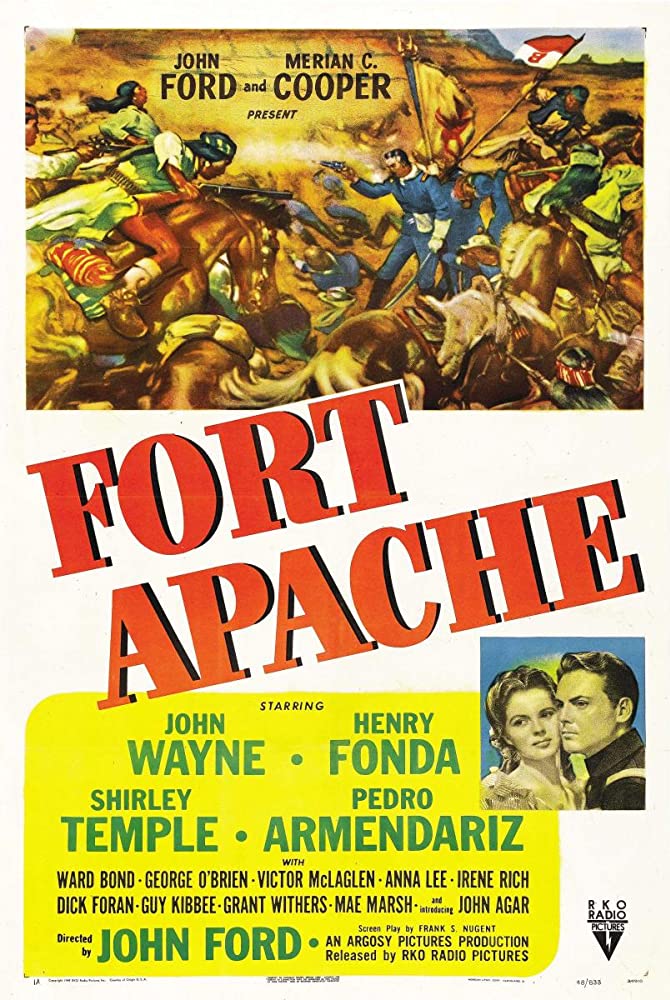
Fort Apache (1948)

Henry Fonda and John Wayne face off in John Ford’s Fort Apache

Director: John Ford

Cast: John Wayne (Captain Kirby York), Henry Fonda (Lt Colonel Owen Thursday), Ward Bond (Sgt Major Michael O’Rourke), Shirley Temple (Miss Philadelphia Thursday), John Agar (Lt Michael O’Rourke), Dick Foran (Sgt Quincannon), Pedro Armendariz (Sgt Beaufort), Miguel Inclan (Cochise), Victor McLaglen (Sgt Festus Mulcahy), Guy Kibbee (Captain Wilkens), George O’Brien (Captain Sam Collingwood), Anna Lee (Emily Collingwood)

Fort Apache was the first of Ford’s “cavalry trilogy”, exploring problems and personality clashes of remote cavalry posts in the middle of what used to Native American territory. Contrary to what you might expect, this is a complex, intriguing film that brilliantly explores tensions between very different ways of thinking and issues of class in America, which are so often overlooked. If it sells some of the tensions of clashing ideals down the river with an ending that fully endorses the myth over the reality, the fact the film makes clear that the idea of a well-meaning army all pulling together is a myth says a lot.

John Wayne is Captain Kirby York experienced, more liberal minded acting commander of Fort Apache. Aware of the difficult balance of maintaining good relations with the Apache tribe while protecting American expansionist interests, he’s perfectly suited for keeping the peace in the West. Unfortunately he’s replaced by Lt Col Owen Thursday (Henry Fonda), an arrogant, class-conscious – if polite and honourable man – who applies the letter of the law to all his dealings, so obsessed with rules (he protests “I’m not a martinet” while bemoaning the lack of proper uniform in the dust filled heat of the West) that he sees no reason to moderate even the most corrupt of the local officials who have driven the Apache to revolt, instead demanding the Apache submit. Disaster is on the cards.

Ford’s film revolves around the personality clash between York and Thursday. While both dutifully respect the chain of command, it’s clear that York has a closer bond and understanding with both the men under them and the complex considerations to balance when dealing with the Apache. Thursday, on the other hand, is an arrogant, prickly character, bemoaning his “demotion” from a field rank of General in the Civil War, to an “obscure” fort. A posting he is determined to escape from with an honour laden victory as soon as possible. 

With Ford’s romantic regard for the ordinary soldier and regular Joe, the sort of posh New-Englandish Thursday is a clear stand-out. A stiff-backed martinet, he never listens to others (he constantly needs to be reminded about names) and has a snobbish disregard for Lt O’Rourke (a callow John Agar) whose father, far from being officer class, is an Irish Sgt Major at Fort Apache. Thursday is notably uncomfortable at such Fordesque events as a NCO ball, or when talking with the men – he even looks unsettled in the desert, wearing full uniform and avoiding a hat in favour of an army cap with a dust-sheet attached at the back (no Ford hero would be seen dead wearing such a thing). 

The character works so effectively because he is played so delicately and skilfully by Henry Fonda. Cast against type – and looking older – Fonda plays Thursday as a frustrated man, terrified of failure who simply lacks the flexibility to adjust to situations. Rules instead are there to be followed in detail, regardless of his personal feeling. Corrupt government agent Meacham he treats with contempt, but he will defend his incompetent regime in Apache land to the death. With the Apache he can’t see past his own inbred ideas of superiority, treating them with a paternal disappointment, certain that they are no match for American cavalry might (spoiler, they certainly are). Fonda however keeps Thursday human, a flawed, rigid man dropped into a role he is ill-suited to and struggling to adjust.

John Wayne offers an equally careful performance as York. Unlike Thursday, York adjusts his actions and decisions based on situations and personalities, rather than enforcement of rules. Army regulations can be respected but applied with sense. Meacham to him should be hounded out of town as the root cause of all the problems. Cochise, the Apache chief, he treats with respect and honour – abiding by deals and attempting to compromise with him to find a peaceful solution (a negotiation Thursday of course torpedoes with his arrogance and intransigence). Wayne is often thought of as the action hero, but here Ford starts to explore his elder statesman quality, as well as his underlying decency and honour as an actor.

Other sub plots interweave neatly around this. John Agar’s young O’Rourke flirts with Thursday’s more liberal daughter (played brightly by Shirley Temple) – needless to say this relationship meets with no approval from Thursday. Thursday’s old colleague Sam Collingwood – now a time-serving captain at the Fort – is paralleled with him and York, as a time-server and mediocrity, a decent family man but lacking the will to do what he knows is right. Ward Bond provides both comedy and also a warm fatherly quality as Sgt Major O’Rourke, proud of his son and re-enforcing discipline on his (mostly Irish of course!) soldiers. 

And of course the action is handled extremely well. A chase sequence with Apache, cavalry and a wagon (under-manned and out-gunned, because Thursday believes a few men and rounds of ammunition should be enough to see off the Apache) is filled with excitement. And, of course, the film builds towards the inevitable disaster Thursday’s rigid mismanagement was always heading towards: a suicide charge against a well defended Apache position, fighting to defend a corrupt agent who Thursday and York both know should be replaced.

It’s a film that quite daringly shows that American’s “mission” in the West was often founded on corrupt officials, and that the military leaders were sometimes rigid, incompetent martinets who led their men to avoidable disaster. It’s shame then that the York – and the film – chooses in a flash forward at the films end to promote the idea of Thursday’s charge being a glorious defeat, rather than an avoidable disaster. And that, this printing of the legend, is important to protect the “why we fight” idea of America. It’s the downside of Ford’s love of the past, of the mythology of the West, that even in the end of a film about incompetence, it’s still seen as noble and important to protect people from the truth and promote the legend, than tell the truth. But then for Ford, protecting the memory of the ordinary soldiers who died is the key – and if that means never questioning the how or why, well then that’s a price worth paying. It’s an idea we perhaps have far less sympathy with today.

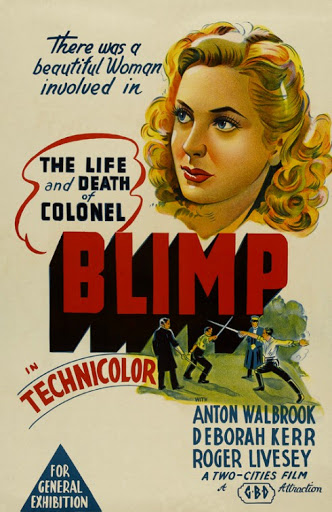
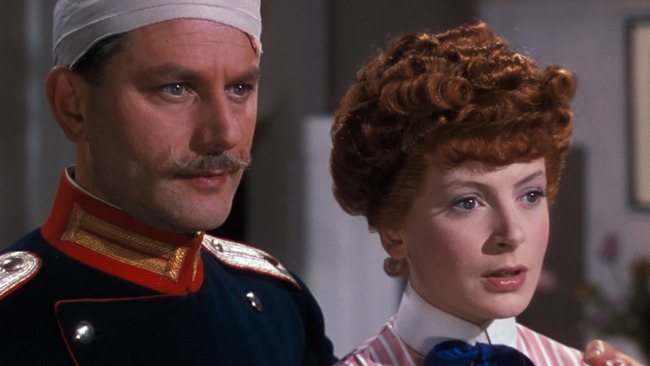
The Life and Death of Colonel Blimp (1943)

Roger Livesey and Anton Walbrook are friends who war cannot divide in The Life and Death of Colonel Blimp

Director: Michael Powell, Emeric Pressburger

Cast: Roger Livesey (Clive Candy), Deborah Kerr (Edith Hunter/Barbara Wynne/Angela “Johnny” Cannon), Anton Walbrook (Theo Kretschmar-Schuldorff), Ursula Jeans (Frau von Kalteneck), James McKechnie (Lt “Spud” Wilson), David Hutcheson (Hoppy), Frith Banbury (David “Baby Face” Fitzroy), Muriel Aked (Aunt Margaret), John Laurie (Murdoch), Roland Culver (Colonel Betteridge)

Is there a film that has better captured the curious state of being British than The Life and Death of Colonel Blimp? Could any other film makers than Powell and Pressburger take a doltish buffoon from newspaper comic strip, and turn him into a tragi-comic figure worth of Hamlet? Could any other film make a wartime propaganda film that features the most sympathetic depiction of the Germans anyone would see for decades to come? Winston Churchill was so scathing of the film that its US release was delayed for two years – and even then it was cut to ribbons. But then, I guess we knew already the guy wasn’t right about everything.

During the Blitz, Clive Candy (Roger Livesey) is a retired Major-General and now a senior commander in the Home Guard. Ambushed in a Turkish bath on the eve of a training exercise (by young officers keen to follow the German example of effective pre-emptive strikes), Candy rages at their dismissal of him as a relic from yesteryear. In flashback, we see Candy’s entire life over the course of the rest of the film. The film charts his military cross, from the Boer War to World War One and his life-long friendship with German officer Theo Kretschar-Schuldorff (Anton Walbrook), after both men are hospitalised after a 1902 duel over insults to the German military. Both men fall in love with the same woman, Edith Hunter (Deborah Kerr) although Clive realises it far too late – and their friendship ebbs and flows over the next forty years.

Powell and Pressburger’s film is, of course, quite beautifully made. The film has that distinctively radiant technicolour look of their most successful works, but it works so well because Powell assembles the whole so wonderfully. Powell knows when to hold a shot and when to look away and his judgement is never wrong. In the duel where Clive and Theo meet (Theo has been randomly selected to fight), the camera at first covers the detail of the prep, then moves to an over-the-head shot as it begins, before pulling out of the gymnasium and away, gliding into a long shot with Berlin sprinkled with snow. Because after all, the actual fight is immaterial to the sense of this being one event in the tapestry of life – and the moment of real importance being the friendship that came from it.

Then, much later, Powell does the exact opposite, holding a shot with powerful, emotional, simplicity. It’s 1939 and Theo is trying to remain in England – his wife having passed away, his sons being lost to Nazism and this adopted country being far closer to his old Prussian ideals of duty and fairplay. In a heartbreakingly low-key, simple speech – just exquisitely delivered by Anton Walbrook – Powell lets the entire speech play out in a single take, giving the moment room to breathe and magnifying its impact enormously – not least by the background extra who switches from shuffling his papers to listening intently to this heartfelt appeal.

It’s this mastery of technique that makes the impact of the film so wonderful – and helps it to masterfully capture the changing of an entire nation. Other the film’s forty years the entire world changes utterly, from one of simple truths where right is right and evils are punished, to the morally complex world of World War Two, where bending the rules and playing dirty might be just what is needed to defeat enemies with no principles. 

Candy is a man of unshakeable morals and ideals, who does not believe ends justify means and is determined that fighting honourably for defeat is far better than victory at all costs. It’s an idea the film affectionately praises, at the same time it sadly shakes its head and admits that such ideals were for the last century not this one. These are ideas Theo has captured far sooner than Candy – and Candy’s tragedy, among his many virtues, is that he always fails until it is almost too late to understand the truth of the world around him (be that politically or romantically).

It doesn’t matter really though, because we always know Candy’s heart is in the right place. In a sublime performance by Roger Livesey, this is a man with an upper-class bombast and a paternalistic regard for his duty and for others. His country and the ideals of that country come first and foremost – but it’s not about pushing those home. He will console honourable foes – as he does with Theo after World War One – and when the battle is over will be the first to say by-gones are by-gones. The film he is in a way a somewhat ridiculously old-fashioned character – but he’s always well-meaning, decent and honourable.

Candy also has the tragedy tinged sadness of not knowing what he wants until it’s too late. He doesn’t realise his affections for Edith Hunter, until she and Theo are telling him of their engagement (although we the audience are already well aware that Edith had feelings for him), and the look of realisation of a deep and lasting love that will last his whole life, is fabulously conveyed by Livesey in a perfect reaction shot. Candy will eventually marry Edith’s near doppelganger, but this unspoken love will last his whole life – and form another bond between him and Theo. Which in itself is what we like to think is a quality the British have at their best.

Along with that British fair-play that is so important to him, it also settles in the friendship between Theo and Clive. A friendship unaffected by tragedy or war (or at least not for long) and which, despite years apart, Clive frequently returns to with all the warmth and openness they first shared. These are bonds of loyalty forged on the playing fields, that operate on unspoken feelings (for a portion of their friendship Theo can’t even speak English). 

These are also the ideas and principles that Clive keeps alive in himself, even while the world becomes ever more bleak around him. He’s a character that never loses his essential positivity and kindness. Deaths or disappointed love are met with regret and then losing yourself in sport (whole years are hilariously shown to pass by montages showing Clive’s hunting trophies appear on walls). But always that British idea of (as Churchill put it) “keep buggering on”, and not letting infinite sadnesses and disappointments undermine or define you.

Powell and Pressburger use all this to make Candy not a joke – as the Lieutenant in the film’s prologue sees him – but as a deeply sympathetic and real man. It’s a film also about our disregard for the old, our failure to ever imagine that they were young. The flashback structure fills in this story beautifully. All this, and it’s not even to mention Deborah Kerr’s superb performance as all three of the women in this story, each subtle commentaries on the other and her return throughout somehow representing the perfect ideals that Clive and Theo are living to. The Life and Death of Colonel Blimp is about understanding how the “rules” of British behaviour are underpinned by a deeper sadness it’s almost a duty to hide – and it understands that better than almost any other film.

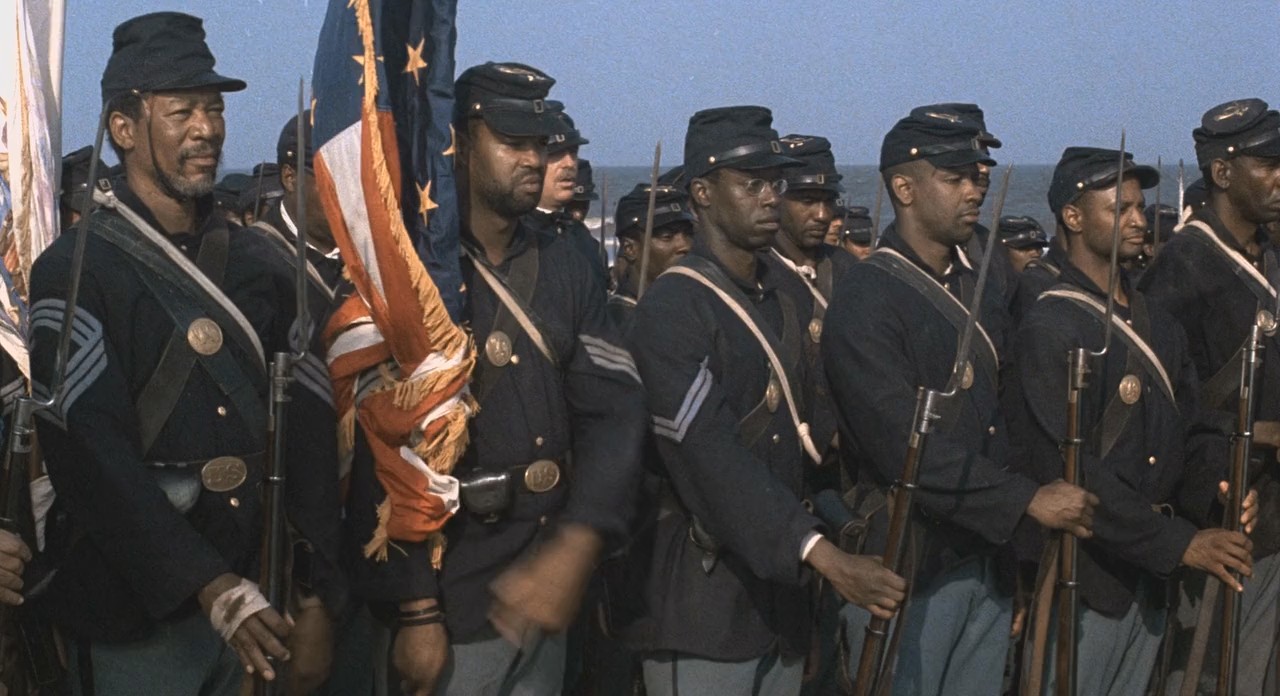
Glory (1989)

Morgan Freeman and Denzel Washington are among the first black American soldier in Glory

Director: Edward Zwick

Cast: Matthew Broderick (Colonel Robert Gould Shaw), Denzel Washington (Pvt Silas Trip), Cary Elwes (Major Cabot Forbes), Morgan Freeman (Sgt Major John Rawlins), Andre Braugher (Cpl Thomas Searles), Jihmi Kennedy (Pt Jupiter Sharts), Cliff De Young (Colonel James Montgomery), Alan North (Governor John Albion Andrew), John Finn (Sgt Mulcahy), Bob Gunton (General Charles Garrison Harker), Jay O Sanders (General George Crockett Strong)

The American Civil War started over slavery, but it took a long time for either side to admit it was a fight about slavery. Racism abounded on both sides, and it was a fight in which black Americans may have been the subject, but were rarely invited to join. Glory covers this point of history, and specifically the first all-black regiment and its struggle to be recognised as equal to the other regiments in the army. 

Wounded at the Battle of Antietam in September 1862, Robert Gould Shaw (Matthew Broderick) returns home to Massachusetts and accepts command of the first all-black regiment, which is currently being raised by abolitionists in the state. With his friend Cabot Forbes (Cary Elwes) as second-in-command (no one was progressive enough to actually allow black officers for the regiment), he recruits a wide range of black Americans, from free-man and bookish intellectual Thomas Searles (Andre Braugher) – an old friend of Robert and Cabot – to former slaves such as the wise John Rawlins (Morgan Freeman) and the resentful Silas Trip (Denzel Washington). Training is a struggle, with the army denying the regiment supplies and support, and it’s an equal struggle when they reach the front line to be recognised for duties other than looting and latrine digging. Will the Massachusetts 54th be given the chance to prove itself in the front line – and establish a black man can fight as hard and bravely as a white man can?

Edward Zwick’s beautifully filmed, carefully re-created historical epic set the tone for much of his future career. It’s an often overly-sentimental film straining for a very self-conscious sense of importance, weighed down by the pride at the “message” it is carrying. It often does hit the mark with presenting scenes that carry emotional force – but then seeing as it treats nearly every scene as being a “moment” that should move us (with James Horner’s choral manipulation working double time to get us experiencing feelings), it’s no wonder that it succeeds sometimes.

Which is not to say the message it presents isn’t an important one. Black Americans have often been pushed into the margins of American Civil War history. Or worst of all presented as the victims, reliant on the courage and bravery of the abolitionists of the North to save them from slavery in the South. Until Glory it was very rare for anything to push their stories front and centre – or to tell a story where former slaves were allowed to fight their own battles and choose their own destinies. 

It’s one of the strongest marks of the film: these are soldiers unlike any other, who enter battles with less concern about their own survival, and more about having the chance to live as freemen and to make a mark on the world. To show that they, and people like them, could do just as a white man could do. And if they had to die to do that, better to live a day on their feet as freemen then a lifetime on their knees. It’s the principle emotional message of the film, and something Zwick translates with some skill, even if he frequently overeggs the pudding while doing so.

However, with such a strong message, it’s a shame so much of the film is filtered through the experience of its white lead character. For many of the films of the 80s and 90s dealing with these issues – Cry Freedom, the Steve Biko biopic, with Biko as a supporting character to his white South African journalist friend, being perhaps the key example – it was essential to have a white man at the centre, as if worried that audiences couldn’t understand the story they were seeing unless they had it filtered through the perception of someone who looks a bit more like them.

Matthew Broderick takes on the lead role here of Shaw – with the film giving a significant slice of its running time to its coming-of-age theme of Shaw learning to become a leader of men – and while the character is meant to be callow and an unlikely Colonel, it doesn’t help that Broderick lacks the charisma for the part. Perhaps he is a little too lightweight an actor for such an enterprise, for a film that demands greater force of character (you can imagine Tom Cruise doing a much finer job in the role).  Similarly, the familiar beats of a young man learning how to lead feel trivial compared to the life-and-death issues facing his soldiers.

But too often Zwick’s film returns us to Shaw’s point-of-view, the narrative filtering so much of the action through his perceptions and decisions that the black soldiers become supporting actors in their own stories. Broderick is not helped by the soldiers being played by some of the finest American actors of the last 30 years. Braugher is fabulous in the thankless role of the bookish man who must grow a spine. Morgan Freeman established a persona – the wise and level headed older man, who will not let hate and fury define his life and his choices – that would last him for the rest of his career, and is superb (his Oscar nomination for Driving Miss Daisy is probably the only thing that led to him not getting a nod for this film).

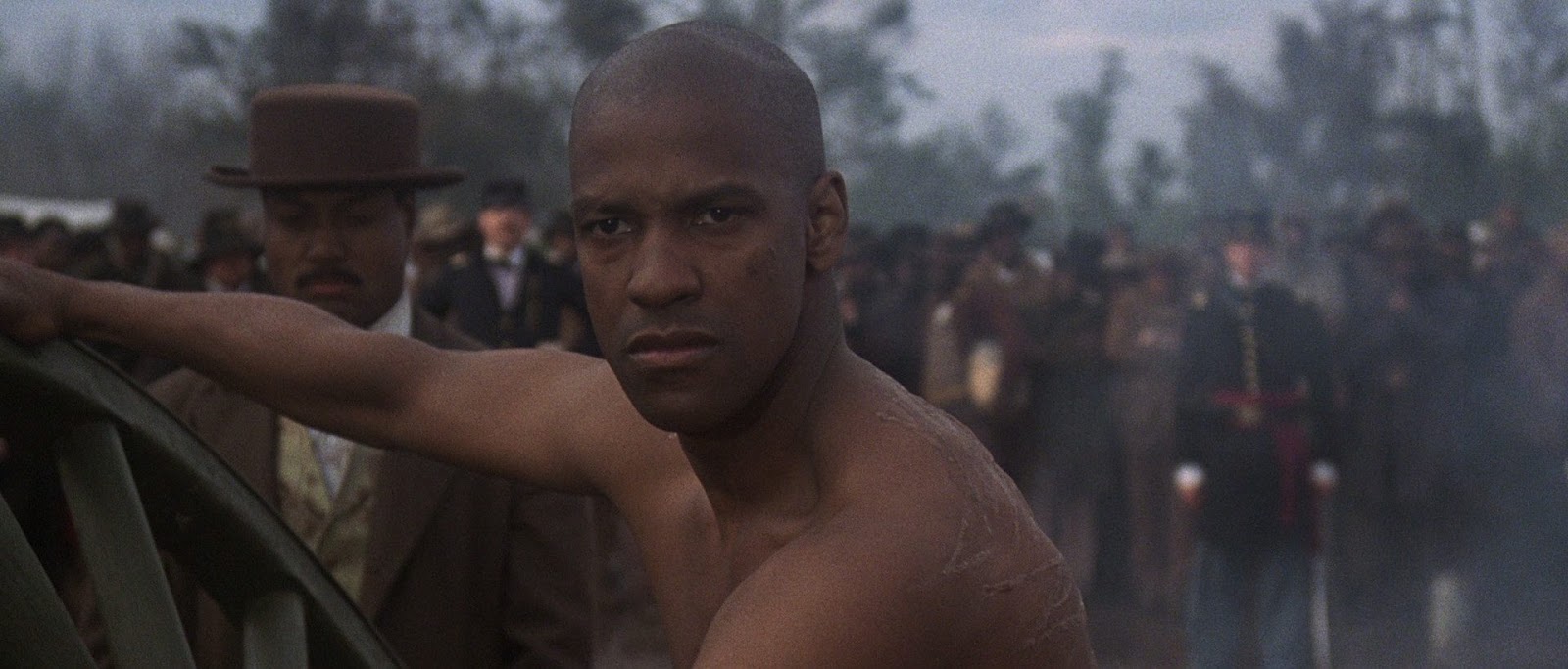
Denzel Washington took home an Oscar as the bitter, angry Trip – and it’s the sort of role an actor seizes with relish. Washington fills every frame with his rage at the system, his inarticulate, indiscriminate anger lashing out in every direction. It’s the fury of a man who has had all his choices taken from him in life, and would rather destroy things than run the risk of allowing himself to become committed to something, or form a bond. Washington probably won the Oscar alone for the astonishing scene where he silently, defiantly accepts a whipping (on a body covered with scars) for missing a curfew. He’s an elemental force of nature in the film.

There is plenty of strong stuff in Zwick’s work, but the film itself overplays its hand frequently. Moments of emotion are played so heavily to the hilt they sometimes fail to have an impact. It wants you to know at every turn that you are watching a film with an important social message – and the speechifying at points put into the mouths of the characters runs dry. While superbly made – veteran photographer Freddie Francis’ work is beautiful (and Oscar winning) – it’s a heavy-handed, overly pleased with itself film that knows all too well that it is about an important subject. While sometimes it lands – often in quieter moments, particularly those where Freeman and Washington are allowed to simply be human without overindulgent music cues hammering home the emotions – at others it comes across as too much.

Paths of Glory (1957)

Kirk Douglas leads men into pointless battle in Kubrick’s Paths of Glory

Director: Stanley Kubrick

Cast: Kirk Douglas (Colonel Dax), Ralph Meeker (Cpl Philippe Paris), Adolphe Menjou (Major General Georges Broulard), George Macready (Brigadier General Paul Mireau), Wayne Morris (Lt Roget), Richard Anderson (Major Saint-Auban), Joe Turkel (Pvt Pierre Arnaud), Timothy Carey (Pvt  Maurice Ferol), Emile Meyer (Father Duprée), Bert Freed (Sgt Boulanger), Susanne Christian (German singer)

Kubrick’s fourth film is one that often gets overlooked when running over his CV – and it’s had less cultural impact than, say, A Clockwork Orange, 2001 or The Shining – but out of all of his films (except maybe The Shining) it’s the one I’ve come back to the most often, and is certainly his first stone-cold classic. This Word War One tragedy simmers with anti-war sentiment, and it’s so beautifully made and assembled you can see its influence in films right up to 1917.

In 1916 the war is bogged down into trench warfare. Command wants results, an action they can point to, so General Broulard (Adolphe Menjou) is sent by the General Staff to instruct General Mireau (George Macready) to launch an attack on a well defended German position called “the Anthill”. Mireau says any attack would be suicide – until the prospect of his promotion being directly linked to it is mentioned, at which point he becomes the attack’s most passionate advocate. Mireau passes the order onto regiment commander Colonel Dax (Kirk Douglas), who protests that the attack is pointless, but is ordered to lead it or be relieved of his command. The attack is a costly farce, and the humiliated Mireau (with Broulard’s tacit agreement) demands a blood sacrifice – one man from each company will be placed on trial for cowardice and shot as an example for the whole French army. Dax deplores this injustice – but with the administrative meat-grinder as deadly as the one on the front, what hope does he have?

Kubrick believed passionately in the project but also needed a commercial hit in order to bolster his career. So he recruited Kirk Douglas to get the funding – Douglas took a third of the film’s budget as his salary, so it wasn’t all charity – and he rewrote the ending of the book to allow Dax to come up with a last minute solution to get the soldiers off. Douglas, to his credit, was having none of that and demanded a rewrite that restored the book’s original bleak ending. 

So it’s largely thanks to Douglas we get the shape of the film that we end up with – but it’s clear that it’s Kubrick’s genius that makes it the film it is. Actor and director were a perfect combination here, so much so that Douglas got Kubrick on board to direct Spartacus (an unhappy experience for them both). But Paths of Glory was where both actor and director were working in perfect partnership, both pushing the other to give of their very best. Dax is the perfect Douglas role – decent, intelligent, well-spoken, passionate, a natural leader, but the film undermines all this with his ineffectiveness. Each of his crusades goes wrong, and he fails at every goal he sets himself. Douglas brilliantly captures both sides of this in his generously low-key but committed performance.

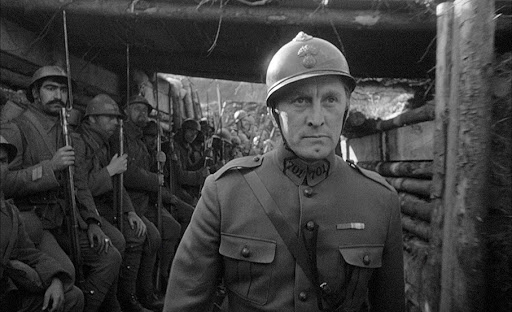
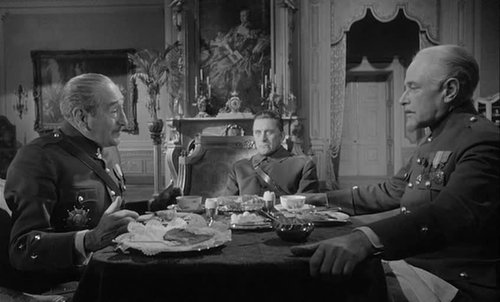
He has a great framework of a film around him from Kubrick. The director uses several longs shots, extended takes and tracking shots to throw us into the world. The opening sequences at the military HQ, taking in the palatial setting of Mireau’s campaign office, have a stately construction and technical formality which then contrasts superbly with the lower angle, tracking shot-laden, POV sequences set in the trenches. Kubrick’s camera glides through these trenches, low angles seeming to make them tower over the viewer, the mud and filth only worse in the body-strewn no-man’s land that stands between the French and the Germans.

It culminates in the attack sequence, one of the greatest battle sequences ever placed on film. Following the doomed advance at a methodical pace, matching the speed of the soldiers, the camera tracks over no man’s land as explosions rend the ground and bodies are thrown to the mud under a hail of bullets. At the front is Dax, vainly blowing on his whistle and encouraging the men forward, while all around him devastation and slaughter win out. Any thought that this wasn’t a pointless enterprise from start to finish is completely dispelled, and our sympathies are completely with Dax and the soldiers, whose lives are superfluous to the ambitions of the generals.

Both generals cut appalling figures for different reasons. Mireau, played with a trumpeting, vain bombast by Macready, is a “blood and guts” soldier who never places his own blood and guts anywhere near the line. Proudly bragging about the skills of his soldiers, then furiously denouncing their cowardice, one telling shot has him in the trenches staring through binoculars at the German positions, oblivious to the wounded men filing past him. Later he orders the shelling of these very trenches in fury at their failure to advance far enough. Broulard is hardly better, Menjou’s “hail well met” bluster hiding a chilling lack of empathy.

The Germans are never seen, because the real enemies here are war itself (and we are kidding ourselves if the same thing wasn’t happening on the other side) and the authorities who push us into it. The film is almost like some sort of black satire, with the generals confidently telling their soldiers they are right behind them, before retreating several miles to the rear to watch the battle unfold. Dax is middle-management, caught between trying his best to deliver orders he knows are impossible, and protecting men he knows are doomed, and failing at both tasks.

The system demands blood sacrifices from the lowest possible rungs, so the hierarchy can reassure themselves they are not blamed (Dax’s offer to take all the blame is promptly rejected by Broulard – no question of any of the officers being at fault!), so the men are chosen by their company commanders. One is chosen by lottery (he of course is a decorated war hero, but that cuts no ice), one because he’s an “undesirable” and the third because he has witnessed his own commanding officer’s cowardice. None of them deserve it, but their guilt is “proved” in a kangaroo court that lasts less than 15 minutes, and in which Dax is barely allowed to put a defence case.

Kubrick’s film becomes a surprisingly fast (it’s less than 90 minutes) but inexorable march towards those three stakes in the ground and the firing squad. Questions of justice and courage are completely pointless – any brave acts in the film are pointless, two of the victims are cited for their courage and the most cowardly character in the film, Wayne Morris’ snivelling Lt Rouget, ends up commanding the firing squad – and the message we are left with is that the institution of war and man are the real villains here.

War has no heroes, only survivors. Victories are important to the generals only in the sense of being tools to jockey for position, and the common soldier is an expendable puppet who can be killed on a whim to fill any political reason. It’s a harsh and chilling view of the military – and leaves very little hope – but it’s superbly made and controlled by Kubrick, in a film surprisingly with more heart in it than any film he ever made before or since. It’s a film that leaks with sorrow and disgust at the victims of the military machine, a film with emotion as well as a technical marvel. It might be Kubrick’s most complete film.

The Good, the Bad and the Ugly (1966)

Clint Eastwood is the Man with no Name in The Good, the Bad and the Ugly

Director: Sergio Leone

Cast: Clint Eastwood (“Blondie”/The Man With No Name), Lee Van Cleef (“Angel Eyes”), Eli Wallach (Tuco), Aldo Giuffrè (Union Captain Clinton), Mario Brega (Corporal Wallace), Luigi Pistilli (Father Pablo Ramírez), Al Mulock (Elam, one-Armed Bounty Hunter), Antonio Casas (Stevens), Antonio Casale (Jackson/Bill Carson), Antonio Molino Rojo (Captain Harper)

The Good, the Bad and the Ugly closed out Sergio Leone’s “Man with No Name” Western trilogy, the role that turned Clint Eastwood into a star. Unlike the other two films in the Dollars series, TGTBTU was shot on a larger and more expansive budget, and showed Leone stretching himself into something more than a peddler of Americana pulp. This was a film that was as much an artistic statement as it was an entertainment – perhaps more so. 

The plot of the film is very simple – considering its extended runtime. Three bandits and hired guns are on a quest for buried gold, while all around them the American Civil War rages. The bandits are: “The Good” (Clint Eastwood) – the taciturn “man with no name” who has more of heart than he lets on; “The Bad” (Lee Van Cleef) – known only as “Angel Eyes”, a stone-cold killer with no soul at all; and “The Ugly”, Tuco (Eli Wallach), a larger than life Mexican bandit, scruffy, scuzzy but with plenty of joie de vivre. The money is hidden somewhere out in a graveyard in the West – but who is going to get there first?

TGTBTU is Leone at a midway point of his career. Tonally the film falls between the more straightforward thrills of the first two Dollarsfilms, and leans closer towards the artistic epic canvasses that Leone would paint in his Once Upon a Time… films. Perhaps this is why TGTBTU is possibly the most popular of all Leone’s films, it’s more entertaining than either of the latter two but has more thematic depth than the earlier two. But that doesn’t change the fact that, watching it, I feel this is reaching for a moral and thematic richness and complexity that is just beyond Leone’s grasp. He’s straining for this film to be something more than his earlier films – and I’m not sure that’s something he manages to do. 

But let’s focus on what the film does right, which is a hell of a lot. This is the film where Leone really found his voice and ran with it. It’s a hyper real world he creates of the Old West, with a tone of artificiality about it. Part of that comes from the odd disconnect you get from the European actors and the dubbed voices that overlay them (not always completely accurately), but it’s there in every inch of the style of the film.

It’s an explosion of style, with artificiality frequently alongside reality, all thrown together into a sort of crazy Western world where everything seems to be happening at once (from bandit towns to the Civil War), and you could turn a corner and end up in either a desert, a battle field or a town under siege. His style is heightened, and makes for some wonderful shots, not least the way first Blondie and later Tuco’s banditos seem to drop into a wider frame, expanding the world suddenly as we watch it. 

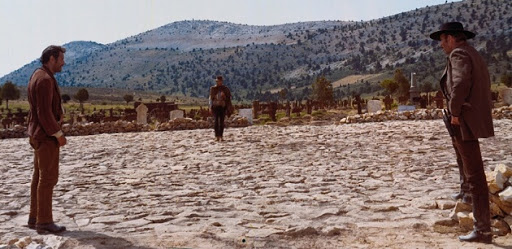
Leone’s a director who practically invented the term “operatic” for cinema. His gun battles are 99% build up and 1% action, and it’s the simmering tension of those build-ups that really make his films stick in the mind. If you think of it, you’ll imagine that iconic Ennio Morricone score (recorded before the film was shot, so Leone could shoot the film to match it – composers dream of having such licence today!), followed by slow series of escalating cuts. Leone will cut to hands approaching triggers, then close ups of faces, then long shots for context, then all of these again and again, each time the hands getting closer, the close-ups getting tighter, the long shots being more prolonged, all of it about building the tension and then BANG the shooting is done in seconds.

The film was criticised for being violent at the time, but it’s more like extremely tense. You can see why Tarantino sites Leone as his master. Watch that introduction sequence for Angel Eyes, a long, quiet scene where he eats a peasant’s food while questioning him and then ends by a sharp series of shootings that leave the family devastated. It’s the style Tarantino was going for in Inglourious Basterds and a tone establisher for Leone. You always know the violence is coming, and you know it will be quick and merciless when it does, but the film makes you sit tensely waiting for it for minutes at a time. The violence when it comes is often cold and those who carry it out are cynics and thieves rather than heroes and villains.

It makes for a sprawling, epic, even rather unfocused film at times – and it means the runtime is hopelessly overextended at over three hours uncut – but it’s also what interests Leone. He sees a world where killers are cool, calm, calculating and don’t go in guns blazing. Where intimidation is an art and micro-calculations occur before any trigger is squeezed. 

And these ruthless killers are in a world of violence all around them. Around the edges of the film’s narrative, the world of the Civil War rages, claiming lives left, right and centre. It’s here that Leone targets a thematic richness that I don’t feel is completely successful. There are elements that work – and the Union prison camp that Blondie and Tuco end up in (staffed by sadistic guards under the guidance of Angel Eyes) is the best of them. Clearly paralleling Nazi extermination camps in the herding of prisoners, the trains that carry them to certain death, the brutal beatings and the Yankee soldiers who are forced to play music (literally for their lives) to cover the noise of those beatings, you can feel Leone’s anger at the horror mankind unleashes on itself. 

But it’s heavy handed at places and makes its points too bluntly, dropping them into the film rather than weaving them neatly into the overall narrative. Towns and villages are bombed out and dead men lie on the edge of roads, but it doesn’t really get tied into an effective contrast with the central treasure hunt narrative. This is Leone straining for greatness, but not having the chops to get there yet. Blondie may bemoan the pointless slaughter of civil war – and even comfort a dying soldier – but these beats could be removed from the film without affecting its overall impact. Leone’s real love is Americana pulp, and his focus on this sometimes gets in the way of achieving his wider aims.

Perhaps that’s also because the impact gets lost slightly in the film’s great, sprawling length – and Leone’s lack of discipline, his insistence in taking everything at his own pace (often a slow dawdle through details), while it works really well for some sequences it also gives us others (such as Tuco running through a graveyard) that seem to last forever for very little impact.

Leone also increasingly became more a director with epic visuals in which characters are only details, with this film. Eastwood – reluctant to return in any case – especially feels like a much blanker presence in this film, coasting through his role almost on autopilot. Although you could say he generously cedes much of the limelight to Eli Wallach, who roars through the film as Tuco. Wallach’s eccentric but heartfelt performance – full of odd mannerisms but underscored with a genuine emotional vulnerability at points matched with a childlike enthusiasm – becomes central to the enjoyment of the film (he’s really the lead character). Van Cleef meanwhile drips demonic, cold menace behind unflinching (Angel) eyes.

Leone’s epic work is a sprawling, over extended, self-indulgent epic that mixes moments of pure cinematic entertainment with heavy handed digressions into man’s inhumanity that are a little too on-the-nose and unthreaded into the central plot to carry as much impact as they should. But it remains one of the most popular films of all time partly because what it does well, it does better than almost anyone – those long, tense build-ups, that electric energy that Wallach represents, the otherworldly artificiality mixed with cold reality. The Good the Bad and the Ugly is Leone’s crowning achievement, and for all its flaws, it still packs a punch.

The King (2019)

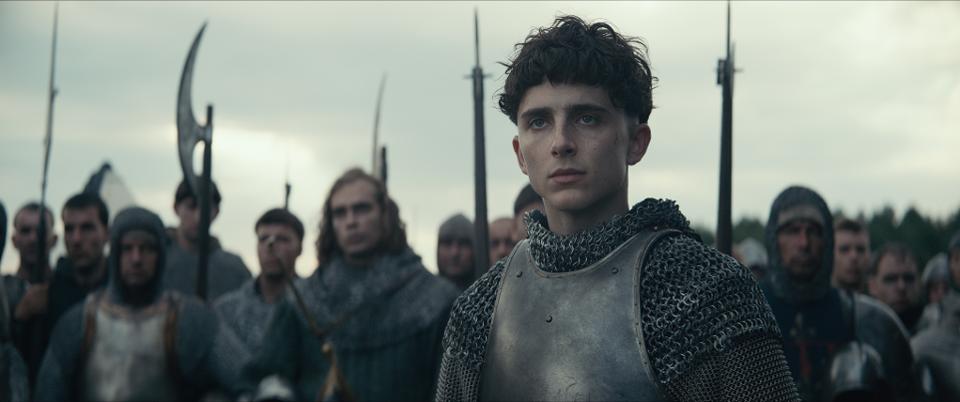
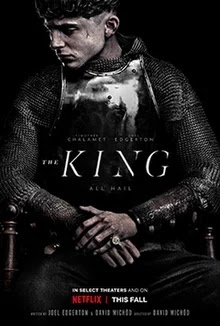
Timothée Chalamet is the war like Henry V in the confused The King

Director: David Michôd

Cast: Timothée Chalamet (King Henry V), Joel Edgerton (Sir John Falstaff), Robert Pattinson (The Dauphin), Sean Harris (William Gascoigne), Thomasin McKenzie (Queen Phillippa), Ben Mendelsohn (Henry IV), Tom Glynn-Carney (Henry “Hotspur” Percy), Lily-Rose Depp (Princess Catherine), Dean-Charles Chapman (Thomas, Duke of Clarence), Thibault de Montalembert (King Charles VI), Tara Fitzgerald (Hooper), Andrew Havill (Archbishop of Canterbury)

This is a story that is pretty familiar to most people now – after all, Shakespeare’s play has probably been being played somewhere in the world for most of the last 500 years. Edgerton and Michôd collaborated on the story and script of this restaging, or reimagining, of Shakespeare’s epic of the wayward fun-loving prince turned hardened warrior king. Despite being handsomely filmed, and impressively shot, this makes for an odd and unusual film which falls between the two stools, as it is faithful to neither history nor the Shakespeare original.

The rough concept remains the same. Prince Hal (Timothée Chalamet) is not just a young man who has fun in the taverns of London, he’s also quite forward looking in his attitudes, and just can’t understand why he should be made to carry on the rivalries of his father, the fearsome Henry IV (a broodingly miffed Ben Mendelsohn) or why he should continue the wars that the council pressures him into. When he becomes king, however, Henry is persuaded by his counsellor William Gascoigne (Sean Harris), that the path to peace for the realm – and safety for his subjects – can only be through unifying the kingdom by war with France. Appointing the only man he trusts – his old drinking companion and famed soldier Sir John Falstaff (Joel Edgerton) – as the Marshal of his armies, Henry heads to France where destiny awaits.

Michôd’s film is at its strongest when it focuses on the visuals and the aesthetic of its age. It’s beautifully shot, with several striking images, from execution courtyards to the battle of Agincourt itself, which takes place in an increasingly grimy field. The battle itself ends up feeling more than a little reminiscent of ideas from Game of Thrones – in fact a few core images are straight rip-offs from the famous “Battle of the Bastards” episode – but it at least looks good, even if there are few things new in it. The costumes and production design don’t feel like they strike a wrong note either with the grimy, lived-in feel.

More of the issues come around the script. The film’s concept of Henry initially as this rather woke modern king – he just wants peace and to give up these tiresome obsessive conflicts of his father – who slowly becomes more colder and ruthless as the film progresses does at least make thematic sense in the film, but it still rings a little untrue. Much as I would like, it’s hard to believe that any prince like this could ever have existed at the time, and so cool and calculating is Chalamet’s performance from the first that he never feels like a genuine, young, naïve princeling whom we can sympathise with early on. 

It makes the film’s arc rather cold, and Hal an even more unknowable character than the film perhaps even intends. There is very little warmth or genuine friendship between Hal and Falstaff, and Hal moves so quickly to the imagining (and enacting) of war crimes during his time in France that his descent towards potential tyrant feels far too sharp to carry impact. Even in the early days of his reign he’s swift to have potential destablisers in his court executed with no mercy. Where is the fall, if he is such a cold fish to start with? And with Chalamet at his most restrained (like the royal baggage and the accent are a straight-jacket around him), how can an audience invest in him? 

And what are we supposed to be making of this anyway, since the film is at equal pains to suggest that the king may be the subject of manipulation and lies that force his hand into war? This Henry, we learn, values truth and honesty highest – but this doesn’t stop him getting pissed when met with counter-arguments from his advisers (even Falstaff) or reacting with cold fury and disavowal when things don’t go his way. It’s a confusing attempt to add an ill-fitting modern morality to a king who essentially in real life spent most of his life at war, and was to die on campaign in France still trying to cement his rights at a young age.

Edgerton and Michôd’s script fails to really square this circle, and all the attempts to have its cake and eat it (the peace loving king still manages to kick arse, including killing Hotspur in single combat thus averting the Battle of Shrewsbury from ever happening) don’t quite pan out. Edgerton writes himself a decent role as Sir John Falstaff, here reimagined as a million miles from the drunken, cowardly knight into a courageous and hardened soldier who has no time for the compromises and deceit of court (in contrast to Henry’s other advisor, the Machiavellian Gascoigne played with a playful archness by Sean Harris). Making Falstaff a respected figure like this rather flies in the face of the logic of why Henry IV is so annoyed about his son spending time with him, but never mind.

It’s not really Shakespeare and it’s not really history. It sticks closest perhaps to Shakespeare in its portrayal of the French as arrogant fops – led by Robert Pattinson going delightfully OTT as the Dauphin – but it never really quite works out what it wants to be. With its Game of Thrones look and feel, and prince who is both great warrior and reluctant warlord, peace-lover and ruthless executor of his enemies, it feels scattergun and confused rather than coherent and whole.

The Beguiled (2017)

Nicole Kidman struggles to resist the charms of Colin Farrell in The Beguiled

Director: Sofia Coppola

Cast: Nicole Kidman (Miss Martha), Kirsten Dunst (Edwina), Elle Fanning (Alicia), Colin Farrell (Corporal McBurney), Oona Laurence (Amy), Angourie Rice (Jane), Addison Riecke (Marie), Emma Howard (Emily)

A remake of Don Siegel’s adaptation of the original novel, The Beguiled throws a feminist slant on a story of a confederate soldier, Corporal McBurney (Colin Farrell) who, in the later years of the Civil War, is found injured in the grounds of a girl’s school, where the women have continued to run the operation while the menfolk are consumed with (and by) the war. The school is run by the distant Miss Martha (Nicole Kidman), with the lead teacher Edwina (Kirsten Dunst) and five students of varying ages. All of the girls and women find themselves entranced (beguiled!) with the deceptively gentlemanly McBurney, whose true aims may be darker than assumed.

Sofia Coppola’s version of the story shifts the attention onto the women of the piece, and their plight and emotional journeys. This is a perfectly legitimate stance to take – and showing effectively a colony of girls and women in the 1860s living some sort of structured commune life is interesting and different – but Coppola’s film has a coolness and distance to it that ironically makes it far less than beguiling than it should be.

Beautifully filmed as the film is, it’s slow pace and meditative tone – as well as the rather obvious points it seems determined to make about male and female relations – actually serve to make the film less engaging than it should be. Wonderfully framed and painterly in its execution, with an effective mix of classical and 1970s style, it still never quite sparks into life.

The cast also struggle to bring a heartbeat to their characters. Nicole Kidman brings her customary reserve and elegance to a woman who has hints of a mysterious past that troubles her to this day, but the role remains distant and difficult to read – more than the film really requires. A clash or seduction between her and Colin Farrell’s corporal keeps promising dynamite but the explosions never really seem to come. Farrell laces his role with charm and a gruff masculinity, but the role misses a sense of his own darkness or manipulative nature until quite late, with the final act revelations making him appear more angry and bitter than the role really requires. It all kind of sums up the film that gets lost in its artifice and fails to uncover its heart.

The film, you could argue, does its best to beguile the audience with McBurney as the film’s character are. We are shown at every angle his vulnerability and tender politeness, and hidden from us for too long are his more manipulative elements. Coppola’s film becomes an intense study instead of sexual feelings and relations within a confined space. From sensual hand washes from Miss Martha, to intense declarations with lonely teacher Edwina, to not-so-innocent flirtations with the pupils, there is more than enough evidence that McBurney’s desire to stay may well be as much linked to seeing the school as having the potential to be his own private harem. The film’s failure in this intense sexual politics is that, while it captures moments of the simmer of attraction, it fails to really establish the danger that McBurney could suggest, as a violent man of action with complete control over a group of women.

Indeed the final moments of the film even suggest that the school itself may be a sort of siren’s bay – although lord knows McBurney is no Odysseys – which I found a rather confusing beat. Effective as the final images, or the film’s last supper betrayals, may be, they don’t carry quite enough wait because the film never quite nails the sexual tension it is aiming for, or the sensual danger it is trying to establish as a theme within the film. 

Other changes make less sense as well. Coppola deliberately changes the race of Edwina, from a mixed-race young woman to someone white enough to be played by Kirsten Dunst. While Dunst’s performance is fine, many of the themes of Edwina’s lack of confidence, her self-loathing, her feeling of having no place outside of the school, of being somehow less than other women are left in place. These themes of course make perfect sense for a mixed race woman in the 1860s who has landed a job through the connections of her father, but they make less sense for an attractive young schoolteacher with a privileged background. Coppola made the change because she felt that she could not do the theme justice, but she misses the fact that the very appearance of the character is the context needed for her to make sense.

The Beguiled is beautiful to observe and has its moments, but it never really comes to light the way it should. Thoughtful and poetic a director as Coppola is, she has created a film here that feels all artifice and no depth, that wants to paint a picture of the life of women in the civil war but never really has the energy and fire to make this come to life in a way to make the audience as engaged as they should be.