Category: War film

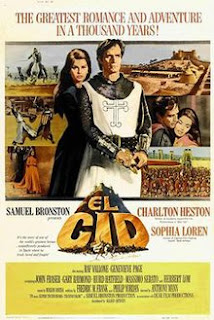
El Cid (1961)

El Cid (1961)

Epic history with just the right amount of seriousness among the scale and thrills

Director: Anthony Mann

Cast: Charlton Heston (Don Rodrigo Díaz de Vivar/El Cid), Sophia Loren (Doña Ximena), Herbert Lom (Ben Yusuf), Raf Vallone (García Ordóñez), Geneviève Page (Doña Urraca), John Fraser (Alfonso VI), Douglas Wilmer (Al-Mu’tamin), Frank Thring (Al-Kadir), Michael Hordern (Don Diego), Andrew Cruickshank (Count Gormaz), Gary Raymond (Prince Sancho), Ralph Truman (King Ferdinand), Massimo Serato (Fañez), Hurd Hatfield (Arias)

Its 11th century Spain, and the country is a mass of feuding Christian and Muslim kingdoms. All that could end if the invasion plans of warlord Ben Yusof (Herbert Lom) come to fruition. To defeat him, the Christians will need Muslim allies in Spain. But of course, none of their leaders have the vision to imagine such a thing: except Don Rodrigo Díaz de Vivar (Charlton Heston) who, after releasing rather than executing two Emirs, is known as “El Cid”. Problem is Don Rodrigo falls continually in and out of favour at court, not helped by his unbending principles. These principles even alienate the woman he loves, Doña Ximena (Sophia Loren), when Don Rodrigo regretfully kills her father in a duel. Will El Cid be able to unite the forces of Castille and his Muslim allies to defeat Ben Yusof?

El Cid was shot on location in Spain, and no expense was spared. Its location footage is beautiful and combined with some impressive sets. Producer Samuel Bronstein was determined to get the best money can buy. The ancient city of Valencia was rebuilt and thousands of soldiers from the Spanish army recruited into the two opposing sides. Thousands of costumes, pieces of armour and weapons were made. Bronstein’s dream cast was assembled (hilariously of course not a Spaniard or Arab among them), led by Hollywood’s biggest stars Charlton Heston and Sophia Loren.

What we get is an at times rather po-faced, sombre even slow epic that still succeeds because it is delivered with such absolute commitment and luscious beauty. Anthony Mann is not the most inventive of directors – and so much of this sort of film is really about producing rather than visionary direction – but he pulls together a collection of visual styles into something that feels wonderfully coherent and suitably dramatic. The castle interiors could have stepped out of Adventures of Robin Hood (Heston and Cruickshank even fight their duel on a winding staircase), the Spanish exteriors rival Ben-Hur and the medieval pageantry brings back memories of Ivanhoe.

It’s pulled together in a script that manages to juggle just about enough action – duels, fights to the death, ambushes, battles, sieges, murders – to sit alongside its earnest attempts to plead for a little love and understanding. Heston’s El Cid is radically ahead of his time, preaching messages of equality and arguing that anyone can kill but only a leader can grant mercy. It’s a film that refreshingly urges that there is more that unites us, than divides us. Yes, it casts Arab characters in most of the villainous roles – while the Christian opponents of El Cid all eventually see the error of their ways – but it still makes several Arab characters (especially Douglas Wilmer’s wonderful Al-Mu’tamin) pinnacles of honour and decency, far more so than most of the bitter and feuding Christians.

At the heart of the film is Charlton Heston, in possibly his most interesting and intelligent ‘epic’ performance. His El Cid is principled to the point of self-harming, but there is a little boy innocence to him that can’t seem to understand why he keeps landing himself in the shit. Duelling with his fiancée’s father, he genuinely can’t understand why he won’t stand down and let the matter rest. Later he marries Ximena with the sad-sack hope that she might remember why she loved him in the first place. He vainly tries to support both sides in the feud to succeed King Ferdinand, because he swore to support all the King’s children. It never occurs to him that Castille might turn down the assistance of the Muslim Emirs he’s recruited. He can understand military nuances, but can’t seem to find the way to translate this effectiveness into courtly politics. And he seems to know it.

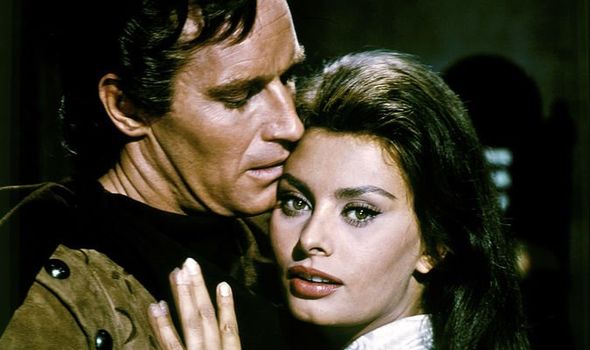
But we know he’s a good guy – so it’s also why we know Sophia Loren’s hatred for him won’t really last. To be honest the chemistry isn’t quite there between them – the two of them famously didn’t get on (Heston famously refused to look at her in many of the romance scenes, hence the odd side-to-side faces in several shots) – and the part of Ximena is incredibly thinly written (she changes her mind about Rodrigo seemingly on a sixpence). But you can’t argue with Loren’s charisma (and she looks ravishingly stunning here) or the force which she can act the hell out of these straightforward scenes (all shot in a few weeks, due to Loren’s availability and Borstein’s determination to get her for the role).

Besides she needed to be the goodie so we could have a dynamic Geraldine Page as the scheming villainous, the Princess of Castille scheming to support her brother Alfonso (a wonderfully fecklessly weak John Fraser), to whom she’s offering more than sisterly love. What chance does headstrong but not-so-bright Gary Raymond’s Sancho have against them? Elsewhere in the cast, Herbert Lom’s voice is used to superb effect as Ben Yusof (like all the actors playing Arabs he’s browned up) and Douglas Wilmer strikes up a wonderful bromance with Heston as an Arabic version of El Cid.

The film is long an often gets slightly bogged down in questions of politics and questions of succession that, at the end of the day, are less interesting than whether Loren will forgive Chuck or our long wait for that Muslim invasion. It is a very long wait: the film opens with Rodrigo a young man – by the time Ben Yusof arrives he’s an old one with two children. Enough events occur sprinkled through the story that it never feels too slow – and you have to admire its attempt at even-handed justice to all.

It culminates as well in a superb sequence covering the siege of Valencia, where all narrative threads are skilfully bought together towards a satisfying conclusion. Mann stages a handsome beach battle here and culminates the film in a long night of the soul that ends with El Cid riding into history in an ironically unique way. The film’s final act is an outstanding mix of epic themes and personal tragedy and loss, that brings the film to a superb finish.

El Cid takes itself seriously – I’m pretty sure there isn’t a joke in it – but it’s well made and acted with a great deal of flair, looks fabulous and never squeezes the life out of itself. As an example of Hollywood’s late epics, there are few that can match it.

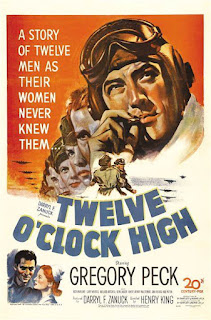
Twelve O'Clock High (1949)

Twelve OClock High header
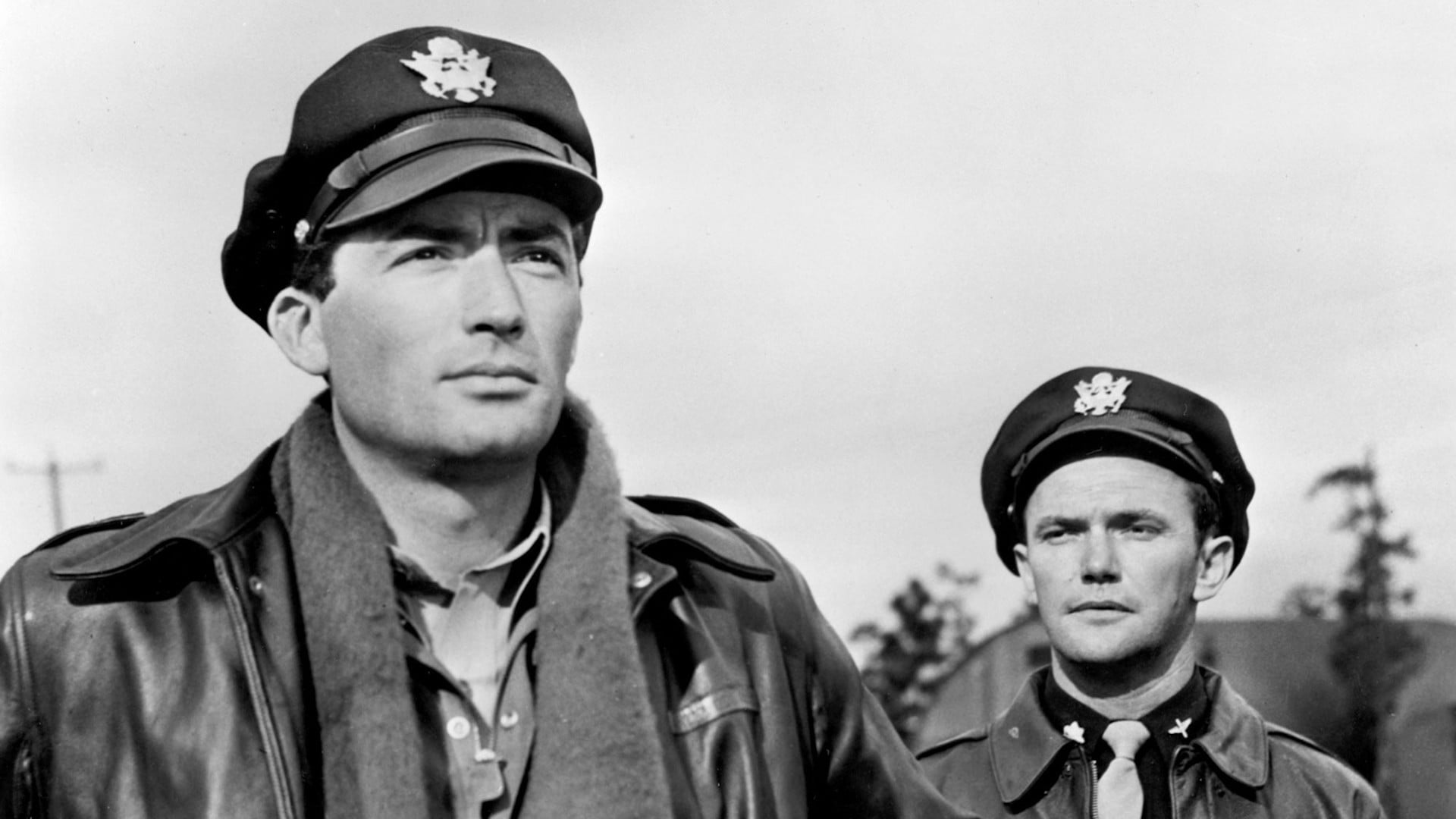
Gregory Peck takes on the burden of command in Twelve O’Clock High

Director: Henry King

Cast: Gregory Peck (Brg General Frank Savage), Hugh Marlowe (Lt Colonel Ben Gately), Gary Merrill (Colonel Keith Davenport), Millard Mitchell (Mj General Pritchard), Dean Jagger (Major Harvey Stovall), Robert Arthur (Sgt McIllhenny), Paul Stewart (Major “Doc” Kaiser), John Kellogg (Major Cobb)

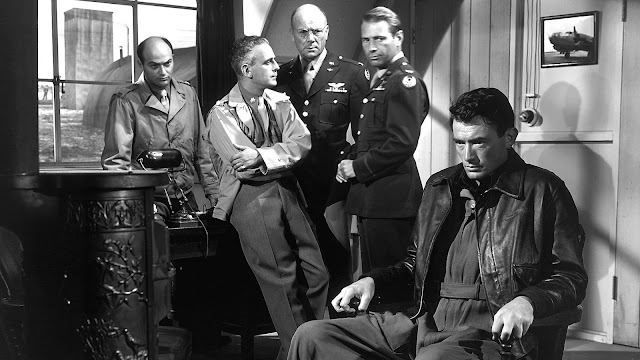
It’s tough at the top. Imagine how much tougher it would be if you job involved pushing people to their limits, and then a little bit further, in a job that puts their lives at daily risk? It’s the sort of burden commanders of American Bomber wings faced during the Second World War. It’s already got to Lt Colonel Keith Davenport (Gary Merrill), a decent guy and much-loved officer, who has grown so close to his men he can’t face sending them off to get killed over Europe any more. He’s replaced by Brigadier General Frank Savage (Gregory Peck), a by-the-book tough son-of-a-bitch who won’t tolerate men who can’t or won’t do their duty. But will the pressure of constant action, escalating casualties and a growing bond with his men also get to Savage?

With Peck at the top of his game, in one of his finest performances of stoical dependability and Lincolnonian authority concealing a carefully nurtured warmth and humanity, Twelve O’Clock High is a very different war film. Here the focus is much less on derring-do and heroism and more on the unbearable psychological pressure a life on the front lines brings. It’s all presented with a documentary style realism – so much so, that the film was used for decades in the USAAF as a training film on successful styles of command.

It’s about the impact that sustained trauma has – how it can make even the toughest man eventually paralysed by over-thinking, uncertainty and doubt. Davenport is a very popular CO – and good in the job in many ways – except the key one: he’s lost the ability to push the men and his willingness to sacrifice them. Essentially, in the nicest possible way, he’s damaging morale by letting the company reflect his own exhaustion, depression and amiable defeatism. He’s lost the ability to push men to want to achieve everything they can for the cause: meaning they are now doing the military equivalent of punching the clock, delivering the barest minimum an attack requires. Mistakes and errors are tolerated and, perversely, casualty rates are rising.

It’s what Savage is sent in to fix. Which he does by essentially blowing apart the cozy, boys-club feel of the Bomber Group. Air Exec, Lt Colonel Ben Gately (a great performance from Hugh Marlowe), is stripped of his command (for not leading from the front) and assigned to commanding the “The Leper Colony” a plane crewed by those Savage believes least likely to pull their weight. Drills are bought in and under-performance is no longer tolerated. Dropping out of formation for whatever reason – a move that puts the rest of the Bomber Group at risk – is punished harshly (a pilot is demoted to the “Leper Colony” for breaking formation to support another a plane, a decision that could have doomed the Group to death). Savage is the ultimate heartless drill sergeant.

Only of course he’s not: as Peck makes clear, the burdens of command weigh as heavy on him as they did on Davenport. But Savage is a professional who knows tough love is what’s going to keep most of the Group alive, accomplishing their missions and bringing the war to an end. And Savage’s policies work: the Bomber Group starts to achieve well above their previous performance. The pilots greet Savage by handing in a group transfer request, but by the time the request is heard by the army (Savage’s adjutant Stovall having delayed the requests with red tape) as a man they back the General. Savage gets then to take pride in themselves and their unit – so much so that, during their first strike on German soil, off duty men smuggle their way onto planes to be part of the mission. (Savage of course doesn’t let slip his pride, rebuking men for abandoning their posts on the base).

Underneath it all, Savage is starting to feel closer to his men. A young pilot, decorated but starting to get worried about flying, is mentored and encouraged by him. Gately responds to the tough love from Savage by aiming to prove to him he is indeed the best pilot in the squadron – winning Savage’s respect, not least when he flies several missions concealing a spinal injury. The pressure inevitably builds on Savage as he finds it harder and harder to maintain his professional demeanour while becoming closer and closer to his men (he even refuses a transfer back to his original job in HQ, as he feels the group isn’t ready for him to leave yet).

It all builds to one of the most famous breakdowns in film, as Savage goes from physically unable to climb into the cockpit to a confused state on the runaway and then catatonic until the Group returns home. This is beyond daring stuff for a 1940s Hollywood film, a true portrait of the effects of wartime pressure on a hero, which never once questions his competence and cowardice but in fact holds up the qualities that led to his breakdown as admirable ones. Peck plays all this with great power and control – and if Savage shrugs off his catatonic state later and the film doesn’t really explore the long-term impacts, the very fact that it showed someone as admirable, competent and professional as this suffering psychological damage from war was quite something.

It’s not a perfect film. King’s shooting style is often unimaginative and the film takes too long to get going – much of the first half an hour is a slow chug towards Davenport being relieved and Savage taking the post. More could be made of the impact of the war on the rest of the men on the group: it’s telling that only Jagger’s Stovell gets a scene where he also is allowed to let off steam against the pressure, getting drunk the night of a big raid, and he won an Oscar for it. But as something very different in Hollywood’s approach to the War, it really stands out as a companion piece to The Best Years of Our Lives.

The Longest Day (1962)

John Wayne leads the charge on The Longest Day

Director: Ken Annakin, Andrew Marton, Bernhard Wicki

Cast: John Wayne (Lt Col Benjambin Vandervoot), Henry Fonda (General Theodore Roosevelt Jnr), Robert Mitchum (General Norman Cota), Richard Burton (FO David Campbell), Eddie Albert (Col Lloyd Thompson), Sean Connery (Pvt Flanagan), Curd Jurgens (General Gunther Blumentritt), Richard Todd (Maj John Howard), Peter Lawford (Brig Lord Lovat), Rod Steiger (Lt Com Joseph Witherow Jnr), Irina Demick (Jeanine Boitard), Gert Frobe (Pvt “Coffee Pot”), Edmond O’Brien (General Raymond Barton), Kenneth More (Capt Colin Maud), Robert Ryan (Gen James Gavin), Red Buttons (Pvt John Steele), Christian Marquand (Cpt Philippe Kieffer), Jean-Louis Barrault (Fr Louis Rolland), Arletty (Mdm Barrault), Paul Hartmann (Field Marshall Gerd von Rundstedt), Werner Hinz (Field Marshall Erwin Rommel), Wolfgang Priess (General Max Premsel), Peter van Eyck (Lt Col Karl Williams Ocker)

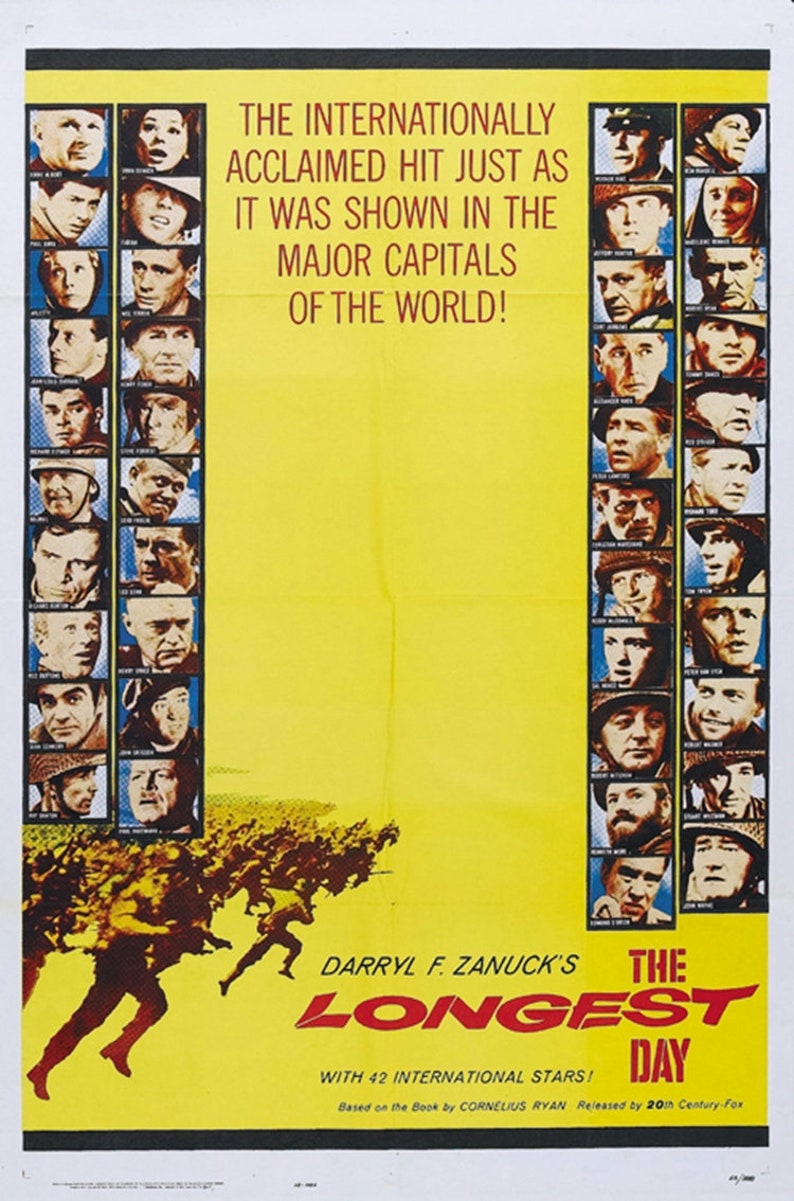
Darryl F Zanuck wanted to make the War Film to end all War Films. So, what better way than to restage D-Day itself, with a cast (as the poster brags) of 42 International Stars, playing out almost in real-time. It’s a grand ‘mock-documentary’ shot in black-and-white (so that actual war footage can be integrated into the film) and aims to show the perspectives of the four main combatants (the Americans, the British, the French and the Germans – with all their scenes played in their respective languages). Adapted from a definitive D-Day book by Cornelius Ryan, it makes for huge, now slightly old-fashioned, Sunday afternoon fun and one of the most iconic second world war films.

To make his dream come true, Zanuck left no stone unturned. Pretty much every single part is played by a ‘name’ actor (although, rather like Around the World in 80 Days, time has left some of them less recognisable than others) no matter how small the role. And I mean no matter how small. Many of the actors appear in no more than one or two scenes. Steiger chips in a brief speech as a Naval officer. Burton has two scenes as an RAF officer, one of the last of the “Few”. Fonda contributes a few minutes of heroism as Theodore Roosevelt Jnr. Robert Ryan briefs The Duke as General Gavin. Jean Servais makes a grand speech as a French Admiral. Gert Frobe doesn’t even speak as a (what else?) bullying German soldier. This parade of stars does though does mean you pay a lot more attention to every single part and it makes it a lot easier to keep track of who’s who.

It’s certainly a ‘producer’s’ film. Zanuck held complete creative control, splitting the directorial duties between three hired hands. Annakin directed all the British and French scenes (and most of the American ‘briefing room’ scenes). Martan, an experienced second unit director, was hired to shoot most of the battle sequences. Wicki looked after the German sequences. With the brief being to replicate the documentary style of actual footage, naturally this basically led to a film that doesn’t have the feel of being ‘authored’ (in the way, say, Saving Private Ryan does), but it’s functional shooting style and design does make it fairly easy to follow.

And it needs to be easy to follow, as this is a very long film indeed – and with the cast frequently changing from scene to scene, can become overwhelming. The quick changes of location – and the lack of time spent with any single character – often means it’s hard to connect to strongly to any of the individual characters. Most of the more prominent characters gain their personality solely from the actors playing them: so I don’t really know what the real Colonel Vandervoot is like, but I know his character here is basically ‘John Wayne’.

The more prominent roles in the script rely on these personality parts. Wayne probably has the largest individual role as the Paratrooper commander who breaks his ankle on landing, but doesn’t let that slow him down from hitting his objective. (Wayne also gets a great little speech, the sort of thing much missed in Ryan, where he praises Brit fortitude under the Blitz, which is a lovely moment of Allied brotherhood). Mitchum gets the juiciest action as General Cota, the highest-ranking soldier on Omaha Beach, who leads the first break out. At the other end of the ranking, Red Buttons brings charm and heartfelt emotion to the most memorable sequence as Pvt John Steele, the paratrooper who landed on top of the church spire at Sainte-Mère-Église, deafened by bells and forced to watch the rest of his platoon slaughtered on landing.

The scale is really what it’s all about. The recreation of the D-Day landings is stunning (the first boats, though, don’t hit the beaches until well over two hours into the film), and its genuinely hard to tell the difference between what is recreated and what is actual war footage. The film doesn’t shirk from showing the cost of war, or the slaughter on that beach (although of course, it looks reserved compared to Ryan). But the combat and operations elsewhere are also perfectly recreated. Richard Todd is very good as Major John Howard, in an expert reconstruction of the seizing of the Orne Bridges near Caen (in real life, Todd himself was one of the commandos serving under Howard and even has a scene where Todd as Howard talks to another actor as Todd).

These battle sequences make for compelling viewing. Slightly less so is the long build-up of the Allies to the attack. There are many, many scenes in various briefing rooms and for every delight (such as Jack Hedley’s briefing around “Rupert” a model paratrooper, dropped as a distraction) there are po-faced actors staring into the middle distance and discussing how important everything is. By far and away the most interesting content in the first half is less the Allies (waiting to leave) than the Germans (trying to work out how and where the Allies will arrive). These scenes feature a range of German officers, from the quietly resigned to die-hard, head-in-the-sand Fascists, and revolve around a series of fascinating debates on where, when or even if at all the Allied attack will come. With a cast of excellent German actors – Jurgens, Preiss, Hartmann, Hinz and Wolfgang Buttner are particularly fine – these scenes stand out as they present a perspective we don’t often get to explore. (Even though the film squarely accepts the German military view that the defeat was all Hitler’s fault and the army was completely blameless of any of the crimes of Nazism.)

After the slow-build, the explosion of tension and action is done really effectively. Sure, the film is long and episodic, but the ever-changing locations do frequently help with the pace. The film’s documentary style also lends it a great deal of authority that a more ‘fictional’ film would not have. After all, pretty much everyone in the film is ‘real’ and while the film could be seen as a collection of D-Day anecdotes, strange moments – such as a platoon of Germans and Americans passing each other on opposite sides of a low wall without noticing each other – have the ring of truth. The script was doctored by a host of major novelists and playwright (including Noel Coward) to brush it up, but really this is a producer’s triumph.

And it is a triumph for Zanuck. Everything he sought to do, he accomplished here – and the doubts that he could pull it off were moved as wrong, as those who doubted whether the Allied plan to cross the Channel would work. Hugely impressive in its staging, detailed in its recreation and with a cast of stars and top actors giving every scene a fresh bit of life, this makes for one of the all-time classic war films.

Michael Collins (1996)

Liam Neeson is outstanding as Irish revolutionary leader Michael Collins

Director: Neil Jordan

Cast: Liam Neeson (Michael Collins), Aidan Quinn (Harry Boland), Stephen Rea (Ned Broy), Alan Rickman (Eamon de Valera), Julia Roberts (Kitty Kiernan), Ian Hart (Joe O’Reilly), Brendan Gleeson (Liam Tobin), Sean McGinley (Smith), Gerard McSorley (Cathal Brugha), Owen O’Neill (Rory O’Connor), Charles Dance (Soames), Jonathan Rhys Meyers (Assassin), Ian McElhinney (Belfast cop)

Britain’s colonisation of Ireland left a poisonous historical legacy that blighted much of the twentieth century. The story of Irish independence, is also one of guerrilla and political brutality, civil war and terrible lost opportunities. Jordan’s biopic of Michael Collins is a study of the man who did more than any other to turn the IRA into an effective guerrilla fighting force – only to be consumed by the very same uncompromising ruthlessness he had set in motion. It’s a powerful and beautifully made film that seeks to explore just how and why violence and politics ended up hand-in-hand in Ireland for almost 100 years.

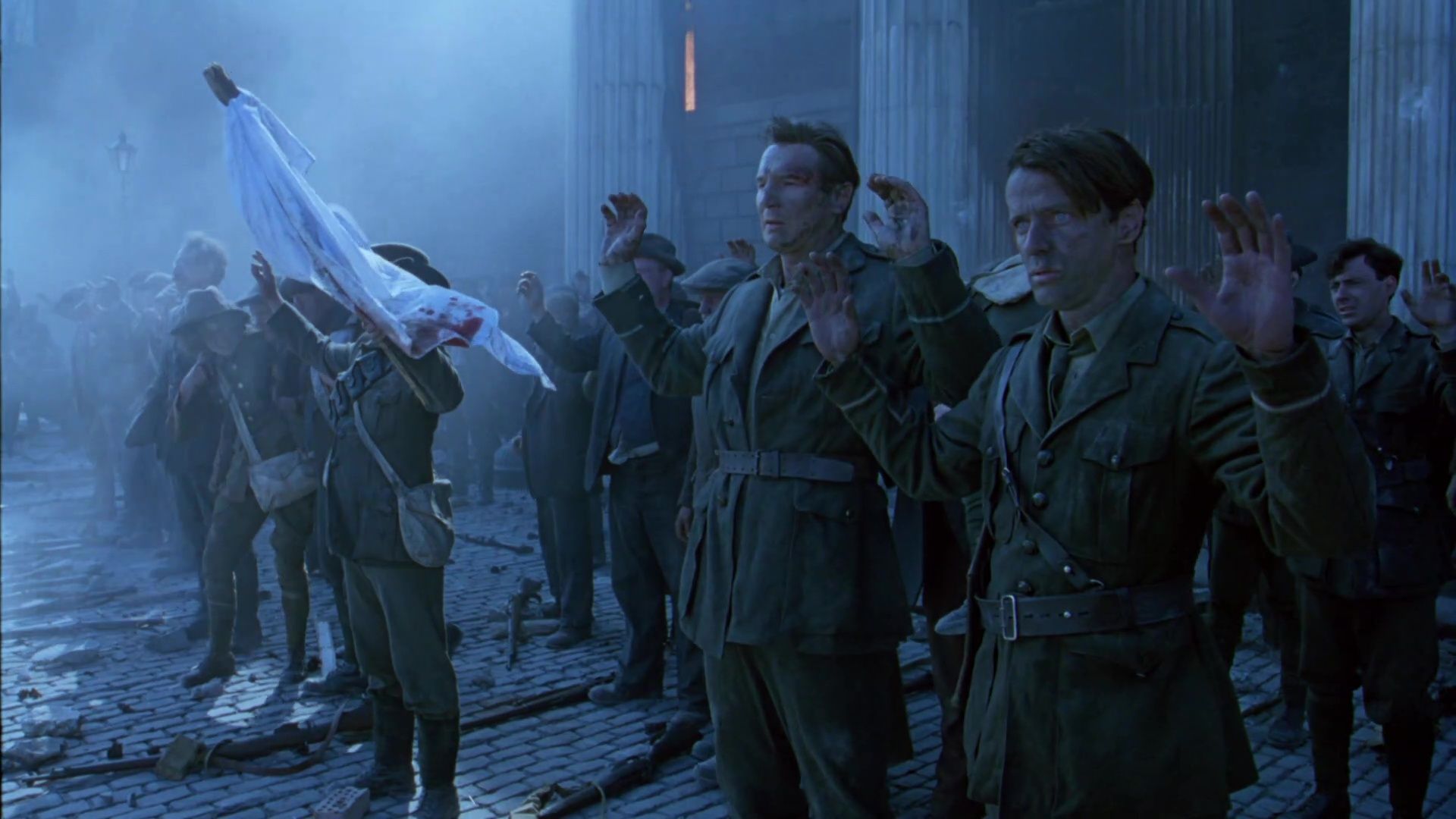
It opens with the 1916 Easter Uprising, an ignominious failure which the British managed to turn into a glorious one by executing rather than imprisoning its leadership. It’s one of many misjudgements in our occupation. It also the impetus for the young Michael Collins (Liam Neeson) to realise that playing by conventional military roles simply means defeat for the Irish time and again. Put simply, the IRA needs to stop trying to be a field army and instead become a guerrilla army, launching targeted hit-and-run terrorist attacks on the British. It’s a hugely successful campaign – despite the doubts of Sinn Fein leader Eamon de Valera (Alan Rickman), who favours more conventional conflict (“They call us murderers!” he cries, with some justification). But after the British agree a Treaty that divides Ireland, the IRA splinters into pro- and anti Treaty factions. Can Collins put the cork back in the bottle of violence, before the country tears itself apart?

Of course, anyone with a passing knowledge of history knows that he can’t. Hanging over the entire film is the knowledge that Collins’ new methods of political assassination, plainclothes soldiers, bombs and bullets in the middle of the night will eventually expand into the indiscriminate bombing and shooting that consumed Ireland for decades. Not that Collins will live to see it, as he was assassinated aged 31 attempting to negotiate an end to Civil War. What makes Collins such an engaging and intriguing figure is that he (or at least the version we see in this film) was a man forced into methods he knew were wrong, to achieve an end he knew was right.

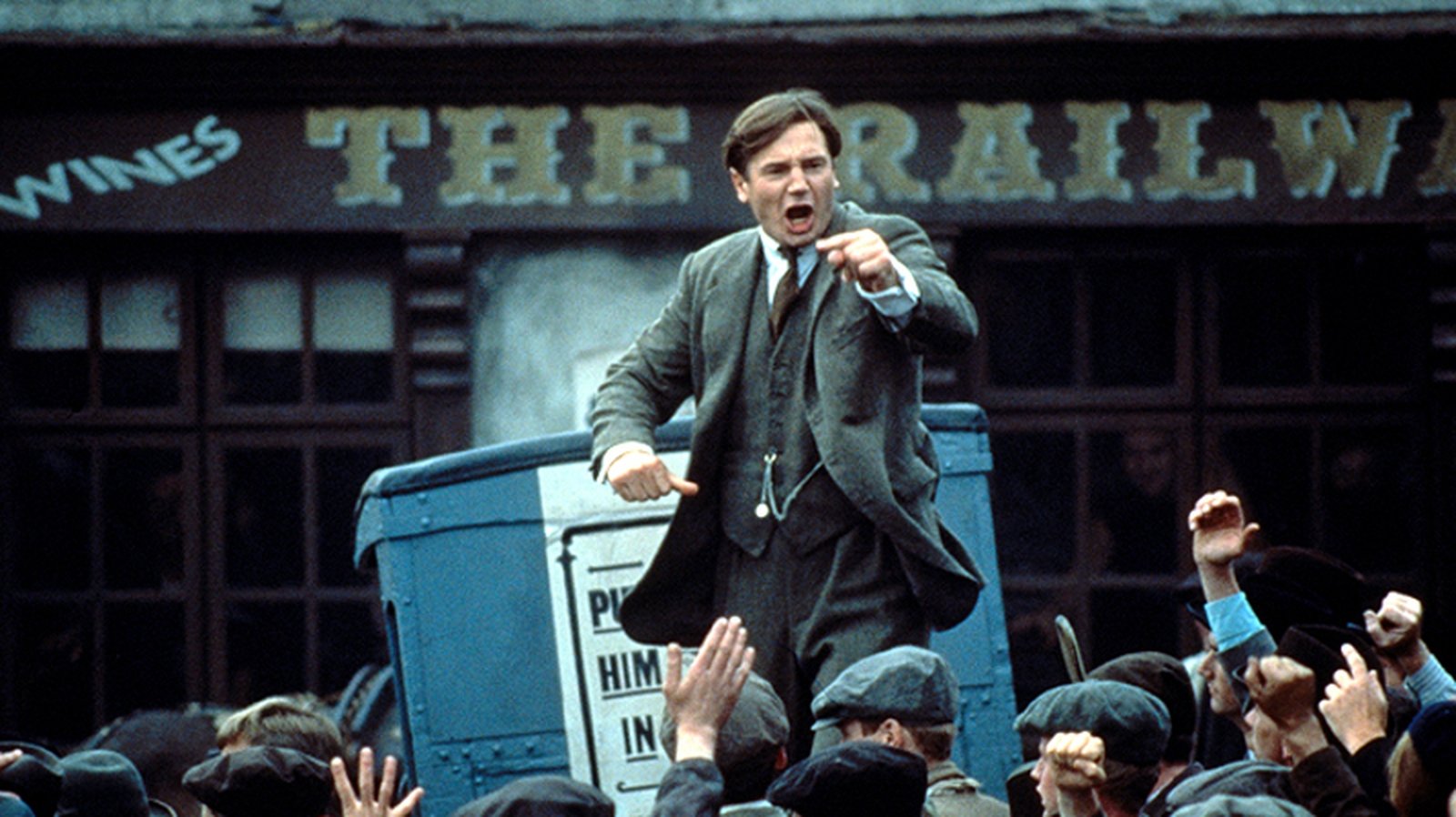
Neeson is superb as the charismatic, blunt yet poetic Collins who is noble enough to know that training young men to quickly and efficiently commit murder is an ignoble legacy. Jordan’s film doesn’t condone Collins use of violence, but establishes why it was necessary. Playing by more conventional rules simply wasn’t going to work – and Ireland didn’t see why they had to wait for British politics to shift. Unlike, say Gandhi in India (and Michael Collins makes a dark companion piece with Attenborough’s Gandhi, two charismatic campaigners choosing radically different paths to independence), Collins believed Britain had to be forced to see holding Ireland wasn’t worth the blood sacrifice and emotional cost. (Jordan’s film is also clear that Britain’s hands were equally dirty, the British conducting their own counter-campaign of assassination and violence).

The tragedy that Jordan finds in all of this is that, when the British were gone, Ireland had become so used to dealing with political problems with violence that they couldn’t imagine solving their disagreements with anything else. Collins is in fact too successful: and the film demonstrates that in radicalising his followers, he’s unable to gearshift them towards compromise. His attempts to get Sinn Fein to accept a Treaty that offers a workable compromise (as opposed to an unwinnable full-scale war), leads to him becoming a victim of exactly the sort of insurgency he pioneered in the first place. To Jordan he is a man trapped in a world of his own making, unable to remove the gun from Irish politics.

Michael Collins makes some compromises with history – something that was bound to get it attacked when dealing with events of such earth-shattering controversy – but it always feel spiritually accurate. The British Black and Tans really were as brutal as they seem, and while they didn’t use an armoured car on the pitch at the “Bloody Sunday” massacre at Croke Park, they did shoot indiscriminately at the crowd and fire at the stadium from an armoured car outside causing 14 fatalities (including two children) and 80 serious injuries. Similarly, in the aftermath of Collin’s assassination of most of the British intelligence operation in Dublin, three IRA leaders were “killed while trying to escape” (even if these were different men than the one who suffers this fate in the film). Just as IRA killings in the street were swift and brutal, so interrogations in Dublin Castle could stretch way beyond what the Geneva Convention would suggest was acceptable.

Much of the first half of the film is structured in the style of an old-fashioned gangster film, with hits and street gangs. Plucky IRA under-dogs (and Neeson’s Collins is so charming, you immediately root for him), take-on the more hissable baddies in British intelligence (led first by a bullying Sean McGinley and then a suavely ruthless Charles Dance). But the romance slowly drains out of this as lifeless bodies hit the floor – and Jordan always gives the focus to the dead after they fall, regardless of their ‘side’. The film has an infectious momentum, which makes its final acts, with their air of tragedy, even more sad and moving. It’s all also quite beautifully shot by Chris Menges, the film bathed in some of the most luscious blues you’ll see.

While Michael Collins is more sympathetic to the Irish (as you would expect), it clearly shows the psychological damage of killing. Hesitant shooters become increasingly ruthless at the cost of their humanity. Collins spends a ‘dark night of the soul’ openly confessing that he hates what he is making young men do and knows it is morally wrong. In the end this explains why methods were chosen, but doesn’t praise them – just as it doesn’t outright condemn them, considering what the Irish were up against. It’s a difficult balance, but very well walked.

There are flaws. Excellent as Liam Neeson (at the time 15 years older than Collins was when he died) and Aidan Quinn as his number two Harry Boland are, the film’s insertion of a love triangle between them and Collin’s eventual fiancée Kitty Kiernan often descends into weaker “Hollywoodese”. It’s not helped by having Kitty played by an egregious Julia Roberts, who struggles gamely with the Irish accent, and who never transcends her star status.

Additionally, while the film has an excellent performance by Alan Rickman (in a pitch perfect vocal and physical impersonation) as Eamon de Valera, it also repositions de Valera as an antagonist. Although de Valera certainly was a prima donna who associated his interests and Ireland’s as being one and the same, the film implies that de Valera’s actions are motivated as much by jealousy as principle and lays most of the blame for the civil war on him. Not to mention implying de Valera’s complicity in Collins eventual death (a heavily disputed assertion, strongly denied by de Valera).

Michael Collins though is a thoughtful, complex and engaging film that brings a tumultuous period of history successfully to life. Jordan’s film manages to wrestle an enthusiastic admiration for Collins, with a questioning exploration of how his actions (however well motivated) led to a legacy of violence. But it doesn’t lose sight of how Collins was aware he was using wicked methods for a noble aim, or that his goal was to bring peace. Wonderfully acted by a great cast (every Irish actor alive seems to be in it), with Neeson sensational, it’s an essential watch for anyone interested in this period of history.

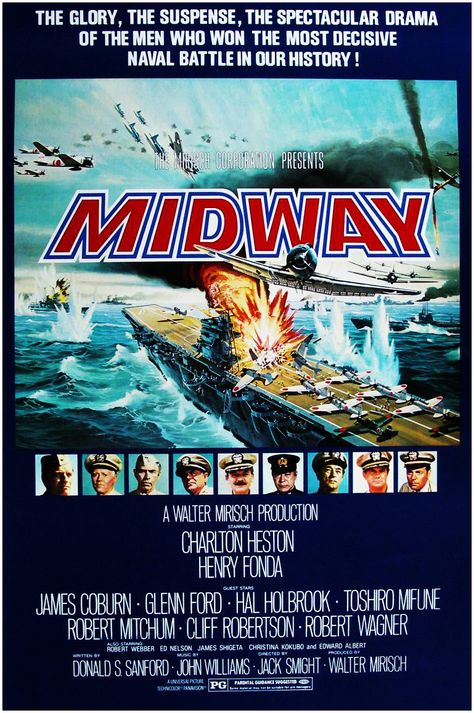
Midway (1976)

Charlton Heston fights in one of the great naval battles at Midway

Director: Jack Smight

Cast: Charlton Heston (Capt Matt Garth), Henry Fonda (Adm Chester W Nimitz), James Coburn (Capt Vinton Maddox), Glenn Ford (Rear Adm Raymond Spruance), Hal Holbrook (Comm Joseph Rochefort), Toshiro Mifune (Adm Isoroku Yamamoto), Robert Mitchum (Adm William Halsey), Cliff Robertson (Comm Carl Jessop), Robert Wagner (Lt Comm Ernest L Blake), Robert Webber (Rear Adm Jack Fletcher), James Shigeta (Vice Adm Chuichi Nagumo)

On 4th June 1942, the fate of the Pacific naval war was arguably settled. The Japanese plan to invade the American base on the island of Midway and, crucially, wipe-out the American aircraft carrier force, instead saw a near total US victory and all four Japanese aircraft carriers destroyed. The story is re-told here as a classic all-star Hollywood epic, with the first hour dedicated to the planning and the second hour to the events of 4th June.

After its – successful – run in the cinemas, Midway was re-edited into a two-part TV mini-series. To be honest, that feels more like its natural home. It’s competently directed by Jack Smight – but no more than that – and revolves around several scenes of star-actors pushing models around maps and less famous actors pretending to fly planes in front of blue-screen. The film makes a proud statement at the start of how it has chosen to use only actual archive combat footage to “honour those who fought” – but this actually, you suspect, was motivated more by the fact it’s much cheaper to purchase and clean up piles of stock footage than it is to shoot things afresh.

The main narrative covers the planning and the crucial day of the battle itself. A brief “human interest” story is introduced via Charlton Heston’s (fictional) Captain Matt Garth, an aide of Admiral Nimitz. Will Chuck improve his relationship with his fighter pilot son, who has fallen in love with a Japanese girl? Whadda you think? Saying that, this rather clumsy human-interest story (which features the only female character in the film) does make some interestingly critical points about the policy of internment against Japanese Americans – stressing both the injustice and explicit racism (American Germans and Italians faced no such fate) behind the policy.

In fact, Midway is very sympathetic in general to the Japanese – as Nimitz even says at the end, perhaps it was less a question of skill than luck that led to the final outcome. The Japanese navy is presented as an honourable and thoughtful opponent, respectful of human life and conducting the war via a code of honour (the kamikaze runs of cliché are completely absent). In particular Admiral Naguma (well played by James Shigeta, in possibly the film’s stand out performance) is a decent man caught-out continuously by horrendous luck and timing, who pays a heavy price. Midway is strong in stressing there is no leeway at sea – get caught out there and it’s the bottom of the briney for you.

The Japanese planning is even slightly tragic in its flawed assumptions – crucially they are totally unaware that their codes are broken and that, far from launching a surprise strike, they are actually sailing into something of a trap – while Toshiro Mifune brings a lot of nobility to Yamamoto even if all he really does is pensively stare at a series of maps.

On the American side, Fonda leads the way, giving Nimitz more than a touch of Fordian home-spun heroism. Heston’s presence does well to link together the various true-life characters and location. Most of the rest of the all-star cast are restricted to one or two scenes: Coburn rocks up to handover a report from Washington, Wagner briefly pushes models across a table in a planning room and (hilariously of all) Mitchum delivers both his tiny scenes from a hospital bed, coated in skin cream.

When the action gets going though, it’s done pretty well with the po-faced, stodgy seriousness these war-time later 70s epics nearly all seemed to have in common. The stock footage does actually look pretty good and the drama of the battle – and the tactics – are captured fairly well. It’s intermixed with some real ships and all scored with a great deal of punch by John Williams. It’s all really B-movie, TV-movie-of-the-week stuff but it’s also far from obviously flag-waving either, instead doing its best to be even-handed and even a little bit critical. You’ll learn what happened and also have a bit of fun into the bargain.

All Quiet on the Western Front (1930)

All Quiet on the Western Front (1930)

War is hell in one of the greatest and most influential war films ever made

Director: Lewis Milestone

Cast: Lew Ayres (Paul Baumer), Louis Wolheim (Stanislaud Katczinsky), John Wray (Himmelstoss), Slim Summerville (Tjaden), Arnold Lucy (Professor Kantorek), Ben Alexander (Franz Kemmerich), Scott Kolk (Leer), Owen Davis Jnr (Peter), William Bakewell (Albert Kropp), Russell Gleason (Muller)

Franklin Roosevelt once said “War is young men dying and old men talking”. Perhaps no film shows that more truly than All Quiet on the Western Front. The first truly great film to win Best Picture at the Oscars, it’s a profoundly influential and unflinching look at the horrific cost of war. Specifically, it looks at how a younger generation buys into dreams of glory and destiny, only to arrive at the front lines and discover they’ve been sold a pup. A sense of glorious purpose collapses into death, mud and misery. War, it turns out, is hell.

All Quiet on the Western Front follows a company of German soldiers during the First World War, plucked from their college to lay down life and limb for the Kaiser. Their unofficial leader is Paul Baumer (Lew Ayres), an intelligent and thoughtful young man. They soon find the frontline is a world away from what they expected, and death moves through the boys like a flu. Over time Paul, with the mentorship of experienced soldier Stanislaud Katczinsky (Louis Wolheim), finds his naïve view of the world torn away with each bullet and failed attack.

In many ways it was brave to make such a large-scale Hollywood epic that placed the side America had actually fought against in the sympathetic role (on the other hand, much easier to look at the losing side and say “you’re fighting for a hopeless cause”). But that makes the film’s message even stronger: it doesn’t matter about sides, war claims young men regardless. The deaths come thick and fast on the Western front – and the gains are negligent. While the boys’ Professor (a pompous Arnold Lacy) sings a familiar hymn of glory and success by Christmas, life on the front line is actually continual terror. Mud, rats, debris and the constant chance the next step you take could be your last. Shelling is non-stop and every inch of the rickety, ramshackle trenches shakes with each explosion. Never mind going over the top, just being there shreds the nerves.

When the attacks come, the film is striking in its modernism and visual invention. Milestone frequently uses intriguing angles and long tracking shots to present an uninterrupted vision of hellish conflict. The film is full of crane shots, urgent camera movements and judicious cutting. The horrors are shown clearly – at one point a soldier literally explodes while cutting through barbed wire, his hands left clinging to the wire, the rest of his body gone. Milestone intercut shots of machine guns firing an arc with the camera moving in a smooth tracking shot as men run towards it and collapse in death. The film is literally shredding its soldiers.

The debris filled, fox-hole spotted no-man’s land the film presents is hellish. It’s a literal minefield of death, with bodies charging backwards and forwards depending on the tide of battle, the camera moving alongside them. For hand-to-hand fighting in the trenches, Milestone shoots the action with a tracking crane shot above the trenches, which stretch like a jagged flesh wound in nature, overflowing with people trying desperately to kill each other. During one charge, Paul lands in a fox hole with a French soldier, who he mercilessly wounds with his bayonet – then spends a dreadful night watching him slowly die. There isn’t any glory here and attack and retreat are both equally pointless. All that really happens is the body count ticking slowly up.

Most of the company are dead well before the film hits the half-way point. After the first big attack, the company goes behind the lines for a meal. Their meal is almost denied them as it was made for a company twice the size of the one that actually reports. It’s a sign of the suffering and hardening to death, that the reaction of the survivors is joy at the unexpected double rations. Later Milestone follows the fate of a single pair of boots, in a beautifully edited sequence that constantly visually focuses on a pair of good boots, while their successive owners meet their deaths.

It’s all so different from how we started, with an Eisenstein-inspired series of cuts to cheering faces as the students sign up. The horseplay at the training camp – where they deal with an officious postman turned corporal Himmelstoss (a puffed up and preening John Wray), overly aware of his own rank and determined to rub the boys faces in it – in no way prepares them for what is to come. This is all too clear from their confused faces at the staging post, a chaos of mud, soldiers and shelling. No wonder no one at home understands what’s happening here – as Paul discovers on leave, when he is repeatedly shocked and disgusted by the casual triumphalism of old-armchair-Generals utterly ignorant of the realities at the front.

All Quiet on the Western Front is so beautifully shot and edited – you can see its influence on so many war films to come – that it’s a shame some of its dialogue and ‘acting’ scenes are now either a little too on-the-nose or overstay their welcome. There are some big themes handled in the dialogue: why are we fighting, what is the point of war, how do we live our lives when they could end at any time – but the dialogue is sometimes a little stilted. It’s also where the film reverts to something more stagey and theatrical and less cinematic and visual. It’s also a slightly overlong film – already a sign that Hollywood had a tendency to equate “important” with “long”. Most of the films’ points are well made by the first hour, and the second hour or so often repeats them.

However, those concerns are outweighed by how much there is admire. Lew Ayres is very good as the noble Paul – the film had such a profound effect on him he became a life-long pacifist, a conscientious objector in WW2 who served as a front-line medic. Louis Wolheim is superb as the rough-edged but decent and kind Kat, a senior soldier taking the new company members under his wing and teaching them nothing is more important than the next meal and no unnecessary risks.

All Quiet on the Western Front takes place in a naturalistic quiet, with no hint of music to interrupt the mood. It is an overwhelmingly powerful movie about the pointlessness and cruelty of war – and the lies that young men are told to fight it. When Paul returns to the homefront – and sees another class of boys being inspired to die for their country by his Professor – he denounces the whole thing (and is promptly branded a coward). War is a cycle that eats everyone it comes into contact with and has no logic behind it. Directed with verve and imaginative modernism by Milestone, this is a brilliant picture, one of the first sound masterpieces – and still one of the greatest war films ever made.
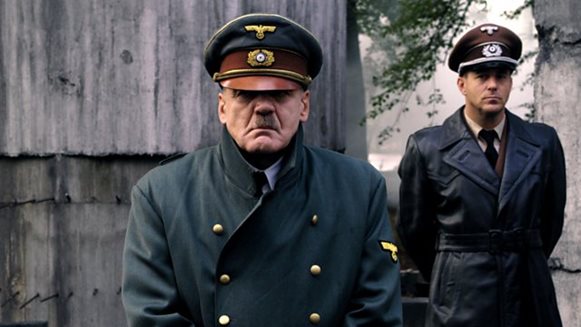
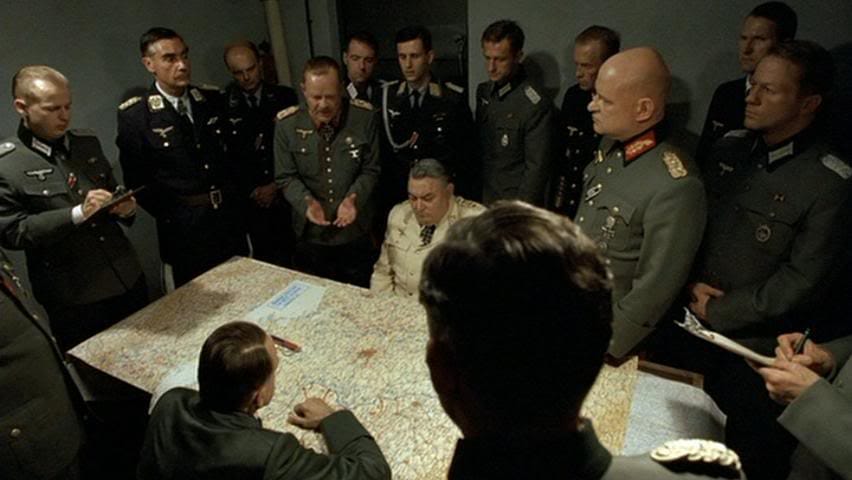
Downfall (2004)

Bruno Ganz excels as Adolf Hitler in Downfall

Director: Oliver Hirschbiegel

Cast: Bruno Ganz (Adolf Hitler), Alexandra Maria Lara (Traudl Junge), Ulrich Matthes (Joseph Goebbels), Juliane Kohler (Eva Braun), Corinna Harfouch (Magda Goebbels), Heino Ferch (Albert Speer), Christian Berkel (Professor Ernst-Gunther Schenck), Matthias Habich (Professor Werner Haase), Thomas Kretschmann (Hermann Fegelein), Michael Mendl (General Weidling), Andre Hennicke (General Mohnke), Ulrich Noethen (Heinrich Himmler), Birgit Minichmayr (Gerda Christian), Rolf Kanies (General Hans Krebs), Justus von Dohnanyi (General Burgdof)

Few people had such an impact on the 20th century than Adolf Hitler. Countless dictators unleashed genocide and war, but few on Hitler’s scale. His dark presence lingers like a cancer on German history, an existential guilt the country has spent generations trying to exorcise. Chronicling the final days of Hitler in his Berlin bunker, told with cinematic verve and documentary realism, Downfall was the first German film to directly tackle Hitler. Perhaps it needed a German film to present a Hitler who felt real rather than an under-the-bed monster – and was able to look into his darkness, and the horror of his world, in a way few films have ever done.

Downfall was controversial on release for ‘humanising’ Hitler. Certainly, the film shows a man capable of consideration and even moments of warmth. But it’s never in doubt a man can be kind to a secretary or affectionate to a dog and still be a sociopath who greets news of young soldiers dying with the words “that’s what young men are for”. Can still be so wickedly egotistical he decides the entire German population should join him in immolation while manipulating with quiet emotional pressure as many of his followers as possible to join him in suicide. Watching the film, you cannot escape Hitler’s monstrous destructiveness, his complete lack of empathy and his instinctive, brutality.

Much as we might not want to face it, Hitler was human: a ruthless, megalomaniac and genocidal one. Part of the fascination of the film is watching those closest to him – Eva Braun, his secretaries, his immediate staff – try to reconcile the kinder private man they know with the one they hear screaming for his Generals to be shot and ranting about Jews and his desire to annihilate entire populations. At one point Eva Braun tells Junge that when saying those things “he is being the Fuhrer” – as if Hitler and the Fuhrer are some hideous Jekyll/Hyde monster.

Downfall charts the final spiral of Hitler as he goes through the stages of grief at his impending defeat. Self-confidence turns into carpet-chewing anger, when reality becomes unavoidable. Grief mixes with fury as Hitler blames everyone – his Generals, his followers and finally the German people themselves – except himself. Never once does the film offer the slightest shred of sympathy for Hitler, this nightmare being all his own creation, consuming him just as it consumed tens of millions before.

As Hitler, Bruno Ganz is quite simply phenomenal. Studying for months film of Hitler, Ganz captures his physicality perfectly – adding Hitler’s likely (undiagnosed) Parkinson’s, a twitching hand he constantly hides behind his back like a nervous expression of his doubt. In private conversation, Ganz’s Hitler is polite and even a little warm, but never anything less than a monster of self-absorption. His favourite topic is himself, and his quiet expectation that everyone should join him in death is matched only by his cold dismissal of those who fail to live up to his twisted standards.

This is nothing to his furious outbursts at those perceived to have betrayed him. His spittle-fuelled rants perhaps only come close to the true carpet-chewing bawlings Hitler was apparently capable of, but they are tour-de-forces of relentless fury and self-pity. Ganz plays Hitler with empathy, but makes it very clear Hitler was incapable of such an emotion himself. The suffering of others is nothing to him. He sheds tears over the death of his dog and barely bats an eyelid at the deaths of thousands: instead they are a perverse monument to himself.

Nazi Germany is the country he created, and Downfall is exceptional in showing how the last days of the Reich were like the final hours of a cult. Few things display this better than the Goebbels themselves. Ulrich Matthes chilling Goebbels is so consumed with devotion for his leader, weeping when ordered to survive and continue the fight, that he cannot imagine living without him. Like Hitler, his fury is reserved for the German people – to him the German people chose their fate and cannot complain that their throats are now being cut.

This is matched by the devotion of his wife Magda, played with a chilling, twisted sadness by Corinna Harfouch, so devoted to Nazism and Hitler she decides (with the logic of a twisted fanatic) her children should die rather than live in a world without them. In a quietly devastating, almost impossible to watch, scene she feeds them ‘medicine’ (actually a sleeping agent) – her eldest daughter, sensing something is wrong, resists desperately before being force fed – then silently breaks a cyanide capsule in each of their mouths, with a kiss to each forehead. Everyone in the bunker knows this happening, but no one stops her. In this cultish world, where death is normalised and suicide expected, it’s only natural.

The second half of the film is a rash of suicides. A German doctor, his hands filthy with the euthanasia programme, detonates two grenades at a dinner, killing his whole family. The Goebbels shoot themselves and order their bodies cremated in a grim echo of Hitler’s own fate. As survivors plan a breakout, an officer calmly states he’s not leaving and shoots himself in the mouth – no one bats an eyelid. Hitler hands out cyanide capsules like candy, the unspoken expectation constant.

This callous brutality and nihilistic embracing of death is constant during the grim, pointless, desperate battle for the city. Indoctrinated children are press ganged into the front-lines and then choose suicide over surrender. Lynch mobs prowl the streets, executing anyone not seen to be fighting – mostly old men, disabled veterans and anyone not holding a gun. The film never suggests the German people are victims, but suggests the final target of the Nazis was Germany itself.

The film is a long spiral into an anti-chamber of hell. After the opening half hour, the Russian advance means the action retreats almost entirely underground into the bunker. In this subterranean world, the cast slowly thins out as people seize their chance to flee, leaving only the most deluded, hard-boiled and fanatical. Generals may protest Hitler’s denunciations of the ordinary soldiers, but will pull their guns on anyone who even suggests the idea of surrender.

In a country where Hitler has encouraged a denial of reality, the scheming and jockeying for position continues even in this madness. Even those who see the end is here are still deluded: Himmler firmly believes a brief chat with Eisenhower will be enough for the SS to be entrusted with maintaining the peace against Bolshevism. Only Speer (played perhaps with too much sympathy by Heino Ferch, in the film’s one mis-step) is clear eyed about what is happening.

Downfall is relentless and eye-opening in destruction of the final days of the Reich. Its reconstruction and research is faultless and acting breathtaking. Framing the device through the experiences of naïve secretary Traudl Junge (an excellent Alexandra Maria Lara), we get a sense of how the scales slowly and painfully fell from the eyes of the German people. It’s atmosphere of oppressive claustrophobia and bleakness is expertly done, with events swiftly and awfully spiralling down into one where death becomes an unremarkable inevitability. No one could come out of this either admiring Hitler or seeing anything in Nazism other than a twisted cult that consumed its followers with the same blood-curdling carelessness it did its millions of victims. Hitler may have been a human, but Downfall makes clear he was never humane.

The Lord of the Rings: The Return of the King (2003)

The Fellowship face one final battle in the conclusion of Jackson’s stunning trilogy

Director: Peter Jackson

Cast: Elijah Wood (Frodo Baggins), Ian McKellen (Gandalf), Viggo Mortensen (Aragorn), Sean Astin (Samwise Gamgee), Andy Serkis (Gollum), Billy Boyd (Peregrin Took), Dominic Monaghan (Meriadoc Brandybuck), John Rhys-Davies (Gimli), Orlando Bloom (Legolas), Bernard Hill (Theoden), Miranda Otto (Eowyn), David Wenham (Faramir), Karl Urban (Eomer), Hugo Weaving (Elrond), Liv Tyler (Arwen), Cate Blanchett (Galadriel), John Noble (Denethor), Ian Holm (Bilbo), Christopher Lee (Saruman), Brad Dourif (Grima Wormtongue), Sean Bean (Boromir)

By the time the third film in Jackson’s Lord of the Rings trilogy came out, we all knew this was something very special. Readers of Empiremagazine voted it the 9th Best Film Ever Made the month it was released. It was showered with awards, winning every Oscar it was nominated for (11, including three for Jackson) and grossed over a billion dollars worldwide. The Return of the King is a landmark – and it’s a stunning sign-off for a triumphant trilogy.

Frodo (Elijah Wood) and Sam (Sean Astin) are even closer now to Mount Doom, guided by the treacherous former ring-bearer Gollum (Andy Serkis). While they must negotiate the dangers of Mordor, Sauron has sent his forces out to conquer Middle Earth. The city of Minas Tirith is his target. Facing an army of thousands of orcs, the city’s only hope is if Gandalf (Ian McKellen) can defend it long enough to allow Aragorn (Viggo Mortensen) – the man destined to become king of Gondor – to lead a relief force. Will Frodo resist temptation and destroy the ring? And will Aragorn be able to defend the city and become its king?

I think it’s fair to say, with books as widely loved as this, no one is going to agree with every single decision Jackson and fellow writers Fran Walsh and Phillipa Boyens made. Here again, changes have been made – famously the scouring of the Shire that closes the novel has been cut (with Saruman dispatched in the opening scenes of the extended edition). What the screenplay seeks to do is increase the pace and tension – it’s probably why Denethor, leader of Gondor, is reinvented as an antagonist (of which more later) and events charge ahead with a relentless forward motion. There is no stopping to catch breath here: there is always a new crisis to solve.

Where changes have been made, they largely have a positive impact. For example, the film takes the decision to introduce conflict between Frodo and Sam – as well as increasing further the scheming malice of Gollum – by having the disturbed ring-addict manipulate the two hobbits into a falling out. This allows Frodo to enter the lair of the giant spider Shelob (a disgustingly visceral creation) alone. Not only does this make Frodo more vulnerable, it also increases the bravery and nobility of Sam, by having him return to save the day (and allow for a classic Hollywood nick-of-time entrance).

The change also adds to the devious brilliance of Gollum, once again superbly played by Andy Serkis. After spending much of The Two Towers bringing out the depth and sadness in this fragile character, The Return of the King carefully shows how this doesn’t excuse his fundamental ruthlessness. The film opens with a flashback showing Smeagol finding the ring, serving as a neat reminder of the Ring’s fundamental wickedness: within seconds its pushes Smeagol to murder his best friend. The sequence following Smeagol’s moral and physical collapse neatly reminds us of its danger and also how close Frodo is to all this happening to him.

Frodo’s suffering and painful growing maturity is more central here. Wood brilliantly charts Frodo’s continuing moral and emotional decline under the Ring’s influence. Increasingly a physical wreck, Jackson carefully lets the suspicion grow that Frodo’s not going to be capable of chucking the ring away. Balancing this, Astin’s Sam Gamgee (the most heartfelt and affecting performance) becomes the moral centre, self-sacrificing, optimistic and fundamentally decent – a beacon of light in the grimness of Mordor.

Again, Jackson ups the stakes, with TROK taking place on the grandest scale you could imagine. The battle sequences are breath-taking in their depth and ambition. But, as with the other films, Jackson knows the scale counts for nothing if you didn’t care about the characters at its heart. So, while the events are epically earth-shattering, the film always brings us back to simple emotion. Even in the siege of Gondor, it finds time for a quiet moment of humanity between Gandalf and Pippin.

But those battle scenes are still stunning. The orc armies are terrifyingly vast, while the strafing run of the airborne Nazgul (soldiers snatched from towers are thrown hundreds of feet to their deaths) adds to the sense that victory is hopeless. Soldiers fight desperately for their, and others, lives. The film even tops the Two Towers’ charge of the Rohirrim with a stunningly rousing charge involving thousands of horses into the massed ranks of Orc (and tops that minutes later with a second change accompanied by a sweeping camera movement and swelling musical cue that is just about perfect).

Jackson brilliantly communicates how much the stakes are against our heroes. We really feel their bravery and desperation as they take on impossible odds – and it’s that which really gives the scenes their power, not the scale or the special effects. No moment is lost without bringing us back to moments of bravery and vulnerability from our leads. There are powerful moments of warmth, kindness, loyalty and generosity throughout. It’s finally what makes the film so effective – it’s a tribute to the power of friendship.

It’s all powered with a beautifully operatic score by Howard Shore. Shore’s music captures perfectly the world of Tolkien. A few years after this, an ill-fated musical version of LOTR was launched – and flopped. Because, essentially, Shore has already turned these novels into a sort of opera-slash-concerto, with perfect themes for everything from martial orcs to whimsical hobbits. Some of the musical cues are so luscious and stirring, they make you want to stand and applaud. The music accompanying Gandalf’s rescue of the retreat from Osgiliath is a wonderful highlight, the triumphant and tense music for the Rohirrim charge is stunning, the score for our heroes leaving for the Undying Lands beautiful. LOTR is so beautifully scored, Shore’s work so gorgeous, LOTRis a film you could certainly watch with just the music playing and still understand it perfectly.

Of course, there are things you can criticise. Denethor – in the novel a portrait of corrupted nobility, his intelligence and pride turned to despair – is repositioned here as a sort of heartless WW1 General, gobbling food while his soldiers die and embracing a nihilistic death wish (although this change does allow for the absolutely beautiful Gandalf/Pippin beacon lighting sequence, in defiance of Denethor). It’s not helped by Noble’s lip-smacking performance, stripping the character of nuance. It’s gives Gandalf more to struggle against, but it’s a crude approach for a character who would have worked better as a mis-guided elitist rather than a crass, hissable villain.

Lots of people have had a pop at the multiple endings as well. Jackson certainly teases us a little too much with fades to black. But I’d argue the lack of a definitive full stop adds greater depth to the story. Tolkien was partly inspired by his experiences in WW1. In that war, the hell of the trenches came to an end, but people’s lives didn’t end with a triumphant parade. Instead, they needed to return home and adjust back into civilian life. I think it’s powerfully affecting that the hobbits return to an unscoured Shire, which hasn’t changed at all while they (and us) have seen Middle Earth torn apart. And it adds real force to why Frodo, in particular, can’t return to “life as normal”.

It gives a powerfully moving, bitter-sweet ending and, I think, brings out a rich, emotional message from Tolkien’s story often missed: Frodo and his friends are fighting to protect their home, but find that they have changed so much they can never settle back into that home in the same way again. It’s something soldiers serving in WW1 experienced, and it feels fitting echoed in Jackson’s LOTR.

Jackson’s LOTR will always spark conversations around faithfulness and otherwise to the source material. Not everyone will agree with every choice. But surely no one can argue with the majesty, scale and wonder of these films, the sublimely perfect casting choices, or the loving detail in every touch of the design. When I first saw Return of the King in the cinema, the audience got to their feet and applauded. You can’t blame them: watch this and you are watching something very special, a true landmark in cinema.

Saving Private Ryan (1998)

Tom Hanks leads a platoon of men through incredible sacrifice in Spielberg’s landmark Saving Private Ryan

Director: Steven Spielberg

Cast: Tom Hanks (Captain John Miller), Edward Burns (Pvt Richard Reiben), Matt Damon (Pvt James Francis Ryan), Tom Sizemore (Sgt Mike Horvath), Jeremy Davies (Cpl Timothy Upham), Vin Diesel (Pvt Adrian Caparzo), Adam Goldberg (Pvt Stanley Mellish), Berry Pepper (Pvt Daniel Jackson), Giovanni Ribisi (Medic Irwin Wade), Dennis Farina (Lt Col Anderson), Ted Danson (Cpt Fred Hamill), Harve Presnell (General George Marshall), Bryan Cranston (Colonel), Paul Giamatti (Sgt William Hill), Nathan Fillion (“Minnesota” Ryan)

There are few films you can categorically point to as changing cinema. Saving Private Ryan is one of those films. Before it, there had never been a war film like it: afterwards there would not be war film uninfluenced by it. Spielberg turned the Second World War from the picturesque setting for an all-star epic, into something immediate, ground-level and utterly, terrifyingly all-consuming. The “boots on the ground” vision of war, that didn’t shirk once from capturing the horrific cost and terror of war and had no suggestion of adventure. Hollywood would look at war differently ever more.

From landing at Omaha beach on D-Day, the film follows a single week in the lives of Captain John Miller (Tom Hanks) and a platoon of soldiers, sent on a ‘public relations’ mission. Three brothers have all been killed in action, with their mother receiving notification of their deaths all on the same day. The top brass decide she has suffered enough and that her last remaining son James (Matt Damon) should be bought home. Problem is, he’s a member of the 101st Parachute Airborne – and no one is quite sure where he’s been dropped. Miller and his men are to find Ryan and bring him home – despite the resentment of his men that their lives at being put at risk to save one man.

Any discussion of Saving Private Ryan begins with that Omaha beach sequence.  It’s hard to even begin to understand the impact this sequence had on audiences in 1998. Quite simply, we’d never seen anything like it. Expectations before its release was that Spielberg was producing a crowd-pleasing, Dirty Dozen style men-on-a-mission film. No one expected a savage, brutally realistic vision of what warfare actually meant, with its brutal, swift and random death.

The sequence starts with Spielberg panning across the faces of soldiers in the landing craft Miller and his company are riding to the beach. He lingers on these faces – only for them to be promptly ripped to pieces by machine-gun fire the second the doors open. Omaha beach is a savage nightmare, the closest thing you can image to hell on earth. Machine gun bullets rip down relentlessly on the pinned down soldiers – and the camera throws us right in there with them.

With drained out colours, hand-held camerawork (some of it operated by Spielberg himself), mud, blood and sand spraying up into the lens, it’s all-consuming. The film’s sound design is awe-inspiringly good, every single sound (the splatter of sand, the thud of bullets ripping through flesh, the snap of rifles) builds into a shatteringly immersive crescendo with no respite. Spielberg doesn’t shy away from the horror. Bodies are mutilated by bullets. Heads are caved in. A soldiers walks the beach, carrying his own severed arm. Medics treat soldiers drowning in their own blood, crying for their mothers. Bullets claim the brave and scared alike.

You watch and you can’t believe anyone emerged from this alive. The cost of getting off the beach is seismic. The visceral horror doesn’t let up over the first 25 minutes as Miller’s company – suffering huge losses – struggles from landing craft, to beach, to storming the German defences. Our ear drums are assaulted by bullet sound effects, and every single step shows us some new horror. There are no long-shots, no cut aways and the only peace we get is when we share with Miller his tinnitus from narrow-escape explosions. The brutality is even-handed – after the massacre on the beach, the US soldiers show no mercy to the Germans (two of whom are gunned down surrendering and begging for mercy), officers urging their men to “let ‘em burn” as on-fire Germans fall from incinerated machine gun banks.

It’s extraordinary – and sets the tone. Combat is immediate, visceral, terrifying, brutal and always carries a heavy cost. The human body is infinitely fragile and every death – high or low – is met with fear, loneliness and regret. Veterans had to leave the cinema during screenings to compose themselves, and viewers were stunned into silence. You could watch Saving Private Ryan and feel you never even began to understand what war was until then – and that even with this taste you can still never understand it. It’s a brutal zero-sum game with only losers.

Any film would struggle to follow that: but Saving Private Ryan does a fabulous job of maintaining the dramatic force of its opening sequence before its book-end final battle, as the remains of the platoon join Ryan’s unit in a seemingly-hopeless defence of a vital bridge in a bombed out town (another grim, gripping and stunning slice of war with the added kick to the guts of watching people we have spent the entire film with being blown away and ripped apart by bullets).

Spielberg’s film explores what makes the cost of this worth it. It’s a film about the power of sacrifice: the sacrifices the men make to find Ryan, but on a larger scale the sacrifices this whole generation made for those that were to come. When Miller urges Ryan to “earn this”, he’s speaking to us all. Men like him died to give us the chance to make the world a better place. The sacrifices of this platoon for one man is all part of the same price this entire generation made for the ones that were to come.

And one of the things sacrificed is the rules of humanity. Prisoners are shot, unarmed men are killed – if you play this game, you play to win. Thrown into Omaha, the audience understand this – meaning we feel as little patience with translator Upham (a fine performance of out-of-his-depth-fear from Jeremy Davies), who whines about right-and-wrong, as his colleagues, who understand living-and-dying is the only issue out here anyone cares about.

Understanding this depends on relating to the soldiers – and the cast has been hand-picked for that. None more so than Tom Hanks, channelling his relatability into a home-spun, ordinary man forced into extraordinary and brutal situations that have left a shattering mark on him. With an intermittent tremor in his hand, Hanks embodies the stoic sacrifice of a generation. It’s a landmark performance. There are many fine performances in the film, Tom Sizemore (battling drug addiction and a promise of instant dismissal if he relapsed) perhaps the stand-out as his hardened sergeant.

If Saving Private Ryan has a fault, it’s that it falls into Spielberg’s sentimentality trap. Sometimes the man can’t help himself. The film is bookended by an old man visiting war graves – someone we discover at the film’s end is Ryan himself. As if somehow still not trusting us to get the message about sacrifice and horror the film has so effectively communicated, old-man-Ryan explicitly tell us, tearily asking his wife if he has led a “good life”. It’s a hammer-home the film doesn’t need and dents its final impact. (I’d also say the film has endless empathy for US Joes, but sees all the Germans as a ruthless swarm fighting an evil cause, although many of them were also as scared).

But these are quibbles in a film that does so much right – and which reinvented an entire genre. It’s one of Spielberg’s masterpieces, a stunning display of directorial skill and immersive film-making, and its impact never seems to lessen. It gets as close as any film can to showing us war – and yet it is still a million miles further away than most of us (thankfully) will ever have to get.

The Lord of the Rings: The Two Towers (2002)

Peter Jackson’s second film in the Lord of the Rings trilogy is another triumph

Director: Peter Jackson

Cast: Elijah Wood (Frodo Baggins), Ian McKellen (Gandalf), Viggo Mortensen (Aragorn), Sean Astin (Samwise Gamgee), Liv Tyler (Arwen), Andy Serkis (Gollum), Billy Boyd (Peregrin Took), Dominic Monaghan (Meriadoc Brandybuck), John Rhys-Davies (Gimli/Treebeard), Orlando Bloom (Legolas), Cate Blanchett (Galadriel), Bernard Hill (King Theoden), Christopher Lee (Saruman), Hugo Weaving (Elrond), Miranda Otto (Eowyn), David Wenham (Faramir), Brad Dourif (Grima Wormtongue), Karl Urban (Eomer), Sean Bean (Boromir), Craig Parker (Haldir)

After Fellowship of the Ring we knew we were in safe hands. So, the real question was would The Two Towers continue to win over long-term fans and new-comers to Middle Earth? Would Jackson pull off the difficult middle chapter, resolving some things, but leaving us with enough tantalising hooks? He succeeded: for many The Two Towers is their favourite film in the series.

The fellowship is broken. Boromir (Sean Bean) and Gandalf (Ian McKellen) are dead. Frodo (Elijah Wood) and Sam (Sean Astin) are making their own way to Mordor – now guided by the former ring-bearer, the dangerously untrustworthy and unbalanced Gollum (Andy Serkis). Aragorn (Viggo Mortensen), Legolas (Orlando Bloom) and Gimli (John Rhys-Davies) are tearing across the land of the kingdom of Rohan following the orcs who kidnapped Merry (Dominic Monaghan) and Pippin (Billy Boyd). Meanwhile, the dark forces of Saruman (Christopher Lee) are moving against Rohan and its sickly king Theoden (Bernard Hill), determined to destroy it. War has truly come to Middle Earth – but can the return of an old friend help to turn the tide? And will Frodo and Sam find safety or danger when they meet Boromir’s brother Faramir (David Wenham)?

Hard to believe considering the scale of the first film, but Jackson’s second Tolkien adventure ramps up the scale even further. It continues the immersive capturing of the look and feel of the novels, while reconceptualising it into something closer to a stirring, gripping action epic. The Two Towersis awe-inspring in its scale and world-creation, building towards one of the all-time great cinematic battles as the few of Rohan hold out against the massed forces of Saruman at Helm’s Deep.

Just as in Fellowship the pace and tension is heightened. With the heroes split into three groups, there are a number of balls to juggle. But Jackson and co-screenwriters Fran Walsh and Phillipa Boyens superbly intercut the more linear book chapters – feeling free to shift orders, motivations and inventing their own narrative flourishes to link events together. The film adapts around 13 of the novel’s twenty chapters (the rest being assigned to the other films), but is so perfectly paced it never feels overstretched or disjointed. They even add more material involving Saruman, making this arch-manipulator a larger presence in the film than in the novel.

The Two Towers radically changes many of the events of the novel – but in most cases (except one) this is done with such respect for Tolkien that even most fans overlooked them. So, it hardly matters Theoden’s motivations for making a stand at Helm’s Deep have radically changed or that the films add warg action or has Aragorn presumed dead at the halfway point. Elves turning up to fight at Helm’s Deep is such a “Hurrah” moment, only the most extreme Tolkien purist could object (they would have objected a lot more to the original plan to have Arwen fight there). Merry and Pippin’s interaction with the Ents (living trees) are re-purposed to give them greater agency.

In fact, the changes to Faramir were the only ones anyone objected. In the novel Faramir is pure-of-heart and untempted by the Ring. With much of the novel’s Frodo material transferred to The Return of the King, Jackson, Walsh and Boyens needed to make Faramir “an obstacle”. Cinematically, the idea of Faramir trying to take the Ring to Gondor – motivated by the urge to win the affection of his distant father – made perfect sense (and Wenham delivers the character very well).

But for many book fans, this was a travesty of a beloved character (for all that Faramir eventually proves his quality). I’ve never met a book fan who wasn’t displeased by “movie Faramir”. For those familiar with the films, there won’t be a problem – but I can see the point. The character is clearly, in a subtle way, different from the more whimsical and unsullied man the book presents.

If there is one element of Tolkien Jackson, Walsh and Boyens are not interested in, it’s Tolkien’s whimsy and idea of characters as paragons (or parAragorns). For the film, the conflicted Boromir is more interesting and sympathetic than goodie-two-shoes Faramir. By contrast, to Tolkien Faramir was an ideal and Boromir a shadow of the martial blowhards who led millions to death in the trenches. Tolkien wanted heroes who were more certain and perfect. The films are about the struggles people face with doing their duty, questioning their purpose. The films are not about questions of spiritualty and moral purity. Tolkien gives over long chapters to the spirituality of the Ents and one short one to Helm’s Deep – that balance is completely flipped here.

But the advantage is that the idea of true heroism being conquering your own doubts pays off hugely in the adaptation. Aragorn – a superb and hugely charismatic Viggo Mortensen, literally sweating heroism and poetic sensibility – has his character arc improved by the film. In the book, he has not doubt at all. The film establishes his reluctance to lead and unwillingness to acknowledge he is of men. From seeing only the weakness of men, he slowly identifies with them. It’s a conscious decision for him to fight at Helm’s Deep and the battle sees him finally accepting leadership. It’s a richness not found in the novel.

Of course, battles are more compelling on screen than the page. Helm’s Deep is perhaps the greatest battle on screen, a Kurosawa-inspired, rain-splatted masterpiece, perfectly mixing character beats and action. It never forgets that we care about people not action, so rarely more than thirty seconds go by without one of our heroes front-and-centre. Shots of refugees establish the stakes, the costs of war are laid shockingly bare and the battle is crammed full of awe-inspiring shots of mayhem and martial prowess. You can’t not be excited by this superbly choreographed epic, with just the right level of Jackson’s pulpish-gore background laid on.

But this is not just a film about a battle. As always, every beat is perfectly worked – even if the Ents material suffers from the reduced interest from the creative team. The opening sequence expanding the battle between Gandalf and the Balrog is jaw-dropping. The world of Rohan is created beautifully. Bernard Hill’s Theoden is plagued with self-doubt. Miranda Otto is very good as a woman who wants to prove her place in a man’s world (even if the hinted romantic sub plot between her and Aragorn feels a little forced).

But the biggest magic in the film, and its most special effect, might just be Gollum. While the computer wizardry to create the character is astounding, it works because the acting behind it is sublime. Serkis invented a whole school of acting in motion capture. The screenwriters expand the novel’s conflicted psyche and explores even more the character’s split personality – Gollum (the Ring dominated side) and Smeagol (the timid but dangerous side), both made distinctive by Serkis. Jackson’s most bravura scene might be one of his most simple, a two-shot argument between the two sides, that sees Serkis switch personality with each cut. It’s a superb combination of cinematic language and acting skill.

The Two Towers is superb film-making, with music, photography, editing and design all faultless. The acting is again brilliant – Wood, McKellen, Astin, Tyler as well as those mentioned above. But it’s also a brilliant adaptation of a novel, making changes to increase tension and drama and carefully selecting the elements that will work most effectively on screen. It’s closing battle is one for the ages, but the entire film is a perfectly paced epic, with a growing sense of danger and doom that ends on a beat of quiet hope. This series is a thing of beauty.