Category: War film

The Woman King (2022)

The Woman King (2022)

Punchy historical action epic is very entertaining (if not hugely original narratively) as well as being a triumph of representation

Director: Gina Prince-Bythe

Cast: Viola Davis (General Nanisca), Thuso Mbedu (Nawi), Lashana Lynch (Izogie), Sheila Atim (Amenza), John Boyega (King Ghezo), Hero Fiennes Tiffin (Santo Ferreira), Adrienne Warren (Ode), Jayme Lawson (Shante), Masali Baduza (Fumbe), Angélique Kidjo (The Meunon), Jimmy Odukoya General Oba Ade), Thando Dlomo (Kelu), Jordan Bolger (Malik)

It’s 1823 in the West African Kingdom of Dahomey. The kingdom is trapped in the middle of a host of competing interests: most notably the rival Oyo empire and the European slavers controlling the region’s main port. Dahomey depends for its security on the Agojie, an elite group of women warriors commanded by their respected general Nanisca (Viola Davis). War brews between Dahomey and Oyo, and Nanisca is pushing King Ghezo (John Boyega) to end Dahomey’s involvement in the slave trade. At the same time, a new Agojie recruit, Nawi (Thuso Mbedu) brings memories of past traumas flooding back to Nanisca – might she and Nawi have some lost bond?

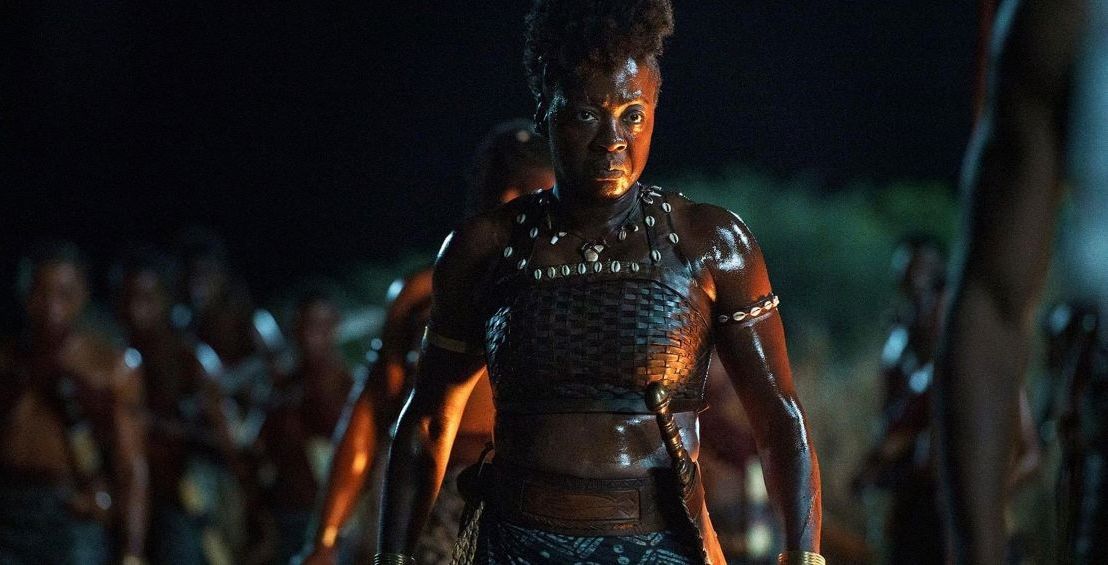
The Woman King is a pulsating action film, a mixture of Braveheart and Black Panther (it even has a cold open, as the Agojie storm an Oyo village to save captured Dahomey citizens bound for the slave ships, that feels like a straight lift from the latter film’s opening). Proudly celebrating both women and black people (men are very much in secondary roles, while the only white character is a hypocritical slaver played with relish by Hero Fiennes Tiffin), it’s a punch in the solar plexus for what’s been a male-dominated genre.

Watching it I suddenly realised, half-way through, that if the film had been made 10 or 15 years ago, the plucky new recruit having to prove she belonged among the Agojie would have been played by a white actress. There would have been a flashback to the child being found by the Agojie and then a montage of her searching from fear to longing to emulate the women around her. Like Cruise in The Last Samurai, she would have become the best-of-the-best, accepted by her new black sisterhood. It’s a triumph that Hollywood no longer needs stories like this filtered through white eyes before they would even consider bringing them to the screen.

Instead, the focus is strongly on a story that wants to celebrate the rich culture and history of African kingdoms. Dahomey’s civilisation, advanced farming and irrigation, egalitarian culture and humane religious and spiritual practices, are shown in loving detail. Their tenuous position as a small kingdom surrounded by rivals is carefully presented, just as the corrupting nature of European powers is made clear. It is they who have turned slavery – an ever-present in African history – into an industry that dominates the African economy and has led to a subtle devaluation of human lives that many Africans openly collaborate in.

In this, Prince-Bythe’s tightly directed film juggles a coming-of-age story for Nawi with a coming-to-terms story for Nanisca. It’s a film that manages to present both in the context of a series of action set-pieces and exciting training montages (the Agojie effectively have to complete a massive obstacle course to qualify as a member of the sisterhood). To be honest, much in the film isn’t really that original, more a remix of set-pieces and ideas from similar films. What makes it stand out is the representation and the context where it is taking place.

It also allows impressive actors to take on roles way outside of public expectations. None more so than Viola Davis, whose pumped up physique shatters any perceptions of what you might expect. This is a tour-de-force role from Davis, as she plays a defiant and strong woman, secretly terrified of trauma in her own past (and worries about her own weakness) who leads by charismatic example, but is just as capable of unjust slap-downs. She’s a woman struggling to embrace all facets of herself, doing so in the spotlight of a whole country looking to her for leadership. It makes for a powerful performance from Davis, perfectly fusing her skill at playing matronly warmth, imperious distance and deep reserves of determination and courage.

There are similarly excellent performances from a uniformly strong cast, with Lashana Lynch a stand-out as a courageous fighter who surprises herself with her mentorship abilities. Thuso Mbedu gives a star-making turn as Nawi, a young woman who matches Nanisca for bull-headedness and suppressed self-doubt, who reveals herself as a natural leader. Shelia Atim is excellent as Nanisca’s level-headed trusted number two, while John Boyega walks perfectly a fine-line of a man teetering between being a wise leader and a playboy.

They are helped by a film that may lack originality in its plotting and structure, but makes up for that with its warmth for its characters, and the gritty, involving realism of its shooting. Prince-Bythe keeps the pace of the film running smoothly and stages each of the film’s many set-pieces with a dynamism that keep you on the edge of your seat. She also successfully manages to incorporate some searching material around Nanisca’s past traumas without being exploitative.

Historically, the film is a little dubious, walking a carefully curated line on Dahomey’s involvement in slavery (in many ways it might have been better if the film was set in a fictional kingdom inspired by Dahomey). It doesn’t dwell on the Agojie chaining up their captives to be shipped to the slavery markets. It pushes an anti-slavery message strongly – but ignores the historical fact that the real Ghezo continued in the trade until the bitter end. (Legitimate points could have been made about his right to the same compensation as plantation owners elsewhere.) There is a complex, difficult story here that the film romanticises into something with cleaner rights and wrongs.

But, with a history of poor representation and white-only-lens view on African culture in film, you can forgive a film aiming to redress that balance. Strongly directed, exciting and crowd-pleasing, with well-drawn characters played with real skill by a very strong cast, it might recycle many ideas from other films, but it does it with a compelling freshness.

Gone with the Wind (1939)

Gone with the Wind (1939)

For decades unchallenged as the best loved Hollywood film ever made, but showing some signs of its age, it’s still an undeniable marvel

Director: Victor Fleming

Cast: Vivien Leigh (Scarlett O’Hara), Clark Gable (Rhett Butler), Leslie Howard (Ashley Wilkes), Olivia de Havilland (Melanie Hamilton), Thomas Mitchell (Gerald O’Hara), Evelyn Keyes (Suellen O’Hara), Ann Rutherford (Careen O’Hara), Barbara O’Neil (Ellen O’Hara), Hattie McDaniel (Mammy), Butterfly McQueen (Prissy), Oscar Polk (Pork), Rand Brooks (Charles Hamilton), Carroll Nye (Frank Kennedy), Jane Darwell (Mrs Meriweather), Ona Munson (Belle Watling), Harry Davenport (Dr Meade)

For most of the twentieth century, if you asked people to draw up a list of the greatest Hollywood films of all time, you can be pretty sure this would be close to the top. A landmark in Hollywood history, everything about Gone with the Wind is huge: sets, run time, costs, legend. It’s crammed with moments that have developed lives of their own in popular culture. Its score from Max Steiner – luscious and romantic – is instantly recognisable, practically Hollywood’s soundtrack. It’s the most famous moment in the lives of virtually all involved and for decades whenever it was released, it raked in the cash. But as we head into the twenty-first century, does GWTW (as it called itself even at the time) still claim its place at the head of Hollywood’s table?

It’s the love child of David O. Selznick. Never mind your auteur theory: GWTW credits Victor Fleming as the director, but parts of it were shot by George Cukor (the original director, who continued to coach Leigh and de Havilland), William Cameron Menzies (the legendary art director, who shot the Atlanta sequences) and Sam Wood (who covered for an exhausted Fleming for several weeks). This is a Selznick joint from top to bottom. GWTW is possibly the ultimate producer’s film: a massive show piece, where not a single cent isn’t up on the screen. Huge sets, vast casts, colossal set pieces, thousands of costumes and extras. It’s an extravaganza and Selznick was determined that it would be an event like no other. And a hugely entertaining event it was.

It would also be scrupulously faithful to Margaret Mitchell’s novel, with a dozen screenwriters working on it (including Selznick). GWTW was the ultimate door-stop romance novel. Set in Atlanta, Georgia, the entire film is a no-holds barred “Lost cause” romance of the South during the Civil War and Reconstruction. Scarlett O’Hara (Vivien Leigh) is the passionate, wilful daughter of a plantation owner, desperately in love with Ashley Wilkes (Leslie Howard), who is attracted to her but all set to marry his cousin Melanie (Olivia de Havilland). Also interested in Scarlett is playboy Rhett Butler (Clark Gable). Romantic complications are set to one side when the Civil War breaks out, bringing disaster to the South. As the war comes to its end will Scarlett and Rhett find love, or will Scarlett’s fixation on Ashley continue to come between them?

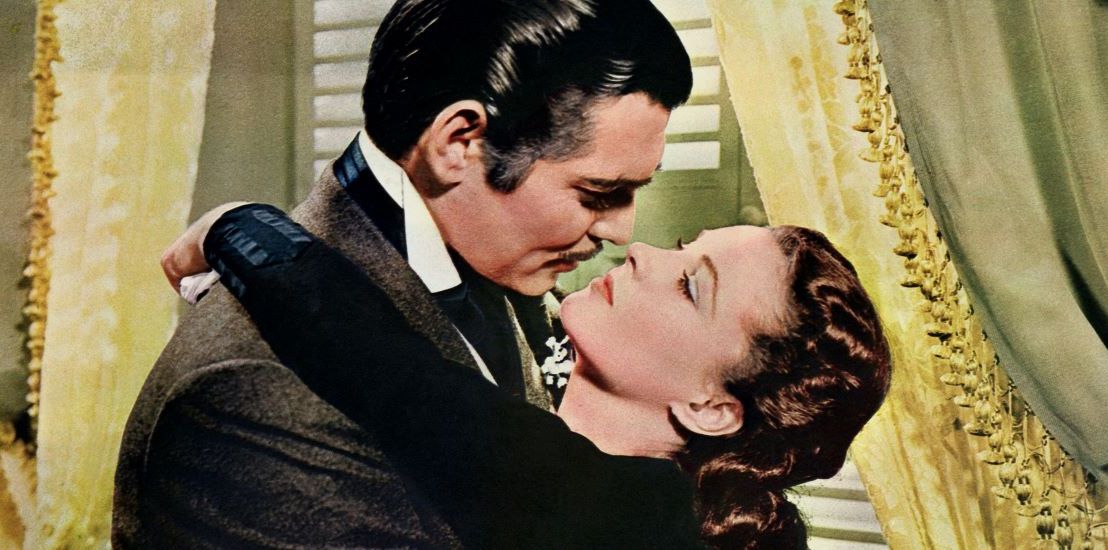
GWTW’s casting was the sort of national obsession not even the casting of a superhero gets today. Every actress in Hollywood seemed to screen test for Scarlett O’Hara, with Selznick playing the search for all the publicity it was worth. No one suggested Vivien Leigh. But, lord almighty, Leigh was placed on this Earth to play Scarlett O’Hara. GWTW is dominated by Leigh, dripping movie star charisma. She would be synonymous with the role for the rest of her life, and it’s no exaggeration to say this one of the greatest acting performances in movie history. Leigh balances a character stuffed with contradictions. Scarlett is wilful and vulnerable, impulsive and calculated, childish and dependable, selfish and generous, spoilt and sensible, romantic and realistic… But Leigh balances all this with complete ease. It’s an act of complete transformation, an astonishingly confident, charismatic and complicated performance.

There was no debate about who would play the romantic hero, Rhett Butler. He basically was Clark Gable. And Gable was perfect casting – so perfect, he was almost too scared to play it. But he did, and he is sublime: matinee idol charismatic, but also wise, witty and vulnerable (it’s easy to forget that Rhett is really in the traditional “woman’s role” – the ever-devoted lover who sticks by his woman, no matter how badly she treats him, spending chunks the latter half of the film halfway to depressed tears). For the rest, Leslie Howard was oddly miscast as Wilkes (he seems too English and too inhibited by the dull role) but Olivia de Havilland excels in a generous performance as Melanie, endearingly sweet and loyal.

These stars were placed in a film production that’s beyond stunning. Shot in glorious technicolour, with those distinctive luscious colours, astonishingly detailed sets were built (plantations, massive dance halls, whole towns). Everything about GWTW is designed to scream prestige quality. It lacks directorial personality – the best shots, including a crane shot of the Civil War wounded or a tracking shot on Leigh through a crowded staircase, seem designed to showpiece the sets and volume of extras. It’s a film designed to wow, crammed with soaring emotions and vintage melodrama. Nothing is ever low key in GWTW: disasters are epic, love is all-consuming passionate clinches. They built stretches of Atlanta so they could burn it down on camera. It’s extraordinary.

And much of GWTW is extremely entertaining. Especially the first half. It’s an often overlooked fact that if you ask people to name things that happen in GWTW, nearly everything (bar the film’s final scene obviously) they will come up with is in the first half. Rhett behind a sofa in the library? Atlanta on fire? Rhett and Scarlett at the ball? Scarlett surrounded by admirers at a garden party? “I’ll never be hungry again?” All before the interval. The first half is a rollicking, fast-paced rollercoaster that takes us from the height of the South to the devastation after the war. It grabs you by the collar and never lets go, supremely romantic, gripping and exciting.

The second half? Always duller. Bar the start and finish of the second half (nearly two hours in all), it’s a Less memorable film. Sure, it has the O’Hara’s in extreme poverty, Scarlett reduced to converting a curtain into a dress to glamour up some cash to keep Tara. It’s got Ashley and Melanie’s adorably sweet reunion. And it’s got possibly the most famous line ever in movies “Frankly my dear, I don’t give a damn” (not to mention “Tomorrow is another day”).

Other than that? It’s a bitty, plot-heavy series of forgettable, episodic moments which you feel really should have been cut. Who remembers Frank Kennedy? Or Scarlett’s lumber mill? Rhett pushing his daughter in a pram? The London sequence? There is a solid hour of this film which is flatly shot, dully paced and devoid of anything memorable at all. GWTW owes all its beloved reputation to the first half: and to be fair you’ll be so swept up in that you’ll give the film a pass for its middling second act. After all you get just about enough quality to keep you going.

But what about the elephant in the room? GWTW, like no other beloved film, has a deeply troubling legacy. They were partly aware of it at the time – after all, every racial epithet was cut, as is every reference to the KKK (it’s referred to as a “political meeting” and Rhett and Ashley’s membership is glossed over) and we never see the attack they carry out on a shanty town of former slaves. But GWTW remains, in many ways, a racist film peddling an unpleasant and dangerous mythology that the “Lost Cause” of the South was all about gentlemanly fair play, rather than coining it off plantations full of enslaved workers.

GWTW, in many ways, plays today a bit like a beloved elderly relative who comes round for dinner and then says something deeply inappropriate half-way through the main course. The dangerous mythology is there from the opening crawl which talks of the South as a land of “Cavaliers and cotton fields” where “Gallantry took its last bow…[full of] knights and their ladies fair, of Master and Slave”. The third shot of the film is a field of smiling slaves, working in a cotton field. Hattie McDaniel won an Oscar (at a segregated ceremony) and she is wonderfully warm as Mammy, but her character is another contented underling. At least she seems smarter than the other main black characters, Pork and Prissy: both are like children reliant on the guidance of their masters.

The Cause of the South is luscious and romantic, as are the people who fight it. Nearly every Yankee we see is corrupt, ugly and greedy, rubbing defeat in our heroes’ faces. It’s not quite Birth of a Nation, but the second half has a creeping suspicion of freed black people. A carpetbagger from the North is a smug, fat black man who mocks wounded Southern soldiers. Scarlett’s walk through the streets of a rebuilt Atlanta sees her startled and mildly hustled by black people who no longer know their place. Every prominent black character is sentimental about the good old days. GWTW would make an interesting double feature with 12 Years a Slave.

It’s this dangerous and false mythology that makes the film troubling today. It’s why you need to imagine the entire thing with a massive asterisk – and why you should be encouraged to find out more about the era than the fake and self-serving fantasy the film peddles as reality. But for all that, GWTW is so marvellous as a film that it will always be watched (and rightly so), even if it was always a film of two halves and only becomes more controversial in time. But watch it with a pinch of salt, and it is still one of the most gorgeous, sweeping and romantic films of all time: that’s why it still remains, for many, the definitive “Hollywood” film.

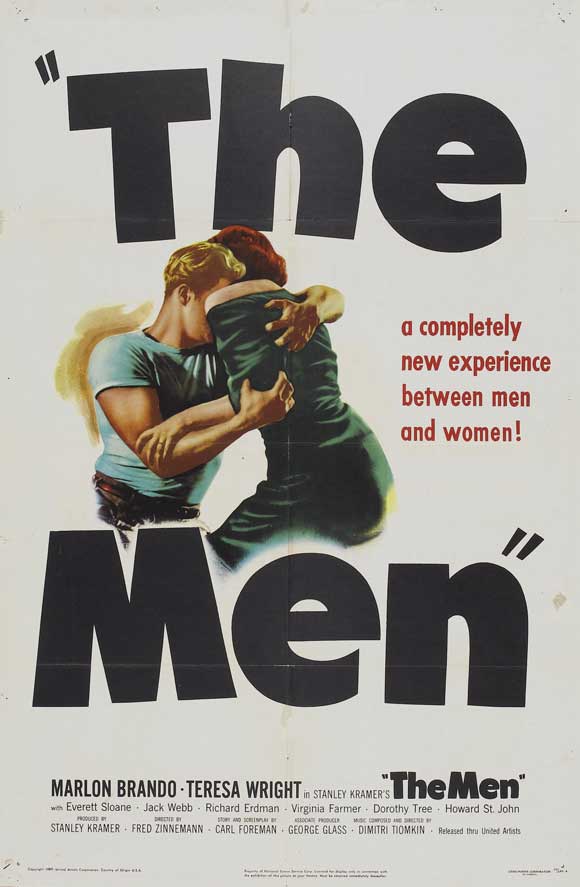
The Men (1950)

The Men (1950)

Brando makes his film debut in this earnest but realistic drama about paraplegic war veterans

Director: Fred Zinnemann

Cast: Marlon Brando (Ken Wilocek), Teresa Wright (Ellen), Everett Sloane (Dr Brock), Jack Webb (Norm), Richard Erdman (Leo), Arthur Jurado (Angel), Virginia Farmer (Nurse Robbins)

The Men opens with a thoughtful dedication to the two wars many soldiers have fought: the first with weapons, the second “with abiding faith and raw courage” against the physical and emotional consequences of the first. Fred Zinnemann’s documentary-influenced The Men takes a careful look at how the impact of that second war at a paraplegic veterans hospital. Ken Wilocek (Marlon Brando, in his film debut) is a former college sports star now confined to a wheelchair and struggling to adjust. His fiancé Ellen (Teresa Wright) is still eager to marry – but are either of them ready for the difficulties Ken will have adjusting his life?

The biggest strength of The Men – aside from its realist lack of flash – is how it avoids easy answers to big questions. Sure, Carl Foreman’s script has a tendency to lean into a mix of relationship drama and information film. But in looking at Ellen and Ken’s wedding night (and, in a neat visual metaphor of a misfiring champagne bottle, their likely sex lives), The Men is coldly realistic. Ellen might be largely presented as a picture-perfect ideal woman – but even she is freaked out by Ken’s squeaky wheelchair, twitching leg, implied impotence and the thought of what she has let herself in for.

That’s as nothing to the self-loathing fury – directed into rage at Ellen – Ken feels. This man who defined himself by machismo and physicality, who labours for weeks to stand upright so he can get married at the alter (it’s a sign of the film’s avoidance of easy solutions that, despite this, Ken still falls over at the alter) suddenly realises that he will always be partially dependent on his wife for simple tasks. He’ll never be the provider he expected to be – and he’ll never be able to fulfil some of his wife’s sexual needs. A proud man, no wonder the realisation throws him into depression.

It’s moments like this when Zinnemann’s film is at its strongest. It’s a film surprisingly frank and (for the time) daring about the emotional and physical consequences of war injury. Everett Sloane’s impassioned doctor is introduced warning wives and mothers about the consequences of paraplegia and the difficulties emotionally, physically and (he all but says) sexually they will have – but he might as well be talking direct to the camera informing the audience.

ZInnemann’s film, in a dispassionate but respectful way shows the process of rehabilitation, its strengths and its weaknesses. From physical training to the difficult emotional adjustments. The film used several real-life veterans – including Arthur Jurado in a key role as a Latino paraplegic holding onto optimism – and worked closely with hospital medical staff (some of whom appear as themselves). There is a solid sense of respectful realism about the whole thing. (You can feel the hand of producer Stanley Kramer.)

He’s also helped hugely by a powerful, committed and complex performance from Brando in the lead role. Making his first film, Brando astounded Zinnemann and the crew with his commitment. Effectively Brando “learned” to be paraplegic, forming deep friendships with the veterans (far more allegedly than with his fellow actors). His performance is a searing collection of contradictions. Ken is boyish, eager and lets excitement flash across his face when playing sports or driving an adjusted car for the first time. But he’s just as apt to be surly, resentful and bitter, to snap at those trying to help him and furious at the failings his own body have forced on him.

It comes to a head at that disastrous wedding night. Brando struggles with a growing realisation of his dependence and helplessness and his face flares with the pained recognition that this is in no way the wedding night be imagined. Throughout much of the film he is desperate to cling to any chance of recovery – from imagining sensation in his legs to furious workouts to build his upper body strength to help him pretend he still has fully functioning limbs. It’s a fabulous performance, a slice of realism and humanity, underplayed with an everyday casualness.

It does mean Teresa Wright at times looks a little more actorly as Ellen. To be fair to Wright, her part is saddled with the most conventional plot arcs and scenes, of romantic devotion mixed with sudden doubts. (It’s not helped by Dimitri Tiomkin’s overly emphatic themes for her character, that do their best to do all the work for the audience). Her scenes tend to have the air of the infomercial about them, as Ellen debates disabilities with Dr Brock and her doubting parents. Foreman’s dialogue also tends to lean a little too much into “I’ll love you Ken, no matter what” territory.

The Men is at its weakest when it looks at societal integration. For all the quality of Brando and the low-key sensitivity of Zinnemann’s direction, this ends up being a lighter, less impactful version of Wyler’s astounding The Best Years of Our Lives. Brando plays a combination of Dana Andrews’ and Harold Russell’s characters from that film, but The Men never hits the same heights of universal experience and pain as that film does. (Teresa Wright basically plays the same role here as she did opposite Dana Andrews). It’s just a little too low-key, a bit too documentary.

When away from the medical, there is a lack of inspiration and poetry from The Men. It gains a lot from Brando’s performance, but without him it would feel more like a Government infomercial. When it hits drama, for all its daring, it never manages to fully turn itself into something more than a traditional romance-against-the-odds. It has its heart in the right place, but it feels like a companion piece to better films than a classic in its own right.

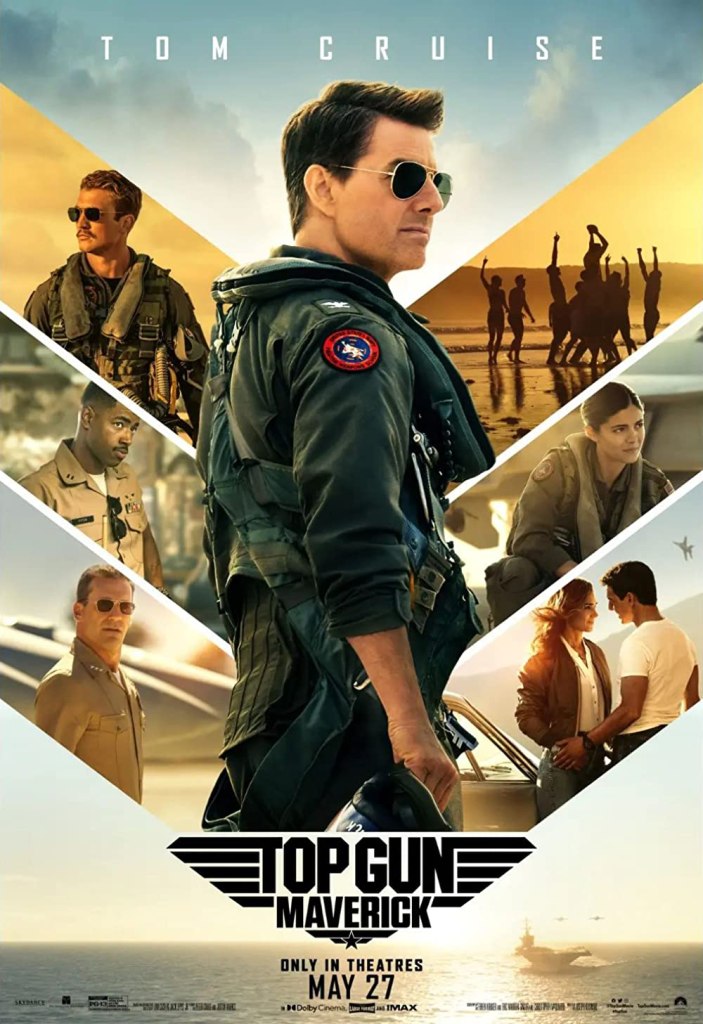
Top Gun: Maverick (2022)

Top Gun: Maverick (2022)

You’ll feel the need for speed in this triumphant better-than-the-original sequel

Director: Joseph Kosinski

Cast: Tom Cruise (Captain Pete “Maverick” Mitchell), Miles Teller (Lt Bradley “Rooster” Bradshaw), Jennifer Connelly (Penny Benjamin), Jon Hamm (Vice Admiral Beau “Cyclone” Simpson), Glen Powell (Lt Jack “Hangman” Seresin), Monica Barbaro (Lt Natasha “Phoenix” Trace), Lewis Pullman (Lt Robert “Bob” Floyd), Ed Harris (Rear Admiral Chester “Hammer” Cain), Val Kilmer (Admiral Tom “Iceman” Kazansky), Charles Parnell (Rear Admiral Solomon “Warlock” Bates)

It’s been 38 years since Tom Cruise last felt that need for speed. Top Gun is a sentimental favourite, partially because its the ultimate brash, loud, Reaganite 1980s Hollywood film. But (whisper it), it’s not actually – and never has been – a very good film. Perhaps though that’s all for the best: Top Gun has so little of merit in it, it offers an almost completely blank canvas for a sequel. It helps the team create Top Gun: Maverick, a film so insanely entertaining it should carry some sort of health warning.

Decades have passed and Pete “Maverick” Mitchell (Tom Cruise) is pretty much the greatest pilot in the world, deliriously skilled at everything in the cockpit and pretty much hopeless at anything outside it. He’s distrusted by all his superiors except his old wingman Iceman (Val Kilmer). Thanks to Iceman he is selected to train the next generation of pilots at TOP GUN for an impossible mission to take out a nuclear plant in a “hostile nation” (clearly Iran). One of that next generation is Bradley “Rooster” Bradshaw (Miles Teller), son of Maverick’s late best friend “Goose”, the guilt for whose death Maverick never recovered from. After Maverick tried to prevent Rooster from following in his father’s footsteps – not able to stand the thought of being responsible for the deaths of both his surrogate brother and son – can the two overcome their problems?

Top Gun: Maverick was delayed from hitting cinema screens for nearly two years thanks to Covid. Cruise resisted all opportunities to sell it to streaming: a decision vindicated by the supreme big-screen entertainment it offers. This one you really do need to see on the big screen. Its aerial footage is so stunning it makes the original look like tricycles on training wheels. Combined with that though, and unlike the original, Maverick has a thoughtful and engaging emotional storyline, with characters who change through well thought out emotional arcs.

But I’ll be honest, the staggering, visceral enjoyment of these plane sequences is probably the principal thing you’ll immediately take out of the film. Working from a training programme partly devised by Cruise, the film shows the impact of punishing G-forces by… actually putting the actors in planes travelling at these huge speeds. Unlike Top Gun, with its blue-screen cockpit shots, there is no doubt Cruise, Teller et al are actually in the planes as they bank at impossible speeds. Partially shot by the actors themselves – sitting the camera up in their cockpits – the film literally shows you the scenery flashing by. It’s Cruise’s mantra of doing it for real taken to a stunning degree. It’s the simple old-fashioned joy of knowing almost everything you see is real.

The mission this time is far more detailed: effectively it’s a steal from Star Wars, our heroes required to fly through a narrow ravine (below the radars of surface to air missiles) before climbing a steep bank and using their laser targeting to successfully blast a small access port. (It won’t surprise you to hear that on the final mission one character has to “use the force” when their targeting laser fails). Maverick’s training programme pushes the pilots to the limit, while his extraordinary flight skills quickly win their awe (in the first session he challenges all the pilots to take him down in a simulated dogfight, with everyone shot down doing 200 press-ups – Maverick does zero, everyone else 200+). Kosinski shoots with a cool clarity that makes you feel you are being punched by G-force.

But Top Gun: Maverick would just be a showcase for cool planes without its emotional heart. And it’s the intelligent and involving story that makes it work. Cruise is at his charismatic movie star best as Maverick – he knows exactly how to win the audience over – but his cocksure confidence is underpinned by a growing sense of fear at the risks he puts others through. Unlike the navy, his main concern is to get the pilots back alive and his guilt-ridden treasured memory of Goose is the hallmark of a man who never managed to put ends before means. He’ll take any risk himself, but balks at taking chances with anyone else’s life.

It’s what drives his troubled relationship with Rooster. The two have a surrogate father-son relationship, fractured by Maverick’s attempt to keep Rooster safe out of the cockpit. (Pleasingly, Rooster does not hold Maverick responsible for his father’s death, only for derailing his career.) The relationship between these two – Cruise’s Maverick quietly desperate to rebuild some sort of familial connection and Rooster shouldering resentment for a father-figure he clearly still loves – is handled with a great deal of tact and honesty. It really works to carry a wallop.

It’s also part of how Maverick’s place in the world, and decisions in life, are being questioned. As made clear in a prologue where he thumbs his nose at a sceptical Admiral (no one scowls like Ed Harris) by taking a prototype jet out for test run, he’s both a relic and a guy who doesn’t know when to stop (he wrecks the jet by pushing past the target of 10 Mach by trying to go another .2 faster). Unlike Iceman – a touching cameo from a very ill Val Kilmer that leaves a lump in the throat – Maverick never fit in within a military organisation (“They’re called orders Maverick”). He’s lonely, his past failed relationship with Jennifer Connelly’s Penny just one of many roads-not-taken. (There is no mention of Kelly McGillis’ character.) In a world of digital drones, he’s an analogue pilot flying by instinct: his days are numbered.

This is proper, meaty, thematic stuff explored in a series of involving personal arcs which by the end not only leaves you gripped because of the aerial drama, but also genuinely concerned about the characters. I can’t say that about the original. Top Gun: Maverick is not only a thematically and emotionally richer story – carried with super-star charisma by Cruise – than the original, it’s also more exciting and more punch-the-air feelgood. This sort of thing really is what the big screen is for.

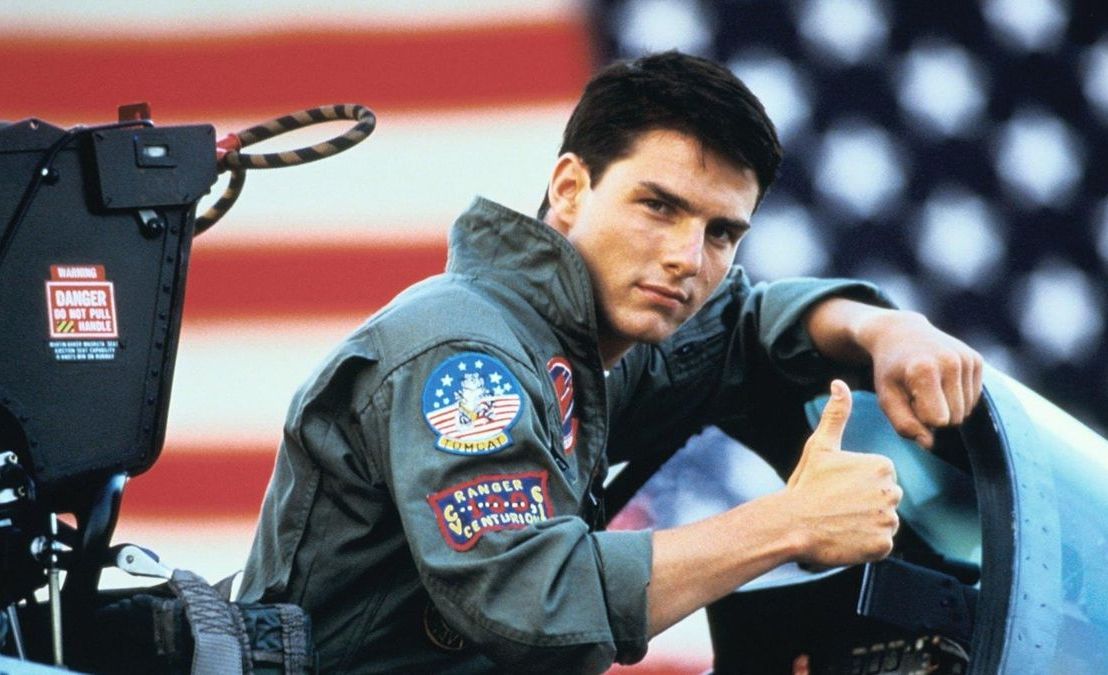
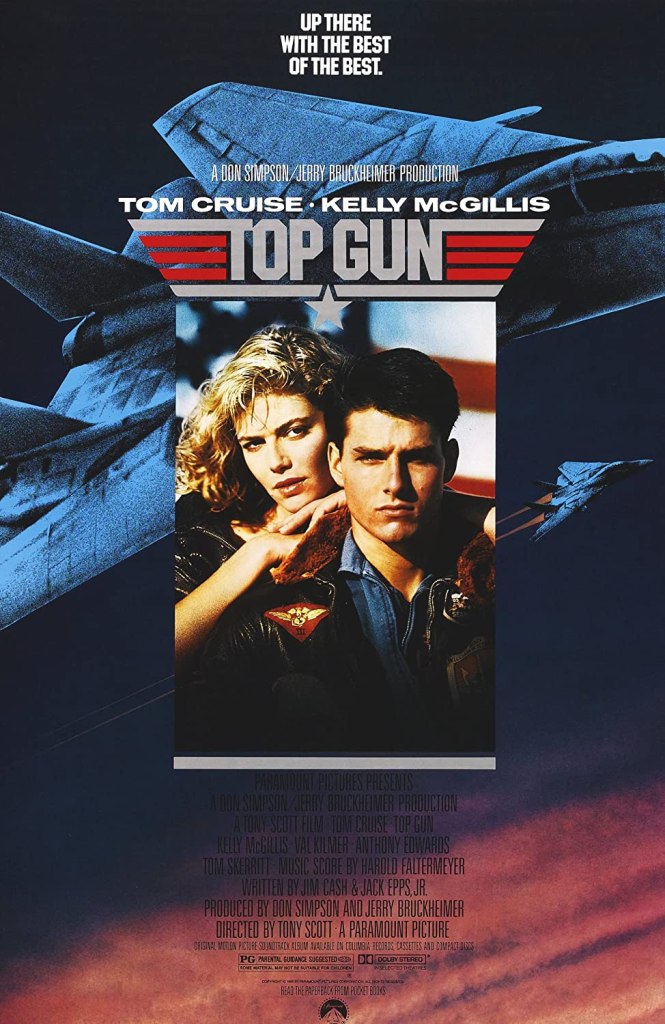
Top Gun (1986)

Top Gun (1986)

Cruise flies into movie super-stardom in this fun-but-much-worse-than-you-remember flying film

Director: Tony Scott

Cast: Tom Cruise (Lt Pete “Maverick” Mitchell), Kelly McGillis (Charlie Blackwood), Val Kilmer (Lt Tom “Iceman” Kazansky), Anthony Edwards (Lt Nick “Goose” Bradshaw), Tom Skerritt (CDR Mike “Viper” Mitchell), Michael Ironside (LCDR Rick “Jester” Heatherly), John Stockwell (Lt Bill “Cougar” Cortell), Barry Tubb (Lt Leonard ”Wolfman” Wolfe), Rick Rossovich (Lt Ron “Slider” Kerner), Tim Robbins (Lt Sam “Merlin” Wells), James Tolkan (Cdr Tom “Stinger” Jardian), Meg Ryan (Carole Bradshaw)

“I feel the need: the need for speed!” Those words lit up mid-80s cinema screens with one of the biggest hits of the decade. Top Gun is still one of Cruise’s most iconic films, its blasting rock-and-roll soundtrack, beautifully backlit romance and cocksure go-getting self-confidence making it one of the definitive Reaganite 80s films ever made. Its legacy is so all-consuming, it’s always a surprise when you sit down to watch it what a fundamentally average it is.

Its plot, such as it is, can be summarised thus: Tom Cruise cockily flies planes and romances Kelly McGillis until Goose dies. Then he flies planes with the same level of skill but slightly more humility and commits to Kelly McGillis. It all takes place in TOPGUN, the navy’s dog-fight training school for elite pilots. Cruise is Pete “Maverick” Mitchell, super-confident best-of-the-best. Kelly McGillis is the astrophysicist and civilian instructor on the course whose heart melts for Tom’s boyish charms. Anthony Edwards is the doomed Goose (he might as well have a skull and crossbones hanging over him – he’s even got a loving wife and son back home). Val Kilmer is Cruise’s rival pilot, super-professional “Iceman”. The training is fast-paced, macho and culminates in a clash with a (conveniently unnamed) country that definitely isn’t the USSR.

There are three things undeniably great about Top Gun. The songs from Kenny Loggins and Berlin are top notch, full of soft-rock sing-along bombast. Scott shoots the hell out of scenes and the sun-kissed beauty framing the various airplanes and aircraft carriers is superb. With its fetishistic worship of the manly glory of the navy and its equipment, the film had full military backing, a huge boon it exploited for wonderfully executed scenes of dogfights and faster-than-sound planes (Scott even paid $25k to get an aircraft carrier to change course – writing a cheque there and then – so a sunset shot would look better). And of course there is Tom Cruise.

Top Gun is the foundation stone in the Church of Tom Cruise, defining a persona Cruise would effectively riff on for huge chunks of his career. Pete Mitchell is so cocksure he’s even called Maverick. But, as well as being arrogant and over-confident, he’s preternaturally skilled, boyishly enthusiastic, strangely vulnerable, yearns for affection, wins people over with a grin and goes through a crisis of confidence that sands down his negative qualities while never touching his courage, skill and likeability. Cruise cemented his eye-catching charisma and relatability: audiences wanted to be him or be with him. A huge chunk of its massive success is down almost exclusively to what a star Cruise is and how easily he makes this hackneyed stuff work.

The rest is a bizarre mix of half-formed plot ideas, weakly sketched characters and a plot so shallow it almost doesn’t deserve the name. Top Gun is all about a cool guy flying planes accompanied by some excellent songs. There is no depth to its character exploration. There is a dim suggestion Maverick needs to mature (with Goose as the sacrificial lamb to prompt that development) but it’s barely explored. It has no shrewdness in its look at the risk-taking intensity of flying or the type of personalities it might attract. The training is awash with familiar tropes: hotshots, grizzled trainers (two of them in Skerritt and Ironside!) mixing growls with behind-his-back grins at Maverick’s pluck. His rival is the anthesis of Maverick, but (gosh darn it!) he eventually learns to respect him.

The central romance seems thrown in because a film like this needs it – it’s very much An Officer and a Gentlemen in the skies. Maverick’s true emotional love story is with Goose – this surrogate brother/uncle providing Maverick’s only friendship and the vicarious family this Cruise archetype character secretly longs for. But gosh darnit, it’s Hollywood so gotta have a beautiful woman for our hero to manfully seduce. Poor Kelly McGillis looks rather uncomfortable in her ill-shaped and poorly developed character, while her love scenes with Cruise are acted with a slobbering over-intensity that suggests both of them are trying too hard (he constantly kisses her tongue first, which is gross). Perhaps they wanted to really go for it in the hope viewers would overlook the obvious homoerotic tensions of most of the film.

Oh those tensions! Top Gun drips with gleaming, tanned half-naked men squaring up to each other in dressing rooms – and that’s not even mentioning the infamous volleyball sequence (where only Edwards, bless him, wears a t-shirt). Characters forever utter variations on “I’ll nail his ass” lines. Iceman and Maverick take part in a homoerotic-tension fuelled rivalry that culminates in an explosive dog-fight climax and a loving embrace on the deck of an aircraft carrier.

It’s hard to tell how much all this was a joke, and how much Scott, Bruckheimer and Simpson just didn’t notice in the middle of all their glistening, back-lit, fast-paced shooting of military muscle (in every sense) how gay it might look. Maybe they thought people wouldn’t notice either amongst all the military machinery (this must be Michael Bay’s favourite ever film). Top Gun’s aerial footage is super impressive (though it is funny noticing now that famous daredevil Cruise clearly does all his cockpit shots in front of a green screen) even if the whole film feels like an MTV video to promote its knock-out songs.

Top Gun is still fun, even if that’s mostly mocking the nonsense and emptiness it’s built upon. Nothing much really happens, its plot so flimsy it barely stands up against the Mach-9 force of its planes. But it’s got Cruise at his blockbuster best – and when you’ve got that you don’t really need anything else. It’s poorly written, junkfood trash all framed in a fetishistic beauty – but it’s sort of goofy, stupid, empty fun.

Ran (1985)

Ran (1985)

Kurosawa’s epic version of King Lear places style over substance, but offers many glorious visual treats

Director: Akira Kurosawa

Cast: Tatsuya Nakadai (Hidetora Ichimonji), Akira Terao (Taro Ichimonji), Jinpachi Nezu (Jiro Ichimonji), Daisuke Ryu (Saburo Ichimonji), Mieko Harada (Lady Kaede), Yoshiko Miyazaki (Lady Sué), Mansai Nomura (Tsurumaru), Hisashi Igawa (Kurogane), Peter (Kyoami), Masayuki Yui (Hirayama Tango)

An ageing Lord lays down the burdens of office to his three children. Two flatter the old man: the third tells him he’s a fool. The lord banishes the third child and treasures the other two, who betray him tipping him into a lonely madness, screaming on a moor. Sound familiar? Kurosawa takes Shakespeare’s King Lear and transposes it to the final days of Samurai Japan. Lear becomes Hidetora (Tatsuya Nakadai) and his daughters become sons, Taro (Akira Terao), Jiro (Jinpachi Nezu) and Saburo (Daisuke Ryu), with the latter two taking on Hidetora’s land.

Ran translates as “Chaos”. That’s really what the film is about. Kurosawa’s Lear is strikingly nihilistic. Anything from the original play that could be called remotely optimistic – there is no good servant figure, no sensible Albany and no Edgar caring for, and avenging, his blinded father – is removed. Instead, Hidetora’s decision leads to unrelenting death and destruction, a carnival of bodies piling up in burnt out, ruined castles. This is Lear, tinged with the sort of Beckettian-wasteland theorists like Jan Kott would love: bleak and hopeless with only suffering at its heart.

As you expect with Kurosawa, its filmed with poetic beauty. The more frantic, Western-action, stylings of Kurosawa’s youth are gone, a victim perhaps of his auteur reputation. Ran is a self-consciously important film, an epic taking place in a series of stately medium and long-shots (I can barely remember more than a few close-ups), in luscious Japanese countryside, peopled by hundreds of colour-coded extras. Kurosawa’s fault is that he sometimes focuses on this, at the cost of the thematic complexity of Lear.

But what he certainly gets right is the bleakness at its heart. Kurosawa is not remotely seduced by any glamour in Hidetora. Played by Tatsuya Nakadai in a deliberately classical noh­-style (full of elaborate poses and declamatory, plot-heavy dialogue) designed to stress how out-of-touch he is, compared to the more modern styles of the other actors. A vain, proud man who expects to be obeyed without question, Hidetora is never a truly sympathetic figure until his final moments.

Everything we learn about him hammers home his past of violence and brutality – he wiped out of the families of both of his daughters-in-law to steal their lands, he blinded Ran’s prince-turned-beggar Tsurumaru, who wanders the wilderness and gives Hidetora shelter. Falling from power, he’s as stubborn and arrogant than ever, leading his retainers to their death in an ambush. There is none of the “very fond, foolish old man” about him (there isn’t much of that about Lear either), just a tyrant who brings himself low.

Hidetora’s greed has also introduced a serpent into his own nest. Many have seen Taro’s wife Lady Kaede (Mieko Harada) as a Lady Macbeth figure, but really she’s a sort of Edmond or Iago. Seductive, vengeful and interested only in furthering the chaos, she lives in her murdered father’s castle, married to the son of the man who killed him. She schemes to turn both brothers against each other, seduces Jiro and pushes him to murder his wife. Using her body and her brain, she works to destroy the clan, her hatred motivated by Hidetora’s past cruelty.

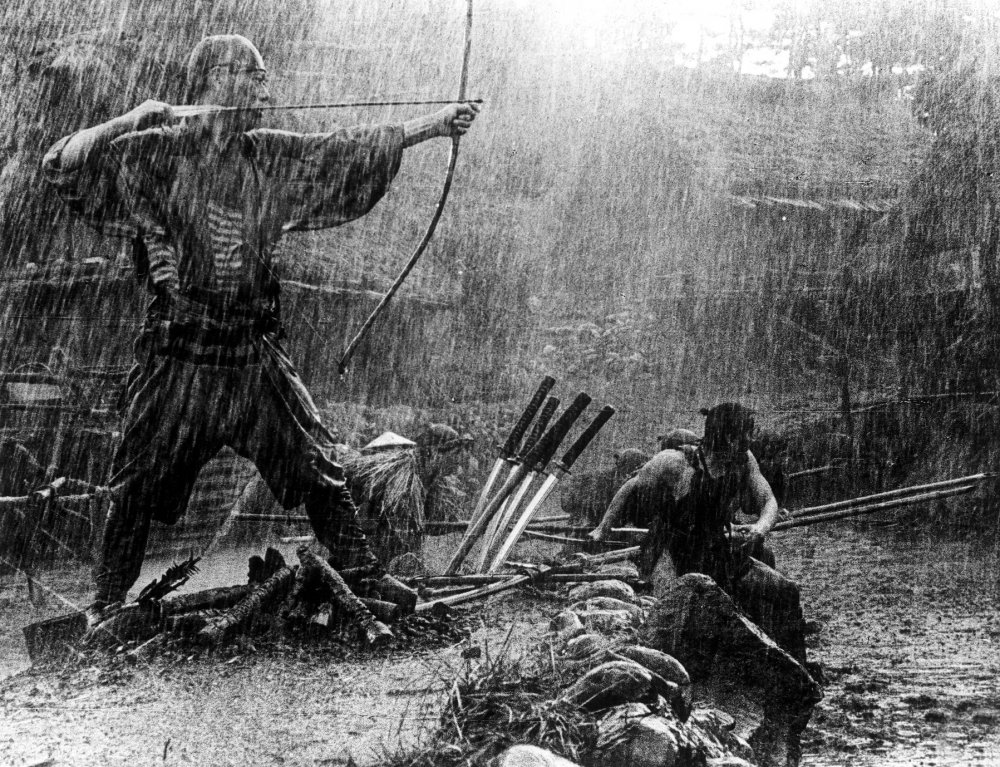
Chaos is the perfect time for her schemes to take hold. Kurosawa’s setting of Ran near the end of the Samurai era, adds an additional blood-tinged brutality to the film’s battles. This was the time when the Samurai were learning their swords and arrows were poor defence against muskets. The battles are massacres: massacres of people fighting two different kinds of war. One is that of guts and honour: another the brutal long-distance finality of the bullet. Samurai are mowed down in their dozens on futile charges, while two of Hidetora’s sons are shot down from a distance, never seeing their killer’s faces. It’s a million miles from the traditional boar-hunt that opens the film – and it’s a world none of the characters manages to adjust to.

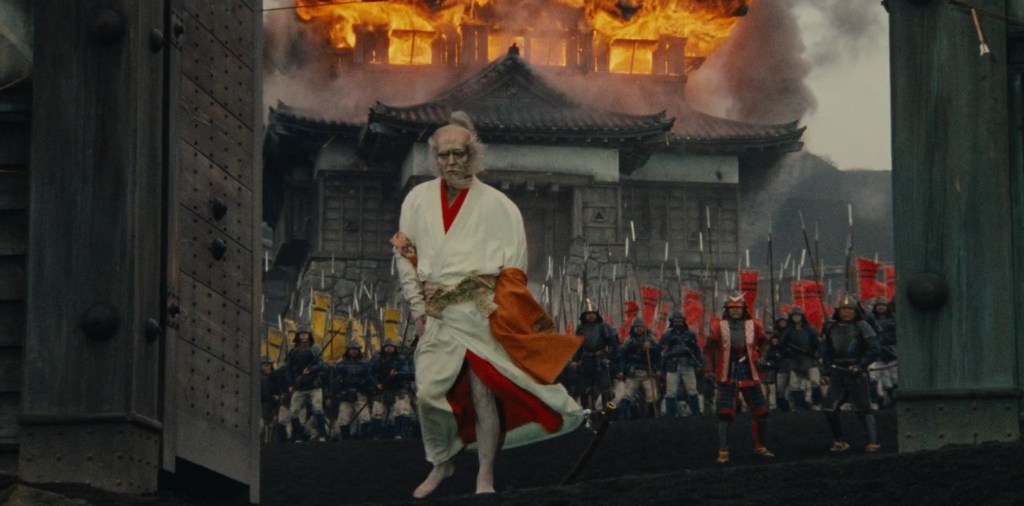
The violence of these battles is the central touch of mastery in Kurosawa’s epic. A whole castle was built – out of plywood – solely so it could be burned down during the pivot sequence at the centre of the film. Hidetora’s last castle is surprised by the armies of both sons, whose soldiers spray it with a never-ending stream of bullets and fire arrows. Playing out in silence under a haunting score, this is a chilling showpiece for Kurosawa’s visual mastery, a terrifyingly nihilistic view of the horror and destructiveness of conflict.

Inside Hidetora’s men are ripped apart or punctured like pin cushions, leaking gallons of crimson blood. His harem commits seppuku. The castle burns down around him. All while Hidetora sits in stoic disbelief at the top of a tower, his connection with reality collapsing. He eventually leaves the castle – walking through the parting invading forces (a shot that could only be attempted once as the set literally burned down around him) and out of the smoking gates. It’s an extraordinary sequence, the finest in the film: wordless, poetic and terrifyingly, hauntingly, brutal.

From here, Kurosawa’s Ran embraces the bleakness of Lear: Hidetora loses all trace of sanity, rages in self-loathing in the same fields he lorded over in the film’s opening sequence, is reduced to pathetically begging for food from the man he blinded and ends the film cradling the body of his murdered son. Around him his fool – an extraordinary performance from Japanese variety performer Peter – mocks his actions and tells bitter jokes about the savagery of the world while despairing and raging at the horrific position he has been reduced to in caring for his master.

Kurosawa embraces that bleakness: but how much does of Shakespeare’s depth does Kurosawa grasp? I’m not sure. In stressing the cruelty and madness of Hidetora, he robs him of Lear’s growing self-realisation about the emptiness of power and his own failings as a ruler. Hidetora is a two-dimensional character, as are most of the others. Kurosawa’s simplification of Lear removes the destructiveness of fate, the grotesqueness of chance and the punishments of loyalty (there is no Gloucester character, while the Kent figure is largely sidelined – both I feel is a real loss).

In making Ran, Kurosawa focused on two things: a depressingly post-Nuclear age vision of the world as a wasteland in waiting, and the pageantry of grand-settings and beautiful imagery. Compare Ran to the faster-paced dynamism of his earlier films (Seven Samurai may be nearly as long, but it doesn’t feel like it compared to the slow-paced Ran). There is a self-important artiness about Ran: it’s more stately style feels like Kurosawa showing he could do Ozu as well as he could Ford, while it’s indulgent run-time (there are many moments of near-silent nihilistic wilderness, that add length and import but not always depth) can test your patience.

Ran is basically a simplification of Lear that takes the core of the story, strips out many of its themes and contrasting sub-plots, and focuses on a single message, of man’s inhumanity to man. In doing that it loses the scope of a play that astutely looks at the personal and the political, the intimate and the epic, that understands the self-deceiving flaws of good and bad men. It’s large and important, but it’s not as powerful a tragedy as Lear because its fundamentally a simple film.

Which is not to say it is a bad film. But it is to say that Kurosawa had perhaps become seduced by his status as a legendary “Great Director” into believing that long and beautiful were synonymous with quality and importance. Ran is a fascinating and chilling film, with many striking and haunting moments. But it also misses some of what made its source material great, and it’s a triumph of moments and visuals than it is of intellect and depth.

Black Hawk Down (2001)

Black Hawk Down (2001)

Ridley Scott’s immersive combat film is politically simple but one of the great combat films

Director: Ridley Scott

Cast: Josh Hartnett (SSG Matt Eversmann), Ewan McGregor (SPC John Grimes), Eric Bana (SFC Norm ‘Hoot’ Gibson), Tom Sizemore (LTC Danny McKnight), Sam Shepard (General William F Garrison), Ron Eldard (CWO4 Michael Durant), William Fichtner (SFC Jeff Sanderson), Jeremy Piven (SW4 Clifton Wolcott), Ewen Bremner (SPC Shawn Nelson), Gabriel Casseus (SPC Mike Kurth), Hugh Dancy (SFC KURT Schmid), Jason Isaacs (CPT Mike Steele), Tom Hardy (SPC Lance Twombly), Orlando Bloom (PFC Todd Blackburn), Nikolaj Coster-Waldau (MSG Gary Gordon), Johnny Strong (SFC Randy Shughart)

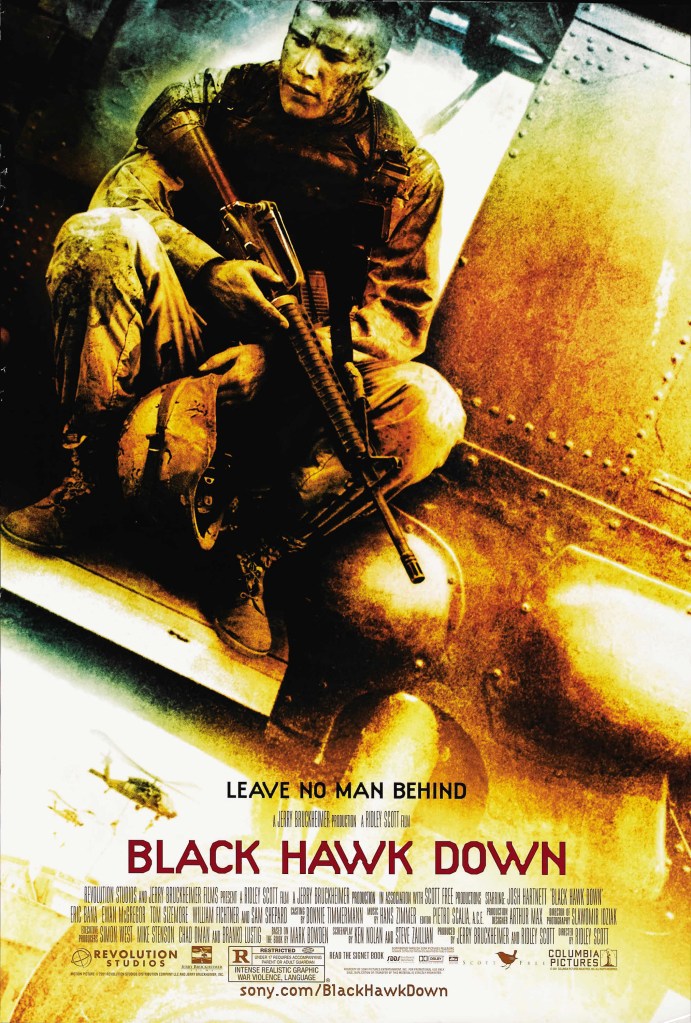
On 4 October 1993, the US won a pyrrhic victory supporting UN efforts to prevent genocide in the Somalian Civil War. A mission in Mogadishu to capture the lieutenants of rebel leader Mohamed Farrah Aidid collapsed into a desperate overnight street battle as Aidid’s forces rose up en masse (up to 4,000 of them) in an attempt to cut off and wipe out the c. 160 US troops.

Although the majority escaped, it was one of the most costly American operations since Vietnam, with the loss of 18 dead and 73 wounded and two Black Hawk helicopters shot down. As many as 2,000 Somalians were also killed. Pictures of the bodies of American soldiers dragged through the streets by Somalian rebels led to a major realignment of US foreign policy, with a reluctance to join future peace keeping operations (most notably the Rwandan genocide).

This is bought to the screen in a virtuoso directorial achievement by Ridley Scott, one of the most immersive and gripping war films ever made. Black Hawk Down doesn’t shirk on an inch of the war experience. Combat is loud, sudden, all-consuming and a barrage on the senses. It’s scary, confusing and always unforgiving. Mud, blood and dirt are flung into a camera that runs through streets alongside the soldiers, embedded with them under siege. The slightest lack of focus or mistake is punished by horrific injury or death. The battle is a nightmare of confusion and desperate improvisation in which neither side (especially the Americans) really knows what’s going on.

It’s not surprising they don’t. The film expertly demonstrates how a multi-approach plan (helicopters delivering ground forces, an armed convoy to collect prisoners) was effectively a rashly planned house of cards, which collapsed when the hornet’s nest of an uncontrolled city, crammed with thousands of potential hostiles, roadblocks and a prepared and dedicated enemy (willing to suffer a level of loss the Americans were not) was unleashed. Ground forces are stranded, helicopters shot down, the exposed convoy becomes a slow-moving hospital, all under constant fire in a dusty, urban centre where every single civilian could be a enemy combatant.

Scott shoots and edits this with pulse-pounding intensity, aided by the dizzying camera work of Sławomir Idziak and the high-octane cutting of Pietro Scalia, whose work grips you by the throat and never lets go. It’s a “grunt’s-eye” view of the war, that puts the viewer very much in the trenches with the soldiers. We pretty much join them running through gauntlets of bullets, ducking into foxholes and desperately trying to stay alive. Scott’s work is outstanding here, a brilliant depiction of the chaos of battle in which events are both intimidatingly out of control but also crystal clear to the audience, assembled with a never-lets-up energy leaving the viewer tense and breathless.

As Eric Bana’s fiercely professional Hoot says “it’s about the man next to you”. That’s very much what Black Hawk Down is about. There’s very little context about the American operation in Somalia, the Somalian people, the impact on long-term American politics…  The film believes the whys and wherefores are less important than protecting the lives of your colleagues.

Argument has raged about whether Black Hawk Down is pro-war or not. I’m not convinced it is. Can a film which shows soldiers maimed, disfigured and literally torn in two, really be a celebration of war? But, what it clearly is, is pro-the American fighting man. The training and expertise of these soldiers – trained to make every shot count and keep their cool in terrifying situations – is crucial to their survival. (The scattergun indiscipline of the Somalian rebels is noticeable by comparison – and it’s fair to note that Black Hawk Down gives very little focus to the Somalians at all, other than as a faceless hostile mass).

The film is in awe of the soldiers’ willingness to sacrifice themselves for each other: the dramatization of Gary Gordon and Randy Shughart’s request to be dropped in to provide some sort of cover to one of the downed Black Hawk pilots (a request they know is a suicide mission) exemplifies “leave no man behind” bravery. Black Hawk Down is a tribute to soldiers.

Interestingly though, that also means it’s a film where characters are more important for what they do rather than who they are. We learn very little personal information about any of them. Hartnett’s newly-promoted SSG has sympathy for the Somali people and is nervous about his first command mission. McGregor’s admin officer is unsettled by his first field operation. Sizemore and Isaacs are professional officers, executing orders to the best of their ability; Fichtner and Bana experienced Rangers, samurai trained to adapt and improvise. But their personalities are only hooks to hang their deeds on. Each melts into the large cast as needed. Black Hawk Down is the triumph of the unit – be that fighting together or some member volunteering to die to help protect others.

It is fair to argue the film should have done more to contextualise events. Black Hawk Down focuses so much on celebrating the bravery of soldiers, it skips any political impact: it’s not made clear in the end captions that the US effectively withdrew from its peace-keeping responsibilities for years afterwards (only shocked back into it by 9/11). It never mentions the UN were slow to respond as they had been caught in an almost identical disaster a few weeks before (a lesson the US didn’t bother to learn from). It never mentions the cost of non-intervention in places like Rwanda. It never explores how these events – and American complacency, not least in the committed-but-unengaged soldiers – were a step toward a terrorist world that would culminate in 9/11.

Scott was aiming to make an immersive film. Perhaps his work on films like Body of Lies (and even Kingdom of Heaven) later was about adding more shading and depth to his presentation of world affairs (and critique of American policy). But, in its intent, Black Hawk Down is a triumph, one of the most unrelenting and compelling combat films ever made. You can argue it turns the Somalis into bogey men fighters – but it’s trying (rightly or wrongly) to be a representation of a single military action, from a single side’s perspective. And there is no doubt this is one of Scott’s finest achievements – and one of the great war films.

La Grande Illusion (1937)

La Grande Illusion (1937)

Friendship, class, warfare and change are explored superbly in Jean Renoir’s masterful war film

Director: Jean Renoir

Cast: Jean Gabin (Lt Maréchal), Marcel Dalio (Lt Rosenthal), Pierre Fresnay (Captain de Boëldieu), Erich von Stroheim (Major von Rauffenstein), Dita Parlo (Elsa), Julie Carette (Cartier), Gaston Modot (Engineer), Georges Péclet (Officer), Werner Florian (Sgt Arthur), Jean Dasté (Teacher)

“Cinematic Public Enemy Number 1”. That’s what Joseph Goebbels called Renoir’s La Grande Illusion on its release in 1937. It’s easy to think it’s because of its pacifist stance – the idea that war itself is the Grande Illusion – but perhaps it’s because Renoir’s masterpiece isn’t easy to dismiss as polemic. It’s intelligent enough to present soldiers who believe in fighting a war on different levels, but don’t see that as a reason to hate the enemy. La Grande Illusion is as much about the passing of an era and the important links that bring us closer together rather than tear us apart. And that of course was anathema to a Nazi regime, intent on crushing freedom of any sort in Europe.

Renoir’s film is one of the foundational war films, the first great POW drama. Two French officers are shot down while flying a reconnaissance mission over enemy lines. One is working class pilot Lt Maréchal (Jean Gabin), the other aristocratic Captain de Boëldieu (Pierre Fresnay). Moving from camp to camp, the two finally find themselves in a camp run by the German officer who shot them down, aristocratic Major von Rauffenstein (Erich von Stroheim). Von Rauffenstein and de Boëldieu have more in common with each other than the soldiers on their own side – though von Rauffenstein’s Victorian, romantic view of the world differs from de Boëldieu pragmatic awareness of the advance of change. When Maréchal and fellow prisoner, Jewish officer Rosenthal (Marcel Dalio) plan an escape, will de Boëldieu help them?

La Grande Illusion is a beautifully thought-provoking and gorgeous piece of film-making, a wonderful and hugely influential film. (It inspired, among others, The Great Escape with its tunnel digging escape exploits and Casablanca’s famous La Marseillaise scene). It’s a pacifist film, masquerading as a war film – but one where we never see any fighting. A polemic would have shown us the horrors and slaughter of the trenches. La Grande Illusion shows us men proud to be soldiers, praises their bravery, centres the cavalry-style dignity of the air-force and features just one death. What makes it more pacifist is the lack of anger or rage of its characters, their lack of rancid nationalism.

This is partly because the film explores a war at the cusp of societal change. The nineteenth century era of ‘gentleman’s war’ is passing away, as are the old societal hierarchies. Maréchal and de Boëldieu are on the same side, but when they are shot down it’s striking that they have more in common with their supposed enemies. Invited to a commiseration dinner by the victorious German pilots, the aristocratic de Boëldieu bonds with flying ace von Rauffenstein (they speak in English together, something that immediately separates them from the others, about horse racing) while Maréchal is delighted to find a German working-class pilot was, just like him, a car mechanic in Marseilles. There is no hatred here, just mutual respect.

On arrival in the camp these class differences are magnified. Maréchal (the magnificently charismatic Jean Gabin) fits in far easier with the other French prisoners, all of them either professionals (engineers, teachers and the like) or outsiders, like Jewish officer Rosenthal (a heartfelt Marcel Dalio). Maréchal is inducted, enthusiastically, into their escape attempts (including the tunnel digging) as well as the social events, like the cabaret shows. de Boëldieu is a different case: there is a faint air of distrust (one prisoner even questions whether he should be told about the tunnel), and he gently refuses to take part in any cabaret and indulges the escape attempt through a sense of fair play.

But de Boëldieu is aware his world is moving on. Superbly played by Pierre Fresnay, with a wry, breezy upper-class distance that masks an acute insight, de Boëldieu knows the future belongs to commoners like Maréchal. His world – and his counterpart von Rauffenstein – is one of horse-racing, society dinners and grand houses, where a gentleman never lets a person’s nation affect his perception of them. He takes part in the war as a final grand gentleman’s sport, but also knowing that a glorious death is “a way out” of the difficult social changes that will follow.

It’s an understanding not shared by von Rauffenstein, played by an iconic preciseness by Erich von Stroheim. Von Rauffenstein respects the word of a gentleman (during a search, he tears apart the beds of every prisoner but de Boëldieu, taking his word for it that he has no contraband), sees war as a glorious expression of masculinity but never something that should come between friends. Locked within a neck brace, his posture stiff and his hands forever in trapped in tight white gloves, there is more than a hint of the closet to von Rauffenstein – and his faintly homoerotic attraction to de Boëldieu, who he sees as a natural brother-in-arms is both sad and slightly touching.

Where do de Boëldieu’s loyalties lie though? To his social equal and contemporary with whom he shares a lifetime of upperclass pursuits, or his fellow countrymen with whom he shares nothing? It’s the core of the second act of the film, as Maréchal and Rosenthal plan their escape and ask for de Boëldieu’s help. Goebbels was no doubt also unhappy with the presentation of Rosenthal. Sure, he fits many of the Jewish stereotypes: he’s a rich foreigner whose family has bought up French land. But he’s also decent, kind, shares his food and sheds a tear when Maréchal is released from solitary confinement. Maréchal and the others aren’t above befriending him despite his Jewishness, but here Rosenthal is a hero.

He’s also part of the melting pot of characters who, though they have moments of prejudice, are fundamentally all in it together. A black French prisoner goes more or less uncommented on. In solitary confinement, a distraught Maréchal is bought a harmonica by a friendly German guard, which he then delightedly plays. The French officers join in a mutually teasing relationship with an officious German guard. The various nationalities in the prison camp all muck in on their cabaret show (and escapes – a blackly comic language barrier prevents a departing Maréchal from informing a newly arrived British officer there is an escape tunnel finished and ready to go in the camp). Despite the world is tearing itself apart, but that’s not a reason for people to hate each other.

Indeed, on the run from the prison camp, Rosenthal and Maréchal find refuge on the farm of a German mother, Elsa, and her daughter, her husband having been killed in the war. (War victories get remarkably little airtime in La Grande Illusion – the famous singing of Les Marseillaise after Maréchal announces a French victory is followed in the next scene by the Germans winning it back. In the camp the soldiers grow increasingly cynical about the shortage of promised easy victories). Maréchal and this woman form a romantic bond – with Rosenthal as translator – that again transcends national boundaries. Can you imagine Goebbels being thrilled at that paragon of Aryan maidenhood, falling in love with a lunking Frenchman whose fellows killed her husband?

Neither would he be thrilled by von Rauffenstein’s desperation to save the life of de Boëldieu, the man abetting an escape. Dancing through the POW castle, pipe in hand, literally leading the guards a merry dance, de Boëldieu stage-manages his own death to leave a legacy and avoid facing the future he knows he has no place in. There is a fatalism about de Boëldieu not present in any other character: and certainly not von Rauffenstein who can’t imagine his world is ending.

But life will go on for others. Every character has a longing for life outside of the demands of war. During the cabaret, a French officer dresses (convincingly) in drag: there is something touching about the stunned, longing silence that falls across these men as they stare upon the closest thing to a woman any of them have seen in years. Maréchal plans for a future with Elsa, Rosenthal one of acceptance in his French home. War is an encumbrance, but one people understand is a burden on all regular people.

The film is beautifully made by Renoir, who uses a series of striking long-takes and intricate camera moves to create a feeling of time and place that is completely convincing, but also hugely engaging and immersive. Characters constantly stare out of windows, stressing their isolation, or are framed seemingly encased by their surroundings. Leaving aside the technical achievements and artistry, La Grande Illusion is a heartfelt, complex and moving film that challenges and questions as much as it feels regret for a time being left behind. By avoiding polemic, and stressing simple humanity and the madness of hate, it’s one of the most powerful anti-war films ever made.

Clear and Present Danger (1994)

Clear and Present Danger (1994)

Tom Clancy’s door-stop thriller is turned into an involving conspiracy thriller that makes masterful use of Harrison Ford

Director: Philip Noyce

Cast: Harrison Ford (Jack Ryan), Willem Dafoe (John Clark), Anne Archer (Dr Cathy Ryan), Joaquim de Almeida (Colonel Felix Cortez), Miguel Sandoval (Ernesto Escobedo), Henry Czerny (Bob Ritter), Harris Yulin (James Cutter), Donald Moffat (President Bennett), Benjamin Bratt (Captain Ramirez), Raymond Cruz (Domingo Chavez), James Earl Jones (Jim Greer), Tim Grimm (Dan Murray), Hope Lange (Senator Mayo)

Tom Clancy’s Jack Ryan has always been the All-American hero (his slimy, besuited CIA rival even frustratedly snarls “you are such a Boy Scout”). Ryan is almost too-good-to-be-true: pure as the driven snow, incorruptible, a success at everything he does and a devoted family man. What chance does someone like that have in Washington? In Clear and Present Danger, Ryan is dragged into the War on Drugs, unwittingly becoming the front man for an illegal military assault team against the Columbian cartels, ordered by a US President on a vendetta for the death of a friend. When the truth comes out, you’ve got one guess who takes it on himself to save the soldiers who are hung out to dry by the suits in Washington.

We know he’ll do the right thing as well, because he’s played by Harrison Ford. Ryan is basically a blank slate as a character, so Ford’s straight-as-an-arrow everyman decency does most of the heavy lifting to establish who he is. As an action hero, Ford has the chops but his real strength is his ability to look frazzled, scared and muddling through – rather like the rest of us would. Ryan gets in some real scrapes here, from dodging missiles in an attack on a diplomatic convoy to desperately fighting for his life in a timber factory. Ford’s strength as an actor is to be both authoritative and also vulnerable – his willingness to look scared but determined works wonders.

Clear and Present Danger also gives plenty of scope for Ford to employ his other major empathetic weapon: the clenched jaw and pointed figure of moral outrage. He does a lot of both here, a central scene seeing Ryan confronting besuited rival Ritter (played by a weaselly, bespectacled Henry Czerny, the polar opposite of Ford’s clean-cut everyman-ness) earnestly telling him he broke the law and is heading to jail (laughed off). There can’t be an actor more skilled at getting you to invest in someone, to both simultaneously worry about him while being confident he will do the right thing. It’s a rare gift, and Clear and Present Danger exploits it to the max.

Ford is the centrepiece – and main strength – of a competent, well-made conspiracy thriller, directed with a professional assurance by Philip Noyce. It makes a good fist of translating Clancy’s doorstop novel – with its huge complexities – to the screen (although you might need a couple of viewings to work out the twisty-turny, backstabby plot, where wicked schemers turn on their own schemes). Noyce has a special gift for keeping dense technical and exposition scenes lively. At one point he cross-cuts a parallel investigation into a fake car bombing between Ryan (who flicks doggedly through textbooks) and his Cartel rival who employs gadgetry and computers. Plot heavy scenes like this are well-shot, pacey and capturing plenty of reaction shots, even if they only feature characters messaging each other on clunky 90s computers or walking-and-talking in shadowy metaphors.

Clear and Present Danger also successful juggles its Washington shenanigans, with parallel intrigue in its Columbia setting. There ruthlessly charming Cortes (played with a wonderful cocksure suaveness by Joaquim de Almeida) is scheming to takeover his boss’ (a blustering Miguel Sandoval) operation. These plot unfold both together and in parallel, allowing for a little bit of neat commentary contrasting the cartels and Washington. The film manages a bit of critique of America’s thoughtlessly muscular intrusion into the affairs of other countries, with a President turning a blind eye after passing on implicit instructions (but still with a boy scout hero who will sort it all out).

Noyce also pulls out the stops for a couple of brilliantly executed scenes. Great editing, sound design and committed acting makes a scene where Luddite Ryan races to print off incriminating evidence from a shared drive while technically assured Ritter deletes the files, edge-of-the seat stuff. Never before has racing to fill a printer with paper seemed more exciting.

That pales into significance with the film’s centre piece, a genuinely thrilling Cartel ambush on a US diplomatic convoy, with Ryan stuck in the middle. With perfect build-up – from James Horner’s tense score to the skilful editing – the attack (with Oscar nominated sound design) is hugely tense, leaves our heroes terrifyingly powerless and is flawlessly executed by Noyce and his crew. It makes the whole film a must watch all on its own.

It’s surrounded by several other well-handled action set pieces, featuring the Marines sent on a covert mission (and then hung out to dry). As the operation leader, Willem Dafoe plays very successfully against type as a (ruthless) good guy, as Clancy’s other regular character, uber-fixer John Clark. Dafoe also has the chops to go toe-to-toe with Ford, and like de Almedia’s charmingly wicked Cartel-fixer also serves as another neat contrast to Ryan’s decency-with-a-fist.

The film is rounded out by a troop of reliable actors. Anne Archer has little to do as Ryan’s supportive wife, but Donald Moffat is good value as the shifty President (communicating both intimidating authority and Nixonian survival instinct), Harris Yulin perfectly cast as a President-pleasing apparatchik and Raymond Cruz as an ace but naïve marine sharp-shooter. Clear and Present Danger has few pretensions to be anything other than an involving thriller – but that also helps make it a very enjoyable one.

Belfast (2021)

Belfast (2021)

Kenneth Branagh pays tribute to his early years in Northern Island in this autobiographical film

Director: Kenneth Branagh

Cast: Jude Hill (Buddy), Caitríona Balfe (Ma), Jamie Dornan (Pa), Judi Dench (Granny), Ciarán Hinds (Pop), Lewis McAskie (Will), Colin Morgan (Billy Clanton), Michael Maloney (Frankie West), Lara McDonnell (Moira), Gerard Horan (Mackie), Conor MacNeill (McLaury), Turlough Convery (Minister), Olive Tennant (Catherine)

Directors making films about their childhood is a well-established sub-genre. Fellini got the ball rolling, a few years ago Alfonso Cuarón made his own black-and-white look at growing up in troubled political times in Roma and this year Pablo Sorrentino has released a film focused on his own teenage years in The Hand of God. Huge admirer of Kenneth Branagh as I am, I can’t deny he’s not a unique visionary in the vein of those filmmakers. But, Belfasthas a heartfelt, genuineness and a sweetness that verges just the right side of sentimentality and is a loving tribute not only to the city he grew up in but also to his parents, making it Branagh’s most personal project since In the Bleak Midwinter and possibly his finest non-Shakespeare film.

Branagh’s substitute is 9-year-old Buddy (Jude Hill), the child of a protestant family, living on a cross-community street in August 1969. His main concerns in life are friends, films, football and a classmate he has a crush on at school. But for his parents (Caitríona Balfe and Jamie Dornan), their worries are much more about the growing sectarian violence in the city. Pa has an offer of a job in England, which could bring them a new life. But it means the whole family leaving behind it everything it has ever known, including Buddy’s beloved grandparents (Judi Dench and Ciarán Hinds). As the city becomes more dangerous, what will the family decide to do?

If there is a memory piece Belfast reminds me of most, it’s John Boorman’s Hope and Glory. That film was true to Boorman’s memory, that growing up during the Blitz was also an exciting time, because as a child he never realised that death could be seconds away. It’s the same with Belfast. Branagh is keeps the film as much as possible from the child’s perspective. A child might be aware of the news playing on the TV, see the growing number of soldiers stopping and searching people on the streets and be wrapped up in riots, while never really understanding what exactly is going on.

The film has been unfairly attacked by some for not focusing on the accepted narratives of this era of Belfast’s history: misery, killing and brutality. What Belfast instead brings to the fore is the warm community. Streets where everyone knew your name, people sat outside their homes and chatted with neighbours, shared celebrations together and looked after each other. You can understand why it was such a wrench to leave this behind – even with soldiers patrolling the street. How scary it was for a person of any age – from Buddy to Ma, who has known nothing but Belfast her entire life – to even consider going to a place where no-one would know you and you would be an outsider.

Belfast is dedicated to those who stayed behind, those who left and all the lives who were lost. It’s a tribute to a community spirit and family, that has chimed with a great deal of people who lived in the city at the same time and place. The film is fundamentally hopeful because, under the violence and danger, it makes a plea – and demonstrates – that many people in Ireland just wanted to live their lives and didn’t care which church their neighbours went to. The opening few moments of the film is a snapshot of these halcyon days, kids from different communities playing together on the streets and their families gossiping and laughing together.

It’s shattered by the film’s first outburst of violence, as a Unionist gang attacks the street and hurl Molotov cocktails at the houses of Catholic residents – with Buddy, confused and terrified, caught in the middle and dragged into his house and safety by his frantic Ma. It’s a threat that will hang over the film for the rest of its runtime, embodied by Colin Morgan’s bullying enforcer, but only vaguely understood by Buddy – and considerably less important to him than whether he gets to sit next to the girl he has a crush on at school.

That crush is one of many things he gets advice on from his Grandad, played with a genuinely heart-warming twinkle by an Oscar-nominated Ciarán Hinds. Hinds is the picture of the perfect Grandad, wise, attentive, patient and full of homespun advice and wisdom – dialogue that Hinds brings to life with an expressive warmth. He’s paired to wonderful effect with Judi Dench (also Oscar-nominated) as Buddy’s Granny, who’s got a sharper tongue (and most of the funny lines) and has a cold-eyed realism about what it might be best for her son and his family.

You could check yourself and ask if Branagh is idealising his memories. But I think this is partly the point of the film. At several moments there is a slight air, not so much of fantasy, but of a childhood’s perception and memory being restaged. Jamie Dornan’s hard-working, caring Dad is frequently shot by Branagh in a way reminiscent of the Western heroes in the film buddy watches (High Noon in particular). A late confrontation between Dornan and Morgan plays out like a child’s romanticised memory of how something might have played out – as does a sequence where Dornan and Balfe sing and dance to Everlasting Love. I think Branagh is asking us to consider this might not be exactly what happened, but a fantasy tinged, child’s idealised memory of an event.

And Branagh’s film – shot in a luscious black-and-white – is told with a sharply edited pace and economy. It frequently allows us to see the ‘true’ situation in the background or on the edge of Buddy’s perception. Ma – beautifully played by Caitríona Balfe as grounded, moral but vulnerable and scared – has genuine worries not only about the violence but also the couple’s financial situation. There is an argument, and a later sad half-ultimatum, between Ma and Pa that we understand but Buddy is only vaguely aware is happening. Branagh’s film is full of half moments like this, where he trusts we are intelligent enough to see exactly what the child is seeing and also see more.

Branagh also draws a superb performance from Jude Hill as Buddy. This is a kid who is wide-eyed, natural, unforced and gets the balance just right between sweetness and a childish selfishness and vulnerability. There are real moments of terror and distress for Buddy, which are immensely well-done, and Branagh proves again there are few better directors of actors out there.

In among this there are some lovely moments where we see Branagh’s passion for the arts and film-making take hold. These are shown in splashes of pure colour: from clips of Chitty Chitty Bang Bang which an enraptured Buddy watches in the cinema, to actors performing A Christmas Carol in the Belfast theatre appearing in perfect colour. That’s not to mention touches of everything from Westerns to Star Trek to a shot of Buddy reading a Thor comic-book (sadly no Shakespeare).

Belfast is above all warm-hearted and loving tribute from a son to his parents and the impossible decisions they needed to take to give him opportunities in life they never had. Branagh’s script is crammed with some wonderful lines and plenty of hard-earned sentiment and the cast play each of these moments to perfection. It’s a passion project that really communicates its passion and shows how love, family and hope are universal. Cynics will sneer, but it’s a lovely film.