Category: War film

Zulu (1964)

Michael Caine and Stanley Baker are under siege in classic Zulu

Director: Cy Endfield

Cast: Stanley Baker (Lt John Chard), Michael Caine (Lt Gonville Bromhead), Jack Hawkins (Reverend Otto Witt), Ulla Jacobsson (Margareta Witt), James Booth (Pvt Henry Hook), Nigel Green (Colour Sgt Frank Bourne), Patrick Magee (Surgeon Major James Reynolds), Ivor Emmanuel (Pvt Owen), Paul Daneman (Sgt Robert Maxfield), Glynn Edwards (Cpl William Allen), Neil McCarthy (Pvt Thomas), David Kernan (Pvt Fredrick Hitch)

There are some films so well-known you only need to see a frame of them paused on a television to know instantly what it is. Zulu is one of those, instantly recognisable and impossible to switch off. A few notes of John Barry’s brilliant film score and you are sucked in. Zulu has been so popular for so long, it’s almost immune to any criticism, and deservedly so because it’s pretty much brilliant.

The film covers the battle of Rorke’s Drift in the Zulu War of 1879. Rorke’s Drift was a small missionary supply station, near the border of Zululand with the Transvaal. The British had instigated the Zulu war with a series of impossible-to-meet ultimatums (the Natal government wanted to restructure Southern Africa into a new confederation of British governed states and Zululand was in its way). The British had of course massively underestimated the disciplined, dedicated and organised Zulu armies and the war started with a catastrophic defeat of the British (nearly 1,500 killed) at Isandlwana by an army of 20,000 Zulu (who lost nearly 2,500 killed themselves). Isandlwana took place on the morning of the 22nd January – and by the afternoon nearly 4,000 Zulus had marched to Rorke’s Drift, garrisoned by 140 British soldiers.

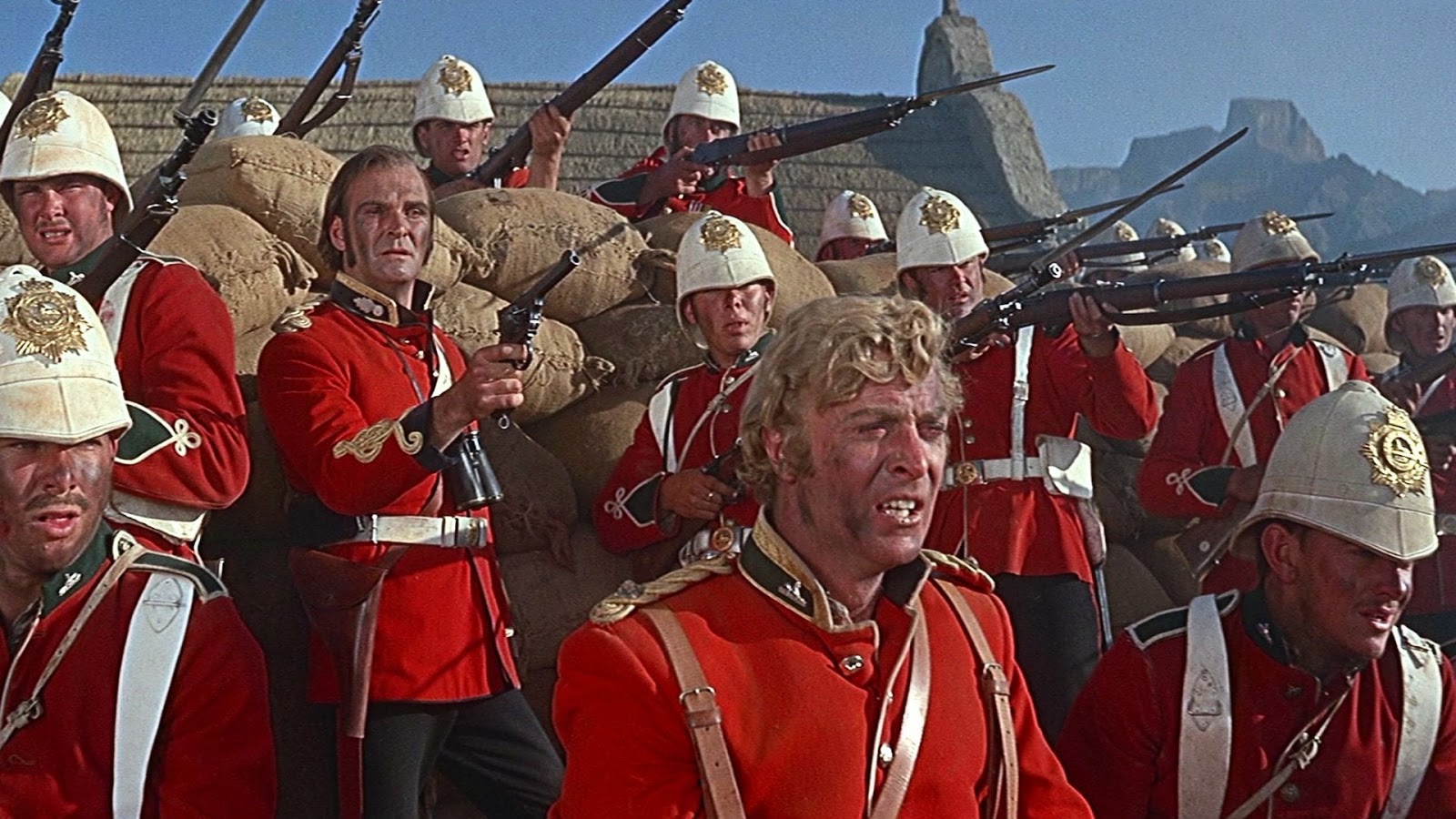
The film opens with the aftermath of the Isandlwana defeat (with a voiceover by Richard Burton, reading the report of the disaster written by British commander Lord Chelmsford). The camera tracks over the bodies of the British, as the Zulu warriors move through the camp (the film omits the Zulu practice of mutilating the bodies of their fallen opponents, which is just as well). Action then transfers immediately to Rorke’s Drift where Lt John Chard (Stanley Baker), a Royal Engineer temporarily assigned to the base to build a bridge, is senior officer by a matter of months over Lt Gonville Bromhead (Michael Caine – famously billed as “Introducing Michael Caine”). Chard takes command of the preparations to repel the siege, building fortifications, arming the walking wounded, and carefully making the defensive line as tight as possible to cancel out the Zulu numbers (the exact opposite of what happened in Isandlwana).

Zulu is drama, not history. Much has been changed to make for better drama. Chard and Bromhead were not as divided along class lines. Nigel Green (excellent) plays Colour Sergeant Bourne exactly as we would expect a Colour Sergeant to appear – a tall, coolly reassuring martinet “father to his men” – so it’s a surprise to learn the real Bourne was a short 24-year old nicknamed the Kid (the real Bourne was offered a commission rather than a VC after the battle). Henry Hook, here a drunken malingerer with right-on 60s attitudes towards authority, was actually a teetotal model soldier (his granddaughter famously walked out of the premiere in disgust). Commissioner Dalton is a brave pen pusher, when in fact it was he who talked Chard and Bromhead out of retreating (reasoning the company wouldn’t stand a chance out in the open) and then fought on the front lines. Neither side took any prisoners – and the British ended the battle by killing all wounded Zulus left behind, an action that (while still shameful) is understandable when you remember the mutilation the Zulus carried out on the corpses of their enemies at Isandlwana the day before.

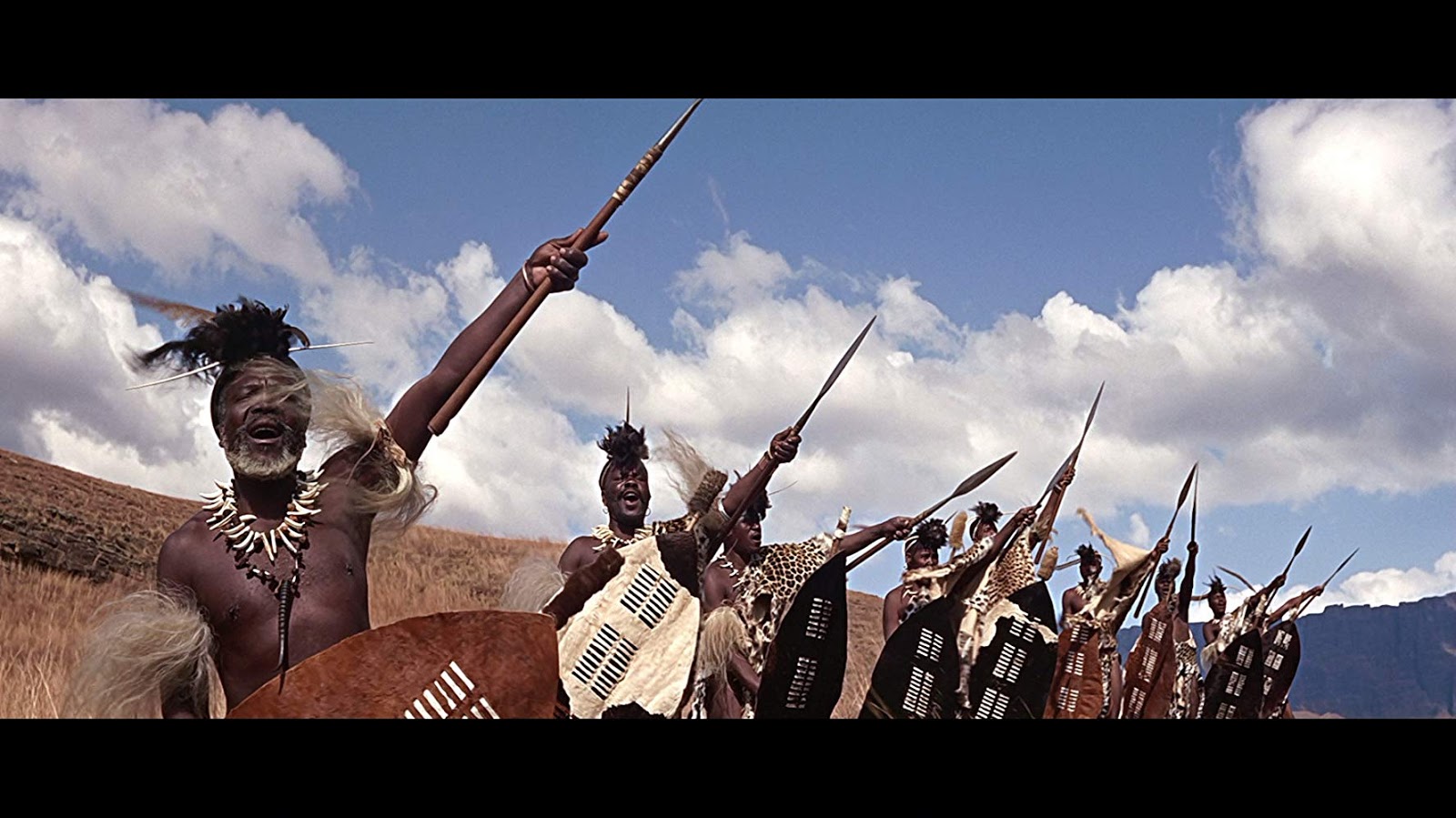
But it doesn’t really matter, because this isn’t history, and the basic story it tells is true to the heart of what happened at Rorke’s Drift. Brilliantly directed by Cy Enfield, it’s a tense and compelling against-the-odds battle, that never for a moment falls into the Western man vs Savages trope. Instead the Zulus and the soldiers form a sort of grudging respect for each other, and the Zulu army is depicted as not only disciplined, effective and brilliantly generalled but also principled and brave. The British soldiers in turn take no joy in being there (Hook in particular essentially asks “What have the Zulu’s ever done against me?”), admire as well as fear their rivals and, by the end, seem appalled by the slaughter. (Chard and Bromhead have a wonderful scene where they express their feelings of revulsion and disgust at the slaughter of battle.)

It’s a battle between two sides, where neither is portrayed as the baddie. We see more of it from the perspective of the defenders of the base, but the Zulu are as ingenious and clever an opponent as you are likely to see. The opening scenes at the court of Zulu king Cetshawayo’s (played by his actual great-grandson) allow us to see their rich culture and their own fierce traditions, grounded in honour (and spoken of admiringly by missionary Otto Witt, played with an increasingly pained then drunken desperation by Jack Hawkins, as he begs the British to flee and prevent bloodshed). Many of the Boer soldiers in the base compare the British soldier unfavourably with his Zulu counterpart. The film goes out of its way to present the Zulu people as a legitimate culture, and a respected one.
But its focus has to be on the British, as this is a “base under siege” movie, and to ratchet up the tension successfully it needs to chuck us into the base, playing the waiting game with the rest of the men. The Zulu army doesn’t arrive until over an hour into the film – the first half is given over entirely to the wait, the hurried preparations and the mounting fear as the seemingly impossible odds start to seep into the British. The men react in a range of ways, from fear, to anger, to resentment, to grim resignation. The first half also plays out the tensions between Chard and Bromhead, one a middle-class engineer, the other the entitled grandson of a General. 

Caine is that entitled scion of the upper classes, and he plays it so successfully that it’s amazing to think it would only be a couple of years before he was playing Harry Palmer and Alfie. Caine nails Bromhead’s arrogance, but also the vulnerability and eventual warmth that hides underneath it. Set up as a pompous obstruction, he demonstrates his bravery, concern and even vulnerability. It’s a turn that turned Caine from a jobbing actor into a major star (Caine originally auditioned for Booth’s part as the working-class Hook. Booth later turned down Alfie). It also meant that Stanley Baker’s excellent turn, in the drier part as the cool, controlled Chard, buttoning down his fear to do what must be done, gets unfairly overlooked.

The film never lets up the slow build of tension – and then plays it off brilliantly as battle commences. Perhaps never on film have the shifts and tones of proper siege combat been shown so well. This is perhaps one of the greatest war films ever made, because it understands completely that war can highlight so many shades of human emotion. We see heroics, courage, self-sacrifice and unimaginable bravery from both sides. We also see fear, pain, horror and savagery from both. Several moments of bravery make you want to stand up and cheer or leave a lump in your throat (I’m a sucker for the moment Cpl Allen and Pvt Hitch leave their wounded bay to crawl round the camp passing out ammunition).

Enfield’s direction is masterful, the first half having so subtly (and brilliantly) established the relative locations and geography of everything at Rorke’s Drift, you never for one minute get confused about who is where once battle commences. The combat after that is simply extraordinary, a triumph not just of scale and filming but also character and storytelling. We are brought back time and time again to characters we have spent the first half of the film getting to know, and understand their stories. Eleven men won the Victoria Cross at Rorke’s Drift (more at one engagement than at any other time in history), and each of the winners is given a moment for their courage to be signposted. All of this compelling film-making is scored with deft brilliance by John Barry, with the sort of score that complements and heightens every emotional beat of the film.

Strangely some people remember this film as ending with each of the garrison being killed – I’ve seen several reviews talk of the men being “doomed”. Perhaps that impression lingers because there is no triumphalism at the end of the film. After the attack is repelled, with huge casualties, the soldiers don’t celebrate. They seem instead shocked and appalled, and simply grateful to be alive. After the final deadly ranked fire of the British, as the smoke clears to show the bodies of their attackers, the men seem as much stunned as they do happy. Bromhead talks of feeling ashamed, Chard calls it a “butcher’s yard”. Duty has been done – but the men were motivated by wanting to survive. The film doesn’t end with high fives and beers, but people quietly sitting, gazing into the near distance. There are small moments of dark humour from the survivors, but never cheers.

It’s all part of the rich tapestry of this enduring classic. Historically, many believe the celebration of the victory at Rorke’s Drift was to deliberately overshadow the catastrophe of Isandlwana (and that the number of VCs handed out was part of this). But, even if that was partly the case, it doesn’t change the extraordinary bravery and determination to survive from the soldiers. And the film doesn’t even try to get involved in the politics of the situation. The men must fight “because they are there” and the rights and wherefores of the war (which the film ignores completely) are neither here nor there. Instead this is a celebration of the martial human spirit, packed full of simply brilliant moments, wonderfully acted and directed, and an enduring classic. It allows you to root for the besieged but never looks down on or scorns the besiegers. It pulls off a difficult balance brilliantly – and is a brilliant film.

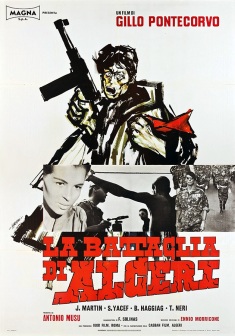
The Battle of Algiers (1966)

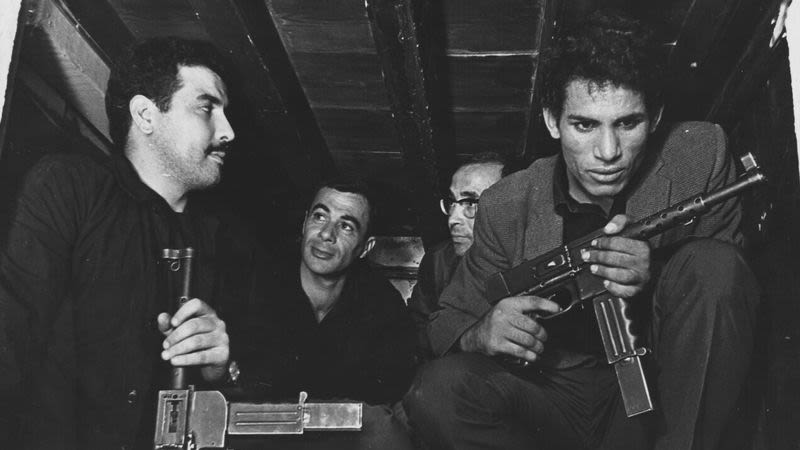
The French military move into Algiers in Pontecorvo’s neo-realist masterpiece The Battle of Algiers

Director: Gillo Pontecorvo

Cast: Jean Martin (Colonel Mathieu), Yacef Saadi (Djafar), Brahim Hadjadi (Ali La Pointe), Tommaso Neri (Captain). Ugo Palette (Captain), Fusia El Kader (Halima), Mohamed Ben Kassen (Petit Omar)

Sometimes, when watching The Battle of Algiers, you have to catch yourself and remember everything you are watching was staged rather than real footage. That right there is the greatest strength of this film, and its ongoing legacy. It feels more real than the news, it looks more authentic than reality. Match that with the fact that (and it says a lot for the world that this is the case) its themes remain painfully resonant today, and you can see why it has had such a lasting and profound impact on film-makers.

Pontecorvo’s film dramatises (although that almost feels like the wrong word) events in Algiers, capital city of French Algeria, from November 1954 to December 1957 when the Algerian War of Independence turned the city into a near warzone, with its hub being an increasingly brutal struggle for control of the Casbah between the French authorities (and then army) and the Algerian National Liberation Front (FLN) cells. 

That description only gets a flavour of the film, which reconstructs the story with a truly awe-inspiring immediacy that feels like a slice of real life. The film has a fearless willingness to depict the dangerous struggle and violence in a combat between terrorists and soldiers. So we get violence on both sides, torture, murder, beatings, bombings of young civilians and other acts of brutality, all chronicled with a documentary realism that never feels exploitative or distasteful.

The film is often hailed as being scrupulously even-handed. I’d argue it isn’t quite – what it does do is recognise that both sides are human. The cause of Algerian independence is clearly one the film finds sympathetic, and while it shows acts of terror from the Algerians, the real acts of violence and prejudice come from the French authorities and citizens. The film doesn’t turn the Algerian terrorists into unspoilt martyrs, but it certainly regards their cause as right. So it can show them killing civilians and engaged in acts of violence, but still admire their cause (the film was made with the involvement of several former members of the NLF both in front of and behind the camera).

The film’s depiction of the French soldiers also gives more of an impression of even-handedness. These soldiers are not brutal or sadistic, but functionaries doing about a job (just following orders?) with a ruthless efficiency. The casting of Jean Martin (the only professional actor in the film) as French commando leader Colonel Mathieu also perhaps weights things, as Martin gives an engaging, morally conflicted performance, and the film lays great stress on Mathieu’s own experiences during the Second World War in the French Resistance and (it’s implied) in a concentration camp. 

The French soldiers go about their task of pacifying the terrorists with a campaign of capture, enhanced interrogation and systematic elimination of cell leaders, using their superior resources and training, in a way that the CIA (which screened the film for its agents in 2003 to help them understand terrorist cells) described as being a complete success militarily, but a total failure politically. It stamps out the Algerians in the Casbah, in a way that reduces casualties and restores order – but totally fails to win over the precious hearts and minds.

And Pontecorvo knows it’s hearts and minds that his film is all about. His camera immerses us in the heat and tension of the Casbah, picking out the faces of the non-professional extras (and actors) that populate his film, showing the bubbling tensions and resentment slowly building in a population that doesn’t start out as bitter and extremist, but becomes more and more so as the French stamp out the Algerian independence movement. People swirl around the action, increasingly objecting to the strict control procedures that segregate the Casbah from the rest of the city, and at several points crowding into potentially violent mobs, spurred on by some members of the NLF.

The NLF also has little compunction in the tactics it has to employ in order to stand any chance against the French. Pontecorvo frames the film around the experiences of Ali la Pointe (a striking performance from non-professional Brahim Hadjadi). It opens with la Pointe trapped by the French soldiers, flashing back to his initial recruitment, radicalisation and increasingly pivotal role as a cell leader under more the more urbane and political Djafar (Yacef Saadi, another non-professional playing a version of himself). 

La Pointe is our audience surrogate – and it’s surprising how we find ourselves drawn towards him. Especially since within the first 15 minutes he’s moved quickly from murdering gangsters in the Casbah to shooting cops and leading riots. Pontecorvo shoots and edits these moments of terrorist action and planning with a Hitchcockian skill. One particularly brilliant sequence follows three NLF women being selected, prepared for, traveling to and carrying out a series of bombings of cafes and bars in Algiers (the victims at one seem to be exclusively teenagers and young people).

The film is full of moments like this, all filmed with a gripping down-to-earth black-and-white realism, buzzing with tension. It’s brilliantly assembled and totally compelling, a documentary slice of Italian neo-realism that presents a fascinating look at the dangerous politics of resistance and occupation. The French military’s heavy-handed tactics are totally effective – even torture is shown to yield enough results to justify its use – but they are also completely wrong, morally repugnant but executed by soldiers going about their duty with no bitterness (Mathieu frequently tells the press that he hopes for a bright future for Algiers and even doubts the wisdom of occupation in the long run).

Pontecorvo’s film remains alarmingly prescient and relevant today – and it’s actually a little scary how little the world has changed. You can just as easily imagine the same events happening in Iraq or Afghanistan today. It’s told here with no sensationalism but a mostly objective even-handedness, that makes clear the side it favours but doesn’t demonise the other. As a slice of history turned into film it’s impeccable.

Patton (1970)

George C Scott triumphs as Patton in this excellent World War Two biopic

Director: Franklin J Schaffner

Cast: George C Scott (General George S Patton), Karl Malden (General Omar Bradley), Michael Bates (General Bernard Montgomery), Edward Binns (Lt General Walter Bedell Smith), Lawrence Dobkin (Colonel Gaston Bell), John Doucette (General Lucian Truscott), James Edwards (Sgt William Meeks), Frank Latimore (Lt Colonel Henry Davenport), Richard Münch (General Alfred Jodl), Morgan Paull (Captain Richard Jenson), Siegfriend Rauch (Captain Oskar Steiger), Paul Stevens (Lt Colonel Charles Codman), Karl Michael Vogler (Field Marshall Erwin Rommel), Peter Barkworth (Colonel John Welkin)

Patton was garlanded with eight Academy Awards in 1970, but rarely seems to get a mention when people list landmark best pictures. This is unfair, as Patton is a marvellous, intelligent, professional piece of film-making that rewards re-viewing: not least because, in George C Scott, it has one of those performances you simply must see, an extraordinary melding of actor and real man to such a great extent many people can’t believe they are seeing the real thing when watching newsreel footage of the actual Patton.

Patton is nominally a war film, but it’s actually an intriguing character piece. It follows the career of General George S Patton (George C Scott) during the course of the Second World War. Patton was a soldier’s soldier, a dyed-in-the-wool military man with a warrior’s instinct and a poet’s soul. The sort of man who berated men for not wearing proper uniform, then astounded them with thoughtful reflections on classical history. The film charts his command in Africa against Rommel, the invasion with Sicily (and feud with British counterpart Bernard Montgomery), his benching after striking a soldier suffering from shellshock in a military hospital, and his command of the Third Army during the Normandy invasion, including his pivotal role in the Battle of the Bulge.

With a script co-written by Francis Ford Coppola and Edmund North (later president of the Screenwriter’s Guild), Patton was a warts-and-all portrait of one of America’s most famous generals that came out amidst the country’s growing disillusionment with Vietnam. It was embraced by both sides of the argument because it very skilfully walks a tight-rope: for the hawks, there is enough of the “if we had more like him …” stance. For the doves, the film doesn’t shy away from Patton’s egomania, lack of tact and love of war (he even strongly advocates immediately turning on Russia – ‘cos they’ve already got all the men in Europe anyway – which you can interpret as visionary or insane depending on which side of the fence you are on).

At the centre of everything, George C Scott is quite simply a force of nature as Patton – I don’t think it’s an exaggeration to say this is surely one of the greatest Best Actor winning performances ever. Patton is in nearly every scene, and even the one’s he’s not in he’s the subject of every conversation, and Scott totally dominates the movie. You can’t put your finger on it, but he quite simply becomes Patton. It’s extraordinary, but the actor totally disappears and you feel you are watching some remarkable act of resurrection (fitting since Patton had a profound belief in reincarnation).

Scott’s Patton rages, he shouts, he goes into fits of childish egomania – but he’s also sensitive, intelligent and poetic. He can write a touching letter to the bereaved mother of his adjutant, expressing his sorrow, but also write how tragic it is that he will miss the wars to come. Scott is ramrod in his posture, and more than embraces the theatricality of Patton himself – when an adjutant tells the General sometimes his soldiers don’t know if he’s joking or not, the General softly replies “It’s not important for them to know. It’s important for me to know”.

It’s easy to eulogise over Scott at the expense of all else – but the film is so focused on Patton that he is intrinsically linked with the film’s success. The film is episodic, but every scene tells us something different about the man. Although since the film starts with one of the greatest opening scenes in movie history, we feel like we pretty much know him from the start.

It opens with an enormous American flag, in front of which Patton emerges in full dress uniform to encourage new soldiers to do their duty and, most of all, to “remember that no bastard ever won a war by dying for his country. He won it by making the other poor dumb bastard die for his country.” Scott famously refused to do this scene when told it would open the picture, as he felt nothing else in his performance could emerge from its shadow (they eventually told him it would go later in the film – no word on how he responded when he first saw the film!).

In a nut shell you get the whole movie. Is the giant American flag ironic or does the film really mean it? Patton is both strangely terrifying and also awe-inspiring, charisma, determination and force seeping from every pore of his body. Scott nails every detail of this speech, just as he nails every other part of the performance, while the camera work reinforces his mythic status (or his hubris depending on where you stand) as a symbol of Americana.

Schaffner’s direction of the film is easy to overlook, largely because it is refreshingly unflashy. It’s superbly professional –not a single scene falls flat. He marshals each scene with extraordinary effect, and manages the film’s difficult balancing act of sly satire and hagiography brilliantly. He also, within an epic canvas, works very well with actors – there are a host of great cameos in here, not least from Michael Bates as a preening Montgomery and Edward Binns as an exasperated Bedell Smith. Karl Malden is the only other really major character as Patton’s junior (later commanding) officer and he is perfect as the honest professionalism in contrast to Patton’s flash.

And the film gives us plenty of Patton’s flash. The man who loved war and combat, also loved performing – and does so with abundant skill. But the film isn’t afraid to show his warts: in Sicily he threatens to sack a general who refuses to risk his men’s lives on a risky operation, primarily motivated by Patton wanting to reach Messina before Montgomery. Later, when striking the scared soldier, his actions are tough to watch even as part of you sees his point about other men having been wounded in the line of duty (the playing of the soldier as a teary whiner probably doesn’t help). The film never fails to show that Patton’s worst enemy is his own arrogant lack of thought – he constantly shoots his mouth off with no thought for the impact.

The film is brilliantly constructed. The photography is excellent, the editing superbly marshals a long film of many individual scenes into a story that seems a lot tighter and forward moving than it probably is. Schaffner makes us feel we go on a clear journey with this character – helped as well by Jerry Goldsmith’s excellent score that conveys a great deal with ancient mythic weight, playing off Patton’s own belief in resurrection.

Patton is often forgotten a bit – but it is a great film, well made, brilliantly balanced, wonderfully written and directed. And at its centre: what a performance. George C Scott is simply astoundingly brilliant, completely transformed into the old general. His Oscar (which Scott declined, thinking awards phony) was as well-deserved as these things get. A wonderful film, a true epic, and a marvellous character study of an enigma – it deserves to sit near Lawrence of Arabia in the personal epic stakes (to which it has more than a few similarities).

Enemy at the Gates (2001)


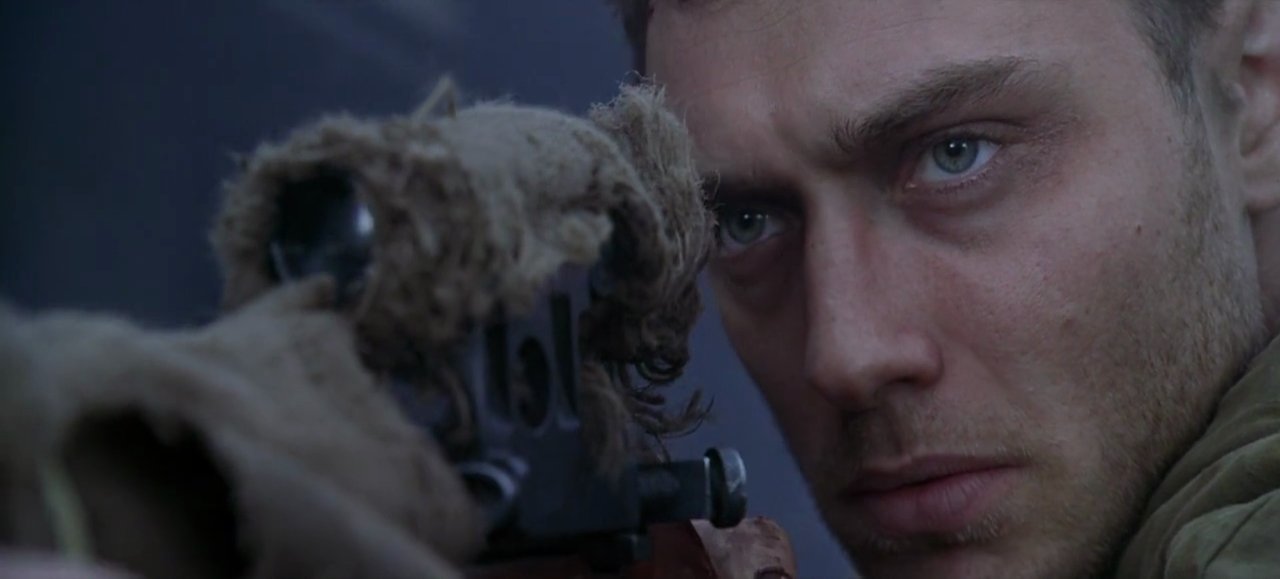
Jude Law takes aim in wonky Stalingrad drama Enemy at the Gates

Director: Jean-Jacques Annaud

Cast: Jude Law (Vasily Zaytsev), Joseph Fiennes (Commisar Danilov), Rachel Weisz (Tania Chernova), Bob Hoskins (Nikita Khrushchev), Ed Harris (Major Erwin König), Ron Perlman (Koulikov), Eva Mattes (Mother Filipovva), Gabriel Marshall-Thomson (Sasha Filippov), Matthias Habich (General Friedrich Paulus)

The Second World War in film almost always focuses on the heroics of the Western Front, where the rights and wrongs are usually pretty clear (the Western powers are noble, the Nazis savage). So it’s different to set a film on the Eastern front – where the Second World War was arguably really won and lost, and where morality is much more complex. The Nazis are terrible, but Stalin’s Russia was no picnic either.

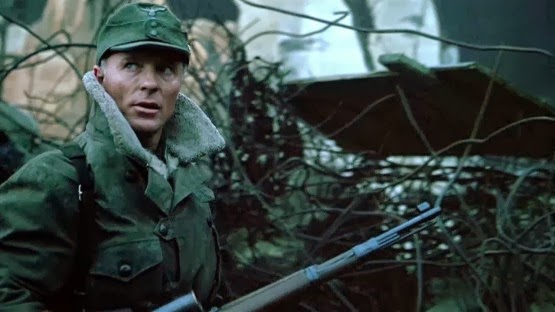
Stalingrad in 1942: Soviet tactics involve giving every other man a gun, and ordering the second man to follow his partner and take his gun when he is killed. Witnessing the sharpshooting skills of young soldier Vasily Zaytsev (Jude Law), political Commissar Danilov (Joseph Fiennes) decides to turn him into the romantic hero the Soviets need to help inspire them. He’s so successful in doing so that the Germans send their own expert sniper, Major König (Ed Harris), to find and kill Zaytsev. Meanwhile, the friendship between Danilov and Zaytsev becomes complicated when they both fall in love for the same woman, sharpshooter and German translator Tania Chernova (Rachel Weisz).

It’s quite something for a film to be denounced by both sides of the war it’s depicting: this probably means it’s doing something right, as it doesn’t deny the hellish atrocities carried out on both sides (even if many of these are implied). The real reason to be outraged is probably more to do with its general flatness and shoving of the great battle into the standard war-movie clichés. There are some attempts to suggest what we are seeing is a true story, but other than a man called Zaytsev existing, there is very little of truth on show. Instead we get a Hollywood view of Soviet Russia: where the characters we like are regular joes, while the ones we don’t are full-on Commie zealots.

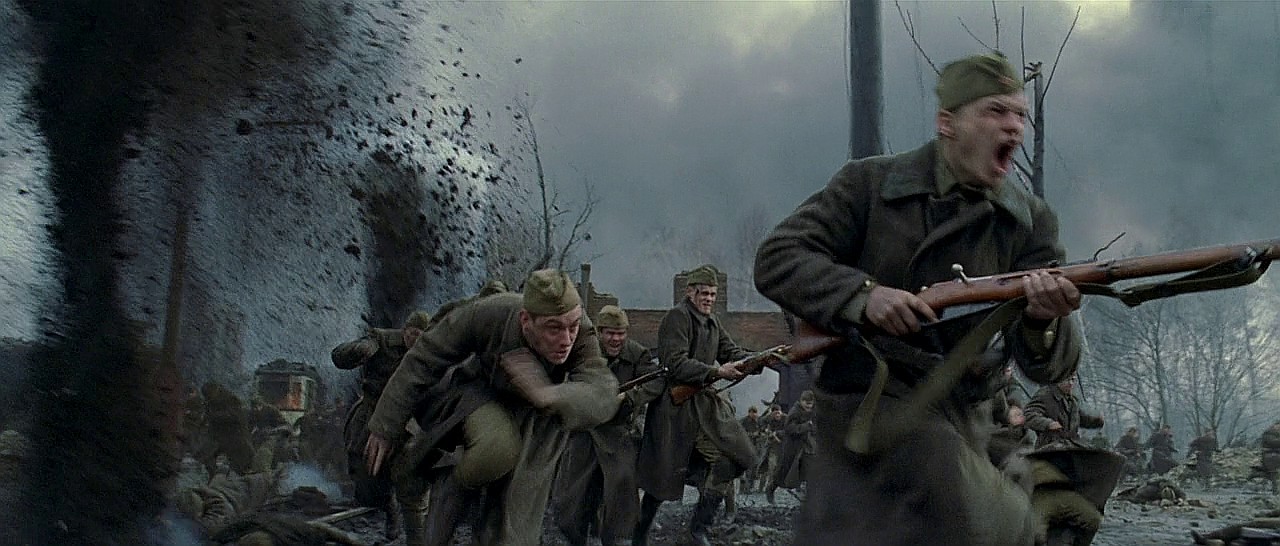
The film starts well, with an extended sequence that follows Zaytsev and several other soldiers boarding boats, crossing the river, arriving in Stalingrad and being marched immediately into the front line. Half the men are killed – the fleeing remainder are swiftly machine gunned by their officers for cowardice. It brings back memories of Saving Private Ryan and, while not as good, gives the impression we are going to see a “horrors of war” film – which the film doesn’t turn into.

Instead we get an increasingly melodramatic plotline around love triangles and sniper duels that never really feels like Russian lives at the time. In fact, the film fails to capture any real sense of Soviet Russia, other than its dirt and ruthlessness. Danilov and Zaytsev celebrate their newfound fame with a sort of giddy laddishness that just doesn’t fit any Russian’s understanding of what being noticed in Soviet Russia would surely mean. When the film does try to sound Soviet it stumbles: there is a painful (unintentionally) funny moment when Zaytsev talks about his dream job to be working in a factory, because factory work seems so noble.

The love triangle also seems ripped from Mills and Boon. Not a lot of it rings true, with Danilov turning into some sort of jealous head-boy. The romance blossoming between Zaytsev and Tania can’t decide whether it’s two souls coming together, or whether it has the air of a “last romance” with death around the corner. So it’s either overblown and overplayed, or not given enough room to build. It doesn’t help that there are a number of strange choices – not least a sex scene where Rachel Weisz seems more uncomfortable and in pain than in the throes of passion.

Maybe it’s that none of the performances of the lead actors feels either particularly Russian or soldierly. Jude Law fails to convince as a man from peasant hardship. He’s also saddled himself with a wooden “peasant” accent that not only makes Zaytsev sound like a mockney chancer, but also sound like a worse actor than he is. Joseph Fiennes is more school prefect than Soviet Commissar. Rachel Weisz is the most natural of the three, but her character makes little real sense: sometimes she’s gung-ho, others she talks about wanting this war to end. None of these actors really brings the right charisma needed – in particular Law looks as overwhelmed by the events around him as Zaytsev claims to feel.

The film belongs to the sniper sequences, and the duel of wits that develops between Zaytsev and König. Ed Harris’ part is as limply written as the rest, but Harris has a movie star charisma the others lack, and suggests a great deal of reserved arrogance and professional coldness. He’s the best thing about the movie. Annaud shoots the slow-burn waiting of sniping with a tension – and the film rather bravely stresses König’s superiority time and time again. As the film zeroes in on these two men trying to outmatch each other, it feels like it’s about something – and also that it’s relieved to leave the war at large behind.

Because for a film set in the Eastern Front, this feels unnerved by there being right and wrong on both sides. It even feels squeamish about sniper shooting. After his initial display of skill, we literally don’t see any sniper work from Zaytsev again – the “cowardly” killing from a distance of regular German soldiers is handed out to other characters. Russians are sorted into good and bad, with the good showing they are “just like us” by quietly denouncing their government. König can’t just be a professional, but the film has to try and nudge him into being a cold-hearted killer. It’s a film about the complex morality of war, that wants to make it as simple as possible.

It’s still well-made, but you wish that more time had been directed towards the script, to give us a story that was slightly better and characters that felt a bit more real. James Horner supplies a decent score (interestingly it also shows how much of film music is re-used, as key refrains in this film are strongly reminiscent of Willowand Troy). But the lead actors are all miscast (Bob Hoskins isn’t much more convincing as a bulldog Khrushchev) and it feels like a film that’s running away from a complex series of issues to try and present something as close as possible to goodies vs. baddies. The War on the Eastern Front was a hugely complex thing: this film hardly scratches the surface.

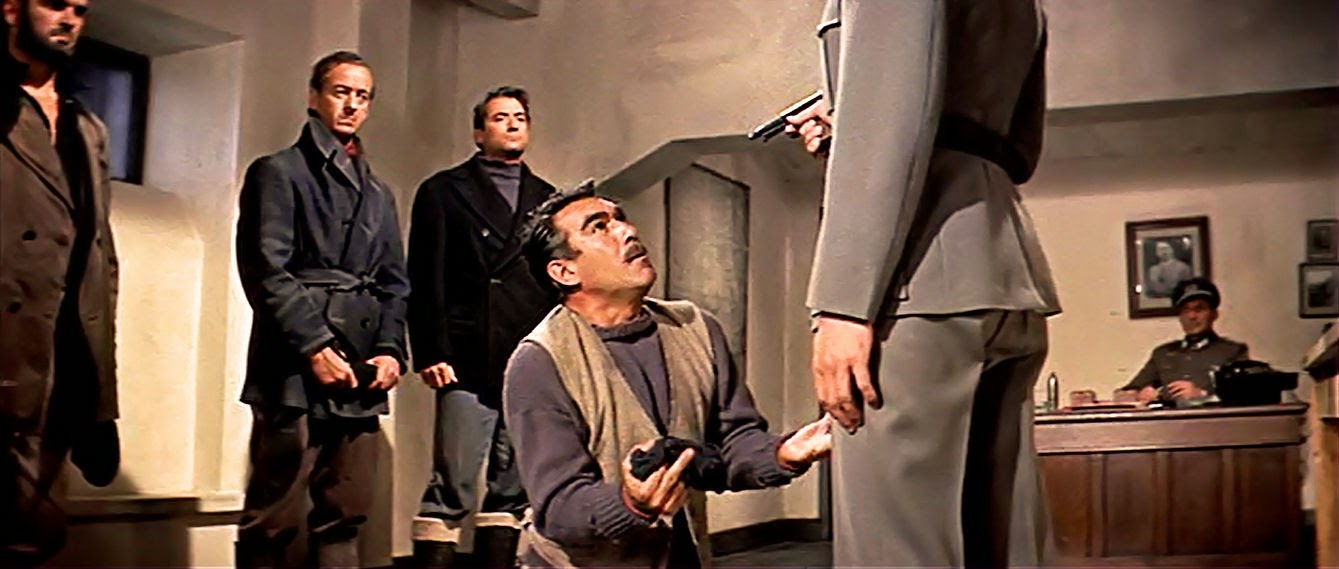
The Guns of Navarone (1961)


Gregory Peck leads one of the first men-on-a-mission films in The Guns of Nararone

Director: J. Lee Thompson

Cast: Gregory Peck (Captain Keith Mallory), David Niven (Corporal Miller), Anthony Quinn (Colonel Andrea Stavrou), Stanley Baker (Private “Butcher” Brown), Anthony Quayle (Major Roy Franklin), Irene Papas (Maria Pappadimos), Gia Scala (Anna), James Darren (Private Spyro Pappadimos), James Robertson Justice (Commodore Jensen), Richard Harris (Squadron Leader Barnsby), Bryan Forbes (Cohn), Allan Cuthbertson (Major Baker), Walter Gotell (Oberleutnant Meusel), George Mikell (Hauptstaumführer Sessler)

The Guns of Navarone is the archetypical “men on a mission” classic – it was the first major film to feature a team of specialists, all played by famous actors, going behind the lines to carry out some impossible task, leaving a trail of explosions and dead Nazis in their wake. Guns of Navarone was lavished with box-office success – and Oscar nominations, surprisingly – and although it’s a little too long, and a little weakly paced at times (as Thompson himself has admitted) it’s still got a cracking, bank holiday afternoon enjoyability about it. It’s not perfect, but honestly who could resist it?

In 1943, 2,000 British soldiers are stranded on the Greek island of Kheros. The Royal Navy plans to rescue them – but the way is blocked by two massive, radar controlled guns, in an impenetrable mountain base. The air force can’t take it out: so it’s up to Commando leader Major Roy Franklin (Anthony Quayle) to put together a team to do it. Recruiting mountaineer-turned-intelligence-agent Keith Mallory (Gregory Peck), explosives expert Miller (David Niven) and Greek-resistance leader Andrea Stavrou (who else but Anthony Quinn?), Franklin leads the team in. But when he is injured, the ruthless Mallory takes command – and leads the team in a perilous behind-the-lines raid.

I’d not seen Guns of the Navarone for a few years, and I’d forgotten what a brilliantly fun, boys-own-adventure thriller it is. I’d also forgotten what a lot of time is given early on into establishing what a team of bad-asses this group are. There seems to be no limit to their ruthless, knife wielding, gun running, cold-eyed killer bravery. And they hired a hell of a cast to play it as well – so damn good that you completely forget Peck, Niven, Quayle and Quinn are all just a little bit too over-the-hill for the derring-do they are called on to carry out.

Guns of Navarone brilliantly explains the mission aims, all the stakes and introduces each of the characters and their basic backstory, before the film basically gives us a series of action set-pieces – on a boat, at the coast, on a cliff, in a village, in a German cell, in Greek ruins, in a German base. It covers everything, and each scene is directed with real verve and increasing tension, with a simplicity to camera-work and editing that really lets the action breathe. The final sequence, waiting for the booby trap to explode among the guns, is a brilliantly done “rule of three” waiting game, with the tension building up each time.

The film is also rattling good fun, and gives each of its actors’ set-piece moments. Gregory Peck grounds the film perfectly as the increasingly ruthless Mallory, willing to sacrifice a number of pawns to achieve the target, but has a war weariness that still makes him sympathetic (as a side note, Peck’s German accent was so woeful all his German was dubbed). Niven plays Miller as a mixture of louche whiner, chippy middle-class man and natural-born troublemaker – and gets some knock-out speeches on the morality of war (Niven by the way nearly died after catching pneumonia during the boat wreck sequence).

Anthony Quinn had a monopoly on playing exotic roles at the time – from Mexicans to Arabs, from Gaugain to Zorba the Greek – so no great surprise he plays the Greek colonel here. He’s terrific though, a cold-eyed ruthless killer – and the sequence where he pretends to be a cowardly awkward fisherman is wonderful (not least for Stavrou’s reaction to Miller’s praise for his performance – a half shrug and a “so-so” hand gesture, one of my favourite ever “character” touches in the movies). Irene Papas is perfect as his female equivalent, while Anthony Quayle puts together another of his “decent army officer chaps” as boys-own adventurer Franklin. Baker and Darren don’t get huge amounts to do, but Baker does well with a “lost my taste for this killing malarkey” sub-plot.

Many of the character beats were so well-done they basically became archetypes for every “group on a mission” film since (the austere leader, the difficult whiner, the old-school traditionalist, the ruthless warrior, the maverick, the one who’s lost his nerve – and, uh, I guess James Darren is the “sexy” one). The actors play off each other superbly. There are also some great cameos – Robertson Justice is great as “the man in charge”, Walter Gotell very good as an archetypical “worthy adversary” German – there is even a slightly bizarre cameo from Richard Harris as an Aussie pilot (yup you read that right). 

Navarone’s pace doesn’t always quite work – the gaps between the action sequences do lag. It takes nearly 45 minutes for our heroes to even get to Navarone. The film also can’t quite decide its stance on warfare. We get Miller’s passionate speeches on the pointlessness of missions when wars are always going to happen anyway. The unmasking of a traitor leads to a long debate on the morality of killing them or not. Several of the characters question the point and morality of war. But then, the film spends plenty of time on Alistair MacLean thriller beats: there is killing-a-plenty of German soldiers, gunned down with ruthless efficiency (not quite as many as Where Eagles Dare but pretty close!). There are small references to Greek villages paying a heavy price in retribution for the gang’s action – but these considerations never even slow them down, or make them stop to think.

Not that it really matters – this is a boy’s own action film, full of hard-as-nails actors grimly “doing what a man’s gotta do” throughout. And, despite being a little too long and aiming for a depth it doesn’t always follow through on, it’s brilliantly assembled, the action sequences are tightly directed, and the acting has a square-jawed confidence to it. Niven is pretty much perfect as the slightly dishevelled Miller, and the clashing relationship between him and Peck growing into respect, has fine bromance to it. Navarone is the first of its kind, and it’s still (and always will be) one of the best – really exciting, really thrilling, really damn good fun.

The Heroes of Telemark (1965)


Kirk Douglas runs rings around the Germans in The Heroes of Telemark

Director: Anthony Mann

Cast: Kirk Douglas (Dr Rolf Pedersen), Richard Harris (Knut Straud), Ulla Jacobsson (Anna Pedersen), Michael Redgrave (Uncle), David Weston (Arne), Roy Dotrice (Jensen), Anton Diffring (Major Frick), Ralph Michael (Nilssen), Eric Porter (Josef Terboven), Sebastian Breaks (Gunnar), John Golightly (Freddy), Alan Howard (Oli), Patrick Jordan (Henrik), William Marlowe (Claus), Brook Williams (Einar)

During the Second World War, Telemark in Norway was the main production factory for Heavy Water, a key component for the German nuclear programme. Norwegian commandoes were ordered to destroy the factory, which they did with a cunning plan. This film dramatizes the story – adding more guns and violence – but does at least make the lead characters Norwegian. Knut Straud (Richard Harris) is the leader of the resistance, Rolf Pedersen (Kirk Douglas) the professor who identifies what the factory is churning out. Parachuted back into Norway after secretly travelling to Britain to discuss issues with the allies, they start to plan a raid.

The Heroes of Telemark is sub-par boys-own action stuff, a sort of cross between Where Eagles Dare and The Guns of Navarone but nowhere near as good as either. Despite being crammed with derring-do, it’s strangely unmemorable, and although the stakes are really high, you never feel like you care. Everything in the film, bizarrely, feels a little bit easy. Our heroes are not particularly challenged (Nazi bigwig Terboven even berates his guards at the base for letting our heroes walk in and blow up the factory all while wearing British uniforms) but there isn’t any real price paid. The only heroes who bite the bullet are so heavily signposted for death, you actually spend most the film waiting for them to cop it.

Part of the problem is both Kirk Douglas and Richard Harris feel miscast in the lead roles. It’s also pretty clear (alleged) on-set tensions carried across into shooting – not only do the two characters not really seem to like each other, you don’t get any feeling of a growing bond between them as the film goes on. You end up not really caring about either of them – and since virtually everyone else on the team is hardly defined at all as a human being, that’s quite a big loss.

Douglas plays a bizarre professor of physics whose character varies wildly from scene to scene depending on the plot. Introduced making out with a student in a dark room, Pedersen initially denounces the boys-own heroics of the resistance. No sooner is a gun placed in his hand though, than he starts turning into a regular “ends justify the means” superman. Marry his new-found ruthlessness with his regular horn-dog attitude to women, and he’s a hard guy to like. I’m not sure a hero today would climb into bed with his estranged wife (a glamourous and pretty good Ulla Jaconssen) and then get shirty when she fails to put out. The part feels like an anti-hero role, reworked to give the Hollywood mega-star some action.

Richard Harris is similarly out-of-place as Knut Straud (a character based on the real commando who carried out the raid). He spends the whole film looking sullen and furious – he’s going for intense devotion to duty, but instead he looks like the whole thing is a tedious chore. Harris isn’t really anyone’s idea of an action star, and he’s an odd choice for the film altogether. For different reasons, just like Douglas, his stubborn touchiness makes him hard to like.

Following these rather disengaging figures means the derring-do constantly falls flat. It doesn’t help that Anthony Mann’s direction lacks thrust, drive and energy and never really gets the pulse going. Even during the most daring commando sequences, it never feels particularly thrilling. It’s a very easy film to drift away from, never managing to be as taut or tight as it should. The world-shattering stakes of the German nuclear programme are never clearly explained, or kept at the forefront. Chuck in some rather obvious doubles work (no way is Douglas that good a skier) and a few wonky model shots (the boulder Harris and co roll down the hill to try and take out Terboven’s car is all too clearly made of papier mache) and you’ve got a film that never gets going.

It also lacks an antagonist. Eric Porter has a couple of decent scenes here and there as Reichskommisar for Norway Josef Terboven, but he disappears from the film for ages. The Nazis end up as a faceless bunch of German soldiers, and are so easily overcome or fooled that they hardly count as challenges. As such, the clashes and arguments really come within the commando organisation itself, but since Harris and Douglas so clearly don’t like each other, even their brief reconciliation doesn’t ring that true.

The Heroes of Telemark will pass the time on a bank holiday afternoon. You get some decent performances – Roy Dotrice is very good as a possible quisling – and the odd good scene (Redgrave gets a good death scene) but it never really comes to life like it should. Mann’s direction is too plodding, and the pacing of the film so slack that it never becomes exciting or engaging. There are so many better movies on a similar theme you could be watching.

A Bridge Too Far (1977)


Dirk Bogarde, Sean Connery, Ryan O’Neal and Gene Hackman are among the Generals aiming to go A Bridge Too Far

Director: Richard Attenborough

Cast: Dirk Bogarde (Lt-Gen Frederick “Boy” Browning), James Caan (Staff Sgt Eddie Dohun), Michael Caine (Lt-Col J.O.E. Vandeleur), Sean Connery (Maj Gen Roy Urguhart), Edward Fox (Lt Gen Brian Horrocks), Elliot Gould (Col Robert Stout), Gene Hackman (Maj Gen Stanislaw Sosabowski), Anthony Hopkins (Lt Col John Frost), Hardy Krüger (SS Maj Gen Karl Ludwig), Laurence Olivier (Dr. Jan Spaander), Ryan O’Neal (Brig Gen James Gavin), Robert Redford (Major Julian Cook), Maximilian Schell (SS Gen Wilhelm Bittrich), Liv Ullman (Kate ter Horst), Michael Byrne (Lt Col Giles Vandeleur), Denholm Elliott (RAF Officer), Jeremy Kemp (Briefing Officer), Wolfgang Preiss (Feldmarchall Gerd von Rundstedt), Stephen Moore (Maj Robert Steele)

You’ve got to love a good war film. In fact, there are few things more cinematic than the old-school, star laden Hollywood war film. A Bridge Too Far is for me one of the finest examples of this genre, and it’s a film I come back to time and time again. Is it perfect? No of course it isn’t – in fact I probably love this film more than some of the people actually in it do. But it’s a damn fine piece of big-screen, big-budget film-making, and it’s got a cast of stars. And more than perhaps any other film of this genre, it’s a film about how overwhelmingly awful and gut-wrenching war is. This is a film about a defeat – and not the sort of triumphant defeat that Dunkirk feels like. It’s just a gut-punch. The Allies threw the dice big time, and they lost.

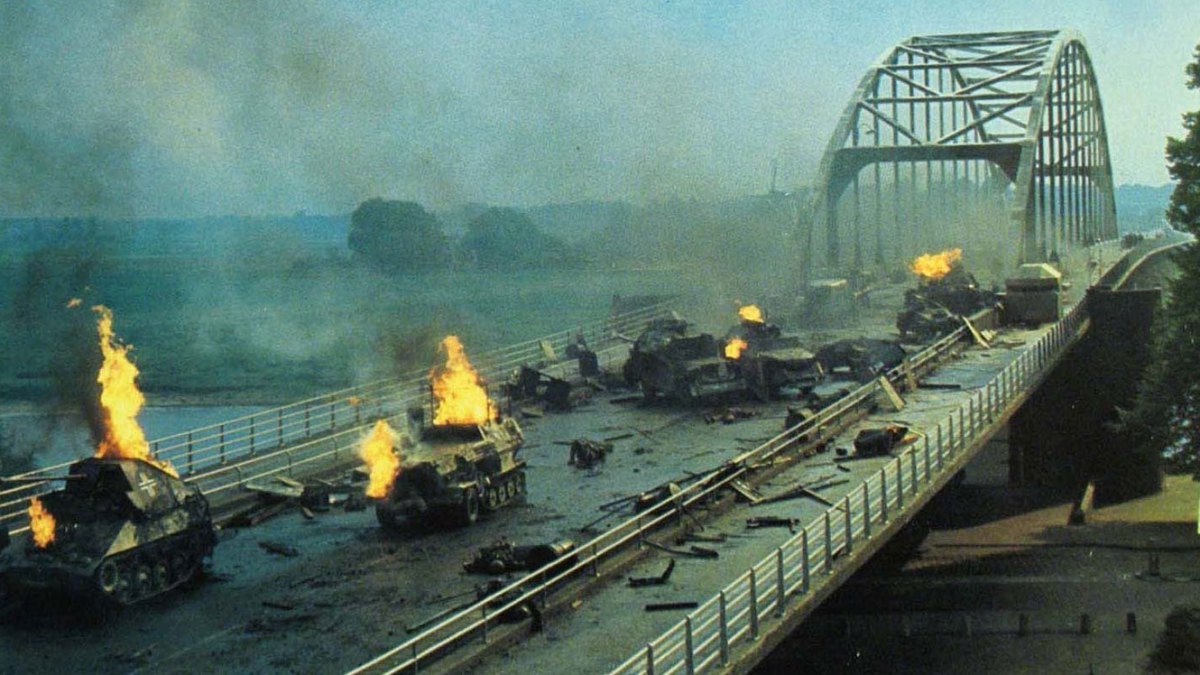
The Battle of Arnhem was one of those “end the war by Christmas” plans. The brainchild of British war-hero Field Marshall Montgomery (noticeably absent from the film), Operation Market Garden was a lightning strike into the heart of the Ruhr to capture Germany’s industrial capability. This involved a series of paratrooper drops into towns in the Netherlands, culminating in Arnhem, to cross the Rhine. While the paratroopers seized key bridges, British Tank Division XXX Corp would power through, cross the bridges and into Germany. It was bold, daring and radical. It was a disaster. Arnhem, far from being undefended, was being used as a rest place for a Waffen-SS Panzer division. The British paratroopers found themselves not seizing a lightly defended bridge, but fighting a tank division with machine guns and limited supplies. Meanwhile XXX Corp’s progress became bogged down in traffic jams and higher than expected German resistance. 

It’s quite something to make a war film about possibly the biggest military disaster on the Western Front during the Second World War. The entire plan is a misconceived tactical blunder, and the film never shies away from this, demonstrating time and again the numerous errors that led to it: from Generals ignoring reconnaissance that suggests this won’t be a cake walk, to paratroopers failing to seize bridges quickly, to tanks crawling down crowded roads, fighting every step of the way. Alongside all this, the film never loses track of the horrifying impact of war on both soldiers and civilians caught in the crossfire. It’s a huge budget, all-action, anti-war film.

Richard Attenborough is the perfect marshal for this film. He has the experience and understanding of scope to handle the action scenes. At the time, this film was possibly the most expensive film ever made. Not only that, it was independently funded – producer Joseph E. Levine thought the film was so important he pumped millions of pounds of his own money into it. The attention to detail is extraordinary – the film consulted nearly every single surviving commander from the battle on the script – and all the stops were pulled out creating the military features of the film. 

This is of course particularly striking now as we know everything in the film is real – no special effects in those days. If you see it in the film, then you know that it was really there. In the sequence showing the planes taking off to deliver the paratroopers to their destinations, there were so many planes in the air that Attenborough could literally claim to command the world’s seventh largest air force. Every military blow of the battle is carefully reconstructed. The tactics are carefully explained and followed. Attenborough can shoot compelling action.

But what makes the film so good (for me anyway) is the way the heart-breaking horror of war never gets lost. In all this action, we are always shown the cost. Attenborough will frequently cut back to the after-effects – several times we hear wounded soldiers whimpering on smoke-filled, body-littered battlefields. Many acts of courage (on both sides) by individual soldiers result only in pointless, gut-wrenching deaths. Arnhem isn’t just damaged by the battle, it’s flattened. The impact on the civilian population is terrible – in a powerful sequence, we see characters we were introduced to earlier mercilessly caught in the crossfire of the German tanks. We return continually to locations increasingly shredded by weapons fire. More and more soldiers are wounded – some horrifically.  Near the end, the remaining British paratroopers, encircled and surrendering, sing a deeply moving quiet rendition of Abide With Me. No one could come out of this wanting to go to war.

Attenborough’s humanity is key to the film’s success. It helps as well that he is a brilliant actor’s director. Want to dispel any doubt on the horrors of Arnhem –then train the camera on the Laurence Olivier’s tear-stained face as he drives through the destroyed streets. Want to understand the sacrifices and the courage? Well just let Anthony Hopkins – simply excellent as the commander of the only forces to reach the bridge at Arnhem – with calm, restrained Britishness request support and supplies late in the film as his men are butchered around him. It’s a film full of brilliant moments of acting like that, where Attenborough points the camera at them and lets them act. 

The sequences around Arnhem and the British paratroopers there are the heart of the film. Sean Connery is terrific as Major General Roy Urquhart, commander of the British paratroopers. His growing frustration as events spiral far out of his control is a great contrast with his initial professional confidence. Gene Hackman, as commander of the Polish forces (slightly odd casting but good once you tune up to it), gets the role of the “one man talking sense” who can smell disaster early on, but works harder than anyone to get the plan to work. A number of the regular soldiers in Arnhem are faces the film returns to again and again – giving us people to relate to as their numbers are increasingly decimated by the savage, desperate combat. John Addison’s score also helps a huge amount with building the emotion in these scenes.

The Arnhem sequences are so good that the other sequences around the American paratroopers feel like they come from a slightly different movie. It doesn’t help that the likes of Elliot Gould are playing slightly clichéd “Brooklyn Yankee” types, chomping cigars and ribbing the stiff-upper-lip Brits. Ryan O’Neal as General Gavin is slightly dull. The XXX Corp material is a little dry (essentially driving up a road or waiting), although Edward Fox is superb (and BAFTA-winning) as their charismatic commander Lt Gen Brian Horrocks. Attenborough puts together at least one terrific set-piece tank battle on the road – but it’s not quite enough.

The two biggest American stars are also given the feel-good, up-beat material. James Caan gets the best part in what is effectively a stand-alone story of a Staff Sergeant going to impossible lengths to save the life of his Captain (Caan had his choice of part and chose well). Robert Redford is a little too starry (bizarrely in a film full of stars!) as a Major tasked to seize the vital bridge at Nijmagen via a daylight river-crossing. This sequence feels like it’s been put in the film to (a) give us something to cheer and (b) to allow an American victory for the box office. Of course, we need the biggest star in the world at the time to play the most straight-forward heroic part!

The film does have a tendency to shuffle its characters into “good” and “bad”. So after Redford seizes the bridge, the character sent to tell him that XXX Corp won’t be rushing across to Arnhem after all isn’t Caine’s Vandeleur, but a nameless Colonel played by Polanski’s villainous Ross from Macbeth himself, John Stride. The most sympathetic generals and commanders are all (coincidentally) the people who served as military advisors on the film.

On the other hand, the film ends up laying most of the “blame” on Dirk Bogarde’s Lt Gen Browning. Browning’s widow, Daphne du Maurier, threatened to sue the film-makers for the portrayal of Browning here (she got an apology). Browning is portrayed as the ultimate “non-boat rocker” – over-confident and arrogant, he disregards intelligence suggesting the Arnhem plan is dangerous, seems shocked and clueless once the scale of the disaster is revealed, and by the end of the film seems to be most interested in positioning himself as always opposed to the plan in the first place. Bogarde (the only actor in the film who actually served in Market Garden) was similarly angry when he saw the film – and he has a point. It’s grossly unfair.

It’s a problem with this film and it does annoy me. The parts not set in Arnhem are not as memorable or compelling as the rest. But huge chunks of the film are brilliant, and never fail to move or (sometimes) excite me. Its anti-war stance is striking. The acting from the cast is very good across the board – say what you like, cast every part with a star and you never get confused about who is who. Attenborough also draws great performances from the non-stars – Stephen Moore is a particular stand-out as a signals man unwilling to voice his doubts about the equipment (and who pays a heavy price). 

I can watch A Bridge Too Far at any time. I always love it. It’s a film of great moments and performances. It carries real emotional weight. Attenborough is a very good director of actors, but also a skilled commander of scale. It’s a film that gets emotion in there. It’s a film that isn’t afraid to present a military disaster. It doesn’t demonise the Germans. Sure it plays goodies and baddies with the Allies, and parts of it to drag on a bit too much or deal with cliché. But at its best is the core of a great film. I love it. It’s a favourite. And always will be.

Starship Troopers (1997)


Earth’s military might goes up against space bugs in Paul Verhoeven’s militaristic satire

Director: Paul Verhoeven

Cast: Casper Van Dien (Johnny Rico), Dina Mayer (Dizzy Flores), Denise Richards (Carmen Ibanez), Jake Busey (Ace Levy), Neil Patrick Harris (Carl Jenkins), Patrick Muldoon (Lt Zander Barcalow), Clancy Brown (Sgt Zim), Michael Ironside (Lt Jean Rasczak), Seth Gilliam (Cpl Sugar Watkins)

Every so often, a film uses the tropes of bad films so well, and makes such effective satirical digs, that people initially miss the point of what the film is trying to do. This is pretty much what happened with Paul Verhoeven’s Starship Troopers. On the surface a terribly acted, deeply stupid sci-fi actioner about soldiers killing space bugs, Verhoeven actually created a sharply intelligent, wry satire on the very bombastic militaristic fascism it seems to celebrate. This satirical bent was missed not only by the critics, but also the producers of the straight-to-video sequels the film spawned.

In the 23rd century, mankind has reached the stars. But it’s done so by creating a militaristic, aggressive society, where the young are encouraged to join up to the military in order to become “citizens”. Leaving high-school, hotshot would-be-pilot Carmen Ibanez (Denise Richards) joins up – followed by her boyfriend Johnny Rico (Casper van Dien), in turn followed by Dizzy Flores (Dina Mayer), the girl in love with him. Joining the ground soldiers, Ricco and Flores find themselves as the point of the spear in mankind’s war with the Arachnids (the Bugs), a race of (it becomes clear) intelligent and savage insects on a distant planet.

Starship Troopers isn’t really like anything else: it might well be Verhoeven’s American masterpiece, the perfect mix of his love for extreme gore, violence and sex (filmed with lashings of comic colour and playful glee) with keen social satire, the very ideas he had explored in everything from Robocop to Total Recall. At first glance, Starship Troopers serves up the all-action, gun-toting space battle excitement you would expect from its genre. But Verhoeven not only ramps everything up to 11, he also laces the dialogue and action with a keen satirical bent that hammers home the underlying theme of how war essentially (as Verhoeven puts it) “makes fascists of us all”.

The action is regularly interrupted by propaganda newsreel footage, which stresses the importance of sacrifice for the military effort. The military training camps are almost obsessively focused on brainwashing and reducing the young people in them to cogs in the machine, with safety and welfare as very much a secondary concern (the death of a recruit in an exercise is a concern only because it shows careless leadership rather than because of the death itself). Everyone in the film seems to be a perfect physical specimen. Military lives are thrown away through a combination of arrogance (they’re just bugs, this will be easy!) and incompetence, but never with any feeling of responsibility or expression of regret (though the media works hard to adjust all casualty figures wildly downwards).

The film fires shots at everything in the industro-military complex. The foreign policy of this world is ludicrously aggressive and jingoistic. Despite the spin of the propaganda, it’s pretty clear that humanity has started the war itself. The army is like Hitler’s wet dream – sleek perfect bodies, suicidal self-sacrifice, a complete lack of questioning of any orders or directives, a willing acceptance of corporal punishment. This attitude of violence and unthinking aggression is at every point of society – newsreel footage shows children holding guns with grinning soliders, who then proceed to hand out live ammunition. Later children are shown stomping cockroaches, to cries of the “the only good bug is a dead bug!”. Trials are routinely praised for the brevity (one day between arrest, conviction and execution!). It’s a terrifying world.

What Verhoeven does so well is that, while aware of the multi-leveled nastiness of the world of Starship Troopers, he also makes it a pretty effective straight-war movie. It’s exciting and the action quotient is high. Just like the soldiers in the picture, it’s very easy to see the bugs as faceless opponents which it is easy to feel little regret over killing. The battle scenes are high scale – and of course blackly comic in their extreme gore and bloodlust. But you can still enjoy the action – which is why the film works so well as satire. And also perhaps why so many at the time missed the point. Verhoeven makes this as an enjoyable B-movie, by really effectively using the tropes of B-movies. He turns the trashy B-movie into a sort of art exhibit.

That surely also explains some of the casting. I’m not sure how many of the actors are in on the joke. Certainly Casper van Dien and Denise Richards seem blissfully unaware of the satirical bent under the film. These two wooden actors trot through the sort of banal, by-the-numbers plot arcs and dialogue that fill films like these, with van Dien’s jaw as chiselled as granite and Richards grinning no matter the content of the scene. But their honest woodenness is perfect for the film: a smarter actor would have wanted to tip the wink to the audience, but these guys play it totally straight without even a hint that they are aware of the message underneath.

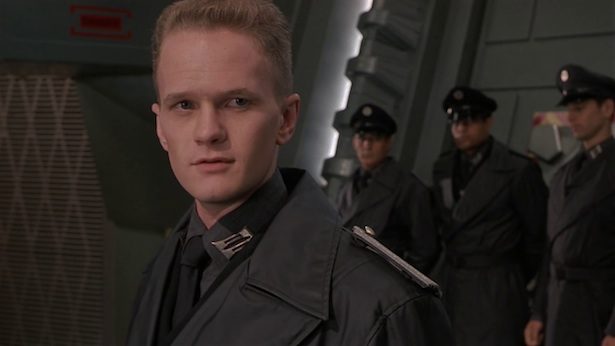
The more satirical element is left to other members of the cast: Michael Ironside has great fun as an almost absurdly fanatical solider, first introduced as a teacher lecturing his students on how the state must come before everything else and violence is the solution to all the world’s problems. Neil Patrick Harris tips a slight nod to the audience as a young man who rises so swiftly through the ranks that by the time we reach the end of the film, he’s a Gestapo-coated secretive colonel. He fits right into the grey militaristic, Nazi design of the military. You can watch all this stuff and simply enjoy the silliness – teenage boys will love this. And when they mature they’ll realise how awful the world it’s presenting is.


Starship Troopers is the ultimate military satire, a film that pushes every single fascist, militaristic society cliché to the limit. The news comes only from state propaganda. Military training involves brainwashing, maiming and slaughter. Education praises anger and violence as a solution to all problems. Verhoeven shoots this all with a grandeur, that pushes the celebration of militaristic violence to the max. 

It’s a film which is brave enough to make its militaristic sequences exciting, to shoot and cut this fascist wet dream with a stirring sense of excitement underpinning all the action. At the end you can celebrate the small victory our heroes celebrate in what is clearly going to be an ongoing war – until of course you realise it’s the victory of a Nazi organisation. The fascist world of the future may bring us sexual and racial equality – but that’s because it’s worked out everyone is needed to feed the grinder. It’s a super-smart satire film that disguises itself as a completely trashy action flick. It’s actually rather brilliant.

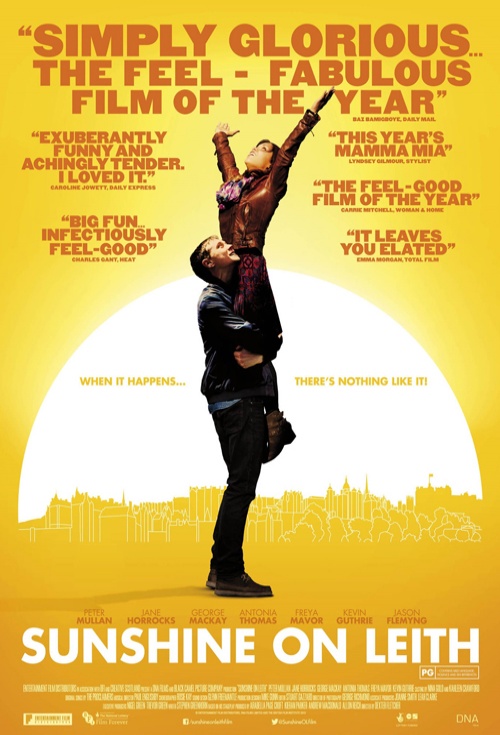
Sunshine on Leith (2013)


Peter Mullan hits the right notes in crowd-pleaser Sunshine on Leith

Director: Dexter Fletcher

Cast: George MacKay (Davy Henshaw), Kevin Guthrie (Ally), Freya Mavor (Liz Henshaw), Antonia Thomas (Yvonne), Jane Horrocks (Jean Henshaw), Peter Mullan (Rab Henshaw), Jason Flemyng (Harry Harper), Sara Vickers (Eilidh)

Sunshine on Leith is a jukebox musical that really works, because its story feels natural, its characters are engaging and the songs don’t feel too shoehorned in (even if, of course, we have a character called Jean to allow Oh Jean to be sung, and another moving to Florida which will of course require a Letter from America). It’s a really good reminder of how many really toe-tappingly, hummable, great songs The Proclaimers came up with. It’s not a masterpiece of course – but as a piece of solid, competent, crowd-pleasing cinema it’s hard to beat. 

The plot follows two soldiers returning from Afghanistan. Davy (George MacKay) is keen to start a new life, Ally (Kevin Guthrie) wants to marry Davy’s nurse sister Liz (Freya Mavor). Davy founds himself drawn to Liz’s colleague Yvonne (Antonia Thomas), while Liz struggles to reconcile her love for Ally with her desire to spread her wings and see more of the world. Meanwhile Davy and Liz’s father Rab (Peter Mullan) discovers, on the eve of his 25th wedding anniversary to Jean (Jane Horrocks), that a brief affair in his early marriage led to the birth of a daughter (Sara Vickers) he never knew he had. Love and family problems play out to a string of Proclaimers hits.

Sweeping camera-work from Dexter Fletcher helps to create a romantic, vibrant image of Edinburgh – you’ll want to book your tickets as soon as the film ends, this is such a good advert for the city – and he draws some wonderful performances from the cast, all of whom I suspect had the time of their lives making this film. How lovely is it to see Peter Mullan moving away from gruff hardmen, to play a man as sensitive and humane as Rab – and also to hear him croon with feeling some top songs? He makes a superb partnership with Jane Horrocks, who not surprisingly is the most accomplished singer, and who channels her natural bubbly mumsiness into a genuinely moving portrayal of a wife dealing with completely unexpected betrayal.

The film keeps the humanity of its characters very much at the centre, never over-complicating the plot or overloading us with extraneous detail or drama. The quietly tense opening sequence of Davy and Ally on tour in Afghanistan (with a rendition of Sky Takes the Soul) swiftly helps us invest in their safety – and sets us up to really feel their release once they return to the safety of civilian life. Nothing hugely unexpected happens in the film at all – it can be pretty accurately predicted from the start – but the whole thing is told with genuine warmth and feeling.

There are some stand-out musical sequences. Over and Done With, told as a pub story-telling session, works really well – it’s wonderful up-beat, vibrant sequence. Jason Flemyng has a great dance cameo during a fun-filled number set in the Scottish National Gallery (Should Have Been Loved). Davy and Ally dance thrillingly down the street to I’m On My Way as they celebrate their discharge. The final number – it’s not a surprise – sees what seems like most of Edinburgh corralled into a massive rendition of a song about walking a very long distance…

George MacKay demonstrates he’s a pretty decent song and dance man – and he also has the every-day ordinariness that makes him a perfect audience surrogate. His chemistry with Antonia Thomas is also fantastic. As the secondary couple, Freya Mavor is headturningly watchable as Liz, while Kevin Guthrie gives a nice air of bemused immaturity to Ally.

Sunshine on Leithis a brilliant crowd-pleaser, and has clearly been made with love and affection for the material and the songs, which seeps off the screen. It’s a perfect advert for everything in it. I would say that I am not sure Fletcher is the perfect film director – he’s afraid to let the camera stand still for too long in the larger dance set-pieces, which means we lose the impact of some of these numbers (or the chance to really appreciate the choreography). But he totally gets the tone of the film, and delivers that in spades.

It’s much pretty guaranteed that you’ll laugh, you’ll cry, you’ll fall in love. And you’ll want to watch it over again.

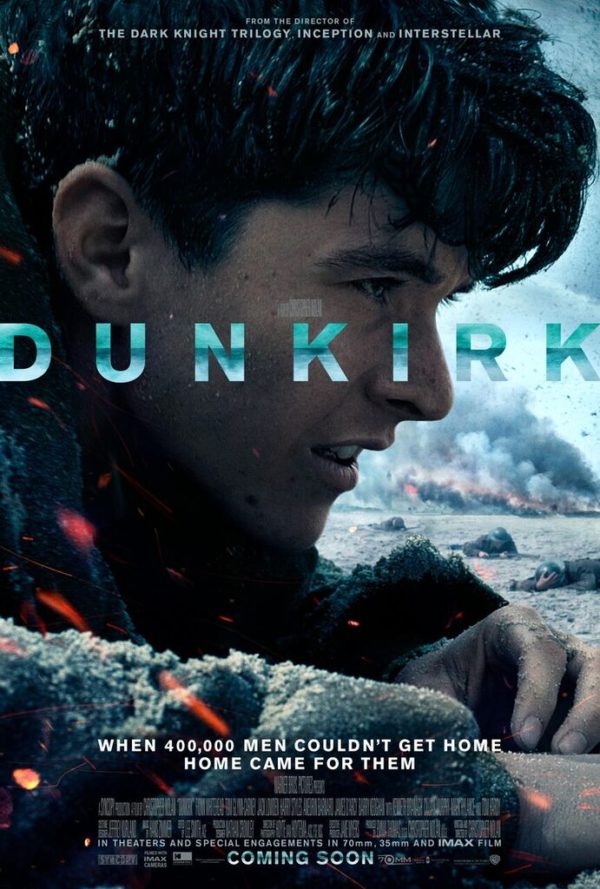
Dunkirk (2017)


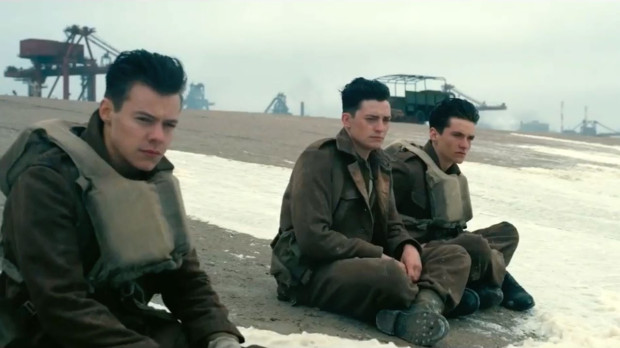
Harry Styles, Aneurin Barnard and Fionn Whitehead are three ordinary soldiers trying to get home in Christopher Nolan’s epic Dunkirk

Director: Christopher Nolan

Cast: Fionn Whitehead (Tommy), Tom Glynn-Carney (Peter Dawson), Jack Lowden (Collins), Harry Styles (Alex), Aneurin Barnard (Gibson), James D’Arcy (Colonel Winnant), Barry Keoghan (George Mills), Kenneth Branagh (Commander Bolton), Cillian Murphy (Shivering Soldier), Mark Rylance (Mr Dawson), Tom Hardy (Farrier)

“We must be very careful not to assign to this deliverance the attributes of a victory. Wars are not won by evacuations. But there was a victory inside this deliverance, which should be noted.” – Winston Churchill

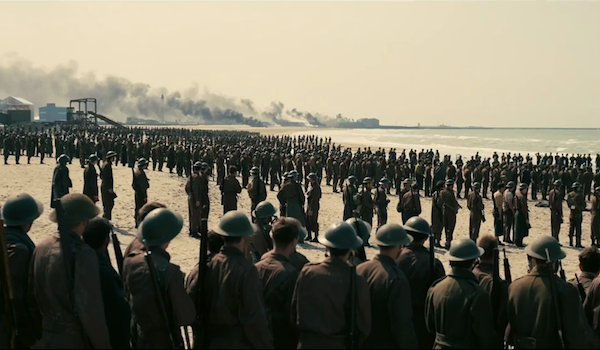
The evacuation of Dunkirk is a very British triumph. Beaten and encircled by the Germans, British forces were stranded in a small pocket around Dunkirk. The country looked certain to lose almost 400,000 men to death or imprisonment – the core of its professional army. The fact that almost 340,000 soldiers were evacuated was more than a triumph: it was almost a miracle. Christopher Nolan’s epic new film brings the triumph and adversity of this campaign to the big screen.

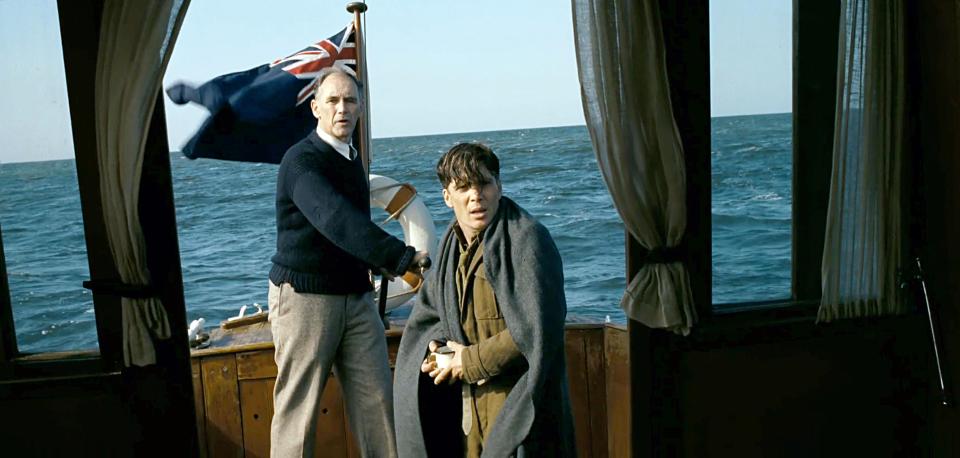
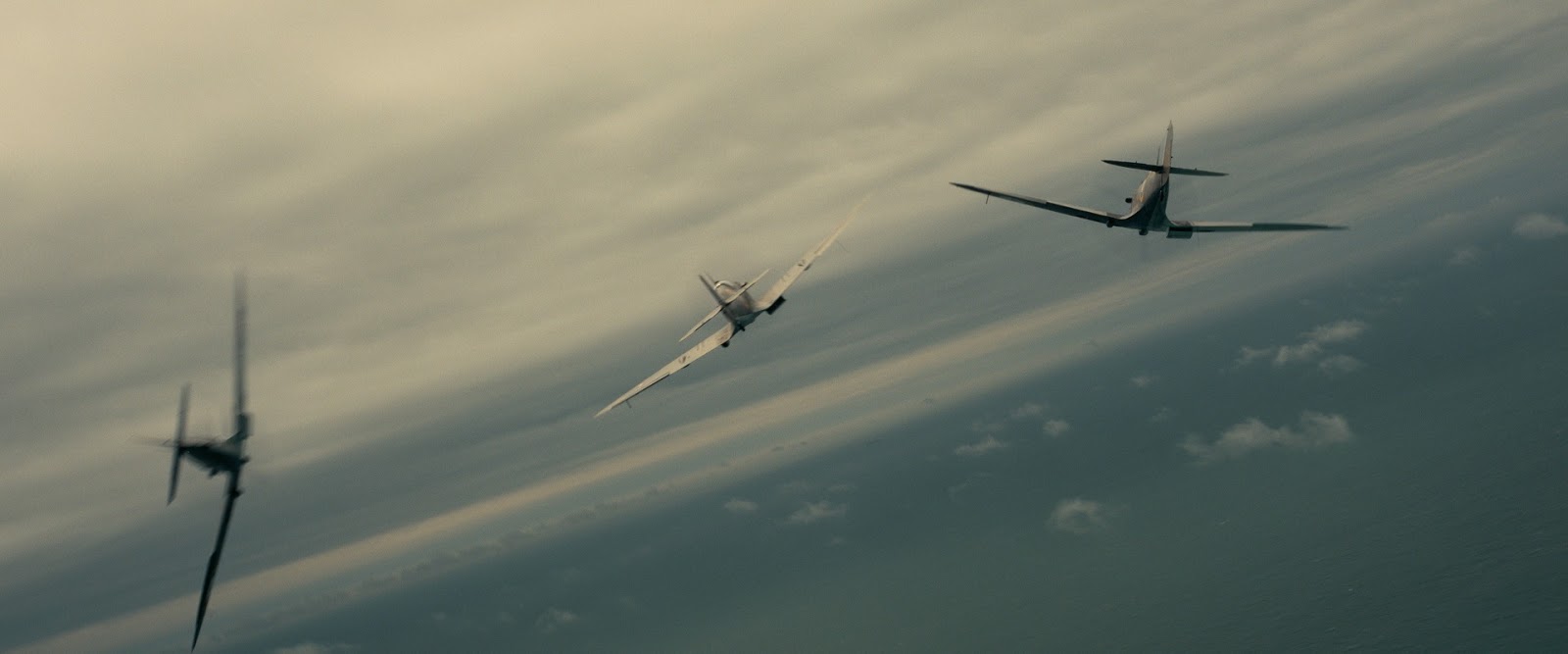
The action unfolds over a week around the evacuation of Dunkirk. On the beach Tommy (Fionn Whitehead), Gibson (Aneurin Barnard) and Alex (Harry Styles) are desperate to escape the chaos on the beach, where the evacuation is being managed from the one standing pier by Commander Bolton (Kenneth Branagh). On the sea, Mr Dawson (Mark Rylance) and his son Tom (Peter Dawson) head to Dunkirk in their small pleasure boat to help with the evacuation, picking up a traumatised soldier on the way (Cillian Murphy). In the air, Farrier (Tom Hardy) and Collins (Jack Lowden) fly a one-hour mission over Dunkirk to provide air support to the stranded soldiers.

As a director, Nolan’s calling cards are playing with narrative forms and timelines, while allowing personal stories play out on extremely grand canvases. Dunkirk feels like a summation of some kind of his career: its multi-layered timelines are gracefully and intelligently threaded together, and while the canvas is enormous, the human stories don’t get lost. The human interest running through the film is particularly impressive, as there is so little dialogue. It’s pretty close to “experience cinema” – it throws the audience into an immersive explosion of events, giving as much of an impression as it’s possible to give of the claustrophobia, tension and terror of being trapped on that beach.

The film-making is impeccable in creating this overbearing feeling. Hans Zimmer’s score thunders over the film, bearing down with a constant pressure and making excellent use of metronome ticking to keep hammering home the time pressure. Nolan brilliantly inverts scale in his filming to create a sense of claustrophobia – we constantly see sweeping shots of but the scale of our surroundings only forces home the seeming impossibility of what the British are trying to do. Individual soldiers seem tiny – how can one man possibly have a chance of escaping? It’s a brilliant mixture of sound and imagery to make the large seem small, the epic seem entrapping.

What Nolan does really well in this grand scale is to create a series of “ordinary soldier” characters. Despite the fact that we learn virtually nothing about them, these characters feel human and desperate. Again, they are such small, ordinary Everyman cogs in the giant machine of the army, that they become hugely relatable. It’s a hugely neat trick by Nolan, another brilliant inversion – just as he turns epic to claustrophobic, he turns ciphers into characters.

Recognising the need for balance between the overbearing impact of the Dunkirk beach sequences, the film allows a mix of story-telling and character types in its other two plotlines. So Mark Rylance’s boat captain voices much of the film’s humanitarianism, in a sequence that plays like a chamber piece – four people discussing duty and the impact of war in a confined space. Meanwhile Tom Hardy’s Spitfire pilot carries more of the traditional “war film” man-on-a-mission dynamics, engaging in a series of dog fights in the sky. Interweaving these stories offers not only relief to the audience, but also narrative contrast.

The interwoven storylines are also brilliantly done since they all take place in very different timespans. The plot at “the Mole” takes place over a week, “the sea” in one day, and “the sky” in one hour. Each of these timelines interlocks and unfolds in the film simultaneously, and characters move at points from one timeline to another.

Okay, writing it down, it sounds impossibly confusing and difficult to follow right? Who could keep track of all that? But the film is so brilliantly assembled that it always make perfect sense. Nolan uses several key markers – a boat, the fate of certain characters – to constantly allow us to see where we are in the story’s timeline. So we understand when we have moved from one timeline to another when we see a ship still on the beach that we’ve seen sinking elsewhere. This also increases the tension – we know at points what will happen before the characters do, because we’ve already seen the after-effects. Again, put it into words it sounds wanky and difficult to follow, but it really isn’t – and the film is put together with such confidence that it never feels the need to show off its narrative gymnastics. Nolan is confident enough to be clever without drawing our attention to it – a very difficult trick to pull off.

All this forceful story telling never prevents the story from also being at many points immensely moving and stirring. The arrival of the boats at Dunkirk is a genuine “lump in the throat” moment. The simple decency of Rylance’s boat captain gives a low-key impression of a very British sort of heroism, of quietly doing one’s duty while valuing every life and wearing your own grief lightly.

The film’s more action-based sequences are equally stirring and moving, because Nolan brilliantly establishes character with only a few brief notes. It’s made clear early on that Hardy’s pilot has only a limited fuel supply: every second he stays above Dunkirk protecting the men and ships below, he reduces his chances of getting home. It’s another sort of heroic self-sacrifice, and in a film that generally doesn’t shy away from showing the deadly consequences of war, Nolan is happy to give us some more traditional, fist-pumping heroics.

Nolan gets the maximum emotion from the more dialogue-heavy parts by hiring some terrific actors: Rylance, as mentioned is superb, and Cillian Murphy is very good as a shell shocked captain. Kenneth Branagh is perfect for conveying the weight of responsibility on the shoulders of the naval commander in charge of the evacuation. And elsewhere, Whitehead, Bernard and Styles all invest their ordinary Tommies with a great deal of emotion and empathy.

Dunkirk is a marvel of cinematic technique and accomplishment, which brings enough moral and emotional force to the drama to keep you engaged in the plights of its characters. You can marvel at the film making tour-de-force of its executions, but you never feel disengaged from it. It’s a marvellous film.