Category: War on Drugs

Clear and Present Danger (1994)

Clear and Present Danger (1994)

Tom Clancy’s door-stop thriller is turned into an involving conspiracy thriller that makes masterful use of Harrison Ford

Director: Philip Noyce

Cast: Harrison Ford (Jack Ryan), Willem Dafoe (John Clark), Anne Archer (Dr Cathy Ryan), Joaquim de Almeida (Colonel Felix Cortez), Miguel Sandoval (Ernesto Escobedo), Henry Czerny (Bob Ritter), Harris Yulin (James Cutter), Donald Moffat (President Bennett), Benjamin Bratt (Captain Ramirez), Raymond Cruz (Domingo Chavez), James Earl Jones (Jim Greer), Tim Grimm (Dan Murray), Hope Lange (Senator Mayo)

Tom Clancy’s Jack Ryan has always been the All-American hero (his slimy, besuited CIA rival even frustratedly snarls “you are such a Boy Scout”). Ryan is almost too-good-to-be-true: pure as the driven snow, incorruptible, a success at everything he does and a devoted family man. What chance does someone like that have in Washington? In Clear and Present Danger, Ryan is dragged into the War on Drugs, unwittingly becoming the front man for an illegal military assault team against the Columbian cartels, ordered by a US President on a vendetta for the death of a friend. When the truth comes out, you’ve got one guess who takes it on himself to save the soldiers who are hung out to dry by the suits in Washington.

We know he’ll do the right thing as well, because he’s played by Harrison Ford. Ryan is basically a blank slate as a character, so Ford’s straight-as-an-arrow everyman decency does most of the heavy lifting to establish who he is. As an action hero, Ford has the chops but his real strength is his ability to look frazzled, scared and muddling through – rather like the rest of us would. Ryan gets in some real scrapes here, from dodging missiles in an attack on a diplomatic convoy to desperately fighting for his life in a timber factory. Ford’s strength as an actor is to be both authoritative and also vulnerable – his willingness to look scared but determined works wonders.

Clear and Present Danger also gives plenty of scope for Ford to employ his other major empathetic weapon: the clenched jaw and pointed figure of moral outrage. He does a lot of both here, a central scene seeing Ryan confronting besuited rival Ritter (played by a weaselly, bespectacled Henry Czerny, the polar opposite of Ford’s clean-cut everyman-ness) earnestly telling him he broke the law and is heading to jail (laughed off). There can’t be an actor more skilled at getting you to invest in someone, to both simultaneously worry about him while being confident he will do the right thing. It’s a rare gift, and Clear and Present Danger exploits it to the max.

Ford is the centrepiece – and main strength – of a competent, well-made conspiracy thriller, directed with a professional assurance by Philip Noyce. It makes a good fist of translating Clancy’s doorstop novel – with its huge complexities – to the screen (although you might need a couple of viewings to work out the twisty-turny, backstabby plot, where wicked schemers turn on their own schemes). Noyce has a special gift for keeping dense technical and exposition scenes lively. At one point he cross-cuts a parallel investigation into a fake car bombing between Ryan (who flicks doggedly through textbooks) and his Cartel rival who employs gadgetry and computers. Plot heavy scenes like this are well-shot, pacey and capturing plenty of reaction shots, even if they only feature characters messaging each other on clunky 90s computers or walking-and-talking in shadowy metaphors.

Clear and Present Danger also successful juggles its Washington shenanigans, with parallel intrigue in its Columbia setting. There ruthlessly charming Cortes (played with a wonderful cocksure suaveness by Joaquim de Almeida) is scheming to takeover his boss’ (a blustering Miguel Sandoval) operation. These plot unfold both together and in parallel, allowing for a little bit of neat commentary contrasting the cartels and Washington. The film manages a bit of critique of America’s thoughtlessly muscular intrusion into the affairs of other countries, with a President turning a blind eye after passing on implicit instructions (but still with a boy scout hero who will sort it all out).

Noyce also pulls out the stops for a couple of brilliantly executed scenes. Great editing, sound design and committed acting makes a scene where Luddite Ryan races to print off incriminating evidence from a shared drive while technically assured Ritter deletes the files, edge-of-the seat stuff. Never before has racing to fill a printer with paper seemed more exciting.

That pales into significance with the film’s centre piece, a genuinely thrilling Cartel ambush on a US diplomatic convoy, with Ryan stuck in the middle. With perfect build-up – from James Horner’s tense score to the skilful editing – the attack (with Oscar nominated sound design) is hugely tense, leaves our heroes terrifyingly powerless and is flawlessly executed by Noyce and his crew. It makes the whole film a must watch all on its own.

It’s surrounded by several other well-handled action set pieces, featuring the Marines sent on a covert mission (and then hung out to dry). As the operation leader, Willem Dafoe plays very successfully against type as a (ruthless) good guy, as Clancy’s other regular character, uber-fixer John Clark. Dafoe also has the chops to go toe-to-toe with Ford, and like de Almedia’s charmingly wicked Cartel-fixer also serves as another neat contrast to Ryan’s decency-with-a-fist.

The film is rounded out by a troop of reliable actors. Anne Archer has little to do as Ryan’s supportive wife, but Donald Moffat is good value as the shifty President (communicating both intimidating authority and Nixonian survival instinct), Harris Yulin perfectly cast as a President-pleasing apparatchik and Raymond Cruz as an ace but naïve marine sharp-shooter. Clear and Present Danger has few pretensions to be anything other than an involving thriller – but that also helps make it a very enjoyable one.

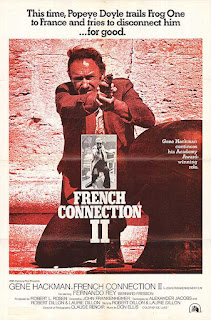
French Connection II (1975)

French Connection II (1975)

Change of setting isn’t really enough to justify the existence of this half-hearted sequel

Director: John Frankenheimer

Cast: Gene Hackman (Detective Jimmy “Popeye” Doyle), Fernando Rey (Alain Charnier), Bernard Fresson (Inspector Henri Barthélémy), Philippe Léotard (Jacques), Ed Lauter (General Brian), Charles Millot (Miletto), Jean-Pierre Castali (Raoul Diron), Cathleen Nesbitt (Old Lady)

Did The French Connection really need a sequel? Friedkin’s original was a self-contained gem, based on a true story, that even ends with a series of “what happened next” captions. But there was enough of a foot in the door for a completely fictionalised resolution to fates left hanging. French Connection II has some similarities with the original, but it’s also a slight film caught even more obviously than the first between documentary realism and trigger-happy actioner.

The whole film feels like it has been assembled in a rush. The plot is incredibly slight. “Popeye” Doyle (Gene Hackman) arrives in Marseilles to help the police track drug kingpin Alain Charnier (Fernando Rey). Doyle doesn’t speak a word of French and charges around pissing everyone off and generally making a nuisance of himself. He’s grabbed off the streets by Charnier’s men. To get him to talk they spend weeks force-feeding him heroin until he’s hooked then cut off his supply. They then return him to the Marseilles police who lock him in a cell and help him go cold turkey. When he comes out if Popeye wasn’t mad before, he certainly is now.

That (long) sequence of heroin addiction and painful cold turkey is one of two things that really makes Frankenheimer’s sequel stand out. I think it must be what attracted Hackman to the film. Not only did the liberal Hackman (troubled by Doyle’s slight neo-fascism in the first film) probably enjoy the idea of seeing this guy hit rock bottom, it’s also an opportunity for an acting tour-de-force. Hackman is probably given more challenging material in this largely forgotten sequel than in his actual Oscar-winning role.

Weaned onto the drugs, Hackman’s body language shifts from defiant resistance to despondent, dope-strewn lethargy until he can’t be bothered to record the passing of days any more in his tally chart. He goes from being cuffed and dragged around, to blankly following his captors and rolling up his sleeve to accept another shot. But that’s nothing compared to the cold turkey scenes.

Locked up in a dingy cell under the police station (the French police worried about taking the blame and also feeling a brotherhood with this fellow cop), Doyle goes through withdrawal mourning – anger, bargaining and eventual grief – in a series of calmly shot, claustrophobic scenes that allows Hackman let rip. And he certainly does, deconstructing this proud man’s self-image until he’s a weeping mess, kicking doors, throwing food around and so full of self-loathing, he can barely face himself in the mirror. It’s hard to watch, and something truly unique – a twisted punishment for a drugs cop and a man who defines himself by his lack of reliance for anyone or anything else.

This long sequence takes up the centre of the film – and includes an equally difficult scene to watch, as Frankenheimer stages in (a single take) forensic detail the French police’s pumping of Doyle’s stomach to get a final (deadly) overdose out of his system. It’s quite unlike anything else I’ve seen before in a cops and robbers shoot-em-up (which is what most of the rest of the film, at heart, is) and you can guarantee it’s the one thing people will remember.

The other element that stands out is Frankenheimer’s – a long time Francophile – ability to shoot Marseilles not as a tourist destination, but a strikingly real urban environment. On top of this anti-picture-postcard environment, he stresses Doyle’s isolation. None of the French dialogue in the film is translated, leaving us as stranded as Doyle is in trying to understand what is going on and what people are saying. Doyle clumsily pantomimes for everything he wants, be that information from a suspect (he tries his toe-picking line to no effect what-so-ever) to a drink in a bar (a long exchange until he finally reaches an understanding with the barman on “whiskey”). Doyle, of course, has made no effort to learn any French and blunders about in a city he doesn’t understand, ruining operations and getting himself and others in trouble.

Aside from these moments though – and despite the film being well shot by Frankenheimer, with a nice continuation of the original’s drained out neo-realism – this is otherwise a conventional and unimaginative film that ticks a number of expected boxes. It has an action set-piece at a dry dock that feels unreal (and also copies the central idea of the car smuggling operation from the first film) and concludes in a chase and shoot-out that’s almost a copy of the original’s ending – with an ending even more sudden. For all Frankenheimer’s love of France, the film still has a suspicion for Europeans – be they smooth criminals or obstructive cops.

French Connection II tries a couple of different things, but never really makes a case for itself as a truly stand-alone film. It’s main rivalry between the hero and villain is dependent on having seen the first film and its slender plot veers into the sort of shoot-outs and set-pieces that don’t feel remotely like they are occurring in a ‘real’ world. It deserves credit for the bravery and honesty of its cold turkey sequence, but it’s a sequence caught in a film that otherwise offers little that’s truly unique.

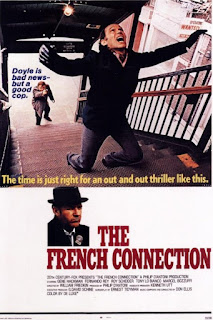
The French Connection (1971)

The French Connection (1971)

A ruthless, obsessed (of course!) cop chases down a drug kingpin in this Best Picture winning crime drama

Director: William Friedkin

Cast: Gene Hackman (Detective Jimmy “Popeye” Doyle), Fernando Rey (Alain Charnier – “Frog One”), Roy Scheider (Detective Buddy “Cloudy” Russo), Tony Lo Bianco (Salvatore Boca), Marcel Bozzuffi (Pierre Nicoli – “Frog Two”), Frédéric de Pasquale (Henri Devereaux), Bill Hickman (FBI Agent Bill Mulderig), Ann Rebbot (Marie Charnier), Harold Gray (Joel Weinstock), Arlene Faber (Angie Boca), Eddie Egan (Captain Walt Simonson), Sonny Grosso (FBI Agent Clyde Klein)

Cops and criminals: do they have more in common than we’d like to think? In Friedkin’s Oscar-winning The French Connection, the lead cop and criminal are both obsessive, single-mindedly ruthless and locked into a cycle of actions that isn’t going to be change with one big bust. Look at them in isolation and its hard to tell at times which is which: the French drug dealer is a suave cosmopolitan type, unfailingly cultured and polite, but remorseless; the cop is a border-line racist and narcissist who doesn’t give two hoots about collateral damage, kills without remorse and whose life is one of tunnel-visioned obsession.

Based on a true-story – the model for Doyle, Eddie Egan, has a cameo playing his own boss – the film covers the arrival in New York of French heroin dealers, led by Alan Charnier (Fernando Rey) looking to make a killing with their prime product. Opposite them is narcotics officer Jimmy “Popeye” Doyle (Gene Hackman), who’s practically the dictionary definition of anti-hero. Doyle and Charnier engage in a battle of wits and force across New York during one blisteringly cold few days in Winter, and never mind who gets in the way.

The French Connection is about masculinity, and that no matter what many men don’t like to lose. Getting beat is certainly the main concern for Doyle, who I’m not sure has ever really thought twice about the impact of drugs (he’d be just as passionate chasing down coca-cola or stamps if you banned those). Neither has Charnier, with his reassured cool of old Colonial Europe, which just knows better than the nouveau Americans. (there is an underlying subversive fear of America being undermined by this suspiciously metropolitan Frenchman, the country’s best defence being a loud-mouthed, son of the streets).

Played superbly by Gene Hackman, Doyle is presented as a man we are invited to make up our own mind about. He’s obviously an effective detective and he doesn’t just go the extra mile: the job is a night-and-day obsession. He’ll spend hours pounding the streets, staking out a hotel on a rainy street, walk miles tailing a subject and barely spend a minute off-duty. He’ll also drive cars wildly though crowded streets, shoot a man in the back, rough-up suspects and treat others with an abrupt anger, xenophobia or both. As a model for the society he’s sworn to protect, he’s a disgrace – but is he the effective agent of crime-fighting we need?

Friedkin’s film largely aims to present Doyle as he is, within its documentary realism – although I’d argue the film repeatedly looks at his commitment and never-say-quit-energy with barely veiled admiration. The film is assembled with an on-the-streets immediacy reminiscent of The Battle of Algiers – added to by the casting of many non-actors in key roles. It’s shot with a drained-out series of muted colours (even more drained-out in Friedkin’s egotistical blu-ray remastering). All shot on location, it captures the slummy flavour of the rougher ends of New York. Right from the off, we see Doyle and Russo roughing up an informer in something between a slum and building site (including the famous “do you pick your toes in Poughkeepsie” exchange, a classic bit of psychological messing with criminals – incidentally check out Scheider trying not to corpse as Hackman roars through this.)

The investigation proceeds with a muted sense of grounded realism. There is a lot of time-consuming following, watching and taking notes. Word is picked up by informers. Careful surveillance work fills out the gang and its members. Doyle is constantly frustrated by bureaucratic demands, not to mention turf-war squabbles with the FBI (who, in addition, think he might be next door to a dirty cop which is pretty fair). Similarly, the criminals go through careful negotiations around timing, testing the purity of the goods and working out the best way of dodging the cops.

Friedkin’s film is so wrapped up in a perfect “slice of life” documentary realism shell, that it gets away with much of the second half being a piece of pure filmic flair. First and foremost is its famous car-chase. Narrowly surviving an assassination attempt from “Frog Two”, Doyle requisitions a car and hares through New York at 100mph trying to beat the elevated train “Frog Two” is escaping on, to the next station. In this superbly cut sequence, Friedkin pioneers the sort of low-angled front bumper shots that would be a staple of car chases for years to come. It’s pounding, gripping and brilliantly assembled, a raw slice of action that uses the film’s documentary style to trick you into thinking it’s something akin to the realism elsewhere.

But it’s a bit of filmic fantasy – and wouldn’t be out of place in Dirty Harry, the other 1971 film about a morally-complex cop. Doyle is certainly a less attractive person than Callahan – with no real moral feelings just a love of winning. Winning is what motivates him in this car chase: he has little interest in questioning the shooter (who has, to be fair, taken out several civilians, including a mother of a young baby) or preserving public safety and way more about getting revenge. He tears through the streets, sending civilians flying, scares Frog Two into killing two more people and finally caps it by shooting his unarmed would-be-killer in the back after a cursory warning. (Not the first time he’ll pull the trigger after only the most slender of warnings).

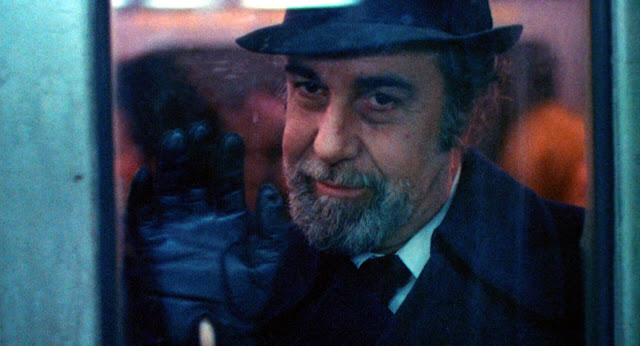
Winning is all that matters though. Charnier is just as bad. He ruthlessly exploits a patsy and has no concerns about bodies piling up. Fernando Rey’s impish smile and campily cool little wave to Doyle through the subway doors, after he has managed to shake him off in a marvellous sequence in a subway station, is all about enjoying a smug triumph. No wonder Doyle repeats the same gesture to him late in the film when the tables are turned.

It’s the way Friedkin’s film mostly doesn’t ask us to blindly root for Doyle that really makes it stand out. In many ways the film is less exciting – or even less intriguing a character study – than Dirty Harry. It uses its documentary realism heavily at times, to justify showing the sort of shocking, exploitative material (at one point, the camera lingers on the incidental victims at a car crash scene at distasteful length) that you would expect to find in Dirty Harry or Shaft. What Friedkin’s euro-inspired style – and Hackman’s committed playing – managed to do was make itself feel like it was making a higher artistic statement than those films, which played a much more conventional hand.

That and the sense that nothing has really changed. Early in the film Doyle and Russo charge into a bar – a bar by the way with an entirely black clientele, who Doyle delights in abusing – to seize whatever drugs people seem to have on them. It’s a basic clean-up and shakedown – but hours later you can be sure it will be look nothing happened there. Similarly, the film’s end credits reveal all involved basically dodged charges (except for the patsy for the smuggling of course), while the cops got transferred. We’ve got one small win at the cost of at least five lives.

I seem to change my mind on The French Connection every time I see it. Sometimes I think it’s not that different from a host of other police actioners released at the same time (add Bullit to that list). At others, I get gripped by its edgy mise-en-scene and Friedkin’s challenges to conventional morality. And I guess, a film that can make you switch your mind constantly, should be seen as some sort of classic.

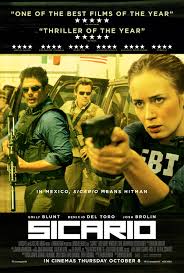
Sicario (2015)


Emily Blunt goes to war with the Cartels, not realising she’s just a pawn.

Director: Denis Villeneuve

Cast: Emily Blunt (Kate Macer), Benicio del Toro (Alejandro Gillick), Josh Brolin (Matt Graver), Daniel Kaluuya (Reggie Wayne), Maximiliano Hernández (Silvio), Victor Garber (Dave Jennings), Jon Bernthal (Ted), Jeffrey Donovan (Steve Forsing), Raoul Trujillo (Rafael), Julio Cedillo (Fausto Alarcón)

The War on Drugs. Smack a military title on it and it helps people think that there is some sort of system to it, that it carries some sort of rules of engagement. Whereas the truth is that it is a nebulous non-conflict where the sides are completely unclear and the collaborators are legion.

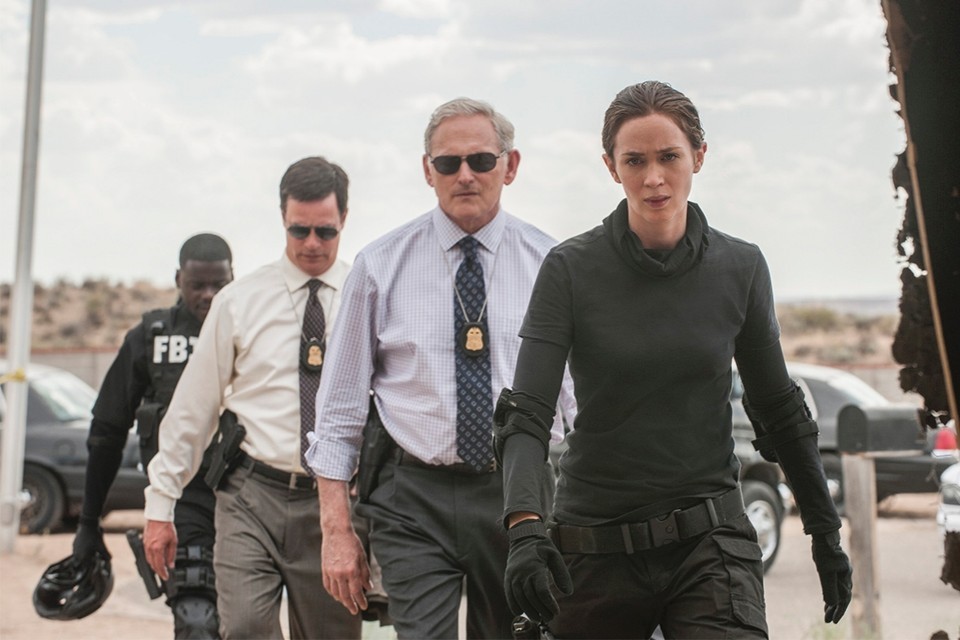
Sicario follows a shady covert operation, run by a combination of the FBI, the CIA, Columbian and Mexican law enforcement and, well, other interested parties. Kate Macer (Emily Blunt) is recruited to the task force because someone with her experience is needed, and finds herself working for maverick, almost pathologically unconcerned, CIA man Matt Graver (Josh Brolin). Graver, in turn, is working closely with a South American freelance operative (Del Toro) whose background and goals remain a mystery to Kate. Far from a clear targeted operation, Kate slowly realises the operation is effectively an off-the-books black op, which she has almost no control or influence over.

Villeneuve has directed here an accomplished, if rather cold, thriller. It denies its audience the release of action, the reassurance of justice or the satisfaction of integrity being rewarded. Instead the film takes place in a hazy never-world, never fully explained to either the viewer or Kate (our surrogate), where it gradually becomes almost impossible to tell who is working for whom and for what reasons – and there is a feeling that those in the film don’t know either.

The whole film has a sense of Alice in Wonderland about it (at the end of the film our heroine literally goes down a tunnel into a strange new land). Emily Blunt’s Kate seems at first to be on the ball, but events throughout the film demonstrate time and again that she is hopelessly out of her depth and little more than a fig leaf to enable her new bosses to bend laws to breaking point. Instead the world she finds herself in is dark, unsettling, confusing and lacks any sense of clear moral “sides”.

In fact, that is one of the most interesting things about this movie. It presents a female lead who is constantly manipulated and defeated throughout the film. Kate is in fact totally ineffective throughout and serves no real narrative purpose to the events of the film other than allowing those events to take place. At the same time, she’s strong-willed, she’s determined and she’s fiercely principled, as well as being an engaging character (helped immensely by Emily Blunt’s empathetic and intelligent performance).

This works so well because Kate represents what we would normally expect in a film – we keep waiting for that moment where she makes a successful stand, or blows the scandal open, or brings someone to justice – this never happens. Instead the film is a clear indication of the powerlessness of the liberal and the just in a world of violence, aggression and corruption – that people like Kate will always be steamrollered by people who are willing to smilingly do anything to achieve their goals and don’t play by any semblance of rules that we would recognise. In a more traditional film, she would end the film arresting some (or all) of the other characters with a defiant one-liner. Instead, she never lays a glove on anyone.

The flip side of her naïve optimism here is Benecio Del Toro’s nihilistic, dead-behind-the-eyes mysterious freelance operative. Del Toro is magnetic here, his character a dark mirror image of the role he played in Traffic, as if that character witnessed every kid he watched playing baseball in that film gunned down before him. He’s like a dark growly end-justifying-the-means shark, who conveys just enough of a flicker of paternal interest in Kate (does he see her as a reminder of what he used to be like?) to show there is someone still human in there. He prowls the edges of scenes before seizing the movie by the scruff of the neck in the final quarter with horrifying brutality.

Del Toro’s rumpled smoothness is a perfect match for the ink jet blacks and bright desert shine of this wonderfully photographed film. Roger Deakin’s cinematography is beautiful to look at and also rich with variation and imagination – from bleached out, hazy mornings to red dawns, from subterranean tunnels to neon lit nightclubs, Deakins presents images in striking new ways. The use of sound is also brilliant in the film – lingering, unsettling silences throughout slowly give way to Jóhann Jóhannsson’s beautiful spare score. There are fine supporting performances from Maximiliano Hernández as a doomed cop, sleepwalking through a corrupt life, Daniel Kaluuya, who is very good as an even more idealistic FBI agent who thinks he understands the world better than he does, as well as from Josh Brolin and Victor Garber.

Sicario offers no comfortable answers. In fact, it offers almost no answers at all. The world it shows us is one where there is no conventional right or wrong, only attempts to control the chaos. Our expectations as a viewer are so persistently subverted that it almost demands to be seen twice to truly understand what sort of story it is actually trying to tell. This helps to make it a cold and distancing film – but it lives in a cold, distant world where sometimes you reach the final frame and only then begin to understand who the baddies might have been and how you’ve only helped funnel the badness towards a controlled point rather than slow down or stop it.