Gentle episodic family drama, powered by some strong performances and lovely scenery
Director: Fred Zinnemann
Cast: Deborah Kerr (Ida Carmody), Robert Mitchum (Paddy Carmody), Peter Ustinov (Rupert Venneker), Glynis Johns (Mrs Firth), Dina Merrill (Jean Halstead), Chips Rafferty (Quinlan), Michael Anderson Jnr (Sean Carmody), Lola Brooks (Liz Brown), Wylie Watson (Herb Johnson), John Mellion (Bluey Brown), Ronald Fraser (Clint Ocker)
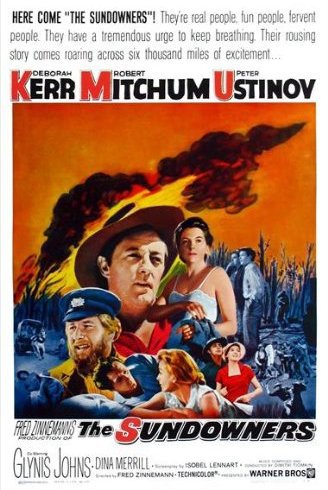
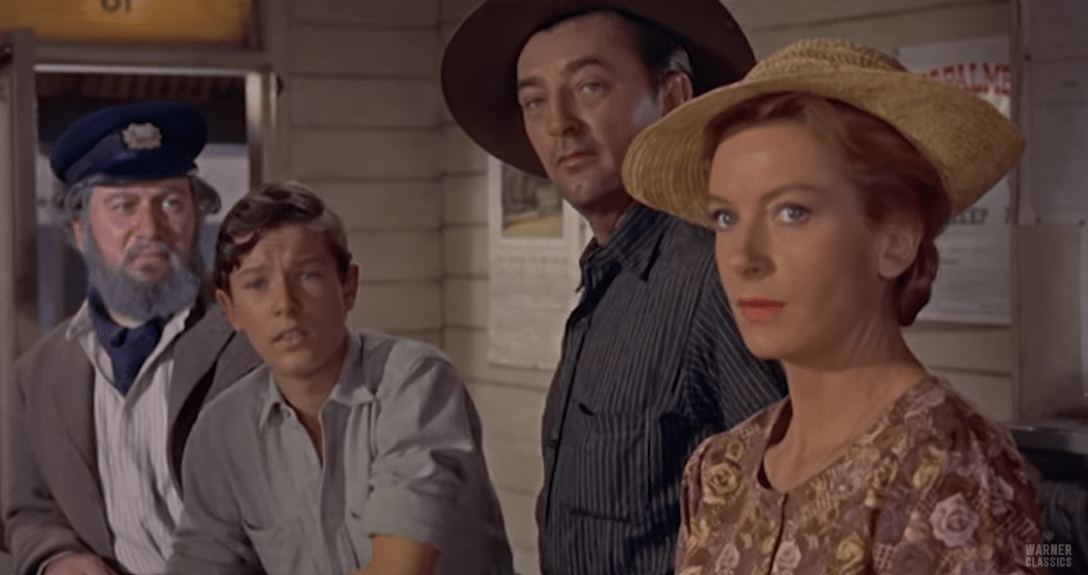
Who wants to settle down when the open road, and all the adventure it promises, lies ahead? Sure not Paddy Carmody (Robert Mitchum), an Irish-Australian sheep drover in the 1920s Australian outback, who loves the freedom of your home being wherever the sun goes down. Problem is, his loving wife Ida (Deborah Kerr) and teenage son Sean (Michael Anderson Jnr) are tired of this itinerant lifestyle. They want to put down some roots, ideally on an available farm they’ve got their eye on. But can they persuade the easy-going Paddy to settle down in the same old four walls?
This makes for some gentle, family friendly drama in this easy-going, episodic film which relies on some lovely location footage and a clutch of very charming performances to carry the day. While you can see links with some of the other film’s on Zinnemann’s CV – in the loose sense that Paddy has to choose whether to take a gentle stand by staying in one place for more than a few weeks – really it’s a leisurely ramble through a clutch of crowd-pleasing vignettes. The Sundowners probably stretches on a little too long, but it’s just about charming enough not to outstay its welcome.
Largely shot in Australia, it also follows Stanley Kramer’s On the Beach in introducing the country to American audiences. The difference being, while On the Beach was largely shot in Melbourne, all of the external footage here is in the dustbowl outback. These panoramas give The Sundowners the feel of a family western, with the Carmodys as decent, honest homesteaders. It’s a very familiar language for the film, spiced up by the film not shirking on chucking plenty of exciting wildlife. The parade of kangaroos, koalas and wombats that we get to see bouncing and crawling around – often looking impossibly sweet and cuddly – must have been catnip to audiences.
The Sundowners also presents an endearing, if terminally cliched, view of Australian life. With the dialogue littered with “g’days” and “fair dinkum” and the like, The Sundowners presents an affectionate portrait of Australian farmhands as honest, boisterous, hard-drinkers, quick to blows and equally quick to laughs straight after. The menfolk, after a hard day’s work driving sheep, like nothing better than to gather in the bar for a few cold ones or the barn for a few cheeky gambles. They’re decent, easy-going, never hold grudges and are a loyal, supportive community – naturally the bonds of friendship are formed in a mass punch-up which quickly turns into a boozy bonding session.
The Carmody’s fit right into this, with the family presented as a warm and supportive unit that, despite occasional disagreements, sticks together through thick and thin. At its heart is the relationship between Ida and Paddy, which is warm, affectionate and has a surprisingly strong sexuality in it (it’s hard not to notice their obvious continued attraction for each other, not least in a bedtime scene with a topless Mitchum). That also comes out of the natural, easy chemistry between Mitchum and Kerr (working together here for the fourth time) who genuinely feel like they’ve been together for years.
While you could take a pop at both actors less than faultless Australian accents, I prefer to think it’s smarter than that: Mitchum’s accent is half-way between Dublin and Brisbane, which feels right as does Kerr’s British-tinged Aussie. What’s more important is both actors give endearingly fine performances. Mitchum brings out a gentle, childlike quality, to Paddy. He’s softly-spoken, prone to moan rather than rage when things don’t go his way (his teenage sulk when roped into a sheep shearing contest is rather funny) and throws himself into things with all his heart – be that thrilled at a betting winning streak or mortified when a later streak goes wrong.
Perhaps even better though is Kerr, who mixes a motherly streak (she’s essentially looking after two kids’ here) with a determined outback assertiveness that sees her mucking in as much with the sheep driving as she does the cooking. But there’s also a soulful longing in Kerr’s performance for something more grounded in her life – a moment where, covered in dust and dirt, she stares at a woman adjusting her make-up on a train, radiates a longing for something more permanent in her life. But, while she may lose her temper with Paddy, she’ll never hold a grudge or leave us in doubt about her love for him. It’s a lovely, sensitive but strong performance.
Perhaps best in show here though is Ustinov, having a whale-of-a-time as grizzled old (pseudo?) posh drifter Rupert who the family effectively adopts and is as in love with the drifting life as Paddy. The role allows Ustinov to be tougher and more manly than ever before, while also using his natural gifts for whimsy and shameless yarn-spinning. Rupert, wearing a sailers cap allegedly from his service in the Chinese navy, claims expertise in everything, to have grown up doing any task you name and loves the refined things in life as much as he has a soft spot for the flirtatious arms of Glynis John’s blousy inn-keeper. It’s a very funny, but also surprisingly layered performance – if Ustinov hadn’t won the Oscar that year for Spartacus he would have stood a good chance of winning for this.
The Sundowners marshals these fine actors into a series of set-piece episodes. From driving sheep across the outback, to settling down at a farm, to the delivery of farmhand’s baby, Sean’s first beer, a sheep-shearing contest (where Paddy is royally hustled by an old timer), an epic coin toss contest, the closing adventures with the family’s newly won race-house Sundowner (with some well shot racing footage), the film constantly throws us into another small drama-within-a-drama, each unspooling with the same warmth and charm.
The Sundowners is, at heart, a slight tale and probably is overextended over its two hour plus. Much of its Australian setting, so eye-opening at the time, looks a bit twee and cliched today. But it’s got strong performances across the board, a good heart and a firm hand holding it together. It’s not a classic for the ages, but is a charming afternoon’s entertainment.