Caché (2005)

Caché (2005)

Haneke’s fascinating puzzle is a profound and challenging modern masterpiece

Director: Michael Haneke

Cast: Daniel Auteuil (Georges Laurent), Juliette Binoche (Anne Laurent), Maurice Bénichou (Majid), Lester Makedonsky (Pierrot Laurent), Walid Afkir (Majid’s son), Annie Girardot (Georges’s mother), Daniel Duval (Pierre), Bernard Le Coq (Georges’s boss), Nathalie Richard (Mathilde)

Is any film more aptly named than Caché? Haneke’s film keeps its cards so close to its chest, it’s entirely possible revelations remain hidden within it in plain sight. Caché famously ends with a final shot where a possibly crucial meeting between two people we’ve no reason to suspect know each other plays out in the frame so subtly many viewers miss it. It shows how Haneke’s work rewards careful, patient viewing (and Caché is partially about the power of watching and being watched), but also how unknowable the past can be. It’s a chilling and engrossing film that fascinates but never fully reveals itself.

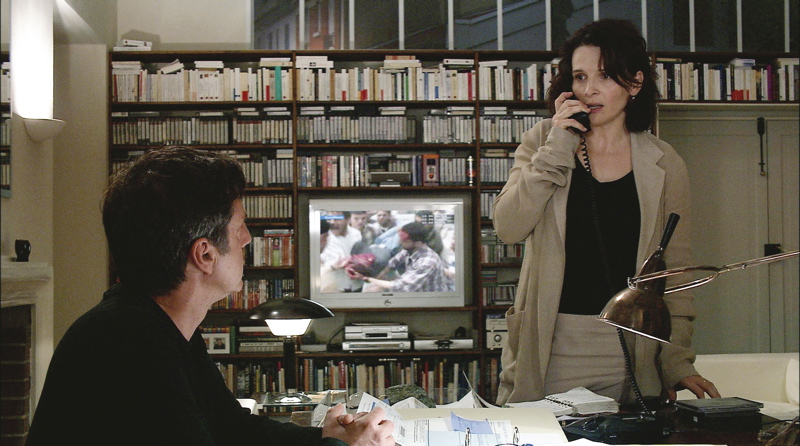
Georges Laurent (Daniel Auteuil) lives a life of success. A wealthy background, host of a successful TV literary debate show and living in an affluent suburb of Paris, he’s married to publisher Anne (Juliette Binoche) and father to young champion swimmer Pierrot (Lester Makedonsky). But there’s a serpent in his Garden of Eden. Georges and Anne are plagued by a stream of videos arriving at their house. These show long, static shots of their home and are accompanied by crude, graphic drawings. Someone is watching their house and the dread that this could escalate at any time is consuming them. But does Georges know more – do the messages chime with guilty memories in his past?

Haneke’s film is a multi-layered masterpiece, a haunting exploration (free of clear answers) into the things we prefer to forget, the hidden horrors we supress. It’s a film all about the shame and guilt buried amongst the everyday. Haneke even shoots the film on hi-definition video so that the surveillance footage of Georges and his home visually merges with the ‘real’ images of the couple. Within that, Caché starts to unpack the hinterland we hold as individuals (and, quite possibly as entire nations) of the guilts of our past that keep bubbling to the surface to bite us.

Caché is shot through with Haneke’s genius for menace and veiled threat. Can you imagine anything creepier than a camera set up outside your home, filming everything you do – but never knowing where it is? It’s an invasion of privacy that is insidious and covered in the additional menace that, at any time, it could escalate to something worse. The creeping, invasive tyranny of surveillance is in every inch of Caché, its omnipresence giving every interaction the feeling of being watched (something Haneke plays up – watch a man watching Anne when she sits in a café with a friend).

So gradually the book-lined world of the Laurents becomes a base under siege, a feeling amplified by Haneke’s mix of smooth camera movements adrift from establishing shots: constantly the camera glides through a space where we feel we neither truly understand the geography or are confident about the time. It’s accentuated by the window-free room the Laurents largely inhabit. In fact, their whole home feels window free, with curtains frequently drawn and rooms plunged into darkness, the family throwing up a shield to protect them from the outside world.

Or is it to cut them off from the unpleasant facts of life? It becomes clear Georges has built a world around himself, where he is the hero and all traces of the unpleasant or disreputable in his past have been dismissed to the dark recesses of memory, never to be accessed. Played with a bull-headed arrogance by Daniel Auteuil, under his assurance Georges is prickly and accusatory, liable to lash out verbally (and perhaps physically, considering the threat he carries in two key scenes). Auteuil masters in the little moments of startled panic and stress that cross Georges’ face, a man so used to a world that matches his needs, that anything questioning that is met with rejection.
It’s why he lies to Anne about his growing suspicions about the source of the tapes. The cartoons hint at a series of (deeply shameful) interactions, when he was a child in the 60s, with a young Algerian boy, Majid, who his parents considered adopting after the death of Majid’s parents. It was Georges lies that forced this boy out of his perfect farm-house into the cold-arms of the unfeeling French orphanage system. This is the original sin of Georges’ life, arguably the foundation of his success – a guilty secret that so haunts and disgusts him, even the slightest mention of it brings out the muscular aggression he otherwise keeps below the surface.

Of course, it’s hard not to see an echo of France’s colonial past. One of the things that works so well with Caché, is that this subtext is there without Haneke ever stressing it. Just as Georges’ lies forced Majid into a life of depression and misery, so France’s treatment of Algeria is the terrible shame the nation would rather forget. Majid’s parents died in a famously brutal stamping out of an Algerian protest in Paris in October 1961 (the deaths of over 200 people at the hands of French government forces only came to light decades later). The anger many show when presented with inconvenient, horrible past deeds (both personal and national), only feels more relevant today with our culture battles over history.

Georges sees himself as a victim of a vicious campaign. But, when Georges meets Majid, played with startling vulnerability by Maurice Bénichou, he seems light years away from the sort of man who could possibly be capable of such a campaign. Indeed, when a video of Georges encounter with Majid is widely shared, it is Georges (as even he admits) who appears the bully and aggressor. Majid has been demonised in Georges’ memory – in his nightmare he becomes an axe-wielding monster-child – but he’s an innocent, who had everything taken from him in a micro-colonialist coup carried out by a 6-year-old Georges. A coup the adult Georges has let himself forget, making him little different from France itself. (We are reminded the cycle continues, with constant background news footage of Iraq, ignored by the Laurents.)

The mistakes repeat themselves, but they don’t trouble the complacent middle-classes who benefit from them. Georges will even use his influence to have Majid and his son bundled into a police van. Of course it leads to an outburst that will shake this world up. Haneke’s films have always been realistic when it comes to the visceral horror of violence, and Caché contains an act of such shocking violence that it will leave the viewer as speechless and distressed as the witnesses.

And still the question hangs: who? It could be anyone. At one-point Georges storms out of his front door to confront the mystery video-sender, only to return to find a video wedged in the door. It’s literally impossible for this video to be placed without him seeing it done. Haneke is so uninterested in the whodunnit part that, perhaps, he’s implying the perpetrator is the director himself, using the mechanics of film-making to entrap the guilty parties. It fits with the coldly intellectual steel-trap part of Haneke’s mind, the part that uses films (like Funny Games) to tell off and preach. What other director would be more likely to set himself up as unseen antagonist in the film?

And does Georges learn anything? He will continue to confront characters who challenge his world view and dispatch (like nations) his guilt to the recesses of memory. His begrudging peace with his wife – a superbly restrained Juliette Binoche, increasingly resentful at her husband’s secrets – seems built on the shaky ground of their continuing mutual comfort. And suspicions linger over his son, an increasingly hostile figure who (just perhaps) is learning more about the flaws of his parents than they would be comfortable with.

Of course, this might all be open to interpretation from multiple angles. After all the film is called Caché. Haneke has hidden enough subtle implications in it that it can reward analysis from multiple angles. Shot with his characteristic discipline that suggests a dark, creeping fear behind every corner, it’s a masterclass in suggestion and paranoia. Brilliantly unsettling and constantly reworking itself before your eyes, it’s a masterpiece.
The Killer (2023)

The Killer (2023)

Fincher’s lean, spare film is a perfectly constructed thriller and an intriguing character study

Director: David Fincher

Cast: Michael Fassbender (The Killer), Tilda Swinton (The Expert), Charles Parnell (The Lawyer), Arliss Howard (The Client), Kerry O’Malley (Dolores), Sophie Charlotte (Magdala), Emiliano Pernia (Marcus), Gabriel Polanco (Leo), Sala Baker (The Brute)

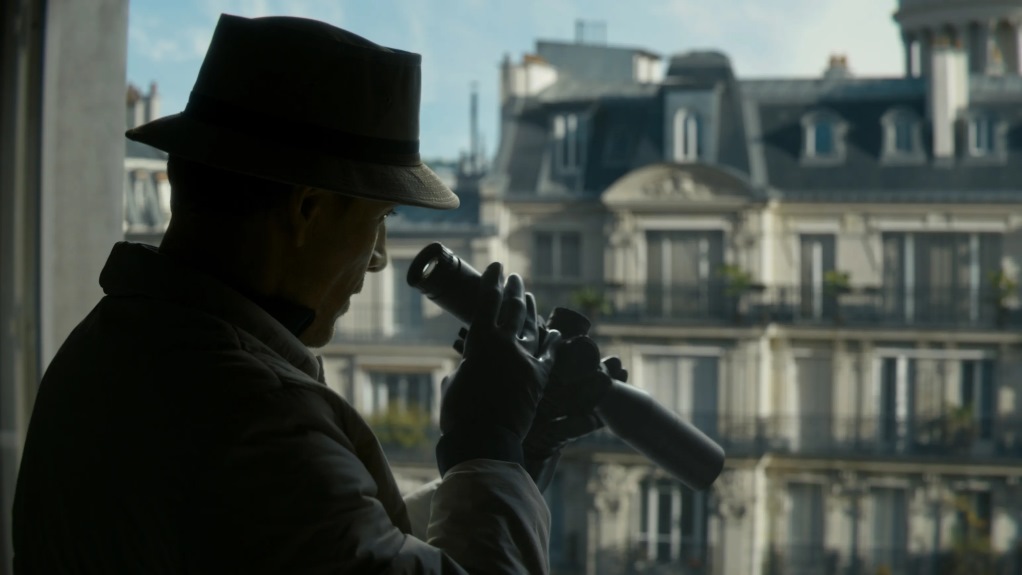
A man sits in monastic silence, starring out of a window at the best hotel in Paris that money can buy. He moves only to sleep, exercise with a monotonous rigour and consume a carefully calculated daily calorie amount from McDonalds. He wears gloves all the time, never moves from the sheeting he lays across surfaces and sometimes assembles and reassembles his rifle. He’s a nameless hitman for hire (Michael Fassbender) and a freak accident on this job will shatter his world of pristine order and leave him hunted by his employers and on a campaign of revenge to guarantee his safety.

The Killer is a lean, slimmed-down thriller full of Fincher’s love for procedure and detail, that delights in every beat of its detailed look at how a professional killer might go about his daily business. Be it lock-ups crammed with mountains of equipment, from guns to false number plates and endless zip-bound folders of fake IDs (all using character names from 70s and 80s TV shows) to the practised ease with which he penetrates even the the highest security building with an Amazon purchased card copier and light-fingered pick-pocketing. All of it assembled with Fincher’s pin-point precision and clockwork eye for detail.

On the surface, you might expect The Killer to be a sort of twist on Le Samouri, Melville’s look at a zen-like hitman. The Killer seems to fit much of the bill. Embodied with an athletic suppleness by Fassbender (his body seems to be almost elastic in the parade of physical stretches and exercises he performs, not to mention the fingertip press-ups he relentlessly pumps his whipper-thin body through). But Fincher gives us a seemingly never-ending insight into the Killer’s inner-mind, via a prolonged (near continuous) monologue of his inner thoughts, ideologies and mantras that dominate much of the film (the first twenty minutes plays out in near on-screen silence, just watching Fassbender and listening to his voiceover).

What’s fascinating is this interior monologue is only a shade away from a stream of corporate middle-management think. (It’s even implied the Killer was originally recruited while training as a lawyer). There are mantras with the air of an assassin’s version of positive thinking (“Stick to your plan. Anticipate, don’t improvise. Trust no one. Never yield an advantage. Fight only the battle you’re paid to fight.”) and passive-aggressive demands to hit a personal standard (“Forbid empathy. Empathy is weakness. Weakness is vulnerability.”). Far from the glamour of an unknowable force acting to a mystical code, this Killer sounds alarmingly similar to a self-doubting white-collar worker using Sun Tze to plan out his pitch meetings.

Beneath the sheen of Fincher’s beautifully dark film, is the suggestion we are watching a character study of a man perhaps only partially aware that his life, and his inner picture of who he is, is falling apart. For starters, despite his mantra of perfection and continued assurance of ‘every detail covered’ and ‘every angle anticipated’, our Killer makes a host of errors. Almost everything we see him do goes wrong in some-way: from that initial hit that takes out the wrong target, to stabbings that leave victims bleeding out faster than he intended, doses of knock-out drunks that are incorrectly calculated, house invasions that fail to surprise the victim… The mantra is clearly an ideal not quite a reality and the Killer’s greatest strength actually turns out to be his ability to improvise in unexpected circumstances.

In addition, for all he maintains he acts only professionally and things are never personal, the entire film chronicles a campaign of revenge in which he takes out a host of targets for personal reasons. The idea of the killer as a man separate from connections is already shattered from his obvious distress, returning to his home in the Dominican Republic after his botched hit, to find his girlfriend seriously assaulted and hospitalised. Michael Fassbender’s mastery of micro-features throughout the film, suggests waves of doubt and insecurity flooding behind the eyes of a man who has tried to master himself as an unfeeling violent limb of faceless masters.

As such, The Killer is a sort of pilgrim’s progress of a man discovering small, unexpected elements of himself while as impassively as possible knocking off anyone he considers a threat (effectively anyone who might know where he lives). No attempt is made in this to make the Killer entirely sympathetic – he ruthlessly kills at least one completely innocent person, and doesn’t hesitate to murder those he has identified, no matter how much he might sympathise with them.

But the monastic chill he aspires to is cracking. You can see it in his conversation with “The Expert” played with a mix of relish and resignation by Tilda Swinton. A professional killer like him, the Expert has not let this stand in the way of “a normal” life outside her trade. She’s married, is a popular regular at a posh restaurant and has achieved a level of compartmentalism the Killer can only dream of. Is the envy and self-doubt in his eyes as he listens to her emotionally articulate reflection on the life they have chosen?

Fincher’s film quietly explores this alongside some skilfully assembled sequences. In many ways the film mirrors its lead character: limber, dedicated, obsessive, executing its sequences with clockwork exactitude and following a fit-bit like a metronome. But it’s also a dark character study of a man (perhaps) realising how empty he has made himself, drowning out doubts with the music of The Smiths. Fassbender is the perfect actor for this, few matching his skill to be both blank and overflowing with suppressed emotion at the same time.

It makes The Killer a fascinating film, a Fincher film that feels at first like a minor work but offers more and more depths for reflection. On one level an auteur John Wick, which brilliantly outlines each trick of its expert lead character. On another level, a sort of dark character study of a man in the midst of an epic breakdown, falling back on mantras and mottos, processing his doubts and guilt through the only thing he really knows how to do: kill people.

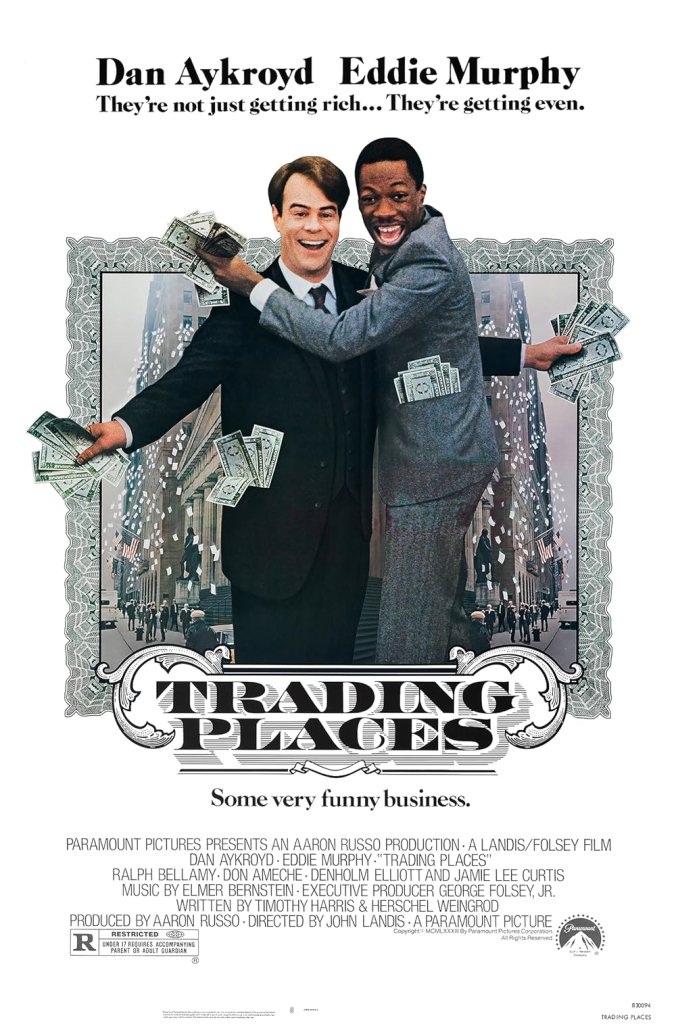
Trading Places (1983)

Trading Places (1983)

Very 80s comedy, full of rude gags and the glories of money still funny in many places

Director: John Landis

Cast: Dan Aykroyd (Louis Winthorpe III), Eddie Murphy (Billy Ray Valentine), Ralph Bellamy (Randolph Duke), Don Ameche (Mortimer Duke), Denholm Elliott (Coleman), Jamie Lee Curtis (Ophelia), Paul Gleason (Clarence Beeks), Kristin Holby (Penelope Witherspoon), Jim Belushi (Harvey)

Louis Winthorpe III (Dan Aykroyd) has it all. A house in Philadelphia, glamourous fiancée and high-flying job as Managing Director at Duke & Duke, the leading blue-chip commodities brokers. Billy Ray Valentine (Eddie Murphy) has nothing: penniless, homeless, hustling on the Philly streets. But is their fate due to nature or nurture? Finding that out is the subject of a bet between heartless Duke brothers Randolph (Ralph Bellamy) and Mortimer (Don Ameche). They turn both men’s lives upside-down by swopping their positions – Louis will be disgraced and left with nothing and Billy Ray will get his house and job. Will they fall or rise? And what will they do when they find out their lives are the Duke’s playthings?

Trading Places was one of the big box-office smashes of 1983, a film that changed the lives of virtually the whole cast. It showed the world Aykroyd could carry a comedy without partner Jim Belushi, gave a second career to Bellamy and Ameche, led Curtis to say the role “changed her life” from just a scream queen and, perhaps most of all, turned Murphy into a mega-star. It’s still witty, fast-paced and funny today, even if in places it’s not always aged well.

Landis takes a screwball approach, unsettling the lives of two contrasting people and then throwing them into an unlikely revenge partnership. Trading Places is very strong on the contrasting world of rich and poor. The wood-lined, club-bound world of the Dukes is carefully staged, paintings of financial and political grandees staring down from walls as assured, masters-of-the-universe easily sachet around posh clubs and squash clubs, to the sound of Elmer Bernstein’s Mozart-inspired score. By contrast, the rough, litter-lined squalor of Philadelphia’s poorer neighbourhoods is unflinchingly shown with, under the comedy, the suggestion life is cheap and everyone is for sale.

Of course, a lot of the ensuing laughs come from seeing a rich person who has only known comfort thrown into this life of a tramp and vice versa. Ackroyd’s Winthorpe bristles with disbelief at his situation and the rich man’s blithe assurance that (any moment) someone will say there has been a terrible mistake carries a lot of comic force. Meanwhile, Murphy’s fast-talking Billy Ray assumes he is the subject of an elaborate prank (or perverted sex game) as stuffs the pockets of his first tailored suit with knick-knacks around the house the Duke’s assure him is now his. Hustler Billy Ray turns out, of course, to be well-suited to the blue-collar hustle of financial trading. He also finds himself, much to his surprise, increasingly interested in the culture and artworks around him.

Under all this, Trading Places has a surprisingly negative view of rich and poor. Louis posh friends and shallow fiancée are all status-obsessed snobs who turn on him in minutes when he is framed for theft, embezzlement and drug trafficking. The servants in their posh clubs – all, interestingly, Black men in a quiet statement on race that you still wish the film could take somewhere more interesting – are treated as little better than speaking items of furniture and there is a singular lack of interest or concern for anyone outside their social bubble. Playing fair, every working-class character we see (apart from Curtis and Murphy) is lazy, grasping and shallow, ignoring Billy Ray until they can get something from him, at which point they fall over each other to snatch freebies from his house.

Trading Places is, in many ways, a very 80s screwball. Money is the aim and reward here. Trading Places has respect only for aspirational characters who save and invest their money. (Curtis’ prostitute is marked out as savvy and decent because she has invested nearly $42k from her work in a nest-egg). The film culminates in a financial scam (playing out on the trading floor of the World Trading Centre) designed to reward our heroes with wealth and punish the villains with poverty. For all the film stares at the reality of poverty and riches, the implications and injustices of wealth are ignored, with money ultimately framed as a vindication.

But then, Trading Places is just a comedy so perhaps that’s reading a bit too much in it. There is a frat-house energy to Trading Places under its elaborate framing and a lot of its gags come from a rude, smutty cheek that sometimes goes too far (not least a punchline involving a villain being repeatedly raped by a randy gorilla). Murphy’s energy – every scene has the crackle of improvised wildness to it – is certainly dynamic (this is probably his funniest and – eventually – most likeable role) and while Aykroyd is a stiffer comic presence, he makes an effective contrast with Murphy.

The real stars here though are the four supporting actors. Bellamy and Ameche seize the opportunity to play the villains of the piece with an experienced gusto, brilliantly funny in scene-stealing turns. Outwardly debonair, the seemingly cudily Bellamy and prickly Ameche superbly reveal the greed and casual cruelty of these two heartless Scrooges. Elliot is also extremely funny, and the most likeable character, as a kind butler just about disguising his loathing of the Dukes. Curtis’ vivacity and charm makes a lot of an under-written “hooker with a heart of a Gold” trope – like her co-stars she seizes her chance with a fun role.

Some of Trading Places has of course not aged well. Jokes with gay slurs pop up a little too frequently. While the Duke’s use of racist language makes sense (after all they are vile people who see Billy Ray as nothing but a curious toy), it’s more of a shock to hear our nominal hero Louis do the same. Murphy’s improvised sexual harassing of a woman on the streets (ending with him screaming “bitch!” after her when she walks off) doesn’t look good. Curtis twice exposes her breasts for no reason. The film’s closing heist involves Aykroyd blacking up and affecting a Jamaican accent.

But, dubious as some of this is now (and while you can argue times have changed, surely even then some people would have been unsettled by this sort of stuff framed for good-old-belly laughs), Trading Places is still funny enough to be a pleasure. And, with the performances of Bellamy, Ameche, Elliot and Curtis we have four very good actors providing a humanity and professionalism to ground two wilder comedians. It’s easy to see why this was a hit.

The King and I (1956)

The King and I (1956)

Deliberately artificial adaptation, powered by star performers and sumptuous set-design

Director: Walter Lang

Cast: Deborah Kerr (Anna Leonowens), Yul Brynner (King Mongkut), Rita Moreno (Tuptim), Terry Saunders (Lady Thiang), Martin Benson (Kralahome), Rex Thompson (Louis Leonowens), Patrick Adiarte (Prince Chulalongkom), Carlos Rivas (Lun Tha), Alan Mowbray (Sir John Hay), Geoffrey Toone (Sir Edward Ramsey)

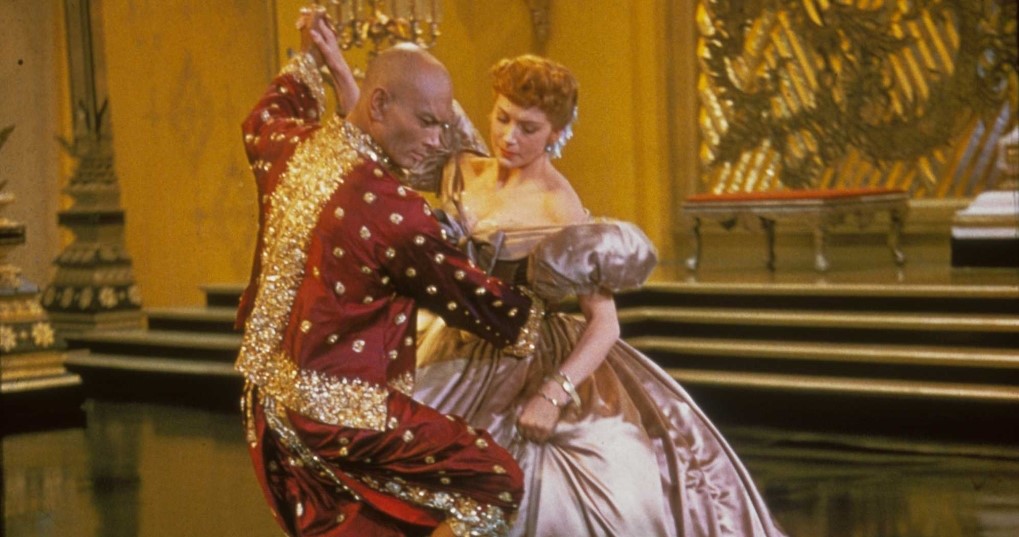
In its glistening, stagy exactness The King and I is the most traditional adaptation of Rodger and Hammerstein to hit the screen. A (questionably accurate) memoir by Anna Leonowens (Deborah Kerr) about her experiences as a tutor to the children of King Mongkut of Siam (Yul Brynner) in the 1860s, was repackaged by the musical hit-machine duo into a charming culture clash, with a garland of unspoken romance across the top. Anna wants to help the king improve and develop his kingdom – but also clashes with his ideas about his antiquated ideas and (above all) his treatment of concubine Tuptim (Rita Moreno), who is in love with servant Lun Tha (Carlos Rivas). Can the King and Anna reach an understanding?

The King and I is one of the grandest, most artificial looking films you will see. No attempt has been made by anyone to even pretend we are not watching events play out on a series of massive, elaborately decorated soundstages. It all looks gorgeous of course, brightly coloured sets filling the frame. Even the scenes ‘outside’ – on Anna’s ship or the palace grounds – drip with ostentatious artificiality.

This impression is only increased by the mediocre direction of Walter Lang. A reliable studio B-movie hack, Lang sets the camera up in the equivalent of the front row of the stalls. While he can frame a scene efficiently (his centring in the final shot of the king’s hand is neatly done), Lang provides no originality, flair or real visual interest, all that supplied solely by the sets. He either misses beats or misunderstands jokes (the accidental flashing of the English ambassador is crying out for a beat of titillation from the old guy). It’s quintessential widescreen hackwork of the 50s, where the focus is on wowing the people with the money, bright colours and massive sets they couldn’t get from the little box in the corner. On that basis, a director who sets the camera up to get as much of that seen as possible all the time, fits the bill.

Besides, the film’s two most distinctive features didn’t really rely on Lang anyway. The King and I’s grand Thai-style ballet based on Uncle Tom’s Cabin was visualised and choreographed by Jerome Robbins (with Lang setting the camera stationary in mid-shot to capture it all). This ballet is, by the way, a masterclass of expressive visual originality (with its swirling use of masks, sheets and banners) that sticks out like a sore thumb in a film as visually flat as this one.

The other was of course Yul Brynner’s star-turn as the King. Brynner’s performance of the role on Broadway had transformed his career and years of honing it on stage meant he was the master of every beat of its eccentric energy. Brynner is magnificent, bombastic, proud, grand but also subtly playful, surprisingly timid and strangely shy. Brynner’s performance with its theatrical touches (the striking pose and the “et ceteras”) could be seen as overplaying, but actually fits perfectly with a man constantly, deliberately, putting on a show.

Brynner really shows the more thoughtful, quiet man under the surface, worried about his kingdom’s future. The earnest autodidact, who lies on the floor reading books. The eager-to-impress man who swots up on topics of conversation to impress the English ambassadors and hands a prompt sheet to Anna to work them into conversation. The careful flirt who only allows flashes of his romantic interest in Anna show. It’s a clever, grand but very human performance. Brynner had wanted to direct (and, rumour has it, partially did so) but settled for a Best Actor Oscar instead.

He also sparks extremely well off Deborah Kerr, buried under some truly might dresses (so heavy, that Kerr allegedly lost twelve pounds over the course of filming). Kerr turns a potentially stodgy part into a woman who is independent but not judgemental, forward-looking but diplomatic and very careful about allowing any expression for romantic feelings. Although her singing is dubbed by Marnie Nixon, it’s Kerr’s engaging sprightliness that carries a lot of the drama. She and Brynner’s chemistry also ensures the scenes between the two of them are by far the film’s highlights.

Most of the faults of The King and I can be traced to the musical itself. There isn’t much in the way of plot. The quiet will-they-won’t-they bond between Anna and the King is partly because that’s the nature of these things, but partly because the musical doesn’t really give them much material to work with. Virtually every character other than these two feels like either a sketch, a plot function or a stereotype, with the actors given almost nothing to work with. Impressive as the ballet is, it essentially takes up almost 15 minutes of screentime without advancing the plot or the themes of the film at all. Thematically the film explores very little, either on social progress in Siam or its place in the world. The film rushes towards a conclusion that feels like it comes out of the blue.

But then people aren’t watching The King and I for its social commentary or thematic depth. They are watching it for some hit songs, impressive production values and charismatic performers. You certainly get that and if the overall shape of the film feels rather loosely plotted and doesn’t go anywhere, that’s neither here or there. And of course, it’s a triumph for Brynner (who, late in life, dedicated his final years to performing the role, racking up over 4,600 performances), whose confidence and star-quality carries thing. Pretty, fun, not deep but pleasant – but then that’s Rodgers and Hammerstein for you and if that’s for you, this is the film for you.

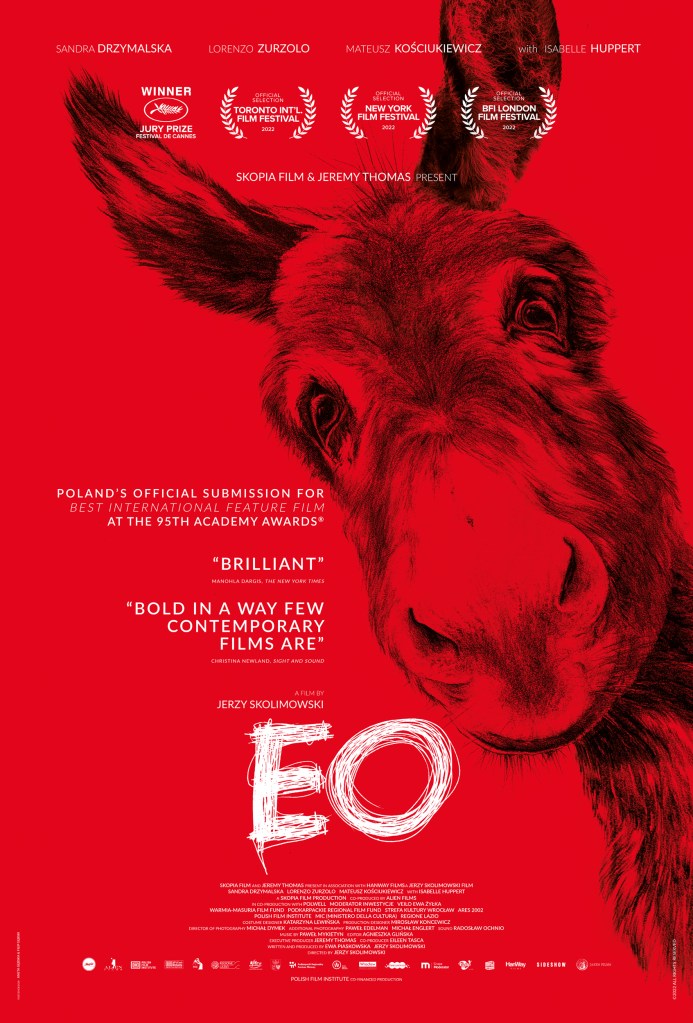
EO (2022)

EO (2022)

Skolimowski’s passionate call for animal rights is a modern Au Hasard Balthasar

Director: Jerzy Skolimowski

Cast: Sandra Drzymalska (Kasandra), Tomasz Organek (Ziom), Lorenzo Zurzolo (Vito), Mateusz Kościukiewicz (Mateo), Isabelle Huppert (Countess)

You can make a lot of judgements on humanity, based on how it treats animals. EO, a poetic and deeply heartfelt film, makes a passionate plea for kindness and respect in our treatment of the natural world, qualities it all too often finds lacking. In that sense, it’s surprisingly different from its ancestor Robert Bresson’s Au Hasard Balthasar. Where Bresson turned the rite-of-passage of a donkey into a Calvary-like journey, with the donkey a poetic substitute for Christ, Skolimowski’s film presents a donkey who is nothing more or less than a donkey, but whose experiences become universal for our treatment (and mistreatment) of animals.

We first meet EO as a circus performer, working closely performing tricks with Kasandra (Sandra Drzymalska). When the circus’ finances collapse, under the demands of animal rights activities EO is taken from his home and deposited in a sanctuary where he feels unsettled and uncertain. From there, his life becomes migratory as wanders encountering violent football hooligans, exploitative mink farmers and the odd decent person, progressing towards an abrupt fate that parallels Bresson’s Balthasar.

Even more so than Bresson’s work, Skolimowski’s EO front-and-centres its donkey star. Among many things, EO is a strikingly beautiful art film. The camerawork – shot by two DPs who pull the film together into a beautifully consistent visual style – is radiant, presenting a series of luscious 4:3 images which capture both the beauty of nature and the starkness of man’s presence in it. Several scenes are shot with a slightly frog-eyed lens, its blurred wet-looking edges suggesting EO-perspective POV shots. Skolimowski presents several sequences with a red-tinged dream-like quality, that suggests EO’s own day-dreams – soaring vistas, locations that visually merge together, flashes of his circus life. All this pushes EO himself into the film’s lead role, a real character.

But yet no attempt is made to anthropomorphise this animal. Although the camera lingers over EO’s face, his emotions are left entirely for us to interpret. In many ways, EO is a proof for that old editing test: show the same neutral face followed by a series of contrasting happy and sad events, and the mind will interpret that neutral face as holding different emotions. That is what EO does marvellously. Perhaps we just imagine EO’s joy at seeing Kasandra again (she is certainly moved – drunk, but moved). Perhaps his fear and discomfort in his new animal shelter home is us reading in what we might feel in his place. When EO kicks a mink battery farmer in the face, do we feel he’s angry because we are? There are no answers from EO: he’s just a donkey.

Nevertheless, he is a donkey on a journey and Skolimowski’s film is a surprisingly sharp-edged fable, deeply critical about our unthinking, brutal exploitation of animals. To too many of us, the film argues, their rights are not worth considering – they are dumb creatures good to work until they are too difficult to keep alive or we wish to use their bodies for something else, from clothing to food. EO’s encounters with humans invariably see him being used for their own needs, rarely considering what the desires of the donkey might be.

Skolimowski establishes from the film’s opening, with its animal rights activists who are (surprisingly considering the film itself is an act of animal rights activism) smug, self-righteous and so convinced they know what is best for EO that they are crucial in separating him from the only human in the film who cares for him. Far from ill-treated in the circus, it gives EO a home, love and a purpose. The instant he is removed from this circus, all three of these elements disappear from his life.

Not that Kasandra is an unequivocally positive influence in EO’s life. Settled onto a farm – again we read depression into his refusal to eat, although maybe EO’s just not hungry – EO’s new surroundings are not unpleasant (in fact, the farm seems to be partly about helping disabled children connect with animals, in a sweetly touching sequence). Kasandra gate-crashes one night, drunk, feeds EO a muffin and then disappears over the horizon. Her presence does enough to cause EO to follow her, escaping from his pen and walking out into the Polish countryside.

This pilgrimage through a forest and shooting range (laser guided hunters track wolves, EO at one point starring at a dying wolf, left to bleed out from the hunt), leads eventually to a village football game where EO’s braying causes one side to miss a crucial penalty. Suddenly EO is flotsam in a hooligan-tinged battle between rivals. The winners adopt him as a sort of comedy mascot, before forgetting him in their drunken haze. Hooligans from their rivals beat EO nearly to death, in a twisted act of revenge. EO has no say in either side of this war, merely becoming a passive and innocent war-ground that humans can exact their primal instincts on.

Treatment of animals is increasingly, cruelly, exposed. Nursed back to health by a vet (a worker at the hospital matter-of-factly asks why they don’t put EO down), he is sold to a mink farm that feels like nothing less than a brutal prison, where animals live in misery until their inevitable skinning to make a scarf. Trafficked across countries with horses, EO is again adopted by a stranger who uses him as a sounding board for his own concerns (this happens arguably three times: Kasandra arguably sees EO’s as a sentimental toy, a drunk unties EO before the fateful football ground because he wants his “friend” to be free and Vito uses him to stave off loneliness). This is as nothing compared to the film’s bleak ending – a terrifying view of the ruthlessness we push animals towards their fate.

EO is so masterful at front-and-centring the experience of an animal, and investing it with immense interpretative empathy, that it means the film actually drags when humans enter the frame. The film feels like it has to include scenes with humans in to bulk up it up to feature length (a better EO would surely be about 60 minutes long). A Polish truck-driver (Mateusz Kościukiewicz) playfully flirts before discovering man is just as inhuman to man as he is to animals. Vito and his mother-in-law, Isabelle Huppert’s countess, play out a small-scale human drama which seems trivial and uninteresting compared to the animal message that dominates the film.

Perhaps this is because EO succeeds so utterly in making us care and even (perhaps) understand the perspective of an animal. It’s a superb act of interpretative art – filmed with an astonishing visual beauty and with a gorgeous score of Pawel Mykietyn – and warm empathetic understanding. It also builds into a surprisingly moving and powerful message on the importance of treating animals with the same dignity and kindness that we would expect to be treated with ourselves. It makes for a thought-provoking and immersive film, that emerges successfully from the shadow of its forbear.

Anatomy of a Fall (2023)

Anatomy of a Fall (2023)

Brilliant courtroom drama, full of enigmatic questions around the nature of truth

Director: Justine Triet

Cast: Sandra Hüller (Sandra Voyter), Swann Arlaud (Vincent Renzi), Milo Machado-Graner (Daniel Maleski), Antoine Reinartz (the Prosecutor), Samuel Theis (Samuel Maleski), Jehnny Beth (Marge Berger), Saadia Bentaieb (Nour), Camille Rutherford (Zoé Solidor), Anne Rotger (the President)

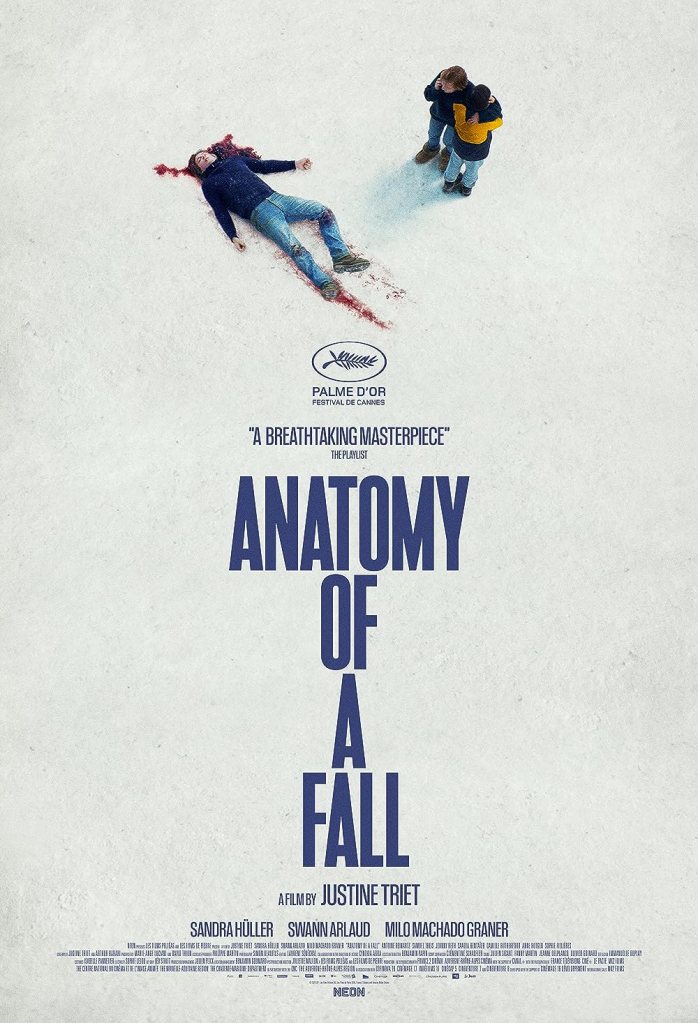
What is a trial? A forum for discovering the truth? Or a theatre where the best story wins? Anatomy of a Fall, Justine Triet’s Palme d’Or winning courtroom drama, explores this and takes its place as one of the finest courtroom films made. Complex, fascinating and compelling, it asks searching questions about the unknowable nature of truth. Presenting only perspectives, recollections and conflicting inferences based on the same handful of facts, it places the viewer in the same position as the jury: ultimately we must choose a version of the truth “we can live with”.

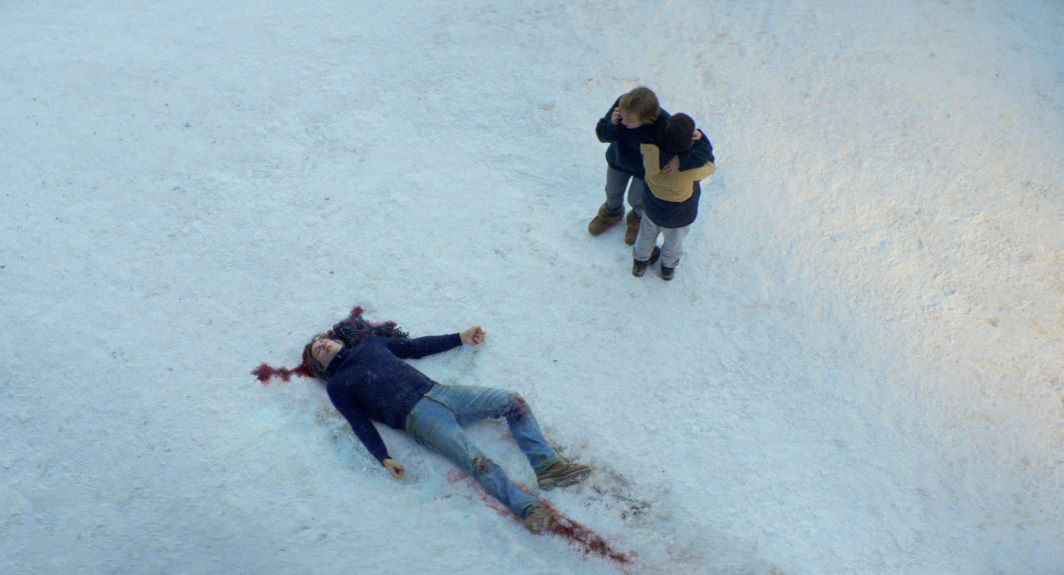
The trial revolves around the death of Samuel Maleski (Samuel Theis), lecturer and amateur house renovator, discovered dead by his son Daniel (Milo Machado-Graner) having fallen from the attic of their Grenoble chalet. Did he fall, jump or was he pushed? Suspicions fall on the only suspect: his wife, famous novelist Sandra Voyter (Sandra Hüller). Sandra’s story doesn’t quite stack up and her assurance that they were in a difficult but loving relationship isn’t supported by the facts. A dramatic court case begins, in which both the prosecutor (Antoine Reinartz) and Sandra’s lawyer, old friend Vincent (Swann Arlaud), lay out compelling, but utterly conflicting versions of Sandra and Samuel’s marriage, with their son Daniel (the only real witness) caught horrifically in the middle.

Anatomy of a Fall only shows us facts that a jury could have. We open no more than an hour before the fateful event, with Sandra’s interview at home with a young student (Camille Rutherford) halted by an unseen Samuel playing an instrumental cover of 50 Cent’s P.I.M.P. at deafening volume. Is his playing of loud music an everyday event (as Sandra says) or a passive aggressive move designed to disrupt the interview of a wife he is jealous of? We don’t know because we never get to see their subsequent confrontation, as we follow Daniel walking his dog, returning find Samuel’s body.

This sets the tone for the superbly uneasy courtroom drama that follows. Throughout, Samuel is literally a ghost. The film finally shows him only when a recording he made of a vicious argument between the couple is played to the courtroom. Triet cuts from the courtroom to a flashback so we can see Sandra and Samuel’s increasingly heated conversation, where he condemns her for selfishly dominating their lives, while she accuses him of a martyr complex and blaming her for his own failures. But the second the recording hits a disputed physical clash we cut back to the courtroom and hear only the sounds themselves and their interpretations from prosecution and defence.

Those interpretations are effectively stories, and Anatomy of a Fall makes it clear a compelling and relatable story is essential. Taking a leaf from Anatomy of a Murder (a clear inspiration), it’s less the facts and more the presentation that is likely to win either conviction or acquittal. Vincent carefully coaches Sandra on her version of events – the loving relationship turned sour by her husband’s depression, bought on by his guilt for the accident that left their son visually impaired – advising her on tone, wording and when to stress certain points and which to avoid. He flatly tells her an accident is something “I don’t believe” and stresses their only chance is to establish Samuel’s suicidal intent. Lawyers aren’t paid to find the truth: they are paid to secure verdicts.

There is an added complexity as Sandra, a German, must conduct the trial in French, her third language, rather than her preferred second language of English. Language is itself a topic of debate in the marriage – her French husband Samuel accuses Sandra of forcing him and French-speaking Daniel to meet on her preferred ground of English, rather than improve her French. She counters that English makes them all equal, speaking a second language. In the trial, Sandra struggles to articulate her points, floundering for precise words. Eventually the pressures of the trial force her to revert to English, which is then translated for the rest of the court.

Superbly played by Sandra Hüller, Sandra is an assured professional, struggling to understand how she has ended up in this position. She can be distant and doesn’t suffer fools gladly. Unspoken as it is, it’s clear for police and prosecution she doesn’t fit their profile of a grieving widow. Every beat of Hüller’s performance is brilliantly open to interpretation: is she anxious about the pressure on her son, or scared about what he might say? Is she filled with stoic regret or did she never care for her husband? Even when she switches to English in the court, is this a result of pressure or because it is easier for her to elaborate a story in this language?

The truth is increasingly sidelined. We see no reconstruction of the possible crime, only two (both convincing) versions of it presented with models and computer graphics that outline first a murder then a suicide, both plausibly explaining how a suspicious blood splatter appeared on a shed. A psychiatrist arguing passionately for Samuel’s clear-headedness and determination to live, is blamed by Sandra for getting him hooked on anti-depressants. Sandra’s novels are dragged into the trial (on the excuse that she has talked extensively about their autobiographical content) – was her use of Samuel’s idea from his abandoned novel theft or agreement? We can never be sure.

This struggle for the best story has an increasingly damaging impact on their son Daniel. Beautifully played by Milo Machado-Graner, Daniel is a quiet, sensitive, precocious young boy, whose accidental visual impairment becomes crucial. Certain at first of what he saw and heard, we see his certainty crumble during police-escorted reconstructions at the scene (the loud music making what he claimed he heard from where, impossible). On the stand he tries to reconcile his love for both his parents with knowledge of their arguments. At home with his mother, he becomes increasingly withdrawn and closer to his court-appointed guardian Marge (a superbly conflicted Jehnny Beth).

It is Marge who gives voice to, perhaps, Anatomy of a Fall’s central message. The truth is, in the end, the story we choose to believe, the one we can live with. Anatomy of a Fall presents us with multiple choices but no definitive answers. It is up to us to listen to the evidence and decide on Sandra’s guilt or innocence. Triet’s superb film throws in a final additional mystery with a late piece of evidence that is even more open to interpretation than anything else, a story that could be argued as a late realisation or an elaborate lie. We even see Samuel again, as the witness recounts words they claim he said, but this time we just see him lip synching to the audio of the witness’ testimony – are words literally being put into his mouth? The truth is what we make of it, and as subjective as any story.

Anatomy of a Fall is a brilliant courtroom drama and a scintillatingly human story with a superbly enigmatic performance from Sandra Hüller at its heart. Triet and Arthur Harari’s script is sharp and marvellously balances objective and subjective facts. Triet directs with a tight, pacey assurance, with a striking series of final images that remain open to viewer interpretation as to who is protecting whom and why. Fascinating, compelling and open to endless reconsideration and reinterpretation, Anatomy of a Fall can take its place as one of the definitive courtroom dramas on film.

Murphy’s War (1971)

Murphy’s War (1971)

This heavy-handed anti-war Don Quixote story is far from a success

Director: Peter Yates

Cast: Peter O’Toole (Murphy), Siân Phillips (Dr Hayden), Phillipe Noiret (Louis Brezan), Horst Janson (Captain Lauchs), John Hallam (Lt Ellis)

In the dying days of World War Two, the merchant ship Mount Kyle is sunk in the Venezuelan Orinoco by a German U-Boat. Surviving the machine-gunning murder of the crew is Irish engineer Murphy (Peter O’Toole), who is treated at a Quaker mission by Dr Hayden (Siân Phillips). Murphy at first seems happy to be out of the war: but that changes, after the murder of fellow survivor Lt Ellis (John Hallam) by u-Boat captain Lauchs (Horst Janson), hunting the survivors. Murphy, assisted by Frenchman Louis (Phillipe Noiret), decides to take revenge, kitting out a crashed bi-plane to launch a series of increasingly obsessive attacks on the u-Boat with Murphy succumbing to a vendetta.

Peter Yates takes an action-adventure novel and adjusts into an anti-war epic that becomes increasingly shrill as it reaches its nihilistic ending. This shift led to several clashes between Yates and the film’s producer Michael Deeley, who was looking for a box-office hit with a charismatic star. While Yates’ film is complex in its eventual structure, the overall impact of the film is confused and blunted, its sympathies mixed and logic often flawed. It has its moments but doesn’t quite work.

As part of its anti-war set-up, Yates believed it was essential to humanise the German sailors (after all, he wanted the viewer to feel unease at Murphy’s destructive crusade). Unfortunately, creates a dissonance in the film. The first thing the German sailors do is ruthlessly machine-gun the Mount Kyle’s sailors as they tumble into burning waters. Graphically shown is every beat of the fear, as charred machine-gunned bodies fill the frame while the Germans show not a moment of regret (indeed we next see them celebrating the Captain’s award of an iron cross). The captain murders Lt Ellis with a face filled with regret, but his execution involves bullets causing Ellis’ body to jerk in its graphic death throws. How are we supposed to sympathise with them after that?

The focusing on such brutality fits the anti-war hell the film wants to lay out. But it fatally undermines the film’s aim to sure Murphy’s campaign to destroy the u-Boat as an obsessive and destructive campaign. With no reason given for the brutal war crimes committed by the u-Boat (for good measure they also machine gun the Quaker settlement, killing many of the villagers), its hard not to feel that actually Murphy has a point and that these guys deserve punishment. Would a throwaway line about a secret German mission or a need to hide have hurt the film?

The film can’t have it both ways. It can’t luxuriate in the destruction and murder war soldiers commit and then ask us to sympathise with these same soldiers when their death is threatened by another obsessive soldier on a quest for revenge. In a better developed film this sort of clash of sympathies might feel more natural. Instead, the Germans are either monstrous or sympathetic depending on the needs of the scene while Murphy himself makes an awkward shift late on from a guy with righteous anger into a destructive figure we are invited to condemn.

This is a particular shame as there is a lot in Murphy’s War to admire. Yates directs with an assurance and sense of epic scale. The Venezuelan scenery is shot with a real beauty by Douglas Slocombe and the film is edited with a professional excellence by future-Bond-director John Glen. The film’s first half hits a “boy’s own adventure” tone very effectively – making the later shift into 70’s anti-establishment nihilism more awkward – with inventive sequences as Murphy, McGiver-like, reassembles the downed biplane and jerry-rigs some home-made bombs.

A big part of any success is the charismatic performance of Peter O’Toole, who tears into the role of this Irish rebel with relish. Mixing insouciant wit with a bitter irony that slowly gives away to a sociopathic gleam as obsession takes hold, this is an excellent performance. O’Toole manages to make a character who is, in many ways, slightly incoherent work effectively. After all this rebel we hear condemning war with counter-culture cool, who fights to the bitter end; a guy who expresses indifference for his colleagues but goes to unimaginable lengths to avenge them. These contradictions don’t feel naturally developed, but ideas that are put in place to ease the plot.

Saying that, the film has some interesting beats as Murphy collapses more and more into Don Quixote like obsession, tilting at his underwater windmill. (Yates clearly had a passion for this angle as he would make two attempts to make a film of Don Quixote before finally making a TV version in 2000). O’Toole is perfect for this increasing severing from reality and as his Sancho Panza, Phillipe Noiret contributes a warm, humane performance as reluctant Louis, who silently acquiesces in a campaign he clearly feels is misguided and delusional. Equally good is Siân Phillips, balancing exasperation and affection for Murphy, finally unable to brake through his walls of aggression.

There are good ideas and moments in Murphy’s War but its poor-plotting (its story is also strikingly slight, with the preparation of the biplane and its test flight filling an elongated stretch of the film) and jumbled mix of adventure and anti-war sentiments eventually fatally undermine its effectiveness. Despite fine work from Yates and a charismatic and highly watchable performance from O’Toole it’s, at-best, an interesting failure.

Sansho the Bailiff (1954)

Sansho the Bailiff (1954)

Mizoguchi’s masterpiece, a stirring, humane fable tinged with the tragedy of the real world

Director: Kenji Mizoguchi

Cast: Kinuyo Tanaka (Tamaki), Kyōko Kagawa (Anju), Eitarō Shindō (Sanshō the bailiff), Yoshiaki Hanayagi (Zushiō), Ichirō Sugai (Minister of Justice Niō), Ken Mitsuda (Fujiwara no Morozane), Masahiko Tsugawa (Zushiō as a Boy), Masao Shimizu (Taira no Masauji), Chieko Naniwa (Ubatake), Kikue Mori (Priestess), Akitake Kōno (Tarō), Ryōsuke Kagawa (Donmyō Ritsushi)

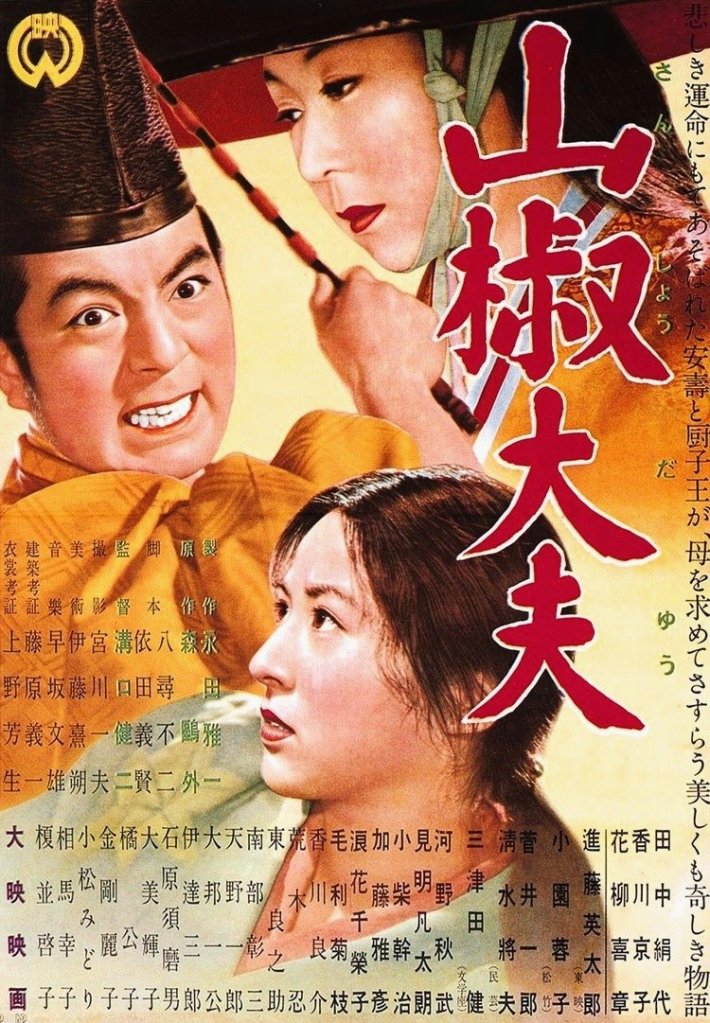
You could imagine the lead characters of Sansho the Bailiff as Hansel and Gretel. There is a fairy tale quality to Sansho the Bailiff, combined beautifully by Mizoguchi with a throbbing humanism. Imagine a fairy tale named after The Wicked Witch of the Gingerbread House then spliced with the trauma of captivity. Mizoguchi’s film is a gorgeous, deeply moving and heartbreaking fable, that yearns for us to hold to our inner goodness but shows the terrible struggle to sustain this in a cruel world and the terrible costs we go through for glimmers of hope.

Based on an old Japanese folktale, an eleventh century feudal official is unjustly dispatched into exile. He leaves his family with a mantra: “without mercy, man is a beast. Even if you are hard on yourself, be merciful to others.” A few years later, while travelling, his wife Tamaki (Kinuyo Tanaka) and children are tricked and sold into slavery. Tamaki becomes a prostitute on the island of Sado, her children slaves on the estate of the brutal Sansho (Eitarō Shindō). As young adults, the son Zushiō (Yoshiaki Hanayagi) has buried his humanity as a cruel overseer but his sister Anju (Kyōko Kagawa) still clings to hope and her father’s principles. Can Zushiō’s principles be reborn, despite the brutality of their surroundings?

Mizoguchi’s film is a masterpiece on man’s capability to inflict suffering and cruelty, most particularly on women. Although full of qualities of a classic folk tale, Sansho the Bailiff is grimly realistic and unflinching about the suffering that slavery can inflict and remarkably unblinking in the human cost escaping from such a world can be. There are no fairy tale endings in Sansho, no clear victories, no satisfying conclusions. For every flash of hope, there is the grim realisation of the cost others have paid to achieve it. In particular, women carry an appalling burden of sacrifice.

The family is cruelly invaded in Sansho suffering a double separation – first the other members from the father, then the wrenching separation of mother from children. Shot throughout with a calmly controlled focus by Mizoguchi, with long takes combined with carefully controlled angles that frequently give a terrible distance to events, making the viewer feel powerless to prevent them. Tamika – played with extraordinary humanity and depth of emotion by Kinuyo Tanaka – suddenly understands what is happening and responds with a desperate struggle (which sees her faithful servant unceremoniously dumped off a boat to drown) while her children struggle hopelessly on land. Superbly subtle editing and framing that stresses distance (placing mother and children at opposing ends of the frame in alternate shots) only add to the sense of a family being torn apart.

This is as nothing to the grim world of Sansho’s estate. Slaves who do not work are beaten. The children are thrown into a shack and bluntly told to work or die. Anyone attempting to escape the estate is brutally branded. Old retainers at the end of their working life are expelled to die in the hills. Even Sansho’s son Tarō (Akitake Kōno) can’t bear life on the estate, refusing to brand recaptured slaves (much to the contempt of his father) and leaving for a life as a priest. Mizoguchi wants to show us a world where humanity has no concern for its brothers and sisters. Later we will see no one in power really gives a damn about the morality of estates like Sansho.

In this environment, the son gives up and makes the sacrifices he needs to survive. He becomes dead-inside, forgetting his father’s words and killing his humanity, the man Tarō refused to be. He will brand a recaptured slave (an old man who welcomed him on his arrival years ago) without a second glance. Yoshiaki Hanayagi’s eyes are dead, his spirit a curled animal which has forgotten itself. It’s his sister Anju, beautifully played with sensitivity and hope by Kyōko Kagawa, who clings to their past life and the belief that they can return to it.

To make that return, it’s Anju who will make terrible sacrifices. Sansho the Bailiff is awash with the cost of the world’s cruelty and lack of humanity on women. Tamika is torn from her children, her faithful servant drowned. On Sado, Tamika’s desperate attempt to escape and find her children sees her dragged back to the brothel and hamstrung to prevent her trying again. The dream of seeing her children again – captured in a beautiful sequence as she hobbles to the top of a cliff and sings notes of her sad song of longing for her children – becomes almost a curse, a continual beating on a bruise that will never heal, a longing others will taunt her with.

Memory lies through Sansho the Bailiff like a golden thread. Moments of quiet nature remind Tamika of her husband. His words will be constantly repeated by his family, the last-remaining link to an old life and principles that feel impossible to sustain in their new one. To close your mind to memory and the past, as Zushiō does, is to kill part of yourself. Tamika’s song of yearning is a new memory link. These memory links are strong – they have to be to try and sustain us.

And the words of her song travel. A new slave in the estate speaks of the sad song, to Anju’s delight – finally contact of a sort with her mother. In a moment of magical spiritualism, the words Tamika sang on the cliff seems to travel across the wind to be heard by her children at their lowest point. Zushiō in particular seems to wake from a deep sleep, and suddenly finds the humanity he had so brutally repressed. Mizoguchi shoots these moments with the same affecting simplicity – but it’s that carefully composed, painterly minimalism that gives them such huge power.

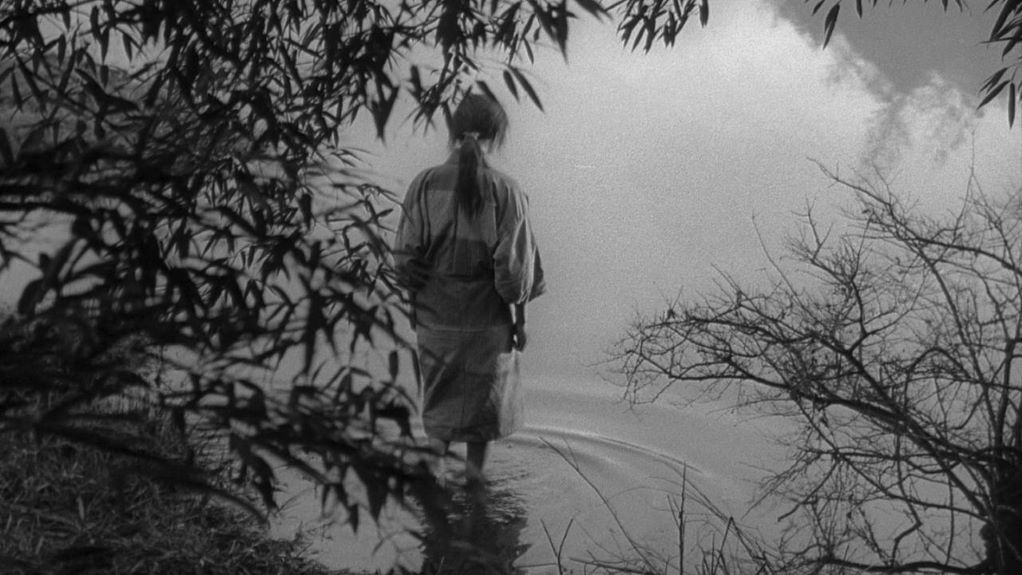
This powerful minimalism is nowhere more effective than Anju’s supreme sacrifice (the fate of women in Mizoguchi’s world). Giving Zushiō the chance to escape, Anju becomes aware that torture for knowledge of where her brother went is inevitable. With serene certainty she walks into the river to drown herself, moving with a sense of freedom she has not known for years. In a single shot we see her walk until Mizoguchi cuts away then back to show bubbles calmly rising to the surface of the water. It is an act of love, stunningly simple and hugely moving – and apiece of a world where freedom and any trace of goodness can only come about through irreversible sacrifices.

Like a folk tale Zushiō is restored to his father’s office, but finds he can make few changes. Slavery is abolished at Sansho’s estate – but the system cannot really be changed. The slaves know this to – they take their chance to sack the estate, aware that fortune’s wheel could return them once again to servitude. Sansho learns nothing from the events, and the suspicion is the next governor will pardon him (after all he brings more revenue in than anyone else). Sansho is the real world and he is inescapable – so much so he even owns the name of a film in which he is a minor player.

It builds towards the final conclusion on a windswept beach, perhaps one of the most heart-rending moments on film. In a Western film, this would be a scene of joyful reconciliation in which two damaged people heal through sharing grief. Mizoguchi had lived through the horrors of war and knew this would have been a lie. Reuniting doesn’t wash away the pain or heal the wounds – physical or spiritual – and doesn’t change the world. It’s just two people on a beach, clawing towards a moment of peace in a difficult world.

Sansho the Bailiff is clear-eyed and realistic about a world where people hurt each other and care nothing. Told with a classic, artistic simplicity, it is both a deeply moving and deeply spiritual piece, a great humanistic artist making his ultimate statement on the nature of the world. An essential film.

Spellbound (1945)

Spellbound (1945)

Hitchcock dives into psychiatry with mixed success in a middle-brow effort

Director: Alfred Hitchcock

Cast: Ingrid Bergman (Dr Constance Petersen), Gregory Peck (Dr Edwardes/John Brown/John Ballantyne), Michael Chekhov (Dr Alexander Brulov), Leo G Carroll (Dr Murchison), Rhonda Fleming (Mary Carmichael), John Emery (Dr Fleurot), Norman Lloyd (Mr Garmes)

Spellbound was born out of Selznick’s faith in the magic of psychiatry. It opens with a touchingly naïve dedication that stresses a little touch of Freud is a magic bullet: “once the complexes that have been disturbing the patient are uncovered and interpreted, the illness and confusion disappear and the devils of unreason are driven from the human soul”. Oh, would that it was so easy. Spellbound turns psychiatry as a sort of detective game, the subconscious a sort of smorgasbord of clues that, when shuffled into the correct order, will produce the answer.

The mystery is what exactly has happened to the new head of Green Manors Psychiatric Hospital, Dr Edwardes, here to replace the not-exactly-happy-to-retire Dr Murchison (Leo G Carroll)? The man who has arrived claiming to be Edwardes (Gregory Peck) may be charming but his odd obsessions with dark parallel markings on white surfaces, tendency to faint and lack of familiarity with psychiatry in general raise suspicions. Dr Constance Petersen (Ingrid Bergman), leading light of the Hospital, deduces Edwardes or “JB” as he vaguely remembers his initials being, is suffering from guilt-induced amnesia. Petersen refuses to believe – despite mounting evidence – that this man she has fallen in love with could be a killer. On the run, she recruits her old mentor Dr Brulov (Michael Chekov) to help analyse JB’S dreams, convinced the answer to the mystery is there.

Selznick hired his psychiatrist to act as a consultant on the film. This didn’t matter that much to Hitchcock, who considered the film essentially another murder-mystery thriller with a bit of Freudian dressing and bluntly told the advisor at one point when she protested yet another inaccuracy “my dear, it’s only a movie”. Spellbound is a decent, mid-level Hitchcock effort, with a touch or two of the master’s invention and magic, but which slows down for an extended act three analysis scene crammed with dodgy psychiatry and a detailed Salvador Dali-inspired dream sequence.

Of course, no one watching the film (rather like Cary Grant in Suspicion) could ever believe for a minute that the charming, handsome Gregory Peck is actually a murderer. Hitchcock’s trick is to keep the tension up, since (at best) there are only two suspects (and only one of them has a heavily advertised motive). You could argue here the trick is a “howdunnit” rather than a “who”. What mystery is Peck holding in his head and why can’t he remember who he is? Hitchcock throws in a host of little flourishes to keep us guessing, and if he clearly cares very little about Freudian insight (just as well, imagine the field day Freud would have had with Hitch) that hardly seems to matter.

Spellbound still manages to fairly barrel along, with a sparky script by Ben Hecht interweaving screwball banter between Peck and Bergman with cod-psychiatry. Hitchcock lets most of this play out fairly traditionally, but punctuates it with moments of flair. An early romance dialogue takes place in voiceover over a series of shots of doors opening to reveal a never-ending corridor (a neat visual metaphor for delving inside the mind). A tracking shot on a disturbed Peck down a flight of stairs, focuses on a cut-throat razor in his hand, ending with the razor alarmingly large in-shot. Disturbing POV shots make objects appear ultra-large, from a glass of milk (echoes of Suspicion) to a gun barrel turned to face us at the film’s conclusion. All of this is accompanied by an excellent score by Miklos Rosza which brings together romantic strings and the theremin to suggest the unsettling undercurrents of the subconscious. Rosza, rightly, won an Oscar for his hugely atmospheric work.

Spellbound is also notable for the way it inverts gender expectations. Peck effectively plays the damsel-in-distress here. Vulnerable and scared about what he could do, he lapses into catatonic panicked silence as much as smooth banter. Instead, for all the film stresses her feminine weakness when in love, it’s Dr Petersen who is the protagonist here. Played with a relaxed authority by Bergman, Constance is an assured professional and a dedicated campaigner for the truth. It’s she who constantly drives the plot forward and its her who plays both doctor and detective to crack the case and confront (with an assured coolness) the killer.

Hitchcock’s film provides a subtle commentary on the experience of women. Searching for JB in a hotel lobby, Petersen is first pestered by a drunk traveller who drunkenly all-but calls her a cock-tease when she asks him to leave her alone. Even when saved from an unpleasant scene by a hotel detective, he assumes her to be a schoolteacher or governess, and Petersen immediately recognises that disguising her accomplishments is a perfect way to gain this would-be-saviour’s help. Petersen also has to shrug off the pestering attentions of a colleague (John Emery).

But it’s her who eventually deduces the meaning of JB’s dream. This dream was heavily promoted as the work of Salvador Dali. While full of striking imagery, it feels more like a pastiche of Dali, as if a Hollywood art director threw The Persistence of Memory and Eyes for Your Eyes at the wall see what stuck. Which is pretty much what happened: Dali’s work was largely discarded for being too weird and overlong and William Cameron Menzies was bought into create something in Dali’s style. Selznick hardly cared – what mattered was promoting the Dali collaboration (Hitchcock had little to do with the scene, until it drew praise and he then claimed authorship).

It’s another striking moment in Spellbound. But truthfully the film is a careful construction of striking moments and performances, which power a simplistic and unrealistic plot which relies on coincidence and bizarre logic gaps. Psychiatry is a magic bullet – it’s hard to imagine anyone in real life reacting with the sort of glee JB does here when he discovers he didn’t murder his brother in his childhood, only accidentally fatally impaled him on some railings outside his house. The “revelations” from the analysis takes an over-extended single session with the unconscious yielding a series of Agatha Christie-style clues.

But then that fits Spellbound in the tradition of Hollywood psychiatry, from this to Ordinary People to Good Will Hunting, a touch of confession on a couch eventually solves all problems (all the kissing Peck gets from Bergman – which didn’t stop off camera – also clearly helped). Hitchcock’s work here is professional, but middlebrow. However, the odd imaginative shot, and the impressive performances (Bergman, Peck and also famous acting-coach Michael Chekov, immensely playful and Oscar-nominated as Constance’s cuddly mentor) still make this an entertaining watch.

Killers of the Flower Moon (2023)

Killers of the Flower Moon (2023)

Scorsese tries to tell an Indigenous story – but from the persecutor’s perspective

Director: Martin Scorsese

Cast: Leonardo DiCaprio (Ernest Burkhart), Robert De Niro (William King Hale), Lily Gladstone (Mollie Kyle), Jesse Plemons (Thomas Bruce White), Tantoo Cardinal (Lizzie Q), John Lithgow (Peter Leaward), Brendan Fraser (WS Hamilton), Cara Jade Myers (Anna Brown), JaNae Collins (Reta), Jillian Dion (Minnie), Jason Isbell (Bill Smith), Louis Cancelmi (Kelsie Morrison), William Belleau (Henry Roan)

In the 19th century, the American government forcibly shifted Indigenous nations from their rich, fertile lands to unwanted backwater reservations. The Osage nation was moved from Missouri to Oklahoma, land no-one wanted… Until oil was discovered there in the early 20th century. Suddenly hugely rich, the Osage nation’s land once again became the focus of white Americans, as keen to dispossess these Indigenous people as they were in the last century. This ruthless grab of oil rights – and the brutal exploitation and murder of dozens of Osage people – is the theme of Scorsese’s epic Killers of the Flower Moon.

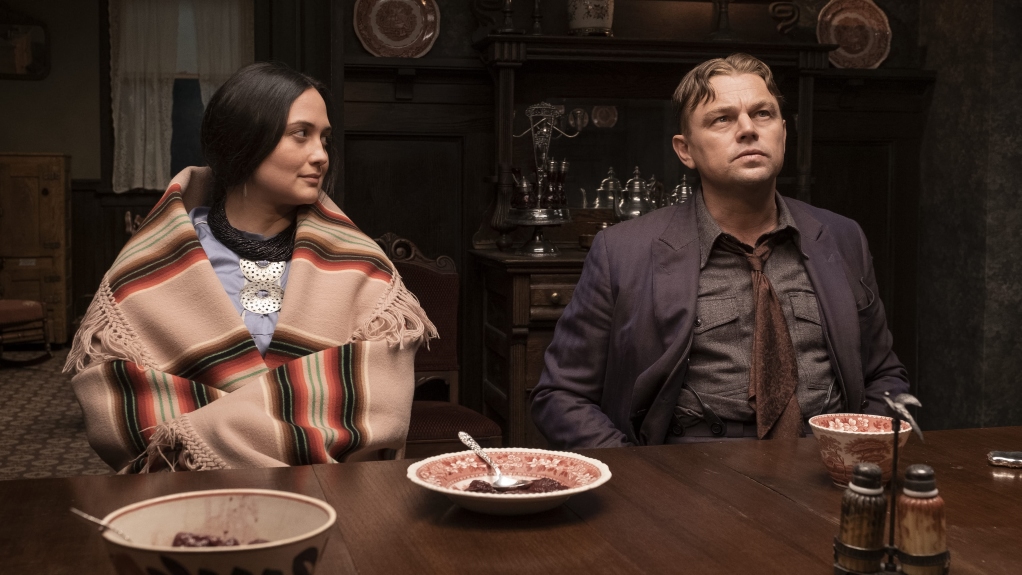
Ernest Buckhart (Leonardo DiCaprio) returns from war service (as a cook) to live with his uncle William King Hale (Robert De Niro) in Oklahoma. Hale lives on a ranch in the heart of reservation country and has built himself a powerful local presence by acting as benefactor of the Osage people. But Hale is, in fact, a ruthless sociopath who smiles cheerily at his neighbours, while plotting ceaselessly to steal their oil rights. Hale persuades Buckhart to marry Mollie Kyle (Lily Gladstone), whose family own headrights. While the gullible and easily-led Buckhart truly loves Mollie, he also willingly takes an active part for years in Hale’s schemes to murder the rest of Mollie’s family, so that their oil rights will collect with Mollie – and, in effect, with Hale.

Scorsese’s film is certainly a rich tapestry, but also a curiously mixed viewing experience. It feels at times like what it is – a film that dramatically changed its focus several times during its development, eventually reaching towards bringing the Indigenous experience to the screen, only to find that reach exceeding its grasp. The original book by David Grann focused on the FBI investigation into the crimes with DiCaprio originally set to play FBI investigator White (now played by Jesse Plemons). DiCaprio instead was drawn to the role of Buckhart, with the film repositioned to focus on the killers rather than the investigators or victims. During Scorsese’s extensive work with the Osage nation, the filmmaker became increasingly compelled by the exploitation of the Indigenous people.

Watching the film, it feels like a late swerve in focus Scorsese isn’t quite able to deliver on. However, some of the film’s most compelling content is its commentary on the Indigenous experience and the brutal exploitation and murders by a white community that sees the Osage people as second-class human beings. As a sort of twisted natural progression from encroaching on land a hundred years ago, people like Hale talk of marrying into Indigenous families, breeding out the blood and turning these communities into extensions of their own white families so they can control their wealth.

Over the course of the film, Scorsese carefully shows community gatherings becoming more and more dominated by white faces. Even tribal functions and ceremonies become awash with white faces, staring on with paternalistic, unfeeling smiles. From an early montage of Indigenous people enjoying their unexpected wealth (in a mix of historical and recreations photos and film stock), we progress ever more sharply into seeing whites take over. These fall into two firm categories: Masonic pinstripe types who stick together to cover-up crimes, and trailer trash and inept lesser-family members who are farmed out like cattle to soak up Osage wealth.

Scorsese’s film doesn’t shirk from depicting the casual racism of this community. A KKK march heads through the town. When Hale attends the cinema, he first sees newsreel footage of the Tulsa massacre then The Birth of the Nation. A montage of suspicious Osage deaths is marked by a Mollie voiceover stressing the lack of investigation. Osage oil owners are dispatched with increasing blatantness, as pretence of staged suicides and accidents degenerates into shootings, executions and finally bombs. Hale rants about the need to “take back control” and coldly states that they can escape any retribution because, fundamentally, no one cares or will remember.

But yet… this is still a film where we see a traumatic event happen to a group, but which focuses overwhelmingly on the perpetrators rather than the victims. I find myself agreeing with one reviewer that it feels at times like Get Out, told from the perspective of the white people. Scorsese’s film’s main beat feels like regret and guilt and perhaps what it needed was anger. For all its noble efforts, it’s hard to escape the fact that Mollie is the only Osage character in its epic runtime who is made to feel like a character, and she remains a person things happen to. The other Osage characters are, by and large, victims – Mollie’s sisters or William Belleau as Hale’s drunken, depressed neighbour – people who pop up in order to be dispatched.

I was reminded somewhat of The Searchers. In 1956, a film that criticised a John Wayne hero as an unpleasant racist was a big statement – but in a film where the Indigenous characters were still faceless nobodies, villains or comic relief. It’s similar here: Killers of the Flower Moon shows us the vileness of its white villains, but doesn’t really give us a full Indigenous perspective. And it feels, in 2023, we should do better. Even the impact and workings of reservations, land displacements and white-guardians isn’t explained in the film. Gladstone is marvellous – her eyes are full of suppressed pain, suspicion, fury and glimmers of the possibilities of forgiveness – but her character remains somewhat of a cipher, never quite receiving the exploration the killers of her family receive.

It feels like a realisation made during the filming, but without the time to deliver (after all the stars are playing the killers). Scorsese gives two beautiful Osage-themed bookends (and his carefulness around avoiding cultural appropriation is to be applauded), but the Osage themselves become passengers in their own story, allowed only a few brief moments to protest or express their anger. In a film that stretches over 200 leisurely minutes, more really should have been done.

Saying that, the film is blessed with two wonderful performances by Di Caprio and De Niro. DiCaprio, his mouth stuffed with rotten teeth, his body stumbling from scene-to-scene, expertly walks a tightrope between weakling and coward. Does he realise the moral morass he has climbed into? Or does he not care? How does he manage the mental gymnastics of plotting the deaths of his wife and her family and yet also convince himself that he is protecting her? It’s a fascinating performance. De Niro gives his greatest performance in 25 years as a polite, gentle man who warmly means every word of his friendliness but is also capable of acts of shocking murder and violence towards ‘his friends’ without even batting an eyelid. De Niro’s avuncular presence chills noticeably over the course of the film, brilliantly letting the egotistical dark heart leak out into the surface.

There is a lot to respect about Scorsese’s film, not least the way the late Robbie Robertson’s heartbeat-inspired score constantly creates an air of menace. It’s beautifully filmed – even if it is incredibly stately in its huge runtime – and it’s trying, very hard, to address an under-addressed issue in American culture. But it fumbles the ball because, for all its good intent, it still tells the story of an Indigenous group through the eyes of white people. Worse – their white persecutors. A braver, better (and shorter) film would have centred Gladstone’s Mollie rather than making her, at times, a passenger on a very long ride. Killers of the Flower Moon strains to make amends to Indigenous Americans – but instead it feels like a long guilt-trip for its white film-makers.