Tag: Alden Ehrenreich

Oppenheimer (2023)

Oppenheimer (2023)

Nolan’s masterful musing on the morality of science is both challenging and compelling

Director: Christopher Nolan

Cast: Cillian Murphy (J Robert Oppenheimer), Emily Blunt (Kitty Oppenheimer), Matt Damon (General Leslie Groves), Robert Downey Jnr (Lewis Strauss), Florence Pugh (Jean Tatlock), Josh Hartnett (Ernest Lawrence), Casey Affleck (Colonel Boris Pash), Rami Malek (David Hill), Kenneth Branagh (Niels Bohr), Benny Safdie (Edward Teller), Dane DeHaan (General Kenneth Nichols), Jason Clarke (Roger Robb), David Krumholtz (Isidor Issac Rabi), Tom Conti (Albert Einstein), Alden Ehrenreich (Strauss’ aide), Gary Oldman (President Truman), Jefferson Hall (Haakon Chevalier)

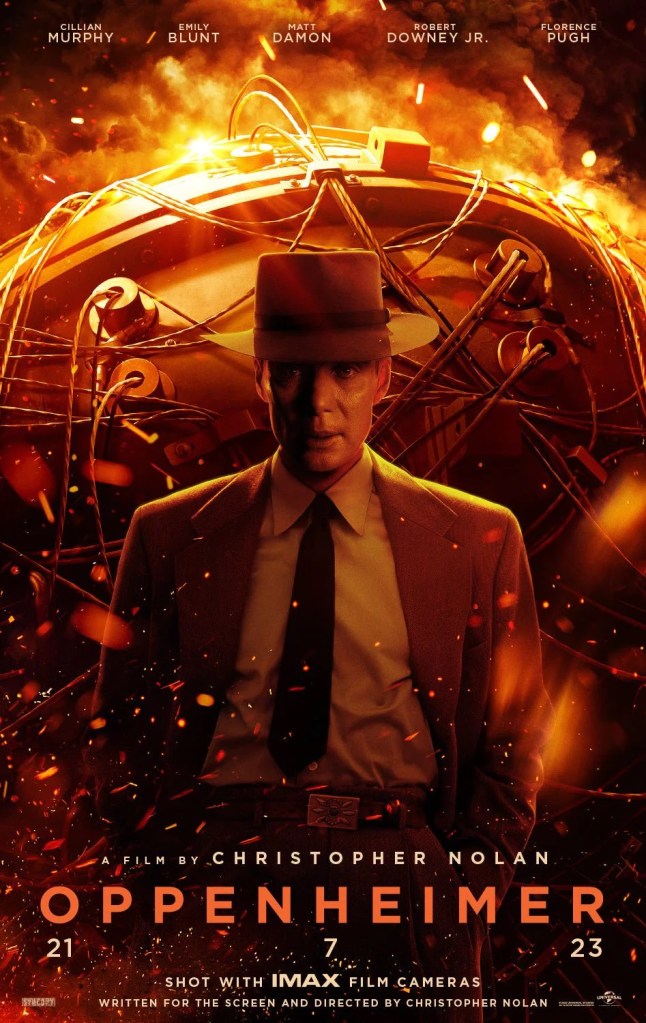
“I am become Death, the destroyer of worlds”. These words from The Baghavad Gita are synonymous with J Robert Oppenheimer, director of the Manhattan Project as he witnessed the destructive force of his creation, the atomic bomb. Fittingly, Nolan’s fascinating and ambitious film opens with a reference to Oppenheimer as Prometheus: the man punished for all time for stealing fire from the Gods. Oppenheimer uses everything from thriller to courtroom drama, to explore the moral responsibilities of science: if we can do a thing, does it follow that we must?

J Robert Oppenheimer (Cillian Murphy) is a Renaissance man and leading theoretical physicist who dabbled more than a little in left-wing politics. The woman he loves, Jean Tatlock (Florence Pugh), is a die-hard communist, the woman he marries Kitty (Emily Blunt) is a former party member, his closest friends are all members. Associations like these will later haunt him after he is approached by General Leslie Groves (Matt Damon) to use his organisational skills, political savvy and charisma to run the WW2 nuclear programme where maverick scientists work hand-in-hand with the army. Despite his position, Oppenheimer remains untrusted by many. In the aftermath of the war, these suspicions will be used by his opponents, among them Lewis Strauss (Robert Downey Jnr) ex-head of the Atomic Energy Committee, to bring about his downfall as Oppenheimer preaches disarmament.

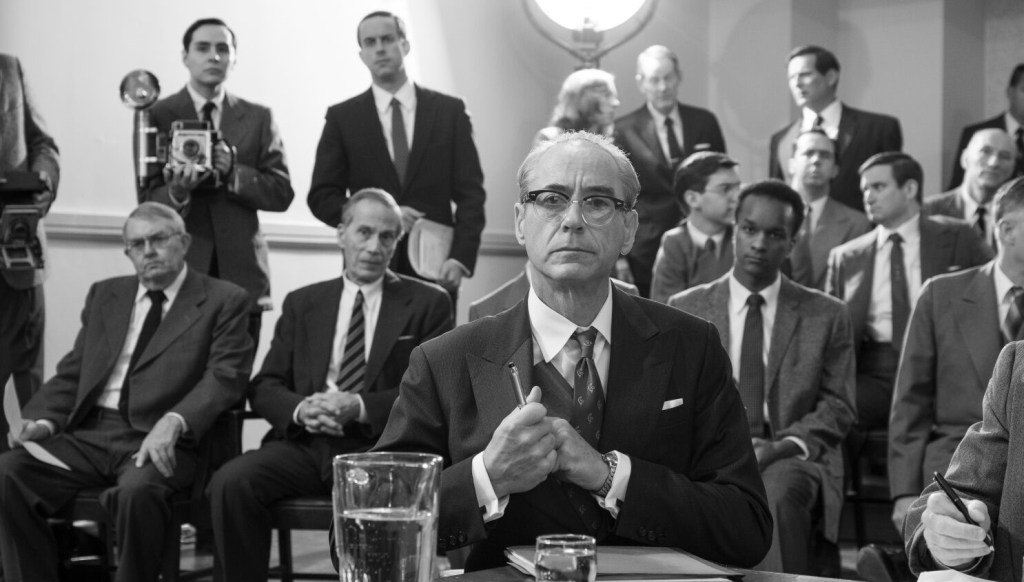
Much like Dunkirk, Oppenheimer is told in two timelines, intersecting with scenes replayed from different perspectives in subtly different ways. In “Fission” we see Oppenheimer, effectively on trial in 1954 for his security clearance, recount his life story, chronological flashbacks taking us through the development of the bomb. In “Fusion”, shot in gorgeous black and white, we follow the 1959 senate hearings to confirm Strauss in a cabinet post, and see his reminiscences of Oppenheimer’s post-war struggles to control the monster he has unleashed.

Oppenheimer is a brilliantly made, cinematically adventurous film: you would, of course, expect nothing less from a distinctive talent like Nolan. Brilliantly intercutting multiple timelines, it’s a film that is as much an experience as a story. This is a behemoth, filled with moments of flair and breath-taking use of sound and vision to affect mood. In particular, the film’s oppressive sound design bears down on the viewer like the pressure of the bomb itself. This means moments when we are released from its grip carry real impact. As Oppenheimer – already plagued with doubt – triumphantly announces the successful use of the bomb, the war-like celebratory pounding of scientists’ feet disappears from the soundtrack leaving Oppenheimer’s words echoing impotently around the room.

The pounding score and epic, sweeping camerawork (even more striking, since so much of the film takes place in small rooms filled with conversation) help Nolan to build up Oppenheimer’s mythic status and simultaneously strip him bare. Literally so at one point as, when questioned on his sex life in his hearing, Oppenheimer is seen naked in the room (as exposed as he must be feeling) answering questions with a naked Jean Tatlock astride him, staring into his wife’s eyes.

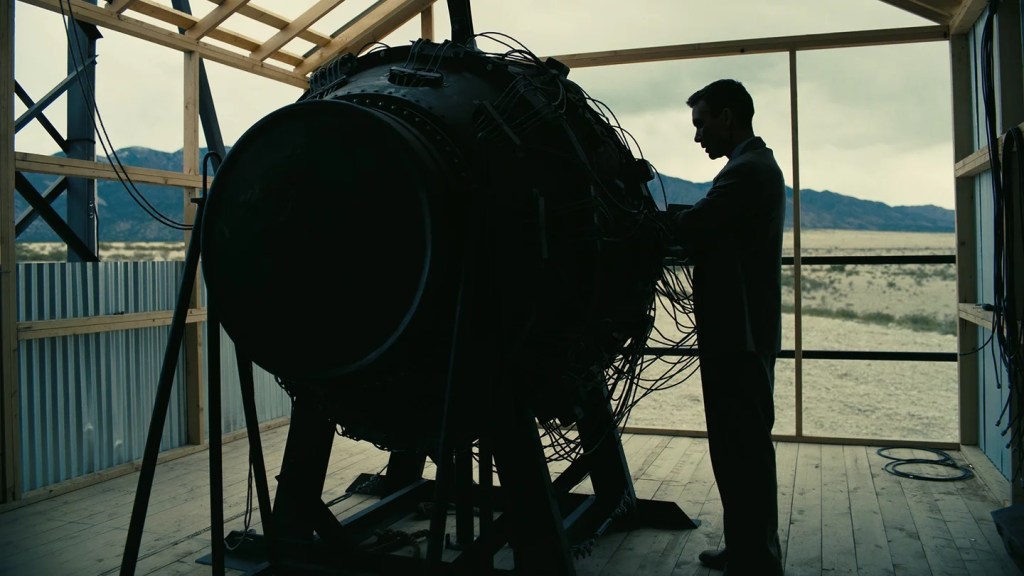
Oppenheimer labours, with the best intentions, to create a weapon before the Nazis. In its middle act, Nolan’s film focuses on the propulsive excitement of creation. The thrill of obstacles being overcome and solutions being found. The joy of a diverse team coming together for a single goal. We find ourselves longing for problems to be overcome, swept up in the desire for the endgame, as anxious as the scientists when it looks like rain will prevent the vital first Trinity test of the bomb.

Oppenheimer feels the same. Powerfully, intelligently and magnetically played by Cillian Murphy, this is a man who is a host of flaws crammed with impossible genius. A charismatic room leader, who is awkward in personal interactions. A charmer who rudely fails to remember his brother’s girlfriend’s name at a party. An inspiring leader who alienates people with ease. Murphy captures every inch of Oppenheimer’s staggering intellect and delight in intellectual problems, just as he also embodies the man’s arrogance and crushing self-belief.

So, it’s as crushing to him as it is terrifying to us, when the bomb explodes and the realisation hits us. Nolan’s sensory experience of a film fades down to silence as Nolan lets the camera float across the all-consuming fire of the silent explosion (the noise only comes when the shockwave hits) and suddenly the chilling implication of this terrible weapon becomes clear. This is a device that will kill millions. Oppenheimer knows it: he slowly shrivels into haunted guilt, Murphy seeming to shrink into himself as he finally understands what he has done.

Images of nuclear destruction both obvious (ashen bodies and nuclear flashes) and subtle (the out-of-focus vibration of background around Oppenheimer, as if sensing an approach shockwave) will haunt him and us for the rest of the movie. While many scientists – foremost among them Benny Safdie’s bull-headed Edward Teller and Josh Hartnett’s WASPish but decent Ernest Lawrence – feel little guilt. But Oppenheimer, and we, can no longer avoid questions of moral responsibility raised by those such as Niels Bohr (a quietly effective Kenneth Branagh).

Are there some discoveries better not made? Because once the genie is out of the bottle, it cannot be stuffed back in again. In this new world every world power must always have more. More bombs, bigger bombs, better bombs. And it explains why, like Prometheus, Oppenheimer must be punished. The tool of his punishment being his communist sympathies, embodied in his yearning attraction to Jean Tatlock (an under-used Florence Pugh). Nolan’s film is very strong on the terrifying paranoia of the secret state, where every word or association can be collected into a terrible portfolio of witnesses you cannot question, evidence you cannot see, testimony you cannot hear.

“Why don’t you fight” cries his wife Kitty, played with a dynamic, intelligent forcefulness by Emily Blunt. I could have done with a third act built more around Blunt’s starkly honest betrayal of a woman ill-suited to being a wife and mother, trapped in a world where that is all women can achieve (and which also trimmed a few witnesses from Oppenheimer’s trial). Why doesn’t Oppenheimer fight? Nolan has his theories, carefully seeded and confidently revealed.

Oppenheimer’s post-war clashes cover much of “Fusion”, anchored by a superbly under-playing Robert Downey Jnr (his finest work since Chaplin) as the outwardly avuncular, but inwardly insecure and bitter Strauss, who sees Oppenheimer as the embodiment of all the elitists who turned their noses up at him (no matter that Oppenheimer himself is an outsider, in a world of science run by WASPish types like Lawrence). Nolan’s film explores how morality is forgotten in an environment so rife with paranoia that the slightest expression of doubt is seen as treason.

Nolan’s film needs its vast runtime to keep as many balls in the air as it tries to. It’s probably a few too many balls. I would have loved more on Oppenheimer’s outsider status, as a Jew in American science (its not mentioned that the J stands for Julius, despite his claims it stands for nothing). Similarly, I would have welcomed more time to explore Oppenheimer’s complicated emotional life, in particular the fascinatingly complex relationship of some love, a fair amount of mutual respect and a large measure of mutual convenience with his wife Kitty.

But the film’s chilling musing on the horrors science can accidentally unleash while focused on progress is superbly explored and leaves a lasting impact. It’s a feeling that continues to be sharply relevant while we struggle with the implications of AI. Was there a need for the bomb? Perhaps there was. Were we ready for the bomb? No. And it is the failure of anyone, including Oppenheimer, to even consider this until it was too late that is the coldest warning in Nolan’s epic film.

Solo: A Star Wars Story (2018)

Alden Ehrenreich tries his best in Solo: A Star Wars Story

Director: Ron Howard (Phil Lord, Christopher Miller)

Cast: Alden Ehrenreich (Han Solo), Woody Harrelson (Tobias Beckett), Emilia Clarke (Qi’ra), Donald Glover (Lando Calrissian), Thandie Newton (Val), Phoebe Waller-Bridge (L3-37), Joonas Suotamo (Chewbacca), Paul Bettany (Dryden Vos), Erin Kellyman (Enfys Nest), Jon Favreau (Rio Durant)

Solo did the impossible. No not the Kessel Run in 12 parsecs. It showed you could release a Star Wars film that lost money. How could this happen? Well the easy solution is to point at the film’s disastrous shooting. Lego Movie directors Phil Lord and Christopher Miller were originally announced as its directors, making their live-action debuts. But Lord and Miller lacked experience, and a litany of complaints – poor direction, a demand for constant improvisation slowing shooting, failing to get enough angles to allow options in editing – led to them getting fired and replaced with Ron Howard. 

Unfortunately, even though large parts of the film had already been shot, Howard still needed to go back and reshoot large chunks (and recast, with Paul Bettany replacing the Michael K Williams as the film’s villain due to a scheduling clash). The budget ballooned to nearly $300million, a sum (with marketing costs) the film didn’t stand a chance of hitting with its poor initial buzz and mixed word of mouth. Not to mention the general (misguided) poor reaction from the core fanbase to Last Jedi, which had literally only just left theatres as this film prepared to launch.

If it seems a little unfair to open a review of the film with an anecdote about its making, that’s because the film’s tortuous journey to the screen is more interesting than most of the things that actually ended up in it. It’s an origins story for Han Solo (gamely played by a trying-his-best Alden Ehrenreich), which traces his early days towards becoming the smuggler we know, with the background given for virtually every aspect of the character: meeting Chewie, how he got his surname, where he found his blaster, how he did he win the Millennium Falcon from Lando (Donald Glover, who with his charisma and cool is the only one who manages to reinterpret his character to feel both fresh and a natural predecessor of Billy Dee Williams’ interpretation) and just how did he do that Kessel Run in 12 parsecs? 

If that sounds a bit like the film is a series of nostalgic box ticks… that’s kind of because it is. The impact is made worse by the fact that nearly all its events – from Han meeting his “mentor” Beckett through to the end of the film as he jets off to do a job for Jabba the Hutt – seem to take place in a week. As so often, the modern Stars Wars films manage to make its universe as small as possible. The sense of wearying accumulation as every half reference ever made in the old films is given a backstory, makes you wonder how boring the rest of Han’s life must have been if everything he ever talks about is connected to this one job.

The telescoped timeline also has a serious impact on much of the film’s relationships. Han and Chewie get by fine because we’ve already invested in that friendship – and Ehlenreich and Suotamo do a good job of building the regard between these two, one of the best beats from Howard’s direction. But other relationships get short-changed, particularly Beckett. Played with a maverick gusto by Woody Harrelson, this character is meant to be a model of the sort of heartless mercenary Han Solo starts A New Hope as. But the relationship of the two characters never works, because there is no sense of bond – they’ve known each other a week or two at best, and the emotional trust between them doesn’t exist, so the inevitable betrayal (when it comes) means nothing.

The other principle relationship between Solo and his childhood sweetheart, the equally mercenary Qi’ra, similarly suffers from getting lost in the shuffle of ticking off iconic references. It’s not helped by the total lack of chemistry between Ehlenreich and Emilia Clarke. Clarke herself feels painfully miscast in a role that doesn’t use any of her brightness and wit, instead pushing her into the sort of fantasy-genre, fanboy’s-dream woman she might find herself trapped into playing. This links in strongly with a terminally uninteresting criminal gang plot in which a wasted Paul Bettany – playing someone who barely seems to manage to have a personality – is the mysterious crime lord manipulating everyone.

The film goes from set piece to set piece, but none of them really stand out, and all are shot and edited together with a sort of bland competence that perhaps you could expect from a master craftsman like Howard, who works better with actors than he does special effects. The film clearly wants to go for a Firefly vibe (with its heists, mismatched criminal gang, double crosses and damaged hero not wanting to get involved in the problems of others) – and there is something quite sad that this film about an iconic character feels the need to rip off a TV show that ripped off a lot of the vibe of that original iconic character.

But then that’s the problem perhaps. This is a wallowing in nostalgia that depends on your affection for Harrison Ford’s masterful Han Solo – but which will only serve to remind viewers that, for all his work, Ehlenreich is no Ford. It also doesn’t help that the film, by its very nature, can allow no development for Solo. This is a character that spends all of Star Wars as a cynical and selfish hired gun, who acts without thinking and has no interest in helping others if there is nothing in it for him. Since Solo basically starts this origins story like this, he therefore must end the film in the same way – so other than becoming a bit more competent and worldly-wise, he’s stuck not developing in any way. This makes for a film that feels even more like a slightly pointless exercise in nostalgia.

For all that, it has its moments and is fun enough – and certainly not the worst film in the franchise. But it’s the first sign, that Disney should have heeded, that nostalgia and retelling familiar stories over and over again was not a guaranteed box office smash any more. By rooting another film in things introduced in the first two Star Wars, it reminds us again that this is a small and incestuous universe, where we see the same faces over and over again. With a film where every scene is a homage and every possible piece of trivia is laboriously given a back story, that feeling grows even more.

Hail Caesar! (2016)


George Clooney is a kidnapped actor in the Coen brothers 1950’s Hollywood spoof

Director: Joel and Ethan Coen

Cast: Josh Brolin (Eddie Mannix), George Clooney (Baird Whitlock), Alden Ehrenreich (Hobie Doyle), Ralph Fiennes (Laurence Laurentz), Scarlett Johansson (DeeAnna Moran), Frances McDormand (CC Calhoun), Tilda Swinton (Thora Thacker/Thessaly Thacker), Channing Tatum (Burt Gurney), Alison Pill (Connie Mannix), Jonah Hill (Joseph Silverman), Emily Beecham (Diedre), Clancy Brown (Co-star Hail Caesar!), Michael Gambon (Narrator)

The Coen brothers’ CV is a bit of a strange thing. It’s one part thriller, one part engagingly brilliant comedy – and then there are a collection of screwball-style entertainments, off-the-wall lightweight comedies (usually about dummies or sharp-talking professionals), as if every so often they needed a palate cleanser. Hail Caesar! falls very much into that final camp. 

Eddie Mannix (Josh Brolin) is a studio manager and fixer in 1950s Hollywood, whose job is to keep the stars in line and the films running smoothly. The latest fly-in-his-ointment is the kidnapping of Baird Whitlock (George Clooney), the star of the studio’s prestigious sword-and-sandals-and-Christianity epic Hail Caesar!. Mannix has to settle the ransom demand, while struggling to keep the news quiet – and manage the production of several other problems including a secretly pregnant Hollywood sweetheart (Scarlett Johansson) and a cowboy-turned-actor (Alden Ehrenreich) struggling with his latest movie requiring him to speak and act rather than just sing and ride a horse.

Hail Caesar! is a mixed bag. There are some wonderful comic sketches in here, the sort of brilliant highlights you could quite happily watch again and again. The problem is these sketches are part of a narrative framework that never really catches fire, that can’t seem to decide how much it is a surrealist comedy and how much it is a genuine Hollywood “behind-the-scenes” slice of life. So I found I delighted in the sketches, and the hilarious reconstructions of some of the studio fodder of the 1950s – while drifting through the general plot of the movie. The laughs are very tightly focused on the stand-alone sketches, and rarely develop from the plot of the movie itself.

Those sketches, though, are brilliant – and the Coens have secured what are effectively a series of stand-out cameos to deliver them. The highlight is certainly a hilarious sequence featuring Ralph Fiennes as a superior English director and Alden Ehrenreich as a cowboy-turned-actor crammed into a period drama in order to “change his image”. It’s a brilliant idea, that revolves around Fiennes’ barely concealed frustration Ehrenreich’s awkwardness in front of the camera, eagerness to please and most of all his accent which so badly affects his elocution that he simply cannot pronounce the line “Would that it were so simple”. The sequence is brilliantly funny – take a look at it down here. In fact it’s so good, it might be too good. Nothing else in the film really touches it.

There are some other good sketches in here as well. Most of them revolve around the loving recreation of Hollywood movies. The movie-within-the-movie Hail Caesar! is a perfect recreation of the Quo Vadis style of movies: large sets, hilariously over-blown dialogue, heavy-handed Christian messages (“Squint at the grandeur!” Clooney’s character is directed in one reaction shot to The Christ – as the filmmakers persist in calling him) and gaudy colour and sets. Clooney himself does a pitch perfect parody of the style and delivery of Robert Taylor.

We also get some spot-on parodies of Hollywood musical styles of the time. Scarlett Johansson plays a Esther Williams-style actress who stars in a series of swimming pool musicals (a bizarre fad of the time). Fiennes is directing a creakingly glacial Broadway-adaptation. Channing Tatum plays an actor in a Minnelli style musical. The tap-dancing sequence we see being filmed is, by the way, another brilliant sketch – a toe-tapping parody song, which also showcases Tatum’s grace and style as a dancer. It’s such a good parody that it actually sort of crosses over into being a genuinely enjoyable slice of song and dance.

I also struggled, as I tend to sometimes, with the artificiality of the Coens’ comedy – there is always an air of them (and their actors) wanting the audience to know that they are far smarter than the dummies in the film. I get this feeling a lot from Clooney in particular – while his film-within-a-film sequences are brilliant, it feels like he never feels much affection for the character outside these sequences. He wants us to know that Clooney is not as dumb or vain as Whitlock is. It’s this lack of empathy that doesn’t quite make the performance work. Empathy is why Eldenreich is the stand-out performer of the film. He plays Hobie Doyle with a real affection and warmth – he makes the character feel like a sweet and genuine person. While Hobie is always a comic spoof, he also feels like he could be a real person – making him so much easier to relate to for the audience.

Hail Caesar! is a film that works in fits and starts, not all the way through. Josh Brolin is fine as Mannix, and his fast-talking, plate juggling, problem solving throws up some funny lines – but his story never really engages the audience as much as it should, and the Catholic guilt Mannix balances in his life never really becomes clear. The Coens are reaching for some point about art and faith – of how film makers may tell themselves they are making something for art, when they actually work for faceless businessmen interested only in making money – but it never really brings this art vs. money argument into place. Does a picture have worth if we talk about worth enough? It’s a question we may as well ask about Hail Caesar itself.

Because the parodies and sketches of old Hollywood movies are so brilliantly done, whenever we drift away from them to the actual plot you find yourself losing interest. It’s a film that actually works better as a few sketches extracted from YouTube – I could happily watch Fiennes and Eldenreich’s scene, or Tatum’s dance sequence, or Clooney’s Taylor spoof in isolation – I don’t really feel the need to watch the entire movie again.