Tag: Alexander Knox

Wilson (1944)

Wilson (1944)

Well-meaning if slightly dry hagiography that struggles to turn history into drama

Director: Henry King

Cast: Alexander Knox (Woodrow Wilson), Charles Coburn (Professor Henry Holmes), Geraldine Fitzgerald (Edith Wilson), Thomas Mitchell (Joseph Tumulty), Ruth Nelson (Ellen Wilson), Cedric Hardwicke (Senator Henry Cabot Lodge), Vincent Price (William G McAdoo), William Eythe (George Felton), Mary Anderson (Eleanor Wilson), Ruth Ford (Margaret Wilson), Sidney Blackmer (Josephus Daniels), Madeline Forbes (Jessie Wilson), Katherine Locke (Helen Bones)

Darryl F Zanuck had a passion project: a biopic of the 28th President Woodrow Wilson. It would be both a tribute to a man, he felt, was overlooked and also a homage to current President Roosevelt – and a warning for the future. Like FDR, Wilson had introduced a raft of reforms and led the country in wars – and Zanuck was worried America would fudge the peace, just as Wilson had failed to get the Senate to endorse the League of Nations, leaving it a toothless lion.

Zanuck’s no-expense spared approach gives us a laudatory biopic that lavishes Wilson in euphoric praise, smooths off all his edges and presents him as a visionary and a near-flawless leader. The money was thrown into building elaborate sets and costumes – vast swathes of the White House and the Palace of Versailles were re-built on the sound stages of 20th Century Fox – and the script repackaged a series of major events interspersed with Wilsonian speeches. It was launched to a fanfare, was nominated (largely due to Zanuck’s influence) for ten Oscars (winning five) and was a box-office failure.

But is it a good movie? In truth, not quite. Despite the lavish production values, this is a dry, unimaginative and stately progression through its subject’s life. Henry King marshals events with the professionalism of an accomplished journeyman, but little inspiration. There is nothing striking, original or brave in a single minute of Wilson, but everything is perfectly framed and (considering its immense length) well-paced. King uses a series of low-angle shots to hammer home the magnificent detail of the sets and Alfred Newman’s score remixes a series of patriotic scores and heavenly-sounding choirs to build the impression of Wilson as secular saint.

But Wilson remains a largely undramatic movie, with an (Oscar-winning) script by Lamar Trotti that fails to inject drama or skilfully convey information. The warning signs are there in the film’s opening, with a group of New Jersey Democrats arrive to recruit Princeton head Wilson to run for Governor and clumsily give each other a potted precis of his CV and academic achievements while they wait for him to join them. Dialogue frequently info dumps historical research in our ears. Newspapers bluntly tell us in crude headlines what’s happening. Poor Thomas Mitchell’s entire role seems to be made up of running into rooms clutching telegrams announcing major events.

In amongst all this research though, we get very little idea of what Wilson actually stood for. There is virtually no time spent on his Governorship of New Jersey, other than a two-scene disagreement with the Democratic bosses whose power he breaks. On becoming President, his major legislative reforms are covered in a less-than-a-minute montage of signed bills. He consults his cabinet once or twice and, when war comes, walks a fine line between preserving American strength and not rushing into war. The final act of the film covers his failed battle for the League of Nations, the only policy the film invests any time into explaining.

For much of the rest of the time, this hagiography concerns itself with down-playing or skating over anything in Wilson that could be perceived as a flaw. Wilson here talks a good game of reform, equality and rights for all. In real life, he was a dyed-in-the-wool segregationist, sceptical about women’s suffrage as well as being an intellectually arrogant elitist who, later in his Presidency, began to see himself as a sort of vessel for God’s policies. While he was undoubtedly a highly effective moderniser and legislator, none of his faults make it to the screen.

Other areas are also carefully removed. Wilson was often accused of being heavily under the influence of advisors like “Colonel” House – House gets a one-scene cameo here. He ran for re-election in 1916 promising to keep America out of the war – this unfortunate broken promise is repackaged as Wilson sitting in the White House deeply regretting the campaign the party is running for him but stating there’s nothing he can do about it. His controversial re-marriage in 1915 to the much-younger Edith Galt (only two years after his wife died) is excused by his wife informing his daughters on her death bed that Wilson must marry again as he needs a wife. Wilson’s incapacity after a stroke in 1920 is down-played, while Edith (who effectively took over running the country for her husband in a constitutional scandal that would never stand today) states “I never made a decision without your knowledge and consent” while sitting with a sturdy Wilson.

All of this is played out in parallel with making Wilson’s rivals in the Senate mustachio-stroking schemers. None more so than Henry Cabot Lodge (well played by Cedric Hardwicke) who begins a career of animosity against the President after being made to wait for a meeting at the White House. In real life, Wilson refused any compromise offered by Lodge to get the League approved by the Senate, but here Wilson is a noble crusader foiled by political pygmies.

Saying that, the film benefits hugely from a very strong performance from Alexander Knox as Wilson, who not only looks and sounds exactly like the President, but perfectly captures his mannerisms. It makes you regret though the film is so little interested in Wilson’s personality or in building any picture of the humanity behind this leader. The rest of the cast have little to do other than state historical facts or stand to listen to Knox masterfully delivering Wilsonian speeches.

Wilson has a historical interest for Presidential buffs and, while it downplays the negatives around Wilson, it makes a very effective case for the President as a visionary leader (he was undoubtedly right about the League of Nations – even if his stance here is restructured into an FDRish self-determination for all nations). But this is a dry, stately film that never manages to turn the march of time into the thrust of drama. The Oscar-winning sets and photography look impressive, but its simplistic and hagiographic presentation of events eventually shakes your interest.

The Vikings (1958)

Kirk Douglas has a whale of a time as one of The Vikings

Director: Richard Fleischer

Cast: Kirk Douglas (Einar), Tony Curtiz (Eric), Ernest Borgnine (Ragnar Lodbrok), Janet Leigh (Morgana), James Donald (Egbert), Alexander Knox (Father Godwin), Maxine Audley (Enid), Frank Thring (Aella of Northumbria), Eileen Way (Kitala), Dandy Nichols (Bridget), Edric Conner (Sandpiper), Orson Welles (Narrator)

There’s a big market for stories about Vikings. Perhaps there is something attractive in our more staid world for a “noble savage” culture, with warriors romantically travelling far and wide. Perhaps a race of brave warriors just seems rather cool. Either way, despite their reputation for ravishing and raiding, Vikings often get a decent deal from films, usually positioned as a race of anti-heroes. That’s definitely what we get from Richard Fleischer’s enjoyable swashbuckler, which has a nodding acquaintance with history.

After the King of Northumbria is killed by fearsome Viking Ragnar Lodbrok (Ernest Borgnine), his queen is raped by Ragnar. Northumbria name a new King, the corrupt Aella (Frank Thring), while the queen sends her baby son (who she knows is Ragnar’s son) to Italy for his protection. Jump forward twenty odd years and, wouldn’t you know it, that young boy turns up as Eric (Tony Curtis) a slave of Ragnar’s, loathed by his unknown half-brother Einar (Kirk Doouglas), Ragnar’s son. The only person who knows who Eric is, is exiled Northumbrian load Egbert (James Donald). Things get even more complex when Aella’s intended Morgana (Janet Leigh) is kidnapped in a raid, and both Eric and Einar fall in love with her….

The Vikings is a great deal of fun, its tongue stuck firmly in its cheek. The plot veers from scene-to-scene from being too dense (various complexities around the rightful king of Northumbria get so confusing the film eventually abandons them) too being shunted off to the sides in favour of the action. But then it’s more about broad, brightly coloured action (very handsomely filmed by Jack Cardiff) with its stars having a good time fighting and shouting.

It’s interesting watching the film as almost a dry run for Spartacus, where Douglas and Curtis would re-unite. Here the film revolves around a rivalry between the two that turns into an alliance of mutual self-interest. Douglas clearly has a whale of a time playing a semi-baddie with depth, his Einar a typical “Viking’s Viking” who drinks hard, fights hard and wants a life of adventure on the high seas. But he’s also got a strange sense of nobility about home and – even though he makes a half-hearted attempt to rape her – he seems to fall genuinely in love with Morgana. Even his eventual comeuppance comes from a moment of decency. It makes for a villain more complex than normal, while Douglas roars through the movie.

Curtis is left with the duller part as the noble son-of-a-king. Looking rather too pampered for a life of serfdom, Curtis feels like a slightly too modern, New Yorkish presence for period pieces (Spartacus would use his pampered prissiness to better effect) but he charges into the sword swinging, high romance of the story with relish, while also shining during Eric’s several moments of brave principle. Morgana, very well played by his real-life wife Janet Leigh, sees a character who could have been a victimised love-interest turn into an independent and strong-minded woman, brave enough to take a stand on the things she believes in.

But the film’s real interest is in the world of the Vikings. There has been some very impressive historical research into their culture and shipping, while the battles and scenes of drunken merriment are well staged and carry a lot of boozy buzz. Most of the cast enter into relish, following Douglas and Ernest Borgnine’s lead (Borgnine, playing Douglas’ father, was at best a few months older) with plenty of shouting, ale swallowing and axe throwing. While the film’s score makes a number of odd choices – this really needed a Goldsmith or Morricone rather than the odd mix we get here – Fleischer’s direction is crisp and adept and keeps things charging forward.

The politics at the Northumbrian court gets a bit forgotten about, with Alan Thring turning Aella into a sneering, unprincipled villain who barely gets much of a look-in. However, the savage punishments that Aella meets out to his rivals – and his ruthless condemnation of anyone seen as being against him – makes a neat contrast with the Vikings who, for all their blood-curdling violence, do at least have some sort of nominal sense of justice and some willingness to compromise.

But the film’s heart is in the action. Douglas, acting as producer, jumped at the chance to take on as many of the stunts as possible – including famously walking across the oars of a Viking longboat while it is at sea (he nearly falls in twice, but it has the sort of excitement of seeing the star doing something for real that you still get with Tom Cruise). He and Curtis eagerly take part in assorted sword battles, while balancing a love/hate relationship (well probably mostly hate) that keeps the film powering forward. All in it makes for some really enjoyable B-movie shenanigans.

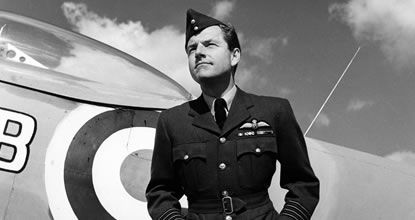
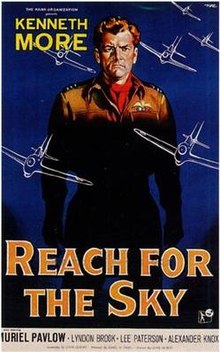
Reach for the Sky (1956)

Kenneth More fights disabilities and the Gerries in Reach for the Sky

Director: Lewis Gilbert

Cast: Kenneth More (Douglas Bader), Muriel Pavlow (Thelma Bader), Lyndon Brook (Johnny Sanderson), Lee Patterson (Stan Turner), Alexander Knox (Dr Leonard Joyce), Dorothy Alison (Nurse Brace), Michael Warre (Harry Day), Sydney Tafler (Robert Desoutter)

There are few stories of the Battle of Britain that captured the public imagination than Douglas Bader, fighter pilot ace whose exploits in the battle – and later in Nazi captivity – were all the more extraordinary because he had no legs. It’s one of the best examples around of good old fashioned British pluck helping overcome something – and Bader is without doubt a stirring hero, whose inspiration was so great he still frequently pops up in longlists of Greatest Ever Brits.

At least part of that continued inspiration is probably connected to this film. In fact Bader himself said his own public persona had been almost completely consumed in the public perception by Kenneth More’s performance of him. Needless to say Bader’s foul mouthed real personality (which left the briefing room littered with f-bombs) and abrasive difficultness (he refused to watch the film for almost ten years after a trivial dispute during its making about whether he would be allowed to double for More in long shots) was largely forgotten.

Indeed, the real Bader is washed away in Reach for the Sky by Kenneth More at his most charming, rogeuish and light. More (by his own admission) was not the actor with the greatest range in the world, but he was perfect for the sort of maverick, plucky, never-say-die Brit Bader was presented as in the film. Reach for the Sky ticks all the boxes of the events in Bader’s life as you might expect. From initial accident, to learning to walk again, to getting back in the sky, More plays it all with a brash bonhomie and British character that makes Bader charming and engaging – rather than the difficult egotist he reportedly was in real life. So much so that you kind of forget that Bader’s initial accident is largely caused by his own arrogance and stupidity attempting a dangerous manoeuvre to show off to a range of new pilots. 

But then that’s because Bader’s ruthless determination to get back in the sky is inspiring. Reach for the Sky isn’t the film that’s going to make you question anything to do with the war or the dangers or costs of the work we do. Putting it simply, this is practically an advert for the British war effort made ten years after the war finished. It actually feels a bit odd that this film hit the cinemas and because a smash hit in the same year as Suez showed Brits that all the Empire-first, Britannia rules the wavesness the film celebrates was a pile of outdated guff. 

But that isn’t to say that what that this film tries to do, it does badly. It lacks the sense of narrative adventure as stuff like, say, The Dam Busters or the importance of working together like Ice Cold in Alex or the bitter cost of war like The Cruel Sea. But as a portrait of a maverick doing his own thing and keeping the British end up its pretty much bang on. There isn’t really room for any other characters in the film’s narrative. It’s nominally narrated by a training colleague of Bader, but he’s barely a presence – the film zeroes in on Bader alone.

It makes for some decent scenes and there is a fair bit of inspirational feeling from watching Bader persevere – while never losing his temper – with walking again or taking up golf with a bullish determination. More’s Bader never shows a flash of anger or bitterness at things that have happened to him, instead carrying on with a jolly “Britain can take it” matey-ness. It makes him an entertaining person to follow around, even if the film itself isn’t particularly dramatic and offers a fairly safe version of an age-old “overcoming all odds” plot. Certainly enough to explain the films continued popularity and lifespan on Sunday afternoon TV. 

And it touches a nerve because, even if he was a fully paid up member of the awkward squad in real-life, what Bader did – and the force of personality required to do it – were extraordinary, the sort of thing only 1 in a hundred could even consider doing. To not only walk again having lost both legs, but to fly – and to become a decorated war hero – is way beyond (thankfully!) the imagining of almost everyone watching the film. And, for all the weaknesses of the film, you can’t ignore or disregard the fact that Bader is an inspiration. More is excellent in a lead role tailored completely to his strengths, and the film has a charming boys-own adventure feel to it. It’s not a smart film, but it’s a crowd pleaser and nothing wrong with that.

Gorky Park (1983)

William Hurt investigates murder in Soviet Russia in ace adaptation Gorky Park

Director: Michael Apted

Cast: William Hurt (Arkady Renko), Lee Marvin (Jack Osborne), Brian Dennehy (William Kirwill), Ian Bannen (Prosecutor Iamskoy), Joanna Pacula (Irina Asanova), Michael Elphick (Pasha), Richard Griffiths (Anton), Rikki Fulton (Major Pabluda), Alexander Knox (The General), Alexei Sayle (Golodkin), Ian McDiarmid (Professor Andreev), Niall O’Brien (KGB Agent Rurik)

Martin Cruz Smith’s novel Gorky Park was a bestseller in the early 1980s. It looked at grim goings-on behind the Iron Curtain, a trio of grisly murders in Moscow’s Gorky Park (the bodies are faceless, toothless and fingerless to avoid identification). The murders are investigated by Arkady Renko (wonderfully played in this film by William Hurt), a chief investigator for the Moscow militia who feels out of place in the corruption of Soviet Russia, but is equally scornful of the consumerism of the West. The investigation delves into a complex web of Soviet relationships with American business and the dissident community, not least an American millionaire fur trader Jack Osborne (Lee Marvin), and a would-be defector and possible friend of the victims, Irina Asabova (Joanna Pacula).

What I loved about this film is the novel is a rather overwhelming 500+ pages, but this film is a brisk and pacey two hours – and I literally couldn’t think of a single thing missing. But then that’s what you get when you have a master writer adapting your screenplay. Gorky Park has Dennis Potter, perhaps the greatest British TV writer of all time – and this is a sublime script, which keeps the pace up, covers all the tense greedy wrangling of the villains, and also makes subtle and telling points about the Soviet system, all in a punchier and clearer way than the books. The dialogue is also absolutely cracking, ringing with a brusque, icy poetry, with a brilliant ear for a turn of phrase.

Filmed on location around Helsinki and Glasgow among other places, what the film misses in actual Russian locations (needless to say the Soviets were not keen to host the production of a film that showcased murder and corruption at the heart of their capital city), it makes up for with Apted’s taut direction and eye for the general crappiness of Soviet life. Everything is run down, everything is dirty, everything looks cold and unappealing, even the houses and luxury bathhouses of the party leaders look a bit middle-class and uninspiring. By the time (late in the film) that you find yourself in one of Osborne’s houses you are immediately struck by the quality of the furnishings – it’s literally a different world.

This atmosphere not only creates something a bit more unique, it also allows us to relax and enjoy the quality of Smith’s story. I found it overstretched in the book, but the film gives it an urgency and a sinister creepiness that grips your attention. Apted has a brilliant eye for the little tricks to survive living in a police state, from watching what you say, to carefully placing a pencil in a dialled telephone wheel to prevent bugs from activting. Every moment is well paced and nothing outstays its welcome. Characters are introduced with skillful brushstrokes, and the relationships feel real and lived in. With such strong dialogue, it’s also great they got such good actors to do it.

William Hurt takes on the lead, and he is perfect, affecting a rather clipped English accent (all the Russians speak with various regional or RP accents). With his unconventional looks (part boyish, part stone-like), he looks the part and he totally captures the yearning unconventionality of a character who deep down probably would be a true believer in a good society, but can’t believe in the corruption around him. Far from the stereotypical would-be dissident, Hurt makes him a man who loves his homeland, but not always the people running it. He’s exactly as you would picture Renko in the book – a guy who will go for justice with the bit between his teeth, a semi-romantic hero, no superman (he frequently is bested in combat), who is looking for something to love and believe in.

The rest of the cast are equally fine. Lee Marvin is cast against type as a suave, hyper-intelligent, manipulatively greedy businessman – although his reputation for playing heavies comes in handy when the gloves come off. Joanna Pacula mixes sultry Euro-siren with an urgent yearning for freedom. Ian Bannen is wonderfully avuncular as Renko’s supportive boss (extra points for Tinker Tailor fans that Bannen is reunited here with Alexander Knox, in a dark reflection of their Control-Prideaux working relationship from that series). Michael Elphick seizes on the part of the down-to-earth Pasha, Renko’s friend and comrade, a role greatly improved from the book (largely to give Renko someone to bounce ideas off).

Apted’s film has a great sense of tension and a wonderful feeling for Soviet Moscow’s dark underbelly. The mystery is increasingly gripping and involving as the film goes on – and, in a nice rug-pull, turns out to be about something totally different than what you might expect. Even the final shootout is assembled and shot with an unexpected vibe. It avoids any Cold War pandering – the main villain is a sadistic American allied with Russians, our hero a noble Russian who partners up with a salt-of-the-earth but decent American cop (Brian Dennehy, also very good). For a late night mystery thriller, with a touch of everything thrown in, you can do a lot worse than this. I enjoyed it far more than I expected. I’d almost call it an overlooked B-movie gem.

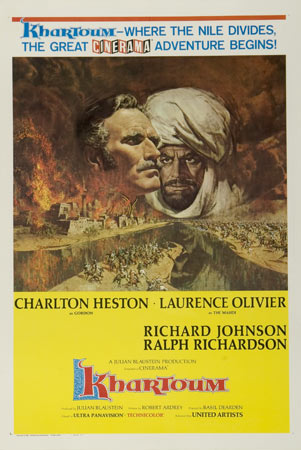
Khartoum (1965)


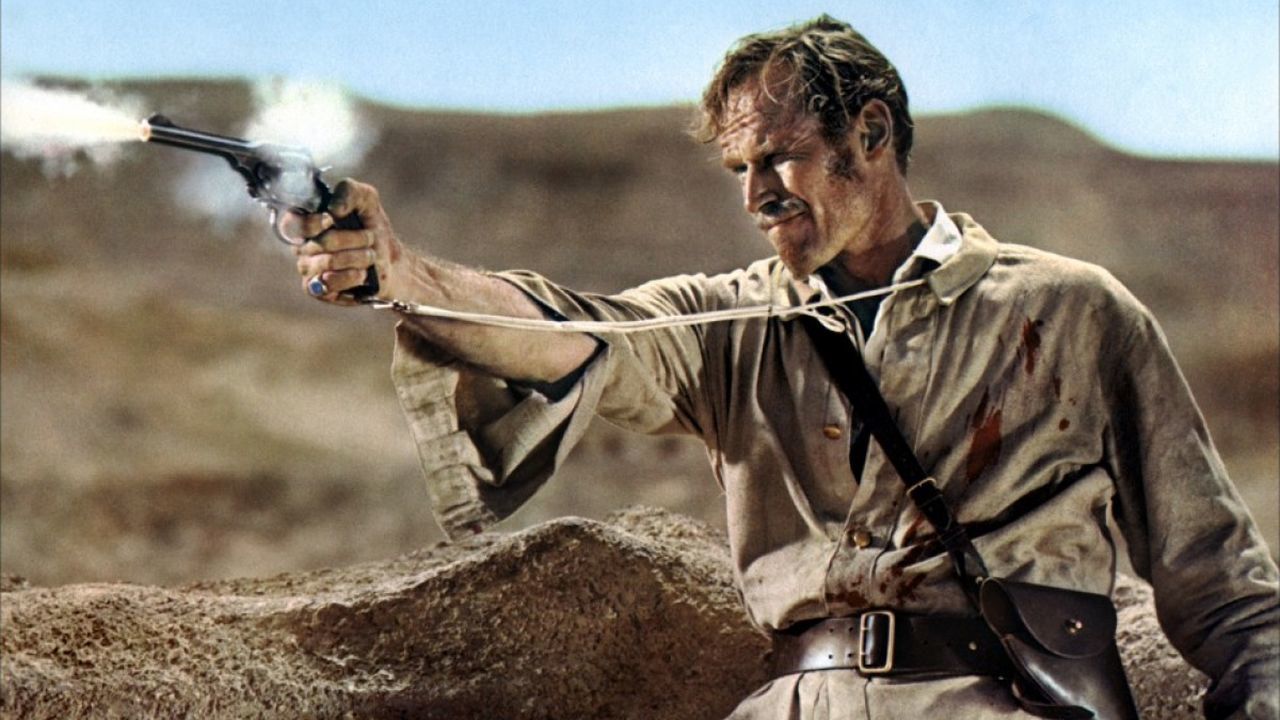
Charlton Heston takes aim in a rare moment of action in Khartoum

Director: Basil Dearden

Cast: Charlton Heston (General Charles Gordon), Laurence Olivier (The Mahdi), Richard Johnson (Colonel John Stewart), Ralph Richardson (William Ewart Gladstone), Alexander Knox (Sir Evelyn Baring), Johnny Sekka (Khaleel), Nigel Green (General Wolseley), Michael Hordern (Lord Granville), Peter Arne (Major Kitchener), Zia Mohyeddin (Zobeir Pasha), Douglas Wilmer (Khalifa Abdullah) 

For me you can’t really beat a big epic film. I love their sweeping vistas, the larger than life personalities, the luxurious running times and the vast array of Brit actors you inevitably find filling out the cast list. There is a lovely Sunday afternoon cosiness about a good epic and, since Hollywood spent large chunks of the end of the 50s and the 60s churning them out, historical events and personages replayed in sweeping panovision, there are plenty to watch.

Khartoum takes as its topic the siege of Khartoum and the death of its commander General Charles Gordon (played here by go-to actor for the big epic, Charlton Heston). Part of the now largely forgotten Sudanese war of the 1870s-80s, the siege was conducted by forces led by The Mahdi (Laurence Olivier) a man convinced that he was a reborn messenger of Muhammed.

Khartoum is a film that means well, but it’s a rather stodgy, po-faced history lesson that struggles with the fact that sieges are rather dull eventless things. Combine this with most of the film’s subplot following faithfully recorded political events back in the UK, and it hardly makes for a event filled spectacular. Instead it’s a slightly muddy lecture, interspersed with invented meetings between characters (Gordon and Gladstone; Gordon and The Mahdi twice!) in which they eloquently talk at each other, mouthing out the writer’s careful research, but give us no real insight into the times or the impact events had on the future.

It’s also rather routinely directed, without any flair or dynamism. It’s clearly aiming to be another Lawrence of Arabia, with everything from its music score to the lingering shots of the desert all aping Lean’s masterpiece. An opening narration (by an uncredited Leo Genn) even mulls over Egyptian and Sudanese history, while lovingly showing the viewer some postcard shots of various Nile attractions, seems particularly dry and dusty.

When the film does allow moments of action (which all seem ill-placed in this seriously serious film) they are rather flat and dull. The final attack on Khartoum has a suddenness about it that works well for the overwhelming force of The Mahdi’s army – and the death of Gordon (inspired by George William Joy’s painting) is rather affecting (although the real Gordon allegedly went down all guns blazing) but this is a film far happier with conversation.

What does work in the film, surprisingly, is Heston, who underplays as an enigmatic Gordon, a quiet, unknowable man addicted to the limelight, a serene soldier with a love of peace and religion, a man of the cloth and accomplished solider. Heston allows his natural charisma to do a lot of the work, and he clearly feels a certain empathy with Gordon, gracing the film with the same determined leadership of the general. Heston is an easy actor to mock, his granite face made for legends, but he’s a quietly assured here.

Olivier’s performance is inevitably more troublesome today, the great man dressed up in blackface and a rum accent as The Mahdi. In fact, as per Hollywood films of the time, most of the major Sudanese characters are played by British actors in blackface. Of course it would never happen today – and it’s tricky not to either gasp or snigger at  Olivier’s first scenes – but looking past that first shock (and his opening speech – “Ohhhhh my belovvvvveed” is too much), Olivier gives a detailed study in ambitious fanaticism which is even more relevant in the age of Al-Qaeda. It’s uncomfortable to see, and Olivier allows the mannerisms too much rein (in particular compared to Heston’s confident underplaying) but it’s a decent performance.

I’ll always have a soft spot for this film as it allows us the chance to see Ralph Richardson as Gladstone, one of my favourite historical figures, and one of the two greatest English statesmen (with Robert Peel) of the 19th century. Richardson would have been brilliant in The Gladstone Story (sadly never made) and he brings to life much of the political scheming back home in Blighty, as a Machiavellian version of the Grand Old Man. Anyway, he’s terrific and the various cabinet room debates are some of the most interesting parts of the film.

It’s a shame that the films gets bogged down too early in Sudanese and Egyptian politics (and still manages to muddle the viewer), before settling into the siege from where, interspersed with slightly repetitive conversations. It’s clear where the film is going, but there isn’t the doom laden dread about this that the film needs. This is a shame, as this story of a colonialist, in love with a colony, killed by colonists while trying to protect other colonists, has a lot to potentially say about the modern world (both now and in the 60s) – it just doesn’t manage to say them.

Note: I was struck in the film by how dangerously many of the horses were thrown about or tackled by soldiers in the battle scenes. “Surely that can’t be safe” I thought as a man knocked over a galloping horse by jumping and tackling its head. Sure enough it wasn’t: allegedly 100 horses bought the farm for this film.