Tag: Andy Devine

In Old Chicago (1937)

In Old Chicago (1937)

Entertaining melodrama leads into a very well-staged disaster epic that burns a city

Director: Henry King

Cast: Tyrone Power (Dion O’Leary), Alice Faye (Belle Fawcett), Don Ameche (Jack O’Leary), Alice Brady (Molly O’Leary), Phyllis Brooks (Ann Colby), Andy Devine (Pickle Bixby), Brian Donlevy (Gil Warren), Tom Brown (Bob O’Leary), Berton Churchill (Senator Colby), Sidney Blackmer (General Phil Sheridan)

San Francisco showed Hollywood the way: spice up a melodrama with a disaster-laden ending. The first took the San Francisco earthquake: In Old Chicago takes the Great Chicago Fire of 1871 which burnt down over three-square miles of the city, destroyed over 17,000 buildings and killed over 300 peoples. Despite a rather earnest message that research was scrupulously carried out with the Chicago Historical Society – other than the fire itself, the entire film is a great big fictionalised soapy melodrama, building towards a grandly staged recreation of the great conflagration itself.

The melodrama is built around the O’Leary family. In legend Mrs Catherine O’Leary, of the city’s large Irish community, was the fire’s unwitting cause after her cow knocked over a barn lamp. Here she is reimagined as Molly (Alice Brady), mother to a flock of sons. In the way of these melodramas one, Dion (Tyone Power), is a cheeky rogue with criminal links the other, Jack (Don Ameche), is a legal straight-shooter determined to clean this town up. Club owner Dion controls a stack of corrupt votes to get Jack elected Mayor – screwing over kingpin rival Gil Warren (Brian Donlevy) in the process – under the mistaken impression he can control his brother (dead wrong). Meantime, Dion bounces through a heated love-hate relationship with glamourous bar-singer Belle (Alice Faye), who knows a little too much about his corrupt dealings.

These elements are expertly melodramatically mixed together with very few narrative surprises to establish some recognisable faces for when the city-burning destruction kicks in, with its punishments and redemptions. King directs all this with a glitzy, big-budget flair while the shallow characters go through familiar motions. Truth be told, there isn’t much especially new about In Old Chicago, which follows the San Francisco model to a tee with soapy personal rivalries (skimming the surface of Chicago’s corruption) beefed up with (fairly forgettable) songs from Alice Faye. There’s even a literally soap-sud filled transition at the start to take us into a superbly re-constructed nineteenth century Chicago, in a film full of impressive production design. But yet, don’t get me wrong, it’s all done with such energy it’s consistently enjoyable.

The two brothers are, of course, studies in contrast (third brother, Tom Brown’s Bob is so decently dull he barely makes any impression). As the ‘bad’ brother, Tyrone Power enjoys himself as a lip-smacking cad obsessed with power. Smirking and full of self-satisfaction at his own cleverness (not as clever as he thinks), he’s a ruthless liar and manipulator who deceives everyone around him: his brothers, the woman he loves, his political allies and rivals. It’s one of Power’s most engaging performances, successfully making Dion the sort of bastard you love to hate without ever making him utterly deplorable. In fact, he feels like a big kid (and a mummy’s boy at that), literally leaning back in his chair and expecting praise for his cleverness.

Opposite him, Don Ameche is saddled with the impossibly noble Jack, a crusading lawyer (who wouldn’t think of charging low-earning clients) and who wants to become Mayor to change the town for the better. His straitlaced decency is constantly thrown off by his brother’s dastardly lack of principle (their relationship eventually culminates in an entertainingly well-staged, no holds-barred fisticuff scuffle). Ameche does a good job of investing depth in this on-paper rather dull character.

The film presents an entertainingly straight-forward picture of machine politics, with votes controlled by bosses, various voters encouraged to register (and vote) multiple times and bosses controlling vast teams of followers. Brian Donlevy brings a very fine sense of arrogant domination to would-be boss Gill Warren (the sort of guy who casually mentions a rival’s bar looks rather flammable during a shake-down). It’s all very much presented as bad apples spoiling the whole barrel (rather than the whole system being a bucket of corrupt snakes), but fun nevertheless.

The romance comes between Dion and Belle, played with a decent mix of rascally bad-girl and misunderstood decency be Alice Faye. Faye (taking over the role at short notice from the late Jean Harlow) gets a few decent songs but the meat of the role is her love-struck switching between adoring and loathing Dion, who (with his flirtation with Senator’s daughter Ann Colby, played by Phyllis Brooks) barely deserves her. Some of Dion’s initial courting – consisting of sneaking into her carriage, pinning her down and kissing her – hardly feels comfortable now, but it supports a neat running joke of Belle’s maid running for help only to return to find the two locked in a passionate embrace.

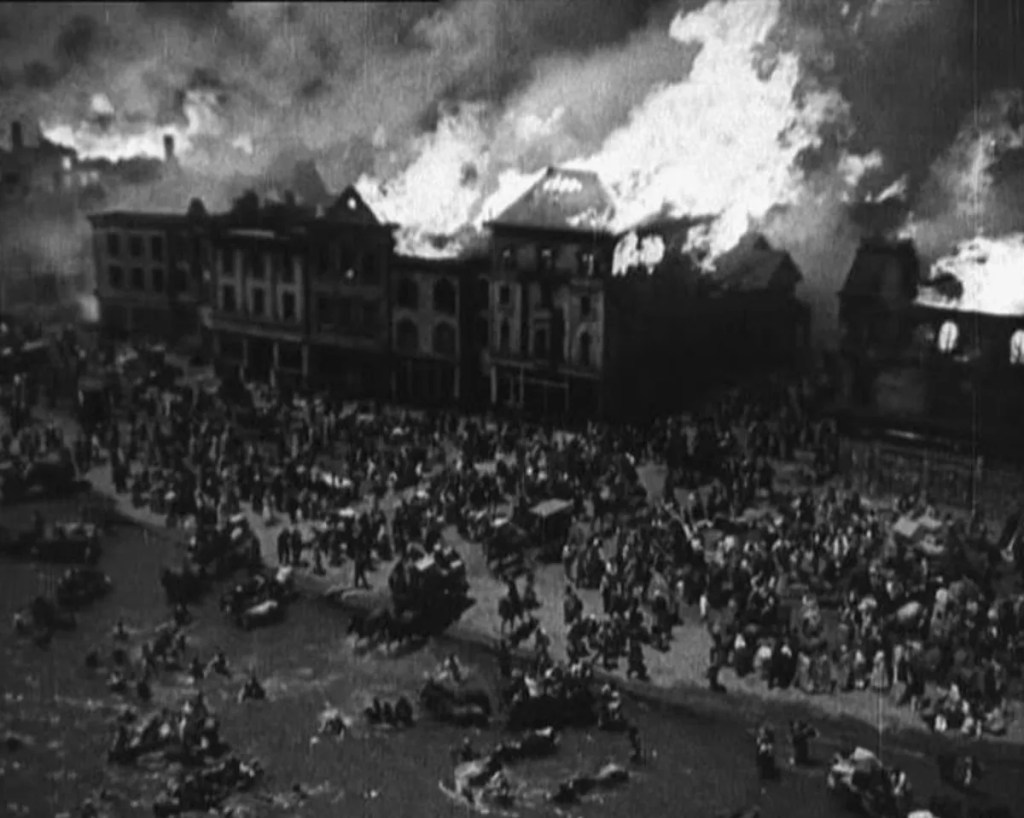
But all of this is just build-up for the main event: an impressively staged reconstruction of the Great Fire. Shot with a mix of real sets and models – you can see where the money was spent on (briefly) the most expensive film ever made. It throws at us buildings aflame, crashing to the ground, huge crowds of extras charging past the camera in tracking shots, a panicked army of bulls fleeing (and crushing those unlucky enough to get in the way). This sequence is genuinely grippingly put-together and impressively epic, utilising some very effective aerial model shots of the city to establish the scale of the fire and the devastation. It balances culminating its plot threads at the same time as embracing the disaster excitement.

This end sequence makes the slightly patchy, familiar soap beforehand retrospectively work even better. It certainly helped deliver a box office bonanza for the film – just as Alice Brady’s closing speech about the unbeatable spirit of Chicago probably helped her to an Oscar (it’s a part Brady clearly enjoys, cementing a stereotype of the domineering Irish mother). After San Francisco, In Old Chicago proved entertaining disaster epics could thrill audiences with destruction for years to come.

A Star is Born (1937)

A Star is Born (1937)

One of the first iterations of the tale, and with two winning performances one of the best

Director: William A Wellman

Cast: Janet Gaynor (Esther Blodgett/Vicki Lester), Fredric March (Norman Maine), Adolphe Menjou (Oliver Niles), May Robson (Lettie Blodgett), Andy Devine (Danny McGuire), Lionel Stander (Matt Libby), Owen Moore (Casey Burke), Peggy Wood (Miss Phillips), Elizabeth Jenns (Anita Regis), Edgar Kennedy (Pop Randall)

A Star is Born wasn’t the first time this story was told and it certainly wasn’t the last. Each generation in Hollywood has produced its own version of the story, not to mention a gallery of other culture creating their own unofficial and otherwise remakes. What Price Hollywood had even effectively told the same story five years earlier, and the entire concept has the air of a medieval ‘fortune’s wheel’ – two souls bound together, one goes up as the other goes down. There may in fact not be nothing new about A Star is Born at all but gave such a bright new polish to the familiar, that we’ve been inspired to come back to it again and again.

In the farmyard sticks, Esther Blodgett (Janet Gaynor) has a dream:  to become one of those stars of Hollywood’s silver screen. With grandma’s (May Robson) money in her pocket (‘What have I got to spend it on?’) she heads to Los Angeles, only to find the city is awash with similarly starry-eyed dreamers desperate for a big break. Esther gets hers in an unusual manner: serving drinks at a Hollywood party she strikes up conversation with famous star Norman Maine (Fredric March). Norman is very taken with Esther – in fact he’s almost immediately in love with her – and arranges a screen test. Soon Esther has a new career, a new name – Vicki Lester – and a new marriage to Norman. Problem is, as her star rises and she becomes the next big thing, Norman stops letting “his acting get in the way of his drinking” and his career slides into oblivion.

It’s high romance, very effectively filmed by Wellman, that requires – and gets – two very strong, highly relatable performances from its leads. Wellman’s film carefully gives both of them the space to grow a relationship that begins shyly and becomes deep and tender. Gaynor is bright, naïve and gentle with just enough ambition and determination to impress. She’s eager to please, but also firm and knows her own mind, far from a pushover in this town of press releases and media spin. Gaynor never lets us forget that under ‘Vicki Lester’ there’s that ordinary Esther Blodgett (could there be a more grounded, less starry name than Blodgett?), a woman with principles in a world of fakes.

Perhaps even better though is Fredric March (it’s the first indication, borne out by nearly all the remakes, that Norman is the better part). March is charismatic, engaging, funny, down-to-earth and everything you would want from a star – while also being a mean drunk with anger management issues. He’s introduced getting into a drunken scuffle at the Hollywood Bowl, and his love of booze makes him just as likely to laugh and flirt with Esther as it can make him take a slug at a guy who looks at him the wrong way. March’s drunk acting is very effectively restrained and he captures extremely well the self-disgust behind Norman at his weakness. March makes him a star who burns away his career through appalling choices, who fervently believes he can stay on the wagon until he can’t. In his hands it becomes a classic tragic piece, a Greek hero destroyed by his fatal flaw, his inability to escape the bottle.

This rich romantic tragedy builds wonderfully, Wellman keeping us deeply invested in this couple. The good times are really endearing: it’s hard not to grin along as they laugh and joke in a camper van after their elopement, or as they cover each other with encouragement and support for their careers. It makes the bad times unbearably painful: Norman’s drunken crashing of Esther’s Oscar win, a shambling monologue of self-pity and resentment, both heartbreaking and excruciatingly embarrassing. Norman’s fateful final decision is full of romantic imagery, as he smiling walks towards a sun-kissed beach, a beautifully staged inversion of a romantic ending.

A Star is Born’s other most interesting feature is its inside glimpse at Hollywood: or at least the version Hollywood was willing to present of itself to people. It even has a meta-theatrical element to it, the film book-marked by images of the shooting script describing the action immediately following or preceding it. Here Hollywood is a ruthless machine, chewing up the dreams of wannabes. An agent bluntly shows Esther the vast numbers of phone calls of wannabe extras they receive every day. Esther struggles just as much as assistant director Danny (Andy Devine) to find regular work. Careers are made and broken by chance, whims or the reaction of the audience to your face on screen. Names in lights one month and being pasted over the next.

Hollywood loves to be cynical about itself. A Star is Born delightedly shows its spin operation as ruthless, cut throat and controlling, planting stories about stars, covering up their misdemeanours (a regular requirement for the drunken Norman) and repackaging their lives into saleable commodities. Lionel Stander, as a heartlessly controlling press agent, is the heart of this, and the film doesn’t hold back on showing the dark powers of these studio fixers in action. But this is just a version of Hollywood: its telling that in A Star is Born while the middle management are condemned, the studio heads are absolved completely. Adolphe Menjou’s Selznick-like producer is an avuncular, uncle-like figure, endlessly caring and supportive of his stars who wouldn’t dream of any funny games to earn some money. This is a portrait of Hollywood where the top man is an affectionate saint – exposure only goes so far.

A Star is Born is also an interesting time capsule. Esther stares in admiration at a host of Hollywood Avenue stars of people must of the viewing public today would struggle to name (Norman Cantor anyone?). Seeking to impress while serving at a dinner party she’ll do impersonations of Garbo, Hepburn, Crawford and Mae West (the last even named). It’s a world where the continual production of content is even more on-going than on Netflix and the studios can start or end careers instantly. It’s a fascinating extra piece of interest in a highly effective, well-staged film. Even with its slightly murky early colour photography (it looks like a colourised black and white film), it’s a well-staged, effective romance with two very winning performances from its leads. Possibly one of the best versions of the story.

Stagecoach (1939)

Stagecoach (1939)

Iconic action adventure, a very exciting chase film with a strong script and characters

Director: John Ford

Cast: Claire Trevor (Dallas), John Wayne (The Ringo Kid), Andy Devine (Buck Rickabaugh), John Carradine (Hatfield), Thomas Mitchell (Dr Josiah Boone), Louise Platt (Lucy Mallory), George Bancroft (Sheriff Curly Wilcox), Donald Meek (Samuel Peacock), Berton Churchill (Gatewood), Tim Holt (Lt Blanchard), Tom Tyler (Luke Plummer), Chris-Pin Martin (Chris), Francis Ford (Billy Pickett)

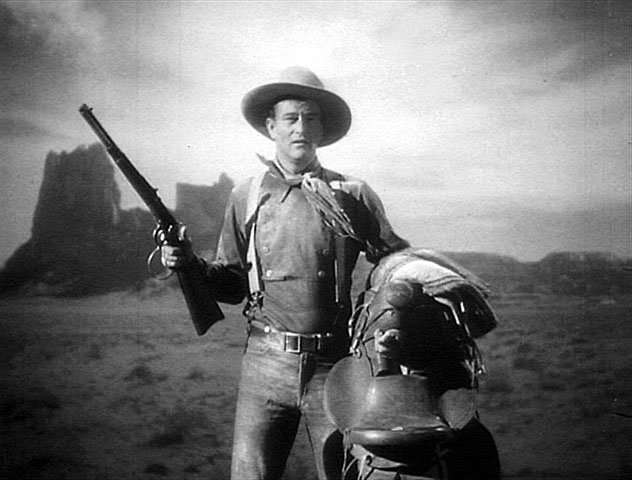
It might be the greatest star entrance of all time. Before Stagecoach, John Wayne was a minor leading man from a never-ending stream of oats-and-saddles B-movies. But, after one shot – a superb fast-paced zoom (so fast, the focus slips at one point) into the stoic face of Wayne, Winchester rifle twirling – that wasn’t going to be the case anymore. Stagecoach was Ford’s return to the Western – and he was bringing a friend along for the ride. After it, both director and star would become synonymous with the genre and Wayne would remain Hollywood’s Mayor-in-all-but-name.

Of course, that shot alone didn’t make Wayne a star (but, as you can imagine Andy Devine’s Buck wheezing “it sure helped, didn’t it”). What cemented the deal was what the hugely entertaining thrill ride Stagecoach is, a rollicking journey through Monument valley, crammed with just about anything you could want, from gun-battles and stunts to class commentary and arch dialogue. Like some sort of JB Priestley play, a regular smorgasbord of folks climb into a stagecoach to travel from Tonto to Lordsburg, facing a parade of dangers from Geronimo’s Apaches along the way – not to mention their own personality clashes and business to take care off in Lordsburg. All aboard!

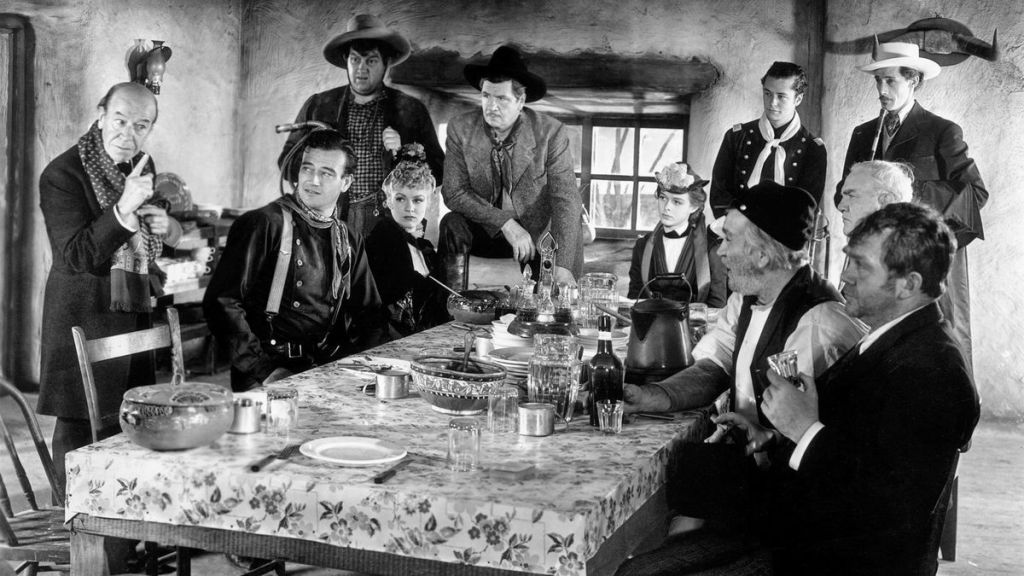
We’ve got prostitute Dallas (Claire Trevor), run out of town by ‘blessed civilisation’ – much like drunken surgeon Dr Boone (Thomas Mitchell) – hoping for a new life. Army wife Lucy Mallory (Lucy Platt) trying to find her missing husband, escorted by Southern gent turned gambler Hatfield (John Carradine); both are more than a little uncomfortable sharing a carriage with a lady of the night. They probably wish the carriage had more people like bank manager Gatewood (Benton Churchill), although they might change their mind if they knew he was an embezzler. Sheriff Curly Wilcox (George Bancroft) is trying to catch escaped prisoner The Ringo Kid (John Wayne), who is himself keen to get to Lordsburg to take down the Plummer gang who killed his father and brother.

All of these well-drawn characters – including the timid whisky salesman (whose name no-one can remember) Peacock (well played by the suitably named Donald Meek) – are bought vividly to life by a strong bunch of actors working with a well-constructed script by Dandy Nichols, crammed with sharp lines and wit. It’s packaged together by Ford into a film that’s lean, plays out at a whipper-cracker pace and juggles several plots, threats and character motivations all at once.

You can see Ford’s mastery of story-telling throughout Stagecoach. The opening fifteen minutes is a superbly efficient piece of lean scene-setting which, in a series of tightly-focused, engaging scenes, brilliantly introduces the principle characters, their motivations and the twin dangers of the Indians on the road and the Plummers in Lordsburg all in perfectly digestible chunks. In addition, Ford carefully introduces the class commentary that greases Stagecoach’s wheels: from the unconcealed loathing and disdain Dallas is treated with by the town’s worthies (including the appalled revulsion of Hatfield and the marginally less strident disdain shown by Lucy) to the unquestioned bluster of blowhard fat-cat Gatewood, whose blatantly transparent lies and increasing nervousness draws no where near the level of suspicion it should do.

But then most people are too worried about catching sin-by-touch from Dallas. Stagecoach never outright states her profession, but only the naïve Ringo Kid seems unaware she’s on-the-game. At the first stop on the journey, Ford orchestrates a perfectly constructed scene of micro-aggressions and class structure, where Ringo guiltily utterly misreads as snobbery about his own jailbird past. (Hatfield is so committed to keeping the distance between himself and Dallas, he won’t even let her borrow his water glass as he does Lucy, tossing Dallas the canteen to drink straight from instead). Similar disdain also meets Dr Boone, whose utter refusal to even slightly moderate his drinking (he spends the first day getting sozzled) disgusts the elite passengers, right up until his skills are needed during a medical emergency. (At this point Hatfield starts treating him as the fount of wisdom).

Ford’s sympathies are, like so often, with the tough little-guys out in the West, who judge people by who they are and what they do rather than where they come from. Claire Trevor is perfectly cast as Dallas, never a victim but always full of patient defiance, all-to-used to the snubs from others. But we respect Dallas because it’s clear – from the start – she’s kind, considerate and decent. When the chips are down for Laura, it’s Dallas and Boone (not self-appointed guardian Hatfield) who step-up to save her, and never once does it cross their mind to hold Lucy to account first.

Just the same is, of course, The Ringo Kid. Stagecoach was possibly the last time Wayne could plausibly be called ‘the Kid’ – he looks older than his 32 years already – and he fills the part with a sincere honesty, courtesy and straight-forwardness that would become integral to Ford’s films, while still making the Kid the rough-and-tumble hero you want to be. The Ringo Kid may be a jailbird, but treats people according to their personal merits, sticks to his word, unhesitatingly protects people (that iconic introduction is him warning the coach of danger ahead) and won’t do anything he isn’t unwilling to do himself. It’s people like that – and Thomas Mitchell’s Oscar winning (Mitchell had key roles in half the best picture nominees that year, so had to win for something!) Doc Boone who turns himself into a master surgeon by force-of-will alone – who form the backbone of Ford’s West.

This all sits alongside some truly sensational action-adventure. Most of Stagecoach is a long build-up to its two action sequences that end the film: the running attack across the wide-open desert sands from the Apache and Ringo’s fateful duel with the Plummers. The eight-and-a-half minute chase would be the highlight of any film, a dynamic, pulsating masterclass of tight editing and tracking shots that fills the screen with electric pace and energy. It also has some of the most iconic stunts of all time, executed by Yakima Canutt Wayne’s long-term stunt consultant. From Canutt-as-Ringo jumping from pair-of-horses to pair-of-horses in front of the coach galloping at full-speed, to Canutt-as-Apache leaping from horse, to coach horses to falling and bring dragged under the coach (a stunt homage by Raiders of the Lost Ark’s truck chase) their visceral thrill is made even more exciting by Ford’s camera speeds making them look like they took place at even faster pace than the 45-miles-an-hour the horses were galloping at.

Ringo’s final duel with the Plummers gets a different approach, a long, steadily paced build-up that culminates in a very low camera watching a ready-for-action Wayne move towards us like a striding mountain. Stagecoach is also a masterclass in visual imagery and camera-use – so much so Orson Welles literally used it as such in prep for Citizen Kane, screening it over 40 times. Not just in action and editing, but also the brilliance of placement. Stagecoach’s low-ceilinged sets and striking shadows are a clear influence on Kane. A superb shot of Dallas from down a corridor, framed in light strewn from an open doorway, is a wonderful piece of visual poetry and there are gorgeous visual flourishes throughout, from the black cat that crosses the Plummer’s path to the wonderful vistas from Ford’s first trip to Monument valley.

All of this comes together into a film that is a wonderfully entertaining character study, wrapped up with a series of knock-out set-pieces, with romance, comedy and social commentary thrown in on top. It’s perhaps one of the most purely ‘entertaining’ Westerns ever made and one of Ford’s finest fusions of artistic brilliance and popcorn chewing thrill-rides.