Tag: Arthur Kennedy

Elmer Gantry (1960)

Elmer Gantry (1960)

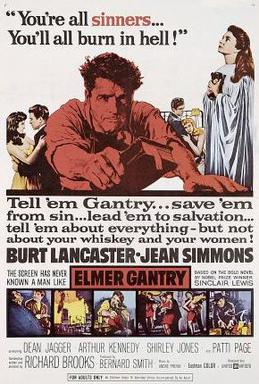
Burt Lancaster gives a magnetic, Oscar-winning, performance in this entertaining plot-boiler

irector: Richard Brooks

Cast: Burt Lancaster (Elmer Gantry), Jean Simmons (Sister Sharon Falconer), Arthur Kennedy (Jim Lefferts), Dean Jagger (William L. Morgan), Shirley Jones (Lulu Bains), Patti Page (Sister Rachel), Edward Andrews (George F Babbitt), John McIntire (Rev John Pengilly), Hugh Marlowe (Rev Philip Garrison), Joe Maross (Pete)

Elmer Gantry (Burt Lancaster) has the patter down perfectly. He can charm, wheedle and turn a phrase to set the whole room alight with laughter. He wants success but the big break never comes, perhaps because he’s selling two-bit vacuum cleaners rather than something people really want. Elmer is smart and works out, when everyone is afraid of dying, it’s a captive market for salvation. With his seminary background, he’s a natural preacher and inveigles himself into the revivalist roadshow of Sister Sharon Falconer (Jean Simmons) which his force of personality shifts into a fire-and-brimstone exhibition of frenzied religious passion – just the sort of thing that gets the punters back into the church. But when the roadshow moves to the big city, will Gantry’s young affair with priest’s-daughter-turned-prostitute Lulu Baines (Shirley Jones) come back to bite him?

Elmer Gantry was seen as controversial and even outlandish at the time of its release – so much so a lengthy pre-credits opening crawl distances it from all those decent servants of the Lord who were worried it was tarring them with the same brush. But with TV evangelists raking in the cash and travelling preachers whipping crowds up into wild-eyed ecstasy, Elmer Gantry doesn’t seem so outlandish these days. Richard Brooks film adapts the middle-act only of Sinclair Lewis’ sharply satirical novel, and while it does smooth down the rough edges and offer touches of redemption for its charismatically selfish hero, it’s still a very entertaining plot-boiler with a well-delivered message and subtle character development.

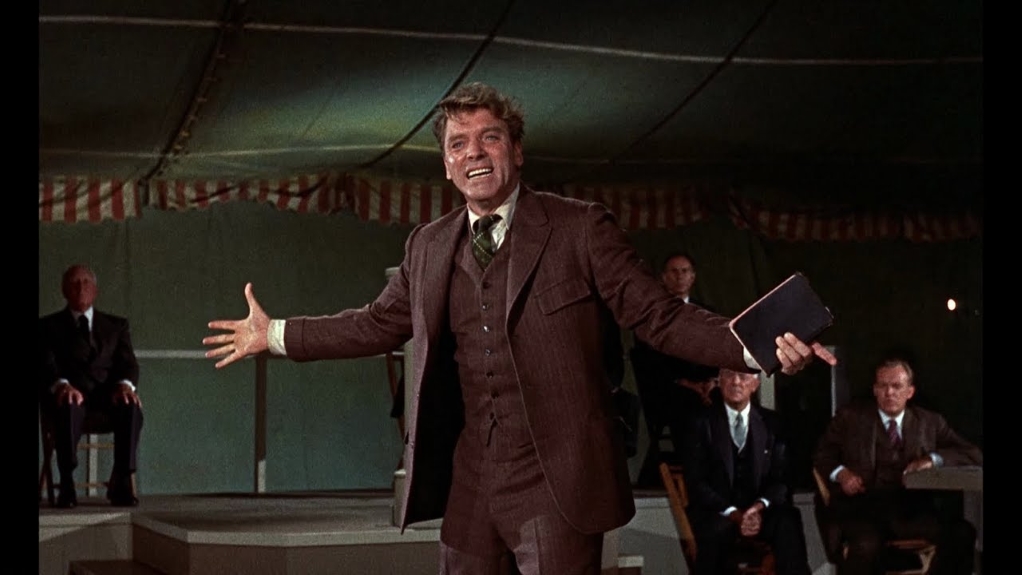
Above all though it’s a defining star-vehicle for a perfectly cast, Oscar-winning, Burt Lancaster. Elmer Gantry plays to all his strengths: charismatic, larger-than-life and charming, overflowing with boundless energy and nimble, physical grace. Lancaster’s intense eyes and excitable grin burns through the screen and he’s totally believable as the sort of rogue everyone knows is a rogue but give him a pass because he’s so likeable. And he nails the magnetic charisma of fire-and-brimstone preaching, full of self-aggrandising comments about his own holy conversion from salesman to man of God. It helps that Lancaster’s physical prowess (at one point he does a body slide down the full length of the aisle mid-sermon) really helps build Gantry’s magnetic presence.

Elmer Gantry superpower isn’t that he’s shameless – he looks suitably guilty when calling his mother on Christmas day to explain, once again, he isn’t coming home – but that he can compartmentalise and forget shame so quickly. He manipulates and uses people with such charm they either don’t notice or don’t care – from charming clients on Christmas Eve with dirty stories to plugging Sister Sharon’s naïve assistant Sister Ruth (Patti Page) for details on Sharon’s life that he will then use to get his foot in the door of her roadshow. Even cynical journalist Jim Lefferts (Arthur Kennedy, warming up for effectively the same role in Lawrence of Arabia), who knows he’s a complete bastard, still finds him a great guy to hang out with.

But the truth is Gantry corrupts everything he touches. It happens by degrees, pushed along with winning arguments and eager ‘I’m just trying to help’ excitability, but its inevitable. Before he arrives, Sister Sharon’s roadshow is a dry but heartfelt and earnest mission focused on winning converts. Under Gantry’s influence it becomes religious entertainment. Because Gantry knows people need to have their passions stirred to really invest in something, and mesmerising patter is a huge part of that. Lancaster’s delivery of these showpiece sermons drip with eye-catching, inspiring passion – even when we know he’s a hypocritical bullshit artist who probably doesn’t truly believe word he’s saying, but sure does believe it in the moment. When even we feel stirred by it, is it a surprise his audiences start to get whipped into a frenzy, barking at devils and clawing across the floor to be saved by Gantry’s touch?

Sister Sharon’s manager and sponsor William Morgan (Dean Jagger skilfully playing a character who is far more susceptible to manipulation than he thinks) might have his doubts, but it works. Elmer Gantry takes a satirical swing at the Church as the reverends of the town of Zenith swiftly put aside any doubts (other than straight-shooter Garrison, inevitably played by Hugh Marlowe) and bring Sister Sharon’s Gantry-inspired roadshow into the big city to help drag more punters (and it’s quite clear that they see congregations as customers for religion) into their church. Elmer Gantry gets some subtle blows in on the commercialisation of the Church, even if it is careful to largely distance it as a whole from the tactics of Gantry.

Gantry’s corruption also touches Sister Sharon herself. Well-played by Jean Simmons, Sharon is earnest but surprisingly steely but as she lets a little of Gantry’s shallowness into her roadshow, so she starts to compromise on the very qualities that made her stand-out. From entering into a ‘good-cop-bad-cop’ performance for sinners to opening her heart to Gantry’s persistent seduction, Sharon becomes a portrait of corruption by degrees. Brooks’ film also implies in its dark finale that she has allowed herself to absorb Gantry’s spin that she could be a vessel of holy power, which puts her life at deadly risk.

Elmer Gantry is overlong and perhaps relies a little too much on Lancaster’s charisma – it fair to say when he is off-screen it’s energy lags. Its satiric edge is sometimes blunted by focusing on Gantry as the disease rather than a symptom of a church struggling to survive in a secular age. The introduction of Lulu Baines – an Oscar-winning Shirley Jones, playing against type as a bitter floozy – is a little late in-the-day and while her performance is solid enough, the character is more of a cipher in a plot-required final act conundrum than a fully-formed character.

But when the film focuses on Gantry, it’s a fascinating character study. How much does he believe in the things he says? Does he feel shame? How ambitious is he? When he says he loves Sharon, does he? Or does he feel everything he says in the moment, but it never sticks? Either way, it’s at the heart of Burt Lancaster’s compelling, charismatic performance which juggles a mountain of contradictions but never loses the sense of the shallow selfishness that lies behind the charm.

Champion (1949)

Champion (1949)

Kirk Douglas is a boxing heel in this noirish melodrama full of excellent moments

Director: Mark Robson

Cast: Kirk Douglas (Midge Kelly), Marilyn Maxwell (Grace), Arthur Kennedy (Connie Kelly), Paul Stewart (Tommy Haley), Ruth Roman (Emma), Lola Albright (Palmer), Luis van Rooten (Harris), Harry Shannon (Lew), John Day (Dunne), Ralph Sanford (Hammond), Esther Howard (Mrs Kelly)

What does it take to get to the top? Skill, luck, ambition, determination – and sometimes just being a ruthless bastard. Midge Kelly (Kirk Douglas) as all five of those skills in spades, flying from bum to champ in just a few short years, burning every single bridge along the way. Champion tells the ruthless story of how Kelly alienated his devoted lame brother Connie (Arthur Kennedy), dropped the trainer (Paul Stewart) who discovered him in a heartbeat and used and tossed aside a host of women: dutiful wife Emma (Ruth Roman), would-be femme fatale Grace (Marilyn Maxwell), artistic, sensitive Palmer (Lola Albright) wife to his new manager. As he enters the ring to defend his title against old rival Johnny Dunne (John Day), will all these chickens come home to roost?

Champion is deliciously shot by Franz Planer with a real film noir beauty, in particular the vast pools of overhead light that fill spots of the backstage areas of the various venues Midge fights in. Its boxing is skilfully (and Oscar-winningly) edited into bouts of frenetic, enthusiastic energy – although you can tell immediately that no one in this would last more than 90 seconds in a real ring – and it manages to throw just enough twists and turns into its familiar morality tale set-up to keep you on your toes and entertained. In fact Champion is a gloriously entertaining fists-and-villainy film, full of well-structured melodrama and decently drawn moral lessons. It’s the sort of high-level B-movie Studio Hollywood excelled at making.

For a large part it works because Douglas commits himself so whole-heartedly to playing such an absolute heel, the kind of guy who knows he’s a selfish rat but just doesn’t give a damn. Douglas was given a choice of a big budget studio pic or playing the lead in this low-budget affair, chose Champion – and his choice was proof he knew where his strengths lay as an actor. Midge Kelly is the first in a parade of charismatic, ruthless exploiters that Douglas would play from Ace in the Hole to The Bad and the Beautiful. Kelly is all grinning good nature until the second things don’t go his own way: and then you immediately see the surly aggression in him.

Its why boxing is a good fit for him. He doesn’t quit a fight – pride won’t let him. It’s the quality that Tommy sees in him, after Midge is literally pulled in off the street to pad up the under-card at a challenger’s fight night. Clueless as he is about boxing technique, he refuses to stay down and picks a fight with the promoter on the way out when cheated out of his fee. Champion shows how, for resentful people like Kelly, pugilism is a great way of getting your own back when you feel life has screwed you in some way. Perhaps that’s why he goes for his opponents with such vicious, relentless energy and why he takes such a cocky delight in beating the hell out of them. In fact, Champion could really be a satire on the ruthless, put-yourself-first nature of much of Hollywood, with both Connie and Tommy commenting that the fists-and-showbiz world is a cutthroat one.

What Champion makes clear though is that Kelly isn’t corrupted by fame. For all Douglas’ charming smile, there is a cold-eyed sociopathy in him from the start. Kelly performs loyalty, but it’s always a one-way street. He’ll assaults those who call his weak-willed, more cynical, crutch-carrying brother Connie ‘a gimp’, but he has no real sense of loyalty. He doesn’t even pause for a second when seducing Emma (daughter of the diner the brothers end up working at on arriving in LA) for a quick fumble despite knowing Connie’s feelings for her. Later, criticised by Connie, he’ll just as angrily lash out at Connie, mocking his disabilities, the second his brother starts to make decisions of his own.

Kelly’s ruthlessness towards women is also clearly something innate. He’ll whine like a mule when forced (virtually at gunpoint) to marry Emma, who he’ll immediately leave behind with no interest of hearing from again (until she finally develops some feelings for Connie of course, at which case he seduces her as a point of pride). His sexual fascination for the manipulative Grace – a purring Marilyn Maxwell – quickly burns out, again not pausing for a second in chucking her aside, all but flinging dollar bills on a table as he goes. Even more heartlessly, after showing some flashes of genuine courtliness in his romantic interest in Palmer (a very sweet Lola Albright), he happily takes a cheque from her husband (right in front of her) to never see her again. None of this comes from fame: it’s the sort of guy Kelly is.

And, as Douglas’ smart, self-absorbed performance makes clear, it’s because deep down Kelly always thinks he is the victim and the world owes him a living. There is a strong streak of self-pity in Douglas’ performance, bubbling just below the surface combined with a narcissistic need to be loved by strangers even while he’s reviled by everyone who knows him. There is an escape from inadequacy for Midge in fighting: something he keeps coming back to time-and-again in complaints about the unjust treatment the world has given him in the past, used to justify any number of lousy actions.

Champion unfolds as an interesting study of a deeply flawed, increasingly unsympathetic character with a huge drive to destroy other people, either by words or fists. An excellent performance by Douglas is counter-poised by a host of other strong turns, especially from Arthur Kennedy, whose Connie effectively trapped in an abusive relationship and Paul Stewart’s unromantically realistic trainer who knows the score long before anyone else. Handsomely shot and directed with a melodramatic flair by Mark Robson, it can enter the ring with any number of other boxing films.

Peyton Place (1957)

Peyton Place (1957)

Small-town America is the home of hypocrisy in this ridiculously silly soap opera that spawned…a long-running TV soap opera

Director: Mark Robson

Cast: Lana Turner (Constance MacKenzie), Diane Varsi (Allison MacKenzie), Hope Lange (Selana Cross), Lee Philips (Michael Rossi), Arthur Kennedy (Lucas Cross), Lloyd Nolan (Dr Matthew Swain), Russ Tamblyn (Norman Page), Terry Moore (Betty Anderson), David Nelson (Ted Carter), Betty Field (Nellie Cross), Mildred Dunnock (Elsie Thornton), Leon Ames (Leslie Harrington)

Small-town America: what mysteries lie behind those white picket fences? If the small New England town of Peyton Place is a guide, all sorts of terrible things. Why is Constance MacKenzie (Lana Turner) so afraid of sex and romance? Could her fear that the slightest kiss could turn her would-be-writer teenage daughter Allison (Diane Varsi) into a slut, be rooted in her own mysterious past? Why does Allison’s friend Selena (Hope Lange) fear her drunken and lecherous step-father Lucas (Arthur Kennedy) so much? Why is Mommas-boy Norman (Russ Tamblyn) so shy?

If that all sounds like the set-up for a great-big TV soap… well that’s because it essentially is. Peyton Place was a huge box-office success in 1957, but you can argue it found its natural home when it later mutated into a long-running TV soap. It’s one long onslaught of high-flung, ridiculously OTT events, all filtered through the sort of dialogue punctured by swelling music to hammer home the feelings. Peyton Place is completely disposable – but also strangely enjoyable, rollicking along like all the best soaps do, so full of events that you don’t have time to stop and realise how silly it is.

Adapted from a doorstop popular novel, screenwriter John Michael Hayes faced quite a task. The original was crammed with sex, foul language and everything from murder to teenage pregnancy, illegal abortions, rape and incest. That’s not exactly the sort of stuff the Hays Code dreamed of. Peyton Place: The Movie is almost a triumph in how much of this stuff it manages to cover, all in a very cunning, under-the-radar way. Sure, the rough edges are shaved off (and, of course, not the hint of a cuss word makes it to the screen) but it still manages to tick a lot of those boxes.

It’s all to hammer home the hypocrisy of small-town America. Curtain-twitching busybodies watch every moment, leaping for their phones at the merest hint of scandal: from kisses out of school to teenage kids skinny dipping (bet they can’t believe their luck when an actual murder happens). Peyton Place follows in Picnic’s footsteps (to which it is vastly superior, equally shallow but much less pleased with itself and far more entertaining) in exposing the hypocrisy of 50s America, where everybody goes to church and no-one practices the good-will and love it preaches (and yes, I know the film is set in the 1940s, but no one told the costume or production designers).

Peyton Place was littered with acting nominations (in a year where 12 Angry Men got none, for Chrissakes!). It’s a little hard to understand why, considering every part fits neatly into a trope. Lana Turner is the nominal lead as the frigid clothes-store owner who hides a secret shame (all about that long-lost husband) that gets in the way of her flirtation with the newly arrived schoolmaster (played with smug dullness by Lee Philips). But that’s only because she’s the most famous actor in it. Her performance sets a sort of template for mothers that would be repeated countless times.

The real leads (both Oscar nominated for Supporting Actress) are Diane Varsi and Hope Lange as the two teenagers at the heart of Peyton Place’s ocean of hormones (although, it being a 50s film, a smooch at a booze-free party is the furthest anyone goes). Varsi narrates most of the film as a precocious would-be writer, with several grandstanding scenes wailing at her mother for being so unfair. It’s a broad but engaging performance and she manages to make Allison not quite as wet as she could be. She also gets a shy romance with nervous Norman Page (a gentle Russ Tamblyn, also nominated): Norman is clearly closeted, struggling with his sexuality in a small town (“I don’t know how to kiss a girl” he says) but the film does its best to overlook this.

More engaging is Hope Lange, who gets the juiciest material to play. The film is surprisingly daring in staging her rape by her boorish step-father (a slightly too ripe Oscar nominated Arthur Kennedy, although still the most memorable male performance). Robson’s camera pans up from her being pinned down, to her raised hands and then finally cuts outside. Lange plays the trauma of this – including an unwanted pregnancy, removed by the Doctor in an abortion the film bends over backwards to make an accident-induced miscarriage – with a great deal of vulnerability and empathy, her shame and desperation rather moving.

It makes her the target for gossip. Peyton Place smugly ticks off small-town America for its gossipy meanness – while still peddling a message that, if we just followed the warmth of the best of small-town values, the world would be a better place – ending with Lloyd Nolan’s doctor delivering a pompous ticking-off to the town (from the witness box during a murder case no-less). Peyton Place at heart is a fairly conservative film, that ends with most people discovering their inner-goodness (apart from a few irredeemable harridans), and all wickedness resolved.

It’s directed with workmanlike professionalism by Mark Robson, but it didn’t need inspiration. It’s odd to consider this had nine Oscar nominations, since it feels like the sort of disposable mini-series Netflix throws together every week. Its main claim to fame might be that its quaint small-town smugness, masking a bucketload of scandal, served as the main inspiration for Twin Peaks (though dialled up to a whole other level of weird). It’s overlong, overblown and very silly, but because it doesn’t take itself seriously (unlike heavy-duty message film that year Sayonara, a silly soap that thought it was Pulitzer material) it’s actually ridiculously entertaining, in a totally trashy way.