Tag: Cedric Hardwicke

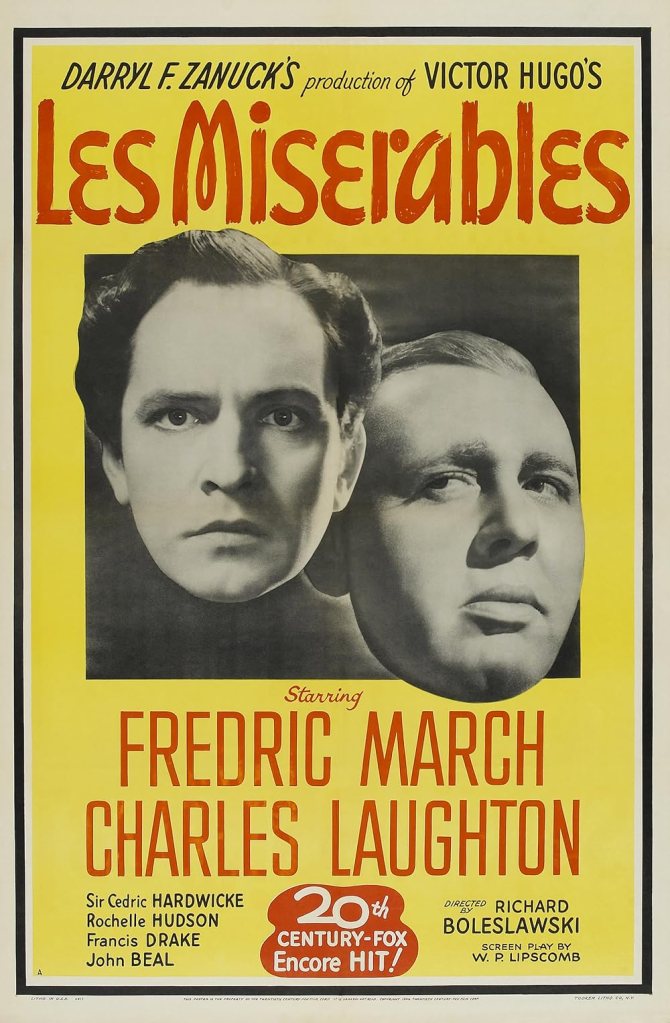
Les Misérables (1935)

Les Misérables (1935)

Odd choices are made in this Hugo adaptation, despite good photography and performances

Director: Richard Boleslawski

Cast: Fredric March (Jean Valjean), Charles Laughton (Inspector Javert), Cedric Hardwicke (Bishop Myriel), Rochelle Hudson (Cosette), Marilyn Knowlden (Young Cosette), Florence Eldridge (Fantine), John Beal (Marius), Frances Drake (Éponine), John Carradine (Enjolras)
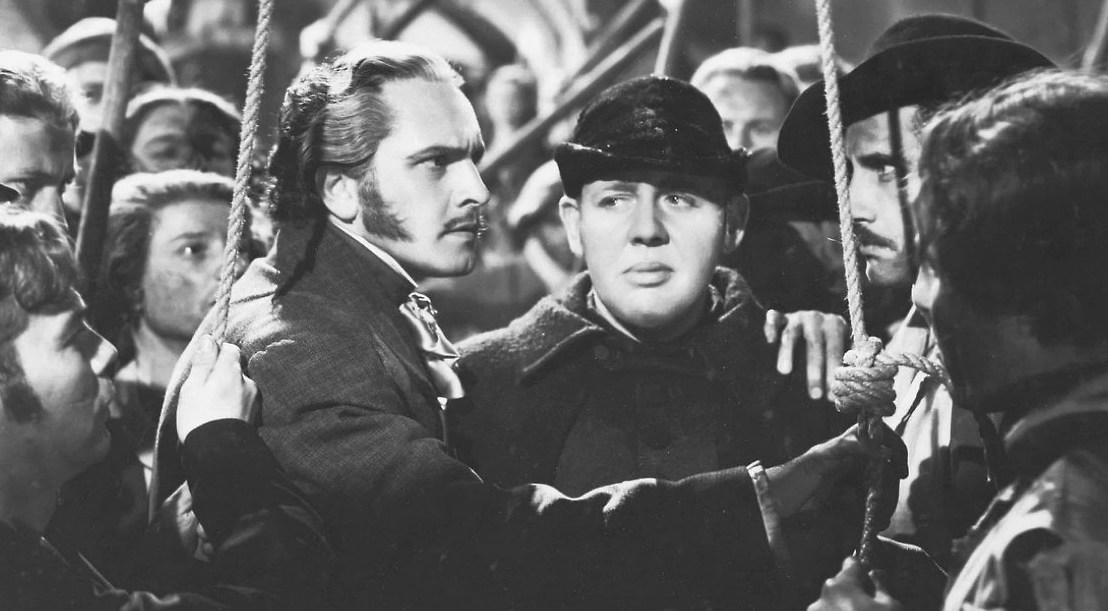
There isn’t a more famous loaf of bread in literature, than that stolen by Jean Valjean to feed his starving family. There’s something quite sweet about the fact that Richard Boleslawski’s film of Hugo’s doorstop gives that loaf its moment in the sun, as its half-eaten remains are produced as evidence in Valjean’s trial. It’s an unintentionally funny moment, but feels right in a sometimes blunt film, that at times makes odd decisions for those of us so familiar now with the plot’s ins-and-outs and the moral up-righteousness of its lead character after forty years of the musical. Boleslawski’s version is an odd mix, part psychological drama, part atmospheric thriller, part thuddingly obvious soap where a loaf of bread needs to be literally seen. Parts of it work extremely well, other parts weigh the film down like the chains on its galley slaves.

The film is overwhelmingly focused on the clash between Valjean (Fredric March) and Javert (Charles Laughton). One a good man who wrestles with temptation, but follows the sprit of justice. The other a rigid fanatic, who sees the letter of the law as gospel and the rights and wrongs of a situation an irrelevance. First meeting when Valjean serves a decade as a slave at the oars in the galleys, their paths recross after a released Valjean has a road-to-Damascus moment after the intervention of a noble priest (Cedric Hardwicke). Reinventing himself as ‘Monsieur Madeleine”, he becomes mayor of a small town and protector of Fantine (Florence Eldredge) and her daughter Cosette (Rochelle Hudson). But he cannot escape the pursuit of Javert which carries him into hiding for years in Paris, where a now grown-up Cosette falls in love with reforming student Marius (John Beal), leaving Valjean with one last dangerous choice.

Les Misérables restructures the novel into three acts, each presenting Valjean with a moral quandary. As such, Fredric March’s impressive performance must be unique among Valjean’s: this version is forever tempted with greed, anger and his own desires, constantly struggling to overcome his baser feelings. March is very good at bringing to life this conflict, just as he sells the sense of awakening purpose Valjean feels washing over him after the Bishop’s intervention prevents him from being returned to prison. It’s a muscular, agonised performance of a man constantly striving, even in the face of his resentment, to live up to his adopted moral principles. So, much as Valjean would like to let another man be accidentally condemned for his crimes, or to keep Cosette to himself or pull a trigger on Javert (March’s skilfully communicating the deep internal conflict each time) he’ll still (however reluctantly) find himself doing the right thing.

He contrasts excellently, with Laughton’s rigid, well-spoken, self-loathing Javert who has absorbed his moral code so completely, its left no room for any other form of principle or emotional judgement. Introduced, lips quivering, as he explains being denied promotion due to his convict father, Laughton’s Javert has channelled that resentment to worshipping the penal code as God. As he repeats, several times, good or bad is irrelevant, it’s just about the law. Of course, Laughton’s performance bubbles with repressed frustration, his pursuit of Valjean clearly motivated by far more personal feelings of anger and envy than he is willing to admit. Valjean is a spoke in his wheel of justice, a factor that makes no sense to him.

Boleslawski’s film is at its best when these two face off. It’s also at its most stylistic for these sequences. Les Misérables is awash with Gregg Toland’s atmospheric, mist-filled photography and expertly uses his expressionistic shadows. It’s depiction of a Parisian uprising, just like it’s introduction of a fast-paced horse chase between Valjean and Javert, are snappily edited and throw in a parade of dynamic Dutch and high angles. At the end of each act, Christian imagery is well used (in two cases, shrines to Mary and Jesus) to add emotional heft. A pursuit through grime and mist-filled sewers near the film’s close has a Fritz Lang atmospheric strength (did Carol Reed watch this before The Third Man?) as well as the film’s most effective use of music to build atmosphere as Valjean desperately submerges himself and Marius to hide.

There is effective stuff in Les Misérables. So, you try your best to forgive the fact it’s full of extremely on-the-nose, obvious touches. The introduction of the bread at the trial is not an end of its obviousness: for starters, the galley’s were prison hulks, not actual ships rowed around by convicts (where do they imagine these enormous hulks are going?). Truncating so much of the book down – and focusing overwhelmingly on its two leads – means many other parts of the story are short-changed or make little impact or sense (the hilariously watered down Parisian revolutionaries don’t turn up until the final 40 minutes). Florence Eldridge’s Fantine (all references to her prostitution are of course cut) does almost nothing but die – although not before the film gives her a (unique) ludicrously sentimental reunion scene with her daughter (played by a highly irritating precocious film-school brat before she grows up into Rochelle Hudson). Clearly the actual tragedy here (a mother never sees her daughter again) was considered too much.

Then there are the strange mis-readings and mis-interpretations. I can understand why Marius and his law students are re-imagined, by conservative Hollywood, into legal reformers rather than idealisitic revolutionaries (Marius even denounces the very idea of overthrowing the government as terrible). Here they want only penal reform – although of course, while ensuring the guilty are harshly punished – and chat like champagne socialists. It’s a bit of a mystery why this call for slow-paced, moderate social reform erupts into throwing up barricades, but clearly audiences at the time couldn’t be expected to get on board with anti-Monarchist cells. They’d probably agree with Eponine (interpreted here as a sort of femme fatale and Marius’ secretary) that it’s all a silly, slightly disreputable, waste of time.

However, even more strange, is the inexplicable interpretation of Valjean’s desire to keep Cosette to himself not due to being a protective father-figure investing everything in his life into his daughter, but instead an unpleasant sexual desire to make Cosette his wife. Even leaving aside this utter perversion of the novel, since we’ve seen Valjean raise her from the age of about 6 it’s hard not to feel a bit of bile forming in your throat at the stench of grooming this gives the relationship. It’s almost as if Hollywood could only imagine a man going to great lengths to protect a woman if he wanted to eventually get in her pants.

It’s odd reinventions like this that don’t quite work even within the world presented by the adaptation, let alone compared to the original source, that weighs the film down too much. They are blotches in the streamlining of a huge novel. But when the film focuses on an increasingly personal clash between two men, both well played by March and Fredric, and its atmospheric visuals, it works much better.

Richard III (1955)

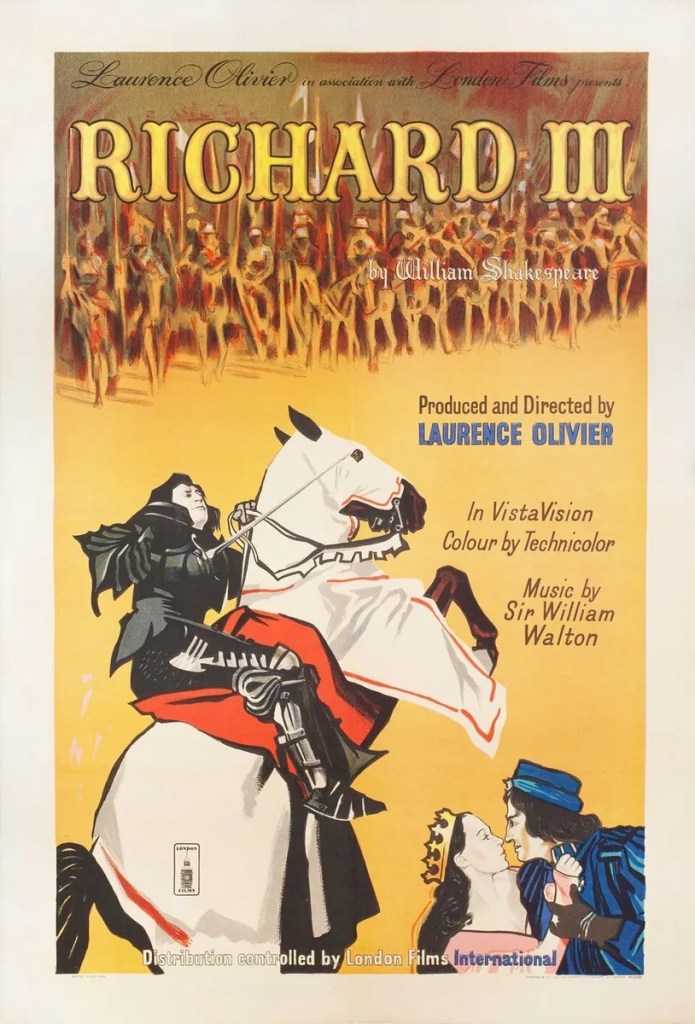
Richard III (1955)

Olivier stamps his claim to Shakespeare’s greatest villain in this gorgeous theatrical epic

Director: Laurence Olivier

Cast: Laurence Olivier (Richard III), Cedric Hardwicke (Edward IV), John Gielgud (Clarence), Ralph Richardson (Buckingham), Claire Bloom (Lady Anne), Helen Haye (Duchess of York), Pamela Brown (Mistress Shore), Alec Clunes (Lord Hastings), Laurence Naismith (Lord Stanley), Norman Wooland (Catesby), Clive Morton (Lord Rivers), Douglas Wilmer (Dorset), Stanley Baker (Richmond), Mary Kerridge (Queen Elizabeth), Esmond Knight (Ratcliffe), John Laurie (Lovell), Patrick Troughton (Sir James Tyrell), Michael Gough (Murderer)

Olivier had played the greatest Shakespeare hero in Henry V and made Hamlet the most romantic princes of film. Having scaled those heights, did he also want to set the benchmark for Shakespearean villainy? Perhaps, with his vaulting ambition and competitiveness, he knew his clipped, precise tones and physical suppleness was perhaps best suited to playing the villain. What better role to prove it than the “poisonous, bunch-backed toad” himself, Richard III. Olivier bought to the screen a performance that would be as influential as his Hamlet (perhaps even more so), an embodiment of the role that all future Richards would be compared to.

I like to think of Richard IIII as a twisted inversion of Henry V. Like that film, the action is shot in lusciously beautiful technicolour, with beautiful costumes and a marvellously stirring, magnetic score by William Walton. It has courtly intrigues, a charismatic lead, the seduction of a young princess, many of the same actors and caps itself in a bravura battle shot on location. The only difference being that, instead of “the mirror of all Christian kings”, our lead is a twisted, remorseless killer who acts as his own Chorus to bring us on-side with his Machiavellian schemes. (There is a fun little opening message, stressing that this is a legend not the truth, that almost feels like an apology in advance to the Ricardian societies of today).

Olivier’s performance is the heart and soul of this film, and it’s possibly his finest cinematic (and certainly his finest screen Shakespeare) role. This Richard is openly – almost proudly – cruel and hypocritical, sociopathic in his amoral ease with the death and slaughter of his nearest and dearest (including his beloved wife, brother and nephews to whom he is sweetness and charm), overwhelmingly impressed with his own cunning and eagerly inviting us to share in his villainy. Olivier practically caresses the camera in his readiness to get close to us, forever turning towards it with a smile, quick aside or delighted breakdown of schemes to come. Olivier inverts his matinee idol looks into a stooped smugness (his costume, with its dangling sleeves, frequently makes him look like a spider) and his clipped vocal precision is dialled up to stress his heartless self-confidence.

Stare into Richard’s eyes and all we see is an uncaring blankness, the chill of a man who cares for nobody except himself. His sigil maybe a boar, but he resembles a wolf, devouring the Lords around him. Much of the first two thirds sees him keep a steady illusion of outward good fellowship. He comforts Gielgud’s Clarence with genuine care, greets Hastings like an old friend, is mortified and hurt by the suspicions cast on him by the Queen and her family, smiles with affection at his cousins. It means the moments where Olivier lets the mask slip even more shocking: the matter-of-fact abruptness he urges murderers not to take pity on Clarence, the whipped glare of pure loathing he shoots at the princes after an ill-advised joke about his hunched back or the imperious hand he shoots at Buckingham to kiss after being acclaimed by the crowds, harshly establishing the hierarchical nature of their ‘friendship’.

While the charisma of course is natural to a performer as magnetically assuring as Olivier – and this Richard is truly, outrageously, wicked in his charm – he also nails the moments of weakness. Having achieved the crown, Olivier allows not a moment of enjoyment of his feat, but his brow furrows into barely suppressed concern and anxiety that he may be removed by schemes exactly like his own. The threat of armies marching on him sees him first lose his temper publicly and then leap to cradle the throne in his arms like a possessive child. The morning of Bosworth, he even seems quietly shocked at the very idea that he could feel fear.

Richard III, despite its length, makes substantial cuts to the original play, including throwing in elements from Henry VI. Several characters – most notably Queen Margaret, whose major confrontation scene with Richard is lost altogether – are cut or removed all together. Olivier reshuffles the order of events, most notably shifting the arrest of Clarence to split up the seduction of Lady Anne. Richard’s late speech of remorse before the battle of Bosworth hits the cutting-room floor (Olivier’s Richard never seems like a man even remotely capable of being sorry for his deeds). Several small additions from the 18th century by Colley Cibber and David Garrick are kept in (most noticeably his whisper to his horse on the eve of battle that “Richard’s himself again”).

The film is deliberately shot with a sense of theatrical realism to it, Olivier favouring long takes so as to showcase the Shakespearean ease of the cast (much was made of the cast containing all four of the Great Theatrical Knights of the time in Olivier, Richardson, Gielgud and Hardwicke). The camera frequently roams and moves, most strikingly during the film’s first monologue from Olivier, where it flows from the coronation retinue outside the throne room, through a door, to find Richard himself waiting for us in the hall. It’s set is similarly theatrical, a sprawling interconnected building (with some very obvious painted backdrops) where the Palace of Westminster, the Tower of London and Westminster Abbey seem to be one massively interconnected building.

The film makes superb use of shadows, the camera frequently panning from our characters (especially Richard) to see their shadows stretch across floors and up walls. The claustrophobia of the interconnected set also helps here, making events seem incredibly telescoped (it feels like the film takes place in just a few days at most). It makes the court feel like a nightmare world completely under the control of Richard, who knows every corner to turn and can seemingly be in several different places at once. In that sense, filming Bosworth outside on location in Spain seems like a neat metaphor for Richard’s lack of control of events: suddenly he’s in a sprawling open field, where it’s possible to get lost and it takes genuine time to get from A to B.

Olivier may dominate the film with a performance of stunningly charismatic vileness, but he has assembled a superb cast. Ralph Richardson is superb as a supple, sly Buckingham, a medieval spin doctor whose ambitious amorality only goes so far. While I find Gielgud’s delivery of Clarence’s dream speech a little too poetic, there are strong performances from reliable players like Laurence Naismith’s uncomfortable Stanley and Norman Wooland’s arrogant Catesby while Stanley Baker makes a highly effective debut as a matinee idol Richmond. Claire Bloom superbly plays both Lady Anne’s fragility but also a dark sexual attraction she barely understands for this monster. Perhaps most striking though is Pamela Brown’s wordless performance as Mistress Shore (mistress first to Edward IV then Hastings), a character referred to in the play but here turned into a sultry, seductive figure who moves as easily (and untraceably) around the locations as Richard does.

Fittingly for a film obsessed with the quest for power, we return again and again to the image of the crown. It fills the first real shot of the film, bookmarking its beginning and end and frequently returns to fill the frame at key moments. With the films gorgeous cinematography, it’s a tour-de-force for its director-star and a strikingly influential landmark in ‘traditional’ Shakespeare film-making.

Wilson (1944)

Wilson (1944)

Well-meaning if slightly dry hagiography that struggles to turn history into drama

Director: Henry King

Cast: Alexander Knox (Woodrow Wilson), Charles Coburn (Professor Henry Holmes), Geraldine Fitzgerald (Edith Wilson), Thomas Mitchell (Joseph Tumulty), Ruth Nelson (Ellen Wilson), Cedric Hardwicke (Senator Henry Cabot Lodge), Vincent Price (William G McAdoo), William Eythe (George Felton), Mary Anderson (Eleanor Wilson), Ruth Ford (Margaret Wilson), Sidney Blackmer (Josephus Daniels), Madeline Forbes (Jessie Wilson), Katherine Locke (Helen Bones)

Darryl F Zanuck had a passion project: a biopic of the 28th President Woodrow Wilson. It would be both a tribute to a man, he felt, was overlooked and also a homage to current President Roosevelt – and a warning for the future. Like FDR, Wilson had introduced a raft of reforms and led the country in wars – and Zanuck was worried America would fudge the peace, just as Wilson had failed to get the Senate to endorse the League of Nations, leaving it a toothless lion.

Zanuck’s no-expense spared approach gives us a laudatory biopic that lavishes Wilson in euphoric praise, smooths off all his edges and presents him as a visionary and a near-flawless leader. The money was thrown into building elaborate sets and costumes – vast swathes of the White House and the Palace of Versailles were re-built on the sound stages of 20th Century Fox – and the script repackaged a series of major events interspersed with Wilsonian speeches. It was launched to a fanfare, was nominated (largely due to Zanuck’s influence) for ten Oscars (winning five) and was a box-office failure.

But is it a good movie? In truth, not quite. Despite the lavish production values, this is a dry, unimaginative and stately progression through its subject’s life. Henry King marshals events with the professionalism of an accomplished journeyman, but little inspiration. There is nothing striking, original or brave in a single minute of Wilson, but everything is perfectly framed and (considering its immense length) well-paced. King uses a series of low-angle shots to hammer home the magnificent detail of the sets and Alfred Newman’s score remixes a series of patriotic scores and heavenly-sounding choirs to build the impression of Wilson as secular saint.

But Wilson remains a largely undramatic movie, with an (Oscar-winning) script by Lamar Trotti that fails to inject drama or skilfully convey information. The warning signs are there in the film’s opening, with a group of New Jersey Democrats arrive to recruit Princeton head Wilson to run for Governor and clumsily give each other a potted precis of his CV and academic achievements while they wait for him to join them. Dialogue frequently info dumps historical research in our ears. Newspapers bluntly tell us in crude headlines what’s happening. Poor Thomas Mitchell’s entire role seems to be made up of running into rooms clutching telegrams announcing major events.

In amongst all this research though, we get very little idea of what Wilson actually stood for. There is virtually no time spent on his Governorship of New Jersey, other than a two-scene disagreement with the Democratic bosses whose power he breaks. On becoming President, his major legislative reforms are covered in a less-than-a-minute montage of signed bills. He consults his cabinet once or twice and, when war comes, walks a fine line between preserving American strength and not rushing into war. The final act of the film covers his failed battle for the League of Nations, the only policy the film invests any time into explaining.

For much of the rest of the time, this hagiography concerns itself with down-playing or skating over anything in Wilson that could be perceived as a flaw. Wilson here talks a good game of reform, equality and rights for all. In real life, he was a dyed-in-the-wool segregationist, sceptical about women’s suffrage as well as being an intellectually arrogant elitist who, later in his Presidency, began to see himself as a sort of vessel for God’s policies. While he was undoubtedly a highly effective moderniser and legislator, none of his faults make it to the screen.

Other areas are also carefully removed. Wilson was often accused of being heavily under the influence of advisors like “Colonel” House – House gets a one-scene cameo here. He ran for re-election in 1916 promising to keep America out of the war – this unfortunate broken promise is repackaged as Wilson sitting in the White House deeply regretting the campaign the party is running for him but stating there’s nothing he can do about it. His controversial re-marriage in 1915 to the much-younger Edith Galt (only two years after his wife died) is excused by his wife informing his daughters on her death bed that Wilson must marry again as he needs a wife. Wilson’s incapacity after a stroke in 1920 is down-played, while Edith (who effectively took over running the country for her husband in a constitutional scandal that would never stand today) states “I never made a decision without your knowledge and consent” while sitting with a sturdy Wilson.

All of this is played out in parallel with making Wilson’s rivals in the Senate mustachio-stroking schemers. None more so than Henry Cabot Lodge (well played by Cedric Hardwicke) who begins a career of animosity against the President after being made to wait for a meeting at the White House. In real life, Wilson refused any compromise offered by Lodge to get the League approved by the Senate, but here Wilson is a noble crusader foiled by political pygmies.

Saying that, the film benefits hugely from a very strong performance from Alexander Knox as Wilson, who not only looks and sounds exactly like the President, but perfectly captures his mannerisms. It makes you regret though the film is so little interested in Wilson’s personality or in building any picture of the humanity behind this leader. The rest of the cast have little to do other than state historical facts or stand to listen to Knox masterfully delivering Wilsonian speeches.

Wilson has a historical interest for Presidential buffs and, while it downplays the negatives around Wilson, it makes a very effective case for the President as a visionary leader (he was undoubtedly right about the League of Nations – even if his stance here is restructured into an FDRish self-determination for all nations). But this is a dry, stately film that never manages to turn the march of time into the thrust of drama. The Oscar-winning sets and photography look impressive, but its simplistic and hagiographic presentation of events eventually shakes your interest.

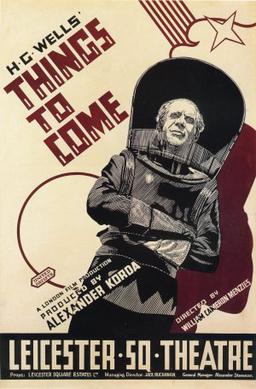
Things to Come (1936)

Things to Come (1936)

HG Wells ultra-serious view of the future is stilted but also visionary

Director: William Cameron Menzies

Cast: Raymond Massey (John Cabal/Oswald Cabal), Edward Chapman (‘Pippa’ Passworthy/Raymond Passworthy), Ralph Richardson (The Boss), Margaretta Scott (Roxana Black), Cedric Hardwicke (Theotocopulos), Maurice Braddell (Dr Edward Harding), Sophie Stewart (Mrs Cabal), Derrick De Marney (Richard Gordon), Ann Todd (Mary Gordon), John Clements (Enemy pilot)

Alexander Korda was thrilled. He’d secured the rights to the legendary HG Well’s new novel. Even better the Great Man would work, hand-in-glove, with Korda’s team to bring The Shape of Things to Come to the screen. It would be a grand science-fiction hit, that would echo the success of American films based on Wells’ work (films, to be fair, Wells pretty much hated apart from The Invisible Man). It became a continual struggle before the final flawed-but-fascinating film arrived in cinemas.

Things to Come opens in the (then) near future in 1940 as war tears “Everytown” on Christmas Day and flies 100 years into the future. Bombing destroys the city and hurtles the world into over twenty years of never-ending war that leaves civilisation wrecked by carnage, advanced weapons and poisonous gases. A legacy of the war, “the wandering sickness” devastates the survivors, killing half the remaining population. In the ruins of Everytown in the 1960s, the Boss (Ralph Richardson) rises to take power, one of many warlords across the world being challenged by the “World Communications” alliance of engineers and scientists in Basra, Iraq. When they reshape the world, decades of progress lead to a new civilisation in 2036 aiming at the stars.

HG Wells saw Things to Come as a polemic, an ambitious and optimistic look at how mankind should progress, leaving behind war and politics to embrace rational thought and the quest for knowledge. Written at a time when tensions were high in Europe, it would show the world torn apart, devastated and reborn greater than it ever was before. Never-the-less at every point, the unambitious, myopic and power-hungry gather to hold back progress. What he didn’t really see it as was a conventional “drama” or those involved as “characters” more devices, ciphers and mouthpieces for his viewpoints.

Which helps explain the curious project that made it to the screen. Wells was guaranteed approval over the dialogue, which remains flat and heavy handed. Actors felt constrained within the sonorous phasing and over-written prose. It wasn’t helped by director William Cameron Menzies’ discomfort with dialogue scenes. Whenever two people stand around (which sums up the blocking) and chat, the film is frequently a little dull, settling for a semi-disguised lecture on humanity, science and progress. Korda correctly identified the dialogue problems and cut as much of it as possible.

In doing so, he snipped away much of the narrative framework of the film. In a film that flies forward through time and world-changing events, we frequently get confused about the exact details of who goes why and where and what makes characters do the things they do. Characters disappear and reappear, fly across the world in seconds, form and break alliances and argue and drop cases all on a sixpence. Raymond Massey later talked about how hard he found his character (a man and his grandson, bridging all timelines) to bring to life with dialogue largely devoid of emotion. Much of Things to Come can be dry-as-a-bone.

But yet… Away from the weaknesses of the script, much of Things to Come is quite awe-inspiring. While the characters might be a little flat, the energy of the film’s first two acts (in 1936 and 1966) offers a host of striking scenes and images. Things to Come remains powerful and horrifying when it looks at the darkness and damage of war. The 1936 bombing attack on Everytown still shocks with its superbly assembled shots of buildings exploding, crowds panicking, dead bodies slumped in cars, terrified faces and dead children in the rubble. Imagine watching this with the Blitz just a few years away. Menzies may not direct acting or dialogue with much inspiration, but his skill with visuals and editing is clear. The montage carrying the world over the next thirty years is a masterful mix of fake news-footage and technological innovation as ever more advanced tanks and airplanes roll past the screen. The film’s use of design and visuals is frequently haunting and impressive.

It carries across to the bombed-out design of Everytown in the 1960s. A shell of a city, where wrecks of cars are pulled by horses. Those suffering from “the Wandering Sickness” move like zombies through the city. Homes and buildings are gutted remains. Newspaper headlines – of newspapers that become ever more basic in printing and more expensive in price – had previously helped communicate the passage of events. Now the news is chalked up onto a board outside the home of the Mussolini-like Boss (the film’s finest performance of charismatic swagger and delusional power-mad greed by Ralph Richardson). Clothing is basic and functional, pulled together from scraps leftover from the war, in a world largely devoid of all technology.

This wasteland makes the futuristic designs even more striking. The “Wings Over the World” organisation – growing from the cradle of civilisation in Iraq – is sleek, metallic and efficient in its construction. When John Cabal (Raymond Massey) lands back in the 60s ruin of Everytown, he looks like a spaceman. He might as well be. His fleet of unimaginably vast airplanes have inspired visions of futuristic flight right up to the mighty airbases the Avengers operate in the MCU.

While you can snigger a little at the utopiaish version of the future – very Star Trek in its flowing robes and shoulder pads – it’s vision of subterranean cities full of everything from wrist communicators to widescreen TVs feels quite prescient. Everything is clear, polished and perfect – much of it doesn’t look a million miles away from an Apple store. While the villains of the future (a band of luddites led by Cedric Hardwicke) may be little more than paper tigers, given only the vaguest motivations, the grand engineering accomplishments of the future and their glances at the stars feel inspired in their detail and ambition.

It’s where Things to Come triumphs. It might not often have much to listen to, but every single scene carries a slice of design or visual interest. Its frequently assembled into effective – and even terrifying – montages. And its design of the future – based on Wells vision and bought to life by Menzies and his technical team – is a perfect mix of striking and prescient. Things to Come isn’t always the best drama, but as a forward-looking piece of design it’s truly memorable.

The Ten Commandments (1956)

The Ten Commandments (1956)

DeMille’s massive, camp epic sets the table for what we expect from Biblical epics

Director: Cecil B. DeMille

Cast: Charlton Heston (Moses), Yul Brynner (Rameses II), Anne Baxter (Nefretiri), Edward G. Robinson (Dathan), Yvonne De Carlo (Sephora), Debra Paget (Lilia), John Derek (Joshua), Cedric Hardwicke (Seti I), Nina Foch (Bithiah), Martha Scott (Yochabel), Judith Anderson (Memnet), Vincent Price (Baka), John Carradine (Aaron), Olive Deering (Miriam), Douglass Dumbrille (Jannes)

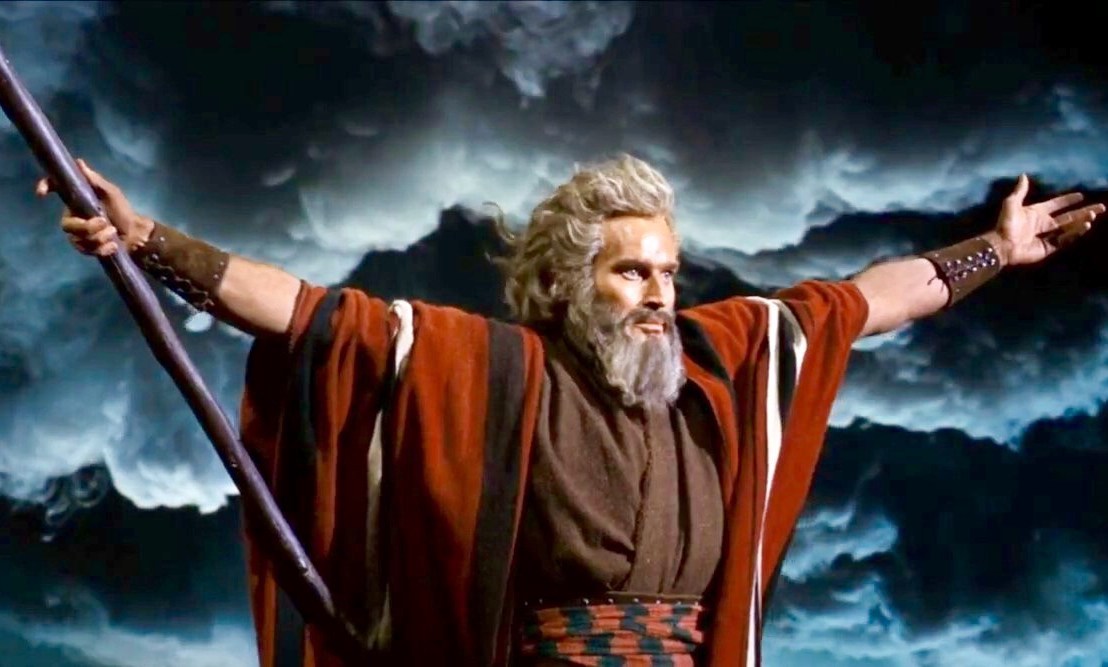
“Let my people go!” Close your eyes and think of Moses. Chances are you’ll see an image of Charlton Heston, arms spread wide, parting the waves to lead his people to freedom. Heston had been partly chosen for his resemblance to Michelangelo’s sculpture of the famous law-giver. It’s also a tribute to how Cecil B DeMille’s slightly ponderous, very-very-serious Biblical epic pretty much defined what we expect from Bible stories.

The Ten Commandments would be DeMille’s final movie (and for all its many flaws, it’s way more deserving of the Best Picture Oscar than the valedictory pat-on-the-back his penultimate film got). It’s basically a triumphal capturing of his self-important style, with sonorously devout voiceover and a faultless hero chiselled from marble an excuse to fill the screen with action, campy scheming and lots of sexiness. The Ten Commandments became a massive hit because it’s a rollicking pile of nonsense and something you could persuade yourself was “good for you” because it’s about the Exodus.

It’s a BIG film. DeMille delivers an opening direct-to-camera address, dripping with pompous self-satisfaction, where he piously tells us about the level of historical and Biblical research he’s carried out. The credits list a stack of professors, historians, religious experts and, last of all, the Holy Gospels as sources (presumably the Gospels’ writers got no cut of the vast profits). DeMille, as per his style, marshals thousands of extras and some huge (and distinctly sound-stage looking) sets to play out a series of tableaux, many of them rooted in classic silent-movie framing and techniques. Special effects abound to create plagues (disappointingly the film skips seven of them) and parting of the Red Sea. DeMille narrates with the grandiose aloofness of a Sunday School teacher.

It’s almost enough grandeur to make you overlook this pageantry covers a rather camp, frequently silly piece of entertainment. The film is ripe with buff actors striking poses: Heston does a lot of this during the first half, matched by Brynner (who worked out at length so as not to be shown-up). Opposite them, gorgeous Israelite and Egyptian babes fawn and flirt. The film is at least as interested in the love/hate relationship between Moses and Nefretiri as it is in the Word of God, not least because DeMille knows that this soapy stuff really sells.

Perhaps that’s why Anne Baxter plays Nefretiri with a level of campy purring that would be almost laughable, if you weren’t sure that she’s in on the joke. Relishing the chance to play a sex bomb – in costumes designed to stress her assets – Baxter simpers, flirts, drapes herself across Heston’s ram-rod (in every way but one of course – he’s righteous man of God) Moses and gets to utter lines like “Oh Moses, Moses, you stubborn, splendid adorable fool”. She mocks and cajoles Rameses into rejecting Moses’ demands, partly because she can’t stand Moses is immune to her charms, partly because she can’t bear the idea of Moses leaving Egypt (and her) behind forever.

Ten Commandments elevated Heston to the rank of the immortals. Few actors could carry the weight of films like this as well as he. His performance is in two acts. The first is the visionary, egalitarian adopted son of the Pharoah: the guy who builds the best cities, turns rival kingdoms into allies, gives the stuffy priests’ grain to the slaves (even before he finds out he’s one of them) and whom Seti (a haughtily British Cedric Hardwicke) would rather took over the kingdom than Rameses. Discovering his roots, he morphs over a (long) time into the white-haired, broad-shouldered prophet, speaking most of his lines in sonorous block capitals (“BEHOLD. THE POWER. OF GOD” that sort of thing). Very easy to mock, but only Heston could have played such woodenly written silliness with such skilful conviction.

He generously said he believed Brynner gave the better performance. Brynner does have the more interesting material. A playboy monarch who is true to his word and seems (at first) torn with how he feels about this adopted brother who overshadows him at every turn, Brynner adds a lot of light and shade to a character written as a pretty much straight villain. Moses is presented as such an imperious stick-in-the-mud, it’s a little tricky not to feel a bit sorry for the put-upon, inadequate Rameses, for all he’s a tyrant.

Heston was the only actor who went on location for a few key shots (the others all perform on sound stages or in front of green screens). Keeping things sound stage based allowed DeMille to have complete visual control over the set-ups. This suited his conservative camera movements and editing – most of the scenes take place in a few carefully extended mid-shots, that allow us to soak up the pretty costumes and the theatrical acting. The Ten Commandments is partly a flick-book of devotional pictures – so much so that a tracking shot into Seti’s face when he banishes Moses stands out for the amount of camera movement.

That doesn’t stop DeMille throwing in plenty to look at in frame. With Heston spending half the movie as (in some cases literally) the voice of God, John Derek’s Joshua carries the action torch: chiselled of chest, he’s introduced zip wiring to save Moses’ mother from being crushed by a mighty stone. Like most of the “good” characters he gets very little to actually work with: the decent Jews are either excessively pure or aged men of physical weakness who commentate on the wonders around us. Still, it’s better than the hilariously cheesy dialogue of the regular Israelites (“We’re going to the land of milk and honey – anyone know the way?”) that contrasts laughably with the Biblical pastiche Moses and the other principals speak in.

DeMille has plenty of fun with the doubters and naughty among the Israelites. Edward G Robinson goes gloriously over-the-top as quisling Dathan, blackmailing Joshua’s girl Lilia (a timid Debra Paget) into years of servitude and taking every single opportunity to undermine Moses’ leadership. It works as well: no wonder Moses gets so peeved – the slightest set-back and the Israelites seem ready to stone him. Dathan leads the final act Golden Calf orgy (DeMille’s voiceover tuts constantly, while letting us see as much of the action as the censor would allow) while Moses is up the mountain picking up the Word of God.

Robinson has the tone right though: the cast is stuffed full of OTT actors. Vincent Price plays a perverted Egyptian architect with lip-smacking glee. Judith Anderson jumps over the top as Nefretiri’s nursemaid. Nina Foch (one year younger than Heston!) plays Moses’ adopted mother with grandiose gentleness. They know this is a big, silly, pose-striking pantomime passing itself off as a piece of devotional work.

But that’s why its popular. DeMille knows that people don’t want to see a devotional lecture – or even really have to think that much about the rights and wrongs of an Old Testament story that sees the Lord strike down a load of kids with a murderous cloud (even Moses is torn by this for a minute). The Ten Commandments is huge in every sense, full of campy nonsense, pose-striking acting and a mix of stuff it’s taking very-very-seriously and campy ahistorical nonsense. It’s a winning cocktail that doesn’t make for a great film (or even, possibly, a good one) but cemented it as a landmark everyone recognises even if they haven’t seen it. In a way, making it one of Hollywood’s most magic epics.

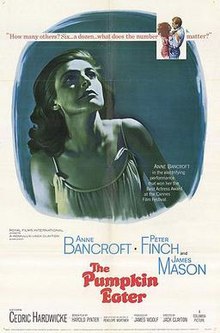
The Pumpkin Eater (1964)

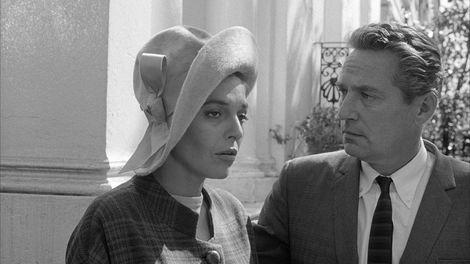
Anne Bancroft and Peter Finch in an unhappy marriage in the overlooked The Pumpkin Eater

Director: Jack Clayton

Cast: Anne Bancroft (Jo Armitage), Peter Finch (Jake Armitage), James Mason (Bob Conway), Cedric Hardwicke (Mr James), Richard Johnson (Giles), Eric Porter (Psychiatrist), Rosalind Atkinson (Mrs James), Frances White (Older Dinah), Alan Webb (Mr Armitage), Cyril Luckham (Doctor), Yootha Joyce (Woman at Hairdressers), Maggie Smith (Philpot)

Released in 1964, The Pumpkin Eater was rather unfairly seen as too strongly aping the new-wave of European film-making, in particular Michelangelo Antonioni and Ingmar Bergman. It’s a strange trend in British culture to ruthlessly lambast anything seen to be too good or too well made, as if trying too hard is vulgar and flies in the face of our love for the amateur. This is supremely unfair for The Pumpkin Eater (which I will say is weighed down by a pretty terrible title – Scenes From a Marriage would have been better, but that one got nabbed by Bergman) which is a little classic of a film.

Based on a semi-autobiographical novel by Penelope Mortimer about her marriage to lawyer-turned-writer John Mortimer (creator of Rumpole), Anne Bancroft (with an impeccable British accent) plays Jo Armitage: an intelligent woman, suffering from depression, with a huge number of children from three marriages. Her new husband, Jake (Peter Finch), is a charming man, a hard working screenwriter, an excellent father to all the children – and, alas, a selfish serial adulterer. The film charts the ups and downs of their marriage, often in a non-linear way, including Jo’s battle with depression and the fallout from Jake’s affair with the wife of a film producer Bob Conway (James Mason).

Shot in sumptuous black-and-white, The Pumpkin Eater is so well made by Jack Clayton it became almost a stick to beat it with. One contemporary review even mentioned it was “irritatingly without flaws” in its film-making, as if this was a bad thing! Clayton’s direction is detailed, precise and beautifully done and throws a host of fascinating images at the screen, as well as drawing out some simply superb performances from the cast. Clayton chooses interesting angles and visual mirrors – events from scenes are reflected and repeated, in different contexts, in later scenes. The camera takes up unusual positions, not least a zoom in on James Mason’s mouth as his character spits out vile insinuations.

Clayton’s direction also captures a superb sense of empathy with his characters. His depiction of depression and ennui in Jo Armitage captures the sense of drift beautifully. Early in the film, she is captured in shot aimlessly standing in the shade of a car port. At her lowest she seems to get almost stuck in the frame. The film’s most famous moment features Jo breaking down in despair in Harrods – a wonderful sequence that uses a combination of POV, overhead shots, a camera attached to Anne Bancroft as she works, and a crashing close up on Bancroft’s face (also repeated later in the film) that all serve to stress her isolation, her despair and the mixed to hostile reaction to her tears from the shoppers around her. 

But the film doesn’t solely take Jo’s side. It’s interesting how many contemporary reviewers – men and women – found Jo a tiresome and selfish woman (she’s not, just an unhappy one). That’s partly due to the film’s success in making Jake a fully rounded character. Sure he’s charming and fun, but he’s also clearly a great dad and genuinely cares for Jo – it’s just that he can’t help himself doing things that end up hurting her. The film is also careful to suggest that, deplorable as some of his actions are, he has a point about the pressure of adding another child to a family which already has about seven (two of them at least have been farmed off to boarding schools, and it’s clear in one late sad scene that Jo now hardly knows them). How are they meant to cope? How are they going to be able to support another baby?

The film works as well because both Bancroft and Finch give extraordinary, fully rounded performances in the lead roles. Bancroft had just won the Oscar for Best Actress, and it’s quite something to think that committing to this British picture was her next gig. But she immerses herself in the character, and sells every single one of the complex emotional ups and downs Jo goes through. She’s perfect at drawing us deeply into Jo’s sorrow and uncertainty, but also her brittleness and anger. She’s not afraid to acknowledge that sometimes depressed people are immensely difficult and frustrating – or that they are also intensely vulnerable and fragile. Peter Finch is equally good as a hail-fellow-well-met, whose selfishness doesn’t quite fit into his self-image as a good guy but who is overflowing with good intentions and small moments of kindness.

Both actors are helped immeasurably by a very strong script by Harold Pinter. Pinter’s structure intelligently draws out great depths from the material, as well as playing smart games with structure and timeline that provoke thought. He is the master of the stand-out scene, and the film is crammed with smaller moments that stand out in the memory. Maggie Smith has a brilliant cameo as a shallow, gossipy house guest who may or may not be having an affair with Jake. In one extraordinary sequence, Jo is accosted at a hairdressers by a total stranger (played by Yootha Grace) who recognises her from a magazine article about Jake, who oscillates between wanting to be her friend and vicious bitterness that she isn’t. 

It’s a sign of the gift parts that this film gives to actors. Stand-out amongst the remaining cameos is the great James Mason, whose cuckolded husband at first seems to be a decent, if overly bombastic life-of-the-party type, who reveals himself to have unending reserves of bitterness and poison and delights in pouring anger and suspicion into Jo’s ears.

Clayton and Pinter’s work dovetails perfectly here into a sharply intelligent, haunting film which throws you into a marriage that refuses to paint either side as either completely wrong or completely right (Clayton was even concerned the film may have gone too far in making Jake sympathetic to the detriment of Jo). A compelling storyline, in a beautifully made film crammed with intelligent lines and wonderful moments, The Pumpkin Eater can rightly claim to be an overlooked classic of British cinema.

Suspicion (1941)

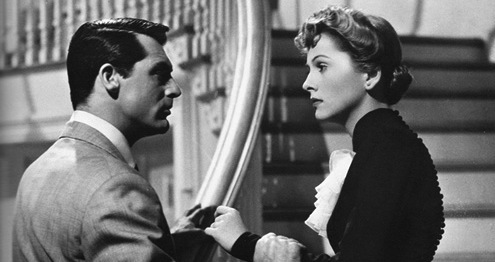
Is Cary Grant plotting to murder Joan Fontaine? Oh the Suspicion.

Director: Alfred Hitchcock

Cast: Cary Grant (Johnnie Aysgarth), Joan Fontaine (Lina Aysgarth), Nigel Bruce (Gordon Cochrane ‘Beaky’ Thwaite), Cedric Hardwicke (General McLaidlow), May Whitty (Martha McLaidlow), Isabel Jeans (Helen Newsham), Heather Angel (Ethel), Auriol Lee (Isabel Sedbusk), Leo G Carroll (Captain George Malbeck)

What do you do when you suddenly start to believe you might be living in a murder mystery? When you begin to think that the person you are married to might just be planning to dispatch you as well? That’s the big suspicion that haunts the mind of Lina Aysgarth (Joan Fontaine), a shy and meek heiress who has been charmed into marrying waster Johnnie Aysgarth (Cary Grant), a lazy spendthrift and playboy. After they elope together, she quickly finds out that Johnnie has no work ethic or talent at all other than spending money. As real estate deals fall through, and Johnnie steals money from his employer to cover his debts, Lina starts to worry that her life insurance is looking more and more tempting to Johnnie.

Suspicion is a decent, middle-of-the-road Hitchcock thriller, which deals with familiar themes of doubt, dread and (of course) suspicion, but with Hitchcock very much in second gear. He’s not helped by the neutering of the source material. The original novel is very much a story of a woman who works out that her husband is definitely trying to kill her. The producers here, however, couldn’t abide the idea that CARY GRANT could be plotting to kill his wife. So the story is rejigged at the end to turn Lina into a silly, paranoid woman and Johnnie into, well yes a playboy, but also one who has been treated badly because of the suspicion thrown at him. This may have flown in 1941, but it’s impossibly sexist today. Plus it means the whole film basically builds towards – well – nothing.

Hitchcock throws in the odd decent flourish – most famously the carefully lit glass of milk that Johnnie carries up the stairs near the film’s end, which may or may not be poisoned. But far too often the story seems to be taking place in a fairytale England, of horses riding to hounds, country villages, Agatha Christie style authors dispensing accidental poisoning advice, and careful class structures. For all the odd moments of danger, the film is safe, contained and as unthreatening as it can get. But the rest is Hitch on autopilot, which feels at time as a remix of the director’s earlier Oscar winning film Rebecca.

That mood carries across to Joan Fontaine as well in the lead role. Fresh off working with Hitchcock on Rebecca, Fontaine essentially recreates the same role again here as the timid, shy, would-be dutiful wife who wants to see the best in a husband who in fact seems dangerous and unknowable. Fontaine won the Oscar for this film – but it feels as much like a compensation award for her previous defeat for Rebecca as it does for Suspicion. Really she does very little here that lifts the film, or stretches her as a performer from her previous role. It’s a retread, and while it’s a trick she does well, it’s a trick she has done before.

A far more challenging performance comes from Cary Grant, who uses the role as a clever meta-commentary on his own persona. Johnnie has all the charm and engaging bonhomie of Grant himself, but all subtly twisted with a selfish superficiality and wastrel greed. Grant walks a very fine line of a man who could be plotting to murder his wife or could just be a greedy chancer – and walks it very well indeed. You always see that Johnnie is bad news, while also understanding why Lina finds him so engaging. It’s a terrifically skilled performance, a lovely riff on Grant’s own screen persona, that shows he’s a far better actor than people often give him credit for – and you feel he is only too willing to embrace the chance to play a weak-willed, opportunistic murderer with little conscience (except of course it turns out he isn’t a murderer). 

It’s a shame that nothing else in the film really rises to the occasion in the same way (although Nigel Bruce gives a very good performance as the gentle, ageing playboy Beaky). The film itself never really seems to be heading anywhere – it even takes a good two-thirds of its runtime before Lina begins to wake up to the fact that Johnnie is far from being the sort of husband women should dream of. It’s a bit slow, a bit too safe, and it largely lacks the element of danger. For the final few scenes, logic seems to evacuate the film as all the clues and hints we’ve had building towards us are shown to be – nothing more than red herrings and the inferences of a silly woman. Because, after all, CARY GRANT can’t be a murderer can he? No matter what he wants.

The Hunchback of Notre Dame (1939)

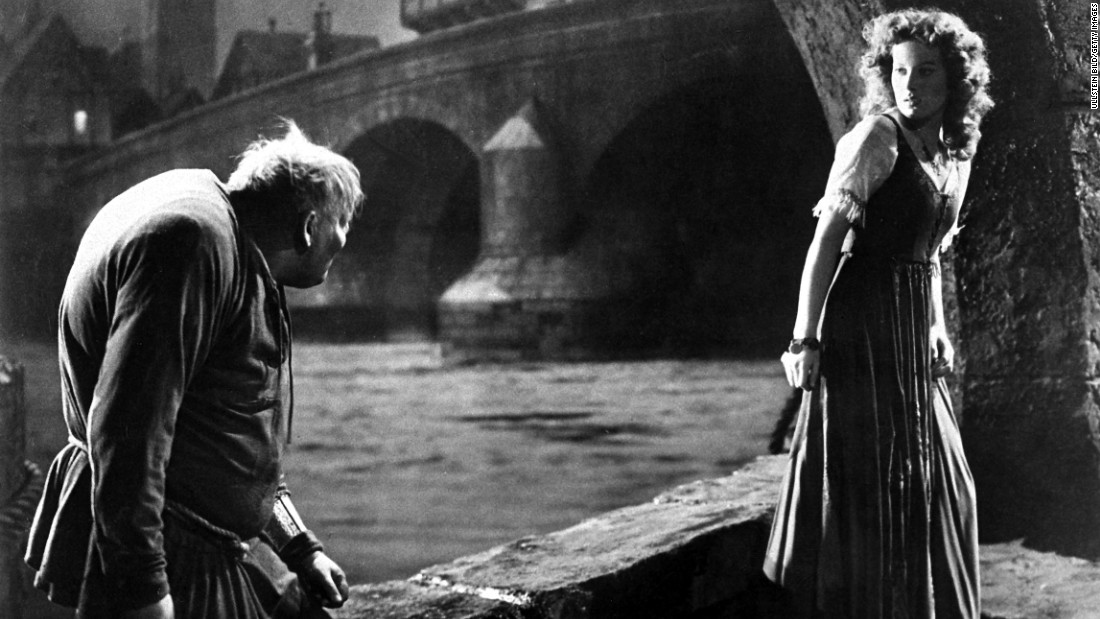
Charles Laughton looks on with longing as The Hunchback of Notre Dame

Director: William Dieterle

Cast: Charles Laughton (Quasimodo), Cedric Hardwicke (Jean Frollo), Thomas Mitchell (Clopin), Maureen O’Hara (Esmeralda), Edmond O’Brien (Pierre Gringoire), Alan Marshal (Captain Phoebus), Walter Hampden (Archbishop Claude Frollo), Harry Davenport (King Louis XI), Katherine Alexander (Madame de Lys), George Zucco (Procurator)

Victor Hugo’s gothic romance–slash-tragedy has been turned into a film so often, it’s a wonder anything that happens in it remains a surprise. But this 1939 version is perhaps the most influential, where Hollywood decided to throw money at the fable and try and make something as close as possible to the spirit of the book. But of course with a happyish ending on the end – because, you know, it’s still Hollywood!

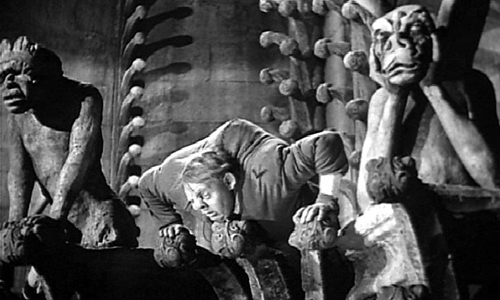
In 1470s Paris, the city is caught between the pressures of religion and new developments such as the printing press. In the centre of the city is the Cathedral of Notre Dame – where the bells are operated by foundling Quasimodo (Charles Laughton), a deformed hunchback driven deaf by the constant ringing of the bells. His benefactor, Judge Jean Frollo (Cedric Hardwicke), is running a vicious campaign to cleanse the city of the gypsies and beggars that make up a large part of its underbelly – but he’s hit for six when he falls in love (or rather lust) with beautiful gypsy woman Esmeralda (Maureen O’Hara). But he’s not alone – equally smitten are naïve young poet Gringoire (Edmond O’Brien), arrogant Captain Phoebus (Alan Marshal), and Quasimodo himself. When Esmeralda rejects Frollo’s advances she soon finds herself in danger – and her only hope of safety comes from unexpected sources.

Dieterle’s background in German expressionism and silent cinema shines through in this visually striking and opulent studio production, with its superbly marshalled crowd scenes, brilliant use of near-impressionistic shadows and fabulous camera work that drifts over the impressive (and hugely expensive) set. Dieterle mixes this technical expertise with a real sense of emotion and character development, helped by some terrific performances from the cast. It’s a film that motors through the story of the novel, but skilfully repackages it as both a fascinating semi-romance and a sort of urban tragedy, as well as a subtle mediation on love and lust.

At the centre of it, you have Charles Laughton giving probably the definitive performance of the hunchback. Sweating under layers of make-up and an artificial hump, Laughton is nearly unrecognisable as the bell-ringer. His triumph is to make a gentle, tragic character emerge from make-up that suggests more Frankenstein’s monster than tragic hero. Nearly wordless for the first hour and a half of the film, Laughton does his magic with an expressiveness that speaks volumes of the loneliness in Quasimodo. Tenderly, he watches people knowing he can never be part of their lives – and look how excitedly he bursts out when he finally gets a chance to speak to Esmeralda one-on-one. Suffering punishment on the wheel, Laughton’s eyes convey the numb acceptance of pain as his natural state of affairs. But he also manages to bring out the gentle, childlike qualities of Quasimodo. It’s a wonderful, wordless, expressionistic performance – a triumph of physical acting and wonderfully judged emotional vulnerability.

The rest of the cast match Laughton stride-for-stride. Censor demands at the time required that Frollo be removed from his position (in the novel) as Archbishop, so the book-version of the character is split in two here. Archbishop Frollo is the sort of pious bore who can keep the Hayes committee happy. But Cedric Hardwicke gets to play the invented evil brother Judge Jean Frollo, the lecherous hypocrite from the novel. An authoritarian ascetic, Hardwicke’s Judge Frollo is lean, mean and utterly ruthless – and totally in denial about both his lustful feelings and hypocrisy. Hardwicke is virtually an archetype of the sinister authoritarian, but he manages to never chew the scenery. Incidentally, knowing the two characters are basically split from the original book, does allow moments of fun imaging the moral debates between the two as a sort of split personality discussion.

But there are plenty of other good performances as well – not least from Maureen O’Hara, who is charming and engaging enough to make you believe that the whole male cast is in love with her. Edmond O’Brian goes large at times with the passionate romance, but he does a very good job in the role. Thomas Mitchell is good value as the leader of the beggars, Clopin. There are strong performances across the whole film.

All these performances are framed within a fabulous design. The trouble and expense that has gone into the construction of the set is inspiring, the sweeping gothic arches and towers giving every shot something exquisite to look at. It also gives never-ending options for camera placement and impressionistic imagery for Dieterle. It works as well – the gloomy, imposing towers of Notre Dame are captured with real artistry, while the shadow it casts over the whole city of Paris serves as a constant reminder of the oppression the city lives in.

Dieterle also brilliantly films the crowd scenes, getting a superb sense of visceral emersion from these sequences. Whether the camera is in the mix, or flying above the crowds from the tops of Notre Dame, these scenes look equally fantastic. Dieterle handles the more action-related scenes with particular skill – Quasimodo’s rescue of Esmeralda from a death sentence is particularly well staged in its dynamism and graceful filming. 

Not every beat works. The portrayal of Louis IX as a sort of kindly old uncle seems off-piste from the very start. The early sequences sometimes get bogged down too quickly in set-up rather than getting into the action. Alan Marshal is rather wooden as Captain Phoebus, although the film goes surprisingly far in suggesting the dark desires and predatory sense of danger that comes from the character. Some of the beggar court sequences get similarly stuck in kitsch.

But these are minor beats. It’s a film that really understands emotions and makes the dramatic thrust work. It also has a dark sexual power, not least in Hardwicke’s Frollo: a seething mess of frustrated desires. It never loses sight of the sadness at the heart of its central character’s story, of his loneliness and isolation, and manages to communicate this brilliantly in every scene where the character appears – he is trapped by his muteness, his ugliness or his sadness at every turn. It’s a development that never fails to be engrossing and finally moving. It’s a film that is brilliantly assembled with real technical skill, very well acted and wonderfully directed.

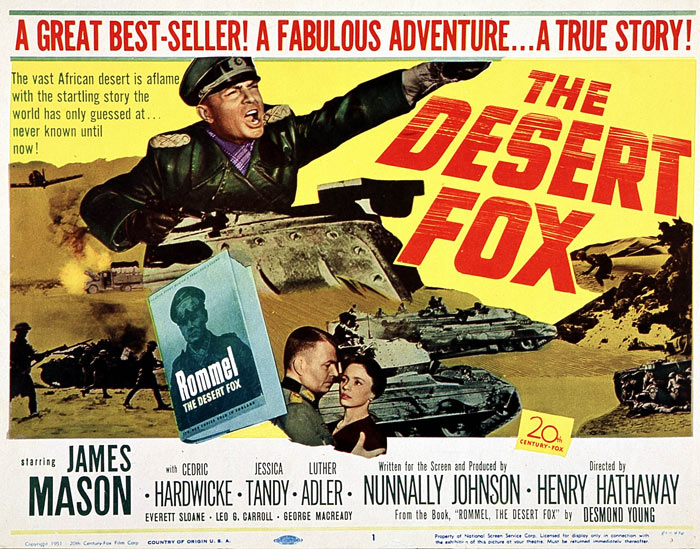
The Desert Fox (1951)


James Mason rides into action as a sympathetic Nazi

Director: Henry Hathaway

Cast: James Mason (Field Marshal Erwin Rommel), Jessica Tandy (Lucie Rommel), William Reynolds (Manfred Rommel), Cedric Hardwicke (Dr Karl Strölin), Luther Adler (Adolf Hitler), Everett Sloane (Gen. Wilhelm Burgdorf), Leo G. Carroll (Field Marshal Gerd von Rundstedt), George Macready (Gen. Fritz Bayerlein), Richard Boone (Capt. Hermann Aldinger), Eduard Franz (Col Claus von Stauffenberg)

It’s pretty astonishing when you think about it that less than six years after World War II ended, Hollywood produced a film about one of Germany’s leading generals which painted him in a largely positive light. Even more of a surprise is that this was a box-office hit. But then this film was designed to be a step towards reconciliation – especially with one eye on the Cold War and the need for Germany as an ally.

James Mason (brilliant in one of his most iconic roles) plays Rommel, with the film beginning just as the tide of war turns in Africa at El Alamein. Of course, this allows a lot of talk of Rommel being a noble fighter and brilliant general, without having to awkwardly show him chasing the Sixth Army across Africa! From his defeat to Montgomery (unseen but often referenced), Rommel slowly loses his faith in Hitler, realising the Fuhrer cares little for the lives of his soldiers. Gradually he becomes closer to the conspirators of the July 1944 bomb plot to assassinate Hitler. When it fails, he is given the choice: suicide and a hero’s funeral or execution as a traitor for him and his family.

The film is notable for opening with an exciting James Bond-style action sequence, a 1941 raid by British commandos on Rommel’s HQ (codenamed Operation Flipper), designed to grab the viewer’s attention – and to provide the action in a war film that otherwise has virtually no combat in it. It’s a terrific opening that immediately establishes the importance Rommel holds. The Desert Fox was one of the first films to use this device of an action prologue to open the story – the sort of thing James Bond has since mastered.

From there, Hathaway’s journalistic film (much of the World War II footage is reused from newsreels) is very smoothly and professionally directed, turning the last few years of Rommel’s life into a classic morality tale. Whether this is completely true or not (more recent research on Rommel suggests he was a much more enthusiastic early supporter of the Nazi party than suggested here), there seems little doubt that he was at the very least sympathetic to the July 1944 bomb plot. Rommel here is a man who sees the light too late – and pays a heavy price.

Nunnally Johnson’s well-researched and tight screenplay focuses on conversations and political manoeuvering, with Rommel presented as apolitical and straight shooting, clumsily working through debates he lacks the political sophistication to understand. Johnson’s script also provides excellent opportunities for sparkling cameos. Leo G. Carroll is particularly good as Rommel’s frustrated and cynical superior, but there are also stand-out performances from Everett Sloane as a lackey from High Command and a memorable cameo of controlled ranting extremity from Luther Adler as Hitler.

The film, though, is carried by James Mason’s subtle and sympathetic performance. Mason has the charisma, his upper class manner perfect for the military man, but he isn’t afraid to play both positive and negative. So we get his arrogance and wilful blindness, showcased in scenes where is passionate defence of Hitler is as much an attempt to persuade himself as others. But we also see his loyalty to his men and the tenderness of his relationship with his wife (played well by Jessica Tandy). Mason’s performance is compelling and soulful.

It’s not a perfect film. There are some slightly clumsy links at the start back to the source book written by Brigadier Desmond Young, who served in North Africa. Young cameos at the start in reconstructions of his meeting-at-a-distance with Rommel and his post-war research. Narration from the book is a worked into the film – and having heard the real Young speak, its mid-Atlantic tone is rather jarring. The narration often serves as a transition from event to event, but this is never completely smooth, meaning there are some odd jumps.

But it’s a very decent, very professionally done piece of film making. Its version of Rommel isn’t seen as the whole story today (there is a whole historiographical argument about the “Rommel Myth” of the man as an apolitical soldier or willing accomplice), but it’s very consistent within the film. Very well acted and scripted and very professionally directed, it’s a political film cunningly disguised as a war film, which does a very good job of creating the atmosphere of Nazi Germany and in re-creating historical events and has an excellent lead performance from James Mason.