Sumptuous silent-epic, full of exciting set pieces that was basically the model for the more famous version
Director: Fred Niblo
Cast: Ramon Novarro (Ben-Hur), Francis X Bushman (Messala), May McAvoy (Esther), Betty Bronson (Mary), Claire McDowell (Miriam), Kathleen Key (Tizah), Carmel Myers (Iras), Nigel de Brulier (Simonides), Mitchell Lewis (Sheik Ilderim), Leo White (Sanballat), Frank Currier (Arrius), Charles Belcher (Balthazar)
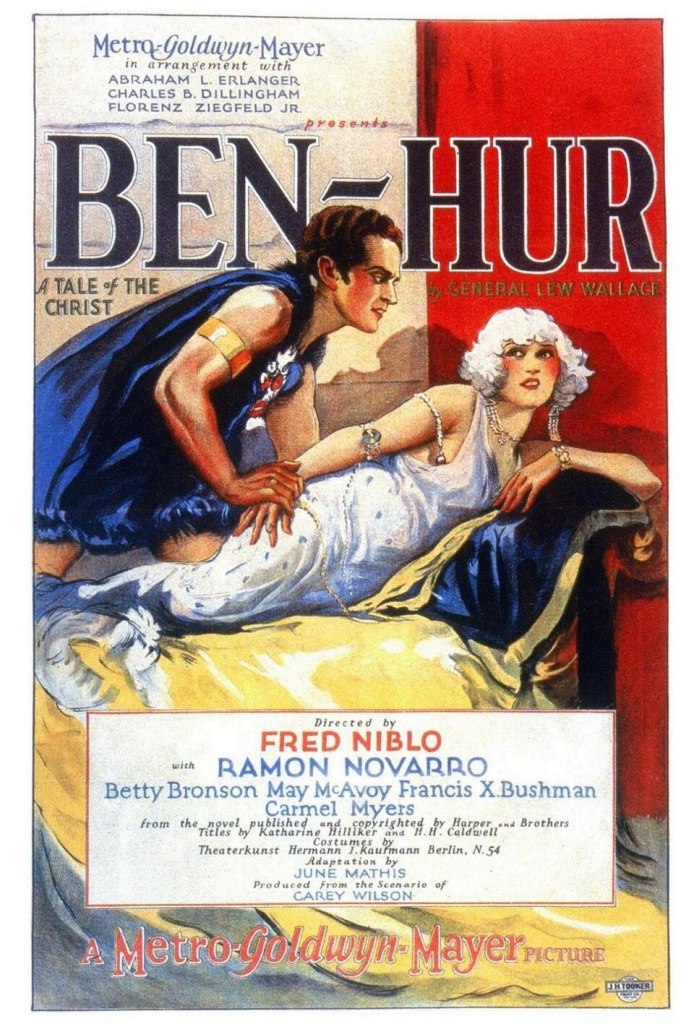
Of course, General Lew Wallace’s tombstone historical novel is now best known as the Heston-led, Oscar-winning behemoth Ben-Hur, the self-proclaimed most epic epic ever to arrive on the screens. But it was not the first time this novel had made its way to the screen. Wyler’s film owed a vast amount to this 1925 epic, which inspired so many of its key sequences you’d have to call his version a re-make. This gigantic silent film was itself the second attempt to screen Ben-Hur, but with all the strengths of the 1959 film (namely the set-pieces like that chariot riot) but without some of its weaknesses (its crushing length and heavy-handed self-importance) it’s the better film.
Opening with the birth of Christ, the story is, as always, that of wealthy Jewish noble Judah Ben-Hur (Ramon Novarro) whose old friendship with Roman Messala (Francis X Bushman) collapses into life-long loathing when Messala has Ben-Hur arrested on trumped-up charges and, for good measure, chucks his mother Miriam (Claire McDowell) and sister Tizah (Kathleen Key) into a dungeon. Judah becomes a galley slave until he saves the life of Roman General Arrius (Frank Currier). Adopted as Arrius’ son, Judah returns to Jerusalem for revenge against Messala and to find his missing family. With the best revenge possible being defeating Messala in a deadly chariot race.
Ben-Hur: A Tale of the Christ is gargantuan in a way only the great silent epics could be. It features huge reconstructions of ancient Jerusalem, crowded with armies of extras – in its opening shots alone, elephants ride through the gigantic gates of the city. Sprawling sets, shot with perfect wide scale to hammer home their size, run throughout the whole film, with the chariot race set a towering grandstand further increased by a skilfully used matte painting. Its set pieces – the naval battle and the chariot race – are both awe-inspiring in their scale, the match of anything in the 1959 film. It’s impossible not to be slightly taken aback by the weight of what it thrown up on screen here.
In this grand-scale, the expressive pose-striking of Ramon Novarro actually feels rather fitting. Particularly as his moments of distraught guilt and fear feels earned, considering the misery of the galleys and the emotion-packed struggle of his family to try and escape unjust arrest. But also, because Novarro has the handsome, matinee-idol looks of a guy you can root for (he replaced George Walsh, who was deemed insufficiently heroic looking). It works because Ben-Hur, for all its ‘Tale of the Christ!’ background, is basically a great big Roman-era soap, an entertainingly, rollicking tale through the turn of the millennium ups-and-downs of a handsome prince who always lands on his feet.
He does so via some truly excellent set-pieces. The naval battle, where Judah wins his freedom, is set on a truly impressive scale. Naval ships crash into each other, soldiers and pirates flood the deck of the flagship. During the battle limbs are hacked off, bodies are skewered and crushed (including one poor soul, tied to the head of the pirate’s ship batting ram, as it ploughs into the Roman flagship) and a newly released Judah escapes the watery doom of the galleys to spray pirate-defying death left, right and centre. It’s a gripping sequence, told on a huge scale.
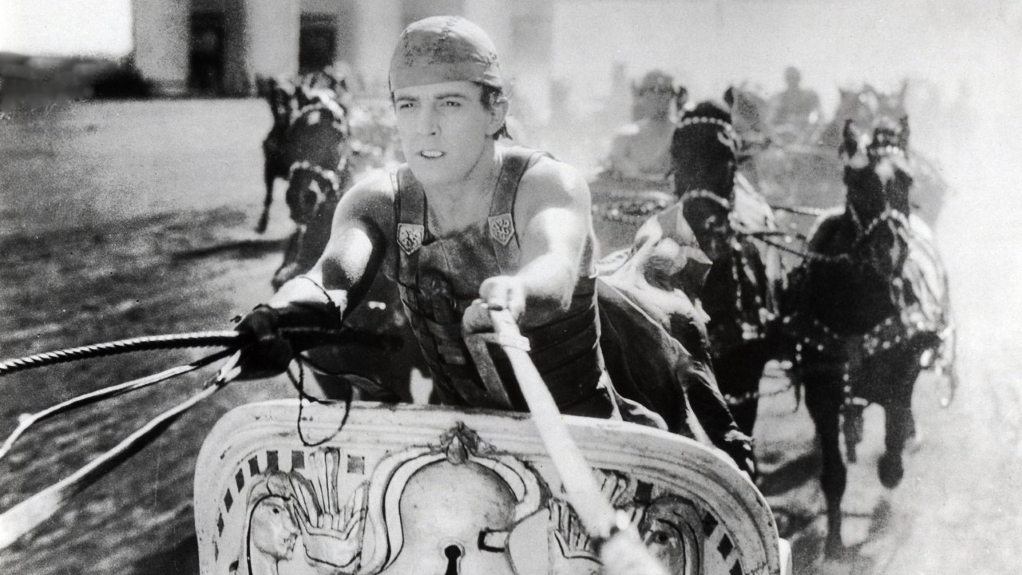
Even more impressive though is the marvellous chariot race, a sequence so compellingly edited and assembled it not only was essentially used as a shot-for-shot reference in the remake, but its arguably inspired countless race sequences since. From its camera tracking alongside and in front of the racing chariots, low angles that see the chariots racing above, the frantic cutting that keeps momentum flying without ever losing narrative clarity, and the skilful way it keeps returning to Judah and Messala’s very personal battle, its masterfully done. In a nice touch, Judah drives the only white horses meaning we can always spot him. As chariots rip round bends, leaving dust spraying, crash into terrifying pile-ons or leaves competitors mangled and crushed on the track, it’s impossible not to feel impacted by the relentless momentum (certainly Willaim Wyler was – he was one of the assistants working on the sequence).
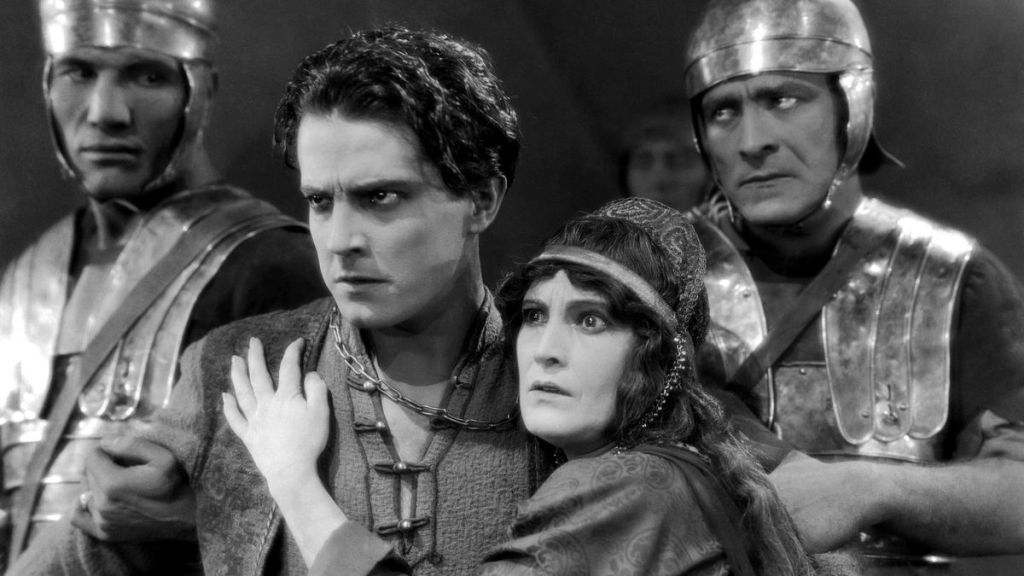
Away from these dramatic highlights, Ben-Hur remains a soapy, melodramatic tale. The tragic force is dialled up, with Judah’s family suffering for years in a blue-lens-tinged prison, succumbing to leprosy. Bushman’s Messala is devoid of complexity, embracing his role as pantomime villain with relish. Iras (Carmel Myers) bats her eye-lids to seduce both Judah and Messala, playing the two off each other. Its one of two soft-focus romances, that the film frames with unabashed sentimentality. Judah throws himself into a passionate advocacy of the coming of the Lord, the film frequently throwing him into military garb (at the head of a self-funded army to fight the Good Fight) that looks bizarrely like he’s stepped out of Fritz Lang’s Die Nibelungen.
What makes this nonsense work is the film doesn’t take it too seriously and, unlike the 1959 version, doesn’t dwell on it all at great length. However, what it does share with the remake is the reverence for the story of Jesus. Some things never change, and Hollywood worked out an action epic could seem far loftier if it was marketed as “truly the film ever Christian should see!” The Messiah is a frequent just-off-camera figure (just as he would be in 1959), his hand heading into shot to heal the sick or pass a dying Judah some water. The final sequence plays out with the crucifixion front-and-centre and a grieving but rapturous Judah telling us all He will rise again.
Many of the recreations of the Bible – starting with its nativity opening – are filmed in a post-production painted early colour, with the references for the colour clearly being the very best religious art of the Renaissance, most clearly in its beatific Mary complete with halo-like effect. The film returns to these time-and-time again, taking a break from the soap opera to give us worthy shots of the history of Jesus, that look rather like reverent stained-glass windows. It’s all part of adding an important spiritual purpose to the film, to cement it as more important than just sword-and-sandals epic.
In that it’s not dissimilar from the remake. What it does though is manage to wear this slightly lighter and slightly less of an air of bumptious self-importance. Match that with the film’s compelling action highlights and truly stunning scale and you might have a leaner, faster and perhaps just as entertaining version of the story – even if it is in silent and black-and-white. It can certainly claim to be the finest version of Lew Wallace.