Tag: Brandon Hurst

The Man Who Laughs (1928)

The Man Who Laughs (1928)

Gothic romance, wrongly remembered as a proto-horror, also has a dark sexual undercurrent

Director: Paul Leni

Cast: Conrad Veidt (Gwynplaine), Mary Philbin (Dea), Olga Baclanova (Duchess Josiana), Josephine Cowell (Queen Anne), George Siegmann (Dr Hardquanonne), Brandon Hurst (Barkilphedro), Sam De Grasse (James II), Stuart Holmes (Lord Dirry-Moir), Cesare Gravina (Ursus)

The Man Who Laughs often gets remembered as a horror film, which seems a bit odd when you actually watch this Victor Hugo adaptation. It’s really a sort of melodrama romance with a touch of conspiracy-tinged action. What possibly cements it as a comedy is the Glasgow-smile of its lead character Gwynplaine, played by that legend of silent cinema monsters Conrad Viedt. (It went on to inspire the look of The Joker, further cementing the film as horror in minds). But, far from a monster, Gwynplaine is a sweet-vulnerable figure who has find himself at the centre of an atmospheric drama with lashes of shadow and Gothic German expressionism from its director Paul Leni.

Gwynplaine has his twisted smile after his face was mutilated as a child, a punishment for his executed father, stripped of his lordship by order of James II (Sam De Grasse). Years later, in the reign of Queen Anne (Josephine Cowell), Gwynplaine is the leading figure of a travelling band of players, famous as the Man Who Smiles. He’s in love with the blind Dea (Mary Philbin) but disgusted and ashamed of his own appearance, which prevents him declaring his love. But his ancestry is discovered, as his (unwanted) claim to the title now held by the nymphomaniac Duchess Josiana (Olga Baclanova), and he becomes the centre of a scheme for power by the sinister Barkilphedro (Brandon Hurst).

The Man Who Laughs main focus is the gentle romance between Gwynplaine and Bea, which becomes absorbed into a tragic story of creeping gothic power. Gwynplaine wants nothing more than to be left alone. He hates being the centre of his attention, only really comfortable when disguised under theatrical make-up or with the blind Dea. Even then, Gwynplaine refuses to let her touch his face so terrified is he that she will reject the twisted facial features that she will find below her hands. This is told with a gentle, sympathetic sweetness by Leni, who dials down the misty misery and darkness that casts its shadow over the rest of the film, to allow this romance to spread hope.

It’s far different from the gloomy, gothic foreboding that covers the rest of the film in its frequently shadow and mist filled frame. From its opening in the bedroom of King James – lined with stony carvings that look like they’ve been peeled off the wall of an ancient Minster – it throws us into a grizzly execution for Gwynplaine’s father, locked into a spike-lined Iron Lady with a stoic look on his face. The banishment of Gwynplaine, along with the bizarre cult who deformed him, on a rickity ship passes through a frozen coast-line, where the young boy is cast aside the moment the going gets tough. From there, we see streets filled with hints of violence under the mists. Brandon Hurst’s darkly twisted Barkilphedro is the sort of man who thinks nothing of dispatching a witness to the torture chamber or dragging a victim in the middle of the night to who-knows-where. Hurst is an unsettling stand-out here, playing a man with no sense of loyalty or honour, happy to lie and manipulate as well as slimly ingratiate himself to anyone in power.

The gloomy sense of danger that this world is filled with is captured superbly in Leni’s film, which is stuffed with atmospheric compositions that only stress the unsettling sense of peril lurking around every corner. It’s also a world filled with perverse sexual longing. It’s hard to imagine The Man Who Laughs having a whisper of existing a few years later under the Hays Code, such is the dark sexual current flowing beneath it. Frequently sexual desire rears its head, from the coded glances Queen Anne gives the missing chair of the Duchess, to the base desires that drag Gwynplaine from his bed one night to explore a beguiling offer from the Duchess.

The Duchess is the heart of the sexual darkness in the film, an allusive seductress we are introduced to lazing practically naked on a bed, attempting to seduce Barkilphedro to follow her whims with him perching at the end of her bed and allowed a peek of her (possibly non-existent) underwear. Not until Basic Instinct would another villainous of such rampant, unabashed sexuality hit the screen. The Duchess is as sexually excited by the thought of men fighting over her on the street (and its implied would be more than happy to satisfy any number of winners) as she is hornily fascinated by Gwynplaine’s unusual features. She is able to puppet along Stuart Holmes’ clueless Lord, who can barely tear his eyes from her even while he knows she is treating him like dirt. Her sensuality even runs the risk of seducing our hero, and her unabashed revelling in her sexuality feels light years ahead of its time.

But the lasting impact of The Man Who Laughs comes from its lead character, wonderfully embodied by Conrad Veidt in one of the legendary silent performances. Labouring under the facial disfigurement make-up – which left his face and mouth sore and exhausted – Veidt belays the restrictive nature of his make-up to offer a parade of expressions, variations on the same smile. Devotion, shame, joy, excitement, fear and hope play across his face so clearly that, even with the lower part of his mouth rigidly fixed, it’s always certain exactly what he is feeling. Presented to the House of Lords at the film’s end, Veidt is given a marvellous set-piece of moral force, berating the crowing bewigged courtiers who turn on him and vigorously asserting his right to choose. It’s a crowning moment of a subtle and moving performance.

And it makes Gwynplaine so sympathetic, it’s even more unusual that it’s been remembered as a horror, for all the film ends in a gothic chase and the brutally bloody intervention of a loyal but fierce wolf hound. Because The Man Who Laughs is, in the end, a hopeful and undeniably romantic testimony to how love can in fact conquer all, which for all its gothic gloom, leaves us sailing into a sunset relieved that the future promises all the best for our heroes.
The Thief of Bagdad (1924)

The Thief of Bagdad (1924)

Fairbanks swings into action in this grand-scale epic that’s still gloriously entertaining

Director: Raoul Walsh

Cast: Douglas Fairbanks (Ahmed), Snitz Edwards (His associate), Charles Belcher (Holy man), Julanne Johnston (Princess), Anna May Wong (Mongol slave), Sôjin Kamiyama (Mongol prince), Brandon Hurst (Caliph), Tote du Crow (Soothsayer), Noble Johnson (Indian prince)

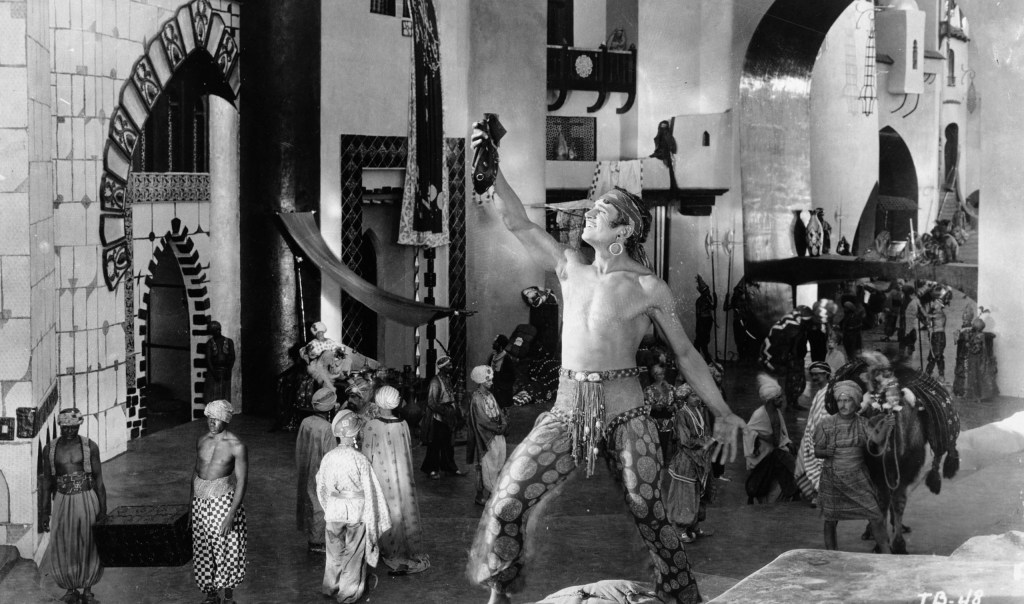
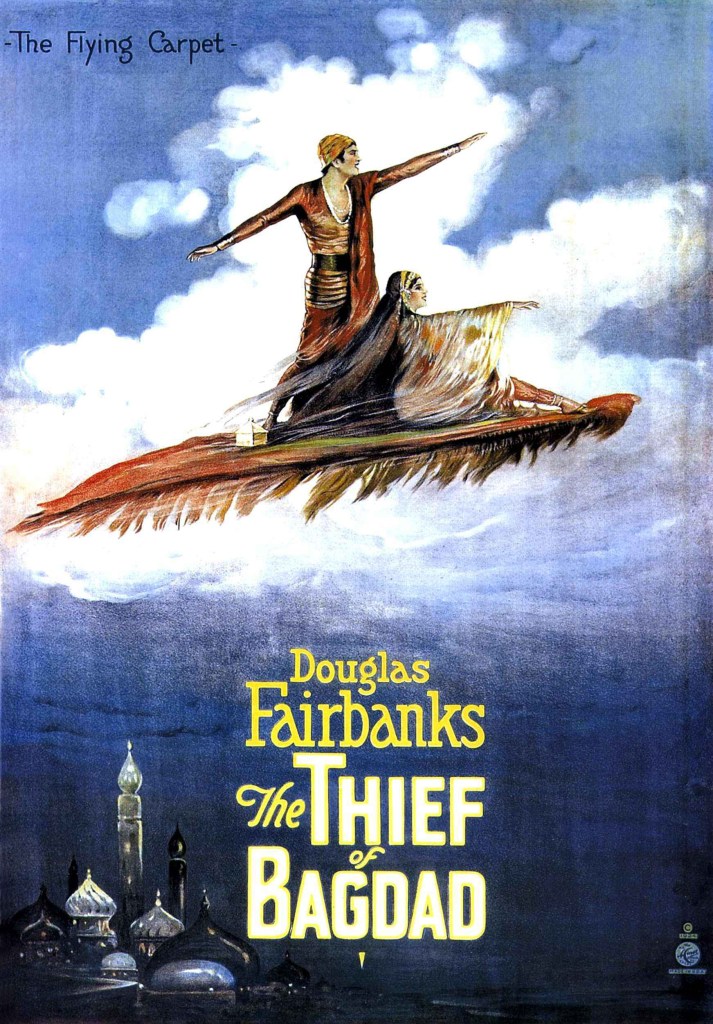
There was perhaps no bigger star of the silent screen than Douglas Fairbanks. The Thief of Bagdad was his Magnum Opus, lushly filmed (over a year in the making) adaptation of the Arabian Nights into a swashbuckling epic where our bare-chested hero leaps and bounds over every obstacle on his way to heroic glory. It remains wildly entertaining, a pacey thrill ride crammed with excellent stunts and impressive special effects.

Fairbanks is Ahmed, a good-for-nothing thief who disdains the rules, saying ‘What I want, I take’. How can this guy learn a little humility? Perhaps from the sight of a beautiful woman. Ahmed sneaks into the palace (via a magic gravity-defying rope) to filch treasure, falling instantly in love with the Princess (Julanne Johnston). Ahmed passes himself as a Prince to join the suitors looking to win her hand. Among them is the villainous Prince of the Mongols (Sôjin Kamiyama) who plans to conquer Bagdad, with the aide of the Princess’ treacherous slave (Anna May Wong). After he reveals his identity, and is banished, will Ahmed still do everything he can to save the city?

Of course he will! Along the way he’ll perform a parade of stunts and fits of athletic derring-do that helped make Fairbanks a beloved household name. Fairbanks is larger-than-life; in more ways than one, he’s a master of the gesticulating school of silent cinema, throwing his arms up and twisting his body into a series of emotional poses. Here he has the chiselled frame (on display for virtually the whole film) that comes from over a year of running, jumping, climbing and throwing himself through things.

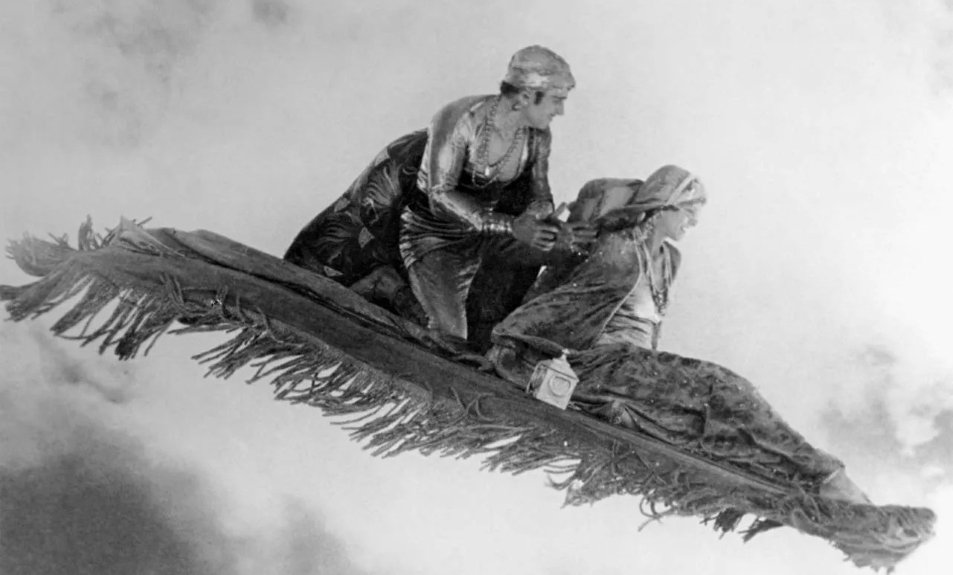
A large part of the fun of The Thief of Bagdad is soaking in Fairbanks’ natural charisma, from his introduction feigning drowsiness at a water fountain to pick pockets, to the magic carpet riding athleticism that ends the film. The film offers a parade of stunts carefully worked out to the minutest detail. A bounds in and out of giant pots. He climbs up ropes and launches himself through windows. He fights monsters and jumps from walls in athletic leaps. He balances precariously on high ledges. Only Buster Keaton rivalled his obsession with showstopping stunts.

It’s not surprising Raoul Walsh’s film sits back and keeps the camera largely in mid-shot so we can soak up all the action. This is massively to the benefit of the enormous sets, brilliantly designed by William Cameron Menzies, which tower up several stories. The mighty buildings and city walls of Bagdad, with its gate looking like a giant gaping maw, are particularly impressive. The city walls constantly have people walking them to confirm what we are looking at is real. The frame stretches to the mighty scope of the film (and of course, Fairbanks’ was hardly designed for the intimacy of the close-up).

The set-piece special effects and sets also bring the more magical Arabian Nights moments to life. A rope, charmed to spring up and suspend itself in mid-air (in actuality an illusion captured by filming upside down, which is almost more impressive when you think of Fairbanks clinging upside down to a rope). A collapsing pot, a cloak of invisibility thrown around Ahmed, magic dust that brings to life your heart’s desire. And, of course, the impressive flying carpet (a steel platform on intricate wires, dangerous enough that it was the last thing filmed). There is a real magic about these practical effects, just as there is something impressive about the real tigers guarding the palace.

The Thief of Bagdad arguably starts slow: our introduction to the thief takes up much of the first thirty minutes and it is nearly an hour before the real meat of the story takes off. Much of the final act sees the thief engaged on an epic quest via a host of locations – caves of fire! An underwater kingdom! A palace in the clouds! – that doesn’t always make a lot of narrative sense, but looks impressive. Of course the real focus is less on the story and more the thrills of Fairbanks jumping through cavernous flames or duelling a series of fierce creatures (which, to be honest, look like the sort of rubbery abominations Doctor Who would spend the 80s tackling).

The story frequently flies by with very little sense. The machinations of the Prince of Mongols (an effectively sinister Sôjin Kamiyama) are not always clear, but certainly threatening enough. The Thief of Bagdad sees this wicked prince’s schemes come to fruition in a surprisingly terrifying palace siege (though it also features such laugh-out-loud ridiculousness as a villainous sidekick stirring boiling oil in a jar the size of a swimming pool). The he film’s most interesting performers are on the side of the villain – Anna May Wong is particularly fine as the duplicitous servant – making their dastardly deeds engaging, even if they are not always logical.

It’s perhaps not surprising that the real villains are played by actual Asian actors, while the heroes are all white Americans playing Asians. But that’s par for Hollywood’s course – and one of those is Noble Johnson virtually ‘whited-up’ as the Prince of India (interestingly the other potential suitor is played by a woman, Mathilde Comont in a fine comedic performance). Julanne Johnstone’s Princess, on the other hand, makes little impact (there must have been very little left to play with when sharing the scene with Fairbanks), with the same true for the rest of the court while Snitz Edwards is a rather uncomfortable stereotype as the thief’s assistant.

There are other dated moments – it’s hard not to imagine that no film today would have its lead character storm into a mosque and announce all its teaching bunkum – while a call to prayer sequence, obeyed by all mid-chase, is awkwardly played for comedy. Other parts must have looked silly at the time, not least Fairbanks’ awkward slow-motion walking when fighting under the sea (no idea how the thief breathes down there). But then you’ll get a daring climb of a giant statue or Fairbanks leaping on a horse and riding through some gorgeously filmed desert at breakneck speed and it’s all fine.

The Thief of Bagdad isn’t trying to be more than entertainment – and its careful ‘show the money’ framing and filming offers very little in the way of cinematic invention (unlike its stunts and cutting-edge special effects). But it’s extremely impressively mounted and very good fun, exactly the sort of rip-roaring entertainment its star made his stock-in-trade.

The Hunchback of Notre Dame (1923)

The Hunchback of Notre Dame (1923)

Chaney establishes his own legend in this crowd-pleasing epic, shot on the grandest scale

Director: Wallace Worsley

Cast: Lon Chaney (Quasimodo), Patsy Ruth Miller (Esmeralda), Norman Kerry (Phoebus de Chateaupers), Kate Lester (Madame de Gondelaurier), Winifred Bryson (Fleur de Lys), Nigel de Brulier (Dom Claud), Brandon Hurst (Jehan), Ernest Torrance (Clopin), Tully Marshall (Louis XI), Harry van Meter (Mons. Neufchantel)

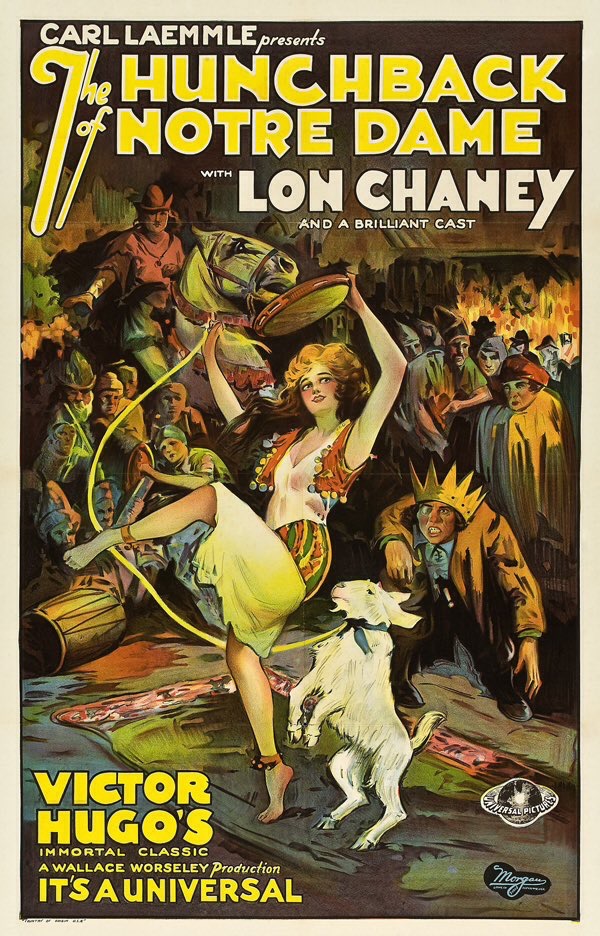
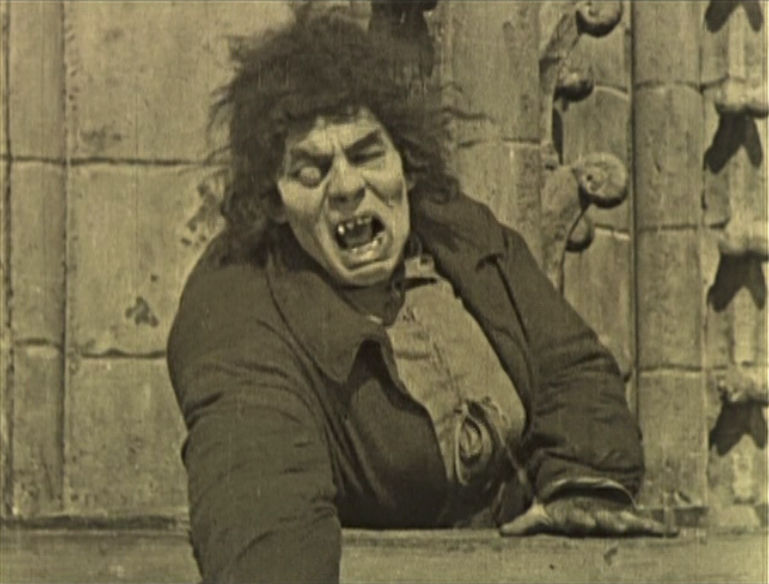
If any film cemented Lon Chaney’s reputation as ‘Man of a Thousand Faces’ it was this. Chaney knew Quasimodo was a gift for him, securing the rights for himself and shipping them around the major studios until Universal Studios bit. Setting up the project as a ‘Super Jewel’ (with Chaney taking a handsome pay cheque), a near full scale reproduction of the exterior (and many of the interiors) of Notre Dame was built on the Universal set and the film became a smash hit.

Quasimodo (Lon Chaney) is the frightful bellringer of Notre Dame cathedral, a lonely hunchbacked man, mocked and scorned by Parisians. Half-deaf after years of bellringing, he is in thrall to his master Jehan (Brandon Hurst), brother of the saintly Dom Claud (Nigel de Brulier). Jehan tasks Quasimodo to kidnap the beautiful Roma girl Esmeralda (Patsy Ruth Miller), adopted daughter of Clopin (Ernest Torrance), ‘king’ of the beggars. It fails, but the arrested Quasimodo is treated with kindness by Esmeralda and falls in love with her. Esmeralda though is in love with roguish captain Phoebus (Norman Kerry), only to be accused of attempted murder after the jealous Jehan stabs him. Quasimodo rescues Esmeralda as the city collapses into revolt.

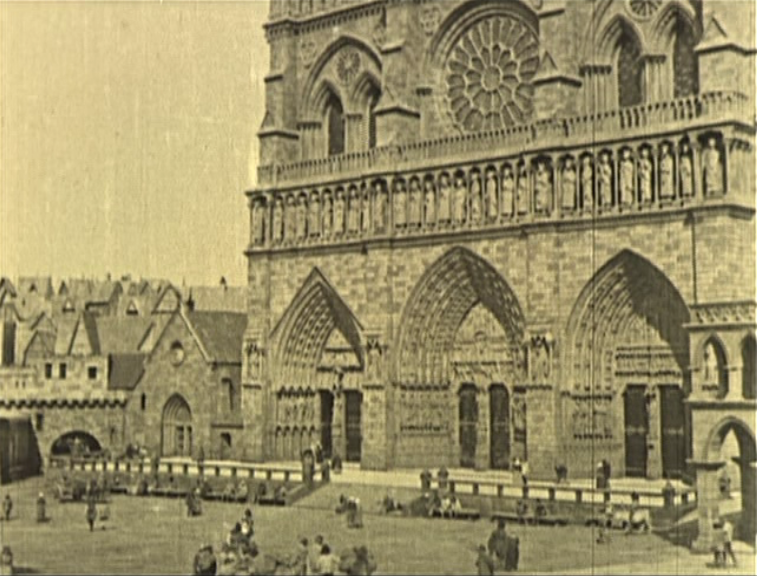
Brilliantly assembled by producer Carl Laemmle, Hunchback looks amazingly impressive. The reconstruction of Notre Dame (and the square around it) is genuinely stunning in its scale and detail. (Surely thousands of viewers believed it’s the real thing!) The sets inside the cathedral skilfully use depth perception to create cloisters that seem to go on forever. Crowd scenes fill the film with vibrancy: from the off, with its medieval feast of fools, it’s a dynamic explosion of energy, with everything from men dressed as bears to dancing skeletons, full of raucous naughtiness. Later battle scenes (including a cavalry charge) before Notre Dame’s doors brilliantly use the sets striking height.

The film’s finest effect though is Chaney’s Quasimodo, a portrait of sadness and timidity under an aggressive frame. Chaney’s physical dexterity and ability to bend and twist his body is put to astonishingly good effect, as a he swings on bells, clambers up and down the set and contorts his body into a series of twisted shapes that drip of pathos. He finds a childlike innocence in this man who knows virtually nothing of the real world and latches onto those who show him affection with a puppy-like adoration.

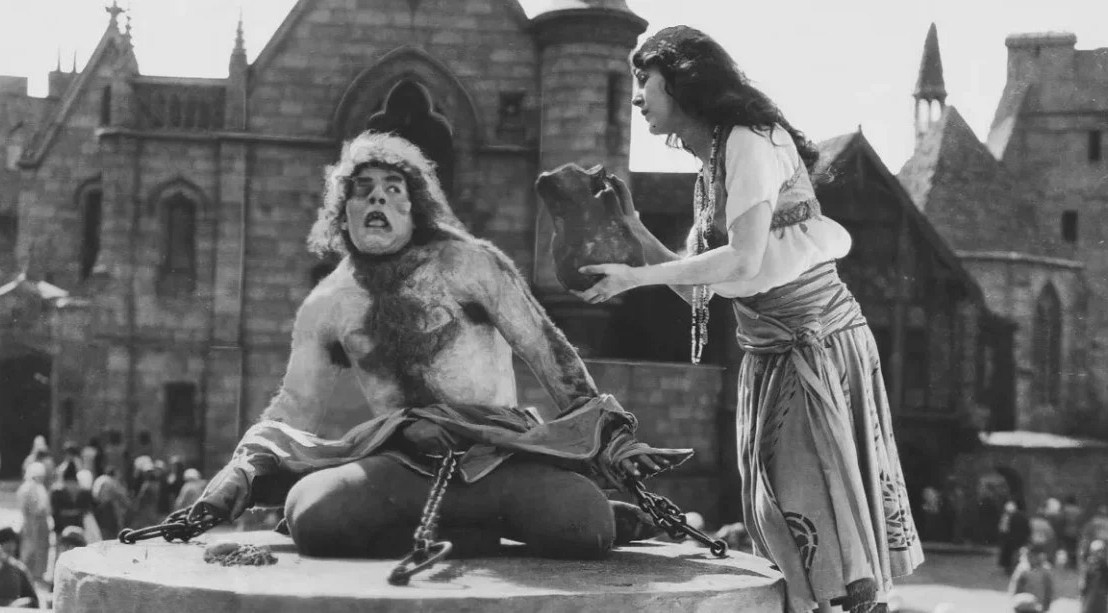
The film’s finest sequences show-case Chaney: whether that’s following his graceful descent down the walls of Notre Dame or seeing his fear and vulnerability exposed in front of the crowd. In a film of such vastness, perhaps its most striking moment is one of genuine intimacy. Tied to a wheel for a public lashing (taking the rap for Jehan’s misdeeds), Chaney retreats into shame and fear and recoils in terror when Esmeralda approaches him – only to soften and almost collapse into a pool of gratitude when she tenderly offers him water rather than the abuse the crowd gives him.

It’s a striking testament to Chaney’s mastery of physical transformation, but also his ability to humanise those who appear as monsters. Quasimodo’s genuine love for Esmeralda is very sweet, as his bubbly excitement at experiencing such feelings for the first time. Chaney’s determination to protect Esmeralda at all costs (including misguidedly defending Notre Dame from a gang of beggars as bent on protecting her as he is) is very touching. It’s a genuinely great performance.

The Hunchback of Notre Dame cemented the public image of the novel – most of the (many) later versions that followed used it as an inspiration. For starters, it moved Quasimodo into the most prominent role. Forever more, the public image of the novel was a lonely, tragic man, swinging on bell ropes and shouting sanctuary. Not just that: this film started a trend of splitting the novel’s hypocritical churchman Frollo into two characters (here a noble priest and his villainous brother) to avoid making a man of the cloth a villain. It also started the ball rolling on re-interpretating the selfish Phoebus as more of a matinee-idol romantic figure. Not to mention seeing the film as a gothic-laden, semi-romance with Hugo’s social and political commentary utterly shorn off.

Today we only have a reduced road-show cut of the film. This does mean Hunchback sometimes rushes or abandons plot points, or swiftly cuts off scenes with an occasional abruptness. An entire plot strand of Eulalie Jensen’s deranged old woman (secretly the mother of Esmeralda) is utterly abandoned without any emotional conclusion. Tully Marshall’s Louis XI pops up for a few brief scenes only to be ditched with brutal abruptness. Phoebus’ initial fiancée Fleur du Lys and her mother emerge for a few key scenes to be all but forgotten by the close.

Hunchback ditches many of the novel’s complexities. As mentioned, Phoebus – in the book a creepy semi-rapist – becomes a conventional romantic leading man. Hunchback has echoes of his novel’s more ambiguous original: his first scene flirting with Esmeralda features a cut to a spider spinning a web and Louis XI openly calls him a rogue. But his affection for Esmeralda is treated as genuine, allowing the film to excuse his shabby treatment of Fleur de Lys. Norman Kerry does his best with all this, although the audience is far more invested in Quasimodo’s unrequited love for Esmeralda.

Similarly, the social commentary around the beggar’s, led by a charismatic Ernest Torrence as Clopin, gets shaved back. Hunchback throws in a snide comment about ‘justice’ under Louis in its title cards as Quasimodo is thrashed for Jehan’s crimes and Esmeralda’s receives a farcical trial for murder (despite her ‘victim’ Phoebus still being alive) concluding with an iron boot being screwed onto her foot to extract a confession. But the beggar’s campaign for justice gets short-changed in the cut, and it’s just as easy to see them as a gang of troublemakers (who need to be restrained from a lynching at one point by Esmeralda).

Hunchback was directed by Wallace Worsley after other options, including Erich von Stroheim, Tod Browning, Raoul Walsh and Frank Borzage were rejected over concerns about their lack of budget control (an odd concern, seeing as they built a 225-foot replica of the lower front of Notre Dame, including each individual carving and gargoyle). Worsley brings professionalism, marshalling the vast crowd with great skill – promotional material made huge play of him casting aside his megaphone in favour of a radio to control the huge cast. There are few moments of genuine visual originality or inspiration in Hunchback, but Worsley captures the scale with some fine camerawork (especially striking images looking down from the top of Notre Dame).

Hunchback is an epic drama, a grand melodrama with a brilliant performance by Chaney. However, you can argue its focus is on entertainment rather than cinematic skill. There are genuinely very few truly memorable shots. It feels like a producer’s film, where resources are expertly managed and the money spent is all up on screen. But when its’ put up there as entertainingly as this, who can complain about that?